Tales from Africa

In December, 2025, my wife Karin and I took a cruise in southwest Africa, terminating in Cape Town and then went to Zimbabwe for wildlife viewing. What started as notes for my annual holiday letter to friends took on a life of its own, and I’ve been sharing this larger than expected work already. As a forewarning, some of this is a conventional travelog from a personal perspective, but much is personal anecdotes that can’t be replicated but are of the sort that can happen when you travel and that make it fascinating.

Cape Town is wonderful

Cape Town, an overview with Table Mountain at the rear.

Our December 2025 West African cruise put us in Cape Town, one of our very favorite cities, for the third time in 12 months – all being the terminus of cruises.  For those unaware, like our home town of San Francisco, Cape Town has a multicultural population, temperate weather, a foodie culture and nearby vineyards with great wineries and tasting rooms.  And while Robben Island doesn’t have the pizzazz of Alcatraz, for 27 years it incarcerated Nelson Mandela, whose inspirational story can be learned there.  The city also has the breathtaking backdrop of Table Mountain (where thick clouds can flow down from the flat top like waterfalls) plus Signal Peak and the 12 Apostles.  With that, it completes the list of the world’s four most stunning combined urban/mountain/seascapes along with San Francisco, Hong Kong, and Rio.  Cape Town has a visual sparkle and lifestyle zeitgeist that competes with Sydney; beautiful, white-sand beach town suburbs like Miami; botanical gardens and bird sanctuary (both with many species unique to the area) akin to Singapore; remnants of colonial history and architecture; and probably the best pan-African artisan and arts markets anywhere.  Oh, and there are national wildlife reserves within a few hours drive endowed with lions, elephants, and such.  Other than that, Cape Town is quite ordinary.
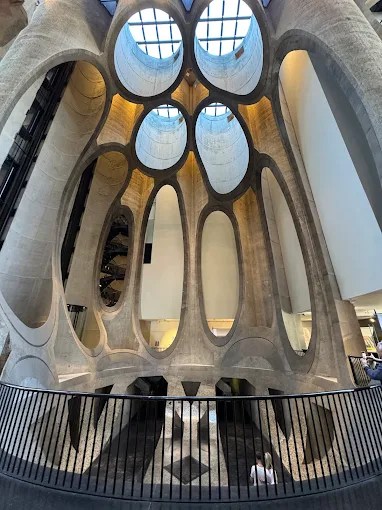
Partial view of the spectacular Zeitz Museum atrium.

This time we visited the Zeitz Museum of Modern African Art on the Victoria and Alfred Waterfront – that’s not a typo – the city honors her son who visited there, not her husband Prince Albert.  The spectacular interior of the edifice was carved from a battery of adjoined cement grain silos.  Its 60-foot-high atrium reveals various oval cuts and abutments sliced from the original silos, and this magnificent centerpiece alone is worth the price of admission.

Bo-kaap, historically the Cape Malay district of Cape Town.

Ice and imitation

Our other notable experience in Cape Town in 2025 started in 2003, when we entered its most distinguished diamond retailer – Prins & Prins.  After being seated, the salesman, noting the dulled 2 ½ karat sparkler on Karin’s finger, asked “May I replace your cubic zirconium?”  Surprised at his observation and presumptuousness at its not being a diamond, she replied “What would it cost?”  “No charge,” said he.  This is a diamond merchant, replacing a CZ for free on his own initiative.  Are you kidding?
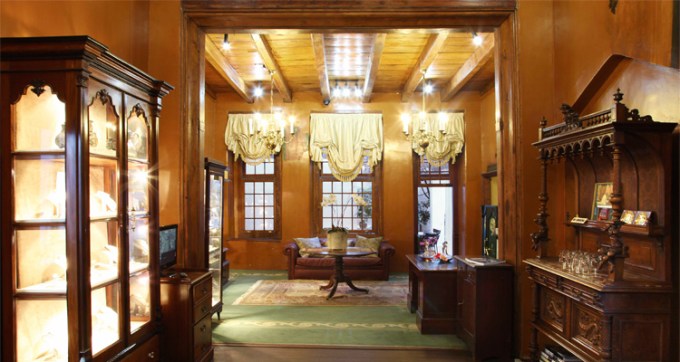
Prins & Prins central foyer.

Flash forward to December 2024, and we return to Prins & Prins and have the seemingly dulled, free CZ from 2003 replaced for the modest cost of labor.  Karin was never that happy with the new one and when we knew we would be back in December 2025, we scheduled an appointment for yet another replacement.  They set aside two possible successors, and as a courtesy when we arrived, buffed up the old 2003 rock that Karin had, of course, saved and brought along.  Of the four possibilities, the 2003 CZ that they initially gave her looked the brightest and biggest, and lo and behold, it is back in the setting again (you may age yourself if you thought of Gene Autry’s song “Back in the saddle again”).

Prins and Prins paid 75 cents for this promotion.  Not really, but they did give us free bottled drinks along with all of their attention.  It still amazes how well they treat us, time-after-time, pretty sure that we’re not going to spring for $45,000 to buy the real thing.

Benin – fond memories from one of the world’s poorest countries

Amazon Monument, 100 foot high bronze commemoration of the Dahomey Amazons, the only documented all-female military regiment anywhere. On the right is the Convention Center.

Our cruise embarked in Accra, Ghana, but since we had been there before and since Ghana’s new visa process is extremely taxing and threatening, we decided to skip it and strongly recommend that others avoid Ghana as well.  Karin detailed the process to her orthopedist, who is African-American and had planned a one-week slave-history related vacation to Ghana with his family of four, and he abruptly cancelled.

Our southwest Africa cruise actually began in Cotonou, Benin, the commercial center of the country near the capital of Porto Novo, but it almost didn’t, as there was a failed coup two days before we left SFO.  We didn’t know if we might get stuck in Paris (there are worse places to spend a few unplanned days), or worse yet, if we would get to Benin and our cruise ship would decide to bypass the destination because of the risk.  The cheapest way to get out of Benin and make it to a later destination on the cruise would have been to return to Paris and then go to Lisbon!  As it turned out, Cotonou’s airport and seaport were reopened and we made it.

One of hundreds of artistic panels in Cotonou’s Wall of Heritage.

On the flight from Paris, we had met a young Beninese man who works for Google and lives in the Bay Area.  After we returned home, we found that he and his wife both had to make unplanned trans-Atlantic flights concerning her residency to deal with Trump’s scheduled travel ban, instituted with his characteristic racism, ignorance, and lack of any cohesive plan.  Ash showed us around town in a way that only a local could, insisting on paying for everything, including a restaurant that no tourist would find, so it turned into a great visit.

Ganvie, the town on stilts near Cotonou. When we were there the canals were cluttered with boats like this supporting the government against the recent coup attempt.

Highlights of Cotonou were the longest graffiti mural in Africa, at over 3,000 feet, along a main artery, with many artists contributing panels to the appealing attraction; the vast open market with hundreds of mostly grocery and fabric stalls;  an exurb of 40,000 people all in houses on stilts in a lake that is only accessible by water; and seeing the hoopla surrounding a woman who had already broken the Guiness Book of World Records standard for continuous cooking – though she was allowed, by Guiness rules, two hours sleep per night and 15-minute breaks every four hours.  She was in her 11th day and targeted 14 to smash the world record of six days.  Taking advantage of the buzz, 60 or so temporary food, tchotchke, and entertainment kiosks sprung up near the Convention Center, creating a carnival-like atmosphere.  Despite the level of poverty in Benin, our hotel was among the more lavish that we’ve stayed in, with huge grounds.

What a difference a fly makes – Another song reference, this from Dinah Washington, substituting fly for day, which also works for the story
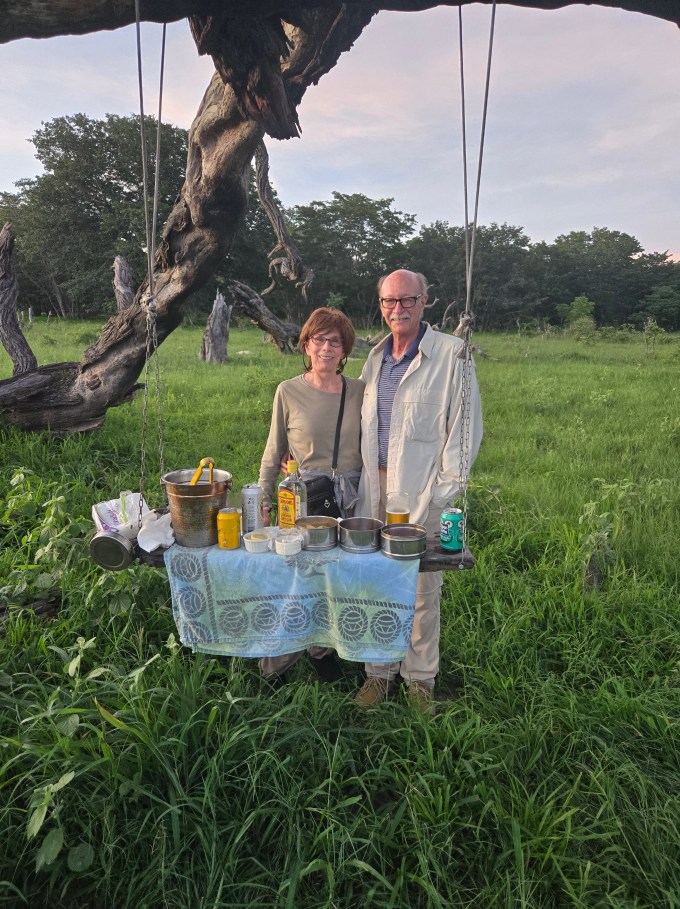
The author and wife Karin taking a refreshment break.

The greatest trepidation on this trip because of long term or terminal implications came from São Tomé and Principe, a tropical island nation that is Africa’s smallest country.  I was bitten on the elbow by what we are certain was a tsetse fly, which causes African sleeping sickness, a usually fatal disease, though treatable if caught in time.  Karin and I both saw the bite occur from the fly, which is several times larger than a common house fly.  It left pain, itch, and a 1 ½ inch in diameter round, red spot.  Other than the Crystal Cruise doctor, who was not a tropical disease specialist and had no available treatment, I was unable to get medical attention until four days later in Namib, Angola.

Sao Tome and Principe has little man-made of visual interest, but it is lush and possesses beautiful beaches.

With the help of the driver of a Crystal contractor, we had an adventure searching out five different pharmacies looking for medicine.  Many travelers would find this a real headache, but we enjoyed having a mission, interacting with the locals, and seeing the town beyond the touristy spots and things to do.  The reason for lack of availability of medication was that the northern Angolan jungle is endemic with sleeping sickness, but Namib is in the desert, with no incidence of tsetse flies.  Finally, someone recommended going to a hospital.  The hospital was free, and I was whisked through the emergency room and attended immediately.  The knowledgeable doctor noted that since I didn’t have site infection within three days, I was likely clear, but that I should look for symptoms over the next few weeks.  It seems that I dodged the bullet on that one.

Safari – our main, but not only, motivation for African travel

Painted dog – an endangered wild dog breed.

The trip ended in Zimbabwe and Botswana with great land photo safaris (Hwange in Zim and Chobe in Botswana) with great guides as well as wonderful safari cruises on the Zambezi and Chobe Rivers.  It doesn’t appear that canoe rides near Victoria Falls among the hippos and crocs like we took in 2002 are allowed any longer because of danger.  Except for ubiquitous impalas, elephants, hippos, and crocs, wildlife sightings on land were relatively low because rainy season provides cover and well distributed water, so that game doesn’t have to go to permanent water holes.  We did see zebras, wildebeests, jackals, kudu, water bucks, warthogs, buffaloes, striped mongeese, steenboks, and more – including rare and beautiful painted dogs although in an acres large jungle reserve.  But a wide variety of interesting birds is always around, and the wildlife and whole experience was still amazing.   Hwange is elephant rich, and we had two or three very close and threatening interactions with elees.  A first for us was that our safari vehicle was able to follow two brother lions cavorting and marking their territory repeatedly.

A few of Hwange’s thousands of elephants.

By the way, the Zimbabwe city of Victoria Falls, which was our hub, is unique for multinational game viewing – strongly recommended.  Within two hour drives or less, you have your choice of wildlife in Zim, Zam (Zambia), Botswana, and Namibia.  There is even a nearby bridge that touches all four countries.  Plus, there is the falls – the largest continuous sheet of water in the world.  Iguazu has more total water flow but is broken into many divided cataracts.  Niagara is the third in size in this unique group of massive cataract waterfalls, but still spectacular.

Lion brothers surveying and marking territory. The notion of a pride of lionesses always being headed by a single male is most common but not to exclusion.

Despite the appeal of a Vic Falls based itinerary though, for first-time safari goers, South Africa offers the most.  While Kenya and Tanzania attract more attention, they target foreigners exclusively and are priced accordingly, while South Africa has its own large middle class and includes game options that are targeted for them as well as the well-heeled.  And for supplemental activities, it is without peer.

Mosi-oa-Tunya (The Smoke that Thunders). We know it as Victoria Falls, a stunning natural wonder.

Huge stress to make the plane

Our 40-hour door-to-door return home (longest ever for us) started with a time-pressured, white-knuckle, two-hour drive from a remote camp in Zim’s Hwange National Park on a heavily potholed, muddied, puddled, dirt road on which we saw no other vehicle for over an hour.  Oh, yes, and we had already blown out a tire the previous day, and couldn’t get a replacement in this isolated area, so if we’d had another flat, we would have been marooned without a spare for a good while and would have missed our three-flight program home.  We made it to the airport with minutes to spare, but understandably had to pay extra fees to the car rental company for tire replacement, minor damages, and cleaning the mud-covered car.

Anecdotes for the informationally curious

As a side note, all of you probably already knew that Angelina Jolie birthed her twins in Swakopmund, Namibia (or maybe not!), and that this town of mild climate has virtually the same monthly average temperatures (reversed for different hemispheres) as Monterey, California, both benefiting from cold currents from their respective polar oceans.  Also, nearby Walvis Bay (another stop on the cruise) has the longest palm tree alley in the world with 1,800 mature trees spread over three miles on the highway toward nearby Swakopmund.

Confusion from naming abounds in this region, largely thanks to colonial rule.  It has the Republic of the Congo and the Democratic Republic of the Congo, with their national capitals across the street from one another.  The city of Namib is not Namibia, but Angola.  Benin City is not in Benin, but in Nigeria.  And the famous Benin bronze statues are from Nigeria, not Benin.  Former colonies along the Bight of Benin (the country was named after the huge gulf, not the reverse) were originally and oh so cleverly named Gold Coast, Grain Coast, Slave Coast, while only Ivory Coast (Cote d’Ivoire in the official French) persists with the colonial name as the country name.

Finally, Americans tend to look at slavery from a U.S. perspective, and we view the main sources of slavery as being Gambia (“Roots” and Alex Haley’s ancestral history started there) and Senegal (President Obama visited Gorée Island, off Dakar, with its “Door of No Return”).  But, get this, present-day Angola provided more than 10 times as many slaves to the Western Hemisphere than the combined other two mentioned.  Who knew?
What the Constitution Means to Me

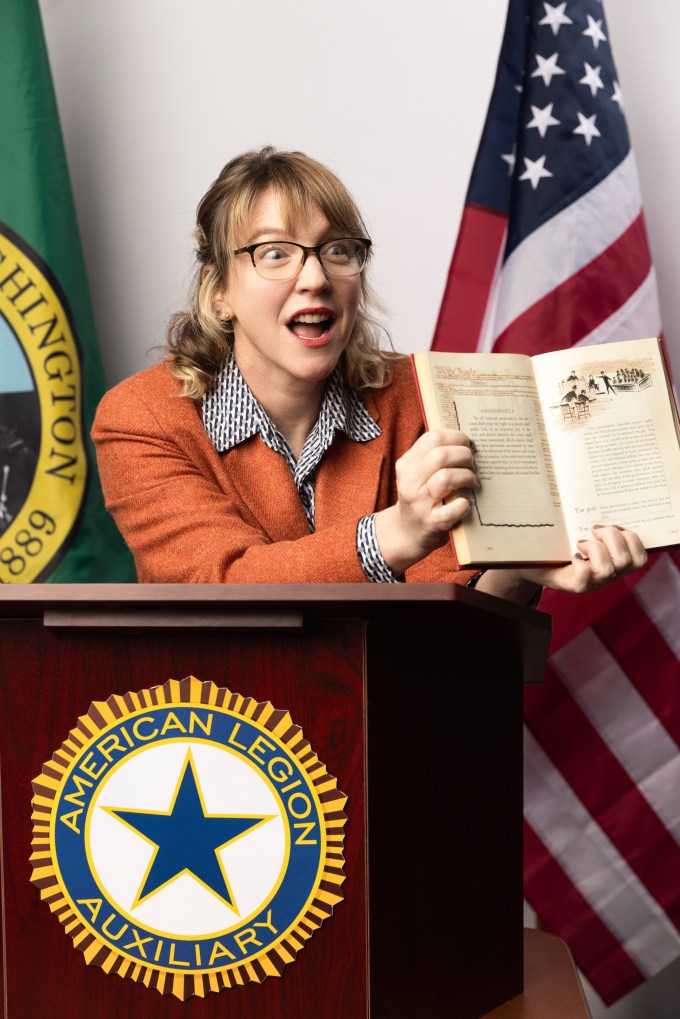
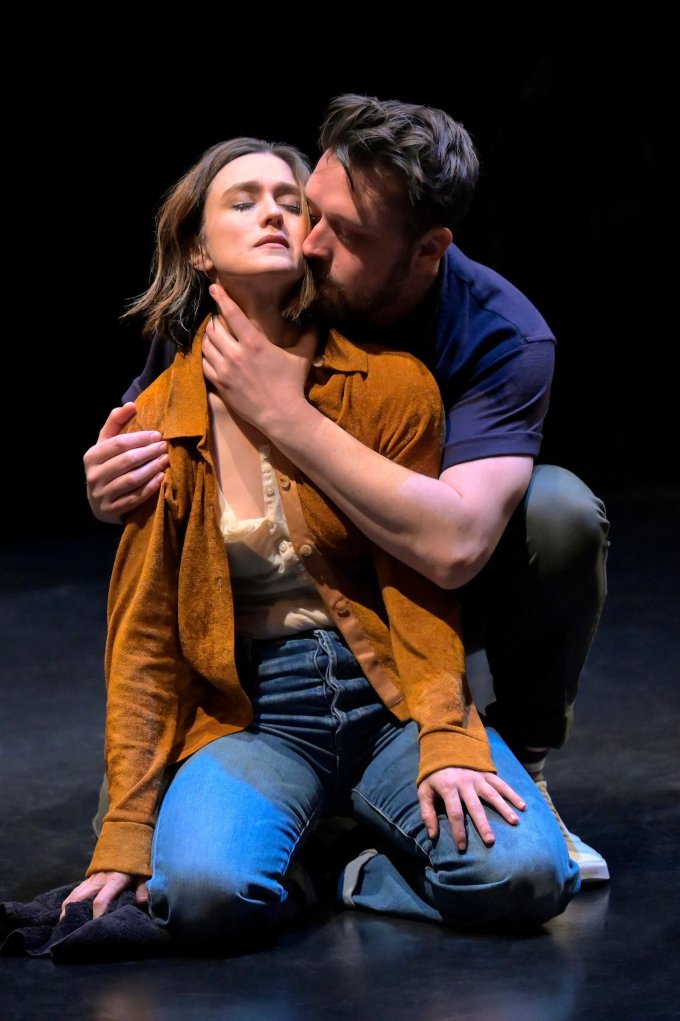
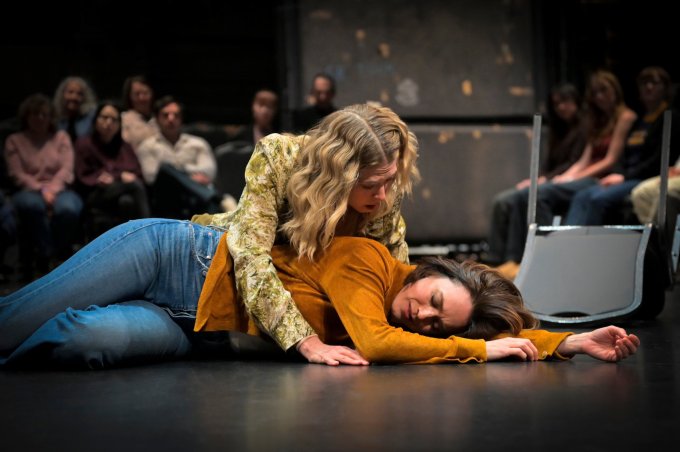
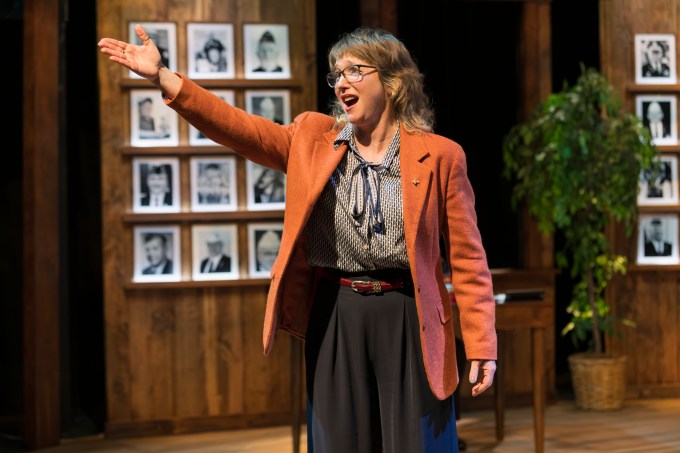
Kimberly Donovan as Heidi. All photos by Tracy Martin.

The Constitution of the United States, drafted in 1787 and ratified on March 4, 1789, became the touchstone for democracy and egalitarianism around the world.  Embracing the tenets of Enlightenment philosophers such as John Locke, David Hume, and Charles Montesquieu and building on the Magna Carta and other European political documents, it was long the model of democratic rule.  It should be noted that many consider the U.S. Constitution ossified.  Though other democratic constitutions around the world are now viewed as better models, it’s hard to imagine constructing a constitution without first analyzing this seminal document.

Yet, its deficiencies were anticipated by many and almost immediately recognized by most.  No sooner was the ink dry on the Constitution than the Bill of Rights was drawn and ratified on December 15, 1791.  While the Constitution established the form of government, the Bill of Rights deals with the rights of individuals.  The application and interpretation of these first 10 amendments together with the Emancipation (from slavery) Amendments (numbers 13, 14, and 15) provide the grist for most Constitutional cases of great significance.

As a teen, Heidi Schreck became focused on the greatness of the U.S. Constitution, and she was able to win prize money that paid for much of her college education by competing in contests about the Constitution, many sponsored by American Legion chapters.  As an adult, she began to lecture on the Constitution, and the ultimate evolution became the 2017 play What the Constitution Means to Me, which she has frequently performed in as well.  Play, playwright, and performer have all been highly decorated.

Kimberly Donovan as Heidi.

One structural conceit of the play is that Schreck is sometimes represented as the high school debater she was, and sometimes as the contemporary woman she is.  In Hillbarn’s production, she is portrayed by Kimberley Donovan who gives an absolutely command performance – riveting, intensely enthusiastic, and totally committed to the importance of the Constitution.  Her arms flail, her eyes pop, and her voice soars with authenticity as she celebrates the good fortune of the United States.

Of course, the Constitution covers a lot of territory, but Schreck zeroes in on those aspects that have the most meaning to her, which have great resonance, nay, foreboding, in today’s environment.  Those are rights of women, citizenship, and residency, which lead to discussions of contemporary interest such as Roe v. Wade and the impact of its overturn; birthright and naturalized citizenship; and rights of immigrants and non-citizens.  The problem is that even when the Constitution gets it right, the Supreme Court has become so politicized, that rulings arise in which the interpretation required to support the decisions defies rational thinking.

We see that as a teen, Schreck is totally enamored of the Constitution, and Donovan practically bursts with excitement over it.  But as Schreck matures, she sees its bias.  The rights embedded in the original Constitution applied not just to men, but only to men of property.  She notes that the word woman does not even appear in the original document, and even the 19th Amendment which gives women the right to vote prohibits denying the vote on the basis of sex with no use of the word woman.  Native Americans are granted no protections, nor were slaves, almost all African-American, until the conclusion of the Civil War.

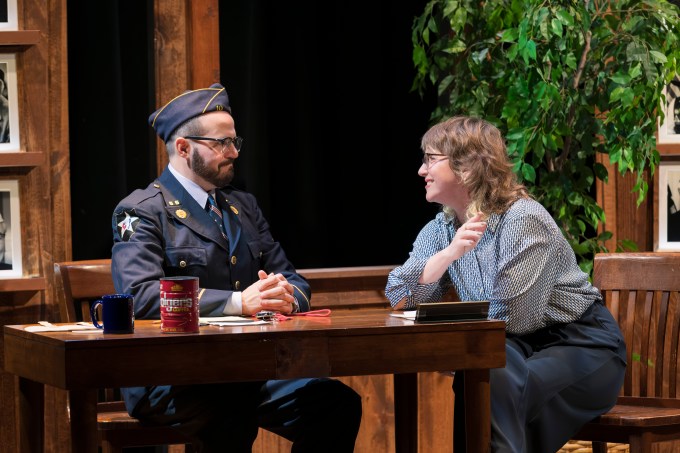
Vincent Randazzo as Legionnaire, Kimberly Donovan as Heidi.

In large measure, the play is really a one-woman performance, but another structural element is that much of it is staged in the fashion of Schreck’s debating at an American Legion hall.  Vincent Randazzo appears throughout, mostly as the debate facilitator, a role in which this fine actor is totally underutilized.  While the debate concept is appropriate, Schreck often goes way past her permitted debate time, making the device seem a bit unrealistic.

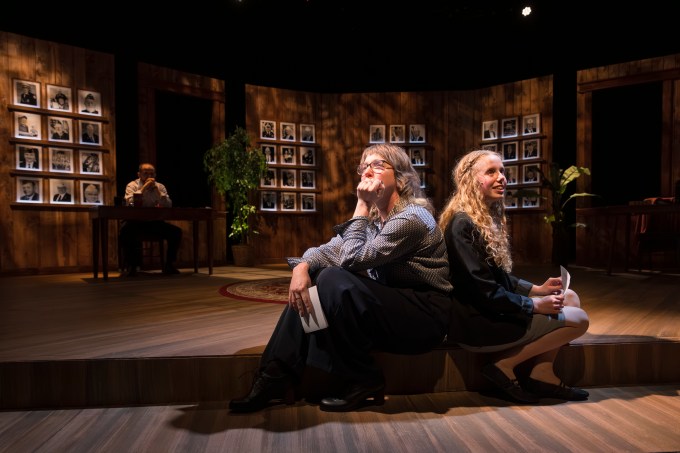
In the final segment, a high school debater, a well-presented Avery Hartman at our performance, comes to the stage to debate with the Schreck character about whether the Constitution should be retained or abolished.  Some audience involvement is built into this sequence.  Both debaters make valid points, but even accepting that the Constitution is mostly well-intended, it often fails us in final adjudications at the Supreme Court.  The whole debate of whether to continue to amend or recreate de novo really hinges on whether the conditions of a Constitutional Convention would result in a better or worse document.

For those less familiar with this country’s binding documents, What the Constitution Means to Me will be an eye opener.  It will fascinate with its characterization of the instrument’s penumbra between light and shadow; the power of the 9th Amendment to recognize new rights; and the drag of its focus on negative rather than positive rights.  But even those who are knowledgeable will find the play gripping, informative, and entertaining.

Kimberly Donovan as Heidi, Avery Hartman as debater.

What the Constitution Means to Me, written by Heidi Schreck, is produced by Hillbarn Theatre and appears on their stage at 1285 East Hillsdale Blvd., Foster City, CA through February 8, 2026.

Hershey Felder: The Piano and Me

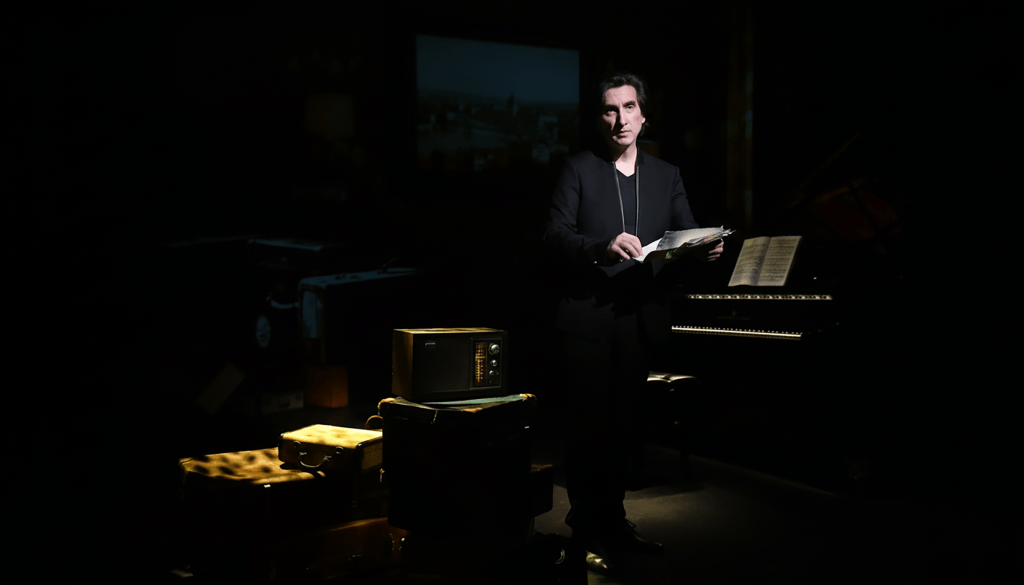
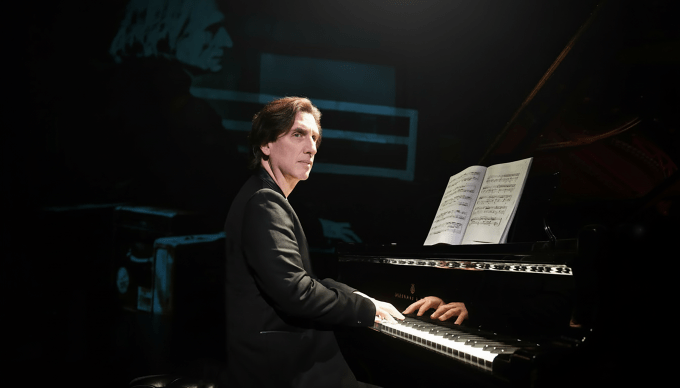
Hershey Felder. Photos by David Lepori.

Sometimes an actor is able to create an identifiable niche that makes the performer the darling of casting directors – the wizened cowhand, the craven felon, the doting grandmother.  Some singers or bands seek to establish distinct identities, like Madonna, The Grateful Dead, or Kiss.

Multivariate artist Hershey Felder has written his own ticket, finding an undeveloped space that suits him well.  Combining his skills as a piano virtuoso, an incisive playwright, and a deft raconteur and actor, he has created a cottage industry of authoring and performing one-man-show biographies of great composers.  Playing at a Steinway piano and strolling the stage, he regales with the composer’s music and the story of his life.  He has portrayed Gershwin, Berlin, Bernstein, Chopin, Tchaikovsky, Rachmaninoff, Beethoven, and Debussy.  The Bay Area has proven a devoted audience, with his productions appearing in concert with two of its most esteemed companies, TheatreWorks Silicon Valley and Berkeley Rep.

Felder has returned to TheatreWorks with a world premiere, but this time, an autobiography.  Having seen and appreciated all of the above-mentioned bios, this reviewer approached a self-referential work with some trepidation.  But unlike his previous works, the artist’s life story is delivered with a unique sense of authenticity that derives from revealing personal experience.  There are numerous anecdotes from his life that resonate with significance, and his storytelling ability gives a heartbeat even to the mundane.  Coming from an immigrant and multilingual household as well as taking on accents for his parts in previous works, he brings a catalog of voices and accents to embellish this one.

Another factor enriches The Piano & Me.  In his biographies, he must depict the composer’s ouvre by performing 10 or 12 pieces by the composer, some of which he may not relish.  In The Piano and Me, he plays music that he loves or that has held special places in his development as a pianist.

Born and raised in Montreal, Felder is Ashkenazy Jew on both sides, having had a dour Polish father and an angelic Hungarian mother.  The vignettes he tells are of his growth as a pianist and of the people who impacted it, particularly family and teachers.  A surprising portion is dedicated to Holocaust related stories, given the chilling effect that they have, but they are a deeply felt gash for all Jews and any human beings with compassion, and the reality of those heinous deeds should not be forgotten.  A small sample of his tales follows.

Growing up, he characterized himself as fat, different, and subject to ridicule.  But he was drawn to the piano, and his parents supported the endeavor.  A fast learner, he tells of playing part of a classical piece for his first piano teacher.  She then gave him the daunting task of memorizing the full score of the piece for the next lesson, but he failed to mention to her that he visualized it before him and had already memorized it.  (Incidentally, Hershey, in the audience Q&A after the Friday performance, I was the one who asked whether you had photographic memory and if it was music specific.)

In speaking of the Holocaust, like virtually any Jew in the world, Felder’s family suffered losses at the hands of the Nazis.  On his paternal side his grandparents had a total of 20 siblings, and only two survived the Holocaust.  Decades after the war and living in Canada, his maternal grandparents kept a suitcase filled with beloved religious possessions in case they were forced by hostility to evacuate hastily.

On a different note, perhaps because of the diaspora, many Jews engage in what I call Jewish geography, which my Jewish wife has played.  In Felder’s case, he made connections, one of which was finding that he was a distant cousin to Joel Zwick, a Hollywood player best known as the director of the TV series Full House and the movie My Big Fat Greek Wedding.  Despite Zwick’s initial abruptness and dismissiveness, he would be instrumental in launching Felder’s composer biographies line-of-business, when the Gershwin family gave permission to this unknown to perform a biography of George for a mere two weeks.  That seed 30 years ago is what led to Felder’s life’s work.

Many other stories and quips entertain.  As always, Felder’s piano playing of sometimes very challenging pieces mesmerizes.  The performance engages throughout.

Hershey Felder: The Piano & Me is a world premiere with book by Hershey Felder, presented by TheatreWorks Silicon Valley, and plays at Mountain View Center for the Performing Arts, 500 Castro Street, Mountain View, CA through February 8, 2026.

A Streetcar Named Desire

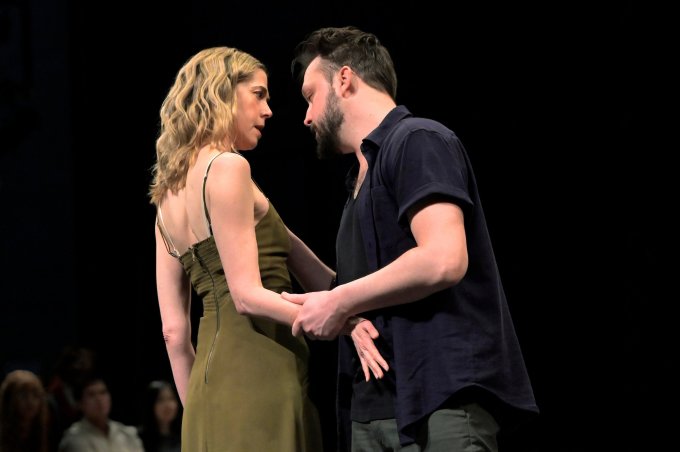
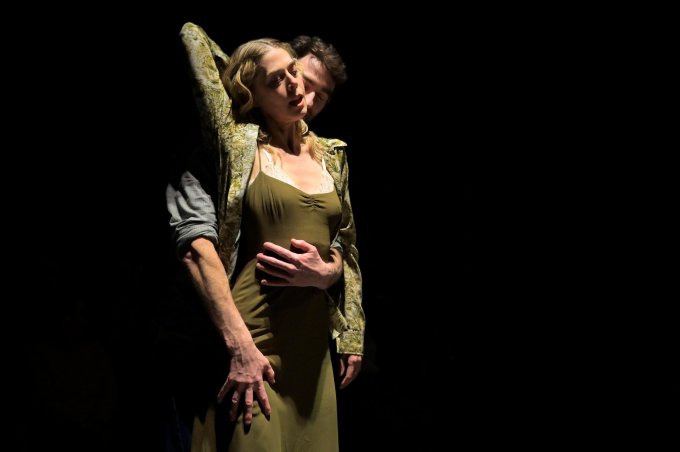
Lucy Owen as Blanche, Brad Koed as Stanley. All photos by Kevin Berne.

What is it about Tennessee Williams’ A Streetcar Named Desire that makes it one of the most loved and lauded plays in the American canon?  Is it the clash of the common and earthy Stanley with the pretentious and fragile Blanche with its contrast between brutally honest and delusionally dreamy?  Is it the multiple dynamics of love, loss, loyalty, and longing?   Is it the exotica within America of Frenchified New Orleans with its Napoleonic Code?  Is it vicariously experiencing aspects of the playwright’s sordid imagination and existence?  Or was it propelled by the fame of its 1951 filming with the searing and iconic depictions of Stanley by Marlon Brando and Blanche by Vivien Leigh?

The premise is that Blanche DuBois (played by Lucy Owen, who has also “co-created” this production) has lost the family’s Mississippi plantation, Belle Reve (aptly, “beautiful dream”), and has intruded upon her sister Stella (Heather Lind) and her working-class husband Stanley Kowalski (Brad Koed) in their humble two-room flat in the French Quarter.  Blanche finds the conditions beneath her and Stella’s dignity.  Despite being a beggar, Blanche shares her disdain for the digs and verbally abuses Stanley, disparaging his Polish heritage, manners, livelihood, and all else.  Not a gracious or endearing house guest.  In time, we learn that Blanche’s history is more complicated than she lets on.

Heather Lind as Stella, Brad Koed as Stanley.

As a reviewer, I usually avoid comparing a theatrical production to a film, as the two vehicles are endowed with such different assets and potential.  In this case, the film is probably what makes Streetcar such a familiar story, and it is probably a fine exemplar of the playwright’s intent – a grim and gritty commentary on working class life with the intrusion of a square peg in that round hole.  Expectations and comparisons become hard to avoid.

Artistic contributors to live performance often struggle with the challenge of either producing a best-possible, classic rendition of a play or finding a unique interpretation to show the material in a different light.  Owen and collaborator Nick Westrate, who also directs, have created a variation of Streetcar that holds faithfully to Williams’ text, yet its tone and staging depart radically.  This variation was well-received by the opening night audience and does succeed on some levels, but its tone suppresses the power of Blanche’s accumulating angst and delusion.

Lucy Owen as Blanche, James Russell as Mitch.

To establish a more intimate feel at the ACT performance, a number of audience members are seated on the three closed sides of the stage.  In devising a more stripped-down, abstract telling of the story, the narrative plays out on the otherwise bare stage with the off-stage mechanics of pulleys, lifts, fly, and such exposed behind the stage-seated audience.  The players do however frequently move beyond the stage into the aisles of the orchestra, into lower box seating, and even behind the stage audience to depict more private scenes such as showering.  And in a final budget-saving practice, the cast is limited to four actors, with multiple parts played by James Russell, whose primary role is Mitch, Stanley’s friend who courts the newly-arrived Blanche.

The more significant variance is that Blanche’s role especially is played with a lighter lilt than expected.  I don’t remember a single laugh in the film or the other staged version that I’ve seen, but the first act of this version is filled with chuckles and guffaws.  While the humor on its own is winsome and shows how talented actors can mold lines in different ways, it detracts from the weightiness that otherwise makes this a great play.  Another controversial element is the use of almost constant music, usually piano playing.  Its tone sometimes seems to contradict the action, and at times drowns out the dialog.  Otherwise, sound and lighting are highly impactful.

Brad Koed as Stanley, James Russell as Mitch.

Streetcar’s greatness derives from its sharp characterizations and the conflicts they cause, with issues arising between each pair of major characters.  The most pronounced is between the seemingly sexually repressed and somewhat guarded Blanche versus the candid, clever, cynical, and aggressive Stanley.  Another important universal dynamic concerns the difference between Blanche, who lives in the past and cannot reconcile to a diminished socio-economic status, versus Stella, who accepts her new life and finds the good in it.

In the context of this interpretation, Lucy Owen is an effective Blanche, managing the contradictions of the character well.  She is blithely self-indulgent, at once haughty and condescending, yet greedy for human contact.  Her disconnections with reality are convincing and evocative.  Heather Lind is a fine Stella, a positive and largely buoyant force, moving about with optimism and decisiveness as she tries to maintain loyalty to her sister and husband at the same time.  The male cast members both bring serious acting cred and command to their roles, Koed relishing the underlying meanness of Stanley and Russell the ambivalence of Mitch, but more gravitas would make for richer depictions.

Lucy Owen as Blanche, Heather Lind as Stella.

In any case, the importance of A Streetcar Named Desire must be recognized.  It packs considerable depth of meaning in one evening and moves briskly except for a bit of drag toward the culmination.  This treatment, while spare and experimental, captures the essence of playwright’s words in its own way and the attention of the theater goer in a provocative way.

A Streetcar Named Desire, written by Tennessee Williams and “created by” Lucy Owen and Nick Westrate, is presented by American Conservatory Theater and plays at its Toni Rembe Theater, 415 Geary Street, San Francisco, CA through February 1, 2026.

Stomp

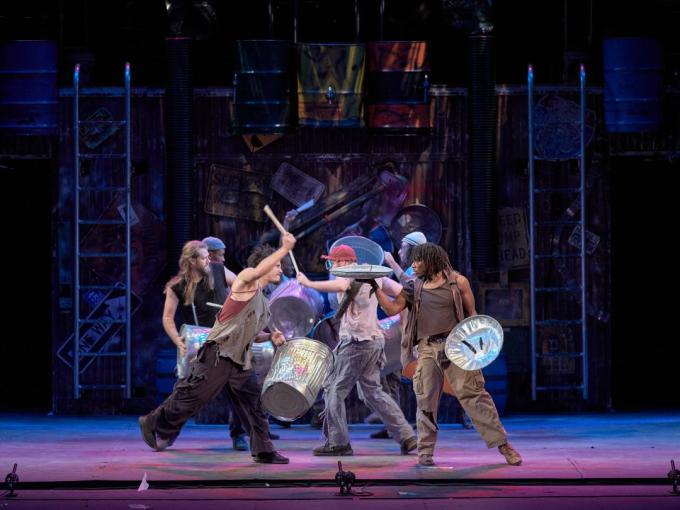
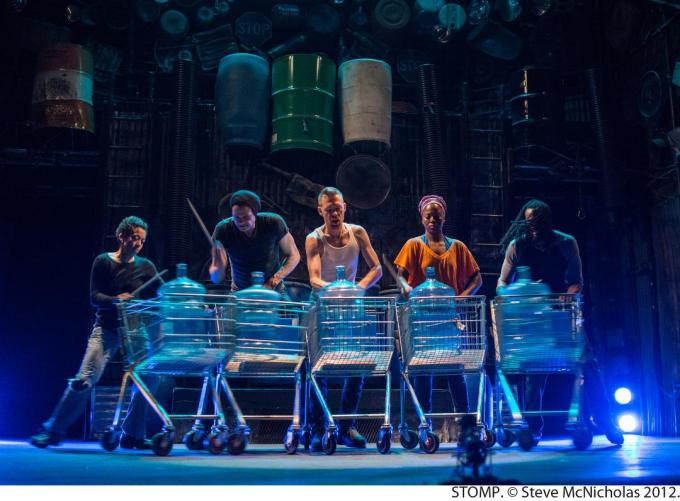
All photos copyright Steve McNicholas.

Rat-a-tat, click, crash, swoosh, thump, tap, ting.  These are some of the many percussive sounds you will hear in 90 minutes of audio/visual thrills and adventure at Stomp as eight performers romp about the stage.  What you won’t hear or see is the spoken word or music.  All of the acting – and there is humor as well – is mime.

Having evolved from busker’s performances in the U.K., Stomp celebrates its 30th anniversary as a stage show, with a stint at the Henry J. Kaiser Center for the Arts in Oakland.  The pounding, frenetic high energy show is a crowd pleaser from beginning to end.

The germination of Stomp is that virtually any item, from match boxes to newspaper, can be used to create sound.  Varying the timing of the beats creates rhythm.  Adding multiple performers to create the rhythm delivers either resounding unison or an orchestra of counterpoint percussion.  Choreograph the motion and you have a well-honed, unique, and entertaining stage show.

Of course, creating percussive sounds from various items to communicate or entertain is universal and timeless.  In the modern era, popular examples of creating a beat from beyond the drum kit was broadly popularized by two legendary dancers.  Fred Astaire taps around and bangs on various props in movies like Easter Parade, and Gene Kelly and friends attach trash can lids to their feet to dance and create crashing sounds in It’s Always Fair Weather.  In fact, one of Stomp’s signature skits using trash cans as drums and lids as cymbals appears to be inspired by Kelly’s idea.  But it is doubtful that any collection of sound and movement sketches has ever been as complex or diverse as Stomp.

The show opens as a realization.  A single performer using a push broom focuses on the brushing sound the bristles make.  He then taps the wooden sides on the floor and adds rhythm.  One by one, the other performers appear, and before long, a symphony of sound and movement emerges.  This is the first of the myriad of overlaid rhythms and movements that astound with their variation, intensity, and accuracy.

The sounds of each prop vary, and some are unexpected.  Various sizes of plastic accordion pipe when extended or when stroked with a stick result in different sounds, as if a cacophony of insects and chattering animals in a jungle.  Amazing as well is how the sound of a straw scraping in the cut opening of a drink cup lid can carry and play off of the pounding of a blown-up plastic film bag.  In another sketch, the performers align on a darkened stage and flick cigarette lighter flames off-and-on in precision for a starlight show.

Apart from the cornucopia of sound, the performers impress with pinpoint timing and athleticism.  In some sequences they hurl large objects to one another at long distances; they stick fight in others; and they stomp and prance throughout. 

Stomp’s brief stay in Oakland is at the Kaiser Center for the Arts, formerly a convention center.  After a 20-year closure, it has been renovated and is now in a soft opening in its new repurposing.  Functionally, its 1,350 seat Calvin Simmons Theater, one of five indoor venues at the Center, fills a performing-house gap in Oakland among the massive (Oakland Arena), the merely huge (Paramount and Fox Theaters), and the intimate (Yoshi’s, for example).  For its size, the whole seating configuration is relatively close to the stage as many seats are in side wings and others in two tiers above the orchestra.

The stately Center sits in a beautiful location at the foot of Lake Merritt, adjacent to both the Oakland Museum of California and Laney College.   Although the Center has a parking lot, it is too small for popular performances, and the event parking fee for this night was $40.  Street parking and other nearby lots are a possibility.  The Center’s entertainment offerings are building, and hopefully they will all be as well received as Stomp.

Stomp, created by Steve McNicholas and Luke Cresswell, played at Henry J. Kaiser Center for the Arts, 10 Tenth Street, Oakland, CA December 6-7, 2025.

Over the River and Through the Woods

Joseph “Joe” Walters as Nuncio, Deb Anderson as Emma, Karen DeHart as Aida, Filip Hofman as Nick, John Mannion as Frank. All photos by Christian Pizzirani.

For the remainder of the year, my San Jose and Peninsula theater reviews will be posted on Talkin’ Broadway with only introductions to those reviews on this site. Please continue to https://www.talkinbroadway.com/page/regional/sanjose/sj303.html for full review.

Tengo familia” – “I have family.”  To an American, these words are an innocuous truism.  To an Italian, it is a powerful statement of having and belonging, of the unbreakable bonds of blood.  The Italian bromide recurs throughout Joe DiPietro’s beloved play about immigrant generations, Over the River and Through the Woods.  City Lights Theater and Director Jeffrey Bracco present a loving and crowd-pleasing production of this winsome story of societal evolution through one family’s experience.  Laughs are almost continuous with short breaks for sympathetic moments.

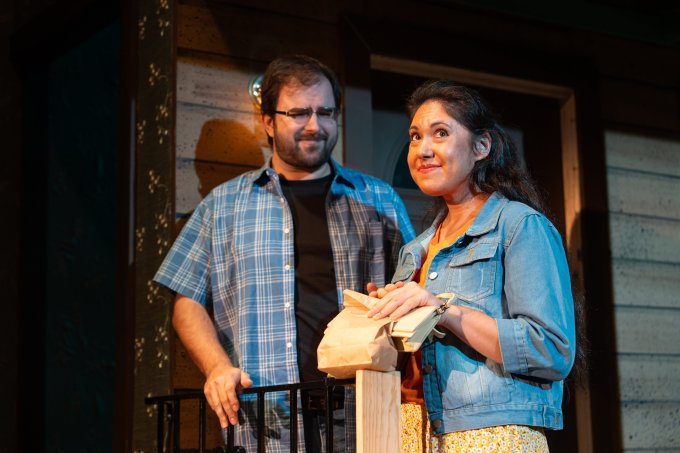
Nick, played as often exasperated yet caring grandson by Filip Hofman, is a 30-ish marketing executive from Hoboken, New Jersey who has dinner with both sets of Italian immigrant grandparents every Sunday in the early ‘90s.  His parents have retired to Florida.  When Nick announces that he received an offer for a better position in Seattle, the grandparents conspire to frustrate the move.  And what better way than to have him fall in love with a young lady of their arrangement.  Enter Caitlin, the appealing and ever-smiling Delaney Bantillo, who is the antithesis of what she regards the dyspeptic Nick.

Filip Hofman as Nick, Delaney Bantillo as Caitlin.

Relationships operate differently in southern than in northern European families.  Nick’s modal means of communication with his grandparents is to shout with seeming hostility, to the point that you wonder if he really loves them.  His frustration comes from incidents like learning that one set of grandparents want to return the VCR he bought them and give him back the money, because it was too expensive a gift.  Or when he finds that the message recorder he bought them is broken and asks why, he finds that maternal Grandpa Frank threw it on the floor because he didn’t like its squawking.

Stereotypes run rampant in the play, but coming from a Sicilian family on my mother’s side with immigrant grandparents, I can testify that I know equivalents of all of the characters in the play and all of the situations and conversations.  Aida (Karen DeHart) is the hostess and maternal grandmother, who seems to only leave the kitchen to take (or give) food orders.  For her, whatever the question, the answer is food, which solves everything.  It’s always “Can I get you something to eat?” and no is not an acceptable answer, which is another of Nick’s frustrations.  So oblivious is Aida to rejection concerning food, when Caitlin says repeatedly that she is vegetarian, Aida blithely replies “I understand. Have a piece of veal.”……………Continue to https://www.talkinbroadway.com/page/regional/sanjose/sj303.html

Over the River and Through the Woods runs through December 21, 2025, at City Lights Theater Company, 529 South 2nd Street, San Jose CA. For tickets and information please visit cltc.org.

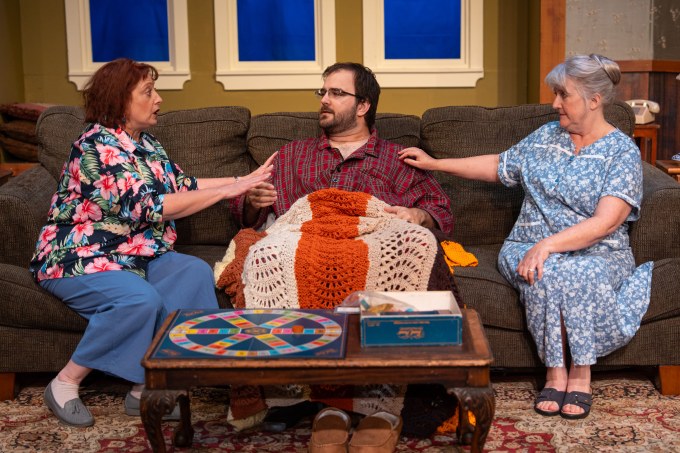
Deb Anderson as Emma, Filip Hofman as Nick, Karen DeHart as Aida.

Ada and the Engine

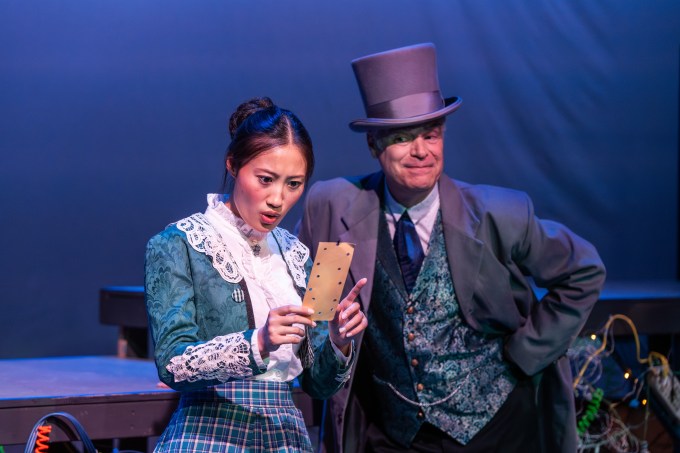
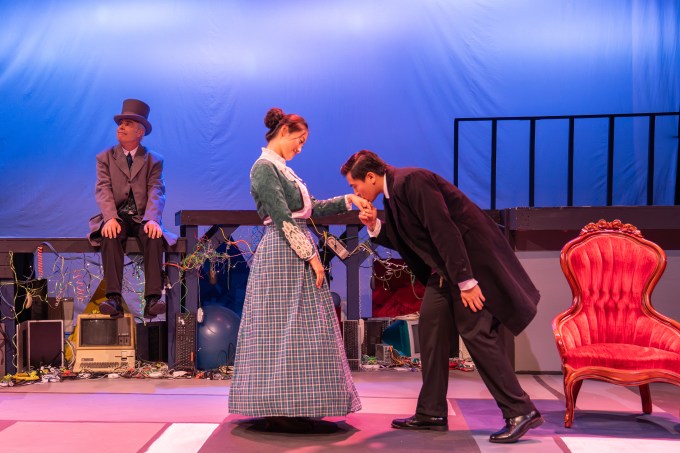
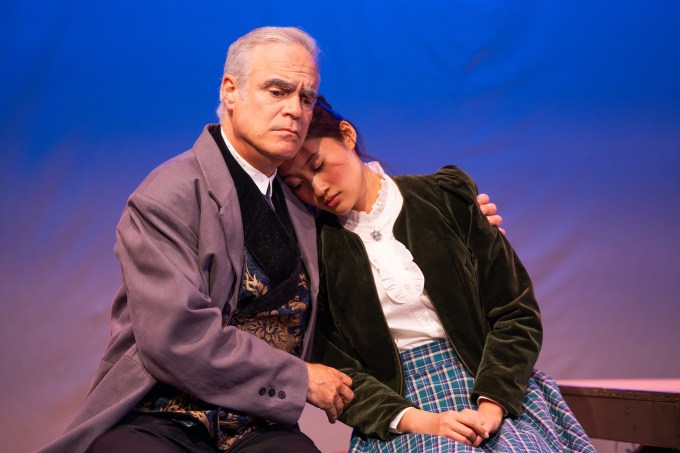
Angel Lin as Ada, David Boyll as Babbage. All Photos by Mikenzie Gilbert.

My South Bay and Peninsula reviews for the last half of 2025 also appear at Talkin’ Broadway. The link for this review is: https://talkinbroadway.com/page/regional/sanjose/sj302.html .

Many people think of the introduction of ENIAC in 1945 as the birth of computers, but conceptually, many in the know credit Englishman Charles Babbage with his Analytical Engine over a century earlier.  Though it never operated, with the help of Lady Ada Byron Lovelace, who many consider the first ever computer programmer, its functions were fully explicated.

In Ada and the Engine, the facts concerning Babbage’s innovations and Ada Lovelace’s contributions are accurate history.  Playwright Lauren Gunderson has crafted plausible exchanges between those two as well as their relationships with Ada’s mother, Lady Anabella Byron, and others.  The result is an engrossing biography that in more than one dimension spans time.

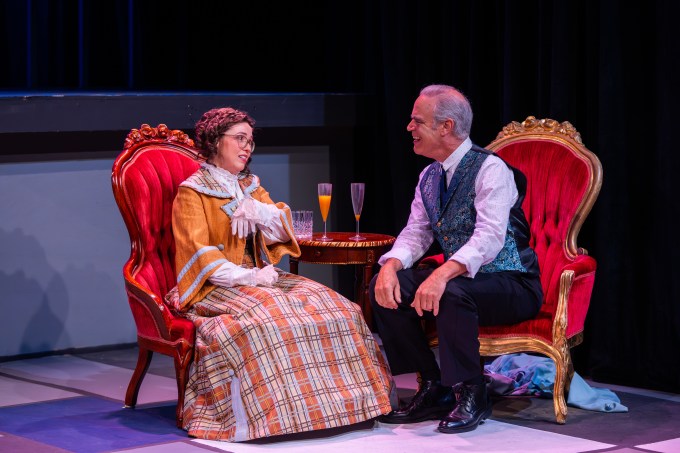
Angel Lin as Ada, Maya Capur as Anabella.

One surprise to some is Ada’s lineage.  She was the only legitimate child of George Gordon Lord Byron, the esteemed Romantic poet so often linked in the triumvirate of Byron, Shelley, and Keats.  Ada’s mother was Anabella, who was distinguished as a philanthropist, educational reformer, and abolitionist.  She is also said to be the only woman that Byron didn’t charm, and he abandoned her for Greece only a month after Ada’s birth.  Ada would never know her father, and as one aspect of Anabella’s severe treatment, Ada wasn’t even shown an image of him until she was an adult.

Because of Lord Byron’s capriciousness and mental illness, Anabella forced Ada away from artistic pursuits and into mathematics, which turned out to be a fortuitous fit.  The mother’s only goal in the play is depicted as wanting Ada to marry into a title, but enjoining her to attend one of Babbage’s soirees had the opposite effect.  Instead, she found an outlet for her prodigious mathematical talent as Babbage’s protégé and in many ways became his equal.  Later, as they looked to establishing a firm to promote the unrealized engine, Ada even proposed herself as the overall boss.

Olga Molina as Mary Sommerville, David Boyll as Charles Babbage.

Angel Lin portrays Ada who was sickly from youth and had a troubled relationship with her mother.  Lin’s portrayal is of a young woman who is independent, yet cheery – cheered by being able to pursue mathematics.  Yet the gravity of her father pulls her.  In reading his poetry, she taps her heart to the rhythm of the syllables and even embraces the fusion of technology and arts by deeming Babbage’s engine to have a beating metal heart.

Lord Byron had died at age 36, and anticipating Ada’s own brief existence, Lin speaks rapid-fire and enthusiastically as if the character is trying to cram as much into life as she can.  Urgency and initiative drive her.  She distinguishes herself by translating a scholarly paper in mathematics from Italian and adding notations that exceed the length of the paper.  Her insights into the engine’s possibilities lead her to conceptualize computing functions well beyond what Babbage had considered.  Ada derived that any symbols could be coded into zeros and ones, her favorite being musical notation.  The binomial system applied to computer data starting a century later codes as she conceived.

David Boyll as Babbage, Angel Lin as Ada, Joshua Bao as Lord Lovelace.

Although Ada and Babbage had disagreements on concepts and development, only once was their personal and professional relationship almost fractured.  That resulted from a resolute Babbage wanting to publicly point fingers at the government for not funding the development of the engine.  Otherwise, David Boyll’s apt depiction is of an affable, sometimes bumbling, but socially progressive man, though in some cases, he did wish to share less credit than he should.

Maya Kapur’s Anabella is adeptly played as sour and uncompromising.  One might be a bit surprised that Byron would have married someone of that sort, but perhaps his lack of discipline and ultimate betrayal of her contributed to her unpleasantness.

David Boyll as Babbage, Angel Lin as Ada.

Like any parlor-room drama, the success of Ana & the Engine relies on a taut narrative and good acting to succeed, and so it does.  The one plotline element that does feel a little clumsy is the add-on closing scene in which the deceased Ada and her father can finally commune in the afterworld.

One acting issue of note is that several actors do not project their voices well, and from the more distant seats, some are too faint to be consistently understandable.  And while Kapur and Boyll use English accents, Lin as Ada does not.  Taken as a demonstration of acting, her characterization is very sound, and she does show breadth of emotion when appropriate, yet her accent and gesticulation do not convey the Englishness of her character.  To some patrons, like my wife, that may not matter.  And in the final analysis, Angel Lin and the play deliver a worthy result.

Joshua Bao as Lord Lovelace, Angel Lin as Ada.

Ada & the Engine, written by Lauren Gunderson, is produced by The Pear Theatre and is performed on its stage at 1110 La Avenida, Mountain View, CA through December 7, 2025.

The Monkey King

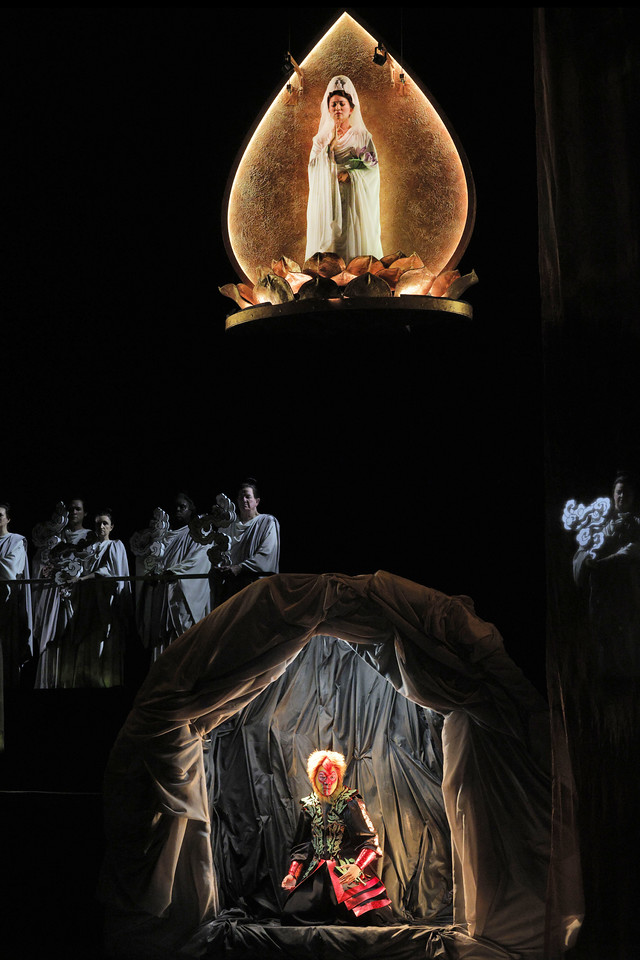
(above) Mei Gui Zhang as Guanyin, (below) Kang Wang as Sun Wukong the Monkey King. All photos by Cory Weaver.

San Francisco Opera has long reigned as a premiere American opera company.  The city has served as a gateway to Asia for trade and tourism, containing the country’s oldest and probably most important Chinatown.  Further, San Francisco and the overall Bay Area population has the highest concentration of Asians in the U.S.  So it is fitting that the company would be home to its third China-focused world premiere opera.  Of those, The Monkey King is the second libretto drawn from the renowned four classic Chinese novels.  The result is a wildly popular, eye-popping, phantasmagoric opera experience.  It is a huge production in every way and demonstrates the power of San Francisco Opera.

Jusung Gabriel Park as Master Subhuti, Kang Wang as Sun Wukong.

The monkey has long held significance in pan-Asian mythology.  The 16th century Chinese-Buddhist-influenced Monkey King, dubbed Sun Wukong, can be seen as derived from the ancient Indian-Hindu monkey God Hanuman.  Modern realizations include the Indonesian retelling of the Ramayana through the kecak, or monkey, dance portrayed with 100 or more chanting, gesticulating men.  A click-clacking in the orchestra is even reminiscent of the kecak sounds.  But Sun Wukong is a superhero popular across Asia who is also represented in contemporary films and games.

Kang Wang as Sun Wukong.

Huang Ruo has composed a score set to David Henry Hwang’s libretto, which is based on the first seven chapters of Journey to the West, written by Wu Cheng’en.  But like the character himself, the story is full of contradictions, and to begin with, while Sun travels in his adventures to the sea, the underworld, and elsewhere, there is no journey to the west.  The plot, such as it is, is a series of episodes told in flashback.  In keeping with the epic sense of time, Sun Wukong has been detained under a mountain for 500 years.  We find how he got there; experience his previous conquests; and understand what he had to learn to gain freedom.  Many sequences are filled with exciting bursts of animated movement and kaleidoscopic flushes of color.

Chorus, (center) Konu Kim as Jade Emperor.

The music is very much in the modern vernacular, which I find uninspiring, but with strong influences suggestive of traditional Peking opera and other Asian forms to add an exotic touch.  For the most part, the orchestration supports the vignettes unobtrusively but becomes more conspicuous, more Chinese, and more distinguished with the use of the pipa, a Chinese plucked lute, and Asian gongs and cymbals.  Carolyn Kuan conducts this musical hybrid with great skill.

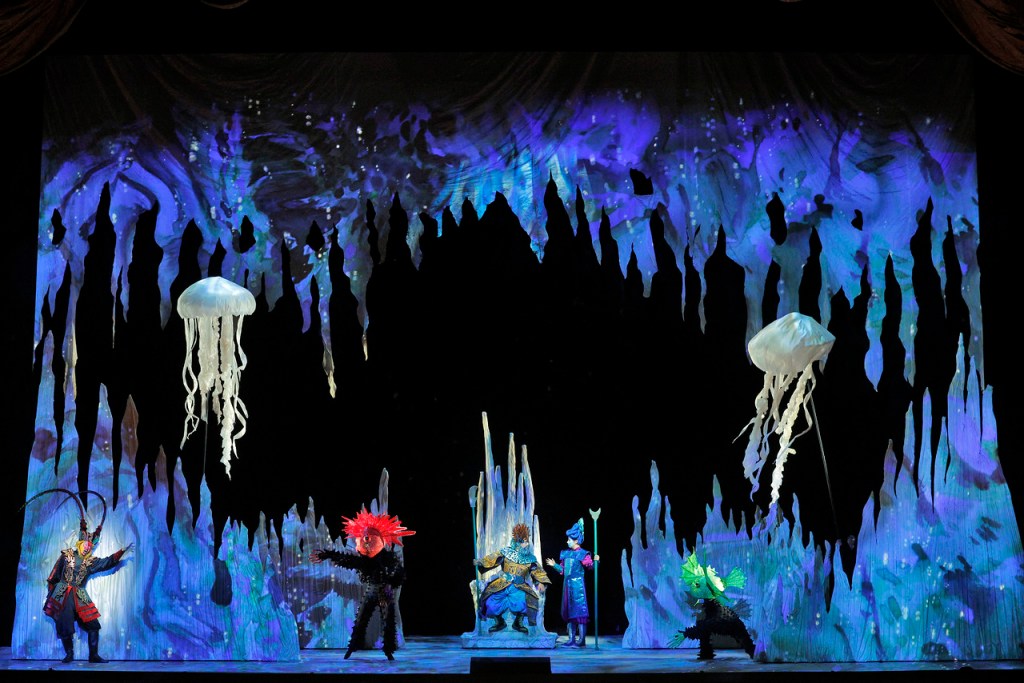
Dragon Palace of the Eastern Sea.

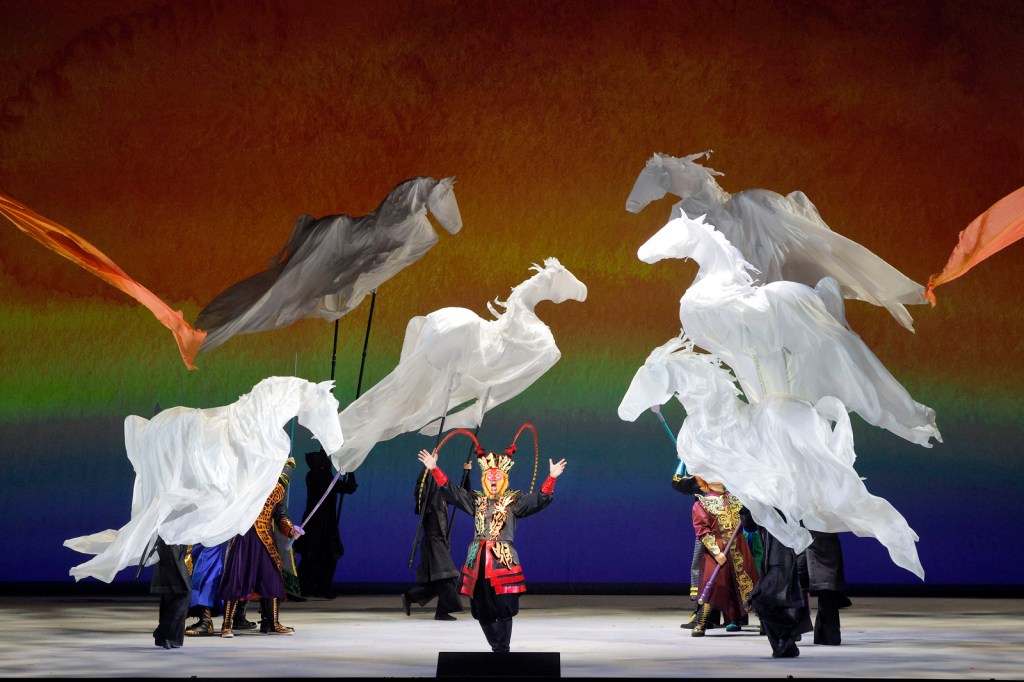
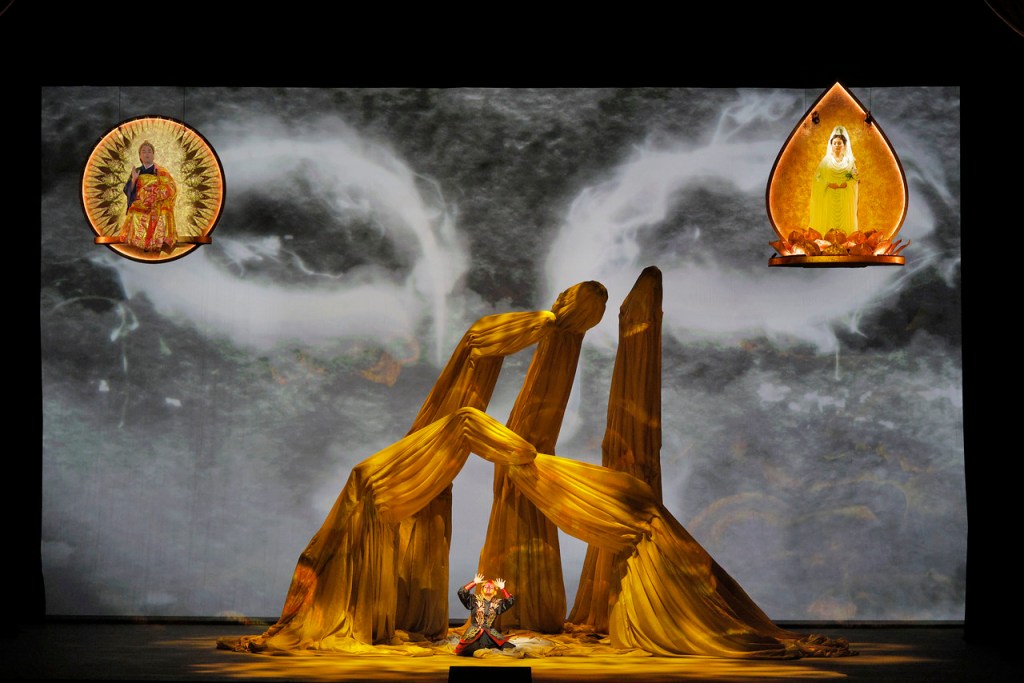
The score actually opens with chants in homage to Buddha.  But it is the visual that is the mark of things to come.  Guanyin, the Buddhist Goddess of Compassion, performed by refined soprano Mei Gui Zhang, glides about suspended in her light-framed conveyance, the first of many stunning visual effects from Set and Puppetry Designer Basil Twist.  Costume Designer Anita Yavich also contributes throughout with a dazzling and colorful array of attire that fills the eye with joy.  Yet, to these eyes, the most stunning visual effect is the simple use of white silk.  Six life-sized “puppet” horses, each raised on sticks by puppeteers, billow and flow like so many white clouds quivering and galloping in the sky.  A still image cannot possibly convey the mesmerizing elegance.

(above) Jusung Gabriel Park as Buddha, Mei Gui Zhang as Guanyin, (below) Kang Wang as Sun Wukong.

Following on the heels of its visually stunning production of Parsifal, San Francisco Opera is showing itself to be in the forefront of operatic spectacle, inspired image-focused productions.  A substantive corollary to Parsifal is that the hero in both must undergo an awakening to attain his goals.  While Parsifal is expressly a fool at the outset, The Monkey King has mental acuity, yet he doesn’t realize that when he ascends to heaven all puffed up in self-adulation, that the title he is given, Lord of the Stables, is to denigrate his station.

Chorus, (foreground) Kang Wang as Sun Wukong.

The Monkey King himself is the most interesting dramatic element in the opera.  Though he is portrayed and sung with great verve by tenor Kang Wang, he is also depicted at times by a dancer and by a puppet.  Sun’s triumphs are predictable, but his paths and behavior are not.  Despite his superpowers, he reveals many of the contradictions of a regular guy.  He is a profane rascal and funny as a gaggle of gags.  Sun’s silliness provides comic relief, and the Kang Wang is adept at triggering laughter with anachronisms, like when he refers to having food for take-out.  At one point, the character even lifts his leg and pees, not realizing that he is peeing in the hand of Buddha, which is so vast that Sun can’t escape it!

(left) Dancer Huiwang Zhang as Sun Wukong, (center) Actor Kang Wang as Sun Wukong.

Following its source material, the opera brims with philosophical wisdom.  It draws on the notion that “power is not enough,” and teaches that the key to divinity is a spirit of caring to help all beings.  It’s remarkable that we still have to preach that gospel.

The Monkey King, composed by Huang Ruo with libretto by David Henry Hwang and based on part of Journey to the West by Wu Cheng‘en and directed by Diane Paulus, is a world premiere produced by San Francisco Opera and plays at War Memorial Opera House, 301 Van Ness Avenue, San Francisco, CA through November 30, 2025.

Madama Butterfly

Emily Michiko Jensen as Cio Cio San. All photos by David Allen.

What more can be said about Giacomo Puccini’s Madama Butterfly that hasn’t been said a million times before?  Along with his other monster hits La Boheme, Tosca, and Turandot, no other composer forged a core of operas that have been so beloved by so many and received so many productions year after year, though Verdi and Mozart do have more breadth of offerings.

What is Puccini’s secret?  Like no other opera composer from the classical-romantic era, he loved women as his central characters – perhaps because his first full-length opera, Edgar, was a failure.  Just look at the titles of each of his seven mature, full-length operas – only women are referenced in the title.  The heroines are highly diverse and often vulnerable, though in different ways – from frail (Mimi) to vibrant (Tosca) and from imperious (Turandot) to submissive (Cio Cio San).

Christopher Oglesby as Pinkerton, Ilhee Lee as Goro, Eugene Brancoveanu as Sharpless.

Opera San Jose takes on the war horse Madama Butterfly.  Thanks to a cast of fine voices plus the rich-sounding orchestra conducted by Joseph Marcheso delivering the sumptuous score, the result is a delight.  Although several set pieces always stand out, absent those highlights, the music is still luminous throughout, shimmering like moonlight reflecting on water.  Innovatively, Puccini also introduces Japanese pentatonic musical forms, most memorably in the unique off-stage “Humming Chorus.”  Meanwhile, the dramatic storyline is cohesive and highly emotive.

The opera belongs to Cio Cio San, Butterfly that is, who dominates the action.  Emily Michiko Jensen makes the most of it in her role debut.  Of course, there are many conceits in opera, and though young herself, Jensen’s powerful voice would hardly be that of an ingenue of 15 years, as Cio Cio San is in the source material.  The soprano appears to love the role.  She displays particularly well in the mid-and-upper ranges, calling on a strong and mellifluous vibrato, and giving a beautiful rendering of the protagonist’s signature aria, the universally loved “Un Bel Dia Vedremo” (“A Beautiful Day Will Come”).

Cast, (center) Emily Michiko Jensen as Cio Cio San.

Cio Cio San is from a good but now poor family in Nagasaki, Japan.  She is banished by relatives and friends when marrying American Naval Lieutenant B. F. Pinkerton, played by the formidable tenor Christopher Oglesby, who brings vocal and dramatic heft to the part.  The artist’s effective portrayal is callous and condescending but accurate.  Pinkerton reveals from the outset that he sees the marriage as a convenience, and his attitude toward Cio Cio San is denigrating, even though he conceals it from her.  Happily, Oglesby’s voice is commanding.  And though cowardly, the character even elicits a little sympathy toward the end with his lament “Addio Fiorito Asil,” (“Goodbye Flowery Refuge”) when he realizes that Butterfly has waited devotedly for him for three years.

Two other roles play prominent in the storytelling but not in the consequences of the action.  American consul Sharpless, the resourceful and popular baritone Eugene Brancoveanu, detests what he suspects of Pinkerton’s intentions.  But despite his righteousness and respect for local people and culture, he is unable to intercede.  Family retainer Suzuki, rich-toned mezzo Kayla Nanto, displays loyalty and compassion, remaining as Cio Cio San’s servant and primary access to the outside world.

Ilhee Lee as Goro, Kayla Nanto as Suzuki.

Madama Butterfly remains one of the most controversial popular operas, largely because of the relationship dynamics.  She sacrifices all and does her best to adopt all things American, but Pinkerton sees her as chattel, and other than paying the rent after his ship sails, everything about his treatment of her is despicable.  So, aspects of pedophilia (though supertitles in this production list Butterfly as 18 years old, probably to allay that issue), racism, and spousal abuse can be lodged against the American.  As a consequence, American chauvinists may consider the opera anti-American.  Unrelated to the content of the libretto, the dodgy question of appropriability by non-Japanese performers is inherent in this opera.  But because of its manifold assets, Madama Butterfly remains in the firmament where it belongs.

Although the production is very rewarding, a couple of issues deserve mention.  The beautiful orchestral score is replete with frequent crescendos that don’t seem that loud.  But particularly when volume stays at a plateau after the rising, singers are surprisingly overpowered by the orchestra, notably in the lower ranges of their voices.

Kayla Nanto as Suzuki, Emily Michiko Jensen as Cio Cio San, KC Oania as Trouble, Eugene Brancoveanu as Sharpless.

Another element that some patrons will not care for is the set design with a stage dress in black and the absence of a physical house, though the unobtrusive backdrop does have the positive effect of making the performers’ appearances pop.  Plus, some setups are quite striking like the flowers and stars staging. Finally, the back wall projection is underutilized and provides no scenic framework.  Presumably the intention is to paint the opera with the darkness that it may deserve, but many will find the black box look unreal and unappealing.

Notwithstanding, Madama Butterfly remains a favorite in the repertory, and the maestro’s music delivered by artists with great aplomb will engulf the audience as it has to millions of opera goers before.

Courtney Miller as Kate, Kayla Nanto as Suzuki, Eugene Brancoveanu as Sharpless, Christopher Oglesby as Pinkerton.

Madama Butterfly, composed by Giacomo Puccini with libretto by Luigi Illica and Giuseppe Giacosa and directed by Michelle Cuizon, is produced by Opera San Jose and plays at California Theater, 345 South 1st Street, San Jose, CA through November 30, 2025.

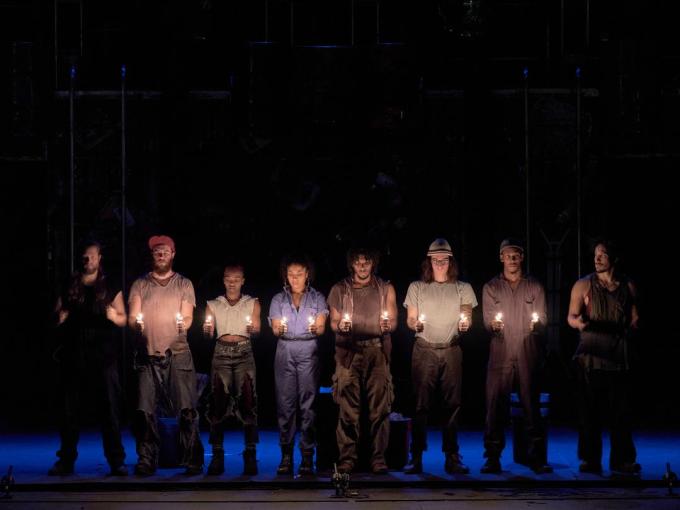
The Woman in Black

David Acton as Arthur Kipps playing Keckwith the Trap Driver, Ben Porter as The Actor playing Arthur Kipps. All photos by Jenny Anderson.

Many of us will remember camping trips as a kid, perhaps with a Scout troupe or with a group of friends.  A highlight was always sitting around a campfire at night and roasting hot dogs and marshmallows.  And as sure as the sun would rise in the morning, the ghost stories began.  The only one I still remember is about the homicidal maniac with a hook for one hand that escaped from an institution.  A couple was making out in a car near the institution that night.  When the young man drives the girlfriend home and walks around the car to open the door, a bloody hook is hanging from the door handle.  Now that was scary!  And no matter how many times you heard it and knew it was just a story, it would still trigger a sleepless night.

The Woman in Black is a campfire ghost story for adults.  Having played London’s West End for 33 years, the play’s longevity is testament to its appeal.  A two-hander adapted for the stage by Stephen Mallatratt from Susan Hill’s gothic horror novel, it doesn’t horrify a theater audience in the same way that a nail-biter would a child.  But the tremorous ambiance can feel creepy, and the loud shrieks, screeches, and thumps without warning are jolting.

Ben Porter as The Actor playing Arthur Kipps.

The setup and structure are a bit odd, as an attorney named Arthur Kipps has written a tome about his frightening experiences on a business trip and hires an actor to help him prepare for a presentation of this unsettling suspense to his family.  The opening is humorous as the (unnamed) actor tries to animate Kipps to make his presentation interesting.  But Kipps balks, inducing much laughter from the audience as he reverts to the same dull-as-sliced-white-bread delivery with each effort.

A solution imposed by the actor is that he will play Kipps when rehearsing the narrative, and Kipps will play all of the other characters.  With this device, the sniveling Kipps, portrayed by Ben Porter on this night, takes on a wide array of accents and affects to represent several different personas with immense brio.  Meanwhile, James Byng performs “the actor” who takes on the part of Kipps with great gusto and far greater enthusiasm than Kipps himself.

Ben Porter as The Actor playing Arthur Kipps.

In the plot, Kipps is charged to travel from London to an isolated town on the marshes to close out the affairs of the recently deceased Mrs. Alice Drablow.  But Kipps finds that she left an abundance of papers that need reviewing, and he opts to overnight at her manor which lies across a causeway, accessible only by a low tide crossing, creating a further sense of vulnerability.  Among the stacks of bills, grocery lists, and other inconsequential papers, he finds that Mrs. Drablow had adopted a boy, the son of her unmarried sister, which raises questions in his mind.  Alone in this possibly haunted house, he also encounters the terrifying effect of finding things in the house have been moved when presumably nobody else is there.

The spare, drab set and spooky lighting enhance the harrowing feeling, accentuated by occasional appearances of a black apparition.  Kipps’ anxiety is piqued as locals refuse to reveal whatever they know about Mrs. Drablow and the mysterious affairs surrounding the manor.  And then there is the door in the house that has no apparent means of opening, yet opens by itself to reveal a nursery, long untouched.  Trenchant verbal descriptions of the threatening marshlands speak of the grayness making indistinguishable the land, sea, and sky.  Incidents of drownings heighten the threat.  Even the small dog Spider, invisible to the audience, who accompanies Kipps is all but sucked into the mire, saved in risky desperation by Kipps.

Ben Porter as The Actor playing Arthur Kipps, David Acton as Arthur Kipps playing Sam Daily.

A stage show lacks the scope and technology that movies have to create a truly horrifying experience.  But given the resources of a live performance, this original London production of The Woman in Black serves as a major signpost on the bumpy road to horror.

The Woman in Black, adapted by Stephen Mallatratt and based on the novel of the same name by Susan Hill, is presented by Center Rep and plays at the Lesher Center, 1601 Civic Drive, Walnut Creek, CA through November 23, 2025.