Merrily We Roll Along

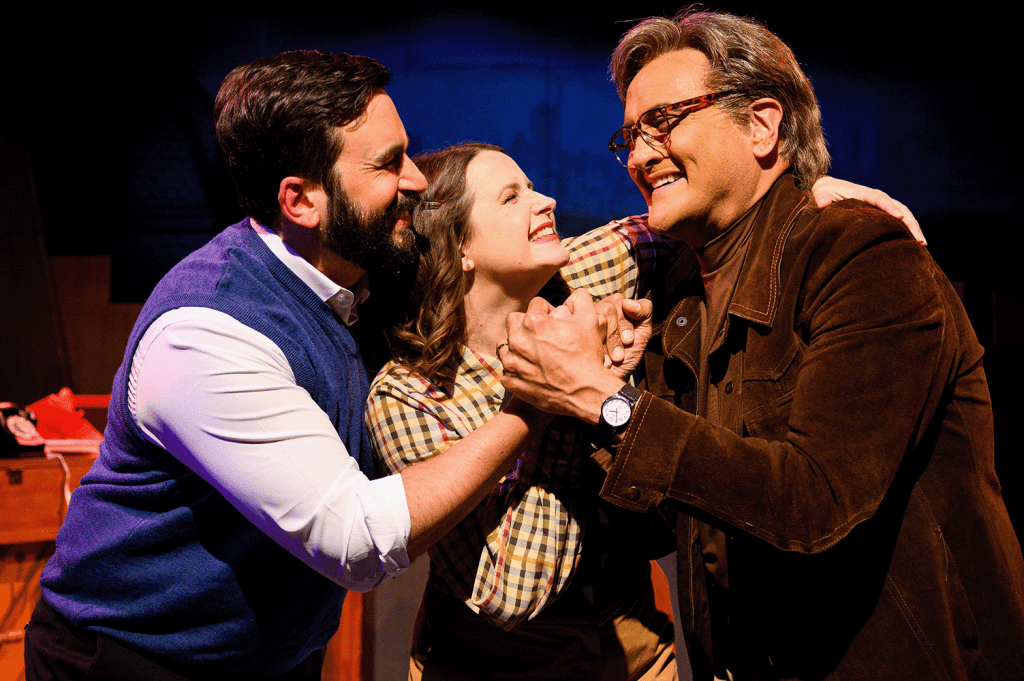
Will Giammona as Frank, Melissa WolfKlain as Mary, DC Scarpelli as Charley. All photos by Ben Kranz Studio.

Alert: Sondheim afficionados and other lovers of musicals.  Complete your dance card.  Take advantage of attending 42nd Street Moon’s new production of the rarely seen “Merrily We Roll Along.”

First, the easy part in discussing this stage oddity.  “Merrily We Roll Along” tells the evolving relationship of friends from 1957 to 1976.  The central figure is Frank, who begins as a poor, idealistic composer of musicals who cracks Broadway and then becomes successful composer for movies.  He is also a serial lover with a succession of girlfriends and wives.  Charley, Frank’s childhood best friend and lyricist during the Broadway days, becomes a family man and staunchly retains his artistic ideals, unwilling to bend to the demands of Hollywood.  The two men part ways.

Now for the complications.  When Stephen Sondheim’s “Merrily We Roll Along” hit Broadway in 1981, he was esteemed as the finest composer/lyricist in the stage musical idiom.  But for various reasons, this work was an abject failure.  However, it was subsequently reworked, winning various awards Off-Broadway and on the West End.  Confidence in the revision has reached the point that it is scheduled to play Broadway this fall.  That said, issues remain.

Will Giammona as Frank, Juliana Lustenader as Beth.

A distinctive, but not unique, feature of “Merrily We Roll Along” is that the story unfolds in reverse time.  We first see Frank as the toast of the town, hosting a party for Hollywood glitterati, and work backward to a rooftop on 110th Street in Manhattan, where Frank, Charley, and their new friend Mary view Sputnik and dream of the future.  The narrative arc is not remarkable, but serviceable as a libretto for a musical.

However, there are reasons that reverse-time storytelling is atypical.  Because it doesn’t conform to human experience, it is harder for the viewer to remember details and make factual connections as the story proceeds backward.  Perhaps more importantly, the conceit inhibits emotional involvement, as we don’t observe character evolution in its normal sequence.  Although Sondheim selected the Kaufman and Hart play of the same name with the reverse storytelling in mind, many will find that device to be the weakness of the musical.

Happily, there are good reasons to see the current rendering.  Those familiar with 42nd Street Moon will see how this offering fits the company’s modus operandi.  Obviously, it is a musical, and one that calls for a large ensemble, but with limited orchestration and minimal staging, all of which suit the company.  But for that, you get Sondheim – witty, and sometimes searing lyrics, creative rhythms, often delivered in patter style, and great music.  The music, however, is a little off the composer’s beaten path – a bit more conventional Broadway and a bit less dissonance.  There also seems to be an unusual amount of reprise, and not a lot of memorable melodies, though the leading phrase of the title song, which recurs a lot, is a prime candidate for an earworm.

Ensemble.

The performers are also typical of the company, with many veterans of earlier productions.  Will Giammona heads the cast and is in fine voice.  But DC Scarpelli as Charley, whose vocals vary, delivers the real show stopper, “Franklin Shepard, Inc.,” largely a funny talk-sing about how they work, how they play, and how they are already going their separate ways.

Indeed, perhaps the central theme of the show, which is explicitly revealed soon after, is that good friends don’t want good friends to change.  It is very true to life as we all go through losing relationships because of growing in different directions, even as in the case of Frank and Charley, when the divergence has major financial consequences.  A very public, real-life case in point is when Paul McCartney ultimately acknowledged that it wasn’t the presence of Yoko Ono that caused the Beatles to break up.  Their fans wanted them to remain together and unchanged forever, but as McCartney said, they simply grew up and apart.

Much of the sauce in this production actually comes from the female secondary leads.  Mary, portrayed by a spritely Melissa WolfKlain, is the third friend who the men meet in 1957.  For years, she is the conciliator who works to keep Frank and Charley together, but in time, she becomes a liability rather than an asset in keeping the peace.  A sharp portrait comes from Christine Capsuto-Shulman, who plays Gussie to the hilt.  She will become Frank’s second wife.  On the plus side, Capsuto-Shulman has a wonderful and powerful singing voice and charismatic pizzazz.  On the minus side, her character is selfish, self-centered, and always one to create friction rather than harmony.  Gussie is trouble, but because of her allure, some men can’t avoid entrapment.

Christine Capsuto-Shulman as Gussie.

The ensemble effectively acts to brighten the stage and sound, usually as party goers.  Their voices are uneven, but some stand out, such as Juliana Lustenader, who also plays the role of Beth, Franks first wife.

In all, this work will not rank among Sondheim’s masterpieces, but that’s setting a very high bar.  This production meets expectations for the company’s offerings and does provide plenty to those interested in the musical genre.

“Merrily We Roll Along” with music and lyrics by Stephen Sondheim, book by George Furth, and based on the play of the same name by George S. Kaufman and Moss Hart is produced by 42nd Street Moon and plays at Gateway Theatre, 215 Jackson Street, San Francisco, CA through April 9, 2023.
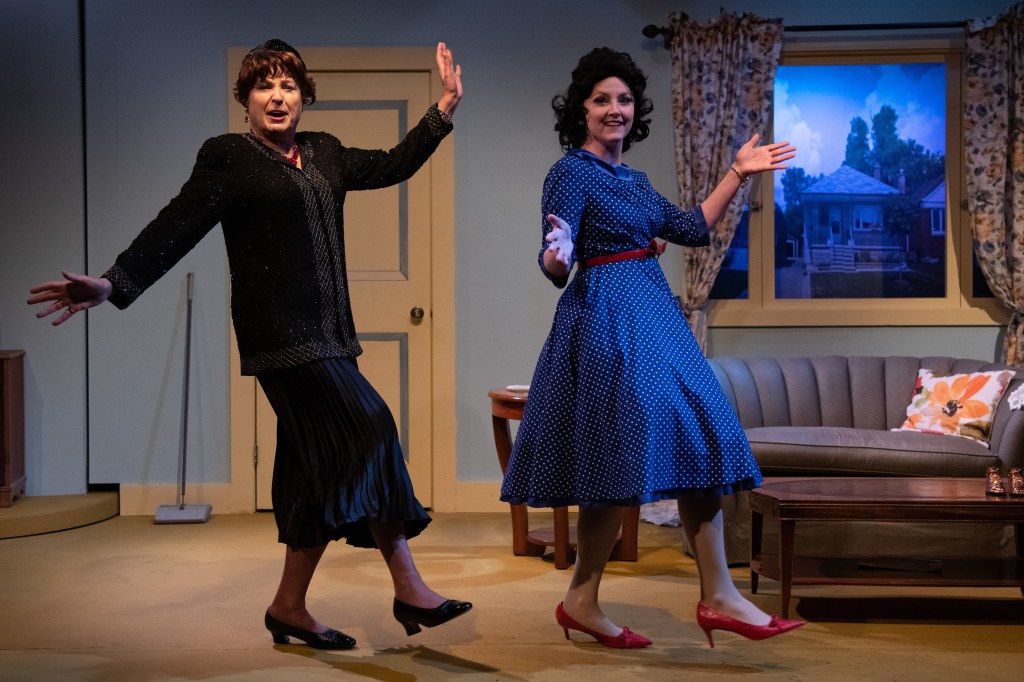
Ruthless! The Musical

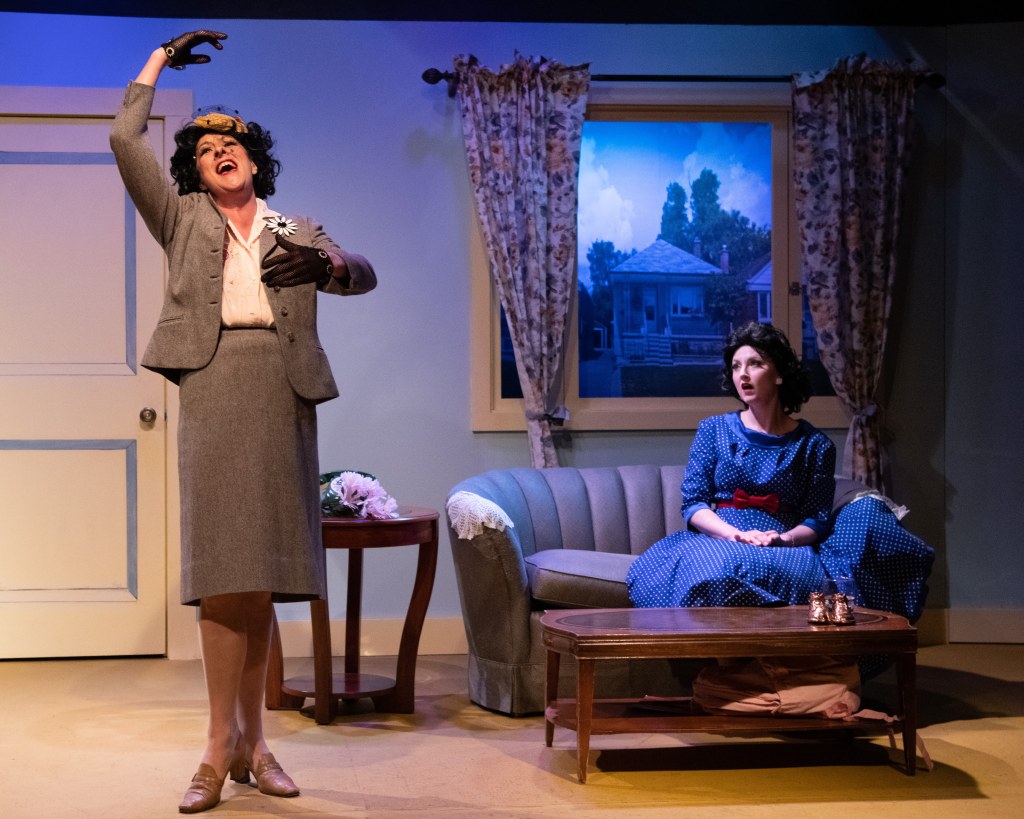
Ronnie Anderson as Sylvia St. Croix, Sarah Elizabeth Williams as Judy Denmark. All photos by Grizzly De Haro.

One of the more pleasing experiences of a critic is to reluctantly attend a production with low expectations but to find the performance totally gratifying.   If the show is known to be a “send-up,” you can raise a red flag of apprehension, and even more if it’s a not-so-notable musical by not-so-famous collaborators.  Send-ups can be tricky, since pastiche, and particularly farce, can wear thin.  But “Ruthless! The Musical” pushes all the right buttons, offering a bright script and bouncy music with clever and provocative lyrics.  Altarena Playhouse gives it a rousing rendition that is enjoyable from start to finish.  The casting and acting are superb, and the creative elements sparkle.

“Ruthless! The Musical” is all about the super talented pre-teen Tina Denmark, portrayed by the super talented pre-teen McKenzie Lopezlira, who acts, sings, and taps up a storm.  Her sarcasm bites, and her occasional off-color language lands with just the right mix of surprise and humor.  Tina aspires to be a great performer.  She receives all the support imaginable from sacrificing Judy, her stay-at-home mom, who exemplifies the ideal 1950’s homemaker.  Attired in a crisp dress, a pristine white apron, and red high-heeled shoes, she’s prepared to serve tea or cocktails to any unannounced visitor.  Sarah Elizabeth Williams is Judy, who displays a fine singing voice and crack comic timing as the demure mom in Act 1, and as her alter ego in Act 2.

Ronnie Anderson as Sylvia St. Croix, McKenzie Lopezlira as Tina Denmark, Anna Joham as Miss Thorn.

The show starts with a light touch as we get to know the characters.  But then, Tina auditions to play the lead in “Pippi in Tahiti.”  She loses to the untalented but rich Louise Lerman, played to the hilt by Caroline Schneider, and we find that Tina wasn’t spawned on the set of “Father Knows Best,” but of “The Bad Seed.”  Black comedy sets in.  Not only does Tina become manipulative and foul mouthed, but evil intentions arise when she realizes that if she were the understudy, she would stand in as Pippi Longstocking if the lead is unable to perform.  Disaster looms.

Along the way, we meet Miss Thorn, the third-grade teacher, who selects Louise as the lead in the play because of her parents’ connections, and who suffers through the girl’s acting incompetence.  A special recognition goes out to Laura Morgan, who in an emergency stepped in to play Miss Thorn.  Morgan is not even the understudy, but the show’s choreographer!  Although she had a script in hand to help with the lines, her performance could not have exuded more acting savvy, full of emotion and zest.  The audience was demonstrative of its appreciation for her outstanding contribution during the bows. 

McKenzie Lopezlira as Tina Denmark, Caroline Schneider as Louise Lerman.

There are also not one, but two, important characters who draw on the “Mame” and Mother Rose from “Gypsy” tradition.  Ronnie Anderson plays Sylvia St. Croix, an unscrupulous theatrical agent, who pushes to get Tina into show business, with an over-the-top performance that fills the stage.  Enter Lita Encore, theater critic and Judy Denmark’s adoptive mother, portrayed by an also saucy and domineering Lisa Appleyard, who offers a powerful delivery of the contrarian “I Hate Musicals.”

Significant events toward the end of Act 1 lead to situational and character transformations and revelations that should be enjoyed as surprises when attending the play.  Some events become more extreme and darker, but they are so unrealistic and silly that they don’t dampen the fun.  Suffice it to say that “Ruthless! The Musical” deserves its cult status and the awards that it has received over the years.

Lisa Appleyard as Lita Encore, Sarah Elizabeth Williams as Judy Denmark.

Director Dana Anderson uses all of the resources of the Altarena stage from the balconies and circular staircase to the vomitoria (i.e.: egresses).  The crack performances and sharp interplay drive the action at just the right pace.  Of the creative elements, Sarina Renteria’s lighting especially stands out.

The production is not flawless, but weaknesses don’t diminish the overall enjoyment.  The band’s volume was too high in the prelude and continued to overpower the singers early in the performance.  Williams has a beautifully trained voice, but her lyrics in her opening number, “Tina’s Mother” were sometimes drowned out by the musicians.  The only sub-standard singing comes from Sylvia, which is particularly exposed in the trio “Angel Mom” because of the vocal range.   Fortunately, the role of Sylvia is conducive to a talk-sing style, so not much is lost, and Anderson’s acting prowess has already been noted.

“Ruthless! The Musical” with book and lyrics by Joel Paley and music by Marvin Laird is produced by Altarena Playhouse and performed on their stage at 1409 High Street, Alameda, CA through April 30, 2023.

Tosca – Livermore Valley Opera

Alex Boyer as Cavaradossi, Ann Toomey as Tosca. All photos by Barbara Mallon.

Of all opera composers, perhaps none is so beloved for his soaring lyricism and accessibility as is Giacomo Puccini.  His tragic heroines radiate fine-grained distinction.  And where is the maestro more embraced than the Bay Area?  From the time that Gaetano Merola brought professional opera to San Francisco, no composer has reigned with such a following.  All four of Puccini’s top tier of masterworks, “La Bohème” (1896), “Tosca” (1900), “Madama Butterfly” (1904), and “Turandot” (1926) enjoy great popularity here.

The work that stands as the benchmark is the passionate “Tosca,” which audiences can’t get enough of.  While sometimes criticized for its harshness, its compelling music which demands great vocal artistry, along with its wrenching libretto make it a perennial favorite.  As appealing as “Tosca” is to audiences, its productions attract fine performers.  The intense drama possesses three mighty roles to-die-for, and indeed, all three of the characters die!

Kirk Eichelberger as Angelotti.

Livermore Valley Opera provides a handsome, artistic, and well-cast traditional production of “Tosca,” which is no mean feat.  In its essence, the opera is an intimate triangle of love, predation, betrayal, and murder.  Although Puccini was no stranger to big ensemble numbers, he deliberately restrains that temptation to retain a strong sense of verismo and human closeness.

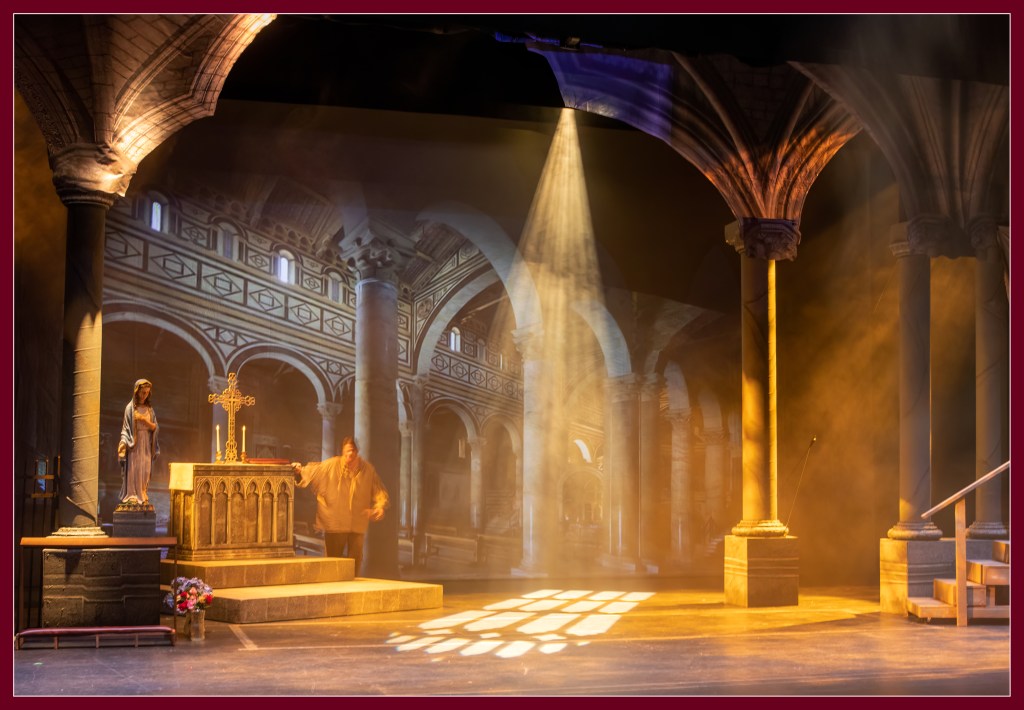
Yet the intimacy of “Tosca” plays against a grand canvass of three unrelated settings, which LVO executes deftly.  Act 1 occurs in the nave of the Church of Sant’Andrea della Valle, where Cavaradossi is painting a larger-than-life portrait of the Magdalene for the church.  Significant to the narrative, the painter is also a revolutionary fighting to overthrow Rome’s current government.  In this act, the integration of the physical set with the backlit projections is especially well done.  Act 2 takes place in the Chief of Police Scarpia’s vast quarters in Palazzo Farnese.  Here, he manipulates his defenseless prey, Tosca, with sexual extortion, and Cavaradossi, with false arrest and beating.  Act 3 takes place against the parapet of Castl Sant’Angelo, where Cavaradossi faces a firing squad.

Aleksey Bogdanov as Scarpia, chorus.

Casting for the three main parts in this opera is critical, starting with the title role, and Livermore Valley Opera has attracted Ann Toomey for her Bay Area debut.  Toomey offers the vocal versatility that suits this demanding role completely.  In mid range and middle volume, her lyrical voice caresses the composer’s beautiful melodic lines.  But Tosca is an actress – one who suffers personal degradation and whose lover faces existential threat.  As Toomey’s voice crescendos in emotional scenes, it emits a dramatic fervor rising to the intensity of the moment.  Although she masters this duality throughout, it particularly comes together in Tosca’s wistful yet powerful signature aria, “Vissi d’arte” (“I lived for art”), when she realizes that life will not go on as before, and she begs Scarpia to release her from the pain.

Although Alex Boyer’s resumé includes stints around the country, he is well planted in the Bay Area, where he has become an audience favorite as a fine lyric tenor with a strong, clear, and compelling voice.  Cavaradossi fits well within his catalog.  He nails the hero’s bookend arias.   His romanza, “Recondita armonia” (“Concealed harmony”), a love letter to Tosca when life is good, is sung with great panache.  Sadly, he faces death and regret with the hauntingly delivered “E lucevan le stelle” (“The stars showed brightly”), though his being seated at the beginning of the latter reduces the impact at the start of the piece.  Boyer also brings a little bit extra to his portrayal.  Cavaradossi is often played with a rather dull earnestness, but the tenor adds a light and humorous touch with a charming twinkle in the eye.

Aleksey Bogdanov as Scarpia, Ann Toomey as Tosca.

It is unsurprising to learn that, despite his youth, Aleksey Bogdanov has performed Scarpia with several opera companies around the country.  His characterization is as well-matched as it is profound.  The high demand for his services in this part becomes evident from his first entry onto the stage.  Unctuously pursuing Tosca, this cruel and imposing figure is a visual magnet who dominates the stage.  More importantly, Bogdanov’s dark baritone booms, but with a percussive clarity unusual for such deep tones.  While sopranos are often asked to sing above the din of many voices, it is uncommon to expect a male with a lower voice to do so.  But Bogdanov rises to the occasion with his “Va, Tosca / Te Deum” in which he vocally slays the lesser voices surrounding him.  The resounding number is particularly poignant in contrasting Scarpia’s purported religious devotion with his lust for Tosca as he repeats her name against the religiously themed music.

Of the supporting roles, Kirk Eichelberger deserves special recognition.  In his brief presence as Angelotti, an escaped prisoner and political ally of Cavaradossi, he delivers a ringing vocal account with his nimble baritone voice.  Conductor Alexander Katsman paces the orchestra well and produces a mellow sound.  One of the understandable compromises that a smaller opera company must make is the size of the orchestra.  Underpowering is an occasional issue, particularly with the striking opening of the opera and other recurrences of the searing Scarpia motif.  Nonetheless, “Tosca” is another credit to LVO’s artistry.

Alex Boyer as Cavaradossi.

“Tosca,” composed by Giacomo Puccini, with libretto by Luigi Illica and Giuseppe Giacosa, is produced by Livermore Valley Opera and plays at Bankhead Theater, 2400 First Street, Livermore, CA through March 12, 2023.

Fannie: The Music and Life of Fannie Lou Hamer

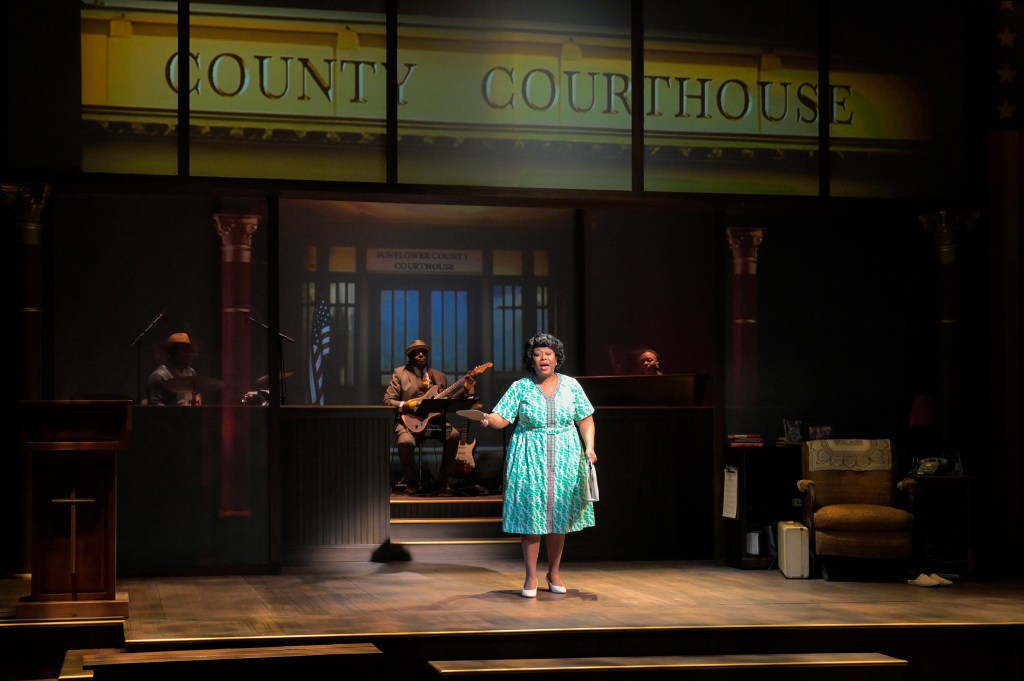
Greta Oglesby as Fannie Lou Hamer. Photos by Kevin Berne.

The side walls of the Lucie Stern Theatre are bedecked with simple posters reflective of 1962, when the push for the Civil Rights Act began.  “We Demand the Right to Vote.”  “No to Jim Crow.” “Pass the Civil Rights Bill.”  And many more.  Screen projections and audio on stage highlight the key players and incidents from the movement to secure voting rights for African Americans.

Several years ago, this play could be seen as history – a poignant reminder of the many tragedies and the ultimate triumph of good over evil – an admission of our reviled former days.  Regrettably, this country suffers a redux of our hateful and sinful past, if without the preponderance of violence and extreme intimidation for wanting the vote.  However, violence is still visited upon Blacks in other ways and for other reasons.

The political right wing in the United States threatens the very existence of democracy as political operatives boldly and cruelly crush the goodness out of progress and what made this nation great.  The U.S. Supreme Court has undermined the Civil Rights Act of 1965, and conservative (read Republican) local political authorities, judges, state legislatures, and their colleagues in the U.S. Congress brazenly introduce laws and administrative procedures with the evil intent of depriving people who are not in their clan the right to vote by using lies, deceit, and Machiavellian ploys.  As startling as the following question may be – how do these actions differ from fascism?  And why aren’t its enemies not fielding a stronger defense against this perversion?  So, ultimately, this is to say that “Fannie: The Music and Life of Fannie Lou Hamer” should not be viewed as a simple history lesson, but as a cautionary analogue to what is happening at this very time.

Greta Oglesby gloriously reprises the role of Fannie Lou Hamer that she performed at Oregon Shakes’ vast outdoor Elizabethan Theatre.  She brings a speaking voice brimming with passion and conviction, as well as a strong and melodious singing voice.  She stalks the stage with a slight hobble as a wounded warrior who is too busy planning the next demonstration to let her nagging injuries slow her down.

So, who was Fannie Lou Hamer?  A minimally educated, but intelligent, articulate, and committed Mississippi woman – she is one of those whose contributions are not recognized in the same breath as activist leaders of the day.  Yet, she organized the pivotal Mississippi’s Freedom Summer and co-founded the National Women’s Political Caucus.  Perhaps her story has not rung forth simply because she is a woman, much like Dolores Huerta’s light as a leader of the United Farm Workers’ of America was totally overshadowed by co-founder Cesar Chavez until recently.

Playwright Cheryl L. West has crafted a 70-minute summary of Hamer’s work, shining light on this much overlooked lioness.  Mixing vignettes of great gravity with occasional lighter touches, the playwright keeps the action moving along, and Director Tim Bond creates a kinetic and visual environment to prevent the one-woman show from going stale.

Fighting through poverty, even through the years of her activism, Oglesby depicts Hamer’s indomitable spirit in a series of stories mostly from the 1960’s.  In one harrowing sequence in jail, she is beaten almost to death involuntarily at the hands of a Black male prisoner, so demanded by a White jailer.  Hamer would suffer permanent kidney damage along with other lasting ailments.  She vowed, however, that if she could survive that beating, she would be intimidated by nothing.  She continued to register people to vote and fight literacy tests, poll taxes, and lying intimidation to accomplish equal voting rights.  Along the way, she would objectively acknowledge the truths that she confronted.  Not to generalize, but some white women advanced their own voting rights at the expense of rights of Black women to vote, so that the suffrage movement actually set back progress for Black women.  At the same time, some white men and youths were instrumental in helping to move the needle toward universal suffrage.

The structure of the play is a key element in the entertainment.  Throughout, Hamer sings snippets of songs of protest to enliven the stories, and she does so with great verve in a number of styles from ballad to rousing revival meeting gospel with sing-along, inducing audience involvement.  Some lyrics are organic and cleverly carry the narrative of the story, while others are old standards like “This Little Light of Mine” and “We Shall Not Be Moved.”   Missing is the civil rights anthem “We Shall Overcome,” which may have been omitted because it would seem too cliché.  This device of integrating music into dialog, which she did use in her meetings, adds much liveliness to what could be a wholly depressing chronicle.

“Fannie: The Music and Life of Fannie Lou Hamer,” is a fitting tribute to a courageous and accomplished woman.  While its messages are important, unfortunately, they largely reach the already converted.  In these days, many people do not seek the truth but rather reinforcement of what they already believe.  So those who don’t want to acknowledge the flaws in American history are unlikely to seek exposure to a presentation like this.  As a footnote, Hamer’s prescient warning echoes that just because White resisters to the progress of Blacks are not wearing hoods doesn’t mean that they’re not trying to destroy the Black community.  The battle is far from won.

“Fannie: The Music and Life of Fannie Lou Hamer,” is written by Cheryl L. West, produced by TheatreWorks Silicon Valley, and is performed at Lucie Stern Theatre, 1305 Middlefield Road, Palo Alto, CA through April 2, 2023.