Kimberly Akimbo

Peter Marietta as Buddy, Jamison Vaughn as Kimberly. All photos by Grizzly De Haro.

Critics of the performing arts crave originality.  Having progeria, a disease in which the body ages at 4 ½ times the normal, as central to a comedy must check that box.  Playwright David Lindsay-Abaire crafted a thoroughly entertaining and touching play about a girl suffering the condition who turns 16, the average life span for its victims.  But the play is full of humanity and even an odd sense of optimism, promoting the notion of carpe diem, seize the day.  With a stellar cast and distinctive contributions from the creative directors, Altarena Playhouse offers a production that delivers most everything the play has to offer.

Kimberly lives with her dead-end, self-centered parents, Buddy and Pattie in northern New Jersey.  Kimberly deals with her physical tragedy as well as the expected social isolation of looking like the grandmother of her peers.  But at home, she is the most grounded and the adult in the room.  Buddy is a lush who always lies about why he is very late getting back from work and makes promises he will never keep.  The narcissistic Pattie exhibits hypochondria; is pregnant; and has both hands bandaged from carpal tunnel surgery, so she needs assistance to eat and more.  The family had moved houses recently without notifying Pattie’s sister Debra, a grifter who was in jail at the time.  But Debra tracked them down and moved in on the sly, armed with a scheme to get rich the illegal way.

Allison Gamlen as Pattie, Jamison Vaughn as Kimberly.

Jamison Vaughn is Kimberly, and she inhabits the role beautifully.  Often disparaging her parents for bad behavior, Vaughn’s sentences usually begin with a whiny “D-a-a-a-d” or “M-o-o-o-m” followed by a chiding or a plea.  And though her remaining life is short, she immerses herself in the day-to-day, and seems uncommonly well adjusted.  Although people close to her are sensitive to her condition and her mortality, well-intended but clumsy people say hurtful things.  One of the sublime elements of Vaughn’s acting is the subtle flinching when confronted with unmindful, distressing comments.

It’s rewarding to watch a great performance by an actor who is completely outside his real skin, and does it without the aid of prosthetics or transformative makeup.  Peter Marietta appears more fit to play debonaire or self-possessed roles, but aces the part of Buddy assisted only by sloppy clothes and slightly ruffled hair.  Of course, he adds the facial and bodily expressions as well as the speech, which is “The Sopranos” Jersey Accent 2.0 to create a totally convincing working class schlub.  His thoughtlessness is reflected in picking up Kimberly 2 ½ hours late in the freezing cold, and along with Pattie, forgetting Kimberly’s 16th birthday.

Caroline Schneider as Debra, Jamison Vaughn as Kimberly, Allison Gamlen as Pattie.

The same acting case can be made for the striking Allison Gamlen as she nails the heedless Pattie who is full of cringeworthy comments that are well delivered in Jersey patois.  In front of Kimberly, she insensitively notes about her unborn that “This one will be perfect.”  And about not being able to her use her bandaged hands, she shares with all that “I can’t wait to be able to wipe my own ass.”  She is however forward thinking enough to record comments as a memory bank for her next child, but needless to say, many of those comments may not reflect well.

Along with the parents’ insensitivity, profanity abounds, and one bright spot is that they agree to Kimberly’s challenge to put a nickel into a jar on the kitchen table each time they swear.  Surprisingly, given their personalities, they even humorously cough up the forfeit when nobody hears them and nobody is looking.

Jamison Vaughn as Kimberly, Rowen Cole Weeramantry as Jeff, Peter Marietta as Buddy.

Caroline Schneider impressively portrays the bombastic, ne’er-do-well Debra who creates mayhem any time she is in the scene.  Rounding out the cast is a charming Rowan Cole Weeramantry as Jeff, a recent and only school friend of Kimberly’s who obsessively creates anagrams, which accounts for the name Akimbo in the title.  He also shares the bond of living with bad parenting.

Director Dana Anderson leads an impressive team of creative directors.  Tom Curtin’s set is fitting for the production.  Danielle Ferguson provides many lighting changes from intensity and location to blackout.  Daniel “Techno” Debono offers numerous sound effects. 

Although the production brims with virtues, one major flaw in Kimberly’s depiction fails to avail the breadth of the character.  Vaughn’s age appearance on stage is ambiguous.  She could be in her thirties or forties.  She should look 72 years old, which is easily correctible with a realistic salt-and-pepper or gray wig.

Caroline Schneider as Debra, Jamison Vaughn as Kimberly, Peter Marietta as Buddy.

I usually hate comparing elements of a production being reviewed to another realization, but this time it is too hard to resist.  I saw 62-year-old actress Victoria Clark, who won a Best Actress Tony Award, portray Kimberly in the Broadway musical based on this play.  Two things make the central age conceit work for Clark with such power, and they could work in this production.  One is the massive contradiction between the look of a matronly woman versus her teenage behaviors and her teenage friend.  The other is the daughter looking like the mother to her parents rather than vice versa, which acts as a constant reminder of her condition and how close she is to the end of life.  These important dimensions are regrettably lost by not showing the character aged appropriately.

A minor issue concerns audibility, which is an inherent problem with a full-thrust stage, having audience on three sides.  Depending on where the action takes place on the stage and what direction the speaker is facing, dialogue is sometimes lost to one or the other wing section of the audience.  This was particularly true with Weeramantry early on when his voice did not project well from upstage right.
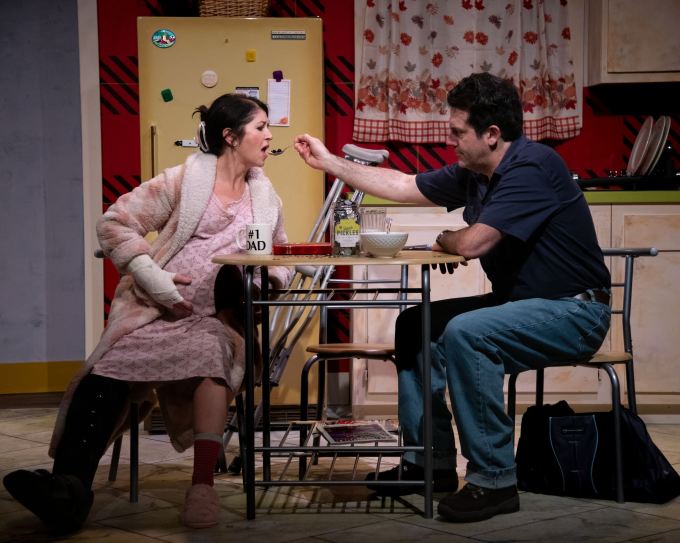
Allison Gamlen as Pattie, Peter Marietta as Buddy.

A final issue concerns pacing, which felt slow in the first game scene.  The second game scene, which involves “Dungeons and Dragons” was brisk, but of little interest to audience members who aren’t familiar with the game.  That, however, is a script issue, not a directing one or performing one.

But despite its theme and the abundance of flawed characters, “Kimberly Akimbo” is a winsome play and a delightful experience.

“Kimberly Akimbo,” written by David Lindsay-Abaire is produced by Altarena Playhouse and plays on its stage at 1409 High Street, Alameda, CA through February 25, 2024.

Miriam and Esther Go To The Diamond District

Janet Roitz as Esther, Ellen Brooks as Miriam. All photos by Marcus Hanschen.

Before the era of saving everything imaginable on electronic media, physical mementos were often preserved – handwritten letters, photographs, financial and legal documents, manuscripts, memorabilia from life’s experiences like books, Playbills, vinyl record albums, and other collectibles.  Upon a person’s death, one or more individuals, usually surviving family members, are often charged with foraging through the effects of the deceased to decide what to keep and what to trash.  The process can be daunting, with the fear of possibly disposing something that is of financial worth or sentimental value to someone else close to the deceased.  Some surprises may be positive, like an unexpected insurance policy or securities certificates.  But there may also be revelations that the survivors wish had not been unearthed.

Playwright and Director Andrea Gordon’s self-referential world premiere deals with just such an event.  Upon the death of their mother, two somewhat estranged sisters converge on the Upper West Side Manhattan apartment that had become their home when their father died and their mother moved them to New York City from Berkeley.

Janet Roitz as Esther, Merrill Grant as Mother.

The overall narrative arc of the play is relevant and interesting, as are most of the specific events, but the script needs a sharper pen and insights from more pre-production readers.  Modern playwrighting usually benefits from the number of processes that plays usually go through and from the numerous comments from participating artists along the way.  One risk that is usually avoided is the playwright directing their own play, which eliminates what is typically the most useful dialog in script evaluation and production development.  That caution is not exercised in this instance.

In Act 1 the sisters’ mother has died, and the women rifle through old artifacts, both reminiscing and reopening past wounds.  Miriam (played by Ellen Brooks) is six years older than Esther (played by Janet Roitz).  The gap is enough to argue that just based on age difference and birth order, that they grew up in different “families.”  Indeed, so separated are they that Esther states to Miriam that the latter doesn’t even know her.

Janet Roitz as Esther (rear), Ellen Brooks as Miriam (fore).

A specific incident reinforced their different family experiences.  Both bridled under their mother’s second husband, an urbane and well-connected patron of the arts, who also domineered the girls in an unpleasant manner.  Concerned about her own happiness, Miriam ran away from home as a teen, giving no thought to the consequences to Esther who was left to deal with the hostile environment on her own.  As relationship fissures crack open during the search through artifacts, they also come upon letters written by their father, which prompt yet another reappraisal of their childhood.

The mother had been an opera singer, and the playwright uses dream flashbacks to introduce her and to suggest the sisters’ remembrances of their childhoods.  The mother is played by Merrill Grant, who in the first act appears only twice, without speaking.  Once she sings the opera aria “O mio babbino caro” which a daughter sings to her dying father in Puccini’s “Gianni Schicchi.”  Later, she sings the “Embroidery aria” from Britten’s Peter Grimes, a song with dark themes that had oddly been used as a lullaby.  The transitions into the dream sequences are unclear, but the good news is that Grant has a beautiful and powerful voice that stunned the opening night audience into appreciation.

RP Welsh as Father, Merrill Grant as Mother.

In Act 2, the sisters continue to reveal more about themselves as well as their mother and both fathers.  A flashback conveys the backstory of the blood parents.  Included in the flashback is a nicely choreographed and danced pas de deux that seems a bit gratuitous, and its tone wavers uneasily between humorous and melodramatic.

This narrative is of considerable interest and one that many people will be able to relate to – at least in general, and for many, specifically.  Deception and forgiveness play important roles.  The personality differences between the women are well delineated, with Miriam being the steady, reliable one, and Esther being the easy-going Peter Pan.  Even the deceased are well defined, especially the stepfather, who, like the father has his backstory exposed through letters found by the sisters.  Creative elements and acting are sound.

Ellen Brooks as Miriam, Janet Roitz as Esther.

The weakness of the production derives both from the script and the manner of delivery.  The sisters get caught in the middle – neither sympathetic enough to evoke compassion or fractious enough to evoke discomfort.  There are situations that could produce more energy if the sisters were more combative with one another, and points of bonding that could produce more empathy.  Also, references to Valerie, a relative who had already picked over the belongings, don’t add anything to the drama.

Except from well established playwrights, premieres rarely emerge fully formed.  This play elicits considerable interest and enjoyment.  Hopefully it will benefit from strengthening the script and earn additional productions.  A new title could even be considered.  Although it is captivating, the story tells of the stepfather taking Miriam to the Diamond District when she is a teen, but there is no connection with Esther.

“Miriam and Esther Go To The Diamond District” written by Andrea Gordon, is produced by Rainbow Zebra Productions and plays at Magic Theatre, 2 Marina Blvd., Fort Mason Center, San Francisco, CA through January 28, 2024.

Legally Blonde – The Musical

Gwynnevere Cristobal as Elle. All photos by Austin Andrade.

From its opening number, with UCLA’s Delta Nu sorority sisters singing, shrieking, and shimmying to ‘Omigod You Guys,’ it’s clear that you’re in for an evening of youthful enthusiasm and energy.  Tri-Valley Theatre Company, in its inaugural production under this banner, shows that with “Legally Blonde – The Musical,” it knows how to make a musical and how to have fun.

Based largely on the real-life experiences of Amanda Brown, the movie “Legally Blonde” premiered in 2001 with a modest budget and revenue expectations that were blown away by its success.  Contrary to the normal sequencing, the Broadway musical followed the movie. Nominally a chick flick and then a sisters’ stage show with its veneer of pink wardrobe, style magazines, toy dogs, and shallow characters at the outset, it never loses its sense of humor, while making some strong social commentary along the way.

Gwynnevere Cristobal as Elle (center), sisters of Delta Nu sorority.

The central character is Elle, aptly sharing the same moniker as the famed fashion magazine.  Although her interests are decidedly plebeian, she will demonstrate that she can compete with the pompous privileged.  Along the way, she will show herself to be smart, persevering, analytical, loyal, and humane.  Not a bad personality package.  And despite some theater goers’ inclinations to have condescending thoughts about the slick, silly-seeming character, it’s well-nigh impossible not to be on her side.

Gwynnevere Cristobal plays Elle, conveying the character’s outsized personality with charisma and possessing a strong singing voice that perfectly suits the stage musical form.  Cristobal’s bubbly enthusiasm captures the essence of the character and carries the show.

Andrea Rae as Paulette, Gwynnevere Cristobal as Elle.

Near college graduation, Elle is crestfallen to find that her boyfriend Warner, who she expected to marry, is disposing her for not fitting the right socio-economic pattern for a permanent alliance.  He’s leaving her behind to go off to Harvard Law School.  But through diligence and unlimited chutzpah, the girl graduate who majored in fashion design wrangles acceptance to Harvard Law as well and surprises Warner by showing up to become his classmate.  Predictably, Elle must overcome obstacles to achieve her goals.  The relationship derails upon her arrival, but Elle will find her grounding and actualization in other ways.

The story is aided by the introduction of distinctive secondary characters, most importantly Elle’s mentor/friend in law school, Emmett. As he comes from a humble background and must work to overcome disadvantages, he inspires Elle to stick it out despite the hurdles and humiliations she faces.  Tommy Lassiter fills the bill with just the right levels of humility and assertiveness.  Also, beautician, Paulette, gives Elle a friend outside the legal community that she can relate to.  Andrea Rae possesses a beautiful and powerful singing voice but also imbues Paulette with the ethnicity and working-class zest to give her character great comic appeal. She urges Elle to be true to herself rather than give in to the conformities that others try to force upon her.

Gwynnevere Cristobal as Elle, Tommy Lassiter as Emmett, Alexander Kolm as Warner, Ray D’Ambrosio as Professor Callahan, Kinsey Erin as Vivienne, Emma Marie Wall as Enid – the Harvard Law contingent.

The music generally bounces and contributes to the plot and characterizations.  Professor Callahan’s “Blood in the Water” concerns the cutthroat nature of the law and absence of scruples in its practice.  Emmett’s “Chip on My Shoulder” is about marginalized students in law school who lack money and prominent family.  In “Bend and Snap” Elle shows a technique for use to detect perjury in a murder trial to distinguish whether a witness is gay or straight.  The action moves swiftly, though there is some superfluousness, especially the events surrounding the murder trial of Brooke, an exercise celebrity.

“Legally Blonde” has small scope in that situations are personalized and venues are interiors.  Yet this production is big and boisterous.  The choreographic demands on Cat Delos Santos Reyes are immense, and the vibrancy of the dance and the squealing from some of the cast create an energized environment.  Costume Designer Andrea Gorham-Browne deals not only with a large cast, but a huge number of costume changes.  With the exception of Elle’s wardrobe, most are pretty routine, but the volume, selection process, and logistics are monumental and very well managed.

Andrea Rae as Paulette, Tommy Lassiter as Emmett, Gwynnevere Cristobal as Elle.

The overarching creative contribution comes from Stage Designer Thomas Curtin.   Although the fixed set is simple, the endless changes of venue require numerous set dressing treatments which are handled deftly without delays in the action.  In addition to a vast array of moveable props on wheels, the designer makes great use of the stage’s fly to drop scenery in from above.  Final kudos go to Director Misty Megia, who manages and arranges all of the pieces of the demanding production.

Overall, the musical entertains.  Both its frivolous surface and its exploitation of social issues from professorial abuse to relationship dynamics resonate, and the production rewards with its stylishness and verve.  There are areas for improvement such as the voices in the sorority scenes, the orchestra at opening, and some of the dance execution, but these are minor.  Friends and family in the audience were quite apparent at the opening and filled the house.  Hopefully the production will continue to draw.

Shelly McDowell as Brooke (foreground).

“Legally Blonde – The Musical” with music and lyrics by Laurence O’Keefe and Nell Benjamin and with book by Heather Hach is based on the novel by Amanda Brown, produced by Tri-Valley Theatre Company, and plays at Bankhead Theater, 2400 First Street, Livermore, CA through January 28, 2024.