Rigoletto

Duke of Mantua (Edward Graves), Rigoletto (Eugene Brancoveanu). All photos by David Allen.

The sixteenth of Giuseppe Verdi’s operas, “Rigoletto,” which debuted in 1851, marked an inflection point in the composer’s career.  The opera represented his first masterpiece of the highest order and the beginning of his rich middle period trove, to be followed immediately by “Il Trovatore” and “La Traviata.”  Although the libretto truncates important developments in the narrative, it touches on numerous themes from family relationships, romantic love, and gender norms to honesty and integrity.
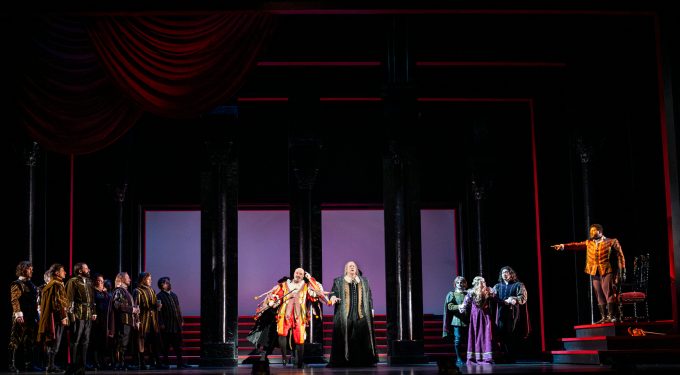
Rigoletto (Eugene Brancoveanu, center) and Monterone (Philip Skinner, center), Duke of Mantua (Edward Graves, right).

“Rigoletto”’s brass-dominated foreboding prelude and this production’s mostly low lighting and darkened sets foretell the tragedy ahead.  The drama is intense and dispiriting, but the music is glorious like few other operas.  Four of its highly melodious and uplifting arias and quartets are fixtures in opera music compilations.  Remembering them may cause one to forget how many other luxuriant phrases and passages grace the score, not to mention the fireworks from the many highly emotional tracks.  Act 1 alone contains a complex double ensemble and two beautiful duets.

Rigoletto (Eugene Brancoveanu), Gilda (Melissa Sondhi).

Opera San Jose offers a highly entertaining, riveting, and traditional rendition, maintaining the complexion that made the opera controversial in its own day for its immorality and even more so in current times for its social incorrectness.  The jester Rigoletto hypocritically obsesses over his daughter Gilda’s honor, yet publicly lampoons courtiers as being cuckolded.  At the same time, women are treated as chattel.  Rigoletto’s employer, the Duke of Mantua, lies and debauches, yet Gilda, will make the ultimate sacrifice to protect the Duke, her abusive and libertine lover, who has shown no reciprocal commitment.

The taunted and isolated Rigoletto, who values only Gilda in this life, is portrayed by Eugene Broncoveanu, OSJ stalwart and veteran of the role.  His deceptively effortless and clarion baritone booms throughout this demanding part, which requires diverse acting skills as well as a versatile voice.  Those qualities culminate when Rigoletto confronts the courtiers upon learning that Gilda has been kidnapped.  Interestingly, the title role is large and presents vocal challenges, yet with the exception of a small participation in the glorious quartet section of “Bella figlia dell’amore” (“Beautiful daughter of love”), it lacks a real signature number.

Rigoletto (Eugene Brancoveanu), Gilda (Melissa Sondhi).

Rigoletto has cloistered Gilda so that she doesn’t know the ways of the world.  Her naivete leads to her deceiving her father and the impulsive willingness to give up her life for love.  Soprano Melissa Sondhi is Gilda, and early in Act 1 on opening night, her voice sounded thin and strained.  Fortunately, she was fully prepared by the end of the act for the moment that emblemizes the innocent girl.  The haltingly beautiful “Caro nome” (“Dearest name”) tells of her first love, really an infatuation, for the student Gualtier Malté, who is the Duke in disguise.  Sondhi’s voice was warm and evocative, and she milked the brief aria for all it is worth.  The silences between single notes were palpable, and her ornamentation was delightful.

Gilda (Melissa Sondhi, left), Sparafucile (Ashraf Sewailam, center), Duke of Mantua (Edward Graves, right).

Detached from the opera, and without knowing the context of its most famous arias, one might think that the Duke is heroic, rather than the cad he really is.  His “La donna è mobile” (“Woman is fickle”) is one of the most famous arias in the consciousness of the general public, but the Duke also sings the bouncy “Questa o quella” (“This woman or that”) and the solo portion of lavish “Bella figlia dell’amore.”  Tenor Edward Graves handles each with great dexterity and in fine voice.  His Italianate melodiousness (some might say twang) fits perfectly with this great work from the Italian canon.

Maddalena (Melisa Bonetti Luna), Rigoletto (Eugene Brancoveanu), Sparafucile (Ashraf Sewailam).

The supporting cast is strong.  Two basses stand out – Philip Skinner as the mournful and vengeful Monterone who issues a curse on Rigoletto, and Ashraf Sewailam as Sparafucile, the assassin who Rigoletto pays to murder the Duke.  Mezzo Melisa Bonetti Luna shines as Maddalena, Sparafucile’s sister, whose morality falls beneath her brother’s.  Conductor Jorge Parodi keeps the orchestra and action at a brisk pace making for a highly rewarding experience.

“Rigoletto” composed by Giuseppe Verdi with libretto by Francesco Maria Piave produced by Opera San Jose, plays at California Theatre, 345 South First Street, San Jose, CA through March 3, 2024.

Corpus Evita


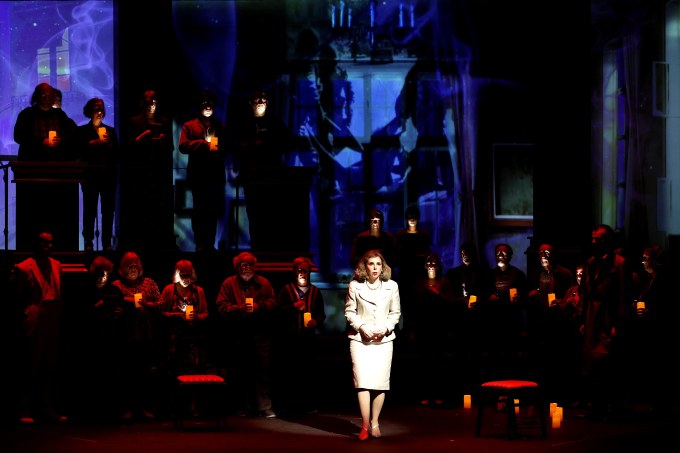
Eva Perón (Jessica Sandidge), Juan Perón (Casey Germain), Doctor (Anders Froehlich), Ministro (Patrick Bessenbacher). All photos by Otak Jump.

The name Perón is synonymous with modern politics in Argentina.  Juan Perón was a dominant post-WW2 populist president.  His second wife Evita became a mystical talisman for the country’s working class seeking a better way of life, but she died tragically in 1952 at age 33.  Perón was overthrown in 1955, but returning from exile, his third wife, Isabel, became his running mate in 1973 and succeeded him upon his death.   She sought to resurrect the magnetic aura of Evita as her own, only to be repudiated and overthrown by a military coup in 1976.

In fashioning “Corpus Evita,” composer Carlos Franzetti and librettist José Luis Moskovich explore the charisma of Juan and Evita, in contrast with Isabel’s doomed ascent and rejection, replete with the apparitions of her predecessors.  The seldom produced but remarkable musical drama was nominated for a Grammy in 2005.

Isabel Perón (Sara LeMesh), Ministro (Patrick Bessenbacher).

West Bay Opera offers a musically and visually powerful rendering of this piece which holds special resonance for its creators.  Both composer and librettist grew up in Argentina in the Perón era; were teenagers during Isabel’s regime; and ultimately crafted this operatic indictment of Perónism that many in their home country would find objectionable.  The librettist is West Bay’s General Manager, its artistic visionary, and the conductor of the orchestra.

The vivid look of the opera from Peter Crompton’s set and projection design appears from the start, with a classic public-appearances balcony surrounded by expressive and detailed projections that give depth to the stage.  At the opening, Evita bids farewell to her admirers from the balcony as she is dying from cancer.  In her soliloquy, soprano Jessica Sandidge cuts a striking and authentic figure as she powers through the high passages with grace and authority.

Doctor (Anders Froehlich), Corpus Evita (Laure de Marcellus).

The scene then shifts to 1974.  The central focus throughout the narrative is on the unprepared and hapless Isabel who considers herself well-intended but is unable to offer the hope and magnetism of Evita.   Feeling ineffectual and trapped, she meekly authorizes actions that result in the murders of thousands of innocent people.  Soprano Sara LeMesh adeptly captures Isabel’s inner conflict and sings her anguish with strident conviction without losing her eloquent vibrato.

A composite figure, Ministro, is the male lead, performed by tenor Patrick Bessenbacher.  He poses an ominous figure as the behind-the-scenes manipulator who hopes to resurrect “the flame of Evita” through Isabel.  He scorches his rage through his mid and upper range, but is asked to dig lower at times, and gets lost beneath the orchestra.

Isabel Perón (Sara LeMesh).

The musical idiom of the piece is neoromantic, without memorable melodies but continuously attractive.  Lush strings-forward sound dominates, with percussion often finishing, especially in heated sequences.  Notable choral contributions also include rhythmic, percussive effects, especially through repetition like “Evita. Evita. Evita” or “Isabel. Isabel. Isabel.”

Ensemble pieces also appeal.  Evita and Juan, sung by bass Casey Germain, engage in a self-indulgent duet at a grand ball, and the contrast of voices works particularly well.  Conversely, Isabel and Ministro vocally shout blame at each other with controlled fury in their electric exchange.  In a revelatory trio, Isabel, Juan, and Ministro share their different perspectives and shared regrets from Isabel’s failed regime.

Ministro (Patrick Bessenbacher).

“Corpus Evita” deals intelligently with important themes.  And though the conceit of magical realism allows for great leeway, because this opera deals with critical historical issues, accuracy is important.  Greater clarity would be welcomed in the plot line.  Simply including dates (which are in the program) in the supertitles would help orient the patron, as the timeline jumps by decades and is not chronological.  And though the device of Evita as an apparition is clever and understandable, a scene that includes Isabel with both Evita and Corpus Evita is not clear.

The events depicted in the opera are highly dramatic and engaging.  However, the drama is disrupted by emptiness during slow scene changes.  If the set change can’t be hastened, one solution is to move transitional action in front of the curtain while props are being moved.  Another is to add bridge orchestration for the changes.

Juan Perón (Casey Germain), Eva Perón (Jessica Sandidge).

Nonetheless, this opera offers a scintillating and worthy experience with beautiful music, an important storyline, and an opulent production.  Thematically, it excoriates Perónism as a symbol of populism, decrying the cult of personality and myths that invariably lead to tyranny.  Regrettably, many people fall captive to auras and neglect substance.  We face the same chilling challenge in this country today.

“Corpus Evita” with music by Carlos Franzetti and lyrics by José Luis Moskovich is produced by West Bay Opera and plays at Lucie Stern Theatre, 1305 Middlefield Road, Palo Alto, CA through February 25, 2024.

My Home on the Moon

Jenny Nguyen Nelson as Mai, Rinabeth Apostol as Vera, Sharon Omi as Lan. All photos by Jessica Palopoli.

Innovation has shaped the experience of humanity.  From hand tools to machines to computers, implements have reduced our burdens and determined how we go about our work and play.

Otherwise, from the dawn of humankind, dreams have reflected perceptions of a different world lived within – sometimes grand in our wakeful imagination, sometimes fearsome in our sleep.  But more recently, the innovations of virtual reality and artificial intelligence enhance perceptions and transport us to new and different realizations.  Playwright Minna Lee’s world premiere dramedy “My Home on the Moon” explores such an alternate reality, and San Francisco Playhouse delivers a richly rewarding production.

Sharon Omi as Lan.

Lan is a middle-aged Vietnamese-American woman who owns a café, Pho Lan, that offers only one item, the eponymous, famed noodle and meat soup from the country of her birth.  Young Mai, a dropout from a gourmet cooking academy, produces Lan’s recipe.

Though the soup is highly regarded, the café has fallen on hard times as the neighborhood gentrifies; other shops are closed to be replaced by construction for high rises; and the old customers move on.  Pho Lan faces closure when a seeming white knight comes along.  Lan learns that the shop has “won a grant” from the mysterious Novus Corporation.  Its representative, the marketing-savvy and charming but herky-jerky Vera organizes a new marketing campaign that Novus will sponsor.  It begins with a stylish update of the downmarket noodle shop that includes a lush Southeast Asian jungle.  But the promotions also include incongruous advertising with a vulgar couple engaging in sexualized acts, not something usually associated with a pho cafe.

Will Dao as Food Critic, Sharon Omi as Lan, Jenny Nguyen Nelson as Mai, Erin Mei-Ling Stuart as Camera Person.

The marketing plan works!  Pho Lan can’t keep up with demand, and even adds another popular menu item, bán xèo, a Vietnamese crepe.

So what’s wrong with this picture?  Without giving away too much, let’s say that we see the clash between fantasy and reality.  And since the fantasy experience is superior, it begs the question why we would ever want to come back to reality.  Although the script has logic holes, it could not be more timely.  It provokes thoughts about how we confront and assess the limitless potential and onslaught of falsehoods, security risks, displacement, and more that arise from artificial intelligence.

Erin Mei-Ling Stuart as Gigi (CEO of Novus), Will Dao as Beau (former employee of Lan).

Although the issues surfaced are serious, the overall tone is light.  The action occurs at the time of Tet with lion dances highlighted.  Separately, Lan and Vera perform humorous song and dance numbers demonstrating both Eastern and Western footwork.  Meanwhile, Vera’s personality is quirky altogether, while Will Dao’s food critic is outlandishly hyper and funny.

The cast is led by three captivating and contrasting female leads.  Sharon Omi is Lan, a smiling, sympathetic character who holds to tradition and hope.  This kind older woman treats Mai as a daughter.  As Mai, Jenny Nguyen Nelson is more grounded and concerned about the influx of unpaid bills that could cause the shop to close.  Vera becomes the catalyst for change, and an enthusiastic Rinabeth Apostol cooks up the marketing plan but has much to learn herself, much of which she will gain from a personal relationship with Mai.  Will Dao and Erin Mei-Ling Stuart give solid performances in multiple supporting roles.

Rinabeth Apostol as Vera, Jenny Nguyen Nelson as Mai.

Another big star is the production design led by Director Mei Ann Teo.  With the utilization of its revolving platform, SF Playhouse sets the Bay Area standard for multi-set staging, and Tanya Orellana’s clever use of the space complemented by Vincent Chau’s props results in a remarkable design.  Three essential lighting-related treatments complete the overall appearance.  Lighting Director Michael Oesch employs several lighting features including color changes to produce the look.  Jacqueline Scott, the specialty properties designer, implements the long snake-like light noodles.  Finally, Hao Bai’s inward swooping isobar projections create the appropriate symbolic sense of tumbling down the rabbit hole.

Sharon Omi as Lan.

“My Home on the Moon,” a world premiere written by Minna Lee, is produced by San Francisco Playhouse and plays on its stage at 450 Post Street, San Francisco, CA through February 24, 2024.

Cult of Love


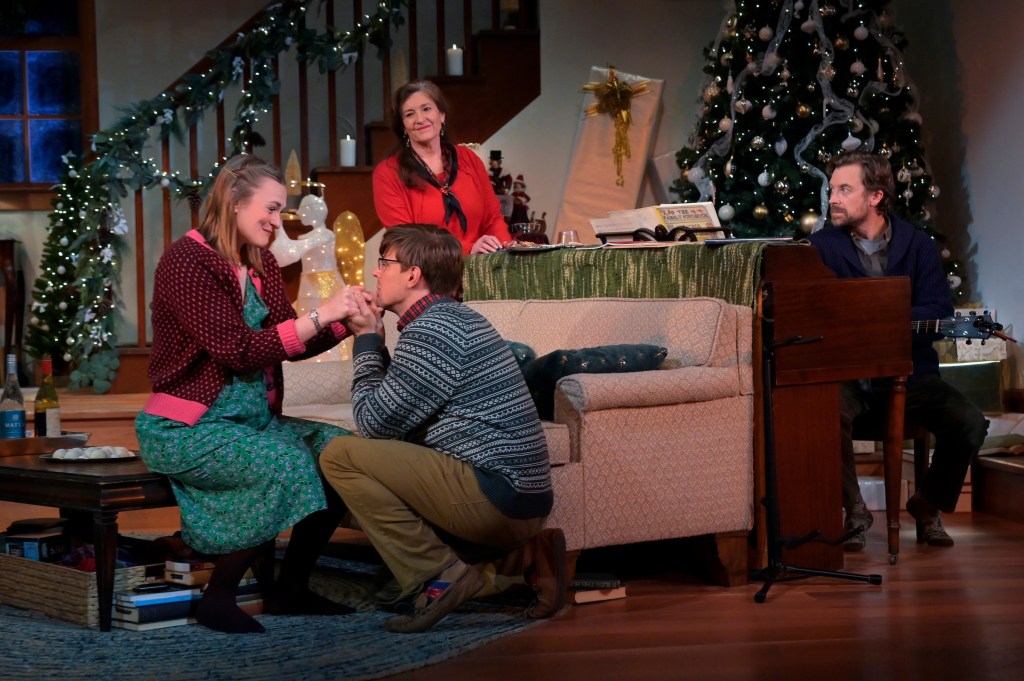
Cass Buggé (Pippa Ferguson – Evie’s wife), (above) Kerstin Anderson (Diana Dahl Bennett – daughter), Virginia Kull (Evie Dahl – daughter), Luisa Sermol (Ginny Dahl – mother), Lucas Near-Verbrugghe (Mark Dahl – son). All photos by Kevin Berne.

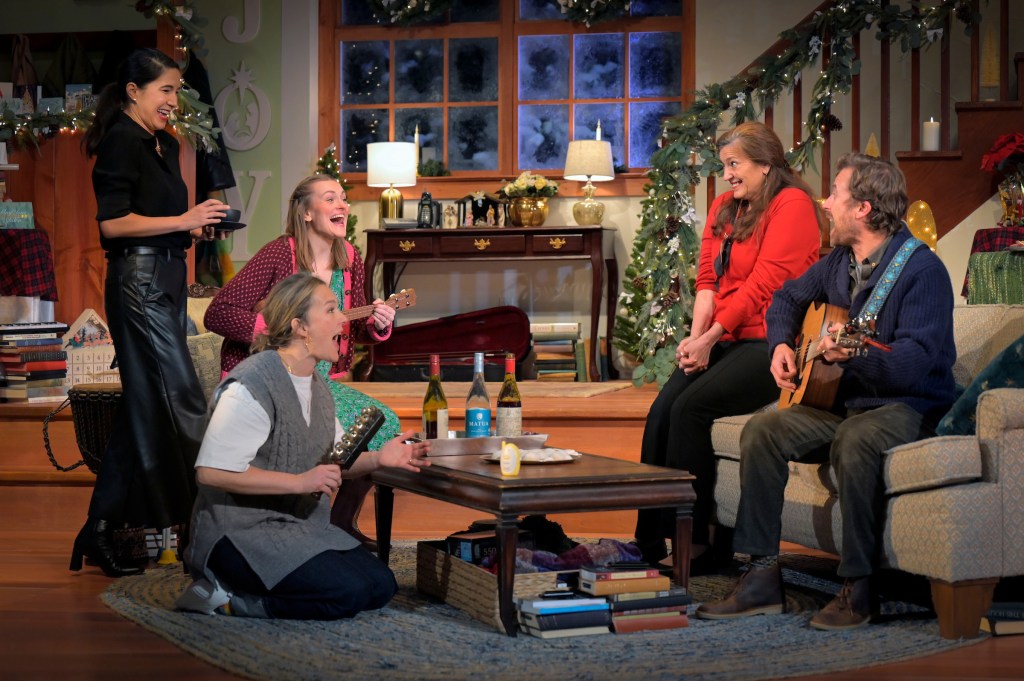
It all starts in Kumbaya spirit.  Adult children and their spouses gather with their parents at the Dahl family homestead, festively fashioned for Christmas.  Smiling and enthusiastic, they sing holiday and folk traditionals like “A’Soulin” and “Children, Go Where I Send Thee.”  Later, in memory of a trip to the Great Smokies, the four children sing a beautifully harmonic “Oh, Shenandoah.”  But like their erroneous connection with that song, which actually relates to an Indian chief, the familial harmony is an illusion, as it occurs almost solely when they join in song.

Dan Hiatt (Bill Dahl – father), Virginia Kull (Evie Dahl – daughter).

Playwright Lesley Headland has crafted a wildly entertaining and stunningly searing indictment in “Cult of Love,” the final chapter in a seven-play series.  Trip Cullman, a frequent collaborator with Headland, directs a stellar cast to a masterful and captivating production.  Each play addresses one of the Seven Deadly Sins, with this installment focusing on pride, which in some ways can be considered a master sin, as it can lead to committing most of the others. 

Bill and Ginny Dahl fervently identify themselves as “Christians” and raised their children accordingly. Christmas takes on special meaning for them, as the children ritually return home for the holiday; sing carols; eat lamb dinner prepared by the father; and take the obligatory photo of the four kids together smiling. 

Lucas Near-Verbrugghe (Mark Dahl – son), Molly Bernard (Rachel Dahl – Mark’s wife).

But ultimately, the traditions become disingenuous as children gain their own sense of agency, and gaping fissures appear in the relationships.  The uber-talented and academically accomplished Mark has settled for a government job, married a Jewish girl and seemingly repudiated Christianity.  Johnny is a recovering heroin addict and unmarried.  Evie is a lesbian and in a same-sex marriage.  Finally, Diana has become a doctrinaire fire-and-brimstone zealot who castigates and alienates those around her with her judgmentalism and rigidities.

Parents always hope to love their children, but the elder Dahls must confront children whose actions contradict the parents’ beliefs.  Not exactly what the parents hoped for.  But like Christian fundamentalists, Ginny’s belief-driven system extends beyond the moral and existential, so that beliefs trump facts in the realm of science. Although Bill has shown evidence of mental deterioration, she refuses to accept the obvious, which becomes a major source of friction in the family.

The partiality of the parents is felt by some of their children, to which Bill argues that he loves everyone, which may be interpreted as he feels no more for his children than for others.  He then qualifies his statement by noting that he hated his father, which suggests that generational antipathy is not limited to this immediate family.

(standing) Christopher Sears (Johnny Dahl – son).

Headland makes an interesting choice of surnames for the family in question, Dahl.  It is a homophone of doll, which is a human imitation, a counterfeit.  Are the Dahls a family in name alone?

Personality traits become more manifest and unidirectional as the action unfolds.  One exception is Mark, who has an episode that either represents retrogression or convenient and skilled acting.  Siblings inflame old wounds and new with remarkable candor.

Kerstin Anderson (Diana Dahl Bennett – daughter), Christopher Lowell (James Bennett – Diana’s husband), Luisa Sermol (Ginny Dahl – mother), Lucas Near-Verbrugghe (Mark Dahl – son).

So how does this all relate to pride?  The playwright’s thesis is that certainty of belief breeds pride.  We become self-referential and exclusionary when we feel that we have all of the right answers.  It may not be too difficult for the reader to intuit the primary source of the sin in this drama.  Of course, a further question is begged – is a person who actually does have the right answers prideful?

While the script offers powerful messages, they are also delivered with consummate skill.  Acting is superb by an ideal ensemble cast.  Talking overlap and even competing conversations are deftly executed.  Although the conflict in this play is pronounced, it offers considerable levity, with players earning laughs from pedestrian lines.  Major contributions are added by the creative designers, with a special nod to Scenic Designer Arnulfo Maldonado, whose massive and detailed set provides beauty, function, and authenticity.  This play is highly recommended.

Lucas Near-Verbrugghe (Mark Dahl – son), Dan Hiatt (Bill Dahl – father), Vero Maynez, (Loren Montgomery – addiction recovery mentee, friend of Johnny), Luisa Sermol (Ginny Dahl – mother).

“Cult of Love” is written by Leslye Headland, produced by Berkeley Repertory Company, and is performed on its stage at 2025 Addison Street, Berkeley, CA through March 3, 2024.