Something Rotten

Nick Bottom (Brandon Savage), Nostradamus (Caitlin Beanan). All character photos by Tracy Martin, cast dance photos by Mark Kitaoka.

Imagine if William Shakespeare were alive today.  As the playwright of a canon of 40ish of the world’s most produced plays, he would easily be the richest literary figure ever seen.  Then there would be royalties from works based on the Bard’s plays, like Verdi’s operas “Otello” and “Falstaff” and many musicals/movies like “West Side Story” or “Kiss Me Kate.”

Perhaps because of Shakespeare’s mystique and his mysterious life, he has also become the subject of semi-factual, speculative, and fanciful works such as “Shakespeare in Love” and “The Book of Will.”  One that would put a burr under his saddle if he took it seriously is “Something Rotten.”  Some may argue that it intends to bring The Bard down a notch, but more likely, it’s that a spoof like this works because he’s a big target known by all.
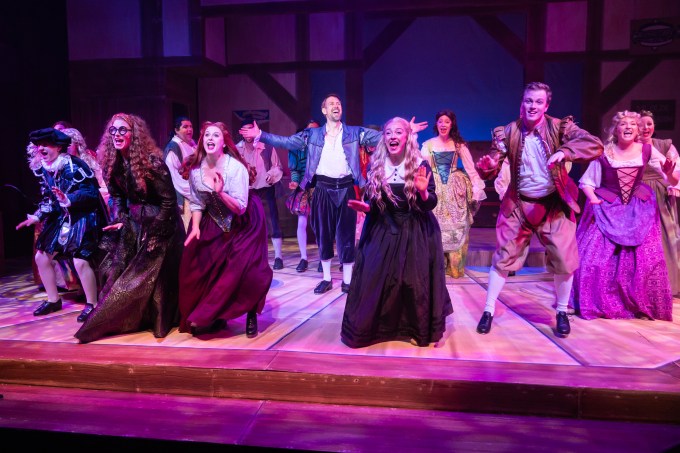
Cast.

If Shakespeare joined in with the rest of the audience, he would appreciate this piece as a highly literate, screamingly funny, fast-moving, well-produced farce.  In its 83rd year, Hillbarn Theatre provides consistently high-quality community theater, and with this musical it demonstrates once again that a non-equity house can deliver a totally professional-quality production.

In this whimsical narrative, the brothers Bottom write plays but fail to keep pace with the literary darling of the day, Will Shakespeare.  Nick, being the older and more driven (portrayed by a charismatic and talented Brandon Savage), consults with a soothsayer to predict trends in the entertainment industry.  That oracle Nostradomus (played by a wildly frenetic, magnetic Caitlin Beanan) predicts that musicals will be the next big thing.

Nigel Bottom (Andrew Cope), Nick Bottom (Brandon Savage), Bea (Melissa WolfKlain).

Ultimately, the Bottoms birth “Omelet,” and you would be surprised how many tongue-in-cheek corollaries to “Hamlet” can come from a musical about eggs, starting with the rotten references.  For those looking for deeper messages, the direction taken exemplifies the eternal clash of whether to write a money-making hit or “To thine own self be true.”

Along the way, the poem authoring younger Bottom, Nigel (an innocent, diffident Andrew Cope) crafts what Nick considers throw away lines like “To be or not to be,” “This is the winter of our discontent,” “A band of brothers,” and more.  Tossing the pages they’re written on, guess who is around to pick up the pieces!

Shakespeare (Julio Chavez).

Of course, Shakespearian allusions and colorful characters abound.  Most characters’ names draw from “Midsummer Night’s Dream,” but Nick’s wife Bea, presumably represents Beatrice from “Much Ado About Nothing.”  Played by a bouncy and determined Melissa WolfKlain, she represents feminism as she insinuates herself into traditionally male trades, including bear dung removal!  She boldly insists that, this being the 1590s, and having a queen as Head of State, gender equality will certainly come by 1600.”

Shylock from “The Merchant of Venice” shows up so there can be a Jewish money lender, stage show producer, and source of schtick.  Meanwhile, Puritan minister Brother Jeremiah tries to gum up the works with religious sanctimony.  The final key character is the Renaissance rock star Shakespeare himself, played flamboyantly by a strutting, writhing, and shifty Julio Chavez.  As you might infer, the lauded playwright and poet is depicted as a conniver and plagiarizer, but it’s all in good humor.  Like all the leads in the cast, Chavez’s comic timing makes every laugh line work.

Brother Jeremiah (Dan Demers), (on right) Portia (Jill Jacobs).

As a musical, “Something Rotten” brims with songs that enhance the storyline like “God, I Hate Shakespeare” and “A Musical,” having bright melodies, witty lyrics, and unending literary references.  Strong voices ensure that they are well sung, and often, comic undertones give the delivery extra zing.  A fair share of double entendres creep into the book and the lyrics as suggested by the song title “Bottom’s Gonna Be On Top.”  While a little raunchiness and potty language surfaces, rarely would an attendee be offended (or maybe they wouldn’t get the drift).

Director Randy O’Hara leads an outstanding creative team that pulls all the right stops.  Special recognition goes to Costume Designer Pam Lampkin, who puts together an abundance of period costumes as well as modern garb to represent characters from the likes of “South Pacific” and “Annie,” whose popular music themes are sampled in this soundtrack. Choreographer Leslie Waggoner produces many appealing dance numbers, effectively utilizing numerous performers who ably strut their stuff, in fun dance idioms, from tap to high kick lines.  A good time is had by all.

Cast.

“Something Rotten,” with book by John O’Farrell & Karey Kirkpatrick and music and lyrics by Karey & Wayne Kirkpatrick is produced by Hillbarn Theatre and plays on its stage at 1285 East Hillsdale Blvd, Foster City, CA through May 12, 2024.

A Strange Loop

J. Cameron Barnett (Thought 2), Tarra Conner Jones (Thought 1), Jamari Johnson Williams (Thought 6), John-Andrew Morrison (Thought 4), Malachi McCaskill (Usher), Jordan Barbour (Thought 5), Avionce Hoyles (Thought 3). All photos by Alessandra Mello.

Under the best of circumstances, getting a play produced on Broadway is a longshot, even if it doesn’t have any particular obstacles that might deter audience attendance.  To assess traits that undermine a play’s marketability, a funnel can be used as a visual representation of how unpopular aspects of a play can accumulate, resulting in diminishing audiences.  A large volume at the top of the funnel (bigger audience) gets more restricted the further it goes down (smaller audience).

Consider the likelihood of “A Strange Loop” reaching Broadway.  The funnel of impediments that accumulate, starting at the top, looks something like this:  It’s a musical —– with book, music, and lyrics from a writer without a professional theater credit —– about a fat man —– who is also black —– and queer —– and totally navel-gazing, self-referential about being fat, black, and queer —– having an all-black cast —– that is almost all male —– whose language concerning sexual parts and private bodily activities is totally unfiltered and almost constant —– that uses the n-word with great frequency —– and includes simulated homosexual sex.

Of course, you wouldn’t be seeing this review if the weight of these obstacles weren’t overcome.  Michael R. Jackson’s play “A Strange Loop” won the Pulitzer Prize for Drama; Tony Awards for Best New Musical and Best Book of a Musical plus nine more nominations; and many other recognitions from its Off-Broadway beginnings.  Using the Broadway creative team, the San Francisco premiere from American Conservatory Theater offers a captivating, high energy, yet empathetic production that found a wildly supportive audience on opening night.  Adventuresome and more open-minded theatergoers will like much if not all in this production, but the caution flag is up for those who might be offended by the rawest of language and action.

Malachi McCaskill (Usher).

The central figure, and surrogate for the playwright, is Usher, whose outline is given above.  Further, he is 25 years old, from Detroit, and trying to make it as a playwright in New York.  Fittingly, while he pursues his dreams, he ekes out a living as a theater usher.  The playwright’s choosing a character’s name that is shared by a famous R&B singer is no accident, because Jackson has suffered with that issue all his life.  And much of the playwright’s subtext concerns matters of “Who am I?  Am I Michael Jackson? Whose adulation do I deserve? Am I really loved?  What matters?  Am I a negro?  Am I their negro?” Those in the Bay Area familiar with Brian Copeland’s popular theater work will particularly appreciate the last two questions.

So, what is a strange loop?  It’s a rather obscure psychological term that ….. Well, it’s complicated.  You can look it up.  What is “A Strange Loop” about?  At one level, it’s about Usher’s obsession with his physical being and his sex life.  But the text also cascades metatheatrically into his professional aspirations.  It’s a play about a fat, black, gay man writing a play about a fat, black, gay man writing a play about a…… 

Malachai McCaskill is absolutely stunning as Usher.  He completely earns the compassion of the audience including those who don’t identify with the personal traits of his character.  Even his vulgarity conveys a sense of innocence and yearning to make sincere connection.  With warm charisma, McCaskill gives a bravura performance, being on stage almost full time and bearing a heavy singing load.  His vocal range is great, which is needed, but his voice is not terrific, at least not the way he uses it here.  And that is a good thing, because if he had a fine voice like the celebrity Usher, it wouldn’t fit his downtrodden character.

Thoughts 1-6.

Remarkably, and somewhat in parallel with Jackson, this is McCaskill’s first professional engagement.  He is a junior at University of North Carolina Greensboro, and all of his stage credits are from there!

The other six actors program names are listed as Thought 1 through Thought 6.  They manifest Usher’s neverending introspection, and most of the thoughts that they disclose are self-chastising.  One of these psyches controls his pronounced sexual ambivalence, but he does seem to have genuine affection for “the little white girl inside me.”  In addition to being revelatory, The Thoughts are a total scream – flamboyant with wild gesticulations and great movement choreography.

The six sometimes play specific characters, most importantly, Usher’s parents, neither of whom have reconciled to his coming out several years before.  His father has no compunctions about his feelings about homosexuals.  More than once he asks if Usher is attracted to him since the son likes men.  It is not clear whether the father simply provokes the son or whether he shares some of the same orientation and possibly an inclination toward incest.  While his uber-religious mother (always played by men) shows affection it does not appear unconditional.  She invariably rails against his homosexuality and implores Usher to craft plays such as a gospel musical or something like Tyler Perry would do.

Jordan Barbour (Thought 5), Malachi McCaskill (Usher).

Among other notable characters that The Thoughts perform are a sextet of historical black persons; a handsome black man who comes on to Usher in the subway; and a chilling and abusive white man.  While we know that the black people appear in Usher’s imagination, who knows about the white man?

The production quality is top flight.  Its two greatest weaknesses concern repetitiveness.  Some points are made repeatedly, so that the script could be abbreviated a bit.  Also, while each song is pleasant and most are energetic, a certain propulsive sameness sets in.  Finally, it is interesting to note that in various iterations of “A Strange Loop,” different casting configurations have been used, including an early one with two white girls.  Another female in this version would be welcomed.

That said, the musical offers equal and rewarding measures of entertainment and insight.  And despite the frequent negativity and pushback that Usher faces, we somehow feel that he’s going to come out okay.  His playwright certainly did.

(front) Malachi McCaskill (Usher), (rear) Jamari Johnson Williams (Thought 6), Tarra Conner Jones (Thought 1), John-Andrew Morrison (Thought 4), Avionce Hoyles (Thought 3), J. Cameron Barnett (Thought 2).

“A Strange Loop,” with book, music, and lyrics by Michael R. Jackson is produced by American Conservatory Theater in association with Center Theatre Group (of Los Angeles), and plays at Toni Rembe Theater, 415 Geary Street, San Francisco, CA through May 12, 2024.

Forever Plaid

Edu Gonzalez-Maldonado as Jinx, Kevin Singer as Frankie, Matt Skinner as Smudge, Justin P. Lopez as Sparky. All photos by Ben Krantz.

Four-part vocal harmony dates at least to the Baroque era, achieving its artistic apex with 19th century Romantic opera, evidenced by multi-lyrical, polyphonic quartets (i.e., having multiple lyrical lines and melodies simultaneously), like the beautiful “Bella figlia dell’amore” (“Beautiful daughter of love”) from Verdi’s “Rigoletto.”

Barbershop quartets of all male voices reached broader markets in the United States in the late 19th century and beyond.  Finally, starting in the 1930s with the Mills Brothers and the Ink Spots, male pop music ensembles would populate the hit music charts and the air waves.  The popularity of male groups with mellow sound and close harmonies would peak in the ‘50s and early ‘60s with memorable music from The Ames Brothers to The Lettermen, and many groups with Four in their names.

Kevin Singer as Frankie.

Against this most recent backdrop, writer Stuart Ross created “Forever Plaid,” a musical revue of mostly four-part male harmony songs from the pop era, wrapped in a tissue thin, but funny scenario comprised of unrelated skits mostly built around songs.  The show’s appeal is revealed by its long legs, having run off-Broadway for over four years and spawning successful revivals worldwide.  42nd Street Moon’s winsome production, stage and music directed by Daniel Thomas, brims with nostalgia, laughs, and good sounds.

The central conceit is that, having performed only at the likes of Moose Lodges, dive bars, and weddings, the four aspiring singers die in a car accident.  So, their show takes place on a vastly bigger stage – their return from the ether for one last concert.

But rather than a simple stand-and-deliver from behind four microphones, the young men are in motion.  Brittany Monroe’s individual dance skits may be simple, but the choreography works well and runs constantly from curtain rise to curtain fall.  And of course, humorous obstacles always block the way of the group, like attacks of asthma and nose bleeds.

Justin P. Lopez as Sparky.

Although some of the cast’s voices are better than others, the good thing about ensembles is that even modest voices can add up to a great overall sound, and this is the case with The Plaid.  The show opens and closes with two classics of the genre, both having had popular versions by The Four Aces – “Three Coins in the Fountain” and “Love is a Many Splendored Thing.”

However, the “close ups” are often in songs delivered as solos.  Edu Gonzalez-Maldonado as Jinx, sings “Cry,” popularized by the Johnny Ray recording in 1951.  Up to that point in the show, Jinx was portrayed as diffident and his voice didn’t come across much in the harmonies.  So, imagine the surprise when he grabs a standing mic; dips it almost to the floor a la Elvis; and belts out a confident and worthy version with a powerful voice and good range as well.

Edu Gonzalez-Maldonado as Jinx, Matt Skinner as Smudge.

Kevin Singer (his real last name?) as Frankie didn’t seem to be in particularly good voice to start but revealed fine tone and variation later on.  In the funniest skit, he sings “Lady of Spain” while the other three perform a Cliff Notes, Keystone Kops, slapstick version of the Ed Sullivan Show in three minutes and eleven seconds.  There’s the magician, the juggler, the opera singer, and of course, the memorable puppet character, Topo Gigio.

Another highlight is “Perfidia” which Justin P. Lopez as Sparky gets to sing lyrics in both English and Spanish.  His voice is pleasant but seemed underpowered in this performance.  He does however lead one of the funnier dance sequences as well.  Finally, with the lowest singing voice of the group, Matt Skinner as Sludge (!) soloed with his version of “16 Tons.”

Although a few curious choices fill the playlist, a number of other classics from the period capture audience enthusiasm, including a medley of Perry Como songs and a medley of calypso numbers.  To ensure involvement by the patrons, the Jamaican song “Matilda” included audience sing-a-long participation.  Also, a brave theatergoer was brought on stage to lend one finger to help play a song that is an early right of passage to any wannabe piano player, “Heart and Soul.”

Matt Skinner as Smudge.

For this Sunday matinee, the audience was the expected highly homogeneous blue-haired crowd, this reviewer and his wife included.  But it was just the right generation to soak in the nostalgia of the musical and appreciate the enjoyable production.

“Forever Plaid” is written by Stuart Ross with music by various composers and librettists, is produced by 42nd Street Moon and plays at Gateway Theatre, 215 Jackson Street, San Francisco, CA through May 5, 2024.

Florencia en el Amazonas

(foreground) Paula (Guadalupe Paz), Riolobo (Ricardo José Rivera), Alvaro (Efraín Solís), (above) Captain (Vartan Gabrielian). All photos by David Allen.

Mexican Daniel Catán’s 1996 opera has received great attention because of the rarity of Spanish language operas and the number of performance firsts that it has amassed.  One can be excused for believing that it is produced because of its lingual uniqueness or because it placates audiences in communities with large Hispanic representation.  That would be wrong.

Some critics have been dismissive of the opera simply because it looks backward stylistically rather than adhering to the drab tenets of modern opera convention. The first signal that it stands on its own as a towering work is that each of its three distinguished commissioning opera companies (Houston, Los Angeles, and Seattle) have revived the work – a total of four times.  The Met and the Lyric of Chicago have also produced it.  Opera San Jose offers a stunning production that raises the question why it took so long for this piece to make it to this stage.

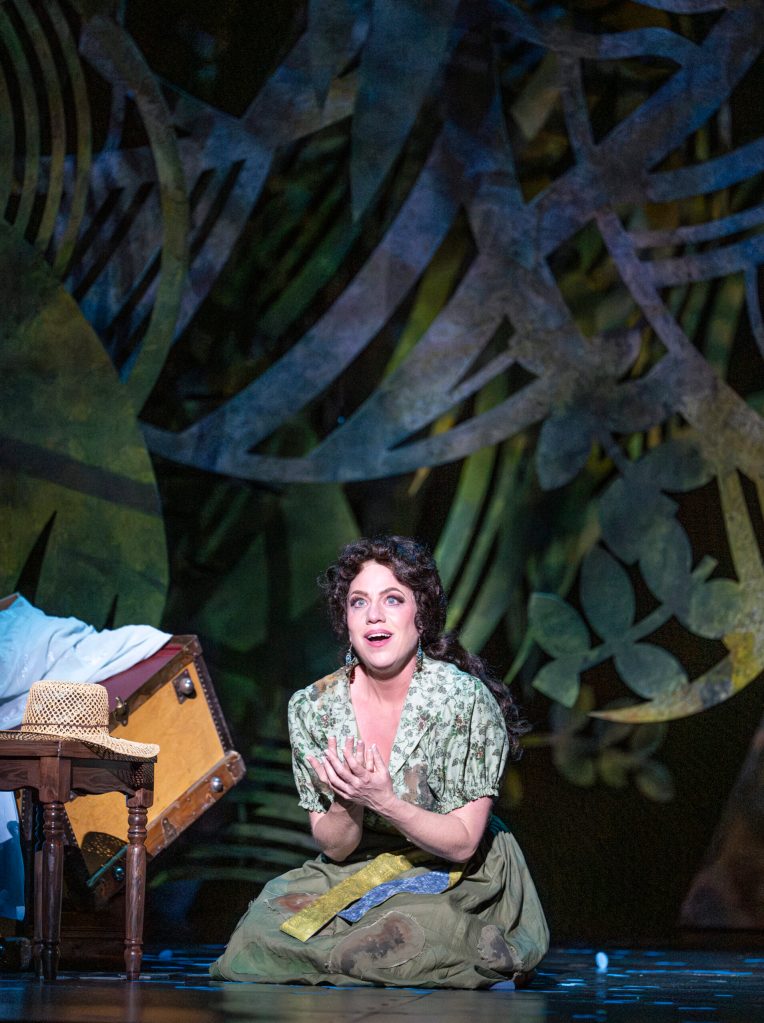
Florencia (Elizabeth Caballero).

The composer worked with librettist Marcela Fuentes-Berain who developed a straight-forward and accessible narrative that adds richness by merging it with the magical realism of Gabriel Garcia Márquez, under whom she studied.  The jungles of the Amazon are a perfect setting for the literary conceit.  Fuentes-Berain even integrates cholera into the libretto of this love story, in a nod to her mentor’s masterpiece “Love in the Time of Cholera.”  Other trials, large and small, will confront the passengers on their journey.

In opera, music comes first.  Unlike most modern operas with musical scores that afficionados are trained to appreciate but rarely really like, “Florencia en el Amazonas” will thrill lovers of 19th century Italian and French opera with its lush romanticism.  Its warm tonal music fits the place and time, which is presumed to be late 19th to early 20th century.

(seated) Alvaro (Efraín Solís), Paula (Guadalupe Paz), (standing) Riolobo (Ricardo José Rivera).

Catán especially uses instruments like vibes, timpani, and drums in addition to the usual orchestral instruments for onomatopoeia.  Together, they imitate the haunting trills and undulations of the jungle, from birds and insects, as well as the rolling and thumping of thunder and storms.  The vocals, particularly the soprano arias and the ensembles sound like they could come straight out of a Puccini opera, especially recalling the soaring of Mimi and the torment of Tosca.

Opera soprano Florencia Grimaldi (interestingly, an Italian surname and the dynastic royal family of Monaco) had deeply loved Cristóbal, a butterfly hunter who disappeared into the Amazon jungle.  Twenty years later and with great fanfare, Florencia (portrayed by Elizabeth Caballero) is to return to perform at the Manaus Opera House.

(foreground) Florencia (Elizabeth Caballero), Rosalba (Aléxa Anderson), Paula (Guadalupe Paz), (above) Riolobo (Ricardo José Rivera).

Because of her discomfort with fame and adulation, she travels on a ship from Colombia to the Amazon incognito, where she encounters a journalist, Rosalba (Aléxa Anderson) looking to fill out her notes for a biography of Florencia.  A feuding couple Paula (Guadalupe Paz) and Alvaro (Efraín Solís) complete the passenger list.

The Captain (Vartan Gabrielian) loves only sailing as a profession and cannot imagine any other, while his nephew Arcadio (César Delgado) cannot wait to escape the tedium of the river.  Arcadio will fall in love with Rosalba, resulting in a third romantic dyad.  The final character, a spirit figure who links the real and magical worlds, is the colorful catalytic factotum Riolobo (Ricardo José Rivera).

Arcadio (César Delgado), Rosalba (Aléxa Anderson).

Although the central character’s name appears in the title, the opera is an ensemble in terms of shared limelight, and the vocal quality of the cast collectively shines.  The accomplished Caballero navigates the score’s musical challenges including a wide range with many significant vocal leaps, while displaying a rapid, shimmering tremolo, particularly in Florencia’s wistful paean to her lost love.  The little heralded Anderson as Rosalba proves her mettle and more with a bright, crystalline, and penetrating soprano and an ability to hit the leaps in her role part without the hesitation that Caballero sometimes takes.  On the male side, Rivera’s powerful baritone as Riolobo fills the house, as does his personality.

Alvaro (Efraín Solís), Rosalba (Aléxa Anderson), Paula (Guadalupe Paz), Arcadio (César Delgado).

The Joseph Marcheso conducted orchestra produces an ideally diverse, warm, and powerful resonance.  While the three artists in the previous paragraph are able to compete with the enthusiastic volume of the orchestra, some other performers did not always fare as well on opening night, especially early on.

As beautiful as the arias and the stand-alone orchestral tracks are, the most stunning music is in the many duets and quartets involving many combinations of characters.  A quartet of players in a card game trivially disclose their holdings, but each singer shines in brisk, short solos.  In subject and style contrasts to the card players, Florencia and Rosalba share a poignant revelatory duet, while in another set piece, Paula and Alvaro reflect on the mistakes that they’ve made in their relationship.

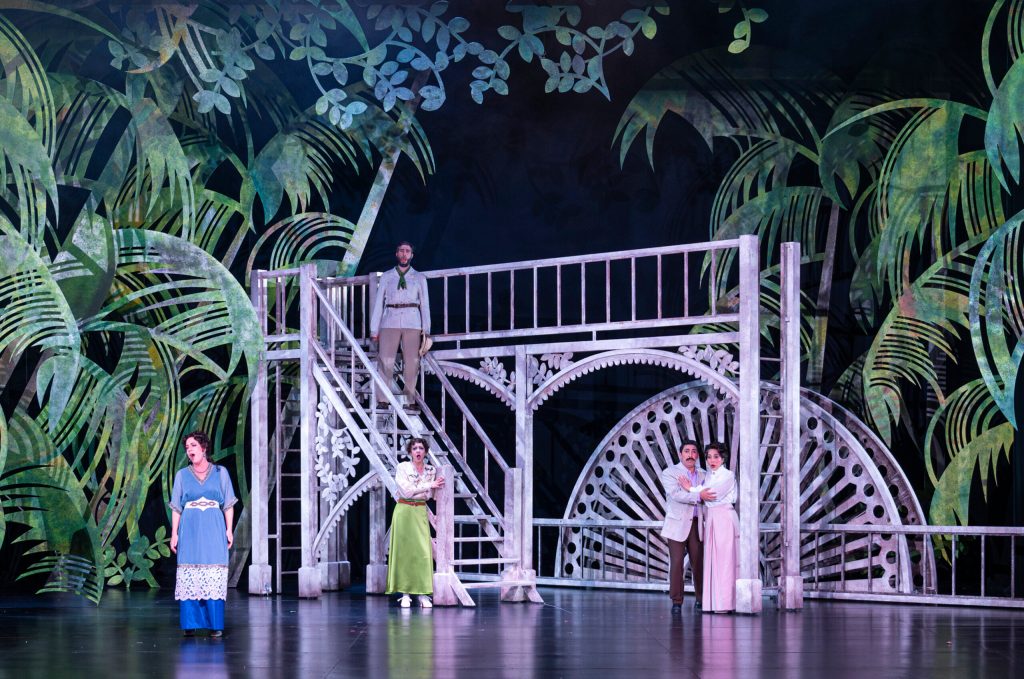
(foreground) Florencia (Elizabeth Caballero), Rosalba (Aléxa Anderson), Alvaro (Efraín Solís), Paula (Guadalupe Paz), (above) Captain (Vartan Gabrielian).

Commentary about Director Crystal Manich’s masterful staging must include compliments to Liliana Duque-Piñeiro’s captivating, impressionistic scenic design that figuratively captures the mystical sense of the environs.  Two components dominate.  The broadleaf, green jungle that frames the stage looks like it’s pulled from an Henri Rousseau painting.  And the sparkling white paddlewheel and stairs that represent the ship appear as if drawn from an American primitive painter’s riverboat study.  Tláloc López-Watermann’s often concentrated and diverse lighting, which affects color shading throughout, adds to the drama.

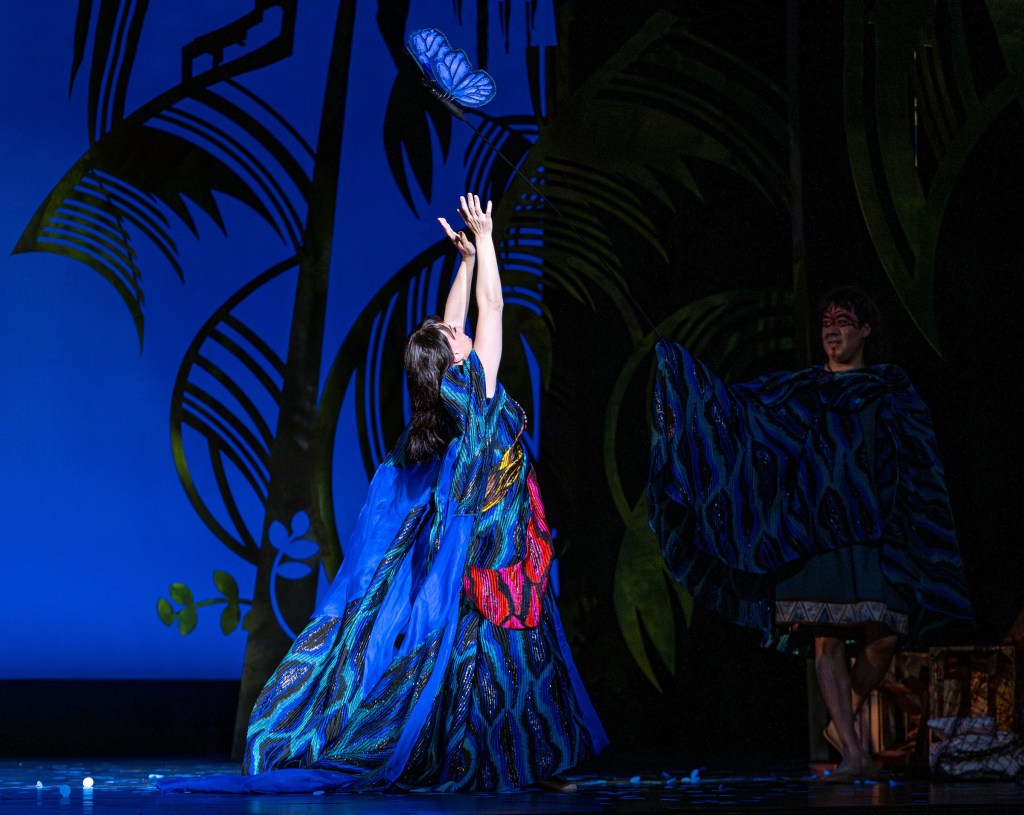
Not only do the music, libretto, and staging excel as individual elements, but the totality exceeds the sum of its parts, capturing the magical realism, most visibly as small butterflies flutter to the stage at the end of Act 1.  Fittingly, at the story’s end, one large butterfly offers itself for a lover’s transmigration.

Florencia (Elizabeth Caballero), Riolobo (Ricardo José Rivera).

“Florencia en el Amazonas,” composed by Daniel Catán with libretto by Marcela Fuentes-Berain, is produced by Opera San José and plays at California Theatre, 345 South 1st Street, San Jose, CA through May 5, 2024.

Tiger Style!

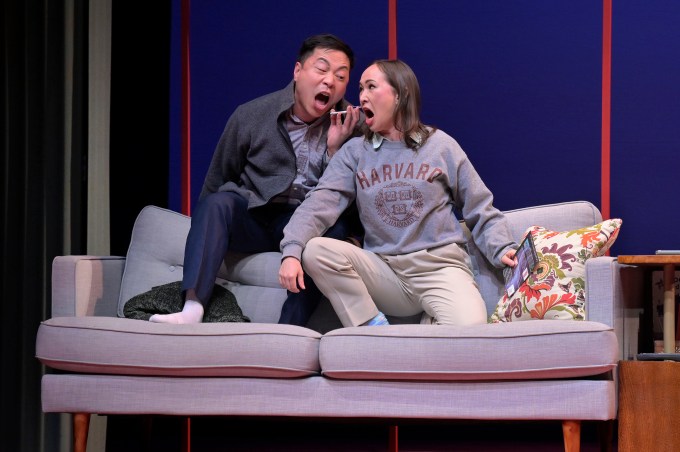
Emily Kuroda as Mom, Will Dao as Albert, Francis Jue as Dad, Jenny Nguyen Nelson as Jennifer. Photo by Reed Flores.

Stereotypical Asian parenting has long been recognized in American communities with significant Asian populations, but it became more known and talked about with the 2011 publication of Amy Chua’s “Tiger Mom.”  Tiger parenting demands superior performance from children with little tolerance of diversion from goals, whether academic or extracurricular.  While parents may be loving, they rarely praise and often belittle their children.  A further characteristic is that children should “keep their heads down” to avoid confrontation with authority.

Playwright Mike Lew unveils tiger parenting in a raucously humorous, though sometimes overwrought, manner.  But instead of depicting children enduring parental authoritarianism, we see unmarried adult siblings.  Already into their careers, they are unable to escape the psychological shackles of their upbringing, long on knowledge but short on life skills.

Francis Jue as Melvin (the boss), Jeremy Kahn as Russ the Bus, Will Dao as Albert. Photo by Reed Flores.

Jennifer (Jenny Nguyen Nelson) represents the storybook of accomplishment – Harvard MD/PhD and former concert pianist to boot!  But what she really wants is to live a life like in an American rom-com.  Her brother Albert (Will Dao) writes computer code, but he wishes to be like a band member from the musical “American Idiot.”  As a good collaborator, Albert doesn’t take personal credit for the output from his team at work, but when a low-contributing, dim-witted white guy, Russ the Bus (Jeremy Kahn), gets promoted over him, Albert reaches his breaking point.  No longer will he keep his head down.

Quitting his job, Albert enlists Jennifer in a momentous quest.  As an Asian, Albert feels unable to become all-Western, and so decides to go full-Asian.  The two choose to take an “Asia Freedom Tour.”  Feeling they would fit in better in China, the land of their heritage, they decide to pack it in and resettle there, never mind that they don’t speak any Chinese dialect.  As expected, things get even whackier when they arrive in China.  Not surprisingly, the taunts of “You’re not American” that they had heard in the past, turned to “You’re not Chinese.”

Emily Kuroda as therapist, Jenny Nguyen Nelson as Jennifer. Photo by Reed Flores.

“Tiger Style!” covers a lot of ground that might appear well-trodden by more cosmopolitan audiences but not by more provincial.  For the theater-going among the former group, there may be a sense of déjà vu, as the backstory of the siblings’ immigrant great-grandfather and the history in the play “The Far Country,” which just closed at Berkeley Rep, are virtually identical.  The ancestor comes through the immigration severity of Angel Island; leaves family behind; starts as a dishwasher; moves up to working in a laundry; ends up owning multiple laundries.

The playwright touches on a number of themes.  Certainly, stereotyping is one.  The good news is that for the greater part, simplified thoughts about Asians center on resentment and envy because many of them have excelled despite facing extra obstacles.  In the words of the siblings’ parents in dealing with rejection in the broader white community is “Just suck it up.”  The focus on education along with hard work has led to considerable success.

Will Dao as Albert, Jenny Nguyen Nelson as Jennifer. Photo by Kevin Berne.

The narrative deals with the challenges of being an Asian-American – probably having ethnic pride; perhaps having loyalties both to the United States and the heritage country; and often suffering by the attribution from other people of having divided or conflicting loyalties.  Of course, this is an issue with all hyphenated Americans, but with non-Europeans, facial appearance alone invites discrimination.  There is also the factor of the political relationship between the U.S. and the country of the heritage of the hyphenated American.  Chinese, or presumed Chinese, will endure a different form of discrimination because of fear-mongering and finger-pointing concerning the origins of Covid, in addition to the political and economic competition between China and the U.S.

All of the characters in the play are caricatures, but most Chinese are treated with some sympathy or possess some redeeming qualities.  The three European-American roles are a computer coder who is stupid and offensively familiar; a boyfriend who is self-indulgent and rudderless; and an immigration officer who is rigid and condescending.  The playwright could have introduced some nuance for these treatments to avoid being subject to the accusation of reverse racism.

Francis Jue as General Tso, Will Dao as Albert. Photo by Kevin Berne.

Another interesting issue that is raised concerns immigrant progression toward assimilation.  Succeeding generations from immigrants typically have better education; speak better English; ascend the work and socio-economic ladders; and face fewer barriers than previous ones.  Those earlier ones often sacrifice for their progeny, but as shown in “Tiger Style!,” conflict of objectives and behaviors often arises between generations.

The play is blessed with a fine cast.  In addition to those young stalwarts already mentioned, they are joined by two estimable veterans, Francis Jue and Emily Kuroda, who portray the parents as well as other roles.  They particularly get to show their silly sides in this winning farce.

Jeremy Kahn as Immigration Officer, Will Dao as Albert, Jenny Nguyen Nelson as Jennnifer. Photo by Kevin Berne.

“Tiger Style!” is well produced and well directed by Jeffrey Lo.  Arnel Sancianco’s stark staging, utilizing rolling props and labels for the locations represented, offers minimalism yet versatility.  But the 99 Ranch Market livery atop the open stage is a bit of a mystery. Though the humor sometimes goes over the top and seems fatuous, the messages resonate and deserve attention.

“Tiger Style!” is written by Mike Lew, produced by TheatreWorks Silicon Valley, and plays at Mountain View Center for the Performing Arts, 500 Castro Street, Mountain View, CA through April 28, 2024.

Julie Benko in “Standby, Me”

Jason Yeager, Julie Benko.

What a difference a comma can make, or a space.  One can be excused for instinctively evoking the great Ben E. King performed song “Stand By Me” or the Stephen King based boys coming-of-age film of the same name when seeing this title.

Rather, this paean to stage performers who sit in the wings waiting and hoping to go on, standbys among them, was a solo cabaret performance produced by Bay Area Cabaret at the Fairmont Hotel’s Venetian Room.  It starred winsome singer, raconteuse, and Broadway celebrity Julie Benko, who has extensive experience having been there.  She was in good voice and charmed with her many vignettes from her stage experience.

Appropriately, Ms Benko opened the show with a nice rendition of the century-old “Second Hand Rose,” made famous by Fanny Brice.  Why appropriately?  Both because Benko played Fanny Brice, the lead role in the recent Broadway revival of “Funny Girl” over 180 times, and because she did it in three different capacities – as standby, interim replacement, and alternate.

Benko and her pianist/husband Jason Yeager participated in endless repartee about the definitions of these and other terms for stand-in performers, but we’ll get them resolved up front.  And while some are often used interchangeably, each has a specific application.

Starting with Benko’s “Funny Girl” experience, a standby is responsible for a single track (the theater term for role).  An interim replacement has full time responsibility for the track in the interim between major stars performing it.  In this case, Benko played Fanny Brice for five weeks after Beanie Feldstein left the musical and until Lea Michele arrived.  An alternate has committed performances, and for this role Benko replaced Michele every Thursday.  An understudy has their own track but is a stand-in for a bigger principal, while a swing performs ensemble and is prepared to sub in for multiple principals.

The main tenet of using stand-ins is that the show must go on, and the key for the stand-in is not to sparkle, but simply to fill the track professionally.  In conjunction with singing “Matchmaker” Benko told the amusing story of having been a swing in the Broadway revival of “Fiddler on the Roof,” responsible for four ensemble roles and all four of Tevye’s daughters.  Stand-ins don’t rehearse with the main cast, and once when she subbed in as daughter Chava, she and Jessica Hecht as Tevya’s wife Golde ran to one another to embrace.  They tilted their heads in the same direction, and the collision broke open a river of blood from Benko’s nose onto their costumes, but she still had to deliver her lines as if nothing happened!

Jason Yeager, Julie Benko. Photo by Jon Finck.

Benko sang other songs from musicals she performed in, garnering enthusiastic applause from the audience.  Although she understudied the Cosette track in “Les Miserables,” she delivered Fantine’s anthem “I Dreamed a Dream,” full throttled to great appreciation.  She closed the set with “People” from “Funny Girl.”  It’s hard to imagine that song being sung without channeling Barbra Streisand at least a little, and while Benko did, she varied the phrasing and the edges of the melody line enough to make it her own.

Overall, Benko’s vocalization was traditional Broadway, somewhat nasal with a rolling tremolo and powering to a controlled wail when needed.  She showed some versatility by taking on a novelty song about the stresses of auditioning, which she did humorously and in a juvenile voice. 

To display other styles, she regaled with a non-theatrical experience she competed in, the annual American Traditions competition in Savannah, in which contestants who make it all the way to the finals must sing in nine different genres.  Benko’s numbers to sing blues (song unknown to me) and folk (“Leaving on a Jet Plane”) were nicely done, but very Broadway, lacking the distinctive character and sounds of the genres.  For jazz, however, she gave a scat singing rendition of “I Love Paris” that really popped.

There was also a moral to the story of the competition.  After the trials, Benko received a rejection, saying that she had not been accepted but was listed as an alternate that might be called if another contestant dropped out.  Of course, not only was she called, but despite failing the qualifying round, she ended up winning the competition.  Like being a wannabe in theater, the message is to continue to believe in yourself and keep striving.

After the well-deserved standing ovation for her set-closing song “People,” she delighted the audience with an encore.  Appropriately, what else could it be but a gruff and howling “Stand By Me”?

“Standby, Me,” a cabaret performance by Julie Benko, was produced by Bay Area Cabaret and was presented at the Venetian Room of the Fairmont Hotel, 950 Mason Street, San Francisco, CA on April 14, 2024.

The Kite Runner

Among life’s most enriching experiences are the lessons learned from observing or participating in other cultures.  Opportunities for cross-cultural interaction are almost unlimited in the Bay Area and contribute significantly to our knowledgeable, empathetic, and tolerant population.  Among the many immigrant groups inhabiting our region, Afghanis are well represented, their diasporas having been induced by the warring of domestic tribal leaders, the Russian invasion, the American War in Afghanistan, and the draconian Taliban rule.

Having a diplomatic father who received political asylum, Afghan-born novelist Khaled Hosseini has lived in the U.S. from the age of 15, settling in the Bay Area.  His heritage has informed his writings, starting with his wildly successful 2003 novel “The Kite Runner,” which was closely adapted for the stage in 2009 by Matthew Spangler and first appeared in this theater.

The narrative is seen through the eyes of Amir, first as a teenager in Kabul starting in 1973 and then as an Afghan-American author in San Francisco from 2001.  One conceit in casting is that adult actor Ramzi Khalaf plays Amir at the disparate ages.  He uses voice, gesture, and movement to simulate the teen, and though the device is jarring and may be off-putting at first, it soon becomes just another item in the list for suspending disbelief in a theater production.

Semi-autobiographical elements have been acknowledged by Hosseini, beginning with his “survivor’s guilt” for not suffering along with those who were left behind, which is depicted in the storyline.  Also like Amir, Hosseini came from the privileged class, emigrated to the U.S., and became an author.  Amir is taunted as being a tourist in his own country by his bullying nemesis because of his wealth and status, which Hosseini now doubt heard having lived in Paris and Tehran for several years.

The plot covers several important themes – friendship; parent/child relationships; tribalism and discrimination; and moral failure, courage, and redemption.  The central symbol is the kite, and kite fighting was an important sport for teenage boys.

Until the age of 12, Amir was somewhat cloistered, and his best friend was Hassan, unusual because Hassan’s father was servant to Amir’s father.  Further, Hassan was illiterate and from the Hazara tribe, which is Shiite rather than the dominant Sunni practiced by Pashtuns.  Hazaras suffered great discrimination and even genocide from Pashtuns in earlier times and later from the Taliban when they took command of the government.

Children are taught bigotry, and even though the boys had an unequal relationship, it was not tribal or religious, but rather patrician versus peon.  But in one area, Hassan held sway.  He was a skilled kite runner.  Kite competitors were allowed an assistant, and Hassan had a sense for anticipating movement and a nose for the tactics to bring other kites down.

Amir’s mother died in birthing him, and his father, Baba, played by an irascible and overbearing Haythem Noor, saw nothing but failure in his son despite the boy’s literary accomplishments.  But winning a kite competition should placate Baba, and with Hassan on his side, Amir can compete for victory.

Despite Hassan’s loyalty and courage, after the two suffer from bullies, Amir betrays Hassan.  This abandonment will change the lives of both, and the consequences will haunt Amir.

Before the action intensifies, the author and playwright do a fine job of establishing the characters’ characters and defining the socio-politico-religious context.  Following the turning point are riveting instances of betrayal, sacrifice, flight to freedom, abandonment, obstacles, harassment, threats, deaths, courageous risk taking, and some heartwarming events.

Though the play reveals numerous culture-specific issues, the universality of human challenges comes through.  The drama strikes a nice balance between the macro events of the periods involved and those of individuals whose consequences will not tip a societal scale.

The production is professional with fine acting and sharp scenic design employing low lighting configurations throughout.  One distraction is that several performers play multiple parts, and their different looks aren’t always sufficiently differentiated.  The gender balance is poor with only one female having significant stage time and impact.  In defense of the author, his follow up novel “A Thousand Splendid Suns” focuses on similar issues from the female perspective.

“The Kite Runner” is written by Matthew Spangler from the novel by Khaled Hosseini, with the Broadway touring production produced locally by San Jose State University’s Hammer Theatre and En Acte Arts, and plays at the Hammer, 101 Paseo de San Antonio, San Jose, CA through April 7, 2024.

Birds and Balls – Two One-Act Operas

Nicola Printz as Billie Jean King, Nathan Granner as Bobby Riggs in “Balls.” All photos by Kristen Loken.

You might wonder what the 500-year-old Belgian tradition of counting the frequency that birds repeat their call and a 20th century tennis match have to do with one another.  Well, both are/were esteemed competitions represented in one-act operas produced by the ever-inventive Opera Parallèle at SF Jazz, the latter piece holding its world premiere.

The unifying conceit is that a non-singing “Howard Cosell” announces the contests as ABC Wide World of Sports broadcasts.  The result is a highly amusing and entertaining, if untraditional, night at the opera.

Cast of “Vinkensport, or the Finch Opera.”

“Vinkensport, or the Finch Opera” provides an incisive look into this unique Belgian activity.  In a nod to Cosellism, that character refers to the outcome of the match as “the trill of victory, and the agony of the tweet!”  Birding might seem to be the last refuge from vicious competition.  Regardless, in trying to induce the greatest number of song repeats by one-ounce, opera-diva chaffinches in the prescribed time, owners have abused their birds in oh so many ways.

Banned in large measure because of a Thomas Hardy poem decrying the practice, finches were formerly blinded so that their singing would be more focused.  Also as implied or expressed in the opera, real-life competitors have used hidden tape recorders to fudge the numbers; injected birds with various drugs to give them more strength and stamina; and used artificial light to induce them to perceive the spring mating season at the time of the competition.

Award-winning modern music composer David T. Little has produced an accessible musical score that bridges opera and rock sensibilities but with limited vocal challenges.  Given his background as a drummer, the percussive nature of the music is no surprise, but the rhythm comes from tonal instruments, including marimba and vibes.  The counting of the songs is noted by a recurring “tick, tick, tick, tally,” but we don’t hear the imitated sounds of the birds.

Shawnette Sulker as Sir Elton John’s trainer, Nathan Granner as Hans Sach’s trainer, Chung-Wai Soong as Prince Gabriel III’s trainer in “Vinkensport…..”

For such a brief opera, librettist Royce Vavrek reveals not just the nature of the competition, but also unmasks the competitors.  On the surface, the people and the situations seem amiable, even laughable, but many challengers are loners or losers.  The narrative discloses backstories, subtexts, and discontent as they take turns exposing their thoughts, often aloud through anthropomorphizing their birds. Indeed, we learn the names of the birds, but not the people.

For instance, one female competitor had found her husband in flagrante delicto.  Now, one of the male competitors considers her a stalker, but he toils in loneliness as expressed in his closing aria.  Another felt abandoned as a child because of his father’s love of vinkensport, but he competes even though he expresses hate for it.

The ensemble cast deftly adopts the personalities of these quirky characters.  They act and sing their clumsy interactions and inner feelings with big heart and fine voices.

Like many undertakings in life, the opera discloses that what becomes an obsession for some carries no importance whatsoever to most of society around them.  Although the stakes are low in this opera, the offbeat and unfamiliar topic; interesting character representations; dark humor; and light music make for a worthwhile time spent.

Nathan Granner as Bobby Riggs in “Balls.”

Unlike the unassuming unknowns from the previous opera, “Balls” brims with brio in recounting the “Battle of the Sexes.”  This highly publicized 1973 tennis match between Bobby Riggs and Billy Jean King would attract the largest viewership of any tennis match ever.  The lively opera shows Riggs’ taunting and braggadocio; the media frenzy with television interviews; and even the over-the-top pageantry with King being conveyed to the court in a palanquin to the strains of the “Triumphal March from Aida,” while Riggs arrives as an advertisement, displaying the yellow and red livery of Sugar Daddy candy bars.

A multiple award winner in multiple musical idioms, composer Laura Karpman keeps the audience guessing what’s next with a wide range of genres from bouncy pop and bluesy blues to operatic-style arias.  She also uses all manner of ensembles to enrich the sound as well as a capella supported by syncopated clapping by the orchestra.  This mix of non-operatic styles may not suit traditionalists, but should satisfy those looking for freshness and variety.

Nikola Printz excels with confidence and elan as Billy Jean King, able to maintain a steady and rich mezzo voice even while flailing away with a tennis racquet.  Nathan Granner is Printz’s equal as Riggs, clowning and voicing profound gruffness, as he did in “Vinkensport…..” as well, which depicts great passion, but doesn’t it hurt his throat?

In addition to the competition of the tennis match itself, undercurrents add to the complexity of Gail Collins’ libretto.  Feminism is an agenda item, as King was motivated by women’s rights to accept Riggs’ challenge.  But the composer also wanted to reveal King’s lesbian relationship with Marilyn Barnett, winsomely portrayed by soprano Tiffany Austin, who dreamily sings a blues ballad about hoping to share a house in Malibu with King.

Nikola Printz as Billie Jean King, Tiffany Austin as Marilyn Barnett in “Balls.”

The binding of these two operas with Wide World of Sports framing and the incidental connective music to allow them to show without a break are just the beginning of the ingenuity of Creative Director Brian Staufenbiel and Artistic Director & Conductor Nicole Paiement.  Staufenbiel’s multimedia scenic design with David Murakami’s projections is one more step taken by this team in the enhancement of conventional opera with electronic elements, following their innovations with “Everest” and “La Belle et le Bête.”  In this program, the backstories of characters in “Vinkensport…..” are shown in bigger-than-life projection videos.  In “Balls” they are used for historic footage, period advertisements, and extensions of the sporting arena.

As usual, Paiement conducts with decisiveness and enthusiasm the two different orchestras for the operas.  But more than that, she and the whole production team seem to have fun with this undertaking.  They deserve to have pleasure, and they still give it back to the audience in a most enjoyable experience.

“Vinkensport, or the Finch Opera,” composed by David T. Little with libretto by Royce Vavrek plus “Balls,” a world premiere composed by Laura Karpman with libretto by Gail Collins are produced by Opera Parallèle and perform at SF Jazz, 201 Franklin Street, San Francisco, CA through April 7, 2024.

Kristina Wong, Sweatshop Overlord

Kristina Wong. All photos by Kevin Berne.

Readers of this review no doubt prefer to know something about a play before committing to see it.  So do I under most circumstances.  In this case, the script of “Kristina Wong, Sweatshop Overlord” was nominated for the Pulitzer Prize for Drama, and the play won Outer Critics Circle, Lucille Lortel, and Drama Desk Awards for solo performance on its off-Broadway run.  What more do you need to know?

Well, much to my surprise, the play is not about exploitive labor practices by the garment industry in Asia and elsewhere.  Instead, it is the playwright/actor’s autobiography of her time during the Covid pandemic.  While the topic was unexpected, the quality of the script is not, given its well-deserved kudos.  Delivered with passion, pathos, and humor, Kristina Wong’s performance crackles, sparkles, and pops.  Its message of caring and contributing, even in a small way and to beneficiaries unknown, resonates deeply.

Starting in March, 2020, and particularly during the period of shelter-in-place orders, most of us simply retreated into our cocoons.  Through selective amnesia, many of us have already suppressed memories of how frightening that period was, with brave medical people losing their lives in droves and ultimately, over one million Americans dying from the disease.

Like other Asian-American women, Kristina Wong had been taught to play it safe, keep her head down to avoid challenging authority, to cook, and to sew.  This last skill would be put to use to help fend off the pandemic.  In the early days, the medical community identified masking as key to reducing Covid transmission, but supply of masks woefully failed to meet demand.

Wong’s performance art was involuntarily placed on a hard pause, leading her to question her decision to forego family building for her career.  Otherwise unengaged, and having been conditioned to live in the shadow of failure, she nonetheless decided to sew and distribute cloth masks and then to enlist others to support the cause.

Social media and electronic meeting technology were among the rare positive byproducts of social isolation during the pandemic. Through technology and friendship snowballing, Wong was able to build a cadre of hundreds of volunteers donating many thousands of masks to those in need.  In the Asian tradition, these mostly older and mostly Asian women became her aunties.  She dubbed the collective as the Auntie Sewing Squad, and yes, she knew the resulting acronym.  Wong introduces us to some of the aunties and shares the challenges they confronted and how they soldiered on, overcoming issues concerning cloth, elastic banding, mailing, and more.

On a set with big, brightly colored items evoking a day care rumpus room, Wong regales and engages the audience with her experiences.  She prowls the stage with grand gestures and high energy, breaking the fourth wall to directly engage with the audience.  But her emotion of despair swells when she speaks of the dark forces of antagonism and ignorance.  One wonders how she can summon and enact these very personal experiences night after night, but her conviction powers her through her unflinching performance.

This is not an unstaged, solemn, static, stand-and-deliver exercise like Will Rogers spinning yarns or Harry Truman giving ‘em hell.  Chay Yew’s direction gives the depth of production usually seen in fully-staged plays rather than solo performances.  In addition to Junghyun Georgia Lee’s simple but well-suited scenic design, Amith Chandrashaker’s sharp and varied lighting gives a dramatic look, while Caite Hevner’s projections give not-all-too-happy visual reminders of this recent past.  Mikhail Fiksel and Adam Salberg’s bombastic sound punctuates the lively events effectively. If there is any weakness in the production, it would be that it plays on the long side for a solo performance.

To conclude that “Kristina Wong, Sweatshop Overlord” only stands as a self-congratulatory tribute would be mistaken.  The two-tiered narrative switches between personal and societal commentary, with the latter being haunted by her assailing society’s failures.  Those readers who fall into the correlated factions of anti-masking, anti-vax, anti-science, racist, conspiracy theory, pathological lying, and culture wars promoters (read – collectively, socio-political conservatives) may not wish to read on.

The show sadly recounts the many tragic events that occurred during the pandemic, from George Floyd’s killing to Ruth Bader Ginsburg’s death.  The sad ignorance of some people and the pernicious promotion of anti-vax, anti-masking sentiment as a political wedge issue undermined the work of Wong and multitudes of others who sought to help humanity, irrespective of political persuasion.  Worse, lies about masking and vaccination caused the deaths of many thousands of people.

Understandably, the most personal of the fractious issues was the cynical finger pointing at China for the Covid outbreak.  Savagely referring to the disease by names like kung flu and Chinese Covid gave rise to intolerable threats and worse to all Asians, especially by those with white supremacist leanings.  To express what the playwright only implies, the political party with conservative bent, Republicans, failed to repudiate this and other extremism, fanning the flames of division and risking to douse the light of American democracy as we know it.

“Kristina Wong, Sweatshop Overlord,” written by Kristina Wong, is produced by American Conservatory Theater and plays on its Strand Theater stage, 1127 Market Street, San Francisco, CA through May 5, 2024.

Pal Joey

Nico Jaochico as Joey, Maria Mikheyenko as Vera. All photos by Grizzly De Haro.

Patrons may wonder how theater companies select their offerings.  It may be the board of directors’ feeling that a show will do well selling tickets; or an artistic director’s personal preferences; or a nod to a show’s social or intellectual content.

Given the gender politics and social mores of today, “Pal Joey,” which had a successful but not sensational launch on Broadway, comes as a bit of a surprise.  But to its advantage, it’s not cloying like many musicals from its 1940 era.  Instead, it possesses rare edginess that gives it greater currency, with numerous sexual references that would not have passed Hayes Code censorship if it were a movie from the same time.

Jetta Martin as Cookie, Joan Hong as Francine, Shelly McDowell as Val, Rachelle King as Jeannie.

Joey, the lounge singer and emcee central character, is an all-around heel – a womanizer, congenital liar, and manipulator, though he does have sufficient native charm to mostly get away with it.  Mrs. Simpson, or Vera, the female lead, is a crushingly domineering cougar who cuckolds her shady, unseen husband.  So it’s hard to have great sympathy with the main characters, but at least there’s a plot, albeit with skips and jumps, in an interesting milieu.

The action takes place in the nightclub world of Chicago, which would have been pretty unseemly as well.  Interestingly, the 1957 movie adaptation has better-defined relationship development and takes place in San Francisco, which probably would have greater local appeal than the original stage version. Some fine Richard Rodgers music adorns the story, albeit with Lorenz Hart lyrics that usually click, but sometimes fail to drive the plot forward.

Nico Jaochico as Joey, Charles Evans as Mike.

Some musicals would seem almost empty without their signature tune, and so it is with “Pal Joey.”  The beautiful, beguiling “Bewitched, Bothered, and Bewildered” stands as one of the great American standards.  The simple melody with its brilliant recurring octave leaps in only two steps is unmatched, and the rhythmic alliteration and lyrics of its many verses running from lover’s remorse through reprisal add to its emotional power and appeal.

Maria Mikheyenko as Vera delivers the full version of the anthem and its reprise with great beauty and agility in her vibratoed mezzo-soprano singing voice.  As Joey’s patroness, Mikheyenko also captures Vera’s world weariness and oppressive controlling personality with great skill.

Jetta Martin as Cookie, Rachelle King as Jeannie, Max Thorne as Victor.

The other memorable number is a nicely delivered “I Could Write a Book,” a love song that Joey sings with Linda, the other party to a not-well-explicated link in a love triangle (much clearer in the movie).  Nico Jaochico is Joey, and while his portrayal demonstrates his confidence and charisma, he lacks sufficiently mature appearance and uneasy demeanor to convey the weight of having suffered rejection as a performer in several cities throughout the Midwest.

Several elements help lift the Altarena Playhouse production.  Some actors in secondary roles add spark.  Dan Kolodny plays Ludlow Lowell, the artistic manager with extra persuasion, talking like a hammy heavy out of a casting call for a Damon Runyon play.  Max Thorne doesn’t have a lot to do in three bit parts, but does get to show his fine singing chops in “The Flower Garden of My Heart.”  And Shelly McDowell brims with cuteness as Val, one of the dancers.

Maria Mikheyenko as Vera, Nico Jaochico as Joey.

Despite the size limits of the upper stage, Rachell King’s choreography adds important entertainment value and to the feel of being in a nightclub.  The chorines do a nice job in executing several dance styles from tap to pseudo-ballet.  Finally, Ava Byrd creates a wide array of appealing and effective costumery.  Director Laura Morgan brings all the pieces together.

One aspect of the production that could improve is the instrumental performances.  A six-piece band appears on stage, which also adds to the nightclub atmosphere.  However, the theater is a small space.  In order for musicians to produce sufficient volume to give liveliness to the music, they overpower the singers.  The theater does have balconies or backstage options for the band which would produce better balance.  In addition, the band’s sound was not up to expected standard in terms of tuning, timing, and tone.

Dan Kolodny as Ludlow, Jarusha Ariel as Gladys.

To this reviewer, hairdressing constitutes a final issue.  Understandably, a community theater cannot spend on numerous top-quality, natural hair wigs.  But especially in such intimate surroundings, whatever nod to period authenticity with the hairstyles, is more than offset by the cheesiness of the look.  Not to mention, there is nothing particularly unique in the immediate pre-WW II period appearance that the audience is likely to identify or care about.

“Pal Joey,” with music by Richard Rodgers, lyrics by Lorenz Hart, and book by John O’Hara, is produced by Altarena Playhouse and plays on its stage at 1409 High Street, Alameda, CA through April 28, 2024.