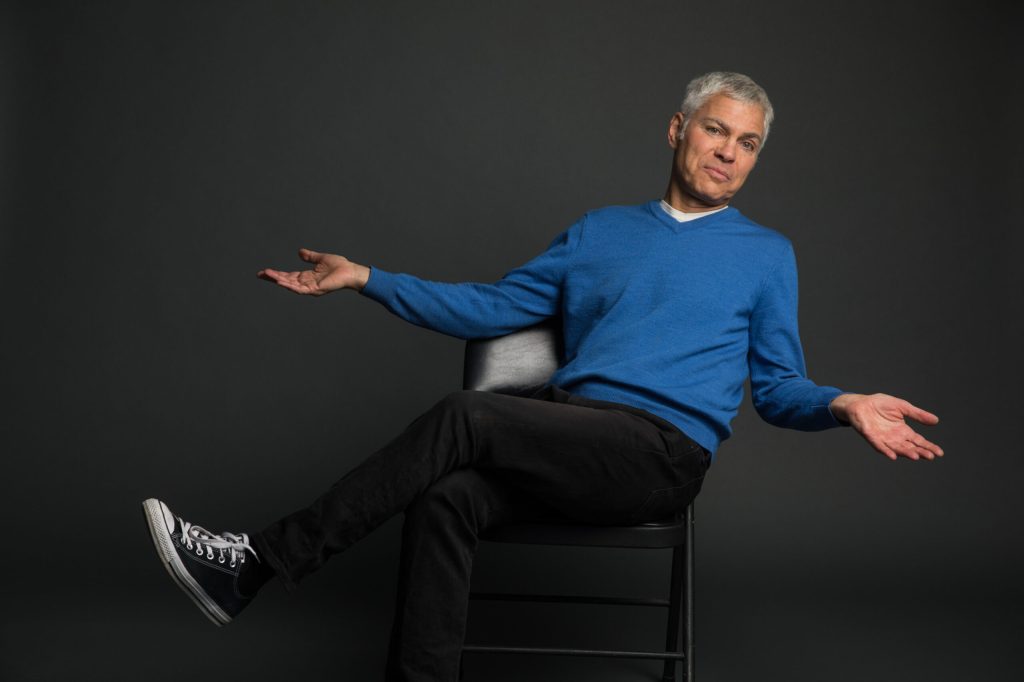
For better or worse, most of us are raised in families. It doesn’t take much observation to realize that few of them are ideal. In his welcomed return to solo performance at the stage of The Marsh in Berkeley, actor, writer, and general factotum Steve Budd shares insights into his father’s rapid and dramatic personality change that prompted hospitalization. The son melds it with episodes of his own growing up, career, and broader life experience. At least with the benefit of great distance in his rear review mirror, Budd dapples these misadventures and adversities into a striking and empathy-inducing canvas. And don’t get the wrong idea, as the performer notes, this is a comedy!
Growing up in Boston, Budd got the bug for acting, foregoing the family business, Budd’s Beverages. Perhaps it was that his father was so uninvolving that the son needed an escape. In Budd’s characterization, his father seems to have aspects of Archie Bunker, but without the personality. From the actor’s apt physical portrayal, you sense an unchanging affect, seated in an easy chair in the parlor, faceless behind an open newspaper. Responses to external stimuli are met with grunts, or at best, one syllable replies.
But one day, his father’s personality transforms. He becomes a gregarious, back-slapping optimist, and the change is so radical that he is taken to the hospital for observation, where he is held without the opportunity to return home. Without giving away too much, suffice it to say that mistakes are made in the diagnosis and treatment, and that other vignettes reveal that the father is not the only one in the family treated for psychological illness.
Back to Steve’s predilection for a life in entertainment, he tells of the usual parental comments about “when are you gonna get a real job?” or “does this actually pay enough to live on?” He goes to Israel, where he does find some promise with interesting gigs, but then, the Gulf War hits. Rather than continuing to dodge incoming Scud missles, and with his mother’s concerned noodging, he returns home, at first as a boomerang kid and to menial jobs.
The performance runs a brisk 60 minutes. The three characterizations are quite distinct, and the timing of the delivery is right on. Objectively, many of the situations seem traumatic or depressing, but Budd manages to dispatch them with a light touch and mostly with an engaging smile on his face.
Sound and lighting design add to the limited staging, but the most significant add-on is the projections, which could be used even more extensively. An acting video is understandably delivered with sardonic humor. The showing and analysis of the night sky is a recurring event, effective and appropriate as it relates to a part-time job that he held. Moreover, it serves metaphorically for his aspirations and for the life cycle of celebrity.
Given the fragments of Budd’s family life that are shared, the show is clearly expandable, or sequels could be added. We look forward to more of his interesting and funny material coming our way.
“Seeing Stars” is written by Steve Budd and performed at The Marsh Berkeley Arts Center, 2120 Allston Way, Berkeley, CA through July 13, 2024.
Solona Husband, Melissa WolfKlain, Anne Tolpegin, Sleiman Alahmadieh, Nick Nakashima, Noel Anthony. All photos by Kevin Berne.
Stephen Sondheim belongs at the head of the elite Pantheon of stage musical composers. Not only was he one of the few great ones to write both his own music and words, but his music was noted for its complexity and his lyrics for being perhaps the most sophisticated and witty among successful stage musical writers. TheatreWorks has produced 20 of Sondheim’s musicals, so it is fitting that Founding Artistic Director Robert Kelley and longtime Musical Director William Liberatore have collaborated to create a revue of Sondheim songs. An adoring audience was duly enchanted by great music and a talented cast at the opening night of the world premiere, “Being Alive: A Sondheim Celebration.”
Several Sondheim revues were already in circulation, among the better known are “Side by Side by Sondheim,” “Sondheim on Sondheim,” and “Marry Me a Little,” so what could be added to the anthology? Past homages take varying approaches – a simple plot line tied together with songs; a “biggest hits of” jukebox musical; a collection connected by filmed commentary from the honoree. Since Sondheim wrote until his recent death, and the revues date from as early as 1976, these composite pieces miss his later work to greater or lesser extent.
Nick Nakashima, Solona Husband, Sleiman Alahmadieh.
Kelley and Liberatore decided to explore the theme of love in their collection. Even Sondheim’s least romantic shows involve relationships, usually with songs about love and its complications. MTI, the copyright holder of 15 Sondheim musicals, imposed a set of rules that among other limitations prohibited songs from shows that they don’t own and restricted the number of songs from any one show to three – still a lot to choose from. The conceit to perform the tunes is that the artists are preparing for a revue. Act 1 is an informal run through, while Act 2 is a dress rehearsal, albeit with totally different songs.
The performers enlisted are three familiar faces at TheatreWorks (Melissa WolfKlain, Noel Anthony, and Nick Nackishima) and three fresh ones (Anne Tolpegin, Solona Husband, and Sleiman Alahmadieh). They are supported by Liberatore on piano and Artie Storch on drums.
Anne Tolpegin, Sleiman Alahmadieh, Melissa WolfKlain.
The creators mined the eligible songbook to find much more than just familiar songs from Sondheim’s most successful musicals. They found gems from more obscure shows like “Love is a bond” from “Saturday Night” and “Everybody says don’t” from “Anyone Can Whistle,” as well as songs that were cut from other musicals but picked up in previous revues, such as the suggestive “Can that boy foxtrot” (from “Marry Me a Little” and cut from “Follies”) led by a sassy Melissa, and “The wedding is off” (from “Sondheim on Sondheim” and cut from “Company”).
There are even instances of songs with music from one source and lyrics from another as in the music of “Putting it together” from “Sunday in the Park with George” while the lyrics are from the revue “Putting It Together.” Context and delivery can make all of the difference in how a song is perceived, one example being “Kiss me” from “Sweeney Todd.” The musical itself is dark and propulsive, and the song so rapid fire that the emotion that underlies it can be lost. Not so in this performance by Solona and Sleiman.
Sleiman Alahmadieh, Solona Husband, Nick Nakashima, Melissa WolfKlain.
Certainly there is representation from Sondheim’s transformative works like “Company” and “Follies,” but two of the most affecting songs come from “A Little Night Music.” Probably his most performed and beloved song is “Send in the clowns,” a mournful despondency about disappointment and mistakes, which is given a tender rendition by Anne with an assist from Noel.
The other magnificent number from the same show is “The miller’s son” sung by the vibrant Solona. Along with many other Sondheim songs, it possesses lyrics that challenge and that are delivered rhythmically at a gallop. This one is a little unusual in that it contains two main musical idioms, including folk portions that are appropriate to the character singing. In “A Little Night Music,” it is sung by a servant who has a minor role. The song ponders the class system and the possibility of rising (or falling) in social stature, yet that the glory of physical love can be enjoyed by any and all.
Solona Husband (foreground), Anne Tolpegin, Sleiman Alahmadieh,Noel Anthony, Nick Nakashima, Melissa WolfKlain.
Final mention goes to “Move on” from “Sunday in the Park with George,” in which Dot declares to George that he is complete, but she is unfinished, which she will remain if she stays with him. This sad end of the love cycle is sung emotionally by Melissa and Nick, a great comic who also reveals his singing chops.
Sondheim lovers will revel in the coordinated selection of 36 songs, and all theater goers should appreciate the talent of the cast and the professionalism of the production. The revue lacks real connective tissue other than one liners that lead from one song to the next, so those looking for a plot won’t find it here. Aficionados will be able to fill in many of the blanks, while those less familiar will not have a sense of the context that makes each song relevant to its show or how different these fine treatments are from other interpretations. Most tunes work well with the simplicity of the musical accompaniment, but some would benefit from support by more instruments.
Melissa WolfKlain, Anne Tolpegin, Nick Nakashima.
“Being Alive – A Sondheim Celebration,” with music and lyrics by Stephen Sondheim, is a world premiere conceived by Director Robert Kelley and Music Director William Liberatore, produced by TheatreWorks Silicon Valley, and plays at Mountain View Center for the Performing Arts, 500 Castro Street, Mountain View, CA through June 30, 2024.
Jordan Covington (ensemble), Claire de Sévigné (Patricia – mother of groom), Miles Mykkanen (Tuomas – groom), Lilian Farahani (Stela – bride), Ruxandra Donose (Tereza – waitress), Rod Gilfry (Henrik – father of groom). All photos by Cory Weaver.
Upon receiving a commission from the Royal Opera House to write an opera on the contemporary world, great Finnish composer Kaija Saariaho enlisted noted storyteller and countrywoman Sofi Oksanen to be her librettist. Because the opera was to be dramaturged and ultimately to be adapted into a multilingual script, Aleksi Barrière was added to the composition team. Not having written for opera before, Oksanen asked what subject had not been tackled in the medium, only to find that opera has explored virtually every manner of existence, psychologically, socially, and historically. The ultimate decision was to plumb rare uncharted territory, the global scourge of our time which Finland had just suffered – mass murder.
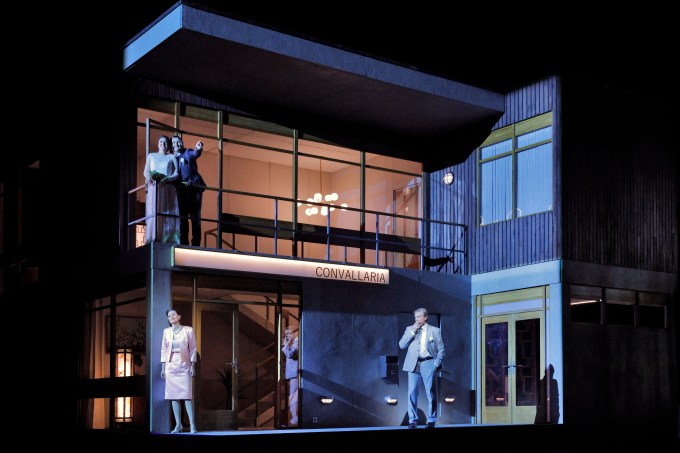
Vilma Jää (Markéta) above, Ruxandra Donose (Tereza) below.
The incongruously titled “Innocence” results, a masterpiece of true brilliance. Co-commissioner San Francisco Opera presents its American premiere in a most memorable, compelling, and powerful production that any opera aficionado will do well to see. The action grips throughout, while the edgy music creates the feeling of imbalance and terror. Regrettably, while Saariaho lived to witness the world premiere, she died a year ago before the full rollout of the commission productions.
After an ominous overture opened by a rumbling orchestra and haunting reeds, the uncommon innovation of the work with multiple conceits manifests itself from the first scene. To begin with, the narrative alternates repeatedly between two time frames, ten years apart. The first surrounds the killing of a number of students by one of their classmates at a high school in Finland. The second takes place at a small wedding reception at which the waitress realizes that the groom is the brother of the shooter whose victims included the waitress’s daughter.
Rowan Kievits (Anton), Beate Mordal (Lilly), Lucy Shelton as the Teacher, Marina Dumont (Alexia), Vilma Jää (Markéta), Camilo Delgado Díaz (Jerónimo), Julie Hega (Iris).
Producer Simon Stone and Revival Director Louise Bakker have integrated wildly complex and demanding creative elements into a phenomenal muscular whole. The action of the opera takes place on Chloe Lamford’s striking two-level revolving cube set design which is used to great advantage depicting various rooms within both major venues. Central to the wedding component is the elegant and composed Last Supper design of the reception party, while the school scenes are ragged and chaotic. The production crew stealthily makes changes to sides of the cube when they are facing away from the audience. James Farncombe’s contrast lighting adds drama and symbolism.
Cast.
Breaches of opera convention begin with the nature of vocalization. While operatic-style singing prevails in the wedding scenes, the school sequences are dominated by three variants employed largely by actors rather than opera artists – simple spoken word, amplified speaking for special effect, and songs and singing in a folk/pop idiom. Another distinction is that the libretto includes nine languages, owing to the international nature of the school and the wedding between a Finn and a Romanian. Although the departures from the norm read almost as a checklist of how to grab attention with unique features, they integrate exquisitely.
The general public certainly has deep sorrow and sympathy for the victims of mass shootings and their families. But “Innocence” goes beyond the superficial to examine the lives of the survivors and the families of the perpetrators, leading a deeper understanding of the complexities of the consequences of these events. Those students who escaped without helping others are forever plagued by the fear that they may have caused deaths by saving their own lives. A boy is unable to be in a room without facing the door. The tormented and hesitant waitress Tereza (splendid mezzo Ruxandra Donose) repeats behaviors daily as if her daughter were still alive. The parents of the killer lead lives of social isolation, and the couple scornfully diverges on whether to reconcile with the shooter son or never to see him again. More provocative is a look at the back stories of the deceased. Often deranged killers have suffered taunting or abuses that spawn their resentment of others who have had more comfortable existences.
Rod Gilfry (Henrik), Ruxandra Donose (Tereza).
Overarching is the theme of guilt felt by those who knew the shooter and the gnawing sense that if they had done something different or differently that the tragedy would have been avoided. The message of the narrative is that this guilt by those not intimate with the perpetrator is misguided. While many signals of projected aberrant behavior can be positively identified in the rearview mirror, the number of false presumptions as a result of amateur psychology would be overwhelming. As the libretto notes, every loner or kid with acne or mild obesity would be reported for observation.
The end-to-end drama of the story line chills to the bone. Saariaho’s complex music serves the drama, which abides with Chekhovian principles. This is not sit-back-and-relax music. With all of its bombast and dissonance, the untrained ear may miss the detailed leitmotifs with different tempo and instrumentation assigned to various characters. But the listener will grasp the jarring and shrieking of the orchestra; the high tessitura of the stressed Patricia, the mother of the groom; and the dark gloominess of her husband Henrik (portrayed with excellence by Claire de Sévigné and Rod Gilfry respectively).
Miles Mykkanen (Tuomas), Lilian Farahani (Stela), Claire de Sévigné (Patricia), Rod Gilfry (Henrik).
Singing was strong throughout, but the most striking vocals come from a non-operatic source. Eclectic musician Vilma Jää plays Markéta, the deceased daughter who appears in Tereza’s imagination. Jää’s arresting and penetrating arias draw from Finno-Ugric folk style with a plaintive wail that pop fans may find reminiscent of The Cranberries’ Dolores O’Riordan.
The libretto’s cleverness goes further than most would expect. To that end, spoilers will be avoided here, and anyone intending to see the opera is encouraged to avoid reading a full synopsis. Rarely does an opera offer this much drama along with twists that would be expected in a thriller. This is a rare modern opera that should appeal to traditional opera lovers as well as to theater goers looking for a riveting opera experience unlike anything they would anticipate.
Kristinn Sigmundsson (Priest).
“Innocence,” composed by Kaija Saariaho with libretto by Sofi Oksanen and Aleksi Barrière, is produced and co-commissioned by San Francisco Opera in a U.S. premiere, playing at War Memorial Opera House, 301 Van Ness Ave., San Francisco, CA through June 21, 2024.
Katina Psihos Letheule as Sister Aloysius, Thomas Hutchinson as Father Flynn. All photos by Grizzly De Haro.
John Patrick Shanley’s 2004 stage play “Doubt, a Parable” won the Pulitzer Prize for Drama and the Tony Award for Best Play. This is quite an accomplishment for a claustrophobic, cloistered story with only four characters that takes place in a convent middle school – mostly in the office of its principal. The movie adaptation won several Oscar nominations. Altarena Playhouse offers an off-the-charts gripping revival of this absorbing drama, driven by an outstanding ensemble of four actors.
At its heart, the play is a character study of Sister Aloysius, the school’s principal. A rules-dominated, my-way-or-the-highway authoritarian, she maintains the unproven belief that young Father Flynn is a sexual abuser. Her belief is supported by the facts that the Father has long nails for a man; that he has been assigned to his third parish with somewhat short tenure in the previous two; and that he touched a boy on the hand.
Driven by these facts and her compulsive personality, she is convinced that Flynn is evil. An incident involving the unauthorized drinking of the sacramental wine by a new student that Aloysius attributes to Flynn’s involvement provides a trigger. The fact that the perpetrator is the only black boy in the school adds another layer of complication.
Katina Psihos Letheule as Sister Aloysius, Anna Kosiarek as Sister James.
Altarena’s Artistic Director Katina Psihos Lethuele steps back onto the stage and into the role of Sister Aloysius with absolutely spectacular results. With pursed lips and lacking makeup, she appears older and dour. Donning a black bonnet and fuddy-duddy spectacles, and walking with an uneven gate add to the effect. The finishing touch is the brusque affect of clipped speech with condescending look and tone. Letheule transforms into the perfect representation of an unwavering, impregnable militant for whatever her chosen cause.
Believing that she has the students’ safety at heart, Sister Aloysius demands that the nuns maintain a watchful eye for any discrepant behavior at the school and to report it to her. Certain in her righteousness and driven by a need for power and control, she will break the same rules that she would denounce others for bending.
She coopts young and naïve Sister James as a confederate to try to out Father Flynn. It is the younger nun who reluctantly reports the wine drinking incident. Anna Kosiarek plays Sister James, and while the part is not nearly as juicy as Aloysius’s, she conveys the young nun’s conflictedness with great skill. Although Sister James’s faith seems unshaken, Kosiarek shows a wide-eyed innocence and a great range of emotions in response to Aloysius’s rigidity in summarily rejecting a wide array of human engagement from friendliness toward students to secular Christmas songs.
Anna Kosiarek as Sister James, Thomas Hutchinson as Father Flynn, Katina Psihos Letheule as Sister Aloysius.
Meanwhile, Father Flynn is in a quandary. Though a priest outranks a nun, the vindictiveness of the principal and her willingness to expose him, even without evidence, puts him in a helpless situation. His turmoil is reflected in his homilies in masses, which deal with intolerance and gossip. Thomas Hutchinson adeptly captures the priest’s love of his work, care for children, and his anxiety when confronted with the charges. More importantly, Hutchinson delicately balances his interactions with Sister Aloysius with such trepidation and ambiguity as to beg the question of guilt in the minds of the audience.
A final star turn is by Billie J. Simmons as Mrs. Muller, the mother of Donald, who had drunk the wine inappropriately. Called into Sister Aloysius’s office for a conference, Simmons nails the characterization of one who may be working class in education and verbal expression, but who has the intelligence and insights to ascertain that the principal is more interested in advancing her own agenda than in protecting the parent’s son. Simmons also exhibits the uncommon courage of a parent not being intimidated by the principal, despite having little leverage.
As suggested by the extension of the title, the play is not simply an examination of a person obsessed about someone’s presumed deficient character. “Doubt” stands as a broad indictment of organized religion. All religions build upon some facts, but at their core, adherents hold to a shared body of intangible, unprovable beliefs, often in conflict with the precepts of other religions. On its own, subscribing to a set of beliefs is not pernicious, but inevitably, beliefs often cleave populations tribally between devotees and outsiders. Just as inevitably, dogmatic holding to these beliefs as truths can act as a battering ram, vilifying and harming people outside the circle.
Anna Kosiarek as Sister James, Thomas Hutchinson as Father Flynn.
Moreover, the playwright exposes the darker side of clerics. Virtually none of the issues in the play concern clash of religious precepts, but many concern the exercise of power. This is evidenced by Sister Aloysius’s administrative and pedagogical philosophies, which she foists on Sister James and others unseen. And while the principal may actually believe that Father Flynn has abused students, she is unwilling to go through channels or wait to prove that something illicit has occurred. Rather, she wishes to muscle him into submission, based on her beliefs unsupported by proof.
Another blemish that can be imputed is that for all of its veneer of religious observance, organized churches constitute an industry. They compete for success and survival. Their managers come and go. Perhaps more damning is the notion of clerics as professionals, who even with the loss of faith continue their careers for any number of dubious rationales. Many have feet of clay and perhaps should never have taken the collar or the habit to begin with.
“Doubt, a Parable” captivates from its opening sermon about how shared doubt can act as a strong bond, leading relentlessly to its crash ending. Director Shannon Nicholson has engaged a superb cast whose performances make for a superior, if somewhat chilling, theatrical experience.
Katina Psihos Letheule as Sister Aloysius, Billie J. Simmons as Mrs. Muller.
“Doubt, a Parable” is written by John Patrick Shanley, is produced by Altarena Playhouse and plays on its stage at 1409 High Street, Alameda, CA through June 30, 2024.
Amitai Pati as Tamino, Lauri Vasar as Papageno. All photos by Cory Weaver.
Opera holds a special place among performing arts. It is exceedingly expensive to produce at its highest levels, and the repertoire of operas that constitute acceptable production risk is limited. Thus, a select number of popular war horses are revived again and again, among them, Mozart’s “The Magic Flute” (“Die Zauberflöte”). In considering both their loyal patrons and newcomers to the form, a challenge for producing companies is whether to repeat traditional renderings of the works or to offer novel interpretations by changing the time frame, venues, or language of the works, or even abbreviating them.
Amitai Pati as Tamino.
While most successful operas are well-grounded period pieces, “The Magic Flute” is a timeless, placeless, mystical, and fanciful fairy tale, all of which make it conducive to a wide array of interpretations with vivid, innovative staging and costumery. San Francisco Opera offers a production by Komische Oper Berlin that breaks the mold with a visually stunning and riveting realization. Although the music is Mozart (enough said) with ample highlights, it’s hard to imagine an opera production that is more about the visuals than this. It is highly recommended for its incomparable visual artistry, but there are points of concern and discussion.
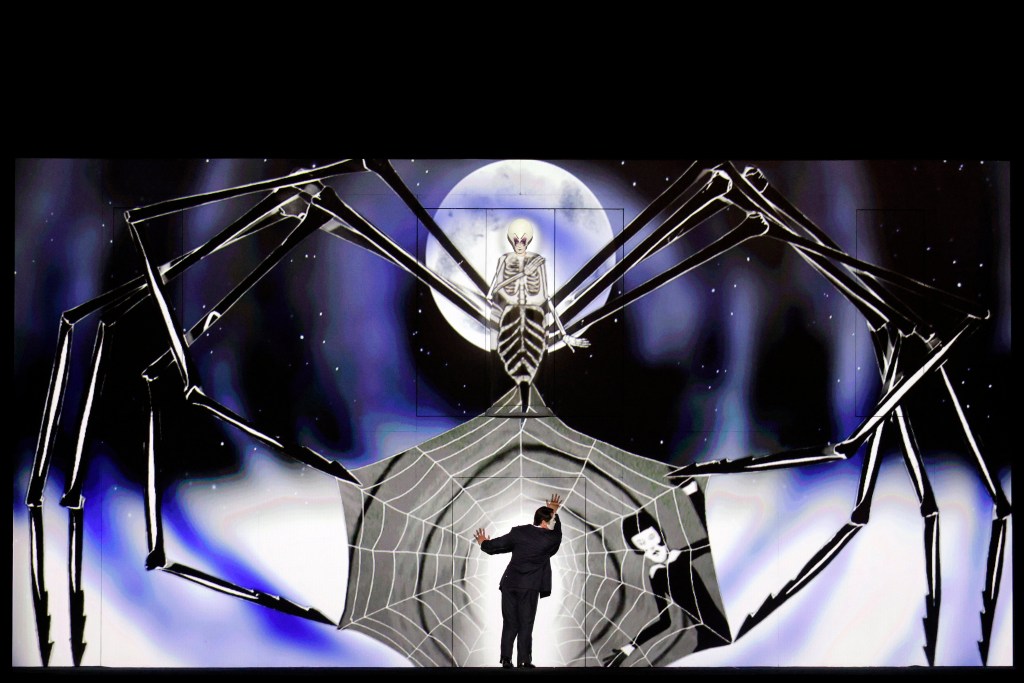
The conceit is to contextualize the story in the silent film era. The device is a screen that fills the stage. Strikingly garbed live characters sometimes gambol across the stage in front of the screen, often in sharp spotlights, but mostly they swivel from doors on the screen like statues appearing from cuckoo clocks on the quarter hour.
Lauri Vasar as Papageno, Christina Gansch as Pamina, Zhengyi Bai as Monostatos.
A phantasmagoria of animation festoons the screen throughout. While the still images in this review give an idea of some of the powerful look, they are a mere fraction of the dynamic eye candy on offer. Sight gags appear on and off the screen. The visuals are so enticing, constantly drawing the viewer’s eyes around the screen, competing with the supertitles, that a valid question is whether they actually distract the patron from the storyline or the music. A sampling of two operagoers says somewhat, but clearly, this is an individual thing.
Anna Simińska (the live head atop the animated spider) as Queen of the Night, Amitai Pati as Tamino.
In a final clever adaptation, spoken dialog, which is frequent in this singspiel, is replaced with bold intertitles on the screen (see first image in review). Mozart fantasias for piano are inserted to accompany the screens, so that music is continuous throughout the performance. I can’t verify this, but it seems that the laughter from this graphic device was greater than from the spoken sections in a traditional production. And for sure, the groans by the audience from the intertitle suggesting that women not step outside their designated sphere were pronounced.
Christina Gansch as Pamina.
The narrative of the opera challenges on its own, but is complicated further if one tries to impute Masonic values into the script, as many feel that Mozart intended. It centers on brave and earnest Tamino who falls in love with a picture of Pamina, daughter of the evil Queen of the Night. He will release Pamina from abduction by Monostatos, a slave to Sarastro, the latter of whom the queen falsely accuses of being evil. Tamino and Pamina will succeed in trials to ordain them into the priesthood and allow them to marry. Playing Tamino’s sidekick is the weak-willed Papageno who only wants a loving wife, and despite his failures in courage, his marriage is granted.
Along the way is musical pleasantry with highlights such as the Queen of the Night’s aria, Papageno’s recurring theme, and Sarastro’s “O Isis und Osiris.” Yet, despite the opera’s popularity and the fact that these splendid accents occur in Act 2, it drags. Perhaps the sheer length of the opera works against it, or the lack of clarity in the libretto.
Kwangchul Youn as Sarastro.
Opening night performance included pluses and minuses. The Eun Sun Kim led orchestra sounded majestic and accurate, and the chorus boomed with vitality. Compared with typical offerings from the company, the principals didn’t fare as well overall. One exception was baritone Lauri Vasar as Papageno, who not only sang the role well but his Buster Keaton-like miming revealed real acting chops. Amitai Pati as Tamino has certainly established himself as a rising young tenor, but he lacked adequate power this evening. Sarastro is a basso profundo role, and Kwangchul Youn did not project the bottom of the range sufficiently. The female leads, Christina Gansch as a Louise Brooks-like Pamina and Anna Simińska as the Queen of the Night, satisfied, but an absence of bravas from the audience after their signature arias suggests that they weren’t memorable.
Lauri Vasar as Papageno, Arianna Rodriguez as Papagena.
This “The Magic Flute” excites like few other productions and should be seen for its creativity and visual magic. Just considering the unique coordination of all of the activities that go on inspires awe. But is this the future of opera? No. It may inspire other non-traditional productions that promote interest, especially among younger audiences, but tradition will continue to dominate.
“The Magic Flute,” composed by Wolfgang Amadeus Mozart with libretto by Emanuel Schikaneder is produced by San Francisco Opera in a production from Komische Oper Berlin, and plays at War Memorial Opera House, 301 Van Ness Ave., San Francisco, CA through June 30, 2024.







 cordellreportsdotcom