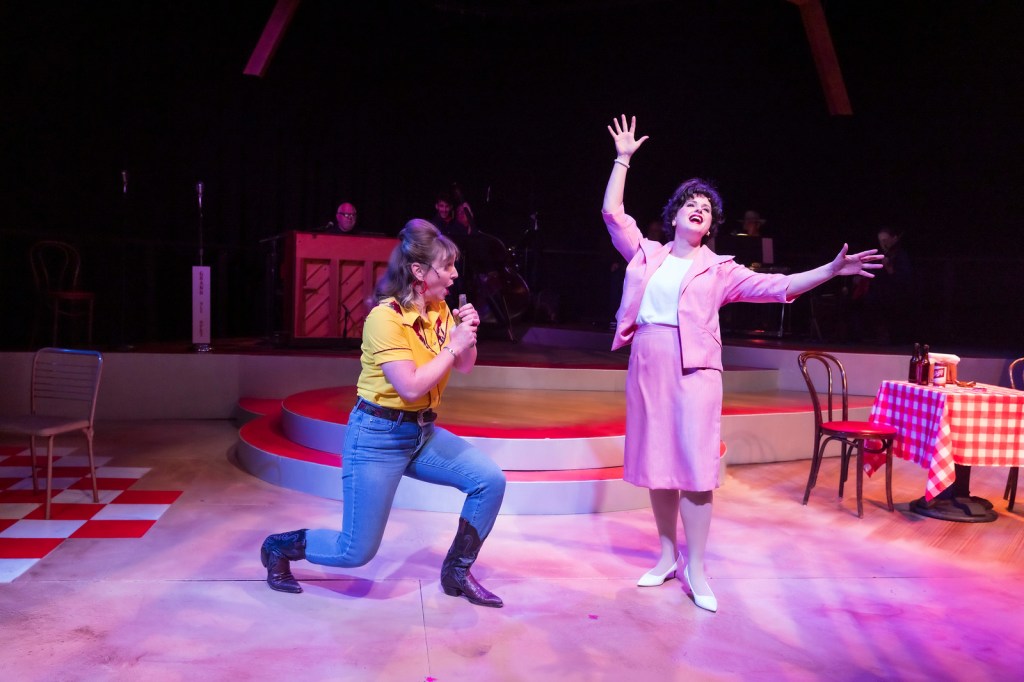
Kimberly Donovan as Louise, Melissa WolfKlain as Patsy. All photos by Tracy Martin.
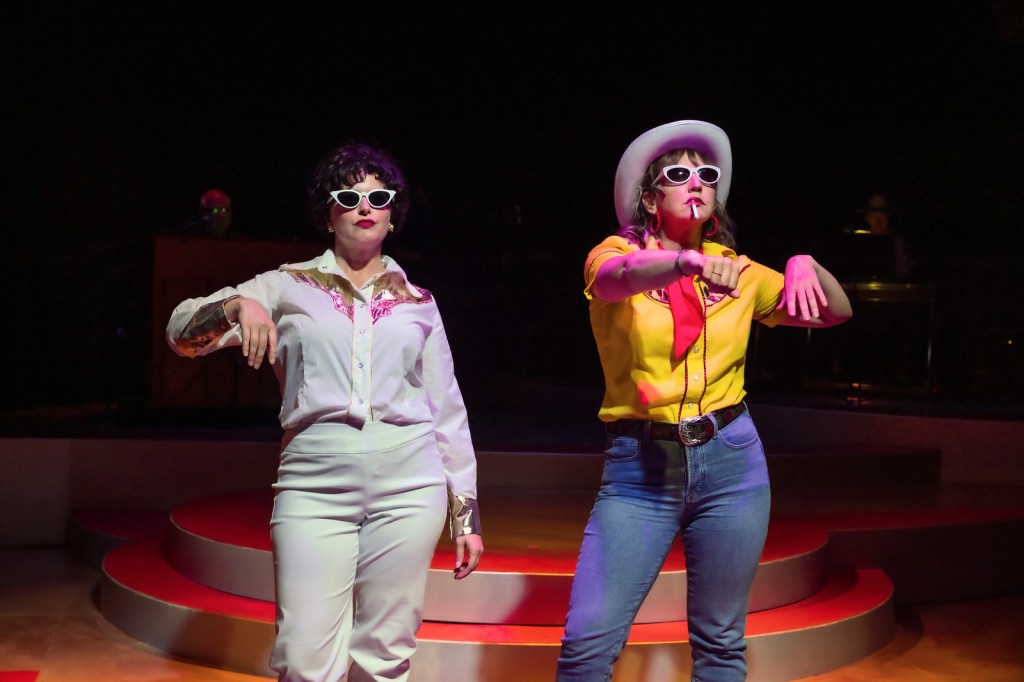
One could argue about the precise distinction between a generic stage musical and a jukebox musical, but in its most specific sense, the latter is a production that celebrates a form or era of music (“Forever Plaid”), a performer (“The Cher Show”), or composers (“Smokey Joe’s Café”) with a limited and often contrived plot line. “Always…Patsy Cline” stands as one of the more enduring and endearing of its kind, particularly embraced by community theaters drawn to its manageability with a cast of two and a band of four to six. Hillbarn Theatre’s current production captures all of the musicality, humor, nostalgia, and emotion of this little gem to provide an evening of sparkling entertainment.
“Always…Patsy Cline” distinguishes itself in numerous ways. To begin with, it retells a real and unlikely incident that occurred in one night in 1961 and footnotes the powerful pen pal friendship that ensued. Louise Seger had become a fanatic fan of the early recordings of Patsy’s, and when Patsy is scheduled to perform at the Esquire Ballroom in Houston, Louise and her male friends are the first to arrive at the venue.
Melissa Wolfklain as Patsy, Kimberly Donovan as Louise.
“Always…Patsy Cline” is created by Ted Swindley, produced by Hillbarn Theatre, and plays on its stage at 1285 East Hillsdale Blvd., Foster City, CA through September 15, 2024. For tickets and information, please visit http://www.hillbarntheatre.org.
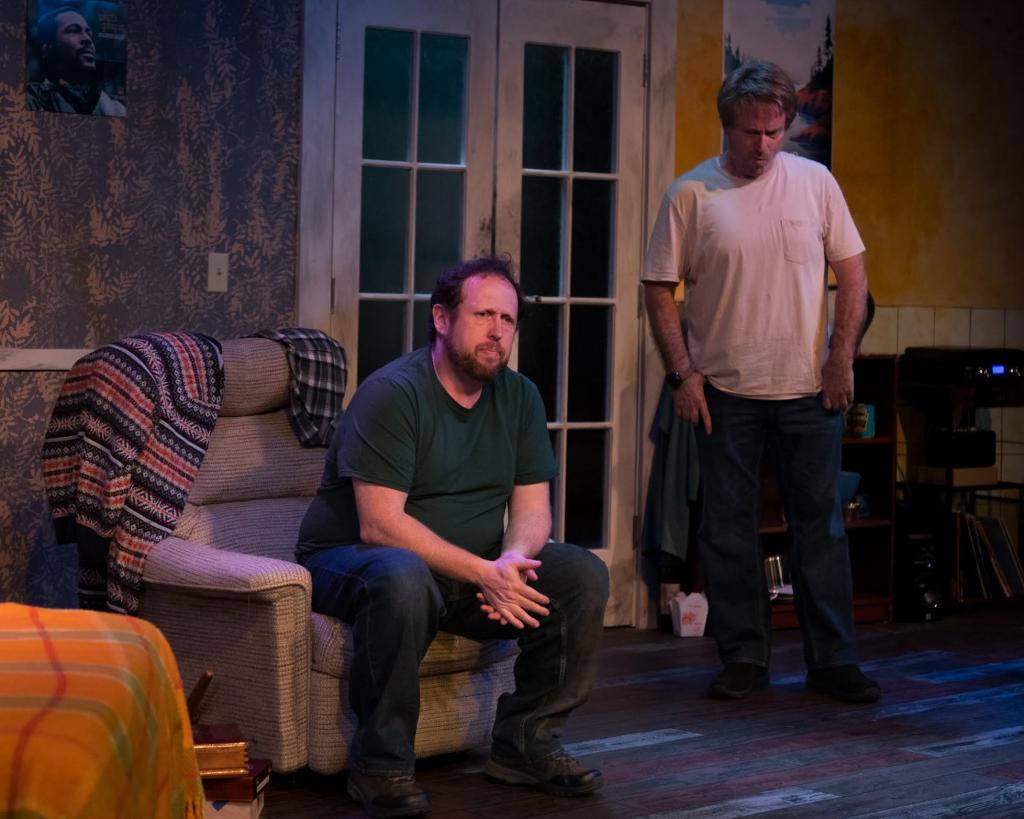
Dan Kolodny as Doc, John Tranchitella as Tommy. All photos by Grizzly De Haro.
Altarena Playhouse, one of the really fine community theaters in the Bay Area, has made a bold choice for its current offering – Conor McPherson’s “The Night Alive.” It arrives with accolades including the New York Drama Critic’s Circle Award for Best Play of 2014 as well as an Olivier Award nomination for the same. I respect these recognitions and often cite such awards, but at times, one wonders what criteria the judges (and reviewers) are guided by.
Ireland has long been a great font for literary excellence, perhaps drawing from Irish gift of gab. In contemporary times, with playwrights like Martin McDonough (though British born), Mark O’Rowe, and McPherson himself, we see numerous gritty, grimy stories of dysfunctional, marginalized people sometimes influenced by notions of the supernatural, which are characteristics that will split the play going public.
Jonathan Covey as Kenneth, Sarah Jiang as Aimee.
My wife and editor surprisingly liked this darkly comic drama, which surprises, as it’s not at all in her wheelhouse. By the end, I came around to being not unhappy about seeing it, because it does provoke but without providing a lot of what I consider entertainment. On opening night, the small audience dwindled somewhat at intermission, but those who stayed showed enthusiastic appreciation.
One of the great analytical bifurcators of plays is the distinction between the written play and the production. In this case, it is easy to argue that even though the content of the play may not appeal to some, it is thoughtful and well-written, sketching the world of the Irish underclass. We constantly feel the pressures of their tawdry lives with repeated references to beans in the cooker, trash bags strewn on the floor, and life’s savings hidden away in a tin box.
The production itself merits praise. The Katina Psihos Letheule-directed staging suits the environment to a T, and the acting is powerful and effective throughout the cast of five. Kudos go to dialect coach Sarah Elizabeth Williams, as all of the accents sounded authentically Irish to these ears, but because of their subtlety, they are all totally understandable.
John Tranchitella as Tommy, Sarah Jiang as Aimee.
Dublin-located “The Night Alive” centers on Tommy, a fiftyish divorced failure, alienated from his kids, who lives in a squalid rented room in his uncle’s house. Lacking fixed jobs, he and his slightly-mentally-challenged friend Doc, of no fixed address, get by living on scraps from society’s table with maybe a little grifting along the way. The triggering event is that Tommy has saved an unknown young woman Aimee from a beating by a man and brings her to his digs to recover. Tommy later learns that the perpetrator was her pathological ex-boyfriend, Kenneth, who will later appear and prompt some gruesome events.
A redeeming quality of the script is that with the exception of the unredeemable Kenneth, each character possesses some goodness. For instance, Tommy had no motive in intervening to save Aimee, but he did. In his complex relationship with Doc, Tommy tries to dupe Doc into accepting boxes of expired cigars in place of money owed for work done. But despite often telling Doc that the latter’s problems are not his concern, when the chips are down, Tommy presses money on him. In the end, many issues are unresolved, but there is some redemption for everyone.
John Tranchitella heads the cast as Tommy. Requiring a range of furious behaviors, Tranchitella hits all the right gruff notes as one who moves from one conflict to another. Dan Kolodny is Doc, and he excels at alternating between being wacky and clueless like in trying to explain how Doc is an abbreviation of his real name Brian, to giving a treatise on the creation of black holes and their effect on time, of all things!
John Tranchitella as Tommy, Geoffrey Colton as Maurice, Dan Kolodny as Doc.
Solid performances are also given by Sarah Jiang as the mysterious and conflicted streetwalker Aimee; Geoffrey Colton as Tommy’s uncle and landlord, the dapper drunkard Maurice, who spots a bag of turnips stolen from his garden under a cot, but doesn’t notice a body on the floor that he almost trips over; and Jonathan Covey as the loathsome interloper Kenneth.
“The Night Alive” is written by Conor McPherson, produced by Altarena Playhouse, and plays on its stage at 1409 High Street, Alameda, CA through September 22, 2024.
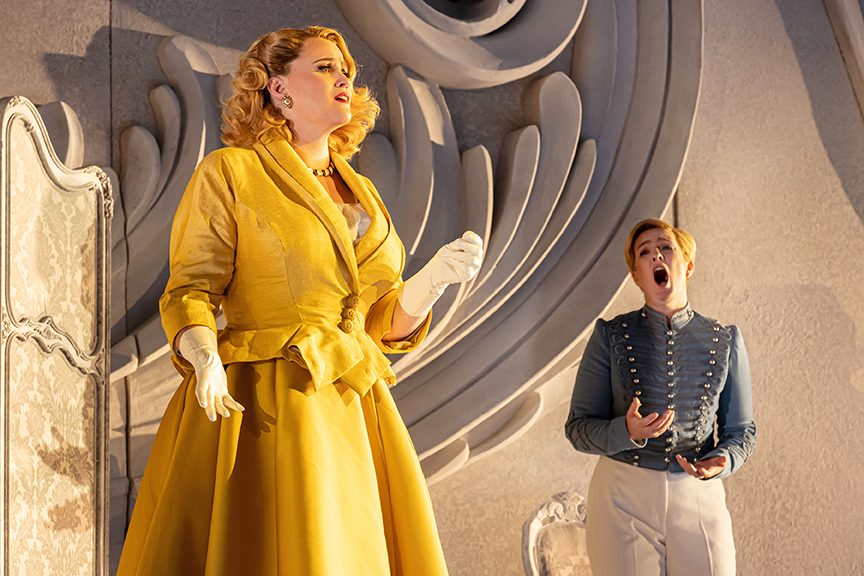
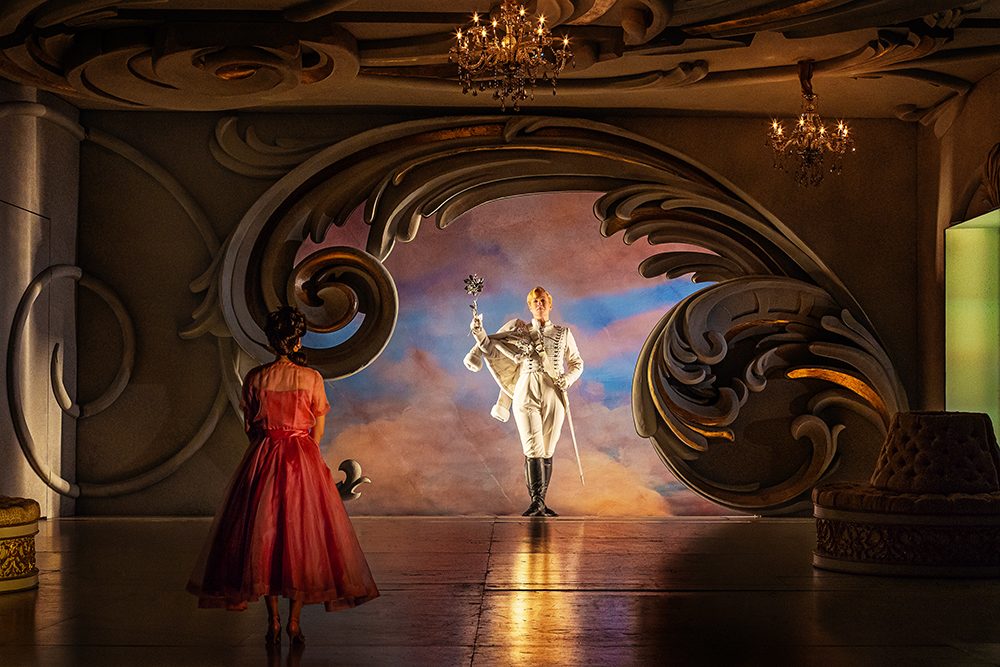
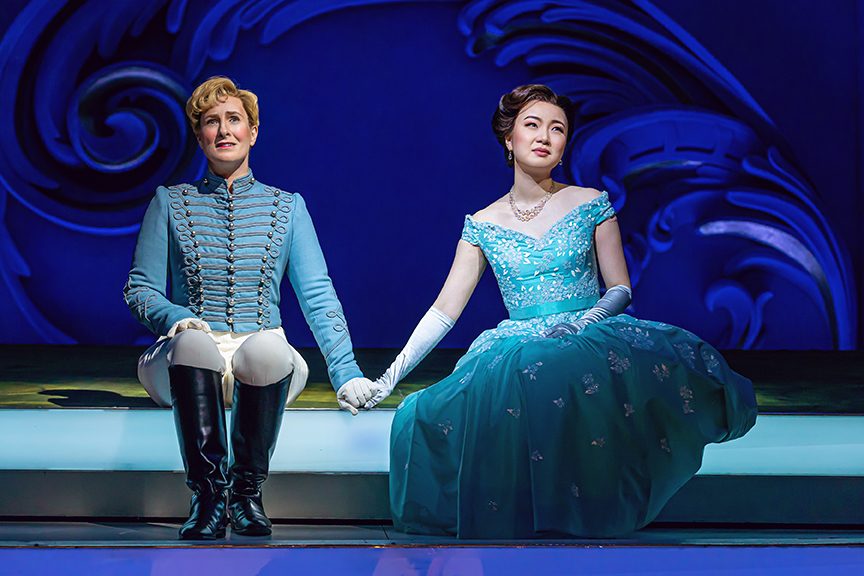
Rachel Willis-Sørensen as Marschellin, Paula Murrihy as Octavian. All photos by Curtis Brown.
Richard Strauss and Hugo von Hofmannsthal represent the most successful collaboration between composer and librettist in opera history. After drifting down the path of modern atonalism and gruesomeness with “Salome” and “Electra,” they risked being considered old-fashioned and retrograde with their 1912 premiere of “Der Rosenkavalier,” a return to German Romanticism, following in the footsteps of Richard Wagner. But it would become their most endearing opera with wonderful characterizations, sumptuous music, and a plotline that entertains and provokes. Santa Fe Opera has offered a superb production with outstanding performing artists and a stunning staging that warps from sumptuous to seedy.
The title refers to a fictional custom of Austrian nobility in which a prospective groom enlists a relative, who becomes the Cavalier of the Rose, to present a silver rose to the bride-to-be. This opera contains three central roles, one of which is the title character, who is a 17-year-old noble, Octavian, performed by Paula Murrihy. A versatile and smooth mezzo-soprano, she not only dispatches this notable trousers role with great aplomb but also wears dresses to become Mariandel, a fictitious maid who will deceive in order to trap lascivious Baron Ochs. The rationale for using a female voice in this role is that Octavian’s voice is presumed to be pre-pubescent. This woman-playing-a-man-playing-a-woman device beat the movie “Victor/Victoria” to the punch by several decades.
Paula Murrihy as Octavian.
But while Octavian reigns in the title and perhaps has the most stage time and singing, the character acts more as a catalyst than a proactor. Perhaps the weight of the role is diluted because much of the time he is in his transvestite alter-ego, Mariandel. But in the end, Octavian will get the girl!
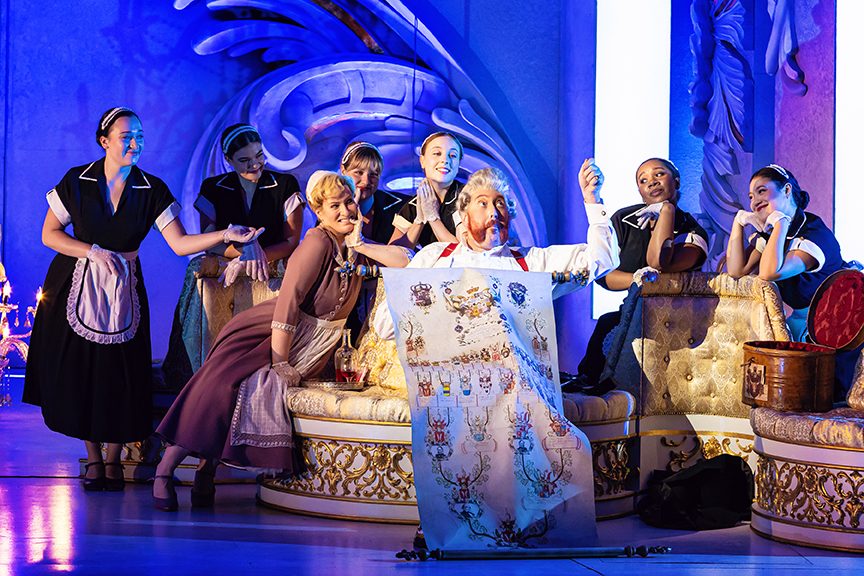
The anti-hero of the proceedings is the boisterous, bumptious Baron Ochs, portrayed delightfully and humorously by big-voiced bass Matthew Rose, who manages the semi-talk-sing requirements along with the resonant sung music with equal facility. Middle-aged Ochs had asked his cousin The Marschallin to arrange the presentation of the rose to young Sophie. This match appeals to both sides as the impoverished noble Ochs will acquire money from a nouveau riche family, while they gain aristocratic standing. But ultimately, Ochs’ condescending and off putting manner will infuriate the otherwise shy Sophie, who even risks being sent to a nunnery in rejecting the suitor.
Paula Murrihy as Octavian, Ying Fang as Sophie.
With all of the above going on, it really hasn’t touched on the heart of the opera, and that is The Marschallin. Though she is absent for over half of the opera, her grace, dignity, consideration, and melancholy are the driving forces behind the action. In her, Strauss and von Hofmannsthal have crafted one of the most sympathetic characters in the canon and a fine part for a dramatic soprano. Rachel Willis-Sørensen ravishes with her physical presence and her full-bodied and lustrous voice with great penetration in the fortissimos.
“Der Rosenkavalier” concerns life’s passages. Ochs’ proposal represents not only transition to marriage, but one involving change in social status, financial transformation, and a May-December linkage. The Marschallin is married, but has had a long and loving relationship with Octavian, who is half her age – another May-December affair. She notes that time is strange – when we are young, we don’t think about it, though when we are older we think of nothing else. Sensing the future and displaying the wisdom of age, she frees Octavian to great dramatic effect and much against his wishes, which will facilitate the resulting of the right match.
Paula Murrihy as Octavian, Matthew Rose as Baron Ochs, cast.
This opera contains several distinctions. The orchestral music is radiant throughout, yet the vocals in its primary idiom are not in the least memorable. However, two particular set pieces are highly notable. The presentation of the rose contains simple but well-spaced harmonic orchestral notes that may come from a celeste and flute. They produce the most haunting and ethereal sounds imaginable, so that it would be heavenly, pretty much whatever’s being sung. This is also the magic moment when Octavian and Sophie’s eyes first meet and foretell the denouement.
Strauss loved the female voice. He challenges the singers with high tessitura, particularly Sophie, which Liv Redpath, performing this evening only, negotiates with ease. Few female ensembles can match the counter melodies and harmonies of the opera’s finale – led by the glorious trio among the three lead females and concluding with The Marschallin stepping away and leaving the final love duet to Octavian and Sophie. A last and unfavorable distinction is the length of the opera. At a four-hour run time, it does drag at times with excess philosophizing and could use some serious editing.
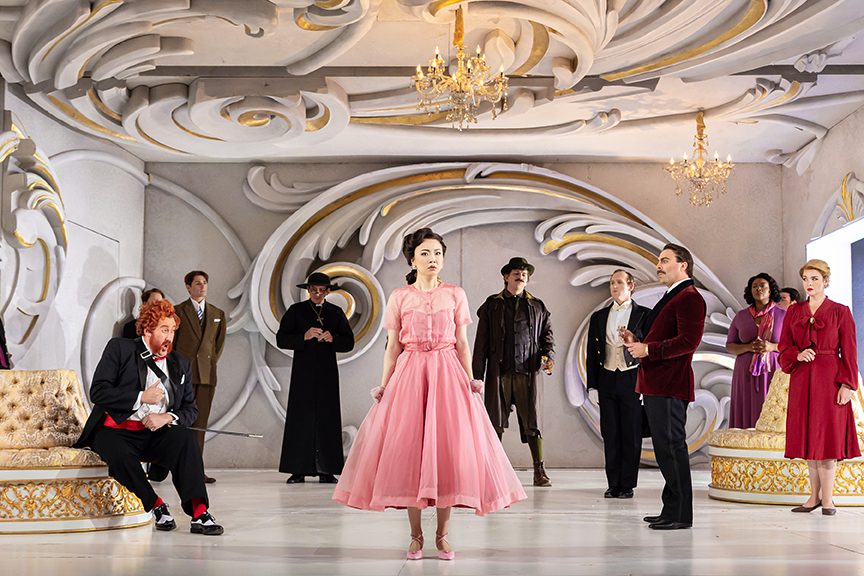
Matthew Rose as Baron Ochs (left), Ying Fang as Sophie (center), cast.
Nevertheless, the composer shows that he could write relatable and accessible melody. He disdained Italian opera and threw in an aria in that style as a parody, but it has appeal. He also included melodious waltzes which were intended to display the majesty of the period of the opera, even though they were an anachronism. And if you are tempted to think that Strauss was strait-laced, the lively music that opens the opera with the Marschallin and Octavian in a curtained, poster bed simulates sex, right up to its conclusion and afterglow!
Apart from fine singing and the animated orchestra conducted by Karina Canellakis, Santa Fe’s production by Bruno Ravella visually delights from start to finish. The Marschallin’s bedchamber of Act 1 comprises restrained gray stateliness with huge, scrolled leaf motifs in thick bas relief. At the end of the act, she is spotlit during a soliloquy wearing a yellow gown that creates a strikingly beautiful duochorome with the backdrop. In Act 2, at the apartment of Sophie’s family, we see contrasting showiness of the merchant class. And the Act 3 look of a cathouse, where Ochs is being compromised, the gaudy set is akilter and surrounded by colored light frames presenting a great environment for the cacophony of garish costumes.
Scott Conner as Police Commissar, cast.
At this, the end of the season, I’d like to add another plug for Santa Fe Opera, and that is for its exquisite pre-opera talks. One option is the fantastic covered, outdoor buffets, though they have gotten to be quite expensive. A guest speaker with some connection to the opera of the evening always gives a talk to conclude the dinner. A predictably entertaining and informative option is the free talk given by long time lecturer Oliver Prezant. His talks always engage and give great insights, especially for those new to a particular opera, but even for those who are already familiar.
“Der Rosenkavalier,” composed by Richard Strauss with libretto by Hugo von Hofmannsthal and produced by Santa Fe Opera was performed at Santa Fe Opera House, 301 Opera Drive, Santa Fe, NM through August 15, 2024.
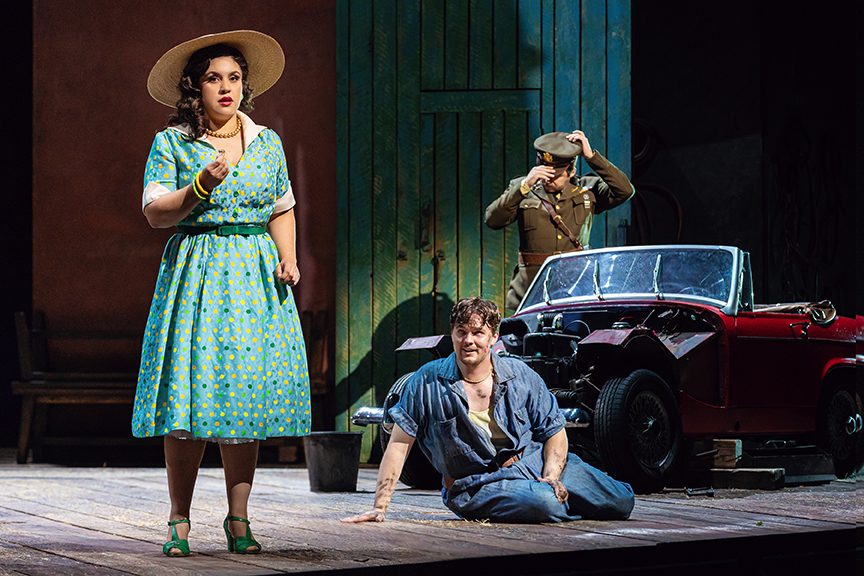
Yaritza Véliz as Adina, Jonah Hoskins as Nemorino. All photos by Curtis Brown.
Rarely has an opera composer moved with equal facility between dramatic and comedic genres. Gaetano Donizetti fills that role. Along with the brooding “Lucia di Lammermoor” and his three dark and tense Tudor-period operas, he wrote the music for “Don Pasquale,” “Daughter of the Regiment,” and “The Elixir of Love,” the last of which is offered in a bubbly and endearing production by Santa Fe Opera.
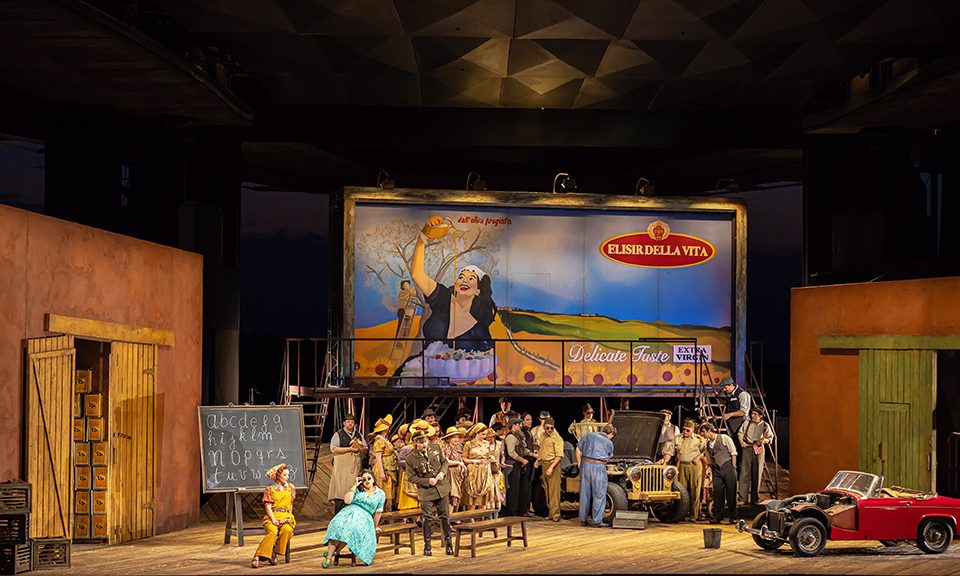
Especially with war horses of the opera repertory, companies are often loathe to present the same formula for each production. Although the underlying substance of the action remains unchanged, this Santa Fe version is brought into the 20th century. The central character Nemorino is still a peasant, but now an auto mechanic, while Belcore, his competitor for the hand of land owner and olive oil maker Adina, is a sergeant in the US Army stationed in Italy.
Cast.
Although this bel canto confection comes from 1832, early in Donizetti’s career, the music is mature and constantly engaging with hummable melodies. With the exception of poignant moments of reflection, the score bounces with playfulness and humor throughout. Considering that the plot concerns a love triangle as well as the involvement of a love potion and its hawker, the libretto is remarkably efficient with only five principal parts.
The beauty of the music springs forth from the outset as Nemorino sings about gorgeous Adina in ‘Quanto è bella’ (How beautiful she is) in which he also reveals his self-doubt. Rising star Jonah Hoskins is the ideal Nemorino, having a supercharged tenor with an Italianate lilt and urgency ideal for this role. He also conveys appropriate youthful innocence and the moxie to compete for a belle well above his station, most unlikely to succeed in the opera’s time and place. But this is a comedy!
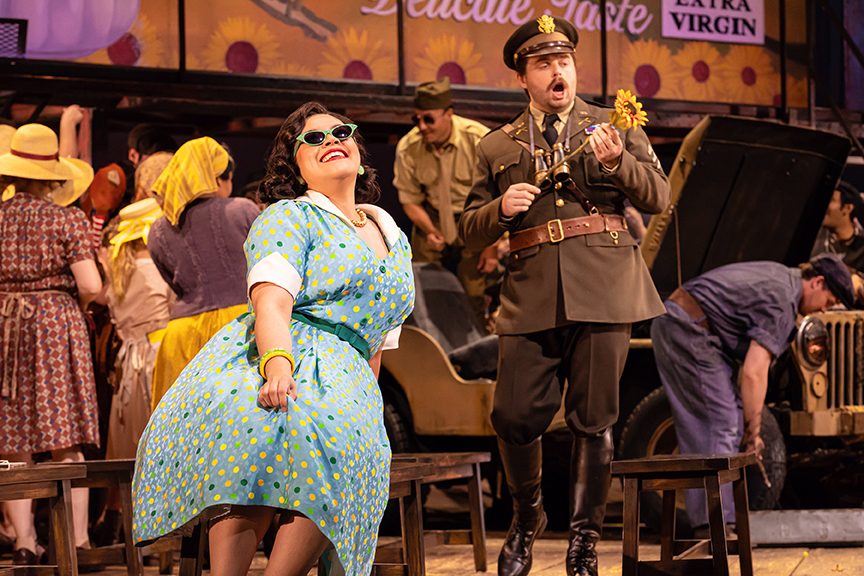
Yaritza Véliz as Adina, Luke Sutliff as Belcore.
The elixir of the title is introduced by Adina from literature. She reads aloud of the love potion employed by Tristan in “Tristan and Isolde” and sings her lovely first aria, ‘Della crude Isotta’ (From the cruel Isolde). Another notable young artist, Yaritza Véliz, performs as Adina. A fine fit for her counterpart, she mixes taunting condescension and convivial flirtation in tempting the hormonal Nemorino. Véliz’s strong soprano voice demonstrates passion and beauty, in addition to great flexibility in the lovely duet with Nemorino, ‘Chiedi all’aura lusinghiera’ (Ask the flattering aura).
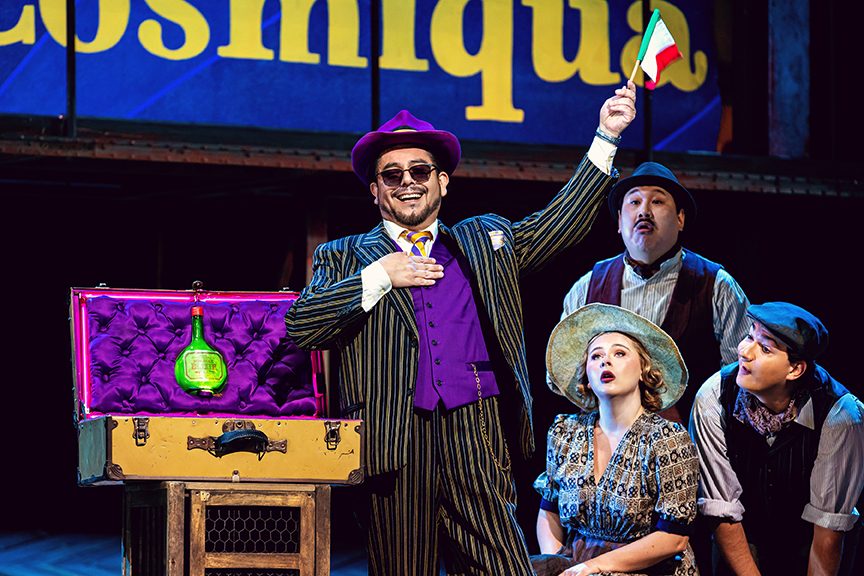
Nemorino’s declaration of love for Adina is unsurprisingly rebuffed. But when “medicine man”/flim-flam artist “Doctor” Dulcamara arrives selling a potion that solves everything from lumbago to sexual appeal, Nemorino sees his solution in a shot of courage. As one would expect, Dulcamara is as evasive as he is effusive, but he assures Nemorino that the potion will make him irresistible. Alfredo Daza portrays the fast talker with zest and plenty of opportunity to display his formidable patter.
Alfredo Daza as Dulcamara.
Meanwhile, conceited Belcore (Luke Sutliff) has proposed marriage to Adina. Like Daza, Sutliff gets to show his comic chops, but he also sings with distinction in a style with varying vibrato that could sometimes be characterized as coloratura, if that term were ever applied to a baritone.
Comic tension is maintained throughout as Adina gives out conflicted messages and actions, and is even seeking revenge against Nemorino by agreeing to marry Belcore. Finally, the worm turns, and Nemorino knows that Adina loves him, revealed in the opera’s hallmark, the mournful tenor aria ‘Una furtiva lagrima’ (A secret tear). As in several other arias, the artist is able to show bel canto virtuosity, in this case, milking pauses for emotional effect. Hoskins offers a masterful rendition.
Jonah Hoskins as Nemorino, cast.
Although much of the narrative is driven by two-way exchanges between characters, the ambiance is kept lively with the almost constant presence of some level of choristers playing various crowd roles, singing as backup to principals, or singing dedicated chorus pieces. Since the chorus is comprised of the company’s vaunted apprentices, its voices are uniformly outstanding. But what makes it outstanding as a chorus is great balance and precise unison of voices, despite the individuals not being professional choristers. The credit for this excellence goes to Chorus Master Susanne Sheston, who is responsible for the choruses of all five summer productions.
A comedy demands a happy ending, and as expected, Nemorino and Adina get together. What does create a bit of unneeded moral qualm is that the protagonist’s uncle has died, making Nemorino wealthy, undermining the notion that a ‘rich girl could fall for a poor boy’ (with a bow to Jay and the Americans’ song ‘Only in America’). That said, is it possible that Adina was the only woman in town to not know of Nemorino’s fortune? But how realistic is that?
(standing, center) Cadie J. Bryan as Giannetta, Yaritza Véliz as Adina, Luke Sutliff as Belcore.
“The Elixir of Love” is one of opera’s most produced works and with good reason. Its blend of exquisite music with laugh-out-loud humor is par excellence. Santa Fe Opera’s production makes the best of a good thing.
“The Elixir of Love,” composed by Gaetano Donizetti with libretto by Felice Romani is produced by Santa Fe Opera and plays on its stage at 301 Opera Drive, Santa Fe, NM through August 22, 2024.
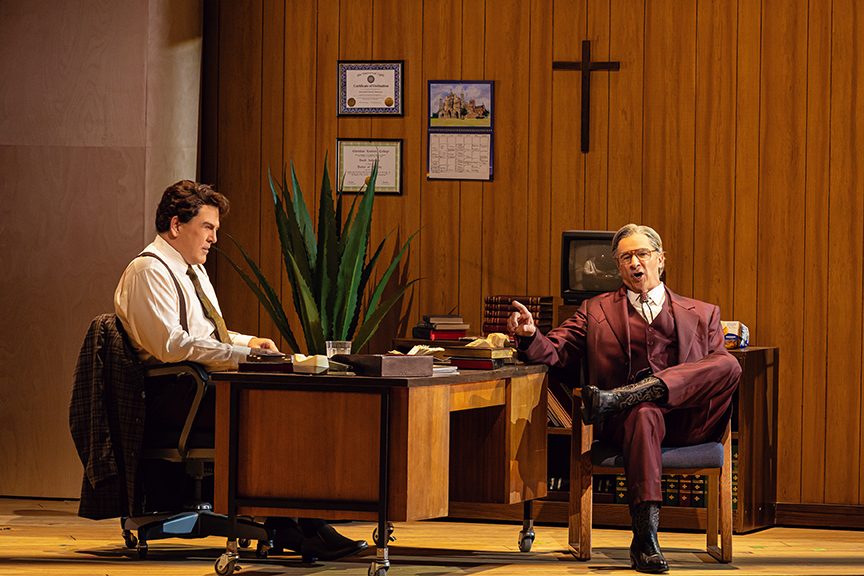
Michael Mayes as David, Greer Grimsley as Paul. All photos by Curtis Brown.
Santa Fe Opera maintains its position as perhaps the foremost summer festival of opera in the United States and as a font for new works. For the 2024 season, it has commissioned “The Righteous,” composed by Gregory Spears with libretto from past U.S. Poet Laureate Tracy K. Smith. The work indicts a large subculture that pervades much of this country, and the production compels and delights on all artistic fronts, from its fine ensemble cast to its versatile and effective staging. Despite areas for improvement, “The Righteous” is a welcomed addition to the opera canon.
Those of us who grew up in the last half of the 20th century in the underbelly of western religiousity, basically red-state America, will perhaps be more familiar with the themes and the characters that populate “The Righteous.” The recurring refrain “Oh, Lord; Oh hope; Oh might” reflects an expressed subservience to Christian teachings, but actions will belie words in fiction and in reality. The notion of patriarchal beneficence mixed with unbounded hypocrisy permeates that society. And the penetration of religious thought into all aspects of life is attested by the hunting scene at the opening in which a prayer is requested to begin a turkey shoot. If there is a god, does it really care whether you bag a turkey or buy one at the grocery store?
Anthony Roth Costanzo as Jonathon, Michael Mayes as David.
David, portrayed by highly convincing and masterful baritone Michael Mayes, represents a class of pastors who aspire to more than serving their flock, but for wealth, power, and/or recognition. One would anticipate that real-world unfulfilled promises and moral corruption of so many religious leaders would impact their appeal to adherents. Yet, public exposure of acute failings of fallen ministers are quickly forgotten – Jimmy Swaggart, Jim Bakker, Jerry Falwell Jr., Robert Tilton (“top 20” televangelist whose shams were exposed by ABC’s “20/20,” and a personal friend of mine for a time during our late teens), and others. The power of identity faith and its associated identity politics make followers seem impermeable to fact, reason, or compromise.
The place of this opera is unnamed, but by connecting the dots, that place would be Texas, on the edge of the Bible Belt. Although the composer Spears is from Virginia, the other bookend of the evangelical South, the librettist Smith would not seem a natural for this scenario. She was reared in the Bay Area of California, has lived in the northeast as an adult, and she is black. Despite these anomalies, Smith has crafted a thoroughly convincing sense of the 1980s and of the white-dominated evangelical world. Importantly, key characters are not cardboard cutout caricatures, but nuanced individuals with good and bad in them. Yet one deficiency that overpowers this whole society is the inability of most of its denizens to either realize or accept the damage that their falseness causes.
Jennifer Johnson Cano as Michele, Michael Mayes as David, Elena Villalón as Sheila.
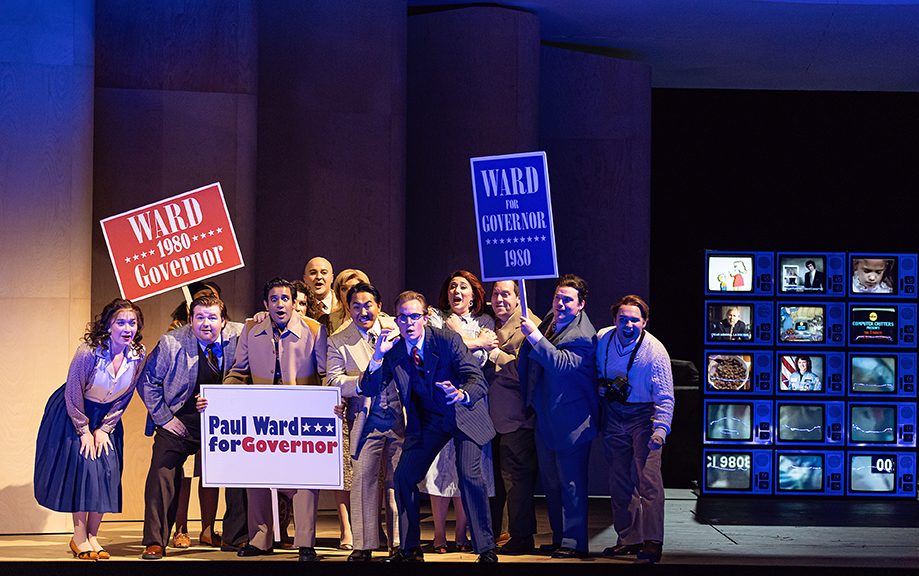
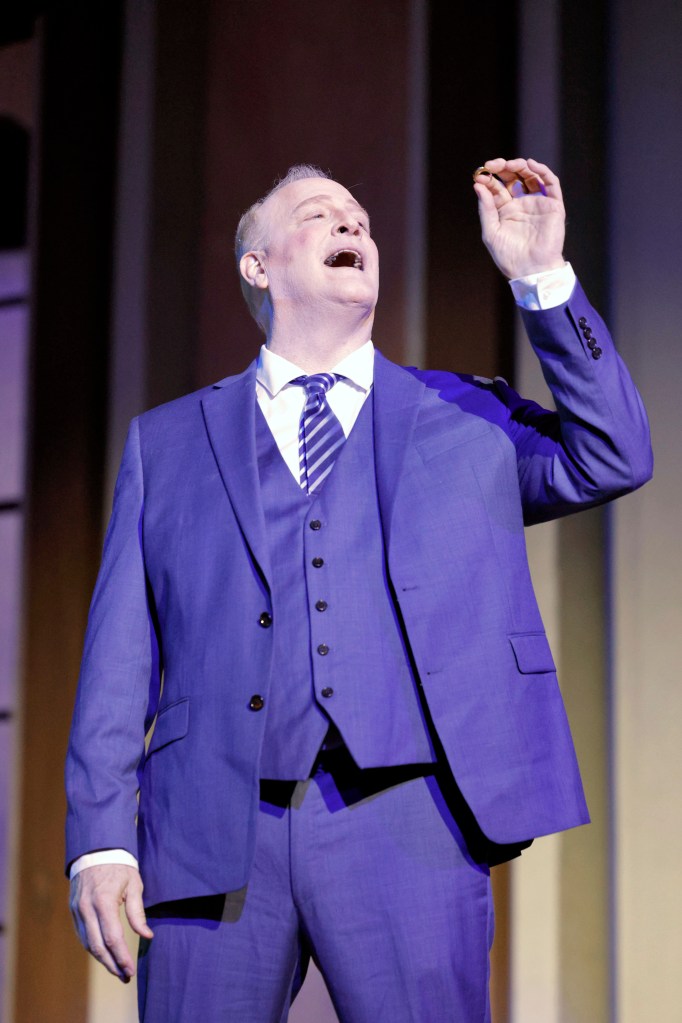
The opera captures the macho, Machiavellianism of the politics in the region, especially in the stereotypical Paul Ward. Portrayed with great bravado by the acclaimed Greer Grimsley, Paul, who becomes governor is the traditionalist red-meat and bourbon glad-hander driven to overpower competition.
More importantly, the mindset of the true believer, David, is first revealed as he evolves from being a non-religious youth whose best friend Jonathon is gay to a preacher committed to good works. As Jonathon, Anthony Roth Costanzo is in fine countertenor form and also drops into lower voicing effectively, as the composer requires dramatic leaps and plunges from several singers. It is in his good works period that David somewhat cynically marries Michele (wonderfully mellow and powerful mezzo Jennifer Johnson Cano who displays considerable range), whom he grew up with and doesn’t love, but who is the daughter of influential Paul.
Brenton Ryan as CM (in blue suit, center), cast.
Meanwhile, David becomes so absorbed with religion that he attributes all of his actions including his ambition to divine guidance. Even admitting to sins of the flesh when he has an affair with Sheila, (an impressive warm, yet full-voiced soprano Elena Villalón) who would become his second wife, he submits that it is God’s will. But when he becomes governor and must issue policies that affect primarily gay and black populations, his decisions are driven by political expediency, not his previous practices or Christian teachings.
The broader issue raised by David’s self-indulgence at the expense of following the teachings of Christ is the cognitive state of the kind of person he represents. Does that person truly believe that their actions are ordained from above, or is it a convenient cover to allow the latitude to do whatever the person wants? In the end, David begins to question the person he has become and repeats the refrain “Life is long; wisdom is slow,” yet he still looks for external explanations rather than within himself. Conversely, Michele and Sheila, both of whom become alienated from David when he deserts his roots, undergo sincere transformations. All three are complex and well-developed characters.
Michael Mayes as David, cast.
One unusual aspect of “The Righteous” is the breadth of issues covered, including many aspects of religion and politics of the day, AIDS, mixed marriage, spousal and child abuse, crack cocaine, youth rebellion and counterculturalism. Traditional operas usually focus on one or two main issues. Although the libretto could be trimmed by a couple of issues and the run time shortened, the fact remains that patrons often look for relevance in entertainment, and that can entail complexity. David’s (and our) world is not as simple as a single-variable experiment in a petri dish, but rather a radically open environment, with influences coming from all directions. This opera integrates important external elements into a personal narrative.
Musically, it is a pleasure to hear sonorous, tonal music in a contemporary opera composition. The Jordan de Souza conducted orchestra fills the bill with a balanced and mellifluous backing. Vocal music is suitable but not memorable. Much of it is in recitative or arioso style, but there are several nice ensembles and arias, primarily given to the female leads who have particularly large and critical roles given the central themes. Although arias are constructed with notable dynamics, the overall volume is usually on high and could be lowered more for the reflective passages. One split trio with the three central figures is exceedingly well written and delivered. Choral pieces are important, and the chorus, comprised of apprentices (read – talented early career singers) is excellent. It opens the opera with a psalmic-like humming chorus and closes with a rich Revelations-like ending having the crashing power of the old Memorex commercial in which the sound waves blow your hair back.
The dramatic arc and characters in “The Righteous” are involving and realistic throughout, and the whole closing scene pulls emotionally. Truly impressive.
Elena Villalón as Sheila, Michael Mayes as David.
Also deserving of some commentary is the venue. Santa Fe Opera, isolated from major markets, has no right to be a world class company, but it is. Visiting should be on the wish list of every opera lover. The setting with vistas of the Sangre de Cristo Mountains is mystical. The striking architecture of the opera house with sides open to nature is unique. When the back wall of the stage is open, as it is in part of this production, the rugged yet majestic view of desert mountains behind enhances the staging. No opera atmospere matches the special ambiance of Santa Fe Opera, and the town and surroundings have a host of assets from fine restaurants to fine arts and activities in nature.
“The Righteous,” composed by Gregory Spears with libretto by Tracy K. Smith is a world premiere commission by Santa Fe Opera and played at its opera house at 301 Opera Drive, Santa Fe, NM through August 13, 2024.
Tracy Cox as Brünnhilde, Alex Boyer as Siegfried. All photos by Cory Weaver.
No suite of operas designed as an integrated series can compete with Richard Wagner’s “Der Ring des Nibelungen” (“Wagner’s Ring Cycle”). Respected for its epic drama, endless continuous melody, and detailed leitmotifs, it constitutes a massive compendium of operatic treasure. But comprised of four music dramas, as the composer would call them, clocking over 15 hours of run time and usually seen in four nights, it also tests the patience of many opera goers and limits its audience and the number of companies that have the capacity to produce the whole cycle. As a result, its component operas are sometimes performed as one-off affairs.
In the year 2000, David Seaman developed a solution to satisfy those who want to refresh their past experience or taste the breadth of the four operas without having to consume the whole thing. He generated a Cliff Notes version that runs 3 ½ hours including intermission in one evening. This summary captures some of the musical highlights and follows the plotline through the full catalog.
Stephanie Sanchez, Mary Evelyn Hangley, and Tracy Cox as the Rhine Maidens; Peter Morgan as Alberich.
West Edge Opera (and under its previous name, Berkeley Opera) is producing “Legend of the Ring” for the third time in 20 years, so the company clearly sees its value. In addition to drawing from the Ring’s deep well of powerful romantic music, the company adds an ensemble of performers whose vocal skills are exquisite across the board and a small but highly polished orchestra to make for a rewarding experience.
Of course, no distillation occurs without loss. With so much beautiful music, “Legend of the Ring” necessarily excludes much of it, including, for instance, perhaps the most memorable music from the Cycle, the full and thrilling “Ride of the Valkyries.” Nonetheless, despite the tens of cuts that are made from the score, the music of the “Legend” is seamless and engrossing.
Philip Skinner as Wotan, Alex Boyer as Siegmund.
What is understandably more problematic is the continuity of the libretto, as what is edited out almost certainly will contain information needed to understand the narrative completely. In one instance, a reference is made to the killing of a family for which there is no antecedent or explanation of motivation. A related problem is that singers perform multiple roles, and while there are generally changes of costumes, it is easy for the viewer to be confused among so much aural and visual stimulation.
The plotline involves many characters and endless convolutions, however, the central thrust concerns a ring forged from Rheingold, which gives the possessor the power to rule the world. After the gold is seized from the Rhine Maidens by the Nibelung dwarf Alberich, a curse, multiple deceptions, and clashes over the ring occur. Ultimately, Brünnhilde, daughter of the God of Gods, Wotan, who has ascended to Valhalla, returns it cleansed of the curse to the Rhine Maidens. As Wotan had said, the ring would result in the end of the Gods, and indeed, a fire destroys Valhalla. An interesting issue concerning these myths and his own embellishments to them is why Wagner became so obsessed with and committed to them for so many years when the morality of the characters is so flawed and prescriptive value is lacking.
Philip Skinner as Wotan.
Although the performance level was high throughout at the opening, three artists deserve special recognition – the three most important. The redoubtable Philip Skinner is Wotan, and his enormous and smooth bass-baritone voice could probably fill any performance hall in existence. Although Alex Boyer has excelled in many lyric tenor roles throughout the Bay Area, he demonstrates that he is equally capable in the demanding dramatic tenor roles of Siegfried and Siegmund, commanding the edge and volume required. Finally, Tracy Cox is Brünnhilde, whose bright and brassy soprano flourishes in the role’s high range. One other performer of special interest is Peter Morgan, a bass-baritone with an interesting down-in-a-well voice. Alberich is a dwarf who is expected to be ugly, but Morgan, who portrays him, cuts a figure more akin to a matinee idol.
The Jonathan Khuner conducted orchestra of 15 pieces can’t produce the volume that Wagner specifies with up to 100 instruments. However, with a near equal mix of strings, winds, and brass, it produces a full, well-balanced, and disciplined sound that serves its purpose with great and deserved aplomb.
Modern staging replaces the vision of mythical lands associated with the Ring. While modernizing the costumery works, some viewers may find that the setting in a club or restaurant or whatever it is, with stock furnishings almost makes the production feel like a concert version. A more naturalistic outdoor setting, even relying on projections, would have kept more with the sense of the drama.
Alex Boyer as Siegfried, Mary Evelyn Hangley as Forest Bird.
The choice to produce “Legend of the Ring” begs the question, why? One is to serve the audience of Wagner aficionados who get to see familiar music performed live and who know all of the characters and can fill in the plot gaps as currently presented.
But there are also the dilettantes and the newcomers who represent audience building opportunities. How could they be better served; gain further knowledge; enjoy it fully; and wish to come back for more? – through enhanced surtitles to better inform the patron. Two sorts are used in other contexts in movies and live performances. First is to flash a screen with each time or location. In this case, each opera could be identified in the transitions, which indicates a shift in action and some change in characters, particularly useful here since artists play multiple roles. Second is to project screens with information on what has transpired between scenes or off-stage that will help explain the flow of the complete plotline which has been diminished.
Sergio Gonzalez as Loge, Peter Morgan as Alberich.
If I haven’t missed documenting any, I have seen 410 live operas including San Francisco Opera’s most recent Ring Cycle and this company’s 2010 production of “Legend of the Ring.” (yes, I keep records of them). What I don’t recall having seen in titles in any opera is an indication of which character is singing the lyrics, so it is by no means a unique West Edge issue. In arias, it is abundantly clear, but often not so in ensembles. It is particularly confusing in “Legend” for non-aficionados of the Ring, especially when characters aren’t clearly named when they take the stage or when an artist sings as many as five roles, which Mary Evelyn Hangley does here. One might think that there is a secret pact among opera companies to prevent sharing this information that might help many patrons fully understand what’s happening.
“Legend of the Ring,” with music and libretto by Richard Wagner from his operas “Das Rheingold,” “Die Walküre,” “Siegfried,” and “Götterdämerung,” is arranged by David Seaman, produced by West Edge Opera and plays at Oakland Scottish Rite Center, 1547 Lakeside Drive, Oakland, CA through August 17, 2024.
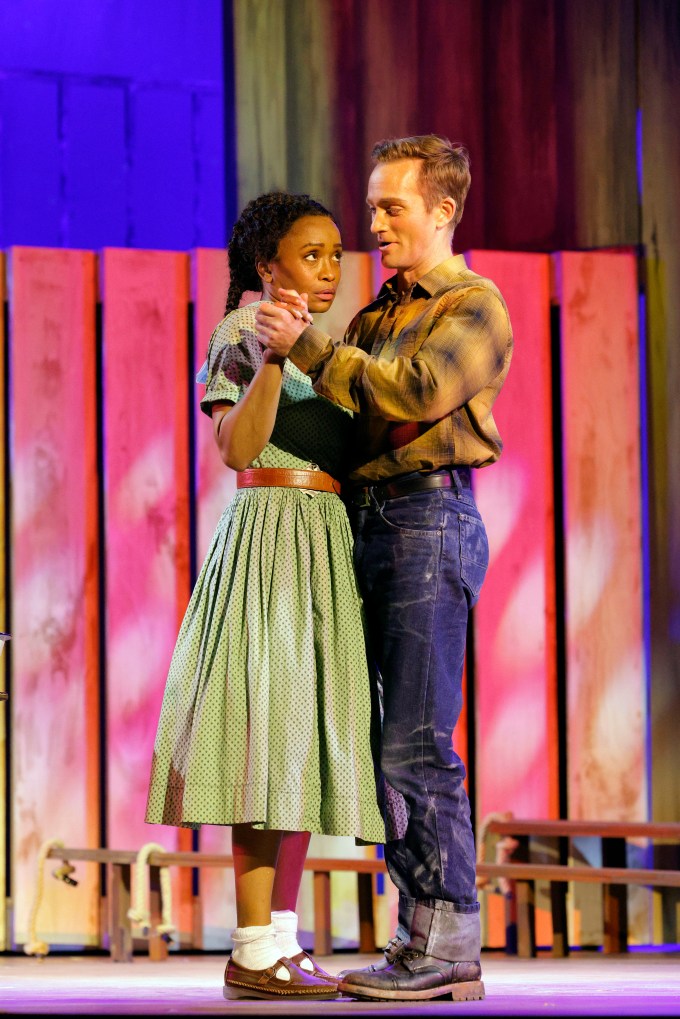
Shawnette Sulker as Bulrusher, Briana Hunter as Vera. All photos by Cory Weaver.
Imagine as a young child realizing that you look significantly different from everyone else around. And then you find out that the reason is because you come from a different tribe than the others. Finally, you learn that your people have been abused in many ways by the tribe that surrounds you. The good news is the notion that a majority population usually doesn’t feel threatened by a minority of one middle-aged man and one young girl, raised by a respected white schoolteacher, so that bigotry is largely suppressed.
Such is the karma of Bulrusher, like a black, female Moses, found in a basket among river reeds near the all-white, northern California town of Boonville. Not until she is 18 years of age in 1955 does a woman arrive in town from Alabama who looks like she shares similar racial background. Bulrusher’s story was first told in Eisa Davis’s eponymous 2007 Pulitzer-finalist play.
Matt Boehler as Schoolch, Rebecca Cuddy as Madame.
West Edge Opera has commissioned an opera version composed by Nathaniel Stookey that holds well to the story line and offers poignant entertainment with lush music performed by a distinguished cast of artists who bring great voices and fine characterizations to their roles. Action in Act 1 is somewhat slow paced, but Act 2 has enough moral lessons, status changes, denouements, and trainwrecks among various groups of characters to easily redeem the narrative. While most operas center on one central clash, “Bulrusher” manages the dramatic tension of these several conflicts effectively.
Shawnette Sulker embodies the role of Bulrusher singing with a sterling soprano, convincing in affect, and even giving the petite appearance of a youth. This foundling stands out in her community not just because of color, but because she has the power to read water to tell the future for others, from knowing tomorrow’s weather to telling a man that his undisclosed gonorrhea is going to clear up.
Shawnette Sulker as Bulrusher, Chad Somers as Boy.
Bulrusher also stands apart as a loner, since her foster father, the reserved and upstanding Schoolch (performed by towering and commanding bass Matt Boehler), demanded that she speak standard English. She doesn’t “harp the ling,” that is, speak Boontling which was the real patois of the locals in that era. The libretto is full of the town’s unique vocabulary (ricky chow for having sex or golden eagles for underwear) and colorful phrases like “geechin gets me scottied” (penetration makes me hungry!).
The ensemble of other characters comprises a diverse lot. Madame (smooth mezzo Rebecca Cuddy) is the somewhat mysterious no-nonsense business woman who prides herself on moral character, yet happens to be the proprietress of the local brothel. Logger (Kenneth Kellogg – another towering and commanding bass) is the one black man in the community, who is also a regular customer of the brothel.
Matt Boehler as Schoolch, Rebecca Cuddy as Madame, Kenneth Kellogg as Logger.
But Bulrusher’s most untried experiences are with her peers. Boy is played by Chad Somers who brings not only a fine tenor voice effective in a wide range, but he captures the contradictions of presumptuous masculine entitlement with gawky socialization. Boy was a classmate of Bulrusher’s who had ignored her through school but has now declared his interest in her to less than enthusiastic and sometimes volatile reception.
And finally, Vera (Briana Hunter, a mellow yet powerful lyric mezzo) has come to town from Birmingham to find her long lost uncle Logger and look for work to save for college. The sheltered Bulrusher comes of age through Vera’s presence, learning of hurt, love, and life in the outside world.
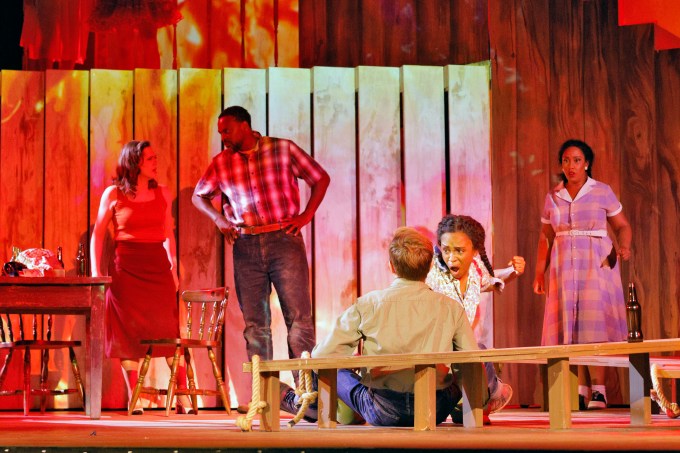
Rebecca Cuddy as Madame, Kenneth Kellogg as Logger, Chad Somers as Boy (facing away), Shawnette Sulker as Bulrusher, Briana Hunter as Vera.
The composer’s score is largely mellifluous but with sufficient dissonance to add some edge. Attractive set pieces abound including brief duets and interesting use of the chorus offstage and in echoing mode. The orchestral component serves the singers harmonically and rhythmically. Rarely does it carry the melody except with a few standout phrases that draw on folk and pop idiom. The orchestra is well conducted by Emily Senturia and is generally restrained and beautiful. It is however very strings dominant, and the slow pace of the score seems exacerbated by that configuration. In addition, when intermediate climaxes arise, the orchestra lacks the brass power to provide maximum impact.
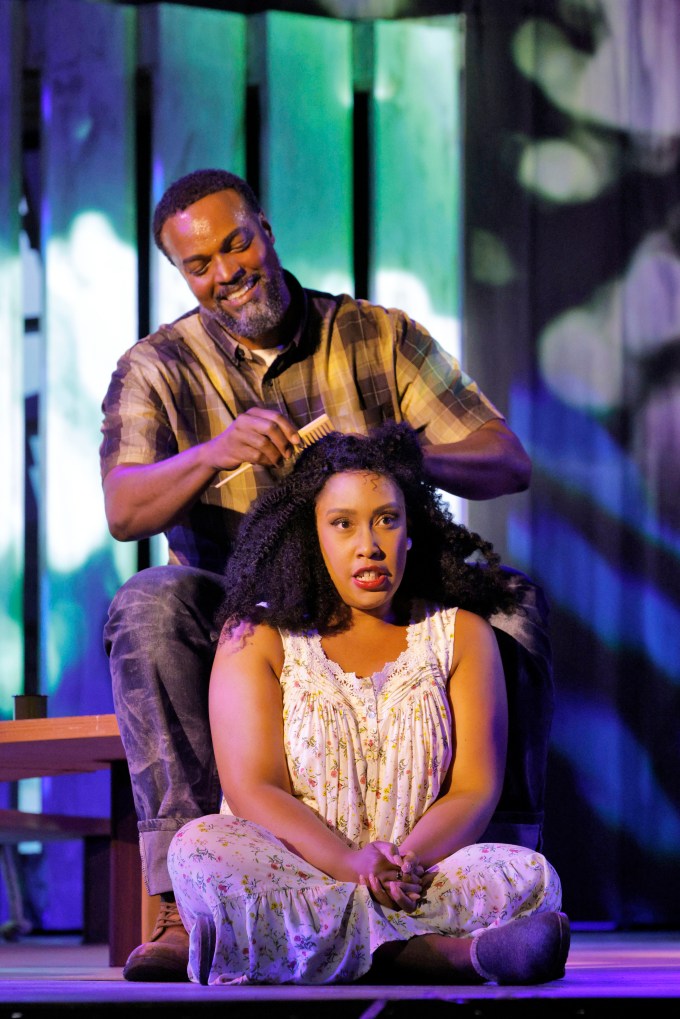
Kenneth Kellogg as Logger, Briana Hunter as Vera.
The one other area of concern is the staging. The company has gone with a minimalistic, abstract set with muted and mottled projections mostly of slowly moving water and other depictions of nature. Several large, curved benches on stage largely lack function, and they are moved into new locations during scene breaks with questionable purpose. This opera is strongly rooted in time and place, which particularly resonates with a Bay Area opera audience. Even if economy measures drive the set design, projections can be used to immerse the audience in the ambiance of Mendocino County in the ‘50s – weathered wood-sided buildings; townscapes; advertising and business signs of the period; and the bucolic environment of apple orchards, vineyards, redwood forests, rivers, and the Pacific Ocean.
“Bulrusher,” a world premiere, with music by Nathaniel Stookey and libretto by Eisa Davis & Nathaniel Stookey is based on Davis’s play of the same name, is produced by West Edge Opera and plays at Oakland Scottish Rite Center, 1547 Lakeside Drive, Oakland, CA through August 18, 2024.












 cordellreportsdotcom