The Thanksgiving Play

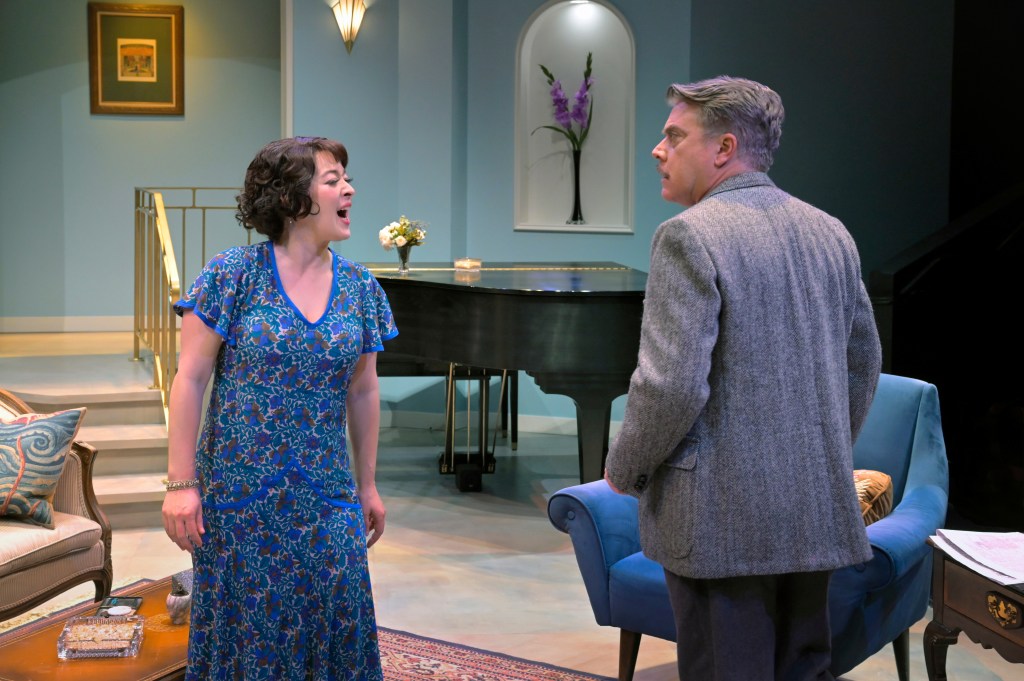
Anna Kosiarek as Alicia, Cary Ann Rosko as Logan, Tyler Iiams as Caden, Will Livingston as Jaxton. All photos by Grizzly De Haro.

The history of great nations is invariably forged with vicious and violent acts of conquest and subjugation.  It sometimes becomes difficult to view such history with self-respect, and many countries formally or informally adulterate facts to whitewash sins of the past.

Most Americans, certainly older ones, grew up with an acute awareness of the meaning of various public holidays.  Schools would often honor them with billboards, class lessons, pageants, and such.

And most of us grew to appreciate Thanksgiving as a special and honorable holiday.  It was not commercial or partisan like Christmas; didn’t honor war like Memorial Day; and wasn’t thematically inert like New Years.  Much as the nearly universal harvest festivals that it derived from, it was a time to give thanks and share nature’s bounty with family (and watch televised football!).
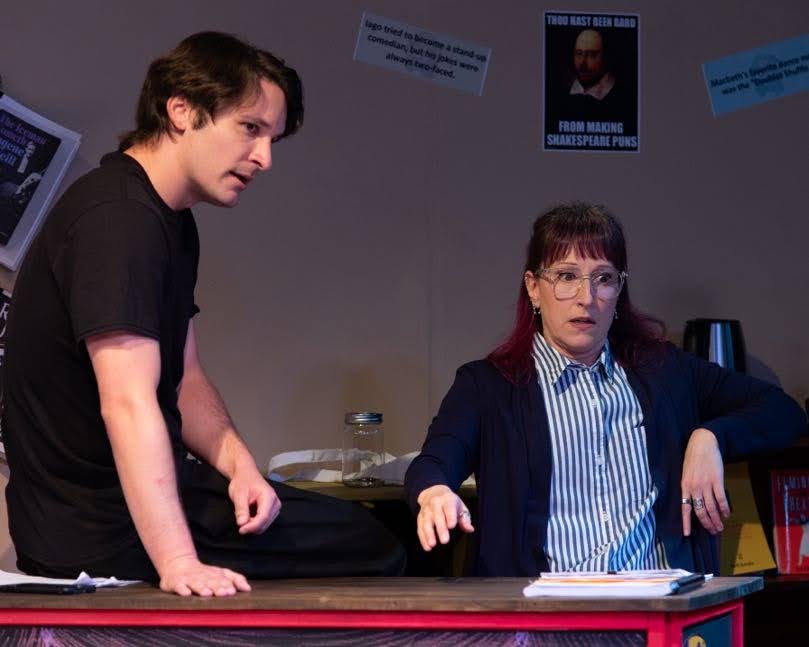
Will Livingston as Jaxton, Cary Ann Rosko as Logan.

The Thanksgiving Play by Larissa FastHorse was the first play written by a female Native American to reach Broadway.  Altarena Playhouse’s production about well-intended people hoping to succeed outside their element hits its mark with fine acting and fine direction from Kimberly Ridgeway and is humorous for the greater part..

Both expressly and implicitly, the play repudiates history suggesting Thanksgiving’s purity being built on the harmonious feast gatherings between New England Pilgrams and the Native Americans of the region. Not to say that there was no peace between the groups, but the fact remains that European settlers disrespected the natives’ very humanity and their traditions, while they massacred and violently displaced them from their homelands.  And it only got worse.
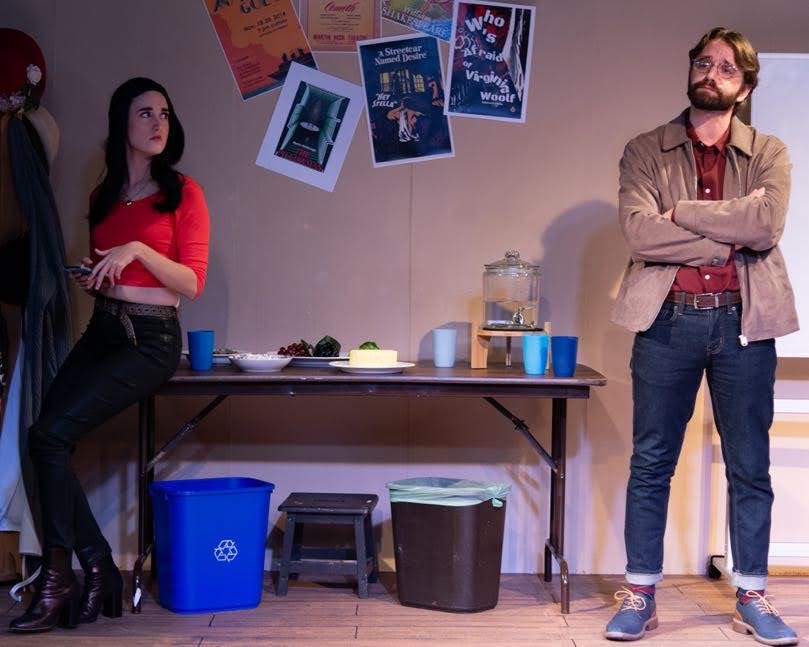
Anna Kosiarek as Alicia, Tyler Iiams as Caden.

This play centers on four white people brought together by frenetic Logan, a teacher who has won a grant to produce and direct a play with four actors illustrating the First Thanksgiving for Native American Heritage Month.  She enlists her boyfriend, Jaxton, an unsuccessful actor, who like Logan, is also an earnest do-gooder, as well as dorky Caden, a history teacher who has written a number of plays that have only been performed by elementary school students.

In attempting for inclusion and compliance with the grant, Logan hires the previously unknown attractive, vacuous, yet purposeful, Alicia, from an actor’s publicity shot with her in Native American garb.  But shortly after Alicia’s arrival, she reveals that she doesn’t fulfill the ethnic condition.  So the challenge becomes how to proceed with political correctness lacking even one Native American participant.  The solution that the desperate Logan ultimately proposes follows logic to the point of reductio ad absurdum.

The primary theme of the play concerns performative activism.  Although they may be sincere in wanting to promote Native American causes, these aspirants are willing to write and act in the project absent input from a Native American voice, and they get caught up in their own self-promotion.  Logan censors acting evaluation discussions between the “actors” in improv sessions, because as the director, she should be the only one to comment on performance.  Jaxton’s greatest inclusion concern is that he be included.  Caden wants to write a script that is historically expansive and accurate.  And finally, Alicia doesn’t want to think about her part, only to be told what to do.

Will Livingston as Jaxton, Tyler Iiams as Caden.

In fairness, however, even the playwright herself acknowledges the challenges of inclusion in geographical areas and particular types of performances where a specific minority group is not well represented.  In fact, her motivation for writing an all-white-cast play was in response to pushback on finding appropriate Native American actors to perform a script.  And of course, there is the additional bind evidenced in this play that it is against the law to ask the ethnicity of a job applicant.

The script is generally funny and the performers deliver the banter with great panache. The show includes several humorously farcical and sadly shocking Thanksgiving videos of the type that would be shown to primary school kids.  One depicts a silly song in which the lyrics to “The 12 Days of Christmas” are replaced with Native American gifts within a Thanksgiving ritual.  The climax to the play is ridiculous and a bit gross, but appropriate to the farce that precedes it.

Cary Ann Rosko leads the cast with a splendid portrayal of Logan, frantic and fearing rules and regulations.  The highly expressive Rosko sparkles as overwrought and hysterical.  Anna Kosiarek delights as the simplistic Alicia who knows that she is not smart but manages to make the most of her endowment without wasting a step.  Will Livingston suits the unctuous Jaxton who wishes to be the model of New Age self-awareness.  However, his weak commitment to causes is well-revealed as an “intended vegan,” but one who likes cheese too much to give it up.  Tyler Iiams fits well as the obsessive compulsive Caden whose endless production of written material seems to come to nothing, as does his yearning for Alicia.

Anna Kosiarek as Alicia, Cary Ann Rosko as Logan.

The Thanksgiving Play strikes many chords with great insight and accuracy, particularly about the marginalization of Native Americans and classic stereotypes.  Sometimes the issues get a little too crowded to be well absorbed and not every gag works, but even grasping most of the issues surfaced and laughing at most of the quips yields a rewarding theatrical experience.

The Thanksgiving Play is written by Larissa FastHorse, produced by Altarena Playhouse, and plays on its stage at 1409 High Street, Alameda, CA through November 24, 2024.

Fallen Angels

Emily Newsome as Jane, Kina Kantor as Julia. All photos by Kevin Berne.

This year marks the 125th anniversary of the birth of Noël Coward, prompting a wave of revivals of his works, albeit that several have remained in the repertory since their premieres.  Coward was a master of extracting humor from English manners and conventions, and his comedies have fared well on this side of the pond.  A number like Blithe Spirit, Present Laughter, and Private Lives have had not only successful stage revivals but have been adapted for the movie screen.

Aurora Theatre Company has chosen to perform Fallen Angels.  Premiered in 1925, it followed on the heels of Coward’s first major success, The Vortex.  While not in the first tier of Coward’s works, Fallen Angels fills the house with laughs if well done, as this production does with a fine cast that keeps the chatty banter flowing.

Michael Barrett Austin as Fred, Kina Kantor as Julia.

The play is also of historical interest, as it was initially prohibited by the censor’s office from reaching the stage in the U.K.  The offense? – references to admitted pre-marital sex and the explicit consideration of adultery.  Clearly, the story line would induce a big yawn if written today, so for today’s audience the fun must come from the repartee.

Kina Kantor as Julia, Kevin Clarke as Willy.

Close friends Julia and Jane are from England’s privileged class.  Each had a fling with a Frenchman, Maurice, several years previous before their respective marriages, which have now descended into comfortable tedium.  When the women find that Maurice is coming to London while the husbands are away on a golf outing, their passions reignite with remembrances of Gallic romance.  Jane even (jokingly?) wonders aloud “Wouldn’t it be terrible if a tree blew down at the golf course and killed Fred and Willy?” (They being the husbands.)

The narrative is dominated by the two women engaging in typical English parlor room behaviors.  Kina Kantor is Julia, and Emily Newsome is Jane.  Both are convincing in their wide-eyed, affected, faux-melodramatic exchanges which fashion the farcical tone.  At an objective level, the written script seems somewhat arid and the exchanges trivial, but comedy is an art of timing and execution, and they manage to sustain it throughout.

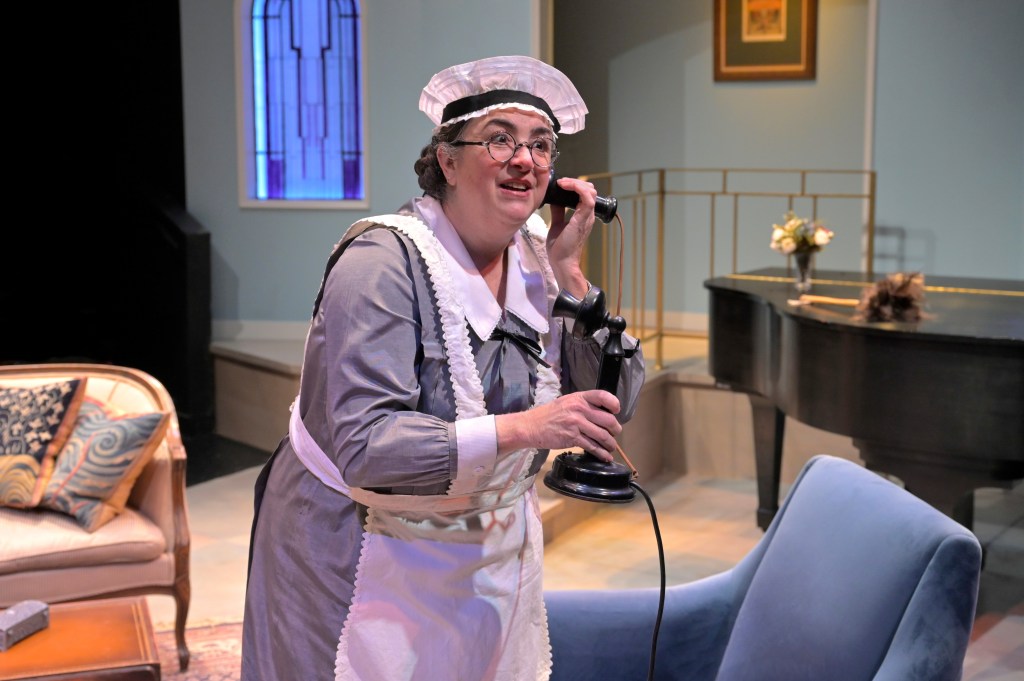
But the funniest acting is from Cindy Goldfield as Julia’s peripatetic and snooty new maid, Saunders.  In addition to one bit of physical comedy, Goldfield milks laughter from virtually everything out of her mouth, no matter how brief her message.  At one point, Julia is playing the piano, and while leaning over a table clearing dishes, Saunders matter-of-factly mouths “D-flat” sotto voce in observing the incorrect D-natural that Julia played.  That simple vocalization triggered roaring laughter because of Goldfield’s expression, her timing, and the context.

Cindy Goldfield as Saunders.

In another instance, Julia and Jane struggle singing a song in French, and Saunders breezes by singing it better.  And when Saunders offers an antidote for a hangover, she notes “I once cured 20 natives with this formula.” It seems that Saunders has had diverse work and life experiences that equal or exceed those of “her betters,” a comment on the superciliousness of the upper classes, that is delivered with piercing wit.

When Julia’s husband Fred is ready to depart for the distant golf course he and Jane’s husband Willy will play, only Saunders knows to tell him that he will only need irons for the course!  The men have a row on their trip as do the women as they await the arrival of Maurice.  When the men return, wrong information is given and other information is misinterpreted, so that foolish squabbles ensue.

Michael Barrett Austin as Fred adds to the hilarity with his elastic facial expressions as does Kevin Clarke playing Willy with his gesticulations and hitching up his trousers.  They petulantly mirror one another, each facing away, throwing back their heads, crossing their arms, and putting downward curls on their lips.

Emily Newsome as Jane.

Apart from inferences that can be made about class distinction, other deeper meaning arises in the double standard for men and women.  Also, there is an instance in which morality of actions by one’s own wife are assessed differently than the same actions by another’s wife.

Though the material for this play is fairly thin, Aurora does a fine job of making it work with overwrought but funny depictions.  Kudos also to Nancy Carlin, the dialect coach, and Maggie Morgan for the period costumery.

Fallen Angels is written by Noël Coward, produced by Aurora Theatre Company, and plays on it stage at 2081 Addison Street, Berkeley, CA through November 17, 2024.
Tristan and Isolde

Anja Kampe as Isolde, Simon O’Neill as Tristan. All photos by Cory Weaver.

The year is 1865, and Richard Wagner’s Tristan and Isolde receives its premiere six years after its completion.  Initially controversial and later accepted as an innovative masterpiece, its initial chord in the prelude would change the trajectory of classical music.

What has become known as “the Tristan chord” conveys an edgy dissonance in several seconds of play that would open the door for atonalism which would later dominate the classical music landscape.  But its significance is not the non-traditional structure of the chord as such.  After numerous tantalizing teases throughout the tempestuous and tortured relationship between the title characters over the next four hours of music (almost five including intermissions), the tension from the dissonance is not relieved until the chord resolves in the title characters’ transcendence scene at the very end.

(foreground) Annika Schlicht as Brangäne, Simon O’Neill as Tristan, (rear) Wolfgang Koch as Kurwenal.

Tristan has had an odd history at San Francisco Opera.  It was the first Wagner opera the company ever performed and received frequent productions in the 1930s and during World War II, even when Wagner’s music was revered by our enemies the Nazis as the Aryan ideal.  Since then, the gaps between productions have lengthened, extending 18 years since the last offering.  The current rendering is a passionate and powerful realization with fine singing and orchestral performance, well appreciated by an enthusiastic audience. 

Influenced by his infatuation with the married Mathilde Wesendonck and the philosophy of Arthur Schopenhauer, Wagner became obsessed with love and death.  Tristan’s forbidden love reflects that of the composer himself, while the opera represents the apotheosis of the merging and transcendence of those two conditions, with the belief that love continues beyond life.  The supernatural nature of love also maps onto the world’s most famous love story, Shakespeare’s Romeo and Juliet.

Annika Schlicht as Brangäne, Anja Kampe as Isolde.

The uncomplicated plot line of the opera draws from Celtic mythology presented in a style of romantic mystical realism.  Tristan, who is designated successor to the throne of Cornwall, escorts a resistant Isolde to marry his uncle King Marke.  To defeat the involuntary arrangement, Isolde instructs her maid, Brangäne, to poison a drink that she and Tristan will share.  Instead, the maid mixes in a love potion, which triggers their illicit love affair and the retribution that would result in their deaths.

Perhaps the most lauded element in the opera is the heroic orchestral music for which Wagner was a master.  Along with novel chord structures, the orchestra largely carries the melody in the score as well as its symbolism.  Eun Sun Kim conducts the 72-piece orchestra through the musical marathon with great skill.  The full orchestra resounds with rich tone and texture from the brass-driven fortissimos to the pianissimos like the beautiful English horn solo in Act 3. 

Wagner also introduced orchestral leitmotifs in Tristan, which convey the symbolism.  Most notably, the beautiful and haunting “Liebestod” (love-death) motif, which recurs in the opera, reaches its full realization as a closing aria in the climax, when Isolde elegizes the deceased Tristan.

Anja Kampe as Isolde, Simon O’Neill as Tristan.

Singing in Tristan demands unparalleled power and endurance.  Two principals carry the load of a very long opera while competing with an orchestral volume that Wagner pitches to challenge singers’ limits.

Fortunately, this production casts leading Wagnerian heldentenor Simon O’Neill as Tristan, a role that he commands.  Soprano Anja Kampe is a highly accomplished Isolde as well.  From the time of their duet that dominates Act 2, both display their mellifluous and clarion voices.  But through early Act 2, both sound underpowered, which one can assume is attributed to saving their voices for later dramatic moments.

Conversely, bass Kwangchul Youn as King Marke, came through as mellow, audible, and understandable throughout.  Granted, however, his role demands less.  Solid performances by Annika Schlicht as Isolde’s attendant Brangäne and Wolfgang Koch as Tristan’s attendant Kurwenal should also be noted.

Kwangchul Youn as King Marke, Simon O’Neill as Tristan.

Despite the outsized influence of Tristan and Isolde in subsequent opera, aspects other than the music don’t stand up as well to the normal scrutiny that operas undergo.  For those expecting dynamic action, that is not this opera’s strong suit.

Wagner was extremely intellectual, philosophical, and poetic.  As a result, Tristan is very reflective, talky, and static with little visual energy.  Philosophical monologs and dialogs about love and death, day and night are sometimes repetitive or exhaustively long.  Predominately, only two or three principals are on stage at a time, and their interaction is largely expository.  The two brief periods that there are more than four artists on stage and any semblance of action, the extras are as unoccupied as statues.  What’s more, the chorus’s brief performance is off-stage, so there is no visual sense of grand opera.

Wolfgang Koch as Kurwenal, Simon O’Neill as Tristan.

In keeping with modern perceptions of the austerity of the Middle Ages, San Francisco Opera’s staging is suitably spare and near monochromatic with dramatic shadowing.  Sets in Act 1 are highly angular, representing the structural bones on the inside of a ship’s hull.  The theme is repeated in Act 3, but with the set askew.  Act 2 reveals plain building exteriors supported by simple early Gothic buttresses.

When all is said and done, Tristan and Isolde stands as a magnum opus in the idiom, and this production reaches admirable artistic heights.  Serious opera aficionados and the intellectually curious will benefit from experiencing it.

Tristan and Isolde with music and lyrics by Richard Wagner is produced by San Francisco Opera and plays at War Memorial Opera House, 301 Van Ness Avenue, San Francisco, CA through November 5, 2024.

Wait Until Dark

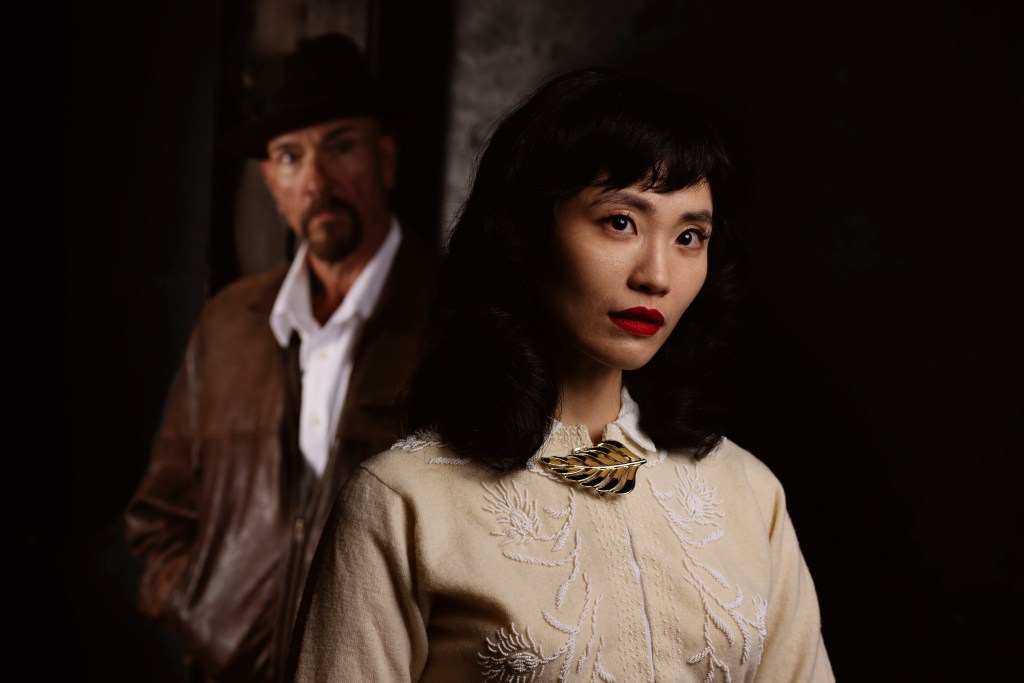
Scott Coopwood as Roat, Sarah Jiang as Susan. Photos by Tracy Martin.

[For the remainder of the year, my San Jose and Peninsula theater reviews will be posted on Talkin’ Broadway with only introductions to those reviews on this site]

Please continue to https://talkinbroadway.com/page/regional/sanjose/sj262.html for full review.

The 1967 film Wait Until Dark was exceedingly successful at the box office and with critics, and its climax ranks #10 in Bravo’s 100 Scariest Movie Moments – of all time.  Yet, many theatergoers might be unaware that the story was originally a successful stage play.

Terror percolates when unknown and unseen.  The heroine, Susan, lives in a Greenwich Village apartment with her husband Sam who is away on a business trip.  Though recently married to the man who is the only person she can depend on, Susan is led to believe that he is already having an affair and that he feels he made a bad decision in marrying her.

When confronted with suspicion and then fear, Susan is particularly imperiled.  She cannot see.  While her physical injuries from an auto accident 18 months before have healed, Susan has been left permanently blinded.  Her limitations mean tighter boundaries around what she is able to experience; a greater intensity of relying on other senses; and an intimate familiarity with her abode, where she spends virtually all of her time.

This suspense thriller is a complex con game in which three professional thieves scheme to extract something valuable from Susan.  That asset is an old-fashioned doll that happens to be stuffed with something of enormous value that Sam became holder of through no intention of his own.

Sarah Jiang as Susan, Mia Rapaport as Gloria.

*****

Wait Until Dark runs through November 3, 2024 at Hillbarn Theatre, 1285 E. Hillsdale Blvd., Foster City, CA.  For tickets and information, please visit https://www.hillbarntheatre.org/ .

Yaga

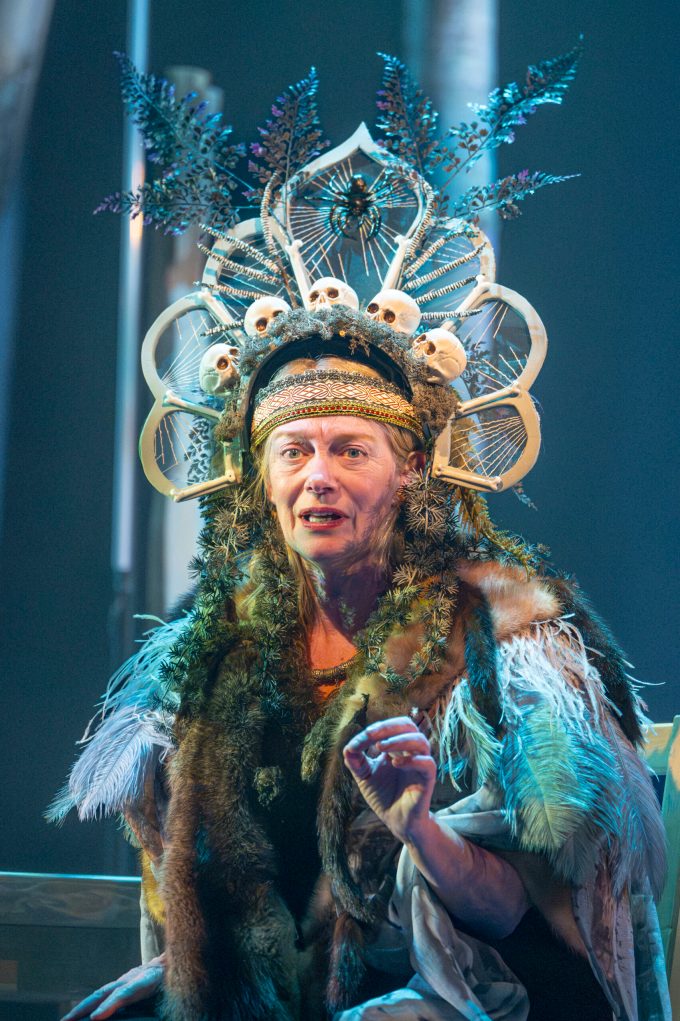
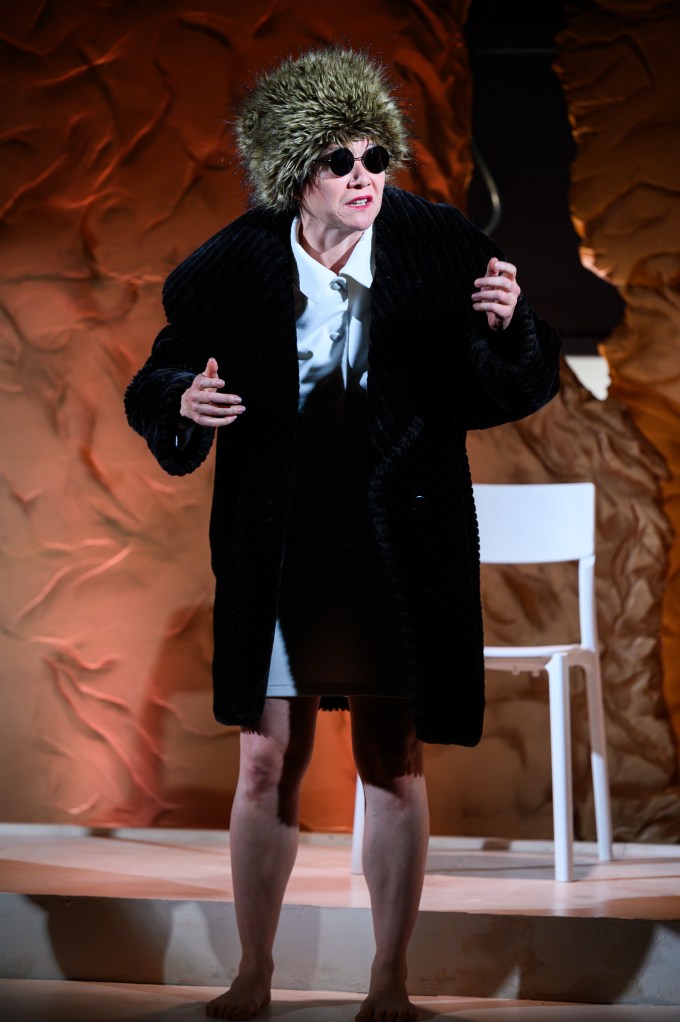
Julia McNeal as Baba Yaga. All photos by David Allen.

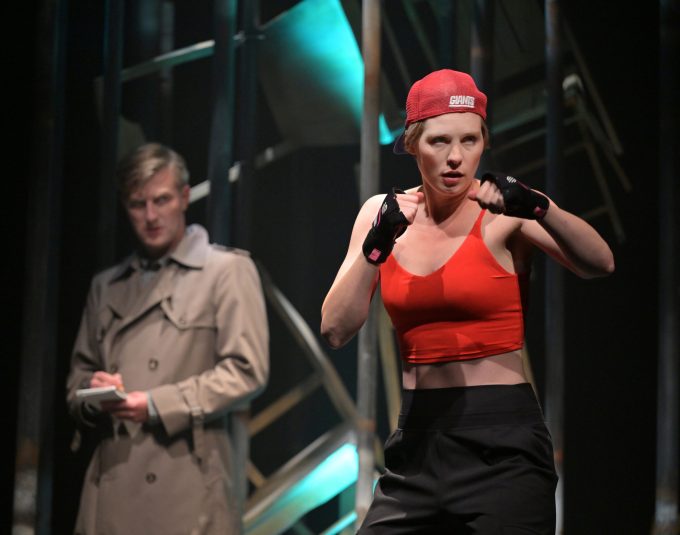
The Slavic folklore cultures of Eastern Europe have long been a gushing font for tales of lurid, preternatural beings such as vampires and witches.  Perhaps the most ubiquitous are the variations of the Baba Yaga, with baba meaning grandmother or old woman, and yaga being etymologically diverse, but generally construed as a witch.  While differing in detail, the Baba Yaga usually appears as a disheveled hag.  Her representations reached high culture in Mussorgsky’s orchestral composition Pictures at an Exhibition and in the form of Ježibaba in Dvořák’s Czech opera Rusalka, and low culture in Keanu Reeves’ John Wick movie series as the nickname of the title character.

Marin Theatre has produced the U.S. premiere of Canadian playwright Kat Sandler’s Yaga, an homage to the ambiguous but powerful exemplar.   The lore is updated to the contemporary period, taking place in a rural town in an unspecified part of North America.  Validating the social isolation of the subject, the play opens with a Baba Yaga asking “Who could love such a person?”  But the folk element of the play integrates into another literary genre, the detective mystery.  A young man is missing and presumed dead and probably murdered.  The wealthy victim’s family, dissatisfied with the police investigation, hires a private detective to pursue the case.  Oh, and by the way, this is a comedy – some might say a farce.

Adam KuveNiemann as Private Investigator Charlie Rapp, Julia McNeal as diner owner Geena, Rachel Clausen as Detective Carson.

Charlie Rapp (Adam KuveNiemann) is a caricature of a private investigator in a comedy – bumptious, full of fast-talking bravado, and dismissive of the public police.  But he does need help, and he leans heavily on Police Detective Carson (Rachel Clausen), who is a nice one to lean on, because he finds her informed and very appealing. 

That leads to the third main character, Professor Katherine Yazov (Julia McNeal), who becomes a suspect.  She attracts attention being an anthropologist who is familiar with the processes to make a body disappear.  The alluring but older professor, who is known sub-rosa as the “bone (or boner!) beast” is also uninhibited.  Her repartee can be quite explicit and enticing, and she has an appetite for young men, including Henry, the disappeared heir.  Yazov comes from a Slavic background, with an elderly mother, Irene, who seems to have traits that might be associated with witchcraft, which include providing unusual drugs to seekers. 

Adam KuveNiemann as Private Investigator Charlie Rapp, Rachel Clausen as boxer Pam.

The play calls for 14 roles, and you have already been introduced to all of the actors.  The three hander is an acting showcase.  As specified by the playwright, the male plays two parts, and the women have six each.  Kudos to the actors.  With pretty minimal costume and hair changes, they do an exemplary job of differentiating the parts that they play by movement, facial expression, and speech patterns.

This conceit of minimizing the number of players would also have placed pressure on the playwright, as two or more characters played by any one actor cannot appear on the stage at the same time, but Sandler managed that challenge effectively. Meg Neville’s costumery facilitates the needed fast switchover of scenes, presumably emphasizing layered and tearaway outfits. 

Adam KuveNiemann as Private Investigator Charlie Rapp, Rachel Clausen as town gossip Truly.

The narrative consists of a myriad of short scenes that advance the investigation with interrogations of several local rubes – all female; elaboration on the main characters and their relationships; and the integration of witchcraft, including a need for breeding and a little faux violence.  While Director Barbara Damashek ensures that the frequent scene change device results in fast pacing even when the content drags, the many shifts in direction can also lead to confusion, especially if a patron misses some dialog or when the logic of the action is not immediately clear.   Flashbacks add another layer of potential complication.

While the storyline acts as a who-dunnit?, a deeper meaning prevails concerning female empowerment.  Men have always written history, and exerting their power, they have inordinately scapegoated women for the wrongs in the world – from Eve in the Bible through the Salem “witches” in colonial Massachusetts.  Yet, in some ways, Baba Yaga represents proto-feminism as a fearsome, powerful woman who does not have to depend on good looks or womanly wiles to succeed.

Rachel Clausen as Detective Carson, Julia McNeal as Professor Katherine Yazov.

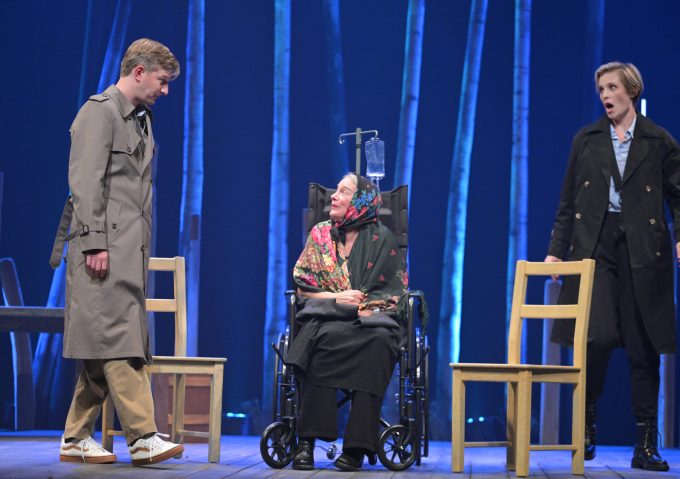
All of the elements of the production are superb.  In addition to exemplary acting, Carlos Aceves’ set provides an attractive birch forest backdrop and a forestage that is versatile enough to represent, somewhat in the abstract, everything from a police station to a motel to a diner.  Kurt Landesman’s lighting appeals aesthetically and directs the eye, while Matt Stines’ thoughtful sound design ranges from understated background to bombastic on the edges.  The recurring musical strands of Santo and Johnny’s wonderful instrumental Sleepwalk have thematic implications.

The inventive script largely entertains with the twists and turns expected in a noir mystery, along with humor and a surprise ending.  But despite the admirable strengths of the production, many theatergoers will not find Yaga to be their cup of tea.  More tolerance is required to come down in favor.

Adam KuveNiemann as Private Investigator Charlie Rapp; Julia McNeal as Irene, mother of Professor Yazov; Rachel Clausen as Detective Carson.

In addition to the concerns already expressed, the run time is almost three hours, which even advocates should agree is taxing for the type of play that it is.  Serious editing would simplify the throughline and reduce the number of less entertaining patches.  Also, the audience will divide on language and suggestion.  Particularly, some Boomers will consider the explicit language and discussion of sex acts to be vulgar and gratuitous, while many Millennials at the other extreme may find it quite routine.

Yaga, written by Kat Sandler, is produced by Marin Theatre and plays on its stage at 397 Miller Avenue, Mill Valley, CA through November 3, 2024.

Angels in America: Part 2 – Perestroika

Edric Young as Joe, Dean Linnard as Louis. All photos by Ben Krantz Studio.

Tony Kushner followed Angels in America: Part 1 – Millennium Approaches, his matchless tale of homosexuality, AIDS, religion, and politics in the 1980s, with an equally compelling Angels in America: Part 2 – Perestroika.  Though the two parts can be appreciated as independent plays, they represent a continuous narrative of the lives of a select few residing in New York City.

Rarely is a follow up of any sort as good as the original, but each part won the Tony Award for Best Play for their respective Broadway premiere years, 1993 and 1994, suggesting how exalted they are.  With the same astounding cast and powerful staging orchestrated by Director Michael Socrates Moran in Millennium Approaches, Oakland Theater Project’s Perestroika is equally stellar in its breathtaking production.

Victor Talmadge as Roy Cohn, James Mercer II as Belize.

Perestroika takes a little unraveling, with its interwoven stories, digressions, hallucinations, biblical allegories, and supernatural fantasies, yet the relevance of the title and the dominant thematic through-line in the narrative is established in the opening scene.  In it, Alexii, the oldest living Bolshevik, rails against Mikhail Gorbachev for abandoning the theory-based communism of the Russian Revolution for an unknown and ill-defined future.  Alexii asks, “What is the theory?  Hamburgers?”

Erin Mei-Ling Stuart plays Alexii as well as a rabbi; the Mormon mother of Joe who outs himself to her; and Ethel Rosenberg, who Roy Cohn notoriously convicted for a death sentence for purportedly selling nuclear secrets to the USSR.  Stuart persuades in every impersonation, both because of her fine acting and her facility with accents – Russian, New Yorker, Yiddish-American, and Utahan (?!).

Erin Mei-Ling Stuart as Alexii.

In concert with the disruption to the Soviet’s established order by Gorbachev’s Perestroika, Kushner’s tale provides a transcendental account of how the divine stasis in heaven was disturbed by human movement and ceased altogether because of the San Francisco Earthquake of 1906!  For heaven’s equilibrium to be restored, humankind must suspend social evolution.  The message to stop movement is delivered to the AIDS-suffering Prior by the Angel, who Lisa Ramirez deftly depicts with looming, mystical charm.  Her mere presence on stage provokes.  Further, her gestures with undulating arms plus her words as with an orgasmic soliloquy make her even more intriguing.

But the playwright’s world view is opposite of the messages to halt human progress.  Experimentation, migration, and intermarriage enrich societies.  Stodgy, unimaginative religions and conservative political parties impede social progress and harmony.  Change is the engine of meaningful life, and an important part of change is acceptance and integration of people from different tribes and orientations.  Like democracy which is messy and flawed but the best political alternative, change beats stasis every time.  Just look back a millennium and ask yourself if you’d want to live as they did.

J Jha as Prior (foreground), James Mercer II as Belize (rear).

If Kushner’s Perestroika has a weakness, it lies in the predictability of life’s transitions in the play.  We know the characters.  Some are doomed to die.  Some relationships are bound to be severed.  The strength however is in the intense journey and ultimate closure.

The most inflammatory character carried over from Part 1 continues to be the historical figure Roy Cohn, whose moral profile frightens with its similarity to his protégé, Donald Trump.  When Cohn is hospitalized with terminal AIDS, his primary nurse Belize is a black, gay man who is played in flamboyant fashion by James Mercer II.  Cohn’s unending racial and lifestyle insults (despite Cohn being a closeted gay) to the caretaker are so gratuitous that one wonders if his bile is driven more by his need to display bravado than by true disdain.  But though Belize deplored Cohn, Mercer displays Belize’s dignity, compassion, and sensitivity.  Belize even insists that a kaddish (Jewish sanctifying prayer) be said when Cohn dies.

As with Millennium Approaches, Victor Talmadge again nails the ever-bellicose Roy Cohn with an electrifying portrayal.  Similarly, J Jha elicits empathy as the raspy, howling, lonely, but courageous Prior with great sensitivity; and Emilie Whelan penetrates the psyche of the crazed but recovering Harper.  Rather than repeat my raves about these three actors as well as the stage elements, I’ll refer the reader to my review of Millennium Approaches on this site earlier this month.

Emilie Whelan as Harper.

Meanwhile the action intercuts with the continuing stories of Mormon law clerk Joe’s separation from his prescription-drug addled Harper; Joe’s mother Hannah coming to Brooklyn to live with Harper; and Louis’s abandoning Prior because Louis can’t cope with Prior’s AIDS.

With the dissolution of previous bonds, Joe and Louis establish a rebound relationship, and their differing affects present an interesting contrast. Joe is conflicted about his sexual identity and the attendant contradictions of being Mormon and Republican.  In this role, Edric Young ably conveys the sadness and confusion of the conundrums, and his sensitive deer-in-the-headlights vacuous looks show how uneasy he is in his own skin.

Dean Linnard plays the committed gay Louis who is guilt-ridden about having left Prior.  Excitable, he flails his hands in joy when pleased, which he is not when finding that Joe is not only an unrepentant Mormon but Republican, which does not align with values of the greater gay community.  Louis’s ire is revealed when he verbally brutalizes Joe with chapter-and-verse reading aloud judicial opinions that Joe purportedly wrote for his boss, a circuit court judge.  They are not only conservative, but disadvantage gays, reflecting the kinds of moral dilemmas closeted gays endure.

Lisa Ramirez as Angel.

Angels in America constitutes a time capsule of a very important period of this country’s social and political history that reverberates with relevance even today.  Seeing both parts, Millennium Approaches and Perestroika involves six hours of time exceptionally well spent.  Great thanks to the playwright along with the creatives and especially the actors of these productions, who convincingly invest themselves in the massive and demanding roles, for a highly meaningful and greatly entertaining experience.

Angels in America: Part 2 – Perestroika, written by Tony Kushner is produced by Oakland Theater Company and plays at 514 4th Street, San Rafael, CA through October 27, 2024.

King James

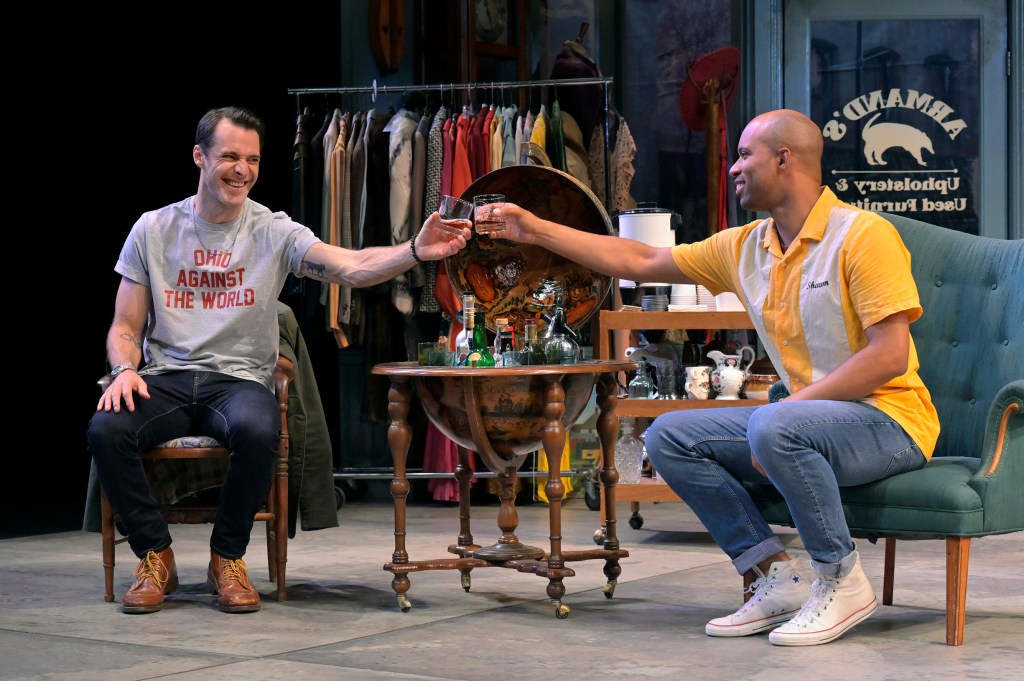
Kenny Scott as Shawn, Jordan Lane Shappell as Matt. Photos by Kevin Berne.

[For the remainder of the year, my San Jose and Peninsula theater reviews will be posted on Talkin’ Broadway with only introductions to those reviews on this site]

Please continue to https://talkinbroadway.com/page/regional/sanjose/sj261.html for full review.

Sports have taken on outsized influence in American life.  Cities vie for teams with uncommonly large subsidies and other concessions to franchise owners.  Games are played in vastly expensive palatial arenas.  Media coverage of contests and sports talk shows reign in popularity.   Players earn princely sums.  Betting not just on game outcomes but even on individual plays indicates the depth of sports addiction and some viewers’ need for constant stimulation.  Analytics are increasingly sophisticated and ubiquitous.  Fanatics’ zeal extends beyond the real world to dedicating more of their lives to fantasy sports leagues.

Needless to say, alliances and friendships build around shared love of teams or individual players and little more.  A generally positive byproduct is that hometown team loyalty also promotes a sense of community patriotism, though this can turn to collective depression when a team does poorly or move away.

Rajiv Joseph explores the theme and consequences of sports obsession in his brilliant King James, a two-handed dramedy defined by the era of Lebron James’ two stints with the Cleveland Cavaliers basketball team from 2004 to 2016.  Without giving anything away except documented history, it covers the time from Lebron’s rookie year through the Cav’s unlikely championship, with a brief mention of his two championships with Miami in between.

Jordan Lane Shappell as Matt, Kenny Scott as Shawn.

King James, written by Rajiv Joseph is produced by TheatreWorks Silicon Valley and plays at Mountain View Center for the Performing Arts, 500 Castro Street, Mountain View, CA through November 3, 2024.

An Inspector Calls

Doll Piccotto as Sybil, Myles Kenyon Rowland as Eric, Erik Gandolfi as Arthur, Sydney Harmon as Sheila. Photos by Christian Pizzirani.

[For the remainder of the year, my San Jose and Peninsula theater reviews will be posted on Talkin’ Broadway with only introductions to those reviews on this site]

Please continue to https://www.talkinbroadway.com/page/regional/sanjose/sj260.html for full review.

“Don’t build walls.  He’ll only tear them down,” one member of the Birling family declares to the others.  This reproach directly refers to the futility of hiding information that will come out anyway, but it also speaks to the divide that the privileged class has erected against the less affluent, including the inspector in question.  The year is 1912, and many in England already sense the impending threat of what would become World War I because of regional conflicts on the continent.

The engrossing An Inspector Calls follows in the English tradition of Agatha Christie’s Murder on the Orient Express and Then There Were None, in which all of those in the collected party are shown to have motive to wish the victim disappeared or dead.  Like those novels, this plot line becomes predictable, and the viewer can anticipate the pins falling and begin to guess the connection of each character to the victim.

But when it seems that the tale is told, audience members may look at their watches and see that there are still 20 minutes left in the estimated run time of two-and-a-half hours.  That remaining time conceals the twist that makes An Inspector Calls distinctive and ultimately satisfying.

****************

Erik Gandolfi as Arthur, Heren Patel as Gerald, Richard Newton as the Inspector.

An Inspector Calls, written by J. B. Priestley is produced by City Lights Theater Company and plays on its stage at 529 South 2nd Street, San Jose, CA through October 20, 2024.

Angels in America – Part 1 – Millenium Approaches

Lisa Ramirez (foreground), Victor Talmadge, James Mercer II, Dean Linnard, J Jha, Edric Young, Emilie Whelan, Erin Mei-Ling Stuart. All photos by Ben Krantz Studio.

Rarely does a play become a classic as soon as it reaches Broadway, but such was the case with Angels in America – Part 1 – Millenium Approaches in 1993.  Receiving the Pulitzer Prize for Drama, and the Tony, Drama Desk, and NY Critics Circle Best Play Awards, its afterlife would include decorated revivals and numerous adaptations.  It resonates now as it did then with its timely and thoughtful depiction of homosexuality (think of any minority as a corollary) and the AIDS epidemic (think of the Covid pandemic). Other grand social themes also receive treatment from race to religion.

Like many, having seen the HBO miniseries and the Berkeley Rep production, I felt inoculated from Angels in America but wanted to support Oakland Theater Project in this major undertaking anyway.  In retrospect, no pretext required.  With Michael Socrates Moran’s commanding, incisive, and brisk direction along with absolutely superlative acting across the board, this riveting production is breathtaking, and three hours whizzes by in an instant.

Victor Talmadge as Roy Cohn.

Angels… was born at the Eureka Theatre in San Francisco of unmatched pedigree.  Playwright Tony Kushner would become one of his generation’s greatest writers.  But most patrons will not realize that the plays were commissioned and shepherded by two of our greatest directors.  Oscar Eustis has become the long-time Artistic Director of New York’s Public Theater, while Tony Taccone long served as Artistic Director of Berkeley Rep.  And while the play takes place in New York City, San Francisco has served as Ground Zero for the topics at issue and remains its emotional heart.

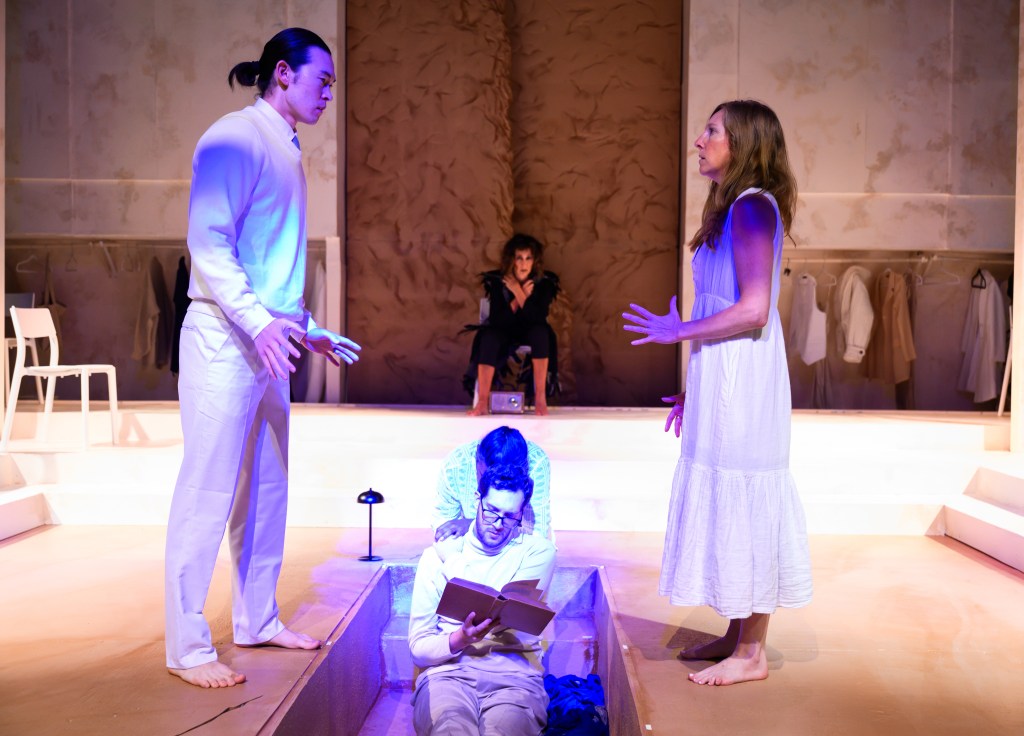
Per the playwright’s stage directions in the script, the staging, by Set Designer Mark Thomas, is abstract with few props, allowing the audience to focus on the actors and to fill the scenery with their own imagination.  The most symbolic aspect of the set is the pit in the center which acts as a sunken bed but anticipates a coffin.  With the exception of the black-garbed angel, whitish outfits dominate the costumer against a whitish set.

Dean Linnard as Louis, J Jha as Prior.

Several taut but seemingly unrelated vignettes open the play, adding to the sense of disconnected abstraction.  Even though the individual aspects of the play are compelling, one may wonder where they will go.  Of course, the dots are eventually connected with intersections among characters, resulting in a rewarding whole.

Emotions are on edge throughout and often run high, though comic moments foreclose oppressiveness.  The most gripping and chilling performance comes from Victor Talmadge who is searing as Senator Joe McCarthy’s associate Roy Cohn, a man always on the attack and physically leaning in.  Perhaps his intense personification is more indelible because his is the only historical character in the play.  What’s more, Cohn was a mentor to Donald Trump, which makes his self-serving, megalomania even more frightening.  It is too relatable today.

(standing) Edric Young as Joe, Emilie Whelan as Harper, (rear) Lisa Ramirez as Angel, (below) Dean Linnard as Louis.

Talmadge’s Cohn knows one talking speed which is fast and one volume which is loud.  He is crass, domineering, and unrelenting.  And it is all about him – wielding his power, no matter whether legal, and satisfying his own needs at the expense of others. But in this end-of-life period, his one obsession is his reputation – that he not be outed as gay or as inflicted with AIDS.  His public insistence is that he has liver cancer, and so it is that appearance and reality fail to coincide in a world of macho and conservative hypocrisy.

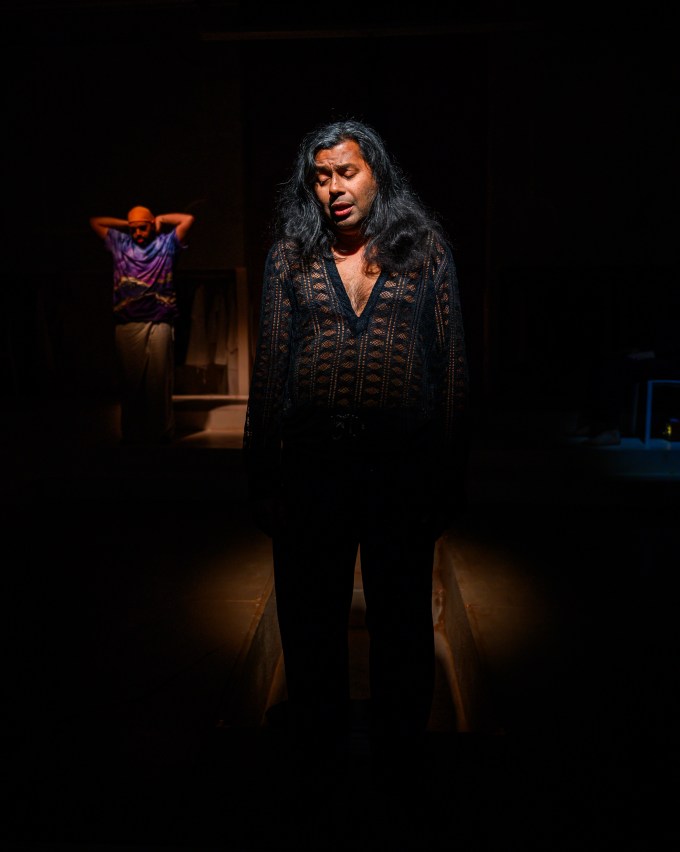
The parallel concerns of love and loss in the fate of two couples actually anchor the storyline.  In one, Prior, the scion of an eminent patrician family, is dying from AIDS, and his partner Louis struggles to deal with the situation.  In a masterstroke of against-type casting, the director went with the best available actor, the salt-and-pepper, long-haired, Indian-ethnic, transgender J Jha in the role.  Jha wails in physical and mental agony with a plaintive rasp, often crying through his speech as he gains the empathy of the audience.  As implausible as this actor should seem in the role, you soon forget that and simply marvel at the fine acting.

J Jha as Prior, Emilie Whelan as Harper.

The other couple is a Mormon pair who have had difficulty procreating and with intimacy altogether.  Joe seems ambiguous and ambivalent, but his wife Harper’s pain is palpable with her agoraphobia and addiction to Valium.  Unlike Prior, she should be able to control the causes of her anguish.  Emilie Whelan shines as Harper, and she captures the vacant loneliness and hallucination with her flittering eyes and actions.

Kushner designed Angels… as an ensemble.  Each actor gets at least one “close-up” with sizzling highlights involving hair-trigger emotion, and each deserves recognition for outstanding work.  Dean Linnard plays the conflicted Louis whose urges and fears could result in betraying Prior.  Likewise, the androgynous Joe, played by Edric Young confronts similar urges and fears in dealing with his marital conundrum.  Lisa Ramirez is the Angel and others, while Erin Mei-Ling Stuart and James Mercer II play multiple roles, all to great effect.

This production truly excels.  Even theater fans who feel that they’ve “been there, done that” and sense that the urgency of those times has passed will plumb this work with renewed appreciation.

Lisa Ramirez as Angel.

To allow for larger audiences, Oakland Theater Project (formerly Ubuntu) has taken temporary residence at Marin Shakes’ new indoor home in San Rafael.  North Bay audiences should take advantage of the opportunity to experience this fine East Bay company.  The two parts are designed to work independently, but experiencing the whole sweep of the masterwork suggests seeing both if you can.

Angels in America – Part 1 – Millenium Approaches written by Tony Kushner is produced by Oakland Theater Project and plays at 514 4th Street, San Rafael, CA through October 26, 2024.

The Daughter of the Regiment

Véronique Filloux as Marie, Eugene Brancoveanu as Sulpice, Chris Mosz as Tonio. All photos by Barbara Mallon.

Like his contemporary Gioachino Rossini, the prolific Gaetano Donizetti proved an elite champion of the bel canto singing style; composed with equal skill in opera buffa and opera seria; and wrote for the French as well as his native Italian opera.  Nestled between his other comic masterpieces, L’elisir d’amore and Don Pasquale, The Daughter of the Regiment is a frothy gem from the repertory that Livermore Valley Opera aces with its lighthearted and skilled production.

The other two of Donizetti’s comedies are warhorses.  For instance, I saw four different productions of Don Pasquale in a little over 12 months, yet I’ve seen The Daughter of the Regiment only once, a production by a small company over 30 years ago.  Happily, LVO has a love affair with Donizetti’s comedies, offering Don Pasquale in 2017, L’elisir d’amore in 2022, and now Daughter…  I say happily because each production has sparkled.

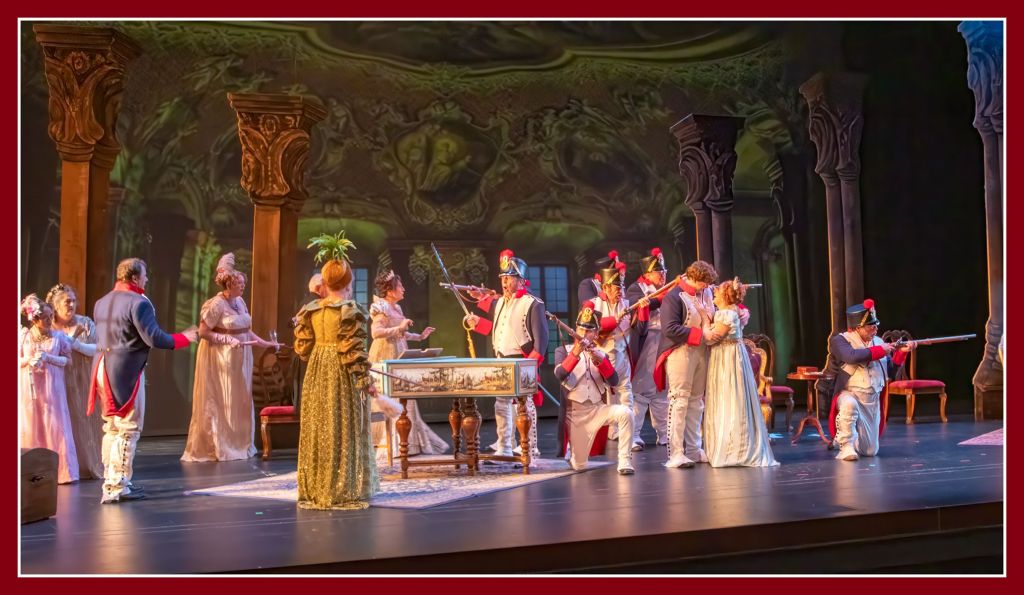
Lisa Chavez as Marquise of Berkenfield (left), cast.

Like his other comedies, Daughter… is full of truly beautiful orchestral music with melodic arias and a number of ensembles, mostly duets graced with elegant counterpoint.  With a story centering on a young girl adopted by a French army regiment, now stationed in the Tyrol after a conflict, there is also ample horn-heavy, military-themed music accented by the rataplan (the librettist’s characterization) of the snare drum.

If Daughter… is not taken too seriously, it is probably because it lacks the underlying gravitas of serious comic operas like Don Giovanni or Falstaff even though it presents moments of conflict, compassion, and pathos.  But the irrepressible and sometimes complex music delights throughout, providing numerous highlights.

Véronique Filloux as Marie, Chris Mosz as Tonio.

All in the regiment are “fathers” to the orphan Marie.  The men’s chorus of eight had already performed as local peasants, but for the remainder will be soldiers of the regiment.  They acquit themselves exceptionally well with a harmonious and substantial sound that belies their small number.

Marie had promised to marry only a member of the regiment, but when falling during a mountain climb, her life is saved by a young Tyrolean, Tonio, and she is smitten.  Among the many comic interludes, this event is played out by small marionettes on a staged mountain. The Father of Fathers is Sergeant Sulpice.  The special relationship between Marie and Sulpice is soon revealed in their charming duet when he questions the girl’s intentions concerning Tonio with “Mais qui vient?” (“But who is this?”). 

Véronique Filloux portrays Marie, and the part fits her like a glove.  Although her voice seemed unready at the beginning, by the time of the first duet, she showed her upper range by hitting the high notes.  Then her agility in the playful opening rollercoaster of vocalization as well as her bright tone, clarity, and coloratura came through in her tribute to the regiment “Chacun le sait” (“Everybody knows it”) with its repeated rousing refrain “Il est là.  Il est là. Il est là.” (“There it is”).  Eugene Brancoveanu is Sulpice, and his always warm and smooth yet powerful baritone filled the house as usual.

Eugene Brancoveanu as Sulpice, Lisa Chavez as Marquise of Berkenfield, Véronique Filloux as Marie.

Another sensitive duet follows, “Depuis l’instant” (“Since that moment”), but this time between Marie and Tonio, whose love is flowering.  Chris Mosz is Tonio, and he brings a beautifully tremoloed youthful voice.  What Daughter… is perhaps most famous for is the Mount Everest for tenors, “Ah! Mes amis, quel jour de fête” (“My friends, what an exciting day”), one of Luciano Pavarotti’s signatures.  Mosz navigated its daunting eight high-Cs with great aplomb, and the audience showed its knowledge and appreciation with extended applause.

Of course, what is a comic opera without tension, discord, and sadness leading to a happy resolution, no matter how implausible the plot line?  Marie finds that she is a child of a marquise, lost during war.  She is swept away to lead a posh but vacuous life and enter into an arranged marriage to a duke, but not before singing her lovely cavatina “Il faut partir” (“I must leave”).  Ultimately love prevails, and Filloux and the chorus get to demonstrate their skills one last time in the patriotic “Salut à la France.”

Cast.

Daughter of the Regiment has had an up-and-down history of being in and out of the repertory, but it deserves the positive recognition it receives.  Although the story lacks depth and realism, it’s certainly not the only opera guilty of that.  Meanwhile the music, situations, and characterizations make for great entertainment.

Livermore Valley Opera gets whatever can be expected from this great comedy.  The cast is superb, and under the direction of Marc Jacobs, their comic acting extracts all of the humor available in the libretto.  In addition to those already mentioned, mezzo Lisa Chavez as the Marquise of Berkenfield deserves a nod as well.  Fine conducting by Alexander Katsman and performance by the orchestra, along with simple but effective staging all result in a fine production.

Eugene Brancoveanu as Sulpice, Véronique Filloux as Marie.

Daughter of the Regiment composed by Gaetano Donizetti with libretto by Jules-Henri Vernoy de Saint-Georges and Jean Françoise-Alfred Bayard is produced by Livermore Valley Opera and plays at Bankhead Theater, 2400 1st Street, Livermore, CA through October 6, 2024.