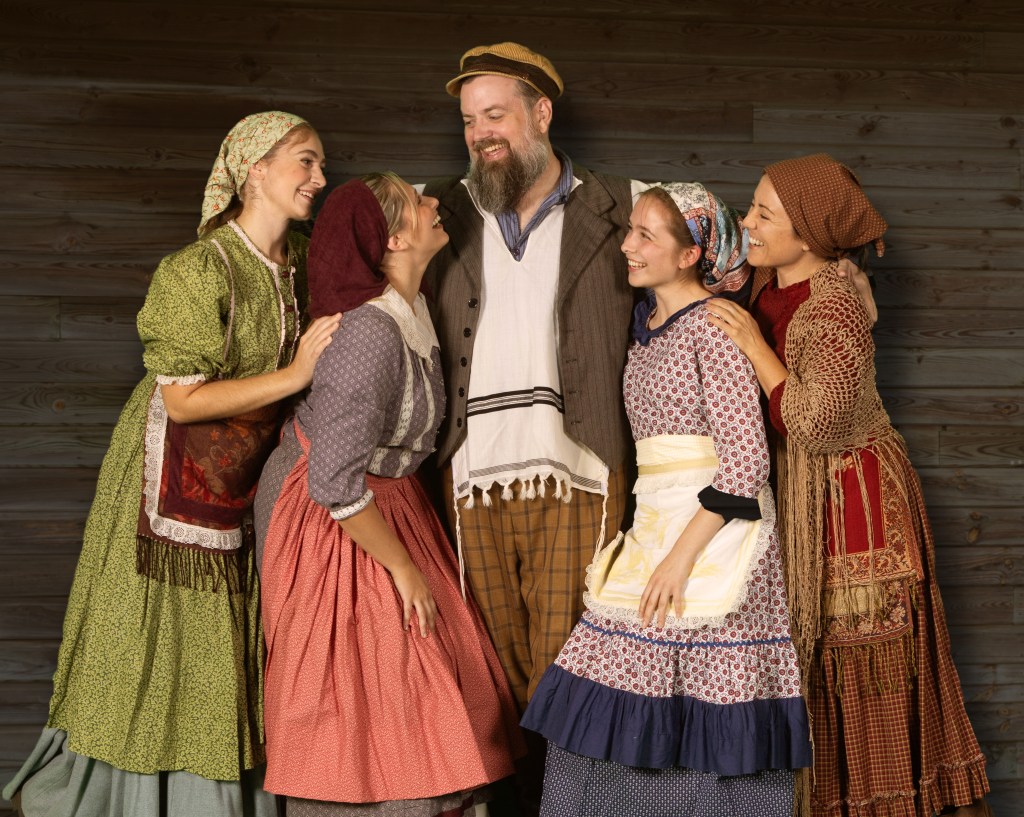
Hodel (Madelyn Davis-Haddad), Tzeitel (Gabrielle Goodman), Tevye (Joey McDaniel), Teagan Murphy (Chava), and Golde (Brittney Mignano). Photo by Scott Lasky.
[For the remainder of the year, my San Jose and Peninsula theater reviews will be posted on Talkin’ Broadway with only introductions to those reviews on this site].
Rarely has a musical garnered the success of Jerry Bock and Sheldon Harnick’s Fiddler on the Roof, setting the mark for the most performances on Broadway, which it held for ten years. Not to mention that it has been revived a gazillion times by theaters in every corner of the world. Now, Palo Alto Players offers a heartwarming and well-mounted rendition – nicely performed, effectively staged, and with fine choreography and costumery.
What particularly surprises about its success is that the play deals with the customs and sad chronicle of Jews, a people who represent a very small minority in this country and who have been unfairly victimized by the dominant religion here and throughout the Christian realm. Also, it takes place prior to World War I in what to many is an obscure region, Imperial Russia’s Pale of Settlement (largely present-day Ukraine), a poor area where all but a few select Jews were forced to live.
But what the musical has going for it is a luminous score with brilliant songs that in part traces the stages of love with great sensitivity; a central character that is one of the great charismatic figures in theater; and dramatic clashes of culture – gentle, traumatic, and existential. This story of Tevya the milkman is written by Joseph Stein, based on the works of the great Yiddish author Sholem Aleichem. Though many particulars of the story may not be relatable, its universality draws from these powerful themes of tradition, love, family, and struggle.
******
Fiddler on the Roof runs through November 24, 2024 at Lucie Stern Theater, 1305 Middlefield Road, Palo Alto, CA. For tickets and information, please visit https://paplayers.org/.
Monica Rose Slater. All photos by Ben Krantz Studio.
On the heels of Halloween and Día de los Muertos, ’tis the season of the witch. And what better way to spend a ghoulish evening than experiencing Ghost Quartet composer Dave Malloy’s musical homage to apparitions and to that thin line between this world and the beyond. It is a dark night brightened by song. Oakland Theater Project (OTP) and New Performance Traditions present an intimate, scintillating, and entertaining rendition of this unique work.
An accomplished composer, Malloy’s pop opera Natasha, Pierre, & the Great Comet of 1812 draws from Tolstoy’s eminent novel War and Peace. For Ghost Quartet, he replicates the sung-through musical format but builds the songs around a theme, the afterlife, rather than a source. The resulting song cycle is an amorphous pastiche rather than a linear accretion. However, there are repeat focal points that bind the text. Sisters Rose and Roxy, the House of Usher, photography, astronomy, and whiskey recur among others.
A small space is the preferred venue for Ghost Quartet, and OTP’s home at Flax Art & Design suits perfectly with the audience on three sides and artists spread around the edges of the performing space, creating the effect that “they” are among us. The piece is designed for four instrumentalist/singers, but this production includes a fifth (performer, that is, not bottle of whiskey!).
Monica Rose Slater, Veronica Renner.
The structural conceit reflects a two-record album, with each song a numbered track on a side of a record. Song titles are announced, which helps when they are audible. One weakness in this format is that a clear narrative is hard to follow with the provocative and sometime confusing song sketches, ever-shifting in time and place which vary from 14th century Persia to contemporary New York City. In addition, characters like Rose have various manifestations, making it more difficult to grasp a through-line to the narrative.
The sources of musical idiom are almost as numerous as the number of songs, but in the aggregate, the music is melodious and highly compelling with an overall feel of folk pop. The lyrics are thoughtful. An early example, “Soldier and Rose” exhibits both Middle Eastern and country music elements, while the jazzier “Monk” pays tribute to jazz great Thelonious Monk, one of Malloy’s influences. Blues, American folk, electropop, and others also make a showing. The only non-original song is the Scots-English murder ballad that closes the show, “The Wind and Rain,” which no doubt was an inspiration to Ghost Quartet, as its chronicle parallels the lead plot line in the song cycle.
Monica Rose Slater takes on most of the lead singing. With an expressive manner and opera-trained soprano voice, she demonstrates great vocal power and control where necessary. Her female singing partner is luminous Veronica Renner, who also pleases in her solos and harmonies. The male lead, who usually sings harmonies and acts as the primary keyboard player, is highly decorated musician Rinde Eckert.
Ami Nashimoto.
But the sound that best characterizes and drives the musical score is Ami Nashimoto’s exquisite cello play. The instrument works perfectly, primarily when producing deep, mournful sounds reminiscent of the darker songs of The Beatles like “Eleanor Rigby.” In addition, sharp, trenchant bursts akin to Bernard Herman’s violin shrieking in the shower scene from Psycho add disquiet.
Eckert’s keyboards provide a constant underpinning to the music, but the other element that provides distinctive sound is the many featured instruments that add spice. Among those that have cameo roles are a Greek three-string lyra, a home-made Latin American 10-string guitar, Buddhist temple bells, and an autoharp, not to mention strumming and plucking piano strings as well as a theremin, the electronic device that produces differing musical tones without touch.
Monica Rose Slater, Michael Perez, Veronica Renner.
The creative team led by Director William Thomas Hodgson creates a seamless experience. Given the overall concept of the work, lighting is especially important. Dr. Stephanie Anne Johnson’s lighting design is, perhaps intentionally, tame in the early goings with only faded darkening between songs. But it picks up energy and uses a number of schemes to add to the atmospherics. Stars are projected on the wall; the whole theater is darkened except for a small, glowing blob representing an assemblage of candles in the middle of the stage; a flashlit face provides illumination; lamps are employed. Sound is also an essential aspect of spookiness, and Sound Engineer Trevaj “True” Siller adjusts the amplification occasionally so that the singer’s voice sounds disembodied.
This is perhaps a good time to mention the performing fifth-wheel, Michael Perez. Also the company’s Operations Manager, his primary role in the play is to introduce the songs and play various handheld percussion instruments as needed. It is also appropriate to note that the production misses the opportunity to festoon the theater with signs of the other-worldly holidays, as with skeleton and ghost decorations, or to emit ominous whirring sounds.
Rinde Eckert.
So, is there a message to this delightfully engaging musical? The revelation occurs in the seventh of 23 songs in the program. And the answer is – “Any kind of dead person” would prefer to be a ghost! Not a poltergeist or a zombie or any of those other strange otherworldly creatures, but a ghost. So, there you have it.
Ghost Quartet with music, lyrics, and text by Dave Malloy is produced by Oakland Theater Project and New Performance Traditions and plays at FLAX art & design, 1501 Martin Luther King Jr Way, Oakland, CA through November 24, 2024 and at ODC Theater, 3153 17th Street, San Francisco, CA December 5-8, 2024.
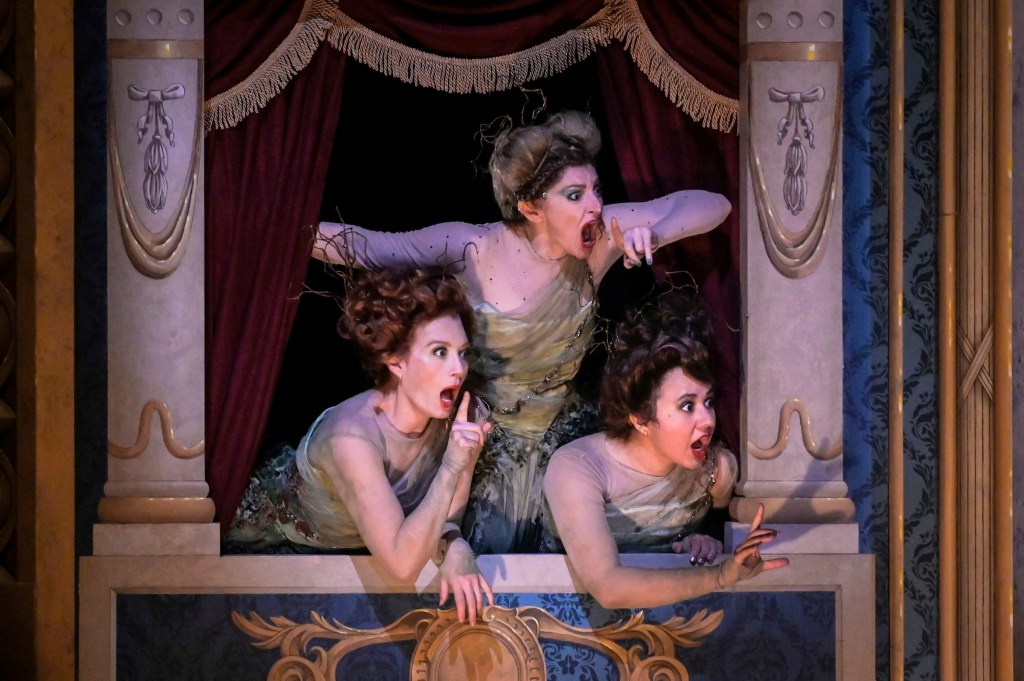
Monica West, Lauren Molina, Tina Muñez Pandya as Three Ladies. All photos by Alessandra Mello.
Berkeley Rep presents the Goodman Theatre (Chicago) production of Wolfgang Amadeus Mozart’s last and highly popular opera, Die Zauberflöte (The Magic Flute). Mary Zimmerman has adapted the libretto and score into The Matchbox Magic Flute and directs as well. The result is a crowd-pleasing gem – creative, visually captivating, unerringly funny, and replete with beautiful music.
This version is abbreviated from the original, but without (further) loss of plot continuity. It uses vocal amplification, so that singers are able to perform several nights in a row, not possible with the demands of traditional opera. Singing and speaking are loosely adapted into vernacular English. The chorus is eliminated and along with it the significant number “O Isis und Osiris.” It retains all of the humor of the original but drops most of the ritual solemnity of the story that may be inferred to suggest Masonic practices, both Mozart and the librettist Emanuel Schikaneder having been Masons.
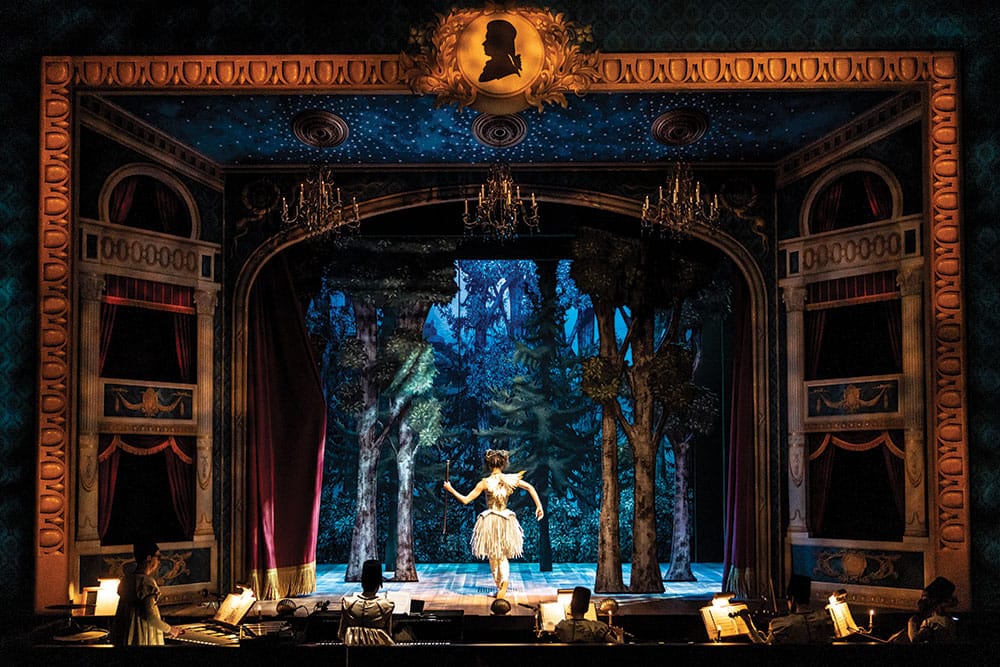
Stage. Reese Parish as Spirit (on stage facing away). Orchestra (foreground).
So, do good things come in threes? ‘Tis the season of the flute, as the Bay Area has been blessed in the last six months with three variations – very different full-length opera productions of The Magic Flute at both San Francisco Opera and Opera San Jose, and now this abridged The Matchbox Magic Flute plays at Berkeley Rep. Coincidentally, three is a significant number in Masonic lore, and for instance, this opera contains three ladies, three boys, three spirits, three doors, and three trials. And the musical score is written mostly in the signature key of E-flat, whose scale has three flats. Are we onto something here?
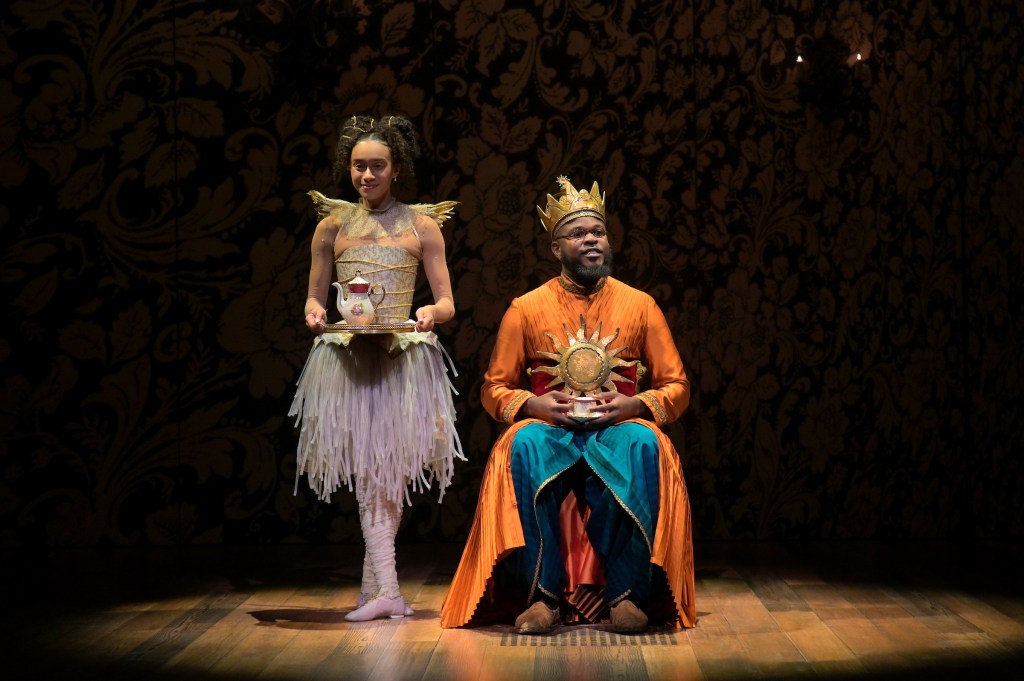
First impressions matter, and this production delivers. The descriptor “matchbox” becomes evident as Todd Rosenthal’s stage width for the proscenium arch is reduced by perhaps 40%, leaving a charming, intimate, colorfully-framed space that gives the look of a puppet-show stage, particularly when the larger performers are in the scene. Ana Kuzmanić’s fanciful costumery adds to the fairy tale look.
Shawn Pfautsch as Papageno, Marlene Fernandez as Pamina.
The story opens with three unnamed Ladies. In most stage works, coveys like this trio would act as a somewhat inert Greek chorus. Here, they are radically expressive; sing attractive harmonies; help drive the plotline; and even slay the dragon that was about to devour Tamino! As an example of the sassiness of the modernistic script, while the Ladies lean over the unconscious body of Tamino, one observes longingly “He must spend a lot of time at the gym.”
The narrative concerns Prince Tamino who falls in love with Pamina, the missing daughter of the Queen of the Night, having only been shown Pamina’s portrait. Accompanied by the Queen’s silly bird-catcher, Papageno, who also seeks a wife, Tamino strives to rescue the damsel from purported kidnapping by High Priest Sarastro, enemy of the Queen. Tamino and Papageno must conquer three trials before being granted their wishes.
Billy Rudd as Tamino, Marlene Fernandez as Pamina.
Like many heroes, Tamino (Billy Rude) is stolid and self-controlled. Though his part is well acted, the character is somewhat uninteresting. Papageno (Shawn Pfautsch) gives the action its comic center with his frittering, blundering, and absence of courage; and the leitmotif often played on his woodwind recorder is one of the most memorable phrases from the opera.
The most famous music from the opera has found its way into popular culture – “Hell’s vengeance boils my heart,” known popularly as the Queen of the Night’s aria. While Emily Rohm acts the role with daunting ferocity and sings with accuracy, the staccato, coloratura passages are more caressed than piercing which would bring forth the venomous intent. The aria is a threat to daughter Pamina (Marlene Fernandez), who has one of the better trained voices in the cast as well as a substantial range that the role demands. Her duet (“In men, who feel love”) and trio (“Just come in”) that include Papageno are very appealing, and like many ensembles, the combined voices produce a very nice sound, better than the individuals.
Emily Rohm as Queen of the Night.
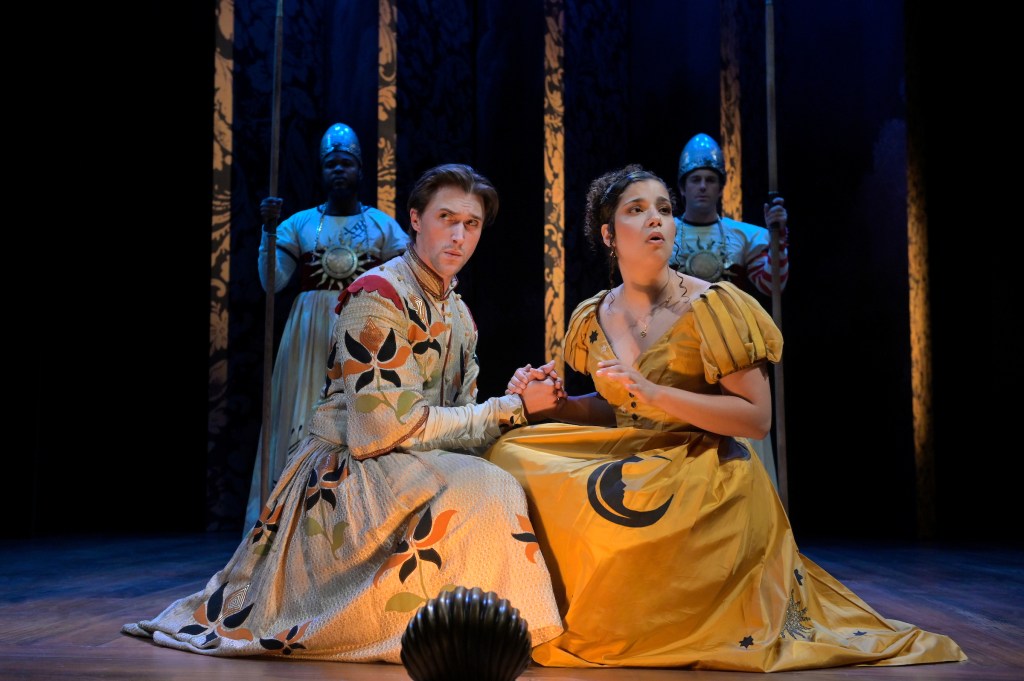
The culmination brings the players together under the aegis of Sarastro. This role is written for a basso profundo, as the range goes deep into the cellar of human vocal potential. The player, Fernando Watts, is one of the few in the cast with opera cred, and he hits the low marks and projects with an assist from the amplification.
So, does this adaptation portend a new future for opera, an art that is radically expensive to produce but is largely tamed by this type of revision? Notably, the orchestra is reduced from fiftyish musicians to a very effective five. Also, only 11 singers are required, and rather than highly specialized and trained artists, most can be stage-musical singers. If there is a weakness in this particular realization, it is that the singers should be uniformly strong throughout, yet there are significant weaker links.
Russell Mernagh as Monostatos, Shawn Pfautsch as Papageno, Marlene Fernandez as Pamina.
This adaptation proves more accessible to an audience comfortable with musicals – in style and length. Most operas were written in eras with different preferences. Mid-19th century French opera demanded five acts including a ballet scene. Wagner wrote several operas that require four to five hour run times. The breezy informality and two-hour run time of The Matchbox Magic Flute speak more to the preferences of today.
That said, this formula is not new. For instance, Baz Luhrmann’s adaptation of La Boheme had moderate success on Broadway 20 years ago. Also, “Legend of the Ring” condenses Wagner’s 15-hour Ring Cycle into a manageable three hours. But these updated versions didn’t start a trend.
Reese Parish as Spirit, Fernando Watts as Sarastro.
However, there are prospects for many more variations like The Matchbox Magic Flute that appeal to prospective new audiences for opera. And this work highly entertains in serving that purpose. Nonetheless, aficionados of the traditional form, who appreciate the unadulterated power and beauty of the natural trained voice, are less likely to be persuaded.
The Matchbox Magic Flute with music by Wolfgang Amadeus Mozart, libretto by Emanuel Schikaneder, adapted by Mary Zimmerman, and produced by Berkeley Repertory Theatre plays on its stage at 2025 Addison Street, Berkeley, CA through December 8, 2024.





 cordellreportsdotcom