Former Ladies of The Supremes

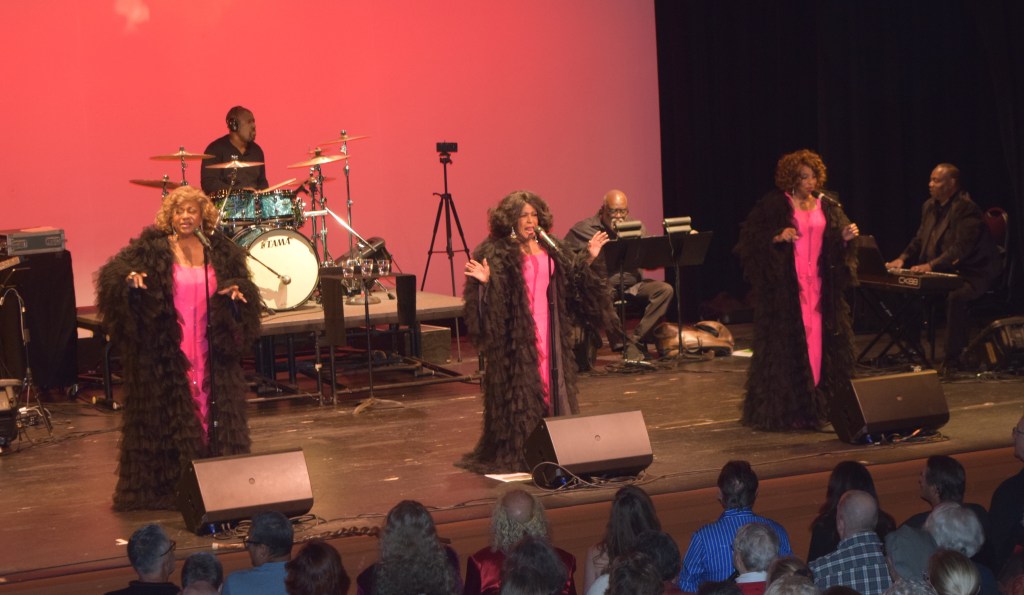
Lynda Laurence, Scherrie Payne, Joyce Vincent. All photos by Eric Iversen.

The three ladies appeared on stage to audience glee with brown long coats (my wife and editor says black – who do you trust?) of layered shag.  Removing them revealed salmon-colored (my wife says pink – she may be right on this one) gowns, inhabited by attractive, fit-looking, mature women crowned by the traditional big wigs of The Supremes.  From the opening strains of “You Keep Me Hangin’ On,” nostalgia was on, with perhaps a little extra interpretation of the song title for the occasion.  Capping the first season of Marin Jazz was a night of sweet sounds and remembrance from the Former Ladies of The Supremes.

For those like me old enough to remember, 1964 was a pivotal year in popular music.  The Beetles’ first American visit marked rock and roll’s British Invasion; Bob Dylan stormed on the scene with a new brand of folk music; and The Supremes emerged from Motown in record-breaking (pun intended) fashion with five straight number one hits from the pens of the prolific composing team of Holland, Dozier, and Holland.

After intermission – definitely salmon! Lynda Laurence, Joyce Vincent, Scherrie Payne.

While a couple of young, female singing groups had single hits in the late ‘50s, the Shirelles established the girl group category as a musical force starting in 1959.  The Supremes would inherit that mantle and take it to new heights.  The number one songs that quickly established The Supremes as the queens of pop music were all on the Marin Jazz program – “Where Did Our Love Go,” “Baby Love,” “Come See About Me,” “Stop! In the Name of Love,” and “Back in My Arms Again.”

Apart from well-crafted songs with a consistent style, another factor stamped the special sound of The Supremes.  Before their national fame, the three original members shared the leads.  Florence Ballard possessed the most powerful voice, followed by Mary Wilson.  But Motown founder Barry Gordy sensed something special in Diana Ross’s high, airy, and fragile voice, and that would become the signature that would propel the group forward.

During their reign, The Supremes, always a trio, would have eight members, two of whom are on the Former Ladies of the Supremes.  Chronologically, Lynda Laurence was Supreme number six, and Scherrie Payne was number seven.  The third member of the Former Ladies, Joyce Vincent, is the Supreme who never was.  Identified as the ninth in the succession, Motown decided that since there were no remaining original members in the lineup, that they would retire the name instead.  Vincent did however have her own career in a formidable trio that had only three members throughout its existence – Tony Orlando and Dawn.

The Former Ladies regaled with over a dozen songs from The Supremes catalogue offering familiar sounding if not identical renditions of the recordings we know, backed by a five-piece band.  At ages of 80 (Payne), 78 (Vincent), and 75 (Laurence), none could be expected to retain the vocal brightness and high range of a Diana Ross in her prime or the strength and control of younger singers, so the arrangements were pitched accordingly.

But they engaged with the audience and Lynda Laurence in particular can still wail with energy and control, as she did in “Reflections” and elsewhere – perhaps because she’s still so young.  In my book, the most impressive numbers were “My World is Empty Without You” and “I Hear a Symphony,” both of which had typical Supremes treatments in which two backups sing repeat lyrics in countermelody in response to the main line carried by the lead.  In addition, the ladies sang attractive versions of Tony Orlando and Dawn hits “Tie a Yellow Ribbon” and “Knock Three Times.”  Unfortunately, the sound system didn’t do the ladies any favors, and particularly before intermission, the mix with the band was off and vocals sounded weak in places.

Lynda Laurence, Scherrie Payne, Joyce Vincent.

Another distinction of The Supremes that the Former Ladies carried out with grace was movement.  Barry Gordy insisted that The Supremes avoid being sexually provocative.  The Former Ladies replicated that notion with extremely elegant arm and hand motion, minimizing hip movement while adding flair to the performances.  Occasional anecdotes about songs and relationships punctuated the evening, but even more would have been welcomed.

The final number was in honor of deceased original member of The Supremes, Mary Wilson.  Fittingly, it was the recording that marked the dissolution of The Supremes, “Someday We’ll Be Together.” The full house showed its appreciation for the evening with a standing ovation.

Former Ladies of the Supremes, produced by Marin Jazz, appeared at Marin Center Showcase Theater, 10 Avenue of the Flags, San Rafael, CA on December 20, 2024.
A Thousand Ships

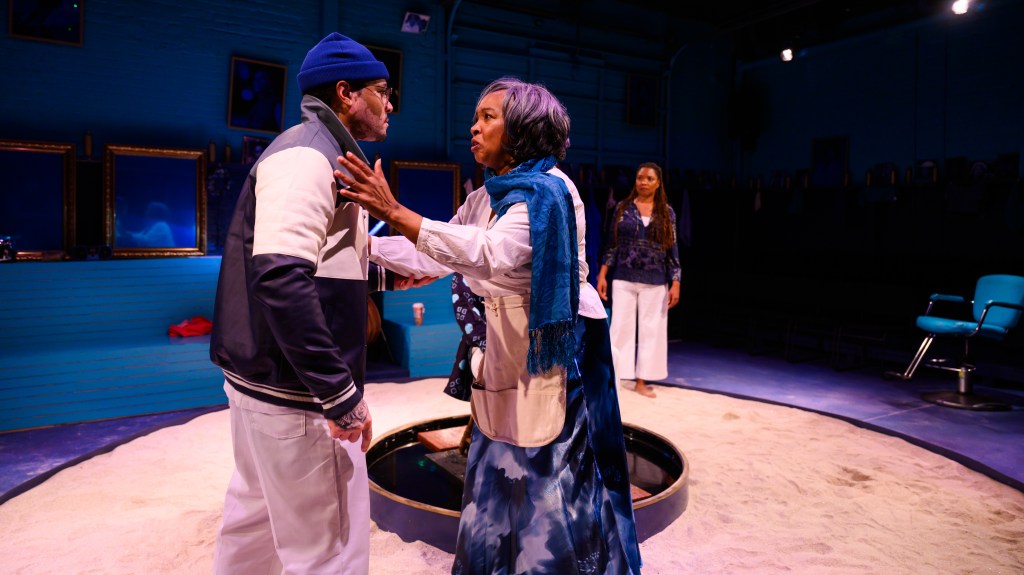
Halili Knox as Adeline, Dawn L. Troupe as Laney. All photos by Ben Krantz Studio.

Oakland, California has a much smaller population with a lower percentage of Blacks than older cities like Detroit, St. Louis, Washington, DC, among others.  Yet its vibrant community has spawned an uncommon measure of African-American attainment.

To begin with, MC Hammer, the Pointer Sisters, Tower of Power, John Lee Hooker, Sly Stone, and more represent music.  Basketball provides Bill Russell and enough All-Star guards for a starting five, including Jason Kidd and Damion Lillard, while baseball Hall of Famers include Ricky Henderson, Frank Robinson, Curt Flood, and Joe Morgan.  There are contemporary film artists like Zendaya, Ryan Coogler, and Mahershala Ali and nationally recognized chefs like Tanya Holland and Matt Horn.  Politically, you have Kamala Harris plus the wildly misunderstood Black Panthers with Huey Newton and Bobby Seale.  Finally, add to that list award winning playwright, screenwriter (The Color Purple, 2023), and poet Marcus Gardley, who makes another valuable contribution to the nation’s theatrical wealth.  And let it be noted that an abundance of white folk from Oakland have made their mark on the world also.

Adrian Roberts as Father of the Water.

Playwright Gardley has granted the world premiere of his most recent play A Thousand Ships to the innovative and enterprising Oakland Theater Project and California Shakespeare Theater.  Largely about the family that we choose, it is a touching, well-developed, and well-acted (by a truly distinguished cast) homage to the black community of Oakland from which he comes.   Even every part of every character name is a place name in Oakland.  Surprisingly, the story centers on women and a beauty salon, and Gardley unveils an uncommon understanding of their societies from the ways they interact to the vast array of hair products they use.

Two young women meet on a train as they abandon the South with hopes for a better life in the Bay Area away from oppressive discrimination.  They open a beauty parlor in the Pill Hill (formerly Academy Hill) district and become friends and business partners for life but would face economic and personal challenges at the end.

William Hartfield as MacArthur, Dawn L. Troupe as Laney.

Halili Knox endows bachelorette Adeline with verve and bluster, storming the stage with purpose.  Eighty years old at the end of the story and unashamed to glow in her lasting attractiveness, she views the world as dirty and attributes her beauty to not allowing people to touch her.  She draws a curious distinction with her touching others, which comes with her profession!

Dawn L. Troupe inhabits Laney with a somewhat more stolid and grounded manner.  Abandoned by her husband who insisted on leaving the United States for a country that would be more receptive to Black people, Laney raised two children with the help of “Aunt” Adeline.  Having started a non-profit to keep Black boys off the streets, son MacArthur (William Hartfield) is her pride and joy but would cause her consternation.  Though Laurel (Sam Jackson) is devoted to her mother and her job as a policewoman, Laney has never fully accepted her as she has “Mac.”

Rolanda D. Bell as First Lady, Jasmine Milan Williams as Dimond.

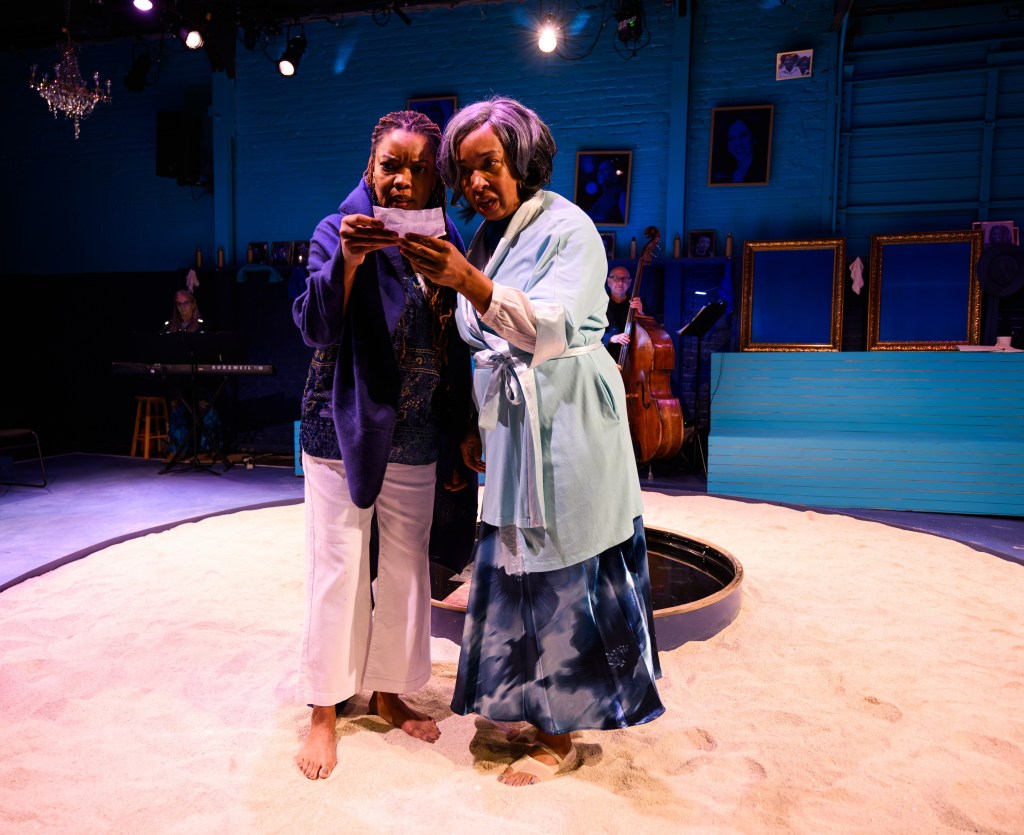
The action pivots on the day of President Obama’s election in 2008.  It plays out on Randy Wong West’s minimalist set with the “healing waters…of Black womens’ history” surrounded by the sands of shores and time.  Into this setting, Adrian Roberts is the mystical Father of the Water who declaims the origin story and philosophizes about Black life.

The salon’s clients and the greater community are represented by only two characters.  Rolanda D. Bell is “First Lady,” an imperious minister’s wife who lives in tony Rockridge but returns to the hood for coiffing. Her proclivities reflect diversity within the Black population and reveal unexpected complexity when the tides shift for the main characters.  Jasmine Milan Williams is Dimond, First Lady’s yappy and very pregnant assistant, who brings comic relief to the proceedings each time she opens her mouth, and sometimes when she doesn’t.

Sam Jackson as Laurel.

Interestingly, the narrative refers to both declines and gentrification of the neighborhood.  Significant are references to a prospective Starbucks.  A largely unknown, undiscussed aspect of the rise of franchise chains in our economy is the devastating effect that chain businesses had on entrepreneurialism, economic independence, and community in Black populations.

In a support portion of a peer-reviewed research paper by this author in 1997, I cite the documented massive decline of Black-owned store-front businesses in the latter part of the 20th century, replaced by the likes of McDonalds, Supercuts, and Jiffy Lube.¹  Granted, these franchises are more efficient than the businesses they replace, but lost is the vital social environment and rich diversity that these institutions provided to clients, effectively a less formal place to fraternize than church.  Further, buy-in costs and conditions of the franchisors eliminated ownership opportunities for virtually all Black small-business owners, depriving them of a continuing stake in the economy.

Halili Knox as Adeline, Adrian Roberts as Cypress Lake.

The thousand ships of the title refer specifically to slave transports which brought the ancestors of most Black Americans to this country.  But it is also an important global metaphor for change, opportunity, losing out to the White man, and in the case of Laney, abandonment.

The plot line of the play, which includes several flashbacks, is compelling and important.  In addition to the inherent drama, composer Molly Holm’s appealing incidental music adds emotional depth to the story.  Plays are often revised after their premieres.  Areas of possible improvement might be grounding the mystical elements so that their meaning is more transparent, and modifying the ending, which is genuine, but many will find it overly maudlin.  The production excels, with performances delivered by a wonderfully magnetic and charismatic cast.  There were a number of muffed lines at opening, but that will likely resolve in time.

A Thousand Ships, written by Marcus Gardley, is produced by Oakland Theater Project in association with California Shakespeare Theater, and plays on OTP’s stage at 1501 Martin Luther King Jr Way, Oakland, CA through January 5, 2025.

¹ Cordell, Victor V., “Implications for Small Business Export Promotion of Differences between Immigrant and Involuntary Minorities,” International Trade Journal, Vol. 11, No.3, 1997.

Shrek the Musical

Nicholas Hambruch as Shrek, Kelly Prendergast as Princess Fiona. Photo by Jason Anderson – Pendleton Photography.

[For the remainder of the year, my San Jose and Peninsula theater reviews will be posted on Talkin’ Broadway with only introductions to those reviews on this site].

Playwright/lyricist David Lindsay-Abaire and composer Jeanine Tesori have conquered Broadway individually and as a team.  Their second collaboration was the highly decorated Kimberly Akimbo, 2023 Tony Award winner for Best Musical and four other Tonys.  Their first was Shrek the Musical, an adaptation of the film which had received glowing reviews and huge box office returns.

The moderately successful Broadway showing was reworked for the highly popular West End production and again for touring.  The final result offered by Broadway San Jose is a charming and whimsical journey with all of the production values expected from a touring show.  While its fairy tale atmosphere and roots in animation suggest an appeal to pre-teens, the themes and references are very adult, and the theater audience tilts toward young adults who may have seen the movie as children.

Shrek is a ponderous, green-faced, self-loathing ogre whose swamp has been overrun by fairy tale characters.  The devious Lord Farquaad owns the swamp, and Shrek arranges to deliver Princess Fiona for Farquaad to marry in turn for Shrek’s regaining control of the swamp.  Accompanied by the loquacious Donkey, Shrek triumphs over obstacles on the route, except that he falls in love with Fiona who shows contempt for her captor.

Please continue to https://www.talkinbroadway.com/page/regional/sanjose/sj265.html for full review.

Naphtali Yaakov Curry as Donkey. Photo by cyorkphotography.

Anastasia

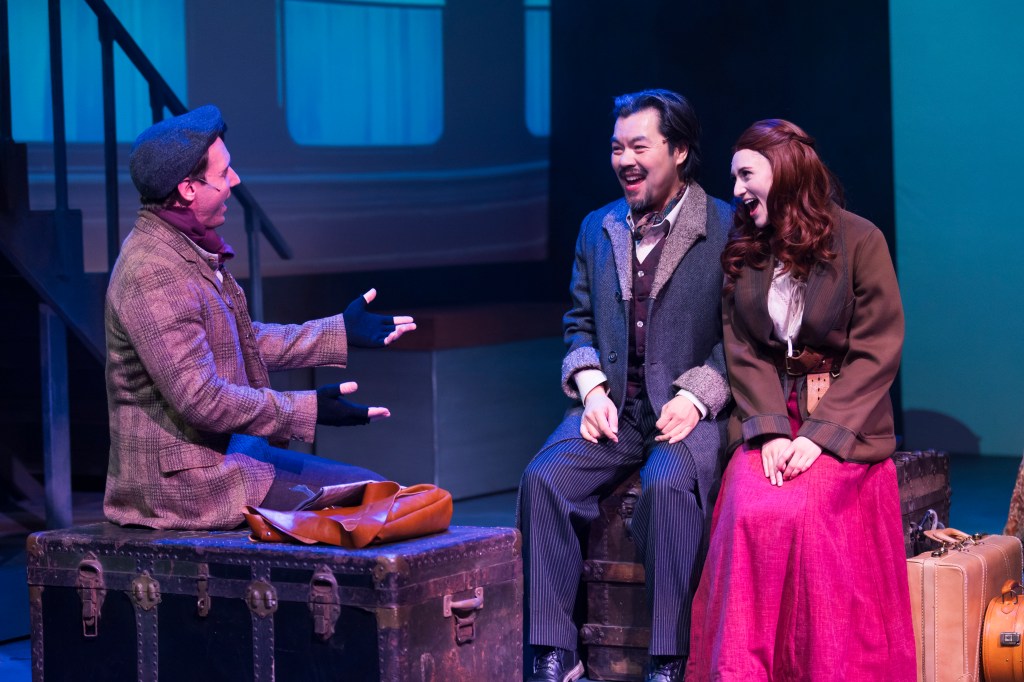
Dmitry (Brad Satterwhite), Vlad Popov (Alex Hsu), Anya (Jillian Smith). Photos by Tracy Martin.

[For the remainder of the year, my San Jose and Peninsula theater reviews will be posted on Talkin’ Broadway with only introductions to those reviews on this site].

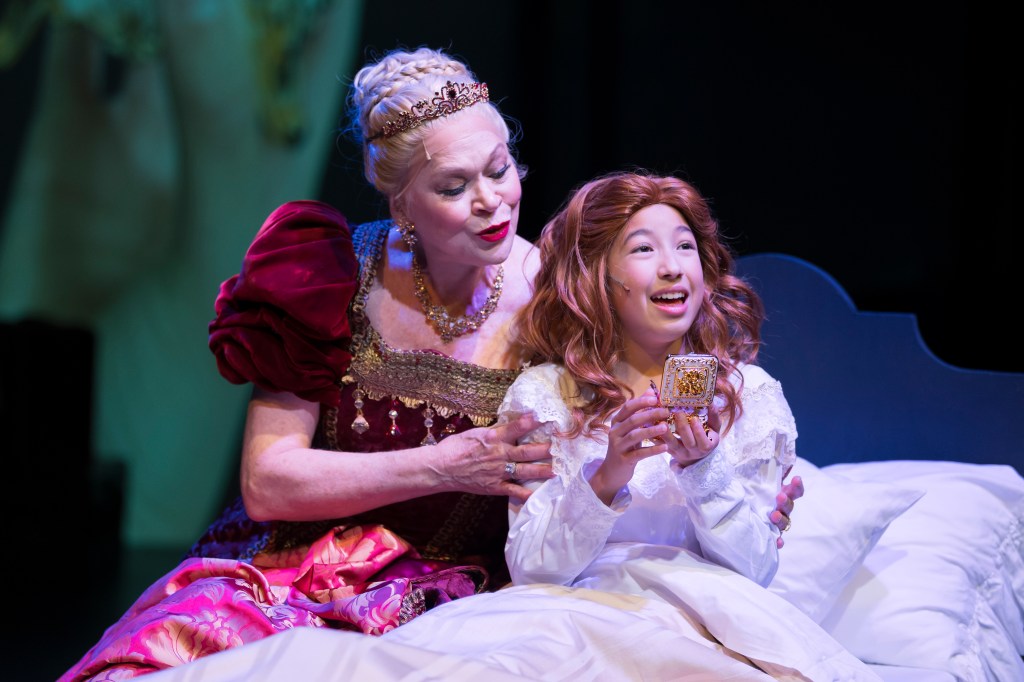
Of the world’s monarchies that have been overthrown, none competes with the violence and thoroughness of the Russian Bolshevik’s 1918 decimation of the Romanov dynasty – Czar Nicholas II, Czarina Alexandra, and their five children.  Of direct family members, only the czar’s mother, the Dowager Empress, who was living in Paris was known to survive.  So how does this have the makings of a stage musical?

Rumors swirled that one Romanov daughter, Anastasia, had escaped.  Many pretenders made claim to be the surviving heir to the Russian throne and were dismissed by the Dowager Empress.  But ten years later, a young woman Anya, would make a most convincing case that she could be Anastasia.  The musical tells Anya’s story.

In addition to a dramatic true history, Anastasia, which had a moderately successful Broadway run, was developed by a top creative team with music by Stephen Flaherty, lyrics by Lynn Ahrens, and book by Terrence McNally.  Hillbarn Theatre’s generally entertaining rendition offers two excellent performances, good singing voices throughout, and a fine overall production, but it lacks the consistent energy expected of a top musical.

Please continue to https://www.talkinbroadway.com/page/regional/sanjose/sj264.html for full review.

Dowager Empress (Judith Miller), Little Anastasia (Araceli Grace).