Jesus Christ Superstar

Lucca Troutman as Mary Magdalene, Deanalis Arocho Resto as Jesus Christ. All photos by Ben Krantz Studio.

This reviewer has attended only several performances at Berkeley Playhouse in my decade of criticism, not because they don’t produce good theater, but because their musicals are usually too familiar to me or not in my wheelhouse (though I loved last fall’s The Prom).  The decision to see Jesus Christ Superstar was an unenthusiastic one, but informed by its success on Broadway and the West End.  However, the appraisal of the musical and especially this production is definitely enthusiastic.

Artistic Director Kimberly Dooley, who directs as well, had dreamed for three decades of mounting her vision of this show. Her commitment comes through in the brilliant outcome, which is interwoven with superb singing and acting by principals and ensemble along with absorbing choreography, costumery, and lighting to produce a many-layered aural and visual extravaganza.

Sydney Jacobs Allen as Judas.

The story is one of the most familiar in western culture and the cornerstone of Christianity – the betrayal and crucifixion of Jesus Christ as depicted in the Gospels of the New Testament.  Composer Andrew Lloyd Weber and librettist Tim Rice recount and extrapolate upon the last days of Christ, especially his relationship with his betrayer Judas Iscariot and the loyal prostitute Mary Magdalene.

Though some non-Christians could be put off by the topic matter, not only does the narrative contain many universalisms, but it can be wholly interpreted through alternative filters.  Perhaps the most poignant is seeing it as a metaphor for the repudiation of McCarthyism and the House Un-American Activities Committee, with the roles of the venomous accusers, evil betrayer, and victim clearly delineated.

Cast.

Jesus Christ Superstar is written in a sing-through mode, so the story is told in song, much of it in soliloquies.  The lyrics are literate yet highly accessible, and while the music is uniformly appealing, it can actually distract from understanding the nuances of the plot as the tunes compete with the words for mind space.  A couple of particularly melodic and catchy songs from the score have thrived successfully outside of the musical.

Jesus is portrayed with passion by Deanalis Arocho Resto whose strong singing wails with absolute electricity in the highest range as when Jesus confronts the moneylenders and avoids the lepers in “The Temple” and among his confused followers in “The Last Supper.”  Arocho Resto also deftly captures the ambiguity, contradiction, and rage specified by Weber and Rice.

Cast.

Preferring to view Jesus as angelic, many conservative Christians object to his characterization.  But the creators’ viewpoint is even inserted into the lyrics of the most popular song in the musical, Mary Magdalene’s “I Don’t Know How to Love Him,” when she expresses that “He’s a man, he’s just a man….” which is the Weber/Rice viewpoint not favored by many Christian adherents.  At the same time, Jews are offended since Judaea was part of the Roman Empire, and thus Pontius Pilate ultimately approved Christ’s death. Yet the agitated crowd of Judaeans (i.e., Jews) is implicated as responsible instead.  In the end, no resurrection, essential in the Christian canon, occurs, and it is fair to question what the authors hoped to convey.

The other two lead portrayals are strong as well.  A fine foil to Resto, Sydney Jacobs Allen is Judas, who despite the betrayal, is shown in a somewhat sympathetic light, sometimes having higher standards of personal behavior than Christ himself and faulting him accordingly.  Jacobs Allen stands out as an actor and singing the bluesy lead-in to the iconic strains of the title song.  Lucca Troutman plays the prostitute Mary Magdalene, who paradoxically, is the most caring and brave of Christ’s followers, despite being scorned by Judas.  Troutman also gives a warm rendering of Magdalene’s signature song.

Cast.

The action plays mostly on Kuo-Hao Lo’s abstract stage comprised of several platforms having backdrop projections with dramatic and dynamic lighting lavished with spots and colors by designer Mark Thomas.  A large ensemble of singer/dancers demands an abundance of outfits, and Costume Designer Ashley Renee answers the call with several distinctive categories of styles and periods.  Choreographer Kevin Gruwell has endowed the extensive dancing with a highly diverse, expressive vocabulary appropriate to each situation and emotion.  The movement of the ensemble is compelling and often explosive.

Music Director Michael Patrick Wiles conducts a small orchestra that plays with the usually desired exuberance.  On occasion, however, especially when singers are in the lower and weaker part of their range, the orchestra overpowers, which is problematic as the plot is being delivered through the lyrics.  Note that Joshua Beld as Caiaphas is not in the group with weak lower range, as he drops into a basso profundo with ease and conviction.

Deanalis Arocho Resto as Jesus Christ.

Another political issue concerning this production deserves comment.  The current administration’s attack on Diversity, Equity, and Inclusion is a transparent embrace of racism and sexism of all varieties, suggesting that ascent in any endeavor by other than a white bread, heterosexual man results from unfair advantage granted women and minorities of all ilks.  The bulk of the lead roles in this cast are performed by women or non-binary people of color though the only female character is Mary Magdalene.  The creative team and supporting actors are of both genders and could include LGBT members.  Each creative designer and performer has contributed with consummate skill.  No apologies needed.

Jesus Christ Superstar, composed by Andrew Lloyd Weber and with lyrics by Tim Rice, is produced by Berkeley Playhouse and plays at Julia Morgan Theater, 2640 College Avenue, Berkeley, CA through March 30, 2025.

Bluebeard’s Castle

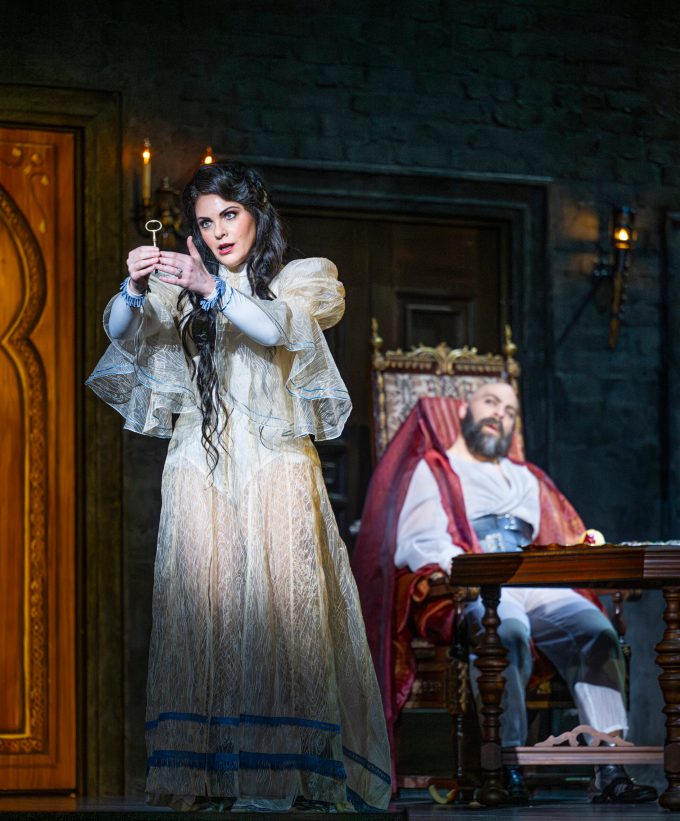
Zachary Nelson as Count Bluebeard, Maria Natale as Judith. All photos by David Allen.

Like Ludwig von Beethoven a century earlier, classical music giant Béla Bartók had only one opera in him, or perhaps he bridled at the notion of having to put his abstract musical construction into words again.  His singular contribution was a one-act, one-scene, two-hander vignette of only 70 minutes duration.  Fortunately, while this musical drama is a very small production, it sparkles like a multi-carat gem.  Opera San Jose has produced a stunning rendition that dazzles, reflecting all of its brilliant facets.

Based on a French fairytale, Bartók’s musical fantasy is set to Béla Balázs’s libretto of Bluebeard’s Castle, which takes place in real time.  Judith, Count Bluebeard’s new wife, has set foot in his castle for the first time, suggesting that they did not have much of a courtship and have much to learn about one another.

Set Designer Steven C. Kemp’s imposing stage is a great room with spare furnishings but a dozen chandeliers of various designs and seven imposing and unique doors, creating a sense of instability that would not be rendered by repeating identical lighting and portal features.  Interestingly, all of the chandeliers and doors are veterans of past Opera San Jose productions.  How’s that for artistic recycling?

Bluebeard is the stereotype of a dominant male – power-driven, combative, and misogynistic.  Zachary Nelson as Bluebeard conveys his authority with an imperious presence, and his deep baritone fits the role well.  He initially resists Judith’s requests to see what is behind the seven doors, choosing to preserve his secrets to maintain the status quo.  Ultimately, perhaps feeling that he will still exercise control, he gives in to Judith’s curiosity.  The opening of each door reveals more about Bluebeard, from his willingness to commit violence to the fruits of his conquests, both in terms of land and ladies.

Bluebeard holds the elevated social station and the possessions, yet Judith asserts herself with feminist demands.  Even though she claims that love drives her need to know what is behind the doors, we don’t really know if love was part of the marriage equation. Judith seems more driven by competition, the power struggle between spouses.  Given the greater performing time to express herself and being the initiator of this psychological combat, the opera really belongs to Judith, the unsettling force.

Soprano Maria Natale leaves nothing on the table as the emotive and insistent Judith.  What surprises is that her specialty has been in the more lyric Italian repertoire, yet she showcases strong dramatic vocalization throughout a very demanding performance.  On stage for the duration, she dominates the action and remarkably sustains her voice with an insistent, controlled, penetrating, high-volume middle range that could be more natural to a mezzo-soprano.  But together with her acting that reflects the character’s emotions from eroticism to rage, it is hard to imagine a finer singing and acting performance of this role than Natale’s.

Bartók’s musical palette contains some harsh dissonance, which is modulated by the melodic influences of Hungarian folk music and the sensuality of Debussy, with whom he had mutual admiration.  The dynamics of the score rise and fall, especially in response to the opening of the doors, with ominous clash in those that reveal the dark side, and with lush luxuriance in the case of those that show the fruit of Bluebeard’s missions.  But one haunting musical and psychological motif throughout is that of the presence of blood beyond each door, which taints even the otherwise pleasant unveilings.

Opera San Jose’s Music Director Joseph Marcuso conducts the shifting musical moods and idioms with grace.  The orchestra, which is large relative to the cast and gives a bigger feel to the opera, responds to demands with great alacrity.

Marcuso has taken a gamble in adapting the libretto which is built around poetic meter specifically fitting Magyar folk ballads. He and collaborator Steven White have translated it to English.  Perhaps hearing the opera in Magyar would provide a stronger sense of the origins of the action, but most of us will never know.  Happily, having the dialogue in English reduces the reliance on supertitles and makes the text more accessible.

OSJ’s General Director and CEO Shawna Lucey stage directs Bluebeard’s Castle, and all aspects of the production integrate well into an intensely rewarding operatic experience.  She has also taken significant liberty with the nonverbal aspects of the drama, especially to update its message after the opening of the golden seventh door.  The major change will not be shared here.  It does provide surprise, drama, and an outcome that will be more satisfying to most opera goers than the original.

Bluebeard’s Castle, composed by Béla Bartók based on a fairytale from Chales Perrault with libretto by Béla Balázs and translation by Steven White and Joseph Marcuso, is produced by Opera San José and plays at the California Theater, 345 First Street, San Jose, CA through March 2, 2025.

La Sonnambula

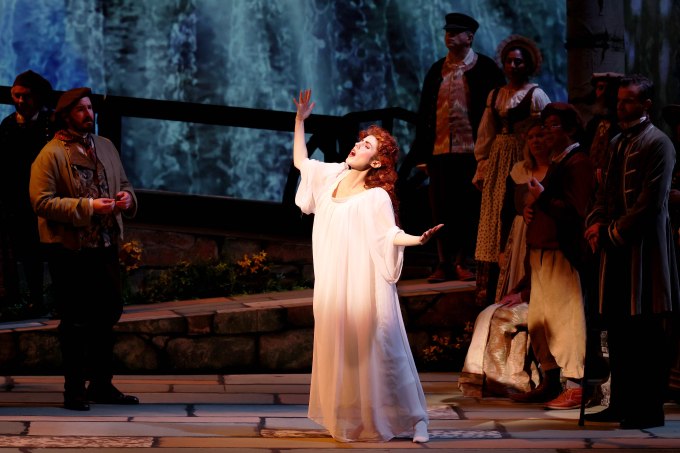
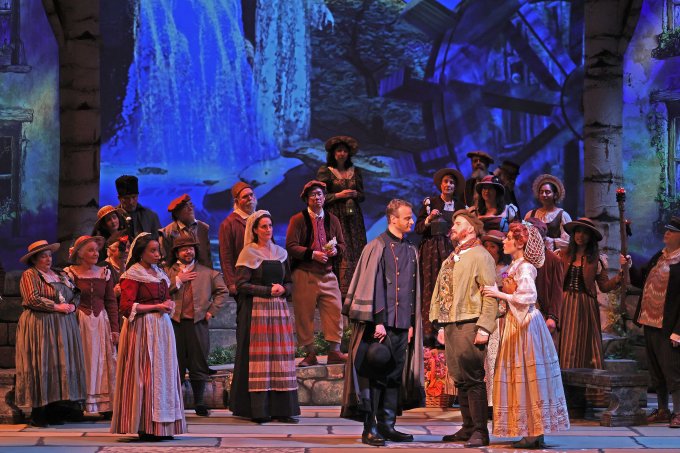
Michelle Drever as Amina (La Sonnambula, center), Chris Mosz as Elvino (left). All photos by Otak Jump.

A concise definition of bel canto opera eludes aficionados, but its composers have been identified ex post facto, and one of the foremost was Vincenzo Bellini.  Despite his brief life of 34 years, several of his operas remain in the repertoire.  Among them is the 1831 pastoral opera La Sonnambula, given a fine production by West Bay Opera.

The narrative is simple.  Amina, a young woman who is a treasure of a town that could be anywhere, is to marry Elvino.  The night before the ceremony, she is seen at the lodgings of a visiting Count.  While the opera goer realizes that she sleepwalks innocently and believes that she is in the company of her betrothed, the townspeople are not aware of her condition and turn on Amina as a result of the scandal.  Incredulous and callous Elvino returns to his past love, Lisa. Ultimately, the Count absolves Amina and the wedding is back on.  The end.

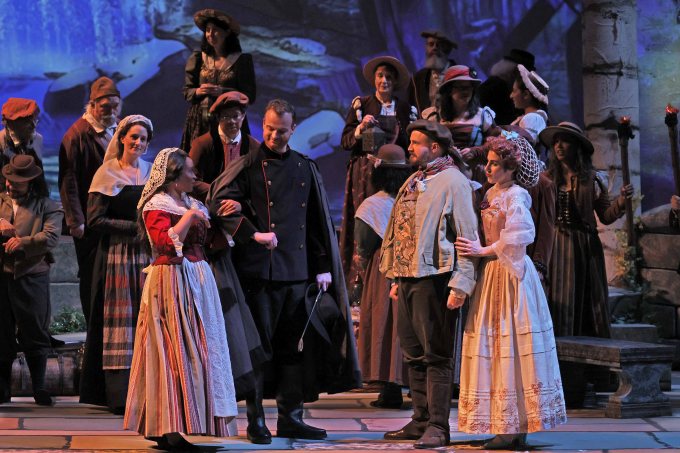
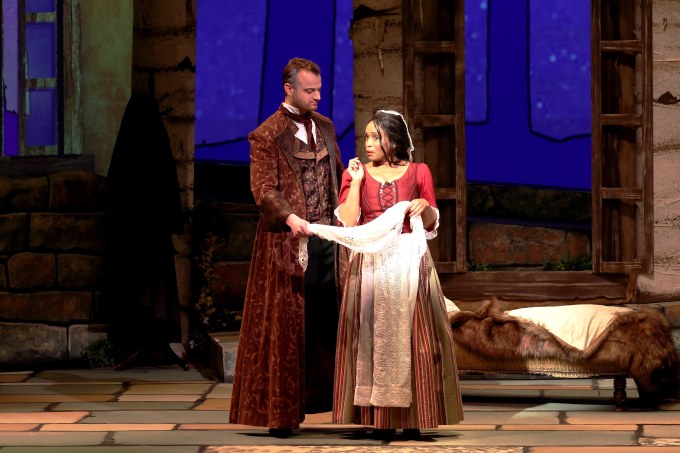
Courtney Miller as Teresa, Shawnette Sulker as Lisa, Casey Germain as Count Rodolfo, Chris Mosz as Elvino, Michelle Drever as Amina.

La Sonnambula brims with melodious music that is delivered by a cast with outstanding voices.  Those voices are mightily challenged as Bellini composed for a particular soprano who had an especially mellifluous head voice, and she was surrounded by others with acrobatic vocal skills.  Not only is the overall tessitura of the three key roles unusually high, but artists are required to hit the high notes, often high D’s cold without a run up.

Coloratura soprano Michelle Drever portrays Amina and nails the part with precision, clarity, and a rich tone throughout her range.  Shawnette Sulker performs Lisa, the innkeeper and Amina’s competition for Elvino’s heart.  Shawnette’s surname couldn’t be more apt, as she spends much of the opera sulking over her losing Elvino.  But her vocals are the equal of Drever’s as she too masters the heights of the soprano range.  Each sings with considerable but controlled vibrato and embellishes beautifully in the bel canto manner.

Casey Germain as Count Rodolfo, Shawnette Sulker as Lisa.

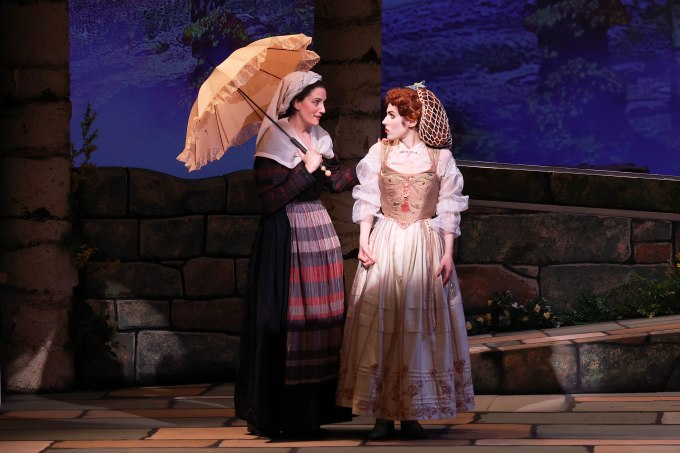
The love interest in this triangle is Elvino, sung by Chris Mosz, who possesses a brilliant and uniquely eerie timbre virtually unique to select operatic tenors.  Having sung Tonio in La Fille du Regiment with its eight high C’s multiple times, he certainly suits this part which demands that he enter the stage for his first aria on a high note.  Mezzo Courtney Miller as Teresa, Amina’s mother, and Casey Germain as Count Rodolfo also deserve recognition for fine singing and acting.

A bit of a surprise is the chorus.  Mostly comprised of veterans with the company, this performance stands out as the best that this reviewer and other confidants can remember.  Whether singing pizzicato and sounding like a score of bass violins being plucked, or wafting harmoniously in full voice, they make a difference.  Kudos to Chorus Master Bruce Olstad and Director/Conductor José Luis Moscovich who also coordinates orchestra and chorus to produce the big, beautiful sound that belies their numbers.

Courtney Miller as Teresa, Michelle Drever as Amina.

The opera itself was a great hit with critics, audience, and fellow composers alike upon its premiere.  However, tastes and audience demands change over time.  One deficiency by today’s standards is that until the critical juncture arrives toward the end of the long first act, the action is very static with little dramatic impact.  Arias typically make operas memorable, but until the sleepwalking scene, one aria after another contains pleasant melody, but nothing hummable or declamatory, and very little interactive.  Amina’s sleepwalk along with her claim of innocence in her aria ‘D’un Pensiero e d’un accento’ that lead to the rousing, complex act-ending ensemble, a structural fixture of the time, largely redeem Act 1.

Conductor Jose Luis Moscovich, Casey Germain as Count Rodolfo, Michelle Drever as Amina.

Act 2 is comprised of five short scenes that move quickly and provide the highlight of the opera.  Amina reprises her sleepwalk.  This time, before reaching the townsfolk assembled, she must negotiate a dangerous ledge across the mill stream.  Designer Peter Crompton’s projections of cascading water behind the vulnerable Amina creates a strong dramatic effect.  Her ensuing “mad scene,” which includes ‘Ah, non credea mirarti,’ her ode to dying flowers from Elvino, is composed and performed exquisitely.

This opera is an important piece of Bellini’s output and has much to recommend it.  La Sonnambula influences other opera composers, and it was parodied or reflected in works as varied as Gilbert and Sullivan’s operettas and George Eliot’s novel The Mill on the Floss.

Cast. Costume designs by Callie Floor.

La Sonnambula, composed by Vincenzo Bellini with libretto by Felice Romani, is produced by West Bay Opera and performed at Lucy Stern Theatre, 1305 Middlefield Road, Palo Alto, CA through February 23, 2025.
The Heart Sellers

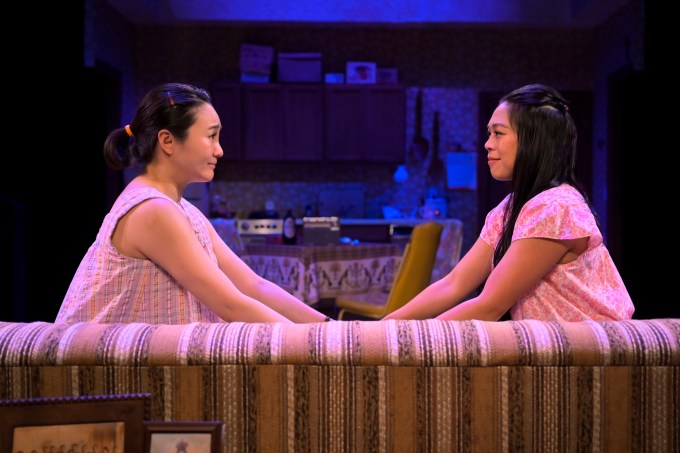
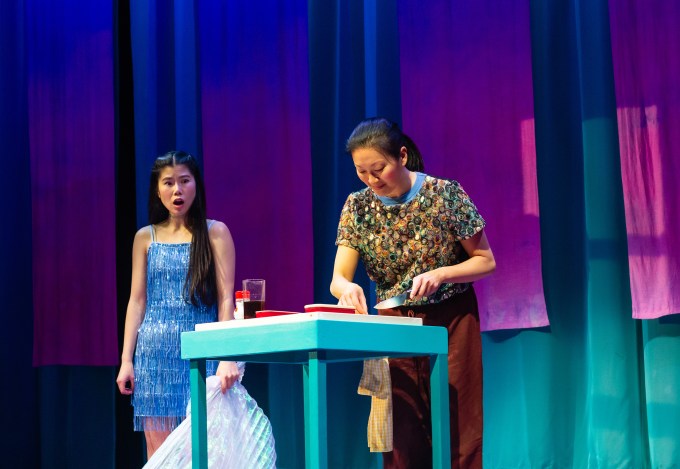
Wongjun Kim as Jane, Nicole Javier as Luna. All photos by Kevin Berne.

It is the 1970s. In Lloyd Suh’s play The Heart Sellers, recent immigrants Luna and Jane have just met by happenstance.  So “What’s in a name?” asketh Juliet in Shakespeare’s Romeo and Juliet.  If the title prompts queries, the answer is that it is a homonym representing the Hart-Cellar Act, formally known as the Immigration and Nationality Act of 1965, pertinent to the characters’ lives and increasingly significant today.  Prior to this legislation, over 80% of immigrants allowed into this country were from four European countries, because previous quotas were tied to the percentage of representation already in the American population

Luna is Filipina, and Jane is Korean.  Apart from Asian heritage, other shared characteristics are that each is childless and both husbands are resident physicians who work long hours.  Each woman feels lonely and isolated, and both husbands are working on this day, Thanksgiving, so the women decide to spend it together at Luna’s apartment.

The Heart Sellers is a two-hander comedy in which the actors wring every bit of humor from the most mundane conversation, much of it because of the cleverly crafted contrast in personalities.  Their differences are also a reminder that while some people tend to lump Asians together as a homogeneous people, their societies are in fact quite different.  The Philippines is predominately Catholic, pop-culture oriented, tropical, Spanish and American influenced, and among the poorer countries in Asia.  Although Protestantism is the largest denomination in Korea, a majority claim no religion.  It was colonized by Japan, has a charactergraphic writing system, values classical music, has four seasons in a northern climate, and has advanced economically and technically.

Though the two characters share common personal experiences and will ultimately bond, they are cut from different cloth.  As Luna, an absolutely delightful Nicole Javier is shot from a cannon – effusive, ebullient, and goofy with a constant rapid patter and nervous movement from curtain up.  She even asks if she talks too much and then clatters past her own question without waiting for or wanting a reply.  Her charm is also driven by her broad, toothy smile and laughter, so natural, enduring, and endearing.  Her typical Filipino accent is strong but with clear diction.

An equally compelling Wongjun Kim portrays Jane, but unlike Luna, her character evolves.  Reticent at the beginning, she seems overpowered by the personable Luna.  But in time, she emerges from her shell, in part because she knows what to do with the turkey that Luna has bought and in part because of the wine they consume.  Not only does Jane’s face light up, but she becomes quite demonstrative and insistent, even placing demands on Luna, though they’ve just met.  Korean born, Kim adopts an appropriately authentic Korean accent in English which can challenge a bit when she mumbles and stumbles and faces away at the beginning, but not so later on when she becomes more confident and vocal.  And don’t worry.  Even if you miss something, you haven’t really missed anything.

Happy to find someone to talk to, the young women become familiar quickly, sharing intimacies.  Each shows curiosity about the other’s belongings when the other goes to the bathroom.  Their shared curiosity extends to the idea of going to a nightclub when their husbands are on duty and taking in a porno movie. 

Like many well-crafted comedies, The Heart Sellers brims with serious subtext.  The balance of funny and dramatic moments works to great effect, and the title itself does have meaning as Luna relates the words with emotive and evocative imagery concerning the frightening experience of immigration interviews.

It is easy for an American to take an ethnocentric view of immigrants and their issues, but the playwright surfaces many of the plights of the immigrant from their perspective.  Apart from the obvious matters of missing family, friends, and the support they provide, the women talk about missing little things like the smells and tastes of their homeland.  They also talk about the loss of confidence when speaking a second language among people who don’t share the same sympathies and who may look down upon them.  The notion of immigrants being caught between two cultures is perceptible by most people.  But what about their future?  Do things change if they become rich?  And what about having children born here who, unlike their mother, are real Americans?

Jennifer Chang directs Aurora Theatre’s The Heart Sellers with a skilled hand, assuring that the timing of the verbal exchanges crackle.  Javier and Kim do the rest with bravura performances.  They make us care about these women and others like them, not only because of the cultural trials they face but because of their lack of agency, merely following in the footsteps of men.  After 90 minutes of stage time, the oven timer rings, signifying the turkey is done.  We wouldn’t mind sharing dinner with them.

The Heart Sellers, written by Lloyd Suh, is produced by Aurora Theatre Company and plays on its stage at 2081 Addison Street, Berkeley, CA through March 9, 2025.

Waste

Liz Sklar as Amy O’Connell, Lance Gardner as Henry Trabell. All photos by Chris Hardy.

Nowadays it seems that many theatrical offerings have special resonance because of aspects that relate to our tumultuous political environment, even though the plays were probably selected before the recent presidential elections.  With Waste, a British play by Harley Granville-Barker from 1906, the central themes smack the viewer in the face as if the play were written as parody of our political times.  This answers the question of why produce this play at this time.  But while we are accustomed to all manner of contentiousness today, this play was censored in England, and its public debut was delayed for 20 years because of its controversial content.

Leontyne Mbele-Mbong as Frances Trebell, Jomar Tagatac as Dr. Wedgecroft.

In Marin Theatre’s production, the performances are mostly exemplary, and the staging is striking.  Certainly, the play’s subject matter is of great moment. But in keeping with late-Victorian English style, its text is highly mannered and stilted, which makes the characters seem distant and artificial, though some relief comes from a number of impassioned exchanges.  The narrative could be trimmed to sustain interest.

Oddly, the two focal social issues in Waste are approached from very different perspectives today than at the beginning of the 20th century.  In the play, Henry Trebell is an ambitious politician, esteemed for his trenchant analysis.  He is wanted on the cabinet of the incoming prime minister because of his well-expressed views on disestablishment, the hot button item that proposes terminating the recognition of the Anglican Church as the official church of the United Kingdom.  This church-state linkage had existed for centuries, from the time of Henry VIII. Consequences of this separation would include budget allocations, distribution of church assets, establishment of secular schools, and more.

(rear) Liz Sklar as Amy O’Connell, (foreground) Joseph O’Malley as Walter Kent.

In the United States, this is a vital issue arising from the opposite direction.  We were founded on the basis of separation of church and state, and the First Amendment to the Constitution states “Congress shall make no law respecting an establishment of religion…..”  Yet today, social conservatives and the religious right are attempting to impose their white Protestant religious vision on our people with initiatives such as tuition vouchers for religious schools and teaching the Ten Commandments and Christian religion in public schools.

The other important matter concerns women’s rights, and in particular, reproductive rights.  On a one-night stand, Trebell has impregnated a married but separated Irish woman, Amy O’Connell.  Learning of the pregnancy, Trebell reveals patriarchal and misogynistic views, as do his fellow politicians when made aware of the situation.  The cynical and self-serving father-to-be regards the fetus as property that he owns, rather than as her or their child, even though he will not allow his paternity to be known.  Like his benighted associates and O’Connell, he hates the smidgen of influence that women have on men after the freedom that men have granted them.  And as may be attributed to a current politician, Trebell seeks power over women as well as men and has contempt for both.

(foreground) Joseph O’Malley as Justin O’Connell, (rear) Mike Ryan as Blackborough, Daniel Cantor as Lord Horsham, Lance Gardner as Henry Trabell, Anthony Fusco as Charles Cantelupe.

In this country, after decades of improving rights for women and minorities, retrogression has resulted in the overturning of Row v Wade.  In addition, attacks on Diversity, Equity, and Inclusion programs are turning back the clock.

These higher order issues play out against a backdrop of another vital matter, and that is scandal.  As much as the prime minister would like Trebell in his cabinet, the scandal of a child out of wedlock would end his political career.  The contrast with modern day America could not be starker.  It seems that no scandal can impede a presidential candidate, or his cabinet nominees, or anyone else anointed by the president (except Matt Gaetz who was flushed not because of scandals, but because he was widely hated by his own party colleagues).

Lance Gardner as Henry Trebell, Leontyne Mbele-Mbong as Frances Trebell.

The narrative of Waste compels, with a couple of surprise shocks and an incisive inside view of political machinations among nominal allies.  As Marin Theatre’s Artistic Director, Lance Gardner chose well for his return to the stage in the central role of Henry Trebell.  He suits the part thoroughly, conveying competence, arrogance, and rage with great conviction.

Some of the finest actors in the Bay Area comprise the remainder of the cast.  A vulnerable yet demonstrative Liz Sklar is notable as Amy.  Joseph O’Malley doubles as Henry’s secretary and Amy’s husband, Justin O’Connell, and as the latter, he stalks the stage and chews the scenery in a vivid featured characterization.

Mike Ryan as Blackborough, Anthony Fusco as Charles Cantelupe, Daniel Cantor as Lord Horsham.

Carey Perloff directs and deserves credit for her adaptation which eliminates most of Act 1, shrinks a number of scenes, and eliminates characters.  While she skillfully manages the action and creative design, she could do more to rein in the text even further.

Waste, written by Harley Granville-Barker and adapted by Carey Perloff, is produced by Marin Theatre and is performed on its stage at 397 Miller Avenue, Mill Valley, CA through March 2, 2025.

Calendar Girls

Jen Halsing, Evan Mooney, Alicia von Kugelgen. All photos by Mike Padua.

Few performing or visual art works acclaim the older woman.  It is refreshing to see a piece that treats not one, but a bevy of them, as individual, vital, and dare we say, appealing and sexy females.  As would be observed in the play, “The last phase of the flower is the most glorious.”  Adapted from the 2003 British film Calendar Girls, the stage version follows the same trajectory, tracing the conflicts, obstacles, and joys of a unique method for raising money for a hospital in a small town in the Yorkshire region of England.

Although a true story, the movie Calendar Girls followed on the heels of the fictional The Full Monty, which almost seems like a companion piece, as it concerns a group of men who perform in a similar manner, also for benevolent reasons.  For those unaware, that manner is nude.

Isa Chu, Emme Clark, Michael Haven, Virgie Poole.

The Women’s Institutes (WI) is a network of women’s service organizations founded in Canada and spread throughout Commonwealth countries.  The central characters in the play are members of the Knapely (Yorkshire) WI, which produces an annual calendar with monthly photos to reflect regional sights and values, such as the churches of Yorkshire.  When Annie’s husband John dies of leukemia, her close friend Chris comes up with the idea of raising money to replace the uncomfortable settee in the hospital’s visitors’ room.

But rather than picturing the traditional staid exemplars in the calendar, Chris takes a page from a cheesecake calendar she had seen at a mechanic’s shop.  Why don’t the members pose nude, with critical parts discretely covered by domestic props such as cakes or balls of yarn?  While the idea faced some tough sledding, it clearly did happen in reality, and the rest, as they say, is history.  And (spoiler alert in this sentence!) it was such a successful history that the settee would be a mere line item in the project budget facilitated by the calendar proceeds.

Alicia von Kugelgen, Evan Mooney.

In many ways, the narrative seems like an amusing throwback, despite its action occurring only 25 years ago.  While competitions in domestic activities that bind WI members such as pie making and knitting still exist even in this country, they may seem quaint to a metropolitan audience.  And resistance points by some members to the obscured nudity in the proposed photos tie more to an earlier era.  A vicar’s daughter who already has a mixed-race child out of wedlock fears reaction from her parents.  An overweight member is embarrassed about displaying even the fringes of her body without wraps.  And the eldest participant notes that her husband first saw her naked only 10 years before, and that was by accident and seen by several other people as well.

Isa Chu.

Like many plays, the setup portion in Act 1 can be uninspiring, and this being an opening night without having had a preview, it seemed a little lethargic with dialog timing and delivery that could have been brighter and brisker.  That changed dramatically at the end of Act 1 with the photo shoot preceded by the characters drinking a little courage.  The enthusiasm and seeming spontaneity in the cast was palpable, as if this was the first time the women had experienced the disrobing.  They squeaked and cheered like schoolgirls, totally shifting the energy of the performance.

Most of the clashes within the WI group occur in Act 2, after the calendar is released.  Success often breeds discontent within small groups.  Members jockey for recognition, clash for claiming credit, question the motivations and actions of others, and argue about future directions. Among others, close friends and leaders of the project, Annie and Chris, skirmish.

Jo Lusk, Virgie Poole.

Those who didn’t support the racy calendar idea to begin with continue to find fault, and in this case, the president of the chapter tries to snuff enthusiasm, cruelly denigrating the most risqué of the participants, Celie.  But in a thoughtful monolog, Celie redeems herself with a reflective narration of who she is, explaining why she dresses in a slutty fashion and what it is like dealing with the illness of golf.

Calendar Girls is the type of project that attracts performers committed to the cause, and this cast seems very dedicated.  It is led by Alicia von Kugelgen who brings strong presence with a powerful speaking and singing voice as the purposeful Annie.  Also noteworthy are the two who vie as the hotties, Jen Halsing as the ebullient underachiever Chris and Virgie Poole as Celie.  No dialect coach is indicated in the program, but to this reviewer’s ears, all of the actors seemed trained specifically in English north country accents, so kudos to whomever, but to Director Michael Sally in any event.

Isa Chu, Sally Hogarty, Simon Patton, Jo Lusk, Jen Halsing, Virgie Poole, Emme Clark.

This play will be enjoyed and appreciated by community theatergoers looking for a feel-good experience with dramatic overtones and a feminist bent.

Calendar Girls, adapted by Tim Firth from the film of the same name written by Juliette Towhidi and Tim Firth, is produced by Masquers Playhouse and plays on its stage at 105 Park Place, Point Richmond, CA through March 2, 2025.

The Thing About Jellyfish

Matilda Lawler as Suzy (below), Kayla Teruel as Franny (above). All photos by Julieta Cervantes.

The greatest mystery of life is death.  Many religions fundamentally exist by trying to make sense out of what happens when mortals pass from this earth, which then informs how we live our lives.  Is there a heaven and hell?  Do we reincarnate?  Will we see our loved ones again?  Against this backdrop are the two extreme manners of dying – protracted illness that allows the deceased to put affairs in order, and sudden death, that prevents closure with loved ones, which can haunt survivors endlessly.

Playwright Keith Bunin has adapted Ali Benjamin’s bestselling novel The Thing About Jellyfish for the stage.  Berkeley Rep’s world premiere bursts at the seams with a compelling story about the search for meaning in a production whose powerful visual dynamics engulf the senses.

Christiana Clark as Dr. Legler, Matilda Lawler as Suzy.

Sixth-grader, motormouth, and know-it-all Suzy doesn’t realize she pushes peers away by her dominance. She has only one friend, Franny, who dies on vacation from drowning off the coast of Maryland.  Knowing that Franny was an accomplished swimmer, the distraught Suzy is certain that there must be a more specific cause.

A voracious learner, she reads of and attributes the drowning to an exotic but deadly jellyfish, even though the species is known to inhabit only as far north as Florida.  But its sting is rarely detected in an autopsy, usually resulting in the conclusion that the deceased has drowned without other known cause.  From the distress of her loss, Suzy also turns mute, which challenges her parents and teacher alike.

Stephanie Janssen as Suzy’s mother Meg, Matilda Lawler as Suzy.

Much of the narrative is told in flashback.  We see a family in transition and archetypes of young teens from the snooty girl to the gross-out boy whose actions are as gross as his language.  And we get to know more about Suzy, and particularly of her fractured relationship with Franny at the time of her death.

In present time, Suzy must choose a zoology project, and her copious research on the significance and sustainability of jellyfish is shared in the narrative.  In dream sequences, she solicits jellyfish experts to help her in her quest to prove the cause of Franny’s death.  But one of the many messages in the subtext is that people often misdirect their energy, fretting over questions that even if answered will change nothing.  A loss is still a loss.

Schoolmates Jasper Bermudez as Dillon, Kayla Teruel as Franny, Lexi Perkel as Aubrey (all above), Matilda Lawler as Suzy (below).

But the play is largely about relationships and how especially vulnerable they can be in the early teens.  Change is signaled as children begin to feel maturity coming on and with it a sense of independence that creates friction with parents.  Attraction to the opposite sex divides friends as do changes in life styles and other evolving preferences.  Even though the content of the narrative concerns early teens, an adult audience will find it involving from beginning to end.

An additional dollop of meaning concerns the importance of search and discovery which drive Suzy’s curiosity.  Finding through her research that jellyfish are able to deal with global warming and plastics pollution in the ocean in ways that most fish can’t, thereby suppressing marine biodiversity, carries an ominous warning.

Robert Stanton as Australian researcher Jamie, Matilda Lawler as Suzy.

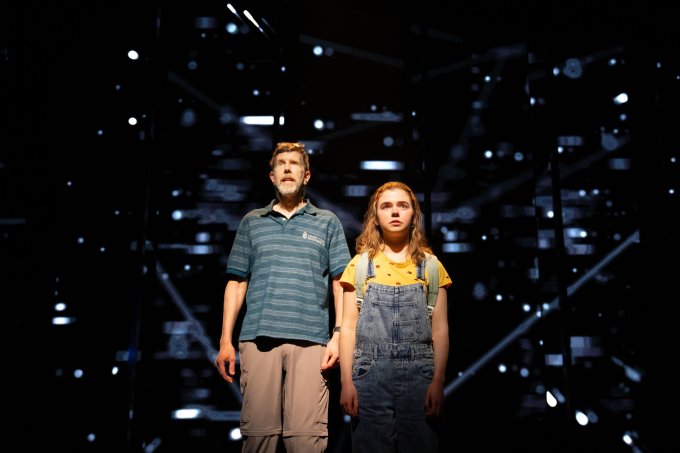
In addition to the engaging script, superb acting anchors the play, led by a fantastic teen actor, Matilda Lawler as Suzy.  Everpresent on stage and always part of the conversation (even when not speaking), the role places demands in its breadth of emotion and the sheer amount of dialog and stage presence to be mastered.  But the most conspicuous star of the show is the stunning projection-driven visual staging, conceived by Director Tyne Rafaeli and designed by Derek McLane and Lucy Mackinnon, which is easy to see but hard to describe.  A number of scenic designs are used, but the dominant format is like a cubic black canyon full of graphic, sometimes scrolling, displays on all walls that give a stunning high-tech appearance and tend to dwarf the actors into lesser significance.

Other production values are superior, including mammoth sound design.  That said, at times, sound effects are surprisingly allowed to overpower dialog.  At other times, speakers’ dialog is simply garbled or underprojected.  These flaws are easily correctible, and in any case, do not materially limit the overall appreciation of an inventive and highly interesting experience.

Matilda Lawler as Suzy, Antonio Watson as classmate Justin.

The Thing About Jellyfish, a world premiere stage adaptation by Keith Bunin of Ali Benjamin’s novel of the same name, is produced by Berkeley Repertory Company and plays on its stage at 2025 Addison Street, Berkeley, CA through March 9, 2025.

Exotic Deadly: or The MSG Play

Ami (Ana Ming Bostwick-Singer), Ami’s mother (Nicole Tung). All photos by Jessica Palopoli.

Primacy effect refers to the cognitive bias that suggests individuals remember vivid, first-presented information better than subsequent findings.  For this reason, Donald Trump pumps out volumes of misinformation, knowing that even if corrected, many observers will better remember and accept what they first heard.  In a more scientific context, primacy effect is behind anti-vax beliefs, as news of vaccines’ causing of autism preceded refutations.  The same is true of the bad rap that monosodium glutamate (MSG) has suffered.  Even though proven that MSG doesn’t cause headaches and nausea, the erroneous belief by many consumers continues.

Ami (Ana Ming Bostwick-Singer), Exotic Deadly (Francesca Fernandez).

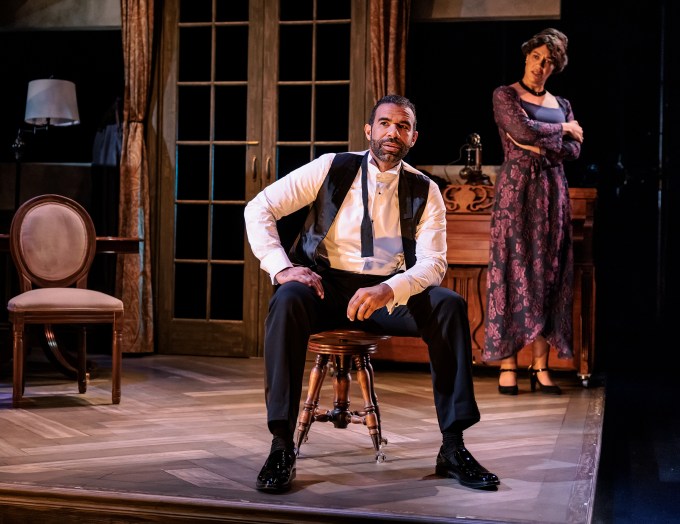
Exotic Deadly: or The MSG Play draws on playwright Keiko Green’s life experience with a Japanese anime, American ‘90s pop culture, and sci-fi driven play full of over-the-top hilarity and fanciful fantasy from beginning to end.  Director Jesca Prudencio and a stellar cast of six keep the laughs coming, yet there are some serious social underpinnings to the proceedings.

The half ethnic Japanese playwright learned as a teen that her grandfather was a scientist at Ajinomoto where MSG was isolated for commercial manufacturing.  It was not created, as it naturally occurs in tomatoes and mushrooms, while it also results from the transformation of milk to cheese.  Most consumers don’t realize how ubiquitous it is in processed foods from Campbell’s soup to Doritos.

Ben (Edric Young), Ami’s teacher (Nicole Tung).

The central action of the play occurs in 1999, and 14-year-old Ami as the proxy for Green, wants to fit in, to be average.  She is already embarrassed by the bento boxes that her mother prepares for her lunches at school, which classmates have described as stinky like farts.  But then comes the vilification of MSG and Ami’s guilt by association.  An anecdotal letter published in the New England Journal of Medicine in 1968 had posed the possible poisonous effects of MSG in what came to be known as the Chinese Restaurant Syndrome.  Never mind that MSG was scientifically exonerated.  The damage was done, and the falsehood lives on.

The play cascades with ease among time frames within the whole of the 20th century and diverse locations from Japan to the bottom of the ocean.  Realistic situations are punctuated with herky-jerky anime action, dreamy musical interludes, and faux martial arts sequences, and it all works.

Dr. Steele (Phil Wong), Bill the Neurologist (James Aaron Oh).

Ana Ming Bostwick-Singer impressively delights as the highly animated youth Ami with flailing arms and unlimited mugging expressions as she muddles through her challenges.  The other big star is Nicole Tung who impresses immensely playing two different key roles.  As Ami’s mother, she is purposeful, dour, and wry, focused on providing Ami good nutrition and encouraging her to be more like her brother who excels academically.  As Ami’s teacher, Tung brings a whole new set of verbal and facial expressions that reflect how good she is at her craft.

Also important to the narrative are the title character, Ami’s rebellious new schoolmate Exotic Deadly, and the anthropomorphised MSG, both played with wacky allure and enthusiasm by Francesca Fernandez.  Phil Wong, Edric Young, and James Aaron Oh round out the fantastic ensemble, each playing multiple parts with unrestrained verve and zany comic zeal.

Mr. Ajinomoto (Phil Wong), MSG (Francesca Fernandez), Ami (Ana Ming Bostwick-Singer).

While the comedy zips along, the story is replete with messages.  Ami reveals the angst of being a lonely and conflicted teenager, having challenging relationships with her mother, brother, and teacher.   Racism is reflected in the attitudes toward MSG and Ami’s bento boxes.  And even the scientific method is brought into question.  The runaway victimization of MSG in the scientific and broader communities was based on false-correlation anecdotes and reports on confirming research that was exceedingly sloppy, along with failure to publish well-executed disconfirming studies.  (Note that Chinese consume almost four times the amount of MSG as Americans, but someone forgot to tell them to have headaches and nausea.)

Keiko Green’s script hits the spot on virtually all counts, though funny bits about Ben and Matt, based on Affleck and Damon, seem contrived.  Everything about the production is first rate, starting with Prudencio’s masterful pacing and facilitating outstanding performances from every actor.  Heather Kenyon’s simplified staging fits the anime motif perfectly while Michael Oesch’s brilliant lighting, James Ard’s outstanding sound design, and Kathleen Qiu’s diverse costumery round out the sparkling look and feel.  This lively romp will have great appeal to a wide array of theater goers

Ami (Ana Ming Bostwick-Singer), Ami’s mother (Nicole Tung).

Exotic Deadly: or the MSG Play is written by Keiko Green, produced by San Francisco Playhouse, and plays on its stage at 450 Post Street, San Francisco, CA through March 8, 2025.

Daisy

Tony Schwartz (Michael Champlin), Louise Brown (Roneet Aliza Rahamim).
 Photos by Tracy Martin except where noted.

The power of moving-image media is evidenced by the massive electoral success at the apex of American politics by movie and TV celebrities inexperienced in government, such as Ronald Regan, Donald Trump, and Arnold Schwarzenegger.  At the next level down, add the likes of former U.S. Senator George Murphy (’40s actor/dancer), U.S. Congressman Fred Grundy (from The Love Boat), and mayors Clint Eastwood and Sonny Bono.

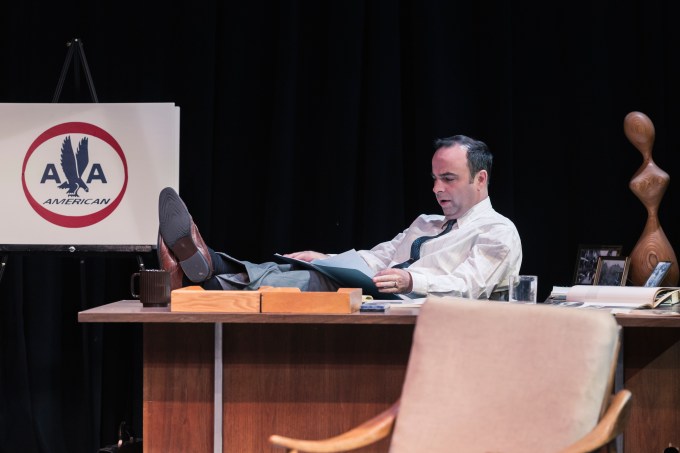
Demonstrable, but harder to directly measure, is the effect of advertising on product sales.  At the outset of the play Daisy, advertising firm Doyle Dane Bernbach (DDB) is crafting an advertising campaign for American Airlines based solely on the notion of the attractiveness of stewardesses to the then dominant niche of travelers, businessmen.

Not mentioned in the play, but at the same time, Braniff Airlines launched a TV campaign promoting their appealing stewardesses being festooned in Emilio Pucci uniforms.  The ads were so successful and business increased so rapidly (which, lest we forget, was people movement, not fashion) that Braniff nearly went bankrupt, as they were unprepared to manage the growth and suffered huge overbooking and operational errors.

In the 1964 presidential campaign, DDB was enlisted by the White House to deliver advertising for Democratic President Lyndon Johnson.  The consequential result was a 60-second spot that ran on national television exactly once.  Identified as Daisy it shows a closeup of a young girl counting to ten as she picks pedals from a flower, followed by a male voice counting down from ten, and culminating with the picture and sound of a nuclear explosion.  It does not name the Republican opponent, but during the Cold War era with the fear of nuclear holocaust, the candidate’s reckless comments allowed the viewer to connect the dots.  For all its indirection, this piece represents the birth of the attack ad.

Sid Myers (George Psarras).

While depicting modern history, playwright Sean Devine has created a provocative and revealing rendering of the events.  Most playgoers will know little of the facts other than the main outcomes, so the narrative will be perceived as a suspenseful drama.  Even for those of us old enough to have been there, factual details are refreshed or totally new, especially the insider information.  Critically, who among us could identify Tony Schwartz?  So who was he?  He was an esteemed freelance sound theorist and designer who scripted the body of the Daisy ad and who insisted on not mentioning Barry Goldwater’s name, as the audience already knew who he was and already feared him.  He also rejected using LBJ’s voice (unsuccessfully) or image, as they were not attractive.  But despite his creativity, DDB did not give public recognition to Schwartz.

The story is told largely from the perspective of three ad people at DDB who are designated to run the ad campaign, highlighting their interactions with Schwartz, their CEO Bill Bernbach, and White House lawyer and liaison with the team, Clifford Lewis.  Though the somewhat flippant style and New Yorkiness of the team may have been accurate, it doesn’t work so well for me, as I feel that straight up dramatic style maintains tension better.  The exception is the character of Tony Schwartz, played with great skill and credibility by Michael Champlin.  Schwartz suffered from agoraphobia and was full of eccentricities that make the off-kilter portrayal highly appropriate and effective.

What makes Daisy especially stimulating is that situations from its era compare and contrast chillingly with today’s political environment.  Notably, Barry Goldwater only became the Republican candidate because Nelson Rockefeller dropped out of the primary as he was poised to win California and the nomination.  Why?  His new wife gave birth to a child eight months after their marriage, and that scandal was enough to scuttle his candidacy.  Our recently elected president is on his third marriage; a convicted felon; a chronic and documented liar of the highest order; adjudged and multiply accused sexual abuser; founder and leader of several companies that went bankrupt; and the list goes on.  Within 60 years, the moral character of voters in this country and their standards for national leadership has so seriously declined that there appears to be no bottom, though anything lower is hard to imagine.

Clifford Lewis (Terrance Austin Smith), Louise Brown (Roneet Aliza Rahamim), Aaron Ehrlich (Keenan Murphy Flagg), Sid Myers (George Psarras). Photo by Mark Kitaoka.

Also, Goldwater and Trump are cut from the same cloth, considered extremists within their own party and with little urge control.  The difference is that Trump has used his uncommon and ununderstandable appeal to Republican voters to bludgeon friend and foe alike into submission with immense intimidation and threat.  Goldwater never had a chance to show if he would embrace fascism in practice.

The history also relates to disingenuous strategies employed in political crusades.   For instance, though LBJ’s Great Society and the Civil Rights Act of 1964 were the hallmarks of his tenure as the replacement president for the assassinated John F. Kennedy, there was to be no mention of civil rights in the campaign for fear of losing Southern support.

At another level, the play is about everyday morality.  One of the team members pleas ethics in condemning the use of negative ads, yet takes credit for the creation of the Daisy ad that clearly belonged to Schwartz.  Another notes that doing the job keeps the paychecks coming, dismissing ethical considerations.  It is interesting how common it is in real life that people carve out ethical, religious, or political exceptions to advance their own cause.  As Bernbach notes to one of the team, “Your name is on that card because your ambition exceeds your ideals,” which could be said of many sycophants in the Trump orbit. An example of the situational disconnect: many farmers are against government programs that tax in order to spread the wealth, except when it comes to farm subsidies, which they consider vital and untouchable.  Where you sit is where you stand.

Clifford Lewis (Terrance Smith), Tony Schwartz (Michael Champlin). Louise Brown (Roneet Aliza Rahamim).

Hillbarn Theatre’s regional premiere offers fine production values with direction by Jeffrey Bracco.  It plays with three separate locations on a period-looking set, supported by the thoughtful projection images, all designed by Steve Muterspaugh.  As is only appropriate, Jeff Mockus’s sound design captures the vital aspects associated with Tony Schwartz’s work with consummate skill.  It is surprising that this play took nine years to arrive in the Bay Area.  Given the current presidential administration, Daisy is likely to sprout legs.

Daisy, written by Sean Devine, is produced by Hillbarn Theatre and plays on its stage at 1285 East Hillsdale Blvd, Foster City, CA through February 9, 2025.