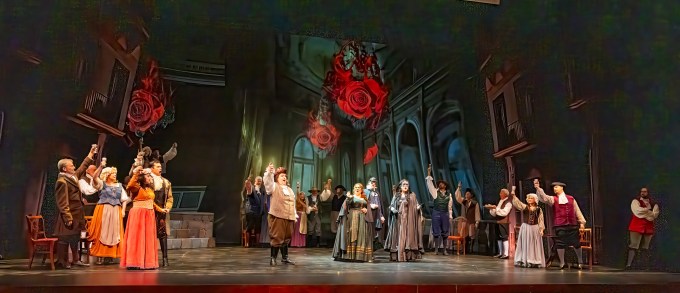
Grease

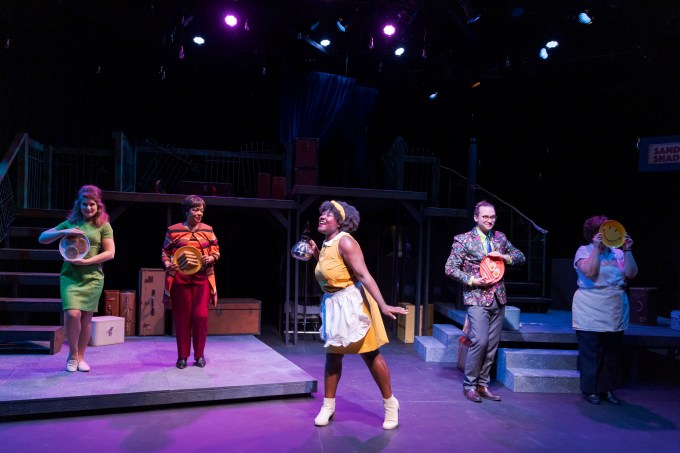
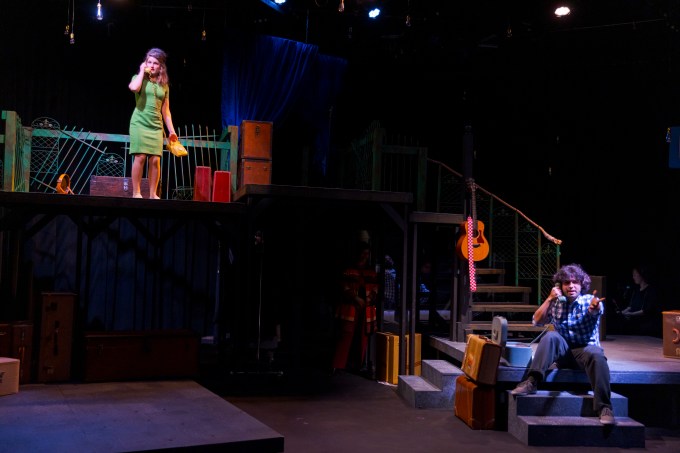
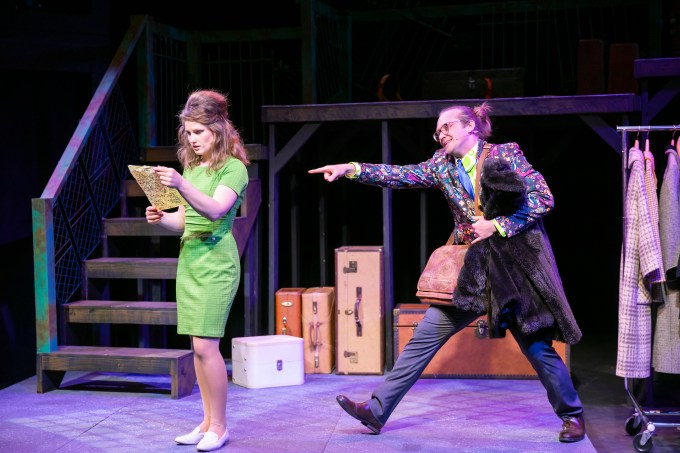
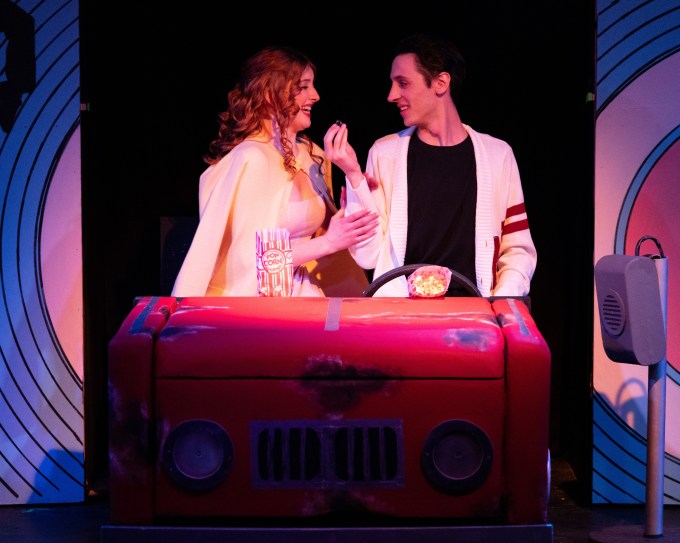
Kit Town as Sandy Dumbrowski, Luc Leffe as Danny Zuko. All photos by Grizzly De Haro.

For many of those who have seen the movie Grease, the very names Zuko, Rizzo, Kenickie, Frenchy, and Rydell High evoke nostalgia for the early rock-and-roll and original American Bandstand era of the late ‘50s and early ‘60s, with dances like the twist, stroll, and variations of the jitterbug.  Guys sported duck-tail hairdos, blue jeans with pant legs rolled into cuffs, and white tee shirts; and chicks had ponytails, poodle dresses, and saddle shoes.

Like many successful movie musicals, Grease drew on a stage predecessor that fewer people will have seen but that triggers as much reminiscence.  Its wildly successful Broadway version ran for eight years.  Neither Jim Jacobs nor Warren Casey who collaborated on the book, music, and lyrics, would create another successful musical, which surprises, as Grease is chockablock with fitting and memorable songs and sharp caricatures.  Altarena Playhouse, with Jacquie Duckworth directing, recreates the energy of the original, keeping the audience in smiles and laughs and applauding enthusiastically throughout.

Will Thompson as Sonny, Luc Leffe as Zuko, Jules Hensley as Doody, Liam Cody as Kenickie, Roberto Ruiz Jr. as Roger.

The narrative is episodic, displaying a slice of life rather than telling a story.  High schools are full of cliques, and at Rydell, the select ne’er-do-wells are the Greasers in their motorcycle jackets with their female counterparts, the Pink Ladies, in pink satin jackets.  Their lives are revealed as much by the music as the dialogue, and a large ensemble shares lead singing duties and plot points.

Kit Town as Sandy, Emma Roth as Jan, Annabella Guaragna as Marty, Seana Nicol as Rizzo, Sarah Elizabeth Williams as Frenchy.

One through line, however, is that Danny Zuko (played by Luc Leffe) and Sandy Dumbrowski (Kit Town) had a summer romance and parted with the expectation that each was going to a different Catholic school, this being a largely Italian and Polish area in Chicago.  But when they show up at the same public school, Danny is conflicted about trying to be the same cool, macho guy with his Greaser friends as well as the sensitive boyfriend to Sandy.  She is new to the school and has to deal with horning in on the territory and male quarry of the Pink Ladies.

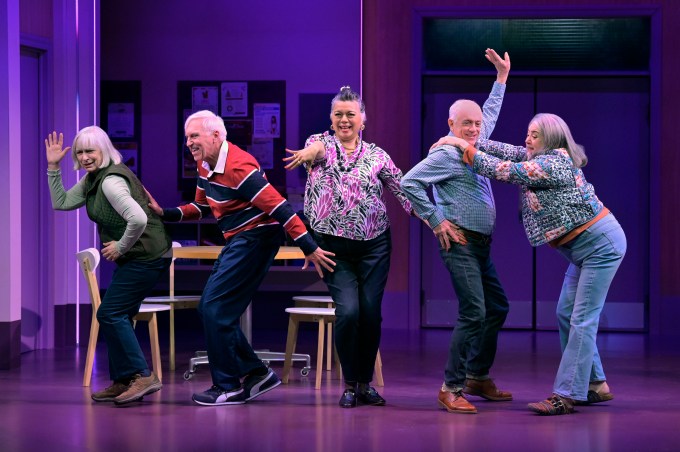
But it is the memorable songs plus choreography by Shelly McDowell that make the show pop.  Group singing was always strong on opening night, while some soloists were uneven, perhaps from opening night jitters.  What distinguishes the dance is the heavy use of hand movement that juices up many dances.  And they often appear as a flurry of cheery, excited movement as almost the whole company is involved in many dances.
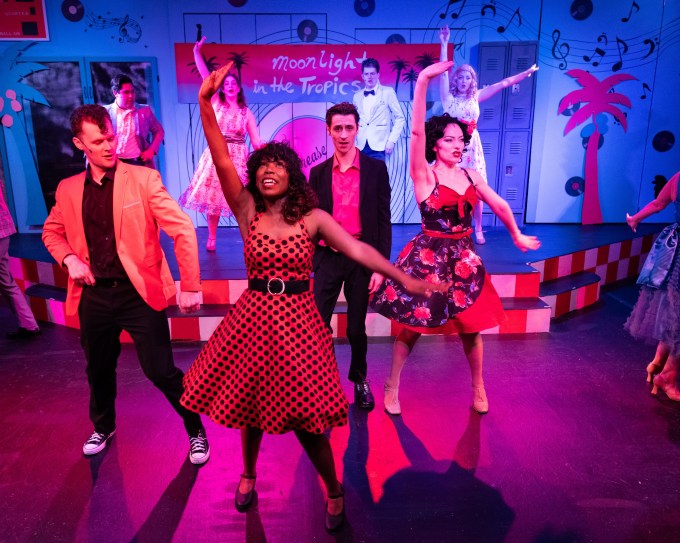
(center) Raven Douglas as Cha-Cha DiGregorio, cast.

Boys and girls dance as a troupe in many numbers such as the lively and expectedly handsy “Born to Hand Jive” and the upbeat closing “We Go Together” with its array of nonsense syllables common especially to doowop.  But also effective is when the cast is clustered in separate gender tribes as if in different locations and sing alternating verses.  This technique is used in the reflective love ballad “Summer Nights” with Danny and Sandy leading their respective groups. It also works on “Those Magic Changes,” another love lament that cleverly starts as an instructional on guitar chord progressions for beginners!  But the real litmus test is the peppy “You’re the One that I Want” which the cast passes with flying colors.  We shouldn’t forget that there are also some solos that hit the spot, including the beautiful “Hopelessly Devoted to You,” which Kit Town caresses until she blasts off, and “Look at Me, I’m Sandra Dee” sung with appropriate derision by Seana Nicol as Rizzo.

Cast.

As uplifting as Grease is, it touches, albeit briefly, on a number of important issues – teen sex and pregnancy; peer pressure and conformity; academic failure; rebellion; and gang violence.  In its pre-Broadway versions, the play, which draws on Jacobs’ own experience in high school was darker and grittier, with more emphasis on story and less on music.  Perhaps the greatest deficiency of the musical is that in sanitizing the book, many incidents and situations hit and run with no depth or development at all.  But the good news is that the fond remembrances of youth, low-ball humor, and finger-popping music make for a barrel of fun.

Raven Douglas, Mateo Urquidez, Heather Warren Camacho as alums.

Grease, with book, music, and lyrics by Jim Jacobs and Warren Casey, is produced by Altarena Playhouse and plays on its stage at 1409 High Street, Alameda, CA through April 27, 2025.
Fat Ham

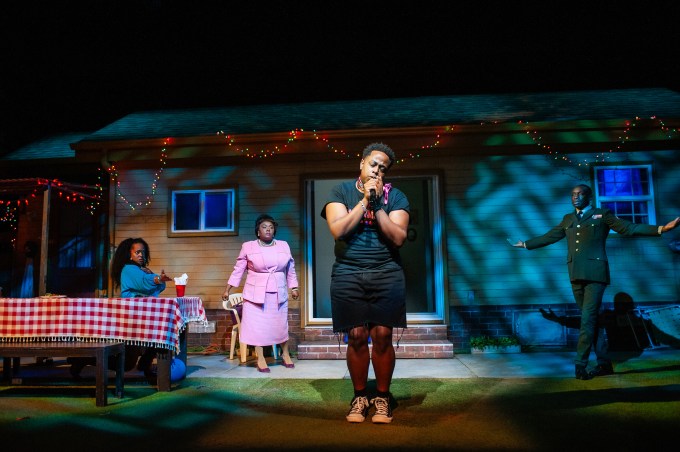
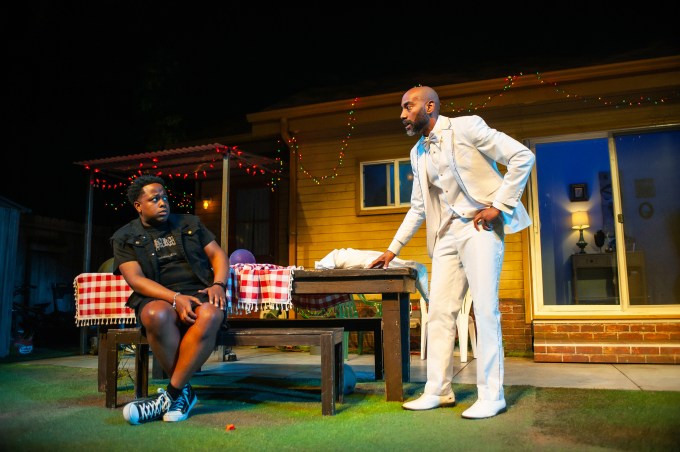
Devin A. Cunningham as Juicy, Ron Chapman as Ghost of Pap. All photos by Jessica Palopoli.

What the theatrical world has desperately needed is a reimagining of Hamlet, but set in contemporary time in the American south and with an overweight, gay, black title character.  Oh, and it should be a comedy.  Well, maybe a rethinking really wasn’t so necessary, but not only was playwright James Ijames undeterred, but his adaptation of William Shakespeare’s and perhaps the world’s greatest literary tragedy, won the 2022 Pulitzer Prize for Drama and five Tony nominations for the play’s Broadway run.  Touché.

While Fat Ham has received many decorations, that doesn’t make a production an automatic slam-dunk success.  It requires solid direction to ensure crack timing of the humor and great actors to deliver the lines.  Happily, the San Francisco Playhouse production with Margo Hall at the directorial helm and a cast of outstanding actors deliver the goods with relish.  The fine set by Nina Ball and crack lighting by Stephanie Johnson don’t hurt either.

Phaedra Tillery-Boughton as Rabby, Jenn Stephens as Tedra, Devin A. Cunningham as Juicy, Samuel Ademola as Larry, Courtney Gabrielle Williams as Opal.

Fat Ham is distinguished as much by its differences than its similarities to its inspiration.  Rather than a royal family with the gravity of succession weighing in on the plot, the murdered Pap (i.e., the ghost of King Hamlet) was a purveyor of barbeque and a pig farmer.  The formalities of the original are abandoned for modern vernacular.  The characters correspond, but Prince Hamlet becomes Juicy, a thicc, “soft,” sensitive young man, melancholy and reflective.

A couple of soliloquies are delivered directly from the script of Hamlet, and Devin A. Cunningham, who soars while inducing empathy for Juicy, delivers them with aplomb.  One of particular note begins “I have heard that guilty creatures sitting at a play have …..,” which foretells a trap that Juicy will later set for Rev. Also, there are a couple of wink-wink references to the original.  An energized Jordan Covington is super-sexed while being pretty explicitly off-color and hyper humorous as Juicy’s cousin Tio (echoing Horatio), who notes that at the end of Hamlet he survives surrounded by the carnage of the other leading characters.  Is that repeated in Fat Ham?  I’ll never tell.

Phaedra Tillery-Boughton as Rabby, Samuel Ademola as Larry, Jenn Stephens as Tedra.

The mousy Juicy’s dilemma derives from visits by the ghost of Pap who demands that he exact revenge by murdering Pap’s brother, Rev (King Claudius), who had killed him.  Ron Chapman grimly seethes with immorality and Machiavellianism playing both brothers.  But Juicy rejects violence at a personal level and for its hobbling of black society.  What’s more, while he loathes Rev, he didn’t exactly love Pap, asking his ghost “Why were you so mean to me when you were alive?”  Yet, he doesn’t outright reject the idea of revenge.

The issue that both Pap and Rev have with Juicy is that he postures effeminately, lacking manly demeanor.  A strong thread of sexual identity runs throughout the play, and indeed, Opal is a closeted lesbian.  This is the Ophelia role played deftly by Courtney Gabrielle Williams as the spunky but respectful daughter who wears a dress that she hates to placate her mother, Rabby, who in a gender shift represents Polonius.  Phaedra Tillery-Boughton plays Rabby as the stereotypical Black church-going lady becrowned with a fashionable hat and dressed to the nines.  She is a walking laugh machine with her high-pitched rapid patter and flippantly dismissive mien.

Devin A. Cunningham as Juicy, Ron Chapman as Rev, Jordan Covington as Tio.

Although most of the personalities reveal themselves quickly, perhaps the greatest transformation that the playwright creates is in the person of Larry, who has little stage time.  Samuel Ademola effectively plays the analogue to Laertes, Polonius’s son.  A returning, uniformed Marine, he is distant and almost catatonic, but in one unpredictable action, he leaves the audience anguished, and in another, applauding.

But in the race for the bottom of immorality, a yet unnamed but central character may take the prize – Juicy’s mother, Tedra, or Gertrude from Hamlet.  A hedonist and opportunist, Tedra marries Rev (Claudius), making him head of the food business (king), before the deceased Pap’s (King Hamlet’s) body is cold.  And she blithely counsels Juicy to move on and accept Rev as his father.  Her values come clear when she depletes Juicy’s college tuition money to pay for a bathroom renovation.

Courtney Gabrielle Williams as Opal, Devin A. Cunningham as Juicy.

As Tedra, the comely Jenn Stephens is salacious, quick with a come-on smile and rotating hips – always ready to party and play games.  But one game evinces her ire.  To Rev’s and her displeasure, Juicy uses a game of charades to reveal unseemly truth about Rev.

Fat Ham is a comedy, and the laughs come continuously from a variety of sources and in a variety of different forms.  But underpinning the comic elements are the tragedy of fratricide/regicide; the social issue of homosexuality; the matter of moral priorities; the poison of toxic masculinity; and considerations of deciding what kind of lives we wish for and what risks to take in attempting them.  Making the serious crests work in an ocean of humor is a challenge.  Whatever shocks or surprises arise are well absorbed by the narrative flow and the directorial management.  The result is a highly entertaining moral tale that is more relatable than the source from which it is drawn.

(foreground) Devin A. Cunningham as Juicy, (rear) Jenn Stephens as Tedra, Phaedra Tillery-Boughton as Rabby, Samuel Ademola as Larry.

Fat Ham written by James Ijames, is produced by San Francisco Playhouse and plays on its stage at 450 Post Street, San Francisco, CA through April 19, 2025.
Mrs. Krishnan’s Party

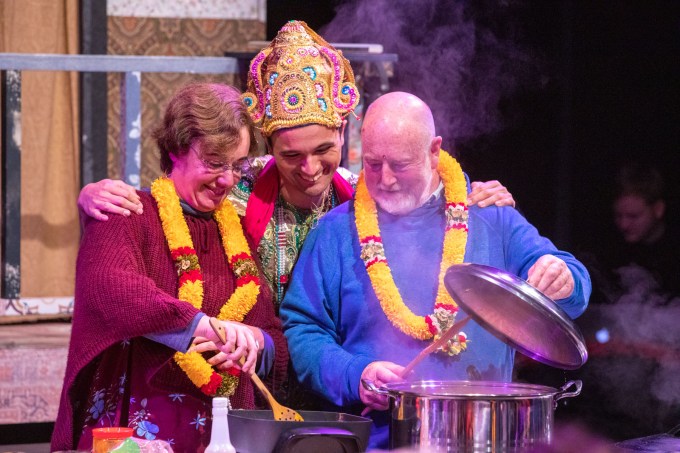
Justin Rogers as James, Kalyani Kagarajan as Mrs. Krishnan. All photos by Indian Ink Theatre.

For those who like comedy clubs, impromptu, skits and such, a laugh-a-minute treat is in store at Marin Theatre.  New Zealand’s Indian Ink Theatre is touring the U.S. in a special production of Mrs. Krishnan’s Party.  The immersive “party” nominally celebrates Onam, a Hindu harvest and cultural festival important to the southern Indian state of Kerala, with the extra lagnappe for party goers being a serving of spicy dal lentils with basmati rice at the end of the show.

This is what Karin and I did at our performance.

The two-hander is performed by actors with distinguished comedic and acting skills.  Kalyani Nagarajan as the widow Mrs. Krishnan storms around the stage with purpose, howling rapid-fire with a typical British-trained Indian accent.  Extreme facial expressions accentuate her mugging particularly by retracting her lips to better reveal her toothy grin.  Justin Rogers is James, her boarder and factotum, equally adept at humoring and stirring up the audience through direct engagement and traditional performance.

Testing the recipe.

Action takes place in the back room of Mrs. Krishnan’s convenience store in New Zealand.  But this theatrical experience does not occur with performers on stage and the audience in the auditorium.  Rather, to allow the actors to interact at close quarters with spectators, all are on the extended stage, to include the wings and back stage.

The theatrical conceit is that, to her great surprise, 100 partiers have showed up for Onam, and to feed them, Mrs. Krishnan will have to prepare and cook large cauldrons of dal and rice, which she will do with help on stage as the comedy proceeds.  Of course, this format is rife with prospects for calamity, including unpredictable interactions with patrons and complications with preparing the food.  This evening survived without a perceivable hitch, unless spilling a large bag of uncooked rice was not intentional.

An Indian dance.

During the show, several audience members are enlisted to participate in the action.  While I thought I was perfectly ensconced to avoid selection, I was chosen as well as Karin, my wife and editor.  I was tasked with stirring the dal for some time as she integrated onions and spices.  When a Carpenters’ tune arose from the sound system, we even improvised a bit of a slow dance together while we each continued to stir with one hand!

The experience lasts approximately 80 minutes.  In addition to the generally fixed script, audience response often adds to the humor.  Props and activities add to the energy with colorful scarfs dispensed for attendees to wear and balloons distributed to create a festive feel.  The stage is decorated with party lights and streamers.  Nagarajan also performs an appealing Indian dance on an audience table with characteristic beautiful finger movement.

Balloons add to the festiveness.

While the laughs keep coming, sometimes they’re driven by the pratfalls and general looks and sounds of the performers.  The accents of the actors (Rogers has a New Zealand accent), and sound interference sometimes makes it difficult to understand specifically what they are saying.

Another point worth mentioning is that if you’re looking for a traditional theater experience with a production that is consistent from one night to the next and that has appreciable subtext, this is not it.  The story of Onam concerning life and rebirth is verbalized as well as some commentary supporting the notion of people of all religions coming together, but the messages are pretty superficial.

However, if you want a fun diversion with some unusual wrinkles, this is one to enjoy.

Audience enjoying the dal and rice.

Mrs. Krishnan’s Party is presented by Marin Theatre, produced by Indian Ink Theatre Company, and plays at Marin Theatre, 397 Miller Ave., Mill Valley, CA through March 30, 2025.

Push/Pull

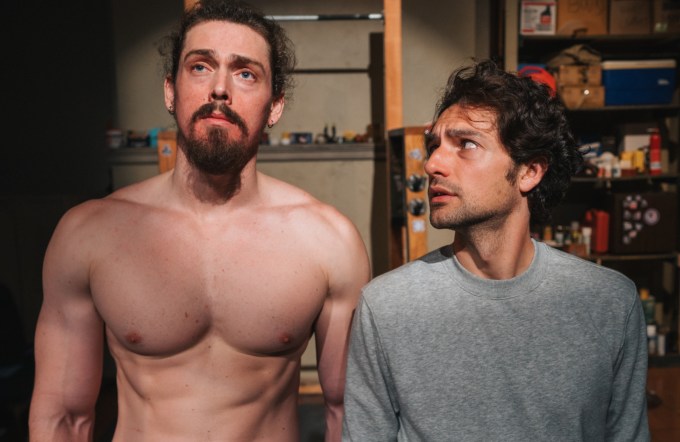
Matthew Kropschot as Nolan, Andre Amarotico as Clark. Photo by Robbie Sweeny.

As the smallest possible cast to comprise a play (the solo performance being fundamentally a monologue) the two-hander holds a special place in theater.  These days, they seem more prominent, probably because they are cheaper and easier to produce than plays with larger casts.  But great dramas for two actors such as The Gin Game and Top Dog/Under Dog fill the catalog, as well as comedies like Greater Tuna and even musicals like I Do!  I Do!

A common theme to two-handers is that two characters share commonality that brings them together and contrast that creates dramatic tension.  The brilliantly written and produced 75-minute gem Push/Pull shares that dynamic.

Two young men have been friends since sixth-grade, but upon leaving school have gone separate ways.  Clark (Andre Amarotico) pursued white-collar work before being side-tracked by a mental condition that put him in a psychiatric hospital, while Nolan (Matthew Kropschot) was flushed out of the Navy; bags groceries at Safeway; and lives with a father he despises.  But he has a hoped-for ticket out.  As a committed body builder, he has converted the garage of his father’s home into a weight room and trains to enter competitions to earn professional certification.

One theme of the play is the notion of what constitutes masculinity.  The diffident, unsteady Clark approaches Nolan because he feels ugly and stupid.  He wants to feel male, hoping that weight lifting will do the trick.  Nolan preens to obsession about body building to the extent that he hasn’t “spilled seed” in 300 days.  When Clark declares his goal, Nolan, inclined toward excess and rage, spews, “There’s no such thing as toned! You need to get jacked!”

As the two reunite, it is clear that Clark had greater success in virtually all aspects of life, but he is now in Nolan’s bailiwick.  They spar over many issues and even disagree on high order goals.  Clark seeks happiness.  Perhaps Nolan has consigned himself to unhappiness because of his failures, but he strives for fulfillment, which he gets through physical self-adoration.  For all of their differences, they do feel attached and share some characteristics such as dark sides and self-loathing, which haunt each of them even if in different ways.     

Kudos to Director Gary Graves for overseeing such a masterful production in such an intimate theater.  He animates the action to the extent that that Kropschot gets a pretty good workout from the various lifting sequences.  The observer’s senses are well stimulated while preserving the claustrophobia of Nolan’s existence.

I can’t remember a production in this space with such detailed set and props.  Joseph Nemeth’s scenic design hits the nail on the head, right down to the body builder’s supplies and routine garage paraphernalia on the shelves.  Gary Graves highly complex lighting with frequent spots and blackouts serves both aesthetically and functionally.  And Gregory Scharpen’s sound design is equally detailed and telling.

Then there is the acting, which is superb.  Matthew Kropschot totally captivates by capturing Nolan’s manic faut-confident excesses as well as his almost uncontrollable fury with great bravado.  He dominates the stage with his physical presence and his single mindedness.  And he is a natural for the body sculpting theme, as he is a body builder with large, well-defined muscles and a V-shaped torso as well as being a seriously good actor.  Perhaps the greatest impediment to this play having legs is finding actors who can look and perform Nolan’s physical side and act with equal authority.

Andre Amarotico as Clark engages as an everyman with a common brand of insecurity that he depicts with needy accuracy, admitting that everything he does is for women and that he can’t get over the former girlfriend who dumped him.  And though Clark has a more even keel than Nolan, Amarotico is quite adept at showing his character’s neuroses and insistent side as well.

I will note that I did not attend the opening of Push/Pull because the topic and the promotion of the play did not interest me.  But given the raves from Critics Circle colleagues, I decided to give it a try and am glad that I did.

The value of the production of course begins with the script.  Harry Davis has accomplished the admirable task of creating a script about body building that transcends the obvious topic matter and even evokes interest for those who are somewhat turned off by the subject on the surface.  The play offers insights into the mind of the bodybuilder while exploring universal topics such as friendship, love, family, and self-regard.

Push/Pull, written by Harry Davis, is a world premiere produced by Central Works and plays at Berkeley City Club, 2315 Durant Ave., San Francisco, CA through March 30, 2025.
Nobody Loves You

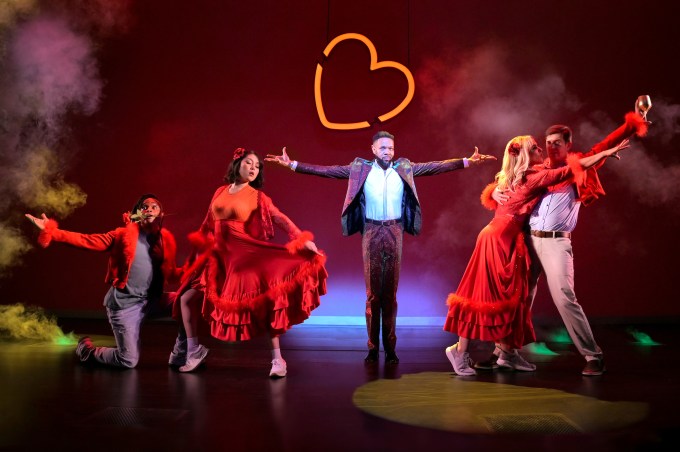
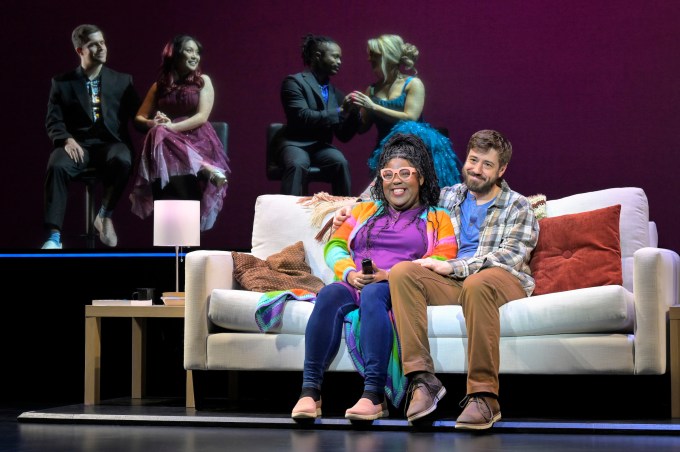
John-Michael Lyles as Dominic, Ana Yi Puig as Samantha, Jason Veasey as Byron, Molly Hager as Megan, Seth Hanson as Christian. All photos by Kevin Berne.

Competition-based reality shows have become a staple of television.  Who can best tame a forbidding wilderness; or produce the best recipe from an omnium gatherum of surprise ingredients; or sing with the most affecting voice?  But the most enduring format long precedes the era of reality television – the competitive mating ritual, with contestants opening their hearts and trove of secrets on national television in hopes of being The One.

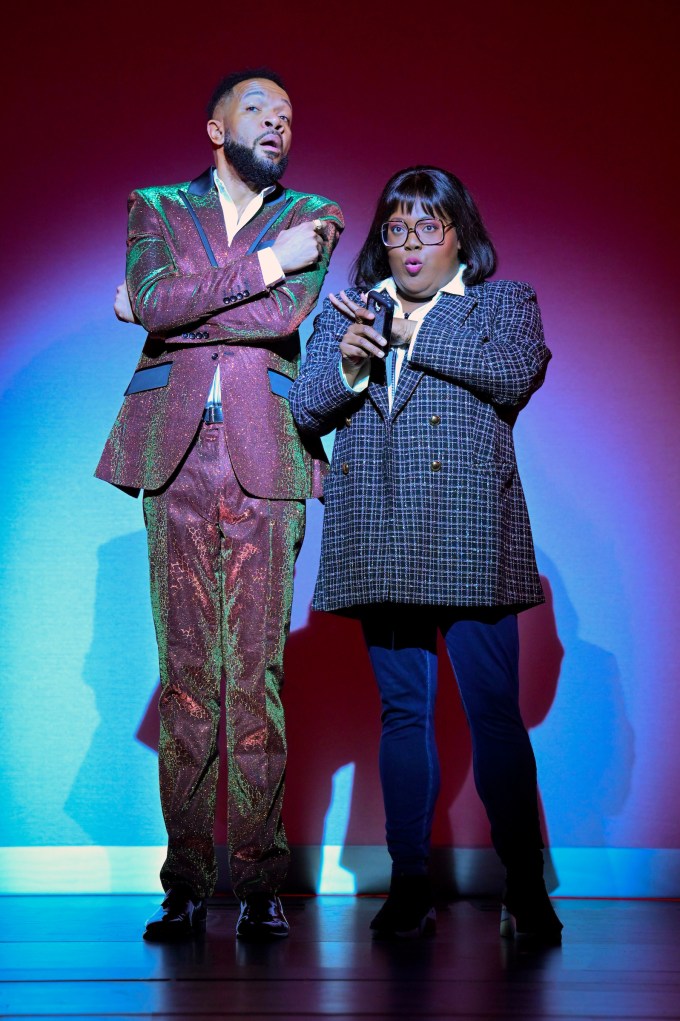
“It’s time for you to pack your things and go, because Nobody Loves You.”  That’s the pronouncement that no contestant wants to hear on the show of the same name.  Yet all but the final survivors will hear it from the show host.  The victimizer, Byron is aptly depicted and portrayed by Jason Veasey as the shallow but engaging man with a radio DJs honeyed voice and a wardrobe of glittery and brightly colored tux-like outfits.  Like the contestants, he is a laughable yet likeable caricature of the type of staff involved in the show’s production.

(front) Ashley D. Kelley as Tanya, A.J. Holmes as Jeff, (rear) Seth Hanson as Christian, Ana Yi Puig as Samantha, John-Michael Lyles as Dominic, Molly Hager as Megan.

For the greater part, the musical aims low, but it keeps the laughs coming.  It succeeds in part because the talented actors work their butts off making comedy; because the situations seem plausible but absurd; and because the pop-rock music is catchy and propulsive.  The contestants with silly behaviors vary from portrayer Seth Hanson’s very Christian Christian (no, that is not a typo) to the dipsomaniac hottie Megan (Molly Hager) to the spacy and gullible animated dynamo Dominic (John-Michael Lyles).  And then there is the contestant with all of the model characteristics and pat answers, Samantha (Ana Yi Puig), even though she is a total put-on, e.g., she says she’s laid back, but she’s really uptight.

Molly Hager as Megan, John-Michael Lyles as Dominic, Ana Yi Puig as Samantha, Seth Hanson as Christian.

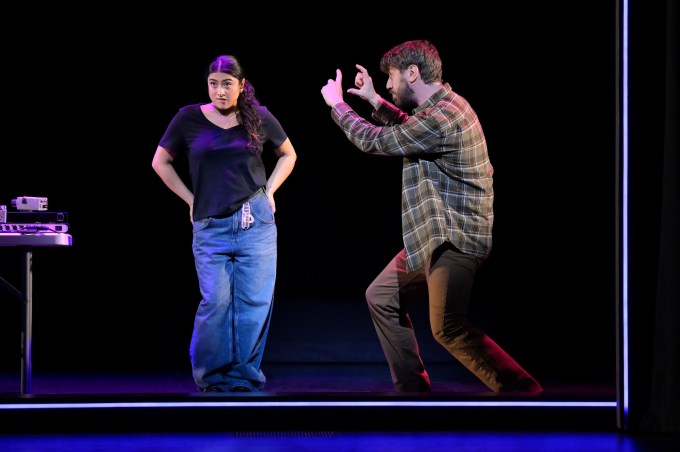
Jeff (A.J. Holmes), who hates everything, is stirred into the mix.  He is the guy who went to a children’s play and was the only one in the audience not to give a standing ovation.  Why?  Because the production was too childish!  An all-but-dissertation doctoral student, he appears at the show’s studio in search of his recent ex-girlfriend who hopes to be on the show.  Holmes is good at being humorously sour as he displays great disdain for everything the show represents, openly denouncing it for denigrating and exposing contestants to embarrassment and for being driven by selfish motives.  He shares his summary feeling to the show runner Nina (Ashley D. Kelley) – “I hate your stupid ass show.”

Kuhoo Verma as Jenny, A.J. Holmes as Jeff.

Despite Jeff’s outrageous behavior, Nina is convinced that his hostility and his fox-in-the-henhouse behavior as a contestant would actually boost ratings.  Jeff sees the opportunity to develop a dissertation topic from the experience and expose the show from within, and voilà, a match made in comic hell.  Along the way, Jeff will find a sympathetic ear in the Assistant Director Jenny (Kuhoo Verma) who hopes to be a documentarian.

Though Nobody Loves You premiered in 2012, ACT workshopped the show for this production, updating the situations to current time and revising some of the songs.  Are there serious undertones to the resulting musical?  Sure.  It’s about how people make moral sacrifices in their personal work that they wouldn’t settle for elsewhere.  It reveals how inauthentic people are as they put on faces to gain recognition.  It shows how people put themselves above others when they’re really not and how they fail to be loved if they don’t love themselves. And much more.

Jason Veasey as Byron, Ashley D. Kelley as Nina.

But it’s best appreciated at a superficial level.  We laugh when Megan tries to lure the sexually inhibited Christian into the hot tub, and when Jeff is constantly dumbfounded that people don’t see the folly of what they’re doing and that they don’t see the world as he does.   We enjoy Kelley’s little “wink wink” as Nina when she notes how several of the contestants look a lot like her – because she is playing all of the roles.  And we enjoy all of the manic performances.  I was particularly taken with Verma as Jenny and Puig as Samantha, both of whom have wonderful singing voices and vivid expressions that gleam all the way to the back of the theater.

Molly Hager as Megan, Jason Veasey as Byron, John-Michael Lyles as Dominic, A.J. Holmes as Jeff, Ana Yi Puig as Samantha, Seth Hanson as Christian, Ashley D. Kelley as Tina.

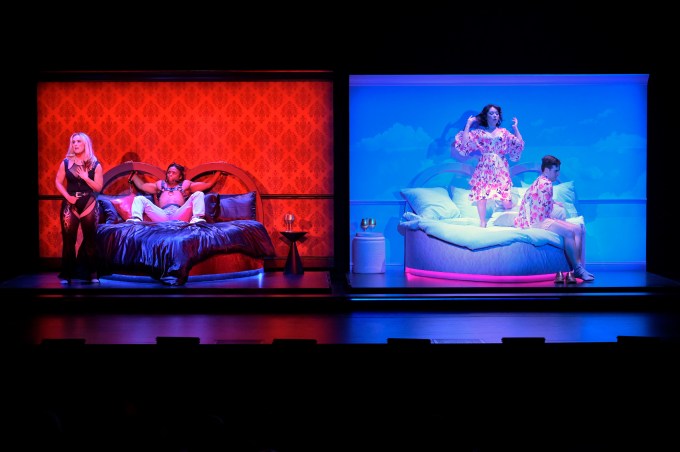
Pam MacKinnon directs, and the production values are as strong as the acting and singing.  Jason Ardizzone-West’s clean scenic design effectively uses partitions that close into square apertures, emphasizing the connection with filming.  Russell H. Champa’s lighting, Jessica Paz’s sound, and Sarita Fellows’s costumes combine to complete the effective staging.                                                                                                                                                                                                                                                                                                             Nobody Loves You, with book & lyrics by Itamar Moses and music & lyrics by Gaby Alter, is produced by American Conservatory Theater and plays at Toni Rembi Theater, 415 Geary Street, San Francisco, CA through March 30, 2025.

Fly by Night

Miriam (Markaila Dyson), Mr. McClam (Lawrence-Michael C. Arias), Narrator (Cathleen Riddley), Harold McClam (Chava Suarez), Daphne (Kaylee Miltersen). All photos by Tracy Martin except as noted.

The pull of stardom, of the bright lights of Broadway extends to every dusty trail and dank bayou in this country.  In Fly by Night, Daphne, who lives in small-town South Dakota, announces to her mother that she is headed for the Great White Way and would like to take the family’s seafoam green Chrysler along with her.  Her mother agrees on one condition – that older sister Miriam accompany her.  The year is 1964.

Fly by Night earned generally favorable reviews in its Off Broadway run at the distinguished Playwrights Horizons in 2015.  The musical offers catchy pop music throughout along with relatable characters in a nostalgic context.  Hillbarn Theatre offers a touching rendering of this story of hope, love, and loss, led by a bubbly and excitable Kaylee Miltersen as Daphne and a more grounded but also sparkling Markaila Dyson as Miriam.

Harold (Chava Suarez), Crabble (Sarah Jebian).

Stars, both literal and figurative, as celestial objects, as people, and as quests, loom large in the story with even the title suggesting them.  Miriam, who loves astronomy, counts them in South Dakota and then in New York City (any guess about the difference?), and shares her love for them in her touching signature song “I Trust in Stars.”  With the bright light extinguished and polluted air repressed by the blackout important to the play’s narrative, even New Yorkers got to star gaze for once as they gathered outside their homes.

While people clearly have agency to make decisions that affect their lives such as leaving home for greener pastures, Fly by Night emphasizes that what may appear to be small decisions can have outsized consequences and that random events often shape the arc of life.  One element of randomness is who we meet and establish relationships with.

Daphne (Kaylee Miltersen), Narrator (Cathleen Riddley), Miriam (Markaila Dyson), Joey (Matt Herrero), (face covered) Crabble (Sarah Jebian).

In her song “Daphne Dreams,” she tells about how she is destined to be a star, yet for months in New York, she sells coats and shoes.  She ultimately meets an aspiring playwright Joey (Matt Herrero), who strives for perfection in his script, and a naval gazing sandwich maker slash aspiring songwriter Harold (Chava Suarez) who will become her love interest.

Harold almost never gets past writing an opening bass riff in his maiden song, but what results is the highly listenable “Circles in the Sand.”  Oddly, it’s about sea turtles hatching on a beach in Florida who move toward the lights on a new highway rather than toward the ocean, and he questions whether he’s also going to the wrong horizon.  Meanwhile, Miriam will also become involved with Daphne’s new acquaintances and will find a job like the one she loved back home, waitressing in a diner.  The action largely centers on the interplay of these characters.

Daphne (Kaylee Miltersen), Harold (Chava Suarez).

Another thread in the plot depicts the broken relationship of Harold with his father, Mr. McClam (Lawrence Michael C. Arias), precipitated by the death of Mrs. McClam at the beginning of the show’s timeline.  Mr. McClam is despondent throughout except when he reminisces with the quirky and clever song “Cecily Smith,” an important observation about relationships.

The song tells about how Mr. McClam randomly meets the eponymous young woman who will become his wife.  When she tells him how lucky he is that she has two tickets to La Traviata, he says that he hates opera, to which she replies with several insightful variations of, “It’s not what you do, but who you do it with.”   La Traviata will become Mr. McClam’s touchstone.

Daphne (Kaylee Miltersen) and Joey (Matt Herrero). Photo by Mark Kitaoka.

Two related devices elucidate and propel the story.  A very active, all-knowing narrator frames the story as it progresses while playing minor characters as well.  In addition, a shrewd plot device that recurs is effective use of non-linear time.  The reason that time warps don’t cause confusion is that the narrator-introduced flashbacks return to previously revealed events and give their backstories or otherwise amplify them.  In the person of Cathleen Riddley, whose acting and singing are admirable, the narrator is a dramatic contributor.  However, Riddley did fumble enough lines to be somewhat of a distraction.

The promotion of Fly by Night highlights the motive force of the Northeast Blackout of 1965 (a real event in which my wife and editor was trapped for a time in a New York City subway).  Though the blackout does influence the characters and the surprise ending, it occurs at the end of the play’s timeline, after most consequences have already occurred.

Cara Phipps directs with a sure hand, using the space of the whole theater to energize the action.  Sarah Phykitt’s spare staging says just enough and allows the focus to remain on the actors, while Pamila Gray’s generally low lighting creates a dramatic atmosphere that complements the set. Together with the script and the acting, the result is a worthy theatrical experience.

Mr. McClam (Lawrence-Michael C. Arias).

A criticism that many will have is the length of the musical, with a clock time of nearly three hours including intermission.  Scenes throughout could be trimmed or removed or any of three minor characters could be eliminated and written around.  This in no way is a criticism of the performances of the roles as all were well portrayed.  I particularly liked the Brooklyn authenticity of Sarah Jebian as Crabble, Harold’s boss in the sandwich shop, despite the part being written for a man. 

Fly by Night, conceived by Kim Rosenstock and written by Will Connolly, Michael Mitnick, and Kim Rosenstock, is produced by Hillbarn Theatre and plays on its stage at 1285 East Hillsdale Blvd., Foster City, CA through March 23, 2025.

Happy Pleasant Valley: A Senior Sex Scandal Murder Mystery Musical

Miller Libertore as cameraperson Dean, Sophie Oda as Jade, Emily Kuroda as June. All photos by Kevin Berne.

“Self Made Jade” is a vibrant young woman and successful influencer with a vlog having over 100,000 followers.  From a fractured background, Jade’s father abandoned the family when she was born; her testy relationship with her mother is unfulfilling; and she is estranged from her halmoni – that is the Korean word for grandmother.  But as an opportunist drastically in need of an opportunity, she decides to ingratiate herself with her halmoni, June.

When Jade reconnects with June it is at her home in an assisted living facility.  Unaccustomed to the diversity of the elderly and perceiving family elders as neutered caricatures, she is shocked to find that her grandmother not only swears like a sailor but has sexual appetites like one as well!  And she’s not the only elder pervert around! 

Jacqueline de Muro, Lucinda Hitchcock Cone, Danny Scheie, Cindy Goldfield as residents.

The problem, however, is that June has had two men die in her bed.  She’s suspected of murder and has been ordered to leave the living facility.  Jade had planned to produce a documentary that presents her as a Florence Nightingale helping the elderly, but getting her halmoni out of this fix is not exactly what she had in mind.

Although a little old for the role, the stage can be forgiving over fine details, and Sophie Oda evidences Jade’s verve and drive for high performance.  Along with fine acting, her role is the only one that really demands a quality singer, and she brings the goods, from wailing rock songs to the very touching like “Can I Make a Change of Heart?”

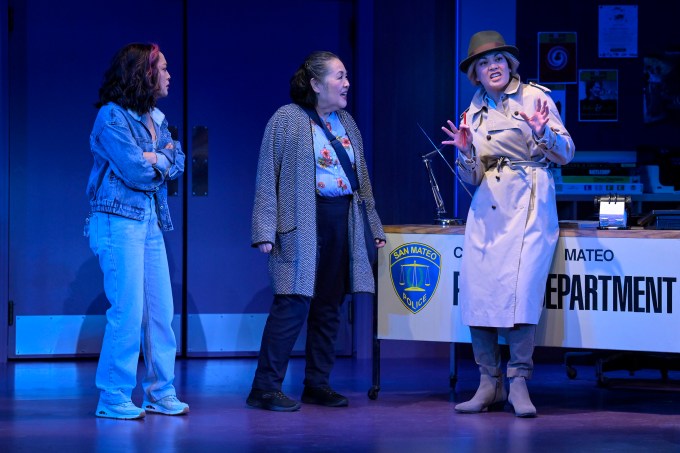
Rinabeth Apostol as Residence Manager Cara, Emily Kuroda as June.

Emily Kuroda portrays halmoni June with total authenticity.  She brings tremendous energy to the role with highly animated herky-jerky movement and complex emotions and behaviors in dealing with a granddaughter that she doesn’t really know.  Kuroda gets to show a lot of dimensionality including June’s fascination with detective work, particularly Murder, She Wrote and Sherlock Holmes stories.

Author Min Kahng shows keen understanding of the elderly and seems to represent the interplay among females with great insight (note: this is judged from the perspective of another male).  Importantly, he differentiates characters to reflect the diversity within the elder community.  There is the woman who presents herself with a grandeur that she never lived; the woman who is lonely and finds solace in communing with and anthropomorphizing squirrels; the man who fancies himself as a virile, irresistible Don Juan; and the man from an open marriage who has come to openly assert a different sexuality.

Lucinda Hitchcock Cone, Michael Patrick Gaffney, Jacqueline de Muro, Danny Scheie, Cindy Goldfield as residents.

A group of Bay Area stalwarts play the other residents in the facility (see photos).  Their acting is superb, and while the singing is a little uneven, who cares?  They’re old people (I can say that as I’m older than they are). Particular recognition goes to Rinabeth Apostol who plays three very different small roles with panache and Miller Liberatore as Jade’s malleable sidekick Dean.

Musical theater triple-threat as composer, lyricist, and book writer, Min Kahng has turned out several works produced for children’s theaters, and this is his third Bay Area premiere for general audiences, following Four Immigrants (TheatreWorks Silicon Valley) and The Song of the Nightingale (Altarena).  Happy Pleasant Valley: A Senior Sex Scandal Murder Mystery Musical brims with melodious pop songs, playful comedy, and clever crime-solving that revisits through video replay the clues that most in the audience probably missed.

Sophie Oda as Jade, Emily Kuroda as June.

The play maintains pace and entertains throughout, but the narrative could be reined in a bit, as it runs long.  One of the challenges that Kahng does overcome is integrating humor and situations that speak to both older and younger generations of theater goers.  The situations must also be age-appropriate for the characters in the play.  One illustration involves June asking Jade and her cameraperson Dean if they know of Angela Lansbury.  After naming several famous Lansbury shows that June’s generation would know (including Murder, She Wrote), the one that finally rings the bell with the younger pair and brings laughter from the audience is Beauty and the Beast, which Jade and Dean would have known as children.

Much of the thematic interest concerns intergenerational family issues, not just preferences and practices, but lies and omissions often intended to protect others in the family but are sometimes self-serving.   Despite serious overtones and deaths, this is a musical comedy that produces laughs throughout.  And as a caution, to appreciate the work, you have to like silly, which the opening night audience clearly did.

Sophie Oda as Jade, Emily Kuroda as June, Rinabeth Apostol as Detective Brown.

Noteworthy is Director Jeffrey Lo’s staging of the musical.  Arnel Sancianco’s scenic design is clean and versatile, framed by Lighting Designer Kurt Landisman’s neon stripes.  Substantial projections and video by Tasi Alabastro enhance the look while providing valuable information.

Happy Pleasant Valley: A Senior Sex Scandal Murder Mystery Musical with music, lyrics, and book by Min Kahng, is a world premiere produced by TheatreWorks Silicon Valley and plays at Lucie Stern Theatre, 1305 Middlefield Road, Palo Alto, CA through March 30, 2025.

The Pigeon Keeper

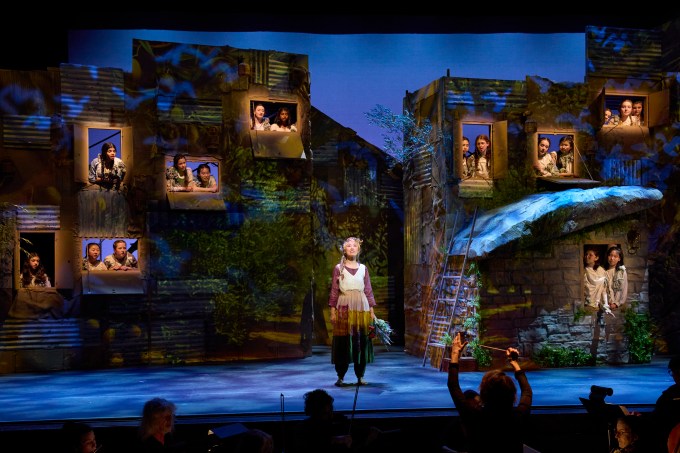
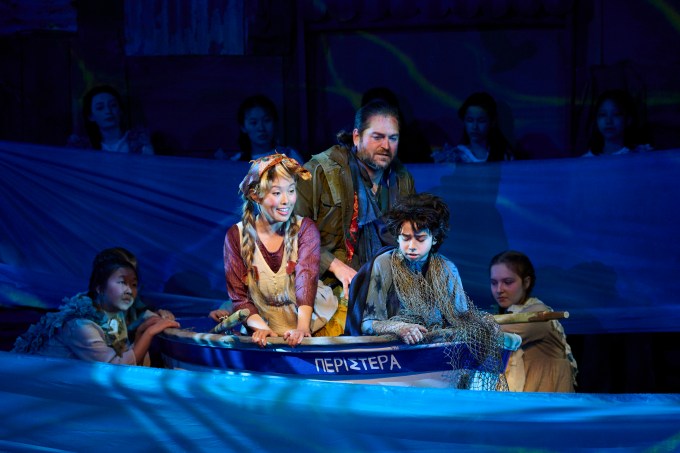
Angela Yam as Orsia, San Francisco Girls Chorus. All photos by Stefan Cohen.

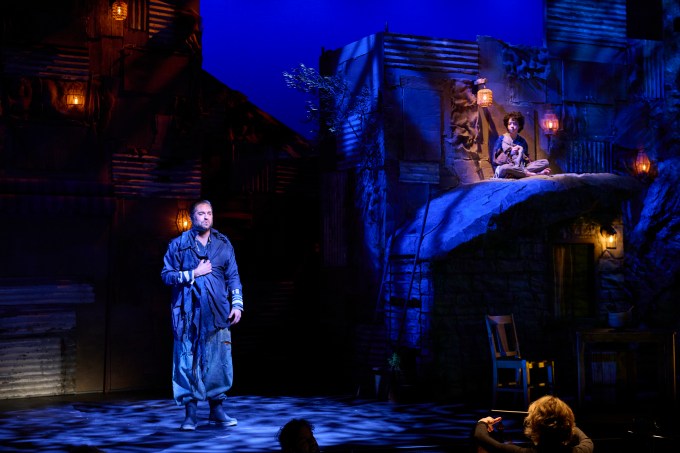
A poor Mediterranean island suffers drought and a scarcity of fish.  Subsistence fisherman Thalasso and his 12-year-old daughter Orsia suffer a hapless day without a catch, but they do reel in a young boy of a different ethnic group who does not speak their language.

So begins the action of the world premiere of The Pigeon Keeper, composed by David Hanlon with libretto by Stephanie Fleischmann, originally a commission by Santa Fe Opera.  Stipulations came with this grant for a chamber opera – that it be written to reach the broadest of audiences and that it require no more than four principal singers.

Angela Yam as Orsia, Craig Irvin as Thalasso, Shayla Sauvie as the boy.

The artistic creators accomplish the task with a wonderfully appealing under-90-minute musical work of magical realism that depicts joy and pathos in an emotionally touching piece with great relevance to our time.  Opera Parallèle’s production could not be more fitting and effective with superb singing and musical support by the Nicole Paiement conducted eight-musician orchestra as well as Brian Staufenbiel’s clever and appealing creative design.

Orsia, the key role, is portrayed brilliantly by Angela Yam, conveying the compassion of the character with bright, clear, and accurate vocalization.  She also looks and acts the part with great conviction.  As the young girl, she wants to keep the mystery boy at least long enough to find him a home but meets with great resistance from her father.  The story focuses on this quest.  Her widowed father, Thalasso, is played with grim countenance by purposeful Craig Irvin whose commanding, barrel-chested baritone voice thunders with resonance and authority, notably in his “We get by” aria.

Shayla Sauvie as the boy, Bernard Holcomb as the pigeon keeper.

Since Thalasso and Orsia must scavenge for drought-resistant greens to produce a paltry meal, we understand the father’s wherewithal concerns.  However, he says of the boy “He’s not one of us.”  The pigeon keeper, who Thalasso won’t allow Orsia to talk to, is also an immigrant.  Thalasso’s reiteration of his bias and the unwillingness of village folk to help out suggest deep-seated bigotry that is not only relevant today but which underscores many governmental and institutional acts in this country taken under other guises. 

Discrimination constitutes the central thematic issue, particularly in the context of immigration and treatment of minorities.  It also covers positive and neutral ground such as love, family, acceptance, rebirth, community, language as a barrier to communication, what needs to happen for humanity to overcome bias, and more.

Craig Irvin as Thalasso, Shayla Sauvie as the boy.

The opera’s authors are able to meet the restriction on the number of principals by writing three roles in the same voice type.  The answer is gregarious actor, the vocally versatile and mellifluous tenor Bernard Holcomb, who fills the bill by portraying both genders as the pigeon keeper, the widow grocer, and the shopkeeper.  The final star in the show is the San Francisco Girls Chorus who sing large as a Greek chorus; a consort imitating bird sounds; and a clapping and singing ensemble à la a ‘60s girl group like The Angels singing “My Boyfriend’s Back.”

Hanlon’s eclectic music which defies categorization takes advantage of the casting and is melodious for a modern score.  The small orchestra fits the intimacy of the narrative.  Delicate solos and pizzicato add appeal to the musical effect.  What is surprisingly effective are the poignant pauses, which quiet the audience and intensify the already considerable emotion and drama.  The music and libretto make great use of the girls’ chorus as does the staging.  While they occasionally move about the stage representing various groups or forces, most appearances are behind Jacquelyn Scott’s deceptively simple but stunning set.  Two building facades with around a dozen shuttered windows comprise the fixed set, and the girls sing mostly from the windows. Striking lighting & projection design by Jessica Drayton and equally attractive costume, hair, & makeup design by Y. Sharon Peng fill out the beautiful look of the staging.

Angela Yam as Orsia, Shayla Sauvie as the boy, Bernard Holcomb as the pigeon keeper.

Though Fleischmann’s libretto is direct, concise, and moving, minor questions about the work relate to the narrative.  One could argue that the plotline is too simple, even though so many moral issues are implied.  The counter is that the trim plot makes it more accessible to school-aged audience members, and it is in keeping with the idiom of fables that tell simple moral stories with very few characters.  Also, some viewers may be confused by the beginning.  Without introduction, a character, whom we much later learn is the pigeon keeper, sings in a foreign tongue with no translation.  Is it a foreigner, a bird, or something or someone else?  Finally, the title is a bit of a misnomer.  While the pigeon keeper is vitally connected to the plot, he is a minor character.

Artistic Director & Conductor Nicole Paiement, Librettist Stephanie Fleischmann, Creative & Stage Director Brian Staufenbiel, Composer David Hanlon.

The Pigeon Keeper, a world premiere composed by David Hanlon with libretto by Stephanie Fleischmann, was commissioned by Santa Fe Opera with co-commissions by Opera Parallèle and Opera Omaha, is produced by Opera Parallèle and plays at Cowell Theatre, Fort Mason, 2 Marina Blvd., San Francisco, CA through March 9, 2025.

Don Giovanni

David Walton as Don Ottavio, Meryl Dominguez as Donna Anna, Cara Gabrielson as Donna Elvira, Titus Muzi III as Don Giovanni. All photos by Barbara Mallon.

Without doubt, the genius Wolfgang Amadeus Mozart’s most fertile harvest from operatic ground came from 1785 to 1790 with the three-opera sequence of Le Nozze di Figaro, Don Giovanni, and Cosi fan Tutte.  Livermore Valley Opera offers the inestimable Don Giovanni, the most regaled serio-comic fantasy in the opera canon.  A cast of outstanding singers give the extraordinary work a rich and rewarding treatment.

The common thread among this trio of operas is that each libretto was written by the magnificent Lorenzo da Ponte.  Don Giovanni is a reworking of the Don Juan myth, but perhaps the fine mosaic integration of incidents with three of the title character’s lovers comes from experience.  Not only was da Ponte close friends with the real-life fellow Venetian, Casanova, who was a legendary lothario, but da Ponte was a debaucher and roué himself.  Some suggest that the opera is a veiled autobiography, and a 2009 Italian film seeks to make that connection.

Joseph Calzada as Masetto, Phoebe Chee as Zerlina.

The overture of Don Giovanni opens with a memorable harsh blast of a chord evincing “a grating noise, a quality of light, a tone…a dream,” (with credit to John Steinbeck’s description of Cannery Row.)  Soon after the action begins, the title character’s indiscretions lead him to a sword fight in which he slays Il Commendatore, father of Donna Anna, whom he has “courted” despite her being betrothed to Don Ottavio.  Hardly the way to start a comedy.

Ensuing are also the stories of Donna Elvira and the peasant Zerlina, both entrapped by Giovanni.  Throughout, he is assisted by his abused and resentful servant and oft times procurer and fall guy, Leporello.   Scenes near the finale bookend the early death of Il Commendatore, who returns as a phantasmagoric statue, foretelling his vengeance and the doom of Giovanni.

Among the unusual features of Don Giovanni is that the two lead males both sing in lower voice types.  While Giovanni is a baritone and Leporello a bass, their ranges are similar enough that occasionally two singers in a production will take turns performing the roles.  In this version, however, the two leads offer as distinctive a contrast in both voice and look as Don Quixote and Sancho Panza.

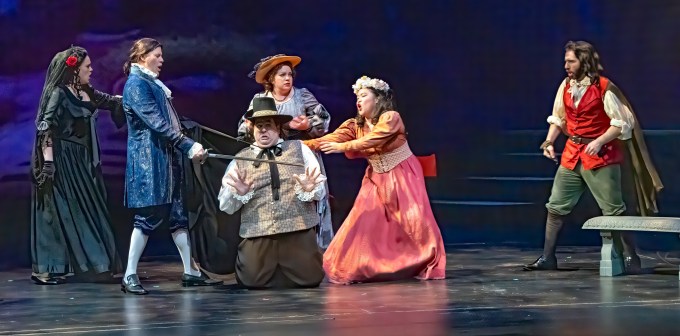
Meryl Dominguez as Donna Anna, David Walton as Don Ottavio, Samuel Weiser as Leporello, Cara Gabrielson as Donna Elvira, Phoebe Chee as Zerlina, Joseph Calzada as Masetto.

Titus Muzi III carries aristocratic bearing as Giovanni.  Notwithstanding, his dignity is frequently compromised, trying to cover his footsteps as a result of his indiscretions and even taking on the guise of his servant to avoid threats on his life.  Muzi proves good as an actor as well as singer.  His voice is crisp, smooth, and certain with sonorous resonance.

Samuel Weiser is Leporello, whose rounder, chestier sound with darker timbre fits his role well, and his comic appearance facilitates his many humorous quips.  Yet Weiser’s voice is agile, and he acquits himself well on his signature aria “Il catalogo,” which humorously enumerates the number of Giovanni’s sexual conquests by number per country.

The opera demands three sopranos as Giovanni’s victims, and LVO’s production offers three with suitably varied skills.  Meryl Dominguez wows as Donna Anna, and befitting one whose father has just been murdered, she excels in her upper register with a quivering tragic wail and later with reflective mournful coloration.  Cara Gabrielson portrays Donna Elvira, and she, too thrills in her upper range with a strong vibrato having a clear, penetrating quality.  Phoebe Chee’s role as Zerlina is somewhat smaller, but unlike the other sopranos who are not as strong in their lower range, Chee is very consistent and strong in her mid and lower range, which is demanded by her part.  She also sings beautifully in the most famous music from the opera, “La ci darem la mano,” Zerlina’s lovely duet with Giovanni.

Titus Muzi III as Don Giovanni, Samuel Weiser as Leporello.

Filling out the cast are LVO favorite, bass Kirk Eichelberger, as Il Commendatore, a brief but significant and well-sung role in the bookend doom scenes.  The others are clarion tenor David Walton as Don Ottavio and fine bass-baritone Joseph Calzada as Masetto, Zerlina’s hot blooded fiancé.

The music, of course, is Mozart, so it’s got to be good.  He particularly gives the two Donnas the opportunity to soar and embellish in charming arias.  And a solemn and heavenly trio “Protegga, il giusto cielo” among Donna Elvira, Donna Anna, and her betrothed, Don Ottavio, provides especially beautiful harmonies.   Nonetheless, it seems that Mozart himself realized that his music in this opera largely lacked memorability.  In the penultimate scene, Giovanni notes tongue in cheek, “you probably know this tune,” following which is sung a sampling of the well-known “Non più andrai” from Le Nozze di Figaro.

Cast.

In addition to fine singing, Alexander Katsman’s orchestra provides sound support to the vocal score, but it is a bit disadvantaged in the overture because of its limited size.  The costumery, lighting, and movement add to the attractiveness of the staging.  And the doom scene near the end is dramatic.

One area that lacks sparkle through much of the opera is the scenery, despite the imposing physical cornerpieces of the set which are caddywhompus, appropriately suggesting instability.  The stage’s back wall projections often feel static and images appear as distant objects (the imposing ballroom and Giovanni’s doom scenes excepted), creating the sense of a concert performance in front of a mural rather than action closely enveloped by its environs.  Also, while the scenes with the Commendatore lend themselves to menacing atmospherics such as stage fog, colored lighting, or dark costumery to enhance the ghoulishness, the presentation is tame.

Kirk Eichelberger as Il Commendatore, Titus Muzi III as Don Giovanni.

As a footnote, librettist Lorenzo da Ponte later fled Europe, morally scandalized and financially bankrupt.  He settled in the United States, becoming a citizen and engendering many firsts. He was Columbia University’s first instructor of Italian literature and opened the first U.S. eatery with Jewish-deli styled food!  He introduced opera performance to this country and later built its first dedicated opera house.  The debut opera performed in the United States, presumably selected by da Ponte himself, was……Don Giovanni.

Don Giovanni, composed by Wolfgang Amadeus Mozart with libretto by Lorenzo da Ponte, is produced by Livermore Valley Opera and plays at Bankhead Theater, 2400 First Street, Livermore, CA through March 9, 2025.