Writing Fragments Home

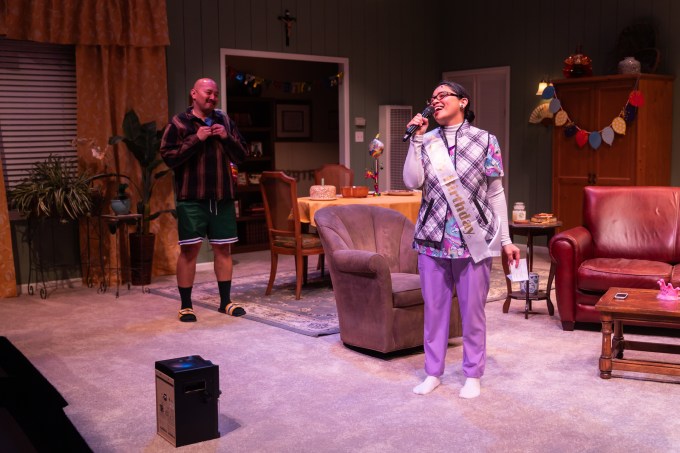
Jay (Jomar Tagatac) and Mary Gwen (Jen Cuevas). Photos by Mark Kitaoka except as noted.

Recent generations have witnessed the fragmentation of the traditional nuclear family, with perhaps the most common variation being the boomerang, in which adult children return home, often when the parents had adjusted to being empty nesters. Jeffery Lo’s world premier offers a partial-semi-not-totally autobiographical peek into that world with a play that is screamingly funny, sadly sad, and very interesting in its structure. If this review is shorter than my typical, note that I accepted press tickets from Hillbarn Theatre with the agreement that I wouldn’t review because of many prior commitments. And though this review is delayed because of travel, sometimes you just want to share something even when there is no obligation.

Portrayed by the always effective Jomar Tagatac, Jay is a 40-year-old, longtime wannabe playwright who is dumped by his girlfriend and leaves his unrewarding job in a rage. What to do in that situation when the financial wolf is at the door? Pack your bags and head for home – your childhood home.
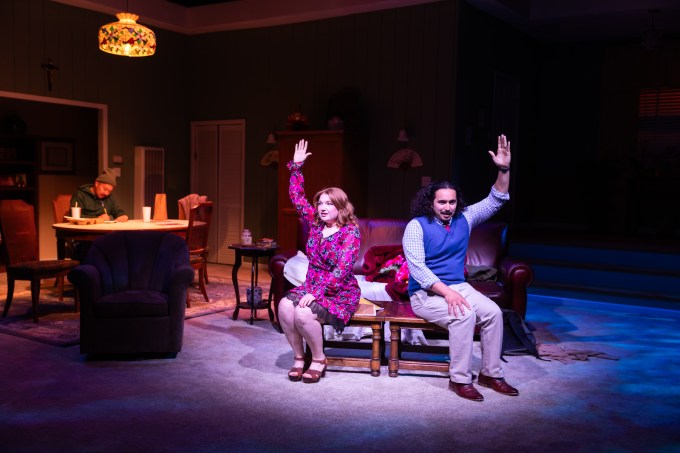
Jay (Jomar Tagatac), Actress (Brigitte Losey) and Actor (Jamiel St. Rose).

Jay is Philippine-American and an only child whose father died when he was a youth. While his mother, Mary Gwen, loves him, she has been very disappointed that he hasn’t pursued a stable career, particularly in nursing like her, which is a major point of friction. And as sloppy as Jay is, his mother is correspondingly neat. A common flash point in boomerang arrangements like this is that the child has been independent for years and used to making decisions, but the parent may want the child to abide by the parent’s rules as a price for returning to the nest.

Mary Gwen is so insistent that Jay not become comfortable with this return engagement that she won’t allow him to use his old bedroom, but rather requires that he sleep on the living room couch. Jen Cuevas is remarkable as the determined Mary Gwen, with exquisite comic timing as she cajoles and badgers Jay with tough love. Even when Jay tries to make good, like by cooking pancit, Philippine noodles, for dinner, the two share a laugh when she asks that he not cook it again.
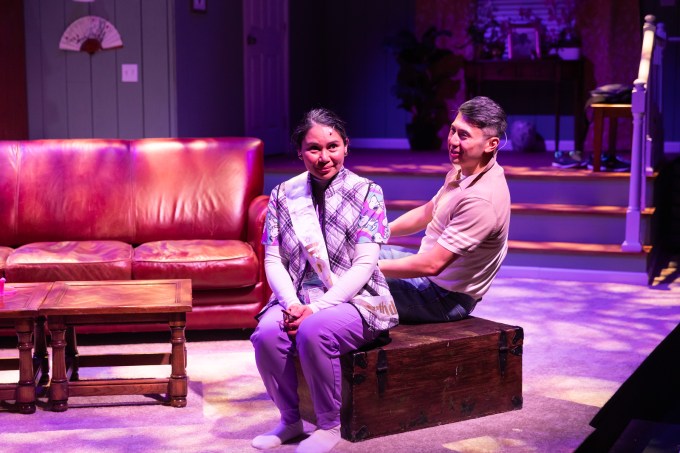
Mary Gwen (Jen Cuevas) and Ronaldo (Jepoy Ramos).

But the play’s special spirit derives when Jay’s new writing results in two actors materializing from the ether, playing out his thoughts. But unlike private dreams, Mary Gwen can also see the actors and realize how hackneyed Jay’s ideas are, like representing a couple fulfilling each other by having them place opposing arms up together. Brigitte Losey and Jamiel St. John as the actors are as funny as a gaggle of goofy ghosts on laughing gas. And add to the ethereal mix Jay’s deceased father, Ronaldo, played by an always smiling and empathetic Jepoy Ramos, who offers guidance to the anchorless Jay.

The dynamics of a parent-child relationship like this, even when the latter is an adult, will resonate with most of us. A parent often has goals for a child that the offspring doesn’t share. The parent’s disappointment then can irritate the child who seeks agency. Conversely, a child is often oblivious or dismissive of the sacrifices the parent makes in offering better opportunities for the youth. In fact, Jay’s parents had come to the U.S. to offer a better life for him. Yet, to manage his cognitive dissonance, Jay embraces the idea that they left the Philippines because it was not good for them, which wasn’t the case. The playwright’s situations and characterizations are highly relatable and will have many audience members laughing and crying alternately.
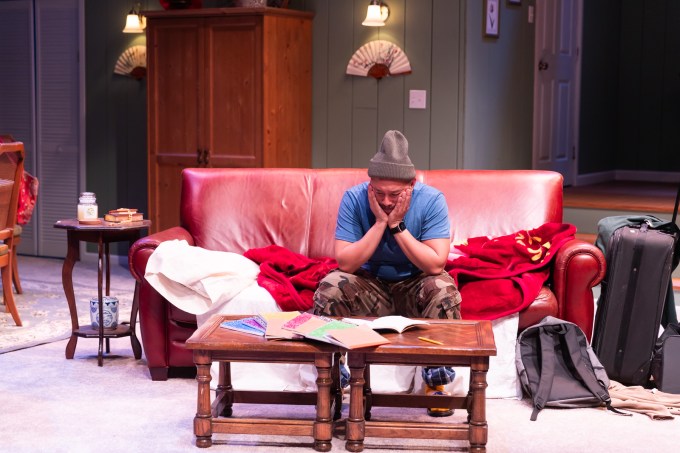
Jay (Jomar Tagatac).

Director Reed Flores extracts crackling humor from the cast. Meanwhile, the production values soar, highlighted by Christopher Fitzer’s scenic design and Pamila Gray’s lighting. Playwright Jeffrey Lo is a local product with many notable directorial accomplishments. It would not be unreasonable to have serious reservations about the worth of a locally produced play written by a hometown hero, but in this case, no apologies are necessary. This script gets high marks for an appealing storyline with crackling dialog and fully developed characters, and the production lives up to the quality of the narrative.
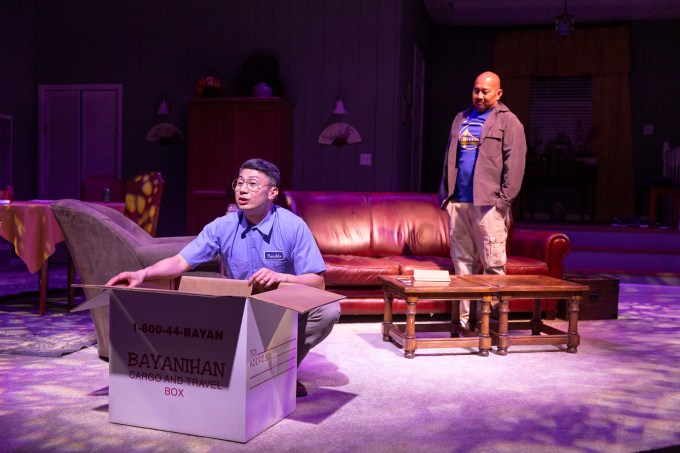
Ronaldo (Jepoy Ramos) and Jay (Jomar Tagatac). Photo by Tracy Martin.

Writing Fragments Home, written by Jeffrey Lo, is a world premiere produced by Hillbarn Theatre, and plays on its stage at 1285 East Hillsdale Blvd., Foster City, CA through May 4, 2025.

Zorro

Cast. All photos by David Allen.

A score of years before the debut of Batman, the Caped Crusader, pulp writer Johnston McCulley introduced the character Zorro.  Like the superhero who followed, Zorro came from privilege; protected those in need; disguised himself with an upper-face mask and headdress; and wore a cape.  He also lived a conventional life outside of his disguise.

A pulp-fiction hero may seem an odd choice as an opera protagonist, but then again, consider some other central figures from operas that take place in Spanish locales – Figaro, a barber, and Carmen, a gypsy cigarette factory worker.  But El Zorro, the fox, offers flair and drama that play fluidly into common operatic tropes.

Xavier Prado as Zorro, Maria Brea as Ana Maria.

Opera San José presents Zorro, and everything about the production is a delight.  The music is a melodic pastiche of Romantic operatic idiom with strokes of mariachi, flamenco, and corrido (folk music).  There is even the recurrence of an ominous two-note death motif from Carmen.  The plot weaves love, selflessness, courage, betrayal, humor, and more among passionate and well-developed characters into a compelling narrative.

Singers and orchestra deliver admirable performances, and the scenic design and costumes create an ambiance to suit the place and time.  Two languages are used in the libretto, which itself is not unusual.  But when done, it is most common in opera that particular characters sing in their origin languages.  In this case, characters switch back and forth within a dialog.  Behind this device is the composer’s desire to use whichever language fits the specific musical phrases best. It should be noted that having a far greater number of open vowel sounds, Spanish is generally more suited to opera vocalizing than English.

Arianna Rodriguez as Luisa, Jesús Vicente Murillo as Sergeant Gomez.

With the opening swordfight scene, you might expect that you’re in for a swashbuckler.  But while there is more well-choreographed swordfighting to come, this is really the origin story for Diego becoming Zorro, with the first famous slashes of the Z coming just before intermission. 

The central social theme that relates to current times concerns discrimination.  Diego’s former best friend, Moncada, is now mayor of Los Angeles in New Spain in the early 1800’s.  He adopts policies to harass mestizos (mixed bloods), including Diego’s love interest, Ana Maria.  Diego’s commitment to fairness and righteousness comes in the gripping “Justice has no color,” which begins as an aria and builds voice by voice to become a stirring quartet.

Lyric tenor Xavier Prado as Diego/Zorro is well suited to the role with a strong singing voice and personable yet assertive acting.  Romantically, Diego loves Ana Maria, who is unrelated to him by blood but raised as his sister.  Soprano Maria Brea’s beautiful tone finds many opportunities to excel, with one of the best examples for her and for Prado being the lovely duet “Abrazame” (“Embrace me”).

Eugene Brancoveanu as Moncada, Melisa Bonetti Luna as Carlota, Xavier Prado as Diego.

Along the way, complicated liaisons evolve.  The always magnificently unforced and resonant baritone Eugene Brancoveanu plays the villain Moncada.  He holds sway over the patrician Doña Carlota as a result of his political power, but she is in love with Diego.  As the conflicted Carlota, mezzo-soprano Melisa Bonetti Luna shows her acting range in her complex relationships and her singing range in her well-sung, low tessitura lament.  And though Carlota’s boorishness makes her an unappealing character at the outset, she evolves into something admirable.

Comic relief comes in the form of the couple Sergeant Gomez, portrayed by bass-baritone Jesús Vicente Murillo, and Luisa, performed by Arianna Rodriguez.  Gomez is Moncada’s bumbling yet grounded gofer who can never do anything right in the eyes of his boss, but the spritely, dreamy Luisa thinks he has the bearing of a general.  Both voices are attractive and true, and Rodriguez conquers the highest tessitura in the score with ease.

Cast.

For composer Héctor Armienta, Zorro represents homecoming in more ways than one.  Raised as an Angeleno, the story plays in the place of his youth.   This production occurs in his artistic home.  A resident of Oakland for two decades, he spawned Opera Cultura, a San Jose proponent of Latino musical arts, which was also a co-commissioner of the opera.

Virtually all aspects of the opera exceed expectation, with the exception of the flamenco.  The sound of the shoes on the floor is too faint to produce any excitement, as is the rhythmic clapping.  The scene feels like a throw-in, which if done, should be done with more flair.  Also, in a couple of instances, singers are inaudible as they face too far away from the center of the audience or are positioned too far upstage.

Eugene Brancoveanu as Moncada, Xavier Prado as Zorro.

Zorro, with music and libretto by Héctor Armienta, is a co-production by Opera San José, Kentucky Opera, and Arizona Opera, and plays at California Theater, 345 South First Street, San Jose, CA through May 4, 2025.

It’s True, It’s True, It’s True

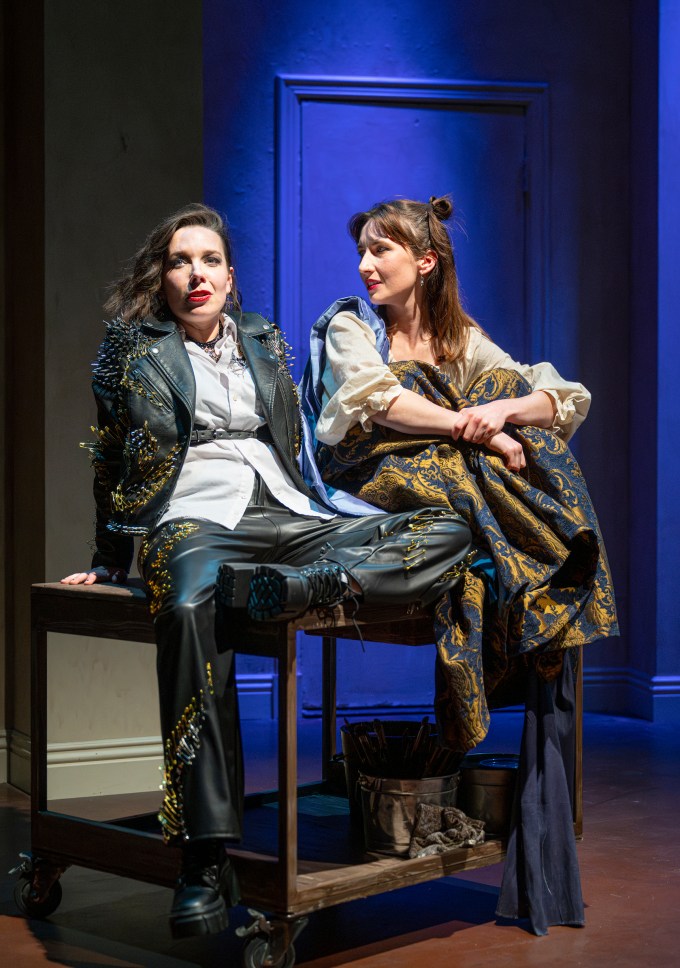
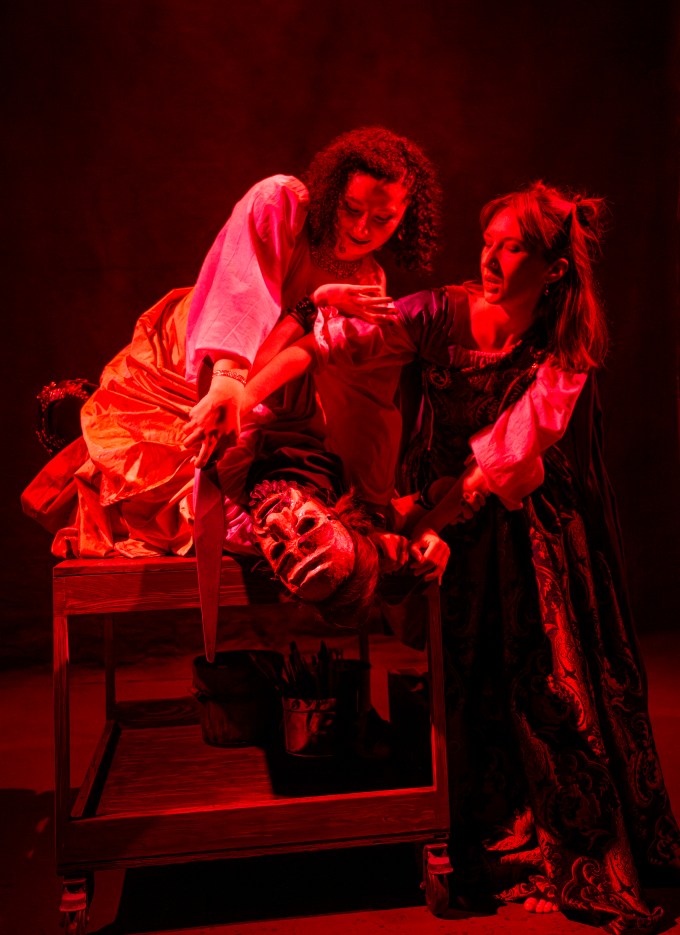
Maggie Mason as Agostino, Emily Anderson as Artemisia. All photos by David Allen.

Plus ça change, plus c’est la même chose.  The more that time marches on, the less knowledgeable about history we become.  Youth today, living in their time bubble, probably feel that the “#Me Too” movement was delivered by virgin birth.  But evolutionary threads exist for virtually any human occurrence.

Marin Theatre offers the energized and rowdy It’s True, It’s True, It’s True, a fascinating look at a seemingly rare and riveting event.  It is the story of Artemisia Gentileschi, a noted Baroque painter, who as a teenager produced masterworks and would become an esteemed court painter and whose works appear at several major museums.  At the age of 15 she was raped by an older male artist, Agostino Tassi in Rome in 1612.  Unusually, Artemisia, a female minor in a heavily patriarchal culture, possessed the determination to have Agostino tried, and the play is fact-based on the transcripts of the court proceedings.  The play provides some backstory, and otherwise, shares direct testimony from the trial and its outcome.

Maggie Mason, Keiko Shimosato Carreiro, Alicia M. P. Nelson, Emily Anderson.

This is a “he-said, she-said” which will evoke memories of moderns like Clarence Thomas/Anita Hill, Donald Trump/E. Jean Carroll, and Brett Kavanaugh/Christine Blasey Ford.  And like these modern cases, the main line of defense was to vilify the accuser by depicting her as a fallen woman or an attention seeker.  In Artemisia’s case, testimony by Agostino’s associates of her many trysts was even found to be false.

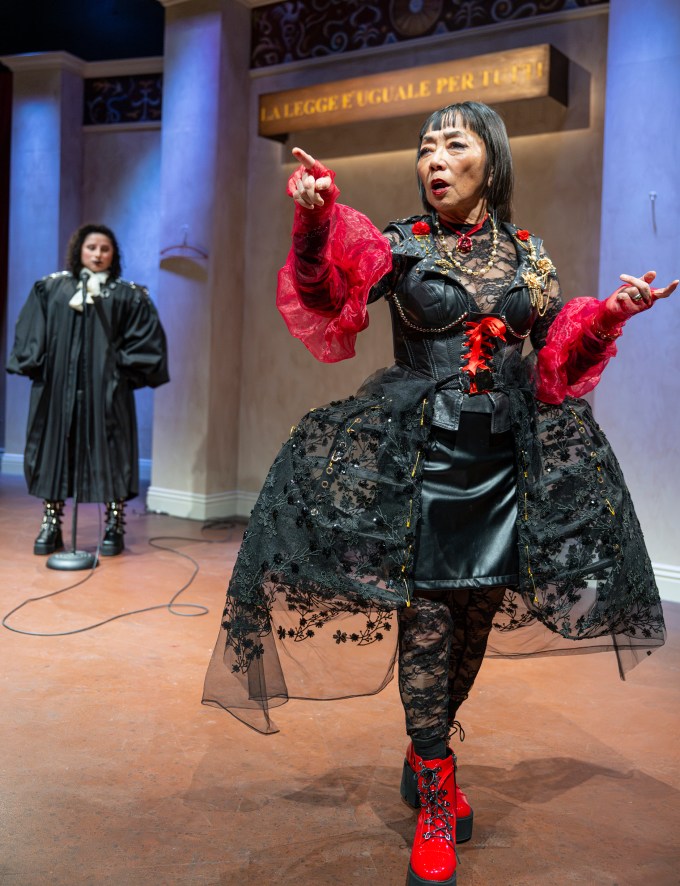
The action of the play is boisterous, replete with explicit language, simulated sex, and partial nudity, driven by a surprising and unusual script delivered by an all-female cast, perhaps in a nod to feminism.  The performances by all four women are absolutely exemplary.  My personal favorite is Maggie Mason displaying the confidence and pride of the devious Agostino who led Artemisia along after the rape, suggesting that they would marry.  Keiko Shimosato Carreiro is also highly animated as Tuzia, a neighbor who became a surrogate mother to Artemisia, watching over her and providing essential support and information at the trial.

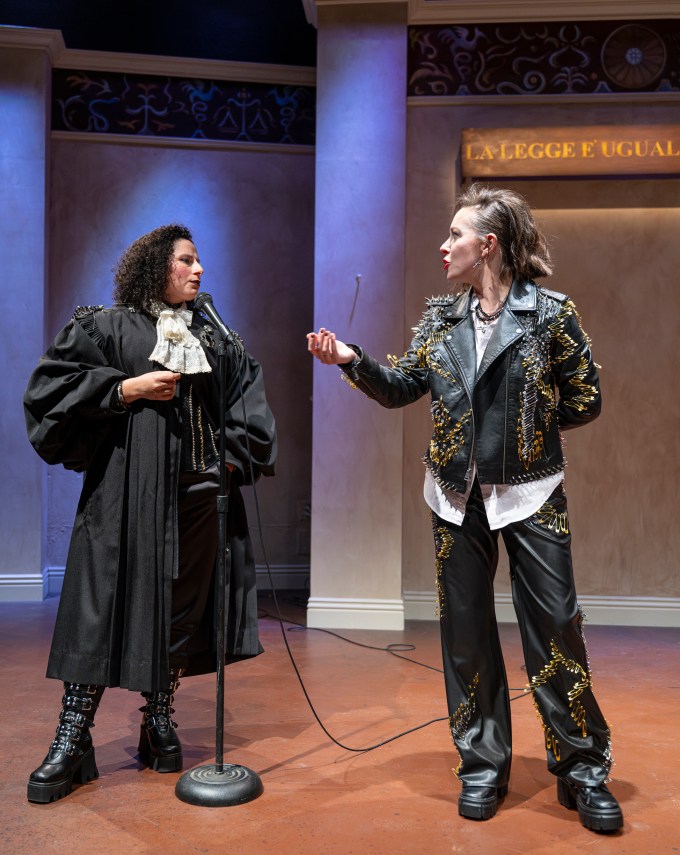
Alicia M. P. Nelson as Judge, Maggie Mason as Agostino.

Alicia M.P. Nelson is the judge, nominally a part with less to do, but with her interventions and wry delivery, she gives the part vitality.  Finally, Emily Anderson portrays Artemisia, a youth in age, restrained in her anger and with conviction to stay the course in the trial.  In a shocking twist, she survives a perverse lie detector test in which she is subjected by the judge to thumbscrews to somehow prove that her testimony is legitimate.

Although the production is small, it is handsome.  Pamela Rodriguez-Montero has created hybrid costumery that spans the centuries.  Matt Stines’ sound design and Marshall’s lighting enhance the overall feel of Mikiko Uesugi’s simple but suitable scenic design for the intimate Lieberman Theatre.  Director Rebecca Wear integrates all of the pieces and drives the pace to create a gripping sense of urgency.

The Elders from Book of Daniel in the Biblical Septuagint.

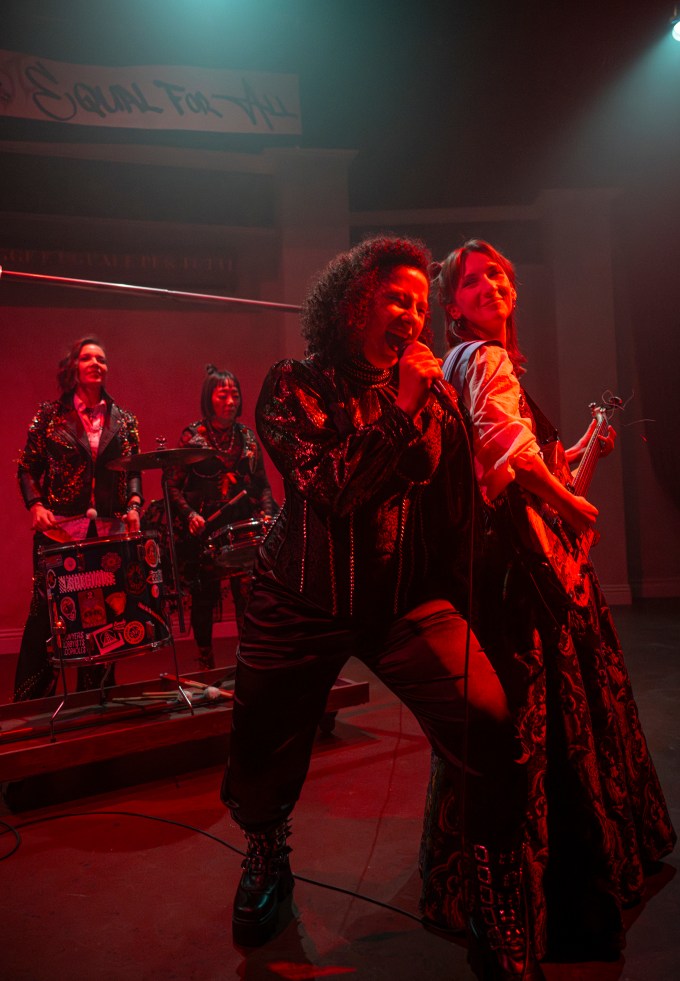
The play’s structure is somewhat eccentric in that the narrative is punctuated several times by musical performances from the four actors.  It feels strange to experience them doing punk songs, with the ingénue-looking Anderson propelling a gritty-sounding guitar like a buzzsaw while others beat on percussion.  The music is fun, but it’s hard to catch enough of the lyrics to know if they contribute to the story line.  You might wonder why these interludes.  Perhaps they make a symbolic link across the 400 years, supporting the notion that today is not so different from yesterday.

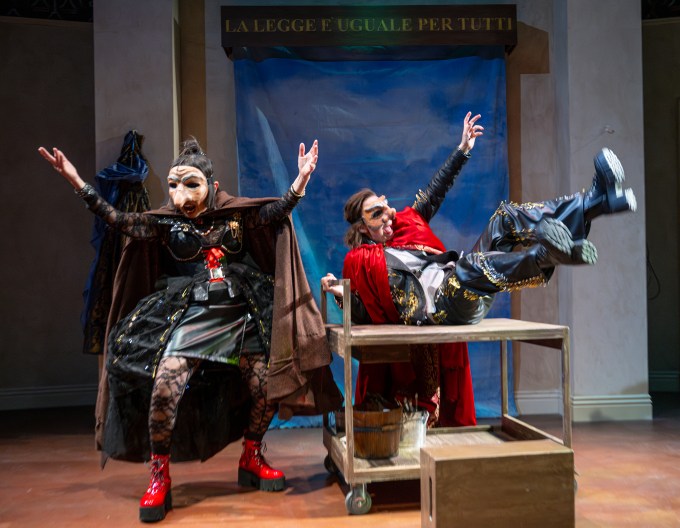
There is also a play within a play, the Biblical story of Susanna and the Elders.  It relates to the main narrative on multiple levels.  In 1610, Artemisia actually depicted the sexual attack by the elders in a painting.  Unlike other paintings by males on this theme, she shows Susannah to be distressed and rejecting the attention.  The selection of the subject may have represented advances that she suffered from men before the rape occurred.

Alicia M. P. Nelson as Judge, Keiko Shimosato Carreiro as Tuzia.

There are other presences and absences that one may wish were a little different.  If you think the words “it’s true” in the title are repeated more than necessary, wait until you hear Artemisia repeat the words tens of times with varying emphasis.  What’s missing is projections of Artemisia’s paintings, which would add credibility to her claimed reputation as an artist.  Finally, some playwrights expect the audience to pick up on character names and shifts in how characters are identified the first time they are mentioned. Some audience members were left in the lurch because multiple, long Italian names were introduced too quickly.

That said, despite its brief 75 minutes including musical diversions, It’s True, It’s True, It’s True covers considerable ground concerning justice and women’s rights, process, history, art, and more.  Those with appropriate interests will find the play highly interesting and rewarding.

Alicia M. P. Nelson, Emily Anderson as Judith from Book of Judith in the Biblical Septuagint.

It’s True, It’s True, It’s True written by Billy Barrett and Ellice Stevens, is produced by Marin Theatre and plays on its stage at 397 Miller Ave., Mill Valley, CA through May 4, 2025.
Here There Are Blueberries

Cast. All photos by Kevin Parry Photography.

History plays a compelling role in the self-perception of societies.  Yet, as important as history is, it is commonly forgotten or distorted.  People routinely develop amnesia for important aspects of events as recent as the pandemic or administrations of recent presidents.  The history upon which countries develop their self-worth is often distorted, twisting even favorable facts and suppressing those that don’t conform to the myth.

Another element of how history emerges pertains to its granularity.  In the presence of free and active press, major public events that shape our broader understanding are typically revealed in real time.  But later, research often unearths new facts through examination of personal and micro-events, that if accepted into the common wisdom, shades and sometimes radically shifts our view of the past.

Delia Cunningham.

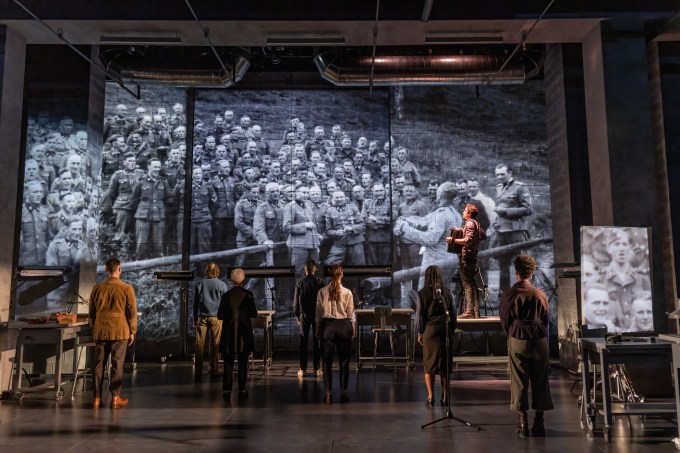
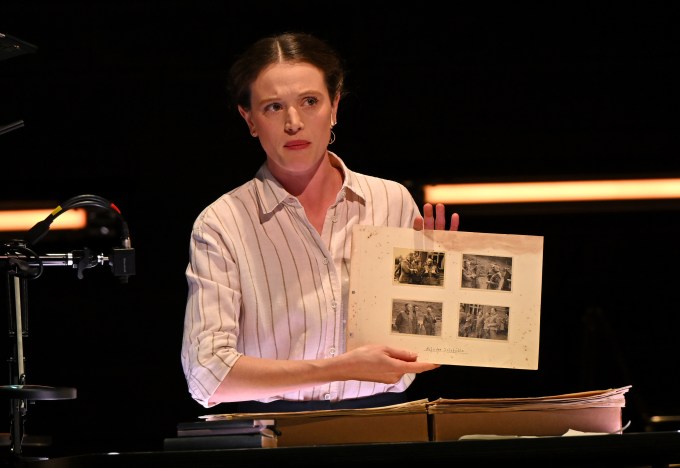
At the center of Here There Are Blueberries, the US Holocaust Memorial Museum received a photo album in 2007 that a U.S. Army officer had found in Germany in 1946, purported to be of the Auschwitz concentration camp.  This find was unique in two ways.  Despite Auschwitz having been the largest facility for murder that the world has ever known, its activities were carefully secreted.  Except for an album picturing victim/prisoners found by survivor Lili Jacob and released in 1980, no known pictures from Auschwitz were known to exist.  Further, this newly-donated album depicted the lives of the camp’s Nazi administrators.  Not a single image of a victim appears.

Indeed, this choreographed look into the lives of those who became cogs in the killing machine almost didn’t become known history.  Why?  The Holocaust Museum’s mission is to honor the victims of the Nazi horror, and perceived neutral or favorable depiction of the perpetrators could be used to glorify them.  Only through the persistence of staff archivist Rebecca Erbelding, portrayed in the ensemble cast by Delia Cunningham, did the album see the light of day.

Scott Barrow, Barbara Pitts, Luke Forbes, Delia Cunningham, Nemuna Ceesay.

This Tectonic Theater Project (New York City) production presented by Berkeley Rep was conceived, directed, and written by Moisés Kaufman with co-author Amanda Gronich.  The work falls into the unusual category of stage documentary.  Eschewing dramatic conventions that could evoke great emotion, it does not produce the weeping responses that could be expected given the topic.  But it does hew to the facts, resulting in a provocative and rewarding piece that examines the inner thinking of the perpetrators and provides a chilling lesson for our time.  The further we move from the actual history, the more important and compelling are reminders such as this.

We witness arguments among Museum administrators and researchers as well as interviews with descendants of perpetrators.  As it unfolds, we see the methodologies of historical research used to solve puzzles.  Images and individuals are triangulated with other documents.  Interviews corroborate facts, yield new directions, and provide additional contacts to expand the investigation.  The play’s dramatic stiffness derives from dialog and soliloquy that are largely expository, yet, this is where its documentary character shines and gives it authenticity.

Barbara Pitts, Jeanne Sakata, Delia Cunningham.

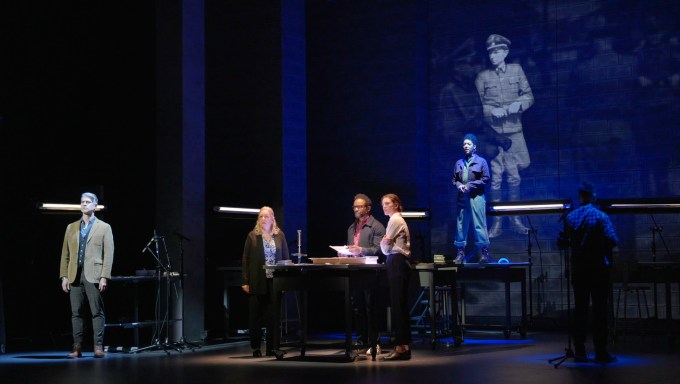
The play is effectively presented on a low-lit and austere stage with projections from the album and related images generously elaborating the narrative.  Although actors perform main roles, each has multiple parts, often of characters of different age and gender than the actor.

The album in question was determined to be the work of Karl Höcher, adjutant to the commandant of Auschwitz.  Many leaders could be identified from their photos, and the backstories and post-war trials for crimes against humanity of some are shared, like Rudoph Höss, the conceiver and developer of Auschwitz, and Joseph Mengele, the medical experimenter known as “The Angel of Death.”

Barbara Pitts, Luke Forbes, Delia Cunningham.

Like much research, serendipity can be profound.  In this case, the album photos were released in Germany, and the grandson of a man in three photos came forward – the first known descendant of a Nazi to assist the Museum.  He made connections with other descendants that shed further light on the album.  Along the way, historical research concluded with certainty that the two disparate albums mentioned above were compiled within 24 hours of each other, only several weeks before the end of WW II.

The pictures themselves make Blueberries particularly dispiriting.  Rather than evil or even scowling, subjects appear quite ordinary, because this album was clearly compiled as an upbeat portrayal of the lives of Auschwitz officers.  In any case, many of them came from pedestrian backgrounds, three leaders being identified as a bank clerk, an accountant, and a candy maker.

Grant James Varjas, Luke Forbes.

More disturbing is a series of photos that show Höcher with a bevy of SS Helferinnin, attractive young women who did clerical work in the administrative building, outside of the concentration/work/death areas of the camp.  It is hard for many people to accept that a significant number of women could have been complicit in Nazi horrors.  Like many others after the war, the Helferinnin, claimed to know nothing about the tragedies beyond the wall, but how could they not know of 300,000 Jews and other “undesirables” being gassed in three weeks of 1944 alone?

Among the benefits of cross-referenced documentary research of Nazis was linking information that proved knowledge by individuals of the killings.  This led to exposing the nefarious and to their trials and convictions.

Research also revealed the character of people who fell into the Nazi movement and became unmoved by or participated in its hideous actions.  They subordinated independent thought to that of a cult leader.  They were drawn in by identity politics; desired to feel a significant part of a group; and were willing to conform to prescribed behavior.  They were able to compartmentalize aspects of the movement that they couldn’t reconcile; deny inconvenient truths; reject individual responsibility by being a small part of a whole; and argue that there was no viable alternative to their participation.

Marrick Smith.

Presciently, before the 2016 presidential election, Berkeley Rep produced It Can’t Happen Here, based on Sinclair Lewis’s novel about the rise of fascism through election in a democratic country.  What parallels with Lewis’s novel and the findings of Blueberries can we see today?

Here There Are Blueberries, written by Moisés Kaufman and Amanda Gronich, is produced by Tectonic Theater Projects, presented by Berkeley Repertory Theatre, and plays on its stage at 2025 Addison Street, Berkeley, CA through May 11, 2025.