Otello

Cast. All photos by Natalya Polyakova.

Indisputably one of the brightest stars in the opera firmament, Giuseppe Verdi’s operas remain among the most popular.  While many endure in the canon, his most performed include the great trio from his rich middle period, La Traviata, Il Trovatore, and Rigoletto, plus the later Aida.  Yet critics most often cite Otello as his crowning achievement.  West Bay Opera has courageously gambled on this notoriously difficult opera and has come up all aces.  All of the creative elements from aural to visual contribute to a riveting and memorable production.

John Kun Park as Otello, Julia Behbudov as Desdemona.

Blessed with stunningly beautiful music, gripping drama, and consummate tragedy, why is Otello not produced more often?  Need we mention that while storyline and lyrics are often operas’ weak knees, Arrigo Boito’s libretto is considered, if anything, an improvement on its Shakespearean source material. The foremost impediment is the challenge of casting.  The title role is deemed one of the most difficult in opera – one that tenors are advised not to try until they are in their own rich middle period because of the stress on the voice.  Plus, Desdemona must command the audience through stunned silence with one of the most wrenching soliloquies in opera, a 12-minute virtuoso demand.  Finally, Iago, a villain non-pareil, must possess a great bass-baritone range and versatile vocal style while acting with a sense of insidious evil.

Another resistance point starting with its 1887 origins is that Otello represents Verdi’s first adoption of Wagner’s notion of continuous music, with no stopping for applause, which Italian audiences rejected.  But unlike Wagner’s later works, especially the Ring Cycle, Otello brims with wonderfully melodious self-contained set pieces.  Wagner also adopted what is arguably a weakness in his music theory (and perhaps his own compositional ability), and that is the abandonment of ensembles of any sort.  Happily, Otello abounds with captivating duets, the masterful double-duet (quartet, if you like) handkerchief scene, and a huge non-synchronous ensemble plus chorus (which plays a very active role) to close this production’s Act 2 that overflows with power and complexity.

Robert Balonek as Iago, Thomas Mulder as Cassio.

The plot is uncomplicated.  Otello, a Moorish general in Venice’s military, returns to Cyprus to victory celebrations in a tumultuous storm that foretells the human drama.  His ensign, the duplicitous Iago, resents being passed over for a promotion that went to Cassio, and he vows revenge.  By placing Desdemona’s handkerchief in Cassio’s quarters, he implicates both.  Upon assuming betrayal, Otello strangles Desdemona, and then finding that she was innocent, impales himself.  For those who may cry spoiler, the generally accepted rule is that it is okay to disclose spoilers to operas and classic literature in reviews, as the reader is expected to know them already.

From the bombastic opening to the tragic and intimate closing, West Bay’s production compels and manages the many hurdles along the way.  The Byzantine Act 2 ensemble finale serves as a telltale.  It could easily come out as mush, but Maestro José Luis Moscovich harnesses the orchestra, chorus, and principals, each into elevating their separate contributions.

John Kun Park as Otello, Robert Balonek as Iago.

John Kun Park imbues the title character with an appropriately grim countenance and single mindedness.  Unfortunately, Otello is as decisive as he is gullible, and accepting Iago’s treachery as truth causes the tragedy.  Park accomplishes the challenge of the role with an accurate and vigorous voice, if slightly muffled in tone in the high end of his range.  He powers his way through the endless demands of the role.  Perhaps his greatest moments are in the absolutely wonderous duet with Iago, “Si, pel ciel” in which he vows revenge on the accused dalliant lovers along with his vow for retribution, “Sangue! Sangue! Sangue!”

As Desdemona, Julia Behbudov brings a sterling voice and passion.  She excels in the beautiful and reflective duet with Otello, “Già nella notte densa,” with cascades of crescendos, as well as in her extended signature soliloquy.  As she contemplates death, she completely captures the audience with Desdemona’s willow song, the haunting lament (“Salce! Salce! Salce!”) with its delicacy, dramatic vocal turns, and chilling shriek, followed by her tender prayer “Ave Maria.”

Cast.

But if Otello belongs to one player, it is Robert Balonek as the manipulative and treacherous Iago, who pulls Otello’s strings like a puppeteer.  The large and encompassing role introduces one of the most iconic villains in opera, and Balonek endows it with every quality it deserves.  We speak of actors chewing up the scenery, and if the concept could be applied to a voice, it would be to his.  Rich, deep, and resonant, his exquisite dynamics can caress the graceful and stealthy yet explode with power.  Balonek’s commanding voice towers with versatile highlights throughout, but perhaps most notably in his “Credo,” when he acknowledges his own depravity but disdains those who may be honest but inept.  His body language and visual expressiveness with his smirks and sneers exhibits every bit of treacherous venom imaginable.

It is rare for a smaller opera company to take on an opera with the demands of Otello, much less produce an outcome as satisfying.  In addition to the performers, artistic contributors deserve recognition as evident from the photos, starting with Stage Director Richard Harrell, plus Peter Crompton for set and projections, Daniele Ferguson for lighting, and Callie Floor for costumes.  Otello deserves full support from the opera loving community on its closing weekend.
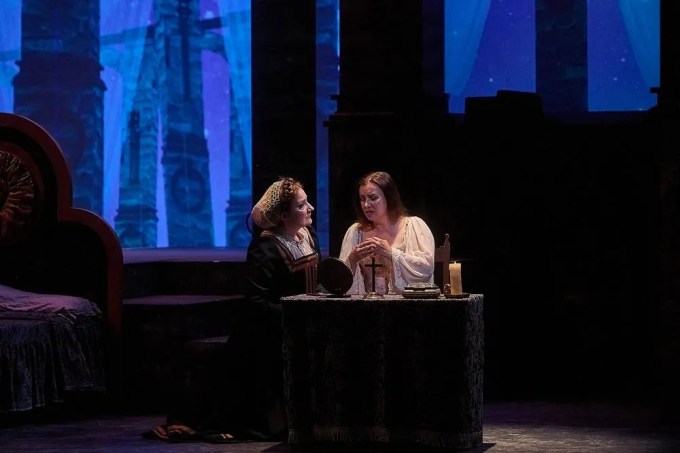
Laure de Marcellus as Emilia, Julia Behbudov as Desdemona.

Otello, composed by Giuseppe Verdi and with libretto by Arrigo Boito based on the play Othello by William Shakespeare, is produced by West Bay Opera and is performed at Lucie Stern Theatre, 1305 Middlefield Road, Palo Alto, CA through June 1, 2025.

The Cake

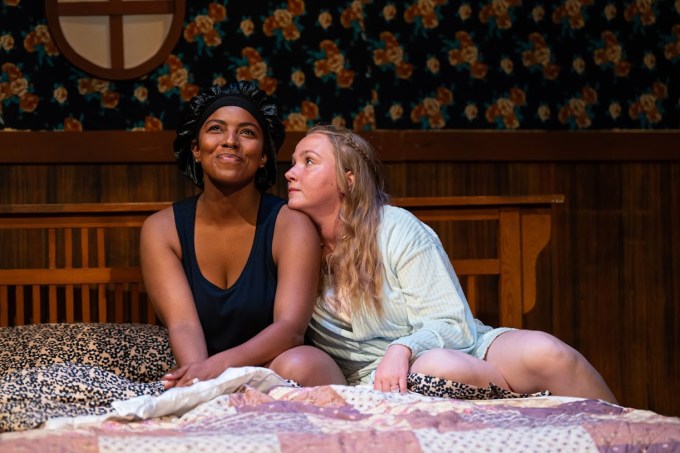
Luisa Sermol as Della, Lizzie Izuymin as Jen. All photos by Christian Pizzirani.

The display cabinets of Della’s Bakery brim with brightly colored, gaily decorated cakes.  The décor is swathed in pink and sea mist green, conveying all of the innocence of a ‘50s ice cream parlor or sweets shop, when boys were boys, girls were girls, and every socially-accepted person visible in Winston, North Carolina was white.  But the fragile patina of this throwback world belies the current era of culture wars and the social clashes that will occur within the bakery’s walls.

On first blush, Bekah Brunstetter’s The Cake appears that it could disappoint the serious theater goer as a frothy comedy with a message produced with the power of a powder puff.  But while Director Lisa Mallette and the cast deliver the laughs, a whole raft of timely social issues are explored.  Though the playwright’s personal disposition should be clear, this is no landslide to bury the retrograde.  Nuance and uncertainties driven by internal conflict rule, and clashes of values are revealed as the character of the characters unfolds.

Sundiata Ayinde as Macy, Luisa Sermol as Della.

Jen now lives in Brooklyn, but to honor her deceased mother’s wishes, she returns with her intended to North Carolina to plan a traditional wedding in her hometown.  Della, childless and the closest friend of Jen’s mom, acted as Jen’s proxy mother, and the love between these chosen family members is palpable.  Obviously, Della would make the cake to celebrate the wedding.

But the anticipated takes a sharp turn when Jen introduces her fiancée, Macy, who happens to be black, agnostic, vegan, and……lesbian – the polar opposite of Della, who is guided by what she considers the teachings of the Bible.  Consulting her calendar, she tells the couple that she couldn’t possibly add another major order in October, their wedding month.  This incident echoes the U.S. Supreme Court case of a Colorado baker who refused to make a cake for a gay couple.  But this pretext of not having time denies accommodating a loved one, not an unknown, random customer.

Tom Gough as Tim, Luisa Sermol as Della.

Luisa Sermol portrays the central character, and she imbues Della with rich complexity.  She is thigh-slapping funny even when talking about recipes and has two not-to-be-disclosed-here risqué and hilarious scenes with her husband.  Yet as a product of her environment, her Christianity represents a big part of her being.  But she will be forced to consider whether the received wisdom from her church and The Book is the correct interpretation; whether it is even true; and whether other factors overtake the righteousness determined several thousand years ago by a people different from ours in so many ways.

Della prides herself on her craft, and one funny thread concerns her being a candidate for the reality show, The Great American Bake Off.  In these recurring episodes, she talks to an unseen voice, and some of the racy communication makes you wonder if this whole sequence is in Della’s mind.  But like everything else in The Cake, a serious message is delivered, in this case concerning judgment made without due process, which is certainly a current concern in this country.

Sundiata Ayinde as Macy, Lizzie Izuymin as Jen.

The ebullient Jen is portrayed by Lizzie Izuymin.  Some of us (or, at least me) may be annoyed at how forgiving Jen is when Della refuses to make room in her schedule for Jen’s wedding cake, which seems an abomination.  But having moved away from her roots makes Jen complex in a different way than Della.  In keeping with the old saw “You can take the boy out of the country, but you can’t take the country out of the boy,” Jen carries some residue from her past and lapses into patterns she valued from earlier in life, some of which don’t please Macy.  Separately, as if to justify her sexual orientation and love for Macy, Jen explains to Della her fear of intercourse with a man and how Macy made physical love make sense.

The other two characters are more rigid, albeit with endearing qualities.  Macy (Sundiata Ayinde) possesses the antenna expected of a person from a minority.  In this scenario, she observes how billboards increasingly offend her the further south she goes.  She is intellectually committed to her beliefs, and as an online journalist, she seeks opportunity and values truth, which will also put her at odds with others.  Della’s husband Tim (Tom Gough) is the likeable, laid-back type.  But scratch the surface, and he’s the archetype of conservative intolerance, expecting his wife to follow his every command; fearing that Jen has been poisoned by northern liberals; and believing that gay love is gross.

Luisa Sermol as Della, Lizzie Izuymin as Jen.

If an optimistic conclusion can be drawn from the play it is that another overlay of conflict depicted is generational.  The younger generation, or the future, is more inclusive, and to some extent, that acceptance seeps through to part of the more resistant older generation.  Time is on the side of youth.

The Cake offers equal parts charm and provocation in a production with fine acting throughout as well as outstanding creative values.  Ron Gasparinetti’s expansive scenery, which includes bedrooms on both flanks of the bakery, is appropriate, appealing, and detailed.  George Psarras’s sound engages, particularly in the Great American Bake Off sequences when Della speaks with The Voice (Max Tachis), while Sonya Wong’s lighting highlights the action.  The integration of designs and pace are exquisitely directed and coordinated by Lisa Mallette.

Luisa Sermol as Della, Tom Gough as Tim.

The Cake, written by Bekah Brunstetter, is produced by City Lights Theater Company and plays on its stage at 529 South 2nd Street, San Jose, CA through June 8, 2025.

The Curious Incident of the Dog in the Night-Time

Mark P. Robinson, Brendan Looney. All photos by Jessica Palopoli.

The corpse of a dog appears – tines of a pitchfork embedded in its side and handle vertical to the sky.  Such is the “The Curious Incident of the Dog in the Night-Time.”

A young boy, intent on finding out who was responsible for the killing and why, clumsily and abruptly questions neighbors to little avail.  The boy, fifteen-year-old Christopher, can rattle off sequences of prime numbers and squares of numbers.  He also stumbles socially; shies from being touched; and refuses to use a toilet that hasn’t just been cleaned.  He is autistic.

Brendan Looney, Sophia Alawi.

The play’s storyline and its structure offer fascinating originality, and San Francisco Playhouse’s production, potently helmed by Director Susi Damilano, captures every bit of uniqueness in the script with a stunning, well-coordinated creative design.

The plot first concerns Christopher’s quest to solve the dog’s killing. Eventually, the perpetrator admits to the killing, but in one of the less satisfying aspects of the story, the action lacks a direct motive.  The other plot thread deals with the boy’s family.  During the narrative, he is told of his mother’s death from a heart attack, but his investigation into the dog’s death leads his seeking to learn more about his mother’s demise.

(standing) Laura Domingo, Brendan Looney, (seated) Renee Rogoff, Whit K. Lee, Catherine Luedtke.

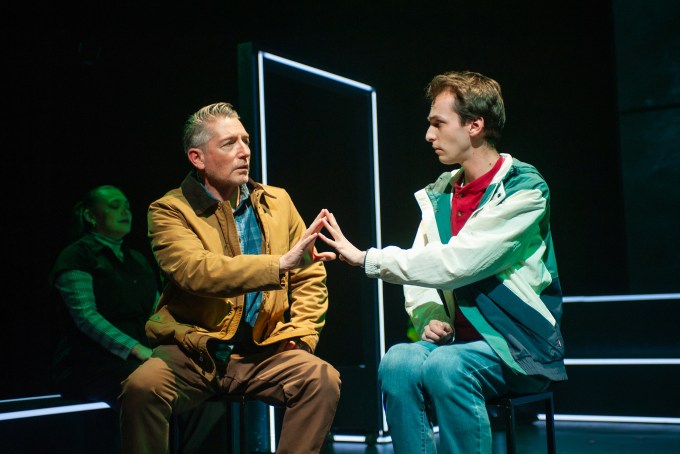
In a broader sense, however, the play goes beyond the plot and dives deeply into the world of autism.  Brendan Looney’s powerfully illuminating Christopher is more than a simple role portrayal, since he brings authenticity as a real-life autistic, logical but regimented and repetitive.  His depiction is deep and memorable.  He elicits sympathy with his inability to grasp social conventions, like the natural aversion others would have to his pet rat, and his difficulty interpreting others’ intentions and facial expressions.  But beyond its anchor in autism, the play is really about all outsiders who are treated with indifference or scorn by established society.

In Curious Incident… we see the world from the perspective of the autistic, who wants acceptance and understanding while not conforming with neurotypical standards.  We learn how those who are on-the-autistic-spectrum are often ill-treated.  For instance, while Christopher’s reading ability is clearly fine and his math skills are stratospheric, he must attend a school for the learning disabled.

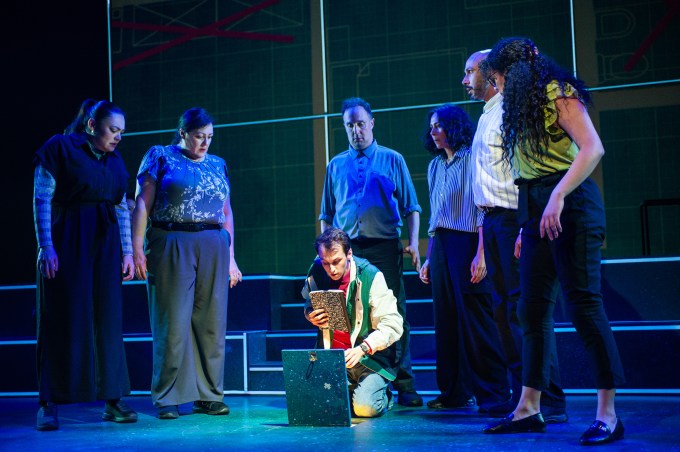
(kneeling) Brendan Looney, (standing) Renee Rogoff, Catherine Luedtke, Cassidy Brown, Laura Domingo, Wiley Naman Strasser, Sophia Alawi.

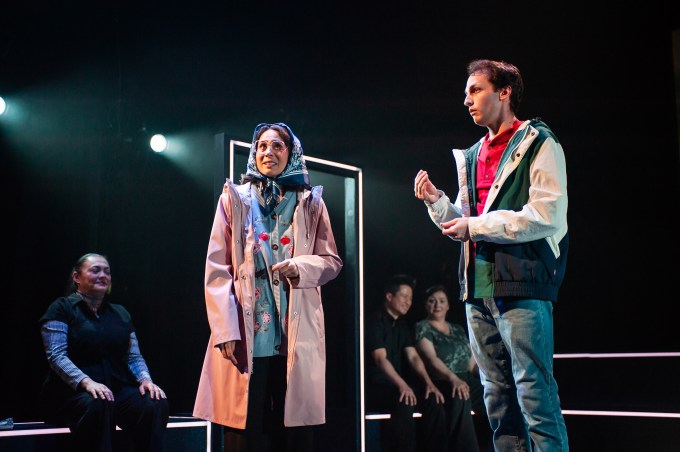
Other than Looney’s breakout performance, an all-star cast fills the other roles, with several actors playing multiple roles, some anonymous and listed as voices.  Sophia Alawi performs the other lead role as Siobhan, Christopher’s teacher.  She acts as a narrator elaborating on the interactions of characters and sharing the boy’s unexpressed thoughts.  While her role is largely expository, offering little dramatic variation, Alawi carries it out with exceptional grace and charm.

Christopher’s parents comprise the remaining key roles, each actor embracing the desirable features and flaws of the characters.  Mark P. Robinson is fiery and demonstrative as Ed, who loves and protects his son.  He insists that the son not investigate the dog’s killing because it intrudes on other people’s lives.  But Ed lies about vital matters that the literal-minded boy cannot process with nuance or forgive.  As the mother, Judy, a passionate Liz Sklar also evidences her love for her son but reveals conflicting wants in her emotions and actions.

Liz Sklar, Brendan Looney, Wiley Naman Strasser, Cassidy Brown.

The teen’s journey through numerous clashes is a voyage of discovery and coming of age.  Having lived a protected life with narrow focus, retracing steps taken many times before, he will travel from a small, regional English city to London, confronting unknown horrors like escalators and the underground, uneasy about even how to enter them. 

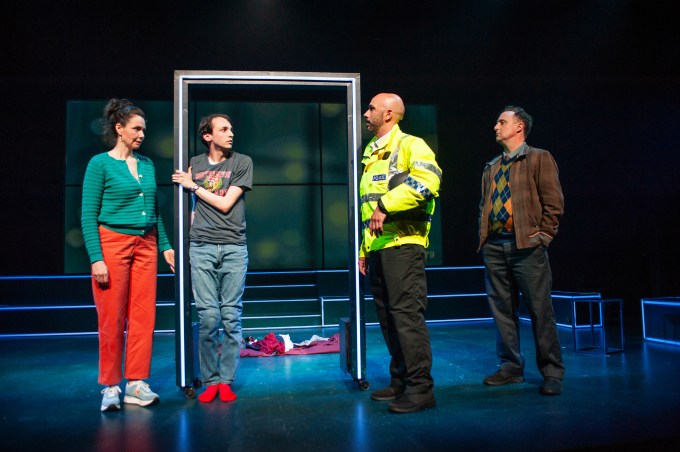
In keeping with Christopher’s compartmentalization and disruptiveness, the action is divided into 57 fast-moving scenes, though a few seem unessential and slow the action.  Actors remain on stage most of the time and move frequently in lockstep and other times organically to Bridgette Loriaux’s brilliant movement direction.  James Ard’s sound design is pervasive and marvelously detailed from musical blipping to the faint sound of a toilet flushing.  This all plays against Bill English’s minimalist but powerful right-angled set framed by light strips and accented by Christian Mejia’s lighting design.  On the back wall of the stage, and in keeping with the angular look, Sarah Phykitt’s linear-graphic projections visually reflect Christopher’s mind which favors predictably organized things like computers and machines.

Brendan Looney, Whit K. Lee.

The play has earned plaudits and awards on Broadway and the West End.  The SF Playhouse production is a highly rewarding revival that informs, provokes, and entertains.

The Curious Incident of the Dog in the Night-Time, adapted by Simon Stephens and based on the novel by Mark Haddon, is produced by San Francisco Playhouse and appears on its stage at 450 Post Street, San Francisco, CA through June 21, 2025.