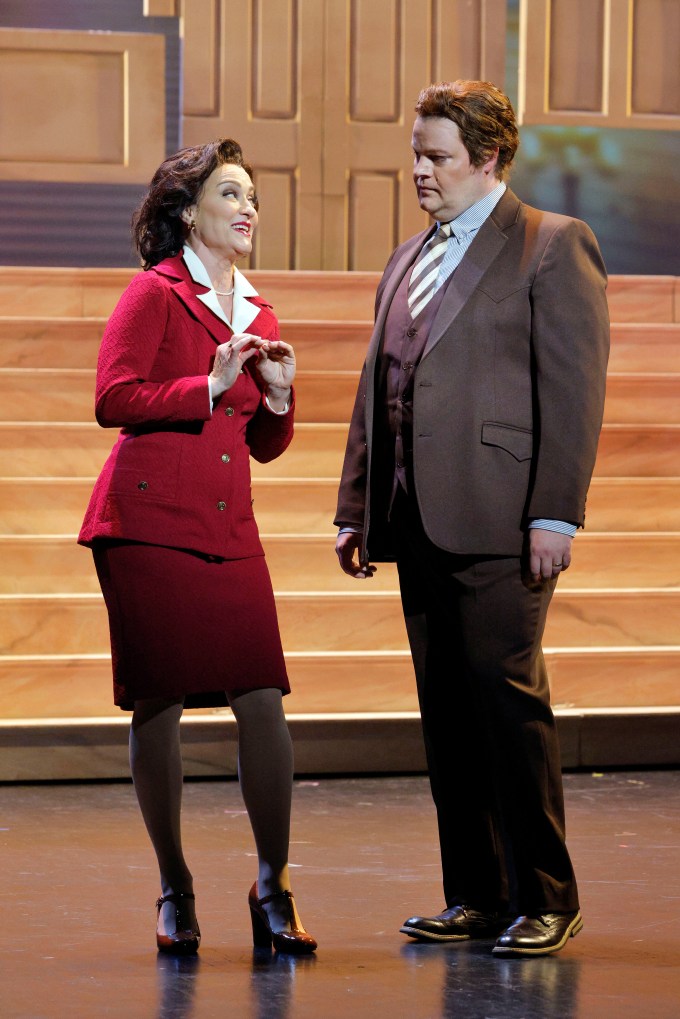
Annunciation

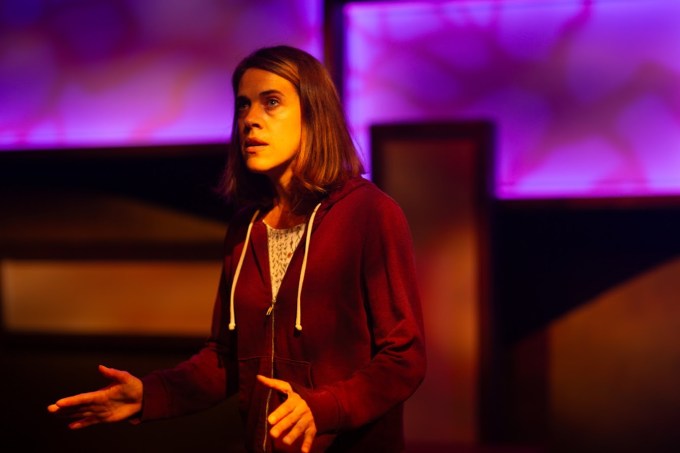
Rosie Hallett as The Woman. All photos by Jessica Palopoli.

A young, unidentified woman from a dysfunctional family graduates a New England college with no family or friends present.  Seeing no clear path to the future in her current situation, she drives west leaving no forwarding information behind, and not stopping until she reaches the Golden Gate.

This is Word for Word’s sterling production of Lauren Groff’s Annunciation, with an outstanding ensemble cast and an often frenetic production directed by Joel Mullennix that ensures pace and action in a narrative heavy on exposition.  It is the story of The Woman’s hard scrapple existence as she tries to gain a toehold on financial independence, starting from scratch.  So desperate is she that at a youth hostel in San Francisco, she pinches food supplies left behind by guests for the hostel.  And when she starts working, she grabs anything available from food trays at meetings.
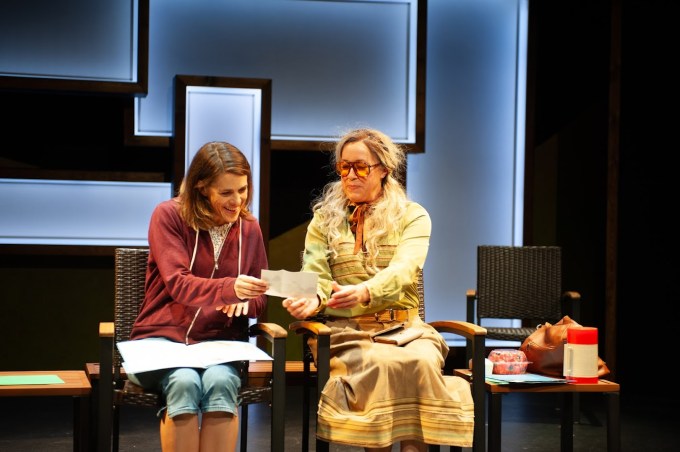
Rosie Hallett as The Woman, Molly Rebekka Benson as Anaïs.

Having seen previous performances and even having chatted with her, I knew to expect professional work from Rosie Hallett.  However, I was unprepared for how she confidently commanded the stage in a huge part as The Woman, virtually on cue non-stop for nearly 90 minutes.  Although very demanding, Hallett’s role is more as a raconteur than an actor with comparatively little range in affect.  Perhaps her greatest deviation from neutral emotion is when she sneers with disgust as a colleague at a meeting snares a bagel that she hoped to pocket for her next meal.  Most of the humor and frenzy are given to the other characters, and in part, The Woman is a straight man/woman/person/whatever to five comic actors.

When The Woman finds a temporary job in Redwood City and housing in a guest cottage in Mountain View, she stabilizes enough that two people will have recurring involvement in her life.  Her wise mentor but still young co-worker, Anaïs (a guarded Molly Rebekka Benson), is a mystery woman who lives with her preschool daughter in a van, even though she is working and can afford to donate $1,000 to a charlatan televangelist preacher.
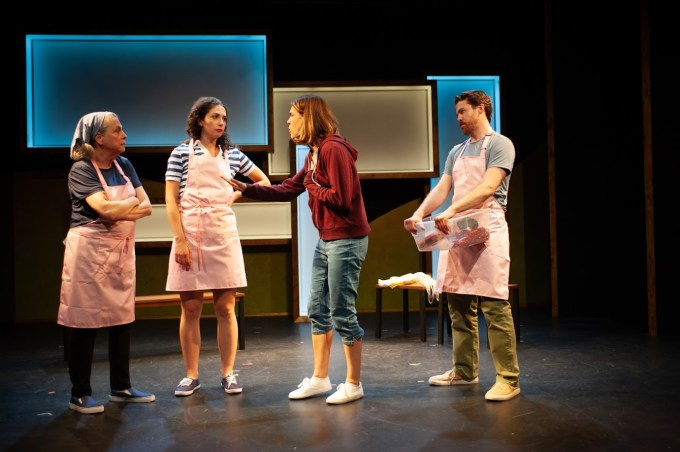
Ensemble – JoAnne Winter, Monica Rose Slater, Rosie Hallett, Brennan Pickman-Thoon.

The Woman’s landlady, Griselda (Patricia Silver, charter member of Word for Word), lives on a large plot of valuable land, yet picks scraps like an unfinished jar of honey from neighbor’s trash.  Full of fanciful tales of time spent with the likes of Andy Warhol, David Bowie, and more, if believable, Griselda’s earlier life was fantastisch, as she would say in her native German.  The Woman gains more control over her future after working for a while, but sad incidents occur with both Griselda and Anaïs, her main links to humanity.

Many sparkling, high energy vignettes accent the narrative, with props and characters in ever-changing costumes shot from the wings like cannon balls.  A toreador and bull flash across the stage. Celebrities appear and disappear in an instant.  Young Griselda briefly basks in the sun on a yacht.  Younger women are generally played with verve by Monica Rose Slater, while older women are mostly played by an also highly animated JoAnne Winter (WfW Artistic Director) or Benson.
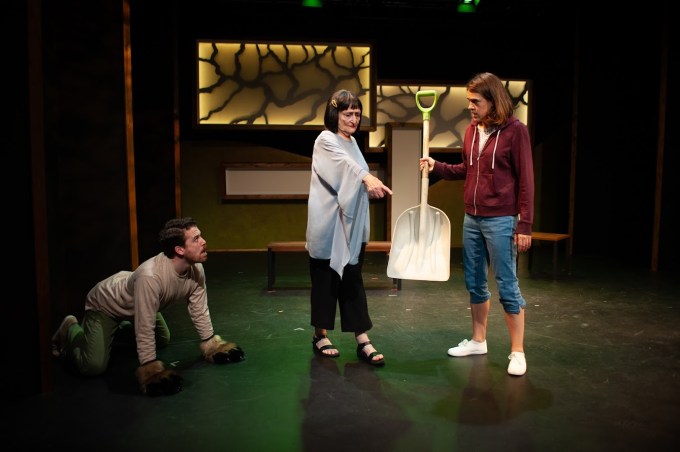
Brennan Pickman-Thoon as mastiff, Patricia Silver as Griselda, Rosie Hallett as The Woman.

Brennan Pickman-Thoon plays the male ensemble parts plus one other.  If you think back to some meta-theatrical movie that you’ve seen, you may remember an acting teacher having students do something ridiculous such as acting like a dog.  Well, this is a rare case where that training is actually put to use.  With only the costumery aid of furry paws with claws, Pickman-Thoon amazes in his complex characterization of a 200-pound English mastiff, from romping enthusiasm to hopeless despair as he tries but is unable to bark as his voice box has been removed.

I have collected a few opinions concerning the broader arc of the story.  There is considerable disagreement, not on the facts, but in interpretation and conclusion.  Some view this as a coming of age in which unpleasant obstacles are vanquished by The Woman, and much of the sorrow that occurs is the reality of life.  She survives and succeeds.  And while she previously regretted turning too much away from life, she has embraced it more in her new environs.

Ensemble – JoAnne Winter, Brennan Pickman-Thoon, Molly Rebekka Benson, Monica Rose Slater.

Others feel, despite the light touch in much of the production, that the events are relentlessly depressing and that the protagonist doesn’t fully escape her demons.  Half empty?  Half full?  In any case, the story is provocative and engaging, and the production is energetic and powerful.

At this point, I wonder if those who aren’t familiar with Word for Word realize that this essay has not been a review of a play per se.  The production is a fully staged and acted short story with no changes to the text.  If the words in the original prose read “she states” or “she looks longingly at the billowing clouds,” an actor, selected by the director as most appropriate, will speak those exact words.  This is what WfW has done since its inception in 1993 with remarkable results.  Particular kudos are due the director of any of these works, as a host of decisions not faced in a play make this a more complex undertaking.

Monica Rose Slater as Young Griselda.

Short stories set for the stage opens up a whole new dimension in performance to theater goers.  The members of the company may know better, but my research has not revealed another company anywhere that shares Word for Word’s mission.  It’s great to have them with us in one of the country’s premier regions for theater.

Annunciation, a performed short story written by Lauren Groff and published by New Yorker Magazine, is produced by Word for Word and Z Space, and plays at Z Below, 450 Florida Street, San Francisco, CA through July 13, 2025.

Come Back to the 5 & Dime Jimmy Dean Jimmy Dean: A New Musical

Judith Miller as Loretta, Lauren Marcus as Mona, Stephanie Gibson as Sissy. All photos by Kevin Berne.

World premieres are always a crap shoot, but the risk is reduced when the material is taken from a known source.  In this case, TheatreWorks Silicon Valley has produced a musical version of a successful play and movie, the new variation being Come Back to the 5 & Dime Jimmy Dean Jimmy Dean: A New Musical.  Akin to its cult-like predecessors, it is a true delight in every respect, with an ensemble of fine actors and great creative design.

Desolate far west Texas desert, between Odessa and El Paso, equals South Carolina in size but has many times more rattlesnakes, scorpions, and horny toads than people.  One of its towns, Marfa, has blossomed into a small artist colony in recent times, but previously was best known for the filming of the movie Giant, released in 1956.  Before the movie’s opening, icon and idol James Dean would die in a car accident, having played the antihero Jedd Rink.  He would earn outsized respect based on acting in only three movies, for which he received two posthumous Oscar nominations.

(Flashback to 1955) Stephanie Gibson as Sissy, Lauren Marcus as Mona, Ellie van Amerongen as Joe (!).

The central character in 5 & Dime is Mona, from the even smaller fictional town of McCarthy.  She’s a focused and slightly condescending type aptly portrayed by Lauren Marcus.  Her life is indicative of how a random event can induce promise of a brighter future to go off the rails.  An extra in the film Giant, she became pregnant ostensibly by James Dean.  As a single mother to a boy she named Jimmy Dean, she dedicated her emotional life to the memory of the actor, starting the “Disciples of James Dean” club.  Now, in 1975, it celebrates the 20th anniversary of the actor’s death.  The action of the play also flashes back to 1955.

Although the play seems shallow at first, it achieves uncommon depth in time, despite having characters that are cardboard thin.  Its messages are as relevant today as they were then.  The celebration takes place at the Kress 5 & Dime in McCarthy, and before long, the other three members of the club appear.  Sissy (a vivacious Stephanie Gibson) has a big sexual appetite and dreams of being a country singing star.  Stella Mae (Hayley Lovgren, whose singing pipes raise the roof, as in her anthem “God damn, I love Texas”) is an emigree to Dallas, childless, but has 100 oil wells with children’s names instead.  And Edna Louise (Ashley Cowl, who is clearly not an ugly duckling) is a Chicana who was ridiculed for her looks and ethnicity. 

(rear) Ellie van Amerongen as Jimmy Dean, (front) Stephanie Gibson as Sissy, Lauren Marcus as Mona, Hayley Lovgren as Stella Mae.

A legitimate small-town Texas vibe can be felt, which this reviewer can verify from personal history.  Loretta (the distinguished Judith Miller) manages the 5 & Dime and represents the rural way of life.  A bible beater who is either ignorant or hypocritical, yet good hearted, she’s even tolerant enough to allow the other women to drink booze in the store, even though she’s a teetotaler.  At the other extreme, Jimmy Dean (played by the androgynous trans guy Ellie van Amerongen), who is anything but typical Texan, drifts in and out of the action.

The soundtrack comprises country-rock songs that are 100% listenable melodies and with thoughtful lyrics that drive the story.  Music is by Dan Gillespie Sells, with lyrics by award winning Shakina, who is notable as the first trans performer ever with a regular part on network television.  She also plays Joanne, a mysterious traveler who just happens upon the action, though McCarthy is on the road to nowhere.

Ashley Cowl as Edna Louise, Shakina as Joanne.

The narrative brims with denouements, big and small.  We learn secrets about husbands, wayward and worse, and about resentments among the women themselves.  Some key disclosures occur in songs, personal “secrets” some of which were known by everyone.

After Edna Louise is ridiculed for how her party dress looks given her pregnancy (I thought she looked great), she and Joanne share a touching duet in the bathroom as each tells of how she has suffered scorn throughout her life.  In another clever but sad number, Edna Louise sings (in Spanish, with Stella Mae translating!) how an Anglo teacher made the Mexican-American kids “bury” their language in an elaborate procedure and refrain from ever speaking it at school.

(front) Hayley Lovgren as Stella Mae, (rear) Ashley Cowl as Edna Louise, Lauren Marcus as Mona, Shakina as Joanne (head only), Stephanie Gibson as Sissy.

Something interesting happened opening night that is more common in opera than in musicals.  Sissy exposed herself with raw emotion in her sincere reveal song.  At its end, the audience couldn’t tell whether the song was over, or whether it was a long pregnant pause.  But perhaps more respectful than hardy applause was the absolute dead, focused silence from the audience.  What’s more, Mona then sang her reveal, and, who would have thunk it, it was déjà vu all over again with unwavering silence.

5 & Dime is full of comic moments and considerable discussion of sex, but it provokes thoughts about friendship in a layered manner.  We first see friends sharing bonding experiences as the women yak and laugh.  But scratching beneath the surface, we see the expressed and hidden clashes.  Yet, scratching further, we sense their warm feeling of communion, despite differences.

The play also examines self-perception and self-delusion.  Our self-evaluation is often based not just on what we think of ourselves, but how we perceive that other people see us.  As these women find, their long-time friends are often privy to what each concealer thought were her own secrets.  Fessing up to some of these embarrassments actually breaks down walls and helps create more sincere relationships.

Judith Miller as Loretta, Hayley Lovgren as Stella Mae, Ashley Cowl as Edna Louise.

Favored with a well-crafted and heartwarming musical, Director Giovanna Sardelli pulls the pieces together, extracting sympathy and laughter, each in good measure.  Frequent design collaborators, Nina Ball with scenic, Kurt Landisman with lighting, and Cliff Carruthers with sound all contribute to a top-notch production.

Come Back to the 5 & Dime Jimmy Dean Jimmy Dean: A New Musical is written by Ashley Robinson, based on the play by Ed Graczyk, with music by Dan Gillespie Sells and lyrics by Shakina, is produced by TheatreWorks Silicon Valley, and plays at Mountain View Center for the Performing Arts, 500 Castro Street, Mountain View, CA through July 13, 2025.

Tartuffe – the Opera

Eugene Brancoveanu as Tartuffe, Courtney Miller as Elmire.

You may not know the name Jean-Baptiste Poquelin, but no doubt you know him by his pen name, Molière, the 17th century playwright and the greatest exponent of French farce and indeed, a non plus ultra of French language literature.  Several of his characters still reign as exemplars of stereotypes, perhaps the most famous of those being Tartuffe, the relentless swindler and unrepentant hypocrite.

In 1980, the opera Tartuffe, composed by Kirke Mechem, premiered at San Francisco Opera, and it has been one of the most successful operas by an American composer.  Pocket Opera, which specializes in English-language, chamber versions of opera’s warhorses as well as many lesser lights has produced a version that delights at every level.  The power of the cast’s voices makes one question whether they are amplified (they’re not), and their comic acting is as good as their singing.  It is difficult to suggest where there could be improvement in the casting or the performances.

Cast.

Though Tartuffe is the center of attention from the outset, the central character doesn’t appear for the first hour.  His advocates and financial lifelines, Mme Pernelle, and especially her son Orgon, are infatuated and cultishly blind to his deception (Does this seem familiar?).  Both sing of his purity, to a chanting counterpoint chorus of detractors.

To daughter Mariane’s horror, Orgon wants her to marry the reprobate, which prompts a cute duet between her and the maid Dorine, after Mariane contemplates suicide.  Ultimately, Orgon insists on making Tartuffe sole heir of the family assets, without finalizing the binder of marriage.  At this point, the action really heats up as the rest of the family fight to expose him.

Isaiah Musik-Ayala as Orgon.

Among those who see through Tartuffe’s artifice, Orgon’s kids and wife are on to him big time. Mariane expresses it plaintively in her aria “Father, I beg you.”  Wife, Elmire, is more exasperated and sarcastic with her “How strange men are! And stranger still that women need them so” which goes on to slyly note “What a myth is marital bliss.”

This Tartuffe is very much an outstanding ensemble, and each of the cast of eight basks in the spotlight.  Rather than sprinkle the review with commendations that apply to each artist – commendable power, accurate pitch, good range, and acting charm – I’ll divvy performers into two convenient categories:  #1 “I Knew They Were Great As I’ve Seen Them Multiple Times Before” – Shawnette Sulker as Dorine, Melissa Sondhi as Mariane, Courtney Miller as Elmire, Eugene Brancoveanu as Tartuffe, and #2 “I Minimally Write 15 Reviews For 6 Bay Area Opera Companies Per Year, And Why Do I Not Know These Fine Talents?” – Alix Jerinic as Mme Pernelle, Isaiah Musik-Ayala as Orgon, Julio Ferrari as Damis (Orgon’s son), Max Ary as Valere (Mariane’s boyfriend).

Melissa Sondhi as Mariane, Shawnette Sulker as Dorine.

The success of this opera starts with the storyline, which is one of the great farces of all time.  On top of that, Mechem’s music, particularly the orchestral support conducted by Music Director Kyle Naig, is delightfully tonal and accessible.  Lyrics offer clever rhymes and rhythmic series of things.  And for those not enthusiastic about farce, the music acts as another dimension that seems to temper the silliness.

Largely, this is like an 18th century number opera with independent arias that can be lifted from the score.  Not all of the arias are highly melodic, but one in particular stands out, Dorine’s “Fair Robin I love.”  Perhaps it resonates because the tune sounds much more like an Anglo-American folk song than an opera aria.  It’s a bit odd, however, that this character not essential to the plot sings the most memorable solo. 

Alix Jerinic as Mme Pernelle, Isaiah Musik-Ayala as Orgon.

In addition to the shining music, hammy acting makes this piece work.  Several riotous, chaotic ensembles integrate both performance components, contributing to the brightness.  Finally, staging plays a key role.  Stage Director Nicolas A. Garcia deserves kudos for integrating the pieces into a brilliant whole.  He has also designed the costumes, while Daniel Yelen created the scenery.  The well-coordinated palette of clothing and furnishing, dominated by gleaming, solid colors provide more cheer.

In all, this is an experience that will leave you culturally enriched and smiling.

(below) Courtney Miller as Elmire, (above) Julio Ferrari as Damis, Shawnette Sulker as Dorine, Melissa Sondhi as Mariane, Max Ary as Valere.

Tartuffe with music and libretto by Kirke Mechem and based on Molière’s play of the same name is produced by Pocket Opera.  It offers two remaining performances – at the Legion of Honor, 100 34th Avenue (Lincoln Park) San Francisco, CA on June 22, 2025 and Mountain View Center for the Performing Arts, 500 Castro Street, Mountain View, CA on June 29, 2025.

Idomeneo

Daniela Mack as Idamante, Matthew Polenzani as Idomeneo. All photos by Cory Weaver.

A prodigy in his youth and prodigious in the whole of his too brief life, Wolfgang Amadeus Mozart was one of opera’s greatest composers.  His five warhorses are known by most opera buffs by a single word – the Italian language compositions Giovanni, Figaro, and Cosi, and the German language Flute and Seraglio.  Perhaps next in esteem, and in some ways more important than the rest, is Idomeneo.

San Francisco Opera offers only its fifth ever production of Idomeneo.  Contrast that with its other summer offering La Bohème, which has appeared in 46 of the company’s seasons! Idomeneo’s stellar cast and Mozart’s immortal music make for a worthy opera experience.

In 1781, Mozart is all of 24 years of age.  His new composition, Idomeneo would become Mozart’s earliest opera to rise to the opera repertory.  Its significance lies in its adoption of new principles.  Strongly influenced by Gluck and contemporary French composers with a foundation in Italian traditions, this opera holds a major position in the reform movement.  It embraces arias, ensembles, and ballet (though not in this production) along with more realistic emotional depictions than previous operas.

Ying Fang as Ilia, Elza van den Heever as Elettra.

The title character is a minor player in classic Greek plays.  Librettist Giovanni Battista Varesco introduces Enlightenment sensibilities to his story and injects the volatile Elettra (better known in English as Electra) with a vital role.  The crux of the plot concerns the ancient tradition in which leaders are asked to make sacrifices to placate the Gods, thus demonstrating their fealty to a higher power, just as leaders expect from their subjects.  To survive a storm at sea, Idomeneo, King of Crete, promises Neptune that upon reaching safety, he will sacrifice the first person he sees.  Tragically for him, that person is his son Idamante.

Alek Shrader as Arbace, Matthew Polenzani as Idomeneo.

Mellifluous tenor Matthew Polenzani brings the conflicted Idomeneo to life with a wide range of emotions and his usual exemplary singing.  His apotheosis is perhaps the finest aria from the opera, “Fuor del mar” (“Saved from the sea”) in which Idomeneo questions why he was saved only to sacrifice his son.  Polenzani handles (or creates?) the liberal ornamentation in this soliloquy with consummate skill.  He then revisits the king’s anguish in the final act.

Females voice the other three leads.  Mezzo Daniela Mack reprises her role as Idamante from the SF Opera 2008 production.  Though a male character, the part is written to be voiced by any gender.  A trousers role for Mack, her vocal timbre simulates a countertenor to give greater credibility to a female singing it.

Ying Fang as Ilia.

While giving an exemplary singing performance, Mack took ill at opening, as announced by General Manager Matthew Shilvock before Act 3, begging the audience’s indulgence.  Mack soldiered on, and if there was any sacrifice in her volume, there was none in her vocal quality or performance.  Oddly, this was a dolorous period for Idamante, so perhaps the illness didn’t hurt Mack’s characterization.

Two dramatic soprano roles complete the top of the bill, and what a pair.  The larger role is Ilia, daughter of King Priam of Troy, who has been defeated by Greek forces led by King Idomeneo.  Captured by the Greeks, Ilia falls in love with Idamante.  Ying Fang plays the role which opens with a searing aria.  She maintains lovely tonal and lyrical quality even throughout the dramatic elements.

Matthew Polenzani as Idomeneo, Daniela Mack as Idamante, Ying Fang as Ilia.

Like Mack, Elza van den Heever is a Merola and Adler Fellow graduate, loved as a part of the greater SF Opera community.  She is Elettra, and she tears through the role with the power of a lioness with strong and accurate vocalizations.  Near the climax, she finds her aspirations crumbling, and her mad scene is an emotive tour-de-force of sound and sight.

This production should definitely be seen, yet the score has issues.  While the music is Mozart, it lacks arias that would appear on popularity lists.  However, a trio and a remarkable duet that morphs into a quartet, with each principal bemoaning a life worse than anyone elses, are both thrilling pieces.  The other matter is that particularly the first half of the 3 ½ hour run time is dominated by stand and deliver singing with relatively little interaction.  Thankfully, the latter part redeems the earlier.

Further, while the cast is blessed with top international performers who show why they are on top, production decisions won’t be to everyone’s liking.  The fixed hardware of the angular set is comprised of white walls with doors for egress.  Australian Stage Director Lindy Hume’s concept is to project scenes and distortions of nature against this backdrop, particularly crashing seas and billowing leaves of trees from Tasmania. This ties in thematically with the Enlightenment period’s growing interest in nature and situates the action in Australia where the production was originated.  Some will find this approach less satisfactory than a conventional staging, and it may seem to be in response to budget limitations.  Disclosures – I have no idea if a run of projections like this actually costs less than full staging, and the projections look much more vivid and attractive in photos than they did from my seat.

Chorus.

Similarly, darkly-hued contemporary costumery is often worn, and with the chorus on stage, it creates a bit of a pall, which, granted, is consistent with the storyline.  The chosen outfits were probably another reflection of the director’s dark vision of the narrative and perhaps another attempt to put a more modern stamp on the production.

Elza van den Heever as Elettra.

Idomeneo, composed by Wolfgang Amadeus Mozart with libretto by Giovanni Battista Varesco based on Antoine Danchet’s opera libretto Idomenée is produced by San Francisco Opera and plays at War Memorial Opera House, 301 Van Ness Avenue, San Francisco, CA through June 25, 2025.
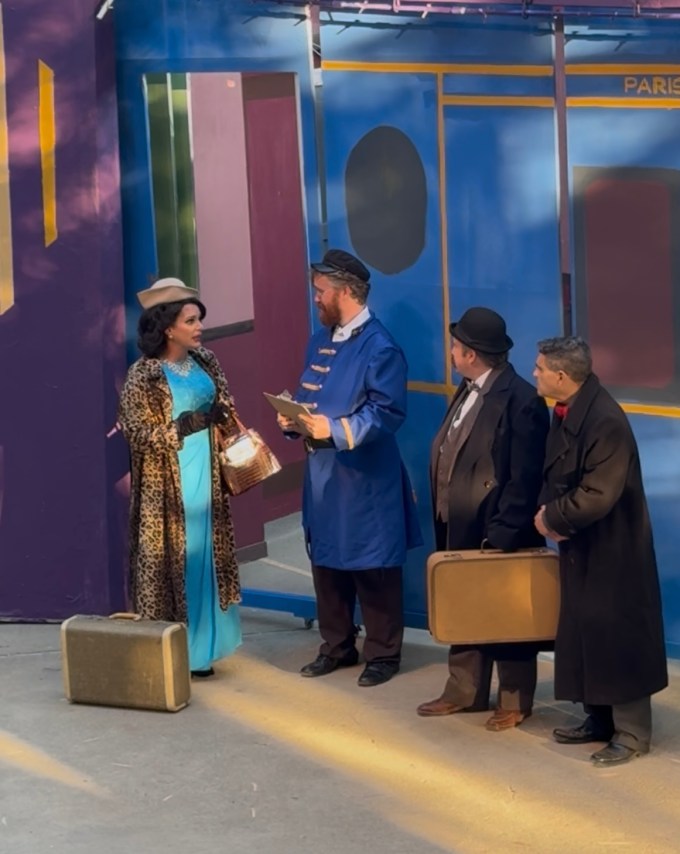
Co-Founders

Roe Hartrampf as Conway, Aneesa Folds as Esata. All photos by Kevin Berne.

With the Tony Awards celebration this week including the tenth anniversary of Hamilton, that musical was lauded for its success through innovation.  Not only did it introduce hip-hop to the musical stage, but it attracted a wave of younger theater goers and spawned like adventures into newer musical forms for theater.  Fittingly, ACT has launched the world premiere of Co-Founders, a hip-hop musical, and it fulfills the prophesy of Hamilton with a totally engaging production that wowed an audience spanning generations.

Not everyone can be expected to cotton to hip-hop, especially folk raised in an earlier age.  Its usual stridency and thumping beat at the expense of melody and lighter subject matter can be off-putting to those nostalgic about the likes of Frank Sinatra, Elvis, or the Beatles.  But happily, the moniker “hip-hop musical” is a bit of an overstatement.  The show offers a nice mix of pop music along with accessible hip-hop that deals with a range of relatable issues from aspiration to the history of innovation in the Silicon Valley.

Keith Pinto as Victor, Aneesa Folds as Esata.

The story centers on Esata, a young black Oakland woman, a whiz of a computer coder, who has designed an Artificial Intelligence software to simulate her deceased father.  Aneesa Folds plays the role.  Her voice conveys both power and beauty, and her acting evokes sympathy as a quality individual whose circumstances have impeded achievement.  Esata hopes for acceptance into Xcelerator, a highly competitive high-tech incubator in San Francisco.

Along the way, Esata meets Conway, played by Roe Hartrampf, who is full of bravado but short on substance.  He is a young white man from Pennsylvania who has been accepted to Xcelerator.  His shortcoming is that he has a concept for virtual reality travel, but he doesn’t have code to flesh it out.  Do we see a match made in heaven here?  Not exactly, but along the bumpy road, there is hope for a happy outcome.

Deanalis Arocho Resto as Chadwick.

The relationship between the two wannabes waxes and wanes.  Conway knows that he needs someone with Esata’s skill.  Though often generous to her, he condescends and also tries to make her the scapegoat for a crash when they are making a demo to Victor, the CEO of Xcelerator.  Unexpectedly, life imitated art when the projection system in the theater crashed, resulting in a half-hour delay in the proceedings.

Keith Pinto is Victor, and from his first appearance in a huge headshot video, he establishes himself as a prototypical motivational speaker with a steely visage and unwavering dedication to success at any price.  Secondary plots concerning Esata’s friends and mother spice the action.  Ryan Nicole Austin and Adesha Adefela, who play two of those roles to great effect are also two of the three playwrights.

Adesha Adefela (on screen), Aneesa Folds as Esata.

Co-Founders is funny and heartfelt and covers a lot of meaningful ground from business ethics to friendship to discrimination, especially concerning the unfair disadvantages faced by black women.  The risks of AI are also surfaced, ominously as it facilitates what could be invasive surveillance.  A very different concern exists when AI humanoids are treated as human, as when mother and daughter both interact with the digital father that Esata created.  These higher order issues have broad appeal.

A major strength at the premiere, however, is likely to be a weakness beyond.  Broadly, the musical is a feel-good about the Bay Area, encapsulated in the song “This is the Bay.”  But moreso, it is a loving and deserved paean to Oakland, with an abundance of detail about the community that would mean nothing elsewhere.  There’s even a little humorous self-deprecation that plays to great laughter in San Francisco, “Would anybody vacation in Oakland?”  Meanwhile, when Conway refers to “San Fran,” it elicits the expected groans, and images of a Tesla truck trigger boos.

(Front row) Ryan Nicole Austin, Aneesa Folds, Jordan Covington.

As wonderful as the script, score, and production are, it is hard to imagine that it would have the same appeal in St. Louis or Savannah.  And while many revisions of works shift place or time, Oakland, the Bay Area, and the high-tech world are so engrained in script and songs that it is hard to imagine Co-Founders set elsewhere.

In addition to engrossing stories and characters supported by snappy and varied music composed by Victoria Theodore, Co-Founders is an electronic visual phenomenon.  Fantastic projections and videos designed by Frédéric O. Boulay and David Richardson are virtually nonstop on the backstage screen, often supplemented by frontstage images on a scrim.  Choreography by Juel D. Lane and music directed by Ben Covello add depth to the experience.  And while costumery by Jasmine Milan Williams is largely conventional, outfits and wigs assist actors in playing multiple characters effectively.  This major production, which can expect a jubilant run, is all brought together by Director Jamil Jude.

(Seated) Ryan Nicole Austin, Jordan Covington, (Standing) Keith Pinto, Deanalis Arocho Resto, Aneesa Folds, Tommy Soulati Shepherd, Adesha Adefela.

Co-Founders, written by Ryan Nicole Austin, Beau Lewis, and Adesha Adefela with music by Victoria Theodore, is produced by American Conservatory Theater and plays at Strand Theater, 1127 Market Street, San Francisco, CA through July 6, 2025.
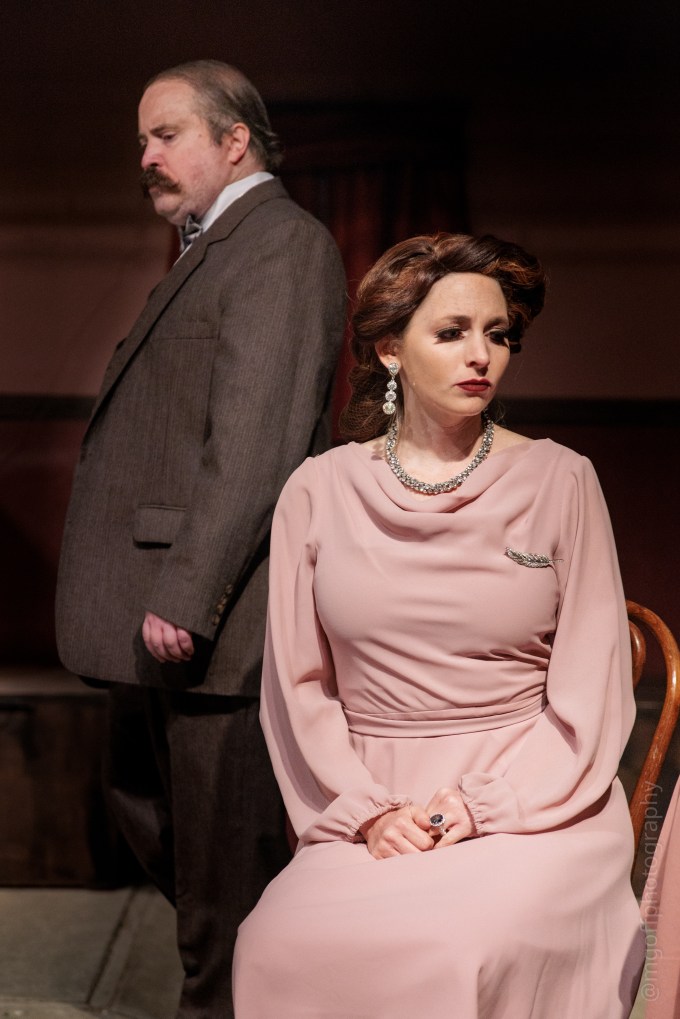
La Boheme

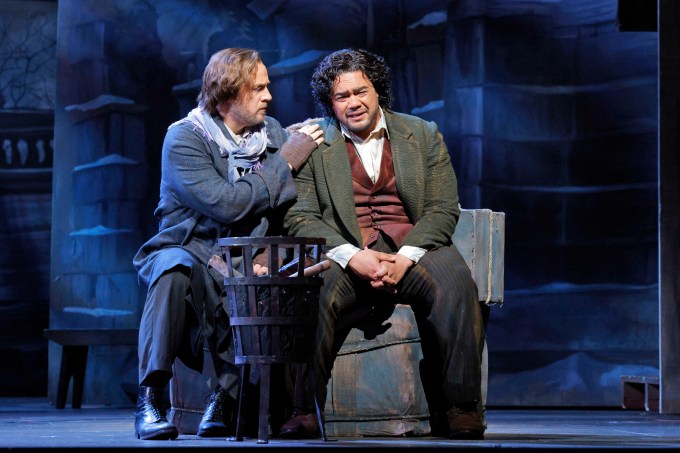
Karen Chia-Ling Ho as Mimi, Pene Pati as Rodolfo. All photos by Cory Weaver.

Always among the most performed of all operas worldwide, perhaps none is more beloved than Giacomo Puccini’s La Bohème.  What is not to love?  It contains some of the most beautiful music ever written; its characters and situations have broad appeal; its bittersweet comedy  endears; and its drama is heart rending.  San Francisco Opera reprises this timeless and wonderful warhorse, its most frequently produced, to great success.

The title character is Mimì, a lovely but sickly maiden, who falls in love with poet Rudolfo on first meeting in their freezing tenement when she loses the flame to her candle and then her apartment key.  The troika of truly beautiful musical highlights that follows would alone make a trip to the opera worthwhile.

Pene Pati as Rodolfo, Bogdan Talos as Colline, Samuel Kidd as Schaunard, Lucas Meachem as Marcello.

As the two crawl on the floor looking for the key, Rodolfo opens with “Che gelida manina” (“What a cold little hand”) and tells her about himself.  She then shares her story with “Mi chiamano Mimì” (“My name is Mimi”).  And finally, they express their newfound love in the duet “O soave fanciulla” (“Oh, lovely girl”).

Local favorite Pene Pati performs Rodolfo and carries the part with charismatic aplomb and a gentle tenor voice with subtle dynamics that embrace the emotion of his love.  Karen Chia-Ling Ho as the delicate Mimì possesses a warm and uncommonly deep, dark timbre for a soprano, but she has no difficulty soaring to the heavens at the finale of “O soave fanciulla,” which unfortunately is barely audible as the couple have moved offstage near the completion of the duet.

Andrea Carroll as Musetta, Dale Travis as Alcindoro.

A secondary love duo involves the often conflicted painter Marcello, portrayed by the smooth and authoritative baritone Lucas Meachem, with fashionable, flirtatious, and flighty Musetta, sung by bold and bright soprano Andrea Carroll.  In an unusual twist, the central character of Act II is given over to the second female lead, Musetta.  At the heart of her self-reverential vanity is her widely known and loved aria “Quando me’n vo’” (“When I walk”), which always lights up an audience.  While Musetta may be taken as a superficial woman, a closer look suggests a streak of independence that may be considered an early state of feminism.

Although the melodies in Acts I and II are the most memorable, the final two acts hold their own.  Considerable new melodic music is introduced, including a sequence with Rodolfo and Mimì that structurally echoes the three love songs in Act 1.  The doleful arias, “Addio” from Mimì and “Vecchia zimarra” (“Old coat”) from Colline (Bogdan Talos) are noteworthy as are a quartet among the artists and a split trio in which Mimì grasps that she’s dying.

Cast outdoors at Cafe Momus.

What is pronounced however is the recurrence of themes from the earlier acts.  While Wagner promoted leitmotifs that could be subtle and comprised of only three or four notes, the repeat themes in La Bohème could be characterized as heavymotifs, as whole phrases are used multiple times.  Happily, they are beautiful melodies.

Along with the love stories, the other thread, which has considerably more depth, is the relationship among the four Bohemian artists who share lodgings in the garret of the tenement – Colline the philosopher, Schaunard the musician, and the two already mentioned.  As not-yet-successful artists, they lead hand-to-mouth but gratifying existences.  This is clearly a commentary on the richness of life steeped in the arts rather than one given over to the almighty dollar (or franc, as it were).

Lucas Meachem as Marcello, Pene Pati as Rodolfo.

But more than that, the friends exhibit comradeship.  To pleasant laughter from the audience, they make light of their paltry existence and demonstrate generosity by sharing food bought with their meager earnings.  More importantly, they sacrifice.  As Mimì is dying, others in the group sell their pitiful assets to give Mimì comfort.  In the depth of winter, Colline even sells his treasured overcoat.

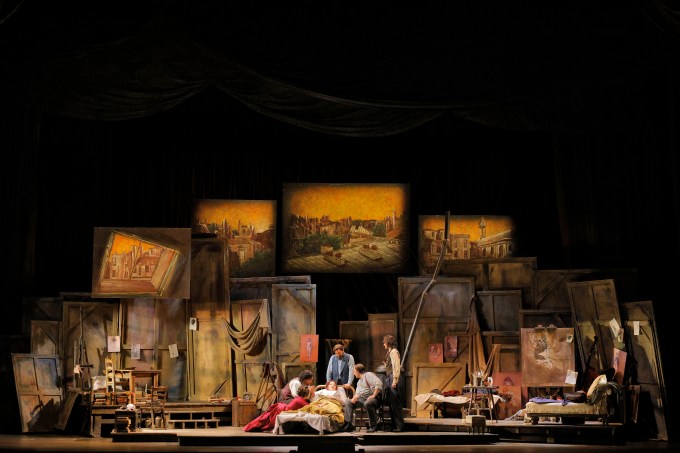
The production is at once handsome and efficient, heavily reliant on painted panels dropped from the fly in two acts with swiveled stage used to deliver genuine scenery and props in the other two.  The lighting level is low overall, which is realistic for the circumstances.  Outdoors at the Café Momus in Act II, lanterns handsomely festoon the stage.  While very attractive, the low light does dim the artists on stage and seems contrary to the brightness of the children’s choruses and the festive mood for that act.

Principals at Mimi’s sick bed.

Conductor Ramón Tebar leads orchestra and singers well.  Together with Director Katherine M. Carter, their excellent guidance of timing and pacing, as delivered by the singers, extract humor and empathy for the memorable characters. Collectively, working from a magnificent score, the artists of San Francisco Opera provide an exemplary evening of culture.

La Bohème, composed by Giacomo Puccini with libretto by Luigi Illica and Giuseppe Giacosa, based on Henri Murger’s autobiographical Scènes de la Vie de Bohème, is produced by San Francisco Opera and plays at War Memorial Opera House, 301 Van Ness Avenue, San Francisco, CA through June 21, 2025.

Murder on the Orient Express

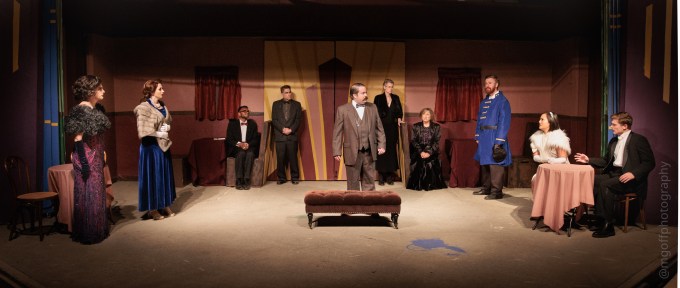
Kelsey Bye as Helen Hubbard, Ruthie Berk as Countess Andrenyi, Shailesh Sivanantham as Hector Macqueen, Wayne Goodman as Monsieur Bouc, Patick Atkinson as Hercule Poirot, Mimi Hamilton as Greta Ohlsson, Patricia Wright as Princess Dragomiroff, Justin Parish as Pierre Michel, Alice Lee as Mary Debenham, Matt Hess as Colonel Arbuthnot. Photos by Matt Goff Photography.

Any work of literature with the word murder in the title immediately evokes grizzly thoughts of harrowing scenes of bloody death or police procedurals – except when the name Agatha Christie is attached.  In the myriad interpretations of her works for the screen, many are light hearted fare headed by comics such as Peter Ustinov or Margaret Rutherford.  Ken Ludwig adapted Murder on the Orient Express for the stage, and Orinda Starlight Village Players, a small but enduring community theater, offer a highly entertaining and humorous production.

From the time that Patrick Atkinson as Detective Hercule Poirot takes the stage for his opening soliloquy, one can breathe a sigh of relief that at least the lead role will be performed in a captivating manner.  But wait!  While community theater is notorious for uneven acting, each of the dozen actors holds their own in this raucous, farcical mystery.  Remarkably, the range of accents of the characters runs from Belgian Walloon (French) to Scottish to Slavic, and overall, they are well differentiated and delivered yet clearly understandable.

For the rare reader who may not be familiar with this work, the denouement won’t be revealed, but the setup will.  Poirot has boarded the train westbound from Istanbul.  Despite being off-season, the first-class coach is full with an omnium gatherum of nationalities and occupations.

Ken Sollazzo as Samuel Ratchett, Patrick Atkinson as Hercule Poirot.

Monsieur Bouc (played by an ebullient Wayne Goodman) who is Poirot’s friend and manager of the train company, is on board.  In time, we will meet all of the passengers including a couple on a tryst and a Hungarian countess who doesn’t seem to be Hungarian.  But the most demonstrative, of course, is an American.  Helen Hubbard, is played to the hilt by Kelsey Bye as a self-important and self-serving wealthy and overwrought woman who forces flippant humor into any verbal exchange, like offering the “biblical” quote, “If Moses doesn’t know the answer, ask the concierge.”

Although Poirot is on vacation, he is buttonholed by Samuel Ratchett, played by an insistent and ominous Ken Sollazzo, who offers him significant money to take a case.  Poirot turns him down but ends up on a case for free when Ratchett is found dead, having been drugged and stabbed eight times.  From that point, Poirot will systematically investigate and interrogate the passengers until he solves the mystery.

OrSVP is one of the many under-the-radar community theaters in the Bay Area with a small but loyal following.  A production like this will hopefully prompt more support.  Matt Cardigan-Smith is the recently-arrived visionary and creative factotum who has made a tremendous impact with limited resources.  Not only does he direct, but he designed the set, sound, and costumes, all of which make important contributions to the overall success of the project.

Kelsey Bye as Helen Hubbard, Justin Parish as Pierre Michel, Patrick Atkinson as Hercule Poirot, Wayne Goodman as Monsieur Bouc.

Although the set has the cheap look of cardboard construction, it is colorful, versatile, and successful in serving its purpose.  One challenge that Cardigan-Smith faced was the multiple locale changes, which he accomplishes using a clever convertible set.  And in one set change to erect the sleep cabins, all of the cast scurried like bunnies shifting pieces into place.

Off the stage, the set is supplemented with a locomotive, complete with cow catcher and beam light, and off to the side a telegraph/radio table appears for several scenes.  Piped sound is used to great advantage.  Discussions relating to an earlier and relevant murder are heard, and when Poirot is questioning passengers, their own taped words are replayed as reminders.  Background noises and music round out the sense of the environment.  These are all touches that reflect well on the effort to create a rich production while having little money to work with.

The storyline of Murder on the Orient Express, exposing its characters’ truths over time, engages throughout.  The cast takes complete advantage of the opportunities to extract humor at every turn.  Much interaction between personalities resonates.  In one particular contentious exchange, Helen and the Russian Princess Dragomiroff amusingly hurl epithets at one another in very dissimilar styles, reflecting their different social stations.

Patrick Atkinson as Hercule Poirot, Ruthie Berk as Countess Andrenyi.

One weakness in the script is that some subsequent developments are telegraphed early on, but that probably doesn’t matter much to those who already know the outcome.  While it doesn’t convey the tone of a morality play, in the end, the play is very reflective concerning moral relativism, so there is meaning for those looking for it.  But for everyone, it is a fun and worthy entertainment.  Hopefully the folks from Orinda and its surrounds will catch on.

Murder on the Orient Express, adapted by Ken Ludwig from the novel by Agatha Christie, is produced by Orinda Starlight Village Players and is performed at Orinda Community Park Amphitheater (outdoors on benches with no back support, food and drink allowed), 28 Orinda Way, Orinda, CA through July 5, 2025.
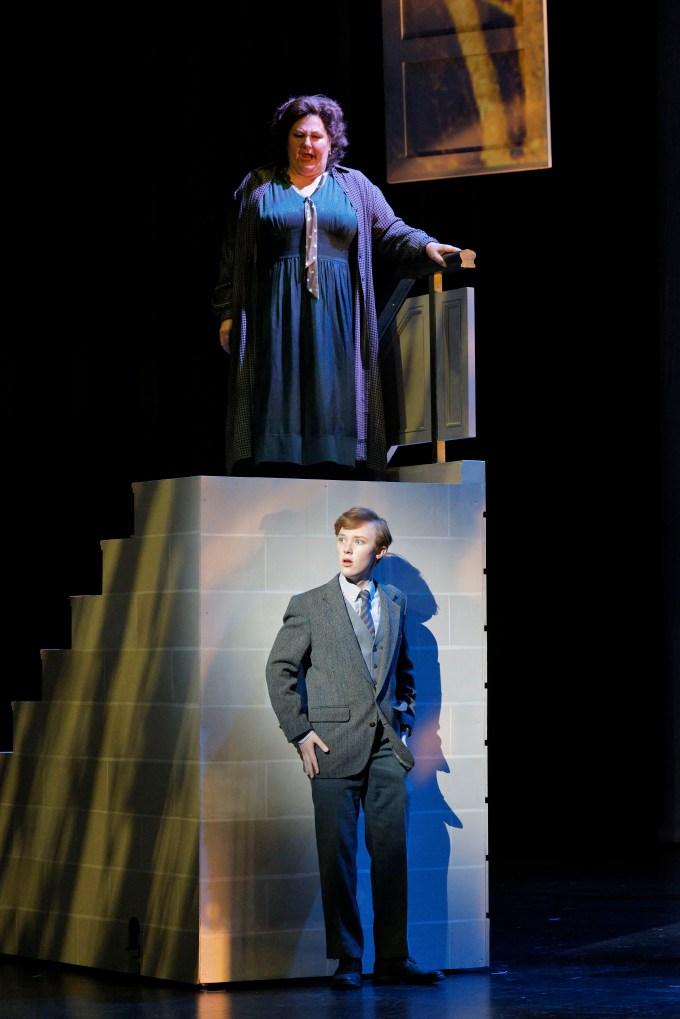
Harvey Milk Reimagined

Matt Boehler (Mayor George Moscone), Michael Kelly (Harvey Milk). All photos by Cory Weaver.

Gay men are overrepresented in opera audiences, but only in 1995 did a gay man become the central figure in an opera.  Notably, that first central figure had been the first openly gay man to be elected to a major city office, and tragically, the first to be assassinated.

Even though commissioned by primo opera companies, the original Harvey Milk suffered bloat in composition, story line, and cast.  However, the arc of Milk’s life and death resonates with historic significance and operatic substance, thus Opera Parallèle and Opera Theater of Saint Louis commissioned a major revision that excels musically and dramatically with moments of poignancy, revelation, and joy.   Its trimmed design facilitates production by smaller opera companies, so, unlike the original, this celebration of a great icon for equal rights for all should have legs.

Catherine Cook (Mama), Curtis Resnick (Young Harvey).

The music is modern, yet accessible, with concise and meaningful lyrics.  The revision emerges at a time when the equality for all that Harvey Milk fought for courageously is under attack from the very government that should be protecting everyone from discrimination.

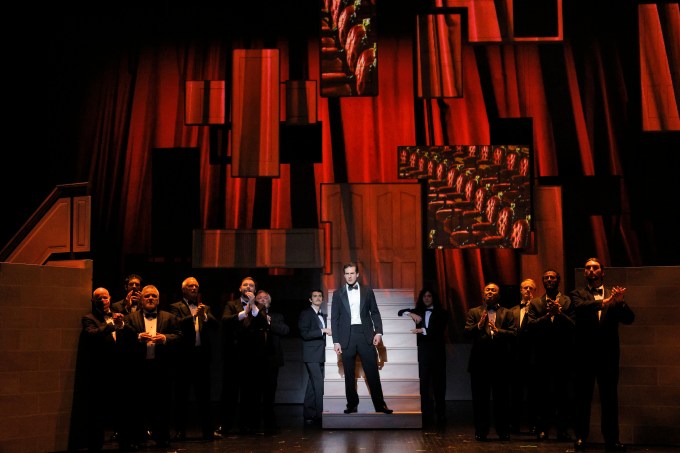
The spectacular opening orchestration captivates aurally and the staging visually.  A pastiche of sound  (design by Ben Krames) incorporates the bombasity of a Philip Glass movie with chaotic clashing and gutteral throat singing, along with samples of the Scarpia theme from Puccini’s Tosca and Wagner’s motifs from The Ring Cycle and Der Fliegende Holländer.  Brian Staufenbiel’s creative direction with Jacquelyn Scott’s scenic design stuns in its total angularity, wonderfully enhanced by Mextly Couzin’s lighting and David Murakami’s projections.

Michael Kelly (Harvey Milk).

An upstage scattering of doors represents coming out of the closet.  Four mobile staircases that can be variously separated and interlocked like so many Lego blocks, serve as an ascending platform for depicting action. They also symbolize Milk’s climb from anonymity to brief political and social consequence but lasting impact.

Though Harvey Milk became a San Francisco idol, composer Stewart Wallace and librettist Michael Korie sought to contextualize Milk’s evolution from his boyhood in Long Island, New York, and over one-third of the run time tracks his changes before moving to California.  Tenor Curtis Resnick portrays the young and naïve Harvey.  He learns from observing male attendees in formal wear after an opera at the Met that they differ from men in his small hometown, where bowling is the major diversion. He also learns that he is attracted to men, which becomes a life-defining moment that he can never share with his beloved Mama.

Henry Benson (Scott Smith).

Early in Act 1, the libretto adeptly juggles multiple realities simultaneously.  Harvey contends with the sexual changes that he feels and the closeted life he will lead in New York, even while a Goldwater Republican and Wall Street analyst.  The gay men, represented by the men’s chorus, lead open lives but are traumatized by the riots at the Stonewall Inn.  Meanwhile, Mama, portrayed in solitude by Catherine Cook, is haunted by memories of the Holocaust and fear for her son.

These events coalesce in Harvey’s mind.  He conceives of his personal Star of David being comprised of the Nazi’s yellow triangle for Jews and pink triangle for homosexuals and sings the affecting aria “I remember.”  This also leads to the beautiful duet “This warm night in June” with Scott Smith (played by Henry Benson), who would become his business partner as well as lover.

As the scene shifts to San Francisco, we meet the circle of people who would become famous along with Harvey.  One of the strengths of the libretto is that the three central figures, Dan White (Christopher Oglesby), George Moscone (Matt Boehler), and Milk are depicted in shades of gray.  Despite White’s premeditated villainy, we are told that he reflected common values – that he didn’t drink, smoke, or swear; that he had a history of civic employment and involvement; and that he had concern for his family.   Of course, his common values sometimes came into conflict with those of the gay community as expressed in the bouncy anthem “Out of the closet and into the streets.”

Michael Kelly (Harvey Milk).

The mature Harvey is portrayed by baritone Michael Kelly who personifies Harvey’s charisma, while revealing his imperfections along with his passions and anxieties.  Notwithstanding his monumental contributions to his chosen cause, he could be expedient, and White’s resentment toward him derived from White’s feeling betrayed.

Though progressive, Moscone practiced realpolitik when needed.  The event that triggered the assassinations was White’s resignation from the Board of Supervisors because of the financial sacrifice, shared in his telling aria “Beans and franks.”  But he then wanted to return and insisted “A man can change his mind.”  But Moscone, who initially signaled support for White’s return and controlled that decision, cruelly turned White’s words upon him when Moscone ultimately decided to deny the request.

Marnie Breckenridge (Diane Feinstein), Christopher Oglesby (Dan White).

Harvey Milk Reimagined engages on all levels with the score driven by the Nicole Paiement conducted orchestra.  A minor criticism is that the title lacks clarity or vitality.  Is this a rethinking of Harvey Milk as a person?  Among myriad options, a fitting alternative would be Mayor of the Castro or The Life and Times of Harvey Milk.  Afterall, Verdi refashioned Stiffelio as Aroldo, Gustavo III as Un Ballo in Maschera, and more.

A more substantive and emphatic criticism is the amplification of voices.  Opera’s central fascination perhaps is the human voice receiving its highest possible expression, with one acoustic singer thrilling the ears of up to thousands of listeners or a single soprano soaring above a chorus of many.  Modern composers, John Adams being the foremost, who abandon the virtue of a well-trained voice, reduce the vocal grandeur of a Pavarotti to an equivalency with a common lounge singer.  What is the excitement of a home run if the walls are moved to just behind the base paths?  With micing, evaluating or appreciating the quality of a singer’s voice becomes futile, so with due respect to the artists, I’ll pass on that.

Christopher Oglesby (Dan White – left), SF Board of Supervisors members, Michael Kelly (Harvey Milk – right).

Fortunately, Harvey Milk Reimagined has much to recommend it.  Hopefully, the decision makers in future productions will reserve amplification for special effects.

Harvey Milk Reimagined, composed by Stewart Wallace with libretto by Michael Korie, is produced by Opera Parallèle and appears at Blue Shield Theater at YBCA, 700 Howard Street, San Francisco, CA through June 7, 2025.