Die Walküre

Ryan Speedo Green as Wotan. All photos by Curtis Brown.

No accomplishment in the world of opera exceeds Richard Wagner’s four opera Der Ring des Nibelungen or Ring Cycle compendium. With 15 hours of staging and 28 years in the making, it was a massive undertaking. Apart from extensive storytelling and the quantity of music involved, its intellectual integrity distinguishes it with its focus on a detailed dramatic arc; continuous music at the expense of popular set pieces, with no ensembles and choruses; and elaborate use of leitmotifs to identify characters and moods. Nonetheless, purity does not ensure that all will find the outcome entertaining.

While the four operas constitute a whole that is intended to be seen together over a short period of time, Die Walküre is the one that perhaps stands alone most successfully as a complete story with a satisfying beginning and end – even if complete closure is not reached. Among the many moral issues from incest to integrity, it deals with one great moral dilemma, betrayal, expressly and in considerable depth that gives it an extra dimension. Santa Fe Opera offers the opera for its very first time, and the result is magnificent.

Soloman Howard as Hunding, Vida Miknevičiūtė as Sieglinde, Jamez McCorkle as Siegmund.

At 4 ½ hours run time including two intermissions, Die Walküre’s storyline reduces to a few basic transactions. The opera opens with Siegmund, portrayed by tenor Jamez McCorkle, displaying a huge voice, especially in a sequence calling for his deceased father. He takes refuge in the home of what turns out to be an enemy, Hunding (Soloman Howard, with a rumbling bass voice), whom he must fight to the death. Siegmund falls in love with the host’s wife Sieglinde (soprano Vida Miknevičiūtė). They find they are siblings, but their tryst leads to pregnancy that will ultimately produce Siegfried, the hero of the next opera in the cycle.

Wotan (bass-baritone Ryan Speedo Green) is the king of the gods, and mortal Siegmund has descended from his illegitimate child. However, Wotan’s wife Fricka (imperious mezzo Sarah Saturnino), is an ally of Hunding’s family and resentful of Wotan’s promiscuity that ultimately led to Siegmund’s birth. She insists that Wotan use his power to ensure Siegmund’s death in the battle.

Sarah Saturnino as Fricka.

Meanwhile, Brünhilda (soprano Tamara Wilson), the leader of the Valkeries, who are the daughters of Wotan, sympathetically aids the illicit couple, as Sieglinde had been abducted and abused by Hunding. Although her assistance fails, Wotan disowns his favorite daughter and alter-ego for her betrayal and reduces her to a mortal to lie in a sleep state until discovered by a man and taken for his wife.

That process is perhaps the best developed moral internal conflict in the Ring Cycle, one that reflects dilemmas that leaders of all kinds face when a beloved or highly valued underling has betrayed trust. The punishment pains the leader as well as the follower. Wagner was nothing if not thorough in his narratives, and this is a good example of why Ring operas are so long, as he dwells on this issue for much longer than needed with the verbal clashes and bouts of empathy between Wotan and Brünhilde.
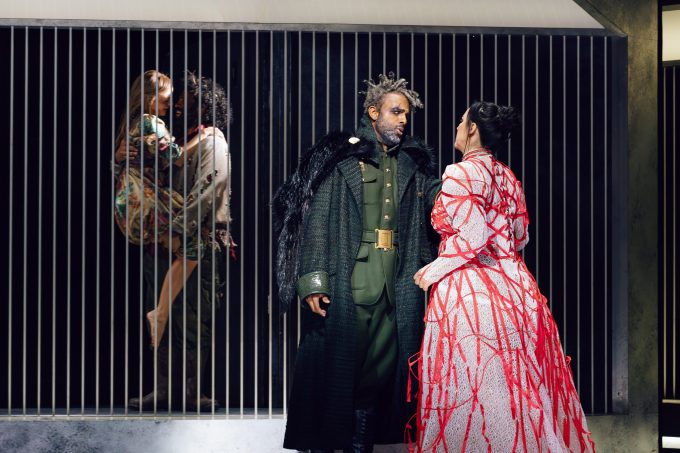
(foreground) Ryan Speedo Green as Wotan, Sarah Saturnino as Fricka, (rear) Vida Miknevičiūtė as Sieglinde, Jamez McCorkle as Siegmund.

Led by the commanding voices of Green and Wilson, cast selection is impeccable, and they deliver the goods. Wagnerian singers must possess powerful voices with heroic, some would say harsh, tone able to compete with the large orchestra that Wagner demands. To make sure that the singers get an adequate workout, roles with higher vocal ranges generally have high tessituras as well. And though Wagner eschews the notion of arias, each principal has at least one long, highly challenging soliloquy.

The biggest surprise of the evening was Miknevičiūtė as Sieglinde. Despite a distinguished European career, this was her American debut, and she wowed with the easy power and range of her mellifluous voice and her compelling stage presence.

Soloman Howard as Hunding, Ryan Speedo Green as Wotan, Jamez McCorkle as Siegmund.

The more melodic music in the Ring is often in the orchestra, and perhaps its most famous is the stirring “Ride of the Valkeries,” whose motif recurs through the final two acts. Associated with it is Brünhilde’s equally spirited “Hai Jo To Ho” which Wilson delivers with relish. Otherwise, it is notable to remember that while singers exert and then relax or disappear during the opera, the orchestra performs the whole time, and musicians’ lips and fingers can tire. Kudos to Conductor James Gaffigan and the orchestra for not only enduring, but excelling.

Director Melly Still and Scenic Designer Leslie Travers’s stunningly sharp abstract look in Acts 2 and 3 is simple in its appearance but complex in its design, which is easier to understand by seeing the included images than reading about it. Stands of closely-arranged vertical, white rubber ropes span the full breadth of the stage. Irregularly arranged red ropes decorate above the white rope frame. The white ropes convey separation and opaqueness, and their flexibility allows the functionality of egress for the characters. The red ropes presumably represent entanglement. Truncated trees and other scenic references to reality occur to enhance the meaning and the visual presence. Add to it Travers’s striking costumery for supernumeraries plus their depictions and movement as horses, dancers, and others, and the visual array is superb.

Tamara Wilson as Brünhilda.

The part of the visual design that detracts from the overall effect is Hunding’s modern dilapidated house with rusted appliances in Act 1. Likewise, the costumes and makeup of the principals are shabby and make the players look like homeless people, and that even extends to Wotan when he goes topless.

Hunding’s wealthy family are close associates of the most powerful goddess, Fricka, and the others are descendants of the leader of the gods. Not only does this look seem inappropriate for the station of the characters, but it is aesthetically unpleasing. There are many ways to be creative in design, but unlike the thoughtful scenery in Acts 2 and 3 as well as the interesting depictions of non-principal players, this portrayal of poverty or slovenliness serves no appealing purpose.
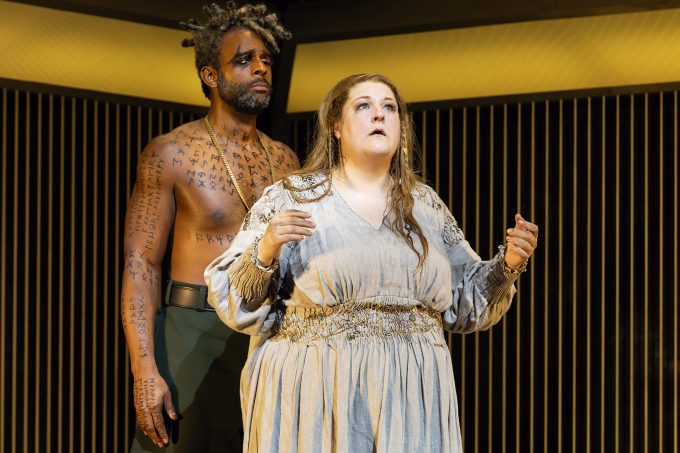
Ryan Speedo Green as Wotan, Tamara Wilson as Brünhilda.

In any event, the production marks an exemplary debut by Santa Fe Opera of this notable work.

Die Walküre with music and libretto by Richard Wagner is produced by Santa Fe Opera (www.santafeopera.org) and plays on its stage at 301 Opera Dr., Santa Fe, NM through August 21, 2025.

Rigoletto

Michael Chioldi as Rigoletto. All photos by Curtis Brown.

On the strength of several renowned operas, Giuseppe Verdi became Italy’s premiere opera composer by 1851. But it was only with the emergence of the masterpieces from his rich middle period that he became the most eminent composer in the genre. The works that marked this ascendance remain among the most revered today – La Traviata, Il Trovatore, and the first produced of the three, Rigoletto.

Common to all three is tragedy – the death of a loved one attributed to poor decisions by the ones closest to them. In the case of Rigoletto, the murder of the jester’s daughter results from revenge gone awry. Besides revenge and betrayal, the opera also explores themes of romantic love, filial love, social structure, integrity, and more.

Le Bu as Count Monterone.

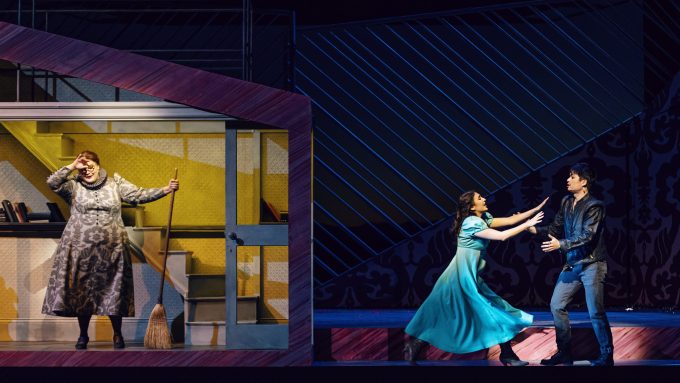
Santa Fe Opera’s current realization is buoyed by Verdi’s timeless music with a raft of great arias and ensembles delivered by a cast of outstanding singers. The most distinguishing element is the staging which is professional and thematically consistent but will not be to everyone’s liking.

Like many operas from earlier eras, Francesco Maria Piave’s somewhat jumbled and gap-filled libretto is not without controversy. In its own day it was considered immoral, while today its dissonance derives from its social incorrectness. While the jester Rigoletto obsesses over his daughter Gilda’s honor, his publicly lampooning courtiers as being cuckolded is fair game. Notwithstanding their purported waywardness, women are treated as property.

Simona Genga as Giovanna, Elena Villalón as Gilda, Duke Kim as Duke of Mantua.

The debauched Duke of Mantua, Rigoletto’s employer, is performed by Duke Kim, who is tested from the starting gate with his lively aria “Questa o Quella” (“This One or That One”). He proves to possess a very Italianate lyric tenor voice with just the right amount of tremolo and lilt. For an assignation, the duke targets Gilda who has arrived only recently and is closeted by her father, and is assumed to be a lover, not a daughter.

Gilda, performed by exquisite soprano Elena Villalón, quickly falls in love with the duke, who has disguised himself as a poor student. At this point, Villalón elegantly sings one of the most hauntingly and haltingly beautiful numbers in the repertoire, “Cara Nome” (“Dearest Name”) to show Gilda’s love to this fictitious Gualtier Maldé. Although the duke is infatuated with her as well, he seeks dalliances with others, yet she is willing to sacrifice for her libertine lover.

Elena Villalón as Gilda, Michael Chioldi as Rigoletto.

Baritone Michael Chioldi is quintessentially adventuresome in performing innovative works, yet he has also sung this title role at the Met, and his rendering here is magnificent. His authoritative and penetrating foghorn voice carries the right mix of caustic humor and ennui, and his stage presence dominates. Somewhat surprising is that, unlike Gilda and the duke, he has no hummable signature aria. Nonetheless, he delivers every vocalization with aplomb, and his rage and lament aria after Gilda has been abducted is particularly poignant.

Although earlier acts are dramatic, the final act in a tawdry inn chills as Rigoletto first affirms the duke’s duplicity. Here Kim sings with great relish the universally known if clichéd “La Donna è Mobile” (“Woman is Fickle”), hypocritically, given the duke’s romantic inconstancy. But what follows is the stunningly beautiful and revelatory “Bella Figlia dell’ Amore” (“Beautiful Daughter of Love”) which starts as the duke’s love aria to the mistress of the inn but becomes a wonderfully conceived and performed double duet, as Rigoletto and Gilda secretly witness the tryst and concurrently sing of the betrayal. Finally, the tragedy plays out.

Michael Chioldi as Rigoletto, Elena Villalón as Gilda.

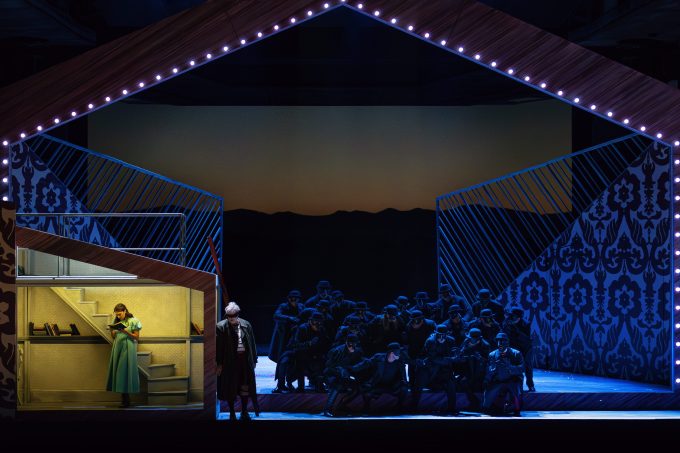
One of the challenges of producing war horses that aficionados have seen many times is the dilemma of whether to stick to the original intention of the composer and librettist or whether to breathe new life into the opera by changing era, location, or even the facts or tone of the action. Director Julien Chavez deserves credit for the creativity that has gone into this innovative version, but his vision does not completely work for me.

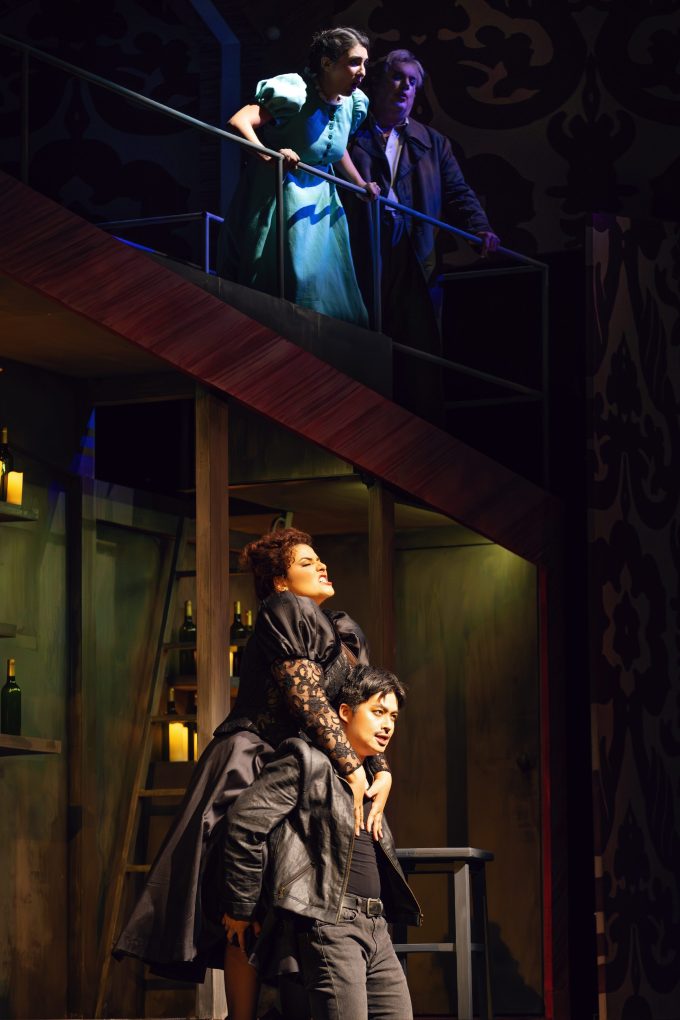
The abstract set gives the appearance of burgundy and cream gift wrap framed by makeup lights, and the first costumes of the chorus repeat the look of the walls, which seems forced. Also, the depictions of the interiors of Rigoletto’s apartment and the inn are like doll house dioramas, and particularly the former is undersized and cramped relative to the players. That said, some visuals are quite stunning.

Stephano Park as Sparafucile, Marcela Rahal as Maddalena.


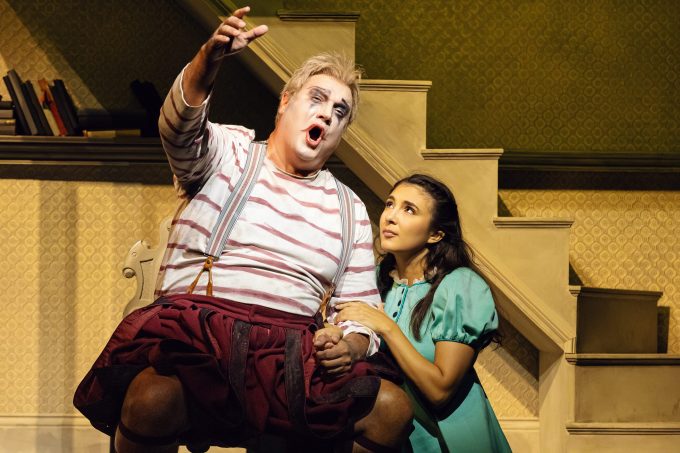
What is more concerning is that while Rigoletto is a tragedy of the highest order that should maintain tension, silliness abounds. Sometimes with (apparently) red lipstick, a dangling earring, and black togs, the duke looks like a refugee from a leather bar and never convinces as one of the highest station. Rigoletto’s maid acts like a giddy Mrs. Doubtfire, and the courtier perpetrators of Gilda’s kidnapping skulk like Boris and Natasha from Rocky and Bullwinkle. Young, first time opera goers often snicker inappropriately anyway, and the inclusion of frivolousness only encourages them to see more humor that is not intended.

Happily, the power of the music conducted by Carlo Montanaro, fine singing, and the unique Santa Fe Opera experience make for a compelling and enjoyable entertainment.

(above) Elena Villalón as Gilda, Michael Chioldi as Rigoletto, (below) Marcela Rahal as Maddalena, Duke Kim as Duke of Mantua.

Rigoletto, composed by Giuseppe Verdi with libretto by Francesco Maria Piave, is produced by Santa Fe Opera (www.santafeopera.org) and plays on its stage at 301 Opera Dr., Santa Fe, NM through August 20, 2025.

The Turn of the Screw

Jacquelyn Stucker as the governess, Brenton Ryan as Prologue. All photos by Curtis Brown.

Drama in opera is relatively easy. The plot does the heavy lifting. Other idioms pose additional challenges. The rare class of ghost stories in opera also requires tingling music; good acting; and more precise action and reaction. In that genre, The Turn of the Screw has long been regarded by most aficionados to be the most successful example. Henry James’s novella proves a fine basis for a spooky chamber opera, and Benjamin Britten’s music fits beautifully. Santa Fe Opera’s handsome production brings out the best in the material.

In a turn-of-the-20th-century chronicle in rural England, a governess is hired by a London-based guardian to care for a boy Miles and a girl Flora, children of his late brother. The conditions are that she make all of the decisions concerning their upbringing and that she not contact the guardian. In time, two deceased former employees of the estate, Peter Quint and Miss Jessel, appear to the governess, but not to the housekeeper, Mrs. Grose. Further incidents leave the governess distressed and lead her to question whether the children are possessed by the ghosts and to wonder about her own sanity.

Jacquelyn Stucker as the governess, Jennifer Johnson Cano as Mrs. Grose.

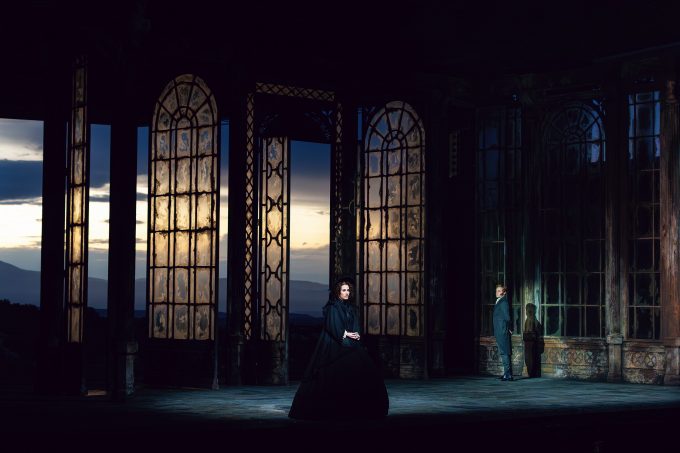
The action takes place on Christopher Oram’s striking set with a back wall of huge, high arched windows and windowed doors. Rather than clear glass, the panes are like a murky isinglass that yields mostly shadows on the other side. A small pond of water on the corner of the stage’s apron into the wing offers optional egress – to a watery grave? Sharp lighting designed by Malcolm Rippeth provides threatening contrasts and shadows, accentuated further as one character, and later another, exits the stage though the water in darkness with only a key light illuminating the face.

The obscurity from the window glass is in keeping with James’s theory of revealing as little as necessary about the people and situations, believing that if readers/viewers know too much, they can be dismissive of the author’s notions, not to mention that sketchiness adds to the mystery. Backstories to embellish characters’ personas are non-existent. And if you’re wondering why the governess’s name hasn’t been mentioned, it’s because neither James nor the opera’s librettist Myfanwy Piper granted her one.

Everett Baumgarten as Miles, Annie Blitz as Flora.

To add to the ambiguity, Director Louisa Muller cleverly keeps the governess onstage throughout, sometimes in a sleep state. Does this suggest that the governess is the narrator of her subjectively perceived story, or that the whole account is perhaps a delusion – a dream?

Meanwhile, should the children be trusted? At times they are playful and seemingly innocent. But each engages in menacing acts. Perhaps because of his “station,” Miles considers himself more adult than he is and refers to the governess with a condescending “my dear.” He even sings a song “Malo” (meaning bad), and asks the governess provocatively, “Aren’t I bad?”

Children masked, Jacquelyn Stucker as the governess.

Britten’s composition makes fine use of a chamber orchestra to create the unstable, ominous sense of vulnerability. The score contains several leitmotifs, the most significant being the varying screw theme used in each of the 16 scenes, with its unsettling successions of rising major fourths and descending minor thirds. Conductor Gemma New executes with both brisk and languid precision, often highlighting solo instruments with great clarity as a bassoon warbles, bells tinkle, drums tick, and chimes toll as if a death knell.

A high vocal tessitura adds to the tension. The score is dominated by female voices, and the two male voices are a tenor and a treble (boy soprano). In addition to some notable but not memorable arias, several ensembles are the most compelling moments in the music, evidencing agitation among the characters.

(rear) Brenton Ryan as Peter Quint, (foreground) Jacquelyn Stucker as the governess, Everett Baumgarten as Miles.

The fine cast of four adult players is led by Jacquelyn Stucker as the governess. Her dramatic soprano voice with a steely edge especially fits the dissonant sections of the score, but one of the contradictions in the vocal requirements is that a young and at-risk female would have such a powerful voice. Stucker’s acting also excels as she descends into the spiral of horror.

High marks to the other mature artists as well – Jennifer Johnson Cano as Mrs. Grose, Wendy Bryn Harmer as the ghost of Miss Jessel, and Brenton Ryan as the ghost of Peter Quint. Child performers, veteran Everett Baumgarten as Miles and Annie Blitz as Flora suit their parts well.

Wendy Bryn Harmer as Miss Jessel, Jacquelyn Stucker as the governess.

Performed at Santa Fe Opera’s fabled sides-open-to-the-elements venue, this production also opens the backstage wall partly to nature. I envy anyone who gets to see this production on a night of thunder and lightning storms, which are common in Santa Fe summers. What a wonderful setting for a ghost story!

The Turn of the Screw composed by Benjamin Britten, with libretto by Myfanwy Piper and based on the novella of the same name by Henry James, is produced by Santa Fe Opera and plays on its stage at 301 Opera Dr., Santa Fe, NM through August 5, 2025.

The Rake’s Progress

(far left) Aleksey Bogdanov as Nick Shadow, (foreground) Adrian Kramer as Tom Rakewell, Marc Webster as Mr. Trulove, Lydia Grindatto as Anne Trulove. All photos by Kayleen Bertrand / Glimmerglass Festival, except where otherwise noted.

Like many innovative artists, Igor Stravinsky, one of the most influential music composers of the 20th century, evolved through distinct stylistic periods. As his neo-classical period reached its end in 1951, he produced his only completed opera, The Rake’s Progress. Although it has proven to be one of the most enduring and popular in the English-language opera canon, it was not critically well-received at the outset. Atonal serialism, initiated by Arnold Schoenberg and later adopted by Stravinsky, had long dominated serious music. The Glimmerglass Festival offers a winsome version of this important opera, led by a stellar cast and a powerful look.

The composer was drawn to William Hogarth’s series of paintings, A Rake’s Progress, whose genesis is based on the Orfeo myth. To create the narrative, Stravinsky turned to eminent poet W. H. Auden, who later drafted another poet, Chester Kallman to the project. Not surprisingly, this team created one of the most literate librettos in this fantasy opera, full of poetic syntax, beauty, and allegory.

Cast.

Tom Rakewell is a country boy who shuns a regular job and instead hopes to fare well relying on his wits. Along comes Nick Shadow, who, unbeknownst to Tom, is the Devil. Shadow offers to be Tom’s servant and to introduce him to the high life in London, which turns out to center on a brothel. Only too late will Tom realize the mistake that he’s made.

The part of Tom represents one of the more challenging tenor roles in the repertory. Not only is his stage time enormous, but his four major arias can sap the strength. Fortunately, athletic Adrian Kramer has the stamina, as well as the vocal skill, to carry it off with seeming ease. He steps up in particular with his signature aria “Here I Stand,” which reflects his delusional confidence in his ability to make good choices with good outcomes.

Aleksey Bodonov as Nick Shadow, Adrian Kramer as Tom Rakewell.

As the faux ally who leads Tom to his descent, Aleksey Bogdanov performs Nick. His slick and swarthy appearance telegraphs his deceit, and while his deep, burly voice resonates ominously, he gains Tom’s confidence by saying things that he wants to hear.

In pursuing his fancy, Tom also abandons his betrothed from the country, Anne Trulove. Lydia Grindatto is the vision of innocence as the mournful yet hopeful Anne, who will continue to naively pursue Tom. Perhaps the best received singing in this opening performance was Grindatto’s long, beautiful Act 1 soliloquy, “No Word from Tom,” in which she excels, displaying her rich coloratura soprano voice.

Cast.

Visual elements on stage are a bit staid until the brothel scenes when they explode. The score makes considerable use of choruses, and the choristers in effect double as a corps de danse who contribute to the overall appearance. Dressed at this point in tawdry black and white, the carnal look and undulating movement is reminiscent of what you might see in Cabaret or Three Penny Opera.

In Tom’s plunge to the bottom, we meet the final main character, Baba the Turk. By some twisted logic, Nick induces Tom to marry Baba as an act of independence in Nick’s deceitful aria “Master, Observe the Host of Mankind.” Baba is performed by muscular-voiced mezzo, Deborah Nansteel, who gets to display her overall power, and particularly the strong top end of her range when Tom turns on her. Her “Scorned! Abused! Neglected!” is a raging tour de force. Oh, did I fail to mention that Baba is a bearded lady in a circus? Well, things do get worse, as all of Tom’s three great wishes go asunder, but I’ll leave it to the reader to suss out those details.

Deborah Nansteel as Baba the Turk. Photo by Brent Delanoy.

From this reviewer’s perspective, the least engaging element in the opera is the music itself. Coming from a great composer, it is technically refined with a classical backbone but dissonance to match the discomfort of the characters. Opportunities do exist for singers to stretch their vocal muscles. Choruses and ensembles, especially a duet between Tom and Nick as well as a couple of trios, appeal, though these gems are too short. Yet, nothing in the music is memorable or will appear in the Top 100 Hits from Opera.

Nonetheless, the colorful narrative fits the music well, and the production aptly fulfills the demands of the opera. It also makes a strong statement that is worth hearing – “Idle hands are the devil’s workshop.”

Cast.

The Rake’s Progress, composed by Igor Stravinsky with libretto by W. H. Auden and Chester Kallman, is produced by Glimmerglass Festival and plays at Alice Busch Opera Theater, 7300 State Highway 80, Cooperstown, NY through August 15, 2025.

The House on Mango Street

Taylor-Alexis DuPont as Sally, Micaela Bennett as Esperanza. All photos by Kayleen Bertrand / Glimmerglass Festival except as noted.

Since its publication 40 years ago, Sandra Cisneros’s The House on Mango Street has been one of the most powerful literary forces in the teen and young adult market. With over 6 million (reference: Wikipedia) or 8 million (according to the author) books sold, its popularity is buoyed by frequent listing in high school curricula and by notoriety from banning.

Having previously received permission to compose songs from the book’s text, Derek Bermel asked Cisneros to collaborate in creation of an opera based on the book. Glimmerglass Festival has commissioned and premiered the work with a stunningly rich depiction of life in a Mexican-American neighborhood in1980s Chicago. The opera entertains as its vibrant, eclectic music manifests the diverse musical culture that lives in Chicano communities.

Mikaela Bennett as Esperanza.

Cisneros speaks of identifying the 10 things that only you know about, and then revealing those you want to forget. She does this in The House on Mango Street with colorful images and eloquent language. These vignettes draw from the author’s own upbringing and experience teaching in an immigrant community. Like the music, the episode-driven format is both a strength and a weakness, highlighting diversity at the expense of drama.

Events reflect the world perceived by teenage girl, Esperanza, portrayed by promising soprano Mikaela Bennett. Like some neighborhood denizens, she dreams of getting away from Mango Street, while others love life there, perhaps because it is the only one they know.

Cast. Photo by Brent DeLanoy / Glimmerglass Festival.

Esperanza has her own story, mournful but not tragic, as she comes from a stable background. She suffers ridicule because of her long name and even its optimistic meaning – hope, in English. As articulated by a friend, she seeks the three things that matter to a girl transitioning to womanhood – education, financial self-sufficiency, and avoiding pregnancy. While she lacks experience in many areas, she also strives to help her friends avoid pitfalls. But Esperanza’s resolve will be tested when she herself is victimized.

Nearly 30 named principals enliven the narrative, resulting in street scenes full of energy and movement – the twins Lucy and Rachel who live for today; Cathy the Queen of Cats with her flashy style; Alicia the college girl with lectures on everything; Sire and Tito, the fast boys with cool grooves. No doubt, these characters animate the novel. But while they give great color to the opera and sparkle individually, many of the episodes involving them impede the dramatic arc.

Angelo Silva as Geraldo.

Esperanza’s own story provides drama, as do her intersections with two other characters. Sally is performed by a strong-voiced and effusive Taylor-Alexis DuPont, whose arias display a hefty top end to her voice. She is a good friend of Esperanza’s with an even more engrossing narrative. She tries to walk the line by having a good time with the boys, but not allowing them to go further than she wants. Sally also suffers abuse from her father, with whom she has a complex relationship often common in these situations.

The other dramatic personage is the most humble and least integrated into the social structure of the community. He is Geraldo, the street vendor, who, though poor, best recognizes the richness of what he has. Working conspicuously in the open, and sadly relevant to our times, his biggest fear, like that of many others, is deportation. He will suffer tragedy that links him to Sally. An adjustment that doesn’t stray far from these three characters’ storylines would probably result in less brightness but a more taut and compelling stage drama.

Mikaela Bennett as Esperanza, Taylor-Alexis DuPont as Sally, cast.

The music that supports the libretto brims with hummable melodies; tweaks the nostalgia with samplings of the likes of “Guantanamera” and “Habañera” from Bizet’s Carmen; and serves up all manner of musical styles. The twins, who are from South Texas, sing in Tejano style; Sally’s “Take and Take” is gospel-like; Sire’s “Ought Not To Be” is hip-hop; and more. Some may consider this pastiche, but in any case, it is spirited and works well. The most touching is the concluding number, Esperanza’s ballad, “A House of my Own,” which summarizes her hope for a better life. The beautiful soundtrack with its mix of idioms sounds almost like a sung-through musical, which some operagoers may find too far from the classical vein or from the received operatic wisdom of today to consider it appropriate to the opera house.

An additional element that makes The House on Mango Street work is its visual cacophony, and I mean that in the most positive sense. World-renowned John Conklin, who died less than a month ago at age 88, came out of retirement to set design four productions, including this one, for the 50th Anniversary Season of Glimmerglass. Conklin may be known to Bay Area fans for his design of San Francisco Opera’s Ring Cycle. This representation is astonishing with flushes of red, stick-skeleton houses, a huge El Muerto puppet and giant clown faces. The bold look brings the street to life. Add the costumery and movement of the players on stage, and the vitality of Director Chía Patiño’s vision makes for a special experience.

Cast. Photo by Brent DeLanoy / Glimmerglass Festival.

Of course, credit should go to the original source material for the opera. With all of its sadness, Sandra Cisneros paints a loving picture of coming of age and of a people whom she honors and whom deserve to be celebrated.

The House on Mango Street, a world premiere composed by Derek Bermel with libretto by Sandra Cisneros and Derek Bermel, is produced by Glimmerglass Festival and plays at Alice Busch Opera Theater, 7300 State Highway 80, Cooperstown, NY through August 16, 2025.

Les Blancs

Jeunée Simon as Tshembe, Brittany Sims as Abioseh, Monique Crawford as Eric. All photos by Ben Krantz Studio.

The longest running Off-Broadway show in 1968-9 was Lorraine Hansberry’s autobiographical To Be Young, Gifted, and Black, drawn from her unpublished writings (It was the very first real play this reviewer ever saw – on a day pass from U.S. Army Basic Training at Fort Dix, New Jersey). Tragically, Hansberry never lived beyond young, having already died from pancreatic cancer at age 34.  After her death, the papers were adapted for the stage by her artistic partner and ex-husband Robert Nemiroff.  Also produced posthumously was the work she considered her most important, which was not quite completed at her death.  That was the play Les Blancs, which was also adapted by Nemiroff.

Oakland Theater Project and Director James Mercer II have produced a vivid and powerful rendition of Hansberry’s chilling play about relationships between colonials and locals in an undisclosed African country during a time of instability.  Notwithstanding a brilliantly delivered narrative, the production does have one considerable fault to be discussed later.

Champagne Hughes as Charlie Morris.

The complex drama challenges the theatergoer by offering up characters from various social, political, and racial backgrounds that refuse to fit conveniently into neat little boxes.  And the action involves brother versus brother in the very literal sense and at the highest level of conflict.

Hansberry was a committed political activist from a young age.  For this, her only play set in Africa, she was particularly influenced by the Mau Mau rebellion in Kenya and by Jean Genet’s play Les Negres.  Hansberry’s title deliberately caroms off Genet’s, and part of her motivation was to challenge the romanticized naivete in Genet’s depictions.

Monique Crawford as Eric, Jeunée Simon as Tshembe.

Les Blancs takes place in a poor village lacking electricity.  European doctors operate a primitive medical facility doing the best they can with poor resources.  It is a time of native terror in revolt against colonial rule, and one doctor notes portentously that even the foreigners who sympathize with the natives and do good works are often victimized by revolutionaries.

Into this tinderbox, Tshembe returns to his homeland from London.  His father was ill but passes before his arrival.  The centerpiece to the cognitive side of the play involves the heated discussions between Tshembe and an American journalist, Charlie Morris.  Each character is flawed, and passionate in his beliefs.  Though they both occupy middle ground in the political spectrum, they still speak past one another and each considers the other a hypocrite.  In effect, Tshembe represents Hansberry’s voice, insistent that colonialism must end, but patient enough to want an amicable parting with the colonial power.  Morris represents Jean Genet and a class of Caucasians who are socially liberal and well-intended, yet condescend and act as apologists for the historic role of colonialists.

Against this backdrop, near-stereotypical characters, but with internal conflicts and complicated underpinnings, interact.  There is the racist white African-born police officer; the elder European widow who considers Africa her home; the otherwise obedient African servant secretly involved in the revolution; the “Uncle Tom” who sells out to western religion, and thus to colonialism; and more.  In time, tragedy ensues, affecting all, not as a conflagration, but as a series of violent incidents.

Jacinta Kaumbulu as Madame Nielsen, Ije Success as Dr. Marta Gotterling.

OTP’s largely abstract scenic design allows the actors to deliver most of the feeling of the environment.  Jeunée Simon portrays Tshembe and creates a riveting persona, who, despite having a foot in the white world and being resistant to joining the terror, demonstrates viewpoints emphatically with body and voice.  Champagne Hughes as Charlie Morris stands up to the onslaught with like fervor.

With regard to the earlier mentioned fault, acting by each of the eight actors ranges from good to excellent.  However, one issue that will cause consternation to some audience members concerns a well-intended but confusing casting approach.  All actors appear to be black women, though the genders and races of some actors may vary from that assumption. Yet they portray black and white, man and woman.  To make things more confusing, three of the actors play two roles each.  Many audience members will be at sea until they unearth the identifications, which are not clear from the outset.

Some natives have European names like Eric and Peter.  And even with a name like Madame Nielsen or a “doctor” named Marta, we cannot assume that they are white until the facts make it clear.  Because all actors are visibly women, with the exception of Simon whose hair is cut in the fashion of a man, I had difficulty perceiving some of the characters as men, whether white or black, to the very end.

Jeunée Simon as Tshembe, Brittany Sims as Abioseh.

Although I am not a psychologist, I suspect that a typical mind can mentally transpose, for instance, one black female opera singer as playing Madame Butterfly, but a whole non-conforming cast taxes the cognitive ability.  As trite as it seems, it would help if markers are identified before the performance by announcing, for instance, that all characters dressed in light colors are Europeans and all in dark colors are African.  It’s unfortunate that trying to disentangle these conundrums distracts from an otherwise powerful experience.

Les Blancs, written by Lorraine Hansberry and adapted by Robert Nemiroff is produced by Oakland Theater Project, and plays at FLAX art & design, 1501 Martin Luther King Jr Way, Oakland, CA through July 27, 2025.

La Vie Parisienne

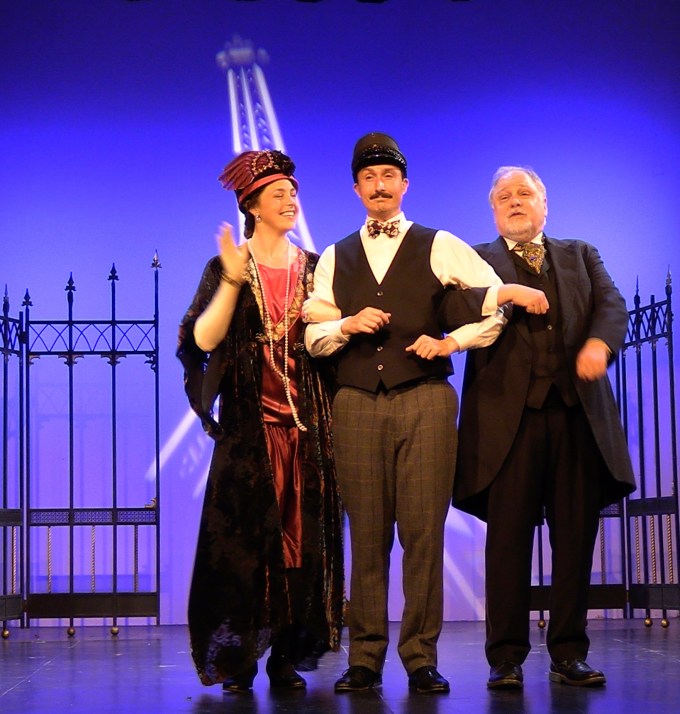
Madison Hatten as Baroness, Andrew Metzger as Gardefeu, Jonathan Spencer as Baron. All photos by Pocket Opera.

[For the remainder of the year, my San Jose and Peninsula theater reviews will be posted on Talkin’ Broadway with only introductions to those reviews on this site]. Please continue to https://talkinbroadway.com/page/regional/sanjose/sj294.html for full review.

Serious music buffs know Jacques Offenbach for his final, unfinished but revered and oft-performed work, the episodic fantasy opera The Tales of Hoffmann.  But in France, he is renowned as the king of operetta with 98 to his credit.  Among his most enduring and endearing is La Vie Parisienne, offered in a well-produced and rousing English language version by Pocket Opera, with its opening at Berkeley’s Hillside Club.

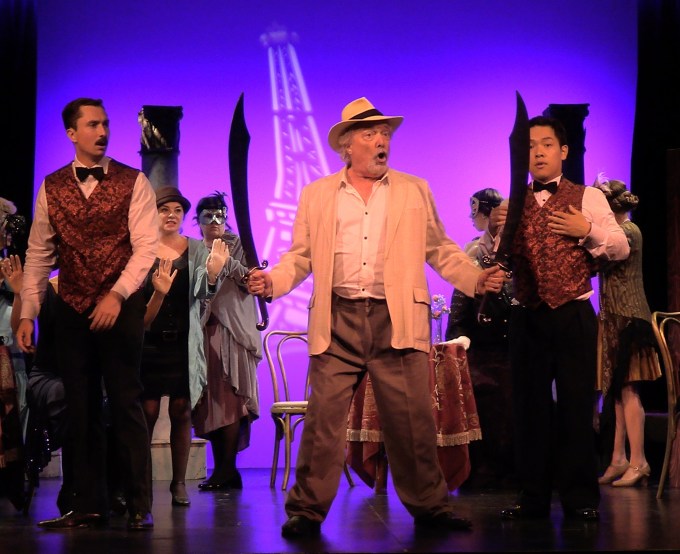
Like most operettas, the storyline by librettists Henri Meilhac and Ludovic Halévy is fanciful.  As Artistic Director Nicolas A. Garcia notes, “Dramatic, it ain’t,” though charming and funny it is.  Parisian dandies Gardefeu (Andrew Metzger) and Bobinet (Justin Baptista) vie for the affection of demi-mondaine Metella (Phoebe Dinga), but when they see her at the train station with another man, the suitors turn to another quarry.  An arriving Swedish baron’s wife (Madison Hatten) appeals, and the baron’s (Jonathan Spencer) wayward ways provide the opportunity for Gardefeu to spirit the baroness away.

Andrew Metzger as Gardefeu, Jonathan Spencer as The Brazilian, Justin Baptista as Bobinet.

The silly subterfuge involves representing Gardefeu’s apartment, where the honored guests will stay, as an overflow of the Grand Hotel, where they are booked.  Dalliances ensue, but in the end, the old alliances are reaffirmed.  Although the plot and humor build slowly, Acts 3 and 4 after intermission redeem the work.  Overall, the artists exude charm and sing the 19th century French pop music with verve.

Offenbach’s music doesn’t possess the sweep of his more serious efforts, but it is lively throughout.  Some of the songs highlight loopy repetition like “frou, frou, toc, toc” or goofy topics like whether boots or gloves are more important to fashion.  The latter is sung by Frick the bootmaker (Michael Mendelsohn) and Gabrielle the glovemaker (Marla Kavanaugh), whose subplot is totally superfluous, but they are pleasing performers, so all is forgiven….. Continue at TalkinBroadway.com .

Phoebe Dinga as Metella, Michael Kuo as Urbain.

Jurassiq Parq: A Musiqal Parody

Vanilla Meringue (Colonel Sanders Hammond), Trixie Aballa (Dr. BD Wang), Elenor Irene Paul (Dr. Laura Dern), Marshall Forte (Dr. Jeff Goldblum). All photos by Nicole Fraser-Herron.

Naughty, bawdy, and gaudy.  That’s what you can expect from pretty much any performance at Oasis, and Jurassiq Parq: A Musiqal Parody does not disappoint.  In many ways, a jukebox musical, it is full of familiar tunes as the characters sing and frolic their way through a genial romp full of visual and verbal sexual innuendo.  The plot, based on the obvious, doesn’t say much, but that’s not why you go to the Oasis anyway.

Perhaps because the wisecracks play into the iconography of the actors, some of the lead players have the names of the actors from the 1993 film rather than the names of the characters they performed.  Elanor Irene Paul is Dr. Laura Dern, while Marshall Forte is Dr. Jeff Goldblum, who is totally lascivious and self-centered.

But rather than portraying Richard Attenborough, drag queen great Vanilla Meringue plays the creator of the park as Colonel Sanders Hammond (Hammond being the character in the film), with an obvious nod to Kentucky Fried Chicken.  This notion gets some gag time in the musical – with video segments suggesting that chickens are descended from dinosaurs and that the Colonel created the four-breast chicken.  It’s also a bit of a riff on the movie Victor/Victoria in which Julie Andrews plays a woman who impersonates a man who impersonates a woman.  In this case, it is a man with a public persona as a female drag queen performing the role of a man, but disguised not to reveal his real appearance.

Snaxx (Triceratops).

Along with the schtick that draws directly from the movie’s leads, there is plenty of space given to song, dance, and mugging by miscellaneous personages.  The well-chosen songfest is replete with well-performed singalong hits from the ‘80s and ‘90s that most of the crowd can relate to.  A taste of the offerings includes Britney Spears’ “Oops!…I Did It Again,” Aerosmith’s “I Don’t Want to Miss a Thing,” Cyndi Lauper’s “Time After Time,” and No Doubt’s “Don’t Speak.”

However, the much-repeated closing anthem, 4 Non Blondes’ “What’s Up?” with its plaintive question “What’s going on?” proves the most poignant.  It speaks to a time of despair; sympathizes with those who feel or are viewed as peculiar; and calls for revolution to get up that “great big hill of hope.”  It’s a sad but vital message for these times.

At one level, the performances are so wink-wink spoofy with over-the-top acting, that it’s hard to appreciate their quality, but the acting is quite decent, and as Billy Crystal would say, some of the voices are “simply mahvelous.”  Oasis is noted for its drag queen performances, but this production includes only dabs of the flamboyant ladies, which may be a disappointment for some.

Evian (Fegosaurus), Kitty Litter (Timy).

What surprises are the production values in this Michael Phillis directed show. To give an idea how similar to theater productions this is, there is a dazzling variety of costumes (Kypper Snacks) and over 1,200 action cues for operators in the lighting and sound design.  Maxx Kursunski’s lighting is notable, though I don’t know if the trail and framing lights that shift colors in the ceiling are permanent or for this show.  Jerry Girard’s sound is carried mostly by hand microphones, which is a bit unusual, but is perhaps a concession to the staging.  Another significant element is the video projections (no design attribution given), which are striking on their own, but also work extremely well in interaction with live characters.

The staging concession referenced is that the action is split between the permanent stage and a temporary platform in the center of the audience.  The division creates a bigness and dynamism in the production that works nicely, but the price to pay is that the audience behind the platform is standing, so they can see the main stage.  And it means these patrons have to hold their drinks.  Table seating between the main stage and the platform is VIP, for an extra charge.

In any case, for those who have not experienced this kind of rowdy LGBTQ entertainment, Jurassic Parq represents a good opportunity to join in the fun.  My wife/editor, Karin, and I probably skewed both the age and sexual preference demographics of the house, but we both had a great time.  For the regulars, it’s just what the doctor ordered.

A cousin of Audrey II, the Venus Fly Trap from “Little Shop of Horrors?”

Jurassiq Parq: A Musiqal Parody, written by Michael Phillis and produced by OasisArts and Michael Phillis, plays on the stage of Oasis Nightclub at 298 11th Street, San Francisco, CA through August 2, 2025.
Constellations

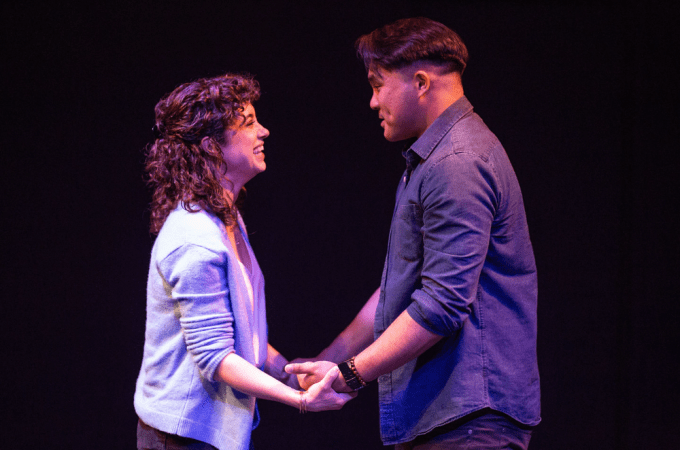
Elana Swartz, Thomas Nguyen. All photos by Reed Flores.

The sun rises each day in the east.  New York City is the most populous city in the United States.  Stephen Curry is a basketball player with the Golden State Warriors.  These would seem to be objective realities – at least as expressed by the verbal symbols for these objects in the English language.

Yet, linguistic theories suggest that the same things are perceived differently depending on the language representing them.  In the social sciences, the theory of Social Construction of Reality suggests that each person perceives a distinct world.  And in the physical sciences, competing theories allow for the existence of parallel universes.

These notions comprise the backdrop for Nick Payne’s innovative and stimulating play Constellations, the title of which suggests perceptive distortion.   While we see constellations in the sky as if all of the stars are in one plane facing us, some stars in the cluster may actually be millions of miles further away from our eyes than others.

Marianne is an astrophysicist at Cambridge University, an intellectual who perceives that there may be multiple universes with corresponding multiples of individuals making decisions with free choice.  Roland, a beekeeper, is grounded in the system of nature as most people would define and understand it.  He is more deterministic, focusing on the natural roles that are laid out for various species.

Vivienne Truong, George Alexander K.

The disparate pair meet and fall in love.  Marianne tells Roland of things like the contradictions of particle and quantum physics, whereas he talks of the utter predictability of the social structure of bee colonies.  As suggested by the gulf in the couple’s world views and interests, nothing in the narrative convinces that these two would ever have a basis for connection, much less marriage – this being one of the gaps in the script that makes it less convincing.

They share the little pleasures of courtship as well as the disappointments with one another along the way.  The compelling conceit of the play is that each of the distinct vignettes between the two is presented three times with variation in each.  In some cases, the exchange is identical until the very end, when the outcome can change.  In others, the three versions differ significantly from the start of the tale.  Otherwise, a significant event may affect one of the partners in the first two tellings of the episode, but it affects the other in the third.  Essentially, the concept reveals the world from Marianne’s perspective of multiple realities. 

Constellations was devised as a two-hander, with the same actors performing all three variations of each episode.  The Pear Theatre has deviated by using three sets of actors playing the two characters.  Not having seen the two-hander format, it’s impossible to criticize with certainty, however, this much is clear.  While the play’s concept is interesting and the specifics of the storyline are mostly very engaging, it is fundamentally a talkfest with little action.

In this version, there is no scenery save for designs of the universe on the stage floor, so it is a truly acting-centric production.  All of the actors are always on a dimmed stage with the spotlight shifting from one couple to another accordingly, creating some dynamism and the energy of six actors.  With only two actors, one can imagine the play to be much more static.

Raven Douglas, Sahil Singh.

Also, with three actors playing each part, it’s a bit like seeing different aspects of their personalities, one Marianne more bubbly, another struggling with aphasia and unable to articulate some of the words that her mind produces.  The two-hander format may allow for more tour-de-force acting, with each actor showing greater range.  On the other hand, it must seem a bit like either an acting class or different takes from filming movie scenes with having to repeatedly differentiate nearly the same material.

The cast of The Pear production, all identified in the photos, excels in creating empathetic characters with their various dimensions.  The minimalist staging suits the spareness of the plotline.

Another interesting format twist by Director Reed Flores is that after the play, some audience members randomly select which actors will play which of the three roles for each character in the next performance.  It could be intriguing to see the play a second time with the actors in different capacities.

Often, theatergoers ask the purpose of a play.  Perhaps the defining contribution of this one is raising the awareness that individual perceptions differ.  Reconciling, or at least realizing, those differences may be the start to better understanding one another.

Constellations, written by Nick Payne, is produced by The Pear Theatre, and plays on its stage at 1110 La Avenida St., Mountain View, CA through July 20, 2025.

The Last Goat

Andre Amarotico as Nikolis, Liris Robles as Cori. All photos by Robbie Sweeny.

Central Works’ unique position in the East Bay market is producing world premiere plays, the current offering being their 77th.  Usually designed for small casts due to the company’s tiny residence at Berkeley City Club, The Last Goat is a three-hander written and directed by company Co-Director Gary Graves.  Its twist on a traditional family theme of elder care triggers turns in the plot that result in a highly entertaining experience with a tense narrative and outstanding execution.

Andre Amarotico as Professor Bull.

Set on the remote Greek island of Kasos in the 12th century BC, two women live in a large, old house – an older woman, Melina, played as dour and suspicious by Jan Zvaifler, and her granddaughter, Kori, portrayed as restless and yearning by Liris Robles.  Blessed with a water source in an otherwise inhospitable terrain, they grow wonderous produce and catch fish from the sea, but they are down to their last goat.  Kori dreams of escape to a normal world, but one of the foundations of family life is that the younger generation, especially females, care for the older when they are in need.

Into their lives comes an intruder, a young man, Nikolis, performed by a seemingly sincere but crafty Andre Amarotico.  His story is that he is from a wealthy family in Mykonos; was returning from war in Ilios; and his boat was sunk by a sea monster of some sort.  He seeks sustenance, shelter, and a way to get back home.

Jan Zvaifler as Melina.

The plot concerns the interactions among the three characters.  We soon learn that, like the goat, the women represent the end of an era as the only remaining humans on an island that has been depleted by plague and war.  But they differ on fight or flight in response to the adversity.

Informed by previous experience, Melina bears an inherent distrust of men, always meeting Nikolis with a knife in her hand.  Zvaifler’s Melina is harsh, cautious, and defensive.  Though he is deferential to the point of obsequiousness, she cynically questions Nicolis’s every motive, repeatedly asking him why he is here and assuming that he holds unstated aspirations at the women’s expense.  At the same time, Kori and Nikolis seem attracted to one another, but is it real, or does each see a way to use the other?  Kori resents and squabbles with her grandmother; finds Nicolis appealing; is prepared to abandon her grandmother to total solitude; and sees Nikolis as her ticket out, if they only had a seaworthy boat.

Andre Amarotico as Nikolis.

Along with the characters’ verbal thrusts and parries come unexpected revelations from their backstories that make for more complex relationships in an engrossing triangle of mistrust.  Nikolis’s clumsiness in responding to some questions only heightens Melina’s skepticism about his trustfulness. Meanwhile, Melina discloses to Kori stories about her parents that the latter had never heard.   Intrigue sets the stage for additional conflict.  Is there a way that these three can reconcile their differences and find some way forward?

The production is well crafted with Central Works’ typically spare staging, which in this case seems appropriate given that décor would not have been well developed in the Bronze Age.  One anachronism however is the use of contemporary costumes, but that decision does allow situational dressing that works well and that the audience can understand.

Liris Robles as Kori.

Acting is solid with particular kudos going to Amarotico, who deserves recognition even before beginning his main role.  At (figurative) curtain up, he masterfully portrays a highly effusive and interesting professor who gives a lecture on the Bronze Era and the locale of the play’s action.  His range is extended as he adroitly expresses the many faces of the opaque Nikolis.

Beneath the surface, The Last Goat explores numerous themes.  Beyond family loyalty and responsibility, it examines self-determination, personal relationships, and life’s priorities.  It is a thoughtful and thought-provoking work.

Andre Amoritico as Nikolis, Liris Robles as Kori, Jan Zvaifler as Melina.

The Last Goat, a world premiere written by Gary Graves, is produced by Central Works and plays at Berkeley City Club, 2315 Durant Ave., Berkeley, CA through July 27, 2025.