Parsifal

Brandon Jovanovich as Parsifal (foreground), Tanja Ariane Baumgartner as Kundry. All photos by Cory Weaver.

Richard Wagner’s greatest renown derives from his four-opera, fifteen-hour-long Ring Cycle, but his favorite among his operatic children was Parsifal.  Over two decades in the making, this was his final opera, displaying the fullness of his organic musical and lyrical powers.  So special was this five-hour masterpiece to Wagner, that he christened it a “sacred festival stage play” rather than an opera and treated it as a religious experience.  And in a rare case of putting principles over profits, the composer required that it be performed only at the Festspielhaus at Bayreuth, his personally consecrated performance venue, a demand that lasted for 20 years.

Brian Mulligan as Amfortas.

San Francisco Opera’s new production of the exceedingly difficult to mount Parsifal is simply spectacular by every measure, and creative designers deserve recognition up front.  Thanks to Director Matthew Ozawa, the stagecraft dazzles, bringing the narrative to life.  Robert Innes Hopkins’ diverse sets visually scintillate to include putting pieces in place that are dropped from the fly and rotated in both directions on the turntable, while Yuki Nakase Link’s lighting adds dramatic contrast and detail.  Rena Butler’s Asian-influenced choreography is magnetic, and Jessica Jahn’s costumery, with a special nod to the flower costumes of Act 2, dresses the stage with graphic and colorful impact.  The photos embedded here don’t begin to reflect the diversity of stage magic in this production.

Kwangchul Youn as Gurnemanz.

Credit Music Director and Conductor Eun Sun Kim for attracting a powerful Wagnerian cast without a weak link complemented by 72 choristers and a juggernaut 77-piece orchestra!  With a complement of only 11 brass instruments, it produces a most mellow yet thunderous orchestral sound as big as it gets.  This is grand opera at its grandest.

Parsifal draws from the non-Biblical, Middle Ages legend associated with the crucifixion of Christ in which a holy spear pierced Christ and a holy grail (chalice) collected his blood.  In this realization, the spear is stolen from Amfortas, King of the Grail, by the villainous sorcerer Klingsor, and prophesy says that only a guileless fool can recover it and restore the crown.  The old knight Gurnemanz finds such a person in Parsifal, who is later transformed into a knight.  Not only does he recover the spear, but succeeds Amfortas to the throne.

Flowers and Dancers.

Among the oddities in Parsifal is that the largest singing role does not come from the male principals above, but from the only female lead, the ambiguous Kundry.  Endowed with mystery, she serves both Amfortas and Klingsor, who are enemies; exhibits manifestations as everything from a disheveled char woman to a radiant beauty; and acts as an aid and an obstacle to Parsifal.  Magnificent mezzo-soprano Tanja Ariane Baumgartner portrays this conflicted role with panache and sings gloriously, reaching the top of the mezzo range and power.

For all of the thrilling bombast associated with the staging, structurally, Parsifal contains relatively little action.  Followed by a beautiful but solemn prelude, full of motifs, the proceedings unfold at a leisurely pace.  As was Wagner’s practice in his later period, there are no ensemble pieces, and long soliloquies prevail, which contributes to the static feel.

Tanja Ariane Baumgartner as Kundry, Falk Struckmann as Klingsor.

The other preeminent singing role is Gurnemanz, whose character is not essential to the plotline.  The first hour of the libretto belongs largely to him, dominated by his storytelling.  Happily, this elderly knight is played by Kwangchul Youn, who demonstrates why he is celebrating his 100th performance of Gurnemanz, which has included a decade at the Bayreuth Festival.  He captivates with his presence and produces a big bass sound that is both deep and mellifluous with a warm vibrato.

Another incongruity is that the title character achieves far less stage and singing time than the two who predominate.  What’s more, like the amorphous Kundry, he changes so much from a scruffy, homeless type to a sparkling hero that his two facets seem like different characters.  Brandon Jovanovich suits the heldentenor requirements of the role completely with a voice that competes well with the orchestra.

Tanja Ariane Baumgartner as Kundry, Falk Struckmann as Klingsor, Brandon Jovanovich as Parsifal.

Two other principals deserve mention.  Brian Mulligan is King Amfortas, and his warm and amply supported baritone seems almost an uprange vocal extension of Youn’s Gurnemanz.  Another baritone, Falk Struckmann is the evil Klingsor.  Along with a booming voice, he offers a commanding stage presence that gives a supremacy to his character.

Although Wagner achieved new heights of musical expression in Parsifal that are lauded by critics and aficionados alike, it is not without flaws and controversy.  As suggested, in many ways, it is plodding.  The lethargy is exacerbated by the opera’s length and frequent stasis and by eschewing ensembles and memorable melody. 

Stage.

A religious epic can be loved by its adherents as reinforcing but be considered sanctimonious and divisive by others.  Wagner was a Christian who rejected organized denominations and valued wisdom from other religions as evidenced by his incorporation of Buddhist and Hindu thought in Parsifal.  However, Wagner’s antisemitism is self-documented.  The enigmatic Kundry possesses negative traits falsely attributed to Jews, and the argument is supportable that she was specifically modeled on The Wandering Jew whom Christians revile for refusing to comfort Jesus on his route to the crucifixion.  A concrete pejorative indicator is that Wagner gratuitously identifies her as having a past life as Herodias, a Jewish princess associated with killing John the Baptist.  While these matters can be ignored and other aspects of the opera appreciated for their virtues, patrons should be aware.

In any event, few opera companies can take on this demanding opus, so when given the chance to see Parsifal, especially a breathtaking production like this one, don’t miss it.

Parsifal, with music, book, and libretto by Richard Wagner, is produced by San Francisco Opera and plays at War Memorial Opera House, 301 Van Ness Ave., San Francisco, CA through November 13, 2025.

The Wisdom of Eve

Allison Gamlen as Karen, Alan Kropp as Lloyd, Anna Kosiarek as Eve, Sindu Singh as Margo, Dan Allen as Clement. All photos by Grizzly De Haro.

Movie fans will know the 1950 film All About Eve, winner of six Oscars including Best Picture, as a true Hollywood classic loved by critics and audience alike.  Musical fans will know the Broadway hit Applause, winner of four Tonys, also a classic.  Both were based on an earlier short story called The Wisdom of Eve, written by Mary Orr.  The title comes full circle with the subsequent play adopting the name of the original story, and in this form, it is a metatheatrical drama, focusing on the backstage and backroom machinations of theater people and productions.  Clearly, the story of ambition and betrayal with crackling dialog has legs, and the Altarena Playhouse presentation entertains as the actors relish the clashes of personalities and desired outcomes.

The movie is easily the best known of the adaptations.  The big picture elements of the play’s plot remain the same as the movie’s, but because of intellectual property struggles among owners of the various adaptations of the story, differences in the details abound.

Sindu Singh as Margo, Alan Kropp as Lloyd, Anna Kosiarek as Eve.

A recurring theme in theater and film is that of the anguish of an aging star witnessing and suffering the rise of a youthful one.  In this one, Margo Crane has been the toast of Broadway, but literal cracks in her façade undermine her ability to continue performing the ingenue roles that have elevated her stature.

Though she believes that she has many friends in the Broadway community, Margo even has serious conflicts with close collaborator Lloyd Roberts, playwright of her three most recent hits.  And while she counts Lloyd’s wife, Karen, (an enchanting Allison Gamlen) among her closest friends, the truth is that Karen is a frenemy who resents much of Margo’s behavior and who will stoop to trip Margo up.  The complexity and unpredictability of relationships among big-ego power players is one of the truisms that the play explores with great success.

Dan Allan as Clement, Sindu Singh as Margo.

Yet, as the title of the movie suggests, the plot is really all about Eve Harrington.  She is not only a main mover of the action that follows but a combatant in much of the friction and a catalyst for even more.  Anna Kosiarek is effectively demure as the solicitous Eve when she enters as a mouse – a stage door adulator.  However, Eve’s strategy includes a backstory to induce sympathy for her and help her insinuate her way into Margo’s realm.

Eve succeeds.  The usually standoffish Margo is taken in by Eve’s obeisance and seeming sincerity, and hires her as her assistant on the spot.  In the new position, Eve appears to subsume her needs to those of her mentor even as she wrangles to become her understudy.

Alan Kropp as Lloyd, Allison Gamlen as Karen.

Meanwhile, Sindu Singh as Margo adeptly displays the arrogance and self-centeredness of many great entertainers.  But because of going a step too far in abusing her relationship with Lloyd and Karen, the latter conspires to open the door for Margo’s decline and Eve’s ascent.

As a character study, The Wisdom of Eve covers the waterfront with each principal facing different trials.  Singh’s impassioned Margo shows wild swings of behavior as she confronts the reality of aging.  Karen reveals that when someone’s future is threatened that they can engage in behaviors that otherwise seem out of character.  Interestingly, though the author is a woman, she lets the men off pretty easily.  Lloyd’s (Alan Kropp) worst sin is feigning obsequiousness when his future paycheck is threatened, which is unsurprising.  Clement (Dan Allan) who is Margo’s husband and producer, is a middle-road pragmatist but who will do business with the devil if it will make the play work.  It goes to show how an abominable person can succeed in entertainment if they can make the cash register ring.

Tyler Null as Harvey (stage manager), Dan Allan as Hinkley (agent), Anna Kosiarek as Eve.

The real piece of work is Eve, who reveals herself as an opportunist and manipulator with no compunctions.  Kosiarek is persuasive becomes explicit in her sneering self-confidence and with her threats.  Eve is either unguarded or unafraid enough to share denigrating thoughts about others even with the press.  The dramatic revelation of the real Eve is one of the masterful characterizations in fiction.

Starting with a sterling script, Kimberly Ridgeway’s direction is decisive and effective.  Tom Curtin’s versatile set creates a suitable appearance for multiple venues; Stephanie Anne Johnson’s lighting isolates and highlights to great effect; and Ava Byrd’s costumery provides the right look for the theater crowd of the period.  Acting on opening night was uneven, a little short on gravitas overall and on glamor in the expected roles, one exception being Gamlen who seems fitting for Broadway society.

Dan Kolodny as “Tally-Ho” Thompson (journalist), Anna Kosiarek as Eve, Shelbey Ballantyne as Vera (actress), Dan Allan as Clement.

The Wisdom of Eve, written by Mary Orr, is produced by Altarena Playhouse and appears on its stage at 1409 High Street, Alameda, CA through November 23, 2025.

Dada Teen Musical: The Play

Jacob Henrie-Naffaa as Tyler, Zoe Chien as Annabel. All photos by Robbie Sweeny.

Dank is cool.  Solid is a favor.  Legit is approval.  Except when they’re something else.  What?  If you need an explanation, you’re clearly not Gen Z.  If you’re a theater goer from another generation, you may or may not need a translator for Dada Teen Musical: The Play, but you are certainly in for a delightful, provocative, unsettling, and often hilarious change of pace with teens at its center.  Characters will seem familiar, and their characters masterfully unfold as performed by an excellent cast of four.

Annabel is a high school senior whose mantra is “Screw my Yale-obsessed family.  I’m going to Harvard.”  Poor thing, living with such limitations.  An overachiever feeling that she needs some icing on her Harvard application, she decides to create a distinctive show to be performed for her high school’s annual theater performance.  How about a 12-hour Smell of the Sound of Music, a Dadaist version of the musical?  Why Dada?  Because, while the Dada art movement rejected logic, linearity (which becomes a recurring theme in the play), and traditional values, it didn’t advocate anything specific.  So Annabel’s alteration could be anything, and she starts by changing the von Trapp family from people to alligators!

(foreground) Jacob Henrie-Naffaa as Tyler, (rear) Chanel Tilghman as Mariah.

To pull this off, she needs serious support.  Enter classmate Tyler, who is so privileged that he makes Annabel seem working class.  We quickly learn that the trouble with Tyler is that while he has endless resources and the charisma to attract a large following, he’s also a pathological liar.  His far-fetched falsehoods serve for personal aggrandizement, and plausible lies cut from whole cloth are meant to hurt others, often accusing them of the very evil that he’s committed.  Thus, dealing with him is iffy.  He has also been caught cheating on a test and crossed swords with the school’s administration. The teacher sponsor for the annual play, Mr. Dorfman, doesn’t want Tyler to perform in it, though Tyler’s condition for the financial and student body support that he can deliver is that he play the lead, Captain Alligator von Trapp.

The final addition to the motley mix is the antisocial, gothic Mariah, a proto-punk, Ramones-obsessed bass guitar player.  Her mode of dress is black leather, against Annabel’s bright and stylish look.  Though the two are an odd couple who have never gotten to know one another over many years, someone with music cred is needed as music director.  Mariah fits the bill as well as anyone around and agrees to take part.

So, where does this all go?  At one level, it is a saga of two talented, coddled, self-indulgent teens behaving badly, and the loner, seemingly maladjusted one doing just fine.

Jacob Henrie-Naffaa raves on and on as the high energy motormouth Tyler who speaks almost exclusively in Gen Z code.  But he has yet more problematic traits.  In addition to compulsive and fanciful lying, he manipulates and feels the need to dominate, which extends to his disrespect for teachers and administrators.  He even has the wherewithal to trap Mr. Dorfman, played with great emotion by Central Works stalwart Alan Coyne, who adeptly captures the teacher’s conflicts.  Although the teacher possesses the legitimate power of position, he is placed in vulnerable situations by the devious Tyler and often has to give in, against his ever-eroding principles.

Alan Coyne as Mr. Dorfman.

Zoe Chien’s Annabel is like a Valley Girl with aspirations – bouncy, sociable, attention getting, but always with her eyes on the prize.  Chanel Tilghman is the mysterious Mariah, a loner who seems to possess more moral fiber than the rest.  An exchange that distills the difference between the two girls and expresses their opinions of each other is this:

Annabel – “The Ramones aren’t going to help you get into college.”

Mariah – “It’s possible to care about something other than getting into college and still get into college.”

Annabel – “Yeah. A state school.”

Mariah – “Everyone knows you’re a vampire who would sleep with Hitler to get a good grade.  But a snob, too?”

Playwright Maury Zeff’s script is complex, literate, and packed with insight.  Beyond that, it can be viewed as an allegory of today’s political environment.  I rue evaluating so many plays through a Trumpian lens, but this play has currency as a world premiere.  And just given what has already been revealed about Tyler, it is easy to see the commonality with Trump of caring only for one’s self and absolutely nothing else.  Seeing the full play fleshes out his character more.  It also reveals the enabling that allows Tyler to exert outsized control over the people around him, another connection with Donald Trump.

Although the play can be identified as a dramedy, with an abundance of funny situations of various sorts, the underlying message is chilling.  Director Gary Graves keeps the action moving briskly, and it engages throughout.

Chanel Tilghman as Mariah, Zoe Chien as Annabel.

Notwithstanding my enthusiasm for the new play development that is Central Works’ stock in trade, my hesitancy about this one was that the “teen musical” in the title didn’t appeal.  I love rock and roll but can do without rap and head knocking hard rock that might be on the agenda.  As it turns out, there are just a few innocuous Ramones clips.  The only original song “Join the Throng” closes the play, bringing closure to the characters’ current goals and to the Dada version of The Sound of Music.  The music of the song appeals; the lyrics are sensational; and it is quite funny.  It left me wanting more.

Dada Teen Musical: The Play, a world premiere, is written by Maury Zeff, produced by Central Works, and plays at Berkeley City Club, 2315 Durant Ave., Berkeley, CA through November 16, 2025.

Hard Times: Appalachian Stories by Ron Rash

Paul Finocchiaro as Musician, Ryan Tasker as Jacob in “Hard Times.” All photos by Robbie Sweeny.

The United States consists of many regions, some quite distinct. Louisiana retains its longline French character. South Florida possesses a modern Latin flair. New York City is a melting pot of immigration. One of the oldest regions in the country is Appalachia, not officially defined, but most narrowly and distinctively, the rural lands along the Appalachian Mountains in the country’s south and border states.

Although even the most restrictive boundaries would include small cities like Asheville, North Carolina, the dominant socio-economic thread in the region is hard scrapple rural life of subsistence agriculture and the services that support it.  Settled by a predominantly Anglo-Celtic, Protestant population, it is stereotyped as an area of backwoods people with strong religious and family values, fierce independence, fonts of folk and country music, grudges of historic proportions, and moonshine whiskey.

Author Ron Rash writes prolifically and eloquently of his beloved Appalachia. The unique theater company Word for Word takes three of his short stories that reveal different time periods and aspects of this community. The result of the performed but literal “reading” of the stories proves a captivating, riveting evening of entertainment, revealing various facets of life among Appalachia denizens.

Delia MacDougall as Edna in “Hard Times.”

If there is a common thread to the three stories it would probably be that “We live in a fallen world,” meaning in religious terms that humanity suffers depravation of all sorts because of its separation from God.  As a result, we must strive to avoid temptation and fight against evil and suffering.

Jacob and Edna live day-to-day, relying on each egg that their hens produce for their sustenance.  When one expected egg goes missing without a trace each day, suspicions settle on the Hartley family and animals.  They represent the notion that as badly as you may suffer, there is always someone worse off.  Hartley also represents excessive pride, and he vividly demonstrates the ill consequences when unchecked dignity and self-esteem become destructive, which strikes fear into Jacob and Edna.  Paradoxically, in such a religious environment, this trait is explicitly censored in the Bible, centering on the verse “Pride cometh before the fall.”

Paul Finocchario as Pilot, Joel Mullennix as Passenger in “Sad Man.”

The vignette represents the apotheosis of the outside world’s perception of Appalachian life – isolated and provincial.  But it is delivered with great sympathy and conviction.  One scene between Jacob and one of the Hartleys having very little dialog is particularly touching in its humanity.

“Hard Times” also surfaces the differing perspectives and sad conflicts that arise in life.  In one instance related that was prior to the time of the story, a daughter permanently abandoned the family because of the humiliation that Edna had caused her, while Edna felt that she was being a responsible parent by preparing the daughter for life outside the cocoon of childhood.

“Sad Man” addresses a single incident involving two men.  A shabby, homeless-looking stranger, with a visible tattoo that suggests he was imprisoned, appears.  With almost all of his cash, he purchases a flight from a puzzled helicopter pilot who sells scenic rides.  The passenger’s fall from grace as a result of drugs and his quest for connection and redemption unfold.  But can the pilot trust the passenger and will he help him?  Each man in very different ways reveals that there is good within all of us.

John Flanagan as Larry in “The Night the New Jesus Fell to Earth.”

The time period of the story is not revealed.  However, toys such as Cabbage Patch Dolls and a telling commentary by the pilot places it in general terms.  He notes that it is a pleasure to see children running toward a helicopter rather than away from it.  Clearly, he was a chopper pilot in Viet Nam.

“The Night the New Jesus Fell to Earth” is the longest, most complex, and the only humorous story of the three.  Against a backdrop of the arrival of a new pastor and the usual cast of church characters, Tracy acts as the narrator.

Her flamboyant, self-centered, self-aggrandizing, used-car salesman ex, Larry, has made a proposal to the church.  He will pay to build a live diorama of the crucifixion for the holidays, and he will depict Jesus on the cross.  Needless to say, there is some self-promotion going on here.  And though Tracy is the only carpenter in the congregation, Larry thinks he knows better ways of building the scenery.  Of course, disaster strikes, but the by-product is that the display becomes a tourist attraction.

John Flanagan as Larry, Molly Rebekka Benson as Tracy in “The Night New Jesus Fell to Earth.”

Since Word for Word is not “real theater,” one might suspect that its productions are below standard.  Nothing could be further from the truth.  Acting is solid throughout this largely ensemble production, and Delia MacDougall’s dialect coaching results in a good mix of authentic yet understandable regional tongue.

However, it’s hard to ignore John Flanagan as the strutting, overconfident Larry in “The Night…..” with the wide-open shirt and tons of gold around his neck.  Molly Rebekka Benson gleams as the incredulous Tracy who lets Larry fall into his own trap.  Joel Mullennix excels as the (ironically) heartless Hartley in “Hard Times” and as the caring, recovering passenger in “Sad Man” as does Ryan Tasker as Jacob in “Hard Times” and the Pastor in “The Night New Jesus Fell to Earth.”

Creative contributions, orchestrated by Directors Amy Kossow and Jim Cave are exemplary throughout and deserve recognition.  Jacqueline Scott and Amy Benjamin’s scenic effort is versatile enough to work for each of the stories.  Drew Yerys’ sound covers a wide range of demands.  Jim Cave’s lighting creates drama.  Callie Floor deals with a wide range of costume needs to reflect the right look for each story. 

Nancy Shelby as Pearl, Carla Gallardo as Lulubelle in “The Night New Jesus Fell to Earth.”

Overall, Hard Times: Appalachian Stories by Ron Rash has much to offer with interesting insights into Appalachian culture. This staging is well worth viewing.

Hard Times: Appalachian Stories by Ron Rash is produced by Word for Word and Z Space and appears at Z Space Below, 450 Florida Street, San Francisco, CA through November 2, 2025.

The Art of Murder

David Mister as Vincent, Jen Cuevas as Annie, Zach Vaughn-Munck as Jack. Photos by Mikenzie Gilbert.

For the remainder of the year, my San Jose and Peninsula theater reviews will be posted on Talkin’ Broadway with only introductions to those reviews on this site. Please continue to https://talkinbroadway.com/page/regional/sanjose/sj300.html for full review.

Farce, mystery, and social commentary – three traits that are seldom found together in one theatrical package.  Yet, Joe DiPietro’s The Art of Murder offers just that.  And the oft-produced play received validation from the Mystery Writers of America as the Edgar Award winner for Best Mystery Play in 2000.  Easy to produce, as it requires only four actors and a single, mostly generic set, it suits The Pear Theatre well.  Director Melissa Mei Jones integrates the artistic contributions with a high energy approach leading to an interesting result.

The triggering event is that noted artist, Jack, invites his New York City art dealer, Vincent, to dinner at his country home in Connecticut.  Jack’s motivation is to demand that Vincent sell Jack’s newest painting, “Study in Red #4,” for $1 million – though it has languished for four months at Vincent’s gallery.  Incidentally, the painting is yellow, and there were no studies 1, 2, or 3, but call it an artist’s eccentricity.  What’s more, don’t evaluate the title, as Jack’s mantra is “Never judge an artist,” which appears in conflict with reality, as an artist’s very success depends on the market’s judgment.  But then Jack doesn’t believe that life should be rational.

We also meet Jack’s wife, Annie, who is an artist as well.  She receives second-class treatment from Vincent, who misogynistically argues that only men are true artists, though we will learn that Annie’s ample skills have been largely hidden.

Also hidden at first are the agendas that each of the three main characters pursue.  Ambition, resentment, seemingly shifting alliances, and thoughts of murder emerge as the plot thickens.  Indeed, when the trio discusses how to increase the value of an artist’s work, death by any means works wonders, but murder or suicide are especially good career moves………..

The Art of Murder runs through October 19, 2025, at The Pear Theatre, 1110 La Avenida, Mountain View CA. For tickets and information please visit www.thepear.org.

Jen Cuevas as Annie, Zach Vaughn-Munck as Jack, Adriana Hokk as Kate.

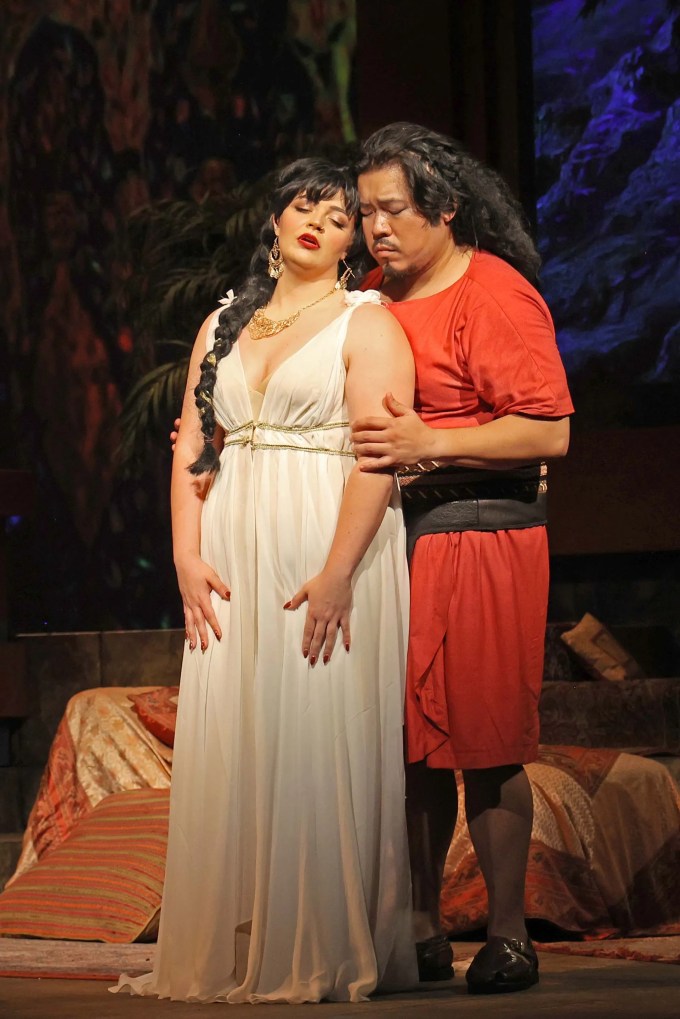
Samson et Dalila

Kim Stanish as Dalila, John Kun Park as Samson. All photos by Otak Jump.

In the performance world, a title comprised of a man’s and a woman’s name is pretty reliably a love story, sometimes tragic – Romeo and Juliet, Abelard and Heloise, and so on.  For those not versed in the Biblical saga of Samson from Judges, Chapter 16, they may expect “Samson and Delilah” might fall into that category.  But rather, it is a grand deception. The Philistine seductress is motivated by hatred for the enemy Hebrew people and by revenge for what she wrongly believes is her paramour’s rejection and ridicule of her.

Today, we accept Biblical stories and personages on the stage as routine.  But when the French opera, Camille Saint-Saёns’ Samson et Dalila, with libretto by Ferdinand Lemaire, premiered in 1877, such representations were typically banned from performance, especially in English speaking countries.  Interest in the composer’s home country of France was so tepid that it opened in Germany.  However, this masterpiece worked its way into the repertoire and has become an understandably beloved work.

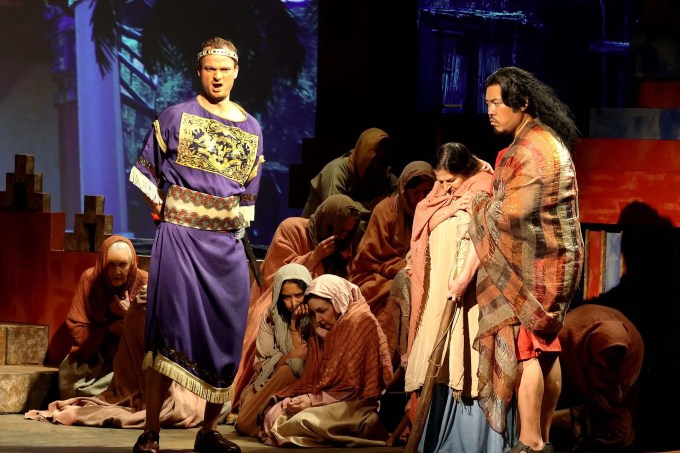
Casey Germain as Abimelech, John Kun Park as Samson.

Illustrative of French music of the late 19th century, Samson et Dalila has much to recommend it.  Its lush orchestration and its stirring choruses are compelling.  Arias and ensembles are melodic and important to the plot.  Especially noteworthy is the trio in which the Old Hebrew warns Samson that love for Dalila would lead to tragedy.  Saint-Saёns also adopted Wagnerian motifs.  Most enchanting is the graceful fluttering, especially of the flute, that produces anticipation for the opera’s signature aria.  And while the basic plot line is known to most opera goers, it is nonetheless dramatic in its consequences and its execution.

West Bay Opera’s production extracts all that can be expected from the opera by a company of its size, and that is considerable.  As the first opera that General Director José Luis Moskovich ever saw, his enthusiasm and search for excellence in the piece come through in his spirited conducting, bobbing and weaving with exacting thrusts at the instruments as they deliver highlights in the score.  The resulting sound is exemplary

Kim Stanish as Dalila, Kellen Schrimper as High Priest of Dagon.

Veteran of recent West Bay productions, John Kun Park as Samson brings a powerful tenor voice and presence to the role.  He is imposing in his portrayal, first strutting and energetic as the potent leader of the Hebrew people enslaved by the Philistines and later subdued as the blinded and weakened shadow of his former self.  Park’s particular strength is in revealing anguish in his singing and acting, whether depicting rage or submission.  Despite his ability to achieve great passion and volume, however, his timbre is a little muffled, having less than exemplary clarity.

Dalila is among the more venomous, detestable title characters in all of opera.  Yet this is one of the great mezzo-soprano roles.  Although the gullible womanizer Samson is deluded into thinking that she loves him, betrayal and destruction motivates her from the start.  Mezzo-soprano Kim Stanish is Dalila. She possesses the demanding vocal characteristics required for the role, which include a strong and complete mezzo range and the ability to sing with the extremes of sweetness or anger.

Cast.

The aria “Amour! Viens aider ma faiblesse” (“Love! Overcome my weakness”) early in Act 2 tests the artist.  Stanish conquers it with a delightful ascending run from her resonant chesty lows to her bright heady highs.  If there is a vocal weakness, she doesn’t fare as well in competing with the orchestra at points in her mid-range.  In terms of her portrayal, perhaps the wig, makeup, or costumery undermine her, but she doesn’t convey the grim resolve as convincingly as desired.

The signature aria in the opera is Dalila’s captivating, unforgettable “Mon coeur s’ouvre à ta voix” (“My heart opens at your voice”), which has even crossed over into other musical genres.  Given its opening line, and as one of opera’s truly beautiful arias, most listeners would expect that it is a sincere love song, but it is really a hypocritical deception.  Stanish gives a completely pleasing rendering of the aria, and when it turns into a beautifully harmonized asynchronous duet, Park joins in showing a mellifluous quality to his voice.

Dancers: Tai Lum, Lydia Lathan, Aikaterini Bousleli.

With the French market of the period in mind, the composer also inserted ballet, most significantly the Bacchanale, which contains the other most recognizable music from the opera.  Unlike the remainder of the score, the exotic, heavily punctuated dance music is very Middle-Eastern.  The writhing dance is well choreographed and performed.  However, while the orgiastic theme and dance fits with the storyline, it comes at a strange time in the opera, just when the audience is looking for denouement and closure.

The overall production, stage directed by Maestro Moscovich, works nicely.  West Bay has long been adept at making the stage seem larger than it is through tiering and projections, with credit as usual to Peter Crompton and Frédéric O. Boulay.  Callie Floor’s extensive costumery also adds to the look of the production.

John Kun Park as Samson.

While the stage isn’t large enough to accommodate several columns from the temple physically collapsing at the conclusion, a combination of live action and graphics is used to depict the destruction.  But for some reason, the simple act of the Philistines falling to the ground to demonstrate that Samson destroyed everyone in the temple does not occur.  Notwithstanding these minor quibbles, the opera and this production are highly worthy and enjoyable.

Samson et Dalila, composed by Camille Saint-Saёns with libretto by Ferdinand Lemaire and based on the book of Judges Chapter 16 from the Bible, is produced by West Bay Opera and plays at Lucie Stern Theatre, 1305 Middlefield Road, Palo Alto, CA through October 19, 2025.

Noises Off

Julie Eccles as Dotty, Jamiel St. Rose as Tim, Patrick Russell as Director (Lloyd), (rear) Sophia Alawi as Brooke. All photos by Jessica Palopoli.

Doors and sardines.  They are at the center of perhaps theater’s farciest farce and the definitive farcical metatheatrical play.  On a set representing the two-story great room of a manor house in England, several doors feature significantly as they slam, sometimes in succession; get locked or opened when they shouldn’t; and reveal things that weren’t intended.  A plate of sardines is a wayward prop that is often where it isn’t supposed to be; gets stuck to an actor’s hand; and creates an oily spot on the floor that is the cause of slips and falls.  Lovers of farce will find the pratfalls of Noises Off just what the funny bone ordered.

Julie Eccles as Dotty, Vivienne Truong as Poppy, Liz Sklar as Belinda.

The play is about the production of a play called Nothing On, which acts as a play-within-a-play, and the audience witnesses its first act in three different forms.  Act 1 of Noises Off depicts the final rehearsal of the first act of Nothing On, which goes well into the night.  Patrick Russell who booms amplified instructions from the back of the house but occasionally struts to the stage, is hilarious as the flamboyant, exacting director, who constantly denigrates actors (“Are you there?”) who really do deserve criticism.  Yet, many of his issues are much ado about nothing.

Dotty, a droll and delightful Julie Eccles, as the older housekeeper is the worst of the lot, unable to remember her lines or her blocking, but she is a financial backer of the show, a famed television star, and having an affair with the leading man (Joe Ayers as a bumbling Garry), so there is much reason for her to be there.

(front) Patrick Russell as Director (Lloyd), (seated) Liz Sklar as Belinda, Julie Eccles as Dotty, (above) Sophia Alawi as Brooke, Joe Ayers as Garry.

The main purpose of the play-within-a-play (as suggested by the title) seems to be to show off the physical assets of Brooke, who jiggles around in a sexy black undies ensemble most of the time.  The versatile Sophia Alawi wows as Brooke, with provocative shimmies and shakes; amusing gesticulations from come-hither bunny action to exaggerated loosening up movements and hip thrusts; and spicy mugging, with great appeal throughout.

Noises Off’s real distinction is in the most riotous Act 2 which occurs at a later performance of Nothing On.  However, it is seen from back stage, with the actors making their entrances through the back side of the same doors as in Act 1, and with some of the resultant onstage dialog audible.  But once the action of Nothing On starts, the noises off rule is in order, and all of the slapstick action backstage is in pantomime.

Julie Eccles as Dotty, Nima Rakhshanifar as Freddy, Liz Sklar as Belinda, Joe Ayers as Garry.

The whole of this San Francisco Playhouse production is a challenge to orchestrate, but Act 2 is particularly complex, and a masterful Director Bill English earns his spurs and more.  The whole scene is a maelstrom, as actors and stage managers bicker and undermine one another endlessly.  In one silent sequence, an axe changes hands several times with multiple attempts to put it to its intended use, only to be blocked with exquisite timing by a third party, sometimes casually or inadvertently.

Act 3 of Noises Off occurs later in the run of Nothing On and is seen in the onstage perspective.  By now, many of the antagonisms, personal frailties, love triangles, and other secrets among the artists have fully emerged, and the raucous performance is full of miscues.  Brooke loses a contact lens and feels around with her hands, virtually blind; one character suffers a bloody nose and falling trousers; and another character shows up in triplicate.  Prop mishandling plays a large role as door handles come off; a phone disappears; the sardine plate is in the wrong place; and more.  Much of what happens can be characterized by the title of a more recent play that follows a similar premise, The Play that Goes Wrong.

Joe Ayers as Garry, Jamiel St. Rose as Tim, Louis Parnell as Selsdon, Julie Eccles as Dotty, Nima Rakhshanifar as Freddy.

This production is excellent, with great scenic design by Heather Kenyon and fine ensemble acting.  Theater lovers will enjoy all of the inside looks at processes and relationships, while lovers of broad comedy, particularly visual, will find Noises Off to be catnip.  Of course there is a major caveat.  If nonsense humor is not in the viewer’s wheelhouse, and it clearly doesn’t work for everyone, the experience could be mixed or even a grind.  And in any event, at nearly three hours of running time and experiencing the same material, even if from three different perspectives, it does get repetitive.

Julie Eccles as Dotty, Sophia Alawi as Brooke.

Noises Off, written by Michael Frayn, is produced by San Francisco Playhouse and appears on its stage at 450 Post Street, San Francisco, CA through November 8, 2025.

Louisa May Alcott’s Little Women

Elissa Beth Stebbins as Jo (kneeling), Emily Ota as Meg, Lauren Hart as Beth, Sharon Shao as Amy. All photos by Kevin Berne

For the remainder of the year, my San Jose and Peninsula theater reviews will be posted on Talkin’ Broadway with only introductions to those reviews on this site]. Please continue to https://www.talkinbroadway.com/page/regional/sanjose/sj299.html for full review.

In 1868, Louisa May Alcott published Little Women, and the world of women’s literature was forever changed.  Indeed, the lives of many girls and women have been altered by exposure to this great domestic story of the four March sisters of Concord, Massachusetts.  Even today, most theater goers are probably familiar with the work at some level.

Co-commissioner TheatreWorks Silicon Valley offers its version of Lauren Gunderson’s theatrical adaptation.  The script stays generally true to the author’s intentions, and the production is professional in all respects, resulting in a lively, poignant, and delightful rendering of Alcott’s semi-autobiographical work.  Since it takes place during the Civil War, a period of political division, and since there is a scarlet fever epidemic, parallels with current times are unavoidable.

Sharon Shao as Amy, Max Tachis as Laurie, George Psarras as Bhaer, Elissa Beth Stebbins as Jo.

First, some context that influenced her life and writings.  Louisa May Alcott grew up largely in Concord, Mass in a family of four girls, one of which, like Beth March, contracted scarlet fever (sound familiar yet?).  As a child, Louisa’s mentors included her parents’ friends Henry David Thoreau, Ralph Waldo Emerson, and Nathaniel Hawthorne!  In addition to these obvious literary influences, her persona was defined by the isms to which she subscribed – feminism, abolitionism, suffragism, and prohibitionism.  Like Jo March, the sister in the novel who is her surrogate, Alcott sought independence of mind and action outside the home, having become a nurse in the Civil War.  She eschewed marriage, or perhaps it eschewed her.

Since this is not the first stage adaptation, what would be Gunderson’s point of differentiation?  Her version uses two devices that elaborate on the action and make up for the condensation of a long novel into a short play.  First is that Elissa Beth Stebbins, who plays Jo, also plays Alcott as a narrator who gives overall perspectives and a modern look at the story.  One modernization that may be more in the direction than the writing is that Jo comes across as more masculine, even insisting to take the man’s part when dancing with Laurie.  He is correspondingly more effeminate than Alcott probably intended.

Sharon Shao as Amy, Lauren Hart as Beth, Cathleen Riddley as Marmee (mother).

The other alteration is the extensive use of parenthetical commentary spoken directly to the audience.  This occurs in several forms.  Personas share their inner thoughts; reveal subtexts of the action; advance the plot; and even provide stage directions.  Some viewers will find this annoying.  I appreciate the conceit for taking the story deeper with efficiency, and I hope others do as well……..

Louisa May Alcott’s Little Women, a rolling world premiere written by Lauren Gunderson, is co-commissioned and produced by TheatreWorks Silicon Valley and plays at Mountain View Center for the Performing Arts, 500 Castro Street, Mountain View, CA through October 12, 2025.