Ada and the Engine

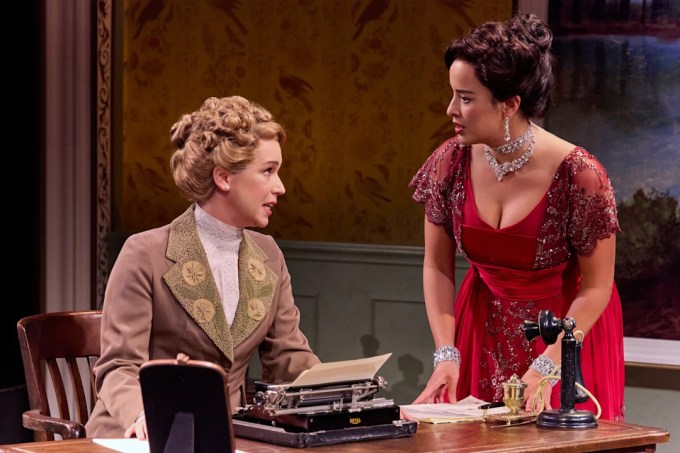
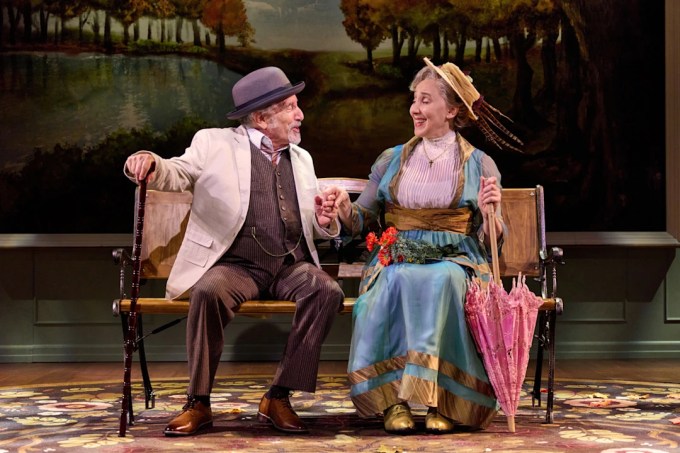
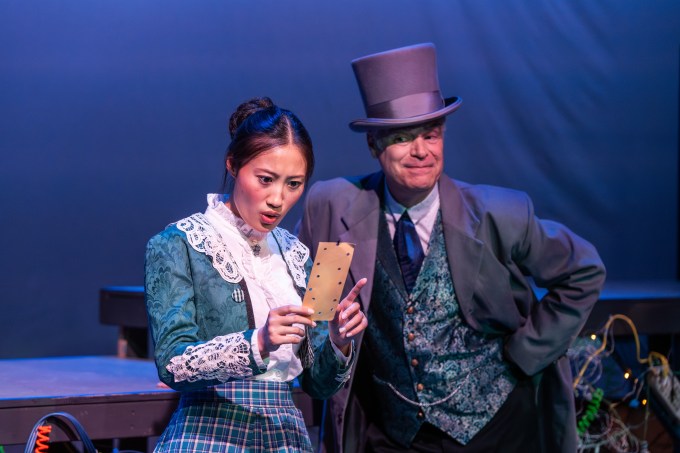
Angel Lin as Ada, David Boyll as Babbage. All Photos by Mikenzie Gilbert.

My South Bay and Peninsula reviews for the last half of 2025 also appear at Talkin’ Broadway. The link for this review is: https://talkinbroadway.com/page/regional/sanjose/sj302.html .

Many people think of the introduction of ENIAC in 1945 as the birth of computers, but conceptually, many in the know credit Englishman Charles Babbage with his Analytical Engine over a century earlier.  Though it never operated, with the help of Lady Ada Byron Lovelace, who many consider the first ever computer programmer, its functions were fully explicated.

In Ada and the Engine, the facts concerning Babbage’s innovations and Ada Lovelace’s contributions are accurate history.  Playwright Lauren Gunderson has crafted plausible exchanges between those two as well as their relationships with Ada’s mother, Lady Anabella Byron, and others.  The result is an engrossing biography that in more than one dimension spans time.

Angel Lin as Ada, Maya Capur as Anabella.

One surprise to some is Ada’s lineage.  She was the only legitimate child of George Gordon Lord Byron, the esteemed Romantic poet so often linked in the triumvirate of Byron, Shelley, and Keats.  Ada’s mother was Anabella, who was distinguished as a philanthropist, educational reformer, and abolitionist.  She is also said to be the only woman that Byron didn’t charm, and he abandoned her for Greece only a month after Ada’s birth.  Ada would never know her father, and as one aspect of Anabella’s severe treatment, Ada wasn’t even shown an image of him until she was an adult.

Because of Lord Byron’s capriciousness and mental illness, Anabella forced Ada away from artistic pursuits and into mathematics, which turned out to be a fortuitous fit.  The mother’s only goal in the play is depicted as wanting Ada to marry into a title, but enjoining her to attend one of Babbage’s soirees had the opposite effect.  Instead, she found an outlet for her prodigious mathematical talent as Babbage’s protégé and in many ways became his equal.  Later, as they looked to establishing a firm to promote the unrealized engine, Ada even proposed herself as the overall boss.
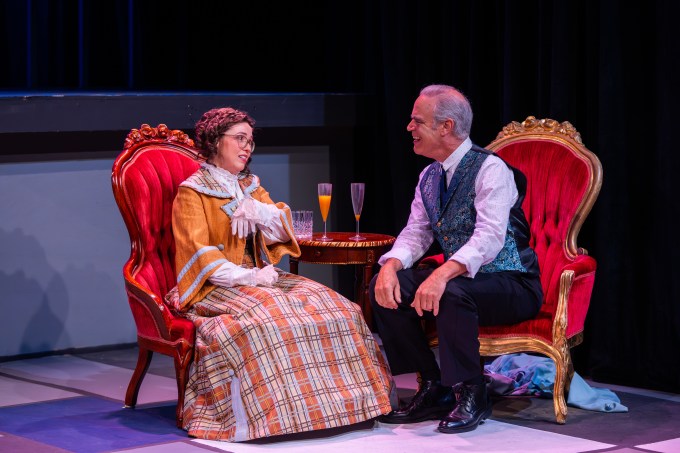
Olga Molina as Mary Sommerville, David Boyll as Charles Babbage.

Angel Lin portrays Ada who was sickly from youth and had a troubled relationship with her mother.  Lin’s portrayal is of a young woman who is independent, yet cheery – cheered by being able to pursue mathematics.  Yet the gravity of her father pulls her.  In reading his poetry, she taps her heart to the rhythm of the syllables and even embraces the fusion of technology and arts by deeming Babbage’s engine to have a beating metal heart.

Lord Byron had died at age 36, and anticipating Ada’s own brief existence, Lin speaks rapid-fire and enthusiastically as if the character is trying to cram as much into life as she can.  Urgency and initiative drive her.  She distinguishes herself by translating a scholarly paper in mathematics from Italian and adding notations that exceed the length of the paper.  Her insights into the engine’s possibilities lead her to conceptualize computing functions well beyond what Babbage had considered.  Ada derived that any symbols could be coded into zeros and ones, her favorite being musical notation.  The binomial system applied to computer data starting a century later codes as she conceived.
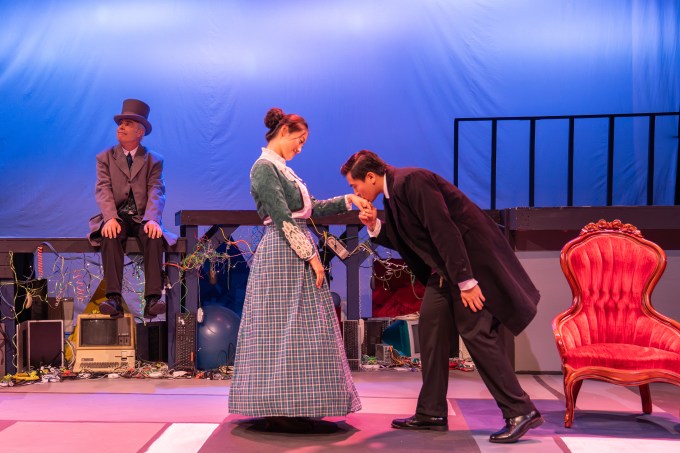
David Boyll as Babbage, Angel Lin as Ada, Joshua Bao as Lord Lovelace.

Although Ada and Babbage had disagreements on concepts and development, only once was their personal and professional relationship almost fractured.  That resulted from a resolute Babbage wanting to publicly point fingers at the government for not funding the development of the engine.  Otherwise, David Boyll’s apt depiction is of an affable, sometimes bumbling, but socially progressive man, though in some cases, he did wish to share less credit than he should.

Maya Kapur’s Anabella is adeptly played as sour and uncompromising.  One might be a bit surprised that Byron would have married someone of that sort, but perhaps his lack of discipline and ultimate betrayal of her contributed to her unpleasantness.
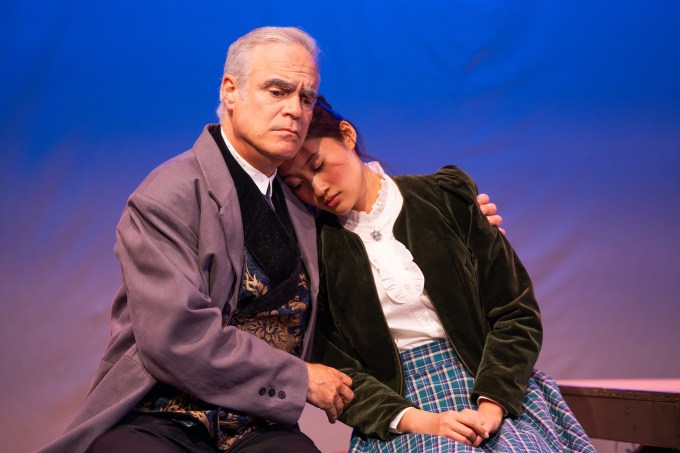
David Boyll as Babbage, Angel Lin as Ada.

Like any parlor-room drama, the success of Ana & the Engine relies on a taut narrative and good acting to succeed, and so it does.  The one plotline element that does feel a little clumsy is the add-on closing scene in which the deceased Ada and her father can finally commune in the afterworld.

One acting issue of note is that several actors do not project their voices well, and from the more distant seats, some are too faint to be consistently understandable.  And while Kapur and Boyll use English accents, Lin as Ada does not.  Taken as a demonstration of acting, her characterization is very sound, and she does show breadth of emotion when appropriate, yet her accent and gesticulation do not convey the Englishness of her character.  To some patrons, like my wife, that may not matter.  And in the final analysis, Angel Lin and the play deliver a worthy result.

Joshua Bao as Lord Lovelace, Angel Lin as Ada.

Ada & the Engine, written by Lauren Gunderson, is produced by The Pear Theatre and is performed on its stage at 1110 La Avenida, Mountain View, CA through December 7, 2025.
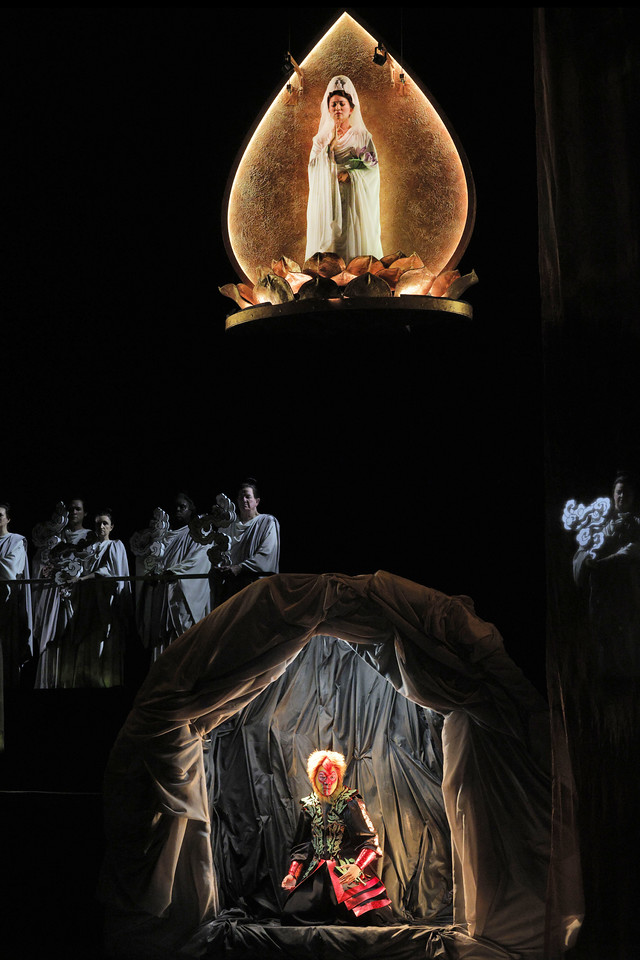
The Monkey King

(above) Mei Gui Zhang as Guanyin, (below) Kang Wang as Sun Wukong the Monkey King. All photos by Cory Weaver.

San Francisco Opera has long reigned as a premiere American opera company.  The city has served as a gateway to Asia for trade and tourism, containing the country’s oldest and probably most important Chinatown.  Further, San Francisco and the overall Bay Area population has the highest concentration of Asians in the U.S.  So it is fitting that the company would be home to its third China-focused world premiere opera.  Of those, The Monkey King is the second libretto drawn from the renowned four classic Chinese novels.  The result is a wildly popular, eye-popping, phantasmagoric opera experience.  It is a huge production in every way and demonstrates the power of San Francisco Opera.

Jusung Gabriel Park as Master Subhuti, Kang Wang as Sun Wukong.

The monkey has long held significance in pan-Asian mythology.  The 16th century Chinese-Buddhist-influenced Monkey King, dubbed Sun Wukong, can be seen as derived from the ancient Indian-Hindu monkey God Hanuman.  Modern realizations include the Indonesian retelling of the Ramayana through the kecak, or monkey, dance portrayed with 100 or more chanting, gesticulating men.  A click-clacking in the orchestra is even reminiscent of the kecak sounds.  But Sun Wukong is a superhero popular across Asia who is also represented in contemporary films and games.

Kang Wang as Sun Wukong.

Huang Ruo has composed a score set to David Henry Hwang’s libretto, which is based on the first seven chapters of Journey to the West, written by Wu Cheng’en.  But like the character himself, the story is full of contradictions, and to begin with, while Sun travels in his adventures to the sea, the underworld, and elsewhere, there is no journey to the west.  The plot, such as it is, is a series of episodes told in flashback.  In keeping with the epic sense of time, Sun Wukong has been detained under a mountain for 500 years.  We find how he got there; experience his previous conquests; and understand what he had to learn to gain freedom.  Many sequences are filled with exciting bursts of animated movement and kaleidoscopic flushes of color.

Chorus, (center) Konu Kim as Jade Emperor.

The music is very much in the modern vernacular, which I find uninspiring, but with strong influences suggestive of traditional Peking opera and other Asian forms to add an exotic touch.  For the most part, the orchestration supports the vignettes unobtrusively but becomes more conspicuous, more Chinese, and more distinguished with the use of the pipa, a Chinese plucked lute, and Asian gongs and cymbals.  Carolyn Kuan conducts this musical hybrid with great skill.

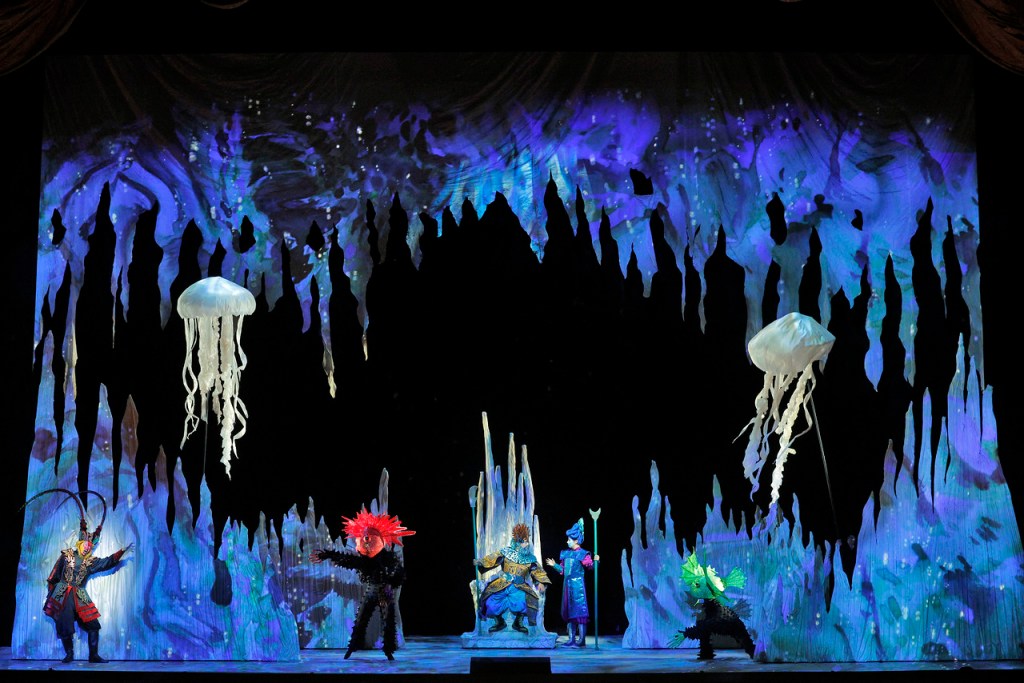
Dragon Palace of the Eastern Sea.

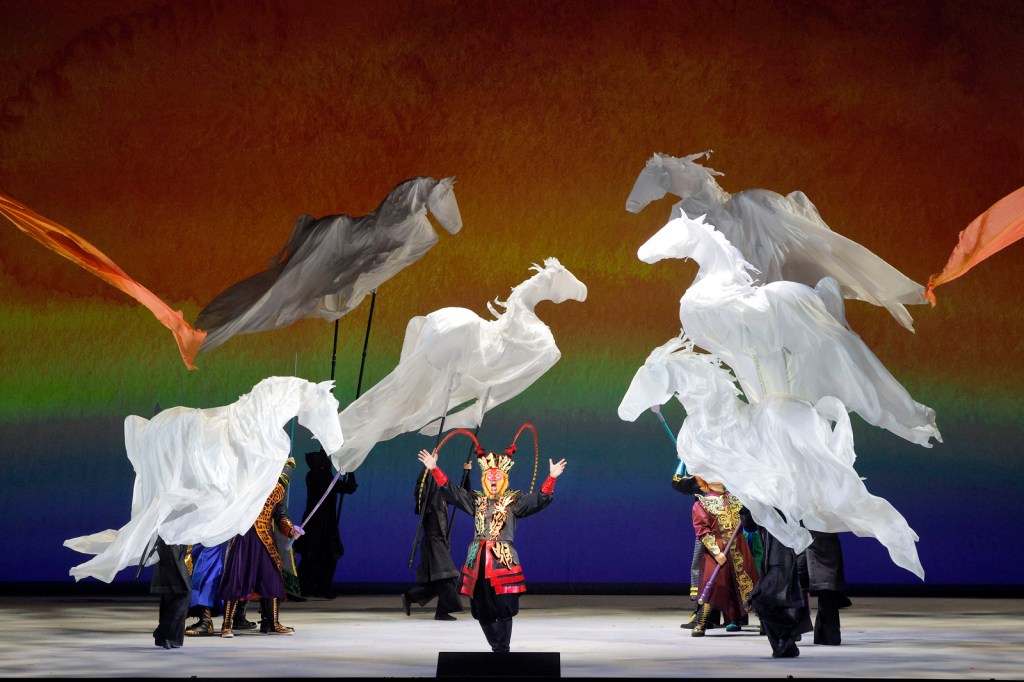
The score actually opens with chants in homage to Buddha.  But it is the visual that is the mark of things to come.  Guanyin, the Buddhist Goddess of Compassion, performed by refined soprano Mei Gui Zhang, glides about suspended in her light-framed conveyance, the first of many stunning visual effects from Set and Puppetry Designer Basil Twist.  Costume Designer Anita Yavich also contributes throughout with a dazzling and colorful array of attire that fills the eye with joy.  Yet, to these eyes, the most stunning visual effect is the simple use of white silk.  Six life-sized “puppet” horses, each raised on sticks by puppeteers, billow and flow like so many white clouds quivering and galloping in the sky.  A still image cannot possibly convey the mesmerizing elegance.

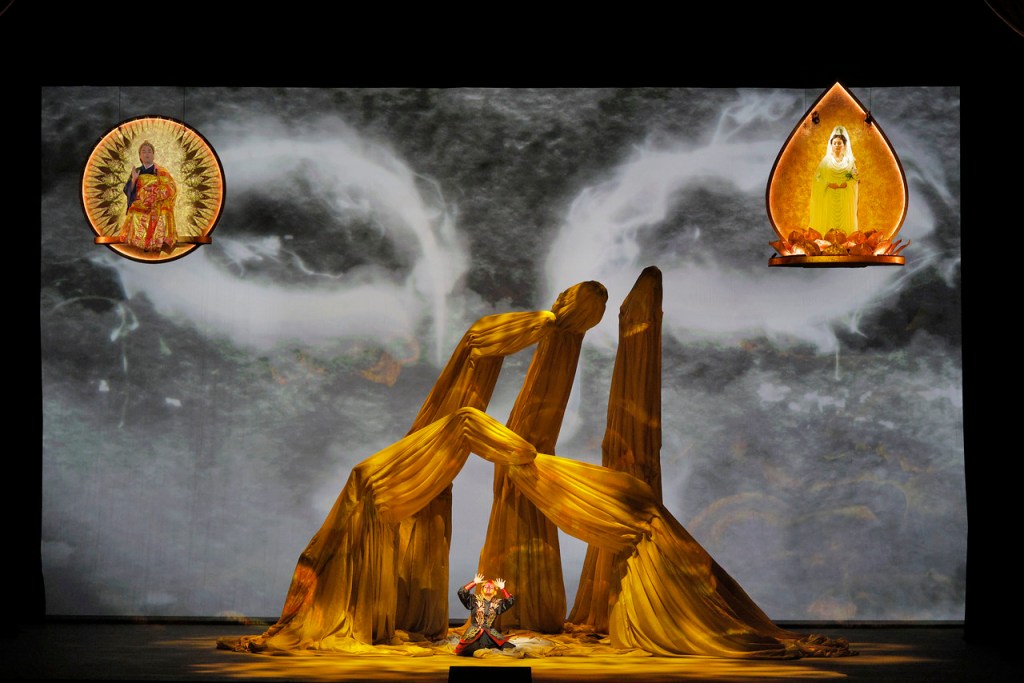
(above) Jusung Gabriel Park as Buddha, Mei Gui Zhang as Guanyin, (below) Kang Wang as Sun Wukong.

Following on the heels of its visually stunning production of Parsifal, San Francisco Opera is showing itself to be in the forefront of operatic spectacle, inspired image-focused productions.  A substantive corollary to Parsifal is that the hero in both must undergo an awakening to attain his goals.  While Parsifal is expressly a fool at the outset, The Monkey King has mental acuity, yet he doesn’t realize that when he ascends to heaven all puffed up in self-adulation, that the title he is given, Lord of the Stables, is to denigrate his station.

Chorus, (foreground) Kang Wang as Sun Wukong.

The Monkey King himself is the most interesting dramatic element in the opera.  Though he is portrayed and sung with great verve by tenor Kang Wang, he is also depicted at times by a dancer and by a puppet.  Sun’s triumphs are predictable, but his paths and behavior are not.  Despite his superpowers, he reveals many of the contradictions of a regular guy.  He is a profane rascal and funny as a gaggle of gags.  Sun’s silliness provides comic relief, and the Kang Wang is adept at triggering laughter with anachronisms, like when he refers to having food for take-out.  At one point, the character even lifts his leg and pees, not realizing that he is peeing in the hand of Buddha, which is so vast that Sun can’t escape it!

(left) Dancer Huiwang Zhang as Sun Wukong, (center) Actor Kang Wang as Sun Wukong.

Following its source material, the opera brims with philosophical wisdom.  It draws on the notion that “power is not enough,” and teaches that the key to divinity is a spirit of caring to help all beings.  It’s remarkable that we still have to preach that gospel.

The Monkey King, composed by Huang Ruo with libretto by David Henry Hwang and based on part of Journey to the West by Wu Cheng‘en and directed by Diane Paulus, is a world premiere produced by San Francisco Opera and plays at War Memorial Opera House, 301 Van Ness Avenue, San Francisco, CA through November 30, 2025.

Madama Butterfly

Emily Michiko Jensen as Cio Cio San. All photos by David Allen.

What more can be said about Giacomo Puccini’s Madama Butterfly that hasn’t been said a million times before?  Along with his other monster hits La Boheme, Tosca, and Turandot, no other composer forged a core of operas that have been so beloved by so many and received so many productions year after year, though Verdi and Mozart do have more breadth of offerings.

What is Puccini’s secret?  Like no other opera composer from the classical-romantic era, he loved women as his central characters – perhaps because his first full-length opera, Edgar, was a failure.  Just look at the titles of each of his seven mature, full-length operas – only women are referenced in the title.  The heroines are highly diverse and often vulnerable, though in different ways – from frail (Mimi) to vibrant (Tosca) and from imperious (Turandot) to submissive (Cio Cio San).

Christopher Oglesby as Pinkerton, Ilhee Lee as Goro, Eugene Brancoveanu as Sharpless.

Opera San Jose takes on the war horse Madama Butterfly.  Thanks to a cast of fine voices plus the rich-sounding orchestra conducted by Joseph Marcheso delivering the sumptuous score, the result is a delight.  Although several set pieces always stand out, absent those highlights, the music is still luminous throughout, shimmering like moonlight reflecting on water.  Innovatively, Puccini also introduces Japanese pentatonic musical forms, most memorably in the unique off-stage “Humming Chorus.”  Meanwhile, the dramatic storyline is cohesive and highly emotive.

The opera belongs to Cio Cio San, Butterfly that is, who dominates the action.  Emily Michiko Jensen makes the most of it in her role debut.  Of course, there are many conceits in opera, and though young herself, Jensen’s powerful voice would hardly be that of an ingenue of 15 years, as Cio Cio San is in the source material.  The soprano appears to love the role.  She displays particularly well in the mid-and-upper ranges, calling on a strong and mellifluous vibrato, and giving a beautiful rendering of the protagonist’s signature aria, the universally loved “Un Bel Dia Vedremo” (“A Beautiful Day Will Come”).

Cast, (center) Emily Michiko Jensen as Cio Cio San.

Cio Cio San is from a good but now poor family in Nagasaki, Japan.  She is banished by relatives and friends when marrying American Naval Lieutenant B. F. Pinkerton, played by the formidable tenor Christopher Oglesby, who brings vocal and dramatic heft to the part.  The artist’s effective portrayal is callous and condescending but accurate.  Pinkerton reveals from the outset that he sees the marriage as a convenience, and his attitude toward Cio Cio San is denigrating, even though he conceals it from her.  Happily, Oglesby’s voice is commanding.  And though cowardly, the character even elicits a little sympathy toward the end with his lament “Addio Fiorito Asil,” (“Goodbye Flowery Refuge”) when he realizes that Butterfly has waited devotedly for him for three years.

Two other roles play prominent in the storytelling but not in the consequences of the action.  American consul Sharpless, the resourceful and popular baritone Eugene Brancoveanu, detests what he suspects of Pinkerton’s intentions.  But despite his righteousness and respect for local people and culture, he is unable to intercede.  Family retainer Suzuki, rich-toned mezzo Kayla Nanto, displays loyalty and compassion, remaining as Cio Cio San’s servant and primary access to the outside world.

Ilhee Lee as Goro, Kayla Nanto as Suzuki.

Madama Butterfly remains one of the most controversial popular operas, largely because of the relationship dynamics.  She sacrifices all and does her best to adopt all things American, but Pinkerton sees her as chattel, and other than paying the rent after his ship sails, everything about his treatment of her is despicable.  So, aspects of pedophilia (though supertitles in this production list Butterfly as 18 years old, probably to allay that issue), racism, and spousal abuse can be lodged against the American.  As a consequence, American chauvinists may consider the opera anti-American.  Unrelated to the content of the libretto, the dodgy question of appropriability by non-Japanese performers is inherent in this opera.  But because of its manifold assets, Madama Butterfly remains in the firmament where it belongs.

Although the production is very rewarding, a couple of issues deserve mention.  The beautiful orchestral score is replete with frequent crescendos that don’t seem that loud.  But particularly when volume stays at a plateau after the rising, singers are surprisingly overpowered by the orchestra, notably in the lower ranges of their voices.

Kayla Nanto as Suzuki, Emily Michiko Jensen as Cio Cio San, KC Oania as Trouble, Eugene Brancoveanu as Sharpless.

Another element that some patrons will not care for is the set design with a stage dress in black and the absence of a physical house, though the unobtrusive backdrop does have the positive effect of making the performers’ appearances pop.  Plus, some setups are quite striking like the flowers and stars staging. Finally, the back wall projection is underutilized and provides no scenic framework.  Presumably the intention is to paint the opera with the darkness that it may deserve, but many will find the black box look unreal and unappealing.

Notwithstanding, Madama Butterfly remains a favorite in the repertory, and the maestro’s music delivered by artists with great aplomb will engulf the audience as it has to millions of opera goers before.

Courtney Miller as Kate, Kayla Nanto as Suzuki, Eugene Brancoveanu as Sharpless, Christopher Oglesby as Pinkerton.

Madama Butterfly, composed by Giacomo Puccini with libretto by Luigi Illica and Giuseppe Giacosa and directed by Michelle Cuizon, is produced by Opera San Jose and plays at California Theater, 345 South 1st Street, San Jose, CA through November 30, 2025.

The Woman in Black

David Acton as Arthur Kipps playing Keckwith the Trap Driver, Ben Porter as The Actor playing Arthur Kipps. All photos by Jenny Anderson.

Many of us will remember camping trips as a kid, perhaps with a Scout troupe or with a group of friends.  A highlight was always sitting around a campfire at night and roasting hot dogs and marshmallows.  And as sure as the sun would rise in the morning, the ghost stories began.  The only one I still remember is about the homicidal maniac with a hook for one hand that escaped from an institution.  A couple was making out in a car near the institution that night.  When the young man drives the girlfriend home and walks around the car to open the door, a bloody hook is hanging from the door handle.  Now that was scary!  And no matter how many times you heard it and knew it was just a story, it would still trigger a sleepless night.

The Woman in Black is a campfire ghost story for adults.  Having played London’s West End for 33 years, the play’s longevity is testament to its appeal.  A two-hander adapted for the stage by Stephen Mallatratt from Susan Hill’s gothic horror novel, it doesn’t horrify a theater audience in the same way that a nail-biter would a child.  But the tremorous ambiance can feel creepy, and the loud shrieks, screeches, and thumps without warning are jolting.

Ben Porter as The Actor playing Arthur Kipps.

The setup and structure are a bit odd, as an attorney named Arthur Kipps has written a tome about his frightening experiences on a business trip and hires an actor to help him prepare for a presentation of this unsettling suspense to his family.  The opening is humorous as the (unnamed) actor tries to animate Kipps to make his presentation interesting.  But Kipps balks, inducing much laughter from the audience as he reverts to the same dull-as-sliced-white-bread delivery with each effort.

A solution imposed by the actor is that he will play Kipps when rehearsing the narrative, and Kipps will play all of the other characters.  With this device, the sniveling Kipps, portrayed by Ben Porter on this night, takes on a wide array of accents and affects to represent several different personas with immense brio.  Meanwhile, James Byng performs “the actor” who takes on the part of Kipps with great gusto and far greater enthusiasm than Kipps himself.

Ben Porter as The Actor playing Arthur Kipps.

In the plot, Kipps is charged to travel from London to an isolated town on the marshes to close out the affairs of the recently deceased Mrs. Alice Drablow.  But Kipps finds that she left an abundance of papers that need reviewing, and he opts to overnight at her manor which lies across a causeway, accessible only by a low tide crossing, creating a further sense of vulnerability.  Among the stacks of bills, grocery lists, and other inconsequential papers, he finds that Mrs. Drablow had adopted a boy, the son of her unmarried sister, which raises questions in his mind.  Alone in this possibly haunted house, he also encounters the terrifying effect of finding things in the house have been moved when presumably nobody else is there.

The spare, drab set and spooky lighting enhance the harrowing feeling, accentuated by occasional appearances of a black apparition.  Kipps’ anxiety is piqued as locals refuse to reveal whatever they know about Mrs. Drablow and the mysterious affairs surrounding the manor.  And then there is the door in the house that has no apparent means of opening, yet opens by itself to reveal a nursery, long untouched.  Trenchant verbal descriptions of the threatening marshlands speak of the grayness making indistinguishable the land, sea, and sky.  Incidents of drownings heighten the threat.  Even the small dog Spider, invisible to the audience, who accompanies Kipps is all but sucked into the mire, saved in risky desperation by Kipps.

Ben Porter as The Actor playing Arthur Kipps, David Acton as Arthur Kipps playing Sam Daily.

A stage show lacks the scope and technology that movies have to create a truly horrifying experience.  But given the resources of a live performance, this original London production of The Woman in Black serves as a major signpost on the bumpy road to horror.

The Woman in Black, adapted by Stephen Mallatratt and based on the novel of the same name by Susan Hill, is presented by Center Rep and plays at the Lesher Center, 1601 Civic Drive, Walnut Creek, CA through November 23, 2025.

An Introduction to Four Shows On-and-Off Broadway

LIBERATION: Susanna Flood, Betsy Aidem. Photo by Little Fang.

As an attendee of the American Theatre Critics Association Conference in New York City, I would like to thank the producers of all of the shows that generously provided press tickets to our members.  Along with my wife and editor, Karin, I was able to see the four noted below, for which I am separately publishing brief individual reviews.

Although I had no overarching thought in mind when selecting shows to see, a powerful theme emerged, the notion of revisiting the past, and specifically of reunion.  The very title of one show is Reunions, a New York premiere of a musical that ties together two turn-of-the-century (20th, that is) narratives, each about two people who find one another by accident after the passage of years.  Another recent opening centers on a tenth-year high school reunion, Romy & Michele: The Musical.  Next is the fantasy musical, Six: The Musical, in which the deceased six wives of Henry VIII get together and compete to find who suffered the most.  And finally, in Liberation, a contemporary woman tries to understand her deceased mother better by meeting with her associates from a consciousness raising (read feminism) group from the early ‘70s.

REUNIONS (“THE TWELVE-POUND LOOK”): Chilina Kennedy, Bryan Fenkart. Photo by Jeremy Daniel Photography.

The other unintended theme across the four selections is womanhood and different aspects of women’s rights.  In Six, all performers, actors and musicians, are female, while the cast of eight in Liberation has only one token, part-time male.  Romy & Michele focuses on the enduring friendship of two girlfriends and their clashes with the popular girls from their high school.  And while Reunions is about couples, its emphasis concerns the agency of women at a time when men domineered.

Two incidents made Liberation special.  First, our conference was fortunate to have a panel discussion comprised of the show’s brilliant playwright Bess Wohl, director Whitney White, lead actor Susannah Flood, and key actors Betsy Aidem and Kristolyn Lloyd.  Their insights were informative and entertaining, and Karin and I were fortunate to see the play that very night.  I’ll add that we had similar arrangements at past conferences with The Band’s Visit and Kimberly Akimbo: The Musical, which offered like experiences.  You might expect that I would have a positive bias in reviewing Liberation because of personal contact with creatives and performers.  I will note however that in the closing session of the conference, when attendees were asked what they liked the most and what they would like to see more of, Liberation led the way both for the panel discussion and for the play.

ROMY & MICHELE: Laura Bell Bundy, Kara Lindsay. Photo by Valerie Terranova.

The other anecdote involves the actor Susannah Flood who portrays the character Lizzie, who often speaks of her dead mother.  Susannah’s quite alive real mother was in the front row at our performance, and we knew in advance that this was the very first time that she’d seen her daughter on Broadway.

I’d also like to express gratitude to Adrian Bryan-Brown, public relations manager, and Joan Marcus, still photographer, for Six: The Musical, who comprised a discussion panel at the ATCA Conference.  Finally, and unplanned, Karin and I conversed for over an hour with Jeffrey Scharf, the creator and writer of Reunions and who is from nearby Santa Cruz, which was enjoyable and illuminating.

SIX: Kelsie Watts, Najah Hetsberger, Krystal Hernandez, Kay Sibal, Taylor Marie Daniel, Gianna Yanelli. Photo by Joan Marcus.

Six: The Musical

Kelsie Watts, Kay Sibal, Najah Hetsberger, Gianna Yanelli, Krystal Hernandez, Taylor Marie Daniel. All photos by Joan Marcus.

I saw this Broadway production on a trip to New York.  Thanks to Six: The Musical’s producers, represented by public relations firm Boneau/Bryan-Brown, for their generous provision of press tickets for members attending the American Theatre Critics Association Conference.

The opening of the fantasy musical Six is like a thunderous rock concert with a darkened stage, thumping music, fog, and six potent women abreast in costumes that bridge the 16th and 21st centuries – rigid, colorful, and sparkly with boots ‘a made for stompin’.  They own the stage.  The opening number, “Ex-wives,” sets the scene with its noteworthy and rhythmically incessant lyrics “Divorced, beheaded, died; divorced, beheaded, survived,” which are the successive outcomes of the women in question.

Taylor Marie Daniel, Kelsie Watts, Gianna Yanelli, Najah Hetsberger, Krystal Hernandez, Kay Sibal.

These are the dead wives of Henry VIII, allowing for spelling variations, the three Catherines, two Annes, and a Jane.  Something you may not have thought of – you probably know who some or all of these women are, but could you name the queen of Henry VII, or Henry VI, or …..?  The six may not have produced a male heir that survived into adulthood, but they did make history.

Six charges forward with high-volume, mostly hard rock music with an all-female cast and all-female band.  Not a man to be found on stage.  There is a lot of jousting repartee among the wives, with the conceit being that the one who can convince the others that she had it the worst as queen, would get to be the lead singer of the six.  A recurring schtick is that each time one of the other wives pouts about how miserable her life had been, Anne Boleyn chimes in, “But did you lose your head?”  The trash talk and clatter clashes are punctuated by solo songs by each queen in chronological order that deal with their travails.

Kelsie Watts.

The voices are uniformly strong and wailing.  The music is listenable and danceable, at least as choreographed for the six.  Apart from the noisy but tuneful soliloquies from most wives, an occasional gentle melody sneaks in as with Jane Seymour’s luxuriant and memorable anthem, the beautiful “Heart of Stone.”  Although the song is about endurance, Jane died from birthing the future Edward VI, barely a year into marrying Henry and before her 30th birthday.  Edward would die at age 16.  Another fine song is Catherine Parr’s melodic lament “I Don’t Need Your Love,” which explores leaving love behind when forced into an arranged royal marriage.

Now comes a philosophical point of whether a reviewer should represent only their own point of view or recognize that their personal opinion may be well out of sync with what the market is looking for.  Despite Six not speaking to me or my wife (or the little girl behind us), I have to accept its virtues, as the audience was overwhelmingly entertained, and its already four-year Broadway run speaks for itself.  The 80 minutes does go by quickly, and it will leave a lot of the audience wanting more.  In particular, teen girls and young women hoot and howl, probably because the music and dialog work for them and because it is of, by, and for females.  That in no way suggests that boys and men shouldn’t enjoy it, because at the same time, it’s a very muscular show in most every way.

Kelsie Watts, Najah Hetsberger, Krystal Hernandez, Kay Sibal, Taylor Marie Daniel, Gianna Yanelli.

Six: The Musical, with book, lyrics, and music by Toby Marlow and Lucy Moss, plays at the Lena Horne Theater, New York, New York, on an open run.

Romy & Michele: The Musical

Laura Bell Bundy, Kara Lindsay. All photos by Valerie Terranova.

Thanks to the producers of Romy & Michele represented by public relations firm Rubenstein Communications for their generous provision of press tickets for members attending the American Theatre Critics Association Conference.

This is the sort of production that a snooty critic might say fits in the category of musicals that had no reason to be made as it borrows so heavily from antecedents like Grease, Mean Girls, and Peggy Sue Got Married.  Yet, it has already found its audience.  Among others who simply enjoy light entertainment, some girls and young women chirp along and cackle at the loopy lines delivered by the clueless duo who those patrons know from the movie Romy and Michele’s High School Reunion.

Jordan Kai Burnett (center), Pascal Pastrana (right rear).

Even cynics may laugh out loud, and for those who must find meaning in shows, the bottom line is to be true to yourself, and to put friendship before popularity and other forms of success.  Another observation is that those in power are loathe to relinquish it.

Broadway pros Laura Bell Bundy and Kara Lindsay are the title characters respectively, and they fit their roles down to the ground portraying the pretty, appearance conscious, but mindless adornments. Romy’s is the larger and more distinctive role, and if her speaking voice doesn’t hurt your ears, her extreme Valley Girl accent will.

(Center) Kara Lindsay Je’Shaun Jackson, Laura Bell Bundy.

 As failed wannabes at Sagebrush High School, they escape Tucson for LA to find fame and fortune.  Ten years out, Romy is a receptionist in a Jaguar dealership and Michele is an unemployed sales clerk.  When invited to a tenth-year high school reunion, they decide that they must go back as successes, so the bright lights hatch a plot to say that they invented Post-Its.  You can imagine how that plays out.  At least they are able to show up at the reunion in a deluxe conveyance, which Romy extracts from the dealership after greasing some skids, shall we say.  And they will benefit from some dumb luck.

The production is bright and lively in every way with perky musical numbers and dance along with kaleidoscopes of shapes and colors, from the girl’s wardrobes to the scenic projections.

Cheerleaders.

Another strong suit is all of the stock characterizations of kids you knew from school.  There is always a guy like Toby (superficially ebullient but often depressed Je’Shaun Jackson) who wants desperately to be liked, but despite all of his efforts to make things happen is totally ignored.  Heather (the brooding, scene stealing, and strong-voiced Jordan Kai Burnett) is the dark Goth loner.  Michael Thomas Grant plays Sandy, the mangy nerd who surprises with his success.  Pascal Pastrana is Billy, the Greek God who goes backward after high school.  Finally, there are the popular-girl cheerleaders.  Enough said.

So, Romy & Michele is not for everyone, but for the right audience or for those seeking an entertaining diversion, it works.

(center) Laura Bell Bundy, Kara Lindsay, (left rear) Michael Thomas Grant, (right rear) Jordan Kai Burnett.

Romy & Michele: The Musical, with book by Robin Schiff and music & lyrics by Gwendolyn Sanford & Brandon Jay, plays at Stage 42, New York, New York on an open run.

Liberation

Susannah Flood, Betsy Aidem. All photos by Little Fang.

I saw this wonderful show on a trip to New York.  Thanks to the producers of Liberation, represented by public relations firm The Press Room, for their generous provision of press tickets for members attending the American Theatre Critics Association Conference.  Also, thanks to playwright Bess Wohl, director Whitney White, lead actor Susannah Flood, and key actors Betsy Aidem and Kristolyn Lloyd for dedicating their time for an informative and interesting discussion panel about the play at the conference.

Audrey Corsa, Susannah Flood.

One of the first things to note about Liberation is that I haven’t seen so much smoking since Mount Saint Helens and so much skin on stage since Oh! Calcutta!  But those aren’t what it’s really about.

It is a memory play about a woman, Lizzie, trying to better understand her mother by conversing with her mother’s past associates.  Like most children, Lizzie had seen her mother through the lens of their relationship, failing to know her as a complete person.

Kristolyn Lloyd, Irene Sofia Lucio, Betsy Aidem, Audrey Corsa.

Playwright Bess Wohl plumbs her own family history, and the fact that her mother had worked for Ms Magazine in its earliest days, to draw a loving portrait of the women who took part in the feminist movement in the ‘70s.  The result is a well-produced and directed, compelling and deep dramedy with broad appeal.  To borrow the words of one of my colleagues who also attended, “It’s not perfect, but I love it anyway.”

The action takes place in a rec center gymnasium in Ohio and switches back and forth between the 1970s and current time.  It starts with Lizzie’s mom organizing the “consciousness raising” group and ends with Lizzie interviewing the women who were involved. 

Irene Sofia Lucio, Kristolyn Lloyd.

For those of us who were there and should remember the footsteps of Betty Friedan and Gloria Steinem, the show is a reminder that while there were many doctrinaire feminists, there was a broad array of positions.  Characters in the play are clearly drawn, ethnically and otherwise diverse women – some unhappy in marriage, and others not so unhappy in marriage; closet lesbian and motorcycle dyke; and more.  They are shy and gregarious; diplomat and bomb thrower; bombshell and Plain Jane.

Susannah Flood strikes all the right notes as Lizzie, often breaking the fourth wall as a narrator to share thoughts directly with the audience.  Besides playing Lizzie, she also plays her (unnamed) mother, navigating the policy clashes among the newly enlisted feminists, like whether to join in the Strike for Equality, which carried the risk of job loss by some participants.  On the personal side, a secret is long withheld by one of the women that she has been dating a man and is considering following him to New York, while at the same time rejecting the practice of marriage.  Some of her cohorts are troubled by the secrecy and her commitment to a man.  Very conflicted.

Kayla Davion, Charlie Thurston.

Dialog crackles.  Led by the terrific Betsy Aidem as the repressed “older” Margie, she spews a catalog of the many chores that she performs without any assistance from her husband.  Another juicy role is that of Dora 1 (there are two Doras), the effusive green-card-seeking immigrant firebrand portrayed by Irene Sofia Lucio.

The most stunning event is the opening of Act 2, which in the earlier panel discussion was not revealed, or shall we say, unveiled.  Beginning on a darkened stage, the audience can see the women disrobing, and when the lights come up, they are totally nude and will remain that way for perhaps 15 minutes.  This courage is the ultimate expression of women’s liberation, and it also provides the opportunity for the characters to demystify body evaluation in their discussions.

This is an exceptionally insightful and fascinating play.  My only real criticism concerns the confusion of time and characters.  Sometimes it is difficult to sus out whether the action is current or from the past which could be easily resolved with a device as crass as having a person walk across the front of the stage with a sign indicating the year.

Susannah Flood, Adina Verson, Kristolyn Lloyd.

Lizzie’s mother should be given a name that is used by others, particularly because she is usually played by the same actor who portrays Lizzie, and with an unchanging set of actors/characters on the stage.  To make matters more confusing, two other actors play the mother at other times.  At least in one case, it is funny.  In a scene where Lizzie’s future father will be kissing her future mother, Lizzie tells the audience that playing that scene would just be too creepy, so someone else would have to stand in, which Lizzie then watches.  Because the sociological notion of “becoming one’s mother” has merit, the idea of the same actor (and a powerful one in this case) playing both roles has great appeal, but it should be managed better.

It’s surprising that these issues survived the show’s transition from off-Broadway to Broadway.  Nonetheless, the funny and serious Liberation should have legs, or better yet, wings to fly.

Liberation, written by Bess Wohl, plays at the James Earl Jones Theater, New York, New York, on an open run.

Reunions

Chilina Kennedy, Courtney Reed. All photos by Jeremy Daniel Photography.

Thanks to the producers of Reunions represented by public relations firm Keith Sherman & Associates for their generous provision of press tickets for members attending the American Theatre Critics Association Conference.

Although there are exceptions like the works of O’Henry and Guy de Maupassant, short-form fiction is a largely overlooked genre, lacking the depth and dimensionality of longer works, and presumably easier for a dilettante to accomplish.  Yet many of these small masterful works distill a single insight into a crystalline gem.

A challenge in the performing arts is how to present such works.  Jeffrey Scharf has adapted two early 20th century works, a short story by Scotsman J.M. Barrie of Peter Pan fame and a short play by the Spanish Quintero Brothers that share a common thread.  The addition of musical numbers results in a very delightful and still short, no-intermission evening of entertainment.

Company.

The first piece is a parlor room drama, while the second takes place on a park bench.  Since both venues are highly focused, each benefits from its performance space which is an intimate, audience-level thrust stage at New York City Center in the Broadway district.  Creator Scharf was also fortunate to attract a complete cast with strong Broadway credentials, so the acting and singing are both of the highest order. 

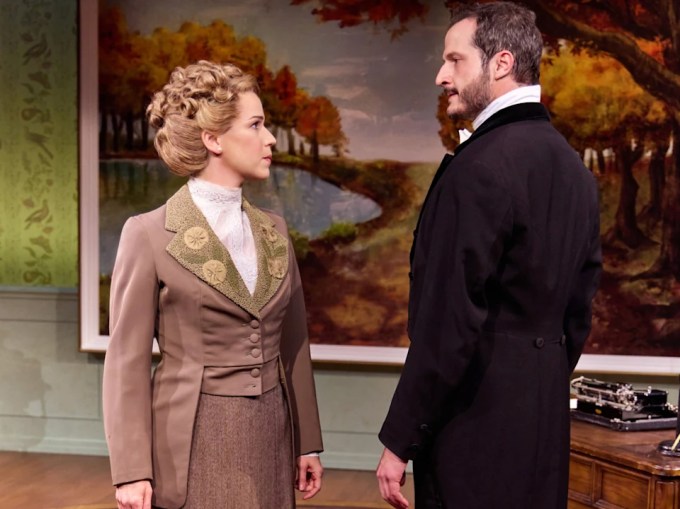
The larger piece is Barrie’s The Twelve-Pound Look, which benefits from appealing costumery and a skeletal set suggestive of life in the manor.  We meet the frivolous, self-centered Harry Sims.  A highly ambitious and successful commoner who has recently been selected for knighthood, he obsesses about getting the ceremony right and insists that his wife Emmy participate in his rehearsals.  An apt Bryan Fenkart preens like a self-indulgent peacock, but we quickly find that his determination extends to his unqualified dominion over his put-upon, but still accepting wife, played by Courtney Reed who in this show escapes being typecast as a sexpot.

Courtney Reed, Bryan Fenkart.

The spanner in the works is that unbeknownst to either side, the typist, Kate, who is brought in to type Harry’s thank you letters for the congratulations he receives is none other than his first wife who had abandoned him.  The dynamics of their relationship are revealed in the duet “You Might Have Been Lady Sims,” and the eloquent disclosure in her solo “I Had to Give Us Up,” in which Chilina Kennedy displays her outstanding voice that complements her fine acting.

Harry admits that he hired detectives to find “the other man” and is crestfallen to hear that Kate simply needed to get away from his overbearing nature and did so as soon as she’d saved ₤12 to buy a typewriter and thus her independence.  The crux of the play is: Will Emmy also adopt The Twelve Pound Look?

In the shorter, second act, A Sunny Morning, the elderly Don Gonsalvo holds to the tradition of going to a bench in the park that he considers his on every sunny day.  Furious that others are seated there one day, he is forced to share another bench with an attractive elderly lady.  Gonsalvo is portrayed by the highly accomplished Chip Zien, who possesses both a booming speaking and singing voice.  The woman is Dona Laura, played by an equally decorated and talented counterpart, Joanna Glushak.

Chip Zien, Joanna Glushak.

Each of these older characters recognizes the other as a lover from decades before but doesn’t think the other realizes their past connection.  Each ruefully reflects on the curse of age and hesitates to voice the revelation, regretful of how the attractiveness of youth has abandoned them and the expected disappointment by the other.  How will this conundrum resolve?  I’ll never tell.

Like all literary mashups, the two stories don’t fit like an original and its sequel, but the theme of finding someone anew who was known years before is a common one.  That linkage, plus fine acting and a score that adds richness to the narratives, make for fine fare.

Reunions with book and lyrics by Jeffrey Scharf and music by Jimmy Calire, is based on the short stories The Twelve-Pound Look by J.M. Barrie and A Sunny Morning by Serafin Alvarez Quintero and Joaquin Alvarez Quintero, plays at City Center Stage II, New York, New York.

A Driving Beat

Jon Viktor Corpuz as Mateo, Lee Ann Payne as Diane. All photos by Kevin Berne.

For the remainder of the year, my San Jose and Peninsula theater reviews will be posted on Talkin’ Broadway with only introductions to those reviews on this site. Please continue to https://www.talkinbroadway.com/page/regional/sanjose/sj301.html  for full review.

In the world of stories, change of scenery usually triggers more profound change.  Perhaps this feature motivates the driving trip as a recurring genre in live performance and film.  All variety of life altering events can occur en route, from car chase to car accident and from wedding to murder.  But in the more placid trips like TheatreWorks’ A Driving Beat, the welcomed reward is seeing characters grow.

In a world premiere three-hander, playwright Jordan Ramirez Puckett explores a new dimension on this theme with great sensitivity and a highly entertaining outcome.  On the surface, Diane is a middle-aged, white-bread, elementary school teacher from Ohio.  One summer, she takes her soon-to-be 15-year-old son Mateo on a driving trip to San Diego.  However, the notion of this being a slice of traditional American life ends there.  The fact that the action is punctuated with hip-hop song and dance diversions by Mateo in English and Spanish in which he shares inner thoughts should provide a clue.

Lee Ann Payne as Diane, Livia Gomes Demarchi as waitress, Jon Viktor Corpuz as Mateo.

Lee Ann Payne as Diane beautifully portrays the earnest and caring mother of an adopted boy.  Her blend of tight and loose rules mixed with love have produced a warm relationship with Mateo.  Diane light-heartedly refers to this trip as his quinceañero, which Mateo bristles at because quinceañeras, celebrating the 15th birthday, are for girls, and there is no male equivalent.

A bright, ebullient, and sensitive Mateo is portrayed by a smiling and visually expressive Jon Viktor Corpuz as a teen who loves Diane but is intimidated by much of what surrounds him.  Mateo was born in San Diego and identified as Latino of unspecified origin.  The purpose of the trip is the hope to find his roots……

A Driving Beat, a world premiere written by Jordan Ramirez Butler, is produced by TheatreWorks Silicon Valley and plays at Mountain View Center for the Performing Arts, 500 Castro Street, Mountain View, CA through November 23, 2025.

Jon Viktor Corpuz as Mateo, Lee Ann Payne as Diane.