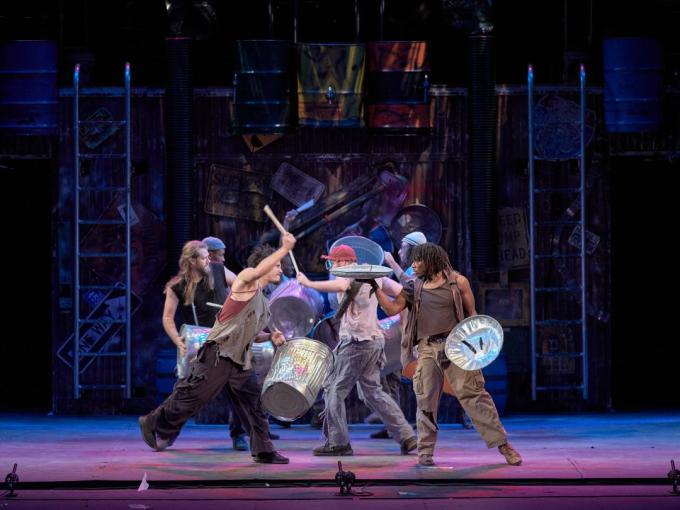
Rat-a-tat, click, crash, swoosh, thump, tap, ting. These are some of the many percussive sounds you will hear in 90 minutes of audio/visual thrills and adventure at Stomp as eight performers romp about the stage. What you won’t hear or see is the spoken word or music. All of the acting – and there is humor as well – is mime.
Having evolved from busker’s performances in the U.K., Stomp celebrates its 30th anniversary as a stage show, with a stint at the Henry J. Kaiser Center for the Arts in Oakland. The pounding, frenetic high energy show is a crowd pleaser from beginning to end.
The germination of Stomp is that virtually any item, from match boxes to newspaper, can be used to create sound. Varying the timing of the beats creates rhythm. Adding multiple performers to create the rhythm delivers either resounding unison or an orchestra of counterpoint percussion. Choreograph the motion and you have a well-honed, unique, and entertaining stage show.

Of course, creating percussive sounds from various items to communicate or entertain is universal and timeless. In the modern era, popular examples of creating a beat from beyond the drum kit was broadly popularized by two legendary dancers. Fred Astaire taps around and bangs on various props in movies like Easter Parade, and Gene Kelly and friends attach trash can lids to their feet to dance and create crashing sounds in It’s Always Fair Weather. In fact, one of Stomp’s signature skits using trash cans as drums and lids as cymbals appears to be inspired by Kelly’s idea. But it is doubtful that any collection of sound and movement sketches has ever been as complex or diverse as Stomp.
The show opens as a realization. A single performer using a push broom focuses on the brushing sound the bristles make. He then taps the wooden sides on the floor and adds rhythm. One by one, the other performers appear, and before long, a symphony of sound and movement emerges. This is the first of the myriad of overlaid rhythms and movements that astound with their variation, intensity, and accuracy.
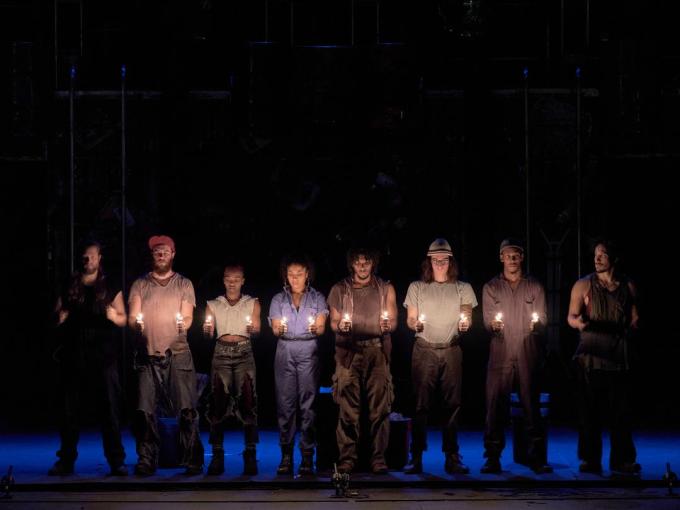
The sounds of each prop vary, and some are unexpected. Various sizes of plastic accordion pipe when extended or when stroked with a stick result in different sounds, as if a cacophony of insects and chattering animals in a jungle. Amazing as well is how the sound of a straw scraping in the cut opening of a drink cup lid can carry and play off of the pounding of a blown-up plastic film bag. In another sketch, the performers align on a darkened stage and flick cigarette lighter flames off-and-on in precision for a starlight show.
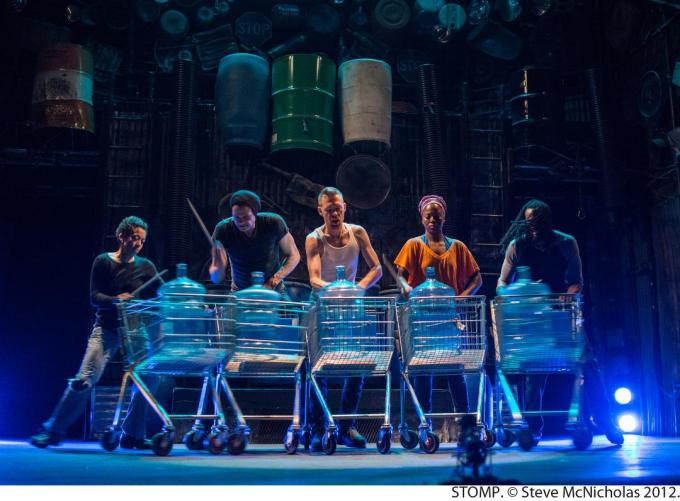
Apart from the cornucopia of sound, the performers impress with pinpoint timing and athleticism. In some sequences they hurl large objects to one another at long distances; they stick fight in others; and they stomp and prance throughout.
Stomp’s brief stay in Oakland is at the Kaiser Center for the Arts, formerly a convention center. After a 20-year closure, it has been renovated and is now in a soft opening in its new repurposing. Functionally, its 1,350 seat Calvin Simmons Theater, one of five indoor venues at the Center, fills a performing-house gap in Oakland among the massive (Oakland Arena), the merely huge (Paramount and Fox Theaters), and the intimate (Yoshi’s, for example). For its size, the whole seating configuration is relatively close to the stage as many seats are in side wings and others in two tiers above the orchestra.
The stately Center sits in a beautiful location at the foot of Lake Merritt, adjacent to both the Oakland Museum of California and Laney College. Although the Center has a parking lot, it is too small for popular performances, and the event parking fee for this night was $40. Street parking and other nearby lots are a possibility. The Center’s entertainment offerings are building, and hopefully they will all be as well received as Stomp.
Stomp, created by Steve McNicholas and Luke Cresswell, played at Henry J. Kaiser Center for the Arts, 10 Tenth Street, Oakland, CA December 6-7, 2025.

 cordellreportsdotcom