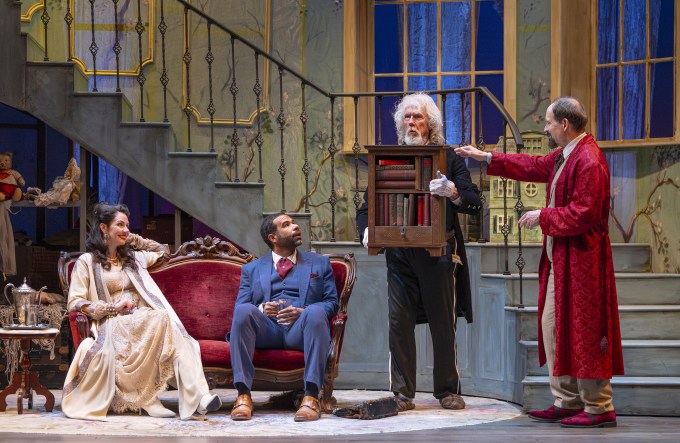
Along with his other masterpieces, Uncle Vanya, Three Sisters, and The Seagull, Anton Chekhov’s The Cherry Orchard resides in the pantheon of international theater. The last of his plays, published in 1904, it appeared just before the emergence of revolutionary activities, but over a decade before the Russian Revolution of 1917. Yet it seems to anticipate sea change in so many ways with its depiction of the precipitous decline of the privileged classes, the successes of many who descended from serfdom, and the influence of idealistic intellectuals in framing the shape of the new society.
Like some of Chekhov’s other works, one of the challenges of launching The Cherry Orchard is its duality. Is it a comedy or a drama? Director Carey Perloff’s interpretation of the handsome and engaging Marin Theatre production is clear from the outset, as characters flounce about the stage breezily with exaggerated gestures and expressions. Though the script shows some weaknesses, a brilliant cast and energetic direction make the best of it. And perhaps one of the ensemble’s strengths is that it reunites the director and several of the actors who appeared last year in Marin’s production of the Edwardian play Waste, which shares some similar themes and comes from the same era.
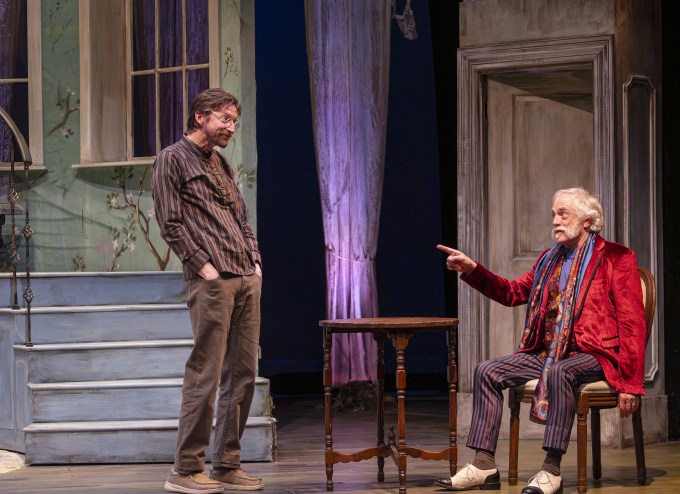
The action revolves around a single event. Liubov (portrayed by Liz Sklar) is a widowed petite-aristocrate who has returned from several years in Paris as her estate with her beloved cherry orchard is failing and is set to be foreclosed and sold at auction. Lopakhin (Lance Gardner) is the wealthy son of a peasant who worked on the estate. Though it is perhaps a stretch to say that Lopakhin was modeled on Chekhov himself, both were grandsons of serfs, abused as children, and were involved in a sale of property that was life changing. In this case, Lopakhin offers a way to preserve a bit of the property and ensure wealth to secure the lifestyle of Liubov and her brother Gayev (Anthony Fusco).
The proposal is to raze the orchard, subdivide the property, and build dachas, vacation homes for wealthy urbanites. But Liubov and Gayev are so entrenched in their memories, their way of life, and the fantasy of its never ending, that the idea is so anathema that they are unable to grab the lifeline.
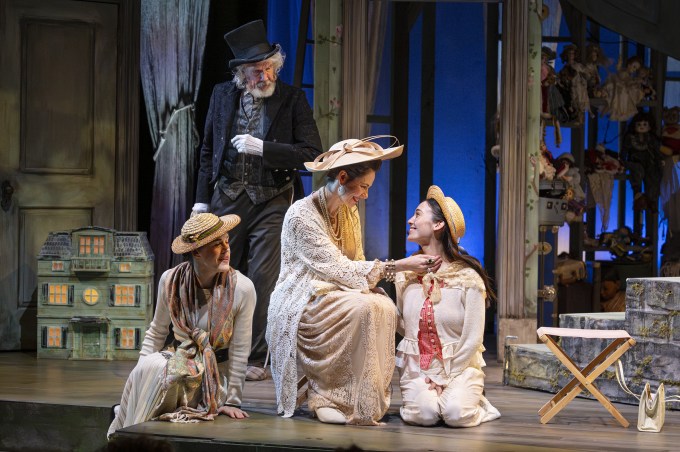
Sklar is delightful as the vivacious Liubov, wearing the perpetual regal smile as she blithely and generously fritters away what little money she has. Appearing simple and frivolous in many ways, Liubov is a fully-developed character. At times philosophical and insightful despite her glaring blind spots, her concern for her daughters and others who rely on her largesse, like the servants and workers, is revealed. Her candor about having had an affair while married surprises, and she is still conflicted by that problematic love link which lies in Paris. Is she delusional to think that her problems resolve in France, or should she succumb to the pull of her homeland?
One of the weaknesses of the script, however, is that all of those around Liubov are caricatures. Lopakhin, beautifully played by Gardner, conveys the discomfort of a nouveau riche with the ability to solve the problems of his former liege. He knows only one measure of success, and that is money, which solves all problems. Gardner shows nervous surprise when two characters at different times, each of whom are in need of money, deny his offering of cash. When given the chance to embrace humanity, Lopakhin reverts to his pecuniary instincts.
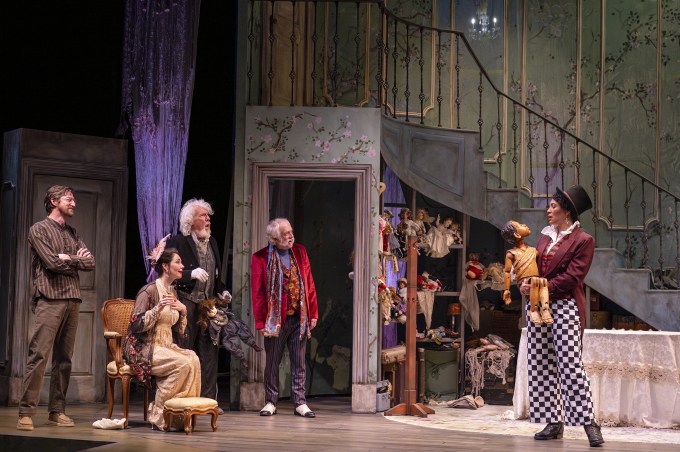
The restrained Fusco’s somewhat brooding but also affectionate Gayev has one obsession, and that is billiards, which recurs in his conversations. Totally inert and uncontributing, even more than his sister, he represents the sunset of the Russian aristocracy with his ad hominem rejection of Lopakhin’s idea to save their property from the auction block. And lacking either motivation or experience, he thinks that a bank job that he has been offered will somehow preserve his station in life.
The interloper into this coterie of tradition is Trofimov, an eternal student, performed with stridency yet charm by Joseph O’Malley. He captures the know-it-all, idealistic youth who lacks experience and responsibility but somehow thinks that he has all of the answers. He has the gall to tell Liubov to forget the estate, that it is already dead, though she notes that he has never faced these circumstances. He even castigates intellectuals for having theories with no action behind them, when he is guilty of the same thing. I suspect some of us can see a past version of ourselves in him. He does serve as a love interest who could divide a household, but more importantly, he stands for the prototypical Bolshevik who will totally upend the established order in Russia.
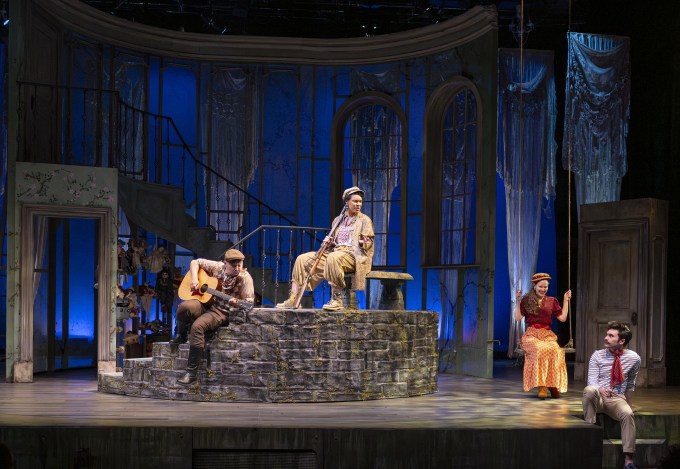
Several notable actors appear in smaller roles and are wonderful in them (see photos and captions). Though most characters are one-dimensional, the actors avail the opportunity to groove deeply into a particular behavior type. Some are also involved in subplots that are superfluous, which is another weakness in the script. Other issues that are common to some Russian novels, but are more difficult for the viewer to deal with in a play, are the inundation of characters at the outset and that they can be variously referred to by surname, given name, and nickname before you even know who they are and how they fit in.
Despite these criticisms, The Cherry Orchard is highly entertaining and well worth seeing. The overarching themes of evolving society, competing values, living in the past, the delusions that people live by, and love and loss are among those that make it compelling. Further, the subtlety amidst the raucousness is that the playwright eschews judgment. Each of the key characters is clearly defined, while possessing good and bad characteristics, and it is up to the individual viewer to decide their worthiness. As previously noted, the performances and direction are superb, and the production values are great, especially Nina Ball’s scenic design of the nursery room in the manor teeming with dolls and Lydia Tanji’s costumes.
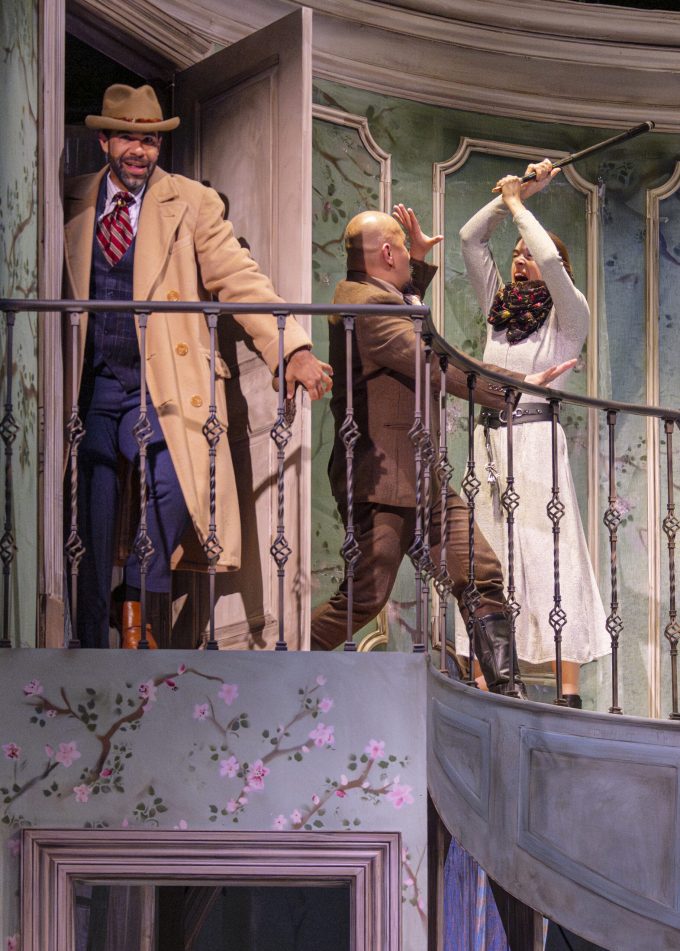
The Cherry Orchard, written by Anton Chekhov, is produced by Marin Theatre and appears on its stage at 397 Miller Ave., Mill Valley, CA through February 22, 2026.
 cordellreportsdotcom