Stereotypes, heuristics, prejudices, schemas, models, labels, tropes, memes. In different ways, they all help us simplify the world around us. While they can serve the god of efficiency, especially for those pressed for time, they can also close the mind to possibilities and lead to disastrous results.
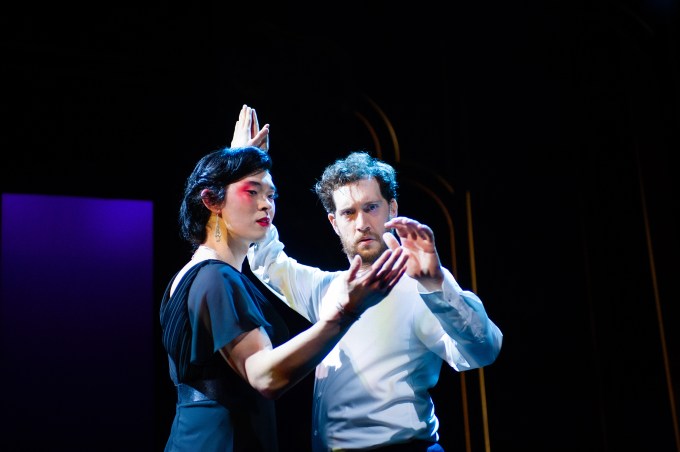
With M. Butterfly, multi award-winning playwright and opera librettist David Henry Hwang introduces us to a fictionalized real-world relationship that confounds most people. Beginning in the late ‘60s, a French diplomat in China, Rene Gallimard in the play, carries on an intimate affair with Song Liling, a singer in the Chinese opera for over 20 years. But despite having a carnal relationship with this “mistress” and the fact that men perform women’s roles in Chinese opera, Gallimard was (presumably) naive to Song’s gender identity the whole time. Furthermore, he was unaware that she was spying on him for the Chinese government.
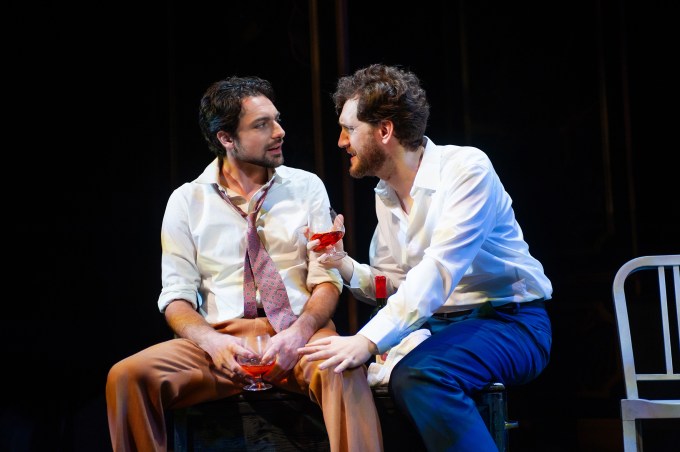
San Francisco Playhouse has launched a handsome and winning production of this unique and provocative play with top actors and striking staging. While it earned the Tony Award as Best Play in 1988 and its nomination for the Pulitzer, the play itself is a little long-winded and could easily be trimmed. Like many other plays, much of the text is subject to interpretation, and non-verbal elements can alter tone and even meaning. While some humor is inherent in the text, Director Bridgette Loriaux and her actors have maximized the more comic elements in the play. What results keeps the play from being dark throughout, but the frequent interference with the seriousness of the situations saps the dramatic arc.
Conceptually, the narrative is presented in a series of flashbacks, so the audience knows the denouement from the outset. Before adulthood, we see Gallimard with his best friend Marc, whose amorality and cynicism lead to an obsession with girls as sexual objects. We then see Gallimard as a low-level functionary whose competence lies in research but who lacks the skills to rise to powerful positions. Upon meeting Song, he is enchanted by her feminine delicacy, and though married and not sharing his friend’s predilections, he begins his tryst.
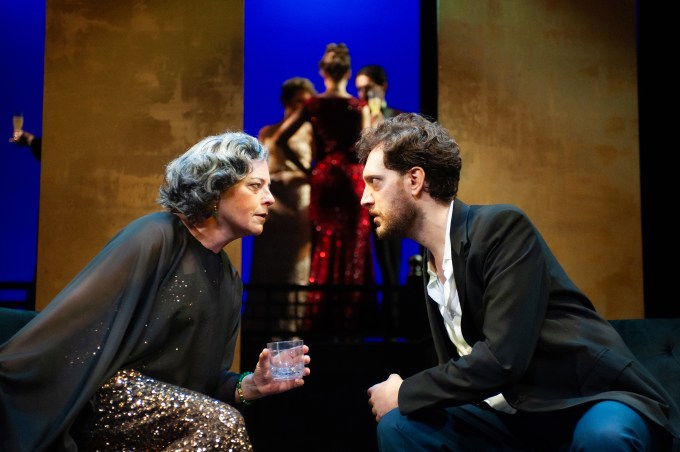
The playwright links the lives of the couple to current affairs in China and elsewhere. Gallimard’s knowledge of the American involvement in Vietnam makes him more important. His flippant ambassador, repeatedly entices him with talk about promotion, and finally she makes him a Vice Consul, but along with increased visibility comes vulnerability. This makes him a more valuable asset to the Chinese government as well, and Song’s handler encourages her to deepen her involvement.
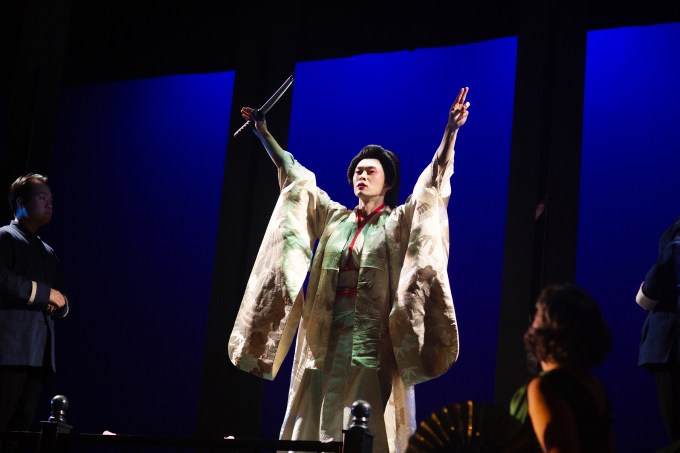
Interspersed and sometimes integrated with the plot line are snippets from Puccini’s opera Madama Butterfly, which enhances the thematic elements of the story. While Gallimard sees conflict in identifying with Lt. Pinkerton, the American naval officer who marries Cio Cio San (Madama Butterfly), he fully sees Song as representing her. Song is Gallimard’s Butterfly.
But rather than focusing on the suspense of what is revealed, Hwang is more concerned with making a socio-psycological commentary on sexual attitudes and behaviors as well as political philosophy. At one level, the playwright sees this as a war of the sexes, with the female perspective largely represented by the crossdressing Song. The Occidental view of Orientals, and their women in particular, is that they are compliant and subordinate. Though Gallimard in no way seems macho, he does feel his masculinity rewarded by having dominion over a delicate female, especially an Asian – finally succumbing to lasciviousness like Marc’s. He would see women as butterflies to be collected and seen as adornments.
Yet in many ways, Gallimard is subservient to her, as his lust seems less controlled than Song’s, and in important ways, he will become the Butterfly. But another dimension of the personal relationship is explored after Song is exposed as being male. Song is no different than before, but can Gallimard be drawn to him in the same way as before? Is it fantasy or reality that acts as the magnet? And did Song really have an affinity for Gallimard, or was the only draw for Song that a homosexual could lead a life style that is otherwise illegal but endorsed by the government?
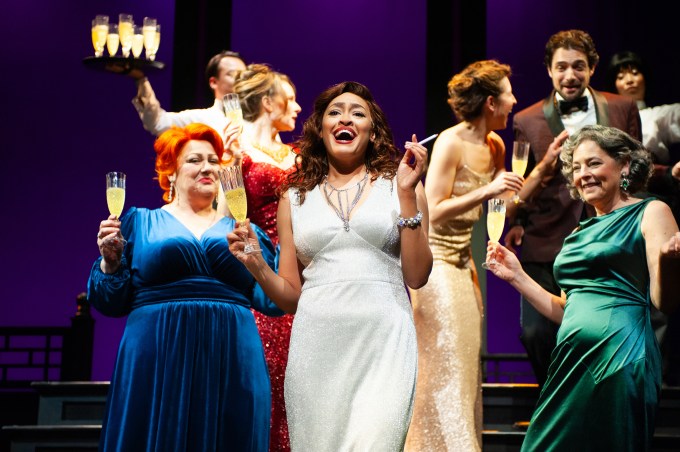
Overlying this dyad is the greater issue of the political realm. Westerners also conceive eastern countries to be aged and weak, and the gentility of eastern women is also imputed onto their whole societies. The result of western thinking results in condescension toward Asians and their countries, which may work over long periods of time. But ultimately, acting on mistaken impressions is a trap that can lead to dreadful mistakes. Westerners fail to grasp the longer term thinking of Asians; their willingness to allow westerners to delude themselves; and their patience in achieving their objectives. These factors come to play in the Gallimard-Song relationship and in the broader political events of the time.
The two leads dominate the action. In Dean Linnard’s portrayal, Gallimard’s contradictions come through. Concise in diction and precise in thought, he is still stumbling and ineffectual. Edric Young captures Song’s fraudulence with grace and conviction, playing the modest and shy card to great effect. They both break the fourth wall frequently which enhances the connectedness of the audience with their characters. Supporting roles are well acted, though they are almost all one-note characters. Andre Amarotico is ebullient as the rascally Marc, while Stacy Ross is breezy and smarmy as the ambassador.
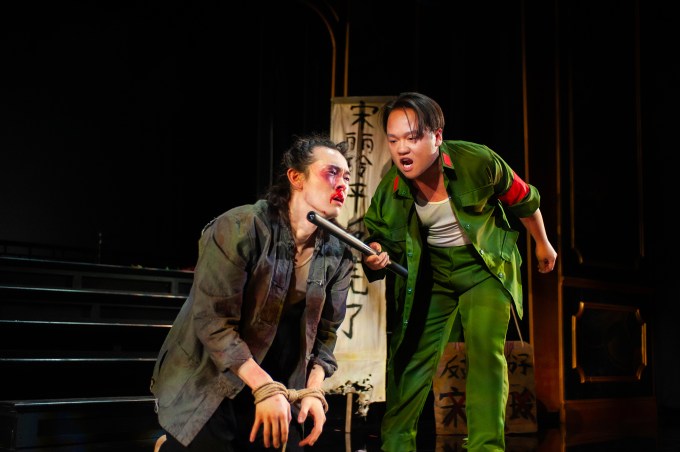
Production values in M. Butterfly are superb. Randy Wong-Westbrooke’s scenic design draws from Chinese black lacquer-work. Mimicking lacquer screens, three concentric black arches with gold designs frame the proscenium, with slick black steps and other angular features dominating the stage. Michael Oesch’s often stark lighting highlights the action, while Keiko Carreiro’s costumes stand on their own and provide sharp contrast with the background. Often, stage wigs can look very phony, but Alexander Class’s wigs for Song are most appropriate. Final kudos go to Sound Designer James Ard who joins the Asian and Western sound elements into a harmonious whole.
Most theatergoers should find M. Butterfly an exotic, thoughtful, and satisfying experience.
M. Butterfly, written by David Henry Hwang, is produced by San Francisco Playhouse, and is performed on its stage at 450 Post Street, San Francisco, CA through March 14, 2026.
 cordellreportsdotcom