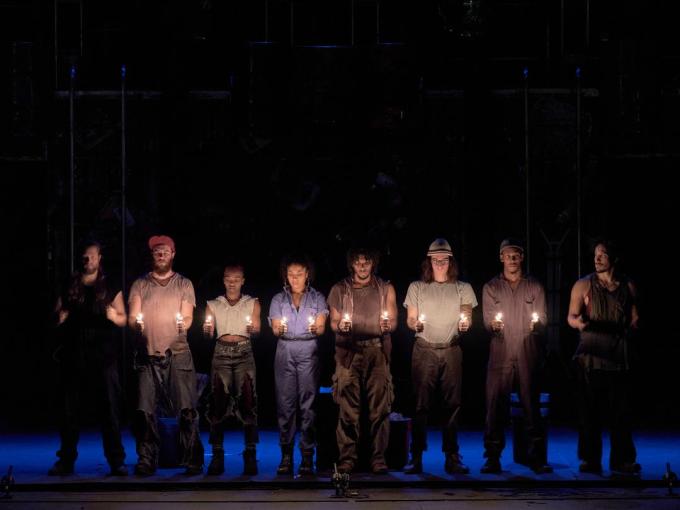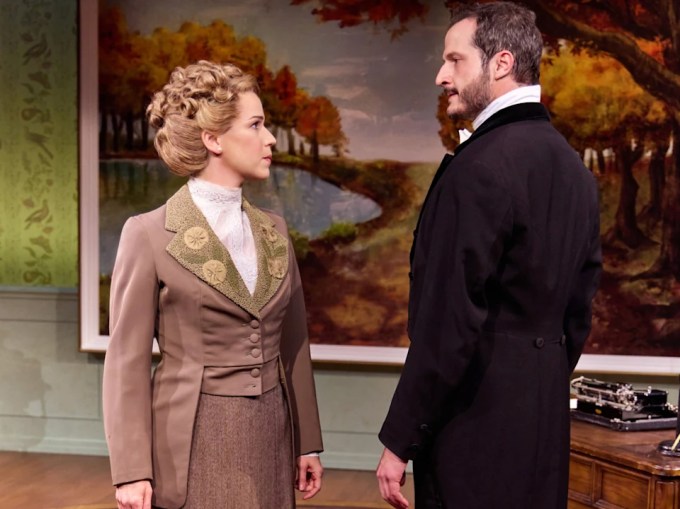
LIBERATION: Susanna Flood, Betsy Aidem. Photo by Little Fang.
As an attendee of the American Theatre Critics Association Conference in New York City, I would like to thank the producers of all of the shows that generously provided press tickets to our members. Along with my wife and editor, Karin, I was able to see the four noted below, for which I am separately publishing brief individual reviews.
Although I had no overarching thought in mind when selecting shows to see, a powerful theme emerged, the notion of revisiting the past, and specifically of reunion. The very title of one show is Reunions, a New York premiere of a musical that ties together two turn-of-the-century (20th, that is) narratives, each about two people who find one another by accident after the passage of years. Another recent opening centers on a tenth-year high school reunion, Romy & Michele: The Musical. Next is the fantasy musical, Six: The Musical, in which the deceased six wives of Henry VIII get together and compete to find who suffered the most. And finally, in Liberation, a contemporary woman tries to understand her deceased mother better by meeting with her associates from a consciousness raising (read feminism) group from the early ‘70s.
REUNIONS (“THE TWELVE-POUND LOOK”): Chilina Kennedy, Bryan Fenkart. Photo by Jeremy Daniel Photography.
The other unintended theme across the four selections is womanhood and different aspects of women’s rights. In Six, all performers, actors and musicians, are female, while the cast of eight in Liberation has only one token, part-time male. Romy & Michele focuses on the enduring friendship of two girlfriends and their clashes with the popular girls from their high school. And while Reunions is about couples, its emphasis concerns the agency of women at a time when men domineered.
Two incidents made Liberation special. First, our conference was fortunate to have a panel discussion comprised of the show’s brilliant playwright Bess Wohl, director Whitney White, lead actor Susannah Flood, and key actors Betsy Aidem and Kristolyn Lloyd. Their insights were informative and entertaining, and Karin and I were fortunate to see the play that very night. I’ll add that we had similar arrangements at past conferences with The Band’s Visit and Kimberly Akimbo: The Musical, which offered like experiences. You might expect that I would have a positive bias in reviewing Liberation because of personal contact with creatives and performers. I will note however that in the closing session of the conference, when attendees were asked what they liked the most and what they would like to see more of, Liberation led the way both for the panel discussion and for the play.
ROMY & MICHELE: Laura Bell Bundy, Kara Lindsay. Photo by Valerie Terranova.
The other anecdote involves the actor Susannah Flood who portrays the character Lizzie, who often speaks of her dead mother. Susannah’s quite alive real mother was in the front row at our performance, and we knew in advance that this was the very first time that she’d seen her daughter on Broadway.
I’d also like to express gratitude to Adrian Bryan-Brown, public relations manager, and Joan Marcus, still photographer, for Six: The Musical, who comprised a discussion panel at the ATCA Conference. Finally, and unplanned, Karin and I conversed for over an hour with Jeffrey Scharf, the creator and writer of Reunions and who is from nearby Santa Cruz, which was enjoyable and illuminating.
SIX: Kelsie Watts, Najah Hetsberger, Krystal Hernandez, Kay Sibal, Taylor Marie Daniel, Gianna Yanelli. Photo by Joan Marcus.
The opening of the fantasy musical Six is like a thunderous rock concert with a darkened stage, thumping music, fog, and six potent women abreast in costumes that bridge the 16th and 21st centuries – rigid, colorful, and sparkly with boots ‘a made for stompin’. They own the stage. The opening number, “Ex-wives,” sets the scene with its noteworthy and rhythmically incessant lyrics “Divorced, beheaded, died; divorced, beheaded, survived,” which are the successive outcomes of the women in question.
Taylor Marie Daniel, Kelsie Watts, Gianna Yanelli, Najah Hetsberger, Krystal Hernandez, Kay Sibal.
These are the dead wives of Henry VIII, allowing for spelling variations, the three Catherines, two Annes, and a Jane. Something you may not have thought of – you probably know who some or all of these women are, but could you name the queen of Henry VII, or Henry VI, or …..? The six may not have produced a male heir that survived into adulthood, but they did make history.
Six charges forward with high-volume, mostly hard rock music with an all-female cast and all-female band. Not a man to be found on stage. There is a lot of jousting repartee among the wives, with the conceit being that the one who can convince the others that she had it the worst as queen, would get to be the lead singer of the six. A recurring schtick is that each time one of the other wives pouts about how miserable her life had been, Anne Boleyn chimes in, “But did you lose your head?” The trash talk and clatter clashes are punctuated by solo songs by each queen in chronological order that deal with their travails.
Kelsie Watts.
The voices are uniformly strong and wailing. The music is listenable and danceable, at least as choreographed for the six. Apart from the noisy but tuneful soliloquies from most wives, an occasional gentle melody sneaks in as with Jane Seymour’s luxuriant and memorable anthem, the beautiful “Heart of Stone.” Although the song is about endurance, Jane died from birthing the future Edward VI, barely a year into marrying Henry and before her 30th birthday. Edward would die at age 16. Another fine song is Catherine Parr’s melodic lament “I Don’t Need Your Love,” which explores leaving love behind when forced into an arranged royal marriage.
Now comes a philosophical point of whether a reviewer should represent only their own point of view or recognize that their personal opinion may be well out of sync with what the market is looking for. Despite Six not speaking to me or my wife (or the little girl behind us), I have to accept its virtues, as the audience was overwhelmingly entertained, and its already four-year Broadway run speaks for itself. The 80 minutes does go by quickly, and it will leave a lot of the audience wanting more. In particular, teen girls and young women hoot and howl, probably because the music and dialog work for them and because it is of, by, and for females. That in no way suggests that boys and men shouldn’t enjoy it, because at the same time, it’s a very muscular show in most every way.
Kelsie Watts, Najah Hetsberger, Krystal Hernandez, Kay Sibal, Taylor Marie Daniel, Gianna Yanelli.
Six: The Musical, with book, lyrics, and music by Toby Marlow and Lucy Moss, plays at the Lena Horne Theater, New York, New York, on an open run.
This is the sort of production that a snooty critic might say fits in the category of musicals that had no reason to be made as it borrows so heavily from antecedents like Grease, Mean Girls, and Peggy Sue Got Married. Yet, it has already found its audience. Among others who simply enjoy light entertainment, some girls and young women chirp along and cackle at the loopy lines delivered by the clueless duo who those patrons know from the movie Romy and Michele’s High School Reunion.
Jordan Kai Burnett (center), Pascal Pastrana (right rear).
Even cynics may laugh out loud, and for those who must find meaning in shows, the bottom line is to be true to yourself, and to put friendship before popularity and other forms of success. Another observation is that those in power are loathe to relinquish it.
Broadway pros Laura Bell Bundy and Kara Lindsay are the title characters respectively, and they fit their roles down to the ground portraying the pretty, appearance conscious, but mindless adornments. Romy’s is the larger and more distinctive role, and if her speaking voice doesn’t hurt your ears, her extreme Valley Girl accent will.
(Center) Kara Lindsay Je’Shaun Jackson, Laura Bell Bundy.
As failed wannabes at Sagebrush High School, they escape Tucson for LA to find fame and fortune. Ten years out, Romy is a receptionist in a Jaguar dealership and Michele is an unemployed sales clerk. When invited to a tenth-year high school reunion, they decide that they must go back as successes, so the bright lights hatch a plot to say that they invented Post-Its. You can imagine how that plays out. At least they are able to show up at the reunion in a deluxe conveyance, which Romy extracts from the dealership after greasing some skids, shall we say. And they will benefit from some dumb luck.
The production is bright and lively in every way with perky musical numbers and dance along with kaleidoscopes of shapes and colors, from the girl’s wardrobes to the scenic projections.
Cheerleaders.
Another strong suit is all of the stock characterizations of kids you knew from school. There is always a guy like Toby (superficially ebullient but often depressed Je’Shaun Jackson) who wants desperately to be liked, but despite all of his efforts to make things happen is totally ignored. Heather (the brooding, scene stealing, and strong-voiced Jordan Kai Burnett) is the dark Goth loner. Michael Thomas Grant plays Sandy, the mangy nerd who surprises with his success. Pascal Pastrana is Billy, the Greek God who goes backward after high school. Finally, there are the popular-girl cheerleaders. Enough said.
So, Romy & Michele is not for everyone, but for the right audience or for those seeking an entertaining diversion, it works.
(center) Laura Bell Bundy, Kara Lindsay, (left rear) Michael Thomas Grant, (right rear) Jordan Kai Burnett.
Romy & Michele: The Musical, with book by Robin Schiff and music & lyrics by Gwendolyn Sanford & Brandon Jay, plays at Stage 42, New York, New York on an open run.
Susannah Flood, Betsy Aidem. All photos by Little Fang.
I saw this wonderful show on a trip to New York. Thanks to the producers of Liberation, represented by public relations firm The Press Room, for their generous provision of press tickets for members attending the American Theatre Critics Association Conference. Also, thanks to playwright Bess Wohl, director Whitney White, lead actor Susannah Flood, and key actors Betsy Aidem and Kristolyn Lloyd for dedicating their time for an informative and interesting discussion panel about the play at the conference.
Audrey Corsa, Susannah Flood.
One of the first things to note about Liberation is that I haven’t seen so much smoking since Mount Saint Helens and so much skin on stage since Oh! Calcutta! But those aren’t what it’s really about.
It is a memory play about a woman, Lizzie, trying to better understand her mother by conversing with her mother’s past associates. Like most children, Lizzie had seen her mother through the lens of their relationship, failing to know her as a complete person.
Kristolyn Lloyd, Irene Sofia Lucio, Betsy Aidem, Audrey Corsa.
Playwright Bess Wohl plumbs her own family history, and the fact that her mother had worked for Ms Magazine in its earliest days, to draw a loving portrait of the women who took part in the feminist movement in the ‘70s. The result is a well-produced and directed, compelling and deep dramedy with broad appeal. To borrow the words of one of my colleagues who also attended, “It’s not perfect, but I love it anyway.”
The action takes place in a rec center gymnasium in Ohio and switches back and forth between the 1970s and current time. It starts with Lizzie’s mom organizing the “consciousness raising” group and ends with Lizzie interviewing the women who were involved.
Irene Sofia Lucio, Kristolyn Lloyd.
For those of us who were there and should remember the footsteps of Betty Friedan and Gloria Steinem, the show is a reminder that while there were many doctrinaire feminists, there was a broad array of positions. Characters in the play are clearly drawn, ethnically and otherwise diverse women – some unhappy in marriage, and others not so unhappy in marriage; closet lesbian and motorcycle dyke; and more. They are shy and gregarious; diplomat and bomb thrower; bombshell and Plain Jane.
Susannah Flood strikes all the right notes as Lizzie, often breaking the fourth wall as a narrator to share thoughts directly with the audience. Besides playing Lizzie, she also plays her (unnamed) mother, navigating the policy clashes among the newly enlisted feminists, like whether to join in the Strike for Equality, which carried the risk of job loss by some participants. On the personal side, a secret is long withheld by one of the women that she has been dating a man and is considering following him to New York, while at the same time rejecting the practice of marriage. Some of her cohorts are troubled by the secrecy and her commitment to a man. Very conflicted.
Kayla Davion, Charlie Thurston.
Dialog crackles. Led by the terrific Betsy Aidem as the repressed “older” Margie, she spews a catalog of the many chores that she performs without any assistance from her husband. Another juicy role is that of Dora 1 (there are two Doras), the effusive green-card-seeking immigrant firebrand portrayed by Irene Sofia Lucio.
The most stunning event is the opening of Act 2, which in the earlier panel discussion was not revealed, or shall we say, unveiled. Beginning on a darkened stage, the audience can see the women disrobing, and when the lights come up, they are totally nude and will remain that way for perhaps 15 minutes. This courage is the ultimate expression of women’s liberation, and it also provides the opportunity for the characters to demystify body evaluation in their discussions.
This is an exceptionally insightful and fascinating play. My only real criticism concerns the confusion of time and characters. Sometimes it is difficult to sus out whether the action is current or from the past which could be easily resolved with a device as crass as having a person walk across the front of the stage with a sign indicating the year.
Susannah Flood, Adina Verson, Kristolyn Lloyd.
Lizzie’s mother should be given a name that is used by others, particularly because she is usually played by the same actor who portrays Lizzie, and with an unchanging set of actors/characters on the stage. To make matters more confusing, two other actors play the mother at other times. At least in one case, it is funny. In a scene where Lizzie’s future father will be kissing her future mother, Lizzie tells the audience that playing that scene would just be too creepy, so someone else would have to stand in, which Lizzie then watches. Because the sociological notion of “becoming one’s mother” has merit, the idea of the same actor (and a powerful one in this case) playing both roles has great appeal, but it should be managed better.
It’s surprising that these issues survived the show’s transition from off-Broadway to Broadway. Nonetheless, the funny and serious Liberation should have legs, or better yet, wings to fly.
Liberation, written by Bess Wohl, plays at the James Earl Jones Theater, New York, New York, on an open run.
Chilina Kennedy, Courtney Reed. All photos by Jeremy Daniel Photography.
Thanks to the producers of Reunions represented by public relations firm Keith Sherman & Associates for their generous provision of press tickets for members attending the American Theatre Critics Association Conference.
Although there are exceptions like the works of O’Henry and Guy de Maupassant, short-form fiction is a largely overlooked genre, lacking the depth and dimensionality of longer works, and presumably easier for a dilettante to accomplish. Yet many of these small masterful works distill a single insight into a crystalline gem.
A challenge in the performing arts is how to present such works. Jeffrey Scharf has adapted two early 20th century works, a short story by Scotsman J.M. Barrie of Peter Pan fame and a short play by the Spanish Quintero Brothers that share a common thread. The addition of musical numbers results in a very delightful and still short, no-intermission evening of entertainment.
Company.
The first piece is a parlor room drama, while the second takes place on a park bench. Since both venues are highly focused, each benefits from its performance space which is an intimate, audience-level thrust stage at New York City Center in the Broadway district. Creator Scharf was also fortunate to attract a complete cast with strong Broadway credentials, so the acting and singing are both of the highest order.
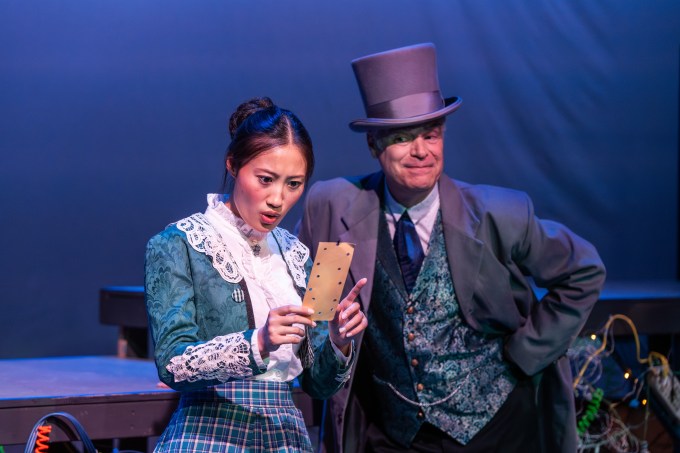
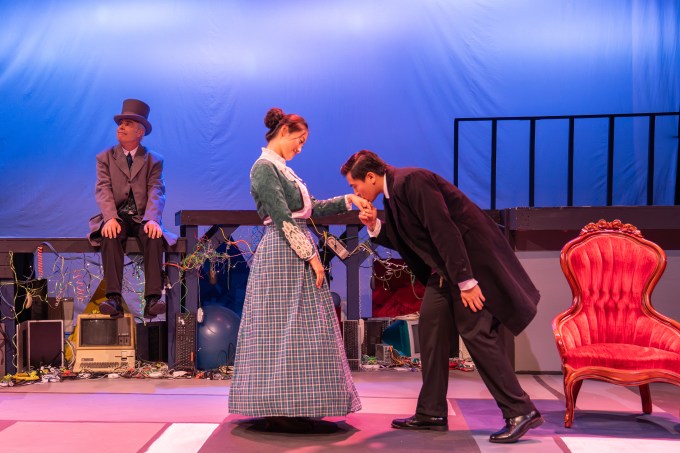
The larger piece is Barrie’s The Twelve-Pound Look, which benefits from appealing costumery and a skeletal set suggestive of life in the manor. We meet the frivolous, self-centered Harry Sims. A highly ambitious and successful commoner who has recently been selected for knighthood, he obsesses about getting the ceremony right and insists that his wife Emmy participate in his rehearsals. An apt Bryan Fenkart preens like a self-indulgent peacock, but we quickly find that his determination extends to his unqualified dominion over his put-upon, but still accepting wife, played by Courtney Reed who in this show escapes being typecast as a sexpot.
Courtney Reed, Bryan Fenkart.
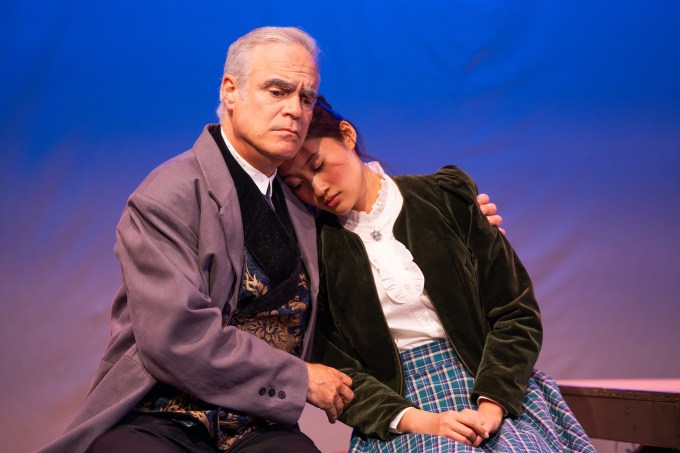
The spanner in the works is that unbeknownst to either side, the typist, Kate, who is brought in to type Harry’s thank you letters for the congratulations he receives is none other than his first wife who had abandoned him. The dynamics of their relationship are revealed in the duet “You Might Have Been Lady Sims,” and the eloquent disclosure in her solo “I Had to Give Us Up,” in which Chilina Kennedy displays her outstanding voice that complements her fine acting.
Harry admits that he hired detectives to find “the other man” and is crestfallen to hear that Kate simply needed to get away from his overbearing nature and did so as soon as she’d saved ₤12 to buy a typewriter and thus her independence. The crux of the play is: Will Emmy also adopt The Twelve Pound Look?
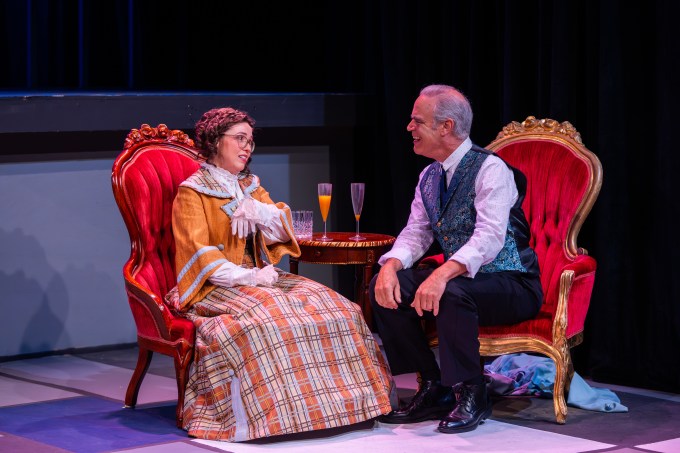
In the shorter, second act, A Sunny Morning, the elderly Don Gonsalvo holds to the tradition of going to a bench in the park that he considers his on every sunny day. Furious that others are seated there one day, he is forced to share another bench with an attractive elderly lady. Gonsalvo is portrayed by the highly accomplished Chip Zien, who possesses both a booming speaking and singing voice. The woman is Dona Laura, played by an equally decorated and talented counterpart, Joanna Glushak.
Chip Zien, Joanna Glushak.
Each of these older characters recognizes the other as a lover from decades before but doesn’t think the other realizes their past connection. Each ruefully reflects on the curse of age and hesitates to voice the revelation, regretful of how the attractiveness of youth has abandoned them and the expected disappointment by the other. How will this conundrum resolve? I’ll never tell.
Like all literary mashups, the two stories don’t fit like an original and its sequel, but the theme of finding someone anew who was known years before is a common one. That linkage, plus fine acting and a score that adds richness to the narratives, make for fine fare.
Reunions with book and lyrics by Jeffrey Scharf and music by Jimmy Calire, is based on the short stories The Twelve-Pound Look by J.M. Barrie and A Sunny Morning by Serafin Alvarez Quintero and Joaquin Alvarez Quintero, plays at City Center Stage II, New York, New York.
Jon Viktor Corpuz as Mateo, Lee Ann Payne as Diane. All photos by Kevin Berne.
For the remainder of the year, my San Jose and Peninsula theater reviews will be posted on Talkin’ Broadway with only introductions to those reviews on this site. Please continue tohttps://www.talkinbroadway.com/page/regional/sanjose/sj301.html for full review.
In the world of stories, change of scenery usually triggers more profound change. Perhaps this feature motivates the driving trip as a recurring genre in live performance and film. All variety of life altering events can occur en route, from car chase to car accident and from wedding to murder. But in the more placid trips like TheatreWorks’ A Driving Beat, the welcomed reward is seeing characters grow.
In a world premiere three-hander, playwright Jordan Ramirez Puckett explores a new dimension on this theme with great sensitivity and a highly entertaining outcome. On the surface, Diane is a middle-aged, white-bread, elementary school teacher from Ohio. One summer, she takes her soon-to-be 15-year-old son Mateo on a driving trip to San Diego. However, the notion of this being a slice of traditional American life ends there. The fact that the action is punctuated with hip-hop song and dance diversions by Mateo in English and Spanish in which he shares inner thoughts should provide a clue.
Lee Ann Payne as Diane, Livia Gomes Demarchi as waitress, Jon Viktor Corpuz as Mateo.
Lee Ann Payne as Diane beautifully portrays the earnest and caring mother of an adopted boy. Her blend of tight and loose rules mixed with love have produced a warm relationship with Mateo. Diane light-heartedly refers to this trip as his quinceañero, which Mateo bristles at because quinceañeras, celebrating the 15th birthday, are for girls, and there is no male equivalent.
A bright, ebullient, and sensitive Mateo is portrayed by a smiling and visually expressive Jon Viktor Corpuz as a teen who loves Diane but is intimidated by much of what surrounds him. Mateo was born in San Diego and identified as Latino of unspecified origin. The purpose of the trip is the hope to find his roots……
A Driving Beat, a world premiere written by Jordan Ramirez Butler, is produced by TheatreWorks Silicon Valley and plays at Mountain View Center for the Performing Arts, 500 Castro Street, Mountain View, CA through November 23, 2025.
Jon Viktor Corpuz as Mateo, Lee Ann Payne as Diane.
Brandon Jovanovich as Parsifal (foreground), Tanja Ariane Baumgartner as Kundry. All photos by Cory Weaver.
Richard Wagner’s greatest renown derives from his four-opera, fifteen-hour-long Ring Cycle, but his favorite among his operatic children was Parsifal. Over two decades in the making, this was his final opera, displaying the fullness of his organic musical and lyrical powers. So special was this five-hour masterpiece to Wagner, that he christened it a “sacred festival stage play” rather than an opera and treated it as a religious experience. And in a rare case of putting principles over profits, the composer required that it be performed only at the Festspielhaus at Bayreuth, his personally consecrated performance venue, a demand that lasted for 20 years.
Brian Mulligan as Amfortas.
San Francisco Opera’s new production of the exceedingly difficult to mount Parsifal is simply spectacular by every measure, and creative designers deserve recognition up front. Thanks to Director Matthew Ozawa, the stagecraft dazzles, bringing the narrative to life. Robert Innes Hopkins’ diverse sets visually scintillate to include putting pieces in place that are dropped from the fly and rotated in both directions on the turntable, while Yuki Nakase Link’s lighting adds dramatic contrast and detail. Rena Butler’s Asian-influenced choreography is magnetic, and Jessica Jahn’s costumery, with a special nod to the flower costumes of Act 2, dresses the stage with graphic and colorful impact. The photos embedded here don’t begin to reflect the diversity of stage magic in this production.
Kwangchul Youn as Gurnemanz.
Credit Music Director and Conductor Eun Sun Kim for attracting a powerful Wagnerian cast without a weak link complemented by 72 choristers and a juggernaut 77-piece orchestra! With a complement of only 11 brass instruments, it produces a most mellow yet thunderous orchestral sound as big as it gets. This is grand opera at its grandest.
Parsifal draws from the non-Biblical, Middle Ages legend associated with the crucifixion of Christ in which a holy spear pierced Christ and a holy grail (chalice) collected his blood. In this realization, the spear is stolen from Amfortas, King of the Grail, by the villainous sorcerer Klingsor, and prophesy says that only a guileless fool can recover it and restore the crown. The old knight Gurnemanz finds such a person in Parsifal, who is later transformed into a knight. Not only does he recover the spear, but succeeds Amfortas to the throne.
Flowers and Dancers.
Among the oddities in Parsifal is that the largest singing role does not come from the male principals above, but from the only female lead, the ambiguous Kundry. Endowed with mystery, she serves both Amfortas and Klingsor, who are enemies; exhibits manifestations as everything from a disheveled char woman to a radiant beauty; and acts as an aid and an obstacle to Parsifal. Magnificent mezzo-soprano Tanja Ariane Baumgartner portrays this conflicted role with panache and sings gloriously, reaching the top of the mezzo range and power.
For all of the thrilling bombast associated with the staging, structurally, Parsifal contains relatively little action. Followed by a beautiful but solemn prelude, full of motifs, the proceedings unfold at a leisurely pace. As was Wagner’s practice in his later period, there are no ensemble pieces, and long soliloquies prevail, which contributes to the static feel.
Tanja Ariane Baumgartner as Kundry, Falk Struckmann as Klingsor.
The other preeminent singing role is Gurnemanz, whose character is not essential to the plotline. The first hour of the libretto belongs largely to him, dominated by his storytelling. Happily, this elderly knight is played by Kwangchul Youn, who demonstrates why he is celebrating his 100th performance of Gurnemanz, which has included a decade at the Bayreuth Festival. He captivates with his presence and produces a big bass sound that is both deep and mellifluous with a warm vibrato.
Another incongruity is that the title character achieves far less stage and singing time than the two who predominate. What’s more, like the amorphous Kundry, he changes so much from a scruffy, homeless type to a sparkling hero that his two facets seem like different characters. Brandon Jovanovich suits the heldentenor requirements of the role completely with a voice that competes well with the orchestra.
Tanja Ariane Baumgartner as Kundry, Falk Struckmann as Klingsor, Brandon Jovanovich as Parsifal.
Two other principals deserve mention. Brian Mulligan is King Amfortas, and his warm and amply supported baritone seems almost an uprange vocal extension of Youn’s Gurnemanz. Another baritone, Falk Struckmann is the evil Klingsor. Along with a booming voice, he offers a commanding stage presence that gives a supremacy to his character.
Although Wagner achieved new heights of musical expression in Parsifal that are lauded by critics and aficionados alike, it is not without flaws and controversy. As suggested, in many ways, it is plodding. The lethargy is exacerbated by the opera’s length and frequent stasis and by eschewing ensembles and memorable melody.
Stage.
A religious epic can be loved by its adherents as reinforcing but be considered sanctimonious and divisive by others. Wagner was a Christian who rejected organized denominations and valued wisdom from other religions as evidenced by his incorporation of Buddhist and Hindu thought in Parsifal. However, Wagner’s antisemitism is self-documented. The enigmatic Kundry possesses negative traits falsely attributed to Jews, and the argument is supportable that she was specifically modeled on The Wandering Jew whom Christians revile for refusing to comfort Jesus on his route to the crucifixion. A concrete pejorative indicator is that Wagner gratuitously identifies her as having a past life as Herodias, a Jewish princess associated with killing John the Baptist. While these matters can be ignored and other aspects of the opera appreciated for their virtues, patrons should be aware.
In any event, few opera companies can take on this demanding opus, so when given the chance to see Parsifal, especially a breathtaking production like this one, don’t miss it.
Parsifal, with music, book, and libretto by Richard Wagner, is produced by San Francisco Opera and plays at War Memorial Opera House, 301 Van Ness Ave., San Francisco, CA through November 13, 2025.
Allison Gamlen as Karen, Alan Kropp as Lloyd, Anna Kosiarek as Eve, Sindu Singh as Margo, Dan Allen as Clement. All photos by Grizzly De Haro.
Movie fans will know the 1950 film All About Eve, winner of six Oscars including Best Picture, as a true Hollywood classic loved by critics and audience alike. Musical fans will know the Broadway hit Applause, winner of four Tonys, also a classic. Both were based on an earlier short story called The Wisdom of Eve, written by Mary Orr. The title comes full circle with the subsequent play adopting the name of the original story, and in this form, it is a metatheatrical drama, focusing on the backstage and backroom machinations of theater people and productions. Clearly, the story of ambition and betrayal with crackling dialog has legs, and the Altarena Playhouse presentation entertains as the actors relish the clashes of personalities and desired outcomes.
The movie is easily the best known of the adaptations. The big picture elements of the play’s plot remain the same as the movie’s, but because of intellectual property struggles among owners of the various adaptations of the story, differences in the details abound.
Sindu Singh as Margo, Alan Kropp as Lloyd, Anna Kosiarek as Eve.
A recurring theme in theater and film is that of the anguish of an aging star witnessing and suffering the rise of a youthful one. In this one, Margo Crane has been the toast of Broadway, but literal cracks in her façade undermine her ability to continue performing the ingenue roles that have elevated her stature.
Though she believes that she has many friends in the Broadway community, Margo even has serious conflicts with close collaborator Lloyd Roberts, playwright of her three most recent hits. And while she counts Lloyd’s wife, Karen, (an enchanting Allison Gamlen) among her closest friends, the truth is that Karen is a frenemy who resents much of Margo’s behavior and who will stoop to trip Margo up. The complexity and unpredictability of relationships among big-ego power players is one of the truisms that the play explores with great success.
Dan Allan as Clement, Sindu Singh as Margo.
Yet, as the title of the movie suggests, the plot is really all about Eve Harrington. She is not only a main mover of the action that follows but a combatant in much of the friction and a catalyst for even more. Anna Kosiarek is effectively demure as the solicitous Eve when she enters as a mouse – a stage door adulator. However, Eve’s strategy includes a backstory to induce sympathy for her and help her insinuate her way into Margo’s realm.
Eve succeeds. The usually standoffish Margo is taken in by Eve’s obeisance and seeming sincerity, and hires her as her assistant on the spot. In the new position, Eve appears to subsume her needs to those of her mentor even as she wrangles to become her understudy.
Alan Kropp as Lloyd, Allison Gamlen as Karen.
Meanwhile, Sindu Singh as Margo adeptly displays the arrogance and self-centeredness of many great entertainers. But because of going a step too far in abusing her relationship with Lloyd and Karen, the latter conspires to open the door for Margo’s decline and Eve’s ascent.
As a character study, The Wisdom of Eve covers the waterfront with each principal facing different trials. Singh’s impassioned Margo shows wild swings of behavior as she confronts the reality of aging. Karen reveals that when someone’s future is threatened that they can engage in behaviors that otherwise seem out of character. Interestingly, though the author is a woman, she lets the men off pretty easily. Lloyd’s (Alan Kropp) worst sin is feigning obsequiousness when his future paycheck is threatened, which is unsurprising. Clement (Dan Allan) who is Margo’s husband and producer, is a middle-road pragmatist but who will do business with the devil if it will make the play work. It goes to show how an abominable person can succeed in entertainment if they can make the cash register ring.
Tyler Null as Harvey (stage manager), Dan Allan as Hinkley (agent), Anna Kosiarek as Eve.
The real piece of work is Eve, who reveals herself as an opportunist and manipulator with no compunctions. Kosiarek is persuasive becomes explicit in her sneering self-confidence and with her threats. Eve is either unguarded or unafraid enough to share denigrating thoughts about others even with the press. The dramatic revelation of the real Eve is one of the masterful characterizations in fiction.
Starting with a sterling script, Kimberly Ridgeway’s direction is decisive and effective. Tom Curtin’s versatile set creates a suitable appearance for multiple venues; Stephanie Anne Johnson’s lighting isolates and highlights to great effect; and Ava Byrd’s costumery provides the right look for the theater crowd of the period. Acting on opening night was uneven, a little short on gravitas overall and on glamor in the expected roles, one exception being Gamlen who seems fitting for Broadway society.
Dan Kolodny as “Tally-Ho” Thompson (journalist), Anna Kosiarek as Eve, Shelbey Ballantyne as Vera (actress), Dan Allan as Clement.
The Wisdom of Eve, written by Mary Orr, is produced by Altarena Playhouse and appears on its stage at 1409 High Street, Alameda, CA through November 23, 2025.
Jacob Henrie-Naffaa as Tyler, Zoe Chien as Annabel. All photos by Robbie Sweeny.
Dank is cool. Solid is a favor. Legit is approval. Except when they’re something else. What? If you need an explanation, you’re clearly not Gen Z. If you’re a theater goer from another generation, you may or may not need a translator for Dada Teen Musical: The Play, but you are certainly in for a delightful, provocative, unsettling, and often hilarious change of pace with teens at its center. Characters will seem familiar, and their characters masterfully unfold as performed by an excellent cast of four.
Annabel is a high school senior whose mantra is “Screw my Yale-obsessed family. I’m going to Harvard.” Poor thing, living with such limitations. An overachiever feeling that she needs some icing on her Harvard application, she decides to create a distinctive show to be performed for her high school’s annual theater performance. How about a 12-hour Smell of the Sound of Music, a Dadaist version of the musical? Why Dada? Because, while the Dada art movement rejected logic, linearity (which becomes a recurring theme in the play), and traditional values, it didn’t advocate anything specific. So Annabel’s alteration could be anything, and she starts by changing the von Trapp family from people to alligators!
(foreground) Jacob Henrie-Naffaa as Tyler, (rear) Chanel Tilghman as Mariah.
To pull this off, she needs serious support. Enter classmate Tyler, who is so privileged that he makes Annabel seem working class. We quickly learn that the trouble with Tyler is that while he has endless resources and the charisma to attract a large following, he’s also a pathological liar. His far-fetched falsehoods serve for personal aggrandizement, and plausible lies cut from whole cloth are meant to hurt others, often accusing them of the very evil that he’s committed. Thus, dealing with him is iffy. He has also been caught cheating on a test and crossed swords with the school’s administration. The teacher sponsor for the annual play, Mr. Dorfman, doesn’t want Tyler to perform in it, though Tyler’s condition for the financial and student body support that he can deliver is that he play the lead, Captain Alligator von Trapp.
The final addition to the motley mix is the antisocial, gothic Mariah, a proto-punk, Ramones-obsessed bass guitar player. Her mode of dress is black leather, against Annabel’s bright and stylish look. Though the two are an odd couple who have never gotten to know one another over many years, someone with music cred is needed as music director. Mariah fits the bill as well as anyone around and agrees to take part.
So, where does this all go? At one level, it is a saga of two talented, coddled, self-indulgent teens behaving badly, and the loner, seemingly maladjusted one doing just fine.
Jacob Henrie-Naffaa raves on and on as the high energy motormouth Tyler who speaks almost exclusively in Gen Z code. But he has yet more problematic traits. In addition to compulsive and fanciful lying, he manipulates and feels the need to dominate, which extends to his disrespect for teachers and administrators. He even has the wherewithal to trap Mr. Dorfman, played with great emotion by Central Works stalwart Alan Coyne, who adeptly captures the teacher’s conflicts. Although the teacher possesses the legitimate power of position, he is placed in vulnerable situations by the devious Tyler and often has to give in, against his ever-eroding principles.
Alan Coyne as Mr. Dorfman.
Zoe Chien’s Annabel is like a Valley Girl with aspirations – bouncy, sociable, attention getting, but always with her eyes on the prize. Chanel Tilghman is the mysterious Mariah, a loner who seems to possess more moral fiber than the rest. An exchange that distills the difference between the two girls and expresses their opinions of each other is this:
Annabel – “The Ramones aren’t going to help you get into college.”
Mariah – “It’s possible to care about something other than getting into college and still get into college.”
Annabel – “Yeah. A state school.”
Mariah – “Everyone knows you’re a vampire who would sleep with Hitler to get a good grade. But a snob, too?”
Playwright Maury Zeff’s script is complex, literate, and packed with insight. Beyond that, it can be viewed as an allegory of today’s political environment. I rue evaluating so many plays through a Trumpian lens, but this play has currency as a world premiere. And just given what has already been revealed about Tyler, it is easy to see the commonality with Trump of caring only for one’s self and absolutely nothing else. Seeing the full play fleshes out his character more. It also reveals the enabling that allows Tyler to exert outsized control over the people around him, another connection with Donald Trump.
Although the play can be identified as a dramedy, with an abundance of funny situations of various sorts, the underlying message is chilling. Director Gary Graves keeps the action moving briskly, and it engages throughout.
Chanel Tilghman as Mariah, Zoe Chien as Annabel.
Notwithstanding my enthusiasm for the new play development that is Central Works’ stock in trade, my hesitancy about this one was that the “teen musical” in the title didn’t appeal. I love rock and roll but can do without rap and head knocking hard rock that might be on the agenda. As it turns out, there are just a few innocuous Ramones clips. The only original song “Join the Throng” closes the play, bringing closure to the characters’ current goals and to the Dada version of The Sound of Music. The music of the song appeals; the lyrics are sensational; and it is quite funny. It left me wanting more.
Dada Teen Musical: The Play, a world premiere, is written by Maury Zeff, produced by Central Works, and plays at Berkeley City Club, 2315 Durant Ave., Berkeley, CA through November 16, 2025.
Paul Finocchiaro as Musician, Ryan Tasker as Jacob in “Hard Times.” All photos by Robbie Sweeny.
The United States consists of many regions, some quite distinct. Louisiana retains its longline French character. South Florida possesses a modern Latin flair. New York City is a melting pot of immigration. One of the oldest regions in the country is Appalachia, not officially defined, but most narrowly and distinctively, the rural lands along the Appalachian Mountains in the country’s south and border states.
Although even the most restrictive boundaries would include small cities like Asheville, North Carolina, the dominant socio-economic thread in the region is hard scrapple rural life of subsistence agriculture and the services that support it. Settled by a predominantly Anglo-Celtic, Protestant population, it is stereotyped as an area of backwoods people with strong religious and family values, fierce independence, fonts of folk and country music, grudges of historic proportions, and moonshine whiskey.
Author Ron Rash writes prolifically and eloquently of his beloved Appalachia. The unique theater company Word for Word takes three of his short stories that reveal different time periods and aspects of this community. The result of the performed but literal “reading” of the stories proves a captivating, riveting evening of entertainment, revealing various facets of life among Appalachia denizens.
Delia MacDougall as Edna in “Hard Times.”
If there is a common thread to the three stories it would probably be that “We live in a fallen world,” meaning in religious terms that humanity suffers depravation of all sorts because of its separation from God. As a result, we must strive to avoid temptation and fight against evil and suffering.
Jacob and Edna live day-to-day, relying on each egg that their hens produce for their sustenance. When one expected egg goes missing without a trace each day, suspicions settle on the Hartley family and animals. They represent the notion that as badly as you may suffer, there is always someone worse off. Hartley also represents excessive pride, and he vividly demonstrates the ill consequences when unchecked dignity and self-esteem become destructive, which strikes fear into Jacob and Edna. Paradoxically, in such a religious environment, this trait is explicitly censored in the Bible, centering on the verse “Pride cometh before the fall.”
Paul Finocchario as Pilot, Joel Mullennix as Passenger in “Sad Man.”
The vignette represents the apotheosis of the outside world’s perception of Appalachian life – isolated and provincial. But it is delivered with great sympathy and conviction. One scene between Jacob and one of the Hartleys having very little dialog is particularly touching in its humanity.
“Hard Times” also surfaces the differing perspectives and sad conflicts that arise in life. In one instance related that was prior to the time of the story, a daughter permanently abandoned the family because of the humiliation that Edna had caused her, while Edna felt that she was being a responsible parent by preparing the daughter for life outside the cocoon of childhood.
“Sad Man” addresses a single incident involving two men. A shabby, homeless-looking stranger, with a visible tattoo that suggests he was imprisoned, appears. With almost all of his cash, he purchases a flight from a puzzled helicopter pilot who sells scenic rides. The passenger’s fall from grace as a result of drugs and his quest for connection and redemption unfold. But can the pilot trust the passenger and will he help him? Each man in very different ways reveals that there is good within all of us.
John Flanagan as Larry in “The Night the New Jesus Fell to Earth.”
The time period of the story is not revealed. However, toys such as Cabbage Patch Dolls and a telling commentary by the pilot places it in general terms. He notes that it is a pleasure to see children running toward a helicopter rather than away from it. Clearly, he was a chopper pilot in Viet Nam.
“The Night the New Jesus Fell to Earth” is the longest, most complex, and the only humorous story of the three. Against a backdrop of the arrival of a new pastor and the usual cast of church characters, Tracy acts as the narrator.
Her flamboyant, self-centered, self-aggrandizing, used-car salesman ex, Larry, has made a proposal to the church. He will pay to build a live diorama of the crucifixion for the holidays, and he will depict Jesus on the cross. Needless to say, there is some self-promotion going on here. And though Tracy is the only carpenter in the congregation, Larry thinks he knows better ways of building the scenery. Of course, disaster strikes, but the by-product is that the display becomes a tourist attraction.
John Flanagan as Larry, Molly Rebekka Benson as Tracy in “The Night New Jesus Fell to Earth.”
Since Word for Word is not “real theater,” one might suspect that its productions are below standard. Nothing could be further from the truth. Acting is solid throughout this largely ensemble production, and Delia MacDougall’s dialect coaching results in a good mix of authentic yet understandable regional tongue.
However, it’s hard to ignore John Flanagan as the strutting, overconfident Larry in “The Night…..” with the wide-open shirt and tons of gold around his neck. Molly Rebekka Benson gleams as the incredulous Tracy who lets Larry fall into his own trap. Joel Mullennix excels as the (ironically) heartless Hartley in “Hard Times” and as the caring, recovering passenger in “Sad Man” as does Ryan Tasker as Jacob in “Hard Times” and the Pastor in “The Night New Jesus Fell to Earth.”
Creative contributions, orchestrated by Directors Amy Kossow and Jim Cave are exemplary throughout and deserve recognition. Jacqueline Scott and Amy Benjamin’s scenic effort is versatile enough to work for each of the stories. Drew Yerys’ sound covers a wide range of demands. Jim Cave’s lighting creates drama. Callie Floor deals with a wide range of costume needs to reflect the right look for each story.
Nancy Shelby as Pearl, Carla Gallardo as Lulubelle in “The Night New Jesus Fell to Earth.”
Overall, Hard Times: Appalachian Stories by Ron Rash has much to offer with interesting insights into Appalachian culture. This staging is well worth viewing.
Hard Times: Appalachian Stories by Ron Rash is produced by Word for Word and Z Space and appears at Z Space Below, 450 Florida Street, San Francisco, CA through November 2, 2025.