The Reservoir

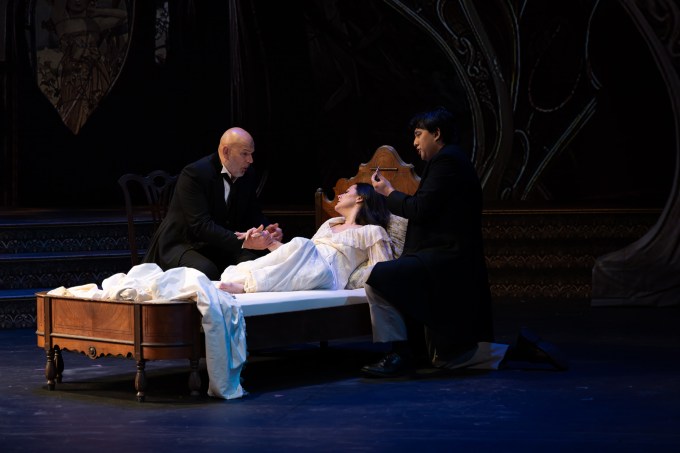
Pamela Reed as Bev, Ben Hirschhorn as Josh. All photos by Kevin Berne.

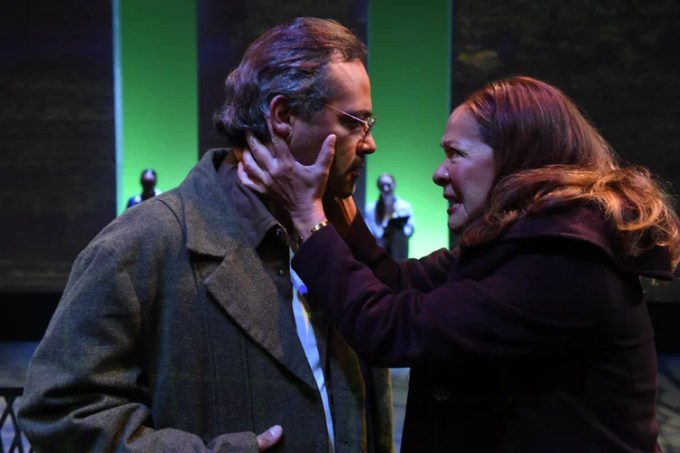
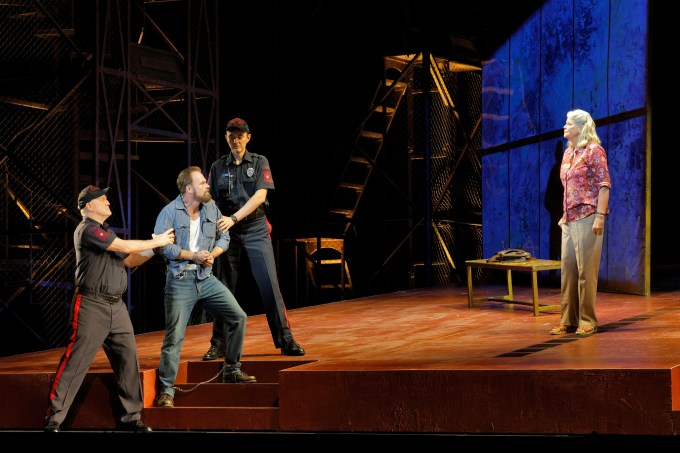
Charismatic and queer, Josh has been kicked out of an alcoholism half-way house for fermenting his own hooch.  Meanwhile, his tough-love mother, Patricia, has confiscated his driver’s license and credit cards and won’t let him return home until he’s been sober for 90 days.  She believes that the addict won’t get it right unless there’s been a memorable price to pay.  What is a young man to do?

So opens Jake Brasch’s compelling dramedy The Reservoir, now playing at Berkeley Rep.  Full of strong performances of well-differentiated characters, this dark but funny semi-autobiography holds the attention throughout.  The play strengthens as it progresses as Josh’s unappealing self-indulgence, is somewhat supplanted by touches of humility and redemption in Act 2.

Not uncommon with young writers is the tendency to cram a lot of the ideas that have consumed their early lives into one package.  This is the case with The Reservoir, which benefits individually from all of its threads, but not all are essential for a cohesive narrative.

Jeffrey Omura as Hugo, Ben Hirschhorn as Josh.

Two dominant narrative themes fuse through a modest linkage.  Josh’s alcohol addiction dominates his part of the storyline. Ben Hirschhorn as Josh gives a bravura performance as the conflicted and immature youth, both when besotted and when recovering.  His heavy drinking has resulted in occasional memory loss and blackouts, which includes missing a full day in which he was to bear responsibilities that he failed to fulfill, causing great consternation to others and repercussions to himself.

His memory loss ties into the second theme.  Josh has left NYU to return home to Colorado where his single parent-mother and both sets of grandparents live.  Dementia in general and Alzheimer’s in particular will sweep through his grandparents like an epidemic.  The sadness of the associated catatonia leads to great reflection and many touching moments.  There is much discussion of the technical aspects of dementia and clever metaphors about the processes involved, which also reveals the reason for the play’s title.

The play also identifies as being intergenerational.  Indeed, Josh tries to connect with his grandparents, and he is not totally successful.  He finds that they have their own lives to live, and partly due to his own missteps, he is not invited by all of them to be part of it.  But he also objects to the politics of his paternal grandparents, arguing that if they loved him, they would accept that he is gay, and that in itself would change their politics.  His relationship with his mother is fractious and one dimensional at this point, and her relationship with Josh’s grandparents is not really explored, so the intergenerational aspect is a bit underdeveloped.

Grandparents: Barbara Kingsley as Irene, Pamela Reed as Bev, Peter Van Wagner as Shrimpy, Michael Cullen as Hank.

A final theme relates to Judaism.  The maternal grandparents are Jewish, and paternal grandparents are not.  Triggered by grandfather Shrimpy (played by a sly and witty Peter Van Wagner), much humor is Jewish, especially because of his having a second bar mitzvah at age 85.  The rest of the humor from the grandparents understandably centers on old people’s issues such as bad hips and bodily functions.  The ethnic element however seems more like the playwright’s simply wanting to share personal information as it adds nothing to the essential concerns.

As Josh’s recovery waxes and wanes, he finds a surprise ally, his maternal grandmother.  The wonderful Pamela Reed plays Bev, gracing her with deadpan sardonic humor, a foul mouth, and crack timing.  Like Patricia, she shows tough love as well.  However, she takes a more proactive role in trying to fix Josh by getting him to appreciate the small things in life that add up and make it worthwhile.  But Josh finds her to be an enigma.  While offering to pay his way back to NYU when his mother won’t, Bev still pushes Josh away.  She doesn’t want to be friends but rather a grandmother who sends impersonal Hanukkah cards once a year, and he can’t understand why.

The Reservoir, with direction by Mike Donahue, plays on a spare set, so the focus is very much on the acting.  Behind a strong lead, a fine ensemble gives excellent performances of a slightly flawed but thoughtful and entertaining play.

Brenda Withers as Patricia, Ben Hirshhorn as Josh.

The Reservoir, written by Jake Brasch, is produced by Berkeley Repertory Theatre and plays on its stage at 2025 Addison St., Berkeley, CA through October 12, 2025.

Rumors

Jeffrey Biddle as Ken, Maddie Rea as Cookie, Louis Schilling as Ernie, Karla Acosta Ormond as Claire, Kelly Gregg Rubingh as Chris. All photos by Elaine Yee.

For the remainder of the year, my San Jose and Peninsula theater reviews will be posted on Talkin’ Broadway with only introductions to those reviews on this site]. Please continue to https://www.talkinbroadway.com/page/regional/sanjose/sj297.html for full review.

No modern humorist playwright can compete with the accomplishments of Neil Simon.  A winner of three Tony Awards plus numerous recognitions for movie and television works, he remained a theatrical institution for four decades.  While many of his plays were a product of his upbringing, conspicuously Jewish and set in New York City or its suburbs, others were neutral and could take place across the country.  Rumors, one of his many beloved plays, does take place in the New York suburbs, but it could be anywhere.

Debuted in 1988, well into his middle-age, Rumors departed from Simon’s bedrock.  He had written relationship comedies of many sorts with a focus on a clutch of well-defined principal characters and usually of the middle class.  This play involves an ensemble of ten in a wealthy suburb and is Simon’s first attempt at farce, embracing ridiculous situations demanding over-the-top acting.

Jeffrey Biddle as Ken, Kelly Gregg Rubingh as Chris, Louis Schilling as Ernie, Thuan Lieu as Lenny, Eric Mellum as Glenn, Karla Acosta Ormond as Claire, Maddie Rea as Cookie.

Pacifica Spindrift Players, an all-volunteer community theater, has chosen well.  The play suits the cast which delivers an entertaining product, extracting humor at almost every turn.  For a small theater, Spindrift’s stage is very large.  All of the action occurs in the living room of a large house, and Alexis Orth’s white with black set is striking and effective.

To celebrate their 10th wedding anniversary, Charley and Myra are throwing a party with four other couples at their home.  All are part of the Porsche/BMW-driving, swanky tennis club belonging, set of rich professionals – analysts, doctors, lawyers, and such.  The playwright needles the snobbish and conspicuous life style of this class of people as every reference to past events they’ve attended is a fund raiser for a charity.  Making the farce seem sillier, the guests are dressed to the nines, with women bejeweled in party gowns and men in formal wear.

Ken and Chris are the first arrivals and have to let themselves in.  Soon, they hear a gunshot, and Ken runs to the master bedroom to find Charley bleeding from a bullet through his ear lobe, which Ken assumes was a suicide attempt.  Myra is nowhere to be found, and the first rumor to be mentioned is that she’s having an affair.  Of course, we know that covering up an incident often creates more complications than facing up to the truth.  Ken’s instinct is to protect Charley, and he and Chris first try to hide what has happened from the other guests.  However, when the next couple, Lenny and Claire, arrive, Lenny starts sniffing it out…………

Louis Schilling as Ernie, Tessalou Valera as Cassie, Thuan Lieu as Lenny.

Gypsy

Ray D’Ambrosio as Herbie, Whitney Hisako Moore as Louise/Gypsy, Caitlin Gjerdrum as Rose. All photos by Scott Lasky.

[For the remainder of the year, my San Jose and Peninsula theater reviews will be posted on Talkin’ Broadway with only introductions to those reviews on this site]. Please continue to https://www.talkinbroadway.com/page/regional/sanjose/sj296.html for full review.

Some characters in plays leave an indelible imprint on the audience.  Occasionally, it is not the title character who earns that distinction.  So it is with Gypsy.  Mama Rose, who is the real central figure and the real gypsy, represents the archetype of the stage mother – bumptious, brazenly ambitious, and living through the successes of her children to the point that she sacrifices all else in that quest.  This musical is biographical, and one performing daughter that Rose became estranged from ultimately became stage and screen actress June Havoc.  The other would become the most storied stripper of her era and perhaps the most famous of all time, Gypsy Rose Lee.

The musical debuted on Broadway in 1959, enjoying a highly successful but not historic run.  Gypsy was nominated for eight Tony Awards but won none.  Yet, it is viewed by most critics as one of the finest musicals ever written and by several influential ones as the greatest musical written up to that time.  Several Broadway revivals have followed, most recently in 2024-5, starring Audra McDonald, who has won the most Tonys of any performer and received a nomination for this one.

Cast.

It must be daunting to step into the legendary shoes of many of the greatest and most iconic actresses.  Among others who placed their stamp on the role, Ethel Merman created Rose for the stage, and Rosalind Russell starred in the movie.  Palo Alto Players has enlisted Caitlin Gjerdrum as Rose, and she is absolutely stupendous.

First of all, Gjerdrum has the pipes, with power to spare.  She blasts away buoyantly and optimistically on composer Jule Styne’s “Everything’s Coming Up Roses,” in which she gives encouragement to her no-talent daughter Louise (Whitney Hisako Moore), who would become Gypsy Rose Lee.  Among lyricist Stephen Sondheim’s brilliant formulations, this song not only conveys Rose’s need to dominate but plays effectively on her name.  Rose also reveals her ambition in “Some People” in which she notes that a sedentary life is okay for others, but not for her.

Gjerdrum brings compassion as well in the hopeful and beautiful “Small World.” She has a long, warm relationship with their act’s managing agent Herbie (Ray D’Ambrosio), and in the song she notes all of their complementarities which make them a fine couple……………..

Chloё Angst as Mazeppa , Barbara Heninger as Electra, Kristina Nakagawa as Tessi Tura.

A Night With Janis Joplin

Libby Oberlin as Janis Joplin. Projection of Big Brother and the Holding Company. All photos by Miller Oberlin.

A jukebox musical paying tribute to a singer depends on two factors for success – a historic figure who resonates with the audience and a performer who engenders nostalgia for the original.  Not only was Janis Joplin an iconic figure, but her flame burned bright and was tragically extinguished in the most distinctive and storied post-WW II decade – the 1960s.

The ‘60s brought with it a sea change of strong influences including involvement by teens and twenties in music, politics, civil and women’s rights, religion, clothing, and intergenerational clashes.  San Francisco sat at the epicenter of these dramatic shifts, highlighted by the Summer of Love in 1967.

(front) Libby Oberlin, (rear) Skylaer Palacios, Safira McGrew, Aja Gianola, Jeffrie Givens.

In the same year and only two hours down the coast, Monterey Pop would become the prototype for Woodstock and other massive rock music festivals.  It provided quantum lifts for Jimi Hendrix, The Who, and a band little known outside of San Francisco – Big Brother and the Holding Company.  Its lead singer Janis Joplin would deliver one of the most memorable and electrifying performances recorded in rock history.

Sonoma Arts Live brings Janis to life in the person Libby Oberlin, who replicates the icon with exceptional flair.  She sings with Joplin’s urgency and raw emotion.  She punches the air, waves her hair, and jitters and stomps around with the same gesticulations. And she talks with Joplin’s signature raspy voice and laughs with her nervous giggle.

Libby Oberlin. Projection of painting by Janis Joplin of her sister.

Those who enjoy the jukebox format and who like or are curious about Janis Joplin will relish the experience.  The performance of over 20 songs dominates the evening, supported by a live band of eight instrumentalists.

Smatterings of somewhat sanitized connective tissue, much about growing up in Port Arthur, Texas, give the show some narrative.  But it largely ignores the ridicule and ostracism she suffered as a teen and her massive addiction problems when she entered the entertainment world.  And while the part of her that is the Southern Comfort-drinking free spirit comes across, we see little of the web of contradictions that include her self-doubt and vulnerability.

Libby Oberlin, Skylaer Palacios, Jeffrie Givens, Aja Gianola.

In one sense, A Night with Janis Joplin is a one-woman show, as the title character is the only one with dialog.  However, the physical energy and vocal demands of the role are punishing, and a clever script design brings timely relief and recovery to the Joplin character.

Joplin grew up with the blues, and her musical influences included Bessie Smith, Nina Simone, Etta James, and her contemporary, Aretha Franklin.  Scattered through the show, performers impersonate and sing works from these great blues singers.  An odd one out that is included is the girl group the Chantels, whose anthem “Maybe” was a Joplin favorite.  In addition to giving the lead performer a respite, these intervals add variety and context.

All four of the additional singers contribute well, as soloists and as backup singers to Joplin.  Particularly notable is Safira McGrew who plays Aretha and other parts.  Her voice is stunningly bright, accurate, and penetrating.

Libby Oberlin.

Of course, Janis and her songbook are the main attraction.  Most moving are “Piece of My Heart” and especially “Ball and Chain,” with their gruffness and wailing.  Yet, more laidback pieces strike the fancy as well, like “Me and Bobby McGee” and the a capella “Mercedes Benz” that delights the audience as a sing along.  Finally, the uniqueness of Janis’s style comes across in songs that are sung two ways – by others in earlier versions and later by Oberlin as Janis.  The distinctiveness shows particularly in “Summertime” and “Maybe,” which also demonstrate how versatile a good song can be.

The one caveat of the evening’s entertainment concerns the format itself.  As a musical compendium with a little history of the title character thrown in, there is no dramatic arc, so it doesn’t feel like a play.  But it will work well for anyone who enjoys treatments of the music of one of rock-and-roll’s queens.

A Night With Janis Joplin is written by Randy Johnson, produced by Sonoma Arts Live, and plays at Sonoma Community Center, 276 East Napa Street, Sonoma, CA through September 21, 2025.

Eureka Day

Lisa Anne Porter as Suzanne, Howard Swain as Don, Leontyne Mbele-Mbong as Carina. All photos by David Allen.

I can’t remember the last time at a play that I laughed so hard that I cried.  And amid a drama-driven narrative replete with messages that resonate with timeliness and relevance.  The central issue concerns the politics of vaccinations.  As this country suffers from a benighted, anti-science administration with a Secretary of Health and Human Services who fires esteemed scientists wholesale and replaces them with political hacks, the considerations could not be more chilling.  But first, the setup…..

Jonathan Spector’s brilliant Eureka Day was commissioned and premiered at Berkeley’s Aurora Theatre in 2018.  Since then, it has gone to New York not once, but twice, and its recent Broadway run resulted in the 2024 Tony Award for Best Revival of a Play.  The present iteration is produced by Marin Theatre in cooperation with Aurora, with the latter’s Artistic Director Josh Costello directing, as he did the original.  This version is spectacular, with the vibrant script supported by exemplary acting and direction.

Eureka Day is a fictional private school in Berkeley that deals with socio-political issues common to the Bay Area.  The matter of the moment is a mumps outbreak and how to deal with it.  But more than dealing with the public health challenge is how to construct messages.  Does the school board say that it is following the guidance of public health officials or take responsibility itself? Then there is the issue of dealing with those who don’t agree with the solution in a society that is becoming more bifurcated, driven by political persuasion.  Already, a group of parents has said that if all students at the school aren’t immunized that they are pulling their kids out, which could cause the school to close.  Conversely, a group of anti-vaxxers could take the opposite position, rejecting any mandate, and bringing down the school.

Teddy Spencer as Eli, Charisse Loriaux as Meiko.

Against this backdrop, an omnium gatherum of Berzerkeley types seek a solution.  The board chair is Don, who is played hyper and over-the-top by Howard Swain.  Don is a smiling bull, charging through problems, hushing people’s objections, and playing to the goodwill of others in hopes of getting them to band together.

The nemesis to agreement is the emotional Suzanne, who smiles and engages when she thinks things are going her way, but who can be prickly when threatened.  Her fixed North Star is that corporate cabals drive bad decisions in health care.  An anti-vaxxer, she represents a class of people who are among the least susceptible to accepting facts.  She lost a child shortly after a vaccination, and though doctors attributed the death to other factors, Suzanne cannot be dissuaded from her conclusion.  Her position reflects the real-life examples of those who conclude causality based on correlation.  Studies have debunked theories that vaccines cause autism and that breast implants cause cancer, but particularly those people with correlated personal experiences are often unwilling to give in to evidence that doesn’t conform with their biases.

Leontyne Mbele-Mbong is Carina, a new board-member and a black woman whose reserve and quiet reflection belie firm convictions that surprise and bring her into conflict with Suzanne, who also makes some wrong and prejudiced assumptions about Carina.

Lisa Anne Porter as Suzanne, Leontyne Mbele-Mbong as Carina, Howard Swain as Don, Teddy Spencer as Eli, Charisse Loriaux as Meiko.

A critical issue in the management ethos of the school is the by-laws mandate that the board rule by consensus, so that when Carina calls for a vote, she is gently rebuked and told that the board doesn’t vote but must rule by consensus.  However, while the accepted definition of consensus is general agreement, it is interpreted by the board as unanimity.  Thus, one contrary member is able to veto the wishes of the other four members.

The two remaining board members are having an affair.  Eli (Teddy Spencer) is the rare type that you find almost only in the Bay Area.  Employee Number 10 at Facebook, he is one of those grotesquely rich youths whose wealth is attributed to the random luck of having been hired by a company that thrived and remunerated early employees largely in shares of stock.  While he seems carefree and non-aligned, he will have a personal experience that will crystalize his position.  Meiko (Charisse Loriaux) is often quiet and moody and also unpredictable.

The hilarity in the scenario comes when the board creates a “community activated conversation” to discuss the mumps options.  The board meets in person but parents join in virtually, and the chat bubbles of the virtual attendees scroll on projections.  They come so fast and are so screamingly funny that it is challenging to also pay attention to what the live performers are saying.  It is an unimaginably well-designed and executed sequence with one big laugh after another for several minutes.

The parents are in a totally different universe than the board, and all the archetypes are there.  People get insulting (“THESE ARE THE FACTS …..” or “You’re a real c***” or “I said the IDEA was idiotic, not her”).  Some make corrections (“I think you mean f***, not duck”).  Others get totally off task (about a former school family – “I think they moved to Vancouver” “No, I’m sure they moved to Montreal” “I visited them and I assure you it’s Vancouver”).  Even the lame brain who does nothing but flash the thumbs up icon after every several comments prompts considerable laughter.

Leontyne Mbele-Mbong as Carina, Lisa Anne Porter as Suzanne.

One element that makes the play work is that diverse opinions are given voice.  However, the political correctness of granting equal play to all points of view comes with a downside.  When positions based on faith or fantasy rather than facts are aired, they are likely to be adopted by others who are easily persuadable.  This gives rise to even more unreasoned thinking which cannot make us a stronger nation.

Eureka Day, written by Jonathan Spector, is produced by Marin Theatre in partnership with Aurora Theatre Company, and plays on Marin Theatre’s stage at 397 Miller Ave., Mill Valley, CA through September 21, 2025.
Santa Fe: The City Different – Traveler’s Notes

Santa Fe Opera House.

Now that Travel and Leisure has anointed Santa Fe as the 2025 “Favorite City in the U.S.” and Condé Nast Traveler as the 2024 “2nd Best City,” the secret is out – at least among their readers.  But to many, it is still a distant, exotic mirage.  My wife, Karin and I, have spent a week per summer in Santa Fe for 15 years (and we’ve visited in several off-seasons as well), primarily for the Santa Fe Opera, for which I’m an invited reviewer, and secondarily for Indian Market.  But each year we find new things to do and leave wanting more.

New Mexico “Land of Enchantment” flag with Zia symbol.

Rather than a typical travelogue narrative, this commentary will be organized by categories and focus in a cryptic fashion on the many firsts, superlatives, and other distinctions that make Santa Fe an unlikely and unique destination that “punches above its weight class” like no other.  “The City Different” of 80,000 residents lies an hour from Albuquerque, the 32nd most populous metropolis in the U.S., and 400 miles from the nearest major markets – Denver and Phoenix.  Yet, it has far more quality and diversity to offer than cities many times its size.

Palace of the Governors portico with vendors selling from blankets.

FURTHER OVERVIEW

  • Oldest state capital city in the United States and second oldest city (est. 1598, but area occupied by Native Americans for centuries), after St. Augustine, FL.
  • Highest elevation of state capitals – 7,000 ft, and set within beautiful Sangre de Cristo mountains
  • Large Mexican-American population there for generations, but also many second-homers, artists, and retirees, especially from Texas, New York, California, and Colorado, plus celebrities.
  • Climate is high desert, four seasons.  Summer days can be relatively hot (80s) but dry with cool nights, so home air conditioning not essential.  Winter is moderately cold with snow but dry and sunny.
Meow Wolf House of Eternal Return – one of over 70 dioramas.

HISTORICAL HIGHLIGHTS

  • Tewa Peoples settlement around 1050.
  • 1610 city formally founded by Spanish conquistadores; 1821 Mexico’s independence from Spain; 1848 New Mexico becomes U.S. territory; 1912 NM becomes 47th U.S. state.
  • Flag adopted is yellow with red Zia emblem – Pueblo Indian symbol of sun with four sets of four lines designating cardinal directions, seasons, stages of life, person’s being (body, heart, mind, spirit).
  • Terminus of Santa Fe Trail and Atchison, Topeka, and Santa Fe Railroad.
  • Civil War Battle of Glorieta Pass fought in Santa Fe County in 1862 carried strategic importance as it ended Confederate hopes of controlling the Southwest
  • Though NM voted not to incarcerate Japanese-Americans in WW II, federal government created high security detention facility in Santa Fe
“Buffalo” – found-object art sculpture by Holly Hughes in New Mexico Capitol art collection.

ARTS

  • Third largest retail art market in the U.S. after New York City and Los Angeles – Miami has a larger art festival market.
  • Home to myriads of artists.
  • Canyon Road is the largest concentration of art galleries in the world with over 80 along and near one street.  250 galleries are found in the city in total with other bunches downtown near the Plaza and at the Railyard.
  • Genre concentrations are abstract, figurative, and Southwestern contemporary painting and statuary
  • Santa Fe Indian Market is the oldest, largest of its kind in the world, with Native American vendors from all over North America. Hundreds of kiosks, main wares being jewelry, art, pottery, apparel.  Market itself over weekend, but activities through previous week including artist receptions at galleries, thematic films through Smithsonian, panel discussions, galas, award ceremonies.
  • International Folk Art Market is the largest in the world
  • Traditional Spanish Market – oldest and largest juried art show of its kind in the U.S.
  • State capitol building and grounds house over 600 beautiful, curated art pieces by NM artists and is model for other states’ collections and display.
  • Meow Wolf House of Eternal Return – This unique immersive visual experience was founded in Santa Fe.  Other variations now operate in four major markets, with Los Angeles about to open.  Over 250 artists were involved in realizing the concept, which has 70 immersive stations, ranging from a Chinatown street to a darkened room of trees comprised of colored neon tubes.  You may find yourself walking through a refrigerator or crawling through a fireplace to get to the next installation.
Bird figurine necklace of silver and semiprecious stones in squash blossom design.

RETAIL

  • Jewelry – Especially silver, turquoise, and coral.  Traditional and modern western and Native American motifs plus broad contemporary styles. My wife has three statement pendants and a silver Mayan cuff all from Santa Fe or Albuquerque.
  • Garments – Stylish Western, Native American, and broad contemporary garments, boots, hats.
  • Furniture – Contemporary design and antiques, the latter driven by the estate consignment market.
Rotunda of State Capitol.

MUSEUMS

  • 20 distinguished museums, several of which are on Museum Hill.
  • International Folk Art Museum has largest folk art collection in the world.
  • Las Golondrinas – a poor man’s Williamsburg, with 34 historic structures, 500 acres including rare desert wetlands, Spanish/Mexican colonial activities
  • Several museums related to NM culture, history, Native American and Western contemporary and historic art
  • Single-artist museum – Georgia O’Keeffe Museum (expanding to 55,000 sqft museum plus campus).  She started movement of artists settling in NM.
Santa Fe Opera House from Stravinsky Terrace. Note open sides to auditorium, sweeping acoustical arc ceiling, cable suspension technology to support split roof, wind baffles on opposite side.

SANTA FE OPERA

Like so much else in Santa Fe, it amazes that the opera company exists in the world-class form it does.

  • Its annual budget ranks in the top 10 in the country, despite having such a tiny home market; being so isolated; and being limited to five productions and eight weeks of summer performances per year.
  • Its opera house is among the most innovative in the world (see Architecture).
  • Its summer apprenticeship program, which includes behind the scenes creatives as well as singers, is the best of its kind in the country.
  • While its ticket prices for good seats at full operas are expensive, its Apprentice Scenes, typically 8 semi-staged extracts from different operas is a tremendous value at $20 per seat.
  • The Sangre de Cristo Mountains setting, desert chic ambiance, including tailgating in the parking lot, make for a very special experience.
Santa Fe style public architecture.

ARCHITECTURE

  • Most uniform and harmonious that can be found in the U.S.  – Virtually all structures are adobe, finished only in earthen colors – virtually all limited to 2-3 stories – Two main styles in housing – Santa Fe, with flat roofs and often with a row of horizontal vigas (full timber beams) protruding from near the top of the structure, which are exposed as ceiling beams inside, plus kiva fireplaces, portals, walled courtyards – Territorial style, with pitched, metal roofs, facilitated by shipping available from railroads arrival
  • Plaza – Downtown center, considered one of the best public plazas in the country – vendors on blankets in portal of Palace of Governors; shops, galleries, cafes; music in bandstand; center of all downtown annual festivals and markets
  • Palace of Governors is the longest continuously occupied public building in the U.S.
  • San Miguel Chapel is the oldest church in the U.S. (est. 1610, rebuilt twice).
  • Oldest neighborhood in the U.S. is Barrio de Analco.
  • Oldest house in the U.S. is 215 E. De Vargas St. (around 1620, not rebuilt).
  • Capitol building – Footprint in shape of Zia, the state emblem that appears on the flag
  • Santa Fe Opera House – 2,000 seats, similar in size to most great European opera houses with unique design, open to nature on the sides, open backwall to stage, huge acoustic arc as ceiling, wind baffles on windward side, outdoor terraces for intermissions – It can be toured without attending opera.
  • Loretto Chapel – Spiral staircase whose lack of support seems to defy physics.
St. Francis Cathedral ahead, vendor kiosks at Indian Market.

FOOD – CUISINE

  • Home of New Mex / Mex cuisine – Distinctions include ingredients like piñon (pine) nuts, blue corn, Hatch chiles, local wild game, cabrito (kid goat), nopales (cactus leaves), cactus pears, abundance of the 3 Sisters (corn, beans, and squash, which are all indigenous only  to the Americas) and preparations like sopapillas (puffed triangles of fried dough, often served with honey), layered rather than rolled enchiladas, pozole, green chili cheeseburgers, green chile stew,  chile con carne, piñon blue corn pancakes, Frito pie, torta de huevo, huevos rancheros NM-style, gorditas, chiles rellenos northern style, stuffed sopapillas, calabacitas, squash blossoms, panochas, biscochitos.
  • Birthplace of contemporary Southwestern cuisine – Mark Miller of Coyote Café is godfather of this fusion of American, Mexican, Native American, and cowboy cuisines.
  • Official state question – “Red or Green?”  Other acceptable answer being Christmas, meaning you’ll have both red and green chile sauce.
Cityscape of Santa Fe.

FOOD – RESTAURANTS

Befitting a major tourism destination, Santa Fe is blessed with an abundance of restaurant options with a raft of James Beard Award designees.  This list is just a beginning and represents only restaurants that I’ve eaten at.

  • Fine Dining – Sazon, Martín’s, Geronimo, The Compound, Zacatlan, Pink Adobe
  • Mexican – Escondido (innovative regional fusion), The Shed, Tomasita, La Choza
  • Casual Brunch – Clofoutis, Dolina’s, The Pantry, New York Deli, Jambo Bobcat Bite
  • Other Notable Ethnic – Alkemé (fine Asian fusion), Jambo (African, Caribbean), El Farol (Spanish tapas – also Santa Fe’s oldest restaurant and center of local flamenco culture).
Native Americans displaying local fashions.

OUTDOOR ACTIVITIES AND INDULGENCES

  • Sports – Hiking offers the greatest general interest and variety, but there is also snow skiing just out of town, rafting on the Rio Grande, horseback riding, and more.  For those who yearn for beaches and a large variety of golfing, Santa Fe is not the right choice.
  • Spas – The city rates in this category as well.  Several in-town hotels have significant spas, while outside of town, full-service destination spa resorts Ten Thousand Waves, Ojo, and Ojo Caliente have beautiful, extensive grounds including multiple outdoor pools.
  • Festivals – Besides arts festivals already mentioned, Chamber Music (50 years old, destination festival having internationally known musicians), International Literary, Beer and Food, Wine and Chile, Wine, and Renaissance Faire festivals and more.
Museum Hill scene.

DAY TRIPS

A wide variety of options are available which enhance the Santa Fe experience. (Apologies for format issues under Taos and Albuquerque. It must be a poltergeist.)

  • TAOS – 1 ¼ hrs drive
    • Taos Pueblo – UNESCO site – living community, continuously inhabited over 1,000 years with rich cultural history
    • Earthship – Important off-grid community not subject to normal building codes, with homes made of recycled materials like car tires, soda bottles using solar power, recycled gray water
    • All things Kit Carson
    • Arts community like a mini Santa Fe
    • Scenic drive along the beginnings of the Rio Grande with wineries en route

ALBUQUERQUE – 1 hr drive

  • Old Town
    • Sandia tram – longest gondola ride in U.S.
    • Hot air balloon rides and festival
    • Museums
    • Wine tasting – esp. Gruet sparkling (best value in category in U.S.), others mostly in Old Town
    • Movie and TV production tours

  • TURQUOISE TRAIL – ½ hr drive
    • Old western towns Madrid, Cerrillos
    • Jewelry, arts retailers
  • CHIMAYO – ½ hr drive
    • Sanctuario de Chimayo – Renowned pilgrimage site.  Small, charming, primitive church with best and worst of religious sites – Nice touch with wall of pictures of locals who served in military – Dirt floor with well for taking dirt said to have healing powers – Wall of canes said to be left by those whose lameness was claimed to be healed at Chimayo.
    • Rancho de Chimayo Restaurant – most historic and respected Mexican restaurant in northern NM
  • LOS ALAMOS 3/4 hr drive
    • Bradbury Science Museum – History of Atom Bomb, created in Los Alamos
    • History Museum – Housed in structures used during the Manhattan Project
  • ABAQUIU 1 ¼ hr drive
    • Georgia O’Keeffe Home and Studio
    • Ghost Ranch

Plaza Suite

Laura Jane Young as Muriel, Will Springhorn Jr. as Jesse. Photos: Tracy Martin except as noted.

[For the remainder of the year, my San Jose and Peninsula theater reviews will be posted on Talkin’ Broadway with only introductions to those reviews on this site]. Please continue to https://www.talkinbroadway.com/page/regional/sanjose/sj295.html for full review.

1968 was a tumultuous year socially and politically in the United States.  It was also the year of Neil Simon’s Broadway blockbuster Plaza Suite, one of the many successful comedies that the playwright brought to the stage.  Hillbarn Theatre offers up a riotous version full of laughs that will leave the audience in a good mood despite the dark sides that underlie the narratives in the play.

The first tenet of writing fictional literature is to write about what you know.  Neil Simon came from a Jewish family and neighborhood in New York City’s Bronx borough.  Shy, poor, and from an unstable family, he grew up during the Great Depression and World War II, and later, having been married four times also informs his writing.  Despite seeming anomalies for the Peninsula marketplace, Simon is Hillbarn’s most presented playwright, this being its 23rd production of his works.

Jessie Kirkwood as Jean (Sam’s secretary), Laura Jane Young as Karen, Will Springhorn Jr. as Sam. Photo: Mark Kitaoka.

Interesting incident-related plots that are hard to expand into full length works present problems to authors and producers.  One solution is to band several together into a compendium with some common thread, though outcomes can be disjointed and uneven.

With Plaza Suite’s three stories, the threads are a suite at the iconic New York hotel and marriage at various stages.  The foundations are very provincial with references special to the New York City environs; the implied Jewish ethnicity; and, all of the characters being from the City or suburbs, even though the action is in a hotel.  In addition, the social mores reflect those of five decades ago, yet the issues and situations prove universal and timeless.  And while the stories are not profound, the Simonesque humor throughout also binds the trio of vignettes together………..

Will Springhorn Jr. as Roy, Laura Jane Young as Norma.

……………………………………

Plaza Suite, written by Neil Simon and produced by Hillbarn Theatre, appears on its stage at 1285 East Hillsdale Ave., Foster City, CA through September 14, 2025.

Good People

Alicia Rydman as Margie, Daron Jennings as Mike. All photos by Grizzly De Haro.

Many neighborhoods in major cities are noted for their ethnic enclaves and distinctive customs like New York’s Chinatown and Miami’s Little Havana.  In the 20th century, the working-class area of South Boston, known as Southie to the locals, became a prime destination for the Irish diaspora.  Among its positive distinctions, South Boston activated modern St. Patrick’s Day parades and celebrations.  Conversely, in the 1970s, this very white neighborhood became one of the nation’s most notorious resistance points to court-mandated school busing to achieve desegregation.  Racial animus participates in this play in two different ways.

Alicia Rydman as Margie, Samuel Barksdale as Stevie.

Altarena Playhouse’s production of Good People scintillates from beginning to end.  Replete with powerful issues about social mores, class, and mobility; racial interactions and prejudice; friendship and loyalty; and responsibility, self-determination, and luck; it jarringly reflects like a social mirror.  The ensemble of six actors, led by the captivating Alicia Rydman as Margie, is absolutely exquisite, with every performance a gem.

Pulitzer Prize winning playwright David Lindsay-Abaire grew up in Southie, so he knows whereof he speaks.  And while the action takes place in 2011, the central characters grew up there in the ‘70s when their critical backstories occurred.

Marsha van Broek as Dottie, Alicia Rydman as Margaret, Nicole Naffaa as Jean.

Margie (with a hard g), works at a Dollar Store and lives hand to mouth.  As a single mother, she has raised a 30-year-old mentally-deficient daughter, Joyce.  Despite a sympathetic boss, Stevie (played by Samuel Barksdale), the burden of Joyce’s care leads to Margie’s losing her job.  Most of the blame lies with her usually kindly but inconstant landlord, the wisecracking older woman Dottie (Marsha van Broek) who watches Joyce on the cheap when Margie is at work.

Her good friend Jean (Nicole Naffaa) is her greatest supporter and urges Margie to contact Mike (Daron Jennings) to see about a job from him or his contacts.  Mike overcame the drag of Southie to become a successful doctor with a home in tony Chestnut Hill, joining what Margie refers to as the “lace curtain” set.  Margie and Mike dated for a couple of months critical to the timeline of Joyce’s birth, but Margie has always attributed the paternity to another.  Ultimately, Margie will meet Mike’s wife, Kate (Rezan Asfaw), who significantly is black, and brings the most dignity among the characters with an uncommon receptiveness to entertaining and respecting someone from the lower class.

Marsha van Broek as Dottie, Alicia Rydman as Margie, Nicole Naffaa as Jean, Samuel Barksdale as Stevie.

With Lindsay-Abaire’s depictions (scenic design by Tom Curtin) and the adroit direction of Russell Kaltschmidt, the situations and characters in Good People resonate with truth.  Though most get by within acceptable social limits, gang fights, petty larceny, jail time, homelessness, and early death abound as topics of discussion in the working-class girls’ talk.  The stultifying immobility of the economically marginalized is numbing.  The thick Boston brogue (kudos to Dialect Coach Sarah Elizabeth Williams), which Mike has overcome to climb the social ladder, acts as a marker.  So does buying from the Dollar Store and Goodwill.  And relief from the humdrum is playing Bingo at the church once a week.

Daron Jennings as Mike, Rezan Asfaw as Kate.

But the characters are lively, interesting, and virtuous in their own way.  They are all good people.  That is, each possesses flawed goodness, which is maybe the most we can expect.  Although Margie does manipulate Mike in some ways and becomes mean and confrontational, her forgiving nature and unwillingness to blame anyone for her burdens and losses is so saintly it’s almost annoying.  In a counterintuitive appraisal, she rejects the excuse that there is no way out of Southie for most people and says instead that she would feel loss if there had been no way out, even though it’s eluded her.  Rydman defines the Southie-rooted Margie with penetrating flair, having an endless vocabulary of facial expressions and gesticulations to match the accent.

While Margie is uninhibited, the guarded Mike has twisted narratives of his past to fit the image he has projected to Kate and the social circle that he graduated to.  Kate has never met anyone from his juvenile years.  But when Margie re-enters his life, she has credible memories at variance with Mike’s.  This includes a life-defining incident that could have ended differently with a profound effect on his future.  How will these differences resolve?  One of the many strengths of this compelling play is the unpredictability of its endless revelations.

Alicia Rydman as Margie, Daron Jennings as Mike, Rezan Asfaw as Kate.

Good People written by David Lindsay-Abaire is produced by Altarena Playhouse and plays on its stage at 1409 High Street, Alameda, CA through September 21, 2025.

Alabaster

Raven Douglas as Alice, Melanie Marshall as Weezy, Sarah Nowicki as June. All photos by Craig Isaacs BlueGoo Photography.

Alabaster is usually thought of in one of two contexts – the beautiful mineral appropriate to artistic carvings or the creamy skin associated with the stone’s warm, translucent color.  Alabaster is also a real town in Alabama.  But what playwright Audrey Cefaly probably had in mind in situating her darkly-comic play in that locale is the portmanteau hidden in the name – Alabama disaster.  Town Hall Theatre has produced a compelling rendering of the quirky but touching and thoughtful narrative.

In this dramedy, the town had been hit with a devastating tornado.  A survivor who lost her family, June suffered extensive injuries requiring a long recovery.  She has since become reclusive on her unreconstructed farm.  But a cousin convinces her to extend an invitation to a New York based photojournalist, and June agrees.

Alice, the photog, has developed a special visual portfolio – damaged women, who have suffered from natural catastrophes, accidents from human error, or abuse.  Her goal is to present these women with dignity and beauty, and she has come to Alabaster in hopes that June would serve as a model.


Sarah Nowicki as June, Raven Douglas as Alice.

Alabaster pays tribute to women in multiple ways.  The cast of four are all women, and the two central characters are lesbians.  Each has lost family in tragic accidents and carries guilt for surviving and not having been able to save loved ones.  Each has adapted but carries additional baggage as well.  Each in her own way needs to give in and move on from what holds her back.

The twist in Alabaster that produces the comedy is that June communes with Weezy, who happens to be a goat that only June can speak with.  Two goats are all that remain of the farm’s livestock, the other being Bib, Weezy’s dying mother.  In a nod to decisions that humans face, Weezy has told June that when Bib passes, she will leave.

Sarah Nowicki is convincing for the greater part as the flippant and independent June.  In addition to farming, she paints, always on pieces of the barn destroyed by the storm because she values the history and the irregularity of wood as a medium.  Nowicki’s star turns come in two soliloquies.  The audience’s hush is palpable in the longer one when she describes how the tornado took away her parents and sister, one by one in different ways, and that she was unable to save them or even honor her father’s death wishes because of her own incapacity after the storm.  Her other dramatic highlight is the shorter but more searing moment as she relives the trauma in a nightmare.

Nathalie Archangel as Bib, Melanie Marshall as Weezy.

Raven Douglas as Alice has less to work with.  However, she is also effective and gets to show dramatic zest in one anger scene.  One area for improvement is that her dialogue is sometimes lost because of insufficient volume, especially when not facing the audience and in sensitive passages.  Like many stage actors, she conveys the touching scenes visually, but lowers her voice as if connecting only with her counterpart on stage.

The humor is driven by Weezy, portrayed by Melanie Marshall, and casting a comedienne in this role is essential to achieving the right balance in the play.  Marshall’s comic timing in her dialogue is exquisite, but perhaps more important is her uncanny mimicking a goat’s eating, facial expressions, and movement.

But the main dramatic thrust concerns the evolving relationship between the two women.  Interestingly, they learn about each other not just through normal conversation but by often invoking the game of Questions, usually with the choice of two answers, that each must answer and defend.  Before the questions between the women become more personal and penetrating, June asks perhaps the most ubiquitous and insignificant one asked in this game, at least by older generations – “Ginger or Mary Ann?” referring to the attractive young women in “Gilligan’s Island.”

Raven Douglas as Alice, Melanie Marshall as Weezy, Sarah Nowicki as June.

Director Kerry Gudjohnsen harnesses the creative resources of the production in an exemplary manner.  Scenery, lighting, and sound all contribute to the claustrophobic feel of June’s life of discontent.  Into her life comes someone with her own unresolved issues.  Is it possible that the two women can overcome their obstacles?

Alabaster, written by Audrey Cefaly and produced by Town Hall Theatre, plays on its stage at 3535 School Street, Lafayette, CA through September 6, 2025.
Wozzeck

Emma McNairy as Marie, Hadleigh Adams as Wozzeck. All photos by Cory Weaver.

Alban Berg was the greatest disciple of Arnold Schoenberg, who changed the face of serious music with his mathematical approach to composition.  Abandoning the mellifluous tonality of using a key-signature in which predominately notes that harmonize are included in the music, Schoenberg advanced the 12-tone method, making atonality a major force in classical music.  Among other notable works, Berg responded by creating Wozzeck in 1925, which staked its claim as the first ever atonal opera and became a highly influential work in the genre.

West Edge Opera offers Wozzeck, and in keeping with its whole summer festival program, the production is supported by outstanding singer/actors and compelling creative design led by Director Elkhanah Pulitzer.  While the storyline deals with social issues of great importance that resonate a century later, it is hard to think of a more depressing libretto in the repertory.  Aficionados who enjoy atonal music will find the musical score and the execution by Jonathan Khuner’s orchestra and the singers to be electrifying.  Those who prefer melodiousness may not be as enthralled.

Hadleigh Adams as Wozzeck, Spencer Hamlin as Captain.

Not only is the musical context of Wozzeck important, but so is the socio-political environment that the Viennese Berg wrote in.  Even worse than the indignities forced on Germany by the Allies after World War I, Austria’s empire was dismembered, and like Germany, it was a failed state economically, politically, and socially.

Into this miasma, Berg transfers from theater stage to opera stage Franz Wozzeck, a dour, downbeat, and abused Army soldier portrayed with chilling effect by Hadleigh Adams.  His non-conformity, which includes having an illegitimate son by a common-law wife, is vilified by his “Captain” (Spencer Hamlin) who receives extra services from Wozzeck for a pittance.  The soldier also receives a small stipend as a subject in the medical experiments of the “Doctor” (Philip Skinner) who should realize that Wozzeck’s dark hallucinations and aberrant behavior signal psychological derangement along the lines of schizophrenia.

Michael Belle as Drum Major, Emma McNairy as Marie.

But most likely, Berg believed that the system is designed to disadvantage the already impoverished, and that their needs will go unmet.  The Doctor complains that Wozzeck piddles in the street, but it is a small example that the poor don’t have the resources to be as virtuous as the rich.  Tragedy will befall the powerless Wozzeck and his lover, while those in the professional class blithely march onward.

Emma McNairy sizzled a decade ago in the title role of West Edge’s Lulu by Alban Berg.  She completes her exquisite command of lead female parts in both of Berg’s operas with her portrayal of Marie, Wozzeck’s common-law wife and lover.  Earthy and volatile, her heavily tremoloed, dramatic coloratura voice pierces with raw emotion, and she dominates the action when she is present.

Spencer Hamlin as Captain, Hadleigh Adams as Wozzeck, Philip Skinner as Doctor.

More complexity is depicted in Marie’s character than any other.  As a fallen woman, she obsesses on Mary Magdalena and reveals either metaphoric thinking or ESP in a well-delivered soliloquy about a boy who lost his parents.  Ultimately, her lust will trigger disaster.  Marie will become entranced by the Drum Major (Michael Belle).  Wozzeck will learn of their tryst, and his violence will lead to downfall.

In a couple of ways, Berg’s composition seems a bit unusual, but for understandable reasons.  Although Hadleigh Adams is a highly accomplished baritone, in depicting the depressed title character, his singing part understandably lacks great expressiveness through most of the opera.  An exception is his brief but effective “mad scene” in Act III.  Conversely, Spencer Hamlin in the much smaller role as the Captain sings much higher in his range and sets the vocal standard among the male performers with great resonance and power.  In a sense, Marie is the central character and McNairy the star.  Her vocal part is more interesting than Wozzeck’s, though that is more understandable as she is a more voluble person, and while Wozzeck is mostly reactive, Marie is a moving force.

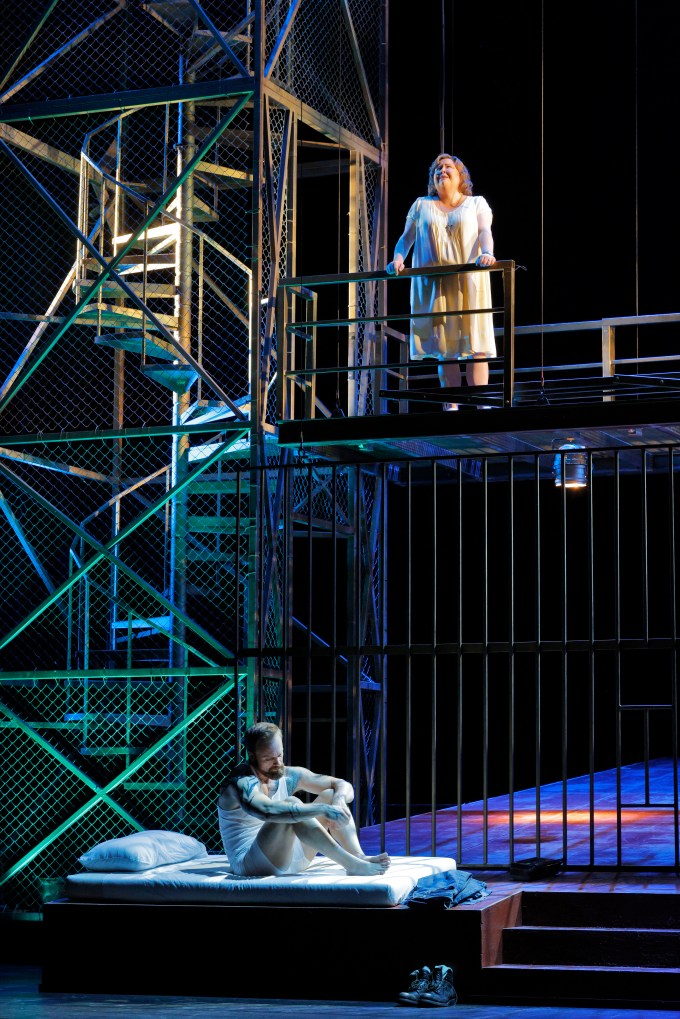
(below) Emma McNairy as Marie, (above) Hadleigh Adams as Wozzeck.

Tanya Orellana’s staging is unusual, with two concentric arcs of plain, light blue-green chairs dominating the set.  The concept is that the stage mirrors the seating of the opera house.  We are looking at ourselves, so the events on stage then represent the audience.  Although the theme of art imitating life appeals, this particular instance is somewhat disturbing, as the characters in the opera dwell in the netherworld of society.  This may be how Berg saw the world around him, and perhaps he would see our world today in the same way as the director seems to imply with this interpretation.

Wozzeck, with music and libretto by Alban Berg and based on the play Woyzeck by Georg Büchner, is produced by West Edge Opera and plays at Oakland Scottish Rite Center, 1547 Lakeside Drive, Oakland, CA through August 17, 2025.