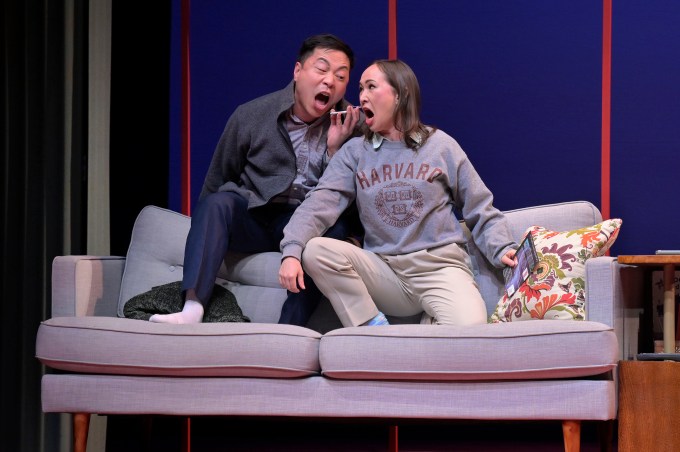
Kristina Wong, Sweatshop Overlord

Kristina Wong. All photos by Kevin Berne.

Readers of this review no doubt prefer to know something about a play before committing to see it.  So do I under most circumstances.  In this case, the script of “Kristina Wong, Sweatshop Overlord” was nominated for the Pulitzer Prize for Drama, and the play won Outer Critics Circle, Lucille Lortel, and Drama Desk Awards for solo performance on its off-Broadway run.  What more do you need to know?

Well, much to my surprise, the play is not about exploitive labor practices by the garment industry in Asia and elsewhere.  Instead, it is the playwright/actor’s autobiography of her time during the Covid pandemic.  While the topic was unexpected, the quality of the script is not, given its well-deserved kudos.  Delivered with passion, pathos, and humor, Kristina Wong’s performance crackles, sparkles, and pops.  Its message of caring and contributing, even in a small way and to beneficiaries unknown, resonates deeply.

Starting in March, 2020, and particularly during the period of shelter-in-place orders, most of us simply retreated into our cocoons.  Through selective amnesia, many of us have already suppressed memories of how frightening that period was, with brave medical people losing their lives in droves and ultimately, over one million Americans dying from the disease.

Like other Asian-American women, Kristina Wong had been taught to play it safe, keep her head down to avoid challenging authority, to cook, and to sew.  This last skill would be put to use to help fend off the pandemic.  In the early days, the medical community identified masking as key to reducing Covid transmission, but supply of masks woefully failed to meet demand.

Wong’s performance art was involuntarily placed on a hard pause, leading her to question her decision to forego family building for her career.  Otherwise unengaged, and having been conditioned to live in the shadow of failure, she nonetheless decided to sew and distribute cloth masks and then to enlist others to support the cause.

Social media and electronic meeting technology were among the rare positive byproducts of social isolation during the pandemic. Through technology and friendship snowballing, Wong was able to build a cadre of hundreds of volunteers donating many thousands of masks to those in need.  In the Asian tradition, these mostly older and mostly Asian women became her aunties.  She dubbed the collective as the Auntie Sewing Squad, and yes, she knew the resulting acronym.  Wong introduces us to some of the aunties and shares the challenges they confronted and how they soldiered on, overcoming issues concerning cloth, elastic banding, mailing, and more.

On a set with big, brightly colored items evoking a day care rumpus room, Wong regales and engages the audience with her experiences.  She prowls the stage with grand gestures and high energy, breaking the fourth wall to directly engage with the audience.  But her emotion of despair swells when she speaks of the dark forces of antagonism and ignorance.  One wonders how she can summon and enact these very personal experiences night after night, but her conviction powers her through her unflinching performance.

This is not an unstaged, solemn, static, stand-and-deliver exercise like Will Rogers spinning yarns or Harry Truman giving ‘em hell.  Chay Yew’s direction gives the depth of production usually seen in fully-staged plays rather than solo performances.  In addition to Junghyun Georgia Lee’s simple but well-suited scenic design, Amith Chandrashaker’s sharp and varied lighting gives a dramatic look, while Caite Hevner’s projections give not-all-too-happy visual reminders of this recent past.  Mikhail Fiksel and Adam Salberg’s bombastic sound punctuates the lively events effectively. If there is any weakness in the production, it would be that it plays on the long side for a solo performance.

To conclude that “Kristina Wong, Sweatshop Overlord” only stands as a self-congratulatory tribute would be mistaken.  The two-tiered narrative switches between personal and societal commentary, with the latter being haunted by her assailing society’s failures.  Those readers who fall into the correlated factions of anti-masking, anti-vax, anti-science, racist, conspiracy theory, pathological lying, and culture wars promoters (read – collectively, socio-political conservatives) may not wish to read on.

The show sadly recounts the many tragic events that occurred during the pandemic, from George Floyd’s killing to Ruth Bader Ginsburg’s death.  The sad ignorance of some people and the pernicious promotion of anti-vax, anti-masking sentiment as a political wedge issue undermined the work of Wong and multitudes of others who sought to help humanity, irrespective of political persuasion.  Worse, lies about masking and vaccination caused the deaths of many thousands of people.

Understandably, the most personal of the fractious issues was the cynical finger pointing at China for the Covid outbreak.  Savagely referring to the disease by names like kung flu and Chinese Covid gave rise to intolerable threats and worse to all Asians, especially by those with white supremacist leanings.  To express what the playwright only implies, the political party with conservative bent, Republicans, failed to repudiate this and other extremism, fanning the flames of division and risking to douse the light of American democracy as we know it.

“Kristina Wong, Sweatshop Overlord,” written by Kristina Wong, is produced by American Conservatory Theater and plays on its Strand Theater stage, 1127 Market Street, San Francisco, CA through May 5, 2024.

Pal Joey

Nico Jaochico as Joey, Maria Mikheyenko as Vera. All photos by Grizzly De Haro.

Patrons may wonder how theater companies select their offerings.  It may be the board of directors’ feeling that a show will do well selling tickets; or an artistic director’s personal preferences; or a nod to a show’s social or intellectual content.

Given the gender politics and social mores of today, “Pal Joey,” which had a successful but not sensational launch on Broadway, comes as a bit of a surprise.  But to its advantage, it’s not cloying like many musicals from its 1940 era.  Instead, it possesses rare edginess that gives it greater currency, with numerous sexual references that would not have passed Hayes Code censorship if it were a movie from the same time.

Jetta Martin as Cookie, Joan Hong as Francine, Shelly McDowell as Val, Rachelle King as Jeannie.

Joey, the lounge singer and emcee central character, is an all-around heel – a womanizer, congenital liar, and manipulator, though he does have sufficient native charm to mostly get away with it.  Mrs. Simpson, or Vera, the female lead, is a crushingly domineering cougar who cuckolds her shady, unseen husband.  So it’s hard to have great sympathy with the main characters, but at least there’s a plot, albeit with skips and jumps, in an interesting milieu.

The action takes place in the nightclub world of Chicago, which would have been pretty unseemly as well.  Interestingly, the 1957 movie adaptation has better-defined relationship development and takes place in San Francisco, which probably would have greater local appeal than the original stage version. Some fine Richard Rodgers music adorns the story, albeit with Lorenz Hart lyrics that usually click, but sometimes fail to drive the plot forward.

Nico Jaochico as Joey, Charles Evans as Mike.

Some musicals would seem almost empty without their signature tune, and so it is with “Pal Joey.”  The beautiful, beguiling “Bewitched, Bothered, and Bewildered” stands as one of the great American standards.  The simple melody with its brilliant recurring octave leaps in only two steps is unmatched, and the rhythmic alliteration and lyrics of its many verses running from lover’s remorse through reprisal add to its emotional power and appeal.

Maria Mikheyenko as Vera delivers the full version of the anthem and its reprise with great beauty and agility in her vibratoed mezzo-soprano singing voice.  As Joey’s patroness, Mikheyenko also captures Vera’s world weariness and oppressive controlling personality with great skill.

Jetta Martin as Cookie, Rachelle King as Jeannie, Max Thorne as Victor.

The other memorable number is a nicely delivered “I Could Write a Book,” a love song that Joey sings with Linda, the other party to a not-well-explicated link in a love triangle (much clearer in the movie).  Nico Jaochico is Joey, and while his portrayal demonstrates his confidence and charisma, he lacks sufficiently mature appearance and uneasy demeanor to convey the weight of having suffered rejection as a performer in several cities throughout the Midwest.

Several elements help lift the Altarena Playhouse production.  Some actors in secondary roles add spark.  Dan Kolodny plays Ludlow Lowell, the artistic manager with extra persuasion, talking like a hammy heavy out of a casting call for a Damon Runyon play.  Max Thorne doesn’t have a lot to do in three bit parts, but does get to show his fine singing chops in “The Flower Garden of My Heart.”  And Shelly McDowell brims with cuteness as Val, one of the dancers.

Maria Mikheyenko as Vera, Nico Jaochico as Joey.

Despite the size limits of the upper stage, Rachell King’s choreography adds important entertainment value and to the feel of being in a nightclub.  The chorines do a nice job in executing several dance styles from tap to pseudo-ballet.  Finally, Ava Byrd creates a wide array of appealing and effective costumery.  Director Laura Morgan brings all the pieces together.

One aspect of the production that could improve is the instrumental performances.  A six-piece band appears on stage, which also adds to the nightclub atmosphere.  However, the theater is a small space.  In order for musicians to produce sufficient volume to give liveliness to the music, they overpower the singers.  The theater does have balconies or backstage options for the band which would produce better balance.  In addition, the band’s sound was not up to expected standard in terms of tuning, timing, and tone.

Dan Kolodny as Ludlow, Jarusha Ariel as Gladys.

To this reviewer, hairdressing constitutes a final issue.  Understandably, a community theater cannot spend on numerous top-quality, natural hair wigs.  But especially in such intimate surroundings, whatever nod to period authenticity with the hairstyles, is more than offset by the cheesiness of the look.  Not to mention, there is nothing particularly unique in the immediate pre-WW II period appearance that the audience is likely to identify or care about.

“Pal Joey,” with music by Richard Rodgers, lyrics by Lorenz Hart, and book by John O’Hara, is produced by Altarena Playhouse and plays on its stage at 1409 High Street, Alameda, CA through April 28, 2024.

Queen

Uma Paranjpe as Sanam, Kjerstine Rose Anderson as Ariel. All photos by Kevin Berne.

What motivates people to enter academe, that is, seek to become university professors?  There are those who wish to be teachers of the highest order, shaping the minds of tomorrows leaders.  There are those who (very naively) seek a soft lifestyle with short working hours and summers off.  Finally, there are those who see themselves as scholars, researchers pushing back the boundaries of knowledge.

What does not drive the academic career choice is love of money.  Even those academic fields that demand much higher pay than the norm can in no way compete with the private sector for financial packages.  But in the reality of becoming adults, probably with mortgages to pay and families to care for, financial exigencies emerge. Those who have sought the research route in academe find that financial reward and adulation correlate highly with research achievement.

Deven Kolluri as Arvind, Uma Paranjpe as Sanam.

Playwright Madhuri Shekar exposes the pressure to publish in her compelling fictional drama “Queen.”  Two research assistants at University of California Santa Cruz in 2017 have spent six years researching colony collapse disorder (CCD), or the extinction of beehives and their resident bees.  While much academic research adds little value to the lives of human beings, this lengthy study has mammoth implications, as the bulk of the world’s food chain depends on the work of bees. Anecdotal evidence and the researchers’ first several data studies point to the chemical neonicotinoid, and particularly the products of the environmentalists’ whipping boy, Monsanto.

Though good friends, the assistants are chalk and cheese.  Ariel Spiegel is played as fun loving and effusive by Kjerstine Rose Anderson, while Sanam Srinivasan is played with caution and concern by Uma Paranjpe.  Central Valley bred, Ariel is the only researcher in the field who comes from an apiculture background, though her family lost their small business, and she is of limited means.  She is a single mom who has sacrificed marriage to stay in this study and notes “Who am I without this work?”.  Sanam is Indian, from wealth, and her specialty is statistical modeling rather than the content area of the research.  Still single, she comes from the tradition of arranged marriage.

Kjerstine Rose Anderson as Ariel, Uma Paranjpe as Sanam.

The women’s paper on the findings is to be published in the scientific journal “Nature,” and their professor, Dr. Philip Hayes (Mike Ryan) is set to receive an award because of the study.  But “Nature” had asked for one more experiment, and this one has not conformed to previous findings to the extent that the overall findings are now insignificant.  Conflict emerges as Ariel, who is wholly invested in this study and this content area, believes there must be a way to present the data favorably, as government policy will be influenced by it.  Sanam believes in the sanctity of the modeling.  Anderson demonstrates her rage and passion, while Paranjpe shows her reserve.

The play opens as a comedy and turns largely to drama as the women’s positions diverge, a switch that both women handle well.  As Dr. Hayes, Ryan, also shows different sides of his personality as he is poised for professional recognition.  Supportive and jocular at first, he then strikes what seems to be a bulldog-like, edgy, demanding “just get it done” posture in the manner of a Godfather-type who leaves no paper trail or fingerprints.  What is he really saying?

The X factor is Arvind, a potential arranged match for Sanam.  As Arvind, Deven Kolluri chews the scenery with his narcissism, pompousness, and flippancy.  A New York financial derivatives trader and high stakes poker player, he assumes that marriage is a done deal, proceeding with self-indulgent expectations and denigration of Sanam’s poorly-remunerated work.  But Arvind is also a statistical modeler, and in this capacity, he introduces a technique that might show the experimental results in a better light, though the procedure is of dubious validity and integrity.

Kjerstine Rose Anderson as Ariel, Mike Ryan as Dr. Philip Hayes, Uma Paranjpe as Sanam.

Several further twists take place adding to the dramatic uncertainty.  The narrative totally engages the audience, and the production is top notch with great performances on a schematic set by Nina Ball and directed by Miriam A. Laube.  At one level, the play concerns personal values that drive us, and at another it deals with making and sustaining relationships – between friends, prospective marriage partners, and mentor/mentees.

But the hallmark of the play is about the practice of science and its integrity and objectivity.  The playwright questions the principles of those who do not abide by the strictures of scientific practice and method.  Indeed, in real life, media reports about misrepresenting the results of studies, or worse yet, forging data, are disheartening.  However, exploitation and sensationalism bias should be recognized.  It is only the exceptions that are newsworthy and gain the public’s attention, not the overwhelming abidance with proper practice.

The script depicts research issues with great skill, but it contains a fair bit of technical matter that will be lost on much of the audience. They undoubtedly do get the overarching issues.  One particular issue that gets passing mention in the script deserves discussion.  (If this reviewer’s credibility on the following matter is in question, I do have a PhD and was a professor who published over 40 peer-reviewed research papers using statistical methodology).

Uma Paranjpe as Sanam, Deven Kolluri as Arvind.

The probabilistic method that calculates the statistical likelihood of a hypothesis being true is derived scientifically.  The statistical matter of concern in this play is that after the last data collection that overall test results no longer met the .05 alpha value, a measure that means that the findings from the study are 95% likely to be true.  The problem is that the .05 threshold is totally human-selected and arbitrary.  Why shouldn’t the passing mark be .01 (99% likely true) or .10 (90% likely true)?  Why would the 90% likelihood that neonicotinoids cause CCD be inadequate but a 95% likelihood be accepted as rock solid?  There is no scientific answer.  As a footnote, however, the EPA instituted various bans on neonicotinoids starting in 2019.

“Queen,” written by Madhuri Shekar, is produced by TheatreWorks Silicon Valley and plays at Lucie Stern Theatre, 1305 Middlefield Road, Palo Alto, CA through March 31, 2024.

King Liz

Fred Pitts as Coach Jones, Davied Morales as Freddie, Damaris Divito as Liz. All photos by Christian Pizzirani.

“Back in the day” professional sports players were chattel.  Three major trends changed the landscape.  The U.S. Supreme Court rejected St. Louis Cardinals star Curt Flood’s challenge to Major League Baseball’s reserve clause but the pressure and momentum from the suit shifted more influence to the players.  Secondly, players’ associations yielded collective bargaining power to athletes which far exceeded their individual influence.  Finally, the employment of business agents gave players intermediaries with negotiating skills, analytical expertise, and legal knowledge.

In time, numerous agents would become famous and powerful, and their clients would share a huge chunk of the riches previously appropriated by the franchise owners.  Although agents seem unlikely subjects for the performance world, the movie “Jerry Maguire” somewhat dispelled that notion, as Tom Cruise played an agent who improbably gained morality.

Alycia Adame as Gabby, Damaris Divito as Liz.

Against this backdrop comes the taut stage dramedy “King Liz,” which is given a rousing and highly entertaining rendering by City Lights.  The play flows, driven by interesting characters and situations, with equal parts of humor, crassness, and dramatic situations.

Few industries have traditionally been as male-dominated and macho as professional sports.  Along comes Liz Rico (note that rico in Spanish can mean rich, tasty, or sexy – all apply!), a Black-Hispanic who rose from the projects to graduate from Yale.  She had taken a job as an assistant to a male sports agent in a startup business.  Fast forward twenty-two years to the time of the play, and she is one of the most successful basketball agents in the business.

Davied Morales as Freddie, Alycia Adame as Gabby, Damaris Divito as Liz.

Damaris Divito is Liz, and in the highest reviewer compliment, she is totally convincing and captivating in the role.  Divito captures Liz’s confidence and decisiveness and unswerving commitment to her profession, including her foregoing a family.  Her charisma and ability to persuade, despite not being a people person, doesn’t hurt.  But she can also be self-absorbed and callous to the point of meanness, as when she denies her assistant an extra ten minutes for lunch.

The owner of the agency, Mr. Candy, assigns a new prospect to Liz, Freddie Luna, who is rated the number one high school basketball player in the country.  From the projects of Red Hook Brooklyn, he shares ethnic and socio-economic history with Liz.  But he also comes with baggage.  He had spent six months in juvenal detention for violent attacks.  His sensitivity about the incident and his hair-trigger temper will continue to haunt him.  Davied Morales is at the top of his game in this complex portrayal of a troubled but talented young man.

Damaris Divito as Liz, Ray Renati as Mr. Candy.

“King Liz” deals with a number of professional and social issues.  The play’s title clearly marks the turf as a gender battle, and despite her success, Liz does have some sexist issues to deal with.  But much of the conflict she faces is gender-free.  It concerns loyalty and integrity.  She acknowledges that “I lie, I cheat, I steal,” but is there a time at which she must consider values other than money and power?  How does this caviar loving woman relate to a young man with basic instincts fresh from the hood?

The NBA is a graveyard for young men with athletic ability but without the maturity and commitment to meet its demands.  The play even mentions the real-life tragedy of Len Bias, the number two overall pick in the 1986 draft, who died two days after being drafted from a cocaine overdose.

Damaris Divito as Liz, Fred Pitts as Coach Jones.

What should society expect from a youth like Freddie, who, just out of high school is thrown into the national spotlight and given a pile of money?  What should or can the young man’s handlers do to ensure that he doesn’t undermine his “brand,” his health, and his emotional future?  When a kid is used to hangin’ with his homies, how do you get him used to treating a professional schedule and his important adult obligations with thoughtfulness and seriousness?

Both Divito and Morales give bravura performances, dispensing sharp dialogue with great verve.  They are supported by a talented supporting cast.  Alycia Adame is Gabby, Liz’s highly competent assistant with a classic subordinate’s personality who wouldn’t be expected to rise in the ranks.  Ray Renati is the ebullient but concerned Mr. Candy, who must decide who should run the agency upon his retirement.  Fred Pitts is Coach Jones who didn’t want to draft Freddie and who has a conflicted relationship with Liz.  Finally, Caitlin Papp is Barbara Flowers, a television journalist who has agreed to give Freddie a powder puff interview in hopes of helping his marketability for prospective endorsements.

Fred Pitts as Coach Jones, Davied Morales as Freddie, Caitlin Papp as Barbara Flowers, Damaris Divito as Liz.

The creative elements add to the effect – Ron Gasparinetti’s clean lined scenery, Carsten Koester’s sharp lighting, and George Psarras’s detailed soundtrack.  However, for those who don’t like hip-hop, you’ll have to put your fingers in your ears every once in a while.

Overall, the production excels, and credit Director Kinan Valdez.  One point for discussion however is that while the lead roles are well grounded in their archetypes, Mr. Candy, Gabby, and Coach are highly interpretive parts.  They often seem silly in this rendering, which adds to the comic side of the piece.  It is not clear whether these characterizations are specified by the playwright’s stage directions, but it would be interesting to see these parts played straight up to give the play more realism and dramatic heft.

“King Liz,” written by Fernanda Coppel, is produced by City Lights Theater Company, and plays on its stage at 529 South 2nd Street, San Jose, CA through April 21, 2024.

Pipeline

Leontyne Mbele-Mbong as Nya, Atlantis Clay as Omari. All photos by Joseph Giammarco.

Many events in the life of a mother can be distressing.  Among the most is when her child’s very public actions come into conflict with the mother’s values and jeopardize the child’s future…..

Dominique Morisseau has become one of the most distinguished playwrights of her generation.  A MacArthur Fellowship (“Genius Grant”) winner, she made her mark with her Detroit Project trilogy, which focuses on the Black community in her Michigan hometown.  She followed the last of those three plays with “Pipeline.”  Like its predecessors, this play exudes insight and power.  African-American Shakespeare’s L. Peter Callender-directed production totally enthralls as it extracts every bit of relevance and urgency from the taut and compelling script.

The title of the play derives from the tragic arc that many Black boys and young men follow.  Numerous studies have established that Black children in schools are subjected to more disciplinary measures than Whites and that their punishment is more extreme.  In the past, virtually all school conflicts were adjudicated by the school administration.  In recent decades, administrators have often turned to the police to intervene.  The consequence is that many Black males have been arrested and charged for behaviors in school before they have become men.  The taint of arrests and missed classes impacts their ability or desire to complete school and their employability, leading to the school-to-prison pipeline.

Atlantis Clay as Omari, Ije Success as Jasmine.

Black, divorced, single parent Nya teaches in a high school that her son Omari would attend if he were to go to public school.  Leontyne Mbele-Mbong is Nya, and she gives an exquisite, nuanced performance.  As one would expect from an aspirational teacher who also acts as a role model, her rage is as controlled and disciplined as her arguments.

Her son, Omari (Atlantis Clay), is bright and able to compete intellectually in a selective private boarding school, but he suffers social/psychological isolation and has had some deportment problems.  When we meet him, he is with his girlfriend Jasmine (Ije Success).  The scene seems out of place until we find through Jasmine that the damning incident of Omari’s pushing a teacher has been video recorded and has been posted on the Internet.

As a mother, Nya’s instinct is to protect her only child.  As a teacher, she feels strongly about civil rules that allow schools and all of society to function properly, even over Omari’s protestations that he was provoked by a biased teacher who made insinuating connections between Omari and the character Bigger from Richard Wright’s novel “Native Son.”

Michael Gene Sullivan as Xavier, Gary Moore as Dun, Atlantis Clay as Omari.

Nya’s ex, Xavier (Michael Gene Sullivan), is prosperous, and both parents are committed to giving their son all of the tools for success, including the private schooling.  Nya’s ambivalence, humility, and problem-solving approach in dealing with a possibly life-altering incident is countered by her ex, Xavier.  Morisseau delineates his character with unflattering precision.

Xavier’s power-based approach and certainty about the right courses of action is matched by the likelihood that his actions will have the opposite effect intended.  We see in his relationship with Omari the classic responsible, but absentee, father.  The checks and birthday presents are always on time, but he lacks a drop of human compassion, which may have led to the marital split as well.  And when it comes to blame, Xavier lays it on anyone but himself.

A subplot acts as a cross current.  In the classroom of a White teacher, Lauri (Kelly Rinehart), a violent fight takes place.  According to the security officer Dun (Gary Moore), protocol suggests that a teacher should always stay clear of the fray and only call security.  But when faced with a brutal struggle that could lead to serious injury or worse, should the teacher stand by or take action, and if so, what? The luxury of reflection does not exist.

In an intense 95 minutes, the playwright surfaces a number of universal relationship as well as racial issues.  Parents often feel accountable about how their children have been reared, and Nya feels guilt about whatever failings Omari manifests.  She also feels protective, knowing that as a young Black man his mere presence and innocent actions can be perceived by Whites as too this or too that.  And unlike Xavier, she is willing to make personal sacrifices for her son.

Leontyne Mbele-Mbong as Nya, Kelly Rinehart as Laurie.

From the opening video projections of violence in schools involving police, this production offers a chilling reminder of our country’s failure to create social harmony and a fair playing field for all of our people.  Unfortunately, the play provides no answers other than to suggest that there is much work to be done.

Fortunately, the production is graced with an ensemble of exceptional actors who bring veracity and passion to their roles.  Giulio C. Perrone’s set design is appropriately simple and leaves it to the words of the playwright and the delivery of the actors to instill the meaning.

Interestingly, the highly regarded film “The Hate U Give” was developed contemporaneously to “Pipeline.” For those interested in different perspectives on similar issues, it covers some of the same concerns and is recommended as a companion piece.  Both note how Whites can often misunderstand and miscommunicate with Blacks, sometimes insulting with or without intention.  Each deals with the lifelong risks of simply being Black and the code of silence in not betraying one of their kind to authorities, despite adverse consequences.  Finally, they deal with the cost that may be associated with taking responsibility, whether Black or White. 

“Pipeline” written by Dominique Morisseau, is produced by African-American Shakespeare Company, and plays at War Memorial Veterans Building, 401 Van Ness Ave., San Francisco, CA through March 31, 2024.

The Far Country

Feodor Chin as Gee, Aaron Wilton as Interrogator. All photos by Kevin Berne.

From 1886, the Statue of Liberty in New York Harbor has stood as a beacon for immigration to the United States with its welcoming inscription from poet Emma Lazarus, “Give me your tired, your poor, your huddled masses yearning to breathe free.”  Warmly admired by most Americans, its neighbor, the storied Ellis Island served as an efficient processing station for millions of European immigrants, unrestricted from entry until World War I.

Apart from the Asian-American community, many Bay Area residents, and some others along the West Coast, relatively few people are aware of Ellis Island’s counterpart, Angel Island in the San Francisco Bay.  From 1890, it served to reject applicants from Asia rather than welcome them, especially through enforcement of the Chinese Exclusion Act of 1882 and its successors.  Unambiguously racist, these laws prohibited immigration of any Chinese person except for those who could successfully claim that they were spouses or progeny of American citizens.  Ellis Island processed the incoming briskly, but detention at Angel Island lasted days, sometimes months, and up to two years.

Cast.

While playwright Lloyd Suh’s “The Far Country” is fiction, its gripping depiction of history, incidents, and characters might well be considered a stellar exemplar for events of its time, which spans from 1909 to 1930.  The play engages from opening curtain, thoroughly engrossing as it invades the sympathetic sensibilities of the audience.

In scene one, Fyodor Chin offers a magnetic tour de force performance that sets the stage for the whole play.  As Gee, a Chinese man resident in San Francisco, he wishes to travel to China, purportedly to bring his son to the United States.  He lacks proof of his right to be in the United States, and all of the immigration and naturalization records generated at Angel Island were destroyed by the 1906 San Francisco earthquake.  The restrictions of the Exclusion Act compounded by the loss of records spawned a massive cottage industry, with Chinese like Gee concocting elaborate origin stories in hopes of gaining permanence in “Gold Mountain,” as the U.S. was known in China.

Tess Lina as Low, Feodor Chin as Gee.

Interrogators at Angel Island used devious methods to try to expose elaborate hoaxes by seeking fine detail like how many steps at the front door of an applicant’s house in China, and what material, what color, and what texture they possess.  They often repeated questions at a later time and sought corroboration from others who should have had the same answers, even if it’s information most people would not know to begin with.

Gee’s interrogators appear heartless and clearly inclined to reject his application, as the extent of fraudulent misrepresentation they confront from men like him is profound.  As Gee, Chin deals with these challenges unflappably.  Ebullient, constantly smiling, and flailing his arms, the interrogators fail to pierce his practiced confidence.

The central thread of the narrative is Gee’s wanting to recruit a teen in China who can act as his fictitious son and who will pay to become indentured to Gee and his laundry business in San Francisco’s Chinatown.  That target is Moon Gyet, played by Tommy Bo, who must also memorize a script compatible with the stories of his presumptive father.

Tommy Bo as Moon Gyet, John Keabler as Interrogator.

Along the way, Moon Gyet will also confront a prospective wife of convenience, Yuen, who is played playfully, sassily, inquisitively, and assertively by Sharon Shao.  Led by Yuen’s constant badgering about what kind of relationship they would have (sex included?), the two find tremendous humor in their simple exchanges, producing one of the several effective and unexpected tone shifts in the drama.  In other scenes with changes in dramatic tension, Gee will reveal two personality transformations that not only enrich Chin’s characterization, but add to the kudos his acting deserves.

One of Moon Gyet’s revelations is that Chinese immigrants never see the Gold Mountain that they dream of but that he believes exists.  He speaks of the crowding, the loneliness, the bad food, and the implied caging of the Chinese in their ghetto because of the prejudices of white society.  So why do they come?  Part of the stereotyping of Chinese is that they are patient, sacrificing, and forward looking.  In this case, the adventuresome believe that theirs is the first step in a long march that will eventually benefit their descendants.

“The Far Country” unfortunately rings true in many ways.  And in fairness, it is not just the white Americans whose integrity is impugned but also the Chinese.  Ultimately, however, the optimism for a better world does come through.

Tommy Bo as Moon Gyet.

The story compels, and the striking artistic elements directed by Jennifer Chang enhance its telling in many ways.  Notwithstanding the play’s assets, the closure does contain an excess of earnestness.  There are other weaknesses like the excessive exposition about the conditions of detention.  Even that is presented in an artistic manner with dim lighting and constant movement of anonymous characters who describe the strictures.

An annoyance is that translators’ commentary overlaps the principal speakers to make dialogue harder to hear.  Supertitles could be employed, or translators could use indistinct low mumbling when the main characters are speaking so that the audience understands the process without disrupting the primary conversation.  Despite any minor criticisms, the play offers a powerful and memorable experience that is recommended for all theater audiences.

Tommy Bo as Moon Gyet, Sharon Shao as Yuen.

“The Far Country,” written by Lloyd Suh, is produced by Berkeley Repertory Theatre and plays on its stage at 2025 Addison Street, Berkeley, CA through April 14, 2024.

Rigoletto

Duke of Mantua (Edward Graves), Rigoletto (Eugene Brancoveanu). All photos by David Allen.

The sixteenth of Giuseppe Verdi’s operas, “Rigoletto,” which debuted in 1851, marked an inflection point in the composer’s career.  The opera represented his first masterpiece of the highest order and the beginning of his rich middle period trove, to be followed immediately by “Il Trovatore” and “La Traviata.”  Although the libretto truncates important developments in the narrative, it touches on numerous themes from family relationships, romantic love, and gender norms to honesty and integrity.

Rigoletto (Eugene Brancoveanu, center) and Monterone (Philip Skinner, center), Duke of Mantua (Edward Graves, right).

“Rigoletto”’s brass-dominated foreboding prelude and this production’s mostly low lighting and darkened sets foretell the tragedy ahead.  The drama is intense and dispiriting, but the music is glorious like few other operas.  Four of its highly melodious and uplifting arias and quartets are fixtures in opera music compilations.  Remembering them may cause one to forget how many other luxuriant phrases and passages grace the score, not to mention the fireworks from the many highly emotional tracks.  Act 1 alone contains a complex double ensemble and two beautiful duets.

Rigoletto (Eugene Brancoveanu), Gilda (Melissa Sondhi).

Opera San Jose offers a highly entertaining, riveting, and traditional rendition, maintaining the complexion that made the opera controversial in its own day for its immorality and even more so in current times for its social incorrectness.  The jester Rigoletto hypocritically obsesses over his daughter Gilda’s honor, yet publicly lampoons courtiers as being cuckolded.  At the same time, women are treated as chattel.  Rigoletto’s employer, the Duke of Mantua, lies and debauches, yet Gilda, will make the ultimate sacrifice to protect the Duke, her abusive and libertine lover, who has shown no reciprocal commitment.

The taunted and isolated Rigoletto, who values only Gilda in this life, is portrayed by Eugene Broncoveanu, OSJ stalwart and veteran of the role.  His deceptively effortless and clarion baritone booms throughout this demanding part, which requires diverse acting skills as well as a versatile voice.  Those qualities culminate when Rigoletto confronts the courtiers upon learning that Gilda has been kidnapped.  Interestingly, the title role is large and presents vocal challenges, yet with the exception of a small participation in the glorious quartet section of “Bella figlia dell’amore” (“Beautiful daughter of love”), it lacks a real signature number.

Rigoletto (Eugene Brancoveanu), Gilda (Melissa Sondhi).

Rigoletto has cloistered Gilda so that she doesn’t know the ways of the world.  Her naivete leads to her deceiving her father and the impulsive willingness to give up her life for love.  Soprano Melissa Sondhi is Gilda, and early in Act 1 on opening night, her voice sounded thin and strained.  Fortunately, she was fully prepared by the end of the act for the moment that emblemizes the innocent girl.  The haltingly beautiful “Caro nome” (“Dearest name”) tells of her first love, really an infatuation, for the student Gualtier Malté, who is the Duke in disguise.  Sondhi’s voice was warm and evocative, and she milked the brief aria for all it is worth.  The silences between single notes were palpable, and her ornamentation was delightful.

Gilda (Melissa Sondhi, left), Sparafucile (Ashraf Sewailam, center), Duke of Mantua (Edward Graves, right).

Detached from the opera, and without knowing the context of its most famous arias, one might think that the Duke is heroic, rather than the cad he really is.  His “La donna è mobile” (“Woman is fickle”) is one of the most famous arias in the consciousness of the general public, but the Duke also sings the bouncy “Questa o quella” (“This woman or that”) and the solo portion of lavish “Bella figlia dell’amore.”  Tenor Edward Graves handles each with great dexterity and in fine voice.  His Italianate melodiousness (some might say twang) fits perfectly with this great work from the Italian canon.

Maddalena (Melisa Bonetti Luna), Rigoletto (Eugene Brancoveanu), Sparafucile (Ashraf Sewailam).

The supporting cast is strong.  Two basses stand out – Philip Skinner as the mournful and vengeful Monterone who issues a curse on Rigoletto, and Ashraf Sewailam as Sparafucile, the assassin who Rigoletto pays to murder the Duke.  Mezzo Melisa Bonetti Luna shines as Maddalena, Sparafucile’s sister, whose morality falls beneath her brother’s.  Conductor Jorge Parodi keeps the orchestra and action at a brisk pace making for a highly rewarding experience.

“Rigoletto” composed by Giuseppe Verdi with libretto by Francesco Maria Piave produced by Opera San Jose, plays at California Theatre, 345 South First Street, San Jose, CA through March 3, 2024.

Corpus Evita


Eva Perón (Jessica Sandidge), Juan Perón (Casey Germain), Doctor (Anders Froehlich), Ministro (Patrick Bessenbacher). All photos by Otak Jump.

The name Perón is synonymous with modern politics in Argentina.  Juan Perón was a dominant post-WW2 populist president.  His second wife Evita became a mystical talisman for the country’s working class seeking a better way of life, but she died tragically in 1952 at age 33.  Perón was overthrown in 1955, but returning from exile, his third wife, Isabel, became his running mate in 1973 and succeeded him upon his death.   She sought to resurrect the magnetic aura of Evita as her own, only to be repudiated and overthrown by a military coup in 1976.

In fashioning “Corpus Evita,” composer Carlos Franzetti and librettist José Luis Moskovich explore the charisma of Juan and Evita, in contrast with Isabel’s doomed ascent and rejection, replete with the apparitions of her predecessors.  The seldom produced but remarkable musical drama was nominated for a Grammy in 2005.

Isabel Perón (Sara LeMesh), Ministro (Patrick Bessenbacher).

West Bay Opera offers a musically and visually powerful rendering of this piece which holds special resonance for its creators.  Both composer and librettist grew up in Argentina in the Perón era; were teenagers during Isabel’s regime; and ultimately crafted this operatic indictment of Perónism that many in their home country would find objectionable.  The librettist is West Bay’s General Manager, its artistic visionary, and the conductor of the orchestra.

The vivid look of the opera from Peter Crompton’s set and projection design appears from the start, with a classic public-appearances balcony surrounded by expressive and detailed projections that give depth to the stage.  At the opening, Evita bids farewell to her admirers from the balcony as she is dying from cancer.  In her soliloquy, soprano Jessica Sandidge cuts a striking and authentic figure as she powers through the high passages with grace and authority.

Doctor (Anders Froehlich), Corpus Evita (Laure de Marcellus).

The scene then shifts to 1974.  The central focus throughout the narrative is on the unprepared and hapless Isabel who considers herself well-intended but is unable to offer the hope and magnetism of Evita.   Feeling ineffectual and trapped, she meekly authorizes actions that result in the murders of thousands of innocent people.  Soprano Sara LeMesh adeptly captures Isabel’s inner conflict and sings her anguish with strident conviction without losing her eloquent vibrato.

A composite figure, Ministro, is the male lead, performed by tenor Patrick Bessenbacher.  He poses an ominous figure as the behind-the-scenes manipulator who hopes to resurrect “the flame of Evita” through Isabel.  He scorches his rage through his mid and upper range, but is asked to dig lower at times, and gets lost beneath the orchestra.

Isabel Perón (Sara LeMesh).

The musical idiom of the piece is neoromantic, without memorable melodies but continuously attractive.  Lush strings-forward sound dominates, with percussion often finishing, especially in heated sequences.  Notable choral contributions also include rhythmic, percussive effects, especially through repetition like “Evita. Evita. Evita” or “Isabel. Isabel. Isabel.”

Ensemble pieces also appeal.  Evita and Juan, sung by bass Casey Germain, engage in a self-indulgent duet at a grand ball, and the contrast of voices works particularly well.  Conversely, Isabel and Ministro vocally shout blame at each other with controlled fury in their electric exchange.  In a revelatory trio, Isabel, Juan, and Ministro share their different perspectives and shared regrets from Isabel’s failed regime.

Ministro (Patrick Bessenbacher).

“Corpus Evita” deals intelligently with important themes.  And though the conceit of magical realism allows for great leeway, because this opera deals with critical historical issues, accuracy is important.  Greater clarity would be welcomed in the plot line.  Simply including dates (which are in the program) in the supertitles would help orient the patron, as the timeline jumps by decades and is not chronological.  And though the device of Evita as an apparition is clever and understandable, a scene that includes Isabel with both Evita and Corpus Evita is not clear.

The events depicted in the opera are highly dramatic and engaging.  However, the drama is disrupted by emptiness during slow scene changes.  If the set change can’t be hastened, one solution is to move transitional action in front of the curtain while props are being moved.  Another is to add bridge orchestration for the changes.

Juan Perón (Casey Germain), Eva Perón (Jessica Sandidge).

Nonetheless, this opera offers a scintillating and worthy experience with beautiful music, an important storyline, and an opulent production.  Thematically, it excoriates Perónism as a symbol of populism, decrying the cult of personality and myths that invariably lead to tyranny.  Regrettably, many people fall captive to auras and neglect substance.  We face the same chilling challenge in this country today.

“Corpus Evita” with music by Carlos Franzetti and lyrics by José Luis Moskovich is produced by West Bay Opera and plays at Lucie Stern Theatre, 1305 Middlefield Road, Palo Alto, CA through February 25, 2024.

My Home on the Moon

Jenny Nguyen Nelson as Mai, Rinabeth Apostol as Vera, Sharon Omi as Lan. All photos by Jessica Palopoli.

Innovation has shaped the experience of humanity.  From hand tools to machines to computers, implements have reduced our burdens and determined how we go about our work and play.

Otherwise, from the dawn of humankind, dreams have reflected perceptions of a different world lived within – sometimes grand in our wakeful imagination, sometimes fearsome in our sleep.  But more recently, the innovations of virtual reality and artificial intelligence enhance perceptions and transport us to new and different realizations.  Playwright Minna Lee’s world premiere dramedy “My Home on the Moon” explores such an alternate reality, and San Francisco Playhouse delivers a richly rewarding production.

Sharon Omi as Lan.

Lan is a middle-aged Vietnamese-American woman who owns a café, Pho Lan, that offers only one item, the eponymous, famed noodle and meat soup from the country of her birth.  Young Mai, a dropout from a gourmet cooking academy, produces Lan’s recipe.

Though the soup is highly regarded, the café has fallen on hard times as the neighborhood gentrifies; other shops are closed to be replaced by construction for high rises; and the old customers move on.  Pho Lan faces closure when a seeming white knight comes along.  Lan learns that the shop has “won a grant” from the mysterious Novus Corporation.  Its representative, the marketing-savvy and charming but herky-jerky Vera organizes a new marketing campaign that Novus will sponsor.  It begins with a stylish update of the downmarket noodle shop that includes a lush Southeast Asian jungle.  But the promotions also include incongruous advertising with a vulgar couple engaging in sexualized acts, not something usually associated with a pho cafe.

Will Dao as Food Critic, Sharon Omi as Lan, Jenny Nguyen Nelson as Mai, Erin Mei-Ling Stuart as Camera Person.

The marketing plan works!  Pho Lan can’t keep up with demand, and even adds another popular menu item, bán xèo, a Vietnamese crepe.

So what’s wrong with this picture?  Without giving away too much, let’s say that we see the clash between fantasy and reality.  And since the fantasy experience is superior, it begs the question why we would ever want to come back to reality.  Although the script has logic holes, it could not be more timely.  It provokes thoughts about how we confront and assess the limitless potential and onslaught of falsehoods, security risks, displacement, and more that arise from artificial intelligence.

Erin Mei-Ling Stuart as Gigi (CEO of Novus), Will Dao as Beau (former employee of Lan).

Although the issues surfaced are serious, the overall tone is light.  The action occurs at the time of Tet with lion dances highlighted.  Separately, Lan and Vera perform humorous song and dance numbers demonstrating both Eastern and Western footwork.  Meanwhile, Vera’s personality is quirky altogether, while Will Dao’s food critic is outlandishly hyper and funny.

The cast is led by three captivating and contrasting female leads.  Sharon Omi is Lan, a smiling, sympathetic character who holds to tradition and hope.  This kind older woman treats Mai as a daughter.  As Mai, Jenny Nguyen Nelson is more grounded and concerned about the influx of unpaid bills that could cause the shop to close.  Vera becomes the catalyst for change, and an enthusiastic Rinabeth Apostol cooks up the marketing plan but has much to learn herself, much of which she will gain from a personal relationship with Mai.  Will Dao and Erin Mei-Ling Stuart give solid performances in multiple supporting roles.

Rinabeth Apostol as Vera, Jenny Nguyen Nelson as Mai.

Another big star is the production design led by Director Mei Ann Teo.  With the utilization of its revolving platform, SF Playhouse sets the Bay Area standard for multi-set staging, and Tanya Orellana’s clever use of the space complemented by Vincent Chau’s props results in a remarkable design.  Three essential lighting-related treatments complete the overall appearance.  Lighting Director Michael Oesch employs several lighting features including color changes to produce the look.  Jacqueline Scott, the specialty properties designer, implements the long snake-like light noodles.  Finally, Hao Bai’s inward swooping isobar projections create the appropriate symbolic sense of tumbling down the rabbit hole.

Sharon Omi as Lan.

“My Home on the Moon,” a world premiere written by Minna Lee, is produced by San Francisco Playhouse and plays on its stage at 450 Post Street, San Francisco, CA through February 24, 2024.

Cult of Love


Cass Buggé (Pippa Ferguson – Evie’s wife), (above) Kerstin Anderson (Diana Dahl Bennett – daughter), Virginia Kull (Evie Dahl – daughter), Luisa Sermol (Ginny Dahl – mother), Lucas Near-Verbrugghe (Mark Dahl – son). All photos by Kevin Berne.

It all starts in Kumbaya spirit.  Adult children and their spouses gather with their parents at the Dahl family homestead, festively fashioned for Christmas.  Smiling and enthusiastic, they sing holiday and folk traditionals like “A’Soulin” and “Children, Go Where I Send Thee.”  Later, in memory of a trip to the Great Smokies, the four children sing a beautifully harmonic “Oh, Shenandoah.”  But like their erroneous connection with that song, which actually relates to an Indian chief, the familial harmony is an illusion, as it occurs almost solely when they join in song.

Dan Hiatt (Bill Dahl – father), Virginia Kull (Evie Dahl – daughter).

Playwright Lesley Headland has crafted a wildly entertaining and stunningly searing indictment in “Cult of Love,” the final chapter in a seven-play series.  Trip Cullman, a frequent collaborator with Headland, directs a stellar cast to a masterful and captivating production.  Each play addresses one of the Seven Deadly Sins, with this installment focusing on pride, which in some ways can be considered a master sin, as it can lead to committing most of the others. 

Bill and Ginny Dahl fervently identify themselves as “Christians” and raised their children accordingly. Christmas takes on special meaning for them, as the children ritually return home for the holiday; sing carols; eat lamb dinner prepared by the father; and take the obligatory photo of the four kids together smiling. 

Lucas Near-Verbrugghe (Mark Dahl – son), Molly Bernard (Rachel Dahl – Mark’s wife).

But ultimately, the traditions become disingenuous as children gain their own sense of agency, and gaping fissures appear in the relationships.  The uber-talented and academically accomplished Mark has settled for a government job, married a Jewish girl and seemingly repudiated Christianity.  Johnny is a recovering heroin addict and unmarried.  Evie is a lesbian and in a same-sex marriage.  Finally, Diana has become a doctrinaire fire-and-brimstone zealot who castigates and alienates those around her with her judgmentalism and rigidities.

Parents always hope to love their children, but the elder Dahls must confront children whose actions contradict the parents’ beliefs.  Not exactly what the parents hoped for.  But like Christian fundamentalists, Ginny’s belief-driven system extends beyond the moral and existential, so that beliefs trump facts in the realm of science. Although Bill has shown evidence of mental deterioration, she refuses to accept the obvious, which becomes a major source of friction in the family.

The partiality of the parents is felt by some of their children, to which Bill argues that he loves everyone, which may be interpreted as he feels no more for his children than for others.  He then qualifies his statement by noting that he hated his father, which suggests that generational antipathy is not limited to this immediate family.

(standing) Christopher Sears (Johnny Dahl – son).

Headland makes an interesting choice of surnames for the family in question, Dahl.  It is a homophone of doll, which is a human imitation, a counterfeit.  Are the Dahls a family in name alone?

Personality traits become more manifest and unidirectional as the action unfolds.  One exception is Mark, who has an episode that either represents retrogression or convenient and skilled acting.  Siblings inflame old wounds and new with remarkable candor.

Kerstin Anderson (Diana Dahl Bennett – daughter), Christopher Lowell (James Bennett – Diana’s husband), Luisa Sermol (Ginny Dahl – mother), Lucas Near-Verbrugghe (Mark Dahl – son).

So how does this all relate to pride?  The playwright’s thesis is that certainty of belief breeds pride.  We become self-referential and exclusionary when we feel that we have all of the right answers.  It may not be too difficult for the reader to intuit the primary source of the sin in this drama.  Of course, a further question is begged – is a person who actually does have the right answers prideful?

While the script offers powerful messages, they are also delivered with consummate skill.  Acting is superb by an ideal ensemble cast.  Talking overlap and even competing conversations are deftly executed.  Although the conflict in this play is pronounced, it offers considerable levity, with players earning laughs from pedestrian lines.  Major contributions are added by the creative designers, with a special nod to Scenic Designer Arnulfo Maldonado, whose massive and detailed set provides beauty, function, and authenticity.  This play is highly recommended.

Lucas Near-Verbrugghe (Mark Dahl – son), Dan Hiatt (Bill Dahl – father), Vero Maynez, (Loren Montgomery – addiction recovery mentee, friend of Johnny), Luisa Sermol (Ginny Dahl – mother).

“Cult of Love” is written by Leslye Headland, produced by Berkeley Repertory Company, and is performed on its stage at 2025 Addison Street, Berkeley, CA through March 3, 2024.