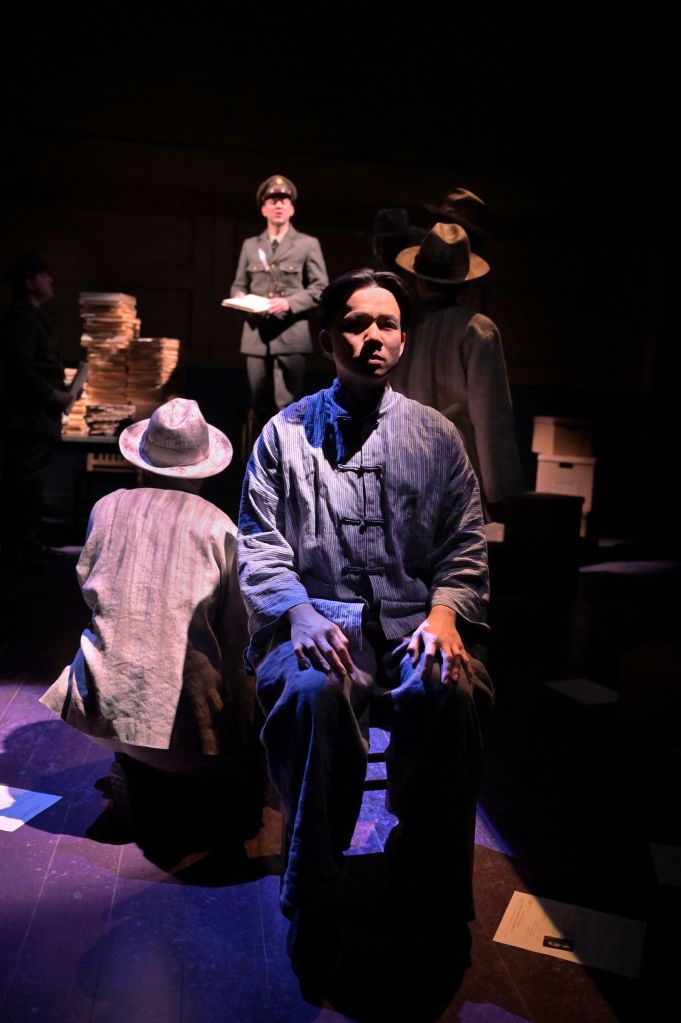
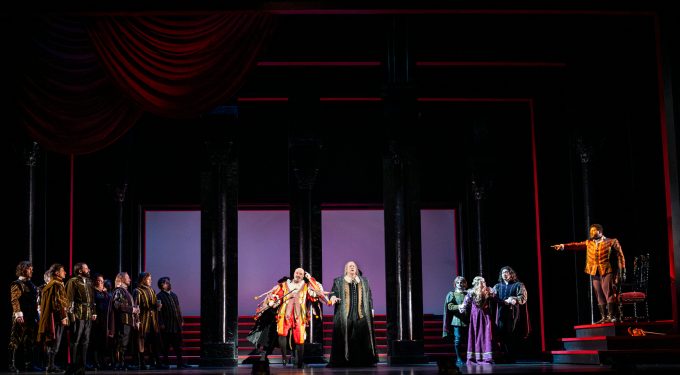
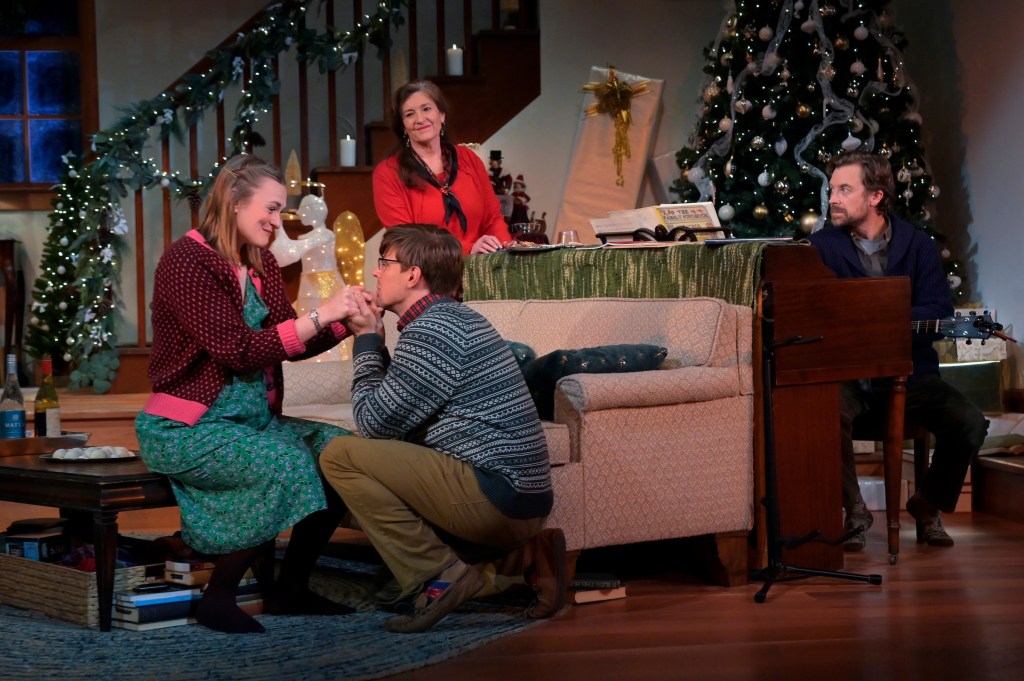
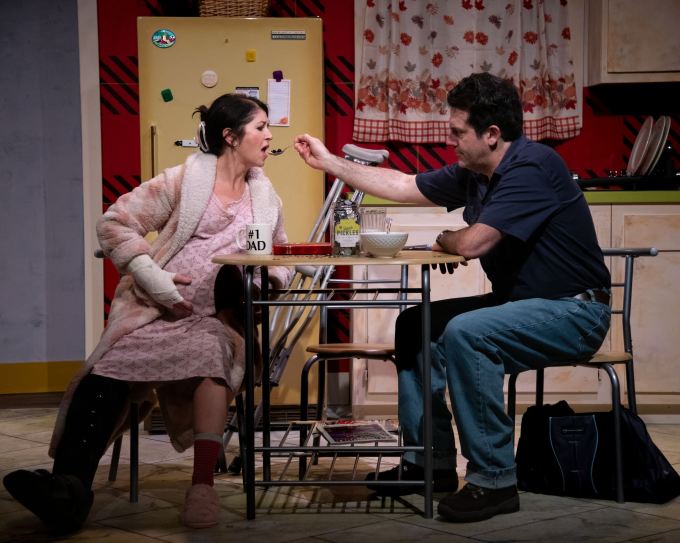
Kimberly Akimbo

Peter Marietta as Buddy, Jamison Vaughn as Kimberly. All photos by Grizzly De Haro.

Critics of the performing arts crave originality.  Having progeria, a disease in which the body ages at 4 ½ times the normal, as central to a comedy must check that box.  Playwright David Lindsay-Abaire crafted a thoroughly entertaining and touching play about a girl suffering the condition who turns 16, the average life span for its victims.  But the play is full of humanity and even an odd sense of optimism, promoting the notion of carpe diem, seize the day.  With a stellar cast and distinctive contributions from the creative directors, Altarena Playhouse offers a production that delivers most everything the play has to offer.

Kimberly lives with her dead-end, self-centered parents, Buddy and Pattie in northern New Jersey.  Kimberly deals with her physical tragedy as well as the expected social isolation of looking like the grandmother of her peers.  But at home, she is the most grounded and the adult in the room.  Buddy is a lush who always lies about why he is very late getting back from work and makes promises he will never keep.  The narcissistic Pattie exhibits hypochondria; is pregnant; and has both hands bandaged from carpal tunnel surgery, so she needs assistance to eat and more.  The family had moved houses recently without notifying Pattie’s sister Debra, a grifter who was in jail at the time.  But Debra tracked them down and moved in on the sly, armed with a scheme to get rich the illegal way.

Allison Gamlen as Pattie, Jamison Vaughn as Kimberly.

Jamison Vaughn is Kimberly, and she inhabits the role beautifully.  Often disparaging her parents for bad behavior, Vaughn’s sentences usually begin with a whiny “D-a-a-a-d” or “M-o-o-o-m” followed by a chiding or a plea.  And though her remaining life is short, she immerses herself in the day-to-day, and seems uncommonly well adjusted.  Although people close to her are sensitive to her condition and her mortality, well-intended but clumsy people say hurtful things.  One of the sublime elements of Vaughn’s acting is the subtle flinching when confronted with unmindful, distressing comments.

It’s rewarding to watch a great performance by an actor who is completely outside his real skin, and does it without the aid of prosthetics or transformative makeup.  Peter Marietta appears more fit to play debonaire or self-possessed roles, but aces the part of Buddy assisted only by sloppy clothes and slightly ruffled hair.  Of course, he adds the facial and bodily expressions as well as the speech, which is “The Sopranos” Jersey Accent 2.0 to create a totally convincing working class schlub.  His thoughtlessness is reflected in picking up Kimberly 2 ½ hours late in the freezing cold, and along with Pattie, forgetting Kimberly’s 16th birthday.

Caroline Schneider as Debra, Jamison Vaughn as Kimberly, Allison Gamlen as Pattie.

The same acting case can be made for the striking Allison Gamlen as she nails the heedless Pattie who is full of cringeworthy comments that are well delivered in Jersey patois.  In front of Kimberly, she insensitively notes about her unborn that “This one will be perfect.”  And about not being able to her use her bandaged hands, she shares with all that “I can’t wait to be able to wipe my own ass.”  She is however forward thinking enough to record comments as a memory bank for her next child, but needless to say, many of those comments may not reflect well.

Along with the parents’ insensitivity, profanity abounds, and one bright spot is that they agree to Kimberly’s challenge to put a nickel into a jar on the kitchen table each time they swear.  Surprisingly, given their personalities, they even humorously cough up the forfeit when nobody hears them and nobody is looking.

Jamison Vaughn as Kimberly, Rowen Cole Weeramantry as Jeff, Peter Marietta as Buddy.

Caroline Schneider impressively portrays the bombastic, ne’er-do-well Debra who creates mayhem any time she is in the scene.  Rounding out the cast is a charming Rowan Cole Weeramantry as Jeff, a recent and only school friend of Kimberly’s who obsessively creates anagrams, which accounts for the name Akimbo in the title.  He also shares the bond of living with bad parenting.

Director Dana Anderson leads an impressive team of creative directors.  Tom Curtin’s set is fitting for the production.  Danielle Ferguson provides many lighting changes from intensity and location to blackout.  Daniel “Techno” Debono offers numerous sound effects. 

Although the production brims with virtues, one major flaw in Kimberly’s depiction fails to avail the breadth of the character.  Vaughn’s age appearance on stage is ambiguous.  She could be in her thirties or forties.  She should look 72 years old, which is easily correctible with a realistic salt-and-pepper or gray wig.

Caroline Schneider as Debra, Jamison Vaughn as Kimberly, Peter Marietta as Buddy.

I usually hate comparing elements of a production being reviewed to another realization, but this time it is too hard to resist.  I saw 62-year-old actress Victoria Clark, who won a Best Actress Tony Award, portray Kimberly in the Broadway musical based on this play.  Two things make the central age conceit work for Clark with such power, and they could work in this production.  One is the massive contradiction between the look of a matronly woman versus her teenage behaviors and her teenage friend.  The other is the daughter looking like the mother to her parents rather than vice versa, which acts as a constant reminder of her condition and how close she is to the end of life.  These important dimensions are regrettably lost by not showing the character aged appropriately.

A minor issue concerns audibility, which is an inherent problem with a full-thrust stage, having audience on three sides.  Depending on where the action takes place on the stage and what direction the speaker is facing, dialogue is sometimes lost to one or the other wing section of the audience.  This was particularly true with Weeramantry early on when his voice did not project well from upstage right.

Allison Gamlen as Pattie, Peter Marietta as Buddy.

A final issue concerns pacing, which felt slow in the first game scene.  The second game scene, which involves “Dungeons and Dragons” was brisk, but of little interest to audience members who aren’t familiar with the game.  That, however, is a script issue, not a directing one or performing one.

But despite its theme and the abundance of flawed characters, “Kimberly Akimbo” is a winsome play and a delightful experience.

“Kimberly Akimbo,” written by David Lindsay-Abaire is produced by Altarena Playhouse and plays on its stage at 1409 High Street, Alameda, CA through February 25, 2024.

Miriam and Esther Go To The Diamond District

Janet Roitz as Esther, Ellen Brooks as Miriam. All photos by Marcus Hanschen.

Before the era of saving everything imaginable on electronic media, physical mementos were often preserved – handwritten letters, photographs, financial and legal documents, manuscripts, memorabilia from life’s experiences like books, Playbills, vinyl record albums, and other collectibles.  Upon a person’s death, one or more individuals, usually surviving family members, are often charged with foraging through the effects of the deceased to decide what to keep and what to trash.  The process can be daunting, with the fear of possibly disposing something that is of financial worth or sentimental value to someone else close to the deceased.  Some surprises may be positive, like an unexpected insurance policy or securities certificates.  But there may also be revelations that the survivors wish had not been unearthed.

Playwright and Director Andrea Gordon’s self-referential world premiere deals with just such an event.  Upon the death of their mother, two somewhat estranged sisters converge on the Upper West Side Manhattan apartment that had become their home when their father died and their mother moved them to New York City from Berkeley.

Janet Roitz as Esther, Merrill Grant as Mother.

The overall narrative arc of the play is relevant and interesting, as are most of the specific events, but the script needs a sharper pen and insights from more pre-production readers.  Modern playwrighting usually benefits from the number of processes that plays usually go through and from the numerous comments from participating artists along the way.  One risk that is usually avoided is the playwright directing their own play, which eliminates what is typically the most useful dialog in script evaluation and production development.  That caution is not exercised in this instance.

In Act 1 the sisters’ mother has died, and the women rifle through old artifacts, both reminiscing and reopening past wounds.  Miriam (played by Ellen Brooks) is six years older than Esther (played by Janet Roitz).  The gap is enough to argue that just based on age difference and birth order, that they grew up in different “families.”  Indeed, so separated are they that Esther states to Miriam that the latter doesn’t even know her.

Janet Roitz as Esther (rear), Ellen Brooks as Miriam (fore).

A specific incident reinforced their different family experiences.  Both bridled under their mother’s second husband, an urbane and well-connected patron of the arts, who also domineered the girls in an unpleasant manner.  Concerned about her own happiness, Miriam ran away from home as a teen, giving no thought to the consequences to Esther who was left to deal with the hostile environment on her own.  As relationship fissures crack open during the search through artifacts, they also come upon letters written by their father, which prompt yet another reappraisal of their childhood.

The mother had been an opera singer, and the playwright uses dream flashbacks to introduce her and to suggest the sisters’ remembrances of their childhoods.  The mother is played by Merrill Grant, who in the first act appears only twice, without speaking.  Once she sings the opera aria “O mio babbino caro” which a daughter sings to her dying father in Puccini’s “Gianni Schicchi.”  Later, she sings the “Embroidery aria” from Britten’s Peter Grimes, a song with dark themes that had oddly been used as a lullaby.  The transitions into the dream sequences are unclear, but the good news is that Grant has a beautiful and powerful voice that stunned the opening night audience into appreciation.

RP Welsh as Father, Merrill Grant as Mother.

In Act 2, the sisters continue to reveal more about themselves as well as their mother and both fathers.  A flashback conveys the backstory of the blood parents.  Included in the flashback is a nicely choreographed and danced pas de deux that seems a bit gratuitous, and its tone wavers uneasily between humorous and melodramatic.

This narrative is of considerable interest and one that many people will be able to relate to – at least in general, and for many, specifically.  Deception and forgiveness play important roles.  The personality differences between the women are well delineated, with Miriam being the steady, reliable one, and Esther being the easy-going Peter Pan.  Even the deceased are well defined, especially the stepfather, who, like the father has his backstory exposed through letters found by the sisters.  Creative elements and acting are sound.

Ellen Brooks as Miriam, Janet Roitz as Esther.

The weakness of the production derives both from the script and the manner of delivery.  The sisters get caught in the middle – neither sympathetic enough to evoke compassion or fractious enough to evoke discomfort.  There are situations that could produce more energy if the sisters were more combative with one another, and points of bonding that could produce more empathy.  Also, references to Valerie, a relative who had already picked over the belongings, don’t add anything to the drama.

Except from well established playwrights, premieres rarely emerge fully formed.  This play elicits considerable interest and enjoyment.  Hopefully it will benefit from strengthening the script and earn additional productions.  A new title could even be considered.  Although it is captivating, the story tells of the stepfather taking Miriam to the Diamond District when she is a teen, but there is no connection with Esther.

“Miriam and Esther Go To The Diamond District” written by Andrea Gordon, is produced by Rainbow Zebra Productions and plays at Magic Theatre, 2 Marina Blvd., Fort Mason Center, San Francisco, CA through January 28, 2024.

Legally Blonde – The Musical

Gwynnevere Cristobal as Elle. All photos by Austin Andrade.

From its opening number, with UCLA’s Delta Nu sorority sisters singing, shrieking, and shimmying to ‘Omigod You Guys,’ it’s clear that you’re in for an evening of youthful enthusiasm and energy.  Tri-Valley Theatre Company, in its inaugural production under this banner, shows that with “Legally Blonde – The Musical,” it knows how to make a musical and how to have fun.

Based largely on the real-life experiences of Amanda Brown, the movie “Legally Blonde” premiered in 2001 with a modest budget and revenue expectations that were blown away by its success.  Contrary to the normal sequencing, the Broadway musical followed the movie. Nominally a chick flick and then a sisters’ stage show with its veneer of pink wardrobe, style magazines, toy dogs, and shallow characters at the outset, it never loses its sense of humor, while making some strong social commentary along the way.

Gwynnevere Cristobal as Elle (center), sisters of Delta Nu sorority.

The central character is Elle, aptly sharing the same moniker as the famed fashion magazine.  Although her interests are decidedly plebeian, she will demonstrate that she can compete with the pompous privileged.  Along the way, she will show herself to be smart, persevering, analytical, loyal, and humane.  Not a bad personality package.  And despite some theater goers’ inclinations to have condescending thoughts about the slick, silly-seeming character, it’s well-nigh impossible not to be on her side.

Gwynnevere Cristobal plays Elle, conveying the character’s outsized personality with charisma and possessing a strong singing voice that perfectly suits the stage musical form.  Cristobal’s bubbly enthusiasm captures the essence of the character and carries the show.

Andrea Rae as Paulette, Gwynnevere Cristobal as Elle.

Near college graduation, Elle is crestfallen to find that her boyfriend Warner, who she expected to marry, is disposing her for not fitting the right socio-economic pattern for a permanent alliance.  He’s leaving her behind to go off to Harvard Law School.  But through diligence and unlimited chutzpah, the girl graduate who majored in fashion design wrangles acceptance to Harvard Law as well and surprises Warner by showing up to become his classmate.  Predictably, Elle must overcome obstacles to achieve her goals.  The relationship derails upon her arrival, but Elle will find her grounding and actualization in other ways.

The story is aided by the introduction of distinctive secondary characters, most importantly Elle’s mentor/friend in law school, Emmett. As he comes from a humble background and must work to overcome disadvantages, he inspires Elle to stick it out despite the hurdles and humiliations she faces.  Tommy Lassiter fills the bill with just the right levels of humility and assertiveness.  Also, beautician, Paulette, gives Elle a friend outside the legal community that she can relate to.  Andrea Rae possesses a beautiful and powerful singing voice but also imbues Paulette with the ethnicity and working-class zest to give her character great comic appeal. She urges Elle to be true to herself rather than give in to the conformities that others try to force upon her.

Gwynnevere Cristobal as Elle, Tommy Lassiter as Emmett, Alexander Kolm as Warner, Ray D’Ambrosio as Professor Callahan, Kinsey Erin as Vivienne, Emma Marie Wall as Enid – the Harvard Law contingent.

The music generally bounces and contributes to the plot and characterizations.  Professor Callahan’s “Blood in the Water” concerns the cutthroat nature of the law and absence of scruples in its practice.  Emmett’s “Chip on My Shoulder” is about marginalized students in law school who lack money and prominent family.  In “Bend and Snap” Elle shows a technique for use to detect perjury in a murder trial to distinguish whether a witness is gay or straight.  The action moves swiftly, though there is some superfluousness, especially the events surrounding the murder trial of Brooke, an exercise celebrity.

“Legally Blonde” has small scope in that situations are personalized and venues are interiors.  Yet this production is big and boisterous.  The choreographic demands on Cat Delos Santos Reyes are immense, and the vibrancy of the dance and the squealing from some of the cast create an energized environment.  Costume Designer Andrea Gorham-Browne deals not only with a large cast, but a huge number of costume changes.  With the exception of Elle’s wardrobe, most are pretty routine, but the volume, selection process, and logistics are monumental and very well managed.

Andrea Rae as Paulette, Tommy Lassiter as Emmett, Gwynnevere Cristobal as Elle.

The overarching creative contribution comes from Stage Designer Thomas Curtin.   Although the fixed set is simple, the endless changes of venue require numerous set dressing treatments which are handled deftly without delays in the action.  In addition to a vast array of moveable props on wheels, the designer makes great use of the stage’s fly to drop scenery in from above.  Final kudos go to Director Misty Megia, who manages and arranges all of the pieces of the demanding production.

Overall, the musical entertains.  Both its frivolous surface and its exploitation of social issues from professorial abuse to relationship dynamics resonate, and the production rewards with its stylishness and verve.  There are areas for improvement such as the voices in the sorority scenes, the orchestra at opening, and some of the dance execution, but these are minor.  Friends and family in the audience were quite apparent at the opening and filled the house.  Hopefully the production will continue to draw.

Shelly McDowell as Brooke (foreground).

“Legally Blonde – The Musical” with music and lyrics by Laurence O’Keefe and Nell Benjamin and with book by Heather Hach is based on the novel by Amanda Brown, produced by Tri-Valley Theatre Company, and plays at Bankhead Theater, 2400 First Street, Livermore, CA through January 28, 2024.
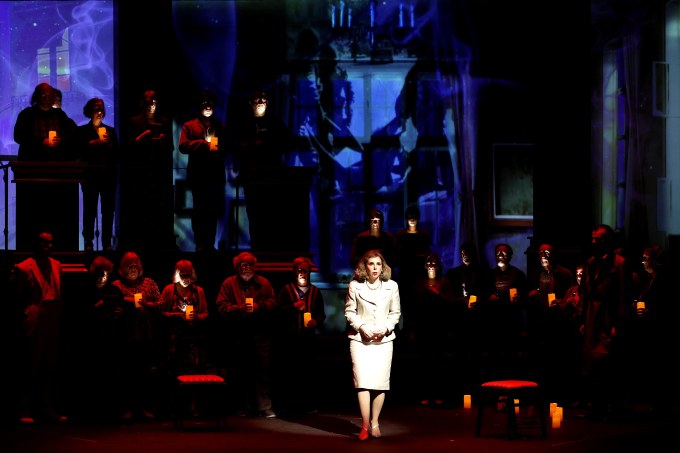
Einstein at Princeton

Nikolas Nackley as Albert Einstein, Angela Cadelago as Helene Dukas, Lori Willis as Marian Anderson.

Renowned scientists are often said to be aloof and austere.  By many accounts, perhaps the most famous and impactful modern scientist, Albert Einstein, had his flaws but was noted as being a mensch, with a great sense of humanity.  With their tenth collaboration, composer Allen Shearer and librettist Claudia Stevens have premiered a one-act chamber opera honoring the great physicist in a small but poignant way, demonstrating that profound matters can be distilled into small vessels. 

The overarching topic and the sub-themes seem teleologically selected by Stevens.  The opera is comprised of three scenes that appear to draw on the librettist’s reflections on her background as a daughter of refugees from Hitler’s Europe.  In a compact manner, it demonstrates the idealism of Einstein contrasted with the pragmatism of the women around him, while the story line covers political and social commentary; God and existence; the enormity of the creation of the atomic bomb; and more.

Angela Cadelago as Helene Dukas, Nikolas Nackley as Albert Einstein, Julia Hathaway as Margot Einstein.

Einstein played the violin for pleasure.  Music was very important to him, perhaps as an escape, including his Wednesday night get-togethers with other amateur musicians.  In this context, Shearer gets to sprinkle his own delightful and accessible music with borrowings from other composers, namely excerpts from Haydn and Beethoven string quartets, in which members of the chamber orchestra go on stage to perform with Einstein.

The title character is performed admirably by warm-voiced baritone Nikolas Nackley who captures a part of Einstein’s character, his concerns, and his groundedness.  The opera opens in 1941, with Einstein, his secretary Helene, and his stepdaughter Margot – the women beautifully sung and played by sopranos Angela Cadelago and Julie Hathaway respectively.  Each one Jewish, the three characters have just become U.S. citizens and relish the freedom from oppression and fear for life under the Nazi Holocaust.  But perhaps in a nod to the current threat to democracy posed by the possibility of a second Trump administration, a cautionary alert is also raised along with their appreciation for new lives.

Nikolas Nackley as Albert Einstein, Julia Hathaway as Margot Einstein.

Tying into the notion that this country has always been a less-than-perfect union, a flashback to 1937 occurs.  A stoic Marian Anderson has just performed in Princeton but was denied a room at the local inn because she is Black.  Einstein welcomes her to stay in his home, with all asking how such a great country could allow such prejudice to persist.  The emotional highlight of the evening is when Anderson is asked to sing.  Mezzo Lori Willis, who plays the great singer, gives a wonderful a cappella rendition of “He’s Got the Whole World in His Hands.”

A third solemn topic is the discussion of the nuclear bomb.  Einstein was instrumental in its theoretical conceptualization and influential in the decision to develop and deploy it.  But he suffered from remorse and raised existential questions about how a loving God could allow it to happen.

Orchestra players with Nikolas Nackley as Albert Einstein.

In composing the score, Shearer faced an extra challenge in orchestration.  He and Stevens proposed to Berkeley Chamber Performances inviting the touring group Strata, a trio of violin/viola, clarinet, and piano, to perform on the same bill before intermission, while they would be included in the opera’s chamber orchestra as well.  Trio Solano, a Bay Area group comprised of violin, viola, and cello, would fill out the opera’s orchestra.  Shearer worked adeptly within this self-imposed configuration to produce a sound suited to the libretto.  Jonathan Khuner deftly conducted the instrumental and voice ensembles, including the eccentric movement of musicians back and forth between pit and stage to perform as members of the amateur quartet.

The score would probably be categorized as postmodern, meaning that sweeping Romantic melodies are eschewed.  If not memorable, the score suits the nature of the interchange, which is conversation among friends and family, so vocal challenges of range and volume are limited.  Quotes from Haydn, Mozart, and Beethoven chamber music comprise a significant contribution to the score and its effect.  But the score also contains emotion and jocularity.  In one case, when Einstein says that he hopes the new cellist in their amateur group will play in tune, the cellist in the orchestra responds with a sad sounding downward glissando, which the audience responded to with laughter.

Lori Willis as Marian Anderson, Nikolas Nackley as Albert Einstein, Julia Hathaway as Margot Einstein.

As weighty as some of the topics in the libretto are, the overall feeling is far from downcast.  Indeed, at the end, and after some distractions, Einstein returns to physics.  Separately, the women conclude that life is limited and appear to accept that what will be will be.

“Einstein at Princeton,” a world premiere opera, composed by Allen Shearer with libretto by Claudia Stevens is produced by Berkeley Chamber Performances and performed at Berkeley City Club, 2315 Durant Avenue, Berkeley, CA, December 5, 2023.

The 25th Annual Putnam County Spelling Bee

Logainne (Jenni Chapman), Leaf (Blake Kevin Dwyer), Olive (Maia Campbell), William (Beau Bradshaw), Marcy (Mai Abe), and Chip (Dave J. Abrams). All photos by Kevin Berne.

Middle School is the worst.  For many, it’s a most difficult time of life – puberty with raging hormones, pimples, fear of the opposite sex, growth spurts.  For some, it becomes an anti-social time of escape – into a private world of computers or video games or books – to be a geek.

In “The 25th Annual Putnam County Spelling Bee,” we meet a diverse group of young teens bound by a common skill – spelling – and a common goal – winning.  Spelling excellence is a grinding and lonely pursuit.  All who compete in this Bee are nerds, but each in their own way, and each is motivated by a different set of circumstances.  The audience will recall kids they’ve known and enjoy a light-hearted and entertaining look at growing up.

Doug (Christopher Reber).

At one extreme of the competitors, Marcy Park (played by Mai Abe) is stereotyped as the Asian overachiever.  Living on only three hours of sleep a night, she speaks six languages and excels in everything from playing multiple musical instruments to championship rugby and hockey.  At the other extreme, Leaf Coneybear (Blake Kevin Dwyer) is not without competence, making his own over-the-top gaudy clothes.  However, he came in only third in his school but was advanced to the county finals because the top two had a scheduling clash and are attending a bat mitsvah.  An instinctive speller who is the least serious of the competitors, he seems to rely on trances to guide him to the right spelling.

Rona (Molly Bell), Chip (Dave J. Abrams).

“…Spelling Bee” is a musical comedy that can be appreciated at different levels.  Superficially, it is what it is – funny characters in silly situations with low-brow humor, singing songs that disclose the ridiculousness around them.  But beneath the obvious, social commentary abounds.  Olive’s (Maia Campbell) absent mother is in an ashram in India, and her father doesn’t make time for her or have the $25 entry fee for the contest.  Logainne (Jenni Chapman) lisps, has two adoptive gay fathers, and a last name that is fodder for endless teasing.  William (Beau Bradshaw) is obsessive-compulsive, allergic to peanuts, and spells out letters with his “magic foot.”

The play has some striking characteristics, the most obvious being that young teens are played by adults.  Happily, the actors are young enough and adopt suitable personalities so that the conceit works.  A unique element is that four members from the audience are brought to the stage to act as additional competitors.  This does create spontaneity that works well and will vary from one performance to another.  After being given easy words to spell, like cow, the interlopers are flushed out with impossibly difficult words.

Mitch (Anthone Jackson), guest speller.

Meanwhile, the situations and songs begin to reveal hidden traits, perhaps the most pervasive concerning the desire to win.  Some might be fiercely competitive, others wanting to lose to escape drudgery or expectations, and a couple maybe consider a sacrifice to advance a romantic relationship.  And of course, there is the ultimate embarrassment that any male who has gone through pubescence can relate to.  Chip (Dave J. Abrams) gets an erection at a most inopportune time.

The adults in the room are at least as amusing as the kids.  The self-promoting, center-of-attention number one real estate agent Rona (Molly Bell – exuberant and with a penetrating soprano voice) is the moderator, while parolee Mitch (Anthone Jackson) is doing his community service by acting as an escort for the participants.

Leaf (Blake Kevin Dwyer).

The juiciest role however is Doug (Christopher Reber), a vice-principal who was banned from the Bee several years before for undisclosed unacceptable behavior, though he says that he’s in “a better place” now.  Apart from his general goofiness, when asked by a contestant, he provides a sentence using the word to be spelled.  Most are hilarious.  For instance, the sentence he gives for the word apoop is told with a mock Italian accent – “Drunken sailor Luigi tells his mates ‘I’ma goin apoop’.”  Of course, apoop refers to the stern of a ship, not to a bowel movement.  There are also little ditties about hasenpfeffer made famous by “Laverne and Shirley” and multiple words that are the names of South American rodents.

“The 25th Annual Putnam County Spelling Bee” will probably not appear on many people’s list of Best Ever Stage Musicals, but it brings guilty pleasure enjoyment with sustained humor from beginning to end.  The songs are fun if forgettable, with one exception.  The unchaperoned Olive, in response to the spelling word chimerical (highly unrealistic, wildly fanciful) appropriately reflects with the affecting lament, “The I Love You Song” (Mama, mama, mama) in which she imagines her parents as supportive.

Olive (Maia Campbell).

TheatreWorks Silicon Valley has produced a winsome realization of the musical.  The ensemble of actors nail the personalities and inner lives of the kids, and the adult roles are played with equal authority.  All of the performers provide spot-on comic timing and singing voices to match.

“The 25th Annual Putnam County Spelling Bee” with music and lyrics by William Finn and book by Rachel Sheinkin is produced by TheatreWorks Silicon Valley and plays at Lucie Stern Theatre, 1305 Middlefield Road, Palo Alto, CA through December 24, 2023.

Dragon Lady

Sara Porkalob. All photos by Kevin Berne.

The stereotype of the submissive Asian woman has taken some major hits in recent times.  Amy Chua’s eye opening “The Battle Hymn of the Tiger Mother” reveals the assertiveness and domineering of many Chinese mothers in demanding excellence from their children.  In politics, a bold Nikki Haley looks to be Donald Trump’s biggest threat for the Republican nomination for president.  And in the entertainment scene, the likes of Margaret Cho, Awkwafina, and Mindy Kaling have shown that Asian women can be as crass and brassy as anyone else.

Based in Seattle is Philippine-American author/performer Sara Porkalob.  She has brought the first of her Dragon Trilogy, “Dragon Lady” to Marin Theatre Company and stunned the opening night audience with her breathtaking talent and captivating manner.  Anyone who thinks that MTC was taking a lazy break by putting a one-person show on its stage would be badly mistaken.  Not only does Porkalob dominate the arena like few solo performers, but the production values meet and sometimes exceed those of a conventional play.

Set.

Porkalob spins tales centering on Maria, a mater familias, raised in Manila.  Personally, I find the following to be a spoiler, but since the promotional material reveals it, I’ll share that the content of the play is based on the performer’s own family history, but who knows to what degree of accuracy?  Maria was Sara’s grandmother, and some of the sketches were shared with her favorite granddaughter on Maria’s 60th birthday.

Incredibly, the downtrodden episodes that are related are full of crime, deprivation, and despair, yet, if the show had to be classified, it could be called a comedy.  But as an indication of how varied the play is, the theater characterizes it as a “solo cabaret musical.”  Her poor family lived on the edge or outside the law, but Porkalob candidly recounts events with such brio that you figure everything is going to be okay.  And her being here to pass on the legends partially affirms the optimism.

The narrative is grisly in part.  Maria was forced to see her father’s fingers cut off by gangsters, and he would later be murdered by them.  Her big break came when, after years of serving as a maid in a cathouse, she would become a public and then a private entertainer in the brothel.  Before knowing his identity, she was swept into bed by a customer, the capo of the very gang that had killed her father.  As told enthusiastically by Sara, Maria had noted that it was her first sexual experience and that they did it 11 times!

Maria did become pregnant soon after and married the American sailor who would give her the distinctive Hungarian family name.  The question of paternity arises but any resolution is not revealed in the play.  However, more fireworks followed.

The stories are told with great animation and joy.  Porkalob captures every emotion, even bringing mist to her eyes and tears to her cheeks.  But it is her wide-eyed exhilaration that energizes the audience.  She cackles and coos; uses different styles of often coarse humor; flounces around using every bit of the stage; and has voices and affects for each of the roles she portrays.

What’s more, the performer sings both with considerable power as well as delicacy.   Original songs with situation-specific lyrics as well as old standards cleverly advance the story line.  And when it suits Porkalob, she even changes lyrics to familiar tunes like “House of the Rising Sun” to say what she wants them to say.  The music also contributes to the everchanging tone and tempo that keep the act fresh for its 90 plus minutes.  She makes the characters involving despite their distance, in many ways, from the audience.  Almost all of the vignettes strike a rich vein, though some involving the children are overextended.  

“Dragon Lady” is directed by Andrew Russell and takes place on Randy Wong-Westbrooke’s detailed interpretation of the Red Dragon Club in Manila with its whorehouse red décor.  A scrim over a slightly elevated platform mutes the appearance of members of the band Hot Damn Scandal, comprised of guitar, upright bass, and trombone, that creates an astounding sound for the performer’s vocals, especially taking advantage of the mellow tremolo of the brass instrument. 

Band somewhat discernable behind scrim.

More clarity would be useful to fill in the overarching narrative.  No time frames are ever mentioned, though the action must elapse over 50 years.  And while the family moves from Manila in Act 1 to Bremerton, Washington in Act 2, that shift is not made clear as soon as it should be.  Among the situations that deserve closure are a little more about Maria’s marriage and separation as well as (another) murder that strangely seems to occur with impunity and without aftermath.

Nevertheless, the minutes fly by.  Sara Porkalob is a great story writer and even better story teller who offers a memorable look at a family that is probably a little bit different from yours.

“Dragon Lady,” written by Sara Porkalob is produced by Marin Theatre Company and appears on its stage at 397 Miller Avenue, Mill Valley, CA through December 17, 2024.

Guys and Dolls

Joel Roster as Nathan Detroit, Melissa WolfKlain as Adelaide. All photos by Jessica Palopoli.

The award winning 1950 Broadway musical “Guys and Dolls” succeeded in its debut run and in several revivals.  But for many, the 1955 film starring Marlon Brando and Frank Sinatra, represents their only knowledge of the piece.  As an aside, Sinatra played tin-eared Nathan Detroit.  The character was given only one song in the stage version, as the role was written for Sam Levene, and he lacked singing chops. Meanwhile, Brando had the Sky Masterson role with the great singing!?!?

While the film succeeded in many ways, some viewers today could see “Guys and Dolls” as antiquated and the casting and acting stilted to distraction – hardly likely to encourage viewers to go to a stage version.  That might be a mistake.  Driven by strong production values and four talented leads, San Francisco Playhouse’s rendition offers a nostalgic time and place capsule, albeit not without flaws.

Cast.

Author Damon Runyan cut a unique swath through the American persona, uncovering colorful characters and situations around Depression Era Broadway.  His world was one of people living on the edge – the demimonde of performers, gamblers, gangsters, tricksters, and women who turn tricks.  His stories form the basis for “Guys and Dolls,” one of over a dozen plays and movies to draw on his fiction.

One conversation that theater goers often have is whether they care about the characters or can relate to them.  Most would not relate to the motley crew in “Guys and Dolls,” but many would empathize with them.  They might feel for Nathan Detroit, but probably wouldn’t want him as a brother-in-law.  Played adeptly as grizzled and stressed by Joel Roster, he earns a hand-to-mouth existence as the proprietor of floating craps games.  Nathan does have a love life as well – a 14-year engagement to Adelaide, a nightclub singer.

Abigail Esfira Campbell as Sarah, David Toshiro Crane as Sky.

Melissa WolfKlain delights as Adelaide, the most challenging of the roles, having to maintain a mousy Brooklyn accent not only for her comedic contributions, but also for her considerable singing requirements to be on key and off kilter at the same time.  Perhaps the best example of that is when she nails the popular “Adelaide’s Lament” in which she attributes all of her maladies to not being able to get Nathan to the altar, e.g., ‘Just from wondering whether the wedding is on or off.  One could develop a cough.’  Meanwhile, she has been sending letters to her mother for years saying not only that she’s been married, but that they now have five children!

If Adelaide and Nathan’s endless engagement is the classic conflict between the party who wants to make a commitment and the other who won’t, the second couple is the classic case of opposites attracting.  The suave and cool Sky Masterson (played suavely and cooly by David Toshiro Crane), occasionally participates in Nathan’s games, and he will bet on anything.  As an indication of how silly the script can be, Nathan needs $1,000 to pay for a venue for his next craps game, and he bets Sky that he won’t be able to get a particular young woman to go to dinner with him in Havana.  (If you can remember a time when you could fly on a whim to Cuba from the U.S., you’re old.)

Cast.

So what’s the catch?  Nathan figures he has a sure bet, as his pick, the prim and proper Sergeant Sarah Brown, portrayed as physically and morally upright by Abigail Esfira Campbell, is a uniformed member of the Times Square Save-A-Soul Mission.  Her mission should be clear, and she’s clearly not accomplishing it.  You guessed right presuming that you predicted Sky would succeed in spiriting Sarah to Cuba, and Sky even gets her to loosen up a bit with the help of some of the island’s finest, highly disguised libations.  The couple’s new found feelings and beautiful voices are on display in the Act 1 finale, “I’ve Never Been in Love Before,” a wonderful duet with a life outside the musical.  Needless to say, plenty of action follows in Act 2.

Jill Slyter as Arvide, Abigail Esfira Campbell as Sarah.

The Frank Loesser score of “Guys and Dolls” contains many pleasant numbers, though some of them are somewhat glued to the storyline such as “Luck Be a Lady” and “Tinhorns’ Fugue.”  If the latter title is unfamiliar, it’s the bouncy gamblers’ song with the lyrics ‘Can do.  Can do.  This guy says the horse can do.’  It is a brief but exceptional three-part counterpoint that is delivered exceptionally well and picks up the pace near the start after an overture that is uninspired in terms of its music, its playing, and its choreography.  Nicole Helfer’s choreography is otherwise strong throughout.  Execution varies but is best when danced by characters who in the script are supposed to be dancers, and at the other extreme, when non-dance movement is individualistic.

Melissa WolfKlain as Adelaide (center), dancers.

A final highlight is the staging, which as usual, takes advantage of the facility’s revolving stage, which is the investment that keeps on giving.  Designer Heather Kenyon’s angular street scape of three-story buildings in subtle but varied colors, reminiscent of an Edward Hopper painting, gives way to a nightclub, a parking garage, the mission office and more.  Along with other creative contributions, Director Bill English keeps the action moving and ties all the strings together.

“Guys and Dolls,” with music and lyrics by Frank Loesser and book by Abe Burrows & Jo Swerling based on short stories by Damon Runyon, is produced by San Francisco Playhouse and appears on its stage at 450 Post Street, San Francisco, CA through January 13, 2024.

The Elixir of Love

Slávka Zámečníková as Adina, Pene Pati as Nemorino. All photos by Cory Weaver.

Few opera composers reached the peak of their profession and showed equal facility in drama and comedy.  Gaetano Donizetti fulfilled those conditions like few others.  The delightful “L’elisir d’amore” debuted in 1832, around the middle of his career but before almost all of his most noted works, including his other two highly esteemed comedies “Don Pasquale” and “Daughter of the Regiment” as well as dramas “Lucia di Lammermore” and the three Tudor operas.

Cast.

This production updates the libretto’s action to the Italian Riviera in the 1950’s with a bright, colorful staging and costumes that give the production extra liveliness.  Director Daniel Slater’s sight gags add to the joy.  Nemorino waits tables in the café of the hotel owned by Adina who rebuffs his advances and instead indicates that she plans to marry Belcore, a captain in the navy.  Enter medicine man (read: snake oil salesman) Dr. Dulcamara, descending in a hot-air balloon, no less.  The good “doctor” convinces Nemorino that a love potion will make him irresistible to Adina.  This is a romantic comedy, so you can imagine the machinations leading to the eventual happy ending.

Slávka Zámečníková as Adina, David Bizic as Belcore.

After his successes on many European opera stages, what makes this production especially sparkle is the return to San Francisco Opera of Pene Pati in what could easily become a signature role for him.  Could there be a more quintessential Nemorino?  His gorgeous tenor voice, with a slight Italianate lilt, fits the vocal demands of the part.  More than that, he embodies Nemorino.  His pleasant, innocent face and easy smile align well, and Pati’s comic acting gives the character additional charm, right down to some spot-on miming of Elvis Presley.

While the libretto of “The Elixir of Love” exudes light-heartedness and froth from beginning to end like few other operas, the composition possesses abundant mastery of the genre.  Although some sameness and singsonginess recurs in much of the music, the haunting, almost bookended romanzas for tenor depart from the rest.  In the melancholy “Quanto è bella,” which is the first aria in the opera, a reflective Nemorino expresses his love for Adina but also his self doubt that he can make her love him.

Cast.

Appearing near the end is the opera’s most famous aria, “Una furtiva lagrima,” which flips the positions of the seeker and the sought.  While unquestionably beautiful, the pensiveness of the aria doesn’t really reflect what should be Nemorino’s joy, as the secret tear falls from Adina’s eye and says that she now loves him.  Pati really milked the aria on opening night with long pauses between phrases toward the end.  His rendition was powerful and deservingly produced as sustained an applause for an aria as you might witness at an American opera house.

Making her commanding American and role debut as Adina is Vienna-based Slávka Zámečníková.  With a voice both silken and agile, the soprano fits well musically into the bel canto role, navigating both the luxuriant and staccato elements of the score.  She captures both the warmth and aloofness of the character.  In her lovely “Della crudele Isotto,” which tells of the use of a love potion in the legend of Tristan and Isolda, Nemorino comes to believe that such a potion might help him win Adina over.  Zámečníková also delights in her duet with Pati, “Chiedi all’aura lusinghiera,” showing great range and vocal beauty.

Renato Girolami as Dulcamara, Pene Pati as Nemorino.

The clear and tight narrative of “The Elixir of Love” requires only five principals, all of whom perform admirably.  Both baritones fill the bill, having performed their respective parts previously.  David Bizic as Belcore and Renato Girolami as Dulcamara, are both self-indulgent, flamboyant, and elusive in their own way.  Belcore is likely to have a girl in every port and Dulcamara suckers in every town.  Finally, Adler Fellow Arianna Rodriguez portrays another employee of Adina, Gianetta, who spreads the word in the closing scenes that Nemorino’s uncle has died and that he is now rich.  Rodriguez shows great promise with a strong soprano voice and stage presence.

Of course, by today’s standards, one could criticize the libretto for its 19th century sensibility that Nemorino’s becoming rich makes him a greater catch.  The good news is that neither lover was aware of the newfound wealth when they declared their mutual love.

Arianna Rodriguez as Gianetta.

“The Elixir of Love” (L’elisir d’amore), composed by Gaetano Donizetti with libretto by Felice Romani after Eugène Scribe’s text based on Daniel Auber’s opera “Le Philtre,” is co-produced by San Francisco Opera and Lyric Opera of Chicago, and plays at War Memorial Opera House, 301 Van Ness Ave, San Francisco, CA through December 9, 2023.

Omar

Jamez McCorkle as Omar. All photos by Cory Weaver.

Historically, most new operas have fit into pre-existing musical formulas.  Although innovation always introduced changes, bel canto dominated at one point, continuous melody at another, and atonality at a third.  Recent trends, driven in part by opera companies seeking different voices and younger audiences, have opened the door to many new idioms with influence from the likes of Chinese and Spanish music.

Impressive additions have come from Black American composers, such as eminence gris Anthony Davis, and the likes of newer entrants like Terence Blanchard and Tamar-kali with no prior experience in opera.  Add to that list honored artists Rhiannon Giddens and Michael Abels who break new ground with their historical depiction of Omar bin Said, an enslaved scholar who left writings not only in English, but in his mother tongue of Arabic.  Co-commissioned by San Francisco Opera, the piece has won the 2023 Pulitzer Prize for music.

(center) Brittany Renee as Julie, Jamez McCorkle as Omar, Taylor Raven as Fatima.

As the driving force in the composition and as the librettist, Giddens has endowed this project with richness, and the music is appealing throughout.  Drawing on her Americana roots, she introduces a wide array of musical styles, depending on the location and situation.  The opera’s opening in what is today’s Senegal and on the passage to America draws on African and Arabic musical themes, using several types of African drums to replicate their folk rhythms.  In the United States, gospel, old time country, and folk become influences.

Cast.

The storyline follows Omar’s capture; his sale to a malicious slave owner; his escape and incarceration; and his eventual purchase by a more humane master.  This final overlord, Owen, encourages his writing and religious thinking, even while arguing that he prayed to a false God, believing the Muslim Allah to be different from the Christian God.  While the arc of the narrative is fitting, the opera’s libretto largely lacks liveliness or pathos.  And in reaching for epic status, focus on the title character sometimes suffers.  Perhaps Omar was a placid individual focused on religion, but his personality comes across as largely inert, and that doesn’t make for an involving character that induces compassion and sympathy.

Cast.

Incidents of horror such as the transportation across the Atlantic that resulted in many deaths because of desperate conditions and lack of food and water are treated perfunctorily.  The physical abuse by slave owners and their strawbosses receive little attention.  The degradation of the slave auction block, other than the incident of a son being separated from his parents, seems as tame as an antique auction.  And even though arias like “Waiting for the Time to See Jesus” and “I May Be Gone” express the fatalism of slaves, they fail to galvanize the emotions.

Powerful moments do arise, but most are brief.  The exception is the evocative multiple-segment closing sequence.  Starting with a strong chorus piece on stage, the cast fans into the audience.  And while this device has been used in other stage productions, the surround-sound effect of the delightful harmonies is exceptional.  On stage, Jamez McCorkle as Omar then sings in soliloquy fashion about faith, and finally transforms with a costume change from slave to modern free man in a profound visual statement.

Barry Banks as Taylor, Jamez McCorkle as Omar, Daniel Okulitch as Owen.

Striking staging complements the fine music.  Beautiful Arabic calligraphy often generously adorns the stage.  Even when the set is spare, it appeals, as when a single tree’s trunk and branches are represented by snarled rope and its leaves by long trains of gauzy muslin.

The opera house acts as the temple of the human voice, valuing the penetrating strength of the trained, unamplified vocalist.  On this occasion, the principals were underpowered in Act 1.  Voices were generally audible but lacked the volume and depth expected.  Sometimes opera singers routinely hold back a bit while their voices warm, but this lasted over an hour.  Act 2 differed.   The two female leads, Julie (Brittany Renee) and Fatima (Taylor Raven), proved to have fine voices.  McCorkle in particular seemed a different singer with a fluid sound, and it may be that his part is so demanding in Act 2 that he saves his voice in the first act.

Brittany Renee as Julie, Jamez McCorkle as Omar, Taylor Raven as Fatima.

“Omar” does deal with very serious historic issues, revealing elements such as the existence of Muslim slaves that many people will not be familiar with.  Although the narrative should produce more emotional involvement, the overall arc, the music, and the staging offer a significant and entertaining evening.

“Omar” with music and libretto by Rhiannon Giddens and music by Michael Abets, is co-produced by San Francisco Opera, Los Angeles Opera, and Lyric Opera of Chicago, and plays at War Memorial Opera House, 301 Van Ness Avenue, San Francisco, CA through November 21, 2023.

I Can Get It For You Wholesale

Right out of the box, let’s note that this musical is exceptionally well done with fine production values and a sensational cast with numerous honors from past Broadway performances.  As a bit of an intro, this revival of a 1962 musical opens in the Garment District of Lower Manhattan in 1937.  Young Harry Bogen who would become a user and abuser (played by an absolutely fitting and believable Santino Fontana) performs menial tasks, but he aspires.  Aided by considerable chutzpah and good luck, he opens a dress making company with two partners.  But success is not enough. His greed and gluttony lead him to crises and decline.

Our American Theatre Critics Association conference was fortunate to host a panel discussion of five creatives from this musical, and the tremendous insights the panelists offered form much of the basis for this commentary.  Some attributions below are inexact, because multiple participants chimed in on many issues.

Central to the revival was John Weidman, son of Jerome Weidman, who wrote the original book and the novel on which it was based.  John revised the book, emphasizing that there must be a reason for a revival, so that while the time and place of the story remain, sensibilities speak to 2023 rather than 1962.  For instance, in the earlier era, anti-heroes often went unpunished, whereas today’s audience would expect the perpetrator to pay a price.  And while Harry is a con man from the outset in 1962, John cleverly makes him a more appealing character to begin with, which brightens the show’s empathy and allows for a character arc.

David Chase adapted and arranged the music, which is full of appealing, exotic Jewish harmonies, but without any breakout songs.  He and others of the team scoured the Yale University archives of the original musical to try to gain further insights.  Among other contributions by Chase, he found two songs that did not make it into the 1962 final production.  Creating a patchwork, alternating duet from them between the devoted girlfriend, Ruthie (played as sweet and optimistic by Rebecca Naomi Jones), and the gold digging back door mistress, Martha (highly talented actor/singer/dancer Joy Woods).  This piece shows contrasting perspectives and becomes one of the musical highlights of the show.

The original story lacked inherent kinetic drive, and playing on a small thrust stage cluttered with sewing tables induces further physical limitations.  Choreographer Ellenore Scott was brought in, and she introduced swirling character movement among the tables and had them shoved aside in a couple of instances to allow hora and ballroom sequences that add tremendous vitality to the mix.

Director Trip Cullman drove the overall artistic vision and brought all the pieces together.  Among other aspects that he attended to was the depiction of the agency that the five women in the story possess – all in their own special way.

The final contributor to this process was Producing Artistic Director Jill Rafson, without whom there would be no production.  In her second year at Classic Stage Company, this was her first production decision – a bold one that appears will be a good one.

The narrative is replete with Jewish and Garment District tropes, but they are not overdone so that the more universal themes of family, faith, and integrity are allowed to come through.  Actually, the title is both a trope and a misnomer.  The common refrain about never paying retail never enters into the picture.

Rather, the theme of the story relates the sometimes devious behavior and corrupted values of many people whose success is measured by money, notoriety, and power.  Songs with indicative titles – “The Sound of Money” and “You’re a Pitcher or a Catcher” suggest this matter.  And a sad recurring theme is that you have to step on people to get to the top.

The creative decision to make Harry a suffering youth who initially is clever without dishonesty is perhaps the most important change in the revision.  He is able to capitalize the company because two righteous women believe in him as a decent and enterprising individual before his moral compass fails – Ruthie and Blanche (a decisive Sarah Steele), the wife of a future partner of Harry’s.  Another desirable quality that Harry has is his loyalty to his mama and his generosity in bringing her gifts and trying to make her happy.  Yet, mama (an austere and insightful Judy Kuhn) was the first to sense when Harry was going astray, and she was willing to share her concerns with the more gullible young women.

The final female of note runs interference for Harry, his secretary Miss Marmelstein.  Julia Lester is a total scene stealer in the role with over-the-top humor and a singing voice strong enough to power a locomotive.  And she is not the least bit intimidated that the cognescenti of musicals know that the role was created by and the launch for another performer who could fit the same description – Barbra Streisand.

Although “I Can Get It For You Wholesale” is a cautionary tale highlighted by Miss Marmelstein’s haunting “What Are They Doing To Us Now?,” it thoroughly engages and provokes without depressing.  The musical works on multiple levels.  Its only deficiency is the lack of tunes that have taken on a life beyond the musical, but there is so much more to appreciate.

“I Can Get It For You Wholesale” with book by Jerome Weidman, revised by John Weidman, with music and lyrics by Harold Rome is produced by Classic Stage Company and plays on its stage at 136 13th Street, New York, NY through December 17, 2023.