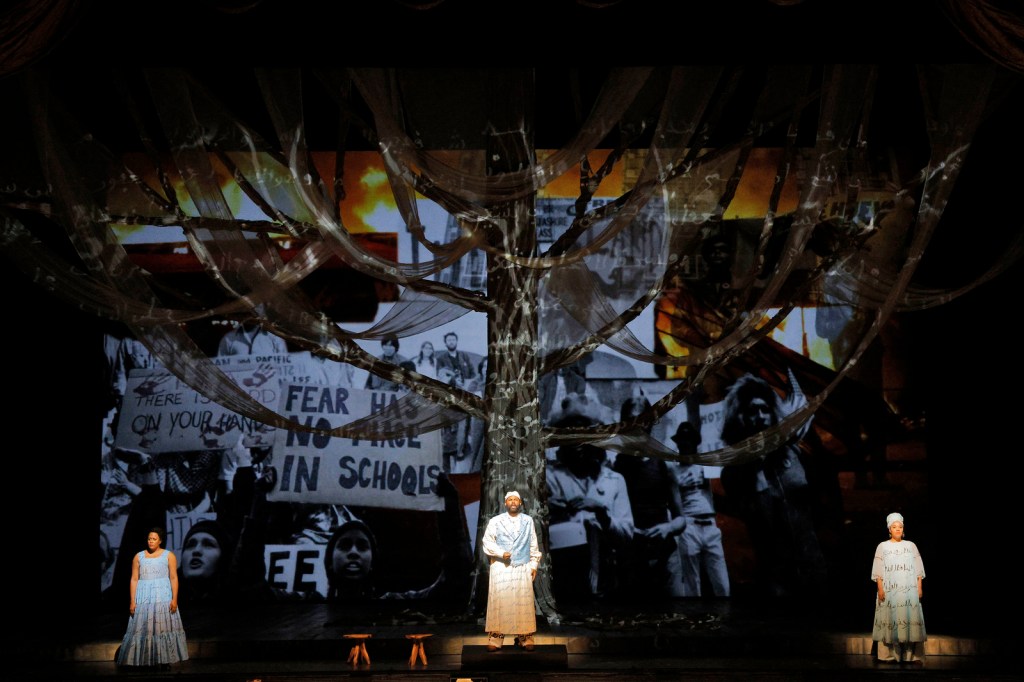
Here Lies Love

Arielle Jacobs as Imelda Marcos. All photos by Billy Bustamante, Matthew Murphy, and Evan Zimmerman.

Of the four plays that my wife/editor, Karin, and I saw on our pilgrimage to New York City for the American Theatre Critics Association conference, the revival of “Here Lies Love” was the only one that qualifies as a Broadway show by meeting the location and seating capacity of the classification.

Have you ever observed an undertaking that seems so out of whack that you ask yourself, “What were they thinking?” That has to be the case when you consider that rocker David Byrne conceived, researched, and developed (with the participation of another rocker, Fat Boy Slim) the notion that young audiences would absolutely love the strange admixture of an immersive theatrical musical that tells the biography of Imelda Marcos, who would become the First Lady of the Philippines. What is whackier is that despite much controversy, the device actually works for the greater part – and without a single mention of the thousands of pairs of shoes that Imelda owned. It is an exceptional crowd pleaser that happily brings a new audience into theater. The unanswered question, however, is whether those attendees will return to the theater for anything other than another crypto-rock-concert-dance-a-thon.

Cast.

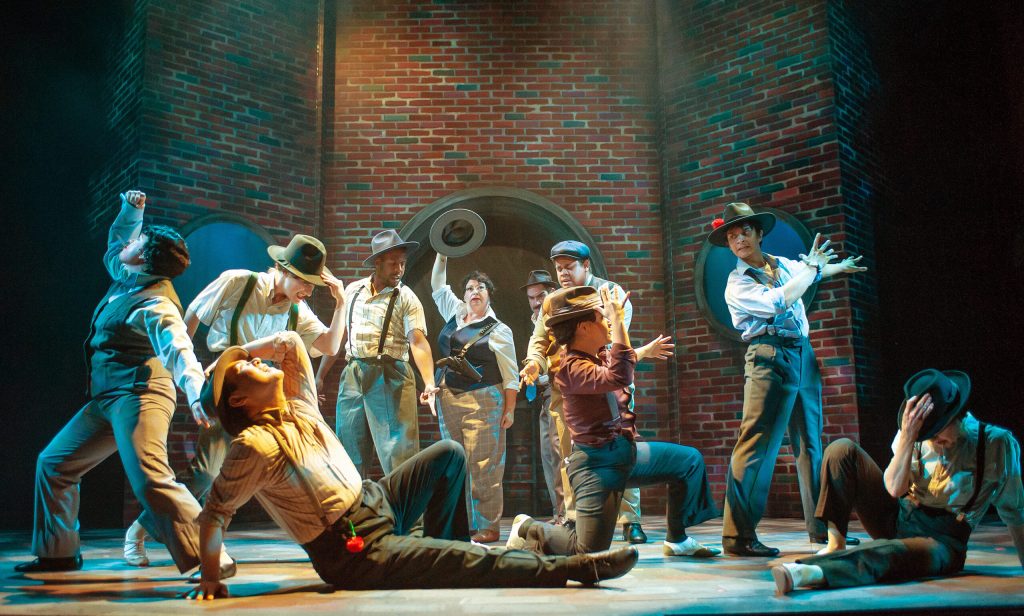
So, to understand what makes this sung-through musical work, it helps to know the lay of the land. At the Broadway Theatre (yes, that’s the proper name of the venue), the orchestra-level seating is removed; the rake of the floor is flattened; and a movable, configurable stage is placed in the middle of the space. Ticket holders who opt for the orchestra floor know in advance that they will be on their feet for the whole performance. Add a hyperactive deejay, loud music, colorful flashing lights, and a compulsion to dance, and what do you have? Disco.

The driving force is definitely the pop/rock musical score which energizes the audience. The recurring call to dance, even among those in seats, engages the audience, but at the same time seems like the kind of manipulation that occurs in political rallies, which relates to an underlying theme of the show.

Jose Llana as Ferdinand Marcos.

Early on, Imelda is poor but becomes a beauty queen at age 16, known as the Rose of Tacloban, the small town she comes from. Bouncy music like the anthem song “Here Lies Love” is consistent with these younger, happier years, but the disco atmosphere is maintained even after Imelda marries war hero Ferdinand Marcos, who would become president and then dictator of the Philippines. From that point, lavish excess, deprivation of civil rights, and the tragedy of tyranny come into focus and are depicted in the narrative and graphic projections, yet, the dance goes on.

The controversy pertains to what many consider the whitewashing of Imelda’s horrific deeds by Byrne, who may be considered a white, parachute tourist. One glaring example of the lack of his understanding of local sensibilities is writing the lament that Aurora Aquino, Ninoy’s mother, sings upon his assassination – “He always wanted to be a drummer,” which seems inappropriate from an American point of view as well.

Cast.

In truth, Imelda’s dark side is largely revealed, but critics will still argue that the mere publicity constitutes glamorization and apologism for wretched behavior. Noteworthy, however, one of the most moving moments in this revival is a postscript. An acoustic number not only reinforces the damage caused by the Marcoses, but argues that democracies are only as strong as its people. This pointed commentary relates to the extremely troubling political environment in the United States, which itself risks becoming a banana republic.

Unfortunately, supporters of demagogues are usually drawn in by the leader’s charismatic ability to arouse crowds and oblivious to their flaws. One naive supporter notes “Imelda never did anything wrong.” This same formula operates to prop up Donald Trump.

Arielle Jacobs as Imelda Marcos, Jose Llana as Ferdinand Marcos.

In Asia, pinoys, or Filipinos, have long been known as skilled entertainers, especially as interpreters of Western pop and rock. So it is no surprise that the cast of “Here Lies Love” is fully Philippine-American, and the performances are absolutely spot on. Arielle Jacobs gives a bravura rendering of Imelda, while Jose Llana as Ferdinand Marcos and Conrad Ricamora as Ninoy Aquino also excel. But the other controversy about this show concerns its casting. On the one hand, the Philippine community in general and the performers in particular are exultant that so many of them have the opportunity to make their mark, but will that translate to future success?

With those caveats in mind, “Here Lies Love” showcases Philippine talent in an accurate narrative about recent history that energizes, entertains, and allows viewers to make their own judgments.

“Here Lies Love” composed by David Byrne and Fat Boy Slim is performed at Broadway Theatre through November 26, 2023.

Spies for the Pope

Eric Loscheider as Giulio Cesare Vanini. All photos by Jonathan Slaff.

On a trip to New York City for the American Theatre Critics Association conference, my wife/editor Karin and I caught four wildly different plays at four wildly different venues.

First was a trip Off-Off-Broadway to the Theater for the New City, which has been offering a home for experimental theater for over 50 years in an earthy, multi-stage facility in the East Village. Playwright Douglas Lackey and Director Alexander Harrington have forged several collaborations, with this most recent one being the highly literate and entertaining world premiere of “Spies for the Pope.”

Standing: Eric Loscheider as Vanini. Sitting: Daniel Yaiullo, Brian Ott as students.

History is full of characters and stories that have been largely lost to time, and this is one example that the author has unearthed and embellished. Giulio Casare Vanini was a Capuchin friar who was charged by Pope Paul V in 1618 to try to fend off an international conflict that threatened to occur among many European powers, most notably the Holy Roman Empire and France. Since this story pertains to history, it is no spoiler to disclose that Vanini failed, and the result was the highly destructive 30 Years War. And as articulated in the play, this abomination derived from pathetic little differences in religious beliefs and royal family-based tribalism.

Lackey tells the tale in 23 scenes as Vanini and his associate Brother Markus cross many borders and meet with numerous dignitaries critical to international diplomacy. The script is extremely well researched and delights with copious details of political machinations, but an equally important and extremely well articulated thread involves arguments over religious theory. Vanini is a deep and free thinker and even though he devoutly believes in God, the fact that he doesn’t accept specious arguments in the received wisdom of The Church becomes his undoing.

Courtney Stennett as Princess Elizabeth, Brian Ott as Frederick of the Palatinate, pretenders to the throne of Bohemia.

The action moves briskly, which keeps things lively, but at times can seem a little jumpy. More distracting are the tedious if minor set changes that occur with each shift in venue, as they disrupt the flow of the narrative. On the other hand, period music excerpts of various ilks from opera arias to madrigals are used throughout, using both live singing and piped music. They blend well and enrich in an organic manner rather than delay the action.

Eric Loscheider portrays Vanini in a confident and believable manner. If the real friar were half as convincing as the actor, one wonders how he would ever have lost an argument. Other performances are generally but not uniformly effective, and a little confusion derives from actors playing multiple parts. That said, this is an entertaining, intellectual piece priced at a pittance, that offers fine value.

Joseph J. Menino as Pope Paul V, Eric Loscheider as Vanini.

“Spies for the Pope,” is written by Douglas Lackey, produced by Theater for the New City, and plays on its stage at 155 First Avenue, New York, NY through November 26, 2023.

Watch Night

Brandon Michael Nase (Josh), Brian Golub (Rabbi), and Arri Lawton Simon (Saul). All photos by Matthew Murphy and Evan Zimmerman.

On a trip to New York City for the American Theatre Critics Association conference, my wife/editor Karin and I caught four wildly different plays at four wildly different venues.

Just having opened in September, the Perelman Performing Arts Center is an essential part of the rebirth of the World Trade Center in response to 9/11. Though it can seat no more than 1,000 patrons, its cost exceeded (sit down for this one) $600 million. It must be the most technologically advanced theater in the world, with the ability to configure into one, two, or three stages. The capabilities of manipulating the performance spaces on every possible dimension are mind boggling, and many decorative elements are simply arresting.

Oneika Phillips, Chelsea Nicole Green, Danyel Fulton (Shayla), and Kevin Csolak (The Wolf – white supremacist).

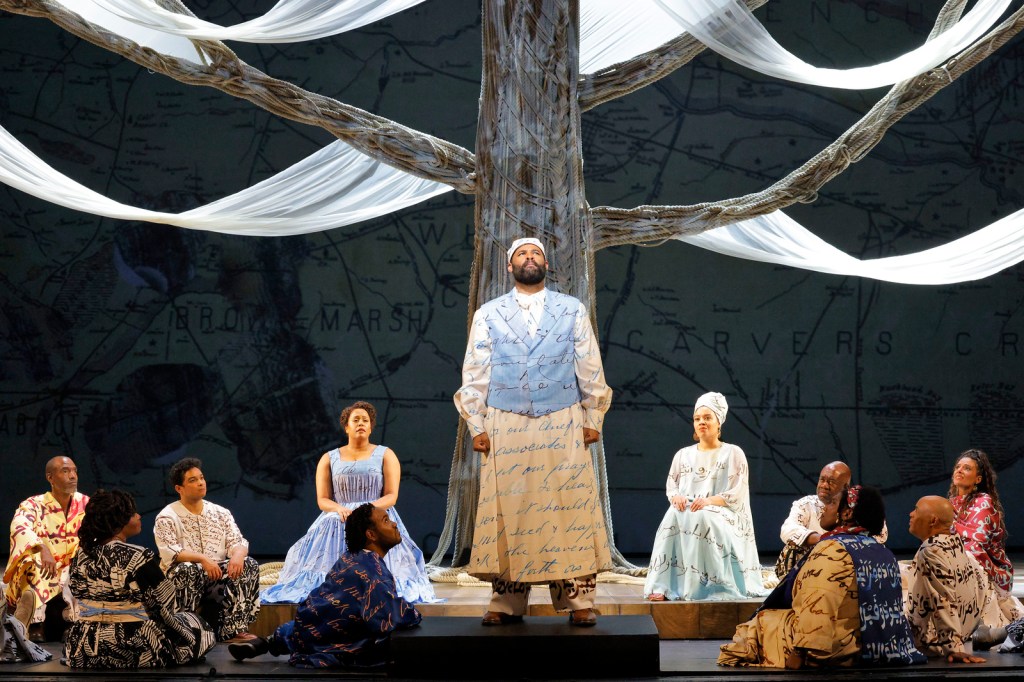
For its first performance commission, the Center turned to Bill T. Jones, one of the world’s greatest choreographers of modern dance and his collaborator Marc Bamuthi Joseph, who like Jones is anchored in dance, but also excels in related artistic realms. So the casual observer might be excused for expecting a dance-centric piece. And while the significance of dance in the artistic expression is undeniable, serious choreography doesn’t occur until 30 minutes into the production. Although it is easy to dismiss “Watch Night” as unfocused multidisciplinary expression, it really masks a serious, modern, sung-through opera full of pathos and diverse, powerful music composed by Tamar-kali.

Appropriate to the rich cityscape rising from the destruction of the World Trade Center, “Watch Night” fervently deals with group trauma resulting from tragic and diabolical events thrust upon two communities. The fictional storyline builds around two real-life incidents among the many that have scarred this nation physically and emotionally. The mass murders in a church with a black congregation in Charleston and in a synagogue in Pittsburgh ground the narrative. Remarkably, like the 30 Years War referenced in another play we attended, “Spies for the Pope”, these tragedies are driven by tribalism (racism) and religion. Sadly, societies seem to have learned little in these 400 years.

Dancers.

The play opens with considerable stridency that suggests that the whole experience that follows may be weighty and without release. However, as characters come into focus, the issues are no less grave, but the humanization allows personal connection and empathy to develop. A journalist, Josh (Brandon Michael Nase), is the key character, and his centrality to multiple situations causes some muddling in the narrative. He is not only witness to Pittsburgh slayings, but loses a brother in the killings.

Josh is conflicted in multiple ways. He is visibly black, though some other blacks confront him with the speculation that one parent is white, which is true. That parent is also Jewish, which places him in two camps that suffer discrimination. Yet, he is not portrayed as the suffering heroic but rather as driven by money rather than principles or tribal loyalty. Many people have defining moments in their lives that shape their life philosophies, and his is revealed when he is treated as black but not Jewish by a rabbi (Brian Golub). The female lead, Shayla (Danyel Fulton) also faces a moment of trial when she confronts the unrepentant white supremacist responsible for the deaths of blacks.

Kevin Csolak (The Wolf), dancers.

“Watch Night” drips with profound gravitas and will appeal to those seeking a gripping, provocative, and meaningful experience, appropriate to these disconcerting times. Those not willing to meet this challenge may not be satisfied. Production values impress, and performances are generally strong with powerful choreography of movement and dance. Especially notable is Ken Alston, Jr., who does not have a principal part, but whose clarion countertenor singing rings through the cacophony.

Interestingly, supertitles are used on occasion to emphasize important points, but plot details and the whole arc would be much better grasped if the production followed the opera house standard, even for English language librettos, and used supertitles throughout.

“Watch Night,” by Bill T. Jones, Marc Bamuthi Joseph, and Tamar-kali is produced by Perelman Performing Arts Center and appears on its stage at 251 Fulton Street, New York, NY through November 18, 2023.

Bulrusher

Jordan Tyson (Bulrusher), Shyla Lefner (Madame). All photos by T Charles Erikson.

According to this story, Boonville, California, 20 miles inland from the town of Mendocino, was never recognized for its diversity.  Prior to World War II, a lumber mill had attracted some black laborers, but it closed, and by the early ‘50s, a single black man named Lucas remained.

However, a somewhat mystical addition appeared 18 years earlier.  Found in a basket in the river reeds was a newborn Black girl.  She would be raised by a white man called Schoolch, which in the surprisingly extensive Boonville patois meant schoolteacher.  The girl was given the name Bulrusher, which was the generic for foundling or illegitimate child.  Not only was she racially unique among her schoolmates, but she possessed a special trait.  She could read water – seeing the future of a person who touched the water.  Of course, not all were happy to hear what was to come.

Cyndii Johnson (Vera), Jeorge Bennett Watson (Lucas), Jordan Tyson (Bulrusher).

If the whole milieu of “Bulrusher” seems off-kilter, the characters we meet seem even more eccentric than you might expect.   To begin with, the charming title character reveals rich and eloquent sentiments, but she has never had a friend.  Various explanations as to why she is a loner are advanced by those around her, and they don’t relate to race.  It’s because she doesn’t “harp the ling” (speak like other locals do), or because she doesn’t have known blood family, or because her special gift makes her weird.

Most of the action takes place in the public area of a brothel, which is certainly a surprise enterprise in a small California town.  Schoolch, who is also a loner, hangs out there drinking tea but doesn’t partake of the carnal offerings.  Lucas frequents the house but does enjoy the sex and also has emotional and physical history with Madame.  Both men have a crush on her.

Jeorge Bennett Watson (Lucas), Shyla Lefner (Madame), Jamie LaVerdiere (Schoolch), Rob Kellogg
(Boy).

It is not clear where this play is going, but it receives more shape upon the arrival of Lucas’s previously unmet niece, Vera, who has come from Alabama unannounced.  She is taken aback by local practices such as her being served in a café by a white woman.  Her presence acts as a catalyst to events and also underscores differences in racial relations between former slave states and those that had less experience with the tragedy of that institution.  It also points up an interesting sociological dynamic.  In situations where minorities are scarce and don’t seem likely to grow appreciably, minorities tend to be treated amicably and as a curiosity.  It is when their numbers surge and begin to represent a threat that the majority population tends to negatively react to their presence.

Vera’s experience and friendship become an education to Bulrusher who had been unfamiliar with things like Jet magazine and modern lynching.  She hadn’t even seen another black woman, and part of her allure is her growing through learning.  Another issue surfaces from outside of Bulrusher’s experience, and that is why blacks stay in places they hate where they continue to face oppression.  Vera’s explanation is that they are tired of running.  Thus, many will courageously stay in the South and stake their claim despite the risk and hardship.

Jordan Tyson (Bulrusher), Cyndii Johnson (Vera).

Playwright Eisa Davis has crafted a highly appealing play that covers a lot of ground.  It deals with race, sexuality, home, family, and the sense of belonging.  Connections between some of her characters sometimes clash, but that is reality.  The narrative is offered from the black perspective, but rather than a strident view of race relations, it comes across with greater hope of how things can be.  While clashes abound, they’re not about race.  Two complicated attempts at interracial romance are replete with differences.  But in one, Boy, who loves and chases after Bulrusher, seems oblivious to the fact that she is of a different race.

Overall, the characters are nuanced and somewhat empathetic.  Schoolch is perhaps the least engaging personality, but how can you not appreciate that he as a single man raised a foundling?

The exception is Madame, who is as rigid as a metal post. A disciplined workaholic who looks more like a school principal than a brothel owner, Madame has her own sense of morality and wants her world to consist of straight lines.  She knows that because of her line of work, she won’t receive any invitations to the Apple Festival, which suggests why she sublimates social involvement with business that she can control.  Although others have baggage as well, she has more, and she keeps her secrets hidden by maintaining social distance.  After previous false starts, Madame does have the opportunity to sell her property at a good price and move on. But the question is whether, like black people who choose to stay in Alabama, she feels that she is home.

Jeorge Bennett Watson (Lucas), Jamie LaVerdiere (Schoolch).

Relationships reflect various dynamics.  Boy and Lucas are both persistent in their romantic forays despite headwinds from their intendeds.  Bulrusher and Vera’s affinity becomes complicated.  The one affiliation that doesn’t resonate is between Bulrusher and Schoolch.  It just doesn’t seem like a family connection, with no explanation as to why they don’t act like father and daughter.  Bulrusher even calls him by his familiar name, which would have been unheard of in the early ‘50s.

In the end, some matters are clarified, while others are unresolved.  That’s life.

The creative side of Berkeley Rep’s co-production, directed by Nicole A. Watson excels.  Although relying on a single set does create some location confusion, it ably depicts the redwoods environment that it represents, enhanced by superior lighting, sound, and extensive projections.  Acting also is solid.  Jeorge Bennett Watson is smiling and charismatic as the black-poetry quoting Lucas, and Shyla Lefner is austere and businesslike as the incongruous Madame.  Jordan Tyson as Bulrusher has a demanding role with a ton of dialogue, and she does capture the character’s youth and inner conflicts.  While she enthralls most of the time, she is not fully convincing on occasion, especially in the dénouement.

Rob Kellogg (Boy), Jordan Tyson (Bulrusher).

“Bulrusher,” written by Eisa Davis, is co-produced by Berkeley Repertory Theatre and McCarter Theatre Company and plays on Berkeley Rep’s Peet’s Stage, 2025 Addison Street, Berkeley, CA through December 3, 2023.

The Emissary

Angela Yam as Mumei, Bradley Kynard as Yoshiro. All photos by Kristen Loken.

Record temperatures and climactic events of greater frequency and intensity.  Depleted fisheries, polluted waters, and rising sea levels.  Human errors in nuclear disasters.  This is but the beginning of the environmental degradation wrought by humankind’s poor stewardship of its home.

Opera Parallèle’s unique and forward-looking Hands-On-Opera contributes to the growth of new audiences and new sources for opera by commissioning operas that cast children and are written by composers who are fresh to the idiom, bringing new musical styles and approaches.  The company’s most recent project is the provocative and entertaining world premiere of the one-act opera “The Emissary,” which takes place in a dystopian future in Japan marred by a disaster broadly reminiscent of the Fukushima nuclear disaster.  Japan has returned to isolationism, and children are more frail and aged than their elders.

Bradley Kynard as Yoshiro.

Composer Kenji Oh was engaged to produce a piece that addresses environmental concerns, and his choice takes place in the country of his birth, a fiction written by Yoko Tawada.   Having no prior experience in opera, Oh’s musical palette in representing the story is eclectic.  He has written classical music for orchestral and choral performance, but he also draws on his own musical modes used in composing for films as well as Japanese folk music themes.

The chamber orchestra, conducted briskly by Nicole Paiement, comprises six instrumentalists.  They produce a mellifluous sound that is often in a punctuated fashion except for the occasional hissing of brushes and languid lushness of the violin.

Angela Yam as Mumei.

With only 50 minutes to work with, the storyline is brief.  The versatile and experienced Kelley Roarke has produced the libretto which induces the emotional response to the tragedy of human and environmental decline.  To fully understand the story, however, does require information from outside of the opera.  Roarke’s account calls for two prime time singers, the first of which is an old man Yoshiro, performed by Bradley Kynard.  After many years as a chorister with San Francisco Opera, the sonorous and expressive baritone is adeptly playing principal roles on smaller stages.  He excels as the sympathetic, loving caregiver.

Yoshiro’s mission is caring for his great-grandson Mumei, who, despite his affliction and sad prognosis, brings cheer and optimism to life, which keeps the narrative from being too depressing.  The role is written in the soprano range, which would be appropriate for a young boy.  But in an interesting conceit, not only is the role portrayed by an adult female, but there is no effort to make her look like a boy.

Ensemble.

Angela Yam is Mumei, and she mimics the deception admirably, with the posturing of a child.  Her vocal role calls for some ascent into her upper range, and she demonstrates dramatic power and command.  Interestingly, while Oh’s score provides operatic-like singing challenge for the Mumei role, the baritone doesn’t have as much opportunity to stretch his skills.

In addition to the two leads, several supporting characters are sung by youths.  A chorus with members from the Lick Wilmerding High School Chorus is often present, and some even have brief solos to add to their resumés.

While the title relates to a group that illegally sends young people abroad to share the story of Japan’s despair, it really centers on mortality and appreciating the small things in life.  For instance, since they are unable to trade with the outside world, the purchase of oranges is limited to one per customer, and shrimp are totally unavailable.

Bradley Kynard as Yoshiro.

In chilling commentary on the frightening and deceitful communication of today in the United States, euphemisms try to hide realities in the opera.  Notably, the word mutation is not to be used, but rather, environmental adaptation.  Disappearances are covered as “special circumstances.”  And fake news permeates everything.  In this telling, the islands of Japan have been further separated from mainland Asia as a result of earthquakes, but opportunists have no compunctions in depicting the event as caused by socio-political factors.

“The Emissary” is a meaningful, attractive, and easily digestible diversion that in its present form offers a great opportunity for school performances, especially because of the breadth of chorus involvement and the chance for many to shine individually with their 15 seconds of fame.  It also has an appealing core of music, drama, and message that could be the basis for a more significant chamber opera.

“The Emissary” is a world premiere composed by Kenji Oh with libretto by Kelley Roarke, based on a novel by Yoko Tawada, translated by Margaret Mitsutani, produced by Opera Parallèle, and plays at ODC Theater, 3153 17th Street, San Francisco, CA through October 28, 2023.

Miss Bennet: Christmas at Pemberley

Samantha Rich as Mary Bennet, Nico Jaochico as Arthur de Bourgh. All photos by Grizzly De Haro.

At times, you may suspect that a play you’ve previously seen wasn’t really as good as you’d remembered.  Other times, you may fear that that a play wouldn’t hold up well if seen again in a different production a few years later.  Sometimes, you’re wrong on both counts.

Altarena Playhouse has revived the first of the Lauren Gunderson & Margot Melcon’s unofficial trilogy of theatrical sequels to Jane Austen’s novel “Pride and Prejudice.”  The result is charming and wildly entertaining.

(foreground) Joshua Roberts as Fitzwilliam Darcy, Sarah Jiang as Elizabeth Darcy, (standing rear) Mikki Johnson as Anne de Bourgh, Samantha Rich as Mary Bennet, Nico Jaochico as Arthur de Bourgh, Zoe Novic as Lydia Wickham, (seated right rear) Thomas Hutchinson as Charles Bingley, Devon deGroot as Jane Bingley.

The main reason for qualms about revisiting “Miss Bennet: Christmas at Pemberley” is that the plotline seems so thin.  After all, it centers on whether a mousy middle sister from a modest middleclass English family will attract the attention of a young, recently-titled, no-count duke.  What does make that situation significant and one that recurred in Austen’s novels is the law of primogeniture, by which real property (i.e., land and buildings) must pass to a single male heir.  Necessarily. the eldest son is the first in line.

Since the Bennet sisters have no brother, their family house will pass onto the closest male relative when their father dies.  This situation leaves bachelorettes defenseless, so a successful marriage is imperative.  Mary, the middle of the five, has been outshined by her more gregarious and “successful” married sisters and has retreated to music and books for solace.  But at this family gathering, the three other sisters (Elizabeth, Jane, and Lydia – the youngest, Kitty, is not present) do note that Mary has become more assertive and adult.

Zoe Novic as Lydia Wickham, Sarah Jiang as Elizabeth Darcy, Devon deGroot as Jane Bingley.

Samantha Rich’s portrayal of Mary abounds with great authority while eliciting sympathy.   Socially clumsy and vulnerable, Rich is nonetheless haughty and willing to challenge with the chill of accuracy the slightest error of speech that others make in social conversation.  Often ignored or forgotten by her sisters, her relationship with Lydia is particularly fractious as they couldn’t be more opposite.

Zoe Novic plays Lydia with delightful buoyancy, but her depiction of Lydia’s shallowness, dishonesty, and meanness toward Mary is appropriately grating.   Married to the dastardly Wickham, Lydia hides her failures with effusive and offensive bravado.

Enter the newly-made duke, distant cousin Arthur de Bourgh, who has been invited to spend Christmas with the family.  Nico Jaochico captures Arthur’s spirit with great confidence.  His character lacks social grace, as he is laughably deer-in-the-headlights oblivious and klutzy as well.

Joshua Roberts as Fitzwilliam Darcy, Thomas Hutchinson as Charles Bingley, Nico Jaochico as Arthur de Bourgh.

Intellectually a perfect match for Mary, Arthur even corrects Jane’s husband Bingley who has referred to her upcoming delivery of a newborn as an extraordinary event.  Arthur, with concurrence from Mary, explains that statistically it is anything but extraordinary, but he obviously misses the subjective human side of the event.  He also finds it difficult to fend off the irrepressible Lydia, and other complications occur.

Jane Austen laid solid bedrock for building on her formidable work, and Gunderson & Melcon have magnificently added new layers to the Bennet family saga.  Issues of love, duty, conformity, and choice permeate the action.  The playwrights grasp the language, customs, and manners of early 19th century manor life in England and have imbued their script with humor that fits the social class of time yet resonates with modern audiences. They have also endowed their main characters with well-defined and interesting personalities.

Samantha Rich as Mary Bennet, Sarah Jiang as Elizabeth Darcy, Devon deGroot as Jane Bingley.

Apart from the many person-to-person issues that are plumbed, one funny thread that runs through the show concerns the appearance of a spruce tree that sister Elizabeth Darcy has installed inside Pemberley for the holidays.  In keeping with the social orthodoxy of the day, several family members separately question the unprecedented and socially questionable idea of removing a tree from nature to display it in a home!  Well, Merry Christmas to you, too!

Altarena has shown once again that its productions can compete with better endowed theater companies in the Bay Area, and Director Jaquie Duckworth has found all of the keys to success.  “Miss Bennet: Christmas at Pemberley” is by no means lavish, but the actors are well dressed (designs by Janice Stephenson and Katina Psihos Letheule), as is the stage (designed by Tom Curtin and Katina Psihos Letheule with props design by Susan Dunn).  Other artistic elements such as lighting (Kevin Myrick) and sound (Michael O’Brien) complement the production superbly.  The actors all answer the call with fine performances.  What is particularly comforting to the audience is that the actors’ accents, while clearly English, are also clearly consistent and understandable.

Samantha Rich as Mary Bennet, Nico Jaochico as Arthur de Bourgh.

Although Christmas appears in the title, the show doesn’t share traits with many holiday offerings, but for many theater goers, this may be a plus. In any event, the play and this production are both delightful and well worth seeing.

“Miss Bennet: Christmas at Pemberley,” written by Lauren Gunderson & Margot Melcon is produced by Altarena Playhouse and is performed on its stage at 1409 High Street, Alameda, CA through November 19, 2023.

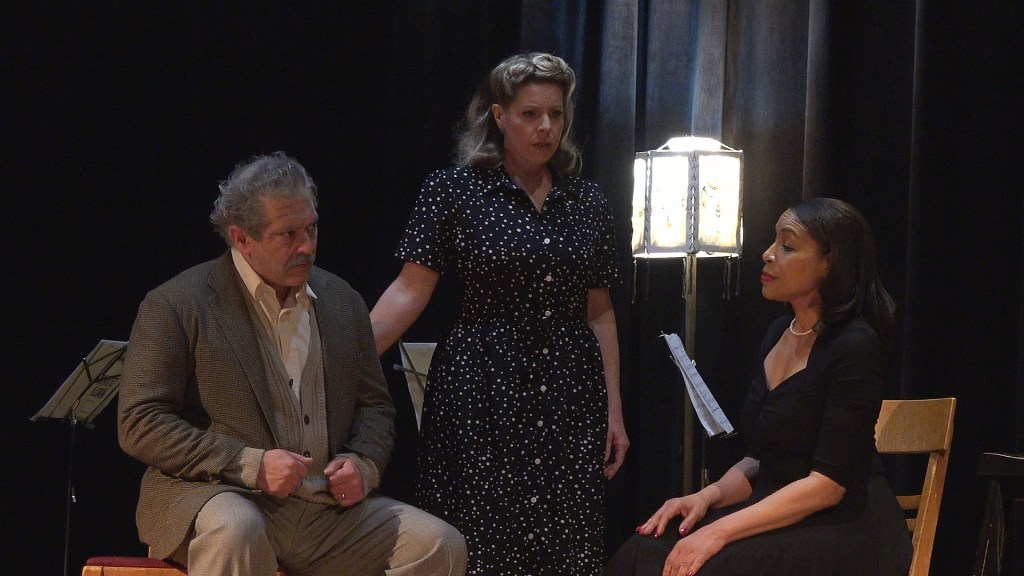
Without You

Anthony Rapp’s arrival on stage at the Curran Theater is met with great enthusiasm by Rentheads and other admirers.  For many Gen Xers, the 1996 rock musical “Rent,” drawn heavily on Puccini’s opera “La Boheme,” was their gateway into live theater.  “Rent” would also win multiple awards from multiple grantors including a Pulitzer and Tonys; endure as one of the longest running plays on Broadway; and become a theatrical touchstone for a generation.  For Rapp, who created the role of Mark Cohen at age 22, it was the inflection point that gave him recognition and launched him to stardom.

Rapp celebrates the years surrounding the early days of “Rent” in a one-man show “Without You,” based on his likewise named book subtitled “A Memoir of Love, Loss, and the Musical Rent.”  Premiered to acclaim at New York’s Public Theater in 2013, it has been successfully revived and is now touring.

Accompanied by a five-piece rock band, Rapp regales his audience with poignant storytelling punctuated by songs from “Rent” as well as many original tuneful and sensitive compositions, mostly by the performer.  The one outlier is REM’s megahit “Losing My Religion,” which Rapp had sung in his audition.

Those who are not familiar with the play may not anticipate the dominance of dying and death.  But for those who know the history, there are really no surprises, so the audience is enrapt by the vignettes and the songs that support them.  Although Rapp talks about himself, rather than a narcissistic self-portrayal, he acts more as a vehicle to honor two others who were important to his life.  And though there is much sadness, it doesn’t seem morose, perhaps because so much time has passed.  Yet, it resonates to those who have suffered loss.

Jonathan Larson wrote the book, music, and lyrics for “Rent.”  He was deeply committed with all phases of development including the 1994 workshopping, Rapp’s first involvement, having been offered the role of Mark Cohen by the playwright.  Larson felt a kinship with the struggling people that he wrote about and the struggling actors who portrayed them, evidenced by his annual Thanksgiving “Peasants’ Feast” to which Rapp was invited.

Larson light-heartedly deemed himself the future of musical theater and was even mentored by Stephen Sondheim.  But tragically and without warning, he died of an aortic aneurysm at age 36 after the dress rehearsal of “Rent.”  To a hushed audience, Rapp relates the anguish in having to press on with the opening performance when its beloved creator had just died, and having to give condolences to Larson’s parents.

What Larson left behind was an innovative musical that broke many barriers, having an array of characters who represented real people that were poor, minorities, gay, and HIV-positive.  He also left us with its music, including the anthem that recurs in Rapp’s show – “Seasons of Love,” which is so notable for its unique, rhythmic lyrics about measuring life and love in the 525,600 minutes of the year.  Rapp also sings another signature song that his character had introduced, “La Vie Bohème.”

Concurrent to the ramping up of “Rent,” Rapp’s mother was diagnosed with cancer, and unsurprisingly, she would die from it several years later.  Even more of “Without You” is dedicated to the author’s loving relationship with her, which Rapp amusingly depicts by speaking both parts in their conversations.

Although she was in many ways a conventional white bread Midwesterner, she accepted that her son went in another direction.  She must have suspected that Anthony was gay.  When telling her by phone that he had fallen in love with a man, she offered perfunctory resistance.  Her first reaction was to ask if they couldn’t just be friends.  When he persisted, her focus turned to ensuring that he wouldn’t allow himself to contract AIDS.

Rapp tells of the trips home to Joliet, Illinois during her decline.  Touchingly, his mother asked if there is anything that she can leave to him.  His caring response was that her gift would be that there would be nothing left unsaid.

The opening night show met with great and deserved audience support.  The fans felt the love.  Although the production enthralls, two issues do deserve mention.  In Rapp’s recordings, his voice sounds steady and sturdy.  In this performance, though he held a couple of sustained end notes with power, his overall singing voice seemed diminished and at times wavering.  Perhaps he was a little ill.  The other surprise was the sound mix imbalance.  Especially in the early going, any time the band was playing while Rapp was talking, the competing percussion and bass made him hard to hear and understand.

“Without You,” written and performed by Anthony Rapp, is produced by Broadway San Francisco, and plays at the Curran Theater, 445 Geary Street, San Francisco, CA through October 22, 2023.

Lohengrin

Simon O’Neill as Lohengrin, Julie Adams as Elsa von Trabant. All photos by Cory Weaver.

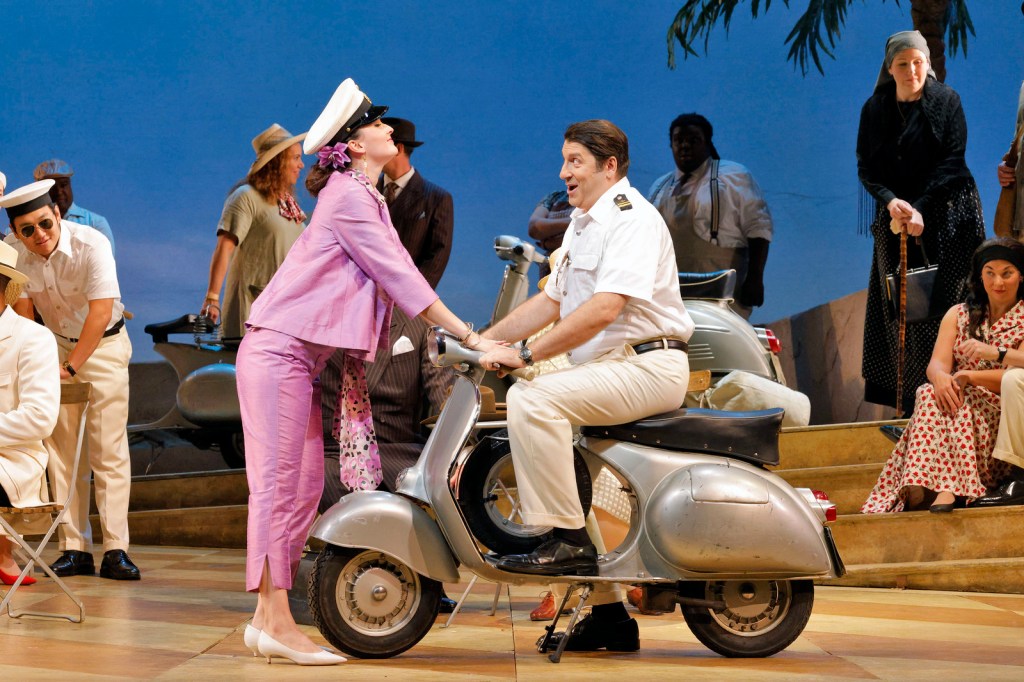
“Lohengrin” had been one of the few major operas that Karin, my wife/editor, and I had not seen.  As we approached War Memorial Opera House, she observed that she expected to either love or hate it.  Certainly, Wagner’s epic operas divide aficionados, and there are sufficient criteria for dissatisfaction with either the composition itself or any particular production which must conquer numerous challenges.  While differences of opinion will be noted, make no mistake, San Francisco Opera’s realization is world class, ideally cast, provocative, and completely worthy.  And though it clocks in at nearly 4 ½ hours, even most short-fused detractors will find it captivating.

This opera holds a special place in Wagner’s canon, as the apotheosis of his Romantic period and the launch point for his magnum opus, the four-opera music drama, the Ring Cycle.  Musically, it departs from previous operatic strictures like set pieces of arias and ensembles. As with much of the composer’s output, “Lohengrin” draws from Norse-Germanic mythology with strong fairy tale elements and moral-religious overtones.  The libretto is considered by many to be his best plotted. Its breadth is breathtaking with themes of love, fidelity, trust, belief, misogyny, sacrifice, betrayal, revenge, tribalism, militarism, and more.

Chorus.

Although his identity is unknown to the community, the title character arrives in Brabant as a God-sent Knight of the Grail to unify the people of the province and to defend the innocent noblewoman Elsa, being tried for her brother’s murder.  To acquit her, the mysterious guest must prevail in combat over Friedrich von Telramund, her lying accuser.  The knight marries Elsa with the same condition of faith placed on the Brabantians for his patronage – that she never ask his name or his origins.  Indeed, his name and association are not revealed until four hours into the running time of the work.

“Lohengrin” is blessed with beautiful tonal music throughout, beginning with the delicate break-of-day elegance that opens the overture.  Although little of the music is memorable, great exceptions are the rousing Prelude to Act 3, which leads into perhaps opera’s greatest contribution to common culture, the wedding processional, known in English as “Here Comes the Bride.”  In addition, a recurring leitmotif of several notes will sound familiar because it foreshadows the central melodic line in the music of “Swan Lake.”  While Tchaikovsky’s lifting this phrasing may be unexpected, a symbolic connection exists.  A swan pilots Lohengrin to Brabant and has visual and transformative prominence in the opera.  In less comforting contexts, the swan acts as proxy for the Reichsadler, or German eagle, adopted as a symbol by Nazi Germany.

Brian Mulligan as Friedrich von Telramund, Kristinn Sigmundsson as King Heinrich, Simon O’Neill as Lohengrin.

Music Director Eun Sun Kim conducts the proceedings with her characteristic celerity and aplomb, guiding not only the pit orchestra, principals, and a powerful chorus, but a bevy of off-stage musicians.  She has committed to offering a Wagner opera each year (and a Verdi), and her love and appreciation of Wagner’s music comes through clearly in her profound and enthusiastic conducting.

Heading the cast is classic heldentenor Simon O’Neill who has mastered many of the challenging Wagnerian roles.  His crisp and edgy tone is especially required to cut through the melifluous din that Wagner presents for his singers, in this case, an orchestra of 71 musicians and a chorus of 79 voices.  Soprano Julie Adams, who is building a resume of both lyric and dramatic roles, joins him as Elsa, and here she gets to show the grit and power in her voice as well as a high tessitura similar to that which O’Neill faces.

Judit Kutasi as Ortrud, Simon O’Neill as Lohengrin, Julie Adams as Elsa.

Also versatile and a veteran of Wagnerian opera is warm and powerful baritone Brian Mulligan as the antagonist Telramund.  Since this is her American debut, few knew what to expect from mezzo Judit Kutasi as Ortrud, Telramund’s wife.  Though the part may be anticipated to be secondary, the vile intriguer is instrumental.  Kutasi exceeds any expectations with a penetrating voice that is round or cutting depending on the demands, and she inhabits the character’s evil to great effect.

Controversy has always surrounded “Lohengrin.”  Nominally written as a solemn Christian fable, from the outset it was criticized as tribal and German nationalistic.  It premiered in 1850, when German unification efforts abounded, albeit, that the setting of Brabant was Flanders, or modern-day Belgium.  In the 1930s, along with Wagner’s music in general, it was particularly adopted by the Nazis because of its theme of unification through lebensraum (literally “living space,” but broadly, cross-border expansion) as well as its being emblematic of their culture and purported superiority.

Judit Kutasi as Ortrud, Julie Adams as Elsa.

A traditional staging of the work in its historic context renders the opera as distant and somewhat inert – a moral tale that lacks modern consequence.  This controversial production is without cuts, so the libretto is unchanged, but Director David Alden has set the visuals in the modern wartime gloom of a presumed Germany. Thus, what may have seemed innocuous now appears ominous.

Today, at the real-life time of two threatening regional conflicts – the Russian invasion of Ukraine and the Hamas-instigated rupture between Israel and Gaza – the militaristic aspects of this production particularly resonate.  The grimness of the production may not suit all viewers, but this very quality provides its power as well as its fearful reality and relevance.

Julie Adams as Elsa, Simon O’Neill as Lohengrin.

In its set design, as the curtain rises, sharply drawn light and shadow define the stage along with still characters, evoking a Rembrandt painting and befitting the Low Countries setting.  But as light overcomes dark, brooding brick buildings are seen leaning akimbo, suggesting instability and destruction.  And except for the highlighted principals, costumery of the multitudes on stage is hued in various shades of depression, indicative of poverty and foreclosed outlook.

The final distress is the depiction of the people’s depravity, which comes in Act 3, when fascist symbols and practices are adopted, including lockstep movements and stylized salutes.  Phalanxes of red and black banners with angular graphics and the appropriated graceful white swan in place of the imperial eagle parallel those of Nazi Germany.

In 2016, a theatrical adaptation of Sinclair Lewis’s similarly bleak novel “It Couldn’t Happen Here,” which deals with a fictional fascist takeover in this country through elections, was revived in the Bay Area.  Couldn’t it?

Chorus.

“Lohengrin,” with music and libretto by Richard Wagner is produced by San Francisco Opera in association with Royal Opera House – Covent Garden (UK) and Opera Vlaanderen (Belgium), and plays at War Memorial Opera House, 301 Van Ness Ave., San Francisco, CA through November 1, 2023.

Of Mice and Men – Opera Version

Robert Mellon as George, Matthew Pearce as Lennie.

One of the most preeminent and prolific American opera composers, Carlisle Floyd also wrote all of his own librettos, though most were based on distinguished literary sources.  Debuted in 1970, Floyd drew on Nobel Laureate John Steinbeck for one of his most successful works, “Of Mice and Men.”  The opera hews closely to the simple plotline of the novella, which is one of America’s distinguished, if controversial literary works, locally banned on various grounds, including sex, violence, racism, and euthanasia.

Livermore Valley Opera has produced an exemplary rendering of the opera that extracts all of the heart wrenching pathos from its essence that could possibly be expected.  Each artist sings and acts in an exemplary fashion and the production values excel.

Chorus, Matthew Pearce as Lennie (far left).

As itinerant ranch hands in California’s Central Valley during the Great Depression, two drifters arrive at another bunkhouse full of forgotten, hopeless men who deserve the empathy of those more fortunate.  George is intelligent and has aspirations, while the hulking Lennie is well-intended, but intellectually deficient.  He has a need for touch and loves to pet small, soft, furry creatures, but has a tendency to accidently kill them.  Although Lennie is a millstone whose actions create troubling situations, George has promised to take care of him and loves him like a brother.

Common with much 20th century opera, Floyd’s music is handmaiden to the drama.  The libretto follows Steinbeck’s grim narrative.  Down-home lyrics that suit the rustic characters capture the bleak subsistence of men with little to live for.  While the score offers no hummable melodies, it is interesting and easy to listen to, and some of the set pieces are intricate and involving, evoking empathy for the characters.

Véronique Filloux as Curley’s wife.

Matthew Pearce very much looks the part as the downtrodden but impish Lennie.  The pleasant anomaly comes when he sings with commanding dynamics that wouldn’t be expected of the character.  His powerful upper register along with lyric sonority are exquisite and foretell a big future for this young tenor.

It is Lennie’s boyish quality that appeals to the ranch foreman Curley’s wife, who brings gender relief to an otherwise all male cast.  The bored vixen is delightfully performed by Véronique Filloux, whose vocal range, mellifluousness, and easy flirtatiousness suit the role.  Her being attracted to the big huggable toy of a man will cause brutal conflict between Lennie and Curley, a small man with a Napolean complex.

Matthew Pearce as Lennie, Kirk Eichelberger as Candy, Robert Mellon as George.

While Lennie is conflicted in his own way, usually after realizing he’s done something wrong, George anticipates conflict on the horizon.  Robert Mellon offers a profound portrayal of George, singing with a dark, authoritative, and soulful baritone who bears the weight of responsibility.  He bemoans that “There’s gotta be more,” while he hopes and plans that he and Lennie can someday buy a little farm.  His wistful aria “I, me, and mine” also reveals his contradictory yearning to stand on his own rather than suffer his burden.

The content and tone in “Of Mice and Men” are crushingly downcast, but Lennie and Curley’s wife share a well-crafted and beautifully delivered duet in which they sing simultaneously of their differing dreams for a better future.  Their hopes raise the question whether having plans and dreams, even if unlikely to be fulfilled, lead to a happier existence.

Chad Somers as Curley, Véronique Filloux as Curley’s wife.

All of the production elements enhance the performance.  Marc Jacobs’ direction provides engaging details that many versions might lack.  The opening scene instills an ominous foreshadowing when a search party on a darkened stage waves flashlights around hunting for the protagonists.  The libretto actually assumes that the vigilantes are off stage.

Jean-François Revon’s scenic design opens up the bunkhouse, so that a claustrophobic, overly  gloomy look is avoided.  Michael Oesch’s lighting highlights and Frédéric Boulay’s video effects create visual drama with stunning panoramic projections.

Robert Mellon as George.

One may actually wonder why, given its depressing nature, Carlisle Floyd selected this novella from all of John Steinbeck’s works to turn into a verismo-styled opera.  But for us who live in this region, it is part of our cultural heritage and this opera should be prescribed to all opera lovers.

Just to nitpick, one minor defect on opening night was that the brass in the orchestra sometimes seemed a little off timing and lacking in clarity.  Also, the two gunshots that occur were so muted that if you didn’t suspect they were coming, you might miss them.  However, these issues are miniscule.  They don’t disrupt the enjoyment of this well-produced opera with a masterful pedigree. 

Robert Mellon as George, Matthew Pearce as Lennie.

“Of Mice and Men,” composed and libretto by Carlisle Floyd and based on the novella of the same name by John Steinbeck, is produced by Livermore Valley Opera and plays at Bankhead Theater, 2400 First Street, Livermore, CA through October 15, 2023.

Ivanov – an Immersive Adaptation

Gracie Meier. Photo by Samuel David Katz. All other photos courtesy of Exodus Ensemble.

As immersive entertainment becomes more prevalent, new variants sprout up.  When Meow Wolf initiated its first installation in Santa Fe, NM, it claimed to be the first immersive art installation, allowing visitors to enjoy any variety of visual experiences by taking their own paths through dozens of dizzying dioramas.  San Franciscans may know “The Speakeasy,” an immersive theatrical experience with a number of different performances that the patron can visit in whatever order, which evokes the city’s Barbary Coast reputation.  In other performance works, audiences have selected which actors to play which roles or voted on who should be the perpetrator in who-dunnits.

The Santa Fe based Exodus Ensemble has introduced theater that has become about as immersive as possible, short of the patrons spontaneously driving the narrative.  Performed by a troupe of talented and committed actors, this stimulating and exciting new form of entertainment already has a track record of delighting those who value youth, spontaneity, innovation, audience participation, and rule breaking.  Those preferring more established modes may be split on whether this kind of entertainment works for them.

(Center, on floor among audience) Emily Neifert, Mikie Beatty.

The company’s “Ivanov” defies traditional theater in many ways.  Designed for an audience of around a dozen, the play is not presented on a stage, but moves scene-by-scene from one room to another in a house or other facility, depending on where it is presented.  There is no fourth wall, as the performers act in close quarters and are sometimes interspersed with the audience.  And although the performers stay in character, they often interact with audience members who sometimes make contributions to the performance.  An often discomforting, yet interesting and involving effect is that the observer can feel that acquaintances rather than actors or fictional characters are going through these trials.

The company focuses on redesigning classics, and this was the company’s very first mounting, which it has now performed over 80 times.  One might ask, why “Ivanov”?  Although it is not recognized as one of Chekhov’s four most famous and esteemed plays, one may ask why to that as well.  It does include the requisite dollop of Russian character and society, but it also contains the additional dimensions of prejudice, as Ivanov’s wife is Jewish, as well as a tragic and violent ending.  Briefly, Ivanov is in debt; his wife Anna is chronically ill; and they have come to live with their friends, the Lebedev family, but the closeness exacerbates temptation and conflict.

The proceedings begin before the formal plot development with actors already in character, but if you’re not aware of the device, you could easily be fooled.  Outdoors, the effusive greeter introduces himself as Borkin, and unless you know the minor character from the play, you might think he’s a member of the acting company who happens to be from Eastern Europe.  It is actually versatile actor Mikie Beatty, originally from Placerville, who also provides tuneful musical accompaniment throughout the play.

Patrons then enter the first of many performance rooms and are regaled with drinks and badinage by Sasha.  She keeps saying that she is 16 years old, which is convincing, but as it turns out, very untrue.  She is actually the hyperactive, screeching, and always engaging Emily Neifert who plays Sasha, a young woman in the Lebedev family who falls in love with the married Ivanov.

Mason Azbill.

This realization of the play offers a broad-brushstrokes look at the original, but with situations and commentary that are American (only Borkin has an accent), contemporary, and localized to the community of the performance.  A married couple becomes a gay couple in a relationship, Sasha is 16 instead of 20, and so forth.  Blustery behaviors and speaking styles owe more to the likes of David Mamet than Anton Chekhov.  Characters have volatile reactions, especially the supposedly melancholy Ivanov, who is played with great passion and authority by Garrett Young.

Despite a severely abbreviated Cliff Notes version of the source material, with wholesale elimination of secondary characters and scenes, this adaptation runs a good 3 ½ hours.  Some measure of the length is attributed to moving the action to a new room every several minutes and breaks for bathroom, libations, and very good charcuterie (how bad is that!).

The main reason for the length is the embellishments.  Everything about Exodus Ensemble appears to be a labor of love, but love wants love in return.  The script is written by company members, and there does seem to be an element of each actor wanting their “close up,” so it’s easy to suspect a writing process in which each actor is writing material to be able to display their talents.  Again, this is an outcome that will please some attendees and not others.  The complex logistics of the piece are effectively orchestrated by Artistic Director April Cleveland.

Company members – (left) Garrett Young, (second left) Zoe McDonald.

The backstory to The Exodus Ensemble is worth revealing.  After the onset of the pandemic in 2020, 13 former participants in DePaul University drama programs magically converged from across the country to settle into a community house in Santa Fe, NM.  This was a great choice because it is a fantastic city and home to Meow Wolf, which would inspire and support the company’s mission.  The group’s intent was to develop avant-garde theatrical works and performances that break with the past.  To that end, they have created several productions for their home market that they are now taking on the road.  A few months after their stint in San Francisco, they travel to New York City.

For their visit to San Francisco, Exodus has offered a fully guided, linear “Ivanov” as well as “Zero,” a blend of sci-fi and artificial intelligence that allows patrons to take different paths through the adventure.  While the performances live up to their billings, the question is their sustainability.  The company does not charge for tickets but welcomes donations while socializing after the performance or any other time.  For the more intimate “Ivanov” they welcome any contribution, but suggest that donations of $500 would especially help them survive.  “Zero” allows 28 guests with a suggested donation of $200.

Jayson Lee.

Needless to say, for a group formed communally in a small market (though individually they do take on other professional gigs elsewhere), to offer such elitist entertainment, is anomalous.  Although they have successfully raised donations to launch their program and reach this juncture, the question is if this model needs to be modified to last.

Kudos and thanks to Edge & Node House of Web3 for their generosity in making their wonderful Presidio co-creation space for Web3 innovation available for these stimulating productions.  A small sample of their space can be seen in the photos.

Cast.

“Ivanov” (the San Francisco tour) based on the play by Anton Chekhov and adapted by Exodus Ensemble is produced by The Exodus Ensemble of Santa Fe, NM and plays at Edge & Node House of Web3, Building 103 Montgomery St., San Francisco Presidio, CA.  The company’s residency runs through October 10, 2023.