Without You

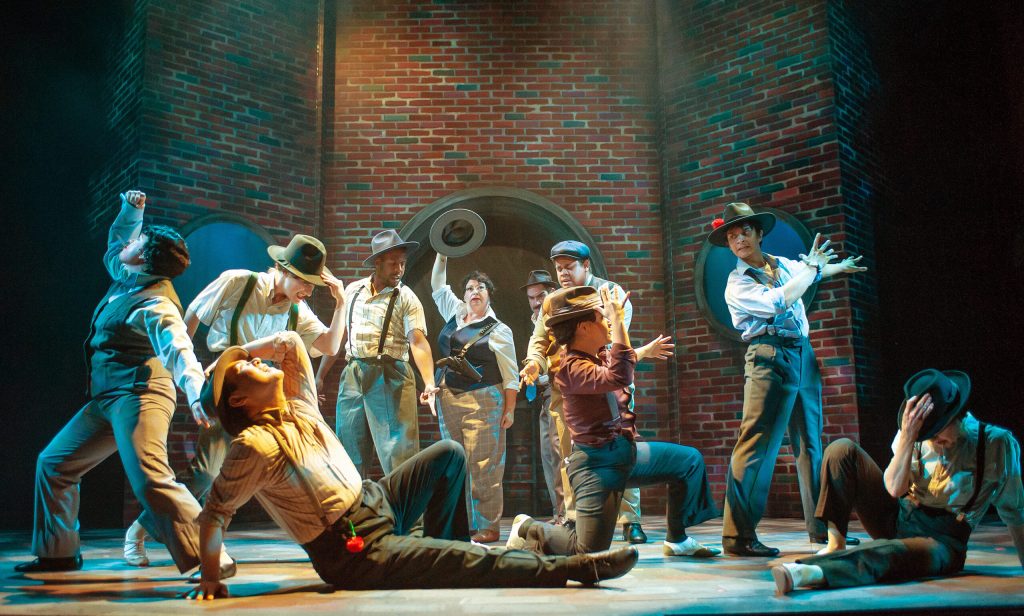
Anthony Rapp’s arrival on stage at the Curran Theater is met with great enthusiasm by Rentheads and other admirers.  For many Gen Xers, the 1996 rock musical “Rent,” drawn heavily on Puccini’s opera “La Boheme,” was their gateway into live theater.  “Rent” would also win multiple awards from multiple grantors including a Pulitzer and Tonys; endure as one of the longest running plays on Broadway; and become a theatrical touchstone for a generation.  For Rapp, who created the role of Mark Cohen at age 22, it was the inflection point that gave him recognition and launched him to stardom.

Rapp celebrates the years surrounding the early days of “Rent” in a one-man show “Without You,” based on his likewise named book subtitled “A Memoir of Love, Loss, and the Musical Rent.”  Premiered to acclaim at New York’s Public Theater in 2013, it has been successfully revived and is now touring.

Accompanied by a five-piece rock band, Rapp regales his audience with poignant storytelling punctuated by songs from “Rent” as well as many original tuneful and sensitive compositions, mostly by the performer.  The one outlier is REM’s megahit “Losing My Religion,” which Rapp had sung in his audition.

Those who are not familiar with the play may not anticipate the dominance of dying and death.  But for those who know the history, there are really no surprises, so the audience is enrapt by the vignettes and the songs that support them.  Although Rapp talks about himself, rather than a narcissistic self-portrayal, he acts more as a vehicle to honor two others who were important to his life.  And though there is much sadness, it doesn’t seem morose, perhaps because so much time has passed.  Yet, it resonates to those who have suffered loss.

Jonathan Larson wrote the book, music, and lyrics for “Rent.”  He was deeply committed with all phases of development including the 1994 workshopping, Rapp’s first involvement, having been offered the role of Mark Cohen by the playwright.  Larson felt a kinship with the struggling people that he wrote about and the struggling actors who portrayed them, evidenced by his annual Thanksgiving “Peasants’ Feast” to which Rapp was invited.

Larson light-heartedly deemed himself the future of musical theater and was even mentored by Stephen Sondheim.  But tragically and without warning, he died of an aortic aneurysm at age 36 after the dress rehearsal of “Rent.”  To a hushed audience, Rapp relates the anguish in having to press on with the opening performance when its beloved creator had just died, and having to give condolences to Larson’s parents.

What Larson left behind was an innovative musical that broke many barriers, having an array of characters who represented real people that were poor, minorities, gay, and HIV-positive.  He also left us with its music, including the anthem that recurs in Rapp’s show – “Seasons of Love,” which is so notable for its unique, rhythmic lyrics about measuring life and love in the 525,600 minutes of the year.  Rapp also sings another signature song that his character had introduced, “La Vie Bohème.”

Concurrent to the ramping up of “Rent,” Rapp’s mother was diagnosed with cancer, and unsurprisingly, she would die from it several years later.  Even more of “Without You” is dedicated to the author’s loving relationship with her, which Rapp amusingly depicts by speaking both parts in their conversations.

Although she was in many ways a conventional white bread Midwesterner, she accepted that her son went in another direction.  She must have suspected that Anthony was gay.  When telling her by phone that he had fallen in love with a man, she offered perfunctory resistance.  Her first reaction was to ask if they couldn’t just be friends.  When he persisted, her focus turned to ensuring that he wouldn’t allow himself to contract AIDS.

Rapp tells of the trips home to Joliet, Illinois during her decline.  Touchingly, his mother asked if there is anything that she can leave to him.  His caring response was that her gift would be that there would be nothing left unsaid.

The opening night show met with great and deserved audience support.  The fans felt the love.  Although the production enthralls, two issues do deserve mention.  In Rapp’s recordings, his voice sounds steady and sturdy.  In this performance, though he held a couple of sustained end notes with power, his overall singing voice seemed diminished and at times wavering.  Perhaps he was a little ill.  The other surprise was the sound mix imbalance.  Especially in the early going, any time the band was playing while Rapp was talking, the competing percussion and bass made him hard to hear and understand.

“Without You,” written and performed by Anthony Rapp, is produced by Broadway San Francisco, and plays at the Curran Theater, 445 Geary Street, San Francisco, CA through October 22, 2023.

Lohengrin

Simon O’Neill as Lohengrin, Julie Adams as Elsa von Trabant. All photos by Cory Weaver.

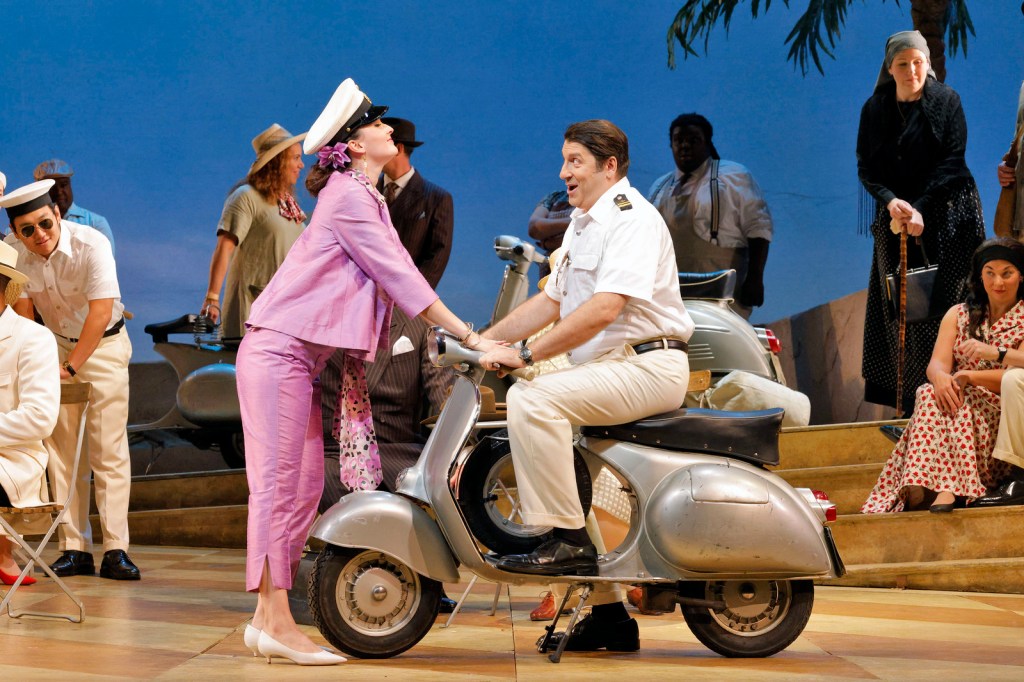
“Lohengrin” had been one of the few major operas that Karin, my wife/editor, and I had not seen.  As we approached War Memorial Opera House, she observed that she expected to either love or hate it.  Certainly, Wagner’s epic operas divide aficionados, and there are sufficient criteria for dissatisfaction with either the composition itself or any particular production which must conquer numerous challenges.  While differences of opinion will be noted, make no mistake, San Francisco Opera’s realization is world class, ideally cast, provocative, and completely worthy.  And though it clocks in at nearly 4 ½ hours, even most short-fused detractors will find it captivating.

This opera holds a special place in Wagner’s canon, as the apotheosis of his Romantic period and the launch point for his magnum opus, the four-opera music drama, the Ring Cycle.  Musically, it departs from previous operatic strictures like set pieces of arias and ensembles. As with much of the composer’s output, “Lohengrin” draws from Norse-Germanic mythology with strong fairy tale elements and moral-religious overtones.  The libretto is considered by many to be his best plotted. Its breadth is breathtaking with themes of love, fidelity, trust, belief, misogyny, sacrifice, betrayal, revenge, tribalism, militarism, and more.

Chorus.

Although his identity is unknown to the community, the title character arrives in Brabant as a God-sent Knight of the Grail to unify the people of the province and to defend the innocent noblewoman Elsa, being tried for her brother’s murder.  To acquit her, the mysterious guest must prevail in combat over Friedrich von Telramund, her lying accuser.  The knight marries Elsa with the same condition of faith placed on the Brabantians for his patronage – that she never ask his name or his origins.  Indeed, his name and association are not revealed until four hours into the running time of the work.

“Lohengrin” is blessed with beautiful tonal music throughout, beginning with the delicate break-of-day elegance that opens the overture.  Although little of the music is memorable, great exceptions are the rousing Prelude to Act 3, which leads into perhaps opera’s greatest contribution to common culture, the wedding processional, known in English as “Here Comes the Bride.”  In addition, a recurring leitmotif of several notes will sound familiar because it foreshadows the central melodic line in the music of “Swan Lake.”  While Tchaikovsky’s lifting this phrasing may be unexpected, a symbolic connection exists.  A swan pilots Lohengrin to Brabant and has visual and transformative prominence in the opera.  In less comforting contexts, the swan acts as proxy for the Reichsadler, or German eagle, adopted as a symbol by Nazi Germany.

Brian Mulligan as Friedrich von Telramund, Kristinn Sigmundsson as King Heinrich, Simon O’Neill as Lohengrin.

Music Director Eun Sun Kim conducts the proceedings with her characteristic celerity and aplomb, guiding not only the pit orchestra, principals, and a powerful chorus, but a bevy of off-stage musicians.  She has committed to offering a Wagner opera each year (and a Verdi), and her love and appreciation of Wagner’s music comes through clearly in her profound and enthusiastic conducting.

Heading the cast is classic heldentenor Simon O’Neill who has mastered many of the challenging Wagnerian roles.  His crisp and edgy tone is especially required to cut through the melifluous din that Wagner presents for his singers, in this case, an orchestra of 71 musicians and a chorus of 79 voices.  Soprano Julie Adams, who is building a resume of both lyric and dramatic roles, joins him as Elsa, and here she gets to show the grit and power in her voice as well as a high tessitura similar to that which O’Neill faces.

Judit Kutasi as Ortrud, Simon O’Neill as Lohengrin, Julie Adams as Elsa.

Also versatile and a veteran of Wagnerian opera is warm and powerful baritone Brian Mulligan as the antagonist Telramund.  Since this is her American debut, few knew what to expect from mezzo Judit Kutasi as Ortrud, Telramund’s wife.  Though the part may be anticipated to be secondary, the vile intriguer is instrumental.  Kutasi exceeds any expectations with a penetrating voice that is round or cutting depending on the demands, and she inhabits the character’s evil to great effect.

Controversy has always surrounded “Lohengrin.”  Nominally written as a solemn Christian fable, from the outset it was criticized as tribal and German nationalistic.  It premiered in 1850, when German unification efforts abounded, albeit, that the setting of Brabant was Flanders, or modern-day Belgium.  In the 1930s, along with Wagner’s music in general, it was particularly adopted by the Nazis because of its theme of unification through lebensraum (literally “living space,” but broadly, cross-border expansion) as well as its being emblematic of their culture and purported superiority.

Judit Kutasi as Ortrud, Julie Adams as Elsa.

A traditional staging of the work in its historic context renders the opera as distant and somewhat inert – a moral tale that lacks modern consequence.  This controversial production is without cuts, so the libretto is unchanged, but Director David Alden has set the visuals in the modern wartime gloom of a presumed Germany. Thus, what may have seemed innocuous now appears ominous.

Today, at the real-life time of two threatening regional conflicts – the Russian invasion of Ukraine and the Hamas-instigated rupture between Israel and Gaza – the militaristic aspects of this production particularly resonate.  The grimness of the production may not suit all viewers, but this very quality provides its power as well as its fearful reality and relevance.

Julie Adams as Elsa, Simon O’Neill as Lohengrin.

In its set design, as the curtain rises, sharply drawn light and shadow define the stage along with still characters, evoking a Rembrandt painting and befitting the Low Countries setting.  But as light overcomes dark, brooding brick buildings are seen leaning akimbo, suggesting instability and destruction.  And except for the highlighted principals, costumery of the multitudes on stage is hued in various shades of depression, indicative of poverty and foreclosed outlook.

The final distress is the depiction of the people’s depravity, which comes in Act 3, when fascist symbols and practices are adopted, including lockstep movements and stylized salutes.  Phalanxes of red and black banners with angular graphics and the appropriated graceful white swan in place of the imperial eagle parallel those of Nazi Germany.

In 2016, a theatrical adaptation of Sinclair Lewis’s similarly bleak novel “It Couldn’t Happen Here,” which deals with a fictional fascist takeover in this country through elections, was revived in the Bay Area.  Couldn’t it?

Chorus.

“Lohengrin,” with music and libretto by Richard Wagner is produced by San Francisco Opera in association with Royal Opera House – Covent Garden (UK) and Opera Vlaanderen (Belgium), and plays at War Memorial Opera House, 301 Van Ness Ave., San Francisco, CA through November 1, 2023.

Of Mice and Men – Opera Version

Robert Mellon as George, Matthew Pearce as Lennie.

One of the most preeminent and prolific American opera composers, Carlisle Floyd also wrote all of his own librettos, though most were based on distinguished literary sources.  Debuted in 1970, Floyd drew on Nobel Laureate John Steinbeck for one of his most successful works, “Of Mice and Men.”  The opera hews closely to the simple plotline of the novella, which is one of America’s distinguished, if controversial literary works, locally banned on various grounds, including sex, violence, racism, and euthanasia.

Livermore Valley Opera has produced an exemplary rendering of the opera that extracts all of the heart wrenching pathos from its essence that could possibly be expected.  Each artist sings and acts in an exemplary fashion and the production values excel.

Chorus, Matthew Pearce as Lennie (far left).

As itinerant ranch hands in California’s Central Valley during the Great Depression, two drifters arrive at another bunkhouse full of forgotten, hopeless men who deserve the empathy of those more fortunate.  George is intelligent and has aspirations, while the hulking Lennie is well-intended, but intellectually deficient.  He has a need for touch and loves to pet small, soft, furry creatures, but has a tendency to accidently kill them.  Although Lennie is a millstone whose actions create troubling situations, George has promised to take care of him and loves him like a brother.

Common with much 20th century opera, Floyd’s music is handmaiden to the drama.  The libretto follows Steinbeck’s grim narrative.  Down-home lyrics that suit the rustic characters capture the bleak subsistence of men with little to live for.  While the score offers no hummable melodies, it is interesting and easy to listen to, and some of the set pieces are intricate and involving, evoking empathy for the characters.

Véronique Filloux as Curley’s wife.

Matthew Pearce very much looks the part as the downtrodden but impish Lennie.  The pleasant anomaly comes when he sings with commanding dynamics that wouldn’t be expected of the character.  His powerful upper register along with lyric sonority are exquisite and foretell a big future for this young tenor.

It is Lennie’s boyish quality that appeals to the ranch foreman Curley’s wife, who brings gender relief to an otherwise all male cast.  The bored vixen is delightfully performed by Véronique Filloux, whose vocal range, mellifluousness, and easy flirtatiousness suit the role.  Her being attracted to the big huggable toy of a man will cause brutal conflict between Lennie and Curley, a small man with a Napolean complex.

Matthew Pearce as Lennie, Kirk Eichelberger as Candy, Robert Mellon as George.

While Lennie is conflicted in his own way, usually after realizing he’s done something wrong, George anticipates conflict on the horizon.  Robert Mellon offers a profound portrayal of George, singing with a dark, authoritative, and soulful baritone who bears the weight of responsibility.  He bemoans that “There’s gotta be more,” while he hopes and plans that he and Lennie can someday buy a little farm.  His wistful aria “I, me, and mine” also reveals his contradictory yearning to stand on his own rather than suffer his burden.

The content and tone in “Of Mice and Men” are crushingly downcast, but Lennie and Curley’s wife share a well-crafted and beautifully delivered duet in which they sing simultaneously of their differing dreams for a better future.  Their hopes raise the question whether having plans and dreams, even if unlikely to be fulfilled, lead to a happier existence.

Chad Somers as Curley, Véronique Filloux as Curley’s wife.

All of the production elements enhance the performance.  Marc Jacobs’ direction provides engaging details that many versions might lack.  The opening scene instills an ominous foreshadowing when a search party on a darkened stage waves flashlights around hunting for the protagonists.  The libretto actually assumes that the vigilantes are off stage.

Jean-François Revon’s scenic design opens up the bunkhouse, so that a claustrophobic, overly  gloomy look is avoided.  Michael Oesch’s lighting highlights and Frédéric Boulay’s video effects create visual drama with stunning panoramic projections.

Robert Mellon as George.

One may actually wonder why, given its depressing nature, Carlisle Floyd selected this novella from all of John Steinbeck’s works to turn into a verismo-styled opera.  But for us who live in this region, it is part of our cultural heritage and this opera should be prescribed to all opera lovers.

Just to nitpick, one minor defect on opening night was that the brass in the orchestra sometimes seemed a little off timing and lacking in clarity.  Also, the two gunshots that occur were so muted that if you didn’t suspect they were coming, you might miss them.  However, these issues are miniscule.  They don’t disrupt the enjoyment of this well-produced opera with a masterful pedigree. 

Robert Mellon as George, Matthew Pearce as Lennie.

“Of Mice and Men,” composed and libretto by Carlisle Floyd and based on the novella of the same name by John Steinbeck, is produced by Livermore Valley Opera and plays at Bankhead Theater, 2400 First Street, Livermore, CA through October 15, 2023.

Ivanov – an Immersive Adaptation

Gracie Meier. Photo by Samuel David Katz. All other photos courtesy of Exodus Ensemble.

As immersive entertainment becomes more prevalent, new variants sprout up.  When Meow Wolf initiated its first installation in Santa Fe, NM, it claimed to be the first immersive art installation, allowing visitors to enjoy any variety of visual experiences by taking their own paths through dozens of dizzying dioramas.  San Franciscans may know “The Speakeasy,” an immersive theatrical experience with a number of different performances that the patron can visit in whatever order, which evokes the city’s Barbary Coast reputation.  In other performance works, audiences have selected which actors to play which roles or voted on who should be the perpetrator in who-dunnits.

The Santa Fe based Exodus Ensemble has introduced theater that has become about as immersive as possible, short of the patrons spontaneously driving the narrative.  Performed by a troupe of talented and committed actors, this stimulating and exciting new form of entertainment already has a track record of delighting those who value youth, spontaneity, innovation, audience participation, and rule breaking.  Those preferring more established modes may be split on whether this kind of entertainment works for them.

(Center, on floor among audience) Emily Neifert, Mikie Beatty.

The company’s “Ivanov” defies traditional theater in many ways.  Designed for an audience of around a dozen, the play is not presented on a stage, but moves scene-by-scene from one room to another in a house or other facility, depending on where it is presented.  There is no fourth wall, as the performers act in close quarters and are sometimes interspersed with the audience.  And although the performers stay in character, they often interact with audience members who sometimes make contributions to the performance.  An often discomforting, yet interesting and involving effect is that the observer can feel that acquaintances rather than actors or fictional characters are going through these trials.

The company focuses on redesigning classics, and this was the company’s very first mounting, which it has now performed over 80 times.  One might ask, why “Ivanov”?  Although it is not recognized as one of Chekhov’s four most famous and esteemed plays, one may ask why to that as well.  It does include the requisite dollop of Russian character and society, but it also contains the additional dimensions of prejudice, as Ivanov’s wife is Jewish, as well as a tragic and violent ending.  Briefly, Ivanov is in debt; his wife Anna is chronically ill; and they have come to live with their friends, the Lebedev family, but the closeness exacerbates temptation and conflict.

The proceedings begin before the formal plot development with actors already in character, but if you’re not aware of the device, you could easily be fooled.  Outdoors, the effusive greeter introduces himself as Borkin, and unless you know the minor character from the play, you might think he’s a member of the acting company who happens to be from Eastern Europe.  It is actually versatile actor Mikie Beatty, originally from Placerville, who also provides tuneful musical accompaniment throughout the play.

Patrons then enter the first of many performance rooms and are regaled with drinks and badinage by Sasha.  She keeps saying that she is 16 years old, which is convincing, but as it turns out, very untrue.  She is actually the hyperactive, screeching, and always engaging Emily Neifert who plays Sasha, a young woman in the Lebedev family who falls in love with the married Ivanov.

Mason Azbill.

This realization of the play offers a broad-brushstrokes look at the original, but with situations and commentary that are American (only Borkin has an accent), contemporary, and localized to the community of the performance.  A married couple becomes a gay couple in a relationship, Sasha is 16 instead of 20, and so forth.  Blustery behaviors and speaking styles owe more to the likes of David Mamet than Anton Chekhov.  Characters have volatile reactions, especially the supposedly melancholy Ivanov, who is played with great passion and authority by Garrett Young.

Despite a severely abbreviated Cliff Notes version of the source material, with wholesale elimination of secondary characters and scenes, this adaptation runs a good 3 ½ hours.  Some measure of the length is attributed to moving the action to a new room every several minutes and breaks for bathroom, libations, and very good charcuterie (how bad is that!).

The main reason for the length is the embellishments.  Everything about Exodus Ensemble appears to be a labor of love, but love wants love in return.  The script is written by company members, and there does seem to be an element of each actor wanting their “close up,” so it’s easy to suspect a writing process in which each actor is writing material to be able to display their talents.  Again, this is an outcome that will please some attendees and not others.  The complex logistics of the piece are effectively orchestrated by Artistic Director April Cleveland.

Company members – (left) Garrett Young, (second left) Zoe McDonald.

The backstory to The Exodus Ensemble is worth revealing.  After the onset of the pandemic in 2020, 13 former participants in DePaul University drama programs magically converged from across the country to settle into a community house in Santa Fe, NM.  This was a great choice because it is a fantastic city and home to Meow Wolf, which would inspire and support the company’s mission.  The group’s intent was to develop avant-garde theatrical works and performances that break with the past.  To that end, they have created several productions for their home market that they are now taking on the road.  A few months after their stint in San Francisco, they travel to New York City.

For their visit to San Francisco, Exodus has offered a fully guided, linear “Ivanov” as well as “Zero,” a blend of sci-fi and artificial intelligence that allows patrons to take different paths through the adventure.  While the performances live up to their billings, the question is their sustainability.  The company does not charge for tickets but welcomes donations while socializing after the performance or any other time.  For the more intimate “Ivanov” they welcome any contribution, but suggest that donations of $500 would especially help them survive.  “Zero” allows 28 guests with a suggested donation of $200.

Jayson Lee.

Needless to say, for a group formed communally in a small market (though individually they do take on other professional gigs elsewhere), to offer such elitist entertainment, is anomalous.  Although they have successfully raised donations to launch their program and reach this juncture, the question is if this model needs to be modified to last.

Kudos and thanks to Edge & Node House of Web3 for their generosity in making their wonderful Presidio co-creation space for Web3 innovation available for these stimulating productions.  A small sample of their space can be seen in the photos.

Cast.

“Ivanov” (the San Francisco tour) based on the play by Anton Chekhov and adapted by Exodus Ensemble is produced by The Exodus Ensemble of Santa Fe, NM and plays at Edge & Node House of Web3, Building 103 Montgomery St., San Francisco Presidio, CA.  The company’s residency runs through October 10, 2023.

Nollywood Dreams

Dede (Brittany Nicole Sims) is concerned about Ayamma’s (Angel Adedokun) acting abilities. All photos by Jessica Palopoli.

From the time that the American movie industry settled into the Los Angeles area, Hollywood became the universal symbol of movie magic and glamor.  Its global sweep can be seen in the identifications of the two largest movie producing countries in the world.  First, India’s movie industry, noted internationally for colorful action-romance musicals with huge dance numbers, is commonly known as Bollywood – a portmanteau of Bombay and Hollywood.  Subsequently, Nigeria’s bustling dream world, an amalgam of many film genres in many languages, has become known as Nollywood.

Talk show host Adenikeh (Tanika Baptiste) interviews Nigerian film director Gbenga (Tre’Vonne Bell).

Ghanian-American playwright Jocelyn Bioh pays homage to West African society and film in her play “Nollywood Dreams.”  Hilarity overflows from beginning to end as flamboyant characters performed by outstanding actors make the dialog crackle.  Set in Lagos, Nigeria, in the ‘90s, the story centers on Ayamma Okafor (played by Angel Adedokun), who hopes to break into show business and responds to an open audition for the lead in a movie.

Although she is no wallflower, Ayamma’s encounters are with dominant people of greater stature than hers, starting with her voluble older sister, Dede (played by Brittany Nicole Sims).  The two work in the family travel agency, and while DeDe wisecracks and cackles on the phone; watches soap operas religiously; and reads gossip magazines assiduously, the more grounded Ayamma does most of the work and acts as a gofer.

Aspiring actor Ayamma (Angel Adedokun) auditions for director Gbenga (Tre’Vonne Bell) in competition with resident diva Fayola (Anna Marie Sharpe).

Of course, the plot wouldn’t go anywhere if Ayamma didn’t get an audition.  When she does, she interacts with important men in the industry – Director Gbenga (Tre’Vonne Bell) and heartthrob Wale (Jordan Covington). However, a gushing and enthusiastic Dede is always there to disrupt Ayamma’s progress and insinuate herself into the proceedings.

In the audition, Ayamma reads with Fayola (Anna Marie Sharpe), a condescending diva who had been successful in Nigeria’s nascent movie industry but who was unable to make a mark in the U.S.  The latter belittles the ingenue, who shows her backbone by confidently returning the diva’s unpleasantries.  Initially starstruck by the men in the movies, she later demonstrates that she is not a wistful dreamer, but a strong woman who is not going to kowtow to anyone (except her sister!).

Dede (Brittany Nicole Sims) and Ayamma (Angel Adedokun) greet Wale (Jordan Covington) at the studio.

Interspersed with Ayamma’s saga are scenes from a talk show hosted by an over-the-top Adenikeh (Tanika Baptiste), who is like a probing, discomfiting, Nigerian Oprah but with an effusive and demonstrative personality.  A final thread involves threatened blackmail by one character as one of the others is associated with the notorious real-life email scams in which a purported Nigerian prince asks for money to be sent to him.  Other embarrassing secrets are known as well.

It is great to see a play that deals with African society beyond those of Athol Fugard (who is a literary giant) or others with heavy handed themes.  What “Nollywood Dreams” does not deal with is broader endemic issues like the casting couch, gender matters, or thematic material. It is a farcical send-up that is to be enjoyed like cotton candy.  Few of the situations are inherently humorous, but the highly animated actors deliver with crack timing.  It is noteworthy that the energy is driven by the female characters, whereas the males seem a bit underwritten.

Wale (Jordan Covington) dances on Adenikeh’s (Tanika Baptiste) talk show.

The good news / bad news about the play is that it is universal, and with the smallest of changes could be set in any number of countries.  The familiarity makes it comforting, yet the small differences give it an exotic appeal.  The “local color” that most comes through is the clipped British-based spoken English (Edris Cooper-Anifowoshe as dialect coach) and the beautiful costumery (designed by Jasmine Milan Williams) that adds another dimension.

Bill English’s sets at San Francisco Playhouse usually stand out, and this is no exception.  Three locales are represented by separate sets on the revolving stage, and while none are especially complex, the detail in the wall pieces gives a differentiating sense of place.  Margo Hall, who is usually associated with more dramatic plays, shows her versatility and directs with great skill.

Ayamma (Angel Adedokun) bursts into the audition room as Gbenga (Tre’Vonne Bell), Fayola (Anna Marie Sharpe), and Wale (Jordan Covington) discuss casting.

“Nollywood Dreams” is written by Jocelyn Bioh, produced by San Francisco Playhouse, and is performed on its stage at 450 Post Street, San Francisco, CA through November 4, 2023.

The (R)evolution of Steve Jobs

John Moore as Steve Jobs. All photos by Cory Weaver.

What topic speaks more to the contemporary Bay Area scene than a massive technological success with roots in a garage in the Silicon Valley?  But an opera about Apple Computers co-founder Steve Jobs?  As it turns out, not only is he an excellent subject for an opera, but composer Mason Bates and librettist Mark Campbell push all the right buttons in creating a masterwork that has already grown legs.  And in the skilled hands of San Francisco Opera, the production excites and triumphs on every dimension.

Although co-commissioned by San Francisco Opera, its first production of “The (R)evolution of Steve Jobs” is occurring six years after the world premiere by commissioning partner Santa Fe Opera.  The pandemic disrupted San Francisco’s initial scheduling, but meanwhile, stagings by six other opera companies demonstrate the interest in this property.

Bille Bruley as Steve Wozniak, John Moore as Steve Jobs.

Jobs would not be the subject of an opera were it not for his accomplishments and fame, but this is not a slavish paean.  He is depicted as a man of many contradictions – meditative yet restless; magnetic yet unapproachable; a Buddhist adherent yet emotionally brutal.  Above all, he had a single-minded drive for perfection, and his abrasiveness receives emphasis.  Among other targets of his perfectionist’s wrath, he repeatedly denigrates employees yelling “Wrong, wrong, wrong!” about everything from color samples to shapes of computer cases.

The composer’s music departs from opera standards but appeals as listenable and curious yet sophisticated.  Along with traditional acoustic instrumentation, Bates’ exotic interpretation integrates electronic elements such as key clicking, beeping, and whirring computer sounds which he personally manages on an Apple MacPro from the orchestra pit.

John Moore as Steve Jobs, Wei Wu as Kobun Chino Otogawa.

The outcome is lively and often pulsating, with extensive use of percussion including chimes and seven timpani drums.  Extending the notion of leitmotifs, each main character has a soundscape, most importantly, steel guitar for Jobs and slow, oceanic harmonies for wife Laurene.  Musical highlights occur when these modes overlap and clash, especially in the brief but well-crafted duets and trios.

Most patrons will be familiar with Apple’s successes.  The libretto looks at Jobs and Wozniak’s earliest forays into electronics through the iPhone introduction in 2007 as well as with Job’s personal relationships.  Rather than telling the story chronologically the libretto is radically non-linear with vignettes from the 1970s until Jobs’ death in 2011.  He even kibbitzes his own memorial which he criticizes on numerous grounds.

John Moore as Steve Jobs, Olivia Smith as Chrisann.

To Campbell’s great credit, not only do the vignettes work individually and cohere into a whole, but the narrative involves and grips the audience despite any foreknowledge.  And the lyrics complement the music nicely, often carrying the driving force that represents the title character.  Series of words that create powerful rhythms fleck the score, as when Jobs messianically introduces the iPhone at a conference, noting that it will “communicate, regulate, educate, stimulate….. “.   And he regales attendees with its ease of use – “tap to call, tap to read, tap to view, tap for pics…..”.

John Moore as Steve Jobs, Sasha Cooke as Laurene Jobs.

The cast is superb, starting with John Moore as Steve Jobs.  His portrayal as the icon is flawless.  His facial look, body type, gesticulations, and emotions are such convincing reflections as to transport the viewer into Jobs’ tempestuous world.  And he sings.  His warm baritone with rich vibrato suits the role well, but he also conveys Jobs’ rage while retaining vocal acuity.  Bille Bruley nicely captures the public perception of Steve Wozniak, the scientific mind behind the early Apple technologies who is submissive to Jobs’ marketing savvy and leadership.  A magnificent Sasha Cooke reprises her world premiere role and Grammy award winning performance as Laurene Jobs, the competent and confident wife.  Wei Wu as Job’s Buddhist spiritual advisor and Olivia Smith as high school girlfriend Chrisann also excel.

John Moore as Steve Jobs, chorus.

A final star is the staging.  Victoria Tzykun’s minimalistic, clean-lines set fits the topic well.  In addition to backwall panels, the set designer employs six large, movable modules that define space and act as screens for “59 Productions’s” front-lit projections that always manage to find their mark, no matter the location of the modules.  The choreography of the modules provides smooth transition from one scene to the next, while Japhy Weideman’s lighting yields accent and clarity.

Of course, there is more to Jobs’ story than can fit in a 95-minute opera, but a couple of notable items are given short shrift.  His firing from Apple is mentioned, but the 12-year interregnum before his return is not developed.  And though he rejected paternity of his out-of-wedlock daughter, Lisa, early on, his reconciliation could have been covered.  Another significant fact that may have affected Jobs that is not mentioned is that he was adopted at birth.  He knew from an early age that he was adopted but always considered the Jobs who raised him as his only parents.  He never sought to meet his birth parents, even though he knew their names.

John Moore as Steve Jobs, Wei Wu as Kobun Chino Otogawa, Sasha Cooke as Laurene Jobs.

“The (R)evolution of Steve Jobs,” composed by Mason Bates with libretto by Mark Campbell is produced by San Francisco Opera under co-commission with Santa Fe Opera and Seattle Opera, and plays at War Memorial Opera House, 301 Van Ness Ave., San Francisco, CA through October 7, 2023.

POTUS: Or Behind Every Great Dumbass Are Seven Women Trying to Keep Him Alive

Stephanie Styles (Dusty), Susan Lynskey (Stephanie). All photos by Kevin Berne.

The subtitle of this play “Or, Behind Every Great Dumbass Are Seven Women Trying to Keep Him Alive” suggests where it’s going.  But if you think that it may simply be misandristic, that wouldn’t be correct.  Given the crazy antics of these females who are close to the president, you could just as easily add the word dumbass in front of the word women.  In any case, the result is “POTUS,” a farce that had Berkeley Rep’s opening night audience laughing with glee from start to finish.

A never-seen president possesses the worst traits from a composite of recent U.S. commanders-in-chief, and the action centers on the women trying to create cover for him.  Early on, the omnium gatherum is comprised of the First Lady, three vital staff members, and a journalist, who are later joined by the president’s sister and what the play’s program calls “his dalliance.”

Dominique Toney (Chris) and Stephanie Pope Lofgren (Margaret).

The triggering event is that president publicly referred to the First Lady as “cunty” (has anyone heard of that derivative?).  His Chief of Staff Harriet (played by Deidre Lovejoy) blithely seeks to dismiss it while Press Secretary Jean (Kim Blanck) scrambles to put a spin on the miscue, as she’ll have to deal with the press.  Meanwhile, all the women get into clashes and reveal their own wacko traits.

For instance, First Lady, Margaret (Stephanie Pope Lofgren), wants to be perceived as earthy, so she wears weird white, high-heeled Crocs that look stupid, especially with her dressy dresses.  Yet, she insists that all of her activities and accomplishments be repeatedly acknowledged publicly.    The president’s sister, Bernadette (Allison Guinn), is a goth who was a couple with Jean – that is, before Bernadette went to prison.  She is now on a short-fuse release to seek a pardon from her brother.

Stephanie Styles (Dusty), Deirdre Lovejoy (Harriet), Kim Blanck (Jean), Allison Guinn (Bernadette).

An incident that won’t be mentioned occurs at the end of Act 1, and women have to create cover for themselves.  However, the president’s secretary, Stephanie (Susan Lynskey), inadvertently swallows a psychotropic drug and frantically galivants in a bikini, making postures like a ninja warrior and asking where the ground is. And while the arrival of squeaky-voiced dalliance Dusty (Stephanie Styles) is unwelcomed, the group feels she will be easily dismissed, until they find that she won’t be easily dismissed.

Since the play’s narrative bursts with ridiculous situations that are not intended to be realistic, it gives rise to overwrought performances, full of shrieking, sarcasm, and silliness.  Nonetheless, a number of meaningful social and political issues surface.  The international political implications and the domino effect of the president’s crass “cunty” statement to a Bahraini contingent is discussed.  Presidents being tagged by the actions of their relatives arises.  The issue of the right of nursing mothers to express milk plays large as the journalist, Chris (Dominique Toney), seeks places in the White House to pump her breasts.  Abortion even takes the stage.  References to contemporary tropes like “the real brains in the White House” and “those around him will go down, but not POTUS” also appear. 

Dominique Toney (Chris).

Director Annie Tippe’s production is top flight.  Andrew Boyce’s scenic design skillfully mimics the White House.  Yi Zhao’s lighting sparkles both in its varied illuminations and its decorative effect, from large scale Broadway bulbs for a singing performance by Dusty to picture lights above White House paintings.  Acting fulfills the demands of the roles.  The play can also be commended as one with an all-female cast that doesn’t seem like it is forced into that box.  It is a true ensemble, and I wouldn’t even have a guess which part had the most lines or which the fewest.

One philosophy of play criticism says that its purpose is to prevent people from going to an unworthy play.  But that notion doesn’t hold up well under examination.  When a play like this is popular with the audience but the critic dislikes it, the critic speaking in his/her own voice may dissuade people from going to something they would enjoy.

Allison Guinn (Bernadette).

Now for the Minority Report.  So, the above review of “POTUS” is an accurate reflection that includes production elements that I appreciated plus objective descriptions which might be written by someone who actually enjoyed the play.  But farce tends to split audiences like few other genres.  Though I’ve enjoyed locally produced farces such as Corneille’s “The Liar,” “Noises Off,” and “One Man, Two Guvnors,” this one does not work for me.  Several other colleagues and acquaintances felt the same way, though one couple enjoyed it a lot for what it was.

I know there are alternate interpretations to acting the parts, but I wouldn’t fault the acting.  An unabated string of wise-cracking one-liners demands hyperenergetic overacting, which the actors deliver.  But the comedy is largely sophomoric, sometimes reduced to potty humor, and there is little pause to allow for lull and climax – no buildup of tension or involvement.

Susan Lynskey (Stephanie), Deirdre Lovejoy (Harriet).

Finally, and noting that I’m no prude when it comes to language or content, I didn’t find the foul language offensive, but excessive and ultimately distracting.  It’s almost as if the playwright is more intent on showing that she can use the crassest obscenities rather than make them work.  How many times do female characters need to say “Get off my dick” before it wears out?  And while I have understood that women are very offended at the use of the word cunt, it is used liberally by this female playwright, though usually in the adjectival variation.  From my perspective, the script would work better with minor adjustments.

Getting back to philosophies of criticism, I often feel it is more important for a critic to disclose information that acts as guidance as to what kind of theatergoer is likely to like or likely to dislike a particular production.  Hopefully, that has come across.

“POTUS: Or Behind Every Great Dumbass Are Seven Women Trying to Keep Him Alive,” written by Selina Fillinger and produced by Berkeley Repertory Theatre, plays on its stage at 2025 Addison Street, Berkeley, CA through October 22, 2023.

Il Trovatore

Arturo Chacon-Cruz as Manrico, Ekaterina Semenchuk as Azucena. All photos by Cory Weaver.

When asked about how to cast “Il Trovatore,” San Francisco Opera Music Director Eun Sun Kim says you simply enlist the five greatest voices in the world.  Why such an extraordinary need?  It starts with roles that demand considerable vocal range.  Then what begins as beautifully lyric singing turns to highly dramatic.  And finally, a great deal of stamina is required, so that cuts are often made from the score to preserve the singers’ voices.  San Francisco Opera’s joint production with the Metropolitan Opera and the Lyric Opera of Chicago soars with stellar voices and stupendous staging.

Debuted in 1853, Verdi’s “Il Trovatore” stands in the middle of perhaps the greatest three opera sequence by any composer.  Preceded by “Rigoletto” and followed by “La Traviata,” all three are artistic masterpieces as well as crowd favorites.

Robert Pomakov as Captain Ferrando (on stairs).

Critics nitpick even the greatest works, and it is easy to criticize the “Il Trovatore” libretto.  Situations are unlikely, but this is not Logic 101.  Characters are rigid and obsessive, but that makes them passionate and vivid.  Revenge is taken to unworldly limits, but otherwise we would have pablum unfit for our viewing pleasure. 

Musically, themes and tones recur.  But that music!  Every phrase from beginning to end resonates melodically.  Memorable set pieces infuse the score.  With its urgency, intensity, and propulsive music, it is deservedly one of the most popular opera works in the repertory.  One oddity that is inconsistent with the passion in the action, however, is the extent of long stand-and-deliver arias even to otherwise empty stages.  The good news is that the three most prominent occur at the outset, before the emotion builds.

Angel Blue as Leonora.

The title character is Manrico, a troubadour and leader of a Roma troupe.  Unbeknownst to anyone but his adoptive mother, he is of noble blood and the brother of his arch enemy, Count di Luna.  They contest not only in the communal and political world but for the love of a woman, Leonora.

Arturo Chacón-Cruz plays Manrico.  Other than the “Anvil Chorus,” which is known well beyond the opera circle, Manrico is endowed with the most famous and perhaps most challenging solo piece from the opera.  In the high tessitura cabaletta “Di quella pira,” (Of that pyre), he responds to learning that his mother, Azucena, will be burned at the stake, like her mother before her.  While the tenor’s voice is somewhat cloaked, he otherwise acquits himself well, as do baritone George Petean as the Count and bass Robert Pomakov as Ferrando, captain of the Count’s army.

George Petean as Count di Luna.

But the emotional center of the opera and the more compelling vocal performances belong to the two leading women.  A spectacular soprano Angel Blue performs Leonora, a lady-in-waiting to the Princess of Aragon.  Although Leonora is of the noble class and is loved by Count di Luna, her love is for Manrico.  Verdi gives his soprano plenty to work with – trills, runs, and leaps, with great dynamics and an abundance of highly inflected vocalization.  Blue’s full tremolo and rich timbre fill the house throughout her range in both delicate and full throttle passages.

Yet the heart and viscera of “Il Trovatore” reside with the highly challenging and gutsy role, Azucena, a plum mezzo assignment.  She vowed revenge when di Luna’s father burned her mother at the stake.  An added tragedy was that Azucena accidently threw her own son into the fire that consumed her mother but then began her revenge by kidnapping the old Count’s other infant boy, who would become her adopted son Manrico.  Ekaterina Semenchuk represents the prototypical Azucena – magnetic, scenery chewing, anguished, intense, and with great vocal range able to make deep dives to her vocal bottom.

Ekatarina Semenchuk as Azucena.

Eun Sun Kim conducts the orchestra with conviction, though instruments overpower singers on a couple of occasions.  Her brisk decisiveness is evident throughout but particularly notable in the “Anvil Chorus.”

The other star of the show is Charles Edward’s immense, imposing, and impressive set design under the overall stage direction of David McVicar.  Inspired by Spaniard Francisco Goya’s series of paintings “The Disasters of War,” an extract from the work which is the size of the proscenium arch is represented on a false curtain.  The set itself towers over the action, with a massive building wall probably 30 feet tall and a single-run, outside staircase running its height and width.  What’s more, this colossal structure rotates on the stage to reveal two more voluminous facings which are then customized to meet the needs of the respective scenes.

Chorus.

As expected from witnessing this great opera performed by this great company, San Francisco Opera’s “Il Trovatore” offers an outstanding evening of cultural enjoyment.

“Il Trovatore,” composed by Giuseppe Verdi with libretto by Salvadore Cammarano and based on the play by Antonio Garcia Gutierrez, is presented by San Francisco Opera and plays at War Memorial Opera House, 301 Van Ness Avenue, San Francisco, CA through October 1, 2023.

Bald Sisters

NICOLE TUNG as HIM, RINABETH APOSTOL as SOPHEA. All photos by DAVE LEPORI.

What about that old adage that blood is thicker than water, which suggests that loyalties among blood relatives should be stronger than those between unrelated people?  Media and personal observation reveal an abundance of examples that belie that cliché.  A somewhat contrary notion suggests that despite growing up with the same immediate kin, the further apart siblings are born, the more they are raised in “different families.”  This premise relates to differences caused by birth order and the changed economic and social condition of the family as it evolves.

“Bald Sisters” is about the clash between two sisters dealing with funeral preparations for their deceased mother, with flashbacks to earlier days which flesh out the relationships among the three women.  Acting by all five actors is adept, and the San Jose Stage realization meets its typically high production standard.  While the script touches on interesting cross-cultural matters and deals well with a number of family crises, the conflicts simmer rather than sizzle or startle.  But along the way, the play is funny and thoughtful.

RINABETH APOSTOL as SOPHEA, KEIKO CARREIRO as MA, NICOLE TUNG as HIM.

The title alone should intrigue anyone unfamiliar with the work, but it is quite literal and highlights a divide between the sisters.  Him, the name of the older daughter, is undergoing chemotherapy for breast cancer and covers her hair loss with a scarf.  Sophea, the younger, has a new buzz cut in recognition of her mother’s passing. It represents the baldness of a Buddhist monk’s foregoing of worldly things.  (One can accept that many actresses would bristle at going with a completely nude pate).

If the name Him for a female raises eyebrows, the family is Cambodian.  The older daughter was born in their ancestral land, though the family immigrated to Dallas.  Unless the playwright simply wanted to highlight this name as reflecting a cultural difference, it is not clear why he chose a character name that in English contradicts the person’s gender.  Him does not appear among http://www.momjunction.com’s list of 176 Cambodian baby names, so there are many alternatives.   A further confusion – the mother is called Ma, but it is pronounced as in matter or mask.  So it is not clear whether this is the daughters’ idiosyncratic rendering of the English word or if it is the Cambodian proper name.

WILL SPRINGHORN JR. as NATE, NICOLE TUNG as HIM.

Anyway, Sophea was conceived in Cambodia and born in the U.S., but the father died before Ma and Him left the squalid conditions of refugee camps in Thailand.  These “different family” factors play into the underlying dynamic between the sisters.

Although she dies in the opening scene, Keiko Carreiro is an absolute scream as Ma.  Totally irreverent and uncensored, this drama queen is the show’s comic center.  She humorously dresses down her daughters by calling them bitches in her scratchy-squeaky voice and otherwise swears like a Marine.  But as much as she tells others what to do, she doesn’t reveal much about herself.  In fact, the girls know nothing about Ma’s expectations for death ceremonies or body treatment.  What’s more, she’s left no will.

ZAYA KOLIA as SETH/SEIF, RINABETH APOSTOL as SOPHEA.

Nicole Tung plays the understandably subdued Him, weakened and leaving the room frequently to vomit from reaction to the chemo treatments.  She is married to a white pastor, Nate, who is deftly portrayed as earnest but diffident by Will Sprinnghorn, Jr.  Given her Christian marriage and having stayed around Ma for the duration, she has proceeded on the basis that Ma would receive Christian burial rites.

Conversely, Sophea resettled to New York City and has not been seen in four years.  Believing that Ma would want to be treated in Buddhist death tradition, she bristles at Him’s dismissiveness about her ideas.  But Him has little confidence in Sophea and that she can do anything right.  Rinabeth Apostol performs as the wayward one who seethes and snarls. 

WILL SPRINGHORN JR. as NATE, ZAYA KOLIA as SETH/SEIF, RINABETH APOSTOL as SOPHEA, NICOLE TUNG as HIM.

The final character, the lawn guy Seth, played by Zaya Kolia, has no strategic significance to the plot.  He does have his shining moment reciting a Syrian prayer, and he does act as diversion fodder elsewise.

While “Bald Sisters” doesn’t reach for much in terms of plot development, the situations and interactions do offer a rewarding experience.  Cultural and family matters are well depicted. One enrichment to the storytelling would be having hair and costume changes for the sisters in flashback sequences.

KEIKO CARREIRO as MA, NICOLE TUNG as HIM.

One final issue of note to some, unlike most all theaters that this reviewer has attended this year, San Jose Stage holds to the pandemic practice of offering no physical program – not even a one sheet listing of performers and artistic contributors.

“Bald Sisters,” written by Vichet Chum, is produced by San Jose Stage and plays at its theater at 490 South First Street, San Jose, CA through October 8, 2023.

The Addams Family – Musical

(above) Alison Peltz as Morticia, Bruce Vieira as Gomez, Harriette Pearl Fugitt as Wednesday, Kayla Gold as Grandma. (below) Milo Ward as Pugsley, Todd Krish as Lurch, Pat Barr as Fester. All photos by Jere Torkelsen.

With the backdrop of their grim, ghoulish, and ghostly digs, we hear the familiar repeated four-note melody and finger snapping of the Addams Family’s theme, and we know that we’re not in Kansas anymore.  In the tradition of the likes of “Rocky Horror Show,” “Beetlejuice,” and “La Cage aux Folles,” the intersection of conventional folks with the off-kilter provides for hilarity.  Novato Theater Company takes on the stage musical version of “The Addams Family” and presents a highly entertaining affair.

In case anyone doesn’t know, the macabre Addams family comprises a bizarre concoction of living, dead, and undecided in which normal human desires are largely perverted or inverted.  For instance, to accommodate wife Morticia’s desire to visit Paris, husband Gomez gleefully seeks to stay in the worst hotel he can find and to take her on the tour of the Paris sewer system (okay, real tourists actually do that as well!).  Their son, Pugsley, will try to obstruct his sister Wednesday from leaving the family home as he would miss her torturing him on the rack.  Get the picture?

Harriette Pearl Fugitt as Wednesday, Milo Ward as Pugsley.

The setup is that, despite her own aberrant lifestyle, Wednesday falls in love and wants to marry a “normal” boy, which Gomez protests.  On the family’s annual gravesite tribute (think Dia de los Muertos) they don’t just honor the deceased, but the ancestors emerge from their graves.  Uncle Fester will enlist the deceased to assist Gomez in hopes of terminating the lovers’ relationship when the boy and his family come for dinner.  Another hitch that becomes significant – Gomez doesn’t tell Morticia what’s afoot, which becomes part of the broader theme of full disclosure.

Ancestors.

Of course, the play is full of dark and campy humor as well as clever songs, and the cast is fully up to the task.  Bruce Vierra plays Gomez with verve and joy.  Smiling and a bit conniving, he hits the right notes – and singing them as well.  Composer and lyricist Andrew Lippa has written a score of pleasant melodies and clever lyrics.  “Trapped” is one that is full of patter about the conundrum that Gomez faces with his daughter and wife, which Vierra delivers with great aplomb.

Morticia is performed delightfully by long-time Novato Theater favorite Alison Peltz.  Although in the prime of her life, Morticia shares many of the insecurities stereotyped to women.  Concerned about losing her youth, she even sings beautifully about death being “Just around the corner,” yet, when it’s time to turn up the sex quotient, she sizzles. But when she finds herself doing things that she swore she never would, she bemoans that “I’ve turned into my mother!”

The pivotal character however is Wednesday, a web of contradictions, played with dead-pan assurance by Harriette Pearl Fugitt.  Although good acting would be pretty sufficient in this role, Fugitt displays serious singing chops with incredible power and range.

Alison Peltz as Morticia, Bruce Vieira as Gomez.

“The Addams Family” bursts with sight gags, witticisms, and one-liners harking back to the prime of the Borscht Belt.  There is homage to early television with “To the moon, Alice,” and, concerning the mother who has long lived with Gomez and Morticia, “My mother?  I thought she was your mother!”  Although it is far from a morality play, a number of messages seep through.  Playwrights Marshall Brickman and Rick Elice do take occasional jabs that probably say something about their socio-political leanings, including the inadequacies of home schooling and the isolation of moderate right wingers.  And while it is easy to nitpick the script, it’s looking to make people laugh, and not provoke them intellectually as with a serious drama.

Marilyn Izdebski’s orchestration of the artistic contributions yields an appealing look and feel that speaks highly of what smaller theater companies can produce even without big budget production values.  Although the set is spare, the ancestors, all dressed in different white outfits with white face, often fill the stage and provide movement and great contrast to the living who are mostly in black.  All of the unmentioned principals play their parts well.  The singing is mostly very good and sometimes adequate.  One weakness on opening night was the Act 2 quartet, which sounded murky.  Otherwise, a good time was had by all.

Cast.

“The Addams Family,” written by Marshall Brickman and Rick Elice, with music and lyrics by Andrew Lippa, is produced by Novato Theater Company and plays on its stage at 5420 Nave Drive, Novato, CA through October 8, 2023.