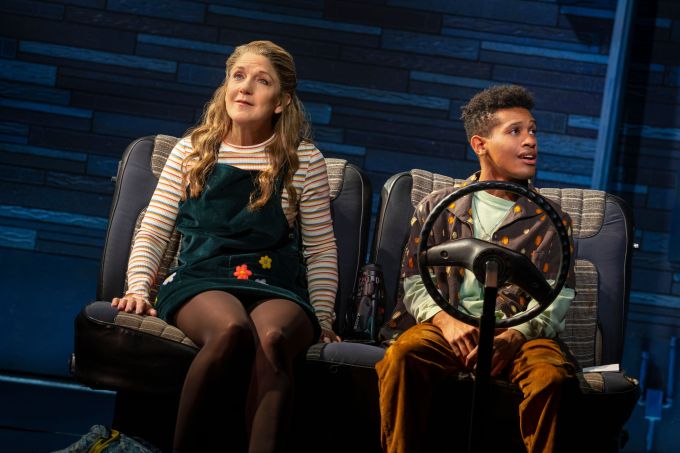
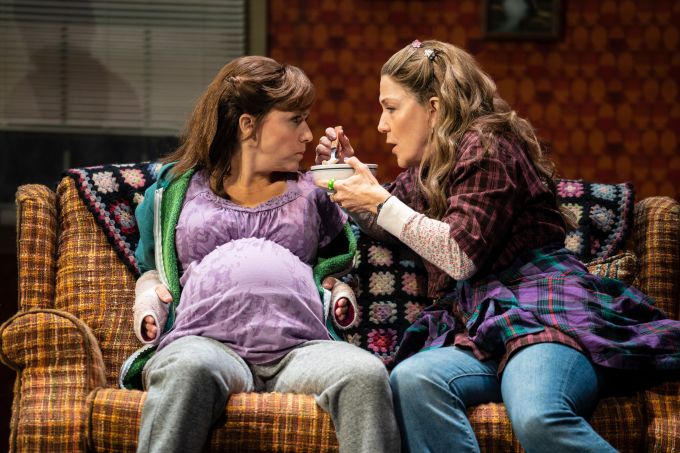
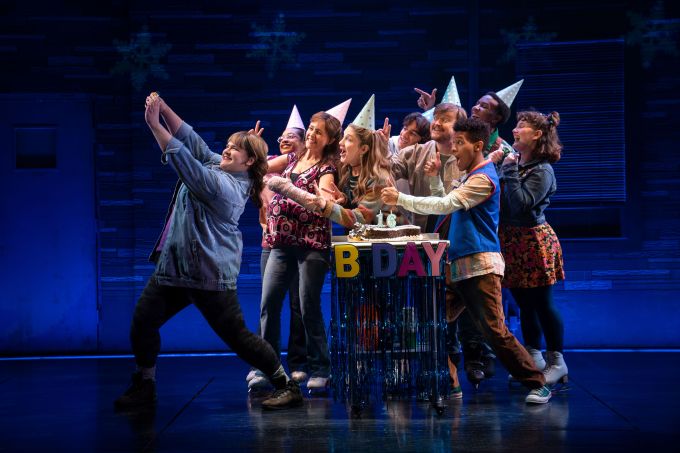
Where We Belong

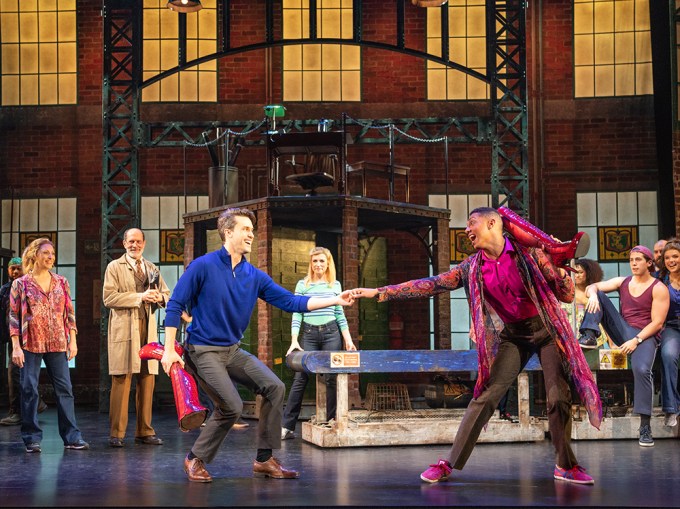
[Overview – After a pandemic pause, the American Theatre Critics Association resuscitated its annual fall conference in New York City in November 2022. It represented an opportunity for theater critics to share new insights into what is happening in the theater world nationwide; to renew acquaintances; and to catch a few plays in the heart of the theater universe. Karin, my wife+editor, and I were fortunate enough to attend four plays in diverse theater categories. They are “A Delicate Balance” (Off or Off-Off Broadway classic drama),”Where We Belong” (Off Broadway world premiere solo performance), “Kinky Boots” (Off Broadway musical revival), and “Kimberly Akimbo” (new Broadway musical moved from Off Broadway). Incidentally, the definition of the category Broadway refers to size of house, specifically capacity of 500 seats or more. 100 to 499 seats is classified as Off Broadway, and smaller is Off-Off Broadway.]

[Addendum – We were originally scheduled to see Suzan-Lori Parks’ new “Plays for the Plague Year,” but because of covid cases in their cast and staff, the performance was cancelled. Happily, The Public Theater was able to substitute this alternative premiere production which delivered a fruitful evening.]

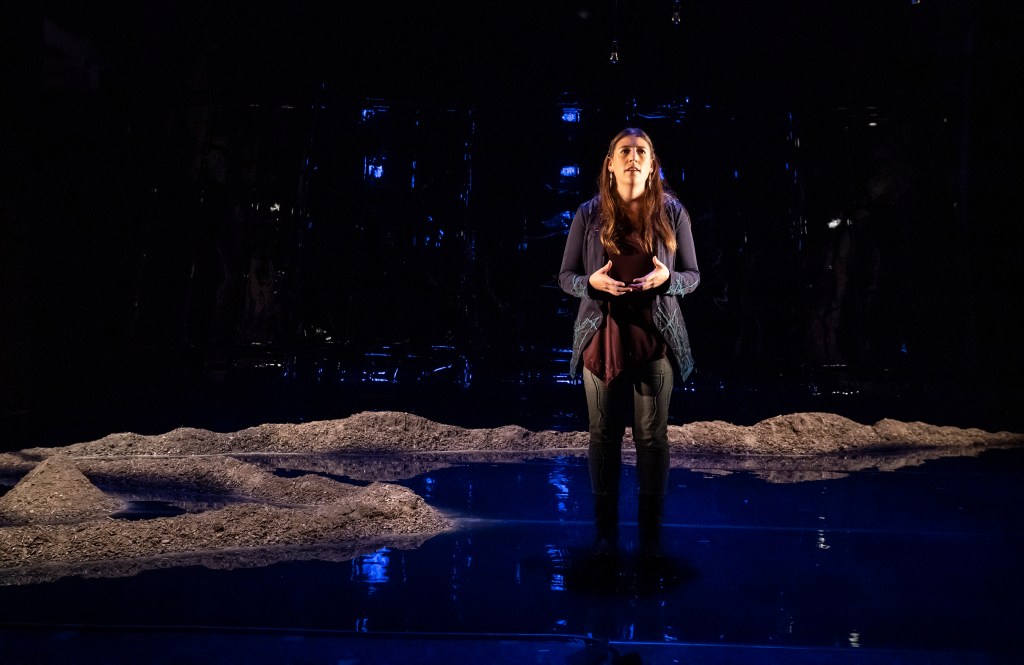
Madeline Sayet. All photos by Joan Marcus.

“Where We Belong”

Regrettably, many Americans blithely refuse to acknowledge the many blemishes in our country’s history, both officially as a government and informally as a society. As a result, we fail to learn from our mistakes. Among our most egregious acts as a country has been our mistreatment of Native Americans, including genocide. Probably the height of hypocrisy has been the abrogation of treaties with various tribes. These and many other abuses can result in feelings by the Native American population of not belonging to the main and of being conflicted in loyalty, as European-Americans have seized their land, suppressed them, and worse. And, of course, many Americans still don’t get it, or don’t want to get it, perhaps because acknowledgement does not conform with their sense of national image. It becomes embarrassing, inconvenient, and expensive.

Against this backdrop, writer, performer, and educator Madeline Sayet has written and acts in a one-person show, “Where We Belong.” The playwright comes from a mixed background of Jewish and Mohegan (known by many as Mohican) and identifies with the latter. Despite displacement and loss of population, her tribe’s roots and reservation remain in Connecticut.

The play covers much ground but explores two major themes. The more common, universal, and expected one concerns the loss of indigenous language, which resulted from U.S. federal policies that insisted on assimilation by native tribes. In school and government work environments, punishment was typically meted out for speaking in native languages. This theme has been explored in other theatrical work. Although James Fenimore Cooper’s “Last of the Mohicans” was apocryphal, the Mohegan language shrank to near extinction. Sayet shares stories about trying to reconstruct spoken language from documents and the challenges of resuscitation without native speakers to intone the words.

The more distinctive and personal story derives from the playwright’s love of Shakespeare. An avid student of The Bard, she was accepted into a doctoral program in the United Kingdom. Sayet was particularly attracted to Shakespeare’s “The Tempest” and especially the character Caliban. Parallel to the experience of Native Americans, Caliban’s territory was invaded by foreigners, and he was subjugated by the interloper. Sayet began her studies in London with enthusiasm and expectation, but one aspect of her participation disillusioned her. There was something about the way that others connected the relationship of her being Native American and succumbing to the attractions of Shakespeare as being her acceptance of Anglo superiority, which was a notion that she rejected, and which would influence her future direction.

Sayet acknowledges that her stories were not intended to be a play. However, she presents and weaves the stories with great confidence. But rather than constituting a cohesive narrative, they act as an interesting collection of related vignettes. Despite the conviction of her presentation, the pacing is somewhat pedestrian for much of the show. However, the latter third contains considerable spark with drama and animation, coordinated by Director Mei Ann Teo.

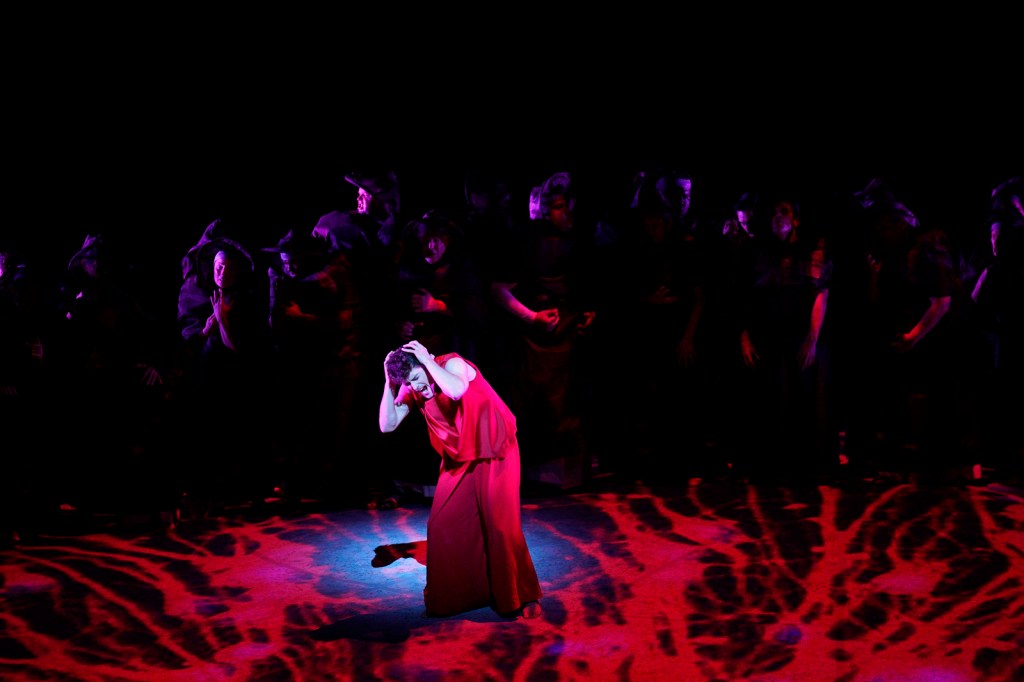
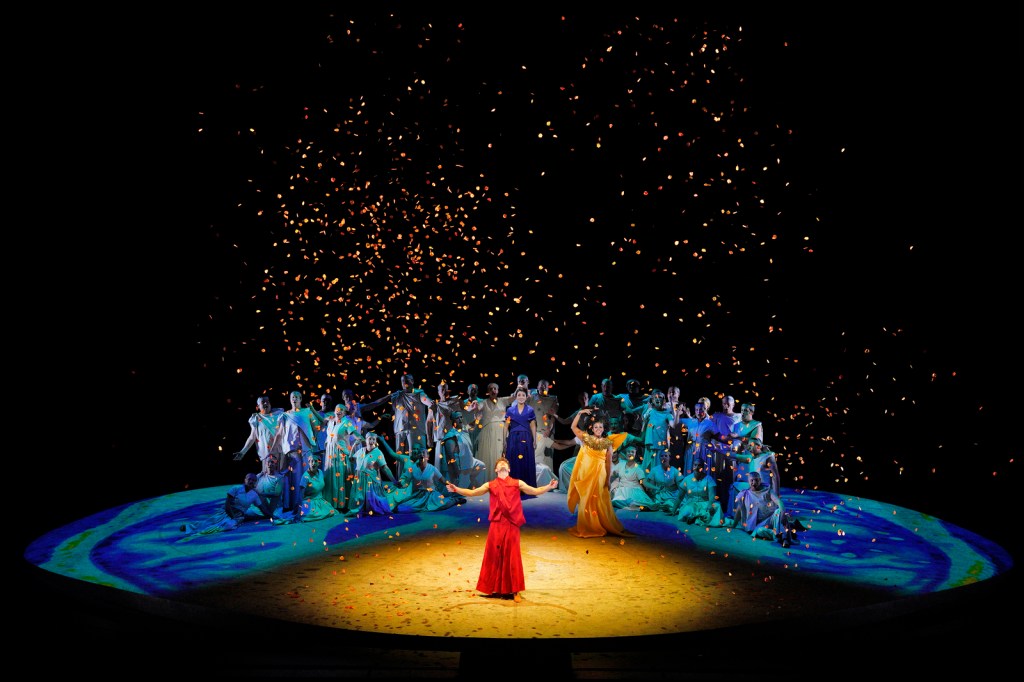
The performance is aided by uncommonly stunning production values for a solo performance. Production and Lighting Designer Hao Bai’s earthen serpentine on the stage floor symbolizes the Trail of Life with its ups and downs as well as the people who are met along the journey. A rumpled but reflective backdrop shows the distortions that we all witness in life but process inaccurately. Constellations of lights and mobile bars of florescents, along with Erik Schilke’s powerful sound design and composing stimulate the senses and enhance the experience.

The messages of the production are what is expected from one who is trying to promote respect and dignity for all peoples, particularly Native Americans. The content of the show is a bit preachy, and to a large extent, Sayet is preaching to the choir. The theater industry is in the forefront of trying to recognize American indebtedness to the original stewards of the land, and its audiences are among the most committed to diversity and mutual esteem. At the same time, these stories should be told. Hopefully, they will touch potential converts, and good will come from them.

“Where We Belong” is a world premiere written by Madeline Sayet, produced by The Public Theater, and plays on its stage at 425 Lafayette St., New York, New York through November 27, 2022.

A Delicate Balance

[Overview – After a pandemic pause, the American Theatre Critics Association resuscitated its annual fall conference in New York City in November 2022. It represented an opportunity for theater critics to share new insights into what is happening in the theater world nationwide; to renew acquaintances; and to catch a few plays in the heart of the theater universe. Karin, my wife+editor, and I were fortunate enough to attend four plays in diverse theater categories. They are “A Delicate Balance” (Off or Off-Off Broadway classic drama),”Where We Belong” (Off Broadway world premiere solo performance), “Kinky Boots” (Off Broadway musical revival), and “Kimberly Akimbo” (new Broadway musical moved from Off Broadway). Incidentally, the definition of the category Broadway refers to size of house, specifically capacity of 500 seats or more. 100 to 499 seats is classified as Off Broadway, and smaller is Off-Off Broadway.]

Manu Narayan as Tobias, Mia Katigbak as Agnes. All photos by Carol Rosegg.

“A Delicate Balance”

This Pulitzer Prize winning play written by the great Edward Albee tells the story of an upper-class couple stressed by the pressure of disruptive house guests. First, the alcoholic Claire (played by an acerbic Carmen M. Herlihy), who is sister of the wife, Agnes, alit. Claire had no other place to turn and has long been a burr under the saddle of her hosting sister Agnes (portrayed with eloquent and resentful reserve by Mia Katigbak). Agnes’s husband, the easygoing Tobias actually finds Claire a comfortable diversion from his austere wife. Then, the couple’s best friends, who have suffered from an inexplicable psychological fear, have sought a refuge with Agnes and Tobias. Finally, their boomerang daughter returns home after separating from her fourth husband.

The central antagonist is Claire, the resented guest, and her lilting sardonic humor prevents the depression from sinking to the level of Albee’s own “Who’s Afraid of Virginia Woolf?” or Eugene O’Neill’s greatest plays. The somewhat farcical treatment of events also provides relief. But the playwright’s view of relationships, whether of family or friend, seems quite grim. Is all of our togetherness obligatory or forced or driven by ulterior motives? Claire is a leech who does nothing to ingratiate herself to Agnes. When Edna and Harry show up uninvited, their sense of entitlement as closest friends extends to moving in for an indeterminant period. What’s more, when the host couple’s daughter, Julia, returns home, they not only insist that they stay in her room, but they treat her with parental authority, causing the already put-upon Julia to turn furious. The delicate balance of Agnes and Tobias’s own fragile relationship is further upset by these intrusions. Must they favor family over friends or vice versa? Is there any way they can re-establish agency and their own peace?

Tina Chilip as Julia, Carmen M. Herlihy as Claire.

Through this all, characters are faced with establishing priorities in relationships, but sadly, the playwright’s pessimism leaves virtually none unsullied by self-interest, as opposed to unselfish generosity. Although much of the context of the narrative fixes on social class and dates the action (dressiness, formalities of speech and actions, cocktails), the friction of the issues remains relevant today, and the underlying message is chilling

The distinctive feature of this production is that it employs an all-Asian cast, something that we might more likely expect to be presented in the Bay Area. The most remarkable aspect of this casting is that there is nothing remarkable. Nothing at all seems unusual about these characters being performed by Asian actors. And the performers act with great conviction. The only issue of note is that while Katigbak probably possesses the greatest gravitas among the actors, her weaker vocal projection makes it difficult to hear her at times.

Paul John as Harry, Rita Wolf as Edna.

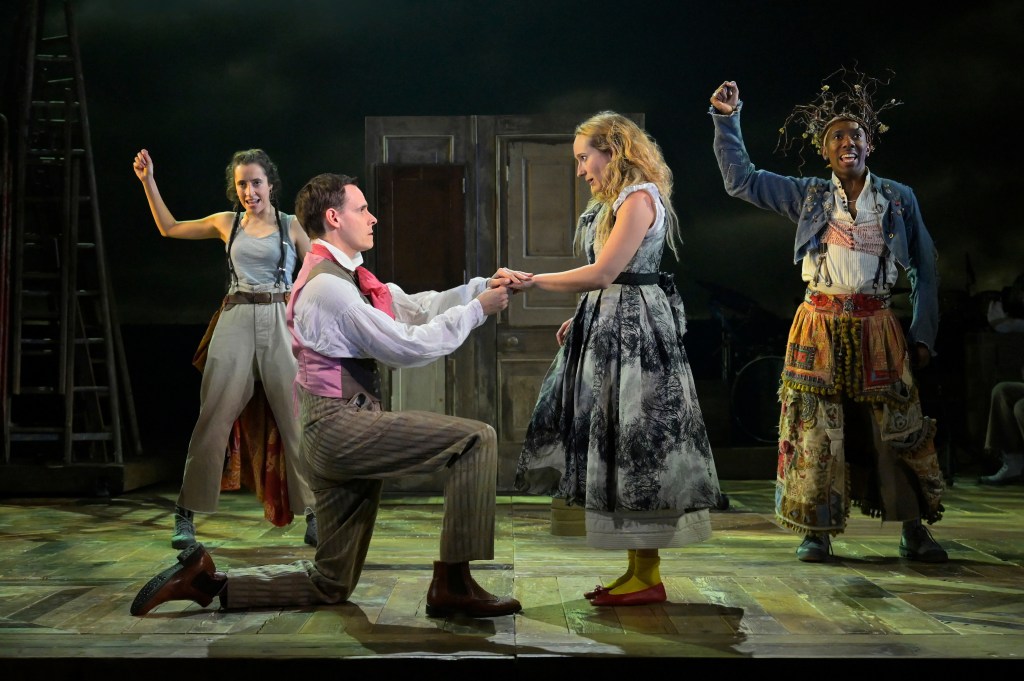
Another point of interest is the set design, as a proscenium arch theater has been turned into an in-the-round concept with audience on two sides, creating an intimacy that suits the play well – effectively turning an Off Broadway theater temporarily into Off-Off. The staging, while conventional in appearance, is quite creative with the stage raised above an apron of books and drinking glasses in separate rows (drinking cocktails is a constant pastime in the household). A huge staircase separates the characters’ intimate lives from their together lives.

Director Jack Cummings III has brilliantly realized the clash between the gracious externalities of elegant living with the hellish internalities that outsiders may never see. This is a play that always justifies revival because the underlying universal issues will never go away.

“A Delicate Balance” by Edward Albee is produced by Transport Group and plays at Connelly Theater, 220 East 4th St., New York, New York through November 19, 2022.

Clue

(front) Wilma Bonet as Mrs. Peacock, Keiko Shimosato Carreiro as Mrs. White, Sarah Mitchell as Miss Scarlett. (rear) Dorian Lockett as Colonel Mustard, Corey Rieger as Professor Plum, David Everett Moore as Mr. Green. All photos by Kevin Berne.

Murder!  Mystery!  Mayhem! are the order of the day (er – night) as Center Rep takes on the classic trapped-in-a-scary-mansion who-dunnit?  Did the butler do it?  In a play that relies on style rather than gravitas, Director Nancy Carlin pulls all the right strings to make for a fluffy and entertaining ninety minutes.

The premise of “Clue” consists of the genre standard.  Several characters unknown to one another are invited to a gathering at Boddy Mansion by the mysterious Mr. Boddy.  Guests are identified by color-coded monikers rather than their real names to protect their identities. One common connection is that they are all being blackmailed, but only Miss Scarlett, who runs an escort service, will admit it.  Guests are locked in, and murders occur.   The challenge is to determine who is (are) responsible for them.

Keiko Shimosato Carreiro, Sarah Mitchell, Wilma Bonet, Corey Rieger, Dorian Lockett, David Everett Moore, Brady Morales-Woolery as Wadsworth.

The success of the narrative depends first on the cleverness of the mystery.  To enliven matters, there is not one central thread, but multiple murders with various presumed motives, so the plot is suitably complicated with many twists and turns.  Evidence will suggest plausible explanations for some of the killings, but they may be red herrings.  To add socio-political heft to the proceedings, the mystery takes place in the Washington, D.C. area, with the House Un-American Activities Committee investigations as a backdrop, but this aspect is not properly developed in the story.

The other requisite is humor, and it flourishes.  The overall tone is farcical, with considerable physical comedy ranging from characters floundering about to corpses being propped up to seem overindulged rather than dead.  Of course, the invisible host wouldn’t be styled as Boddy if there weren’t bountiful opportunities for plays on words with the name. There are plenty, as bodies keep falling.  Each character has odd quirks.  Brady Morales-Woolery deftly portrays Boddy’s butler, Wadsworth, the central figure and orchestrator of activities or herder of cats.  A variant of John Cleese in “Fawlty Towers,” he’s in control – except when he’s not.

David Everett Moore, Caroline Pernick as Yvette, Keiko Shimosato Carreiro.

Perhaps the funniest character is Colonel Mustard, played in amusing dimwitted fashion by Dorian Lockett.  The Colonel constantly interjects eye-rolling non sequiturs and admits that when he doesn’t get things that he is “not very good at nuance.”  He and Wadsworth share a set piece reminiscent of Abbott and Costello’s “Who’s on first,” built around the Colonel’s wanting to know if there’s another body (Boddy?) in the house and getting more confused with each of Wadsworth’s ambiguous responses.

All principal characters are well-drawn, each with their own amusing schtick that provides the little filler laughs.  Sarah Mitchell as Miss Scarlett shakes her booty; Wilma Bonet as Mrs. Peacock shrieks; and Keiko Shimosato Carreiro sulks and glowers.  Overall, the cast is up to the task with exaggerated gestures and good timing.  Most of the gags prompt laughter in the right places.

Brady Morales-Woolery, Sarah Mitchell, Dorian Lockett, Wilma Bonet, Corey Rieger, Keiko Shimosato Carreiro, David Everett Moore.

Repetition is used effectively to bring laughs to several situations.  The assembled often move en masse from one room to another (but ending up in the same space on the stage), so they enact galumphing slow-motion movement on a dimmed stage to arrive at their destination.  Otherwise, various characters, one-at-a-time, provide conflicting scenarios of what has transpired.  After each tale, characters rewind, lurching backward to return to their previous positions.  Even though the audience comes to expect the device, it works successfully several times.  Finally, because matters have become so convoluted, Wadsworth gives a full review of everything that has come before, and as unlikely as it would seem, the recitation plays for laughs.

This type of comedy also relies heavily on staging to enhance effects.  Kelly James Tighe’s single-set stage design transports the audience to different venues within the house by the use of three large set elements that revolve, exposing different rooms, albeit in the same graytone colors and pattern.  Cliff Caruthers’s soundtrack is almost constantly present and includes an abundance of atmospherics like ominous music and crackling thunder to create an eerie sensation.  Similarly, Jennifer Fok’s lighting creates contrast to amplify the sense of foreboding.

Cast.

“Clue” is written by Sandy Rustin; from the screenplay “Clue” by Jonathan Lynn; based on the Hasbro board game of the same name; is produced by Center Repertory Company; and plays at Lesher Center for the Arts, 1601 Civic Drive, Walnut Creek, CA through November 20, 2022.

La Traviata

(foreground) Alonso Sicarios-León as Alfredo, Shaina Martinez as Violetta; (second row left) Jackson Beaman as Gastone; (second row right) Daniel Morris as Marquis d’Obigny, Morgan Balfour as Annina. All photos by Otak Jump.

As one of the most beloved and most performed operas in the repertoire, virtually any opera lover will know the story line of “La Traviata,” so there are few secrets here.  And in opera reviews, spoilers don’t pertain.  Briefly, Violetta is a courtesan.  Alfredo falls in love with her.  While they are living together, Alfredo’s father Giorgio appeals to Violetta, suggesting that his daughter’s engagement would be compromised if Alfredo married a woman of questionable repute.  Violetta’s graciousness in abandoning her beloved astonishes the initially skeptical Giorgio. Violetta, who has suffered consumption from the outset, dies.

Shaina Martinez as Violetta, Alonso Sicarios-León as Alfredo.

West Bay Opera takes on this war horse, and as one who had already seen six productions of “La Traviata,” you’ll understand why your reviewer approached it with little enthusiasm.  But it’s easy to forget how soaring and melodic Verdi’s music is from curtain to curtain and how it can sweep you away.  West Bay operates with the usual constraints of a small, suburban opera company in dealing with a large production like this.  Additional obstacles derive from their facility – like having a pit inadequate for the orchestra and having to place some musicians in either stage wing.  The outcome of all of these imperfections? – a great success!

Ballet dancers and chorus.

“La Traviata” opens with one of its two party scenes, and immediately, the audience is regaled with one of the opera’s myriad of highlights, the brindisi, or drinking song, ‘Libiamo ne’ lieti calici’ (‘Let’s drink from the joyful cups’).  Alfredo must sing in full voice from the outset, and Alonso Sicarios-León, performing the part, brightens up to commence a solid rendition.  He follows with the lead on the beautiful love duet ‘Un di felice, eterea’ (‘One day, happy and ethereal’) and demonstrates not only emotional power often associated with Italianate style, but a textured, rich voice with excellent control of dynamics.  He exhibits many fine qualities that are well suited to tenor roles in the 19th century canon.

Sicarios-León pairs well with his Violetta, Shaina Martinez, who joins her counterpart in the delightful Act 1 duets.  A lyric soprano, she possesses enough edge to give gravitas and strength to her mid and upper range, though her low end lacks similar penetration.  Martinez also demonstrates fine coloratura skills with quick trills and runs in her solo parts.  She offers a well-defined ‘È strano!….Ah, fors’ è lui’ (‘Ah, perhaps he is the one’).  In the ultimate scene, and adhering to one of the conventions in opera that we have come to accept, she belts out with great passion and power her ‘Gran Dio!…morir sì giovane’ (‘Great God!…to die so young’) just before dying from a lung abrading disease!

Morgan Balfour as Annina, Joshua Hughes as Grenville.

The impediment to the lovers’ happiness is Geogio, who is portrayed as sympathetically as possible by baritone Jason Duika.  He brings great earnestness to the part, and his singing is smooth and mellow, if slightly cloaked.  He also handles quick patter and his duet with Alfredo ably.  And he delivers his signature aria‘Di Provenza il mar, il suol chi dal cor ti cancellò?’ (‘Who erased the sea, the land of Provence from your heart?’) which is directed at his son with great mellifluous intensity.

Supporting roles are performed with great aplomb as well.  Morgan Balfour as Annina, Jackson Beaman as Gastone, and Joshua Hughes as Grenville were in particularly good voice for this performance, as was the chorus. The graceful ballet dancers choreographed by Kara Davis provide an excellent diversion.

Alonso Sicarios-León as Alfredo, Shaina Martinez as Violetta.

As usual, General Director and Conductor José-Luis Moskovich marshals a fine orchestra and production.  Of course, the party scenes in particular require special attention, and director Igor Vieira ensures their grandeur.  Peter Crompton’s set follows the West Bay template with multiple stage levels, massive columns, and projections that produce considerable scenic detail in two dimensions.  Callie Floor’s costumes give the requisite elegant period look.

“La Traviata,” with music by Giuseppe Verdi and libretto by Francesco Maria Piave is based on the novel “La Dame aux Camélias” by Alexander Dumas fils, produced by West Bay Opera, and plays at Lucie Stern Theatre, 1305 Middlefield Road, Palo Alto, CA through October 23, 2022.

A Nice Family Gathering

(Rear) Alejandra Wahl as Stacy, Peter Marietta as Carl, Kyle Smith as Dad (visible only to Carl). (Foreground) Marsha Howard as Mom (facing away), J. Aaron Seymour as Jerry, Byron Guo as Michael. All photos by Grizzly de Haro.

What tradition is more American than a family get together for Thanksgiving dinner?  Phil Olson’s “A Nice Family Gathering” occurs on such an occasion, but with a couple of wrinkles.  It takes place in Minnesota, embracing a panoply of only-in-Minnesota traits, including the dialogue being delivered in droll sing-songy Scandinavian-American accents, replete with the signature “you betcha!”  And, oh yes, there’s a spirit in the house that has nothing to do with alcohol.

Altarena Playhouse has taken this endearing and hilarious parlor comedy and made it their own.  Under the masterful direction of Kimberly Ridgeway, every role is performed exquisitely with crackling comedic timing.  The play moves briskly, offering a laugh-out-loud evening with just the right soupçon of sentimentality.

Peter Marietta as Carl.

Missing from the reunion is Dad, a physician who died 10 months before.  However, unbeknownst to others, his ghost appeared to son Carl at his funeral, and he has returned for Thanksgiving.  In a chatty column that Carl writes for the local weekly paper, he had captured his father as “the man who loved his wife so much that he almost told her.”

Now, the deceased wants to tell his widow how much he loved her.  Higher authorities have designated Carl as his mouthpiece, but the son begrudges the assignment, because he never felt that his Dad really loved him.  Mom shows symptoms of Alzheimer’s, and it’s not clear how she would respond to supposed communication from beyond the grave.  Complicating matters, she has invited a date to dinner, Jerry, who was a golf buddy of Dad’s.  You can imagine Dad’s reaction to that.  As Dad, Kyle Smith mines his irascibility with sardonic humor.  He convinces as one who regrets that he didn’t express his love for all of his family when he was alive.

Alejandra Wahl as Stacy, Missa Perron as Jill, Marsha Howard as Mom.

Beyond the ethereal thread in the narrative, a family in dysfunction unveils.  Mom, who is played in appropriately drowsy understatement by Marsha Howard, is a doozy.  She delivers hot water that is supposed to be coffee; blithely draws everyone’s attention to announce an agenda for the day comprised of one item; and can’t remember her daughter’s name, if she can remember her at all.  But when she discusses her estate, she sounds like a Certified Financial Planner.

Despite Mom’s isolation and mental state, her children rarely visit. Carl, the central character who communicates with the living and the one dead, has the opportunity, but he’s both self-indulgent and self-conscious.  He hopes to earn a living as a writer, and like most artists, he identifies himself by his aspiration.  What pays the rent is driving a Pillsbury Doughboy truck, so he hasn’t set the world on fire.  As Carl, Peter Marietta brings great charisma, yet he uncovers the character’s ambivalence and resentment and makes him quirky and very funny.

(foreground) Marsha Howard as Mom, Peter Marietta as Carl, (rear) Alejandra Wahl as Stacy.

Older brother, Michael, played by an effusive, confident, and condescending Byron Guo, has met Dad’s expectations.  He possesses the trappings of being a physician, from the country club to the BMW, but he has marital issues, as evidenced by the frequent crying fits of wife Jill, effectively portrayed by Missa Perron.  Alejandra Wahl captures the diffidence of younger sister, Stacy.  Who knows whether her timidity is the cause or the effect, but everyone around seems to forget or ignore her.  However, she will come to life with surprises that will grab everyone’s attention.  Finally, J. Aaron Seymour nicely conveys the slipperiness of the interloper, Jerry, who tries to ingratiate himself with Mom and her protectors.

Objectively, most of the characters in “A Nice Family Gathering” are not sympathetic, but the plights that they confront are common, and their frailties are human and understandable.  The goofiness of their personas, exacerbated by their accents, also take the edge off of their weaker traits.  Humor abounds.  Mom tells a pizza story with a conclusion that is a total non sequitur.  That story and the implausible ending are even reprised to more laughter.  Carl frequently must cover up for talking to his invisible Dad by acting as if he’s talking into his recorder.

Finally, the staging enhances the overall effect.  Tom Shamrell’s single-set design expresses hominess and works nicely to allow activity in the main room as well as outdoors.  Stephanie Anne Johnson’s usually unobtrusive lighting with occasional directional floods is very effective.

J. Aaron Seymour as Jerry, Marsha Howard as Mom, Kyle Smith as Dad (invisible), Byron Guo as Michael.

We can often overlook any deeper meaning when seeing a comedic play, but this one actually has a lot to say.  It honors selfless mothers; urges the courage to say and do the right things before it is too late; advocates following our dreams; pillories slavish devotion to status symbols; and asks us to better understand those who are near to us.

“A Nice Family Gathering” by Phil Olson, is produced by Altarena Playhouse and is performed on its stage at 1409 High Street, Alameda, CA through November 20, 2022.

Dialogues of the Carmelites

Heidi Stober as Blanche, Michaela Schuster as Madame de Croissy. All photos by Cory Weaver.

How fitting that “Dialogues of the Carmelites” should be produced by San Francisco Opera in its centennial year and that the production should be so brilliant and stunning.  Not only did Francis Poulenc’s opera have its U.S. premiere here in 1957, but the performance by the great Leontyne Price as the New Prioress, Madame Lidoine, represented her career launch in a big house with a major company.

Poulenc requested his opera be performed in the language of the audience because he wanted it fully understood.  However, with the advent of supertitles, San Francisco Opera offers it for the first time in French, the libretto language to which the music was designed, without the sacrifice of translation nuance.

Religious operas, or more broadly, those concerning faith, can be fractious.  “Dialogues” is based on the true story of 16 Carmelite nuns of Compiègne who were guillotined in 1794 during the French Revolution’s Reign of Terror because of their unwillingness to compromise their faith.

Michaela Schuster as Madame de Croissy, Heidi Stober as Blanche.

We live in a divided age when many have abandoned religion, and the Bay Area represents the leading edge of humanistic thinking unfettered by religious stricture.  So how can such a story speak to a community like ours?  Although its religious trappings are unrelenting, universal themes underpin the story – communal and personal love; growth and change; courage and sacrifice.

Poulenc himself was a troubled soul – committed to Catholic doctrine despite being gay.  He also suffered the untimely loss of a dear friend from decapitation, leaving him profoundly depressed.  Although he relied on detailed source material to create “Dialogues,” he penned one fictional character, the protagonist, Blanche.  No doubt, his personal history led him to this particular material, and his own fears and conflicts are manifest through his fictional character.

Deanna Breiwick as Constance, Heidi Stober as Blanche.

This opera rightfully stands as one of the post-Puccini era’s most often performed.  Perhaps one reason is the melodiousness of its score, in contrast to much modern opera.  Poulenc even joked that he was sorry, but his nuns insist on singing tonally.  Yet the vocals consist mostly of recitatives and arioso, with little that could be considered arias.  However, the orchestra, guided decisively by Eun Sun Kim in this production, adds color, particularly with accents and percussive punctuation.

The plotline centers on Blanche, performed by a scintillating Heidi Stober, sometimes brittle in her character but assertive in her singing.  She is a coddled aristocrat who fears for her life during the Reign of Terror and seeks escape in the convent.  Madame de Croissy, the “Old Prioress,” is dubious, noting that the convent is a place of prayer, not of refuge, but she relents.

As Croissy soon lies dying a difficult death, she grapples with her having accepted Blanche as the most recent novice.  More significantly, Croissy had been a sturdy and brave leader who reveals uncharacteristic anguish and fears death during her decline.  Michaela Schuster provides the opera’s most powerful and harrowing soliloquy in her lengthy death scene, aided by a scenic device in which her bed is set vertically on a wall to allow her singing to project better.

Michelle Bradley as Madame Lidoine (center).

To cognoscenti, “Dialogues” can be appreciated with great depth beyond the superficial plot.  In the aforementioned scene, Constance, the other novice, notes that Croissy’s gruesome end, despite her past strength, means that she is dying someone else’s death, and in this case, it is in exchange for Blanche who will then face death with courage and calm.  This pertains to the religious notion of belonging to a Beloved Community and to the sacrificial love aspect of agape.

Another layer that most will miss is the richness from the unusual pastiche that the composer employs.  Each of the five key principals shares personal traits and musical motifs with heroines from earlier operas.  Blanche (Heidi Stober) reflects the title character in “Thaïs,” Constance (Deanna Briewick) is Zerlina from “Don Giovanni,” Croissy (Michaela Schuster) is Amneris from “Aida,” Marie (Melody Moore) is Kundry from “Parsifal,” and Madame Lidoine (Michelle Bradley) is Desdemona from “Otello.”  All of these artists meet the demands of their roles, with Bradley displaying the most commanding voice. The men, led by Ben Bliss as Blanche’s brother, also impress.

Olivier Py, who designed the original realization of this production also adds symbols to enhance the opera’s complexity.  Several dioramas representing moments in the life of Christ embellish the action, two of which will resonate with most opera goers.  As the nuns await their doom, they appear in a scene reflecting the Last Supper, and later, a Crucifixion tableau links their faith to their deaths.

Efrain Solis as Jailer (upper left window), cast.

The overall abstract stage design symbolizes the nuns’ appearance and lives.  The set can be described as “a study of right angles in shades of gray, with movement.”  Charcoal gray abounds, and spectral color appears only as occasional highlights.  The austerity of the set fits well with most of what it represents, especially the convent and the prison, and the versatility and mobility of the pieces is striking.

The musical composition of “Dialogues of the Carmelites” is strong, with intense characterizations, although the narrative moves slowly at times.  Add excellent artistic design and strong portrayals to make for a memorable experience.  And if impression and memory are dominated by recency, the opera goer will leave the house with a vivid and despairing chill as the nuns depart the stage one by one to the swishing, thudding sound of the guillotine and the convulsing of their bodies to the violence of politics gone mad.

Cast.

Historically, the nuns’ singing as they ascended the gallows quieted the bloodthirsty crowd that gathered at these beheadings.  In less than two weeks, Robespierre’s degenerate reign ended with his execution at the guillotine.

“Dialogues of the Carmelites,” with music and libretto by Francis Poulenc and based on the play of the same name by Georges Bernanos is produced by San Francisco Opera and plays at War Memorial Opera House, 301 Van Ness Ave., San Francisco, CA through October 30, 2022.

Sex With Strangers

Matthew Kropschot as Ethan, Allison F. Rich as Olivia. All photos by Dave Lepori.

Some years ago, when the partisan, caustic, and confrontational Bill O’Reilly was Fox Television’s most highly rated commentator, he was interviewed by a correspondent from another network.  During the exchange, he averred that his real personality, known to friends and neighbors, was much different than his celebrity persona.  He proudly claimed to be a mild-mannered, accommodating friend and family man.  What amounts to his plea for respect raises two questions.  Which is the real character, or do both realizations deserve recognition as life forces?  Also, what is the relative importance of the purported private personage who influences tens of people to the public personage who influences millions?

Laura Eason’s “Sex With Strangers” explores the concept of public versus private behavior and much more.  At first, it seems that this may simply be an amusing story, but the longer it plays, the deeper it gets, exposing many sometimes provocative layers, peppered with humor and conflict.  San Jose Stage presents a sensationally acted and directed production of this powerhouse two hander.

How many English teachers are frustrated authors hoping to write the great American novel?  Olivia aspires to just that, and in fact, she’s taken one step in the right direction having published a novel that received many positive reviews, but paltry sales revenues.  One winter break, she sequesters herself alone in a cottage rented out by a friend.  Unexpectedly, another guest arrives during a snowstorm.  It turns out that the younger Ethan is not only a writer as well, but surprisingly, he has read her book.  Shortly, she finds that his joining her in this isolation was no accident.

Allison F. Rich exquisitely captures the archetype that Olivia represents.  She subsumes her urges beneath a mantle of intellectual superiority, cocooning herself with tomes from the likes of Tolstoy and Marguerite Duras while sipping a glass of wine.  But as she minces about pigeon-toed, her reserve and seeming serenity belie deep-seated insecurities about fear of failure.  Having lost at love and unable to endure the occasional negative reviews that her book received, she has withdrawn into a satisficing, defensive existence.

Ethan blasts into her scene like a blue norther, and Matthew Kropschot perfectly explodes into Ethan’s uninhibited and fearless personality.  He is chalk to Olivia’s cheese.  He meets her curtness, suspicion, and protectiveness with audaciousness, soon asking her for a glass of wine and later sex.  His swaggering effusiveness towers over her, and he represents virtually the opposite of everything that she values, breaking all rules of propriety from the outset.

Although he contrived this rendezvous because he respected her writing, it was his books that spent several years on the New York Times best seller list.  The hitch is that they were books about his sexual conquests with virtual strangers, which like his personality, repels Olivia.  But she realizes that he is intelligent.  Upon his establishing some credibility, he gives her encouragement and admiringly quotes from her book.  Olivia’s social and sexual repression break loose.  She soon finds herself attracted to the side of him that she experiences, but still wonders about the callous, misogynistic person in the exploits of his books.

As their relationship evolves, the question of Ethan’s motivation arises as well.  Here is a man in his late 20s with a massive libido and an impressive history of variety seeking in bedding partners.  Why, all of a sudden, is he so interested in an older woman more comfortable in a library than a bar?  Is he really so taken with her intellect and her writing that he can quiet his hormonal hunt?  Can he be using her, and if so, for what?  Although he is starting an app to help less-known authors reach their audience, how big a prize catch would a virtual unknown, part-time writer with one book published represent?  Does he see romance with Olivia as a step toward respectability?

The play covers quite a bit of territory, built in part around the impact of the Internet.  At a generic level, it alludes to changes wrought in personal behavior and privacy.  More specifically, we see the effect on the publishing industry of electronic media, which has decimated the print world.  Ever the resistant traditionalist, Olivia loves the look and feel and even the smell of a real book.  Ethan is an unsentimental man of the moment.

Ultimately, clashes will occur.  Olivia, who is strongly guided by moral principles, will be asked to compromise and reciprocate for benefits that she receives.  But what makes her situation particularly prickly is that there are numerous ways that a debt can be repaid, and the payback expected is in a currency most dear to her.

The characters face numerous conundrums and must deal with significant questions.  Who are we – really?  Do we always apply the same moral rules to ourselves that we place on others?  Are we all willing to compromise our principles, but it’s only a matter of price?  How significantly can or do peoples’ personalities really change?  Can many ethical missteps from youth simply be ascribed to growing up?

“Sex With Strangers” deals with these issues and more.  The playwright confronts these matters in a riveting narrative that totally engages.  It is hard to imagine two actors providing more dazzling performances than Allison F. Rich and Matthew Kropschot, and Director Johnny Moreno deserves recognition for maintaining the pace throughout.   In case it’s not clear, this reviewer liked the play – a lot.


“Sex With Strangers” is written by Laura Eason, produced by San Jose Stage, and plays in its theater at 490 South First Street, San Jose, CA through October 30, 2022.

The Music of Mothers

Kim Donovan as Ethyl, Chelsea Bearce as May.

Don’t they understand that what they characterize as color-blindness simply perpetuates white privilege?  Why won’t they admit that even though they make exceptions for select members of the minority community that they adhere to white supremacy?  Why don’t they see that every news outlet that disagrees with the right-wing media is not left-wing media, but often just reporting events as objectively as they can?  Why don’t his supporters realize that even though his detractors hate him, that everything is not about him?

As May often proclaims, she and Ethyl were best friends from the time they were in-vitro.  They grew up as Generation Xers on the poor side of El Paso, living next door to one another their whole lives in a neighborhood that was mostly black.  They married, and even had their only offspring, both boys, around the same time.  The boys would grow up as classmates and best friends.  May is black.  Ethyl is white.

Chelsea Bearce as May, Elijah Waller as her son R.J.

Victoria Evans Erville has crafted a thoughtful rendering about a roller coaster of friendship and motherhood that touches many bases, intensified by dimensions of race and sexual identity.  We meet the young women in 1996 when May is about to give birth.  They reveal lightheartedness and a bonding that has over two decades of history as juveniles.

They now see life as adults, and a sharp divide occurs when discussing May’s husband Randal’s deployment to the Middle East.  Ethyl’s perspective focuses on Randal’s pride in soldiering and his helping to make America safe by fighting a war far from home.  But May resents that because of being a black man, his options are limited.  The military was his only way out, and he risks his life for a cause that she questions.

For the remainder of the play, the women, and later their sons, will meet in their yards.  History will march on and political and social events will color their lives, especially the Obama and Trump presidencies.  Although they continue to share moments, episodes will increasingly reflect their divergence.  May becomes protective of and fearful for her son because of the constant threats faced by young black men.  Increasingly, Ethyl buys into the narratives posited by Fox News.  She also suffers from denial about her son’s being gay and resents that he favors May over her.

Dylan O’Shea as Troy, Ethyl’s son; Kim Donovan as Ethyl.

The two lead actors give masterful performances.  Chelsea Bearce portrays May deftly, capturing her fierce determination that she can better herself and that her son should have a better life than his father.  The conviction of her beliefs born of painful experience is convincing.

Kim Donovan embodies an archetype most feared by political liberals.  She conveys charm and friendliness that belie deep-seated biases.  Like many of her ilk, the privilege afforded her is ingrained.  She succumbs to fallacious arguments about the liberal press and fake news and is impervious to facts, so that converting her with truth is difficult.  She turns vignettes about individuals who are outside of her tribe into generalizations about whole communities but fails to apply the same principles to her own people.  Further, she diminishes the pain of other groups by equating that “we all have our crosses to bear,” not appreciating that blackness, unlike gayness or political beliefs, can’t be hidden or modified.

In a final episode, the women are confronted with an unexpected challenge.  May has criticized Ethyl for lacking empathy, and when prodding her to do the right thing, May levels what should be a haymaker to any professed Christian – “What would Jesus do?”  Regrettably, many who claim to follow Christ would not act in accordance with his teachings.  What will Ethyl do?

The playwright, who also directs, dispatches a dizzying number of important social messages and does so in an entertaining and involving manner.  The central theme considers the effects of politics on the two lifelong friends, and while May remains consistent throughout, Ethyl offers more interest as a character because she evolves, and not always in one direction or with consistency, which makes for a more intriguing person and reflects realism.

Kim Donovan as Ethyl, Chelsea Bearce as May.

Another thread concerns family relationships.  Though both women love their sons, even true familial love doesn’t always run smooth.  The grabber to the title of the play, which is “Mothering is a political act,” also makes a commentary on modern life and why people have children.  In past times, procreation was largely automatic with comparatively little thought of consequences.  Now it has become a more conscious decision that reflects beliefs and expectations.

Many new plays undergo revision even after their premieres, and some aspects of “The Music of Mothers” might deserve reconsideration.  The plot contains endless issues, but it could use more intense dramatic conflict to support them.  With all of the fear raised because of one boy being black and the other gay, they don’t experience physically damaging incidents to validate the concerns.  Also, the matter of the white son being gay and the mother’s denial recurs often, but some references seem repetitive.

Kudos for simple but effective staging – Seafus Chatmon for scenic, Stephanie Johnson for lighting, and Dave Ragaza for sound design.

A final comment is that in the world of the Bay Area, this play is preaching to the choir.  For it to have legs and persuade the unwashed, May might need to have more flaws, even if she should undeniably be the better person.  Meanwhile, it is for our crowd to enjoy.

“The Music of Mothers” is a world premiere written by Victoria Evans Erville, produced by TheatreF1rst, and performed at Live Oak Theater, 1301 Shattuck Ave., Berkeley, CA through October 23, 2022.

The Elixir of Love

Christopher Bozeka as Nemorino, Elena Galván as Adina, Samuel J. Weiser as Dr. Dulcamara, Alba Franco-Cancél as Giannetta, Andrew W. Potter as Belcore. All photos by Barbara Mallon.

Opera can be the most weighty and severe of the performing arts.  Thus, when a frothy and fun piece comes along, it may seem like a guilty pleasure.  So it is with “The Elixir of Love” (L’elisir d’amore). But make no mistake, it flows from the same pen that gave us distinguished works like the dark “Lucia di Lammermoor” and the trifecta of Tudor-period operas, as well as other great operas buffa like “Don Pasquale” and “Daughter of the Regiment.”

Although Donizetti concocted this superficially light-hearted confection, “Elixir” is a serious delight from curtain to curtain, both as an entertainment and as a great work of composition.  As we have come to expect, Livermore Valley Opera once again punches above its weight with a totally appealing production that hits all the right notes, literally and figuratively.  This rather small-scale production works well in a smaller house, and the performing artists do a magnificent job with singing, comic acting, and playing.

Christopher Bozeka as Nemorino, Elena Galván as Adina.

“Elixir” tells the story of peasant Nemorino who is in love with landowner Adina, a woman above his station.  Of course, Adina shows no interest in Nemorino.  Itinerant “medicine man” “Dr.” Dulcamara will provide the elixir of the title that he promises will make the consumer irresistible.  Complications follow, and happily, the ending meets expectations.

Appropriate to our California home, Adina is portrayed not just as any landowner, but as the owner of the vineyard, where the opera is set.  The charming stage is comprised largely of features like grapevines and the winery depicted cartoon-like in two-dimensions.  Even Dulcamara’s medicine wagon appears on a flat, moveable panel, but this artistic contrivance pleases.

Andrew W. Potter as Belcore, Christopher Bozeka as Nemorino.

Melody abounds in “Elixir,” and even the recitatives, which seem infrequent, sound unusually melodious.  From Nemorino’s opening aria, ‘Quanto è bella!’ about how gorgeous he finds Adina, we sense how beautiful the music will be.  As importantly to this production, we know from his very first phrase that Christopher Bozeka as Nemorino will regale us with a wonderful tenor instrument possessing an emotion-filled Italianate lilt with a big tremolo that suits this work so well.  In addition, his fine comic acting makes Nemorino a funny and sympathetic character.

In answer, Elena Galván, who has graced Bay Area opera stages in several productions, equally captivates as Adina.   From her first arias about an elixir that she has read about, ‘Della crudele Isotta,’ and about her fickleness as a lover in ‘Chiedi all’aura lusinghiera’ she displays not only a commanding middle range but some spinto characteristics. She possesses an extremely powerful yet seemingly effortless top end and a facility for rapid patter – a skill required of male roles on several occasions as well.  Toward the end of the evening, Galván reveals her versatility with an astounding array of vocal gymnastics.

Cast.

It’s not enough that Adina has rejected Nemorino, but she falls instead for Belcore, a sergeant in the visiting army regiment.  That part is played by the towering figure of Andrew W. Potter, who diminishes Nemorino physically and with a dominating, confident swagger as well.  Belcore’s role is written for a baritone, and Potter handles that range quite smoothly and mellifluously.  However, he is actually a lyric bass, and there is one passage for which he deftly descends into an almost basso profundo mode.  It is so far out of baritone range that it presumably was written in as an alternative for a deeper voice.

Into the fray comes the snake oil salesman, Dulcamara, who has no interest but making a quick buck and a quicker getaway.  Although the character perpetuates fraud, he is played in a jovial manner by baritone-bass Samuel J. Weiser with little edge and a fair bit of charm.  He sings with great verve, though his timing with the orchestra is not always on.  Dulcamara facilitates the merriment and confusion by plying Nemorino with a supposed elixir that gives him a shot of courage to take on his challenges.

Christopher Bozeka as Nemorino.

Can any review of “The Elixir of Love” fail to mention its signature aria, ‘Una furtiva lagrima’?  The mournful air, accentuated by the interplay of the tenor’s voice with the haunting bassoon, makes it one of opera’s memorable pieces.  As with all of his singing, Bozeka delivers the goods with a passion-charged rendition of this beautiful piece that received a well-deserved extended applause with bravos from the audience on opening night.

The composer has also created a number of attractive ensemble pieces, which are as well executed as designed.  A final mention goes to the Alexander Katsman conducted orchestra and the chorus.  For their size, they create a very full and rich sound that enhances the overall production and contributes to a memorable experience.

Elena Galván as Adina.

“The Elixir of Love” (L’elisir d’amore), composed by Gaetano Donizetti with libretto by Felice Romani after Eugène Scribe’s text based on Daniel Auber’s opera “Le Philtre,” is produced by Livermore Valley Opera, and plays at Bankhead Theater, 2400 First Street, Livermore, CA through October 9, 2022.

Indecent

Cast. All photos by Jessica Palopoli.

The bare, blackened, back stage and proscenium arch represent the tabula rasa upon which theater brings joy and sorrow.  But what of its only props – several suitcases?  Do they signify the travel of the play and its artists from place to place?  Do they signal a search for a safe haven?  Or do they hold the meager possessions that its owners would be allowed to carry with them to concentration camps and probable extermination?

Decorated playwright and professor Paula Vogel wrote several successful plays and mentored fellow Pulitzer Prize winners Lynn Nottage, Nilo Cruz, and Quiara Alegria Hudes as well as Sarah Ruhl and others.  But only in 2017 did her own work finally reach Broadway with “Indecent,” which would become a Tony Award winner.  San Francisco Playhouse and Yiddish Theatre Ensemble offer an immensely powerful production of this equally powerful play, a metatheatrical treatise of the highest order.  It makes for thoughtful and compelling drama that should not be missed.

Billy Cohen, Dean Linnard.

The genesis of “Indecent” begins in Warsaw in 1906.  Young author Sholem Asch has written a Yiddish play called “God of Vengeance,” which acts as a play-within-a-play in “Indecent,”  as scenes from the former appear throughout the latter.  Portrayed passionately and with grand gestures by Billy Cohen, Asch entreats other writers to participate in a table reading.  After the reading, I. L. Peretz, Warsaw’s most distinguished Yiddish author, tells Asch to burn the play.  Despite contentiousness and only a modicum of support, a Yiddish language company produces the play.

Over the next several years, “God of Vengeance” would be translated into various languages and travel to the major theater centers of Europe.  The contemporary play depicts highlights of issues faced by the earlier one as it spread to foreign locales.   Early on, it was presented in Yiddish in lower Manhattan, but it wasn’t until 1923 that a production of an English translation appeared “uptown.”

Rachel Bochan, Victor Talmadge, Malka Wallick.

Vogel takes us on a riveting journey through that historical evolution of “God of Vengeance” from launch to acclaim to disrepute and beyond.  Through “Indecent,” we learn of the essence of “God of Vengeance” – of the artists involved and of the times; of its connection through the Holocaust; and to Asch’s being called before the U.S. House Un-American Activities Committee.

Although many in turn-of-the-century Europe, particularly Jews, considered the earlier play blasphemous, only when its forbidden love was seen by gentiles in the United States was it broadly deemed as indecent.  Legal actions were triggered, albeit, initiated by an assimilated rabbi.  Because it was withdrawn by the playwright around World War II, it hibernated for decades and was nearly forgotten before the welcomed revival of this culturally significant work.

Cast.

Asch’s play was incredibly daring for its time, especially given its originally intended audience.  First, an observant Jew runs a brothel in the basement of his home.  Then, his daughter falls in love with one of his prostitutes, which results in lesbian action and narrative.  Along the way, a Torah scroll is desecrated.  Many Jews found these plotlines not only scandalous and sacrilegious but anti-Semitic. 

“Indecent,” Vogel’s love letter to Jewish culture and to theater possesses many moving parts, and Director Susi Damilano mixes them with great skill and nary a false move.  Without a distinguishing set, other artistic elements establish the vitally important tone of the play.  Perhaps the period music most imbues the feel of narrative.  A klezmer trio often shares the stage with actors, playing the mostly sad and occasionally fast paced music of Eastern European Jewish stetls.  The instruments are sometimes accompanied by voice and often by the Nicole Helfer choreographed folk dances of the place and time.  Costumery gives an authentic look to the cast, and Wen-Ling Liao’s high contrast lighting adds drama.

Ted Zoldan, Billy Cohen.

An exemplary cast of seven fine actors deliver the goods.  Each plays multiple roles in the play and the play-within-a-play, often requiring different accents and languages.  Apart from Cohen, Dean Linnard stands out in his main role as Lemml, who provides comic relief as he mangles various languages.  A nebbish who was an early supporter of Asch, he finds his footing as the stage manager of the traveling “God of Vengeance.”  Ultimately, he becomes demonstrative and demanding and challenges Asch’s integrity with great determination when the play is watered down to accommodate the marketplace without the playwright’s protest.  The theme of censorship, and how it reflects political and social weakness rather than strength, especially resonates in today’s increasingly intolerant and divisive environment.

Cast.

“Indecent” is comprised of many vignettes that build the drama.  Some evidence pathos, especially those of the Holocaust and Asch’s emotional withdrawal after witnessing pogroms in Lithuania.  At least one offers joy and release, the rain scene between the brothel owner’s daughter Rivkele and the prostitute Manke from “God of Vengeance.”  It may be considered in content and significance as a lesbian corollary to the balcony scene in “Romeo and Juliet.”  It reminds us that love of every kind brings goodness to the world.

Rivka Borek, Malka Wallick.

“Indecent,” written by Paula Vogel, is produced by San Francisco Playhouse and co-produced with Yiddish Theatre Ensemble, and plays at SF Playhouse’s stage, 450 Post Street, San Francisco, CA through November 5, 2022.