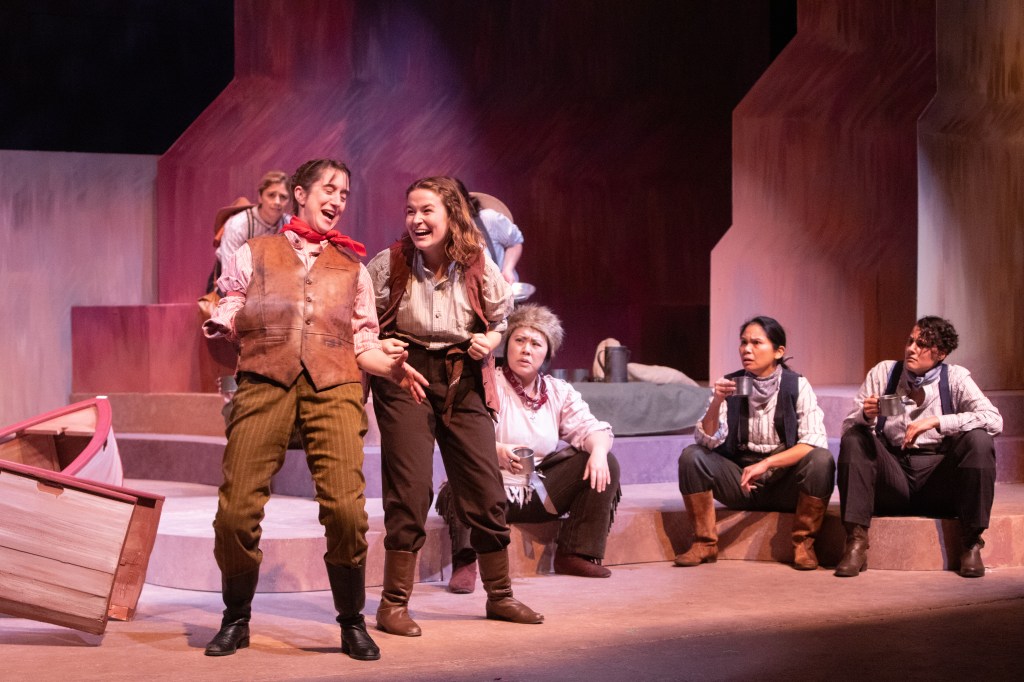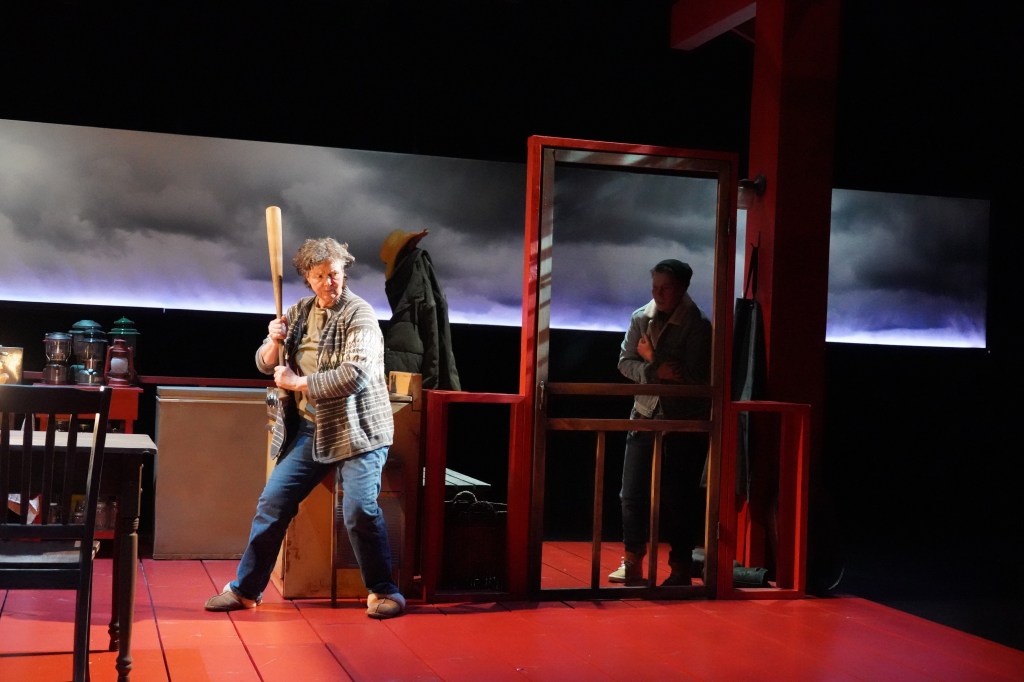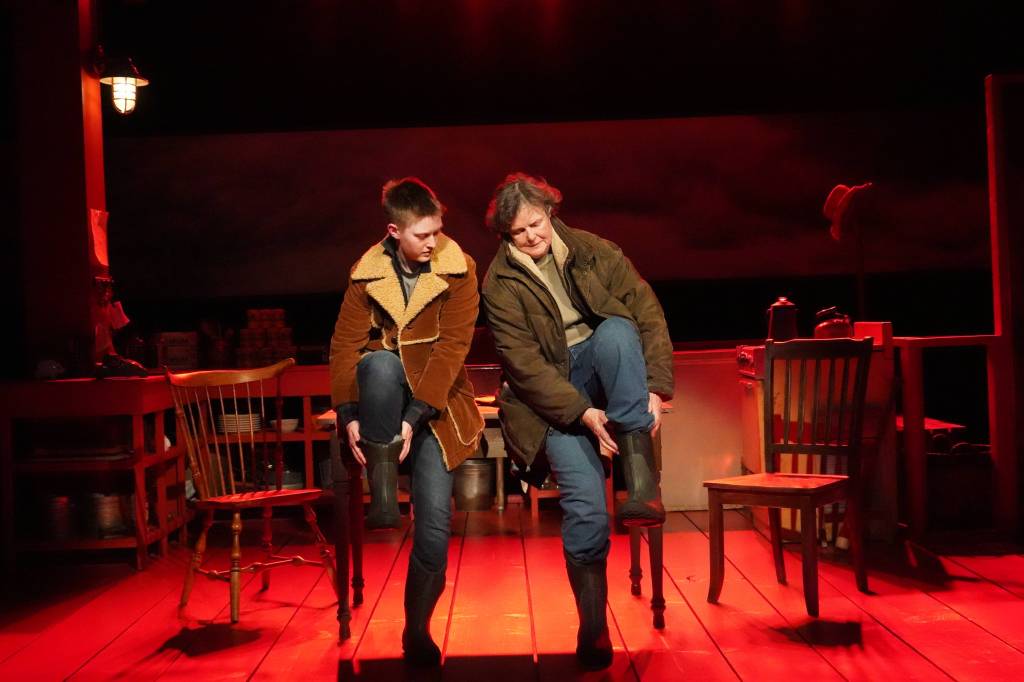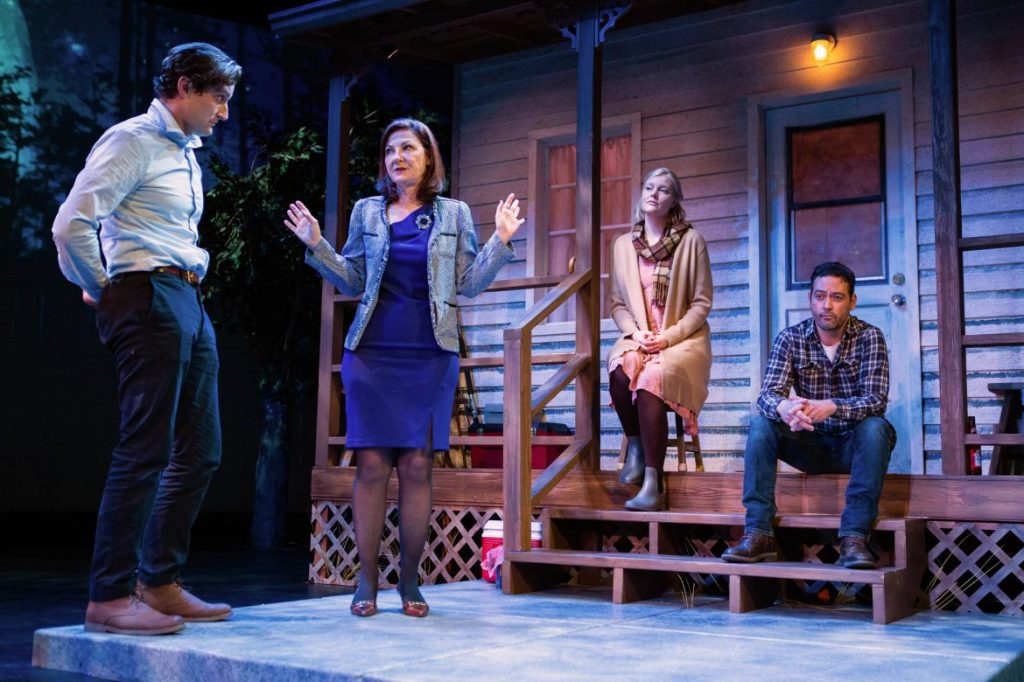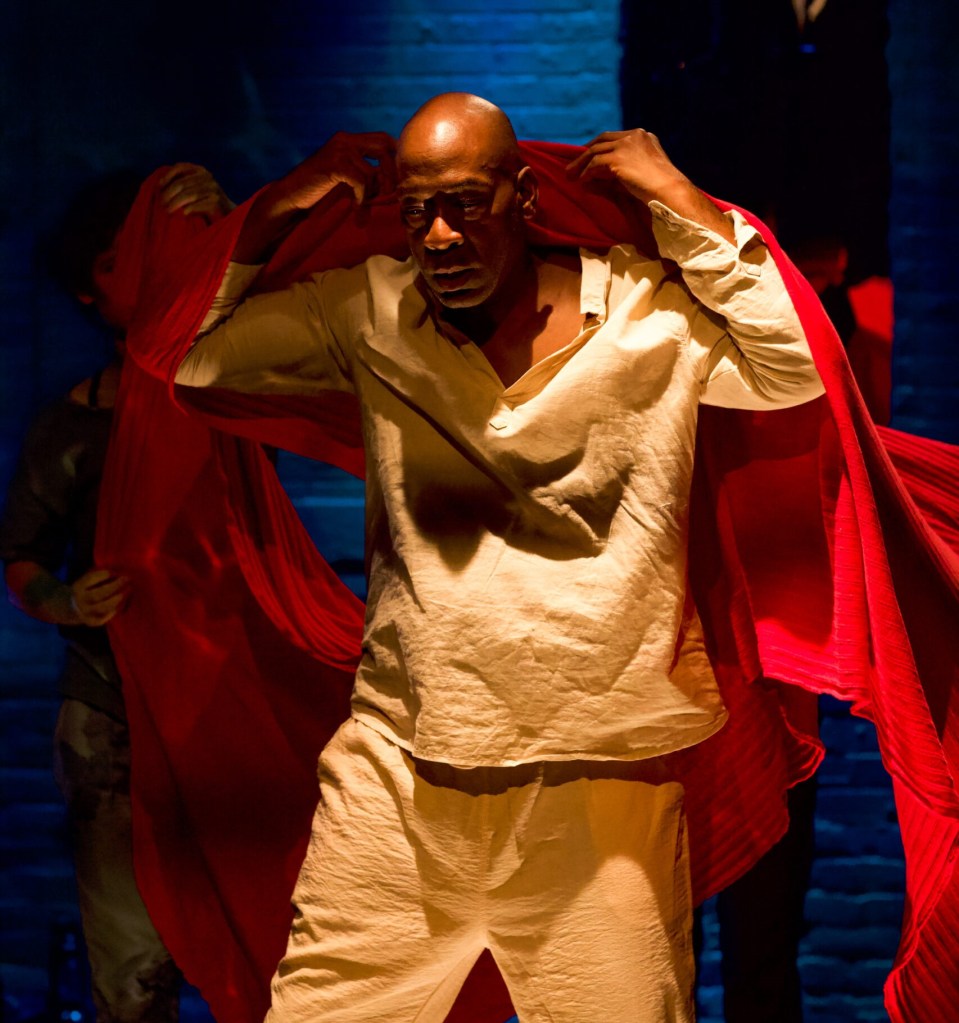
sAiNt jOaN (burn/burn/burn)

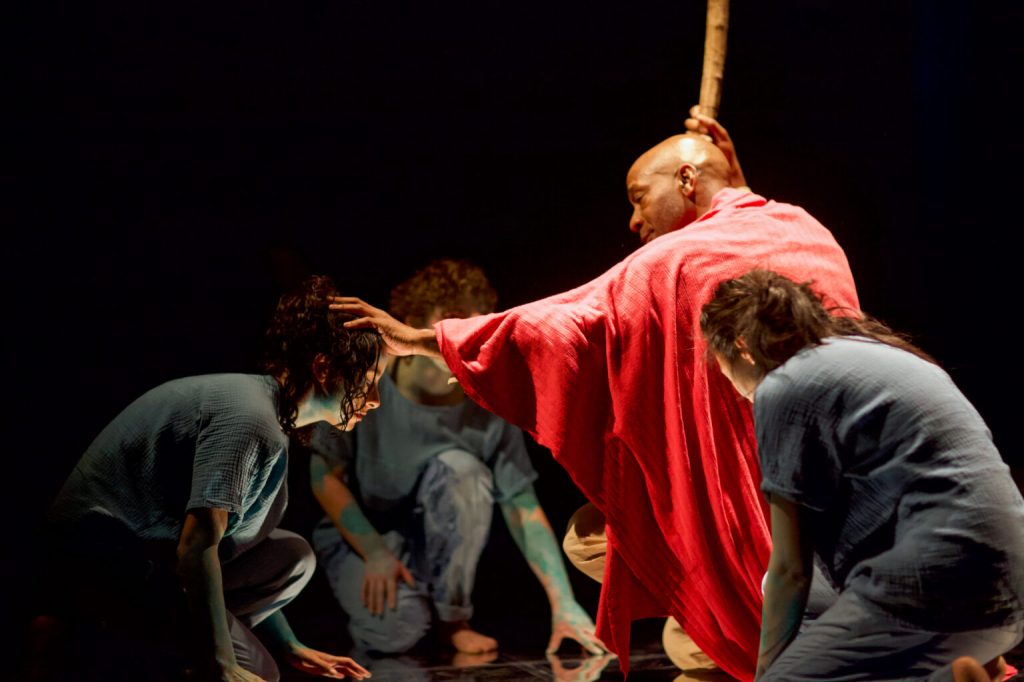
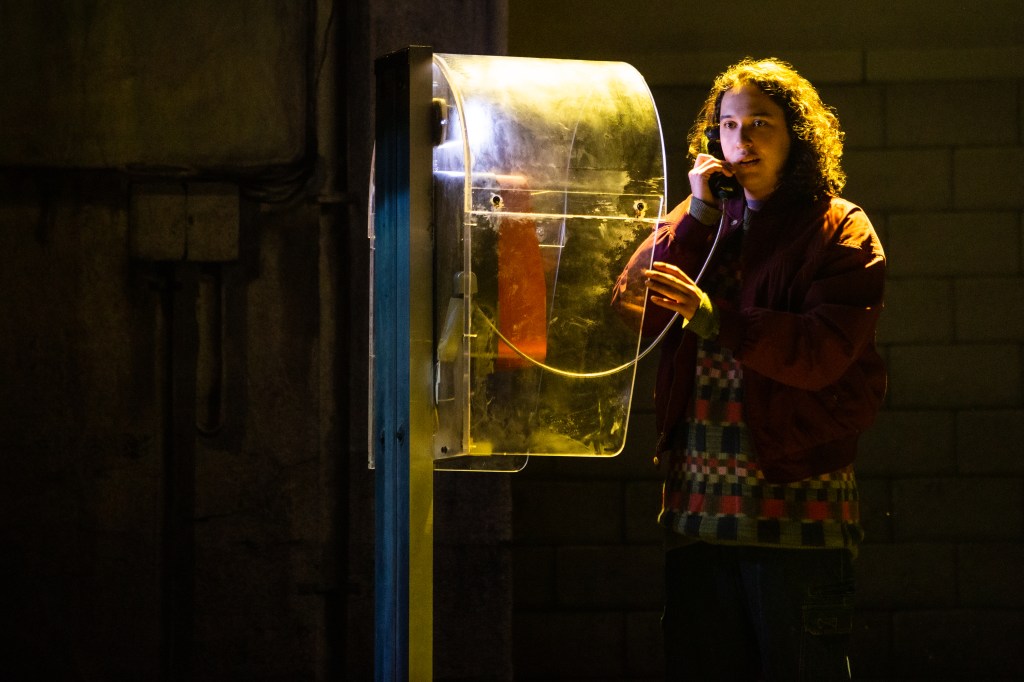
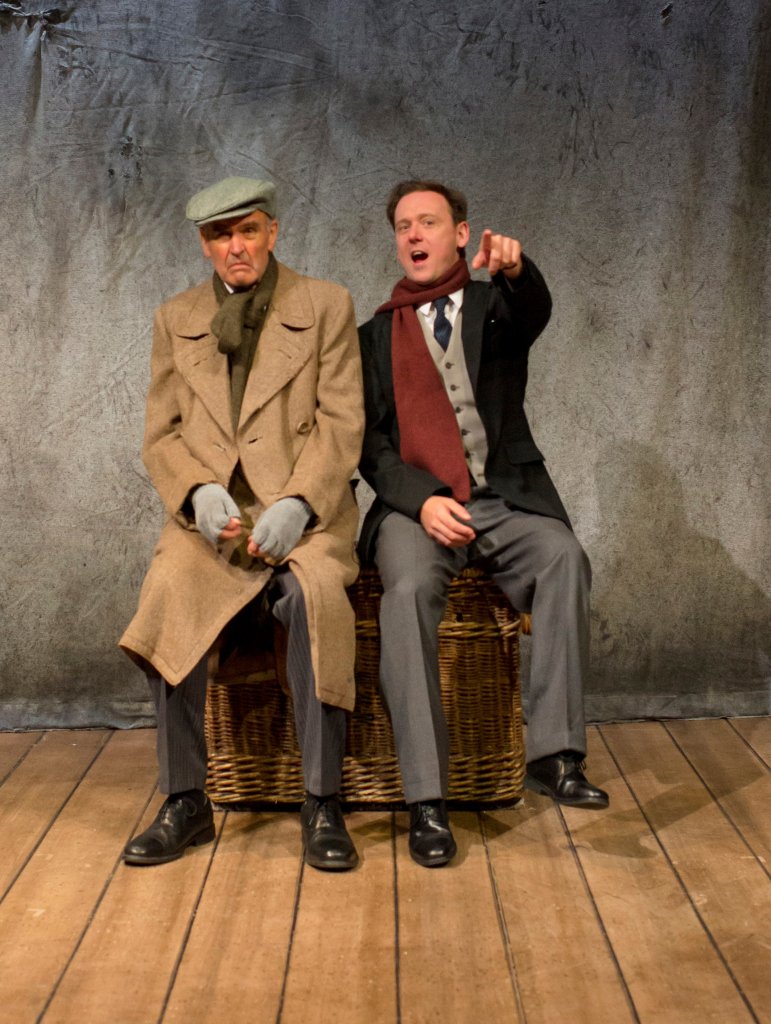
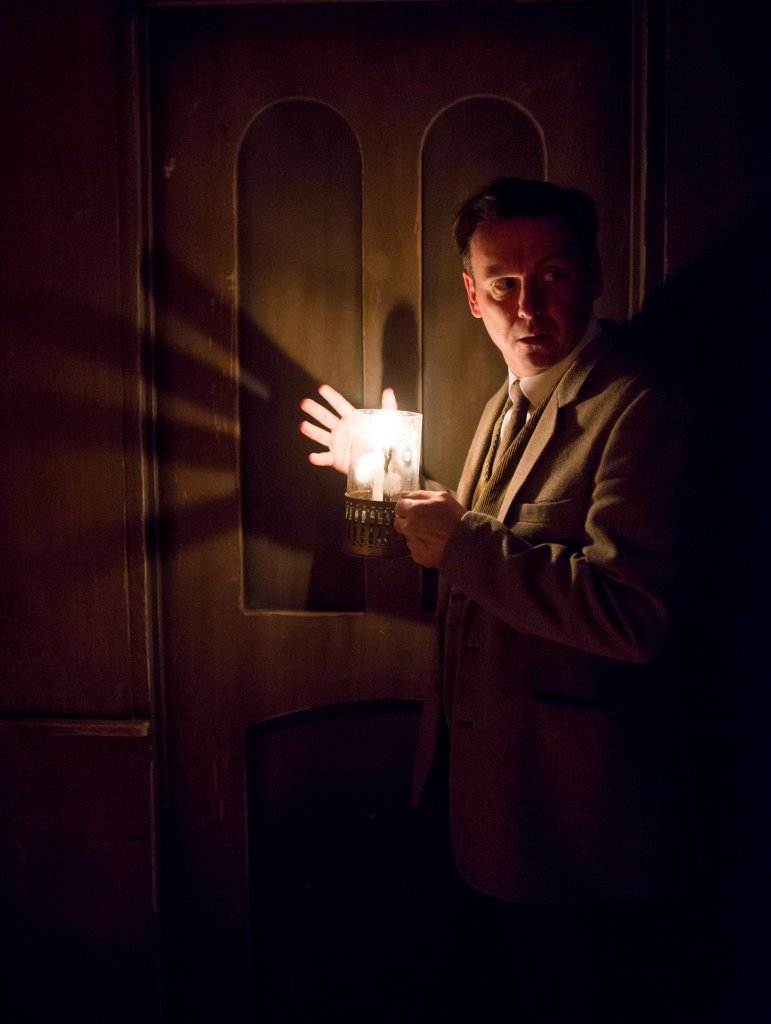
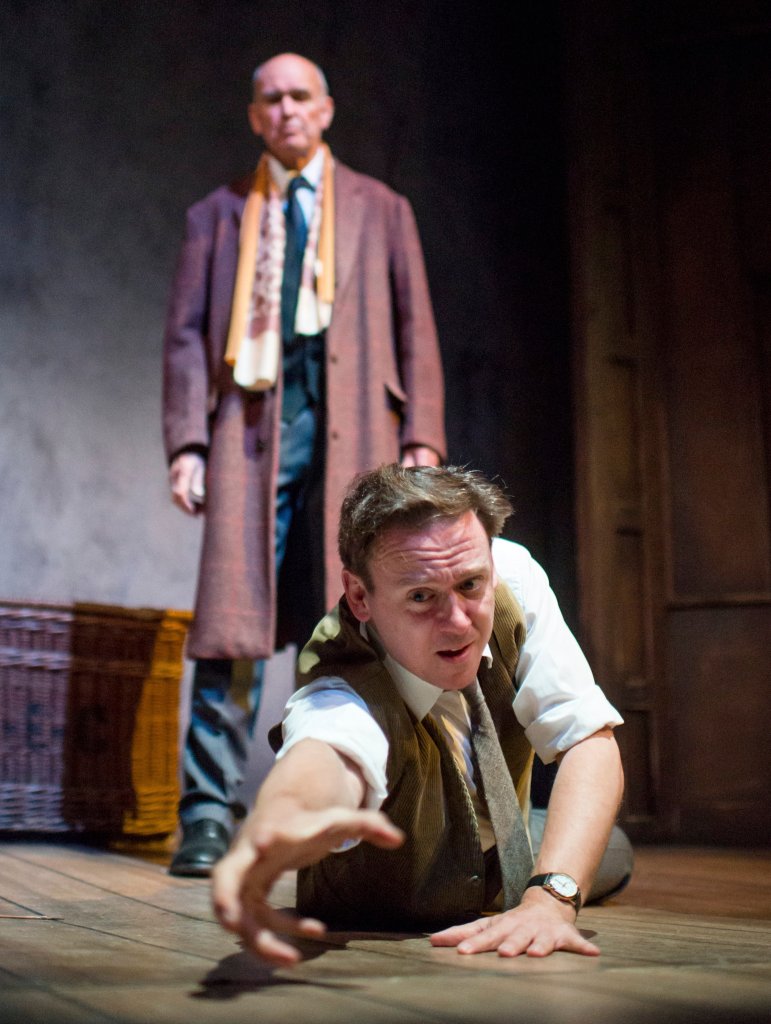
Daniela Cervantes as Sabra, Romeo Channer as Jean Dark, Success Ufondu as Bell, Charlotte Ying Levy as May, and Metsehafe Eyob as Angie. All photos by Carson French.

Jean d’Arc (Joan of Arc to English speakers) (1412-1431) holds a singular place of admiration in world history.  She is revered by French people for her military leadership, while still a teenager, in lifting the Siege of Orléans and turning the tide against England during the Hundred Years War.  Burned at the stake by enemies and declared a martyr by allies, she was canonized as a saint by the Roman Catholic Church for having been inspired by religious visions and for her fight against Protestant invaders.  She represents a role model for authority to feminists and to women in general for her ability to command men in battle and for her unwavering courage and determination against great odds.  But were her visions and her resulting brief period of triumph a result of psychological instability – massive delusion?

Playwright Lisa Ramirez draws on Jean d’Arc’s motive force as the basis for examining the will of young women to effect change in today’s frightening world.  Her vehicle is a riveting, uber-energetic, often chaotic and confrontational clash of five young people one fateful night.  “sAiNt jOaN” grabs the attention by the throat and throttles it for 60 exciting and exhausting minutes.

Charlotte Ying Levy as May and Success Ufondu as Bell.

The setup occurs on the night of a Black Lives Matter protest in Oakland.  In the tumult of violence and police chase, many protesters escape if possible.  Sabra (played by Daniela Cervantes) is of Guatemalan heritage.  Her mother works in a devotional candle jar factory nearby, and Sabra has the code to enter the building, where she and her Chinese-Jewish girlfriend May (Charlotte Ling Levy) take refuge.  During the melee, two strangers, African-American sisters Bell (Success Ufondu) and Angie (Metsehafe Eyob) are allowed in.  Finally, a non-binary who identifies as Jean Dark (Romeo Channer) insinuates themself into the mix.  But did Jean even know where they were or why the protest?  Perhaps they missed taking their meds.  What ensues is a night of personal confrontations and empathy and learning.

A theatergoer might be understandably leary of a new work about teenagers and acted by ingénues, especially a play that attempts to catch the spark of a moment in time.  But Director Michael Socrates Moran lets out all the stops in facilitating the actors’ emotional rage, and they respond with raw and totally convincing portrayals.  Issues that are often carefully soft-pedalled in real life are blasted at megaphone volume.

Daniela Cervantes as Sabra and Romeo Channer as Jean Dark.

Each of the characters carries the burden of a minority status that suffers under the dominance of a largely unsympathetic majority.  Their having come from an event with a mutually shared objective, the expectation would be for a Kumbaya moment.  But even the core singularity of the protest is challenged.  Although the vacuous counterclaim that “White Lives Matter” is clearly an attempt to invalidate “Black Lives Matter,” what about the plight of Latinx?  Sabra raises the provocation that “Brown Lives Matter,” but can that doctrine exist in harmony with the goals of the Black community?  The tempestuous Bell is briefly silenced by the idea.

The complicated quest for united action by youth, who are clearly concerned with the future of their society, is evidenced by fractures within.  (In the real world, such internal divisions have weakened the organization of the “Me, Too” movement.)  Although May suffers discrimination from being both Chinese and Jewish, others in the group lack sympathy as they consider Chinese to be the model minority and Jews to be privileged.  Add that May is focused on environmental issues and that she has an important relative whom the protesters would consider an enemy.  Despite being presumed transgender, the white Jean fails to gain sympathy on an ad locum basis.  Jean is from tony Piedmont.  Through it all, Bell in her stridency sees the world through a race-based prism, although the more moderate and laid-back Angie tries to lower the temperature.  The group even argues over the value of various social media platforms, which Jean rejects the use of altogether.

Metsehafe Eyob as Angie, Romeo Channer as Jean Dark, and Success Ufondu as Bell.

Yet as morning breaks, there is cause for hope. Is it possible that youth can agree on a common agenda of non-competing issues to embrace? Maybe the mere exposure to people of different backgrounds and to their ideas has produced bonding.  Perhaps even Jean will be accepted and join the movement.  Perhaps like her inspiration, Jean will lead future battles.

“sAiNt jOaN (burn/burn/burn),” a world premiere is written by Lisa Ramirez, produced by Oakland Theater Project, and plays at FLAX art & design, 1501 Martin Luther King Jr Way, Oakland, CA through December 19, 2021.

Dido and Aeneas

Nikola Printz as Dido, Efraín Solís as Aeneas. All photos by David Allen.

Ladies and Gentlemen – please welcome Opera San José back to the stage of their lovely home, the California Theatre.  After 20 months of pandemic-induced darkness, OSJ has returned with a carefully-selected, one-hour opera, “Dido and Aeneas.”  Although it was chosen nine moths ago, when live performance strictures were stricter, two characteristics still make it ideal.  First, it is brief, which means the audience remains stationary indoors for a short period.  Second, and uniquely, the entire orchestra is masked, as the composer’s orchestration calls for no wind instruments.  OSJ’s configuration includes about two dozen strings, including a harpsichord, and one percussionist.  Clever thinking by the decision makers.  And to make it better, the company provides an outstanding rendering of the opera.

Rarely has an esteemed opera endured the ignominy of its birth as “Dido and Aeneas.”  Although its composer, Henry Purcell, would reign as the preeminent composer of serious British music from his death in 1695 until the 20th century, his only pure opera borrowed slavishly from a crypto-opera, John Blow’s “Venus and Adonis,” that has not even remained in the canon.

Nathan Stark as the Sorcerer.

Structurally, it follows the predecessor’s tragedy with a prologue followed by three acts; having a chorus playing several roles; driving plotline at times through dance; using ariosa recitatives; and adopting similar allegorical themes such as boars.  Further, despite the fact that Purcell was already distinguished and his ouevre mature, the opera didn’t premiere at a grand venue but at a girls’ school, sometime in the late 1680s, though the exact date is not even known!  It was not produced again during his lifetime, and indeed, languished unnoticed for almost a century before its glorious and lasting revival.

Glaring weaknesses pervade the libretto.  Its brevity relative to its source material results in glossed-over, confused, or absent critical events.  The character of Aeneas is poorly developed.  And for those who dislike repetitious lyrics in opera, Purcell is the king of the repeat – as if you didn’t get it the first two times.  Yet this baroque gem among the earliest of operas has lived on because of its beguiling music, emotional power, and compact energy.

Nikola Printz as Dido pointing at Maya Kherani as Belinda.

In the narrative, Dido, the widowed Queen of Carthage, hosts Aeneas after his escape from the fall of Troy.  Although Dido has pledged to never love again, she is unable to resist Aeneas.  However, an evil sorcerer intervenes with a plan to trick Aeneas into sailing to sea, leaving the forlorn Dido behind to die brokenhearted.

Nikola Printz, as the tormented Dido, offers a model fit with their rich, dark, and powerful mezzo instrument.  Their sound remains round and full even when supine or when being cast about by members of the chorus.  They also demonstrate outstanding control of vocal dynamics, amping and dampening with exceptional control of gradations.  And they rise to the occasion at the conclusion, with a poignant rendering of Dido’s glorious lament “When I am laid in earth.”

Although Aeneas is clearly more important in ancient mythology, Purcell gives him short shrift with less stage time and no signature aria.  Baritone Efraín Solís gives a steady performance with passion when needed and a solid voice, in his rare solo, the recitative “Jove’s commands shall be obeyed.”  As is often the case, the bad guy gets the juicy part, and it is the Sorcerer, portrayed by Nathan Stark who enlivens the action.  Appearing and acting very much the menacing figure intended, his fearsome intimidation extends to his deep, thunderous, chesty vocals. Acknowledgement is also due Maya Kherani as Belinda and Erin Alford as the otherwise unnamed Second Woman.

Efraín Solís as Aeneas, Nikola Printz as Dido (at right)

Purcell was a master of choral works, and much of the score resonates with impressions of sacred music.  The chorus is active throughout and is assigned meaningful and vocally rich highlights such as “Cupid only throws the dart,” and the conclusion, “With drooping wings,” all of which the youthful chorus handles with great competence.

If the libretto is full of jump cuts, the score of “Dido and Aeneas” offers greater continuity and beauty starting with the inviting overture.  The music, ably conducted by Music Director Joseph Marcheso, is characteristically Baroque, but in a distinctive British fashion.  As it is written for a string orchestra, the sound is warm and mellow.  And while there is a harpsichord, we don’t hear (the annoying to some) repeated tinkling riffs to end numerous tracts in the score.

“Dido and Aeneas,” composed by Henry Purcell with libretto by Nathan Tate, based on Tate’s play “Brutus of Alba” and Virgil’s “Aeneid,” is produced by Opera San José and plays at California Theatre, 345 South First St., San Jose, CA through November 28, 2021.

Harriet’s Spirit

Tiffany Austin as Harriet Tubman. Photo by Rachael Heiman.

Composer Marcus Shelby is an accomplished artist.  A distinguished bass player, he is well regarded for his compositions for jazz orchestra, most notably “Port Chicago,” “Soul of the Movement: Meditations on Dr. Martin Luther King, Jr.,” and for the oratorio “Harriet Tubman.”  He breaks new ground with a 50-minute, one-act opera that draws on the inspiration of that great Civil War era abolitionist and humanitarian.

Commissioned by Opera Parallèle as part of their Hands-On-Opera program, a series of operas for youth, “Harriet’s Spirit,” is performed appropriately at the Bayview Opera House, which operates as the hub of the San Francisco African American Arts and Culture District.  The production energizes and provides a beacon of hope for the communities that its story represents.

Librettist Roma Olvera has written her third libretto for Hands-On-Opera, but this is her first of wholly original source material.  In this new work, she perceives the intersection of Harriet Tubman’s fight to eliminate slavery with contemporary teenage bullying, which itself symbolizes many ills in society, the first of which is racism.

Christobel Nunoo as Modesty. Photo by Steve DiBartolomeo.

“Harriet’s Spirit” deals with overcoming fear to stand up for what it right.  As her name suggests, young Modesty is a reserved, bookish teen.  After being taunted and unable to defend herself, Modesty sees a vision of Harriet Tubman who encourages her to be strong and courageous by singing “Do What You Have to Do.”  Yet when a friend is attacked, Modesty still lacks the determination to challenge the bullies.  Another incident occurs, and Modesty finally realizes, through the example of Harriet, that standing up for righteousness is the foundation of love and friendship and the only way to defeat evil.

This opera carries the DNA of an earlier Opera Parallèle production, “Champion,” the first opera by another great jazz artist, Terence Blanchard.  The operas connect through their musical influences and through story lines that speak to the African-American experience.

The narrative in this work is driven by a scintillating, complex, and eclectic score, starting with a striking overture that overlays action on the stage – at first lyrical and bucolic as Modesty reads on a bench, and then ominous as she is taunted by the bullies.  Their powerful, rhythmic stomping and clapping emphasize the threat, reminiscent of gang behavior in “West Side Story.”

The jazz influence comes through in the striking orchestration, with the prominent use of the vibraphone ringing out euphonious jazzy chords and runs.  No doubt, Shelby’s love for the bass violin and its sound results in the frequent double bass thumping in the background and its occasionally acting as lead instrument.  The orchestra is conducted by Nicole Paiement with her characteristic accuracy and decisiveness.

Bradley Kynard as General Montgomery, Christabel Nunoo as Modesty, Tiffany Austin as Harriet Tubman. Photo by Rachael Heiman.

Tiffany Austin, herself a jazz artist, admirably performs Harriet Tubman.  Although not an opera singer, her unamplified warm voice has sufficient strength, and certainly the melodiousness, required for the house.  Her role includes not only bluesy tracts, but encouraged improvisation that occurs in a flashback to Harriet’s lifetime.  Christabel Nunoo is Modesty, whom she aptly portrays as an intimidated and gawky teen.   Her voice, however, is very seriously not teenage.  She possesses fine vibrato, and her top end is very powerful and penetrating.  The two women sing some lovely duets, and both carry an abundance of messages, culminating with Modesty’s anthem “I Will Not Stand Still” and Harriet’s “You’re Meant to Always be Free.”

The third principal is baritone Bradley Kynard, who plays the school janitor in present time and General Montgomery in the flashback.  Although some of his musical lines are at the bottom of his range, he sings those with great professionalism, and he flourishes in his mid and upper range with sonorous tone even in dissonant passages.

The versatile L. Peter Callender, who is an eminent actor and director in the Bay Area theatrical community, undertakes his first opera challenge as stage director.  He transitions with ease, guided by the rhythm of score and libretto as he would be by the language in a play.  Perhaps his greatest accomplishment in this task is successfully shepherding the other collective “character,” the girls in the schoolyard, performed by San Francisco Girl’s Chorus.  Though he can’t take credit for their delightful singing, he guides the novices’ movement and acting, much of which is presumably out of character (they’re probably not bullies in real life!)

Bradley Kynard as General Montgomery. Photo by Steve DiBartolomeo.

Happily, the house was sold out for all three performances, but based on the one I saw, the audience is mostly comprised of the usual suspects – friends and family, company associates, and regular OP patrons.  The Bayview community, and particularly African-Americans, did not seem much represented.  These kind of outreach activities need to reach their target audiences to be effective.

One weakness in the production is the absence of supertitles, which results in much meaning being lost, even for the viewer who has read the synopsis beforehand.   Subject to that correction, “Harriet’s Spirit” should work nicely for its intended audience, and adults should appreciate it as well. 

“Harriet’s Spirit,” is a world premiere composed by Marcus Shelby with libretto by Roma Olvera, produced by Opera Parallèle and Bayview Opera House, playing at Bayview Opera House, 4705 3rd St., San Francisco, CA through November 14, 2021.

Victor Cordell, Ph.D.
San Francisco Bay Area Theatre Critics Circle
American Theatre Critics Association

A Little Night Music

William Giammona as Count Carl-Magnus, Alison Ewing as Desiree, and Martin Bell as Fredrik. All photos by Ben Krantz Studio.

Stephen Sondheim and Andrew Lloyd Webber are undoubtedly the most lauded living composers for the musical theater.  Although Lloyd Webber has garnered more commercial success, Sondheim is probably preferred by most cognoscenti for his originality; sophisticated musicality; concise and insightful lyrics; and adventurous themes.  And while Lloyd Webber seems driven more by popularity, Sondheim almost disdains it.  But the Sondheim canon is so rich that 42nd Street Moon has announced that it plans to produce every Sondheim musical, from the most successful to the abject failures.

Struggling with jet lag from 24 hours of flying, my wife/editor and I attended the Broadway production of “A Little Night Music” with the noteworthy original cast.  In my drowsy condition, it served as a fine soporific.  Not having revisited it for nearly half a century, I remained convinced of its mediocrity.  Wrong!  The 42nd Street Moon production disabuses me of that notion and reveals what a gem it is.  The company offers an entertaining and likeable rendition that demonstrates the show’s many assets but would benefit from some refinements.

Alison Ewing as Desiree, Chloe Fong as Fredrika, Cindy Goldfield as Mdm. Armfeldt, and Jack O′Reilly as Frid.

Sondheim chose his source material well.  “A Little Night Music” is a truly charming, lighthearted delight, with the proviso that strict moralists may find its gentle and mischievous treatment of illicit affairs not to their liking.  Although Sondheim’s music and themes often have sharp edges, “A Little Night Music,” which is based on Ingmar Bergman’s film “Smiles of a Summer Night,” is written predominately in waltz time and is highly melodic.  And with the exception of the pivotal character, Desiree, the singing parts call for highly trained voices.  These characteristics of the musical are in evidence from the opening number which includes operatic vocalizing and waltzing.

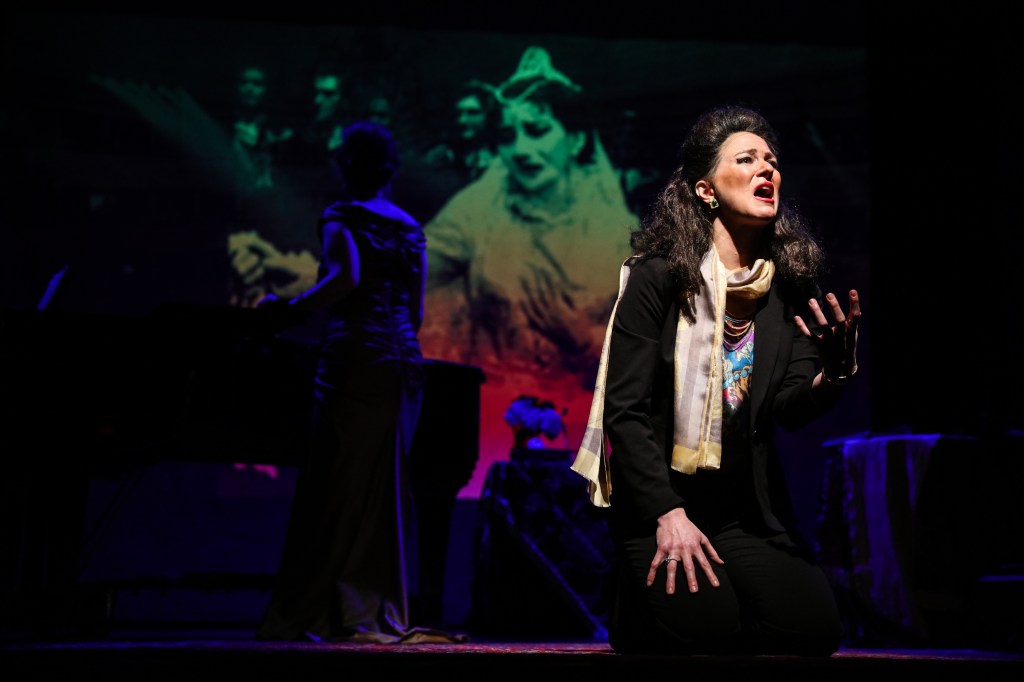
In this farcical Swedish comedy of relationships from the turn of the century, Desiree is a faded but esteemed stage actress reduced to performing in lesser markets.  Alison Ewing, who carries the magnetic air of a diva with great confidence, exquisitely portrays Desiree.  Ewing captures the flair, the self-indulgence, and condescension, yet concealed angst, of the center of attention with a memorable performance.

A lover from Desiree’s past, lawyer Frederik, is recently married to a teenage bride, Anne, but the marriage has not been consummated.  His confused son, Henrik, who is the same age as Anne, is studying at a theological seminary, but is on a home holiday.  Desiree performs nearby, and Frederik furtively visits.  She receives him despite otherwise carrying on an affair with the married Dragoon Count Carl-Magnus.  In short order, after a weekend in the country with humorous interludes, some alignments shift, others remain.

Trixie Aballa as Petra and Samantha Rose Cárdenas as Anne.

The other star turn in the production is Cindy Goldfield as Desiree’s mother, Madame Armfeldt.  She is commanding as the imperious, authoritative grande dame, but under the veneer, she reveals wistfulness and love.  Although she doesn’t take part in the dalliances and is often off to the side of the stage in her wheelchair, she provides the philosophical core to the story and much of its heart.

It’s hard to decide which of the composer’s elements is more compelling in “A Little Night Music,” the music or the lyrics.  The melancholy “Send in the Clowns” is certainly one of the most sublime melodies in all of music, and it is beautifully delivered by Alison Ewing in an uncommonly low register.

But the whole score is not only tuneful, but jaunty and highly complex, with wonderful numbers of hope and regret like “A Weekend in the Country,” “Perpetual Anticipation,” and “It Would Have Been Wonderful.”  Ensembles abound, including a double quintet, as well as rich counterpoint and rondo.  And straying from the central musical motif, the composer integrates a doleful folk melody in the maid’s thoughtful commentary on love and social class, “The Miller’s Son.” The lyrics amaze with their intelligence and incorporation of copious rapid patter, alliteration, multiple rhyming, and frequent use of rhythmic tripling patterns.

Credit 42nd Street Moon for bringing this beautiful and multifaceted work to their stage when the pandemic creates immeasurable challenges in preparation.  Musical lovers who forgive unevenness will find much to enjoy in this production.  Director Brandon Jackson’s overall presentation charms; Mark Mendelson’s versatile one-set staging represents multiple venues well; and Michael Palumbo’s lighting visually partitions the stage in several instances.  Acting generally serves the story.

Shai Wolf as Henrik.

Vocal demands make casting of this musical difficult.  Some singers lack appropriate power and/or vocal quality desired.  Minimally, the performers portraying teenagers would benefit from amplification to ensure that their speaking and singing is sufficiently audible for the audience to follow.  Yet, except for some early murkiness of sound, the singers handled the quick crispness of the lyrics and the convoluted ensembles very well, many of which will put a smile on your face.

“A Little Night Music” with music and lyrics by Stephen Sondheim, book by Hugh Wheeler, and suggested by Ingmar Bergman’s film “Smiles of a Summer Night” is produced by 42nd Street Moon and plays at Gateway Theatre, 215 Jackson St., San Francisco, CA through November 21, 2021.

At the Wake of a Dead Drag Queen

Mario Mazzetti as Hunter/Vickie, Devin Cunningham as Anthony/Courtney. Photo by Vince Thomas.

In seeing the title of this play, many a theatergoer might ask, “What’s in it for me? It sounds like it could be depressing or preachy, and it’s not really in my area of interest.”  Regrettably, the title not only misleads, but it could discourage potential audience.  As declared by Courtney, the main character – “If you’re expecting something depressing, you’re in the wrong place.  Go see ‘Philadelphia.’”  Only by seeing the play’s promotional literature will you learn that it is a multidimensional dramedy.  Only by seeing the play itself will you learn that the wake is only figurative.  The narrative is a flashback of the central character’s last months with a focus on relationship.  You will also learn that other than the quirkiness associated with men portraying flamboyant women, that they share the same joys and sorrows as the rest of us do.

Appropriately, Theatre Rhinoceros presents “At the Wake of a Dead Drag Queen” in its new, intimate home in The Castro.  Their choice of play to christen the new venue fits like a glove.  Thematically, the suitability is clear for the longest running LGBTQ theater company in the universe.  And in a setting where the audience can reach out and touch the performers, a small two hander where the actors’ every small gesture can be seen works well.

“At the Wake of a Dead Drag Queen” transcends the boundaries of its genre and can be broadly appreciated.  It doesn’t hurt that the play is an affective and effective character study of two people grappling with an inordinate number of life’s challenges.  And by the way, it’s a very thoughtful play with generous doses of humor and pathos; well produced and directed; and acted with consummate charm and authenticity. 

Anthony, AKA Courtney, is an experienced black drag performer in small city Georgia.  Hunter, AKA Vickie, is a white drag newcomer who Courtney takes under her wing and more.  It is the beginning of the AIDS epidemic, and both suffer from its threat – a fitting corollary to the current pandemic.  Courtney is played by Devin Cunningham with great panache and gusto – flashing a smile and false eyelashes with the confidence of one who is a sexual magnet.  But while the character can seem blithe and flighty, she has a hard edge.  Having lived under the dark clouds of discrimination and fear for her 23 years, she is cynical, self-indulgent, and sometimes thoughtless.

Credit playwright Terry Guest for investing well in the second character to provide great balance.  Mario Mazzetti plays the more sensitive Vickie with complete conviction, and she can be very engaging and empathetic.  Though she has suffered many of the afflictions that Courtney has, she still retains some optimism and aspiration.  Is it perhaps because she is white, or is it because she is not at death’s door?

The girls dress with the full signature accoutrements associated with drag queens – over-the-top makeup, flashy wigs, garish wardrobes.   They also delight with classic drag queen entertainment.  There’s plenty of lip syncing, with the most memorable being a duet to Shirley Brown’s “Woman to Woman” and Vickie’s rendition of Mozart’s “Queen of the Night” (how appropriate!) aria from “The Magic Flute.”

In this production, talented Director Tanika Baptiste multitasked to also cover costume design and choreography.  One of the pleasant little surprises is the choreography and execution of the dance numbers, which includes a nice dance duet and a sassy solo by Vickie of Shania Twain’s “Man!  I Feel Like a Woman!” 

Between the diverting entertainments, the drama of the relationship ebbs and flows from sweet nothins’ to bickering and avoidance.  As their personalities are exposed, so are broader issues that the playwright addresses.  These are the contrasts between black and white, rich and poor, gay and straight in a state that simultaneously lurches toward inclusive harmony and retreats to all manner of divisiveness.  And in one of the sad and more telling truths, Vickie observes that poor whites and poor blacks have so much in common that they could fight together, but a chasm between them is created by the likes of the NRA and Big Pharma.  Unfortunately, this lesson is lost on the masses, who if united, could institute real change for the better.

“At the Wake of a Dead Drag Queen” is written by Terry Guest, produced by Theatre Rhinoceros, and plays at Spark Arts, 4229 18th Street, San Francisco, CA through November 14, 2021.

The Great Khan

Brian Rivera as Genghis Khan, Leon Jones as Jayden. All photos by Jessica Palopoli.

No good deed goes unpunished.  Often, acts of compassion or bravery imperil the hero.  The ensuing limelight is often unwelcomed as the savior may prefer to lead an anonymous life.  Worse yet, the person may have something to hide that becomes exposed with the notoriety, so that hero becomes victim.  Even the beneficiary of the good deed can be displeased.  The public portrayal of that person may not be consistent with the person’s self-image.

Playwright Michael Gene Sullivan fills the house with laughter in addition to thoughtfulness and social reflection.  In his affecting premiere “The Great Khan,” an otherwise unassuming, middle-class, black teenage boy, Jayden, has saved a black teenage girl, Ant (full name – Antoinette), from a gang of boys.  This creates a dissonant condition for both of them.  Each must deal with the undesired reputation that the situation has spawned.  They are sweet kids, but does Jayden have to live up to being courageous, and should Ant accept the perception that she needed saving, or should she show that she’s tough?  Single-parent mother, Crystal, is so concerned that the gang might strike back at her son for interfering that mother and son move, with the boy enrolling in a new school.

Leon Jones as Jayden, Jamella Cross as Ant.

Several short thrusts into other social issues occur – relationships between mother and child, teacher and student, boy and girl; white abuse of and ignorance about blacks; puberty and more.  Some may consider the play a bit preachy, but quite frankly, there’s a lot more to preach about beyond the limits of this staging.  The other main theme of the play derives from a school research assignment that Jayden shares with Gao-Ming, a shy, yet effusive Chinese-American girl.  The task is a presentation on Mongolian leader Genghis Khan, an evocative figure, largely reviled in the West, and indeed, by many Asians including Gao-Ming’s mother.

While the two students affirm much of what is popularly known of Genghis Khan, they find that he, like many famous leaders, was very complex with much to admire.  So why does the playwright care about this historical figure?  Jayden notes that when European countries by dint of superior force colonized the African continent, they decimated local leaders, records, and cultural artifacts, destroying the people’s heritage.  African heroes from history were lost.  Largely, whites feared blacks and often assaulted them preemptively in many ways, a condition which remains today.  Jayden latches onto Genghis as a proxy, who, because of a different set of circumstances than Africans, beat the Europeans at their own game.

Leon Jones as Jayden, Kina Kantor as Gao-Ming.

Much of the humor in the play derives from surprise visitations that Jayden receives first from Ant and later from Genghis Khan.  Ant is tangible and her mission is palpable.  She wants to assure that Jayden doesn’t spoil her reputation, and maybe something else.  But what about Genghis?  Is he Jayden’s fantasy? a neighbor? Gao-Ming’s father?   In any case, he has some wise things to say, and he sure is funny as he rattles the kid’s cage.

Finally, beyond the moral issues and conflict resolution, “The Great Khan” is about the beauty of youth, and how many of us look back blissfully on our younger days.  Kids never want to move.  We don’t want things to change.  Both Jayden and Ant want nothing more than to have their lives before the defining incident back.  Even Genghis perceives himself not as the great conqueror, but as Temujin (his birth name), who loved and fought to win his young wife and who brought people together in his early days.

Velina Brown as Crystal.

Structurally, a weakness in the play is the extended use of video games toward the end, which slows the pace and won’t resonate with those unfamiliar with the particular titles.  As a preface to the major irritant, let me note that I am a liberal/progressive.  But even I find it offensive that Jayden and Ant repeatedly use “the n…. word” which is deemed so despicable that whites aren’t to even use the word in a third-party quote or reference.  Putting the word unnecessarily and aggressively on display provides ammunition to racists who don’t buy the argument that minorities get an exemption to call themselves by ethnic pejoratives that others can’t.

Although the characters are largely stereotypes, they are sympathetic.  The performers are engaging, led by Leon Jones as the always under pressure but resilient Jayden, with a particularly strong comic contribution by Brian Rivera as Genghis.  Jamella Cross as Ant, Velina Brown as Crystal, Kina Kantor as Gao-Ming, and Adam KuveNiemann as Mr. Adams, round out the excellent cast. Credit Darryl V. Jones with fine direction.

Adam KuveNiemann as Mr. Adams.

“The Great Khan” by Michael Gene Sullivan is produced by San Francisco Playhouse in co-production with The San Francisco Mime Troupe in a rolling world premiere.  It plays on SF Playhouse’s stage at 450 Post Street, San Francisco, CA through November 13, 2021.

Fidelio

Elza van den Heever as Leonore/Fidelio, Anne-Marie MacIntosh as Marzelline, James Creswell as Rocco, Christopher Oglesby as Jaquino. All photos by Cory Weaver.

Ludwig van Beethoven, one of the greatest serious music composers ever, loved opera but created only one.  Near death, he noted of “Fidelio” that “Of all my children, this is the one that cost me the most birth-pangs and the most sorrow…..it is the one most dear to me.”  After the failures of earlier produced versions, the composer endlessly revised it into its final form over nine years ending in 1814.  It emerged a masterpiece enriched by the composer’s complete musical vocabulary.  It also acted as a springboard for his most famous and incomparable vocal piece, Beethoven’s Ninth (Choral) Symphony.

Despite compelling and highly respected music, however, “Fidelio” has generally been consigned in status and popularity to the second twenty of best operas.  San Francisco Opera’s current production maximizes the values of the piece through excellent casting, fine musical direction by Eun Sun Kim, and the addition of what amounts to another character, the stunning scenic design by Alexander V. Nichols, under the purview of Director Matthew Ozawa.

Elza van den Heever as Leonore/Fidelio, Russell Thomas as Florestan.

“Fidelio” is the story of Leonore, whose husband has been imprisoned in a secret location.  In modern terminology (and the setting has been made modern) the husband, Florestan, is a whistleblower (and the modern implications of the risks of this practice are unsettling).  The perpetrator he exposed, Governor Don Pizarro, portrayed chillingly by Greer Grimsley, has vowed to terminate him.  Against this threat, Leonore disguises herself as a man, Fidelio, and takes employment as a guard in the prison where Florestan is isolated.

The relentless and courageous Leonore is played by South African Elza van den Heever.  Her triumphant return represents a homecoming for the world class artist, who received her training and development in San Francisco, from Conservatory through Merola and Adler Fellowship.  Although classified as a dramatic soprano, her timbre smooths the usual harshness associated with that vocal quality, with the result that her voice penetrates yet gleams.  Effective throughout the performance, she acquits herself particularly well on Leonore’s signature aria, “Abscheulicher! Wo eilst do hin!” (O! thou monstrous fiend!).

Leonore’s foremost ally and greatest obstacle is Rocco, the chief jailer, sung admirably by recurring SF Opera visitor, bass James Creswell.   While his vocal parts are not very memorable, Creswell does participate in the ethereal quartet “Mir ist so wunderbar!,” led by fine young soprano Anne-Marie MacIntosh as his daughter Marzelline.  Unlike most characters in the opera who lack dimensionality, a decided weakness in the libretto, Rocco reveals conflicts in objectives and cracks in disposition and morality.  Most vitally, to what limit will Rocco go to facilitate Don Pizarro’s evil plot?

Greer Grimsley as Don Pizarro, James Creswell as Rocco.

Florestan doesn’t appear until Act 2 when the forces of both life and death descend to his dungeon.  As the victim, able tenor Russell Thomas displays near-dead weariness from his captivity but must rise to the occasion for his thrilling and iconic call for “Freiheit! Freiheit!” (freedom! freedom!) which he does with imposing skill.

All of the action of the production takes place in and around the 20-ton “cube” of steel tubing and plates that revolves to reveal its different aspects.  Most appropriately and obviously, its massive angularity represents the prison, but from other angles, it is offices or the dungeon.  This powerful metaphor in metal, glaring in harsh lights, dominates the stage and the viewer’s perception of the severe world that it comprises.

San Francisco Opera’s rendering of “Fidelio” pulls out all of the stops and offers a superb experience.  Kim conducts with verve – capturing the dynamics and tempo of the orchestral-like score.  Ensembles excel, often with beautiful close harmonies, and the prisoners’ choruses stand out.

Chorus.

For those inclined to look at opera with further analysis, it is noteworthy that the conductor chose to omit the option of performing Leonore Overture #3, which saves 15 minutes of run time but loses the most famous music from the opera.  That said, nothing is lost in conveying the narrative.  What’s more, there is plenty of fine music, though surprisingly, given Mozart’s precedent, no arias from “Fidelio” have found their way into common usage.    A final criticism that matters little to many is that the opera is in the form of a singspiel, meaning that there is considerable spoken dialog that results in inconsistent dramatic tone.  Of course, “The Magic Flute” is a singspiel, so “Fidelio” is in good company.  And as we know, “Fidelio” was the composition by Beethoven that was most dear to him, and who could be a more illustrious judge of fine music?

“Fidelio,” composed by Ludwig von Beethoven with libretto by Joseph Sonnleithner and Georg Friedrich Treitschke, is produced by San Francisco Opera and is performed at War Memorial Opera House, 301 Van Ness Street, San Francisco, CA through October 30, 2021.

Victor Cordell, Ph.D.
San Francisco Bay Area Theatre Critics Circle
American Theatre Critics Association

The Claim

Soren Santos, Radhika Rao, Kenny Scott. All photos by Benjamin Krantz.

Stories define lives.  Humorous vignettes, accounts of accomplishments, chronicles of courage, tales of failure.  These windows into notable experiences form the perceptions that people have of themselves and the perceptions that others have of them.  Sometimes stories are not fully revealed.  Sometimes they change over time.  Sometimes the teller believes the revisions, forcing reality to the rear.  Overwhelmingly, these projections of self are harmless, even if somewhat delusional.  Only rarely do they determine the direction of one’s life.

In “The Claim,” Serge hails from Congo.  Now in the U.K., he seeks asylum.  In this farcical three-hander, the immigrant is interrogated by two British bureaucrats – a male who we’ll call A, and a female, who we’ll call B. The pair are intermittently distracted and consume valuable time with their own relationship sideshow while determining the fate of their charge.  The absurdity of the situations resonates with Americans as our country confronts unprecedented waves of refugees on our southern border as well as asylum seekers from Afghanistan as a result of our military departure from that country.

The play opens somewhat confusingly with exchanges and crosstalk between Serge and A that don’t seem to go anywhere.  Then, when B arrives, Serge’s competent communicating ability turns heavily accented with limited vocabulary.  When the light comes on, you realize that he is speaking his native tongue with A, and in his halting English with B.

Kenny Scott, Radhika Rao.

The interviewers seek to hear Serge’s story to determine his eligibility to stay in the U.K.  But how can one retell true stories that brought shame or pain?  Is it more important for Serge to tell the whole truth; or to share a partial truth that may be easier to digest; or to craft a hopefully unverifiable fantasy that is the kind of narrative that will win support?  Will the interviewers realize that they, too, embellish stories, or, as is common, will they set a different standard for those wishing admission to their club? 

The incompetence of the interviewers overwhelms their generally good intentions.  Their misunderstanding of a single incident and the translations from A to B takes them down a Kafkaesque rabbit hole leading to a succession of wrong conclusions that could steal Serge’s agency.  It doesn’t take a lot of imagination to conclude how often this must tragically occur in the real world.

Although the bureaucrats are mostly earnest and trying to be helpful, the baggage that they carry is also in evidence.  No matter how many times the immigrant asks to be called Serge, B insists on using his Congolese name, Sese, a testament to the British colonial mentality of disrespecting native people’s wishes.  The playwright excoriates the system of dealing with refugees and pointedly criticizes the bureaucracy’s unaccountability and anonymity by not providing names for the interviewers.

Kenny Scott, Soren Santos.

The acting of all three performers is superb.  In Kenny Scott’s dominating and charismatic portrayal of Serge, he radiates effusiveness when optimistic but can quickly turn conflictual when he realizes that he is misunderstood.  Soren Santos excels in his blithe cheerfulness as A.  He seems to live in another world almost oblivious to the facts that surround him.  Either that, or he’s on some interesting drug.  Radhika Rao effectively grounds B with a Type A personality – rule-driven, focused, and determined to accomplish her task.

“The Claim” explores only a small portion of the demeaning and frightening experiences that refugees endure.  In doing so, it provokes and entertains.  It is full of word plays and misunderstandings by all, though some of the situations and humor seem a bit extraneous.  Theatergoers who enjoy absurdism should find this very much to their liking.

“The Claim” is written by Tim Cowbury, produced by Shotgun Players, and is performed live at Ashby Stage, 1901 Ashby Ave., Berkeley, CA through October 30, 2021 and on live-stream October 21 and 28.

Victor Cordell, Ph.D.
San Francisco Bay Area Theatre Critics Circle
American Theatre Critics Association

Every Brilliant Thing

Lists.  Everybody makes them.  Often, lists can be reminders to take action – lists of things to do or groceries or activity schedules or guests to invite to a party.  But they also serve to keep records – to catalog checks written or music saved or household inventory.  My wife and editor, Karin, has listed virtually everything she’s eaten in the last 18 years, in print so small that few adults of a certain age can read it (it’s a long story!).

Duncan MacMillan’s award-winning, 60-minute, one-person play, “Every Brilliant Thing,” centers on a list reflective of obsessive compulsion.  The narrator/protagonist itemizes everything worth living for.  Remarkably, he starts the list at age seven.  As might be expected, what’s worth living for in the world of a boy includes things like ice cream, roller coasters, and the color yellow.

As the narrator ages, his values evolve and his intelligence expands, but he persists with the list.  He decides that what is worth living for should be both wonderful and life affirming.  And the list becomes populated with items that are more complex – defined by phrases rather than objects – like “The fact that there is a song somewhere that is perfect for the time” or “People who can’t sing but either don’t know it or don’t care.”  These recitations are often humorous and nostalgic, as we reflect on the things we appreciate in our own lives.

So other than the obvious revelation of the narrator’s quirky passion and his maturation process, how does this content constitute material for a play?  A parallel narrative arc intertwines events in the narrator’s life.  Most importantly, we see the depressive burden of being a child with a suicidal mother.  But we learn over time of his relationships with his music-loving but distant father, his wife, teachers, and analysts.  Some vignettes are particularly illuminating such as discussions of Johann Goethe’s “The Sorrows of Young Werther” and the Samaritans “Media Guidelines for Reporting Suicide.”

What distinguishes the play is the theatrical conceit of structured audience involvement.  Attendees read out items from the list and play counterparts to the narrator in mini scenes.  To facilitate this device demands an actor with skills beyond the script.  Fortunately, William Hodgson, Co-Founder and Co-Artistic Director of Oakland Theater Project (formerly Ubuntu), is just the man for the job.  He exudes the necessary charm, empathy, and quick wit, as he prompts and cajoles participation with great aplomb.  He is directed by his partner-in-crime, Michael Socrates Moran, who shares the same OTP titles as Hodgson.

William Hodgson. Photo by Colin Mandlin.

A necessary consideration in reviewing a theatrical piece of this sort is to assess whether audience participation enhances or detracts from the drama.  “Every Brilliant Thing” would certainly work as a straight forward one-person show.  It would be more focused and intense with the possibilities of its seeming deeper, darker, more poignant and penetrating, but at the risk of being flatter in the wrong hands.  Conversely, audience participation yields spontaneity, with every performance being a little different.  It may feel less oppressive, more cathartic, and even uplifting.  Which format works better depends on what the individual is looking for in a theatrical experience.

“Every Brilliant Thing” is written by Duncan MacMillan with Jonny Donahoe; produced by Oakland Theater Project; and plays at Flax Art & Design; 1501 Martin Luther King, Jr. Way; Oakland, CA through October 31, 2021.

Victor Cordell, Ph.D.
San Francisco Bay Area Theatre Critics Circle
American Theatre Critics Association

Lizard Boy

Kirsten “Kiki” deLohr Helland, Justin Huertas, William A. Williams. All photos by Kevin Berne.

Origin stories are as old as, well, human origins.  Societies, governments, clubs, and all manner of organizations craft stories to honor their legitimacy.  These myths tend to be self-serving glorifications that often stretch the truth and sometimes create legends out of whole cloth.  The brilliant and imaginative “Lizard Boy” origin builds on the slaying of the dragon responsible for the 1980 Mount St. Helens volcano eruption.

Rarely has this reviewer attended a play with less enthusiasm.  Traveling, I hadn’t slept in my own bed in a week; drove hundreds of arduous miles that day; rushed from an afternoon party in Big Sur; and would have to unload the car after driving another hour when the play and reception were over. What’s more, expectations were not favorable as the play’s profile falls outside of the wheelhouse of a traditional theatergoer on a number of criteria – a seeming appeasement to youth culture targeted at attracting a younger audience; comic superhero fantasy motif; a small cast (three hander); a contemporary “new musical;” online-arranged gay dating encounter.

Kirsten “Kiki” deLohr Helland, Justin Huertas.

Suffice it to say, my predictions were wrong on all counts.  With “Lizard Boy,” youth is served and age is respected.  This is a big tent musical that will please anyone with an open mind and a caring heart.  The auteur, Justin Huertas who wrote the book, music, and lyrics, and who plays the lead role, has fashioned an absolutely riveting theater piece that pulsates with emotion and extracts enormous empathy.

In many ways, the play unfolds like “A Day in the Life,” as the action compresses into less than 24 hours.  Huertas plays Trevor, who has escaped his past into the anonymity of the big city – Seattle.  His loneliness prompts Trevor to seek connection through the gay social networking site, Grindr.  Linking up with the heavily hormonal yet sensitive Cary, played in a dorky and lascivious manner by William A. Williams, their clumsy relationship sets off in fits and starts.

It is the time of the annual Monster Fest, and when Cary asks Trevor to take his makeup off, Trevor’s reality is revealed.  He wears none.  He developed lizard scales from being splattered by the blood of the Mount St. Helens dragon that he slayed as a five-year old.  So the subtext reveals the suffering of those who look or act differently, including those of minority ethnicity and those in any way disabled or disadvantaged.  Both young men feel dispossessed and seek acceptance and simple human compassion.

Justin Huertas, William A. Williams

The third character is the super-antihero antagonist, with cover as a singer named Siren.  Portrayed with sexual allure and provocative maleficence by Kirsten “Kiki” deLohr Helland, she stomps and slithers in a skin tight red costume.  But because of their shared past at Mount St. Helens and her designs, Siren represents a threat to Trevor’s future.

The play works for a number of reasons.   First, it is hard not to care for the characters, particularly Trevor, who is trapped in a desultory existence through no fault of his own.  His pain and earnestness are palpable throughout, especially as he sings “Nobody Wants You.”  The dilemmas that the characters face are convincing and expressed eloquently, in large part through the music.  Not only do the charming and thoughtful songs propel the narrative, but the segues from dialogue to song and from one voice to another are uncommonly organic.  Along with the humor, the hand offs are exquisitely timed by all of the performers.

The music itself falls in the folk-pop-rock genre and is melodic and oh so listenable.  It is totally acoustic, with the dominant instruments being – get this – cello, ukulele, and guitar.  (Sidebar – when Seattle Rep commissioned Huertas to write a musical, which he had never done before, the single condition was that he play the cello in it!).  Collectively, the instruments act as another character, and in a fight sequence, they are simultaneously played and used as weapons.  The composer finds incredible two-and-three-part harmonies in ensembles as well as soaring solos to display Helland’s powerful pipes.

William A. Williams, Kirsten “Kiki” deLohr Helland, Justin Huertas.

For those who expect visually descriptive sets to fit the plotline, looking at a stage more suited for a rock concert might seem a little disconcerting at first.  And some of the songs are even done in a “stand and deliver” storytelling style.  But what can I say?  It all works.  We have the imagination to fill in the blanks where necessary.

The structure of the play is playful.  It seamlessly flashes back and forth in time, and some contemporaneous sequences flash between Trevor with Siren and Trevor with Cary.  The one thing that could stand improvement is that the conclusion becomes a little extended and confusing.  The minor flaw in no way undermines this powerful entertainment.

“Lizard Boy,” with book, music, and lyrics by Justin Huertas, is produced by TheatreWorks Silicon Valley and plays at Mountain View Center for the Performing Arts, 500 Castro Street, Mountain View, CA through October 31, 2021.

Victor Cordell, Ph.D.
San Francisco Bay Area Theatre Critics Circle
American Theatre Critics Association