The Curious Incident of the Dog in the Night-Time

Mark P. Robinson, Brendan Looney. All photos by Jessica Palopoli.

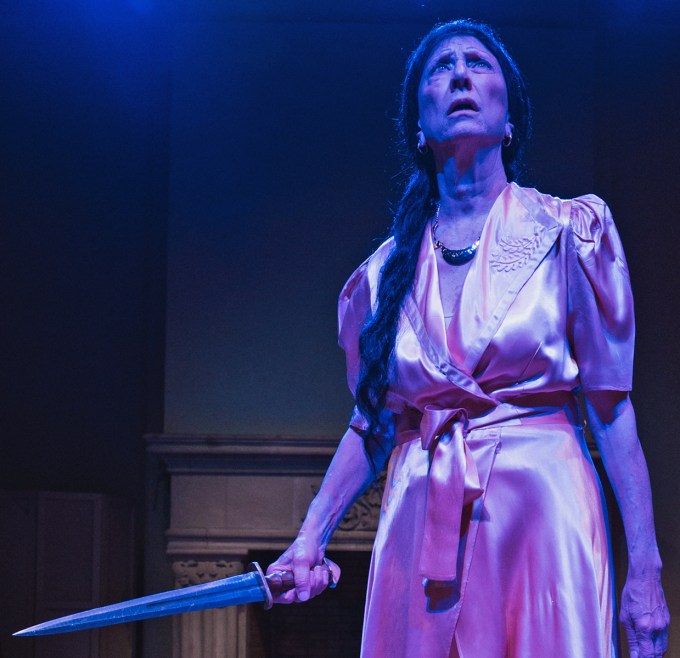
The corpse of a dog appears – tines of a pitchfork embedded in its side and handle vertical to the sky.  Such is the “The Curious Incident of the Dog in the Night-Time.”

A young boy, intent on finding out who was responsible for the killing and why, clumsily and abruptly questions neighbors to little avail.  The boy, fifteen-year-old Christopher, can rattle off sequences of prime numbers and squares of numbers.  He also stumbles socially; shies from being touched; and refuses to use a toilet that hasn’t just been cleaned.  He is autistic.

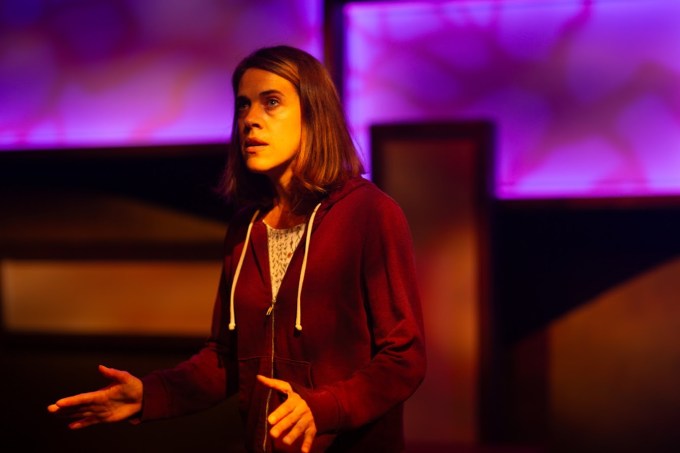
Brendan Looney, Sophia Alawi.

The play’s storyline and its structure offer fascinating originality, and San Francisco Playhouse’s production, potently helmed by Director Susi Damilano, captures every bit of uniqueness in the script with a stunning, well-coordinated creative design.

The plot first concerns Christopher’s quest to solve the dog’s killing. Eventually, the perpetrator admits to the killing, but in one of the less satisfying aspects of the story, the action lacks a direct motive.  The other plot thread deals with the boy’s family.  During the narrative, he is told of his mother’s death from a heart attack, but his investigation into the dog’s death leads his seeking to learn more about his mother’s demise.

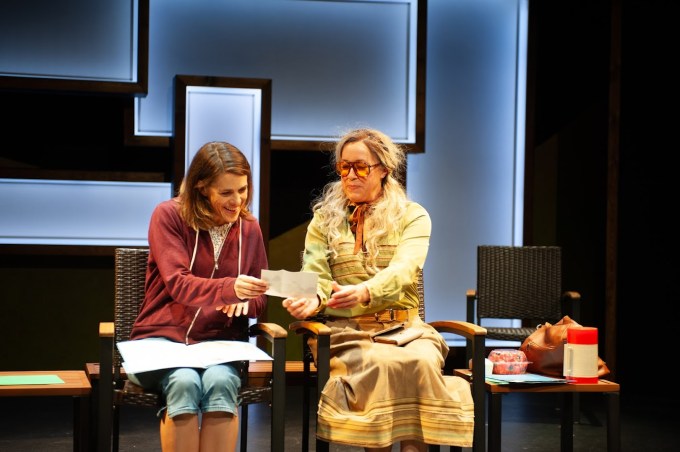
(standing) Laura Domingo, Brendan Looney, (seated) Renee Rogoff, Whit K. Lee, Catherine Luedtke.

In a broader sense, however, the play goes beyond the plot and dives deeply into the world of autism.  Brendan Looney’s powerfully illuminating Christopher is more than a simple role portrayal, since he brings authenticity as a real-life autistic, logical but regimented and repetitive.  His depiction is deep and memorable.  He elicits sympathy with his inability to grasp social conventions, like the natural aversion others would have to his pet rat, and his difficulty interpreting others’ intentions and facial expressions.  But beyond its anchor in autism, the play is really about all outsiders who are treated with indifference or scorn by established society.

In Curious Incident… we see the world from the perspective of the autistic, who wants acceptance and understanding while not conforming with neurotypical standards.  We learn how those who are on-the-autistic-spectrum are often ill-treated.  For instance, while Christopher’s reading ability is clearly fine and his math skills are stratospheric, he must attend a school for the learning disabled.

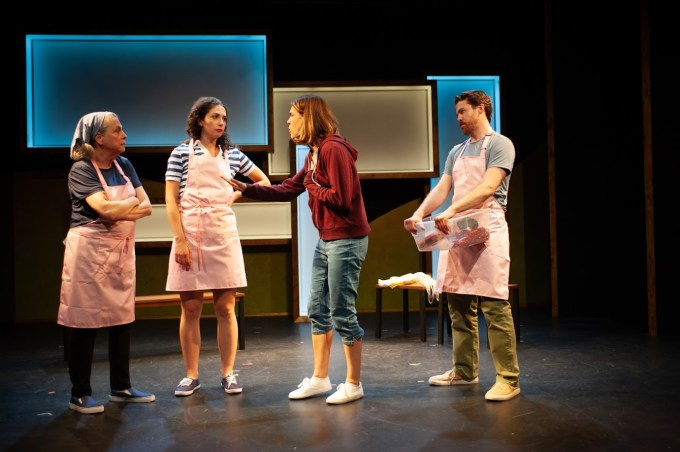
(kneeling) Brendan Looney, (standing) Renee Rogoff, Catherine Luedtke, Cassidy Brown, Laura Domingo, Wiley Naman Strasser, Sophia Alawi.

Other than Looney’s breakout performance, an all-star cast fills the other roles, with several actors playing multiple roles, some anonymous and listed as voices.  Sophia Alawi performs the other lead role as Siobhan, Christopher’s teacher.  She acts as a narrator elaborating on the interactions of characters and sharing the boy’s unexpressed thoughts.  While her role is largely expository, offering little dramatic variation, Alawi carries it out with exceptional grace and charm.

Christopher’s parents comprise the remaining key roles, each actor embracing the desirable features and flaws of the characters.  Mark P. Robinson is fiery and demonstrative as Ed, who loves and protects his son.  He insists that the son not investigate the dog’s killing because it intrudes on other people’s lives.  But Ed lies about vital matters that the literal-minded boy cannot process with nuance or forgive.  As the mother, Judy, a passionate Liz Sklar also evidences her love for her son but reveals conflicting wants in her emotions and actions.

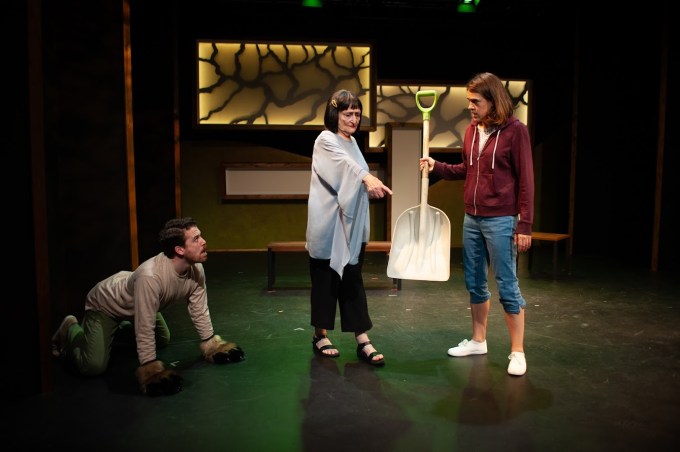
Liz Sklar, Brendan Looney, Wiley Naman Strasser, Cassidy Brown.

The teen’s journey through numerous clashes is a voyage of discovery and coming of age.  Having lived a protected life with narrow focus, retracing steps taken many times before, he will travel from a small, regional English city to London, confronting unknown horrors like escalators and the underground, uneasy about even how to enter them. 

In keeping with Christopher’s compartmentalization and disruptiveness, the action is divided into 57 fast-moving scenes, though a few seem unessential and slow the action.  Actors remain on stage most of the time and move frequently in lockstep and other times organically to Bridgette Loriaux’s brilliant movement direction.  James Ard’s sound design is pervasive and marvelously detailed from musical blipping to the faint sound of a toilet flushing.  This all plays against Bill English’s minimalist but powerful right-angled set framed by light strips and accented by Christian Mejia’s lighting design.  On the back wall of the stage, and in keeping with the angular look, Sarah Phykitt’s linear-graphic projections visually reflect Christopher’s mind which favors predictably organized things like computers and machines.

Brendan Looney, Whit K. Lee.

The play has earned plaudits and awards on Broadway and the West End.  The SF Playhouse production is a highly rewarding revival that informs, provokes, and entertains.

The Curious Incident of the Dog in the Night-Time, adapted by Simon Stephens and based on the novel by Mark Haddon, is produced by San Francisco Playhouse and appears on its stage at 450 Post Street, San Francisco, CA through June 21, 2025.

Writing Fragments Home

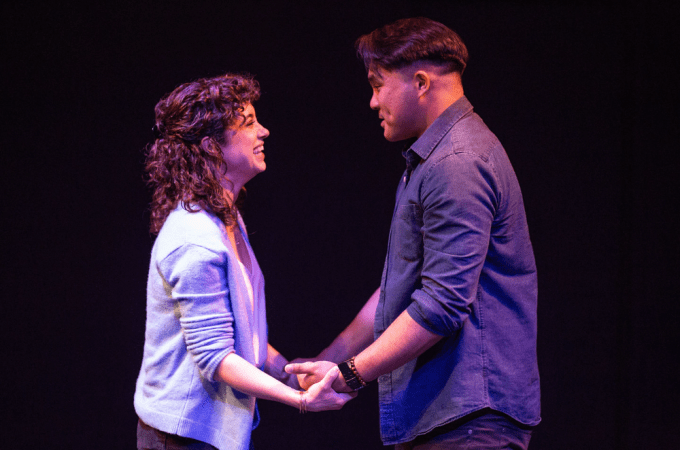
Jay (Jomar Tagatac) and Mary Gwen (Jen Cuevas). Photos by Mark Kitaoka except as noted.

Recent generations have witnessed the fragmentation of the traditional nuclear family, with perhaps the most common variation being the boomerang, in which adult children return home, often when the parents had adjusted to being empty nesters. Jeffery Lo’s world premier offers a partial-semi-not-totally autobiographical peek into that world with a play that is screamingly funny, sadly sad, and very interesting in its structure. If this review is shorter than my typical, note that I accepted press tickets from Hillbarn Theatre with the agreement that I wouldn’t review because of many prior commitments. And though this review is delayed because of travel, sometimes you just want to share something even when there is no obligation.

Portrayed by the always effective Jomar Tagatac, Jay is a 40-year-old, longtime wannabe playwright who is dumped by his girlfriend and leaves his unrewarding job in a rage. What to do in that situation when the financial wolf is at the door? Pack your bags and head for home – your childhood home.

Jay (Jomar Tagatac), Actress (Brigitte Losey) and Actor (Jamiel St. Rose).

Jay is Philippine-American and an only child whose father died when he was a youth. While his mother, Mary Gwen, loves him, she has been very disappointed that he hasn’t pursued a stable career, particularly in nursing like her, which is a major point of friction. And as sloppy as Jay is, his mother is correspondingly neat. A common flash point in boomerang arrangements like this is that the child has been independent for years and used to making decisions, but the parent may want the child to abide by the parent’s rules as a price for returning to the nest.

Mary Gwen is so insistent that Jay not become comfortable with this return engagement that she won’t allow him to use his old bedroom, but rather requires that he sleep on the living room couch. Jen Cuevas is remarkable as the determined Mary Gwen, with exquisite comic timing as she cajoles and badgers Jay with tough love. Even when Jay tries to make good, like by cooking pancit, Philippine noodles, for dinner, the two share a laugh when she asks that he not cook it again.

Mary Gwen (Jen Cuevas) and Ronaldo (Jepoy Ramos).

But the play’s special spirit derives when Jay’s new writing results in two actors materializing from the ether, playing out his thoughts. But unlike private dreams, Mary Gwen can also see the actors and realize how hackneyed Jay’s ideas are, like representing a couple fulfilling each other by having them place opposing arms up together. Brigitte Losey and Jamiel St. John as the actors are as funny as a gaggle of goofy ghosts on laughing gas. And add to the ethereal mix Jay’s deceased father, Ronaldo, played by an always smiling and empathetic Jepoy Ramos, who offers guidance to the anchorless Jay.

The dynamics of a parent-child relationship like this, even when the latter is an adult, will resonate with most of us. A parent often has goals for a child that the offspring doesn’t share. The parent’s disappointment then can irritate the child who seeks agency. Conversely, a child is often oblivious or dismissive of the sacrifices the parent makes in offering better opportunities for the youth. In fact, Jay’s parents had come to the U.S. to offer a better life for him. Yet, to manage his cognitive dissonance, Jay embraces the idea that they left the Philippines because it was not good for them, which wasn’t the case. The playwright’s situations and characterizations are highly relatable and will have many audience members laughing and crying alternately.

Jay (Jomar Tagatac).

Director Reed Flores extracts crackling humor from the cast. Meanwhile, the production values soar, highlighted by Christopher Fitzer’s scenic design and Pamila Gray’s lighting. Playwright Jeffrey Lo is a local product with many notable directorial accomplishments. It would not be unreasonable to have serious reservations about the worth of a locally produced play written by a hometown hero, but in this case, no apologies are necessary. This script gets high marks for an appealing storyline with crackling dialog and fully developed characters, and the production lives up to the quality of the narrative.

Ronaldo (Jepoy Ramos) and Jay (Jomar Tagatac). Photo by Tracy Martin.

Writing Fragments Home, written by Jeffrey Lo, is a world premiere produced by Hillbarn Theatre, and plays on its stage at 1285 East Hillsdale Blvd., Foster City, CA through May 4, 2025.

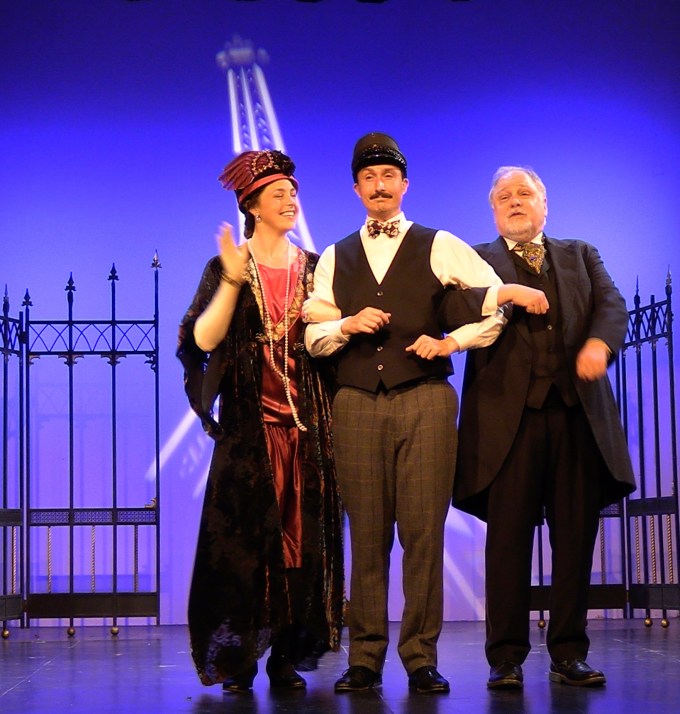
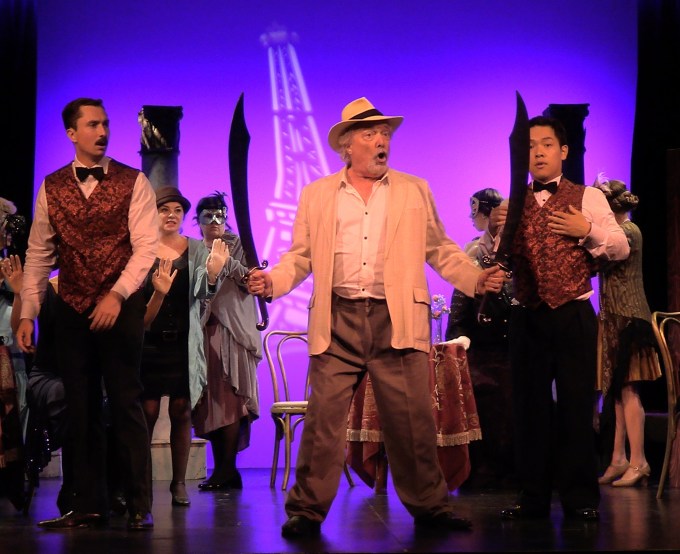
Zorro

Cast. All photos by David Allen.

A score of years before the debut of Batman, the Caped Crusader, pulp writer Johnston McCulley introduced the character Zorro.  Like the superhero who followed, Zorro came from privilege; protected those in need; disguised himself with an upper-face mask and headdress; and wore a cape.  He also lived a conventional life outside of his disguise.

A pulp-fiction hero may seem an odd choice as an opera protagonist, but then again, consider some other central figures from operas that take place in Spanish locales – Figaro, a barber, and Carmen, a gypsy cigarette factory worker.  But El Zorro, the fox, offers flair and drama that play fluidly into common operatic tropes.

Xavier Prado as Zorro, Maria Brea as Ana Maria.

Opera San José presents Zorro, and everything about the production is a delight.  The music is a melodic pastiche of Romantic operatic idiom with strokes of mariachi, flamenco, and corrido (folk music).  There is even the recurrence of an ominous two-note death motif from Carmen.  The plot weaves love, selflessness, courage, betrayal, humor, and more among passionate and well-developed characters into a compelling narrative.

Singers and orchestra deliver admirable performances, and the scenic design and costumes create an ambiance to suit the place and time.  Two languages are used in the libretto, which itself is not unusual.  But when done, it is most common in opera that particular characters sing in their origin languages.  In this case, characters switch back and forth within a dialog.  Behind this device is the composer’s desire to use whichever language fits the specific musical phrases best. It should be noted that having a far greater number of open vowel sounds, Spanish is generally more suited to opera vocalizing than English.

Arianna Rodriguez as Luisa, Jesús Vicente Murillo as Sergeant Gomez.

With the opening swordfight scene, you might expect that you’re in for a swashbuckler.  But while there is more well-choreographed swordfighting to come, this is really the origin story for Diego becoming Zorro, with the first famous slashes of the Z coming just before intermission. 

The central social theme that relates to current times concerns discrimination.  Diego’s former best friend, Moncada, is now mayor of Los Angeles in New Spain in the early 1800’s.  He adopts policies to harass mestizos (mixed bloods), including Diego’s love interest, Ana Maria.  Diego’s commitment to fairness and righteousness comes in the gripping “Justice has no color,” which begins as an aria and builds voice by voice to become a stirring quartet.

Lyric tenor Xavier Prado as Diego/Zorro is well suited to the role with a strong singing voice and personable yet assertive acting.  Romantically, Diego loves Ana Maria, who is unrelated to him by blood but raised as his sister.  Soprano Maria Brea’s beautiful tone finds many opportunities to excel, with one of the best examples for her and for Prado being the lovely duet “Abrazame” (“Embrace me”).

Eugene Brancoveanu as Moncada, Melisa Bonetti Luna as Carlota, Xavier Prado as Diego.

Along the way, complicated liaisons evolve.  The always magnificently unforced and resonant baritone Eugene Brancoveanu plays the villain Moncada.  He holds sway over the patrician Doña Carlota as a result of his political power, but she is in love with Diego.  As the conflicted Carlota, mezzo-soprano Melisa Bonetti Luna shows her acting range in her complex relationships and her singing range in her well-sung, low tessitura lament.  And though Carlota’s boorishness makes her an unappealing character at the outset, she evolves into something admirable.

Comic relief comes in the form of the couple Sergeant Gomez, portrayed by bass-baritone Jesús Vicente Murillo, and Luisa, performed by Arianna Rodriguez.  Gomez is Moncada’s bumbling yet grounded gofer who can never do anything right in the eyes of his boss, but the spritely, dreamy Luisa thinks he has the bearing of a general.  Both voices are attractive and true, and Rodriguez conquers the highest tessitura in the score with ease.

Cast.

For composer Héctor Armienta, Zorro represents homecoming in more ways than one.  Raised as an Angeleno, the story plays in the place of his youth.   This production occurs in his artistic home.  A resident of Oakland for two decades, he spawned Opera Cultura, a San Jose proponent of Latino musical arts, which was also a co-commissioner of the opera.

Virtually all aspects of the opera exceed expectation, with the exception of the flamenco.  The sound of the shoes on the floor is too faint to produce any excitement, as is the rhythmic clapping.  The scene feels like a throw-in, which if done, should be done with more flair.  Also, in a couple of instances, singers are inaudible as they face too far away from the center of the audience or are positioned too far upstage.

Eugene Brancoveanu as Moncada, Xavier Prado as Zorro.

Zorro, with music and libretto by Héctor Armienta, is a co-production by Opera San José, Kentucky Opera, and Arizona Opera, and plays at California Theater, 345 South First Street, San Jose, CA through May 4, 2025.

It’s True, It’s True, It’s True

Maggie Mason as Agostino, Emily Anderson as Artemisia. All photos by David Allen.

Plus ça change, plus c’est la même chose.  The more that time marches on, the less knowledgeable about history we become.  Youth today, living in their time bubble, probably feel that the “#Me Too” movement was delivered by virgin birth.  But evolutionary threads exist for virtually any human occurrence.

Marin Theatre offers the energized and rowdy It’s True, It’s True, It’s True, a fascinating look at a seemingly rare and riveting event.  It is the story of Artemisia Gentileschi, a noted Baroque painter, who as a teenager produced masterworks and would become an esteemed court painter and whose works appear at several major museums.  At the age of 15 she was raped by an older male artist, Agostino Tassi in Rome in 1612.  Unusually, Artemisia, a female minor in a heavily patriarchal culture, possessed the determination to have Agostino tried, and the play is fact-based on the transcripts of the court proceedings.  The play provides some backstory, and otherwise, shares direct testimony from the trial and its outcome.

Maggie Mason, Keiko Shimosato Carreiro, Alicia M. P. Nelson, Emily Anderson.

This is a “he-said, she-said” which will evoke memories of moderns like Clarence Thomas/Anita Hill, Donald Trump/E. Jean Carroll, and Brett Kavanaugh/Christine Blasey Ford.  And like these modern cases, the main line of defense was to vilify the accuser by depicting her as a fallen woman or an attention seeker.  In Artemisia’s case, testimony by Agostino’s associates of her many trysts was even found to be false.

The action of the play is boisterous, replete with explicit language, simulated sex, and partial nudity, driven by a surprising and unusual script delivered by an all-female cast, perhaps in a nod to feminism.  The performances by all four women are absolutely exemplary.  My personal favorite is Maggie Mason displaying the confidence and pride of the devious Agostino who led Artemisia along after the rape, suggesting that they would marry.  Keiko Shimosato Carreiro is also highly animated as Tuzia, a neighbor who became a surrogate mother to Artemisia, watching over her and providing essential support and information at the trial.

Alicia M. P. Nelson as Judge, Maggie Mason as Agostino.

Alicia M.P. Nelson is the judge, nominally a part with less to do, but with her interventions and wry delivery, she gives the part vitality.  Finally, Emily Anderson portrays Artemisia, a youth in age, restrained in her anger and with conviction to stay the course in the trial.  In a shocking twist, she survives a perverse lie detector test in which she is subjected by the judge to thumbscrews to somehow prove that her testimony is legitimate.

Although the production is small, it is handsome.  Pamela Rodriguez-Montero has created hybrid costumery that spans the centuries.  Matt Stines’ sound design and Marshall’s lighting enhance the overall feel of Mikiko Uesugi’s simple but suitable scenic design for the intimate Lieberman Theatre.  Director Rebecca Wear integrates all of the pieces and drives the pace to create a gripping sense of urgency.

The Elders from Book of Daniel in the Biblical Septuagint.

The play’s structure is somewhat eccentric in that the narrative is punctuated several times by musical performances from the four actors.  It feels strange to experience them doing punk songs, with the ingénue-looking Anderson propelling a gritty-sounding guitar like a buzzsaw while others beat on percussion.  The music is fun, but it’s hard to catch enough of the lyrics to know if they contribute to the story line.  You might wonder why these interludes.  Perhaps they make a symbolic link across the 400 years, supporting the notion that today is not so different from yesterday.

There is also a play within a play, the Biblical story of Susanna and the Elders.  It relates to the main narrative on multiple levels.  In 1610, Artemisia actually depicted the sexual attack by the elders in a painting.  Unlike other paintings by males on this theme, she shows Susannah to be distressed and rejecting the attention.  The selection of the subject may have represented advances that she suffered from men before the rape occurred.

Alicia M. P. Nelson as Judge, Keiko Shimosato Carreiro as Tuzia.

There are other presences and absences that one may wish were a little different.  If you think the words “it’s true” in the title are repeated more than necessary, wait until you hear Artemisia repeat the words tens of times with varying emphasis.  What’s missing is projections of Artemisia’s paintings, which would add credibility to her claimed reputation as an artist.  Finally, some playwrights expect the audience to pick up on character names and shifts in how characters are identified the first time they are mentioned. Some audience members were left in the lurch because multiple, long Italian names were introduced too quickly.

That said, despite its brief 75 minutes including musical diversions, It’s True, It’s True, It’s True covers considerable ground concerning justice and women’s rights, process, history, art, and more.  Those with appropriate interests will find the play highly interesting and rewarding.

Alicia M. P. Nelson, Emily Anderson as Judith from Book of Judith in the Biblical Septuagint.

It’s True, It’s True, It’s True written by Billy Barrett and Ellice Stevens, is produced by Marin Theatre and plays on its stage at 397 Miller Ave., Mill Valley, CA through May 4, 2025.

Here There Are Blueberries

Cast. All photos by Kevin Parry Photography.

History plays a compelling role in the self-perception of societies.  Yet, as important as history is, it is commonly forgotten or distorted.  People routinely develop amnesia for important aspects of events as recent as the pandemic or administrations of recent presidents.  The history upon which countries develop their self-worth is often distorted, twisting even favorable facts and suppressing those that don’t conform to the myth.

Another element of how history emerges pertains to its granularity.  In the presence of free and active press, major public events that shape our broader understanding are typically revealed in real time.  But later, research often unearths new facts through examination of personal and micro-events, that if accepted into the common wisdom, shades and sometimes radically shifts our view of the past.

Delia Cunningham.

At the center of Here There Are Blueberries, the US Holocaust Memorial Museum received a photo album in 2007 that a U.S. Army officer had found in Germany in 1946, purported to be of the Auschwitz concentration camp.  This find was unique in two ways.  Despite Auschwitz having been the largest facility for murder that the world has ever known, its activities were carefully secreted.  Except for an album picturing victim/prisoners found by survivor Lili Jacob and released in 1980, no known pictures from Auschwitz were known to exist.  Further, this newly-donated album depicted the lives of the camp’s Nazi administrators.  Not a single image of a victim appears.

Indeed, this choreographed look into the lives of those who became cogs in the killing machine almost didn’t become known history.  Why?  The Holocaust Museum’s mission is to honor the victims of the Nazi horror, and perceived neutral or favorable depiction of the perpetrators could be used to glorify them.  Only through the persistence of staff archivist Rebecca Erbelding, portrayed in the ensemble cast by Delia Cunningham, did the album see the light of day.

Scott Barrow, Barbara Pitts, Luke Forbes, Delia Cunningham, Nemuna Ceesay.

This Tectonic Theater Project (New York City) production presented by Berkeley Rep was conceived, directed, and written by Moisés Kaufman with co-author Amanda Gronich.  The work falls into the unusual category of stage documentary.  Eschewing dramatic conventions that could evoke great emotion, it does not produce the weeping responses that could be expected given the topic.  But it does hew to the facts, resulting in a provocative and rewarding piece that examines the inner thinking of the perpetrators and provides a chilling lesson for our time.  The further we move from the actual history, the more important and compelling are reminders such as this.

We witness arguments among Museum administrators and researchers as well as interviews with descendants of perpetrators.  As it unfolds, we see the methodologies of historical research used to solve puzzles.  Images and individuals are triangulated with other documents.  Interviews corroborate facts, yield new directions, and provide additional contacts to expand the investigation.  The play’s dramatic stiffness derives from dialog and soliloquy that are largely expository, yet, this is where its documentary character shines and gives it authenticity.

Barbara Pitts, Jeanne Sakata, Delia Cunningham.

The play is effectively presented on a low-lit and austere stage with projections from the album and related images generously elaborating the narrative.  Although actors perform main roles, each has multiple parts, often of characters of different age and gender than the actor.

The album in question was determined to be the work of Karl Höcher, adjutant to the commandant of Auschwitz.  Many leaders could be identified from their photos, and the backstories and post-war trials for crimes against humanity of some are shared, like Rudoph Höss, the conceiver and developer of Auschwitz, and Joseph Mengele, the medical experimenter known as “The Angel of Death.”

Barbara Pitts, Luke Forbes, Delia Cunningham.

Like much research, serendipity can be profound.  In this case, the album photos were released in Germany, and the grandson of a man in three photos came forward – the first known descendant of a Nazi to assist the Museum.  He made connections with other descendants that shed further light on the album.  Along the way, historical research concluded with certainty that the two disparate albums mentioned above were compiled within 24 hours of each other, only several weeks before the end of WW II.

The pictures themselves make Blueberries particularly dispiriting.  Rather than evil or even scowling, subjects appear quite ordinary, because this album was clearly compiled as an upbeat portrayal of the lives of Auschwitz officers.  In any case, many of them came from pedestrian backgrounds, three leaders being identified as a bank clerk, an accountant, and a candy maker.

Grant James Varjas, Luke Forbes.

More disturbing is a series of photos that show Höcher with a bevy of SS Helferinnin, attractive young women who did clerical work in the administrative building, outside of the concentration/work/death areas of the camp.  It is hard for many people to accept that a significant number of women could have been complicit in Nazi horrors.  Like many others after the war, the Helferinnin, claimed to know nothing about the tragedies beyond the wall, but how could they not know of 300,000 Jews and other “undesirables” being gassed in three weeks of 1944 alone?

Among the benefits of cross-referenced documentary research of Nazis was linking information that proved knowledge by individuals of the killings.  This led to exposing the nefarious and to their trials and convictions.

Research also revealed the character of people who fell into the Nazi movement and became unmoved by or participated in its hideous actions.  They subordinated independent thought to that of a cult leader.  They were drawn in by identity politics; desired to feel a significant part of a group; and were willing to conform to prescribed behavior.  They were able to compartmentalize aspects of the movement that they couldn’t reconcile; deny inconvenient truths; reject individual responsibility by being a small part of a whole; and argue that there was no viable alternative to their participation.

Marrick Smith.

Presciently, before the 2016 presidential election, Berkeley Rep produced It Can’t Happen Here, based on Sinclair Lewis’s novel about the rise of fascism through election in a democratic country.  What parallels with Lewis’s novel and the findings of Blueberries can we see today?

Here There Are Blueberries, written by Moisés Kaufman and Amanda Gronich, is produced by Tectonic Theater Projects, presented by Berkeley Repertory Theatre, and plays on its stage at 2025 Addison Street, Berkeley, CA through May 11, 2025.

Grease

Kit Town as Sandy Dumbrowski, Luc Leffe as Danny Zuko. All photos by Grizzly De Haro.

For many of those who have seen the movie Grease, the very names Zuko, Rizzo, Kenickie, Frenchy, and Rydell High evoke nostalgia for the early rock-and-roll and original American Bandstand era of the late ‘50s and early ‘60s, with dances like the twist, stroll, and variations of the jitterbug.  Guys sported duck-tail hairdos, blue jeans with pant legs rolled into cuffs, and white tee shirts; and chicks had ponytails, poodle dresses, and saddle shoes.

Like many successful movie musicals, Grease drew on a stage predecessor that fewer people will have seen but that triggers as much reminiscence.  Its wildly successful Broadway version ran for eight years.  Neither Jim Jacobs nor Warren Casey who collaborated on the book, music, and lyrics, would create another successful musical, which surprises, as Grease is chockablock with fitting and memorable songs and sharp caricatures.  Altarena Playhouse, with Jacquie Duckworth directing, recreates the energy of the original, keeping the audience in smiles and laughs and applauding enthusiastically throughout.

Will Thompson as Sonny, Luc Leffe as Zuko, Jules Hensley as Doody, Liam Cody as Kenickie, Roberto Ruiz Jr. as Roger.

The narrative is episodic, displaying a slice of life rather than telling a story.  High schools are full of cliques, and at Rydell, the select ne’er-do-wells are the Greasers in their motorcycle jackets with their female counterparts, the Pink Ladies, in pink satin jackets.  Their lives are revealed as much by the music as the dialogue, and a large ensemble shares lead singing duties and plot points.

Kit Town as Sandy, Emma Roth as Jan, Annabella Guaragna as Marty, Seana Nicol as Rizzo, Sarah Elizabeth Williams as Frenchy.

One through line, however, is that Danny Zuko (played by Luc Leffe) and Sandy Dumbrowski (Kit Town) had a summer romance and parted with the expectation that each was going to a different Catholic school, this being a largely Italian and Polish area in Chicago.  But when they show up at the same public school, Danny is conflicted about trying to be the same cool, macho guy with his Greaser friends as well as the sensitive boyfriend to Sandy.  She is new to the school and has to deal with horning in on the territory and male quarry of the Pink Ladies.

But it is the memorable songs plus choreography by Shelly McDowell that make the show pop.  Group singing was always strong on opening night, while some soloists were uneven, perhaps from opening night jitters.  What distinguishes the dance is the heavy use of hand movement that juices up many dances.  And they often appear as a flurry of cheery, excited movement as almost the whole company is involved in many dances.

(center) Raven Douglas as Cha-Cha DiGregorio, cast.

Boys and girls dance as a troupe in many numbers such as the lively and expectedly handsy “Born to Hand Jive” and the upbeat closing “We Go Together” with its array of nonsense syllables common especially to doowop.  But also effective is when the cast is clustered in separate gender tribes as if in different locations and sing alternating verses.  This technique is used in the reflective love ballad “Summer Nights” with Danny and Sandy leading their respective groups. It also works on “Those Magic Changes,” another love lament that cleverly starts as an instructional on guitar chord progressions for beginners!  But the real litmus test is the peppy “You’re the One that I Want” which the cast passes with flying colors.  We shouldn’t forget that there are also some solos that hit the spot, including the beautiful “Hopelessly Devoted to You,” which Kit Town caresses until she blasts off, and “Look at Me, I’m Sandra Dee” sung with appropriate derision by Seana Nicol as Rizzo.

Cast.

As uplifting as Grease is, it touches, albeit briefly, on a number of important issues – teen sex and pregnancy; peer pressure and conformity; academic failure; rebellion; and gang violence.  In its pre-Broadway versions, the play, which draws on Jacobs’ own experience in high school was darker and grittier, with more emphasis on story and less on music.  Perhaps the greatest deficiency of the musical is that in sanitizing the book, many incidents and situations hit and run with no depth or development at all.  But the good news is that the fond remembrances of youth, low-ball humor, and finger-popping music make for a barrel of fun.

Raven Douglas, Mateo Urquidez, Heather Warren Camacho as alums.

Grease, with book, music, and lyrics by Jim Jacobs and Warren Casey, is produced by Altarena Playhouse and plays on its stage at 1409 High Street, Alameda, CA through April 27, 2025.

Fat Ham

Devin A. Cunningham as Juicy, Ron Chapman as Ghost of Pap. All photos by Jessica Palopoli.

What the theatrical world has desperately needed is a reimagining of Hamlet, but set in contemporary time in the American south and with an overweight, gay, black title character.  Oh, and it should be a comedy.  Well, maybe a rethinking really wasn’t so necessary, but not only was playwright James Ijames undeterred, but his adaptation of William Shakespeare’s and perhaps the world’s greatest literary tragedy, won the 2022 Pulitzer Prize for Drama and five Tony nominations for the play’s Broadway run.  Touché.

While Fat Ham has received many decorations, that doesn’t make a production an automatic slam-dunk success.  It requires solid direction to ensure crack timing of the humor and great actors to deliver the lines.  Happily, the San Francisco Playhouse production with Margo Hall at the directorial helm and a cast of outstanding actors deliver the goods with relish.  The fine set by Nina Ball and crack lighting by Stephanie Johnson don’t hurt either.

Phaedra Tillery-Boughton as Rabby, Jenn Stephens as Tedra, Devin A. Cunningham as Juicy, Samuel Ademola as Larry, Courtney Gabrielle Williams as Opal.

Fat Ham is distinguished as much by its differences than its similarities to its inspiration.  Rather than a royal family with the gravity of succession weighing in on the plot, the murdered Pap (i.e., the ghost of King Hamlet) was a purveyor of barbeque and a pig farmer.  The formalities of the original are abandoned for modern vernacular.  The characters correspond, but Prince Hamlet becomes Juicy, a thicc, “soft,” sensitive young man, melancholy and reflective.

A couple of soliloquies are delivered directly from the script of Hamlet, and Devin A. Cunningham, who soars while inducing empathy for Juicy, delivers them with aplomb.  One of particular note begins “I have heard that guilty creatures sitting at a play have …..,” which foretells a trap that Juicy will later set for Rev. Also, there are a couple of wink-wink references to the original.  An energized Jordan Covington is super-sexed while being pretty explicitly off-color and hyper humorous as Juicy’s cousin Tio (echoing Horatio), who notes that at the end of Hamlet he survives surrounded by the carnage of the other leading characters.  Is that repeated in Fat Ham?  I’ll never tell.

Phaedra Tillery-Boughton as Rabby, Samuel Ademola as Larry, Jenn Stephens as Tedra.

The mousy Juicy’s dilemma derives from visits by the ghost of Pap who demands that he exact revenge by murdering Pap’s brother, Rev (King Claudius), who had killed him.  Ron Chapman grimly seethes with immorality and Machiavellianism playing both brothers.  But Juicy rejects violence at a personal level and for its hobbling of black society.  What’s more, while he loathes Rev, he didn’t exactly love Pap, asking his ghost “Why were you so mean to me when you were alive?”  Yet, he doesn’t outright reject the idea of revenge.

The issue that both Pap and Rev have with Juicy is that he postures effeminately, lacking manly demeanor.  A strong thread of sexual identity runs throughout the play, and indeed, Opal is a closeted lesbian.  This is the Ophelia role played deftly by Courtney Gabrielle Williams as the spunky but respectful daughter who wears a dress that she hates to placate her mother, Rabby, who in a gender shift represents Polonius.  Phaedra Tillery-Boughton plays Rabby as the stereotypical Black church-going lady becrowned with a fashionable hat and dressed to the nines.  She is a walking laugh machine with her high-pitched rapid patter and flippantly dismissive mien.

Devin A. Cunningham as Juicy, Ron Chapman as Rev, Jordan Covington as Tio.

Although most of the personalities reveal themselves quickly, perhaps the greatest transformation that the playwright creates is in the person of Larry, who has little stage time.  Samuel Ademola effectively plays the analogue to Laertes, Polonius’s son.  A returning, uniformed Marine, he is distant and almost catatonic, but in one unpredictable action, he leaves the audience anguished, and in another, applauding.

But in the race for the bottom of immorality, a yet unnamed but central character may take the prize – Juicy’s mother, Tedra, or Gertrude from Hamlet.  A hedonist and opportunist, Tedra marries Rev (Claudius), making him head of the food business (king), before the deceased Pap’s (King Hamlet’s) body is cold.  And she blithely counsels Juicy to move on and accept Rev as his father.  Her values come clear when she depletes Juicy’s college tuition money to pay for a bathroom renovation.

Courtney Gabrielle Williams as Opal, Devin A. Cunningham as Juicy.

As Tedra, the comely Jenn Stephens is salacious, quick with a come-on smile and rotating hips – always ready to party and play games.  But one game evinces her ire.  To Rev’s and her displeasure, Juicy uses a game of charades to reveal unseemly truth about Rev.

Fat Ham is a comedy, and the laughs come continuously from a variety of sources and in a variety of different forms.  But underpinning the comic elements are the tragedy of fratricide/regicide; the social issue of homosexuality; the matter of moral priorities; the poison of toxic masculinity; and considerations of deciding what kind of lives we wish for and what risks to take in attempting them.  Making the serious crests work in an ocean of humor is a challenge.  Whatever shocks or surprises arise are well absorbed by the narrative flow and the directorial management.  The result is a highly entertaining moral tale that is more relatable than the source from which it is drawn.

(foreground) Devin A. Cunningham as Juicy, (rear) Jenn Stephens as Tedra, Phaedra Tillery-Boughton as Rabby, Samuel Ademola as Larry.

Fat Ham written by James Ijames, is produced by San Francisco Playhouse and plays on its stage at 450 Post Street, San Francisco, CA through April 19, 2025.

Mrs. Krishnan’s Party

Justin Rogers as James, Kalyani Kagarajan as Mrs. Krishnan. All photos by Indian Ink Theatre.

For those who like comedy clubs, impromptu, skits and such, a laugh-a-minute treat is in store at Marin Theatre.  New Zealand’s Indian Ink Theatre is touring the U.S. in a special production of Mrs. Krishnan’s Party.  The immersive “party” nominally celebrates Onam, a Hindu harvest and cultural festival important to the southern Indian state of Kerala, with the extra lagnappe for party goers being a serving of spicy dal lentils with basmati rice at the end of the show.

This is what Karin and I did at our performance.

The two-hander is performed by actors with distinguished comedic and acting skills.  Kalyani Nagarajan as the widow Mrs. Krishnan storms around the stage with purpose, howling rapid-fire with a typical British-trained Indian accent.  Extreme facial expressions accentuate her mugging particularly by retracting her lips to better reveal her toothy grin.  Justin Rogers is James, her boarder and factotum, equally adept at humoring and stirring up the audience through direct engagement and traditional performance.

Testing the recipe.

Action takes place in the back room of Mrs. Krishnan’s convenience store in New Zealand.  But this theatrical experience does not occur with performers on stage and the audience in the auditorium.  Rather, to allow the actors to interact at close quarters with spectators, all are on the extended stage, to include the wings and back stage.

The theatrical conceit is that, to her great surprise, 100 partiers have showed up for Onam, and to feed them, Mrs. Krishnan will have to prepare and cook large cauldrons of dal and rice, which she will do with help on stage as the comedy proceeds.  Of course, this format is rife with prospects for calamity, including unpredictable interactions with patrons and complications with preparing the food.  This evening survived without a perceivable hitch, unless spilling a large bag of uncooked rice was not intentional.

An Indian dance.

During the show, several audience members are enlisted to participate in the action.  While I thought I was perfectly ensconced to avoid selection, I was chosen as well as Karin, my wife and editor.  I was tasked with stirring the dal for some time as she integrated onions and spices.  When a Carpenters’ tune arose from the sound system, we even improvised a bit of a slow dance together while we each continued to stir with one hand!

The experience lasts approximately 80 minutes.  In addition to the generally fixed script, audience response often adds to the humor.  Props and activities add to the energy with colorful scarfs dispensed for attendees to wear and balloons distributed to create a festive feel.  The stage is decorated with party lights and streamers.  Nagarajan also performs an appealing Indian dance on an audience table with characteristic beautiful finger movement.

Balloons add to the festiveness.

While the laughs keep coming, sometimes they’re driven by the pratfalls and general looks and sounds of the performers.  The accents of the actors (Rogers has a New Zealand accent), and sound interference sometimes makes it difficult to understand specifically what they are saying.

Another point worth mentioning is that if you’re looking for a traditional theater experience with a production that is consistent from one night to the next and that has appreciable subtext, this is not it.  The story of Onam concerning life and rebirth is verbalized as well as some commentary supporting the notion of people of all religions coming together, but the messages are pretty superficial.

However, if you want a fun diversion with some unusual wrinkles, this is one to enjoy.

Audience enjoying the dal and rice.

Mrs. Krishnan’s Party is presented by Marin Theatre, produced by Indian Ink Theatre Company, and plays at Marin Theatre, 397 Miller Ave., Mill Valley, CA through March 30, 2025.

Push/Pull

Matthew Kropschot as Nolan, Andre Amarotico as Clark. Photo by Robbie Sweeny.

As the smallest possible cast to comprise a play (the solo performance being fundamentally a monologue) the two-hander holds a special place in theater.  These days, they seem more prominent, probably because they are cheaper and easier to produce than plays with larger casts.  But great dramas for two actors such as The Gin Game and Top Dog/Under Dog fill the catalog, as well as comedies like Greater Tuna and even musicals like I Do!  I Do!

A common theme to two-handers is that two characters share commonality that brings them together and contrast that creates dramatic tension.  The brilliantly written and produced 75-minute gem Push/Pull shares that dynamic.

Two young men have been friends since sixth-grade, but upon leaving school have gone separate ways.  Clark (Andre Amarotico) pursued white-collar work before being side-tracked by a mental condition that put him in a psychiatric hospital, while Nolan (Matthew Kropschot) was flushed out of the Navy; bags groceries at Safeway; and lives with a father he despises.  But he has a hoped-for ticket out.  As a committed body builder, he has converted the garage of his father’s home into a weight room and trains to enter competitions to earn professional certification.

One theme of the play is the notion of what constitutes masculinity.  The diffident, unsteady Clark approaches Nolan because he feels ugly and stupid.  He wants to feel male, hoping that weight lifting will do the trick.  Nolan preens to obsession about body building to the extent that he hasn’t “spilled seed” in 300 days.  When Clark declares his goal, Nolan, inclined toward excess and rage, spews, “There’s no such thing as toned! You need to get jacked!”

As the two reunite, it is clear that Clark had greater success in virtually all aspects of life, but he is now in Nolan’s bailiwick.  They spar over many issues and even disagree on high order goals.  Clark seeks happiness.  Perhaps Nolan has consigned himself to unhappiness because of his failures, but he strives for fulfillment, which he gets through physical self-adoration.  For all of their differences, they do feel attached and share some characteristics such as dark sides and self-loathing, which haunt each of them even if in different ways.     

Kudos to Director Gary Graves for overseeing such a masterful production in such an intimate theater.  He animates the action to the extent that that Kropschot gets a pretty good workout from the various lifting sequences.  The observer’s senses are well stimulated while preserving the claustrophobia of Nolan’s existence.

I can’t remember a production in this space with such detailed set and props.  Joseph Nemeth’s scenic design hits the nail on the head, right down to the body builder’s supplies and routine garage paraphernalia on the shelves.  Gary Graves highly complex lighting with frequent spots and blackouts serves both aesthetically and functionally.  And Gregory Scharpen’s sound design is equally detailed and telling.

Then there is the acting, which is superb.  Matthew Kropschot totally captivates by capturing Nolan’s manic faut-confident excesses as well as his almost uncontrollable fury with great bravado.  He dominates the stage with his physical presence and his single mindedness.  And he is a natural for the body sculpting theme, as he is a body builder with large, well-defined muscles and a V-shaped torso as well as being a seriously good actor.  Perhaps the greatest impediment to this play having legs is finding actors who can look and perform Nolan’s physical side and act with equal authority.

Andre Amarotico as Clark engages as an everyman with a common brand of insecurity that he depicts with needy accuracy, admitting that everything he does is for women and that he can’t get over the former girlfriend who dumped him.  And though Clark has a more even keel than Nolan, Amarotico is quite adept at showing his character’s neuroses and insistent side as well.

I will note that I did not attend the opening of Push/Pull because the topic and the promotion of the play did not interest me.  But given the raves from Critics Circle colleagues, I decided to give it a try and am glad that I did.

The value of the production of course begins with the script.  Harry Davis has accomplished the admirable task of creating a script about body building that transcends the obvious topic matter and even evokes interest for those who are somewhat turned off by the subject on the surface.  The play offers insights into the mind of the bodybuilder while exploring universal topics such as friendship, love, family, and self-regard.

Push/Pull, written by Harry Davis, is a world premiere produced by Central Works and plays at Berkeley City Club, 2315 Durant Ave., San Francisco, CA through March 30, 2025.

Nobody Loves You

John-Michael Lyles as Dominic, Ana Yi Puig as Samantha, Jason Veasey as Byron, Molly Hager as Megan, Seth Hanson as Christian. All photos by Kevin Berne.

Competition-based reality shows have become a staple of television.  Who can best tame a forbidding wilderness; or produce the best recipe from an omnium gatherum of surprise ingredients; or sing with the most affecting voice?  But the most enduring format long precedes the era of reality television – the competitive mating ritual, with contestants opening their hearts and trove of secrets on national television in hopes of being The One.

“It’s time for you to pack your things and go, because Nobody Loves You.”  That’s the pronouncement that no contestant wants to hear on the show of the same name.  Yet all but the final survivors will hear it from the show host.  The victimizer, Byron is aptly depicted and portrayed by Jason Veasey as the shallow but engaging man with a radio DJs honeyed voice and a wardrobe of glittery and brightly colored tux-like outfits.  Like the contestants, he is a laughable yet likeable caricature of the type of staff involved in the show’s production.

(front) Ashley D. Kelley as Tanya, A.J. Holmes as Jeff, (rear) Seth Hanson as Christian, Ana Yi Puig as Samantha, John-Michael Lyles as Dominic, Molly Hager as Megan.

For the greater part, the musical aims low, but it keeps the laughs coming.  It succeeds in part because the talented actors work their butts off making comedy; because the situations seem plausible but absurd; and because the pop-rock music is catchy and propulsive.  The contestants with silly behaviors vary from portrayer Seth Hanson’s very Christian Christian (no, that is not a typo) to the dipsomaniac hottie Megan (Molly Hager) to the spacy and gullible animated dynamo Dominic (John-Michael Lyles).  And then there is the contestant with all of the model characteristics and pat answers, Samantha (Ana Yi Puig), even though she is a total put-on, e.g., she says she’s laid back, but she’s really uptight.

Molly Hager as Megan, John-Michael Lyles as Dominic, Ana Yi Puig as Samantha, Seth Hanson as Christian.

Jeff (A.J. Holmes), who hates everything, is stirred into the mix.  He is the guy who went to a children’s play and was the only one in the audience not to give a standing ovation.  Why?  Because the production was too childish!  An all-but-dissertation doctoral student, he appears at the show’s studio in search of his recent ex-girlfriend who hopes to be on the show.  Holmes is good at being humorously sour as he displays great disdain for everything the show represents, openly denouncing it for denigrating and exposing contestants to embarrassment and for being driven by selfish motives.  He shares his summary feeling to the show runner Nina (Ashley D. Kelley) – “I hate your stupid ass show.”

Kuhoo Verma as Jenny, A.J. Holmes as Jeff.

Despite Jeff’s outrageous behavior, Nina is convinced that his hostility and his fox-in-the-henhouse behavior as a contestant would actually boost ratings.  Jeff sees the opportunity to develop a dissertation topic from the experience and expose the show from within, and voilà, a match made in comic hell.  Along the way, Jeff will find a sympathetic ear in the Assistant Director Jenny (Kuhoo Verma) who hopes to be a documentarian.

Though Nobody Loves You premiered in 2012, ACT workshopped the show for this production, updating the situations to current time and revising some of the songs.  Are there serious undertones to the resulting musical?  Sure.  It’s about how people make moral sacrifices in their personal work that they wouldn’t settle for elsewhere.  It reveals how inauthentic people are as they put on faces to gain recognition.  It shows how people put themselves above others when they’re really not and how they fail to be loved if they don’t love themselves. And much more.

Jason Veasey as Byron, Ashley D. Kelley as Nina.

But it’s best appreciated at a superficial level.  We laugh when Megan tries to lure the sexually inhibited Christian into the hot tub, and when Jeff is constantly dumbfounded that people don’t see the folly of what they’re doing and that they don’t see the world as he does.   We enjoy Kelley’s little “wink wink” as Nina when she notes how several of the contestants look a lot like her – because she is playing all of the roles.  And we enjoy all of the manic performances.  I was particularly taken with Verma as Jenny and Puig as Samantha, both of whom have wonderful singing voices and vivid expressions that gleam all the way to the back of the theater.

Molly Hager as Megan, Jason Veasey as Byron, John-Michael Lyles as Dominic, A.J. Holmes as Jeff, Ana Yi Puig as Samantha, Seth Hanson as Christian, Ashley D. Kelley as Tina.

Pam MacKinnon directs, and the production values are as strong as the acting and singing.  Jason Ardizzone-West’s clean scenic design effectively uses partitions that close into square apertures, emphasizing the connection with filming.  Russell H. Champa’s lighting, Jessica Paz’s sound, and Sarita Fellows’s costumes combine to complete the effective staging.                                                                                                                                                                                                                                                                                                             Nobody Loves You, with book & lyrics by Itamar Moses and music & lyrics by Gaby Alter, is produced by American Conservatory Theater and plays at Toni Rembi Theater, 415 Geary Street, San Francisco, CA through March 30, 2025.