Fly by Night

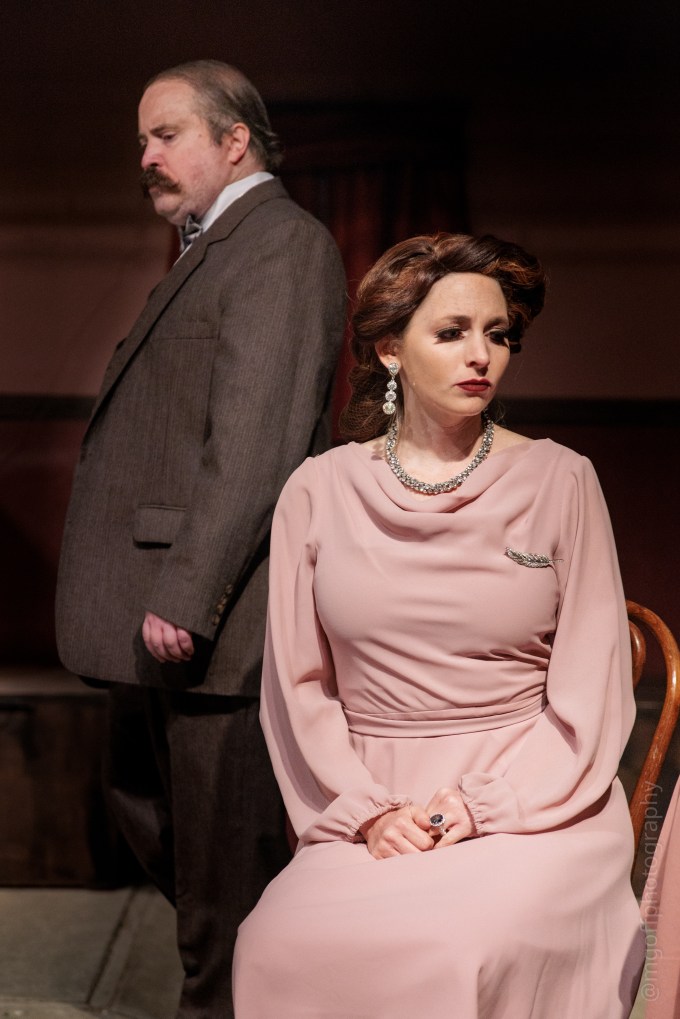
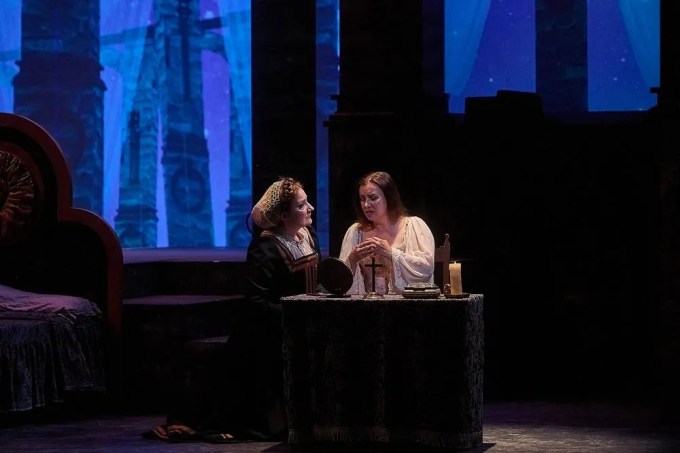
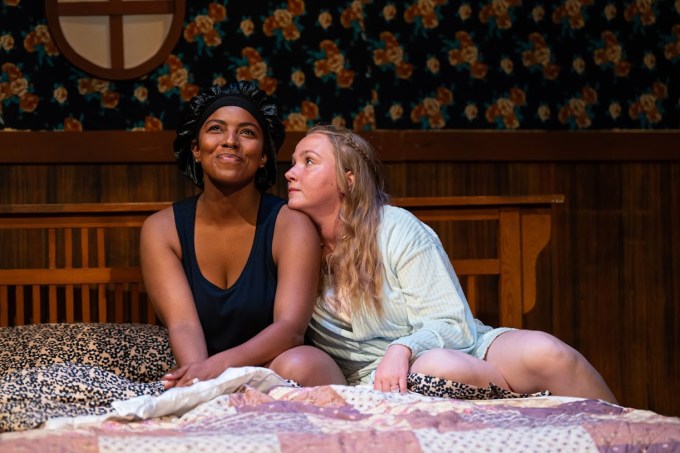
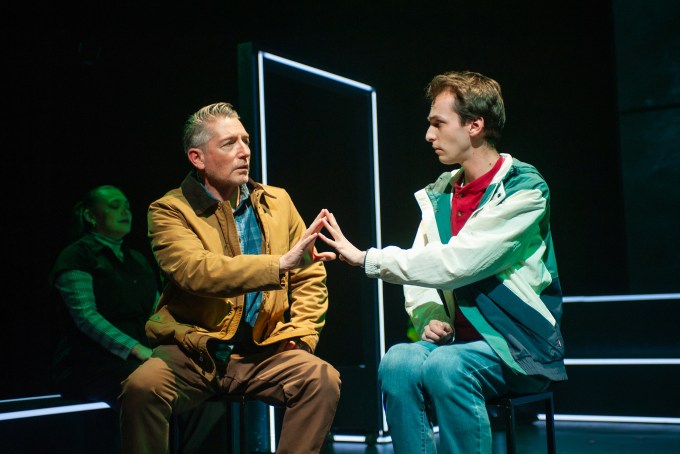
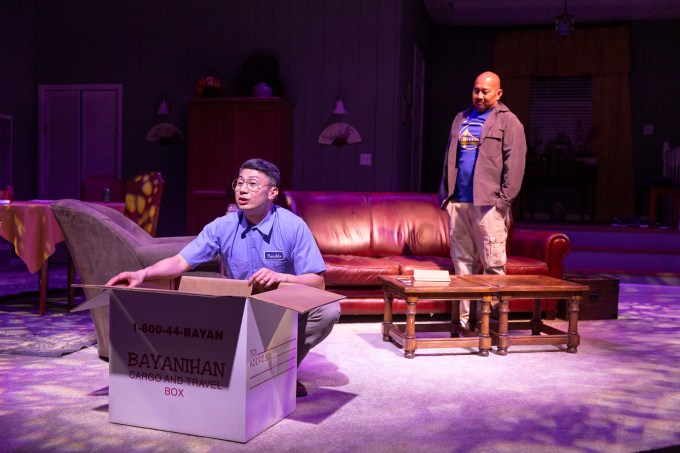
Miriam (Markaila Dyson), Mr. McClam (Lawrence-Michael C. Arias), Narrator (Cathleen Riddley), Harold McClam (Chava Suarez), Daphne (Kaylee Miltersen). All photos by Tracy Martin except as noted.

The pull of stardom, of the bright lights of Broadway extends to every dusty trail and dank bayou in this country.  In Fly by Night, Daphne, who lives in small-town South Dakota, announces to her mother that she is headed for the Great White Way and would like to take the family’s seafoam green Chrysler along with her.  Her mother agrees on one condition – that older sister Miriam accompany her.  The year is 1964.

Fly by Night earned generally favorable reviews in its Off Broadway run at the distinguished Playwrights Horizons in 2015.  The musical offers catchy pop music throughout along with relatable characters in a nostalgic context.  Hillbarn Theatre offers a touching rendering of this story of hope, love, and loss, led by a bubbly and excitable Kaylee Miltersen as Daphne and a more grounded but also sparkling Markaila Dyson as Miriam.

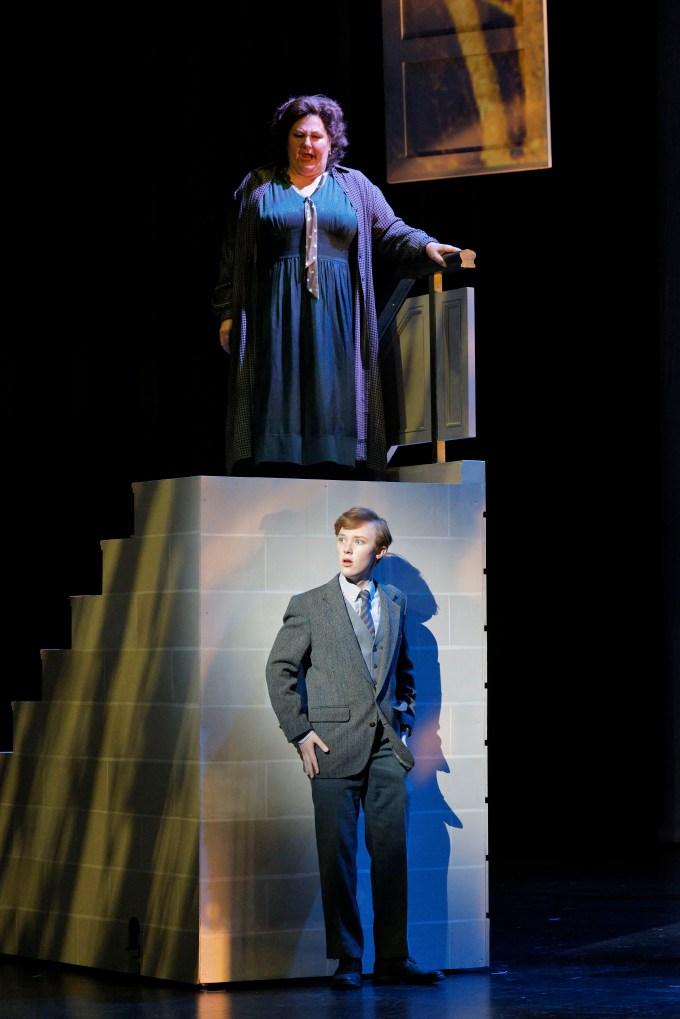
Harold (Chava Suarez), Crabble (Sarah Jebian).

Stars, both literal and figurative, as celestial objects, as people, and as quests, loom large in the story with even the title suggesting them.  Miriam, who loves astronomy, counts them in South Dakota and then in New York City (any guess about the difference?), and shares her love for them in her touching signature song “I Trust in Stars.”  With the bright light extinguished and polluted air repressed by the blackout important to the play’s narrative, even New Yorkers got to star gaze for once as they gathered outside their homes.

While people clearly have agency to make decisions that affect their lives such as leaving home for greener pastures, Fly by Night emphasizes that what may appear to be small decisions can have outsized consequences and that random events often shape the arc of life.  One element of randomness is who we meet and establish relationships with.

Daphne (Kaylee Miltersen), Narrator (Cathleen Riddley), Miriam (Markaila Dyson), Joey (Matt Herrero), (face covered) Crabble (Sarah Jebian).

In her song “Daphne Dreams,” she tells about how she is destined to be a star, yet for months in New York, she sells coats and shoes.  She ultimately meets an aspiring playwright Joey (Matt Herrero), who strives for perfection in his script, and a naval gazing sandwich maker slash aspiring songwriter Harold (Chava Suarez) who will become her love interest.

Harold almost never gets past writing an opening bass riff in his maiden song, but what results is the highly listenable “Circles in the Sand.”  Oddly, it’s about sea turtles hatching on a beach in Florida who move toward the lights on a new highway rather than toward the ocean, and he questions whether he’s also going to the wrong horizon.  Meanwhile, Miriam will also become involved with Daphne’s new acquaintances and will find a job like the one she loved back home, waitressing in a diner.  The action largely centers on the interplay of these characters.

Daphne (Kaylee Miltersen), Harold (Chava Suarez).

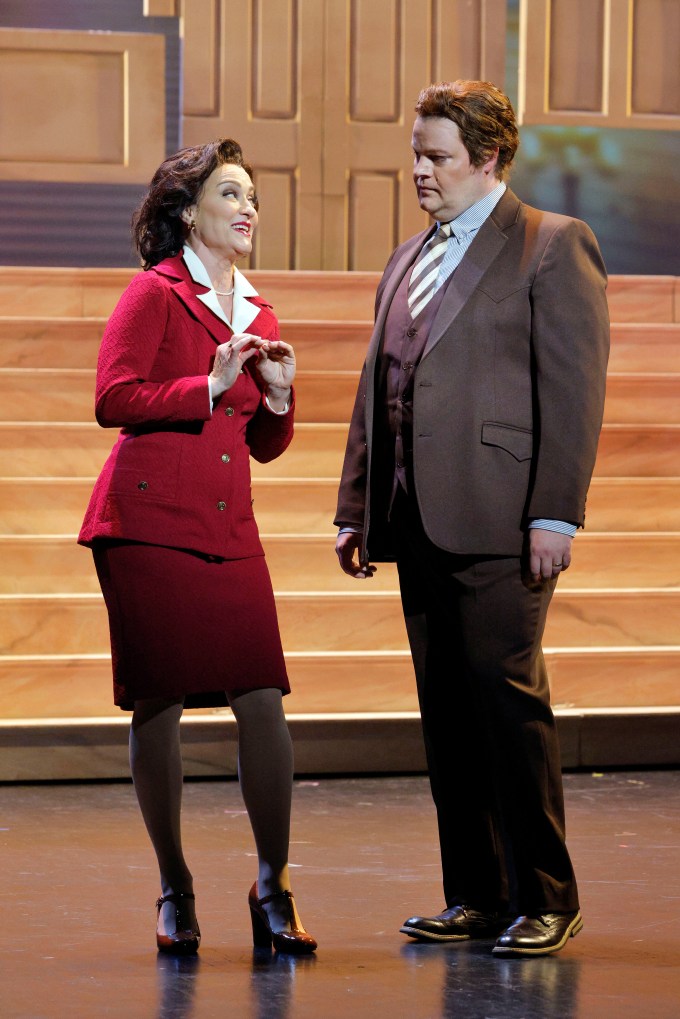
Another thread in the plot depicts the broken relationship of Harold with his father, Mr. McClam (Lawrence Michael C. Arias), precipitated by the death of Mrs. McClam at the beginning of the show’s timeline.  Mr. McClam is despondent throughout except when he reminisces with the quirky and clever song “Cecily Smith,” an important observation about relationships.

The song tells about how Mr. McClam randomly meets the eponymous young woman who will become his wife.  When she tells him how lucky he is that she has two tickets to La Traviata, he says that he hates opera, to which she replies with several insightful variations of, “It’s not what you do, but who you do it with.”   La Traviata will become Mr. McClam’s touchstone.

Daphne (Kaylee Miltersen) and Joey (Matt Herrero). Photo by Mark Kitaoka.

Two related devices elucidate and propel the story.  A very active, all-knowing narrator frames the story as it progresses while playing minor characters as well.  In addition, a shrewd plot device that recurs is effective use of non-linear time.  The reason that time warps don’t cause confusion is that the narrator-introduced flashbacks return to previously revealed events and give their backstories or otherwise amplify them.  In the person of Cathleen Riddley, whose acting and singing are admirable, the narrator is a dramatic contributor.  However, Riddley did fumble enough lines to be somewhat of a distraction.

The promotion of Fly by Night highlights the motive force of the Northeast Blackout of 1965 (a real event in which my wife and editor was trapped for a time in a New York City subway).  Though the blackout does influence the characters and the surprise ending, it occurs at the end of the play’s timeline, after most consequences have already occurred.

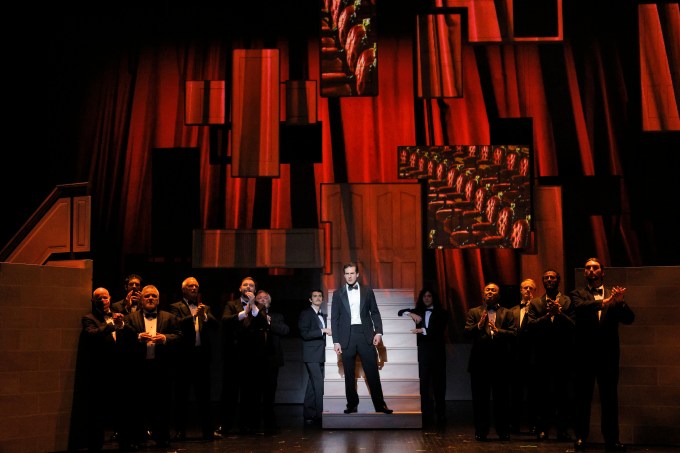
Cara Phipps directs with a sure hand, using the space of the whole theater to energize the action.  Sarah Phykitt’s spare staging says just enough and allows the focus to remain on the actors, while Pamila Gray’s generally low lighting creates a dramatic atmosphere that complements the set. Together with the script and the acting, the result is a worthy theatrical experience.

Mr. McClam (Lawrence-Michael C. Arias).

A criticism that many will have is the length of the musical, with a clock time of nearly three hours including intermission.  Scenes throughout could be trimmed or removed or any of three minor characters could be eliminated and written around.  This in no way is a criticism of the performances of the roles as all were well portrayed.  I particularly liked the Brooklyn authenticity of Sarah Jebian as Crabble, Harold’s boss in the sandwich shop, despite the part being written for a man. 

Fly by Night, conceived by Kim Rosenstock and written by Will Connolly, Michael Mitnick, and Kim Rosenstock, is produced by Hillbarn Theatre and plays on its stage at 1285 East Hillsdale Blvd., Foster City, CA through March 23, 2025.

Happy Pleasant Valley: A Senior Sex Scandal Murder Mystery Musical

Miller Libertore as cameraperson Dean, Sophie Oda as Jade, Emily Kuroda as June. All photos by Kevin Berne.

“Self Made Jade” is a vibrant young woman and successful influencer with a vlog having over 100,000 followers.  From a fractured background, Jade’s father abandoned the family when she was born; her testy relationship with her mother is unfulfilling; and she is estranged from her halmoni – that is the Korean word for grandmother.  But as an opportunist drastically in need of an opportunity, she decides to ingratiate herself with her halmoni, June.

When Jade reconnects with June it is at her home in an assisted living facility.  Unaccustomed to the diversity of the elderly and perceiving family elders as neutered caricatures, she is shocked to find that her grandmother not only swears like a sailor but has sexual appetites like one as well!  And she’s not the only elder pervert around! 

Jacqueline de Muro, Lucinda Hitchcock Cone, Danny Scheie, Cindy Goldfield as residents.

The problem, however, is that June has had two men die in her bed.  She’s suspected of murder and has been ordered to leave the living facility.  Jade had planned to produce a documentary that presents her as a Florence Nightingale helping the elderly, but getting her halmoni out of this fix is not exactly what she had in mind.

Although a little old for the role, the stage can be forgiving over fine details, and Sophie Oda evidences Jade’s verve and drive for high performance.  Along with fine acting, her role is the only one that really demands a quality singer, and she brings the goods, from wailing rock songs to the very touching like “Can I Make a Change of Heart?”

Rinabeth Apostol as Residence Manager Cara, Emily Kuroda as June.

Emily Kuroda portrays halmoni June with total authenticity.  She brings tremendous energy to the role with highly animated herky-jerky movement and complex emotions and behaviors in dealing with a granddaughter that she doesn’t really know.  Kuroda gets to show a lot of dimensionality including June’s fascination with detective work, particularly Murder, She Wrote and Sherlock Holmes stories.

Author Min Kahng shows keen understanding of the elderly and seems to represent the interplay among females with great insight (note: this is judged from the perspective of another male).  Importantly, he differentiates characters to reflect the diversity within the elder community.  There is the woman who presents herself with a grandeur that she never lived; the woman who is lonely and finds solace in communing with and anthropomorphizing squirrels; the man who fancies himself as a virile, irresistible Don Juan; and the man from an open marriage who has come to openly assert a different sexuality.

Lucinda Hitchcock Cone, Michael Patrick Gaffney, Jacqueline de Muro, Danny Scheie, Cindy Goldfield as residents.

A group of Bay Area stalwarts play the other residents in the facility (see photos).  Their acting is superb, and while the singing is a little uneven, who cares?  They’re old people (I can say that as I’m older than they are). Particular recognition goes to Rinabeth Apostol who plays three very different small roles with panache and Miller Liberatore as Jade’s malleable sidekick Dean.

Musical theater triple-threat as composer, lyricist, and book writer, Min Kahng has turned out several works produced for children’s theaters, and this is his third Bay Area premiere for general audiences, following Four Immigrants (TheatreWorks Silicon Valley) and The Song of the Nightingale (Altarena).  Happy Pleasant Valley: A Senior Sex Scandal Murder Mystery Musical brims with melodious pop songs, playful comedy, and clever crime-solving that revisits through video replay the clues that most in the audience probably missed.

Sophie Oda as Jade, Emily Kuroda as June.

The play maintains pace and entertains throughout, but the narrative could be reined in a bit, as it runs long.  One of the challenges that Kahng does overcome is integrating humor and situations that speak to both older and younger generations of theater goers.  The situations must also be age-appropriate for the characters in the play.  One illustration involves June asking Jade and her cameraperson Dean if they know of Angela Lansbury.  After naming several famous Lansbury shows that June’s generation would know (including Murder, She Wrote), the one that finally rings the bell with the younger pair and brings laughter from the audience is Beauty and the Beast, which Jade and Dean would have known as children.

Much of the thematic interest concerns intergenerational family issues, not just preferences and practices, but lies and omissions often intended to protect others in the family but are sometimes self-serving.   Despite serious overtones and deaths, this is a musical comedy that produces laughs throughout.  And as a caution, to appreciate the work, you have to like silly, which the opening night audience clearly did.

Sophie Oda as Jade, Emily Kuroda as June, Rinabeth Apostol as Detective Brown.

Noteworthy is Director Jeffrey Lo’s staging of the musical.  Arnel Sancianco’s scenic design is clean and versatile, framed by Lighting Designer Kurt Landisman’s neon stripes.  Substantial projections and video by Tasi Alabastro enhance the look while providing valuable information.

Happy Pleasant Valley: A Senior Sex Scandal Murder Mystery Musical with music, lyrics, and book by Min Kahng, is a world premiere produced by TheatreWorks Silicon Valley and plays at Lucie Stern Theatre, 1305 Middlefield Road, Palo Alto, CA through March 30, 2025.

The Pigeon Keeper

Angela Yam as Orsia, San Francisco Girls Chorus. All photos by Stefan Cohen.

A poor Mediterranean island suffers drought and a scarcity of fish.  Subsistence fisherman Thalasso and his 12-year-old daughter Orsia suffer a hapless day without a catch, but they do reel in a young boy of a different ethnic group who does not speak their language.

So begins the action of the world premiere of The Pigeon Keeper, composed by David Hanlon with libretto by Stephanie Fleischmann, originally a commission by Santa Fe Opera.  Stipulations came with this grant for a chamber opera – that it be written to reach the broadest of audiences and that it require no more than four principal singers.

Angela Yam as Orsia, Craig Irvin as Thalasso, Shayla Sauvie as the boy.

The artistic creators accomplish the task with a wonderfully appealing under-90-minute musical work of magical realism that depicts joy and pathos in an emotionally touching piece with great relevance to our time.  Opera Parallèle’s production could not be more fitting and effective with superb singing and musical support by the Nicole Paiement conducted eight-musician orchestra as well as Brian Staufenbiel’s clever and appealing creative design.

Orsia, the key role, is portrayed brilliantly by Angela Yam, conveying the compassion of the character with bright, clear, and accurate vocalization.  She also looks and acts the part with great conviction.  As the young girl, she wants to keep the mystery boy at least long enough to find him a home but meets with great resistance from her father.  The story focuses on this quest.  Her widowed father, Thalasso, is played with grim countenance by purposeful Craig Irvin whose commanding, barrel-chested baritone voice thunders with resonance and authority, notably in his “We get by” aria.

Shayla Sauvie as the boy, Bernard Holcomb as the pigeon keeper.

Since Thalasso and Orsia must scavenge for drought-resistant greens to produce a paltry meal, we understand the father’s wherewithal concerns.  However, he says of the boy “He’s not one of us.”  The pigeon keeper, who Thalasso won’t allow Orsia to talk to, is also an immigrant.  Thalasso’s reiteration of his bias and the unwillingness of village folk to help out suggest deep-seated bigotry that is not only relevant today but which underscores many governmental and institutional acts in this country taken under other guises. 

Discrimination constitutes the central thematic issue, particularly in the context of immigration and treatment of minorities.  It also covers positive and neutral ground such as love, family, acceptance, rebirth, community, language as a barrier to communication, what needs to happen for humanity to overcome bias, and more.

Craig Irvin as Thalasso, Shayla Sauvie as the boy.

The opera’s authors are able to meet the restriction on the number of principals by writing three roles in the same voice type.  The answer is gregarious actor, the vocally versatile and mellifluous tenor Bernard Holcomb, who fills the bill by portraying both genders as the pigeon keeper, the widow grocer, and the shopkeeper.  The final star in the show is the San Francisco Girls Chorus who sing large as a Greek chorus; a consort imitating bird sounds; and a clapping and singing ensemble à la a ‘60s girl group like The Angels singing “My Boyfriend’s Back.”

Hanlon’s eclectic music which defies categorization takes advantage of the casting and is melodious for a modern score.  The small orchestra fits the intimacy of the narrative.  Delicate solos and pizzicato add appeal to the musical effect.  What is surprisingly effective are the poignant pauses, which quiet the audience and intensify the already considerable emotion and drama.  The music and libretto make great use of the girls’ chorus as does the staging.  While they occasionally move about the stage representing various groups or forces, most appearances are behind Jacquelyn Scott’s deceptively simple but stunning set.  Two building facades with around a dozen shuttered windows comprise the fixed set, and the girls sing mostly from the windows. Striking lighting & projection design by Jessica Drayton and equally attractive costume, hair, & makeup design by Y. Sharon Peng fill out the beautiful look of the staging.

Angela Yam as Orsia, Shayla Sauvie as the boy, Bernard Holcomb as the pigeon keeper.

Though Fleischmann’s libretto is direct, concise, and moving, minor questions about the work relate to the narrative.  One could argue that the plotline is too simple, even though so many moral issues are implied.  The counter is that the trim plot makes it more accessible to school-aged audience members, and it is in keeping with the idiom of fables that tell simple moral stories with very few characters.  Also, some viewers may be confused by the beginning.  Without introduction, a character, whom we much later learn is the pigeon keeper, sings in a foreign tongue with no translation.  Is it a foreigner, a bird, or something or someone else?  Finally, the title is a bit of a misnomer.  While the pigeon keeper is vitally connected to the plot, he is a minor character.

Artistic Director & Conductor Nicole Paiement, Librettist Stephanie Fleischmann, Creative & Stage Director Brian Staufenbiel, Composer David Hanlon.

The Pigeon Keeper, a world premiere composed by David Hanlon with libretto by Stephanie Fleischmann, was commissioned by Santa Fe Opera with co-commissions by Opera Parallèle and Opera Omaha, is produced by Opera Parallèle and plays at Cowell Theatre, Fort Mason, 2 Marina Blvd., San Francisco, CA through March 9, 2025.

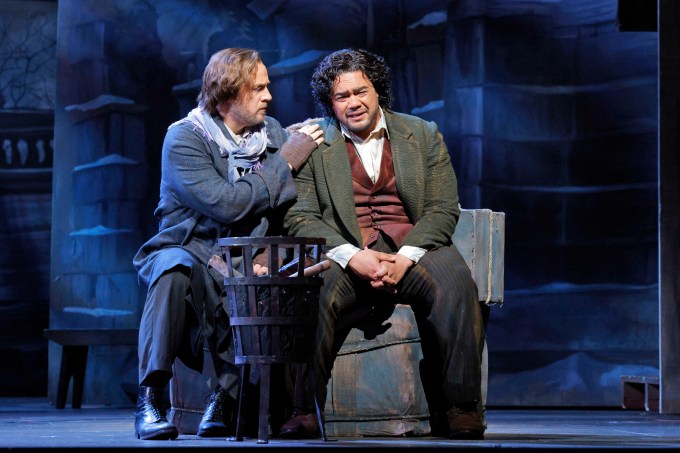
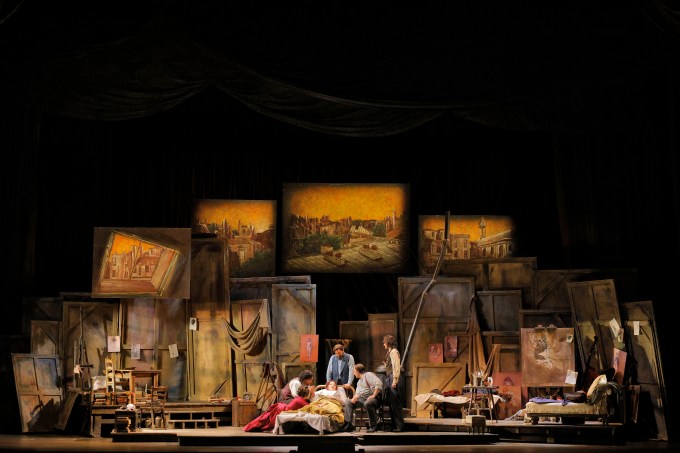
Don Giovanni

David Walton as Don Ottavio, Meryl Dominguez as Donna Anna, Cara Gabrielson as Donna Elvira, Titus Muzi III as Don Giovanni. All photos by Barbara Mallon.

Without doubt, the genius Wolfgang Amadeus Mozart’s most fertile harvest from operatic ground came from 1785 to 1790 with the three-opera sequence of Le Nozze di Figaro, Don Giovanni, and Cosi fan Tutte.  Livermore Valley Opera offers the inestimable Don Giovanni, the most regaled serio-comic fantasy in the opera canon.  A cast of outstanding singers give the extraordinary work a rich and rewarding treatment.

The common thread among this trio of operas is that each libretto was written by the magnificent Lorenzo da Ponte.  Don Giovanni is a reworking of the Don Juan myth, but perhaps the fine mosaic integration of incidents with three of the title character’s lovers comes from experience.  Not only was da Ponte close friends with the real-life fellow Venetian, Casanova, who was a legendary lothario, but da Ponte was a debaucher and roué himself.  Some suggest that the opera is a veiled autobiography, and a 2009 Italian film seeks to make that connection.

Joseph Calzada as Masetto, Phoebe Chee as Zerlina.

The overture of Don Giovanni opens with a memorable harsh blast of a chord evincing “a grating noise, a quality of light, a tone…a dream,” (with credit to John Steinbeck’s description of Cannery Row.)  Soon after the action begins, the title character’s indiscretions lead him to a sword fight in which he slays Il Commendatore, father of Donna Anna, whom he has “courted” despite her being betrothed to Don Ottavio.  Hardly the way to start a comedy.

Ensuing are also the stories of Donna Elvira and the peasant Zerlina, both entrapped by Giovanni.  Throughout, he is assisted by his abused and resentful servant and oft times procurer and fall guy, Leporello.   Scenes near the finale bookend the early death of Il Commendatore, who returns as a phantasmagoric statue, foretelling his vengeance and the doom of Giovanni.

Among the unusual features of Don Giovanni is that the two lead males both sing in lower voice types.  While Giovanni is a baritone and Leporello a bass, their ranges are similar enough that occasionally two singers in a production will take turns performing the roles.  In this version, however, the two leads offer as distinctive a contrast in both voice and look as Don Quixote and Sancho Panza.

Meryl Dominguez as Donna Anna, David Walton as Don Ottavio, Samuel Weiser as Leporello, Cara Gabrielson as Donna Elvira, Phoebe Chee as Zerlina, Joseph Calzada as Masetto.

Titus Muzi III carries aristocratic bearing as Giovanni.  Notwithstanding, his dignity is frequently compromised, trying to cover his footsteps as a result of his indiscretions and even taking on the guise of his servant to avoid threats on his life.  Muzi proves good as an actor as well as singer.  His voice is crisp, smooth, and certain with sonorous resonance.

Samuel Weiser is Leporello, whose rounder, chestier sound with darker timbre fits his role well, and his comic appearance facilitates his many humorous quips.  Yet Weiser’s voice is agile, and he acquits himself well on his signature aria “Il catalogo,” which humorously enumerates the number of Giovanni’s sexual conquests by number per country.

The opera demands three sopranos as Giovanni’s victims, and LVO’s production offers three with suitably varied skills.  Meryl Dominguez wows as Donna Anna, and befitting one whose father has just been murdered, she excels in her upper register with a quivering tragic wail and later with reflective mournful coloration.  Cara Gabrielson portrays Donna Elvira, and she, too thrills in her upper range with a strong vibrato having a clear, penetrating quality.  Phoebe Chee’s role as Zerlina is somewhat smaller, but unlike the other sopranos who are not as strong in their lower range, Chee is very consistent and strong in her mid and lower range, which is demanded by her part.  She also sings beautifully in the most famous music from the opera, “La ci darem la mano,” Zerlina’s lovely duet with Giovanni.

Titus Muzi III as Don Giovanni, Samuel Weiser as Leporello.

Filling out the cast are LVO favorite, bass Kirk Eichelberger, as Il Commendatore, a brief but significant and well-sung role in the bookend doom scenes.  The others are clarion tenor David Walton as Don Ottavio and fine bass-baritone Joseph Calzada as Masetto, Zerlina’s hot blooded fiancé.

The music, of course, is Mozart, so it’s got to be good.  He particularly gives the two Donnas the opportunity to soar and embellish in charming arias.  And a solemn and heavenly trio “Protegga, il giusto cielo” among Donna Elvira, Donna Anna, and her betrothed, Don Ottavio, provides especially beautiful harmonies.   Nonetheless, it seems that Mozart himself realized that his music in this opera largely lacked memorability.  In the penultimate scene, Giovanni notes tongue in cheek, “you probably know this tune,” following which is sung a sampling of the well-known “Non più andrai” from Le Nozze di Figaro.

Cast.

In addition to fine singing, Alexander Katsman’s orchestra provides sound support to the vocal score, but it is a bit disadvantaged in the overture because of its limited size.  The costumery, lighting, and movement add to the attractiveness of the staging.  And the doom scene near the end is dramatic.

One area that lacks sparkle through much of the opera is the scenery, despite the imposing physical cornerpieces of the set which are caddywhompus, appropriately suggesting instability.  The stage’s back wall projections often feel static and images appear as distant objects (the imposing ballroom and Giovanni’s doom scenes excepted), creating the sense of a concert performance in front of a mural rather than action closely enveloped by its environs.  Also, while the scenes with the Commendatore lend themselves to menacing atmospherics such as stage fog, colored lighting, or dark costumery to enhance the ghoulishness, the presentation is tame.

Kirk Eichelberger as Il Commendatore, Titus Muzi III as Don Giovanni.

As a footnote, librettist Lorenzo da Ponte later fled Europe, morally scandalized and financially bankrupt.  He settled in the United States, becoming a citizen and engendering many firsts. He was Columbia University’s first instructor of Italian literature and opened the first U.S. eatery with Jewish-deli styled food!  He introduced opera performance to this country and later built its first dedicated opera house.  The debut opera performed in the United States, presumably selected by da Ponte himself, was……Don Giovanni.

Don Giovanni, composed by Wolfgang Amadeus Mozart with libretto by Lorenzo da Ponte, is produced by Livermore Valley Opera and plays at Bankhead Theater, 2400 First Street, Livermore, CA through March 9, 2025.
Jesus Christ Superstar

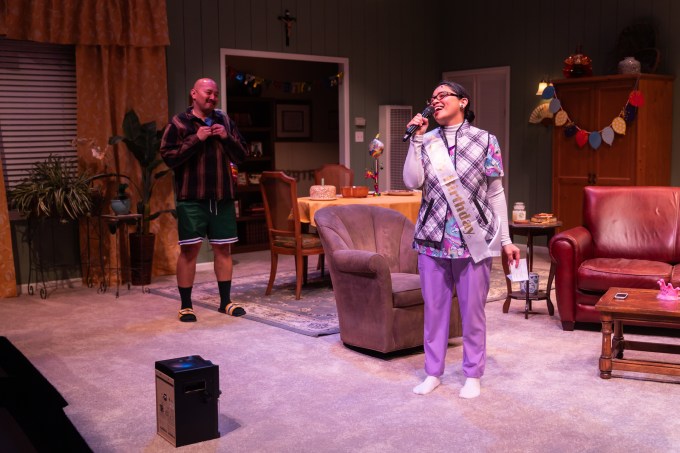
Lucca Troutman as Mary Magdalene, Deanalis Arocho Resto as Jesus Christ. All photos by Ben Krantz Studio.

This reviewer has attended only several performances at Berkeley Playhouse in my decade of criticism, not because they don’t produce good theater, but because their musicals are usually too familiar to me or not in my wheelhouse (though I loved last fall’s The Prom).  The decision to see Jesus Christ Superstar was an unenthusiastic one, but informed by its success on Broadway and the West End.  However, the appraisal of the musical and especially this production is definitely enthusiastic.

Artistic Director Kimberly Dooley, who directs as well, had dreamed for three decades of mounting her vision of this show. Her commitment comes through in the brilliant outcome, which is interwoven with superb singing and acting by principals and ensemble along with absorbing choreography, costumery, and lighting to produce a many-layered aural and visual extravaganza.

Sydney Jacobs Allen as Judas.

The story is one of the most familiar in western culture and the cornerstone of Christianity – the betrayal and crucifixion of Jesus Christ as depicted in the Gospels of the New Testament.  Composer Andrew Lloyd Weber and librettist Tim Rice recount and extrapolate upon the last days of Christ, especially his relationship with his betrayer Judas Iscariot and the loyal prostitute Mary Magdalene.

Though some non-Christians could be put off by the topic matter, not only does the narrative contain many universalisms, but it can be wholly interpreted through alternative filters.  Perhaps the most poignant is seeing it as a metaphor for the repudiation of McCarthyism and the House Un-American Activities Committee, with the roles of the venomous accusers, evil betrayer, and victim clearly delineated.

Cast.

Jesus Christ Superstar is written in a sing-through mode, so the story is told in song, much of it in soliloquies.  The lyrics are literate yet highly accessible, and while the music is uniformly appealing, it can actually distract from understanding the nuances of the plot as the tunes compete with the words for mind space.  A couple of particularly melodic and catchy songs from the score have thrived successfully outside of the musical.

Jesus is portrayed with passion by Deanalis Arocho Resto whose strong singing wails with absolute electricity in the highest range as when Jesus confronts the moneylenders and avoids the lepers in “The Temple” and among his confused followers in “The Last Supper.”  Arocho Resto also deftly captures the ambiguity, contradiction, and rage specified by Weber and Rice.

Cast.

Preferring to view Jesus as angelic, many conservative Christians object to his characterization.  But the creators’ viewpoint is even inserted into the lyrics of the most popular song in the musical, Mary Magdalene’s “I Don’t Know How to Love Him,” when she expresses that “He’s a man, he’s just a man….” which is the Weber/Rice viewpoint not favored by many Christian adherents.  At the same time, Jews are offended since Judaea was part of the Roman Empire, and thus Pontius Pilate ultimately approved Christ’s death. Yet the agitated crowd of Judaeans (i.e., Jews) is implicated as responsible instead.  In the end, no resurrection, essential in the Christian canon, occurs, and it is fair to question what the authors hoped to convey.

The other two lead portrayals are strong as well.  A fine foil to Resto, Sydney Jacobs Allen is Judas, who despite the betrayal, is shown in a somewhat sympathetic light, sometimes having higher standards of personal behavior than Christ himself and faulting him accordingly.  Jacobs Allen stands out as an actor and singing the bluesy lead-in to the iconic strains of the title song.  Lucca Troutman plays the prostitute Mary Magdalene, who paradoxically, is the most caring and brave of Christ’s followers, despite being scorned by Judas.  Troutman also gives a warm rendering of Magdalene’s signature song.

Cast.

The action plays mostly on Kuo-Hao Lo’s abstract stage comprised of several platforms having backdrop projections with dramatic and dynamic lighting lavished with spots and colors by designer Mark Thomas.  A large ensemble of singer/dancers demands an abundance of outfits, and Costume Designer Ashley Renee answers the call with several distinctive categories of styles and periods.  Choreographer Kevin Gruwell has endowed the extensive dancing with a highly diverse, expressive vocabulary appropriate to each situation and emotion.  The movement of the ensemble is compelling and often explosive.

Music Director Michael Patrick Wiles conducts a small orchestra that plays with the usually desired exuberance.  On occasion, however, especially when singers are in the lower and weaker part of their range, the orchestra overpowers, which is problematic as the plot is being delivered through the lyrics.  Note that Joshua Beld as Caiaphas is not in the group with weak lower range, as he drops into a basso profundo with ease and conviction.

Deanalis Arocho Resto as Jesus Christ.

Another political issue concerning this production deserves comment.  The current administration’s attack on Diversity, Equity, and Inclusion is a transparent embrace of racism and sexism of all varieties, suggesting that ascent in any endeavor by other than a white bread, heterosexual man results from unfair advantage granted women and minorities of all ilks.  The bulk of the lead roles in this cast are performed by women or non-binary people of color though the only female character is Mary Magdalene.  The creative team and supporting actors are of both genders and could include LGBT members.  Each creative designer and performer has contributed with consummate skill.  No apologies needed.

Jesus Christ Superstar, composed by Andrew Lloyd Weber and with lyrics by Tim Rice, is produced by Berkeley Playhouse and plays at Julia Morgan Theater, 2640 College Avenue, Berkeley, CA through March 30, 2025.
Bluebeard’s Castle

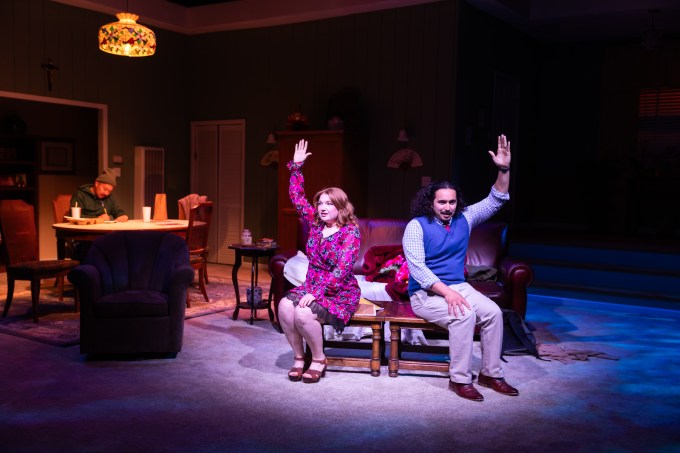
Zachary Nelson as Count Bluebeard, Maria Natale as Judith. All photos by David Allen.

Like Ludwig von Beethoven a century earlier, classical music giant Béla Bartók had only one opera in him, or perhaps he bridled at the notion of having to put his abstract musical construction into words again.  His singular contribution was a one-act, one-scene, two-hander vignette of only 70 minutes duration.  Fortunately, while this musical drama is a very small production, it sparkles like a multi-carat gem.  Opera San Jose has produced a stunning rendition that dazzles, reflecting all of its brilliant facets.

Based on a French fairytale, Bartók’s musical fantasy is set to Béla Balázs’s libretto of Bluebeard’s Castle, which takes place in real time.  Judith, Count Bluebeard’s new wife, has set foot in his castle for the first time, suggesting that they did not have much of a courtship and have much to learn about one another.

Set Designer Steven C. Kemp’s imposing stage is a great room with spare furnishings but a dozen chandeliers of various designs and seven imposing and unique doors, creating a sense of instability that would not be rendered by repeating identical lighting and portal features.  Interestingly, all of the chandeliers and doors are veterans of past Opera San Jose productions.  How’s that for artistic recycling?

Bluebeard is the stereotype of a dominant male – power-driven, combative, and misogynistic.  Zachary Nelson as Bluebeard conveys his authority with an imperious presence, and his deep baritone fits the role well.  He initially resists Judith’s requests to see what is behind the seven doors, choosing to preserve his secrets to maintain the status quo.  Ultimately, perhaps feeling that he will still exercise control, he gives in to Judith’s curiosity.  The opening of each door reveals more about Bluebeard, from his willingness to commit violence to the fruits of his conquests, both in terms of land and ladies.

Bluebeard holds the elevated social station and the possessions, yet Judith asserts herself with feminist demands.  Even though she claims that love drives her need to know what is behind the doors, we don’t really know if love was part of the marriage equation. Judith seems more driven by competition, the power struggle between spouses.  Given the greater performing time to express herself and being the initiator of this psychological combat, the opera really belongs to Judith, the unsettling force.

Soprano Maria Natale leaves nothing on the table as the emotive and insistent Judith.  What surprises is that her specialty has been in the more lyric Italian repertoire, yet she showcases strong dramatic vocalization throughout a very demanding performance.  On stage for the duration, she dominates the action and remarkably sustains her voice with an insistent, controlled, penetrating, high-volume middle range that could be more natural to a mezzo-soprano.  But together with her acting that reflects the character’s emotions from eroticism to rage, it is hard to imagine a finer singing and acting performance of this role than Natale’s.

Bartók’s musical palette contains some harsh dissonance, which is modulated by the melodic influences of Hungarian folk music and the sensuality of Debussy, with whom he had mutual admiration.  The dynamics of the score rise and fall, especially in response to the opening of the doors, with ominous clash in those that reveal the dark side, and with lush luxuriance in the case of those that show the fruit of Bluebeard’s missions.  But one haunting musical and psychological motif throughout is that of the presence of blood beyond each door, which taints even the otherwise pleasant unveilings.

Opera San Jose’s Music Director Joseph Marcuso conducts the shifting musical moods and idioms with grace.  The orchestra, which is large relative to the cast and gives a bigger feel to the opera, responds to demands with great alacrity.

Marcuso has taken a gamble in adapting the libretto which is built around poetic meter specifically fitting Magyar folk ballads. He and collaborator Steven White have translated it to English.  Perhaps hearing the opera in Magyar would provide a stronger sense of the origins of the action, but most of us will never know.  Happily, having the dialogue in English reduces the reliance on supertitles and makes the text more accessible.

OSJ’s General Director and CEO Shawna Lucey stage directs Bluebeard’s Castle, and all aspects of the production integrate well into an intensely rewarding operatic experience.  She has also taken significant liberty with the nonverbal aspects of the drama, especially to update its message after the opening of the golden seventh door.  The major change will not be shared here.  It does provide surprise, drama, and an outcome that will be more satisfying to most opera goers than the original.

Bluebeard’s Castle, composed by Béla Bartók based on a fairytale from Chales Perrault with libretto by Béla Balázs and translation by Steven White and Joseph Marcuso, is produced by Opera San José and plays at the California Theater, 345 First Street, San Jose, CA through March 2, 2025.
La Sonnambula

Michelle Drever as Amina (La Sonnambula, center), Chris Mosz as Elvino (left). All photos by Otak Jump.
A concise definition of bel canto opera eludes aficionados, but its composers have been identified ex post facto, and one of the foremost was Vincenzo Bellini.  Despite his brief life of 34 years, several of his operas remain in the repertoire.  Among them is the 1831 pastoral opera La Sonnambula, given a fine production by West Bay Opera.

The narrative is simple.  Amina, a young woman who is a treasure of a town that could be anywhere, is to marry Elvino.  The night before the ceremony, she is seen at the lodgings of a visiting Count.  While the opera goer realizes that she sleepwalks innocently and believes that she is in the company of her betrothed, the townspeople are not aware of her condition and turn on Amina as a result of the scandal.  Incredulous and callous Elvino returns to his past love, Lisa. Ultimately, the Count absolves Amina and the wedding is back on.  The end.

Courtney Miller as Teresa, Shawnette Sulker as Lisa, Casey Germain as Count Rodolfo, Chris Mosz as Elvino, Michelle Drever as Amina.

La Sonnambula brims with melodious music that is delivered by a cast with outstanding voices.  Those voices are mightily challenged as Bellini composed for a particular soprano who had an especially mellifluous head voice, and she was surrounded by others with acrobatic vocal skills.  Not only is the overall tessitura of the three key roles unusually high, but artists are required to hit the high notes, often high D’s cold without a run up.

Coloratura soprano Michelle Drever portrays Amina and nails the part with precision, clarity, and a rich tone throughout her range.  Shawnette Sulker performs Lisa, the innkeeper and Amina’s competition for Elvino’s heart.  Shawnette’s surname couldn’t be more apt, as she spends much of the opera sulking over her losing Elvino.  But her vocals are the equal of Drever’s as she too masters the heights of the soprano range.  Each sings with considerable but controlled vibrato and embellishes beautifully in the bel canto manner.

Casey Germain as Count Rodolfo, Shawnette Sulker as Lisa.

The love interest in this triangle is Elvino, sung by Chris Mosz, who possesses a brilliant and uniquely eerie timbre virtually unique to select operatic tenors.  Having sung Tonio in La Fille du Regiment with its eight high C’s multiple times, he certainly suits this part which demands that he enter the stage for his first aria on a high note.  Mezzo Courtney Miller as Teresa, Amina’s mother, and Casey Germain as Count Rodolfo also deserve recognition for fine singing and acting.

A bit of a surprise is the chorus.  Mostly comprised of veterans with the company, this performance stands out as the best that this reviewer and other confidants can remember.  Whether singing pizzicato and sounding like a score of bass violins being plucked, or wafting harmoniously in full voice, they make a difference.  Kudos to Chorus Master Bruce Olstad and Director/Conductor José Luis Moscovich who also coordinates orchestra and chorus to produce the big, beautiful sound that belies their numbers.

Courtney Miller as Teresa, Michelle Drever as Amina.

The opera itself was a great hit with critics, audience, and fellow composers alike upon its premiere.  However, tastes and audience demands change over time.  One deficiency by today’s standards is that until the critical juncture arrives toward the end of the long first act, the action is very static with little dramatic impact.  Arias typically make operas memorable, but until the sleepwalking scene, one aria after another contains pleasant melody, but nothing hummable or declamatory, and very little interactive.  Amina’s sleepwalk along with her claim of innocence in her aria ‘D’un Pensiero e d’un accento’ that lead to the rousing, complex act-ending ensemble, a structural fixture of the time, largely redeem Act 1.

Conductor Jose Luis Moscovich, Casey Germain as Count Rodolfo, Michelle Drever as Amina.

Act 2 is comprised of five short scenes that move quickly and provide the highlight of the opera.  Amina reprises her sleepwalk.  This time, before reaching the townsfolk assembled, she must negotiate a dangerous ledge across the mill stream.  Designer Peter Crompton’s projections of cascading water behind the vulnerable Amina creates a strong dramatic effect.  Her ensuing “mad scene,” which includes ‘Ah, non credea mirarti,’ her ode to dying flowers from Elvino, is composed and performed exquisitely.

This opera is an important piece of Bellini’s output and has much to recommend it.  La Sonnambula influences other opera composers, and it was parodied or reflected in works as varied as Gilbert and Sullivan’s operettas and George Eliot’s novel The Mill on the Floss.

Cast. Costume designs by Callie Floor.

La Sonnambula, composed by Vincenzo Bellini with libretto by Felice Romani, is produced by West Bay Opera and performed at Lucy Stern Theatre, 1305 Middlefield Road, Palo Alto, CA through February 23, 2025.

The Heart Sellers

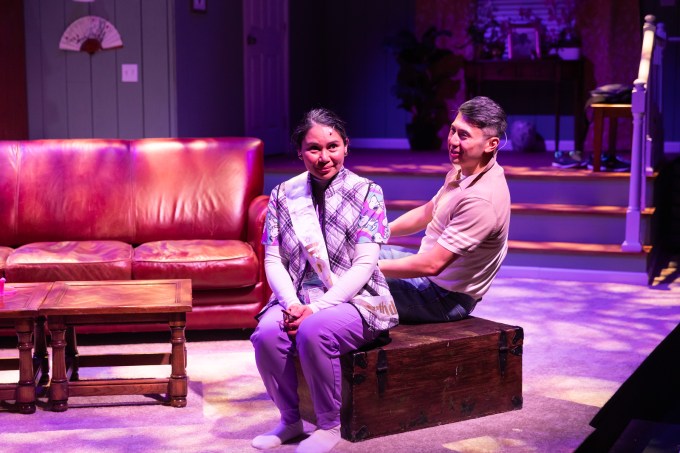
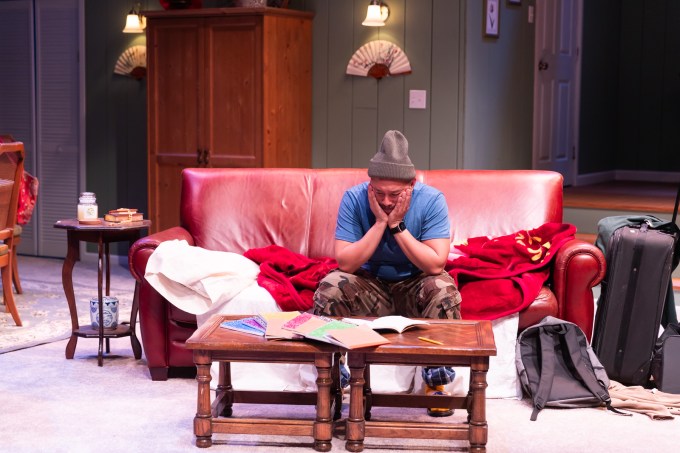
Wongjun Kim as Jane, Nicole Javier as Luna. All photos by Kevin Berne.

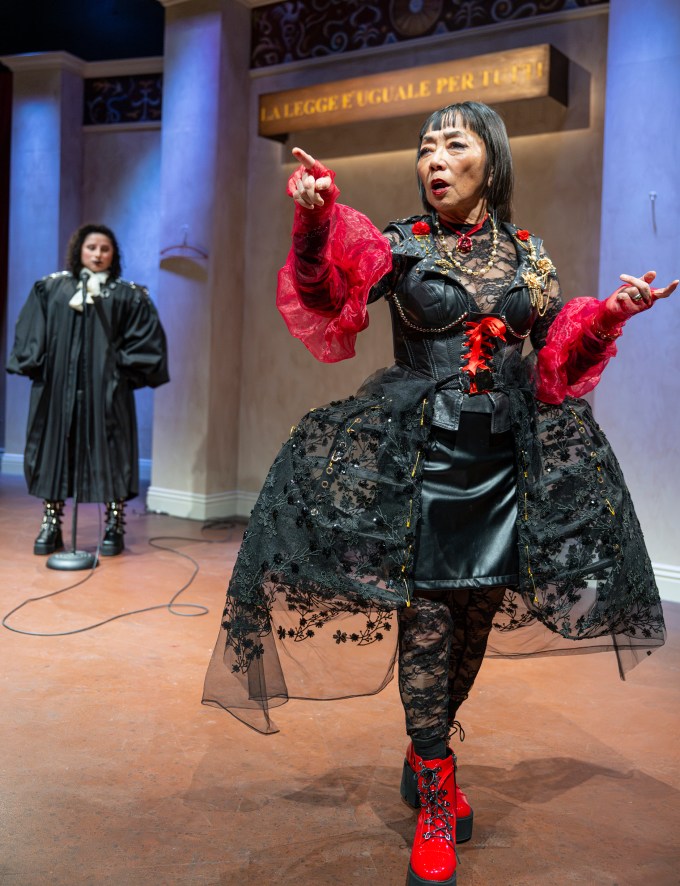
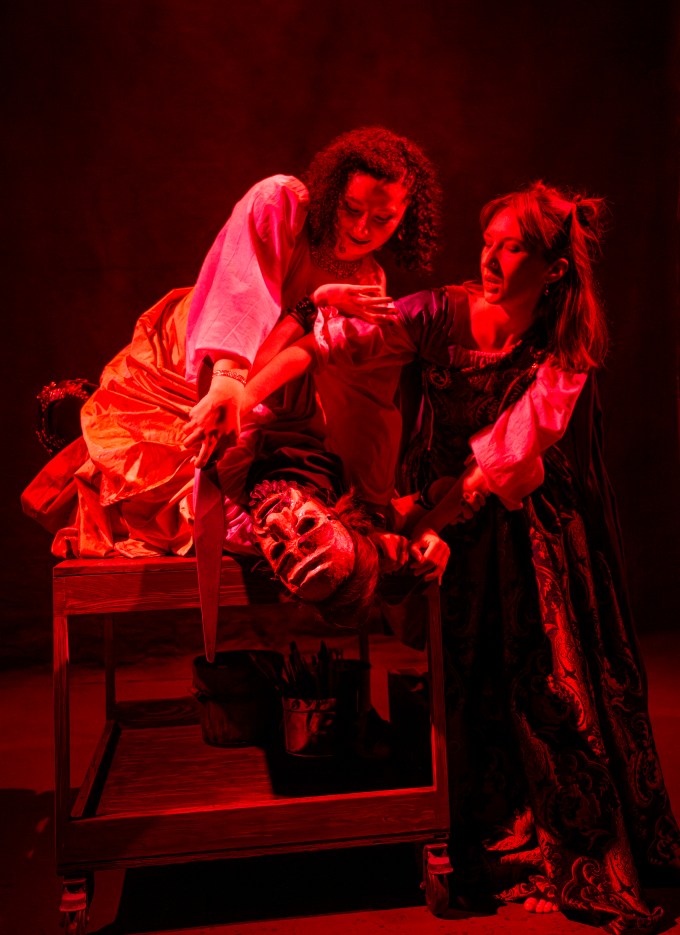
It is the 1970s. In Lloyd Suh’s play The Heart Sellers, recent immigrants Luna and Jane have just met by happenstance.  So “What’s in a name?” asketh Juliet in Shakespeare’s Romeo and Juliet.  If the title prompts queries, the answer is that it is a homonym representing the Hart-Cellar Act, formally known as the Immigration and Nationality Act of 1965, pertinent to the characters’ lives and increasingly significant today.  Prior to this legislation, over 80% of immigrants allowed into this country were from four European countries, because previous quotas were tied to the percentage of representation already in the American population

Luna is Filipina, and Jane is Korean.  Apart from Asian heritage, other shared characteristics are that each is childless and both husbands are resident physicians who work long hours.  Each woman feels lonely and isolated, and both husbands are working on this day, Thanksgiving, so the women decide to spend it together at Luna’s apartment.

The Heart Sellers is a two-hander comedy in which the actors wring every bit of humor from the most mundane conversation, much of it because of the cleverly crafted contrast in personalities.  Their differences are also a reminder that while some people tend to lump Asians together as a homogeneous people, their societies are in fact quite different.  The Philippines is predominately Catholic, pop-culture oriented, tropical, Spanish and American influenced, and among the poorer countries in Asia.  Although Protestantism is the largest denomination in Korea, a majority claim no religion.  It was colonized by Japan, has a charactergraphic writing system, values classical music, has four seasons in a northern climate, and has advanced economically and technically.

Though the two characters share common personal experiences and will ultimately bond, they are cut from different cloth.  As Luna, an absolutely delightful Nicole Javier is shot from a cannon – effusive, ebullient, and goofy with a constant rapid patter and nervous movement from curtain up.  She even asks if she talks too much and then clatters past her own question without waiting for or wanting a reply.  Her charm is also driven by her broad, toothy smile and laughter, so natural, enduring, and endearing.  Her typical Filipino accent is strong but with clear diction.

An equally compelling Wongjun Kim portrays Jane, but unlike Luna, her character evolves.  Reticent at the beginning, she seems overpowered by the personable Luna.  But in time, she emerges from her shell, in part because she knows what to do with the turkey that Luna has bought and in part because of the wine they consume.  Not only does Jane’s face light up, but she becomes quite demonstrative and insistent, even placing demands on Luna, though they’ve just met.  Korean born, Kim adopts an appropriately authentic Korean accent in English which can challenge a bit when she mumbles and stumbles and faces away at the beginning, but not so later on when she becomes more confident and vocal.  And don’t worry.  Even if you miss something, you haven’t really missed anything.

Happy to find someone to talk to, the young women become familiar quickly, sharing intimacies.  Each shows curiosity about the other’s belongings when the other goes to the bathroom.  Their shared curiosity extends to the idea of going to a nightclub when their husbands are on duty and taking in a porno movie. 

Like many well-crafted comedies, The Heart Sellers brims with serious subtext.  The balance of funny and dramatic moments works to great effect, and the title itself does have meaning as Luna relates the words with emotive and evocative imagery concerning the frightening experience of immigration interviews.

It is easy for an American to take an ethnocentric view of immigrants and their issues, but the playwright surfaces many of the plights of the immigrant from their perspective.  Apart from the obvious matters of missing family, friends, and the support they provide, the women talk about missing little things like the smells and tastes of their homeland.  They also talk about the loss of confidence when speaking a second language among people who don’t share the same sympathies and who may look down upon them.  The notion of immigrants being caught between two cultures is perceptible by most people.  But what about their future?  Do things change if they become rich?  And what about having children born here who, unlike their mother, are real Americans?

Jennifer Chang directs Aurora Theatre’s The Heart Sellers with a skilled hand, assuring that the timing of the verbal exchanges crackle.  Javier and Kim do the rest with bravura performances.  They make us care about these women and others like them, not only because of the cultural trials they face but because of their lack of agency, merely following in the footsteps of men.  After 90 minutes of stage time, the oven timer rings, signifying the turkey is done.  We wouldn’t mind sharing dinner with them.

The Heart Sellers, written by Lloyd Suh, is produced by Aurora Theatre Company and plays on its stage at 2081 Addison Street, Berkeley, CA through March 9, 2025.

Waste

Liz Sklar as Amy O’Connell, Lance Gardner as Henry Trabell. All photos by Chris Hardy.

Nowadays it seems that many theatrical offerings have special resonance because of aspects that relate to our tumultuous political environment, even though the plays were probably selected before the recent presidential elections.  With Waste, a British play by Harley Granville-Barker from 1906, the central themes smack the viewer in the face as if the play were written as parody of our political times.  This answers the question of why produce this play at this time.  But while we are accustomed to all manner of contentiousness today, this play was censored in England, and its public debut was delayed for 20 years because of its controversial content.

Leontyne Mbele-Mbong as Frances Trebell, Jomar Tagatac as Dr. Wedgecroft.

In Marin Theatre’s production, the performances are mostly exemplary, and the staging is striking.  Certainly, the play’s subject matter is of great moment. But in keeping with late-Victorian English style, its text is highly mannered and stilted, which makes the characters seem distant and artificial, though some relief comes from a number of impassioned exchanges.  The narrative could be trimmed to sustain interest.

Oddly, the two focal social issues in Waste are approached from very different perspectives today than at the beginning of the 20th century.  In the play, Henry Trebell is an ambitious politician, esteemed for his trenchant analysis.  He is wanted on the cabinet of the incoming prime minister because of his well-expressed views on disestablishment, the hot button item that proposes terminating the recognition of the Anglican Church as the official church of the United Kingdom.  This church-state linkage had existed for centuries, from the time of Henry VIII. Consequences of this separation would include budget allocations, distribution of church assets, establishment of secular schools, and more.

(rear) Liz Sklar as Amy O’Connell, (foreground) Joseph O’Malley as Walter Kent.

In the United States, this is a vital issue arising from the opposite direction.  We were founded on the basis of separation of church and state, and the First Amendment to the Constitution states “Congress shall make no law respecting an establishment of religion…..”  Yet today, social conservatives and the religious right are attempting to impose their white Protestant religious vision on our people with initiatives such as tuition vouchers for religious schools and teaching the Ten Commandments and Christian religion in public schools.

The other important matter concerns women’s rights, and in particular, reproductive rights.  On a one-night stand, Trebell has impregnated a married but separated Irish woman, Amy O’Connell.  Learning of the pregnancy, Trebell reveals patriarchal and misogynistic views, as do his fellow politicians when made aware of the situation.  The cynical and self-serving father-to-be regards the fetus as property that he owns, rather than as her or their child, even though he will not allow his paternity to be known.  Like his benighted associates and O’Connell, he hates the smidgen of influence that women have on men after the freedom that men have granted them.  And as may be attributed to a current politician, Trebell seeks power over women as well as men and has contempt for both.

(foreground) Joseph O’Malley as Justin O’Connell, (rear) Mike Ryan as Blackborough, Daniel Cantor as Lord Horsham, Lance Gardner as Henry Trabell, Anthony Fusco as Charles Cantelupe.

In this country, after decades of improving rights for women and minorities, retrogression has resulted in the overturning of Row v Wade.  In addition, attacks on Diversity, Equity, and Inclusion programs are turning back the clock.

These higher order issues play out against a backdrop of another vital matter, and that is scandal.  As much as the prime minister would like Trebell in his cabinet, the scandal of a child out of wedlock would end his political career.  The contrast with modern day America could not be starker.  It seems that no scandal can impede a presidential candidate, or his cabinet nominees, or anyone else anointed by the president (except Matt Gaetz who was flushed not because of scandals, but because he was widely hated by his own party colleagues).

Lance Gardner as Henry Trebell, Leontyne Mbele-Mbong as Frances Trebell.

The narrative of Waste compels, with a couple of surprise shocks and an incisive inside view of political machinations among nominal allies.  As Marin Theatre’s Artistic Director, Lance Gardner chose well for his return to the stage in the central role of Henry Trebell.  He suits the part thoroughly, conveying competence, arrogance, and rage with great conviction.

Some of the finest actors in the Bay Area comprise the remainder of the cast.  A vulnerable yet demonstrative Liz Sklar is notable as Amy.  Joseph O’Malley doubles as Henry’s secretary and Amy’s husband, Justin O’Connell, and as the latter, he stalks the stage and chews the scenery in a vivid featured characterization.

Mike Ryan as Blackborough, Anthony Fusco as Charles Cantelupe, Daniel Cantor as Lord Horsham.

Carey Perloff directs and deserves credit for her adaptation which eliminates most of Act 1, shrinks a number of scenes, and eliminates characters.  While she skillfully manages the action and creative design, she could do more to rein in the text even further.

Waste, written by Harley Granville-Barker and adapted by Carey Perloff, is produced by Marin Theatre and is performed on its stage at 397 Miller Avenue, Mill Valley, CA through March 2, 2025.

Calendar Girls

Jen Halsing, Evan Mooney, Alicia von Kugelgen. All photos by Mike Padua.

Few performing or visual art works acclaim the older woman.  It is refreshing to see a piece that treats not one, but a bevy of them, as individual, vital, and dare we say, appealing and sexy females.  As would be observed in the play, “The last phase of the flower is the most glorious.”  Adapted from the 2003 British film Calendar Girls, the stage version follows the same trajectory, tracing the conflicts, obstacles, and joys of a unique method for raising money for a hospital in a small town in the Yorkshire region of England.

Although a true story, the movie Calendar Girls followed on the heels of the fictional The Full Monty, which almost seems like a companion piece, as it concerns a group of men who perform in a similar manner, also for benevolent reasons.  For those unaware, that manner is nude.

Isa Chu, Emme Clark, Michael Haven, Virgie Poole.

The Women’s Institutes (WI) is a network of women’s service organizations founded in Canada and spread throughout Commonwealth countries.  The central characters in the play are members of the Knapely (Yorkshire) WI, which produces an annual calendar with monthly photos to reflect regional sights and values, such as the churches of Yorkshire.  When Annie’s husband John dies of leukemia, her close friend Chris comes up with the idea of raising money to replace the uncomfortable settee in the hospital’s visitors’ room.

But rather than picturing the traditional staid exemplars in the calendar, Chris takes a page from a cheesecake calendar she had seen at a mechanic’s shop.  Why don’t the members pose nude, with critical parts discretely covered by domestic props such as cakes or balls of yarn?  While the idea faced some tough sledding, it clearly did happen in reality, and the rest, as they say, is history.  And (spoiler alert in this sentence!) it was such a successful history that the settee would be a mere line item in the project budget facilitated by the calendar proceeds.

Alicia von Kugelgen, Evan Mooney.

In many ways, the narrative seems like an amusing throwback, despite its action occurring only 25 years ago.  While competitions in domestic activities that bind WI members such as pie making and knitting still exist even in this country, they may seem quaint to a metropolitan audience.  And resistance points by some members to the obscured nudity in the proposed photos tie more to an earlier era.  A vicar’s daughter who already has a mixed-race child out of wedlock fears reaction from her parents.  An overweight member is embarrassed about displaying even the fringes of her body without wraps.  And the eldest participant notes that her husband first saw her naked only 10 years before, and that was by accident and seen by several other people as well.

Isa Chu.

Like many plays, the setup portion in Act 1 can be uninspiring, and this being an opening night without having had a preview, it seemed a little lethargic with dialog timing and delivery that could have been brighter and brisker.  That changed dramatically at the end of Act 1 with the photo shoot preceded by the characters drinking a little courage.  The enthusiasm and seeming spontaneity in the cast was palpable, as if this was the first time the women had experienced the disrobing.  They squeaked and cheered like schoolgirls, totally shifting the energy of the performance.

Most of the clashes within the WI group occur in Act 2, after the calendar is released.  Success often breeds discontent within small groups.  Members jockey for recognition, clash for claiming credit, question the motivations and actions of others, and argue about future directions. Among others, close friends and leaders of the project, Annie and Chris, skirmish.

Jo Lusk, Virgie Poole.

Those who didn’t support the racy calendar idea to begin with continue to find fault, and in this case, the president of the chapter tries to snuff enthusiasm, cruelly denigrating the most risqué of the participants, Celie.  But in a thoughtful monolog, Celie redeems herself with a reflective narration of who she is, explaining why she dresses in a slutty fashion and what it is like dealing with the illness of golf.

Calendar Girls is the type of project that attracts performers committed to the cause, and this cast seems very dedicated.  It is led by Alicia von Kugelgen who brings strong presence with a powerful speaking and singing voice as the purposeful Annie.  Also noteworthy are the two who vie as the hotties, Jen Halsing as the ebullient underachiever Chris and Virgie Poole as Celie.  No dialect coach is indicated in the program, but to this reviewer’s ears, all of the actors seemed trained specifically in English north country accents, so kudos to whomever, but to Director Michael Sally in any event.

Isa Chu, Sally Hogarty, Simon Patton, Jo Lusk, Jen Halsing, Virgie Poole, Emme Clark.

This play will be enjoyed and appreciated by community theatergoers looking for a feel-good experience with dramatic overtones and a feminist bent.

Calendar Girls, adapted by Tim Firth from the film of the same name written by Juliette Towhidi and Tim Firth, is produced by Masquers Playhouse and plays on its stage at 105 Park Place, Point Richmond, CA through March 2, 2025.