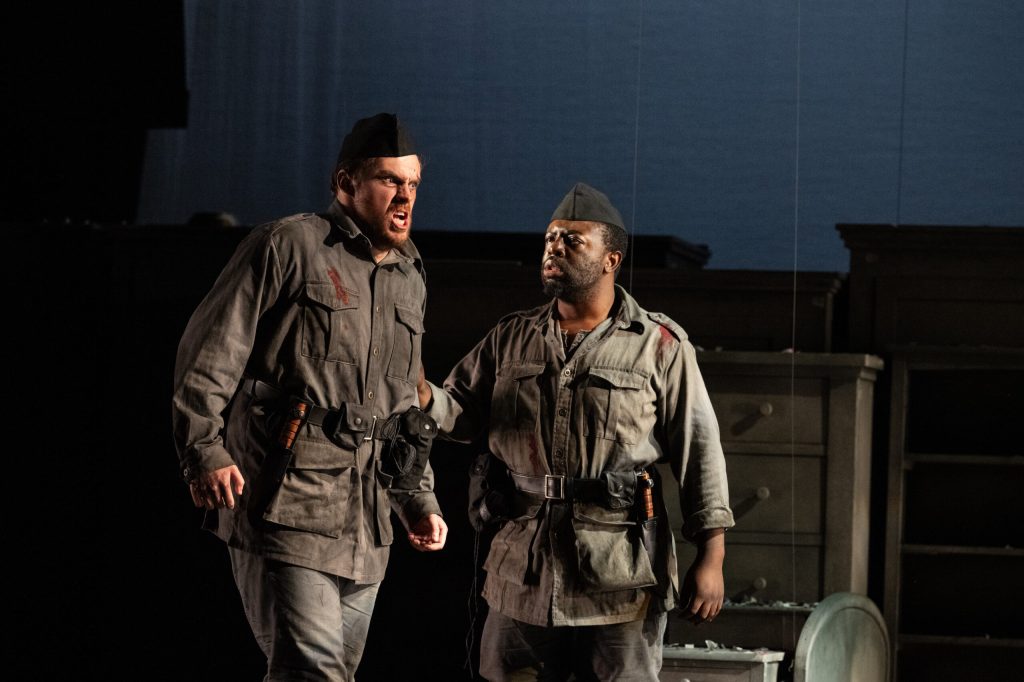
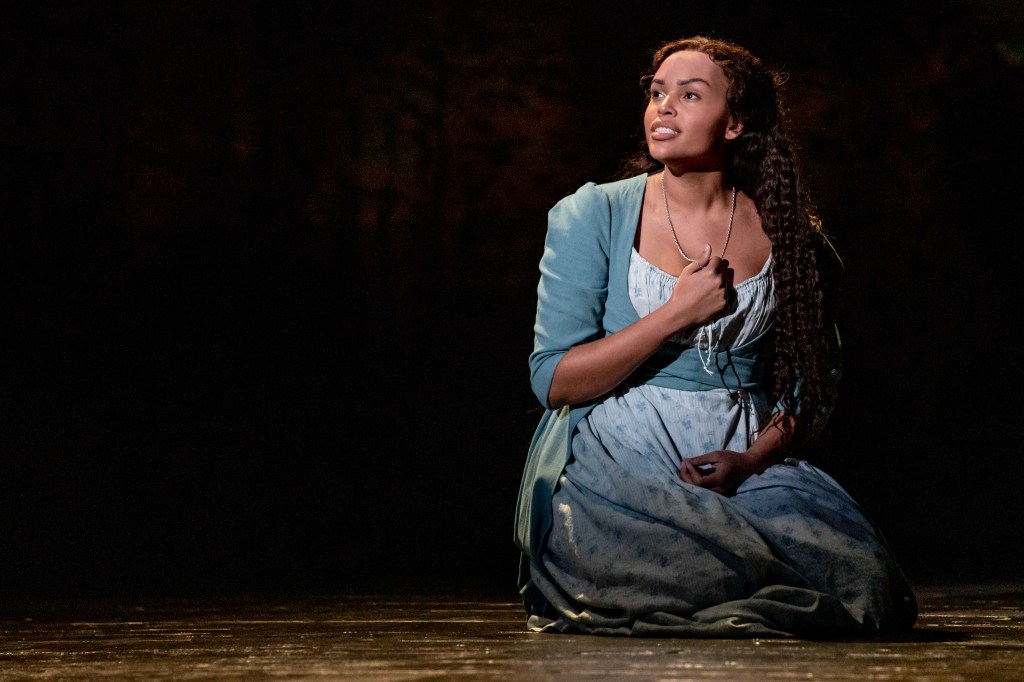
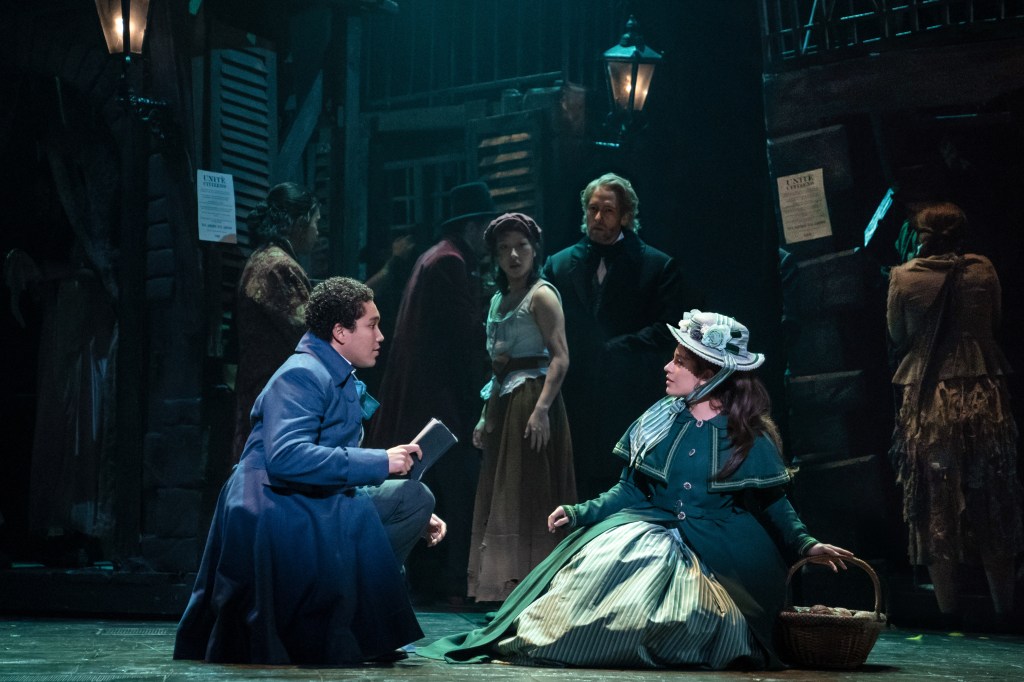
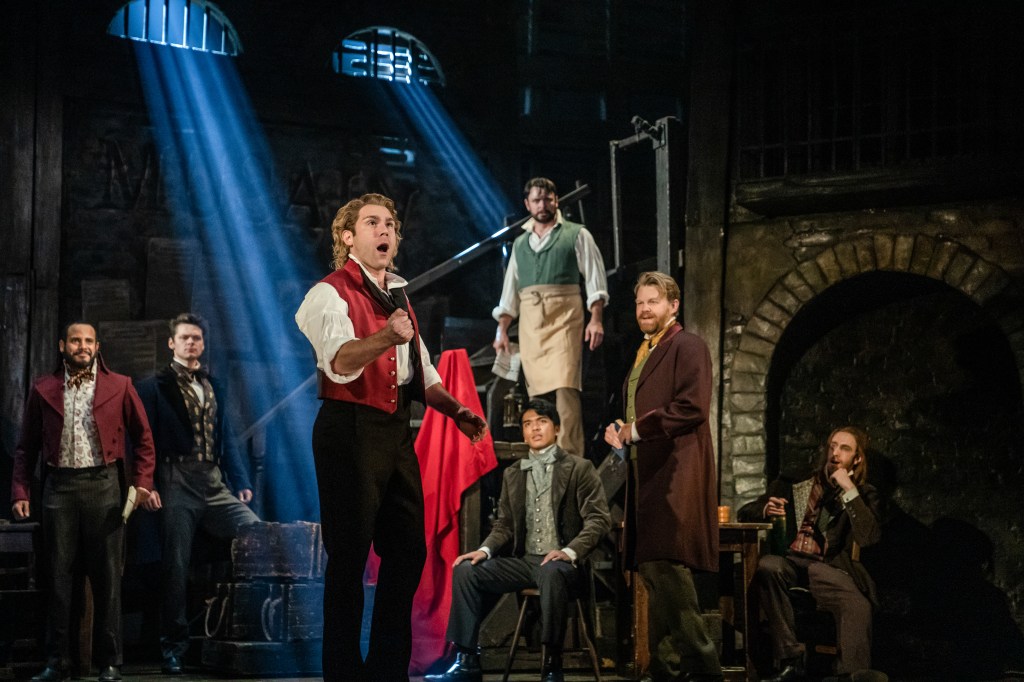
Hippest Trip: The Soul Train Musical

Scenic design – All photos by Kevin Berne & Alessandra Mello.

First there was music.  In modern times, the African-American community’s involvement in most American music genres has ranged from highly influential to dominant to seminal.  Its contributions have been profound and often overwhelming in jazz, blues, gospel, rhythm and blues, rock and roll, and rap and all their descendants, to name a few.  Black invention has led to similar innovations in dance – tap, swing, twist, disco, hip-hop, and their many derivatives.  But it wasn’t until 1971 that African-American music and dance received a national platform to broadcast their deserved exposure.  That platform was “Soul Train,” which would run in syndication for 35 years, a record for live performance on American television.

“Hippest Trip: The Soul Train Musical” is playwright Dominique Morisseau’s homage not only to “Soul Train” itself, but also to its creator and longtime host, Don Cornelius.  The result is an admixture of upbeat music and dance integrated with a serious, warts-and-all biography of a complex man obsessed with the lifelong goal of presenting Black youth in a positive light and securing his legacy as its architect.  For the greater part, the concept works, and the musical entertains.  However, the considerable devotion to dance and the occasionally wandering script sometimes impede the buildup of involvement.

Amber Iman as Pam Brown, Quentin Earl Darrington as Don Cornelius.

The production values of “Hippest Trip” offer a cornucopia of eye and ear candy, and the performers give memorable performances.  From the first number, the dancers undulate their bodies, shake their booties, and twirl their appendages in a non-stop display of fine artistry.  The opening night audience showed wild appreciation at the conclusion, though there could have been a little positive bias, given an abundance of audience members associated with the TV show and the musical.

Quentin Earl Darrington totally inhabits the role of the imperious, buttoned-down Cornelius, whose single-mindedness and impersonality often isolates him from the people who matter to him.  His unwillingness to accept advice from anyone, most often from his longtime assistant, Pam Brown and his son Tony, who worked for him, agonizes even those closest to him.   Acknowledging his own personal and professional shortcomings, Don sadly notes, “The Wiz is just a man.”  Indeed, one of the powerful elements of Morisseau’s script concerns the difference between the public and private individual, observing that many people in the public eye do not have fairytale lives and suffer behind the scenes.

Kayla Davion as Jody Watley, cast.

Like many of the cast, Darrington brings singing chops to the table as well, with a smooth natural baritone as well as a clarion upper register in the falsetto range.  As the more light-hearted yet grounded Pam Brown, the talented Amber Iman counterpoints her boss with a warm, concerned personality and the gumption to confront and sass Cornelius.  She, too, boasts a fine singing voice which drew raves from the crowd.

Of course, music is the foundation of dance, and the score is full of hits that played on “Soul Train” during its era.  Much of the emotion created is through the song selection and performance.  Many are represented by small fragments, but some even recur and have thematic significance.  Such is the case with “Smiling Faces” which addresses hypocrisy and is used to cast aspersions at Dick Clark, who was Cornelius’s nemesis.

Despite its energy, the show doesn’t really gain desired traction until the finale of Act 1, which is a fine rendition of “I Will Survive” sung by several performers.  The momentum created survives intermission, and the highly charged Act 2 is both rousing and poignant.  Interestingly, the key song sung by Cornelius at the climax which pulls at the heartstrings doesn’t fit in the wheelhouse of the “Soul Train” songbook, but is Bachrach and David’s “Walk On By.”

Alain “Hurrikane” Lauture, cast.

Emmy winning Scenic Designer Jason Sherwood’s set adds another dimension to the musical, contributing to the period look.  As shown in the opening photo of this review, the stage is brilliantly framed as if in an old television box.  Large serpentines with electronic displays extend onto the walls of the orchestra and onto its ceiling, creating a spectacular look like you have never seen in a theater.

Multiple Tony nominee Camille A. Brown’s choreography is breathtaking in its volume and complex design within its idiom.  Dancers deliver with personality, boundless energy, and consummate skill.  However, several issues are of concern, which may derive from writing or direction.  What surprises is that the dance numbers don’t emulate “Soul Train,” so that the sense of the TV show is not well developed.  In addition, the specific dance styles lack sufficient contrast to the untrained eye.  When representing the ‘70s, dancers use detailed gesticulations that were not yet in use, seeming to value virtuosity over authenticity.  Little distinction is shown for variations such as disco.  There is no slow dancing, and the TV show’s famous line dancing (if that’s what is intended in some of the dance solos) is not introduced in the narrative or clearly represented.  While “Soul Train” had couples dancing, the production numbers are in corps style.  Particularly to older observers, the styling may seem repetitive and may diminish the interest over time.

Cast.

Like Morisseau’s “Ain’t Too Proud,” this production hopes to move from a premiere in the Bay Area to Broadway.  “Hippest Trip” contains many assets including great execution, but tweaking a few conceptual matters might enhance its chances to shine even more.

“Hippest Trip: The Soul Train Musical” is written by Dominque Morisseau, directed by Kamilah Forbes, presented by American Conservatory Theater, and plays at the Toni Rembe Theater, 415 Geary Street, San Francisco, CA through October 8, 2023.

Mahābhārata

J Jha as Storyteller. All photos by Ben Krantz Studio.

Comprised of 100,000 couplets, the “Mahābhārata” is the longest known poem ever written.  Logging in at 1.8 million words, it is around three times as long as the Bible, depending on which version is being considered.  So, it is no surprise that trying to transform its multitude of stories into performance art would be daunting. Condensing it in some form into a solo dramatic performance of under two hours is a Herculean task.  This is what playwright Geetha Reddy has accomplished.

Although not designed to be a sacred Hindu religious text, as were the four vedas which preceded it, the epic “Mahābhārata” is considered by most to be the fifth veda.  Written in the 3rd century BCE and attributed to poet Vyāsa, it retains a wide following today as its cultural narratives still resonate.

Oakland Theater Project produced this play, written by local playwright Geetha Reddy, in 2019, and reprises it now, so OTP is clearly confident of its worth.  As with the premiere, this one-person show is delivered by actor J Jha, whose performance is sterling, with supporting artistic elements orchestrated by Director Michael Socrates Moran.  The spellbinding and fast-paced delivery of the saga is full of energy, conviction, and credibility.

Jha is transgender, which is relevant to the storytelling, because he/she portrays male and female characters, and because sexual ambiguity plays a role in some of the stories.  She/he effectively uses several different voices, and more importantly, displays an emotion to fit every situation.  Jha laughs, cries, rages, moans, and more – all the while in grand gesticulation – dancing, stomping, and breaking the fourth wall in frequent eye contact directly with the audience.  It is a performance to behold.

In the opening vignette from the text of the poem, a woman is setting her son in a basket on a river, reminiscent of the Judeo-Christian story of Moses.  This and other aspects of the work show how universal some literary themes are, but there are also major differences.  One departure from Western religious scriptures is the extent, scope, and candid discussion of sexual matters including polyamory, illicit affairs with outcomes, and menses banishment in the “Mahābhārata,” which is ironic, given that Indian movies are not even allowed to show kisses.

Notwithstanding moral issues, the central narrative concerns the Kurukshetra War between royal cousins, the Pāndavas and the Kauravas.  Its scale is epic with millions of soldiers and more elephants than probably existed on earth.  Its outcome is near apocalyptic.  Of the many subplots in the poem, time allows for few to be told, and so the conceit is used that they will be selected by the storyteller’s rolls of the dice.  Stories like Chitrāngadā, the Warrior Princess of Manipur, luring Arjuna into marriage, and Draupadi’s husband Yudhishthira “losing” her in a dice game, both engage and reveal aspects of Hindu cultural heritage.

The production entertains because of the exoticism and the scintillating performance.  It does beg the question, however – what is the playwright’s objective?  If it is to understand the play at anywhere near the same level of competence as reading the script, that is not going to happen.  Attendees with a nodding familiarity of Arjuna, Ganesh, Krishna, and several others will perhaps grasp more and have a head start in knowing to stay focused when their names come up.  But what about Kunti, Sanjay, and the tens of other names that are introduced, some only once, while others do become main characters?  I only “got” Chitrāngadā and Yudhishthira through research after the play, not from the performance.  Other names did not connect with me at all.

The point is that appreciating “Mahābhārata” at an impressionistic level with some snippets fully comprehended is fairly easy.  Understanding at a detailed level is difficult as three factors preclude accurate comprehension.  As noted, way too many characters are introduced, some of which have no real bearing on central issues.  The solution to that problem is in the hands of the playwright.  Also, Jha’s delivery is exceptionally rapid, which makes it hard to even understand the names.  Rather than rein in the pace and enthusiasm in the performance, this would be the perfect occasion to flash projections with the character’s name and perhaps a visual representation of a character when introduced.  Finally, the house is set up with split-sides audience.  Whenever Jha faces away to one wing of the house, the words are somewhat to totally lost to some audience members on the other side.  These last two issues are controllable by the producers.

Despite these issues, theatergoers with an interest in or curiosity about Indian culture will find this a rewarding experience.

“Mahābhārata” is written by Geetha Reddy, based on the epic poem of the same name by Vyasa, produced by Oakland Theater Company and Z Space, and plays at Z Space, 450 Florida Street, San Francisco, CA through August 20, 2023.

The Nightingale & Erwartung – Double Bill

Helen Zhibing Huang as The Nightingale, Patrick Scully as Emperor. All photos by Cory Weaver.

West Edge Opera paired these two short operas onto one bill.

“The Nightingale”

In today’s world, the replacement of human beings by technology grows at an expanding, if not alarming, rate.  At first, robots, and now more human-like androids, are programmed to perform physical functions with greater speed and accuracy than people.  And at first, computers, and now artificial intelligence algorithms execute mental functions of massive complexity that humans can’t accomplish, and at unimaginably fast speeds.

Cast and chorus.

The concept of machines replacing humans precedes its actually happening by centuries.  One such fantasy was a simple Hans Christian Anderson fairy tale in which the Emperor of China is bewitched by the song of a dull-looking nightingale.  However, when a machine that looks like a more attractive nightingale appears, the real bird disappears.  Piqued, the Emperor then banishes the real nightingale, only to suffer regrets.  Yet, as straight forward as the plot is, the characters are not well introduced, leading to some confusion as to roles.

Patrick Scully as Emperor, chorus.

Igor Stravinsky composed the three-act, 45-minute opera at a time that he was abandoning the form.  Though “The Nightingale” was not well received initially as a result of the dissonance of the music, it would later be acclaimed.  But as the composer was turning toward dance at this time, he later extracted the music of the last two acts to become “Chant du Rossignol,” a ballet.

West Edge Opera’s production of “The Nightingale” offers an outstanding representation of the instrumental and vocal components of the work.  The orchestra is well-conducted by Jonathan Khuner, and the singers suit the material well.  As the nightingale, soprano Helen Zhibing Huang displays coloratura and dramatic vocal skills as well as the emotional acting needed for the role.  Bass Patrick Scully as the Emperor provides a warm, deep tone and a commanding presence.  The other five principals, Kevin Gino, Kristin Choi, Alice Chung, Chung-Wai Soong, and Wayne Wong also carry out their parts admirably.

Michael Kuo, Brieanne Martin, David Ahn as Foreign Emissaries.

Yet, rarely does an opera production owe so much to costuming and choreography.  Ralph W. Hoy’s costumes are an uncommonly striking cacophony of stunning color and shape that is eye boggling and fits the cacophony of sound produced by the chorus.  Dance occurs throughout, and choreographer Lucas Tischler’s designs and the dancers’ execution of balletic and modern modes adds another creative element that makes this production compelling.

Chung-Wai Soong as Chamberlain (left), Kristin Choi as Cook (center), chorus.

Director Giselle Ty and Scenic Designer Mikiko Uesugi’s set is simple, using shiny, bent metal rods and swaths of solid colored cloth and muted projections on the back wall, but with so much visual stimulation from the costumes and dance, the simplicity of the set is desirable.

“Erwartung” (Expectation)

Mary Evelyn Hangley as The Woman (center), dancers Arvejon Jones, Marcos Vedoveto, Roseann Baker, Juliann Witt, Elana Martins.

Arnold Schoenberg was nothing if not innovative.  The father of atonality, his influence has rippled through succeeding generations of serious music composers.  With “Erwartung,” his first opera, he broke a cardinal rule of drama by writing a monodrama without action, but rather with internalized thoughts, though the thoughts are so well expressed that drama results.

In a nightmarish scenario, the terrorized Woman symbolically searches for her lover in a forest.  When she finds him, he is bloodied and dead, presumably murdered.  Conflicting emotions plague The Woman – reminiscing and worrying (“I am alone in the heavy shadows”); pondering his possible betrayal in meeting with another woman (“Where is the whore with white arms?”); and bemoaning a future without him (“What shall I do here alone in this long, endless life?”).

Mary Evelyn Hangley as The Woman, dancer Felipe Leon as the lover.

Soprano Mary Evelyn Hangley is The Woman as she meets every challenge the composer puts before her – music that lacks thematic repetition; frequent changes of meter and tempo; as well as dramatic vocal leaps from the bottom of her range to the top and one high note nicely sustained.  Further, the score demands around 45 minutes of musical soliloquy without respite.  And Hangley conveys intimate passions and sustained lyricism while competing vocally with 30 instruments, interestingly orchestrated.

Jonathan Khuner demonstrates particular enthusiasm and precision at the baton in this short but demanding piece, as this is a project he has long wanted to conduct.  His father Felix had been in the Schoenberg Circle in Vienna as a member of the Kolish Quartet, whose founder, Rudolph Kolish, was Schoenberg’s son-in-law.

To ensure that this production is not a static stand-and-deliver solo performance, the artistic contributions are enhanced.  In doing so, the composer’s expressed wishes, which were to show “Erwartung” in a naturalistic forest setting, are defied.  Instead, this version takes place in a hospital.  However, Director Giselle Ty and Scenic Designer Mikiko Uesugi are able to powerfully use dancers as mute characters to strengthen the impact of the soliloquy.

“The Nightingale,” composed by Igor Stravinsky, with libretto by the composer and Stepan Mitusov is based on a tale by Hans Christian Anderson.

“Erwartung” (Expectation) is composed by Arnold Schoenberg with libretto by Marie Pappenheim.

The paired operas were produced by West Edge Opera and played at Scottish Rite Center, 1547 Lakeside Drive, Oakland, CA through August 6, 2023.

Rusalka

Ailyn Pérez as Rusalka, Raehann Bryce-Davis as Ježibaba. All photos by Curtis Brown.

“Make a wish – any wish – and it will come true.” Many fantasies offer the protagonist a deal that is too good to refuse. Inevitably, either the recipient of the gift doesn’t see the invisible trap that was laid which nullifies the benefits from the wish.  Elsewise, the beneficiary underestimates the cost of an agreed upon quid pro quo.

Rusalka means water nymph in Czech.  The title character falls in love with a human Prince who cannot see or feel her.  She tells Ježibaba (the Czech word for witch) that she will sacrifice whatever to become a human and receive his love.  In the bargain that she strikes, Rusalka will be mute, and if she loses the Prince’s love, she will lure him to his death and suffer damnation.  Desperate for love, she feels that she can live with the conditions and agrees to them.  The moral of the story – be careful what you wish for.

James Creswell as Vodnik, Ailyn Pérez as Rusalka.

Although Czech opera flourished during the latter Romantic period, it long failed to get recognition by aficionados of the Italian-French-German tradition, largely based on the difficulty of casting in Czech language.  Fortunately, Smetana, Janáček, and in this case, Dvořák, have entered the repertory.

“Rusalka” ranks as Dvořák’s most popular opera and with good reason.  Applying Wagnerian principles with leitmotifs and in sung-through fashion, it also draws from Czech folk music.  The thoroughly romantic, luxuriant music possesses extractable set pieces of compelling melody and emotion.  The fairy tale story draws on several sources, mixing light and dark, with a resulting dramatic outcome.

Ailyn Pérez as Rusalka, Robert Watson as The Prince.

This opera represents the opportunity for female performers to dominate and excel, and the artists in Santa Fe Opera’s premiere production of the work rise to the occasion.  Ailyn Pérez portrays Rusalka, winning the hearts and minds of the audience with a rapturous performance.  Well-regarded in lyric roles, she demonstrates her capability to crossover into spinto/dramatic mode with this challenge.  The composer provides one of the most hauntingly beautiful love arias in opera for the title character, “Ode to the Moon” in Act 1, which the artist caresses mournfully and then powers to its dramatic conclusion.

Rusalka faces antagonists of various sorts throughout, the most consequential being Ježibaba, played with sassy flair and sung with deep mezzo resonance and cutting dramatic bits by Raehann Bryce-Davis.  Her highlight is the humorous conjuring aria as she transforms Rusalka.

Mary Elizabeth Williams as Foreign Princess (in red).

Another antagonist to the water-nymph-turned-human is the Foreign Princess, performed by the saucy, scene-stealing soprano Mary Elizabeth Williams.  While Marie-Jeanne Lecca’s stunning costumery for female principals in this production emphasizes white-colored and demure, the Foreign Princess stands apart, bedecked in a red dress, hat, and long boots.  She even enters astride a mock golden steed.  Driven by her passion, she wins the attention of The Prince, the clear-toned tenor Robert Watson, with whom she shares a chilly but sparkling duet.

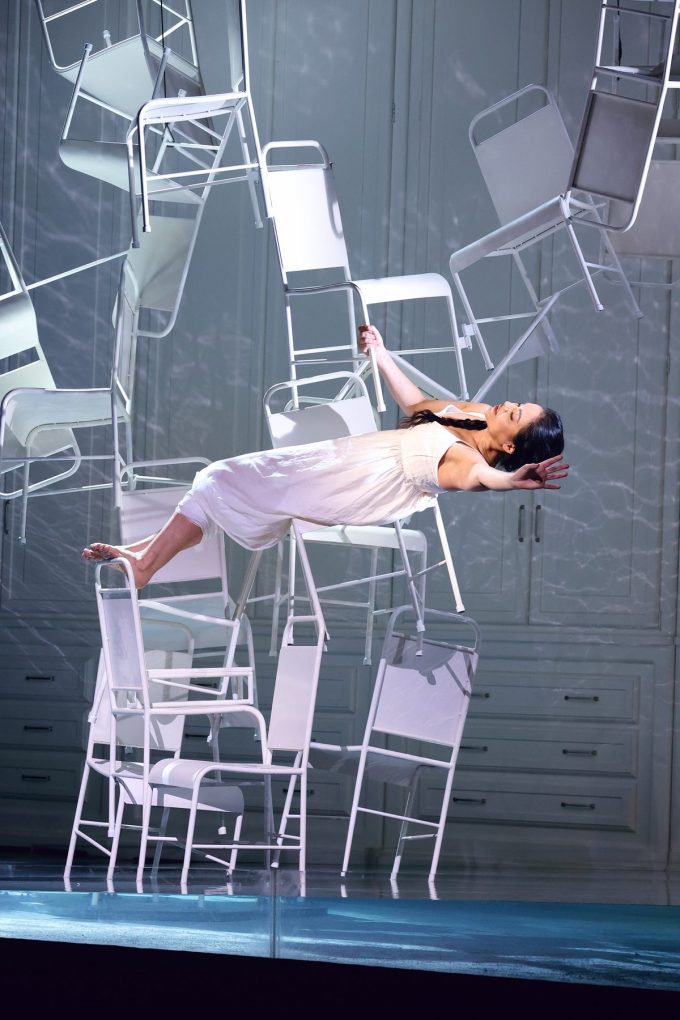
The controversial element of Director David Pountney’s production is scenic design.  As written, “Rusalka” opens in a meadow by a lake which is well-represented by a dank swampy or foresty set.  The whole opera as specified takes place outdoors, and darkness is even mentioned in the libretto.  But Leslie Travers’s full stage set is comprised of massive white built-in looking cabinets which creates unnatural domesticity and artificial brightness that opposes the intent of the story.  Traditionalists will be offended.  An interesting element of the set is a “tree” built of white metal chairs, which Rusalka climbs upon with the audience wondering if and how it will hold.

Ilanah Lobel-Torres, Lydia Grindatto, Meridian Prali as Wood Sprites.

That said, artistic license triggers interest, and many benefits derive from this depiction.  Modules of the set are portable, so that, for instance, a laboratory table and glass cabinets to display female trophies can easily roll into place. So the staging may be inappropriate in several ways, but it does provide exceptionally strong visuals.

Whatever disagreements on staging, however, performances are superb. Strong, clear-voiced James Creswell as Vodnik, Rusalka’s father, also deserves mention.  Cheers to Lidiya Yankovskaya who conducts with accuracy and great aplomb.  Finally, the opera itself is a wonderful testament to the collaboration of creative minds.

Ailyn Pérez as Rusalka.

“Rusalka,” composed by Antonin Dvořák with libretto by Jaroslav Kvapil and based on the fairy tales of Karel Jaromir Erben and Božena Němcová is produced by Santa Fe Opera and plays at its home at 301 Opera Drive, Santa Fe, NM through August 22, 2023.

Pelléas et Mélisande

Huw Montague Rendall as Pelléas, Samantha Hankey as Mélisande with doppelgangers. All photos by Curtis Brown.

When Claude Debussy discussed a prospective opera libretto, he said that he sought a poetic source in which characters seemed out of place, out of time, and only half disclosed. For “Pelléas et Mélisande,” he found his soulmate in future Nobel Prize winner Maurice Maeterlinck, whose opaqueness suited Debussy so well that he adapted the playwright’s work almost verbatim except for modest trimming. The fit of the composer’s music with the play was fortuitous as it resulted in Debussy’s only completed opera.

In literary terms, “Pelléas et Mélisande” was the apotheosis of Symbolist opera, a somewhat ambiguous idiom with a reverence for language unbound by traditional meaning, with links to the delight of unnamed things and the mysticism of sound that becomes associated with them. Things are not what they appear to be but have a deeper meaning beneath the surface. The work is also full of symbolism with its metaphorical representations. Notwithstanding, the many symbols depicted are sometimes indecipherable. While many questions can be asked about this work, there are few answers that are absolutely right or wrong.

Musically, Debussy was a contemporary of Puccini, but his musical vocabulary in opera differed greatly. The Italian maestro penned many set pieces like arias, ensembles, and choruses replete with distinct and memorable melodies having wide musical range and leaps.

Gihoon Kim as Golaud, Raymond Aceto as Arkel.

No stranger to melody, Debussy’s most famous pieces were the lush “Clair de Lune” and “Prelude of the Afternoon of a Faun.” Constrained to a fixed libretto that was not designed to accompany music limited the scope for musical expression in his opera. Thus, Debussy followed Wagner’s thesis of continuous melody with a tighter melodic line, more akin to lengthy but more tonal recitative. Without a chorus or large groups of principals on stage, Debussy’s work plays much like a chamber rather than a grand opera.

The resulting work however was a landmark in turn-of-the-century opera that is conducive to broad staging interpretation. Santa Fe Opera’s detailed and provocative rendering commands the attention and fascinates throughout. Director Natia Jones deserves immense kudos for also designing the complex scenery and projections, as well as costumery. Her only artistic design collaborator is D. M. Wood who is responsible for the also impressive lighting. The overall staging concept is brooding to match the unbroken darkness of the storyline.

The summary narrative of “Pelléas et Mélisande” is simple and well trodden. A prince, Golaud, finds a feral girl, Mélisande, in the forest and marries her. She and her husband’s younger half-brother, Pelléas, fall in love. People die. The end. Fortunately, considerable stimulating drama occurs along the way

Kai Edgar as Yniold, Brandon Bell as Shepherd.

Dyadal conflict within a group of well-differentiated characters drives the plot. Performances and voices excel across the board. Central to the clashes of desire is Mélisande. Haunted in character and with a haunting voice, Samantha Hankey portrays the innocence and beauty that trigger the hormonal reaction in the male siblings.

Knowing almost nothing about Mélisande and knowing that they don’t necessarily fit well, Golaud nevertheless takes her as his wife. While tolerant at the outset, he becomes increasingly hostile, symbolizing the abuse of the weak by the powerful, even using his son Yniold as a weapon of his oppression. Gihoon Kim is chilling as a conflicted tyrant who often intends well but struggles mightily with his urges. His emotive, mournful voice equally expresses his pain and his rage, and his portrayal is commanding.

Susan Graham as Geneviève.

The third member of the triangle is Pelléas, deftly portrayed by Huw Montague Rendall, a youthful sounding baritone in fine voice. In contrast to Golaud, Pelléas hesitates and long withholds his expression of love to Mélisande in spite of its long simmering.

This production is blessed with an exceptional cast of secondary principals. Raymond Aceto is King Arkel. We don’t know if his character has transformed as he readies for death, but for a royal, he is accommodating and empathetic. He holds special concern for Mélisande, despite the fact that her marriage to Golaud upset the king’s plan for a strategic alliance. From the opening words of the opera, Aceto demonstrates his booming resonance and range while he looms as a shell of past power.

Santa Fe treasure Susan Graham plays Geneviève, mother to the half-brothers. The role is small for an artist of Graham’s stature, but she displays both ideal presence and voice. Tweener Kai Edgar is Yniold, the son of Golaud. He is on point as the scared little boy with his penetrating treble (boy soprano).

Huw Montague Rendall as Pelléas, Gihoon Kim as Golaud, with doppelgangers.

A dominant metaphor in the Symbolist narrative concerns water. Variously, a body floats in it; a crown falls into it; a ring is lost in it; hair is draped upon it; and the nose is offended by its acrid odor. What does it all mean? Who knows? It’s up to the observer. It could relate to transition or in some cases sexuality. A likely interpretation is that it has to do with danger or threat, but why should that be a focus of the story? Only Maeterlinck knew for sure.

If the libretto doesn’t create enough ambiguity, the staging adds to it. Gloominess and dim lighting signpost this production’s stage design. A flat, gray set acts as the receptacle for changing, colorless projections that dominate the visual field. Three circulating fans appear as part of the fixed set. Are they figurative, fanning the flames; functional, cooling the stage; or something else?

Another directorial conceit involves sometimes having doppelgangers in twosomes on stage. Often, the actions of the two sets of identical characters is the same, but at other times, they diverge. Do the replicants represent alter egos? Do they depict the differing perceptions of the two characters in their relationships? Probably the latter, but who knows?

Gihoon Kim as Golaud, Samantha Hankey as Mélisande.

In any case, this opera fulfills Debussy’s mystical quest, and this outstanding production offers plenty of entertainment and plenty to think about.

“Pelléas et Mélisande,” with music and libretto by Claude Debussy and book by Maurice Maeterlinck is produced by Santa Fe Opera and plays at its home at 301 Opera Drive, Santa Fe, NM through August 18, 2023.

Orfeo

(foreground) Rolando Villazón as Orfeo, Lauren Snouffer as La Musica, (rear) Luke Harnish (Apollo), Luke Elmer (3rd Pastore), Le Bu (2nd Spirit). All photos by Curtis Brown.

Love versus duty. All too often, the world’s highly accomplished individuals find that they must sacrifice relationships to achieve goals that will yield personal glory. Conversely, lovers sometimes lack the discipline or motivation for greatness.

Orfeo (Orpheus), demigod and son of Apollo, is challenged to follow strict guidance and not to submit to his personal urges. His attempt to retrieve his beloved Euridice from the underworld is oft retold and revised in every form of literary endeavor. Thus, it should be no surprise that Claudio Monteverdi’s “Orfeo” would be the earliest extant opera that holds a place in the modern repertoire. Santa Fe Opera’s stunning production showcases the work’s music in a fresh and appealing manner and offers a vivid visual interpretation of the narrative.

Cast.

Composed in 1607, the score of “Orfeo” bridged Renaissance and early Baroque music. In common with musical dramas of the time that would later be known as operas, music was composed to enhance existing dramas. Composers like Monteverdi would create a continuo, a bass line usually played by a keyboard with harmonies and their instruments specified. They would not fully detail the scores for each instrument, leaving that to the individual production.

As a result, this opera has been orchestrated by a number of conductors and composers. Santa Fe Opera commissioned Nico Muhly to premiere a new orchestration that is designed for modern, rather than period instruments. Although the original continuo is observed, the result is a more contemporary treatment that eliminates the sometimes tinkly clanginess of period instruments to provide a warmer, smoother sound.

Paula Murrihy as La Messaggera.

The most distinguishing feature of this production is its brilliant staging. Overall, scenario goes from light to dark to sunrise in a manner that only Santa Fe can provide. Early sequences surrounding Orfeo and Euridice’s marriage feature La Musica (Music), performed by Lauren Snouffer, who sings with a fine Baroque tremolo. Festivities take place on a stage whose set is comprised of a huge green mound. One assumes that Visual Environment Designers Alex Schweder and Matthew Johnson were purposefully playful with the connection of the hemispheric feature’s shape and color to the composer’s name.

Apart from the main principals who have their own unique costumery, the stage is filled with raucous, gallivanting choristers who don orange and pink garb that is reminiscent of a large gathering of Hare Krishnas. The score utilizes the chorus extensively, and since it is comprised of apprentice singers, the quality of the chorus’s sound is always superb and the acting always as required.

Lauren Snouffer as La Musica.

Putting a stop to the gaiety, La Messaggera (Messenger), portrayed by a delightful Paula Murrihy, announces that Euridice has died and descended to the underworld. This occurs in a staging manner that only Santa Fe can offer. For the scenes that occur in the living world, the back wall of the stage is open to nature – the mountain landscape and skies behind. As darkness descends figuratively in the opera, it also descends literally in the natural backdrop. Plus, ominous storm clouds and rain that were developing in the distance at this performance added to the chilling appearance.

Rolando Villazón as Orfeo.

Orfeo’s crossing into the underworld to retrieve Euridice provides the most striking visuals. In almost total darkness, the hemisphere lifts to create a giant clamshell-like feature that envelopes Orfeo. This is lead performer Rolando Villazón’s time to shine. Not only is he spotlit on the stage which he has to himself for an extended soliloquy, but he is suspended in air on cables and writhing the whole time. He does a remarkable job to maintain his voice under those conditions.

Director Yuval Sharon does an excellent job with overall production design. Yuki Nakase Link’s lighting also deserves recognition, especially in the fearsome underworld, where in the darkness, light darts and undulates on smoke, and the chorus is adorned with neon features.

Amber Norelai as Euridice, chorus.

The uncontrollables are the Achilles heel. This work is worth seeing for its historical importance, staging, and performances. but to the modern sensibility its weaknesses are that the music and drama don’t meet standards of later operas. The music is pleasant and well conducted by Harry Bicket, but singing is in recitative without melodious arias and without the challenges of singing in high ranges. And while the situations are certainly dramatic, the delivery is almost completely in oratorio style. Storytelling and internal revelations dominate with little action or interaction among characters.

Rolando Villazón as Orfeo, Amber Norelai as Euridice.

Also, while one of the glories that makes opera such a unique and compelling art is the display of the power of the unamplified, well-trained human voice, microphones were used in this performance. The lead principals sounded fine, but their voices were not properly tested.

“Orfeo,” composed by Claudio Monteverdi and libretto by Alessandro Striggio with world premiere orchestration by Nico Muhly is produced by Santa Fe Opera and plays at its home at 301 Opera Drive, Santa Fe, NM through August 24, 2023.

Cruzar la Cara de la Luna

Kelly Guerra as Renata, Efraín Solis as Laurentino, Aléxa Anderson as Diana. All photos by Cory Weaver.

Few socio-political evolutions in the United States since World War II have been as profound as the growth in population from Latin American origins, from an estimated 4.5 million or 3% of the population in 1945 to over 63 million or 19% of a much larger current population.  First family arrivals have crossed the border both legally and undocumented in hopes of a safer and more comfortable way of life.

Few socio-political evolutions in the United States since World War II have been as profound as the growth in population from Latin American origins, from an estimated 4.5 million or 3% of the population in 1945 to over 63 million or 19% of a much larger current population.  First family arrivals have crossed the border both legally and undocumented in hopes of a safer and more comfortable way of life.

Alissa Aguilar as Lupita, Moisés Salazar as Chucho.

While the Latinx cultures, language, religion, and music of these peoples have left their marks in most performance arts, opera stands as an exception.  In 2010, composer José “Pepe” Martinez and librettist Leonard Foglia broke new ground with this piece, which translates as “to cross the face of the moon,” on a commission from Houston Grand Opera.  It has proven attractive with several productions launched by mid-sized opera companies.  West Edge Opera is offering a highly appealing and entertaining rendition of the work.

The story is about Laurentino, a man in New York who immigrated from Mexico half a century before.  On his deathbed, he reveals an undisclosed past to his family.  He had a first wife in Mexico who died in the crossing and a son who returned to his native land.  Upon hearing this surprise, his Mexican-American family sets out to locate the Mexican son and reunite him with the father before the latter dies.

Aléxa Anderson as Diana, Bernardo Bermudez as Mark.

As is fitting, “Cruzar” está mezclado de muchas maneras (is mixed in many ways).  As with musicals or operettas, conversation is spoken rather than sung, and songs stand apart with no connective musical recitatives.  Although the songs are in Spanish, dialogue shifts between English and Spanish throughout, with the associated shift in supertitles.  And to really keep the audience on its toes, the narrative is non-linear in time and place.  That said, the storyline is easy to follow because of the cues given in the thoughtful staging.

Sergio González as Raphael.

One might expect that to cover the ground that the action does, with many brief scenes in 90 minutes, the emotional impact of the story would be compromised.  It is not.  The human interest elements, the life challenges, the compassionate characters, and the sadness are largely understated, yet presented in ways that trigger immediate empathetic responses in the audience.  And in many ways, the tragedy of the crossings and divided families resonates even more today than when the opera debuted.

A poignant metaphor of the butterfly recurs in the music and conversation.   When the butterfly emerges from its chrysalis and moves on from its life as a caterpillar, it never returns to the same location, reenacting life’s transformation in a new land.  It is only the descendants that circle back to the homeland of earlier generations.

Instead of a traditional opera orchestra in a pit, the Mariachi Azteca band of guitars, violins, and trumpets plays from the periphery of the stage.  The melodic music in the mariachi style always engages.  Some songs are quite touching with messages particular to the immigrant experience – thoughts like “we never leave the south,” “we always want to return,” and the plea of Laurentino’s first wife Renata “I’m not marrying to receive money through the mail.”

Alissa Aguilar as Lupita, Kelly Guerra as Renata.

Efraín Solis, who has played the American son in several productions, deftly heads the well-suited ensemble cast as the dying Laurentino, who dreams of the life he left behind.  Other characters are well delineated from the distraught American son Mark (Bernardo Bermudez) to the surly Mexican son Rafael (Sergio González) and the spritely American granddaughter Diana (Aléxa Anderson).

Overriding and overlapping issues of interest about “Cruzar” deserve discussion.  First is whether it is an opera, for which there is no definitive definition, but in the first instance, the operatic music is sophisticated and draws from “classical” idioms.  This work is more like a zarzuela, a form from Spain that paralleled the development of opera in Europe, but shares the format of operettas in having spoken language interspersed with song.  It might even be more closely related to the American musical, being more akin to “In the Heights” than “Carmen.”

Efraín Solis as Laurentino, Bernardo Bermudez as Mark.

Another key element is that with rare exception (e.g., outdoor performances and John Adams’ operas) opera vocals are never amplified, but they are in this production.  One of the great virtuosities in performing arts is the astounding grandeur of an opera singer’s trained voice.  The cast of “Cruzar” all have opera credibility on their resumes – for instance, Moisés Salazar who plays Chucho follows Solis as a San Francisco Opera Adler Fellow.  However, it is impossible to evaluate their singing fairly compared with other opera performances when a lounge singer might sound as good using a microphone.  In addition, the songs from “Cruzar” don’t challenge the power, range, or flexibility of the artists’ instruments as is common in opera.  It is the high wire dynamics of the singing that produces the awe in audiences.

Apart from the matter of whether “Cruzar” is artistically suited to the opera house is the marketing issue.  It is good that this work is spreading, and hopefully that will continue.  But to the opera crowd, it may be largely a passing curiosity, not a trend.  It would be great if this piece could bring new audiences to live performance, whether that is in the opera house or the musical theater.  Perhaps the latter would be less intimidating to those without a history of attending either art form.

Efraín Solis as Laurentino, Moisés Salazar as Chucho.

That raises a final question.  Certainly, Latinx should be more drawn to the mariachi music and the cultural aspects of “Cruzar.”  But most Latin Americans in this country will have stories of crossing, separation, and tragedy from their own families or friends.  Although stories like this deserve a wide audience, the question remains whether the Latinx community wishes to relive the experiences in live performance.

“Cruzar la Cara de la Luna,” composed by José “Pepe” Martinez with libretto by José “Pepe” Martinez and Leonard Foglia and book by Leonard Foglia is produced by West Edge Opera and plays at Oakland Scottish Rite Center, 1547 Lakeside Drive, Oakland, CA through August 5, 2023.

The Coronation of Poppea

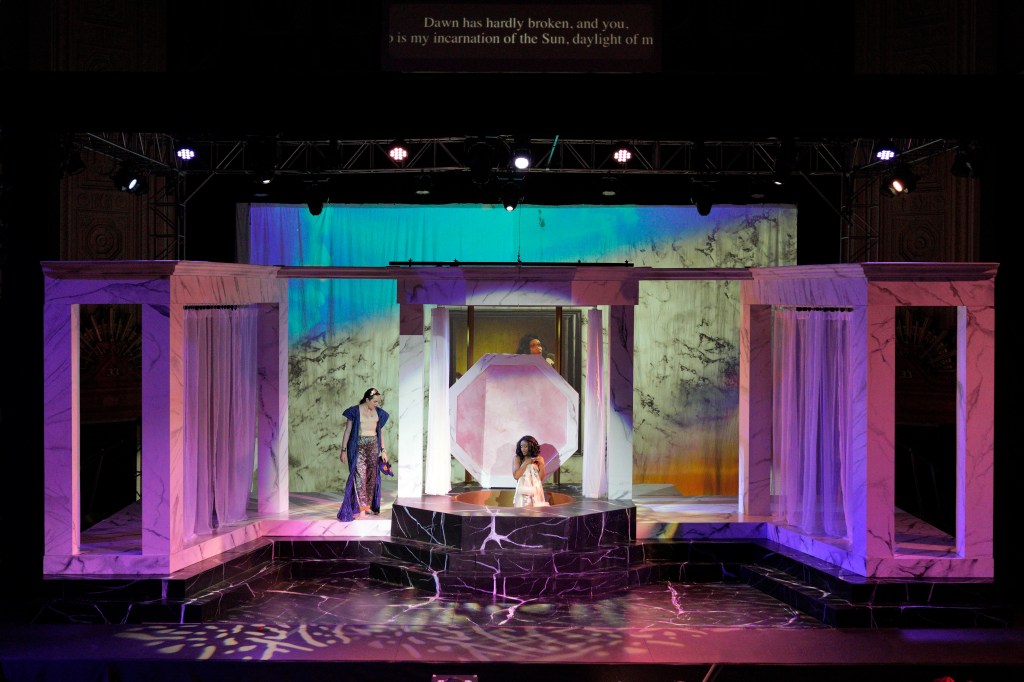
Overall staging. All photos by Cory Weaver.

Overwhelmingly, operas based on history are tragic.  “The Coronation of Poppea” fits the category but barely meets the standard for adversity, exhibiting only attempted murder, forced suicide, intrigue, betrayal, and banishment.

The work acted as an important bridge between Renaissance and Baroque musical periods.  It is one of the earliest extant, and certainly most important seminal operas, produced in 1643 before the word opera was even in use.  At that time, music was composed to honor and enhance an existing text, thus Claudio Monteverdi’s music was designed to compliment and complement Giovanni Francesco Busenello’s scenario.

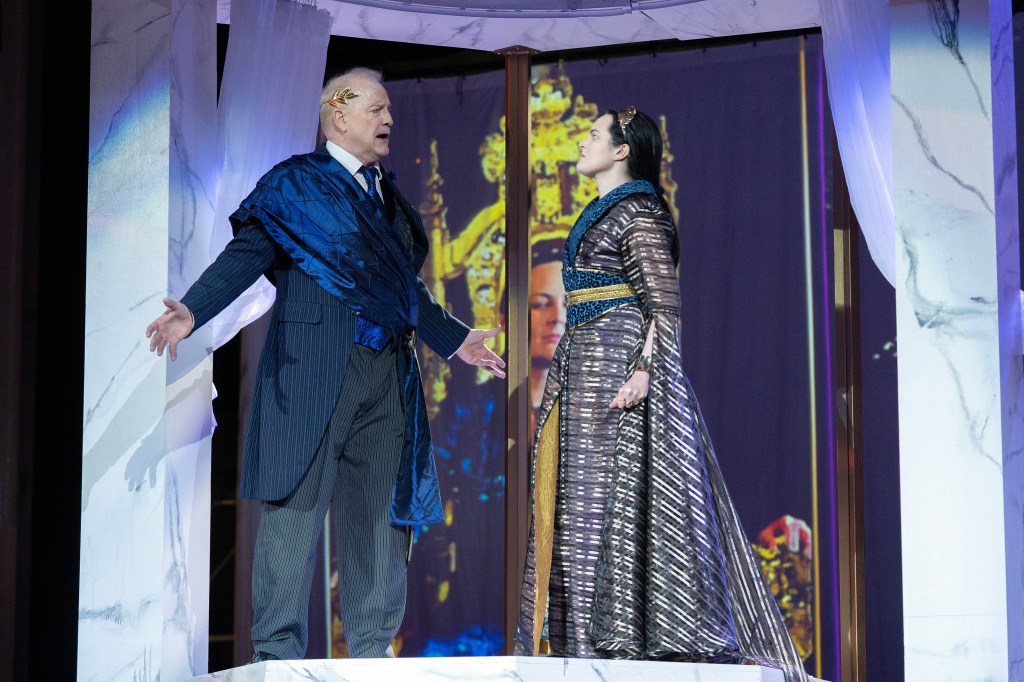
Sarah Coit as Nero, Shawnette Sulker as Poppea.

The libretto is historical only in the broadest sense.  While the plot points actually occurred from AD 58 to AD 65, not only are they condensed into one day, but their order is shifted!  Further, Busenello fancifully changes the character of characters, making some good who were actually bad and vice versa.  Who would have thought of the barbaric and narcissistic Nero as also having room for love and magnanimity?  So, for those who lambaste Hollywood for being fast and loose with the facts, let it be known that it had models to draw on.

West Edge’s bright and winsome production excels on two most important criteria.  The cast amazes – a wonderful match of exciting performers and voices to their respective roles.  Also, since copyright is not an issue, the company was able to trim the running time from four hours to a manageable two-and-a-half without loss of plotline or continuity.

Sara Couden as Octavia.

Despite the grave nature of many of the incidents, the overall effect of the production is relatively light.  This largely derives from ace casting and interpretation decisions, presumably by Artistic Director Adam Pearl.  The exacting and honey-tinged coloratura, Shawnette Sulker, heads the cast with a stellar sultry and conniving enactment and voicing of Poppea.  While her characterization as Nero’s mistress and wannabe empress is conventional, many others are a delightful confetti of gender bending.

Philip Skinner as Seneca, Sarah Coit as Nero.

First, as Nero is Sarah Coit, who handles the role’s tricky ornamented passages in the score with great facility.  Although written as a trousers role, it would normally be performed in a male mode.  However, several physical cues make it appear that a female is performing, and Nero’s wardrobe is largely aligned with that of a woman in terms of patterns and shapes.  The most profound gender switch involves Poppea’s nurse, Arnalta, who provides comic relief and is performed by Samuel Faustine.  The role calls for an alto, but Faustine sings largely in countertenor.  He also possesses a tenor timbre and is able to take deep dives into a lower register to add a special sass and bawdiness to the role.  The final gender twist is the part of Ottone, who is Poppea’s lover before she throws him over for Nero.  Although Ottone is designed as a trousers role for a mezzo’s voice, in a big surprise, a real male performs the role.  This is mellow sounding countertenor Michael Skarke, who acquits himself well.

In order to make Poppea his empress, Nero must rid himself of his wife Octavia.  Of course, when she gets drift of Nero’s intentions, Octavia comes up with an assassination scheme that would solve her problem.  She is performed by Sara Couden who possesses an uncommonly powerful instrument that absolutely fills a theater.  Each time she sang, the audience was rapt in awe.

Samuel Faustine as Arnalta.

The adult in the room is Seneca.  An advisor to Nero, the great philosopher and dramatist was on the receiving end of advice from Nero to take his own life after being implicated in a plot, perhaps wrongly, to kill the emperor.  The dignified and stentorial Philip Skinner fits the role exquisitely, the one exception being that it calls for a bass, while Skinner is a bass-baritone.  He does lose volume, but not other qualities at the bottom of the tessitura required.

The music of the opera engages throughout, though in typical Baroque fashion, harpsichords tinkle and theorboes clink with incessant regularity.   The score possesses a number of set pieces that are both melodious and meaningful.  Two duets are particularly telling and memorable.  The first reflects the moral and intellectual distance between Seneca and Nero with the former advising the emperor to be guided by reason and morality in his actions, while the petulant Nero willfully insists that he will have whatever he wants.  The other is the closing duet between Nero and Poppea.  Erotically charged, it symbolically exudes urgent sexuality in a repeated, fervent call-and-response sequence.

Rayna Mia Campbell as Drusilla, Michael Skarke as Ottone.

Nina Ball’s set embraces clean lines and function as would be expected for an ancient drama.  Yet, the overall staging is gemischt in time and place – although the anachronisms generally enhance rather than detract from the effect.  One device shows the events that occur in the action depicted as front-page newspaper articles, dramatically spinning into place on Ryan Yu’s rear-screen projections.  Unfortunately, columns and a top beam in the set block the visual and informational effectiveness.  Ralph W. Hoy’s costumes are eclectic.  Ottone’s and those of supernumeraries earlier in the piece are suggestive of mid-century Ecuador, with Panama hats, panchos, and earthtones.  Later, extras are wearing formal kilt attire, which may have simply been available from the venue, Oakland’s Scottish Rite Center.

An area for improvement in future productions relates to supertitles.  It would help if characters are identified in the titles at their first utterance.  Sometimes, it is simply unclear who a character is until their name is later mentioned, and the viewer may be left at sea for a time.  Another observation is that the ambient light reduces the contrast in the supertitles and makes them hard to read for many.  Projecting them in larger or thicker font would make them more readable.

Shawnette Sulker as Poppea.

Notwithstanding the minor issues, West Edge has produced an opera of historic significance in an intriguing and highly interesting manner.

“The Coronation of Poppea,” (“L’incoronazione di Poppea”) composed by Claudio Monteverdi with libretto by Giovanni Francesco Busenello, is produced by West Edge Opera and plays at Oakland Scottish Rite Center, 1547 Lakeside Drive, Oakland, CA through August 3, 2023.

The Rape of Lucretia

Natalie Lewis as Lucretia (front left), Samuel Kidd as Tarquinius (front right), Chance Jonas-O’Toole as Male Chorus (back left), Caroline Corrales as Female Chorus (back right). All photos by Kristen Loken.

In the midst of its 2023 Merola Summer Opera Festival, a program for gifted singers artistically associated with San Francisco Opera, it offers a fully-staged production of Benjamin Britten’s “The Rape of Lucretia.”  The opening performance was powerful and engrossing, led by a strong cast of eight singers from the illustrious training ground.

When a group produces only one opera in a season, the question arises how the selection was made.  In this era of “Me, Too,” much analysis is being conducted of the themes in operas.  Clearly, if operas such as “Madame Butterfly,” “Don Giovanni,” “Rigoletto,” “Abduction from the Seraglio,” and scores of others were written today, modern sensitivities would demand different  treatments of themes now deemed offensive.

James McCarthy as Collatinus, Cameron Rolling as Junius.

“The Rape of Lucretia” fits in that category but was chosen largely because of the themes, with the idea of exposing artists to such materials in a safe and supportive environment.  Given that objective, it is somewhat surprising that the rape scene, which could have been totally enacted behind a curtain, is rather physically depicted.  In addition to the rape, the text is full of misogyny.  Junius declares that “Virtue in a woman is lack of opportunity” and Tarquinius says that “The only girl worth having is wine.”  Note, however, that Lucretia’s husband, Collatinus, did not share this sentiment.  Fortunately, the program’s social objective was accomplished while presenting an otherwise interesting work.

Its mid-century, modern musicality does not break barriers, but it is highly listenable.  All eight roles provide significant stage and singing time for each performer, giving ample opportunity for each to show well – and they do.  None of the arias or ariosos are memorable, but two quartets and the septet finale are very involving.

Caroline Corrales as Female Chorus (left), Olivia Prendergast as Lucia (right), Simona Genga as Bianca (below).

The opera is based on history.  Prior to Rome’s becoming an empire, it was ruled by kings.  In the 6th century BCE, the tyrant Lucius Tarquinius Superbus was the last king, and his tumultuous reign was finally toppled by actions of his son Tarquinius.

In the opera, Roman officers, including Tarquinius, who are in a military camp wager whether their wives have remained constant.  Investigations prove that the wives of all of the men in the discussion have had indiscretions, with one exception.  Lucretia has remained faithful.  Tarquinius is determined to corrupt her morals.  Returning to Rome, his amorous advances toward Lucretia are repelled, and he forces himself on her.  Although not dealt with in the opera, this incident was the crowning blow to the king’s reign, and his overthrow led to the period of the Republic of Rome.

Samuel Kidd as Tarquinius, Natalie Lewis as Lucretia.

This early piece, orchestrated for 13 instrumentalists, is the first of Britten’s chamber operas.  Many who are familiar with the composer’s life will know that he often wrote lead parts for his life partner, operatic tenor Peter Pears, who was indeed in the cast of the opera’s premiere.  At first blush, one might think that Pears was shortchanged in being cast as Male Chorus.  However, this is the sole tenor role and the largest part in the work, narrating the storyline and the thoughts of the men.  Rather than a role as a talking-head, stoic sentinel, the Male Chorus is demonstrative, emotional, highly mobile, and interactive with his female counterpart.  Indeed, some would argue that a weakness of the libretto is that storytelling by the Choruses dominate the action.

In this Merola realization, impeccably-voiced Chance Jonas-O’Toole excels as Male Chorus with full vocal and acting ranges.  Caroline Corrales as Female Chorus is likewise a strong presence with an exciting voice.  In the other two large roles, full-throttle baritone Samuel Kidd is the devious Tarquinius and silken-warm-voiced mezzo Natalie Lewis is the righteous Lucretia.

Samuel Kidd as Tarquinius, James McCarthy as Collatinus, Cameron Rolling as Junius.

Other performers are James McCarthy as Collatinus, Cameron Rolling as his colleague Junius, and as Lucretia’s attendants, Olivia Prendergast is Lucia and Simona Genga is Bianca.  As noted, the voices are accurate throughout, but at least three singers have difficulty at the low ends of their tessituras when competing with the small orchestra ably conducted by Judith Yan.

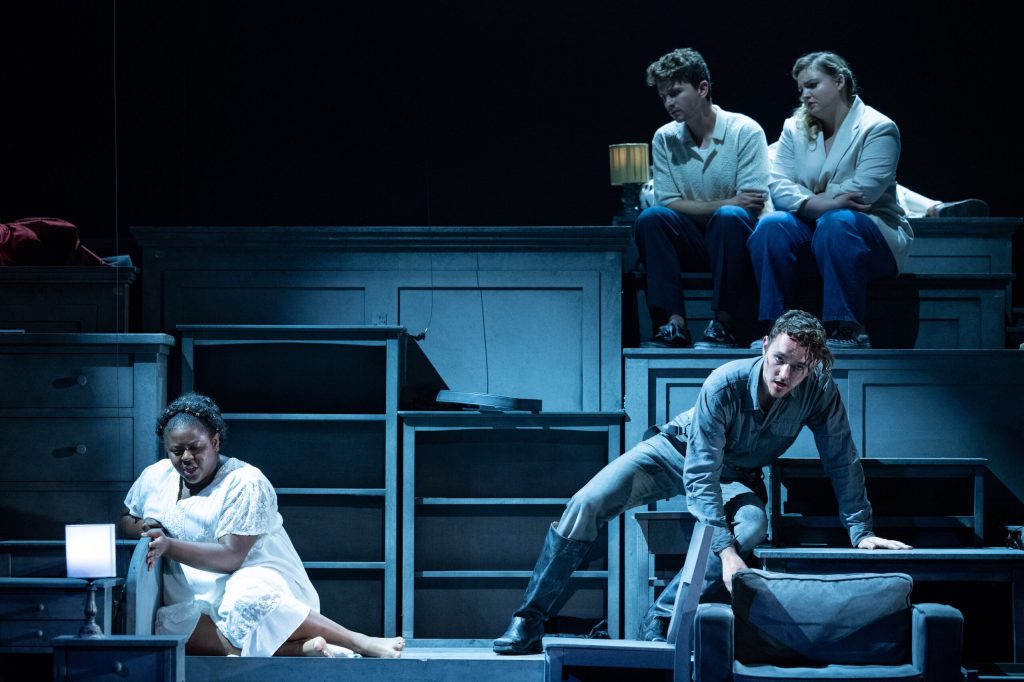
Director Jan Essinger’s staging is simple yet striking.  Sonja Füsti’s sets are monochromatic gray.  In the camp scenes, gray sheets draped over objects comprise the set.  In Lucinda’s home, the sheets are lifted to reveal a stage full of gray furniture pushed together as if in storage.  The somber notes are appropriately accentuated by David Robertson’s dim lighting and Christine Cook’s contemporary drab costuming.

Caroline Corrales as Female Chorus, Chance Jonas-O’Toole as Male Chorus.

Ronald Duncan’s libretto teems with literacy, blessed with intelligent conversation and an array of rich metaphors and references.  If you have to go to your dictionary to look up the word moiety (used to partially rhyme with anxiety), you get the picture.  Unlike many operas with convoluted storylines or leaps of logic, this one plays out clearly and concisely with one exception.

A conceit employed that rings false is the Christianization of the text.  The Choruses are presented as Christian observers in order to needlessly introduce notions of redemption, and in this interpretation, resurrection.  The effect of the dual timeline results in a sense of anachronism, especially when the Choruses are singing with historic figures from centuries earlier.

Natalie Lewis as Lucretia (above), Olivia Prendergast as Lucia (below).

Although “The Rape of Lucretia” is not among Britten’s oft performed works, its assets are abundant, and Merola offers a fine rendering of this underperformed opera.

“The Rape of Lucretia” is composed by Benjamin Britten with libretto by Ronald Duncan and is produced by Merola Opera Program and performed at Herbst Theatre in War Memorial Veterans Building, 401 Van Ness Ave., San Francisco, CA through July 15, 2023.

Les Misérables

Cast. All photos by Matthew Murphy and Evan Zimmerman for MurphyMade.

Though the stage musical descends from the European operetta, it became a unique art form associated with the American theater and particularly with Broadway.  Other English-language artistic teams have crafted musicals that have succeeded in the United States, but rarely has one that originated in a foreign language reached broad acceptance.

The two most popular musicals to fit that category were created by two Frenchmen whose names are little known and won’t roll off the American tongue.  They are composer Claude-Michel Schönberg and lyricist Alain Boublil.  In the 1980s, they brought to the stage in English two stellar musicals – “Miss Saigon,” and relevant to this review, “Les Misérables.”  Broadway San Francisco and Producer Cameron Mackintosh present the national touring production of “Les Mis” with stunning staging and uniformly strong singing voices.  The audience was transported to a radically different time and place and was wildly appreciative of the trip.

Preston Truman Boyd as Javert, Nick Cartell as Jean Valjean.

The source is one of literature’s greatest novels, Victor Hugo’s “Les Misérables,” which is set against the events of its time.  The central figure, Jean Valjean spends his adult life paying for having stolen a morsel of bread for his sister.  Even after a long prison sentence, he finds himself needing to hide and lie to avoid the relentless Inspector Javert, who obsesses over making Valjean pay endlessly for his petty crime.  Of course, the audience aligns with the thief rather than the lawman, as Hugo’s plea for reform of the justice system is clear.  Meanwhile, in 1823, Fantine, a young woman who becomes destitute, dies and asks Valjean to take care of her daughter Cosette.

Haley Dortch as Fantine.

A second plot line concerns the Paris Uprising of 1832.  Act 2 plays out largely at a barricade set up by the republicans who are protesting the re-establishment of the monarchy.  The confrontations with the authorities will test the mettle of Valjean, Javert, and Cosette’s lover Marius.  The stage is ablaze with gunfire and conflict, and many will die before the battle is over.

(foreground) Gregory Lee Rodriguez as Marius, Addie Morales as Cosette, (rear) Christine Heesun Hwang as Éponine, Nick Cartell as Jean Valjean.

The music of “Les Mis” is appealing, but in large part, unmemorable.  What it does have is one powerful song that has grown into public consciousness well beyond the theater – “I Dreamed a Dream.”  While many signature songs from musicals put an exclamation point on the climax, this song comes very early and is delivered by Fantine, who is several rungs down the ladder of important characters.  The good news is that Haley Dortch delivers a beautiful rendition, and it is a truly beautiful song.  What’s more, key phrases from the melody and even the rhythm of the lyrics recur throughout the play, and the haunting and suggestive familiarity adds to the overall ambiance.

Nick Cartell as Jean Valjean.

One aspect of the music is the demands that it makes on Valjean, played with sensitivity and sung with panache by an exemplary Nick Cartell.  Valjean’s music is bimodal in range, and Cartell must often make musical leaps from the lower part of his range to the top while quickly switching from full voice to falsetto.  He accomplishes this with great skill.  As Javert, a very impressive Preston Truman Boyd faces a different challenge.  He is full of bile and bitterness, and he often sings with rage that is just a notch below uncontrollable.

Devin Archer as Enjolras.

Although “Les Mis” clocks in at over three-and-a-quarter hours, the pace is quick and the action commands the attention.  Through many clever, well-designed sets, the staging is among the darkest and most brooding in the genre, with low lighting and generous use of smoke.  The peasants’ costumery adds to the overall downtrodden effect.  Hugo’s artistry as a painter inspired the set design, but it appears that the novelist was in turn inspired by some of France’s most eminent early-and-mid 19th century painters.  We see the unstable action tilt from Delacroix; the dangling, supine corpse from David; the landscaping from Corot; and the grizzly peasantry from Daumier.  Set change, which is brisk, is facilitated by the broad use of backlit projections as distant scenery, reducing the props to be moved.

Preston Truman Boyd as Javert.

In their two highly successful musical collaborations, Schönberg and Boublil have drawn heavily on the Andrew Lloyd Webber playbook in three ways.  This musical is written in sung-through fashion.  Like opera, rather than traditional musicals, all of the text is sung.  A second commonality is that “Les Mis” contains a single beautiful anthem that is separable from the musical as a pop song and can be used as a promotion in advance of the play’s staging.  Finally, the show has a strong graphic logo that serves as an identifier that also aids in marketing.  In this case, it is the head shot of a straggly-haired Cosette as a waif in front of the French flag.

Christine Heesun Hwang as Éponine.

Altogether, the result is a musical that explores the human condition, starting with duty, love, forgiveness, and redemption. Its many assets have propelled it to becoming one of the longest running musicals both on Broadway and the West End.

“Les Misérables” with music by Claude-Michel Schönberg, French lyrics by Alain Boublil and Jean-Marc Natel, English lyrics by Herbert Kretzmer, and based on the novel of the same name by Victor Hugo is produced by Cameron Mackintosh, presented by the producer and Broadway San Francisco, and plays at the Orpheum Theatre, 1192 Market Street, San Francisco, CA through July 23, 2023.