Oklahoma!

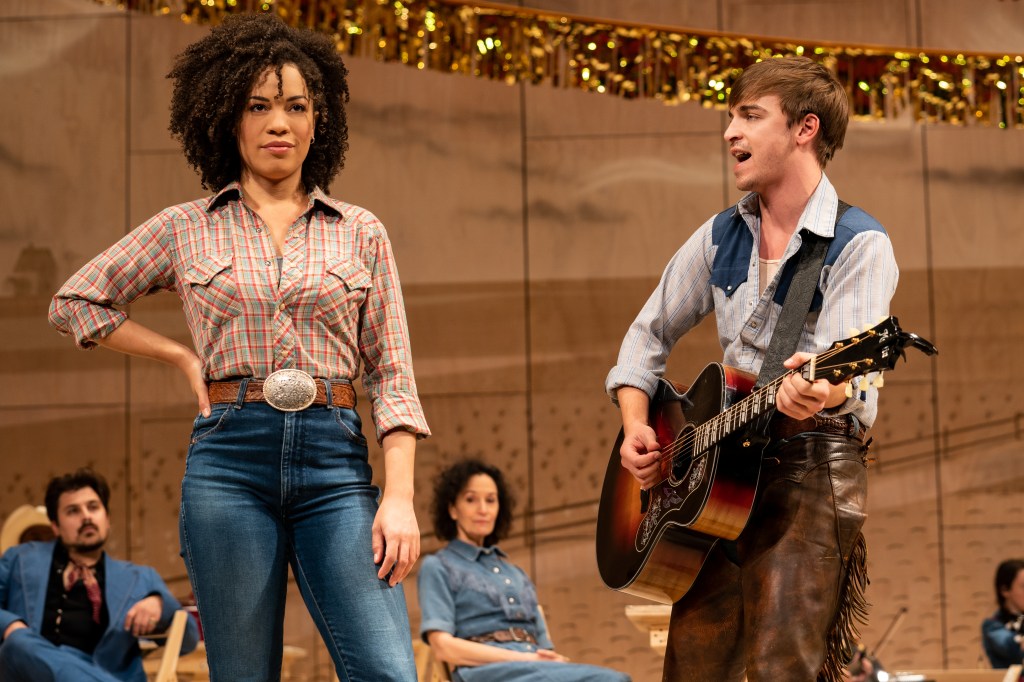
Sasha Hutchings as Laurey, Sean Grandillo as Curly, (rear) Benj Mirman as Ali, Barbara Walsh as Aunt Eller. All photos by Matthew Murphy and Evan Zimmerman for MurphyMade.

To theater goers who grew up in recent decades, it might be easy to look at the musical “Oklahoma” as a saccharine relic of the past.  Although it opened in 1943, this first collaboration of Rogers and Hammerstein heralded the post-WWII Broadway musical era of American confidence and optimism.  More importantly, it represented a breakthrough in the form.  Rather than a showcase for unrelated songs, all of the artistic elements – music, lyrics, book, and dance – integrate in driving the plot forward.  Of course, it doesn’t hurt that “Oklahoma” is full of memorable songs and characters.

“Oklahoma”’s debut also occurred during a period of social repression.  The Motion Picture Production Code that existed from 1930 to 1968 acted as moral police to ensure that films supported its sense of propriety and patriotism.  While its scope did not extend to the stage, producers of expensive musicals didn’t want to risk attracting MPPC’s attention.  That changed, most notably with 1967’s “Hair,” which brimmed with promotion of anti-war ideas, flag denigration, and nudity.

Hennessy Winkler as Will, Sis as Ado Annie, (rear) Ugo Chukwu as Cord, Hannah Solow as Gertie, Barbara Walsh as Aunt Eller.

In recent years, producers have looked to reimagine many of those musicals from the sweet and light era and reveal their dark underbellies.  Musicals that already had a shadowy side like “Carousel,” “Camelot,” and “Oklahoma” were prime prospects.  Broadway saw this musical revitalized in an edgy form in 2019.  That production, directed by Daniel Fish, won a Tony for “Best Revival of a Musical” and is currently touring.

For those who have seen the musical in its original form, this vision may seem provocative and interesting with considerable pluses and minuses in contrast with past viewings.  Those who are new to the play will likely enjoy it without having a really good sense of its intended complexion.  It would be interesting to see how the first timers would react to seeing a traditional production, which they might find hoaky, particularly after this one.
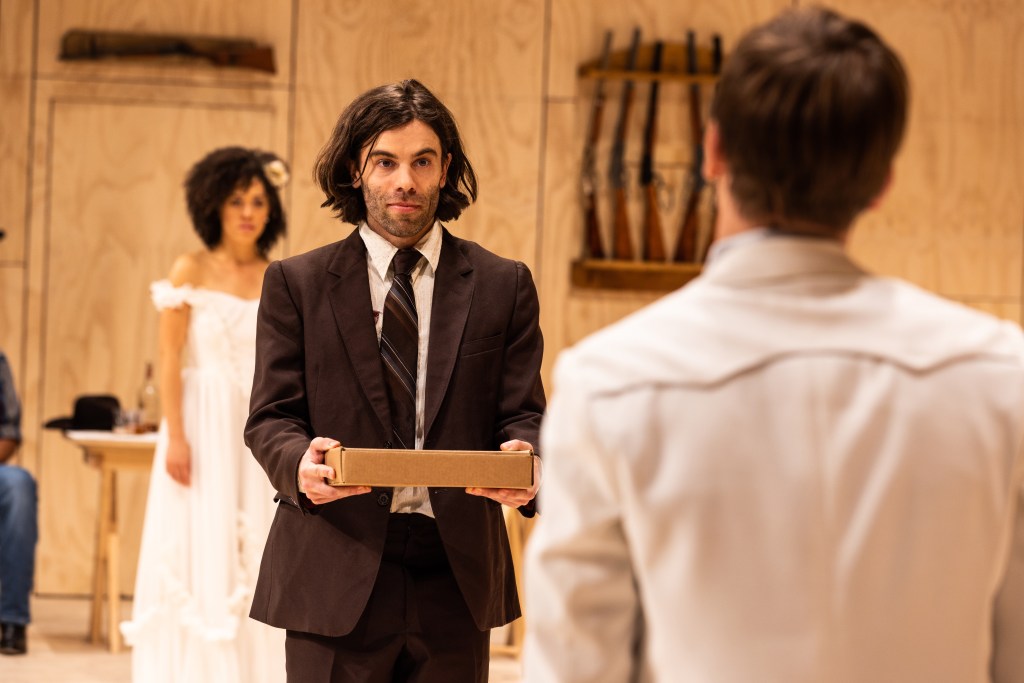
Christopher Bannow as Jud, (rear) Sasha Hutchings as Laurey.

The visual elements of this new work strike the viewer before hearing a word or a note.  The cast is highly diverse, a welcomed and radical change from the white bread look of early productions, which was accurate for 1906 rural Oklahoma Territory.  The staging is not the elaborate sort common with big musicals in big theaters.  A number of light-colored, wood trestle tables and folding chairs that look straight from a raw furniture store dot the stage.  The principals and the several-piece country-swing type band are all on stage virtually the whole time, just observing the action when not performing (there is only one dedicated dancer and no chorus).  It often gives the impression of a stand-and-deliver rehearsal in a barn rather than a polished production.

Richard Rodgers’s music introduced country elements, but the score remained fundamentally show-tune in nature.  In this production, the country twang is much more pronounced, and it is often blended with rhythm-and-blues stylings, particularly the songs sung by the two female leads.  Tempos are altered, with the protagonist guitar-wielding Curly’s opening “Oh, what a beautiful morning” delivered at dirge speed by talented Sean Grandillo.

Hannah Solow as Gertie, Sean Grandillo as Curly.

From the outset, we expect that Curly and Laurey will ultimately get together, but it is a rough road.  Their bickering early on, which could be done in a charming manner, consists largely of smarmy ripostes.  Despite their friction, they provide a fine duet of one of the signature songs, “People will say we’re in love.”  Sasha Hutchings as the female lead takes a nice turn with a little dance solo in that number and demonstrates her fine unaccompanied voice later in the acapella “Out of my dreams.”

The fly in the ointment is Jud, the hired hand on Laurey’s Aunt Eller’s farm.  A dangerous loner, he becomes obsessed with Laurey and is determined, as is Curly, to sacrifice all to win the bidding for her basket at the fund-raising picnic.  A clash between the two men is inevitable.
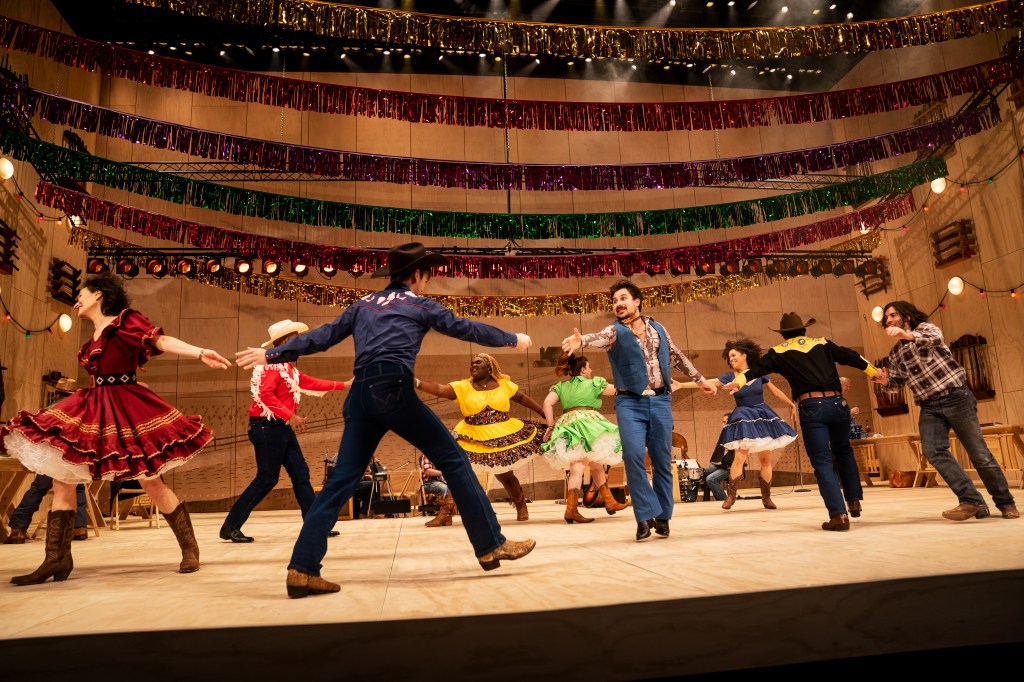
Cast.

The secondary plotline concerns another love triangle, with Ado Annie and prospective suitors cowboy Will and itinerant peddler Ali.  Sis plays the rambunctious Ado Annie, and more than any other performer, she lights up the audience.  “I cain’t say no” is always a fun and popular number, and with her deep alto voice and her gospel/bluesy rendition, she had the audience clapping rhythm.

The production is noted for other departures from the past.  In keeping with the edginess of the new look, Act 2 opens like an acid rock concert.  With a thick manufactured fog covering the stage, an instrumental medley blasts with deafening, dissonant distortion leading into the famous dream sequence dance.  And while Agnes de Mille’s original choreography featured a graceful ballerina with a long cloth train blowing in the wind against a featureless backdrop, athletic dancer Jordan Wynn offers a high-energy modern take on the scene with mock horseback riding and gymnastics.  Another unusual feature of the production is several occasions of extended stage darkness, as well as an effective low-light, silhouetted scene.

Sis as Ado Annie.

Although the climactic scene is brief, and like the rest of the play, changes nary a word of book or lyrics, the controversy it creates surprises.  Without divulging the difference in the action of the old and new versions, suffice it to say that a sad ending goes from regrettable but understandable to morally challenged.  Very confusing.

Traditionalists may find this depiction of “Oklahoma” beyond a reasonable scope of interpretation, and they may object to the style and simplicity of the staging.  The curious and intrepid will appreciate its creativity and some of its highlights and anomalies, despite some unevenness in staging and casting.

“Oklahoma” with music by Richard Rodgers; book and lyrics by Oscar Hammerstein II; and based on the play “Green Grow the Lilacs” by Lynn Riggs is presented by Broadway SF and plays at the Golden Gate Theatre, 1 Taylor Street, San Francisco, CA through September 11, 2022.
Tristan and Isolde

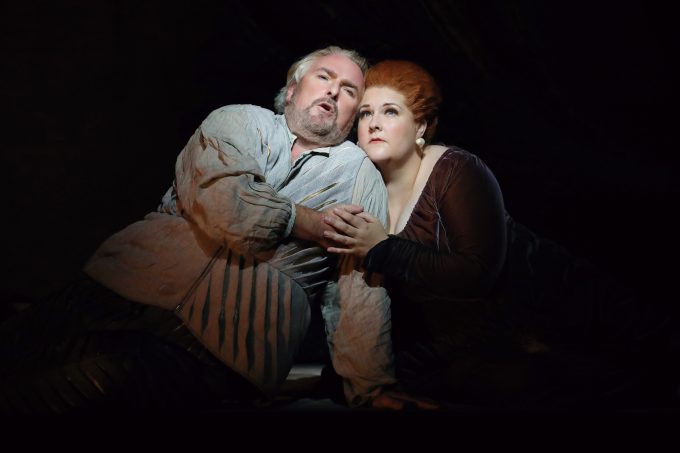
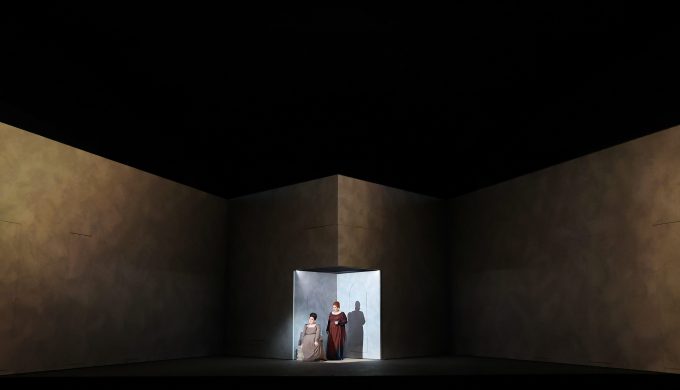
Simon O’Neill as Tristan, Tamara Wilson as Isolde. All photos by Curtis Brown.

Many people envision life in the Middle Ages as a study in austerity – common people inhabiting featureless hovels and nobles inhabiting dank castles.  Directors Lisenka Heijboer Castañón and Zack Winokur  and Scenic Designers Charlap Hyman & Herrero Company depict 12th century Cornwall and Brittany as well as a ship that transports ill-fated lovers in symbolic simplicity.  Similar to Maya Lin’s Vietnam War Memorial – a gash in the landscape – the mottled walls appear a sterile yet somehow fertile canvas.  For those who relish stark elegance or appreciate concert versions of opera, the virtually featureless backdrop means little clash of visuals with music.  For those who prefer the pageantry of the stage, it is time to let the imagination run wild and to remember that there will be other days.  But opera lovers be heartened, as Santa Fe Opera’s “Tristan and Isolde” delivers all the power and passion that can be extracted from this most significant opera.

The invariable element of this opera is its formidable music.  Premiered in 1865, Wagner’s heroic love story presented difficulty in orchestration and near insurmountable vocal challenges.  The composer led the musical world to the brink of atonalism with uncommon chord structures and harmonies never heard before, that were largely unappreciated at the time.

Jamie Barton as Brangane, Tamara Wilson as Isolde.

Its opening chord receives special recognition as “The Tristan Chord,” which more than any several seconds of serious music, changed the trajectory of the art.  It’s not just that it is dissonant. But true to the subject matter, the strains refuse to resolve through four-plus hours until the very end, thus seeming a repeatedly deferred sensual gratification of Tristan and Isolde’s torturous love. Only with the beautiful closing “Liebestod” (love-death) motif does any climax occur.  Many consider the long unresolved dissonance of the score to act as the gateway to modern atonal music.

“Tristan and Isolde” is distinctive and distinguished on many dimensions. Consistent with later Wagner, the large orchestra not only carries much of the melody and complexity of the music, but also the symbolism of the story with its leitmotifs, which Wagner first revealed in this work.  Conductor James Gaffigan heeds the composer’s wish that orchestra challenge singers to extract their maximum output, and at times the orchestra can overpower even the strongest singers.

Nicholas Brownlee as Kurwenal, Jamie Barton as Brangäne.

That said, this cast possesses seriously Wagnerian vocal style and strength.  The word powerful aptly describes the voices of all five lead principals.  The demands of the roles are formidable, but for the artists portraying the title characters, their stamina is remarkable given the size of parts and length of the opera.

The central characters match well as evidenced in their duets.  As Tristan, Simon O’Neill boasts a substantial resumé as a noted Wagnerian tenor.  Possessing a clear instrument, he deftly navigates the dangerous contours of the vocals.  In a role debut as Isolde and claiming little Wagner experience, Tamara Wilson boldly announces her arrival.  With a glass-shattering soprano’s high end that pierces the air and relentless vocal force, she should now be able to attract Wagnerian heroines to whatever extent she wishes.

“Tristan and Isolde” differs from most operas in its reflectiveness.  Action is limited and plot points are infrequent.  Rather, the composer largely addresses the thoughts of the characters, and he is far from sparing with the detail.  Long tracts of the opera are monologs and dialogs, eloquently expressed and philosophical.  Although the music is always exquisite, the sheer length of the opera and stasis that dominates the narrative and visuals will discourage many from appreciating its assets.

Eric Owens as King Marke.

Wagner brings personal baggage to “Tristan and Isolde.”  He especially obsesses with forbidden love, as it was suffered by him in his passion for Mathilde Wesendonck, the wife of his patron.  This relationship is mirrored in the opera, as Tristan travels to Ireland to convey Isolde to the bridal altar.  Her intended is King Marke of Cornwall.  Tristan is an exemplary person in every respect and Marke’s loyal nephew.  Since the King’s wife had died long before without producing an heir, he had designated Tristan as his successor, yet Tristan sacrifices all when he falls in love with Isolde.

Wagner’s other obsession is death, which he links to perfect love, feeling that love transcends death.  And in the footsteps of Romeo and Juliet, Tristan and Isolde will face eternity together, as with both literary couples, the death of one prompts the other’s need to follow the lover into the afterlife.

Three other principals deserve recognition.  Widely recognized mezzo Jamie Barton is Brangäne, Isolde’s maid, who consistently shows better judgment than Isolde.  Her counterpart is Kurwenal, Tristan’s cautious and faithful servant, portrayed by young, clarion bass-baritone Nicholas Brownlee.  Finally, esteemed, smooth-voiced bass-baritone Eric Owens portrays King Marke, who is forced to contemplate Tristan’s romantic betrayal against his lifetime of loyalty and good works.

Tamara Wilson as Isolde, Simon O’Neill as Tristan.

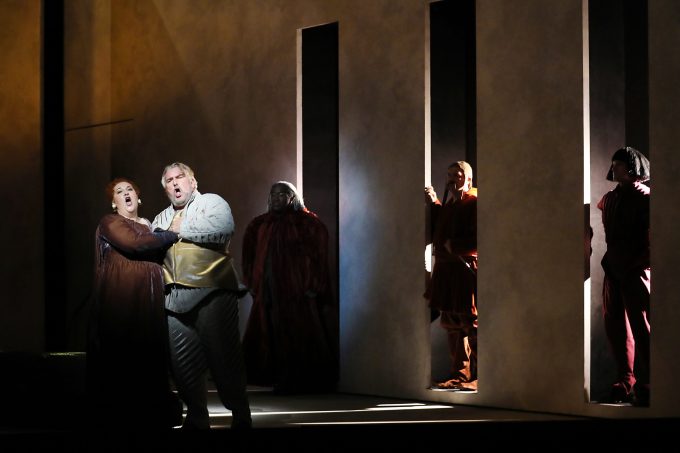
While the production is spare, the set works most effectively in Act 2, when the romantic leads are unable to resist one another.  Lighting Designer John Torres’ low illumination and striking shadows create a haunting atmosphere, as the lovers face gigantic shadows of each other on the walls.  The light behind the several sharply cut doorways produces a chiaroscuro effect, much like a Giorgio de Chirico painting.

Despite whatever discomforts may be associated with “Tristan and Isolde,” it endures as a monumental piece.  A production with this level of quality should be experienced by every opera lover.

“Tristan and Isolde,” with music and libretto by Richard Wagner is produced by Santa Fe Opera and plays at Santa Fe Opera House, 301 Opera Drive, Santa Fe, NM through August 23, 2022.

M. Butterfly – the Opera

Kangmin Justin Kim as Song Liling, Mark Stone as Rene Gallimard. All photos by Curtis Brown.

In the bizarre world of “fact is stranger than fiction,” few stories seem more unlikely than a two-decade long affair in which the man was unaware that the “woman” was in fact a man.  David Henry Hwang penned a multi award-winning play about this relationship, “M. Butterfly,” which premiered in 1988.  The play is based on true-life events, starting in the 1960s, of a French diplomat serving in China who fell in love with a Chinese opera singer who portrayed females on stage.  The diplomat assumed (we assume) that the artist was female.  Yet, at the time, all Chinese opera performers were male, so the big question is whether the diplomat really knew that his lover was male.

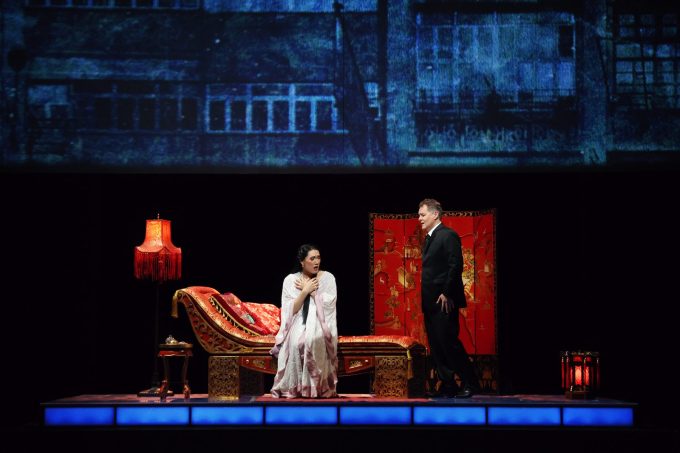
Since Hwang’s play centers on this opera singer, and since its title and some themes clearly pay tribute to Puccini, the extension of the play into an opera seemed almost inevitable.   Hwang had already written opera librettos, including “Dream of the Red Chamber,” also set in China.  Thus, taking the responsibility for the lyrics in “M. Butterfly” seemed natural, as did drafting Chinese-born composer Huang Ruo to write the music.  The opera premieres with a highly rewarding many-layered, many-faceted production commissioned by Santa Fe Opera.

Kangmin Justin Kim as Song Liling, Mark Stone as René Gallimard

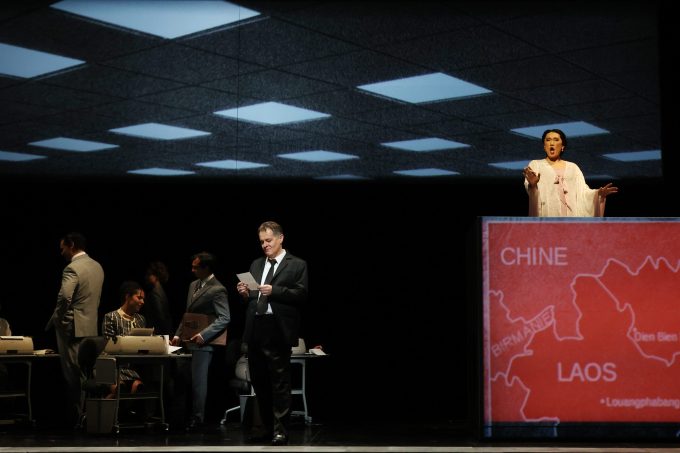
Action begins during China’s Cultural Revolution.  Life for Chinese is poor, austere, regimented, and threatening, as any violation could lead to being sent for re-education.  Intimacy with foreign devils, who are few, is taboo.  Expatriate life is also harsh given the lack of goods and services, and foreigner partiers in the opera even complain that Chinese food is better back home.

Against this backdrop, René Gallimard (a fictionalized name, as is that of his lover), serves as an accountant with the French foreign service.  Performed ably by Mark Stone, he is a drab, detail-oriented bureaucrat who believes that Asians submit to Europeans as being superior, which perhaps prompts his ability to make overtures to Song Liling after seeing her perform “Madama Butterfly.”  His fraternization with locals, work reliability, and lack of leadership qualities are noticed by the Ambassador, who eventually promotes him to Vice Consul, in a capacity where he can collect local intelligence.

Kangmin Justin Kim as Song Liling, Hongni Wu as Comrade Chin, and dancers.

Although consorting with the enemy is discouraged, Liling hopes that an association with a foreigner might open up new horizons for her (as Liling lives as a woman, her gender identity pronouns will be used).  Our first exposure to Liling is as she sings Puccini’s “Un bel di vedremo,” and Kangmin Justin Kim gives a stellar rendering of this beautiful aria.  Countertenors can seem harsh and forced, but Kim’s sensual vocal style has the warmth of a top-flight mezzosoprano which shows ideally in this opera.  Kim’s Liling will be a conniving mistress, but for understandable reasons.  Not only is China a harsh place to live, but homosexuality is illegal, and her very public presence makes her particularly vulnerable.

Hwang and Ruo’s flirtation with Puccini’s namesake follows many paths.  Arias and incidental music are borrowed, and this opera’s affecting “Humming Chorus” and other elements are pastiches of the same in “Madama Butterfly.”  But the driving force is the thematic likeness.  Cross-culturalism is confronted, and Pinkerton’s racist mistreatment of Cio-Cio San from the earlier opera is revisited.  Yet, in some regards, the primary deception is reversed, with the Asian misleading the Westerner.  In addition to the grounding in Puccini, the sexual confusion interlaces with butterfly themes recurrent in Chinese mythology, providing an intellectually rich and dramatically fulfilling narrative with a satisfying musical backdrop.

“M. Butterfly” is composed in the modern operatic style without the lush melodies and memorable arias of old.  Yet, it is fitting.  Western mode dominates Ruo’s score, but Asian motifs are also introduced.  Conventional western instruments comprise the orchestra, but when needed, Ruo extracts Asian ornamentation through use of 5-tone scales.

Mark Stone as René Gallimard, Kangmin Justin Kim as Song Liling.

The storyline goes well beyond the romance, as what made their relationship newsworthy was charges of espionage.  These two aspects balance well.  Scenes shift between Beijing and Paris; between private and public; and between the mid ’60s and early ’80s.  The visual depictions in Allen Moyer’s impressive and fast-moving scenic design utilize differing color combinations, moving sets, projections of newspaper stories; stark and lush looks; and settings as varied as formal parties and interrogations.  Director James Robinson’s overall vision is also enhanced by Seán Curran’s choreography in an Asian acrobatic style and Christopher Akerlind’s contrasting lighting.

Ultimately, the story concerns a broad and somewhat menacing intellectual issue that builds on the question of whether René really believes that Liling is a woman.  In the greater arena, it concerns denial of uncomfortable reality in favor of self-serving fantasy.  Cults, religions, and whole societies thrive on rejecting facts that don’t support their preferred world view. Unfortunately, these delusions result in poor decisions that not only destroy self, but promote bias and social decline. 

Conversations about race and gender identity, particularly among the socially liberal community, have transformed considerably since 1964 to the extent that some may ask the relevance of this story.  Not only does that argument miss the mark on artistic and socio-historic grounds (e.g., why attend “Tristan and Isolde,” “La Traviata,” and many more?), but it neglects the fact that cultural wars are very much with us.  Transgenders are still murdered for the simple reason of their being, and state legislatures actively pass egregiously discriminatory gender and gender-identity based laws.  Further, there are many countries that are far more benighted than ours.

Chorus and lead principals.

As a footnote, many performance enthusiasts probably assume, as I did, that the “M.” in “M. Butterfly” is simply a shortening of “Madama” in the title’s attempt to retain a connection to the Puccini opera.  However, fittingly in French, M. is the abbreviation for monsieur.

“M. Butterfly,” a world premiere, with libretto by David Henry Hwang and music by Huang Ruo is produced by Santa Fe Opera and plays at Santa Fe Opera House, 301 Opera Drive, Santa Fe, NM through August 24, 2022.

Carmen – opera by Bizet

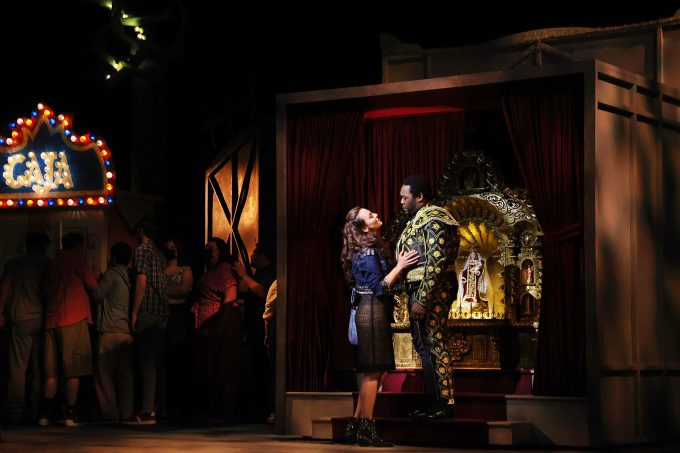
Michael Fabiano as Don José, Isabel Leonard as Carmen. All photos by Curtis Brown.

Georges Bizet’s “Carmen” ranks as a perennial favorite among both opera aficionados and novices.  There are many bases for its appeal, especially its distinctive score with much of it adapted from the folk music of Spain. Paradoxically, its music captures the sense of its locale as few other operas, but because of the proliferation of Spanish culture throughout Latin America and because the story deals with common people, productions often change the setting to other countries, other eras, and even to workers in different occupations.  The story is blessed with an exotic and seductive heroine; a suitor whose bad judgment leads him astray; and a love triangle resulting in inevitable tragedy.  Santa Fe Opera’s current production of this classic boasts a superb, world-class cast and a production full of eye candy.

Carmen’s independence and self confidence set her apart, and her fiery temperament bedevils her.  When arrested for fighting with a co-worker at the cigarette factory, she induces the infatuated soldier Don José to let her escape, for which he receives 30 days in detention.  With Carmen on the run and Don José disgraced, they join a band of smugglers. Their destinies become intertwined and tragedy becomes inevitable.

Men’s chorus as soldiers. Back wall of stage open.

Carmen’s unrestrained willfulness primes her descent. Her character is unsympathetic because she invites friction by constantly confronting peers, lovers, and authorities. Don José shows weakness by letting his hormones dominate his rationality.  The virtuous Michaëla who he grew up with clearly loves him, but he idolizes Carmen and abandons righteousness altogether.  Although it is hard to sympathize with weak characters, the audience remains engaged through the powerful music and the action.

In its original and traditional conceptualization, the opera is full of Andalusian character with the air of bullfighting, flamenco, and colorful costumes. In an interesting twist, this production sets the bullfighting-related sequences in a carnival atmosphere. Only Escamillo’s costume suggests the sport. But the clever staging and use of revolving sets provide a fresh look by depicting a nightclub in garish red; old-fashioned carnival backdrops framed by light bulbs; a roller coaster; and even Dia de los Muertos designs.

The most controversial treatment is the characterization of Carmen. Isabel Leonard is one of the finest mezzos of her era with a commanding stage presence, but the portrayal that she is directed to perform dilutes the intensity that makes Carmen a magnetic character. She is clad in drab clothes including blue jeans and sneakers, and she is played in a reflective manner with much of the scorching temperament suppressed. With the restrained demeanor, she is depicted more as a victim with much of the vigor sapped from her personality. As a result, Don José’s flaws appear more conspicuous, and indeed, he is hot-tempered, violent, and possessive, a profile that any feminist would revile.

Isabel Leonard as Carmen, Isla Burdette as Little Girl.

A creative lagniappe cut from whole cloth is the frequent appearance of a young girl who observes and dances and mimes. She is reminiscent of the interloping little female figure in Rembrandt’s “The Night Watch.” The young girl’s presence is welcomed but unexplained, though she can be interpreted as a symbol of lost innocence and most likely as Carmen in childhood.

Bizet’s score is studded with memorable arias and duets throughout, mostly reflecting the Spanish folk culture and setting. The connective music is also quite beautiful, though more French. Its creative harmonies differed from the standards of the day and contributed to its rough treatment by critics and audiences in its early showings.

The highlights begin with Don José and Micaëla’s “Parle-moi de ma mere” (Tell me about my mother). Michael Fabiano is Don José, and the artist possesses a powerful tenor voice with Italianate inflection that works well in this French language opera as well. Sylvia D’Eramo is Micaëla, and while she is usually played with diffidence and modesty, here she is more assertive, even kissing Don José on the lips when supposedly delivering affection from his mother. The soprano’s voice is similarly assertive, and her strong vibrato and power hold up well to Fabiano in her duets with him. And of course, the tenor’s voice fills the house like few can, and among other arias, he shows well on “La fleur que tu m’avais jetté.” (The flower that you have thrown to me).

Michael Fabiano as Don José, Sylvia D’Aramo as Michaëla.

As the title character, Isabel Leonard’s voice is well suited – a warm, throaty, and resonant melodiousness. She excels in all of Carmen’s famous arias like the Habañera “L’amour est un oiseau rebelle” (Love is a rebellious bird) and the equally memorable Seguidilla “Près des ramparts de Sévilla” (Near the walls of Seville).  However, while her vocal tone holds well in her duets with Fabiano, the pair is a little unbalanced as she does not have the volume to equal the tenor.

Other notable numbers abound for the leads, but the second principals deserve mention.  Michael Sumuel as Escamillo does a fine job with the Toreador Song, and Sylvia D’Eramo is captivating as Michaëla, especially in her prayer for courage “Je dis que rien ne m’epouvante” (I say that nothing frightens me) when she seeks Don José in the den of smugglers. The company’s choruses which are comprised of the company’s summer apprentices (a sad understatement for how talented these artists are) is strong as always, and Conductor Harry Bicket shows deft touch with the musical variety.

Isabel Leonard as Carmen, Michael Sumuel as Escamillo.

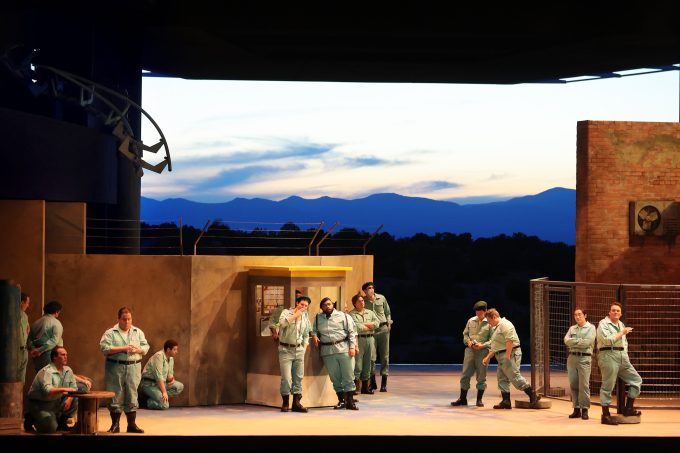
The overall feel of this Mariam Clément directed production is very strong.  As noted, many different looks are created by Scenic Designer Julia Hansen who manages the assets and limitations of the house well. She takes advantage of the opera house’s unique ability to drop the stage’s back wall to reveal the high desert mountain terrain before darkness sets in. Attending the Santa Fe Opera is a very special experience with its singular ambiance, and the city holds many delights. Every opera lover should make the pilgrimage.

“Carmen,” with music by Georges Bizet and libretto by Henri Meilhac and Ludovic Halévy is produced by Santa Fe Opera and plays at Santa Fe Opera House, 301 Opera Drive, Santa Fe, NM through August 27, 2022.

The Anarchy Quartet

Fred Pitts as King Stephen (de Blois), Catherine Luedtke as Matilde (Maude), Max Seijas as Adelin, Katherine Park as Eleanor of Aquitaine. Photo by Doug Despres.

Stress is visited upon all human beings, of great bearing and small.  The possible loss of face or possessions or relationships drives our concerns.  The difference for nobles who vied for hereditary thrones in days of old is that their stress routinely concerned the possible loss of life.  Monarchs as well as claimants and the presumed allies of both could fully trust no one.  Intrigue was constant, and life could end early and violently.  The many eras of contested claims to the monarchy were rife with threats to all those close to the sovereign.

Mid-Twelfth Century England was one such period of turmoil.  The triggering event leading to the instability was the infamous White Ship Disaster of 1120, in which a large number of nobles perished when the boat, carrying 300 passengers, sank after hitting a reef in the English Channel.  Included in that number was Adelin, the only legitimate son of King Henry I of England.  Thus, when the king died in 1135, the battle for his throne, the so-called Anarchy, began.  The victor was Henry’s nephew, Stephen de Blois, who would rule for 18 years after an invasion from France and a coup d’etat.

Playwright Stuart Bousel has taken this context to create a theatrical piece involving four of the principals of the period.  The characters and the events represented are historically accurate, but the play consists of the possible thoughts of the four subjects.  It is highly literate and will be of particular interest to those who are drawn to the history of the period.  But those without prior knowledge may find it difficult to follow because of the complexity of the relationships and how quickly they are rolled out (but this commentary will help!).

Extremely well acted with great conviction and animation by all, the principals do not interact.  Therefore, there is no real drama.  Each person is, in a sense a raconteur, with their own story to tell, which they deliver in scattered vignettes to the audience from their own assigned portion of the stage.  Curtis Overacre’s excellent lighting highlights each speaker in turn.  Many snippets are individually interesting, and distinctive personalities emerge that are well defined by the playwright and well exploited by the actors.  While there are concluding events in the true history, the play ends without closure or postscript, leaving a sense of incompleteness.

Although the notion of attributing insignificant events and concocted dialogue is part and parcel of historical fiction, the most fanciful aspect of “The Anarchy Quartet” is that the triggering figure, Adelin, is long dead and appears as a ghost.  Suitably portrayed as somewhat blasé and clever by Max Seijas, Adelin’s cavalier philosophy leads him to conclude that history is kinder to him than if he’d survived and become king.  As he died trying to save his half-sister, Matilda, he remains forever a hero, but if he’d been a mediocre king, he would have been long forgotten.

Adelin’s sister, Matilda (known as Maude, because her mother, half-sister, sister-in-law, and other noblewomen were also named Matilda) is played with imperiousness and sarcasm by Catherine Luedtke.  The excitable Maude had already been Empress of the Holy Roman Empire until the emperor died.  With the death of her beloved brother, she was anointed as heir by Henry I, but her forces were defeated by Stephen, whom she disdainfully refers to as “The Moustache.”

The action of the play occurs during Stephen’s reign.  Stephen is played as diffident and humorous by Fred Pitts.  One of the main causes of his self-effacing is the reason that he (literally) missed the boat and was not among the victims of the White Ship’s sinking.  But you have to see the play to find out the reason.

Finally, whereas Eleanor of Aquitaine harbors ambitions, she is the most gentle of the four, played with finesse and subtle humor by Katherine Park.  Eleanor’s leitmotif is patience, which she urges to her unborn as she rubs her pregnant belly.  Like Maude, who envies common people because they can look for love, Eleanor also values love and wishes she had a more normal upbringing that would have allowed non-political connections.

The play does not continue beyond Stephen’s reign, but without a surviving son, he agreed that Maude’s son would succeed him to the throne.  In 1154, that son would become Henry II, immortalized by Shakespeare and the movie “The Lion in Winter.”  He would take as a wife [drum roll] – Eleanor of Aquitaine, making Maude her mother-in-law.

These nobles were all significant personages in their time.  The narrative weaves back and forth among the principals and makes many connections among them.  Along the way, the playwright offers insights into the personalities and conflicts of this foursome.  Even though they held special places in their societies, perhaps the most significant representation is that they still faced many of the same issues as regular folk.  Through these characters, the play interestingly delves into the realms of chance, aspiration, power, relationships, forbearance, and more.

Despite the small venue at The Exit, the production has fine touches.  In addition to the notable lighting, Nick Trengove’s staging is simple, yet exquisite, blending aspects of nature and symbols of power and war.  The striking costumes are absolutely fitting (pun intended).  Trengove’s direction also deserves recognition, especially for the smoothness of all of the transitions of soliloquys from one speaker to the next.

“The Anarchy Quartet,” a world premiere written by Stuart Bousel, is presented by The Exit Theatre and appears on its stage at 156 Eddy Street, San Francisco, CA through August 20, 2022.

The Lion King

Gugwana Diamini as Rafiki. Photo by Joan Marcus.

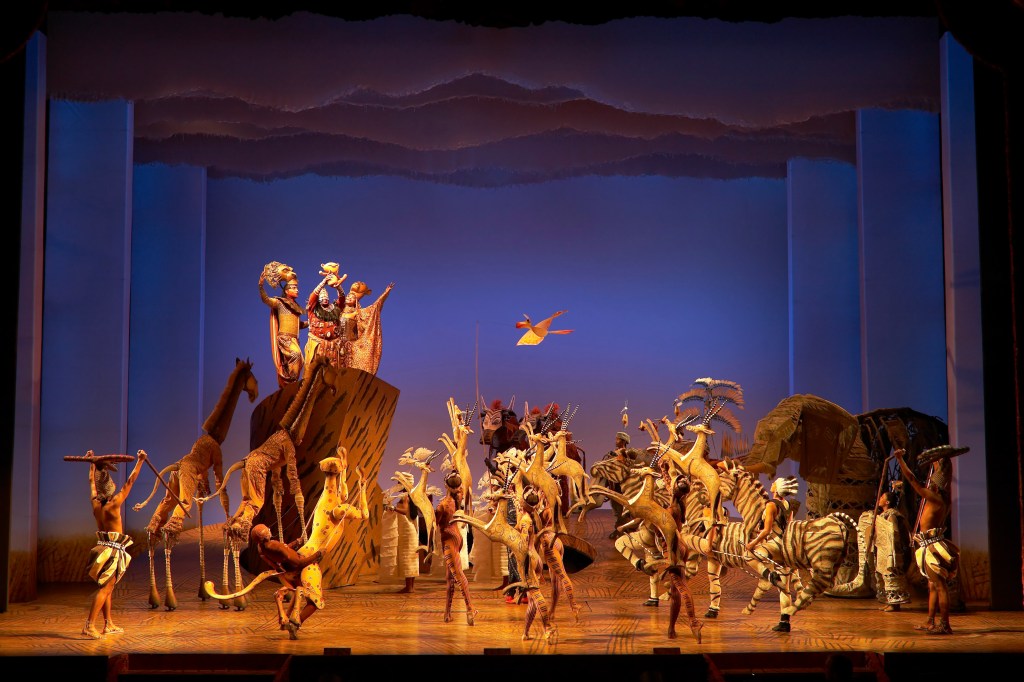
An old maxim notes that it’s best to begin at the beginning.  In the case of “The Lion King,” its beginning may be the best received by an audience ever.  The character Rafiki, a mandrill, sings the goosebump-producing “Circle of Life / Nants Ingonyama” that introduces African voice, thought, music, motion, and rhythm.  Meanwhile, the parade of absolutely stunning human-puppets-as-animals walks the aisles and fills the stage, becoming the most remarkable anthropomorphic array imaginable.  At the opening number’s end, the applause at this performance was deafening.

“The Lion King” is one of the most honored and awarded Broadway musicals of all time.  Despite the disruption of the Covid-19 pandemic, it is the biggest grossing ever.  Playing in San Jose on its third national tour, it largely replicates the Broadway production, topping the charts on every dimension – scenic; music and sound; choreography and movement; story line; and performance.

Circle of Life. Photo by Brinkhoff-Mogenburg.

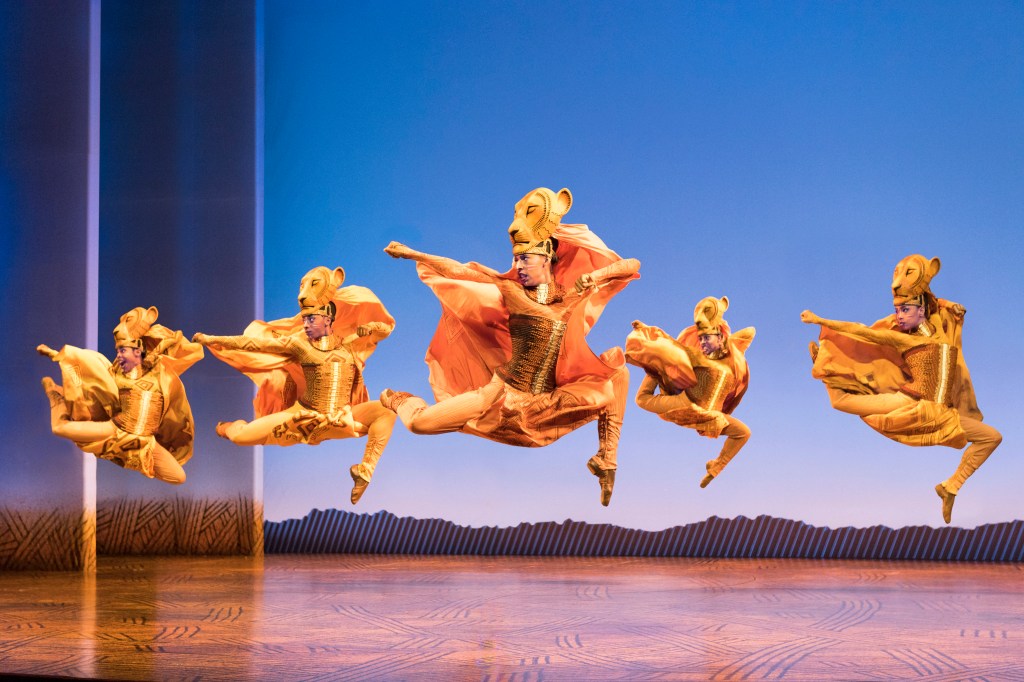
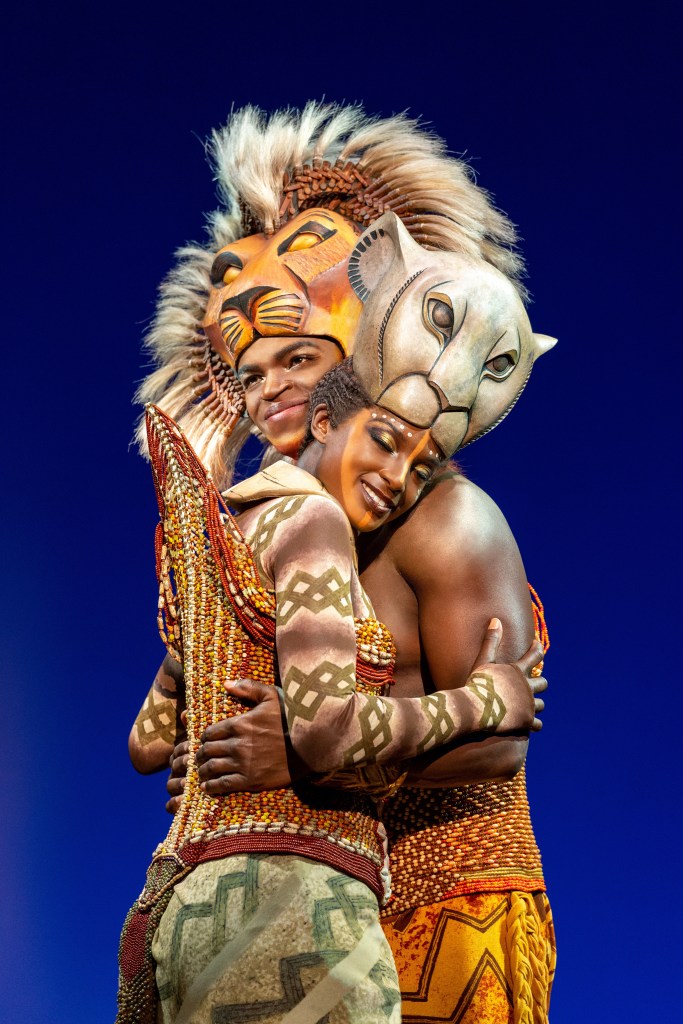
But if there is one incomparable distinction, that goes to the fantastic costumes.  Director and Costume Designer Julie Taymor rightfully won Tonys and most every other grantor’s awards in both categories.  In the distinctive style used for most of the animals (lions mostly excepted), the human puppet’s body apparel suggests the animal, but the performer’s face is exposed, while the caricatured animal’s face is suspended on a tether above and in front of the performer’s, allowing the viewer to sense both the actor and the animal character.  The precise movements by each animal also distinguish and amuse – the elongated stretching of the cheetah; the bugged eyes and dangling tongue of the lasciviously ravenous hyenas; the clacking beak of the hornbill; and the particular shifting of the heads of the lions when they communicate.

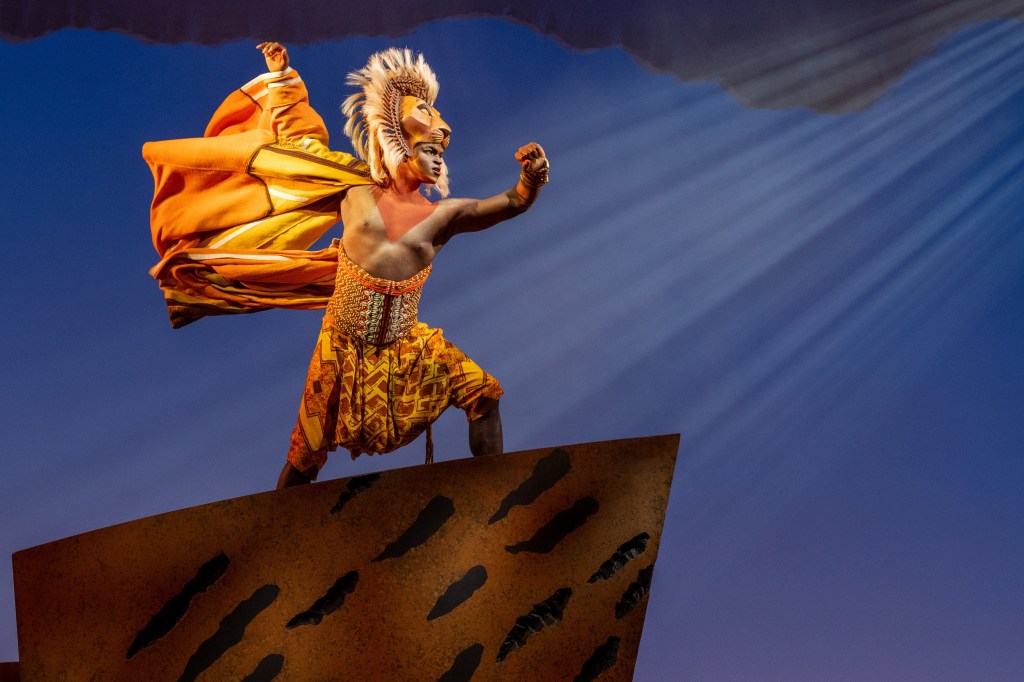
Darian Sanders as Simba. Photo by Deen van Meer.

The plot is one that appeals to adults and children as well.  King of the lions, Mufasa, is killed under confusing circumstances, and his only son Simba feels the responsibility for the death.  Instead of facing his people, he escapes to the jungle.  Only when Simba becomes a young man does he return to confront his demons and his uncle, Scar, who unrightfully ascended to the throne.

The narrative works particularly well, because of the moral issues it contains.  Musically, the show opens and closes on the same theme, the circle of life, on how we can never have or do everything that we wish, but we can find a place that can leads us to fulfillment.  It is also about the cycle of life – of the inevitability of death and of regeneration.  When Simba cries that his father is gone, he is told to look into the water. It is through that reflection that he realizes that his father lives on in him.  It is also about courage, loyalty, love, environmentalism, and a need for balance in the world, which makes room for animal predator and prey.

Lionesses Dance. Photo by Deen van Meer.

In contrast to what could be considered preachiness in treating with moral issues, plenty of humor lightens the mood.  One of Simba’s buddies in the jungle is Pumbaa, the warthog, who suffers from chronic flatulence.  There are numerous jokes about “gas” that kids find funny – and maybe adults as well.  Even the villain, Scar, provides humor.  Effete, obnoxious, and sarcastic, he becomes a laughable character.

Of course, the music can’t be ignored.  The use of African lyrics and tunes and the pounding of batteries of large drums add locational feel, while many songs drive the plot forward.  Finally, the most memorable piece from the show speaks both to the romance of Simba with Nala and to greater realms – “Can You Feel the Love Tonight?”

Darian Sanders as Simba, Kayla Cyphers as Nala. Photo by Deen van Meer.

“The Lion King,” with music and lyrics primarily by Elton John & Tim Rice and book by Roger Allers & Irene Mecchi, is presented by Broadway San Jose and plays at San Jose Center for the Performing Arts, 255 South Almaden Blvd., San Jose, CA through August 21, 2022.
Coraline

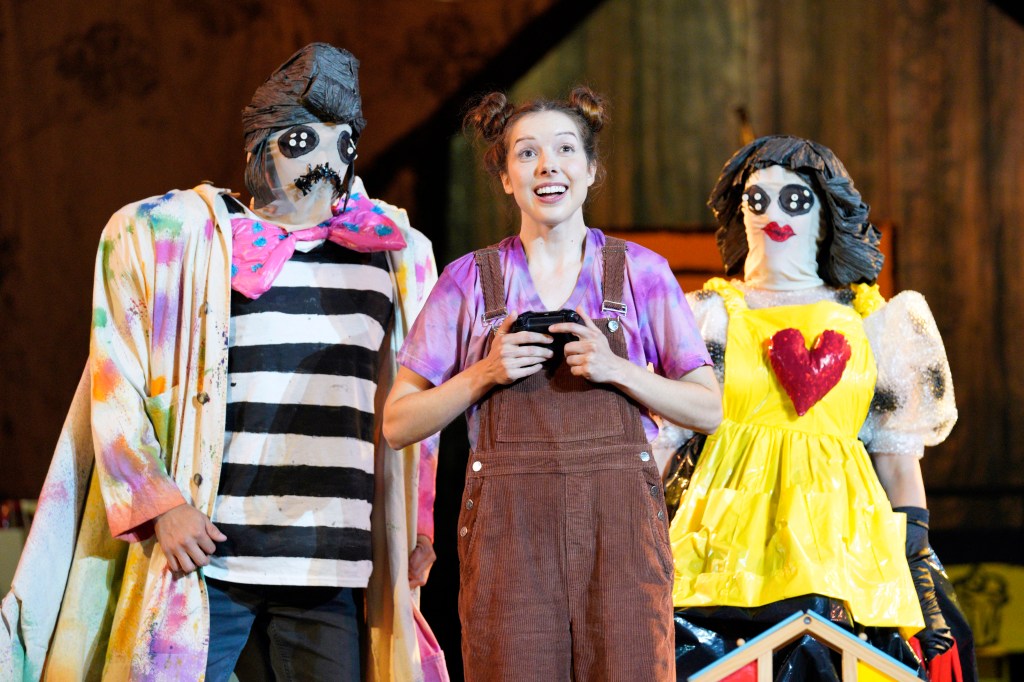
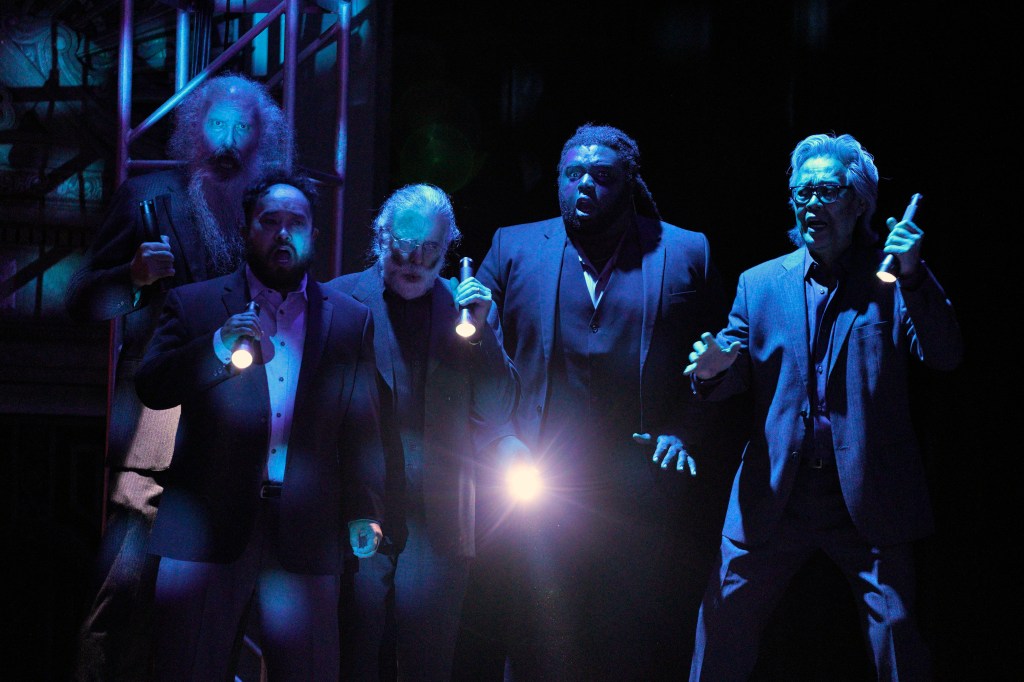
The Other House. All photos by Cory Weaver.

Along with her parents, 11-year-old Coraline has moved to a new home, and she faces going to a new school.  She hates the healthy, but gloppy, soup that her father routinely makes for lunch.  She’s bored because it’s raining, and she’s not allowed outdoors when she’d like to explore the garden.  What’s more, the neighbors are weird and call her Caroline, much to her displeasure.  Of course, she’s annoyed, petulant, and implacable.  Like many children, she showers the blame on her parents.

In time, Coraline passes through a special door that acts as a devise like the rabbit hole in “Alice in Wonderland” or the tornado in “The Wizard of Oz.”  She enters an alternate world, a house that is identical to her real house, but with parents who accede to her every wish and tell her how much they love her, unlike her real parents, they say.

Kendra Bloom as Coraline, Efrain Solis as Father.

Based on the award-winning 2002 novella by Neil Gaiman, composer Mark-Anthony Turnage and librettist Rory Mullarky have crafted an opera that mirrors the creepiness of the novella and the animated film of the same name.  West Edge Opera offers superb voices and orchestra, fine staging, and clever, fanciful costumes in a scintillating production of this enticing work.

The success of this opera hinges on the performance of Coraline, whose role dominates.  Although one might expect the part to go to a lyric soprano, Kendra Broom is a mezzo with considerable dramatic vocal cred that fits the part completely, as tension dominates the girl’s experience.  Broom’s voice penetrates the venue with clarity and accuracy.  Having the look of an ingenue and gesticulating with a child’s mannerisms, she embodies the character extremely well.

Stephanie Sanchez as Mother.

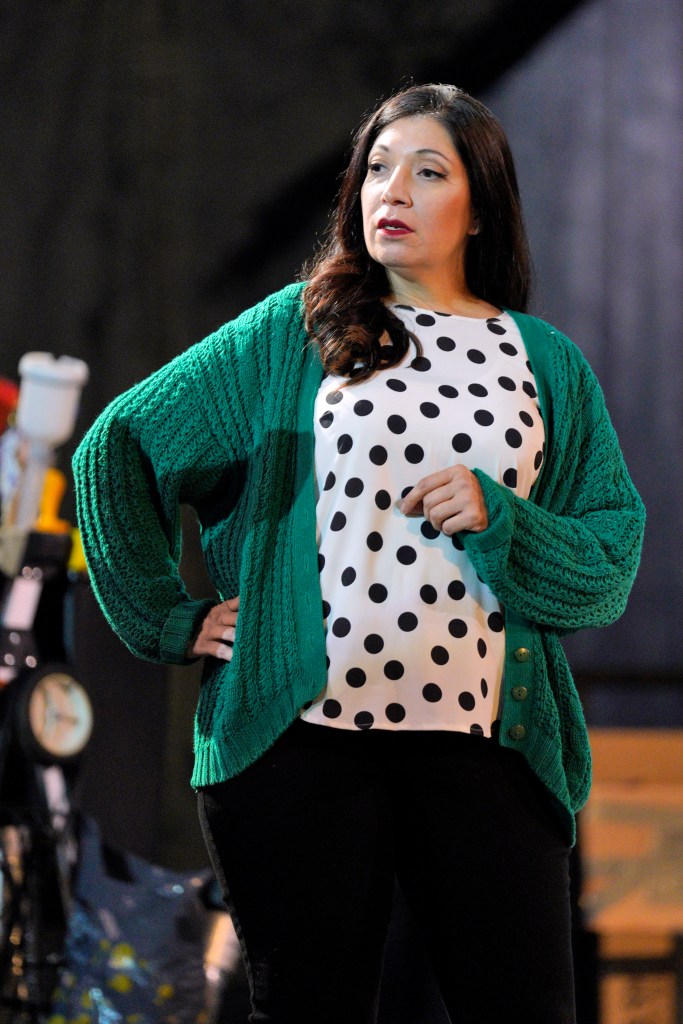
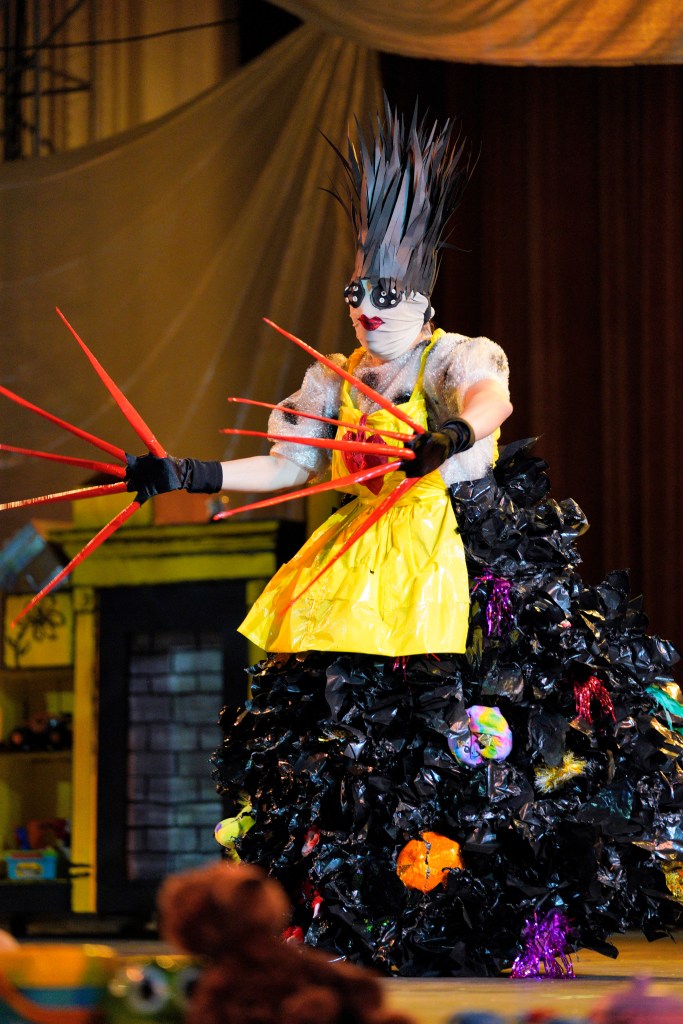
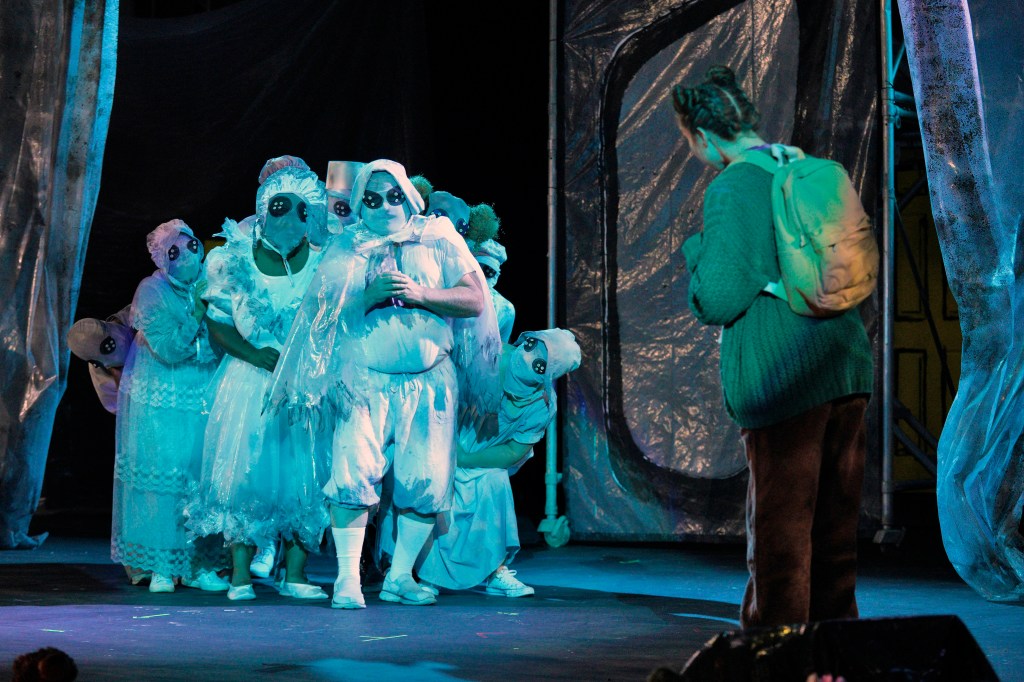
In Coraline’s real world, Stephanie Sanchez as Mother is involved with her but strict.  Efrain Solis as Father is charming but absorbed with his work as an inventor.  Both artists are gifted as singers and actors.  When Coraline moves into the alternate world, the same performers take on the roles of Other Mother and Other Father, but their faces appear like ragdolls with buttons for eyes.  Other Mother tells Coraline that she can always have anything she wants, and the only exchange is that she must allow her eyes to be replaced by buttons.

Stephanie Sanchez as Other Mother.

Much of the thematic material concerns children’s values and perceptions of the world around them.  Children’s appraisals of their parents can be harsh.  But when Coraline realizes that the price of living with the Other Parents is giving up her eyes, she begins to grasp that the grass is not always greener on the other side and initiates action to extricate herself from their grip.

Another moral in the opera that would inform Coraline’s own bravery is a story that she tells about Father.  When the two of them were attacked by wasps, Father shepherded Coraline to safety.  Despite suffering 39 wasp bites, he returned to the swarm to retrieve the eyeglasses he had dropped.  Although Coraline was impressed with his bravery in protecting her, he noted that he wasn’t brave then as he did what he had to do.  He was brave in returning for the glasses, despite the threat, as that involved a conscious decision.  The message is that bravery cannot exist without fear.

Jazmine Olwalia as Miss Forcible, Krista Wigle as Miss Spink.

But Gaiman’s symbolism is not accidental and plumbs darker territory.  Other Mother’s pandering to Coraline’s wants; her manipulation of Coraline’s perceptions; and the condition of removing her eyes point to the sinister practice of mind control that is fundamental to cultism.  This motif occurs throughout Coraline’s time spent in the other world and is amplified by her meeting the Ghost Children who have been abducted by Other Mother.

Turnage’s music is in the modern idiom, but largely tonal, especially the instrumental portion conducted by John Kennedy.  The orchestral balance gives wind instruments more favor than many operas, which provides a sharper tone.  There are occasional unexpected turns in style with shifts in rhythm, but that is in keeping with changing situations and characters that Coraline meets.

Efrain Solis as Other Father, Kendra Broom as Coraline, Stephanie Sanchez as Other Mother.

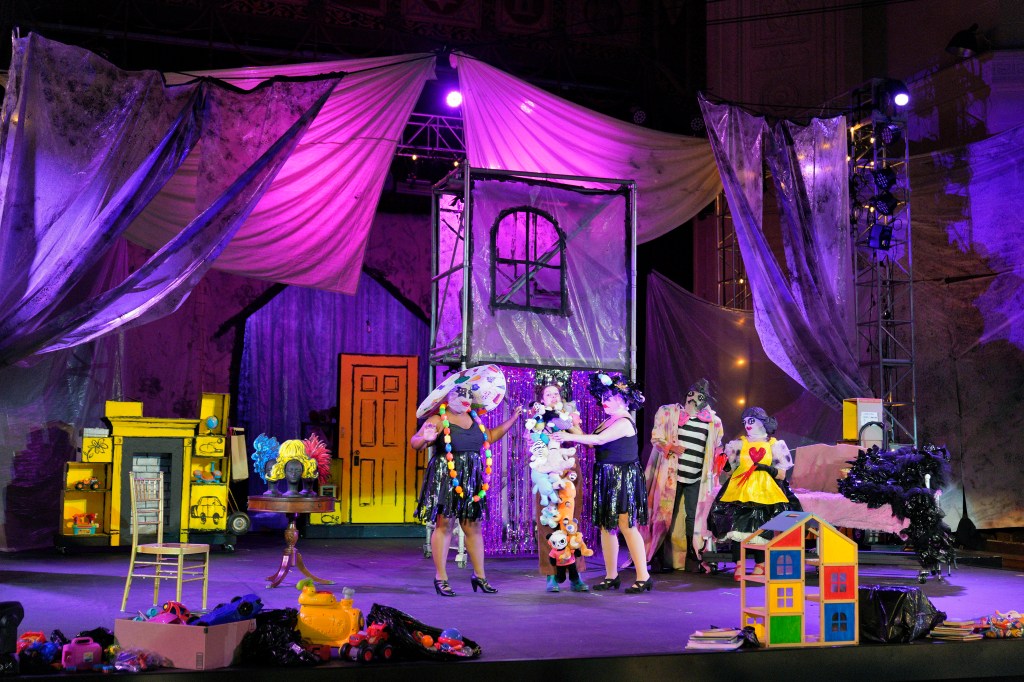
The opera is enhanced considerably by the visual elements in the production coordinated by Director Tara Branham.  Jefferson Ridenour’s set mixes prosaic packing boxes with large hanging sheets of plastic and eye-catching props such as colorful teddy bears.  A door that can spin on wheels is used to facilitate looking into the real versus alternate house spaces, but sometimes it is not immediately clear which side the players are in.

While Christine Crook’s costumes in the real world are distinctive and appropriate, they sizzle in the other world with bright colors and unusual textures.  Combined with Ridenour’s set, the overall look of the other world is a kaleidoscopic phantasmagoria. Each character’s face is completely covered in gauzy material with comic-book facial features attached.  As a result, the audience does not see the facial movement of the singing being produced.  The outcome may seem a little disconcerting, but it absolutely adds to the menacing ambiance intended.

Ghost Children, Kendra Broom as Coraline.

“Coraline” is the American premiere of the opera composed by Mark-Anthony Turnage, with libretto by Rory Mullarky, based on the novella by Neil Gaiman, produced by West Edge Opera, and plays at Scottish Rite Center, 1547 Lakeside Drive, Oakland, CA through August 7, 2022.

Ariane & Bluebeard

Philip Skinner as Bluebeard,
Renée Rapier as Ariane. All photos by Cory Weaver.

Frenchman Paul Dukas’ 1907 opera “Ariane & Bluebeard” possesses compelling music and a libretto rich with symbolism and open to varied interpretation.  Although advocates for the opera included many prominent composers of the day, its success was limited from the outset, and it has failed to find a place in the repertory.  Plausible explanations exist.  One is that it was drowned out during its infancy by two operas that competed in a similar space from more eminent composers.   Like Debussy’s “Pelléas and Mélisande” from 1902, it used a Maurice Maeterlinck libretto that was also based on one of his plays.  Bartók’s “Bluebeard’s Castle” in 1911 was based on the same primary inspiration as Dukas’, “Le Barbe bleu” by Charles Perrault.  Another explanation is that Dukas being partly Jewish, discrimination played a role.  In subsequent times, the argument is that artistic directors’ comfort levels inhibit taking risks on less familiar properties.  Happily, West Edge Opera does not fall in that category, and it presents a scintillating interpretation of the highly worthy “Ariane & Bluebeard.”

Sarah Couden as Nurse,
Renée Rapier as Ariane.

Librettist Maeterlinck was associated with the Symbolist literary movement that confronted the prevailing naturalism with message-associated allegory. The many symbolic representations in this work begin with the music which is robust from the opening note and softens over the course of the opera.  In the story, Bluebeard has had five wives.  The presumption is that he has killed them all, but he has actually imprisoned them in a windowless cellar.  This darkness is represented by the loud, harsh music which ultimately turns to light as the women are released from their imprisonment.

Accordingly, the early part of the opera also contains an uncommonly low tessitura delivered by only three principal voices.  The extremely dominant and hugely demanding role throughout is that of Ariane, portrayed by mezzo Renée Rapier, whose voice is exquisite with a great deal of singing in the lower range.  The other major, flawless, and low range vocal contribution is from Nurse, sung by contralto Sara Couden.  Title character Bluebeard has a great deal of stage time to display his vanity, his dominance, and perhaps his insecurity, yet his singing role is very small.  However, when called upon for a bottom range baritone vocalization, Philip Skinner delivers.  Each of these three are magnificent, and similar attributes can be applied to all three.  How many times can you say deep, warm, resonant, powerful voice?

Renée Rapier as Ariane (center), Alexa Anderson as Mélisande, Sharon Shao as Alladine, Silvie Jensen as Sélysette (top). Candace Johnson as Ygraine, Taylor See as Bellangère, Sarah Couden as Nurse (bottom).

Despite warnings, Ariane becomes Bluebeard’s sixth wife.  He bequeaths her seven door keys to rooms that hold his treasures.  She may use the six that are silver but not the one that is gold.  Unlike previous wives, Ariane has no interest in the silver keys, but Nurse uses them to reveal rooms full of glorious gems – sapphires in one, rubies in another, and so on.  Only the last elicits any reaction from Ariane with her aria “O mes clairs diamants!”  (“Oh, my clear diamonds!”).  Such a sequence could prove visually dramatic, even using projections.  Sadly, the colorful display that would be revealed by an outpourings from a wall of doors is invisible (except figurative projections of diamonds).  This vision is left to the imagination of the viewer in this production.

The diamond vault reveals the door that can be opened by the gold key, which leads Ariane to the dark chamber that houses the former wives.  This courageous action is analogous to the Expulsion from the Garden of Eden story from the Bible.  Like Eve, Ariane is forbidden only one thing, yet that is the one that she yearns for.  The traditional interpretation of the Biblical tale is that Eve yielded to temptation, but like Ariane, the willingness to defy the restriction represents self-actualization and the pursuit of learning and independence.  Happiness and fulfillment cannot be given, as by the six silver keys, but must be taken, as by the gold key – or by the forbidden fruit.  Without the defiance of the stricture, Ariane would have no way to open the world to the wives, as Eve would have no way to give Adam and herself, as well as the humanity that followed, a meaningful reason to live.

Richard Mix and Joachim Luis (Chorus), Douglas Mandell as 2nd Peasant, Wilford Kelly as 3rd Peasant, Chung-Wai Soong as Old Peasant.

Even before the wives come into view, Ariane and Nurse are greeted by the strains of their anxious ensemble “Les cinq filles d’Orlamonde,” (“The five maidens from Orlamonde”) which begins the lighter overall musical tone, as most of the wives are sung by sopranos. The wives have not attempted to escape, as their fear has led to inaction.  Bluebeard has forced Ariane to join the wives, but her determination will lead them to the light.  Ariane is not only concerned with challenging patriarchy and liberating the wives but in liberating Bluebeard from his impediments as well.  The malaise of the wives and the eventual reconciliation with Bluebeard reflect the condition of minorities and women in societies who are subject to discrimination. Majority populations often fail to realize that lifting the underprivileged, or allowing them to lift themselves, results not only their betterment, but the betterment of all of society.

“Ariane & Bluebeard” possesses a compact narrative and melodious music that are lifted by outstanding voices.  Expansive blocking, which uses all of the stage and more, includes a chase scene on foot that extends into the lower gallery of the house.  One clumsy aspect of the production is the use of the same core staircase as in “Julius Caesar” but with different decorative framing.  While it offers a smooth egress in the other opera, players in this one unceremoniously stagger up and down the structure, even stumbling.  A clever aspect of the staircase is that it disassembles into pieces that characters lounge upon.

Renée Rapier as Ariane, Silvie Jensen as Sélysette, Alexa Anderson as Mélisande, Sarah Couden as Nurse (back and above), Sharon Shao as Alladine, Philip Skinner as Bluebeard, Candace Johnson as Ygraine, Taylor See as Bellangère (front).

The Jonathan Khuner conducted orchestra provides a full, clean sound for Dukas’ music. Together with the other elements, the result is a totally enjoyable experience.

“Ariane & Bluebeard” composed by Paul Dukas, with libretto by Maurice Maeterlinck as adapted from his play which draws from the literary tale ” Le Barbe bleu” by Charles Perrault is produced by West Edge Opera and plays at Scottish Rite Center, 1547 Lakeside Drive, Oakland, CA through August 6, 2022.

Julius Caesar (Giulio Cesare in Egitto)

Shawnette Sulker as Cleopatra, Aryeh Nussbaum Cohen as Julius Caesar. All photos by Cory Weaver.

Although Julius Caesar ranks high as a memorable political and military figure in history, he is probably most remembered for Shakespeare’s creative reenactment of his brutal assassination than for his accomplishments.  Handel’s 1724 opera masterpiece “Julius Caesar,” dealing with Caesar’s victories in Egypt in 48-47 B.C.E. shortly before his return to Rome and death in 44 B.C.E., may be considered a prequel to the theatrical masterpiece.   And while two great leaders die in the process of the opera, Caesar is not one of them.  West Edge Opera’s production presents a cast of superb vocalists; a wonderful supporting orchestra conducted by Christine Brandes; surprisingly interesting choreography; and visual power through simplicity.

Their production of “Giulio Cesare in Egitto” (being the Italian title) marks the peripatetic company’s inauguration of their new home for the 2022 festival season, the Grand Auditorium of The Scottish Rite Center in Oakland.  Unlike some of their repurposed past venues, this one is designed for performance, with proper acoustics; is physically stunning, including a production-appropriate classic colonnade on the circumference of the high walls; and possesses permanent seats with perfect sight lines in sloped rows (which WEO habitués will appreciate!).

Glenn Healy as Curio, Aryeh Nussbaum Cohen as Julius Caesar.

Quest for power drives the plot.  Members of the informal First Triumvirate, Caesar and Pompey, vowed to share power.  Betrayed, Caesar led an army to Egypt to defeat Pompey.  However, the latter was killed by Ptolemy, who, with his sister Cleopatra, ruled Egypt as a puppet state of Rome.  Despite his conflict with Pompey, Caesar was devastated by the wanton murder.  Meanwhile, Ptolemy tries to eliminate Cleopatra, as she and Caesar fall in love.  Both lovers vow vengeance, but their claims are superseded by Pompey’s widow Cornelia and son Sesto.

Opening night performance did not begin auspiciously as it seemed that some performers’ voices were underpowered for the size of the house, but it turned out that they were just not warmed up.  In due time, all were fully audible and mostly in good voice, mastering the heavily decorated Baroque trill associated with music of the time.  This opera presents modern casting challenges as two of the major roles were written for castratos.  If males are used in those parts, countertenors are the modern-day substitute, but they are a rarity, and it is fortunate that WEO was able to attract Aryeh Nussbaum Cohen as Caesar and Cenk Karaferya for Ptolemy.  Cohen showed well on the hunting aria “Va tacito,” which is also significant for the prominence of the French horn.  Handel was one of the first opera composers to use horns in the orchestra, and the solo by the brass instrument in this aria is believed to be the first in all of opera.

Shawnette Sulker as Cleopatra, Jasmine Johnson as Nirena.

Other highlights include two duets, each showcasing two voices in beautiful contrast.  Caesar and Cleopatra share a set piece toward the finale.  Soprano Shawnette Sulker as Cleopatra dazzles here (and throughout, especially her Act 2 aria).  The other duet pairs Cornelia and Sesto in “Son nata a largrimar.”  Mezzo Katherine Pracht sings Cornelia, while mezzo Sarah Coit, in a trousers role, portrays Sesto.  While all of the principals were well received by the audience, the mellifluous and clarion Coit received the biggest support.

Director Mark Streshinsky’s instincts for the look of the production work wonderfully.  Scenic Designer Liliana Duque Piñero’s fixed set comprises of one fixture – a large, fanciful, angular staircase structure that narrows as it rises.  Otherwise, props and moveable furniture, such as a bed, luminarias, and potted plants, decorate the stage as needed.  The spareness works particularly well for the period of the action, like a Greek drama that is set in ancient times.  Ron S. McCan’s mostly contemporary, mostly black costumery and Pamila Gray’s highly variable lighting fill out the appearance of the staging.

Katherine Pracht as Cornelia (above), Sarah Coit as Sesto.

Choreographer Marcos Vedoveto offers two striking ensemble dance numbers.  One near the finale is a nicely designed and executed conventional ensemble.  For moves, think the Bangles song and dance “Walk Like an Egyptian” or Steve Martin’s parody on Saturday Night Live.  The other number occurs on a darkened stage in which four dancers surround the love bed of Caesar and Cleopatra.  The dancers wear see-thru capes with several strings of small light bulbs, perhaps symbolizing stars, that emanate from the necks of the garments.  The modern dance moves with the light arrays create a captivating scene.

Cenk Karaferya as Ptolemy (front).

One decision will displease a fair portion of the audience.  As a result of the characterization of Ptolemy as a flamboyant bisexual (I think) with a boy toy entourage, there is a good deal of low brow humor.  Surtitles use modern jargon including references to people as assholes and worse.  Truly, this opera can be slow and repetitive in parts with frequent da capo set pieces (having an A-B-A song structure), so a little spice doesn’t hurt.  The problem is that farcical humor becomes hard to contain to the places it is intended.  Some in the audience become conditioned to laugh and do so at the wrong times, which can break the spell for those who are focused on the drama.

Katherine Pracht as Cornelia, Michael Parham as Achilla.

This opera is one of the finest from the Baroque era, with excellent music, fine characterizations, and meaningful conflict in the context of historically significant events.  As expected, West Edge Opera provides a professional quality production.

“Julius Caesar” (“Giulio Cesare in Egitto”) with music by George Frideric Handel and libretto by Nicola Francesco Haym is produced by West Edge Opera and plays at The Scottish Rite Center, 1547 Lakeside Drive, Oakland, CA through August 4, 2022.

Follies

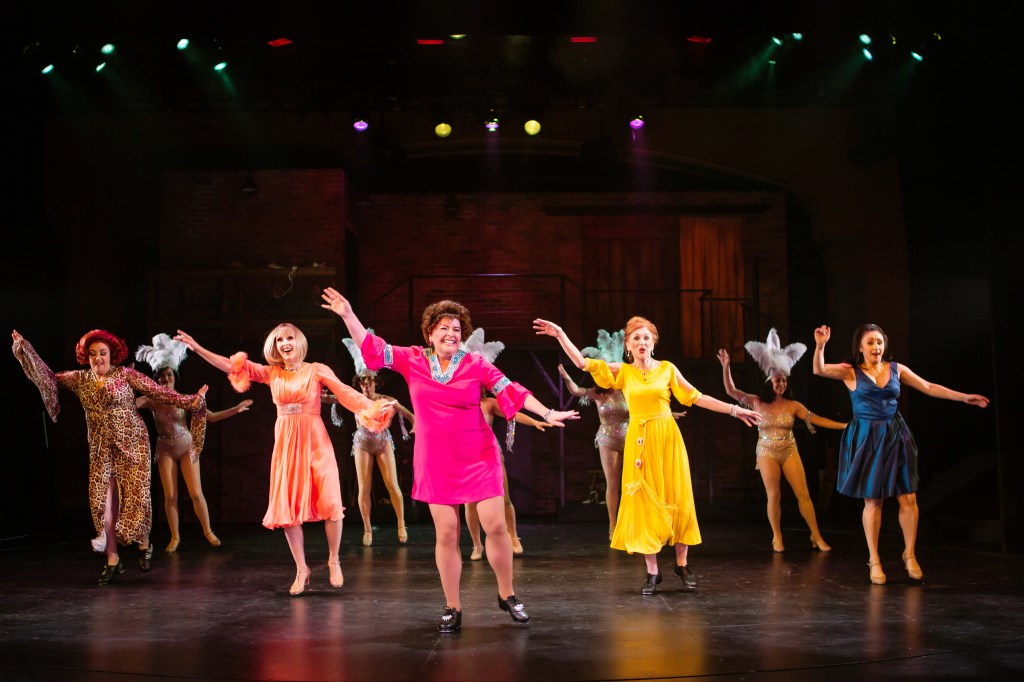
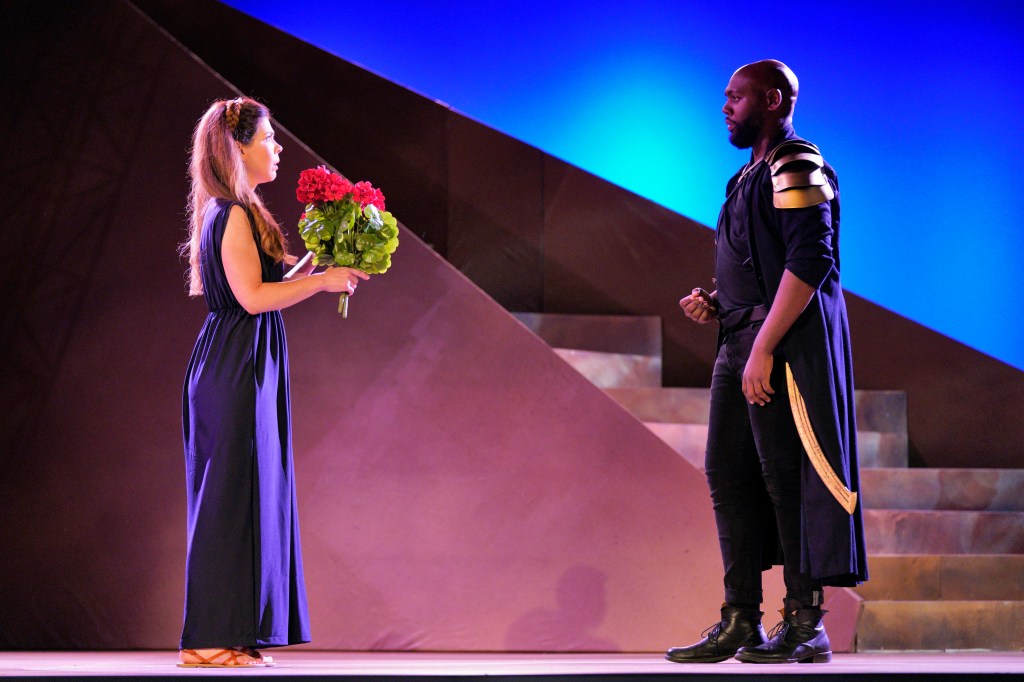
Carlotta (Cindy Goldfield), Solange (Jill Slyter), Stella (Caroline Louise Altman), Phyllis (Maureen McVerry), and Sally (Natascia Diaz). All photos by Jessica Palopoli.

Reunions promise joyous revelry with nostalgia for days of old; reestablished contacts with friends from the past; and the memories of younger ages.  Yet the froth belies a potentially dark underbelly.  Some of the revelers will seem as vital as in their youth, but others will have aged before their time.  Some will have succeeded in life by whatever measures, while others will have failed.  And though many friendships will be rekindled, historic clashes and other unpleasantries may re-emerge.

After some success as a lyricist, as well as writing the music for “A Funny Thing Happened on the Way to the Forum,” Stephen Sondheim decided to undertake only projects in which he would write music and lyrics.  The works that followed in the early Sondheim musical style received massive Tony Award recognition – “Company” (1970), “Follies” (1971), and “A Little Night Music” (1973).  The lavish and expensive-to-produce “Follies” earned 11 Tony nominations and won seven, but was a box office disappointment with barely 500 performances on Broadway.  Yet, the show became a classic.  San Francisco Playhouse has taken on the challenge of producing this massive and demanding project.  The result is a worthy rendition of a great American musical.

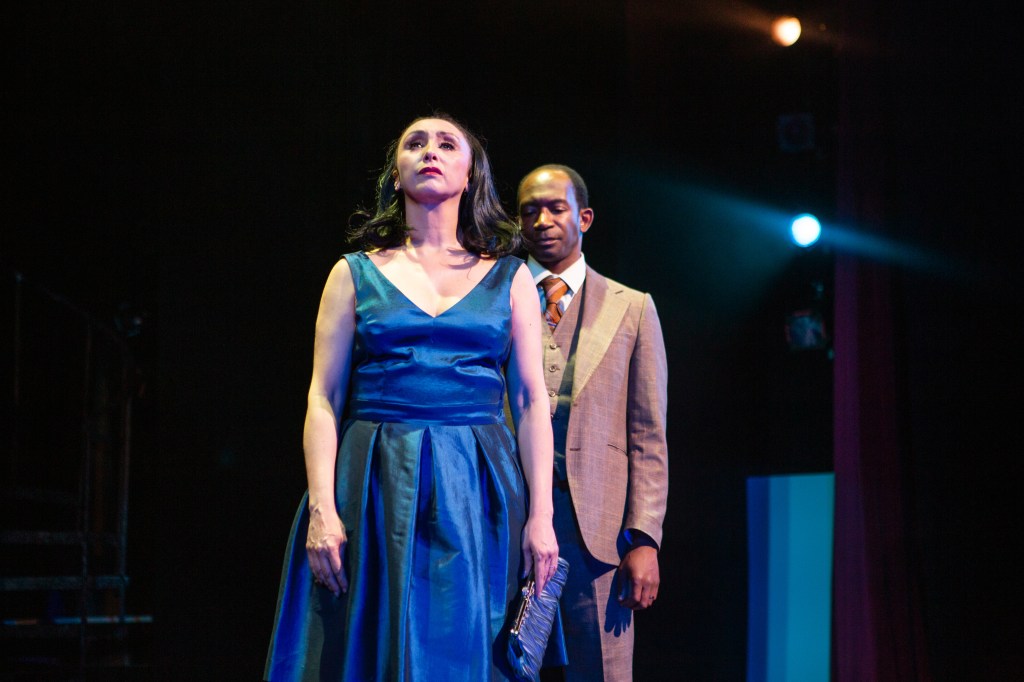
Sally Plummer (Natascia Diaz), Buddy Plummer (Anthony Rollins-Mullens).

Clearly mimicking the Ziegfield Follies, the reunion is of Weismann Girls and their spouses, some three to four decades after their glory.  In this metatheatrical play, the event takes them back to the theater in which they performed.  Now crumbling and slated for demolition, the setting symbolizes the marital relationships of the two central couples in the narrative, both of which are on the brink of collapse.

Ben became a successful politico in Washington, but his childless wife, Phyllis, has become disillusioned and sarcastic.  Buddy, an oil equipment salesman in Phoenix, had been Ben’s good friend.  Sally, his somewhat neurotic wife, has driven Buddy into affairs largely because of her dissatisfaction with her station in life.  Meanwhile, after all these years apart, Sally still carries a flame for Ben which threatens to ignite at the reunion.

Benjamin Stone (Chris Vettel) and Phyllis Stone (Maureen McVerry).

An affecting flashback device in the play involves younger versions of the four main characters often appearing on stage to re-enact the past, highlighting the passions and mistakes of the young.  The actors playing the youthful parts in this production match the present-day actors nicely, so the conceit generally works very well.  There are complications, however, particularly when characters from different time periods interact.

Apart from the intimate and often contentious exchanges involving the two couples, a completely different, mostly bubbly and upbeat vibe takes place in scenes with the other party goers.  Sondheim created a large number of secondary roles.  Indeed, several highlight songs are sung ably by various supporting players in this cast.  A number of these numbers are pastiches of music from the earlier era including memorable songs like the bouncy “Broadway Baby” (Hattie); the Valentine to a city “Ah, Paris” (Solange); and the wistful “Who’s That Woman?” (Stella), as well as the show-stopping survival anthem “I’m Still Here” (Carlotta).  But the climactic crux of the show is delivered by Phyllis with the thoughtful discourse on dividing lives with divorce, “Could I Leave You?”  Guess!

Carlotta (Cindy Goldfield), Solange (Jill Slyter), Dimitri Weismann (Louis Parnell), Theodore Whitman (Rene Collins), Emily Whitman (Eiko Yamamoto).

Choreographer Nicole Helfer’s numerous arrangements add to the lighter side of the action.  Perhaps the most lively piece in the play is the stage-filling dance tied to “Who’s That Woman? (Mirror, Mirror).”  Five of the Follies alums are joined by an equal number of sequined and feathered “Ghosts of the Follies Past” for a ten-women tap number that is vigorous and highly entertaining.

It is still curious that “Follies” didn’t register with audiences at the outset, as it is extremely literate and innovative with a lively score full of memorable songs.  However, the narrative presents several hurdles that could cause the audience to shy.  In particular, each main character is despondent for a different reason, and it’s hard to root for any of them.  The counterbalance of the cheerier party sequences involves many characters which confuse and give the play a bit of a split personality.  Finally, when it seems that the show should be about over, there is a sequence of four scenes.  Each is a “folly” for a lead character in the manner of a Weismann Follies skit that seems inorganic.

Young Ben (Cameron La Brie), Young Phyllis (Danielle Cheiken), Young Buddy (Chachi Delgado), Young Sally (Samantha Rose Cárdenas).

Director Bill English does a fine job in pulling the pieces of this production together with over 40 performers and production techs, including five stage managers – not to mention the additional creative team.  English and co-designer Heather Kenyon’s front-stage and back-stage sets is another great asset to the show.  At opening, performances and voices were a little variable in much of Act 1 but were largely redeemed by Act 2.  Similarly, the orchestra lacked proper tuning when it was on its own for the overture, but that defect was not noticeable when the instruments accompanied singing.  Taken as a whole, the production is a delightful crowd pleaser and a credit to the company’s success in presenting important musicals from the past.
“Follies” with music and lyrics by Stephen Sondheim and book by James Goldman is produced by San Francisco Playhouse and plays on its stage at 450 Post Street, San Francisco, CA through September 10, 2022.