Follies

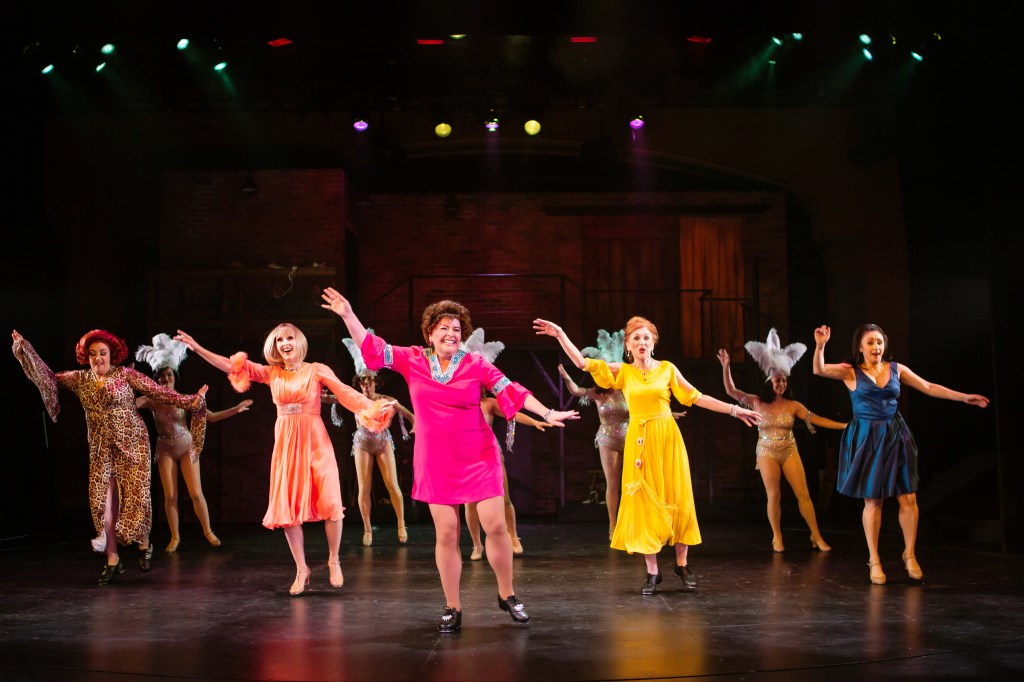
Carlotta (Cindy Goldfield), Solange (Jill Slyter), Stella (Caroline Louise Altman), Phyllis (Maureen McVerry), and Sally (Natascia Diaz). All photos by Jessica Palopoli.

Reunions promise joyous revelry with nostalgia for days of old; reestablished contacts with friends from the past; and the memories of younger ages.  Yet the froth belies a potentially dark underbelly.  Some of the revelers will seem as vital as in their youth, but others will have aged before their time.  Some will have succeeded in life by whatever measures, while others will have failed.  And though many friendships will be rekindled, historic clashes and other unpleasantries may re-emerge.

After some success as a lyricist, as well as writing the music for “A Funny Thing Happened on the Way to the Forum,” Stephen Sondheim decided to undertake only projects in which he would write music and lyrics.  The works that followed in the early Sondheim musical style received massive Tony Award recognition – “Company” (1970), “Follies” (1971), and “A Little Night Music” (1973).  The lavish and expensive-to-produce “Follies” earned 11 Tony nominations and won seven, but was a box office disappointment with barely 500 performances on Broadway.  Yet, the show became a classic.  San Francisco Playhouse has taken on the challenge of producing this massive and demanding project.  The result is a worthy rendition of a great American musical.
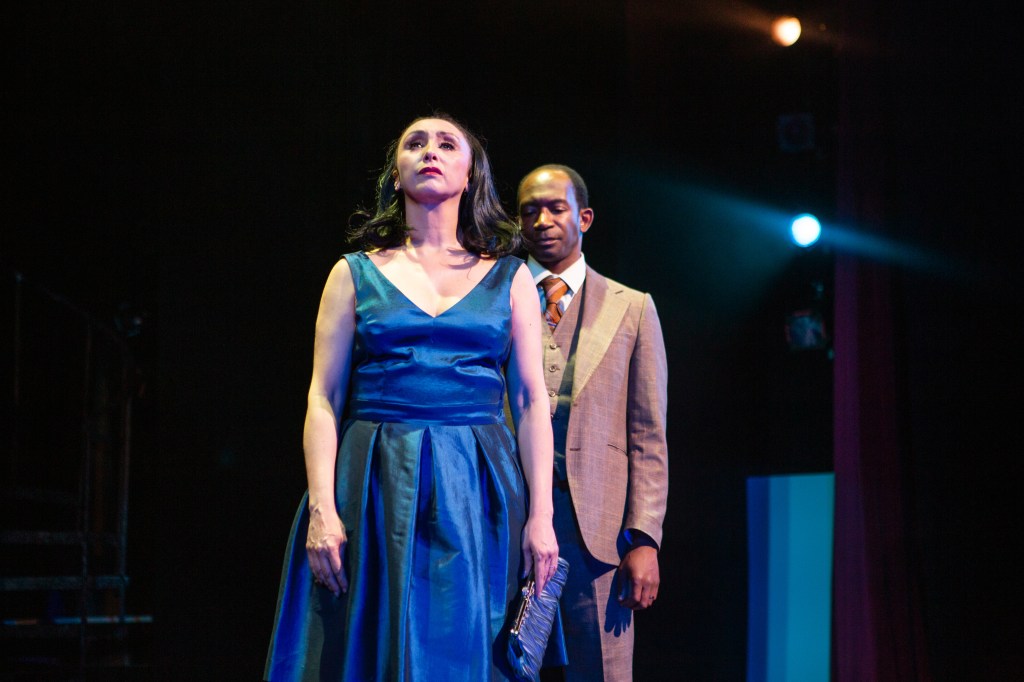
Sally Plummer (Natascia Diaz), Buddy Plummer (Anthony Rollins-Mullens).

Clearly mimicking the Ziegfield Follies, the reunion is of Weismann Girls and their spouses, some three to four decades after their glory.  In this metatheatrical play, the event takes them back to the theater in which they performed.  Now crumbling and slated for demolition, the setting symbolizes the marital relationships of the two central couples in the narrative, both of which are on the brink of collapse.

Ben became a successful politico in Washington, but his childless wife, Phyllis, has become disillusioned and sarcastic.  Buddy, an oil equipment salesman in Phoenix, had been Ben’s good friend.  Sally, his somewhat neurotic wife, has driven Buddy into affairs largely because of her dissatisfaction with her station in life.  Meanwhile, after all these years apart, Sally still carries a flame for Ben which threatens to ignite at the reunion.

Benjamin Stone (Chris Vettel) and Phyllis Stone (Maureen McVerry).

An affecting flashback device in the play involves younger versions of the four main characters often appearing on stage to re-enact the past, highlighting the passions and mistakes of the young.  The actors playing the youthful parts in this production match the present-day actors nicely, so the conceit generally works very well.  There are complications, however, particularly when characters from different time periods interact.

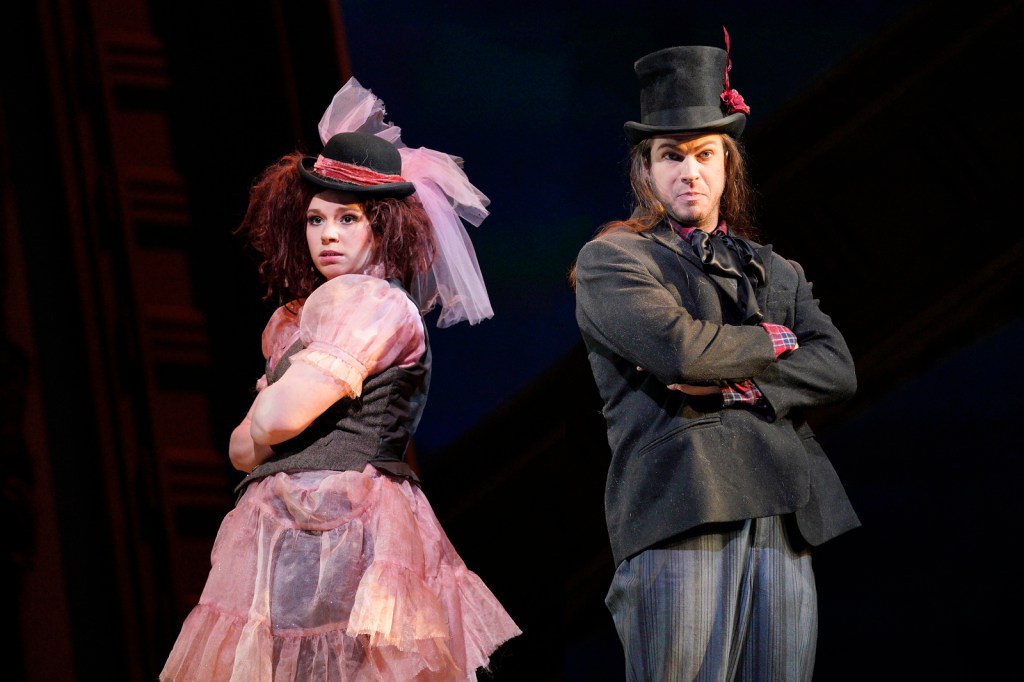
Apart from the intimate and often contentious exchanges involving the two couples, a completely different, mostly bubbly and upbeat vibe takes place in scenes with the other party goers.  Sondheim created a large number of secondary roles.  Indeed, several highlight songs are sung ably by various supporting players in this cast.  A number of these numbers are pastiches of music from the earlier era including memorable songs like the bouncy “Broadway Baby” (Hattie); the Valentine to a city “Ah, Paris” (Solange); and the wistful “Who’s That Woman?” (Stella), as well as the show-stopping survival anthem “I’m Still Here” (Carlotta).  But the climactic crux of the show is delivered by Phyllis with the thoughtful discourse on dividing lives with divorce, “Could I Leave You?”  Guess!

Carlotta (Cindy Goldfield), Solange (Jill Slyter), Dimitri Weismann (Louis Parnell), Theodore Whitman (Rene Collins), Emily Whitman (Eiko Yamamoto).

Choreographer Nicole Helfer’s numerous arrangements add to the lighter side of the action.  Perhaps the most lively piece in the play is the stage-filling dance tied to “Who’s That Woman? (Mirror, Mirror).”  Five of the Follies alums are joined by an equal number of sequined and feathered “Ghosts of the Follies Past” for a ten-women tap number that is vigorous and highly entertaining.

It is still curious that “Follies” didn’t register with audiences at the outset, as it is extremely literate and innovative with a lively score full of memorable songs.  However, the narrative presents several hurdles that could cause the audience to shy.  In particular, each main character is despondent for a different reason, and it’s hard to root for any of them.  The counterbalance of the cheerier party sequences involves many characters which confuse and give the play a bit of a split personality.  Finally, when it seems that the show should be about over, there is a sequence of four scenes.  Each is a “folly” for a lead character in the manner of a Weismann Follies skit that seems inorganic.

Young Ben (Cameron La Brie), Young Phyllis (Danielle Cheiken), Young Buddy (Chachi Delgado), Young Sally (Samantha Rose Cárdenas).

Director Bill English does a fine job in pulling the pieces of this production together with over 40 performers and production techs, including five stage managers – not to mention the additional creative team.  English and co-designer Heather Kenyon’s front-stage and back-stage sets is another great asset to the show.  At opening, performances and voices were a little variable in much of Act 1 but were largely redeemed by Act 2.  Similarly, the orchestra lacked proper tuning when it was on its own for the overture, but that defect was not noticeable when the instruments accompanied singing.  Taken as a whole, the production is a delightful crowd pleaser and a credit to the company’s success in presenting important musicals from the past.

“Follies” with music and lyrics by Stephen Sondheim and book by James Goldman is produced by San Francisco Playhouse and plays on its stage at 450 Post Street, San Francisco, CA through September 10, 2022.

Nan and the Lower Body

Christopher Daftsios, Lisa Ramirez, Elissa Beth Stebbins, Jeffrey Brian Adams. All photos by Alessandra Mello.

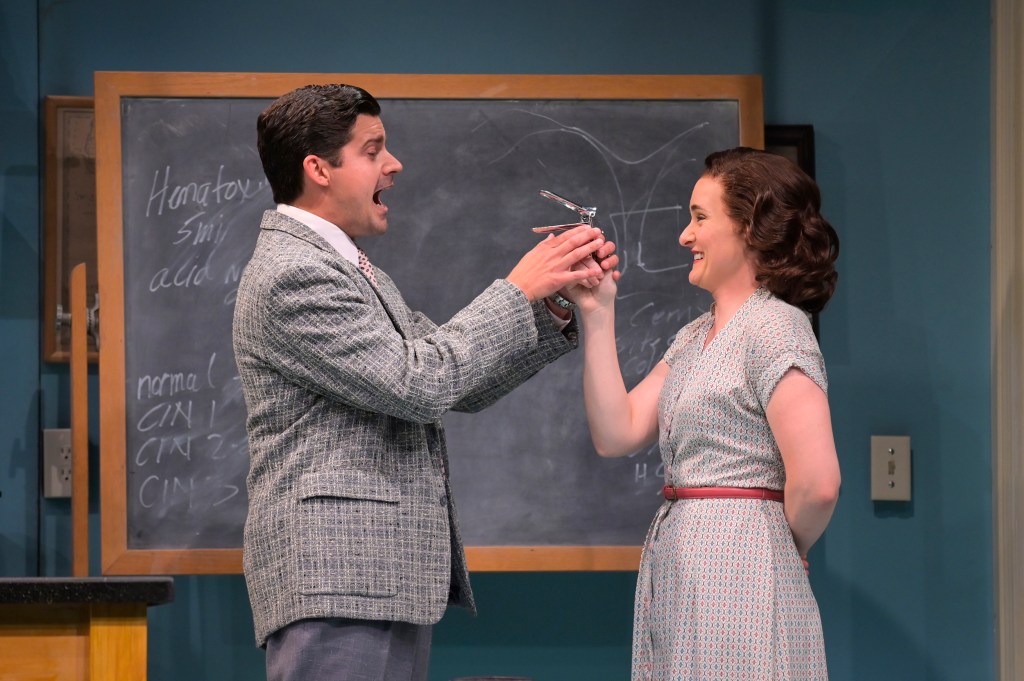
Who knew that the Pap smear was actually named after somebody?  Playwright Jessica Dickey takes us on a somewhat factual, somewhat fanciful journey that occurs at Cornell University in 1952.  Dr. George Papanicolaou has devised the landmark test for cervical cancer, and he is welcoming Nan Day to assist in his further research into women’s health issues.  While that may seem like pretty dry material for theatrical entertainment, the playwright injects sufficient conflict and complication among compelling characters, and the actors provide brilliant performances.  The result is a rousing world premiere success, full of poignancy and humor.

The play opens with Dr. Pap addressing a classroom – the audience.  The content of the lecture is unimportant, yet those brief moments absolutely hook the viewer.  There is no waiting to get involved with the story line.  In character as Dr. Pap, actor Christopher Daftsios appears unlikely to exude confidence and exhibit outstanding comic timing, but he brims with enthusiasm and turns words that would be humdrum on the page into comic thunder.

Elissa Beth Stebbins as Nan is a suitably focused and serious young woman who has the courage to know when to draw lines, even though women at that time had little leverage at work or at home.  What Dr. Pap had not realized in hiring Nan was that she has a trailing spouse (decades before that concept received critical mass).  Her husband, Ted, is a minister, and he is in a make-do situation but is looking for a permanent position.

Christopher Daftsios, Elissa Beth Stebbins.

This story touches on many themes that are as relevant today as they were in 1952, accentuated by the recent and regressive Supreme Court decision on reproductive rights.  The play is about women’s place in the world – their rights, their health, their careers, and their relationship with men.  It also concerns other groups that suffer discrimination, specifically immigrants from non-Anglo populations.  Dr. Pap relates how he suffers insults, being cast as a dirty Greek.  In his case, that disdain ties into another form of rejection.  Even scientists, who seek truth and look to push back the boundaries of knowledge, can resist breakthroughs by interlopers that don’t conform with the received wisdom.  So it is with Pap’s discovery and his colleagues’ refusal to accept him as an equal.

On the light side, the play pokes fun at society’s discomfort in speaking about clinical matters when they involve sex.  In his opening classroom lecture, Pap blurts out “Vagina, vagina, vagina” just to desensitize the students.  He is also mischievous, as he likes to see people squirm at the word, and he uses it several times in conversation with Ted, to the latter’s dismay.  Later and on separate occasions, Nan and Pap’s wife, Mache, regale Ted with the threatening word.  Rather than becoming accustomed to it, Ted’s discomfort only increases as Mache talks about her vagina being a private little place where she could hide things and nobody would know!

Jeffrey Brian Adams, Elissa Beth Stebbins.

One interesting clash between the two male characters is the difference in their beliefs and practices concerning women’s equality and rights.  Dr. Pap argues that women are superior because humans are birthed and produced with material provided by the woman.  In practice, he shows his feminism by selecting Nan, who was the only female applicant for his assistantship.  He even suggests that she could become his partner in research if she remains at his lab.  Yet, while he says that Mache, played by a sometimes imperious and mysterious Lisa Ramirez, has completely shared with him throughout their marriage, some of her unexplained actions and vibes suggest that she maybe doesn’t feel an equal.

Ted is charmingly portrayed by Jeffrey Brian Adams as a jocular and uncommonly liberal minister for the day.  His position on women’s station says that women’s birth function should be set aside and that they should simply be considered equals.  Yet when it comes to the fork in the road on whose career takes precedence, he opts to promote his rather than Nan’s.  Of course, this begs the question – does this suggest that he doesn’t really believe in gender equality, just because he wants to advance his own career?  Clearly, one of them will have to “win,” and why shouldn’t it be him?  More broadly, how is a zero-sum game between equals resolved?

Lisa Ramirez, Christopher Daftsios.

The latter part of the play is largely a soliloquy, an epilogue conducted by one of Nan’s granddaughters.  Its message is one that so many of us miss in our unmindful and self-centered youth, while our parents and grandparents are still living.  How many of us have realized too late that they witnessed history and had stories to tell about themselves and the very different world around them in the decades before?  The greater regret is that when we fail to unlock the lessons from the past, it makes us less prepared to confront the challenges of the future.

For this production, Director Giovanna Sardelli’s whole design team is female.  All of the contributions work well, but special recognition goes to Nina Ball’s scenery comprised of two detailed movable sets.  The one glitch in the performance is that the female cast voices are not strong enough to carry the house when not facing toward the audience. 

“Nan and the Lower Body,” a world premiere play written by Jessica Dickey, is produced by TheatreWorks Silicon Valley, and plays at Lucie Stern Theatre, 1301 Middlefield Road, Palo Alto, CA through August 7, 2022.
The Drowsy Chaperone

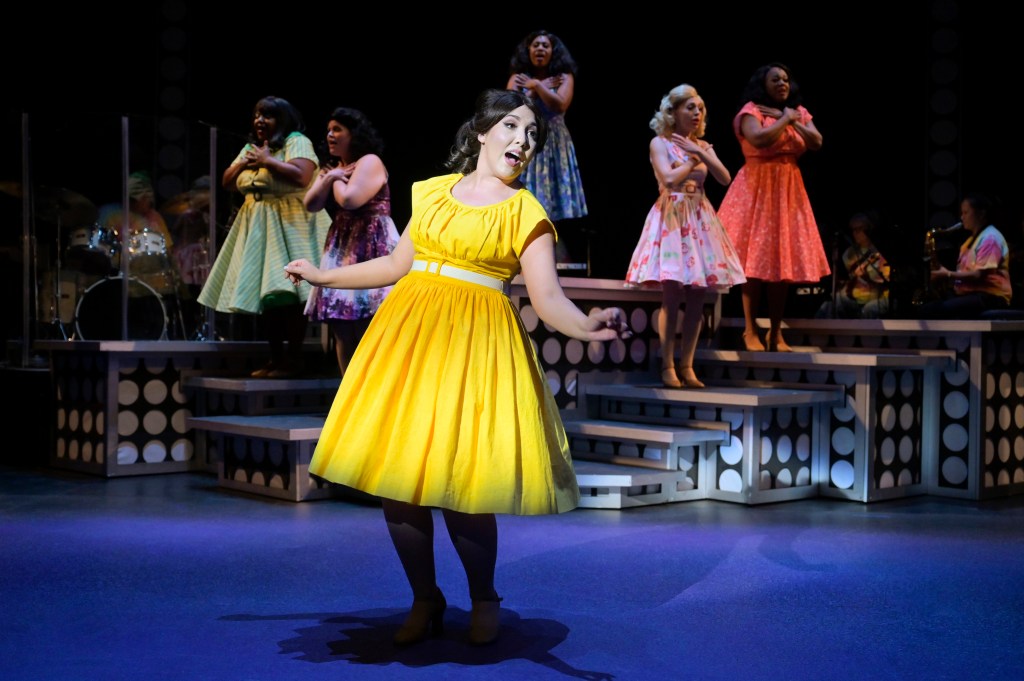
Cast. All photos by Eric Chazankin.

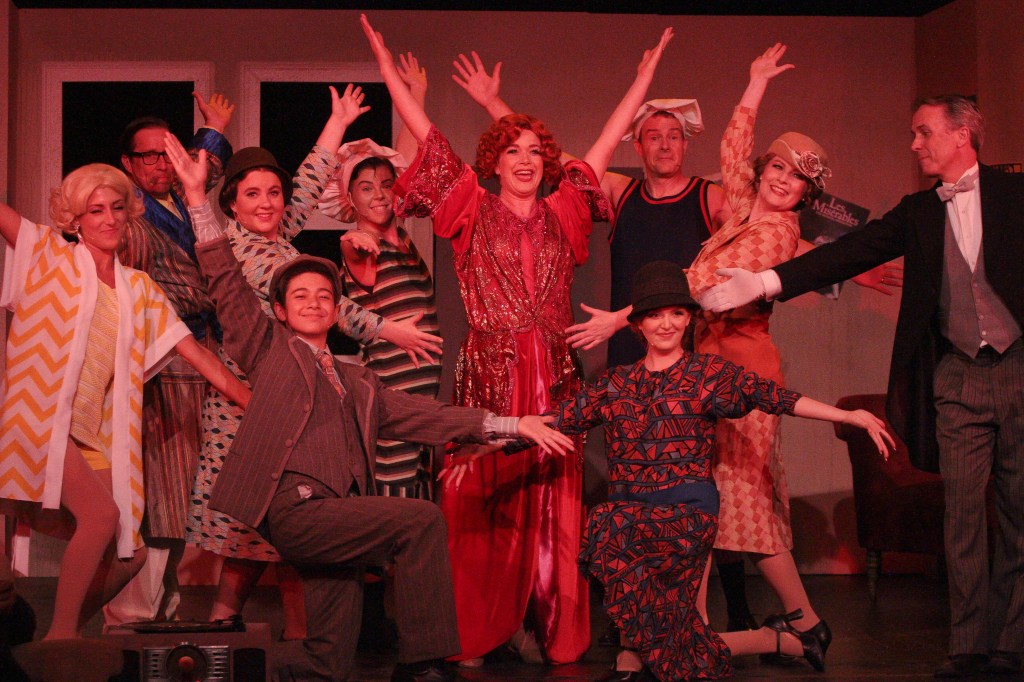
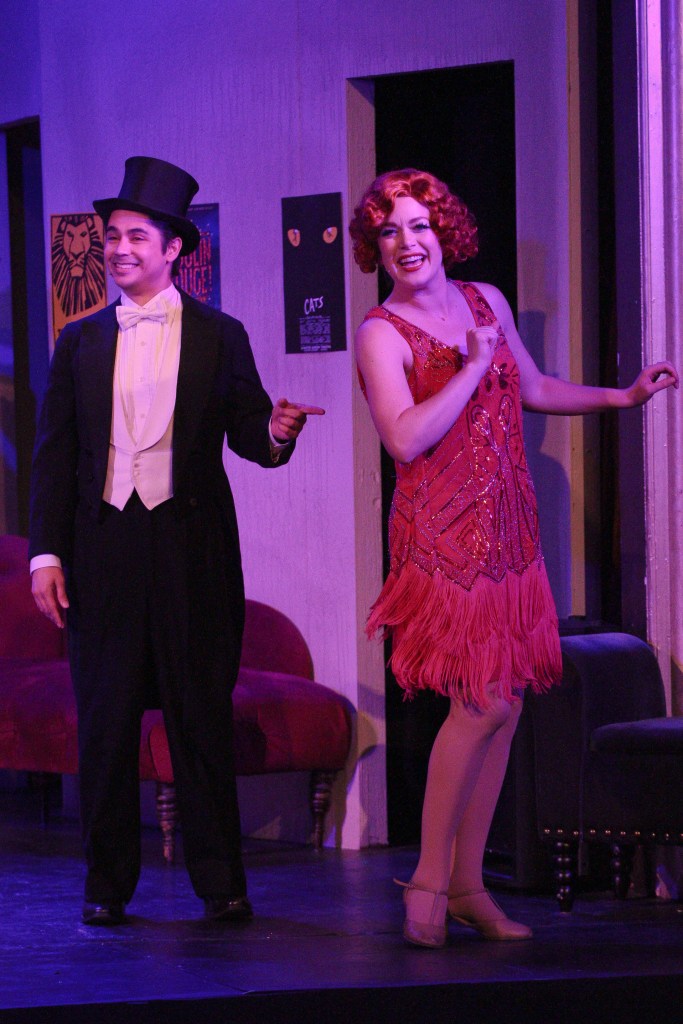
In the lonely solitude of one’s own living room, the imagination can take flights of fancy.  The “Man in Chair” is a Broadway musical devotee who places the soundtrack album of his favorite musical on the turntable.  To his amazement, not only does the music and dialogue from a musical that he’s heard but never seen come through the hi-fi, but the musical’s action takes place right there behind him in his drab apartment!  This is the conceit of “The Drowsy Chaperone,” a fictitious musical from 1928.  Sonoma Arts Live takes on this frothy concoction and delivers a production that bubbles with delight from curtain’s (figurative) rise to fall.

The opening premise of the fiction is that Janet van de Graaf and Robert Martin, played by the charming and talented pair of Maeve Smith and Stephen Kanaski, are to be married on the day that the musical takes place.  The reality of the show’s evolution is that “The Drowsy Chaperone” began as a spoof of old musicals that was performed at a stag party for a real engaged couple with the same names as the characters in the show.  Got that?

Tim Setzer as Man in Chair.

Several hilariously delivered plot turns drive the action.  Janet’s drunken chaperone, played with great panache by the redoubtable Daniela Innocenti Beem, is charged with ensuring that the groom doesn’t see the bride before the ceremony.  While Robert doesn’t see Janet, he does kiss her, not knowing it’s her, and that becomes the basis for the bride wanting to call off the wedding.  While this causes some consternation, that’s fine with two gangsters acting as bakers, as they are charged with finding a way to stop the wedding.  It seems that their boss is an investor in a show that stars Janet, and it would probably flop without her.  Meanwhile, unlikely couples instantly fall in love, so that there may be more than one replacement wedding that day.

As is probably already apparent, this send-up is rife with tropes from musicals.  Songs with ridiculous lyrics and dance numbers appear for no real narrative reason, but they do entertain and showcase talent.  Beem belts out in Ethel Merman fashion, and Smith shows tremendous soprano range, hitting the high notes.  Kanaski and Jonathen Blue, who plays George, the anxious best man, show fancy feet and flair with an entertaining tap dance number.  Other stock characters abound as well, including a licentious Broadway producer and his untalented but otherwise appealing chorine girlfriend; a haughty matron and her very proper butler; and a narcissistic Latin lover.

Stephen Kanaski as Robert Martin, Maeve Smith as Janet van de Graff.

The play-within-a-play is an ensemble piece with many performers getting to show their stuff, and the few rough edges in performance, which there are, can be permitted.  The one character that must be spot-on is the unnamed Man in Chair who narrates and communes with the audience.  The actor portraying this role is a fail-safe choice, Tim Setzer, who is phenomenal.

Setzer totally inhabits the character as he lounges in his easy chair wearing house clothes with clunky slippers.  His one passion is his love for musicals, and he is knowledgeable about many aspects of them.  His apartment is chock-a-block with related albums and books.  A sluggish and reclusive type with little going on in his life, he chronically suffers from the blues.  Although a gentle personality and generally amiable, dolefulness and sarcasm frequently seep through his soft smile.  The actor speaks directly to the audience as if confiding in us. He makes us feel comfortable with him and interested in what he has to say.  Oddly, despite this being his favorite musical, he issues a lot of criticism. But through it all, he makes us laugh.

Daniela Innocenti Beem as The Drowsy Chaperone.

Those viewers who loved listening to records and lived through the age of vinyl will recognize clichés from the old days, like lifting and setting the needle arm to select a track and the anticipation brought about by the static that precedes the track.  In one funny sequence, that many of us can relate to, Man in Chair plays the same section of a song over and over trying to decipher the lyrics.

Director Michael Ross has done a fine job of marshaling his resources in this production.  Two aspects of stage artistry particularly contribute to creating a period feel.  Rebecca Valentino deserves note for the bulk of ‘20s costumes that provide the overall look, and Liz Andrews’s choreography, including dances of the era, add to the feel.  Music directed by Sherrill Peterson backs singers admirably, but on several occasions on opening night, the band overpowered even singers with very strong voices.  Overall, this dip back into time offers an enjoyable time spent.

“The Drowsy Chaperone,” with music and lyrics by Lisa Lambert and Greg Morrison and book by Bob Martin and Don McKellar is produced by Sonoma Arts Live and plays at the Sonoma Community Center, 476 East Napa Street, Sonoma, CA through July 31, 2022.

La Belle et la Bête

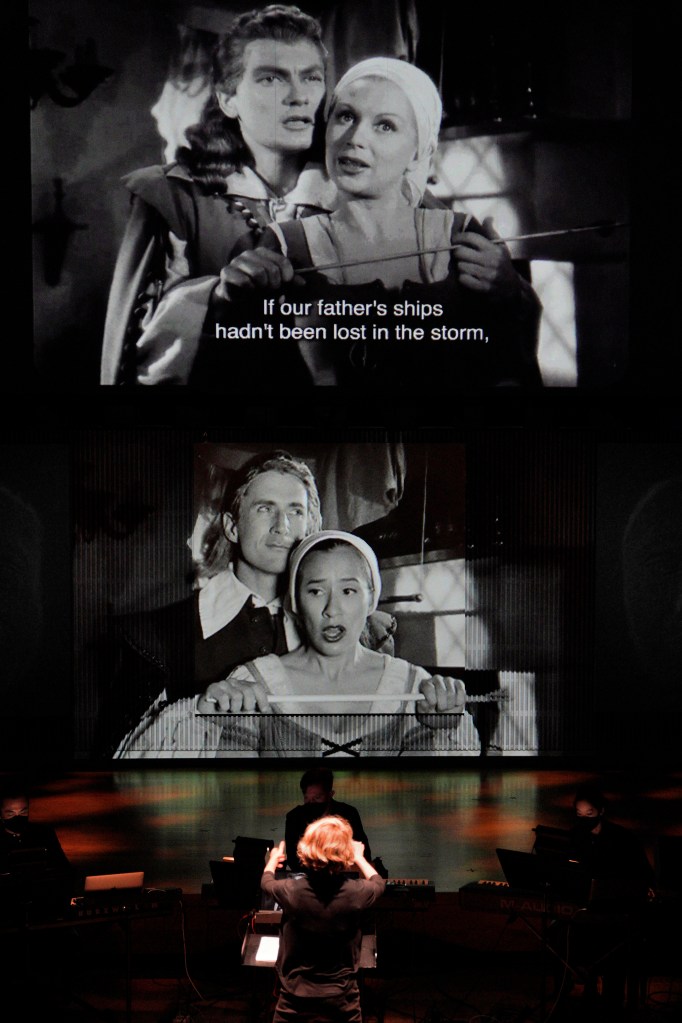
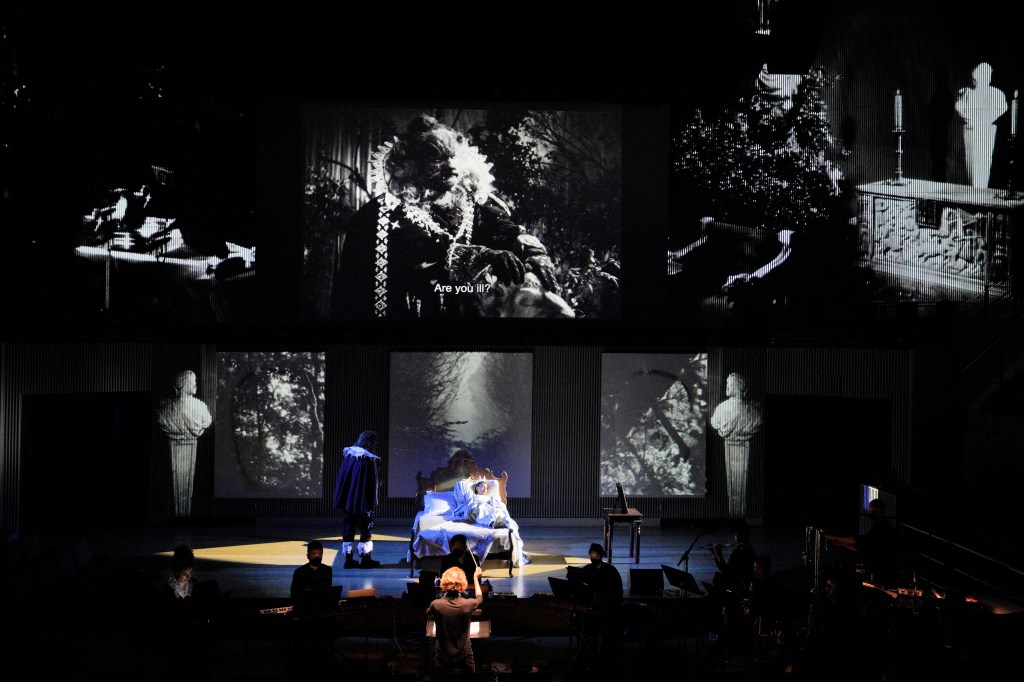
Jean Marais, Josette Day (screen top), Hadleigh Adams, Vanessa Bacerra (screen below), Nicole Paiement (live). All photos by Cory Weaver.

The black and white images in highly contrasted lighting glisten like ebony onyx and silver pearls.  Enchantment virtually leaps off of the screen as the title characters conquer near insurmountable challenges and ultimately endear themselves to one another and to the audience.  Such is Jean Cocteau’s enchanting 1946 film “La Belle et la Bête.”

In Philip Glass’s adaptation of a trilogy of Cocteau films to opera (the others being “Orphée” and “Les Enfants Terribles,” both previously produced by Opera Parallèle), the composer saved his most imaginative treatment for this most uncommon love story.  To preserve the spellbinding charm of the source and the visual magic that can only be produced electronically, the movie is projected over the stage, while the soundtrack is stripped.  Instead, Glass’s original musical score and libretto are performed live under the backdrop of the electronic images. But the four singers appear variously in the flesh and on the screen.  The resulting hybrid is a unique and captivating performance experience.  A triumph!

Panorama, including Nicole Paiement, orchestra.

The story itself is better known to most from the Disney film and stage musical versions, both of which were wildly successful.  The substance of any version is similar, an admixture of “The Hunchback of Notre Dame,” “Cinderella,” and “The Frog Prince.”  Belle’s father inadvertently triggers the plot conflict by picking a rose for her from the Beast’s garden.  The Beast condemns the old man to death, unless the latter sends one of his daughters to live with him.  Of course, Belle consents, and so begins the rocky road between the title characters, slowly resulting in understanding, followed by empathy, and culminating in love.

The narrative has endless interpretations and is replete with symbolism in its objects, from mirror to white horse to key.  The overarching moral of the story is about inclusion and acceptance for what a person is inside.  OP recognized the broader implications of this theme and hosted a recent panel discussion connecting the story to LGBTQ and ethnic issues.  This could not be more timely as the Republican party’s culture war rapidly reverses rights of transexuals; treats homosexuality as a deviance that is to be corrected; victimizes immigrants from minority communities; and vilifies legitimate protests of racial injustice such as Black Lives Matter, while turning a blind eye to white supremacy.

Hadleigh Adams, Vanessa Bacerra.

Like the composer, OP thrives on innovation.  Director and Production Designer Brian Staufenbiel and his creative staff have masterfully combined elements, resulting in smoothly coordinated, multifaceted artistry.  The performance of the opera sometimes results in sensory overload, and it can be difficult to absorb everything at once.  Endless original projection arrays exhilarate. The one constant is Cocteau’s film, with its light and darkness and its luminous leads, Josette Day and Jean Marais.   Meanwhile, the delightful live lead characters, Vanessa Becerra as La Belle and Hadleigh Adams as La Bête, sometimes appear videoed on a screen below the film screen; sometimes are live on the stage; and other times sing in the darkness of the vomitorium (yes, that is a real word!).   If there is a formula behind the whys and wheres of these manifestations, I didn’t figure it out.  The omnium gatherum male and female singers, Eugene Brancoveanu and Sophie Delphis sit in costume with the orchestra for the greater part.  All four singers are superb in their roles.

Philip Glass draws on numerous sources for his musical inspiration, and in many ways is an unconventional modern composer.  His score of “La Belle et la Bête” is attractive, full of mystery, menace, and lush beauty.  The orchestral lines of repetitive structures pulse with insistence throughout, provided by repeated keyboard pizzicato or percussion or even wind instruments.  They reflect specific sounds such as horse hooves or clock chimes as well ambient drive. 

Panorama, including Hadleigh Adams, Vanessa Bacerra, Nicole Paiement.

Conductor Nicole Paiement leads the orchestra with boundless energy and the absolute precision required to synchronize all of the moving parts of this production.  The orchestra of a mere seven pieces – three keyboards, three woodwinds, and percussion maps onto the Philip Glass Ensemble for which many of the composer’s works have been designed.  The fullness of the sound produced belies the size of the orchestra, and both synthesizers and winds mimic sounds of a great variety of instruments from strings to brass.

For the patron who is accustomed to the extravagance of fully-staged opera, this clever, mixed entertainment might seem a bit eccentric.  But it is a totally engaging, artistically valid, professionally mounted, and highly compelling production.

“La Belle et la Bête” with music and libretto by Philip Glass; performed to the movie created by Jean Cocteau; and based on the story “Beauty and the Beast” written by Jean-Marie Leprince de Beaumont; is produced by Opera Parallèle and co-presented by SF Jazz; and plays at SF Jazz Center, 201 Franklin Street, San Francisco, CA through July 17, 2022.

Dreaming in Cuban

Mary Ann Rodgers as Celia, Anna Maria Luera as Lourdes. All photos by Cheshire Isaacs.

Although the ostensible theme of “Dreaming in Cuban” receives a fairly direct reference in the play, the title relates to how nightdreams, daydreams, and memories, even those of half-truth and fabrication, inform our character and how we lead our lives.  But this is far more than a dreamscape.  Cristina Garcia, who has adapted her 1992 National Book Award finalist novel into a world-premiere play, delves into a number of stock motifs and stock character types, but in a vivid, imaginative, and entertaining way.  The story, which takes place in Havana and Brooklyn in 1979-1980, reveals a family with four determined women of Cuban ancestry; representing three generations; living in two countries; and sharing one common condition – zero male partners impede their personal pursuits at this point in their lives.

The plot centers on the widow Celia, the abuela, or grandmother.  A civil law judge in Cuba, she remains wed to the revolution and all it represents. Her ardor for Castro’s communism may have been a compensation device for her loveless marriage to Jorge, who even had Celia institutionalized for a time in hopes of eradicating her lingering affection for a past lover.  Though Jorge has passed, his spirit often appears as a vision to Celia and her two daughters, adding an element of mysticism that is accentuated by the spare staging and Director Gary Graves’ fine use of accent lighting.

Natalie Delgado as Felicia, Steve Ortiz as Jorge (a spirit), Eric Esquivel-Gutierrez as Ivanito (Felicia’s son).

Celia’s rigid adherence to political principal at the expense of family is matched by daughter Lourdes, who escaped to the U.S. shortly after Castro’s ascent.  Goal oriented and severe, she owns a successful bakery in Brooklyn.  Aptly named Yankee Doodle, it reflects Lourdes’ super-American values with a near pathological disdain for communism that is often associated with Cuban emigrees.  When she finally meets her mother face-to-face for the first time in two decades, the political divide is palpable as both see every human transaction through the lens of politics.  The interaction is more like two welterweight boxers feeling each other out and then releasing flurries of punches, rather than the loving reunion of mother and daughter.

Lourdes’ daughter Pilar was two years old when her mother took her from Cuba.  (Note that this fact and more map onto the playwright’s own personal history.)  Consistent with the theme of one generation rejecting the values of the preceding one, Pilar romanticizes Cuba and yearns to visit her abuela, whom she feels will provide the love that she misses from her mother.  Like many teens, however, she fails to appreciate that Lourdes has stepped up for her in important situations.  And like many who claim memories of earliest childhood, Pilar holds to beliefs that really represent images of desire rather than realities.

Thea Rodgers as Pilar, Eric Esquivel-Gutierrez as Max (who works at bakery).

Celia’s other daughter, Felicia, missed escaping to the U.S., but like Lourdes, she rejects the Cuban political system. Having suffered traumas, she is emotionally fragile.  But Celia considers Felicia a non-conformist, and despite the mother having suffered incarceration herself, she visits a similar punishment upon her daughter.  Putting love of country and its political system before love of family, Celia has Felicia committed to an indoctrination camp in hopes of changing her political philosophy.

The cast is led by Mary Ann Rodgers as Celia, who captures not only the abuela’s dogmatism, but also her wistfulness and loneliness as she revisits unsent letters to her Spanish lover from before her marriage.  Anna Marie Luera ably conveys the often deficient humanity of the fiery Lourdes as she pursues objectives with little regard for unintended consequences.

Steve Ortiz as Lt. Rojas (a patriot).

A lively dynamic occurs as the action shifts back and forth between the U.S. and Cuba, yet there are occasional lapses in narrative pacing as well as acting and timing of interaction.  But there are also several significant events and clashes among characters that bristle with dynamic tension.  The plethora of themes that are explored, particularly concerning the various conflicts of values, yields a provocative theatrical piece that is nicely rendered with great sensitivity.

“Dreaming in Cuban,” a world premiere written by Cristina Garcia, is produced by Central Works, and plays at Berkeley City Club, 2315 Durant Ave., Berkeley, CA, through July 31, 2022.
Don Giovanni

Etienne Dupuis as Don Giovanni, Luca Pisaroni as Leporello. All photos by Cory Weaver.

The sky is fiery ashen orange, reminiscent of the foreboding atmosphere in the Bay Area from the 2021 California wildfires.  Fortunately, this post-apocalyptic vision comes not from nature, but rather from the opera stage.  Fittingly, San Francisco Opera sets the tale of the morally failed title character in a time of environmental and societal collapse.  This is “Don Giovanni” in what could be future America.

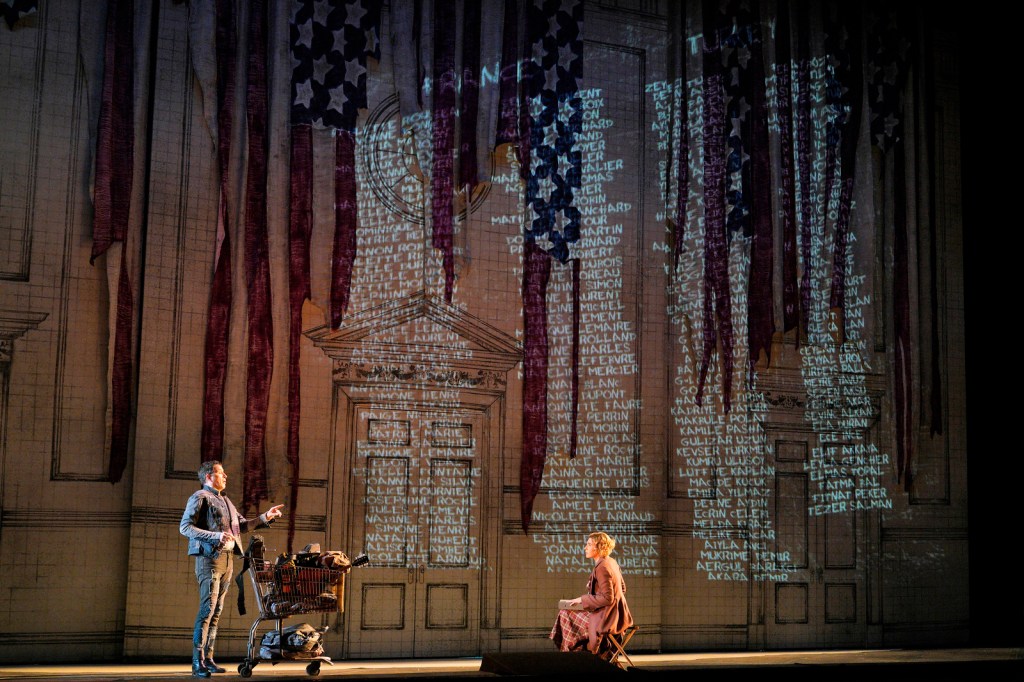
Before the pandemic, San Francisco Opera decided to package Mozart’s three greatest Italian-language and Italianate-style operas, “Marriage of Figaro,” “Cosi Fan Tutti,” and “Don Giovanni”” into a trilogy.   They also happen to be his three collaborations with the great librettist Lorenzo da Ponte.  The common thread of the adaptations is not just that they take place on American soil, but literally on the same plot of earth.  For the first installment, it was a Revolution-era home that in the second had been converted into an exclusive club in the 1930s.  In the final opera in the series, the stately Greek Revival edifice is crumbling in the dystopia of the year 2080.

(top to bottom) Amitai Pati as Don Ottavio, Adela Zaharia as Donna Anna, Soloman Howard as The Commendatore.

The dark comedy “Don Giovanni” holds a place as one of the greatest operas ever composed.  In the hands of a world class company like San Francisco Opera with a great orchestra and the ability to attract some of the best artists to grace the stage, the production is as musically rich as it is professionally performed.

Based on the oft-told Don Juan legend, the title character is a womanizing libertine of low moral character, whose only positive trait is his charm, which acts as the fuel for his ability to seduce and rape women with lies and abuse and betray his loyal manservant, Leporello.   Among the latter’s less dangerous chores, he actually keeps a log of his master’s thousands of conquests, revealed in the servant’s humorously-delivered signature aria “Madamina, il catalogo è questo.”  The Don and Leporello are Etienne Dupuis and Luca Pisaroni respectively, and both give apt portrayals with powerful vocals spanning the bass-baritone range.

Christina Gansch as Zerlina, Cody Quattlebaum as Masetto.

Mozart himself loved women, and da Ponte’s libretto offers three very satisfying female roles of fairly equal importance.  Although their incidents with Don Giovanni are unrelated, the women’s paths cross and they become collaborators, like a posse hunting down a perpetrator.

Adela Zaharia is Donna Anna, whose steely determination to identify and punish the killer of her father, the Commendatore, is a key driver to the action.  Her clear and concise voice reaches its heights in Act 2 with a beautiful coloratura in “Non mi dir,” when she tells her suitor, Don Ottavio, that she is not ready to wed quite yet after the recent tragedy.  As Donna Elvira, Nicole Car shares her dramatic vocalization in two ensembles with Don Giovanni and Leporello, “Ah! chi mi dice mai” and “Ah! taci ingiusto core.”

Christina Gansch plays Zerlina, who as a peasant is relegated to lesser treatment.  However, she is vocally equal to the other female victims, and she shares with the Don the most memorable music in the opera, the classic duet “Là ci darem la mano.”

Luca Pisaroni as Leporello, Nicole Car as Donna Elvira.

This staging of “Don Giovanni” is problematic.  On the one hand, it can be accepted as random design and virtually ignored, since the captivating music and complex drama can still be fully appreciated.   On the other hand, Director Michael Cavanagh did conceive this as the last piece in the American trilogy.  But other than abundant damaged remains of U.S. flag motifs, nothing seems especially American.  And although the costumery is supposed to symbolize the repurposing of haberdasher leftovers in this grim futuristic world, that notion doesn’t come across unless the viewer has read the director’s intent.  Further, when an orchestra appears on stage, gray-wigged players are in period European uniforms, which is confusing given the time and place of the action.

Separately, the treatment of the Commendatore is undramatic at the outset but stunning at the end.  The performer, Solomon Howard, is not made to look old and distinguished, and rather than having some stage time, perhaps as an apparition to establish the sense of the character and situation, he simply descends a staircase and promptly gets killed, making the whole action seem perfunctory and insignificant.  Conversely, at the closing, a 24-foot high bust of the Commendatore moves slowly upstage to dramatic music, as clever lighting morphs the ghostly sculpture.  A ragged chasm down the center of its face splits open, and a fiery inferno appears in the divide.  Quite a spectacle!

Etienne Dupuis as Don Giovanni.

As previously noted, it is easy to quibble about the strengths and weaknesses of the production design, however, the bones of this opera will always stand tall, and the fine cast and orchestra deliver a fine experience.

“Don Giovanni,” with music by Wolfgang Amadeus Mozart and libretto by Lorenzo da Ponte, is produced by San Francisco Opera and plays at War Memorial Opera House, 301 Van Ness Ave., San Francisco, CA through July 2, 2022.

Hadestown

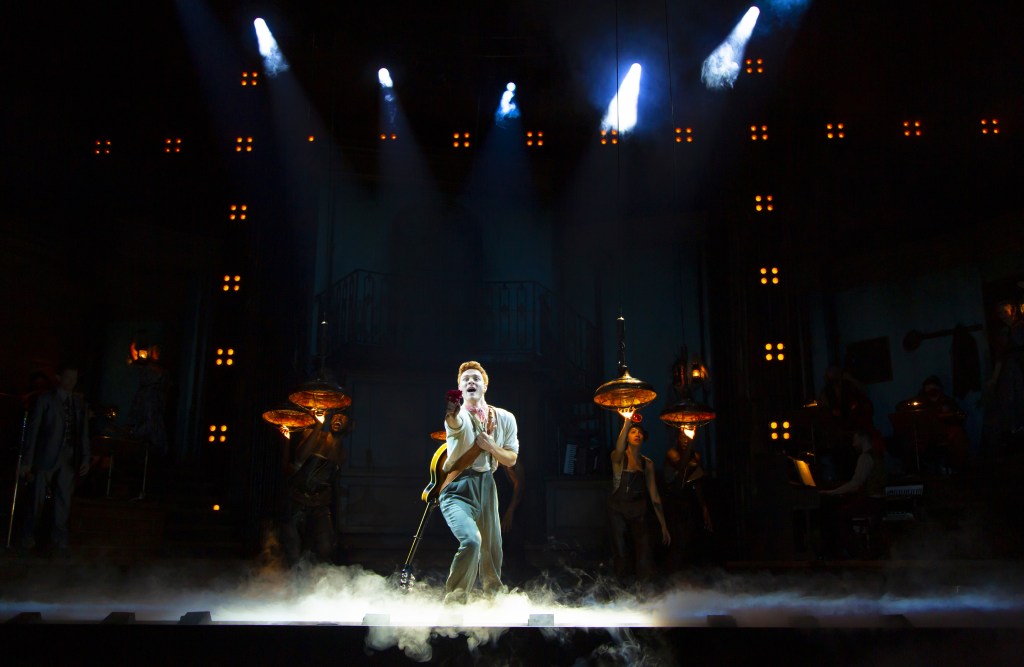
(Foreground) Morgan Siobhan Green as Euridice, Levi Kreis as Hermes, Nicholas Barsch as Orpheus. (Above) Kevyn Morrow as Hades, Kimberly Marable as Persephone. All photos by T. Charles Erickson.

Certain classic stories have legs.  Orpheus and Euridice, one of the most famous stories from Greek mythology, is one that has been interpreted frequently into various forms of performing arts.  With themes that include fateful love, loss of faith, temptation, free will, and the cost of disobeying rules, it has broad appeal.

(Foreground) Morgan Siobhan Green as Euridice, Nicholas Barsch as Orpheus. (Rear) The Fates – Belen Moyano, Bex Odorisio, Shea Renne.

In the original myth, Euridice died from snakebite and was consigned to the underworld.  Under protection from the deities, Orpheus is allowed to retrieve her, but Hades issues the proviso that she walk behind him when departing and that he never look back.  Of course, he disobeys, and the price is that Euridice is returned to the underworld and that Orpheus will never see her again.  This theme of violating divine edicts recurs in literature, but at least in this case, the man takes responsibility.  Conversely, in the often misogynistic Bible, women are assigned guilt. Eve takes the rap for eating the forbidden fruit and causing the first couple to be evicted from Eden, and Lot’s wife (not even granted a name) is turned into a pillar of salt for defying the stricture against looking back at Sodom and Gomorrah as the cities burned.

From this play’s outset, it is clear that “Hadestown” will have a distinctive style.  Although the musical’s auteur, Anaïs Mitchell, comes from the folk world, she developed a unique musical amalgam for the show with elements from blues, jazz, and pop in addition to folk.  Her orchestration is as unexpected as it is brilliant in providing a magnificent background sound.  A seven-piece orchestra is dominated by strings with only one wind-blown instrument, though it adds surprisingly colorful accents throughout the score.  While the music is compelling, the lyrics are even better – penetrating and revealing with great clarity.  The storyline and overall production are equally captivating, making for a standing ovation theatrical experience.

Levi Kreis as Hermes, Kimberly Marable as Persephone.

When charismatic Levi Kreis, as the narrator Hermes, takes the stage at the “curtain-up,” he hushes the audience. The silence at that time and in other pauses during the performance is remarkable.  Then the blast begins, quite literally.  Audrey Ochoa’s powerful, slurred, bluesy trombone leads Hermes’ rhythmic railroad song “Road to Hell” that foretells the fateful path that the protagonists will take.  Those hot licks set the groove for the entire performance. This opening is followed by Euridice and The Fates “Any Way the Wind Blows,” about the disappearance of spring and fall, which is making life on earth hellish – a clear comment on climate change unique to this adaptation of the myth.

In the central love story Orpheus loves Euridice.  He is poor and downtrodden, yet optimistic.  As a fine musician, he claims that the song which he is working on will bring back the spring and win Euridice’s heart.  Nicholas Barasch portrays Orpheus, whose singing is distinguished by repeated shifts between a powerful countertenorish falsetto and a common tenor-baritone chest voice.  He carries off this pyrotechnic challenge with seeming ease.

Euridice is lured instead to Hadestown by Hades’ false promises in the stunningly contrasted duet “Hey Little Songbird.”  Kevyn Morrow is Hades, and he induces Euridice by dismissing her life as it is.  He does so in a jaw-dropping basso profundo that retains sonority in a range that is about as low as a human being can go, while conveying his character’s unrelenting menace.  Meanwhile, Morgan Siobhan Green is Euridice, and she sings with plaintive beauty as she is ready to give in, feeling that Orpheus, whom she has come to love, has failed her in her time of need.

(Foreground) Kevyn Morrow as Hades, Morgan Siobhan Green as Euridice, (Rear) The Fates – Belen Moyano, Bex Odorisio, Shea Renne.

The final principal is Persephone. Hades enticed her to become his partner because of his great love and willingness to make concessions to her.  Kimberly Marable sings Persephone’s signature “Lady of the Underground” with great power as she reveals that she can control the seasons.  Yet, she is a complex figure who will induce Hades to free Euridice from Hadestown.

The single set has a somewhat-worn New Orleans nightclub look with wrought-iron balcony lace and plantation shutters above, plus elevated platforms on either side of the stage for the split seven-piece orchestra.  Since much action takes place in venues other than the club, the show might seem semi-staged.  And since most of the principles are attired in dressy clothes, it may even look like a concert version.  But the effective use of high-contrast lighting and darkness; movement; and other costumery stimulate the viewer’s imagination to fill in the blanks.  One example of a symbolic look is the depiction of dreary underground laborers in dirty work clothes, trudging on a rotating stage lit only by miners’ head lights and a few dim swinging lamps.

It seems that many theatrical works these days can be seen through a political lens, and particularly as a comment on Trumpism, whether intended by the respective playwright or not.  There is no obliqueness in “Hadestown.”  Act 1 closes with “Why We Build the Wall” which could not be a more explicit indictment of Trump’s border wall efforts.  The lyrics given to Hades are especially damning: “The enemy is poverty; And the wall keeps out the enemy; And we build the wall to keep us free.”  In Act 2, Orpheus and Hermes’ “If It’s True” condemns the institutionalized lying by Trumpians (“And it isn’t for the few; To tell the many what is true”) and the cheating that benefits the rich against the poor (“ ‘Cause the ones who tell the lies; Are the solemnest to swear; And the ones who load the dice; Always say the toss is fair”).

Nicholas Barasch as Orpheus.

“Hadestown,” with music, lyrics, and book by Anaïs Mitchell; developed with and directed by Rachel Chavkin; is produced by Broadway SF; and plays at the Orpheum Theatre; 1192 Market Street; San Francisco, CA through July 3, 2022.
The Pajama Game

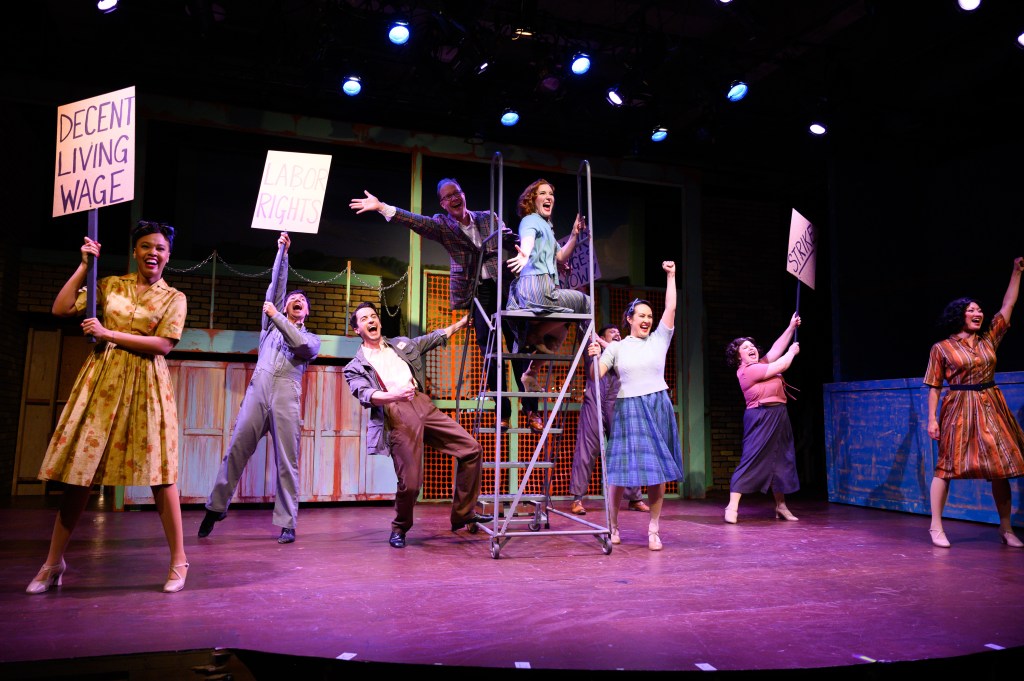
Tiana Paulding, Nicholas Yenson, Tony Conalty, Daniel Thomas, Ashley Garlick, James Mayagoitia, Katherine Stein, Tosca Maltzman, Nicole Tung. All photos by Ben Krantz.

Two sides with clashing interests stand apart.  A young man and a young woman on the opposing sides fall in love.  No, it’s not Romeo and Juliet or the Hatfields and the McCoys.  The interests are economic; the time is the 1950s; and the place is a factory in Cedar Rapids, Iowa.  It’s “The Pajama Game,” which won the 1955 Tony Award for Best Musical and enjoyed a three-year Broadway run.  42nd Street Moon has produced a charming rendition of this underappreciated, yet flawed, property.

Workplace romance is fraught with challenges.  Some romances are hidden from view.  Some may be characterized as sexual abuse.  Some have repercussions at the office, especially if the couple splits.

In “The Pajama Game,” Sid comes to the “hick town” from Chicago to become the Sleep-Tite Pajama Factory Supervisor, a management position.  He becomes smitten with Babe, a worker who heads the Union Grievance Committee.  Workers are seeking a 7 ½ cent per hour raise that competitors have adopted.  This specific issue is the barrier between the two getting together.  Babe’s token resistance to falling for a man who is not a worker fades, and they become an item.  But eventually they split over an incident related to labor protests.  However, this is a ‘50s comedy, and it ends pretty predictably on all counts.  Meanwhile, we are regaled with middle-American practices and mores of the period, from company picnics to stamp collections.

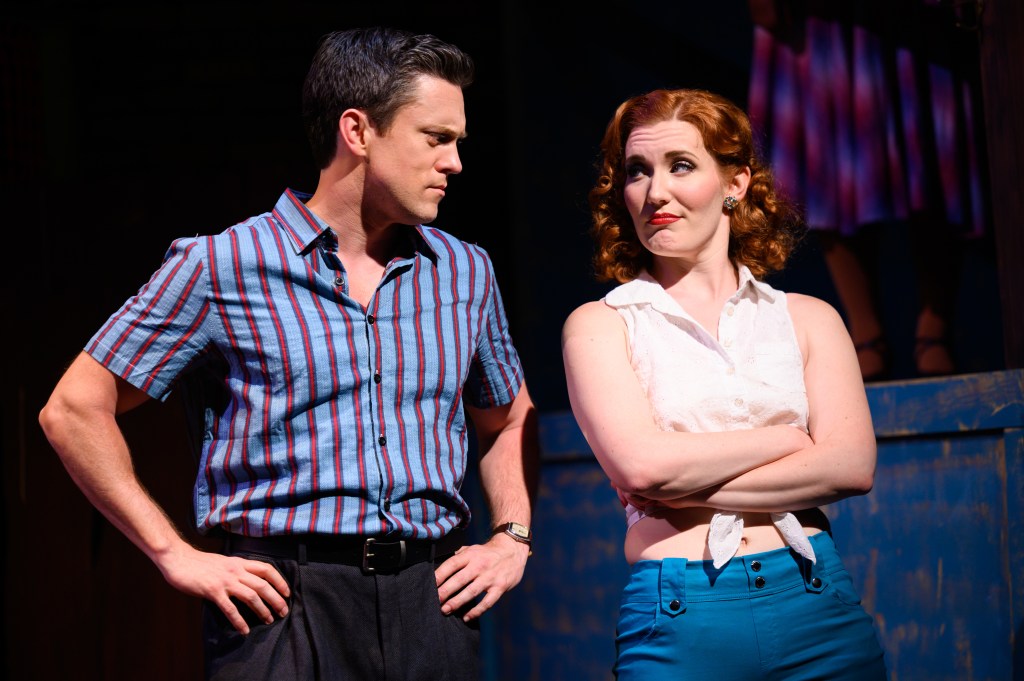
Ben Jones, Ashley Garlick.

Along with the expected humorous situations, some of the notable tunes work well in framing the narrative.  At the opening on the factory floor, “Racing with the Clock” deals with time-and-motion studies to speed production that became popular during the era.  Although the song is chirpy and clever, it wasn’t well projected by the girl’s chorus on opening night.

The dreamy and beautiful “Hey There” is one of the two songs from the show to become a pop standard.  It deals with Sid’s ruminations over early rejections by Babe.  Ben Jones does a fine acting job as Sid and has a strong and wonderful voice, but in the first rendering of this great song, he didn’t project well either.  Fortunately, that was never an issue afterward.

Another crowd pleaser is a duet between Sid and Babe, portrayed by Ashley Garlick, who also brings great acting chops and voice to the stage.  The song is ‘There Once Was a Man,” which affirms their love for each other.  Its lyrics are totally appropriate and the tune is very catchy, but the strange thing about it is that the musical idiom is Western with fast-traveling patter and great upward-leaping vocal glissandos.  It sounds like it comes out of the Frankie Laine songbook, and you anticipate whip cracking and yeehaws at any time. 

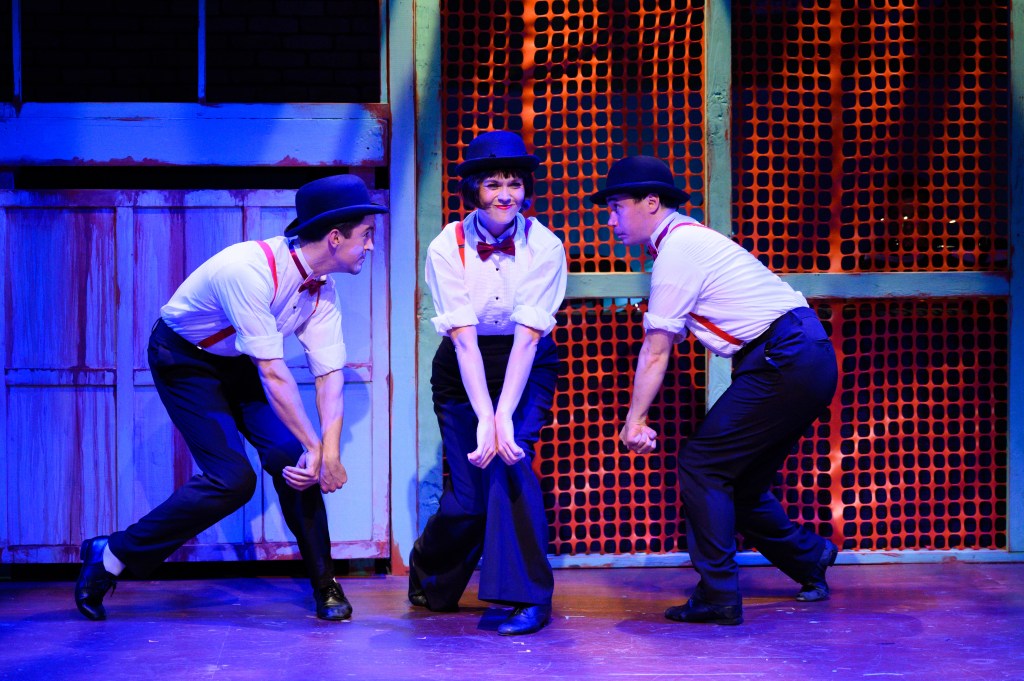
Tony Conaty, Renee DeWeese, Nicholas Yenson.

Act 2 opens with the memorable “Steam Heat,” a song and dance trio.  Its lyrics are of the generic “I can’t live without your love” sort that is superfluous.  Its context is contrived, and the dance style is wildly different from other dances in “The Pajama Game.”  However, this happened to be Bob Fosse’s first show as a choreographer, and the good news is that this number is the first to demonstrate many of his later trademark characteristics – bowler hats and gloves, sloped shoulders, dangling arms, and rhythmic stomps.  Led by Gladys, who is portrayed by choreographer Renee DeWeese, the dancing is a real showstopper that is stunningly performed.

“Hernando’s Hideaway” is about an invitation-only club where lovers could meet in secret.  Such a refuge probably didn’t exist in small midwestern cities, but it does serve as a suitable venue for a furtive meeting between Sid and Gladys, who is the boss’s secretary and Hines’s (the time-and-motion engineer) girlfriend!  The halting tango perfectly fits the ambiance of a candlelit sanctuary.  And it is another enjoyable song that became a pop standard.

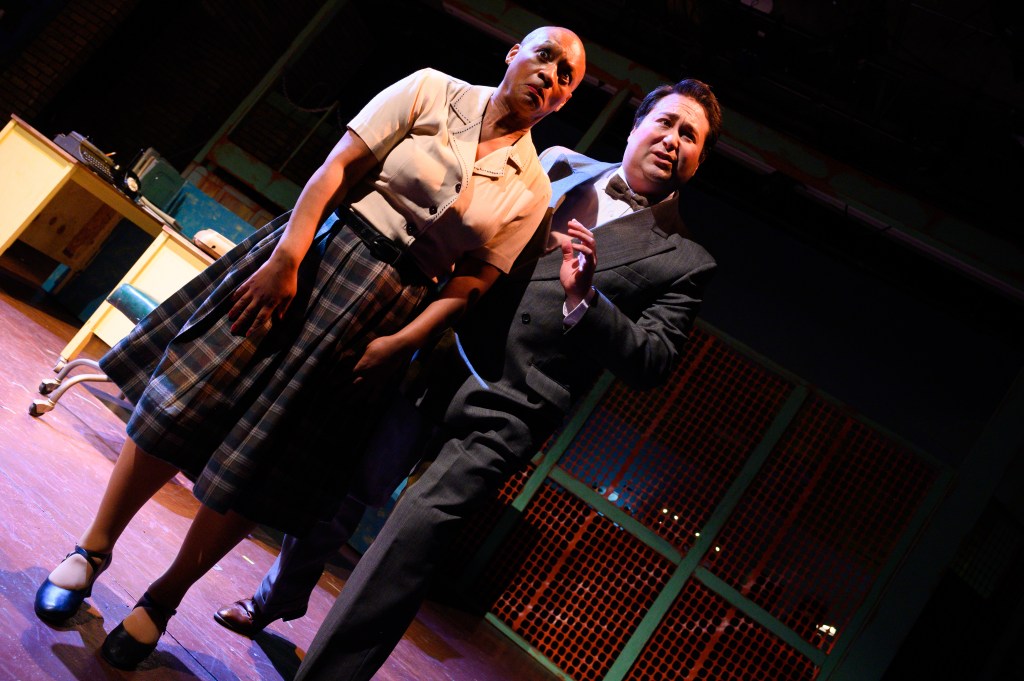
In addition to the good performances by the lead couple, the other major roles are well acted.  Daniel Thomas, the producing company’s Executive Artistic Director, is Prez, the union head, who keeps failing to get the workers’ raise and who also has an eye for Babe.  Nick Nakashima receives the most laughs as Hines, who worries about work and has a jealous streak.  And Jesse Caldwell bounces to and fro, as he plays both the greedy boss, “Old Man” Hasler and empathetic Pops, Babe’s father, who is trying his best to get her married off.

Tracy Camp, Nick Nagashima.

Through the disarray in story elements, “The Pajama Game” is still charming, and it is fun to see.  Production values, including several other dance numbers and skeletal instrumental support, are consistent with 42nd Street Moon standards.  Theatergoers who welcome revivals of earlier musicals, a niche that the company serves well, will particularly enjoy this experience.

Although “The Pajama Game” may not come across as an expressly political play, it was written when over 300 entertainers were still blacklisted as a result of House Un-American Activities Committee investigations.  The central clash is certainly a classic between capital and labor.  “Old Man” Hasler, the factory head, is played unsympathetically for his dishonesty and for his rigid rejection of a workers’ raise when the factory is doing extremely well.  Further, he repeatedly refers to anyone who supports the raise or acts to slow production as a communist.  This is a clear jab by the musical’s creative team at right-wingers who make flagrant, unfounded accusations and reject the notion that those outside their fraternity deserve rights and comforts.  Sadly, this scapegoating philosophy and the practice of pejorative and unjustified labeling has had a troubling resurgence in today’s world.

Ashley Garlick, Ben Jones, Jesse Caldwell.

“The Pajama Game” with music and lyrics by Richard Adler and Jerry Ross, book by George Abbott and Richard Bissell, and produced by 42nd Street Moon, plays at the Gateway Theatre, 215 Jackson Street, San Francisco, CA through June 19, 2022.

Beehive: The ’60s Musical

Constance Jewell Lopez, Arielle Crosby, and Erica Richardson. All photos by Kevin Berne.

In an implicit nod to the growing marijuana and hallucinogenic drug culture of the decade, David Crosby famously said that if you can remember the ‘60s, you weren’t there.  Fortunately, for most of us who lived through it, that is a canard. Half a century later, memories from that era are distinct and intense.  It was a time of social and political upheaval, in which music played a profound role.  And for the first time in history, most music of the day was targeted at, purchased by, and performed by youth.

Our religion was Top 40 radio, 24/7.  Before contemporary music was pushed more into silos, we called our music rock-and-roll, but not in a narrow sense.  It included associated youth culture idioms like rhythm-and-blues, doo wop, girl groups, crossover country, and pop, as well as older genres such as show tunes, instrumentals, and blues.  And in this new and changing environment emerged new styles of female singers.  In days past, women had fronted Big Bands and sung solo pop music, but singers and songs were largely prim and proper.  This new wave was largely driven by strong women and by music with earthy themes that were alien to previous decades.

Ashley Cowl and the Cast.

“Beehive: the ’60s Musical” honors that decade and the women who made their music a big part of the shifting scene.  Center REPertory presents this musical revue with high energy and a joyful spirit.

From the terrific acapella medley that opens the show, it is clear that the cast of six young women are all talented vocalists.  What surprises is that those same voices that create ethereal harmony in some of the ensemble numbers can also wail and belt it out in solos that call for a diva’s intensity.  They also display the choreographed movement and dance of the time, all the while looking the part, especially clad in the go-go dancer costumes with the white latex boots.  Oh, and they’re well-backed by an all-female rock band.

The early part of the show is about the early and mid-‘60s.  Rock era girl groups dominated and were largely Black and largely teenagers who were high school friends.  The genre had gathered steam in the late ‘50s.  In 1960, a breakthrough came with the first girl group number one Billboard hit, the Shirelles’ “Will You Love Me Tomorrow.”  As with all of the material, the cast does a great job of providing a version that is both reminiscent and in their own style.  They also swing and sway and shake and shuffle through “Be My Baby,” “Sweet Talkin’ Guy,” “Walking in the Rain,” and more.  With well over two dozen songs, every audience member will have their own favorites.

Monique Hafen Adams, Constance Jewel Lopez.

To give a little context to the musical era, some commentary is provided about social and political movements in the decade – civil rights, women’s rights, and Viet Nam.  In a departure from the music formula, recognizing the assassination of President John F. Kennedy, the girls sing a poignant version of “Abraham, Martin, and John.”

The latter part of the show covers the latter part of the decade and even cheats into the ‘70s.  It focuses on the electrifying female performers of the era – Aretha Franklin, Janis Joplin, and Grace Slick.  But the most rousing performance is a rendition of “Proud Mary,” replete with fringe dress and the trademark stomp and shimmy of Tina Turner.

Elizabeth Curtis.

“Beehive: The ‘60s Musical” is thorough entertainment, with no higher order aspirations.  Director and Choreographer Dawn Monique Williams has effectively guided this production to its objective, and the performers (Monique Hafen Adams, Ashley Cowl, Arielle Crosby, Elizbeth Curtis, Constance Jewell Lopez, and Erica Richardson) hold up their part of the bargain.

Not within the control of CenterREP, the script could benefit from a little more elaboration on the social scene of the ‘60s and more identification and discussion of the artists associated with the songs.  Also, the song selection would benefit by replacing add-on numbers like “Academy Award” and “The Beehive Dance” that temporarily deflate the energy of the nostalgia.

Despite these minor bumps in the road, those who are drawn to this material should find it a pleasant experience.

“Beehive: The ‘60s Musical” is created by Larry Gallagher, produced by Center REPertory, and plays at Lesher Center for the Arts, 1601 Civic Drive, Walnut Creek, CA through June 26, 2022.

Cats

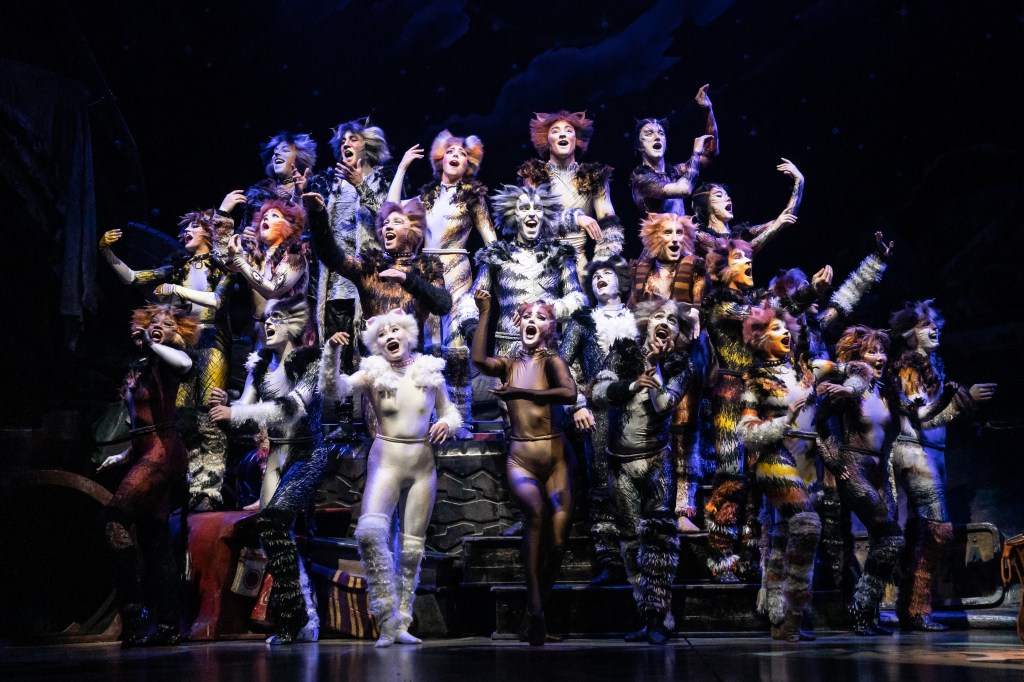
The Cast. All photos by Matthew Murphy, Murphymade,

“Cats.”  It’s really a different breed of – cat.  On its opening at London’s West End in 1981, its radical, never-before characteristics created an immediate buzz.  Its cast is fully anthropomorphized.  It is sung-through in the fashion of grand opera.  Its lyrics are based on poems for children by a Nobel laureate in literature.  Except for a few moments, its diverse choreography and movement is non-stop.  And a plotline is largely lacking, with each song acting as its own separate drama.  Finally, marketing of the musical relies on the visual of the cat’s-eye logo rather than promoting the performers or posting pull-quotes from reviews.

Who could predict that such a musical would set performance records for both the West End (21 years) and Broadway (a mere 18 years)?  But innovation doesn’t put butts in seats.  So, what propelled “Cats” to immortal fame?

Michelle E. Carter as Jennyanydots, Lauren Louis as Demeter, Chelsea Nicole Mitchell as Bombalurina, Kayli Jamison as Jellylorum.

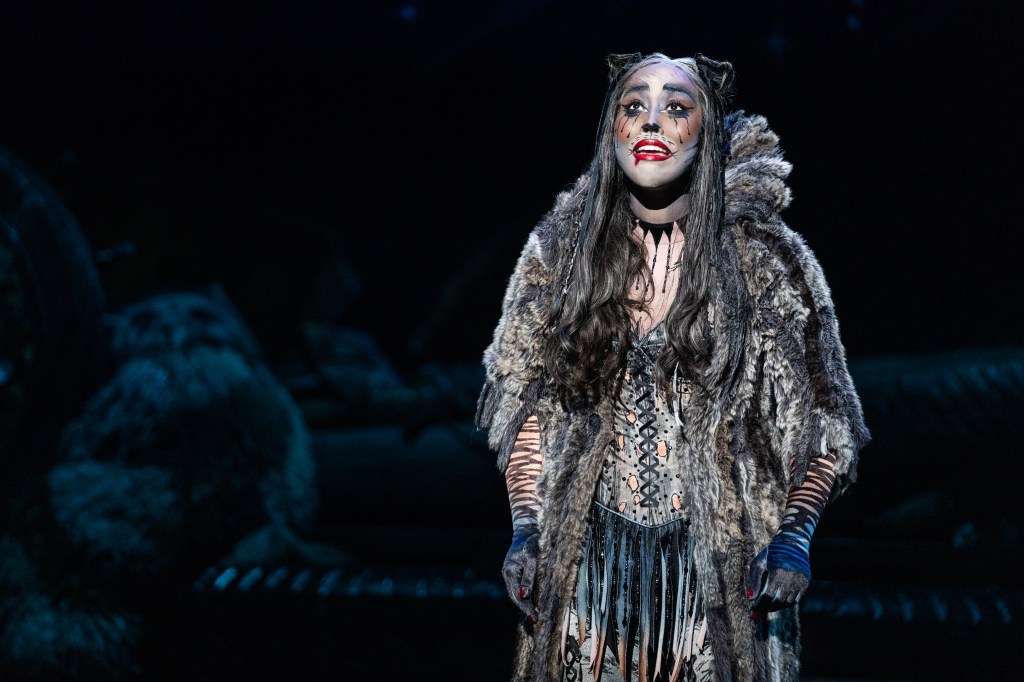
Spectacle!  As the world’s first megamusical, “Cats, and this touring production” fills the eyes and ears with delight.  The scenic design is phantasmic with brilliant shifts in lighting; use of billowy stage smoke; a large seemingly levitating disk; and a very detailed set.  The stage is often filled with two dozen performers adorned in resplendent cat costumes of various ilks.  There is a fluffy, fat, black cat, and a shapely white cat with shaggy legs, and a sleek gray cat, but there are mostly a variety of distinctive striped cats.  They move around the stage almost continuously, crawling and writhing, and best of all, dancing, and doing it quite well.  There are many elements of modern dance, but also fine ballet, particularly by Mistoffelees, with stunning leaps and spins, and even an energetic rat-a-tat tap number led by Jennyanydots.

“Cats” composer Andrew Lloyd Weber pens an eclectic mix of background styles to complement the poetic lyrics.  Except for perhaps the Jellicle theme, few of the tunes stand the test of memory, though the music is effective and often uplifting, fitting the situations of the songs well.  But with “Cats,” Lloyd Weber began a strategy of creating a single tune that could be lifted out of the context of the storyline and pushed for Top 40 music commercial success, thus promoting the show.

Tayler Harris as Grizabella.

That song is the luminous “Memory.”  Although the situation of the haunting and melancholy song is about Grizabella’s separation from the tribe of (fictitious) Jellicle cats and a plea for acceptance, the neutral lyrics make it a universal.   Trevor Nunn’s alluring adaptation of T. S. Eliot’s poem is even superior to the original, creating a very special meter and rhythm that enhances the words and makes the music sing.  The achingly beautiful song closes Act 1 and is reprised in different ways in Act 2.  Happily, the final rendering by Grizabella with a little harmony assist from Sillabub, is a showstopper, because the previous ones on opening night were not memorable.

The musical is full of interesting and distinctive characters whose cat lives map onto human ones.  Each is portrayed with great skill, as if the performer benefits from a collective unconscious of the role having been played thousands and thousands of times all over the world.  Every theatergoer will have their own favorite cat.  There is the wise Old Deuteronomy, the gigantic and respected leader of the Jellicle cats.  Maybe it’s Gus, the Theatre Cat, whose doleful appearance hides a past as a star revealed in his nostalgic reflections.  Or maybe the colorful orange-striped Mungojerrie and Rumpleteaser, the roguish pair of thieves who ransack houses.

Indalecio De Jesus Valentin as Old Deuteronomy (above) and cast.

“Cats” is an audience pleaser, especially attracting younger people to the theater.  Akin to “Rocky Horror Show” a cult of “Cats” lovers exists that see the show multiple times, and their enthusiasm does add to its ambiance and appreciation.  The show has its detractors, largely because of the lack of continuity and cohesive narrative.  Its signature song seems to spring out of nowhere.  And though the performances are totally professional on the whole, there are occasional weak links.  But its assets make “Cats” a unique theatrical experience worth the price of admission.  The current touring production carries on a tradition that will have legs for a long time to come.

“Cats,” with music by Andrew Lloyd Weber and lyrics based on “Old Possum’s Book of Practical Cats” by T. S. Eliot, is produced by Troika Entertainment, presented by Broadway SF, and plays at the Golden Gate Theatre, 1 Taylor Street, San Francisco, CA through June 5, 2022.