The Sound Inside

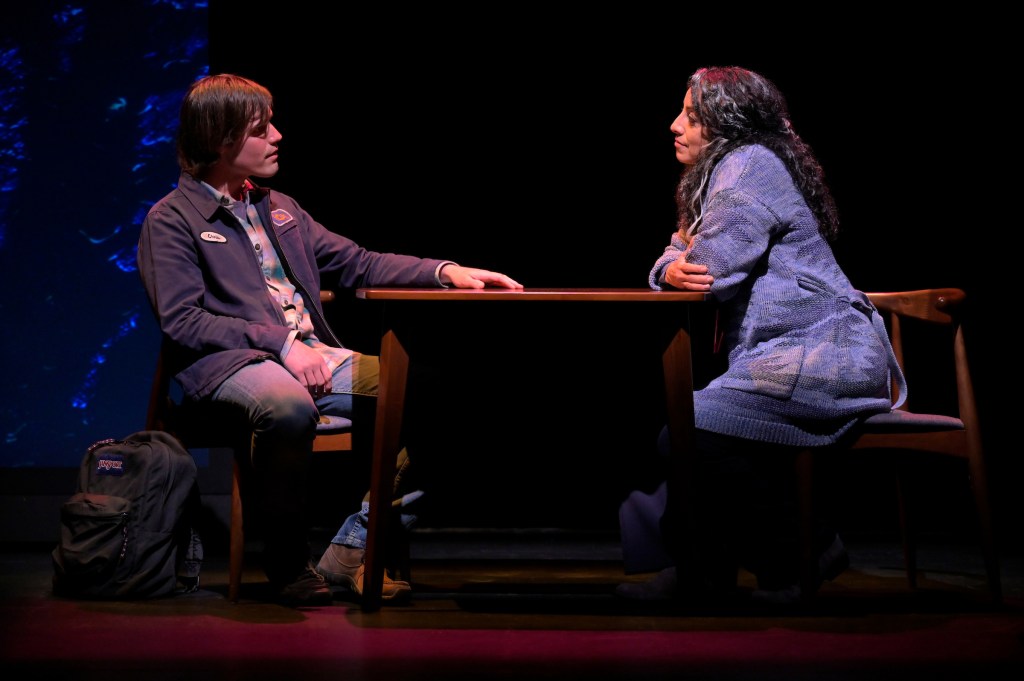
Tyler Miclean as Christopher Dunn. Denmo Ibrahim as Bella Baird. All photos by Kevin Berne.

A relationship staple in the catalog of dramatic themes is that of professor and student.  Traditionally, the professor is a man who takes sexual or emotional advantage of a female student, but that formula has diversified in recent decades.  Perhaps a theatrical watershed was David Mamet’s 1992 two-hander “Oleanna,” which reflected the sea change in universities’ policies in adjudicating teacher/student harassment claims.  Previously, the professor had been assumed, or at least treated, as truthful and innocent, and the student was hung out to dry.  Under new rules at many institutions, a professor was assumed guilty until proven innocent in a harassment accusation from a student unless contact was in public places.

These policy shifts were part of major realignment of the power structure between professor and student.  Abetted by new technologies, professors became more accessible and were to be responsive at virtually any time.  Because of a new emphasis on students’ evaluations of teacher performance, students would hold a stronger hand than ever before.  In this environment, Adam Rapp has also written a two-hander, “The Sound Inside,” a taut relationship drama that takes on characteristics of a mystery or thriller.

Denmo Ibrahim as Bella Baird.

Bella Baird is a tenured professor.  Portrayed with supreme skill and compassion by Denmo Ibrahim, she introduces herself to the audience as a teacher of undergraduate creative writing at Yale University.  Ultimately, we learn that she is 53 years old and never married; loves her job; had a modicum of success writing published fiction; and is enamored of speaking and writing in lengthy, wandering sentences that she cautions her students to avoid.

Christopher Dunn, deftly played by Tyler Miclean, is a Yale freshman.  His outerwear is a thin filling-station jacket that will be his only protection in the dead of winter, but when questioned about it, he demurs, noting “I’m from Vermont.”  Bright and highly literate, his mind and tongue are quick.  He reveals his brashness when responding in class to a tract in Fyodor Dostoevsky’s “Crime and Punishment.”  Unlike his modest classmates, he announces “Someday, I’m going to write a great moment like that.”

Christopher appears at Bella’s office without notice.  In addition to ignoring the university’s appointment scheduling software, the near Luddite doesn’t use email or social media, and while he has a computer, he composes on a manual typewriter.  Though his self-indulgent behavior disrespects the professor’s authority, he is inspired by her teaching and writing, and she appreciates his nimble thinking and lofty goals.  He is also writing a novel, and she is transfixed by both the youthful ambition and the clever narrative he has devised.

Tyler Miclean as Christopher Dunn.

So begins a relationship outside normal boundaries, meeting at her office, at restaurants, and at her home.  Rapp writes exchanges that are frank, and Miclean often snarls Christopher’s crass and fractious comments.  Conversely, Ibrahim displays delicacy as she weighs the consequences of censoring him and perhaps snuffing his spontaneity and their connection.   Several threads beyond their writing define the bonding.  They share appreciation of James Salter’s “Light Years” as well as “Crime and Punishment” and its evil but complex and somewhat redemptive main character, Raskolnikov.

But they are also loners, and Christopher confronts Bella by asking why she doesn’t have any friends.  She admits that she stopped liking people, and Ibrahim is completely convincing in her depiction of Bella as resigned, but adjusted and happy in her skin.  Miclean is disquieting when exposing Christopher’s angst.  Also antisocial, but somewhat unstable, he goes ballistic when Bella insists that following rules is important even in the relative freedom of academe.  Despite their shared interests and long time together, when Bella asks Christopher for a favor that could only be expected from a true intimate, he responds, “But you even don’t know me.”  And the truth is that she doesn’t know the most basic of things about him, such as his middle name.

Tyler Miclean as Christopher Dunn, Denmo Ibrahim as Bella Baird.

As is appropriate in a play focused on literature, Rapp endows his characters with erudite language and astute metaphors.  This is good news for theatergoers who appreciate language as a blessing and a gauge of civilization, but maybe bad news for the marketability of the play.  Many prospective theater goers could find the perceived pompousness and dark elements, including existential threats, as intellectually satisfying but not entertaining as such.  This is unfortunate, because the play is compelling and unpredictable from beginning to end, covering a wide range of human issues.  And if the reader thinks they know the story from this review, think again.  This is but an introduction to a dense and provocative 90 minutes of taut and memorable drama.

Marin Theatre’s production of “The Sound Inside,” masterfully directed by Jasson Minadakis and with two outstanding performances, meets the highest theatrical standards.

“The Sound Inside” is written by Adam Rapp, produced by Marin Theatre Company, and plays on its stage at 397 Miller Avenue, Mill Valley, CA through June 16, 2022.

The Quality of Life

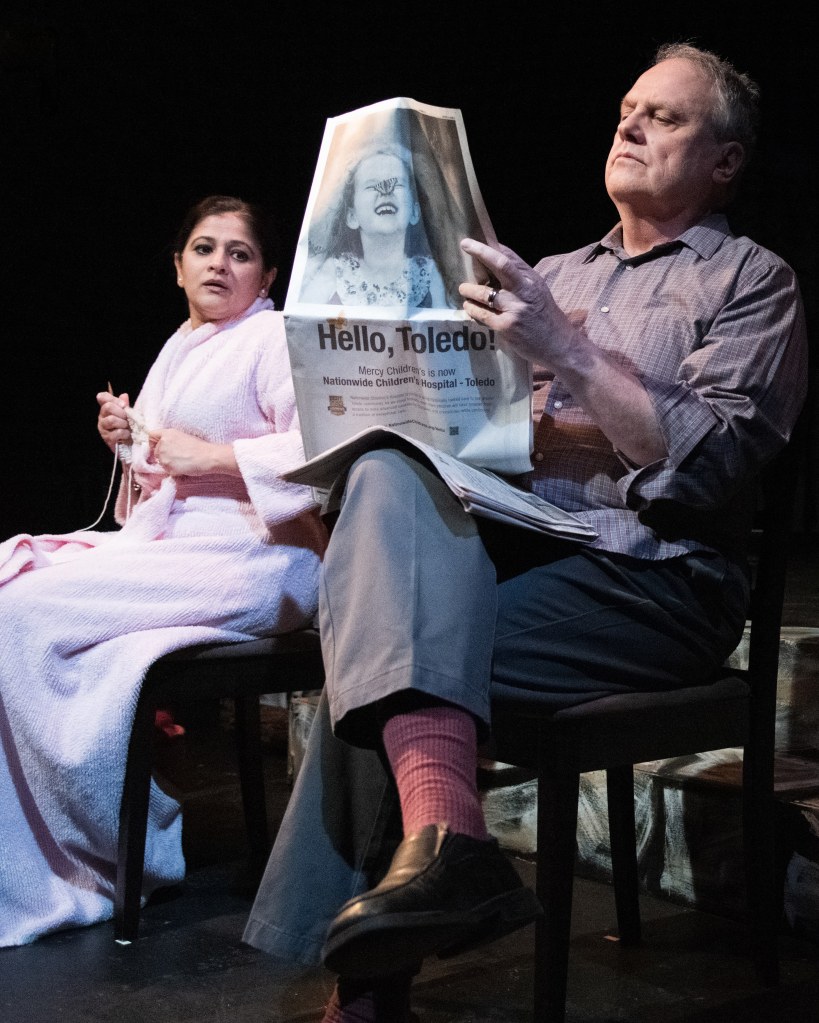
Ted Barker as Neil, Sindu Singh as Dinah, CJ Smith, Bonnie DeChant as Jeanette. All photos by Grizzly De Haro.

More and more, the United States is becoming a house divided – blue states versus red states.  Profound differences in fundamental values, from civil and women’s rights to gun control, rupture the connective tissue of the body politic.

Jane Anderson’s “The Quality of Life” depicts this schism within a family, and it feels even more pertinent today than at its premiere in 2007.  How “today” are family rifts resulting from moral/religious differences as well as the loss of virtually all material possessions due to a California home being consumed by wildfire?

Altarena Playhouse’s production of this biting drama, directed by Katina Psihos Letheule and with set design by R. “Dutch” Fritz, is outstanding.  An amazing foursome of wonderfully-cast actors deliver remarkable and memorable performances to a provocative script that especially resonates with Bay Area audiences.

Sindu Singh as Dinah, CJ Smith as Bill.

While the term quality-of-life registers with most people, its ambiguity derives from the fact that each person’s criteria for it will differ.  Despite the hardship associated with Jeanette and Neil’s losing their Berkeley hills home, the playwright may be suggesting that the involuntary return to nature dictated by their current situation has regenerative and other benefits.  Although some aspects of quality-of-life may be difficult to measure, most will be physical attributes such as number of sunny days a year or availability of public transport.  But the socio-political differences between the two couples in the play also suggest that the emotional effect of being in an environment with people of like thinking is important.

Dinah and her husband Bill have suffered a tragedy, and Dinah feels it would be a good time to get away from their home in Ohio and reconnect with her Bay Area cousin, Jeanette.  Meanwhile, Jeanette and Neil are living in an off-the-grid yurt on their charred property.

The reunion reveals love and conflict within and between the couples, each pair with their resolute philosophical views of how life should be lived.  The playwright exposes a raft of issues to contemplate – faith, ecology, life cycles, renewal, bonding, and letting go.  She endows her characters with distinctiveness, particularly in the nature and strength of their moral convictions.

Tension is continuously palpable from the opening scene when Bill shows his disrespect of Dinah by leafing through the newspaper while she tries to engage him in conversation.  But throughout, humorous asides cool the temperature and keep the taut, serious drama from being depressing. 

Bonnie DeChant as Jeanette, Ted Barker as Neil.

In large measure, the play is comprised of four character studies.  Central to the narrative is Neil, whose body is failing him.  An appropriately ashen Ted Barker exudes confidence as a professor who believes in his rational judgment and relishes intellectual exchange, even though his mind is made up on most issues.  He may even goad an opponent just for fun.

Jeanette is portrayed poignantly by Bonnie DeChant, as one who looks and acts like a maturing hippie.  She’s earthy; she’s confident; and she’s reconciled to the loss of the physical representations of the couple’s 29 years of memories, instead displaying as art the remains of cameras, glass, and window frames mangled by 2000° heat from the fire.

Sindu Singh is Dinah, and the actress beautifully captures her somewhat subservient and timid but sincere and generous nature.  She actively seeks guidance from Christ and usually follows Bill’s lead, but she is not happy with the new congregation that they’ve joined and is committed to helping Jeanette.

Bonnie DeChant as Jeanette, Sindu Singh as Dinah, Ted Barker as Neil.

Finally, while CJ Smith is probably a really nice person, he performs the dogmatic, inflexible Bill to a T.  Bill believes rigorously in his own righteousness and in the Christian path.  He questions whether non-believers can possess morality without having a guidebook for direction.  He is also troubled by the life style of Jeanette and Neil, especially pot smoking.  And as a prototype of today’s clannish conservative politician, there is no problem on earth that he can’t find a way to blame on people of persuasions different from his.  Like Dinah, he does have a giving side, but it derives from intrusion and dominance, not altruism.

As time passes, incidents arise that both bind and divide and raise more questions.  Why do tragedies sometimes promote division rather than unity?  What constitutes the sanctity of life?  Is God responsible when bad things happen to good people, or does God even exist?  Tempers flare and alliances are challenged.  In the end, Bill offers Dinah an avocado tree, and the open question is – “What will it take to grow an avocado tree in Ohio?”

“The Quality of Life” is written by Jane Anderson, produced by Altarena Playhouse, and plays on its stage at 1409 High Street, Alameda, CA through June 26, 2022.

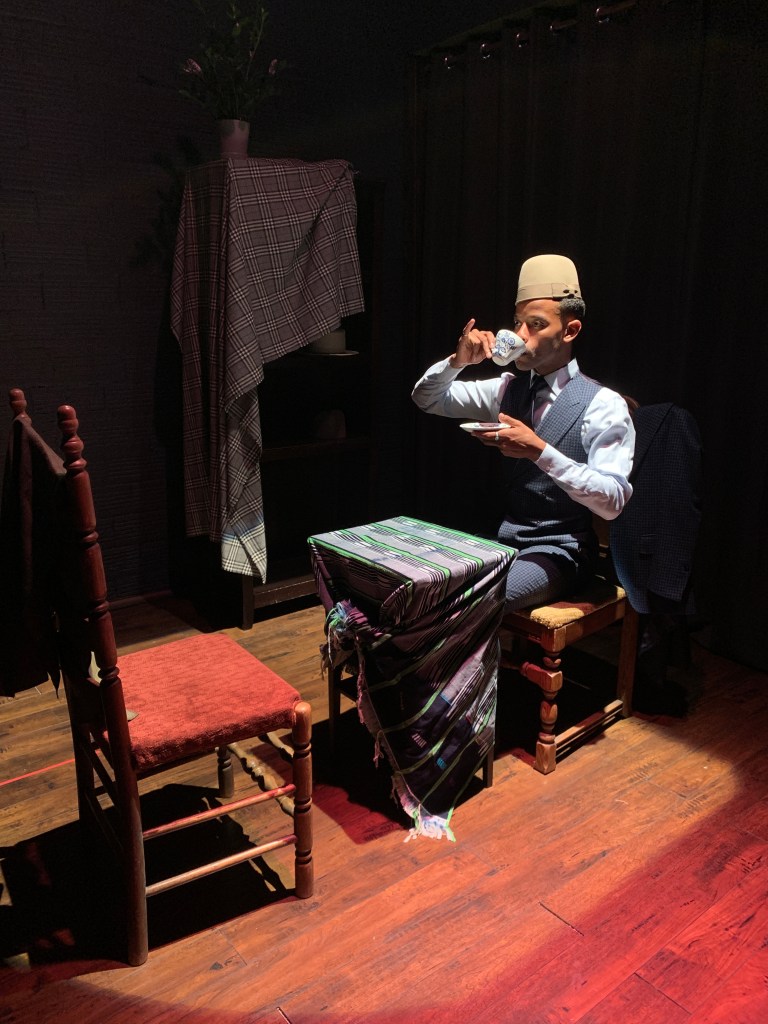
Hat Matter: Thoughts of a Black Mad Hatter

Michael Wayne Turner III. All photos by Colin Mandlin.

The world of wardrobe fashion and fad changes endlessly.  Consider men’s dress jackets alone – from time to time, the mode has been two-button, three-button, thin lapel, wide lapel, double breasted, Nehru, unstructured, and more.  But in the 21st century, dressing up had already fallen into secular decline, then exacerbated by the pandemic and an accelerated rate of work from home.

Yet, pockets of contrarianism exist.  An exemplar of an atypical commitment to fashion is a self-proclaimed Black Dandy – Michael Wayne Turner III, the Black Mad Hatter.  To him, stylish dress is not only an aesthetic preference but a sociological statement of defiance.

In this one-man show, Turner is surrounded on stage by his own wardrobe.  While he tinkers with his clothing for much of the hour of the performance, the title of the show is still somewhat of a misnomer.  Fashion is clearly central to his personality, and the script reveals his personality.  However, he discusses fashion a bit, but sartorial matters act as a springboard for his storytelling and socio-philosophical thoughts.

And spring he does.  Turner is a veritable whirlwind of motion as he regales the audience with his own words – a series of many vignettes delivered variously as prose, poetry, and hip-hop-like lyrics.  They are an amalgam of social commentaries that he delivers with electrical charge.  His enthusiastic emotionalism and provocative thoughts induce audience involvement in a lively call-and-response atmosphere, often associated with African-American religious services.

The author/performer’s dominant and most emotive theme concerns race, which elicits the most vocal response from the audience.  He begins by asking the question “What do you think?” which deals with the issue of the great racial divide, the prejudice in the perceptions of White people about Blacks.  It prompts the thought, why is it that so many people and societies identify by color of skin.  In a more specific account, about the tragic and lawless practice of lynching, he honors the Billie Holliday popularized song “Strange Fruit” with his own ruminations.

Turner also looks at the macro issue of economics in the piece “What’s wrong with the world?”  He presents the humanist argument that much of the poverty and fault in the world derives from the vast concentration of wealth and resources in the hands of few self-interested individuals.  The imbalances cause fractures in all institutions in society including government, education, and justice.  Of course, these dysfunctions lead to further racial disparities.  At the other extreme, Turner includes personal stories from the very special relationship of a newborn with its mother to the first time he experienced getting beaten up – because of mistaken identity.

On a line-by-line basis, the text of “Hat Matter:…” is dramatic and compelling.  Audiences will find much to cheer and reflect upon.  Some tracts may seem stream of consciousness and disjointed, but overall, the language is colorful and riveting, and the thoughts are profound.

“Hat Matter: Thoughts of a Black Mad Hatter,” written by Michael Wayne Turner III, played on the stage of Oakland Theater Project at Flax Art & Design, 1501 Martin Luther King Way, Oakland, CA in May, 2022.
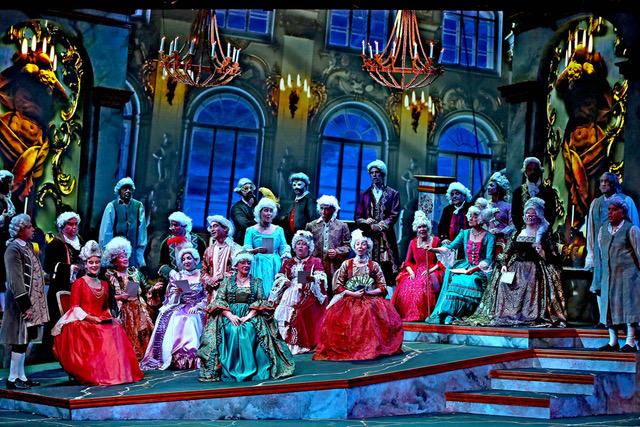
Pique Dame

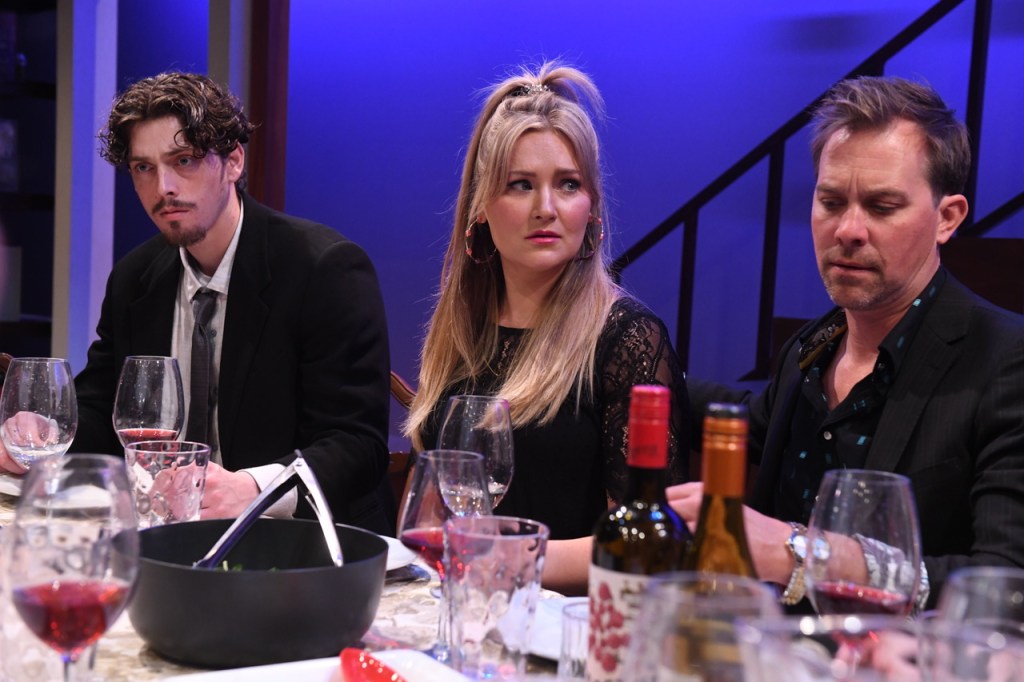
Michael Boley as Hermann and Rhoslyn Jones as Liza. All photos by Otak Jump.

Few classical composers can claim a substantial portfolio in both instrumental music and opera.  In the United States, Pyotr Illyich Tchaikovsky is best known for his distinguished ballet music, “The Nutcracker,” “Swan Lake,” and “Sleeping Beauty,” as well as great symphonic pieces such as his “Symphony No. 5,” and “Piano Concerto No. 1”.  Tchaikovsky also wrote 11 operas, several of which remain immensely popular in Slavic countries.

Despite the difficulty of casting Russian language opera, two are present in the American repertoire, “Eugene Onegin” and “Pique Dame” (“Queen of Spades” in English).  Although the former premiered 11 years earlier than the latter, they share the same DNA, including source material derived from Alexander Pushkin.  Thematically, both involve military officers, unconsummated love, lethal gunfire, and untimely deaths of principals.  Musically, their haunting Russianness draws on folk music, sharing similar idioms and phrases, yielding common overarching sound adorned with uncommon poignancy.

Jonathan Beyer as Prince Yeletsky, Jason Beaman as Chekalinsky, Matthew Lovell as Surin, Kiril Havezov as Tomsky, Michael Boley as Hermann.

Gaming occurs in numerous operas, usually to create an ambiance or to elaborate a main character’s character, sometimes as an addictive personality.  In “Pique Dame,” gambling acts as the central metaphor of casting one’s fate to the vagueries of chance.   Uniquely, the title of the opera is represented by one symbol-laden playing card.

Hermann, a seemingly virtuous but poor army officer, often visits the casino with friends but only as an observer.  Upon falling in love with Liza, he finds that she is the granddaughter of the Countess and therefore above his station.  Dedicating his life to becoming rich enough to marry Liza, he learns that the Countess extricated her way out of extensive gambling debts by betting on an irrefutably successful sequence of three numbers.  But that supernatural bestowal carried threatening conditions.  In his obsession to learn the sequence, Hermann’s morality is compromised, and Liza questions whether he still loves her or is only interested in the money or the quest itself.

A suitably doleful Michael Boley portrays the desperate Hermann.  In a role that challenges in vocal complexity, he also sings in every scene.  From his first significant set piece, the aria leading to a duet with his friend Tomsky, “I don’t even know her name,” Boley displays both range and power.  Early on at opening night, his voice seemed to lack full melodiousness, but it sounded richer as the evening progressed, and he redeemed himself well.

Maria Kaganskaya as Polina, Rhoslyn Jones as Liza, chorus member.

As the object of Hermann’s affection, Liza is played by Rhoslyn James.  With some exception, the tessitura of Liza’s part in early scenes is middle range, which plays well to James’ big, round vocalization in that realm.  Her duet with Polina, “Tis evening, the edges of the clouds have darkened” and her ambivalent aria about loving two men “But why these tears?” both demonstrate her easy power.  Range demands increase later in the opera, leading to her beautiful rendition of Liza’s evocative signature aria in Act 3, “Ah, I am worn out by grief.”

Tchaikovsky is at the top of his opera game in “Pique Dame.”  His plaintive and phantasmic sound, often relying on the reeds and large strings, suits the ghostly elements of the script.  The story line compels as we see Hermann’s obsession take hold, and considerable tension created.  The principal action is complemented by orchestral interludes and extensive use of chorus.  To make the setting more exotic to then contemporary audiences, the composer moved the action back to the 18th century.  In a gesture to classicism and particularly Mozart, he not only mentions that composer by name, but he includes a pastiche pastoral play-within-a-play, “The Faithful Shepherdess,” which also includes a fine female duet.

Laure de Marcellus as The Countess.

Producing this opera is among the many courageous decisions by General Director and Conductor José Luis Moscovich to extend the repertoire of his audience.  This production offers a delightful experience and everything an attendee of regional opera should expect.  That said, there are certainly pluses and minuses to note.  The secondary principal cast members, too many to mention, uniformly meet or exceed expectations.  Most had appealing and sometimes surprisingly strong voices, and they offered many highlights, as Tchaikovsky spread the wealth around.  The choristers have room for improvement, but they convey the music and the tone well.  Kudos to the large number of women, men, and children for participating in a work with considerable choral content that must be learned by most singers as nonsense syllables.

On the design side, Peter Crompton has established an excellent and efficient scenic formula for West Bay Opera productions that includes multilevel forestage; extensive projections as side walls and backdrops; and a few sticks of movable furniture.  These sets are handsome and make the staging appear complete. A number of projections are used, but in some instances, they fail to reflect the spaces they are supposed to represent – bedroom and barracks scenes, for instance.  Abra Berman also deserves a nod for capturing an appropriate look and for the sheer volume of costumes required for this production, which alone ornament the stage with a period appearance.  One exception is that the outer tunics of the military outfits lack appropriate decoration or distinction and thus don’t capture the feel of dress uniforms.

Women’s and Men’s choruses.

As indicated earlier, this is an opera that opera lovers will love.  It is a deserving production that can be thoroughly enjoyed.

“Pique Dame,” composed by Pyotr Illyich Tchaikovsky with libretto by Modest Tchaikovsky, after a novella of the same name by Alexander Pushkin, is produced by West Bay Opera and plays at Lucie Stern Community Center, 1305 Middlefield Road, Palo Alto, CA through May 29, 2022.

Monument, Or Four Sisters (A Sloth Play)

Rinabeth Apostol, Lisa Hori-Garcia, Erin Mei-Ling Stuart, Sango Tajima. All photos by Jay Yamada.

I know.  Your first question will be “What’s with that name?”  Each of the three elements in the title reflects something of significance in the play.  It wouldn’t be my choice, but at least you can say that it represents the many layered nature of the narrative.  Playwright Sam Chanse has created a highly involving entertainment in this world premiere, propelled by the dual engines of humor and empathy.  Vignettes touch on a veritable compendium of issues that women face in life while mixing in a big dollop of environmentalism.  Its most significant weaknesses are that it can seem a little preachy and that unseen male characters are uniformly flawed or bad.  However, an otherwise fine script and an outstanding production yield a highly pleasing result.

Four API-American (that’s Asia Pacific Islander) sisters comprise the dramatis personae and the centrality of the story line.  Erin Mei-Ling Stuart is Amy, a marine biologist who not only has the most successful career of the sisters, but acts as the family anchor, always empathetic and ready to help.  Rinabeth Apostol portrays Constance.  She writes for animated children’s television programs but isn’t always happy about some of the concessions that she must make in depictions of female and minority characters.  Sango Tajima is Mac, the youngest of the group.  Although she was very happy in a job that she had held for years, she left under undisclosed circumstances and has been living at Amy’s house while she seeks a new way forward.  Finally, Lisa Hori-Garcia plays Lina, the mystery sister who rarely stays in touch.  Although she has a career in the arts world, her husband plans to move to a community where there would be no call for her professional skills.

Sango Tajima, Rinabeth Apostol.

Rather than a forward moving plot, “Monument…..” is more a well-assembled kaleidoscope of unfolding episodes that reveals its characters.  Themes of the uphill battles that women face include male priority and dominance, starting often with their fathers; sexual harassment; unfair behavioral standards, and more.  But while the topics aren’t new, their depictions are fresh.

Constance makes keen observations about gender discrimination that a man is usually less aware of than a woman.  She discusses the delightful animated movie “Ratatouille,” in which a Paris rat becomes an esteemed chef.  That’s okay, but her beef is that all of his sewer rat associates are voiced by males, which is probably unnoticed by most viewers.  Her point – if they were all females instead, the audience would undoubtedly wonder if they killed off all of the male rats.  She also notes that in the animated series that she writes for, the heroine, Magdalena, is the only female.  But Constance bemoans that Magdalena is characterized as expert in many endeavors in order to establish her credibility with viewers, whereas a man wouldn’t need all those qualifications in order to be the hero.

Erin Mei-Ling Stuart.

Two of the sisters’ professional activities tie into the ecological aspects of the story.  The characters in Constance’s animated adventure series are sloths, and audience of the play is regaled with the symbiosis and vulnerability that results from sloth’s pooping!  In addition, Amy gives lectures on coral building, which also depends on symbiosis, as well as the death of coral by bleaching, which comes from the collapse of fragile natural relationships.

“Monument, or Four Sisters (A Sloth Play)” is a delight.  The playwright introduces topics of great moment and invests them with an apt balance of poignancy and hilarity.  She has created lively and complex characters that we are drawn to, and who are played with consummate skill by a wonderful cast that exude emotions as varied as playfulness and gravity from the script as required.

Rinabeth Apostol, Sango Tajima, Lisa Hori-Garcia, Erin Mei-Ling Stuart.

In addition, Magic’s production, deftly and richly directed by Giovanna Sardelli, turns the play into a multidimensional confection.  All of the creative designers add to the splendid outcome, however two have the most visible impact.  Sarah Phykitt’s videos are very active throughout, but those of the animated television program clips are particularly striking.  In conjunction with those video diversions, costume designer Michelle Mulholland excels.   The four actors play the comic sloths Magdalena and her male followers on the stage in costumes that fit the silliness of the skits.

“Monument, or Four Sisters (A Sloth Play)” is a world premiere written by Sam Chanse, produced by Magic Theatre, and plays on its stage at Fort Mason, Bldg. D, 2 Marine Blvd., San Francisco, CA through May 29, 2022.

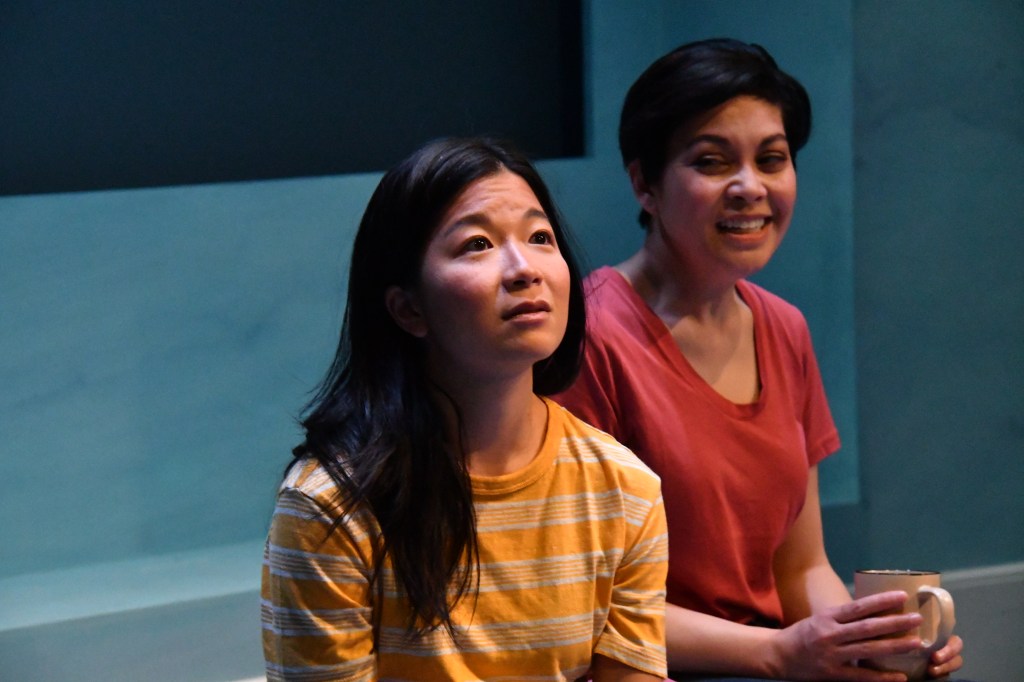
Endlings

Pauli N. Amornkul, Mia Tagano, Keiko Shimosato Carreiro. All photos by David Flores II.

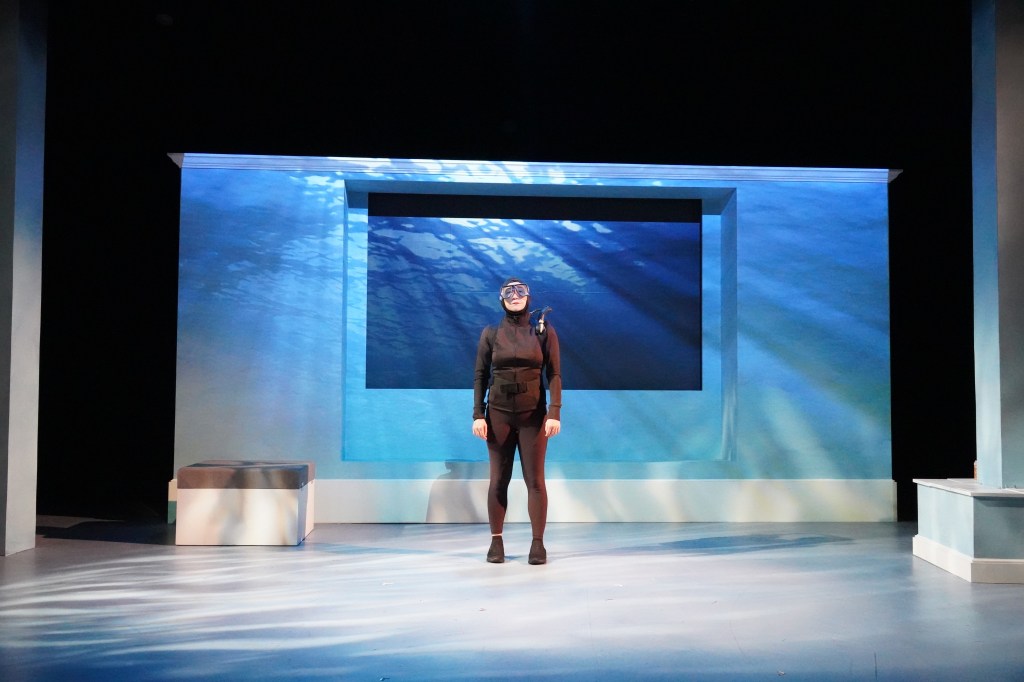
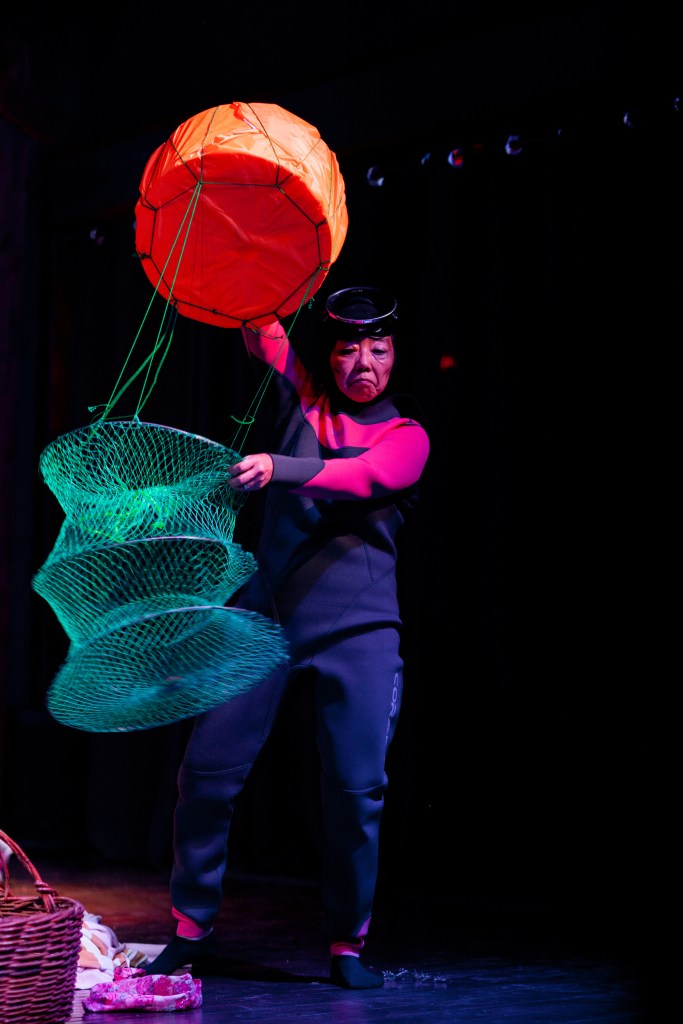
The main subjects of “Endlings” seem like inspiration for the kind of article you would see in “Parade” magazine – “World’s Most Unusual Occupations.”  Three Korean women, aged 78 to 93, are the last of a dying breed in a centuries-old occupation.  As recently as the 1970’s, over 15,000 women made their living in this manner in a matriarchal society.  They free dive as deep as 65 feet without additional air supply, repeatedly throughout each day, to harvest seafood and seaweed from the ocean’s bed.   Because more efficient means exist for capturing these delicacies, their earnings are subsistence level.  But they live on a small island, Man-Jae, with minimal commerce, and it’s the only income producing skill that they possess.

Playwright Celine Song honors these haenyeos, or “sea women” with an insightful and charming narrative about their daily cycles.  Each woman has her own schtick.  The eldest, Han Sol, is generally cheery and copes with the boredom of their existence best as indicated by her mantra “television rules.”  Go Min, the middle one by age, is somewhat dour and the saltiest of the salty mouths.  She insisted that her kids get as far away from the island as possible, and since her husband died, she finds nothing to stimulate her.  Sook Jo is the youngest (at 78!).  Never having married, she still thinks she knows how best to raise kids, and still concerned about appearance, she applies lipstick to dive.  Keiko Shimosato Carreiro, Mia Tagano, and Pauli N. Amornkul respectively provide moving and authentic representations of these women.

Pauli N. Amornkul, Mia Tagano.

As might be expected, much of the women’s conversation centers on work, but with an uncommon focus – death.  The risks of their work are ever present, and they recount how other haenyeo have lost their lives during dives.  But the obsession with death goes beyond work, perhaps because of their ages.  There is even a recurring theme in which the pecking order of age plays a role, in which Han Sol insists that she must die first.  In this near-solitary existence, there is also concern about who would attend their funerals as the elder two’s families have dispersed, and Sook Jo has none.

What dissipates the attention from the main theme is that the playwright imputes herself into the play with a second story, but that scenario is full of perception.  The scene shifts to Manhattan, where we meet an ethnic Korean woman, Ha Young, in her late 20s who has just written the first act of a play, which is presumably the act that we just saw.  She feels that she had previously sold out to whiteness in her writings, and this is her first effort at a story that reflects her ethnic heritage.

Keiko Shimosato Carreiro.

Ha Young’s internal identity conflict is revealed in a play-within-a-play-within-a-play that concerns the perceived whiteness all around her.  Her husband really is white, but in the skit she envisions, white actors live in an all-white world with white prayer, white money, white rage, white everything.  The preoccupation with all things white is equaled by her world view centered on real estate, where all is reduced to “location, location, location” and the fixation on apartment rental prices.  The whiteness speaks to cross-cultural differences that she confronts, and real estate presumably is a commentary on comparative values and materialism.

The Manhattan act does try to tie back to Korea with the immigration story of Ha Young’s ancestors, but it still seems like the playwright wanted to force all of her ideas into one play, even getting into the political division of Korea and how it affected her fictional family.  The good news is that the playwright is portrayed by a delightful Joyce Domanico-Huh who informs the role with boundless freneticism and juicy sarcasm.

Joyce Domanico-Huh.

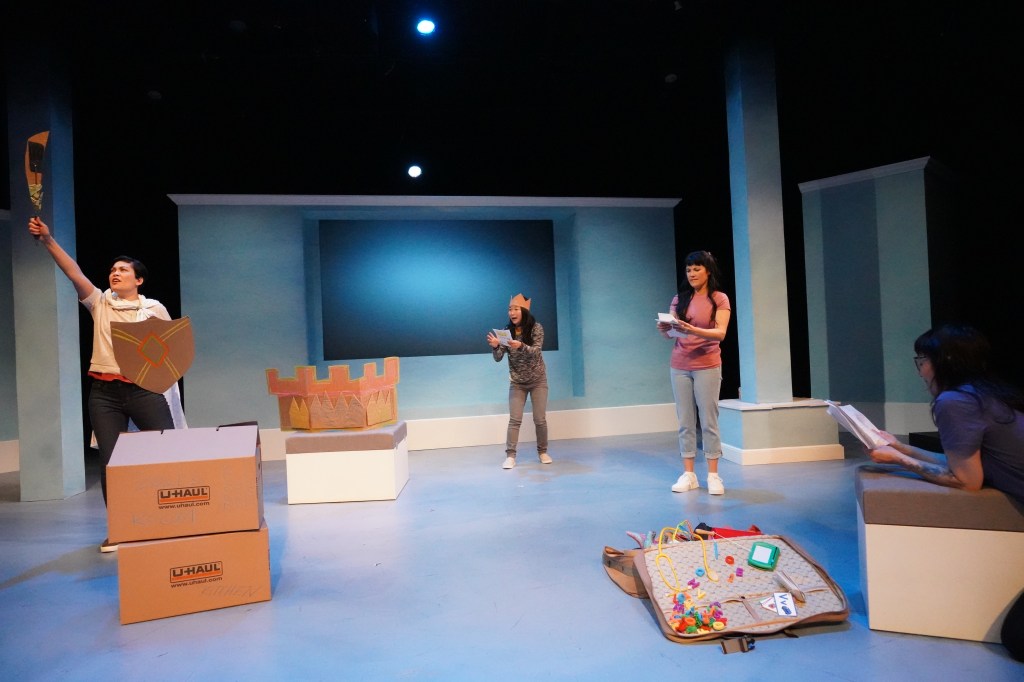
Happily, both acts have something to say, and those interested in cross-cultural issues will find the evening rewarding.  Typical of Oakland Theater Project plays, Director May Liang makes good with limited resources and creates a total environment feel.  Karla Hargrave’s spare scenic design with fine use of props offers enough tangible detail to give a good sense of place.  OTP stalwart Stephanie Anne Johnson does wonders with the lighting as we have come to expect.  Elton Bradman adds an extra dimension with the background sounds of sea and storm. 

“Endlings,” written by Celine Song, is produced by Oakland Theater Project in association with Ferocious Lotus Theatre Company and plays on OTP’s stage at Flax Art & Design, 1501 Martin Luther King Way, Oakland, CA through May 1, 2022.
Fefu and Her Friends

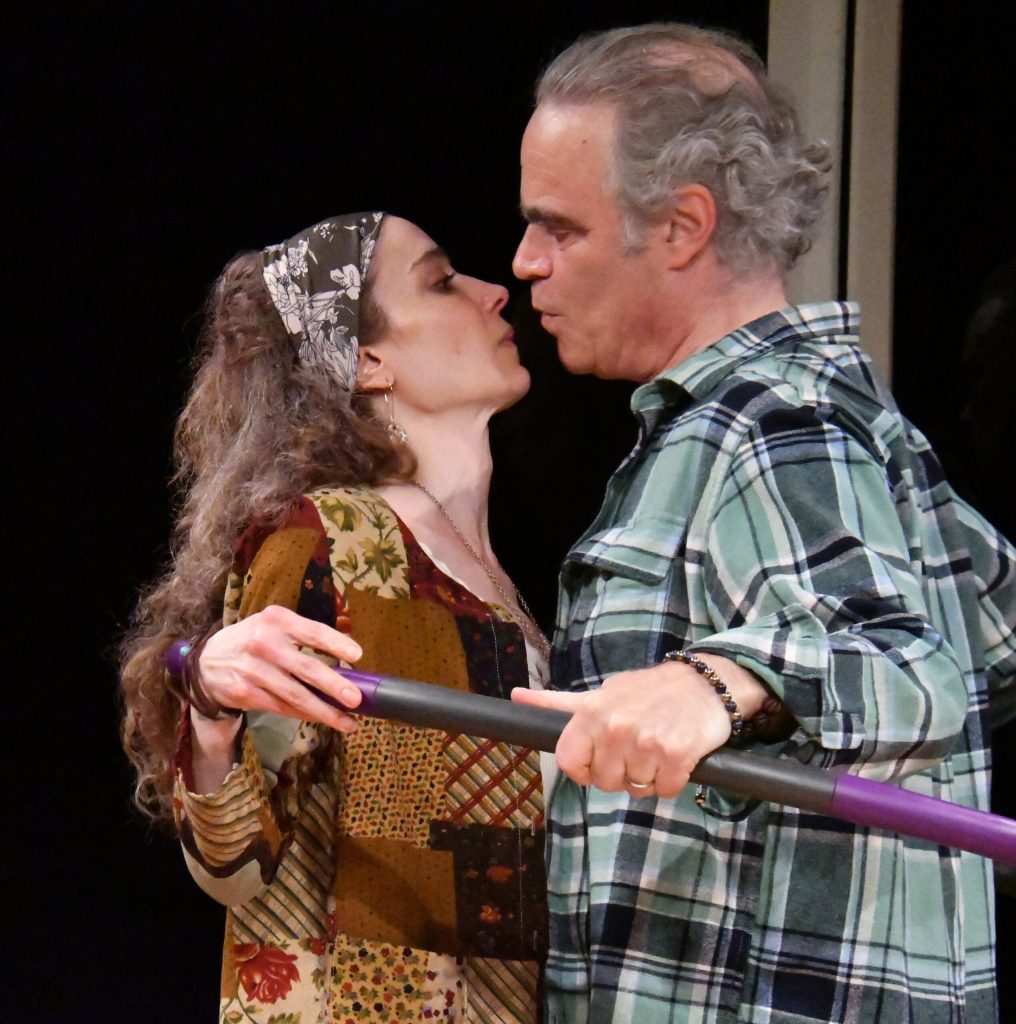
Sarita Ocón as Christina and Jennifer Ikeda as Cindy (both facing away), Lisa Anne Porter as Julia, Cindy Goldfield as Emma, Catherine Castellanos as Fefu, Marga Gomez as Cecilia. All photos by Kevin Berne.

In 1936, Clare Boothe Luce’s “The Women” became the first play with an all-female cast to reach the stage.  The women came from various walks of life; topics focused mostly on women’s relationships with men; the venues ranged from Manhattan to Reno and a trans-continental train that linked them; it took place over years; and the characters were stylized.

In 1977, María Irene Fornés’ innovative “Fefu and Her Friends” replicated the notion of an all-female cast but flips the script on all of those dimensions.  It concerns a reunion of a group of friends gathered to rehearse a presentation to be given to a charity; themes are varied, including women’s relationships with women, which was pretty daring at the time; the single setting is Fefu’s house; action takes place in one day; and the characters, if a little wacky, are grounded in realism.  ACT has assembled a cast of some of the Bay Area’s finest actors and provides a beautifully produced and directed, entertaining production of this quasi-absurdist play.

Catherine Castellanos as Fefu, Cindy Goldfield as Emma (both on balcony). Atrium as garden breakout venue.

But first, a note on a distinguishing structural conceit that limits the number of sites where it can be produced and creates unusual logistics challenges.  Although the happenings occur in one house, they span five locations.  For the opening and closing acts, the living room scenes are performed on the main stage.  In between, four breakout rooms are used for activities that go on simultaneously.  The audience is divided into four groups that rotate to the various locations to see the nine-minute scenes.  This play is highly regarded but seldom performed because of the design demands, so take advantage of seeing it while you can.

The use of simultaneity had been raised to high art by Alan Ayckbourn’s “Norman Conquests,” comprised of three full plays, each occurring in different parts of a house and grounds with the same six characters in each.  However, Fornés’ twist of the promenading to the four small locations adds the opportunity for audience reflection and sharing insights during the proceedings.   The viewer also observes those scenes with such intimacy as to feel like a member of the reunion.

Stacy Ross as Paula, Marga Gomez as Cecilia. Kitchen as breakout venue.

The play is set in New England in 1935.  Although Fefu, portrayed with flamboyance and dominance by the redoubtable Catherine Castellanos, facilitates the affair, wheelchair-bound Julia represents the axis of the plotline.  Sometime past, when a hunter had killed a deer in the woods, Julia, who was in attendance, fell as if shot herself.  And while no external wound was found, Julia suffered the loss of movement in her legs and a recurring madness developed.  Perhaps her condition represents the invisible emotional pain that many women suffer.

From start to finish, Julia’s story is quite short, but narratives zigzag as we learn about the women’s lives and relationships.  The playwright’s goal seems to be more about getting to know some real and diverse women and their relationships behind the curtains, rather than pressing a particular thematic agenda.  The content of scenes is all over the place.  One breakout session takes place in the study where Christina verbalizes her French language lessons and Cindy muses aloud at world records in a “Ripley’s Believe It Or Not” book.  They intermittently chat about things like the literal versus figurative meanings of being swept away.  That’s it!

Meanwhile, in the kitchen, Paula deconstructs the cycle of love into its sequence of events and determines that it lasts for seven years and three months.  As she’s solving this profound mystery, she is visited by Cecilia, a former lover who appears interested in rekindling the flame.

Sarita Ocón as Christina, Jennifer Ikeda as Cindy. Study as breakout venue.

The only breakout session with complete linearity to the central narratives has Julia lying in a semi-conscious state in a bedroom, hearing voices and mumbling about being clubbed.  Another odd thread is that she expresses misogynistic thoughts that are also espoused by Fefu in the living room.  These ideas are difficult to digest in the context of a play that advances women as whole people, but perhaps it’s another reflection of the playwright’s desire to be adventuresome and provocative rather than definitive.  As Fefu says, “Life is theater; theater is life.”

Subject matter is often dense and delivered with speed so that it may be hard to follow at a micro level, but whole skits can be missed without losing the overall sense of the play.  Each character has a chance to shine, but the most impactful is probably Cindy Goldfield as Emma.  She delivers an environmental treatise that includes dramatic sign language which is a hoot, as well as a line of questioning that starts “Do you think of genitals all the time?”

Leontyne Mbele-Mbong as Sue, Stacy Ross as Paula, Lisa Anne Porter as Julia.

Director Pam MacKinnon marshals her resources well.  Not only are there five stages to dress, but the logistics of moving the audience groups around as well as some of the actors who appear in more than one of the simultaneous vignettes is a special challenge.  Tanya Orellana has designed five spectacular and highly varied stages with separate audience seatings.  Jake Rodriguez with sound and Russell H. Champa with lighting have also created multiples of their artistic specialties.  The distinguished cast is Catherine Castellanos as Fefu, Cindy Goldfield as Emma, Marga Gomez as Cecilia, Jennifer Ikeda as Cindy, Leontyne Mbele-Mbong as Sue, Sarita Ocón as Christina, Lisa Anne Porter as Julia, and Stacy Ross as Paula.

“Fefu and Her Friends” is a unique theatrical experience that stimulates all of the senses.  ACT’s realization excels by every measure.  But to fully appreciate it, you must be pleased to leave the theater with more questions than answers.

“Fefu and Her Friends” is written by María Irene Fornés, produced by American Conservatory Theater, and plays on its Strand Theater stage at 1127 Market Street, San Francisco, CA through May 1, 2022.

Hotter Than Egypt

Paul Morgan Stetler, Jen Taylor, Ahmad Kamal. All photos by Kevin Berne.

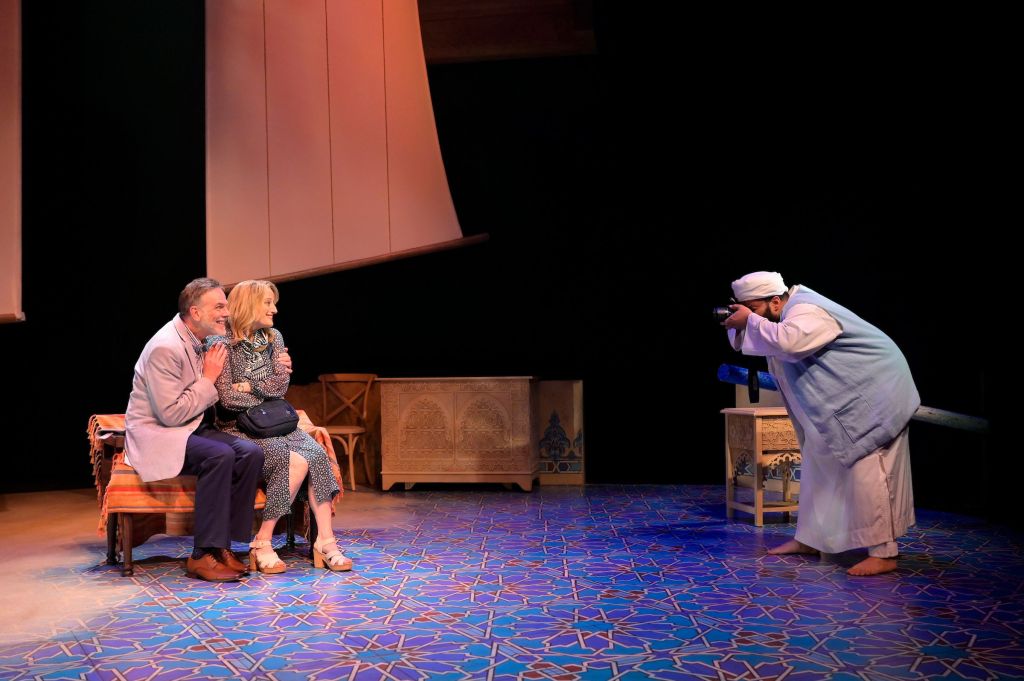
When Jean returns from the pool to the hotel room in a two-piece bathing suit and towel, husband Paul insists that she dress immediately, as their Egyptian tour guides, the recently engaged Maha (female) and Seif (male) are present.  Maha had previously been Paul’s tour guide, and she is breaking in Seif, as she hopes to shift to fashion design.  Maha insists that Jean is a tourist doing what tourists do, and that she is not offended.  Seif, supposedly speaking Arabic to Maha, is sarcastic.  Not wanting to offend local sensitivities, Paul persists, arguing to Jean that the Egyptians are not always going to say what they really mean.

This opening volley sets in motion the cross-cultural dimension of “Hotter Than Egypt,” which, by the way, is not a reference to the weather.  But the play-opening incident does raise some interesting questions.  Although cultural differences and norms clearly exist, does recognizing and acting upon them automatically affirm a form of stereotyping?  And though great differences between cultures often exist at the working-class level, generally, aren’t the richer and more educated in most places more cosmopolitan and not so bound by their society’s broader mores?  And should we cut more slack for private behavior than public action?

Naseem Etemad, Wasim No’Mani.

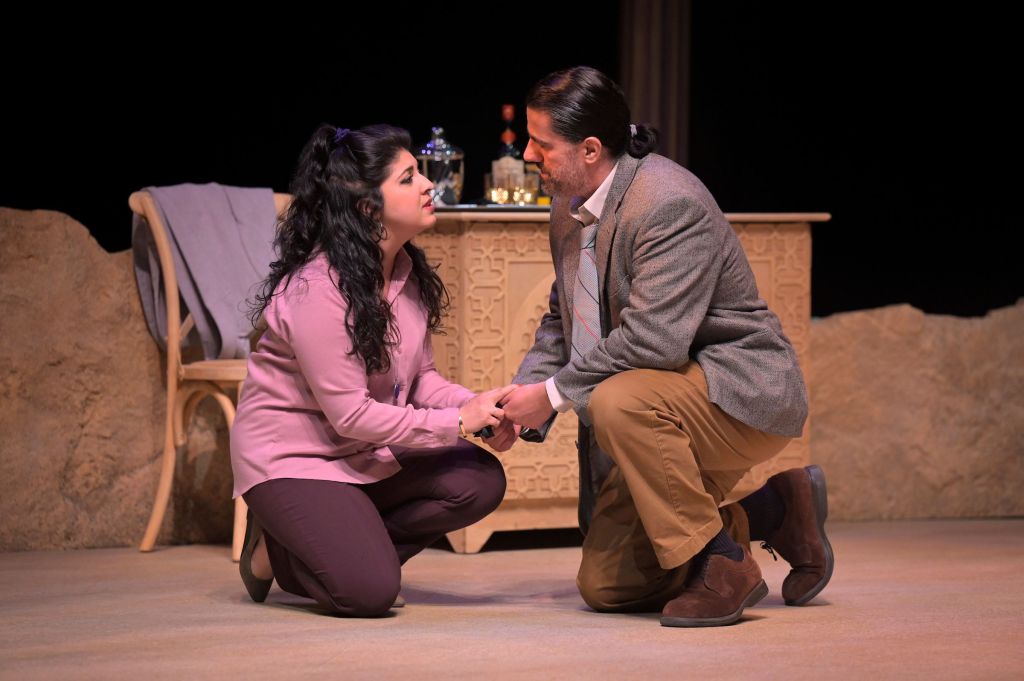
Yussef El Guindi’s new play deftly delves into a constellation of differences – not only cultural, but marital, economic, power, gender, and generational – some between cultures and some within.  The result is a lively dramedy that reveals the causes and consequences of the cracks in the American couple’s marriage.

Paul is a successful businessman from Wisconsin who has previously visited Egypt on business trips.  He and Jean have decided to celebrate their 24th wedding anniversary by combining business and pleasure on a trip Cairo.

Rather than a commemoration, the playwright shows how time together can expose classic, long simmering issues.  One is the asymmetry, particularly in the white-collar community, that results when the wife is a homemaker, which Jean is.  For decades, the husband engages regularly with other adults on issues of consequence beyond the family, while the wife’s horizons are limited mostly to dealing with children and interacting with other stay-at-home moms.  The husband thus may find the wife has become boring to him with less to say about the outside world.  The other is the contention that while men can become more attractive with age, that women invariably lose their appeal (this writer rejects that viewpoint), with the result that younger women become interested in older men and vice versa, often with disastrous outcomes.

Wasim No’Mani, Jen Taylor.

Structurally, the many social and personal divides are revealed in an unusual, but effective manner.  The bulk of the stage time is taken by scenes of two-person, mixed-gender conversations, with all four combinations of principal characters well represented.  Each twosome constitutes a very different relationship, and in these dyadal exchanges, we get in-depth looks into these people, who are depicted in very real ways.  The Paul and Jean conversations reinforce the notion that people simply change over time, and that any two people don’t necessarily change in compatible ways.  We also understand the kismet of random events.  Certain uncontrollable situations can have profound impacts on relationships.

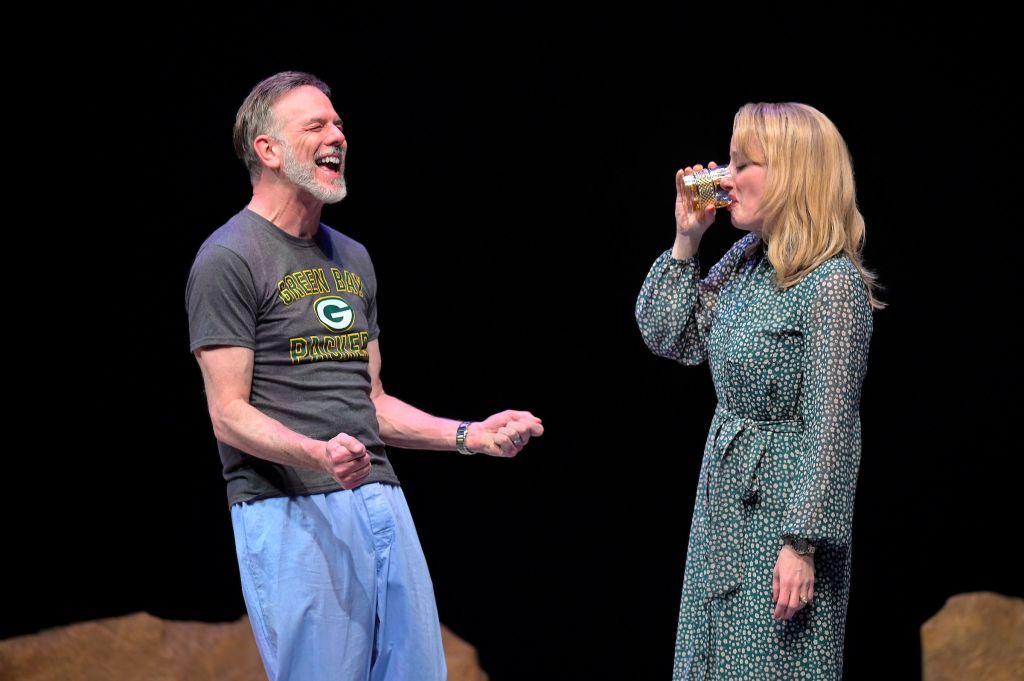
Depictions by each of the actors resonate with authenticity. Paul (portrayed by Paul Morgan Stetler) is a great proponent of U.S. values; smarmy in his certitude; and deluded into believing that he is a great proponent of women’s rights, although he is quite condescending to his wife.  The diffident Jean (a particularly sensitive portrayal by Jen Taylor) feels her life has been wasted and dislikes her college-aged kids, but this adventure may be a game changer for her.  It’s not clear whether it is she or Paul who is more responsible for their sexual disengagement.  Maha (Naseem Etemad) is amiable, but goals oriented enough to keep her eye on the prize, tolerating what she must to get there.  The less self-censored Seif (Wasim No’mani) is “fed up with what we are in this country” but equally disparaging of ignorant foreigners.  In the end, however, he is perhaps the most complex of the characters, both in his restraint and in his foresight.

Paul Morgan Stetler, Jen Taylor.

Throughout, we see enough of Egypt to get the seeds of difference that separate it from American ways.  Nothing concerning this plot line is particularly original, but thematic elements are compiled in a cohesive and interesting fashion and effectively directed by John Langs.  The production is very worthy.  One glitch is that, at the beginning, it was not clear that Maha and Seif were speaking Arabic to each other when in the company of others, though later, Paul refers to being uncomfortable when they do.  More interesting options would be for the characters to speak Arabic while projecting English surtitles or for the Egyptians to code-switch into heavy accents to identify the foreign language speaking.

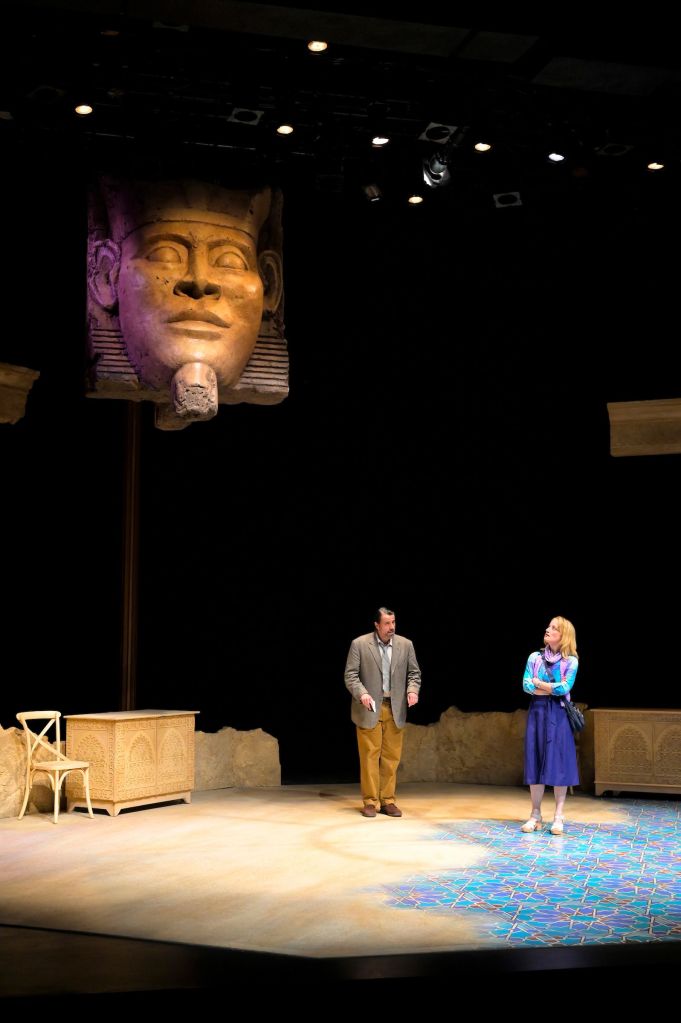
The story plays against Carey Wong’s strong and versatile set that had to be redesigned from the Seattle co-world-premiere, as it was performed there in-the-round, whereas Marin has a proscenium stage.  Special touches like antiquities features and the sails of a felucca boat on the Nile suspended from the fly add to the ambiance.  Johanna Melamed’s rich sound design evokes an Egyptian feel.

“Hotter Than Egypt,” a world premiere, is written by Yussef El Guindi, co-produced by Marin Theatre Company and A Contemporary Theatre of Seattle, WA, and plays at the MTC stage, 397 Miller Ave., Mill Valley, CA through April 24, 2022.

August: Osage County

Allison F. Rich as Barbara, Michael Ray Wisely as Bill, Judith Miller as Violet, Marie Shell as Mattie Fae. All photos by Dave Lepori.

In “Anna Karenina,” one of his finest novels, author Leo Tolstoy notes that “Happy families are all alike; every unhappy family is unhappy in its own way.”  In “August: Osage County,” the greater Weston family of greater Tulsa, Oklahoma and beyond covers most of the bases for unhappiness – suicide, addiction, adultery, separation, betrayal, incest, and more.  But at least they pursue their unhappiness with a certain quasi-intellectual flair and rapier-sharp wit (complemented by an abundance of f-bombs) as the family abounds with writers, teachers, and a librarian.

Playwright Tracy Letts’ Pulitzer Prize and multiple Tony Award winning play concerns the family reunion from hell.  The family doge, Beverly, was a prominent poet in his younger days, but settled into a long life as a disgruntled teacher and acknowledged but likeable alcoholic.  Several days after his unexplained disappearance, Violet, his wife and family doyenne, musters the troops.  Her sister and three daughters, each with their own family attachments in tow, arrive at the family homestead, and the mayhem begins.

Elena Wright as Ivy, Judith Miller as Violet.

Letts has mastered dramedy.  The events could not be more serious, yet the constant flow of laughable moments seems totally organic and averts the dark descent into another “Long Day’s Journey into Night.”  San Jose Stage stays true to the play’s intent and delivers an absolutely riveting production with captivating performances that make the time fly by, though run time could be the play’s most common criticism.  Along with fine contributions from the creative team, this is an excellent rendering of an excellent play.

From the outset, we understand that we’re dealing with a family that has issues.  Director Kenneth Kelleher has cleverly designed the opening scene in which Beverly is interviewing a Cheyenne woman, Johnna, to be a live-in cook/maid for the cancer-suffering Violet.  All the while, he scours the premises trying to fill his glass from hidden bottles of Jim Beam with dregs remaining in them.  Bev shares with the prospective employee that he and Violet have a contract – he has his booze and she has her pills.  Randall King as Bev milks the incident for all it’s worth, avoiding the static nature of a conventional sit-down exchange.

The dysfunction and division within the Weston family is palpable, but why shouldn’t it be?  As Ivy, the demure librarian sister observes, relatives are accidental – “a random collection of cells.”  Why is the family even together after Bev disappears?  Habit?  Custom?  Inheritance?  Violet notes that they didn’t gather when she was diagnosed with cancer, but they did when they thought Beverly might be dead.  The playwright explores these and other issues of being part of a family, like who takes responsibility for being around and for caring as well as social standards.

(foreground) Carley Herlihy as Jean, Allison F. Rich as Barbara. (rear) L. Duarte as Johnna, Michael Ray Wisely as Bill, Terrance Smith as Deon Gilbeau.

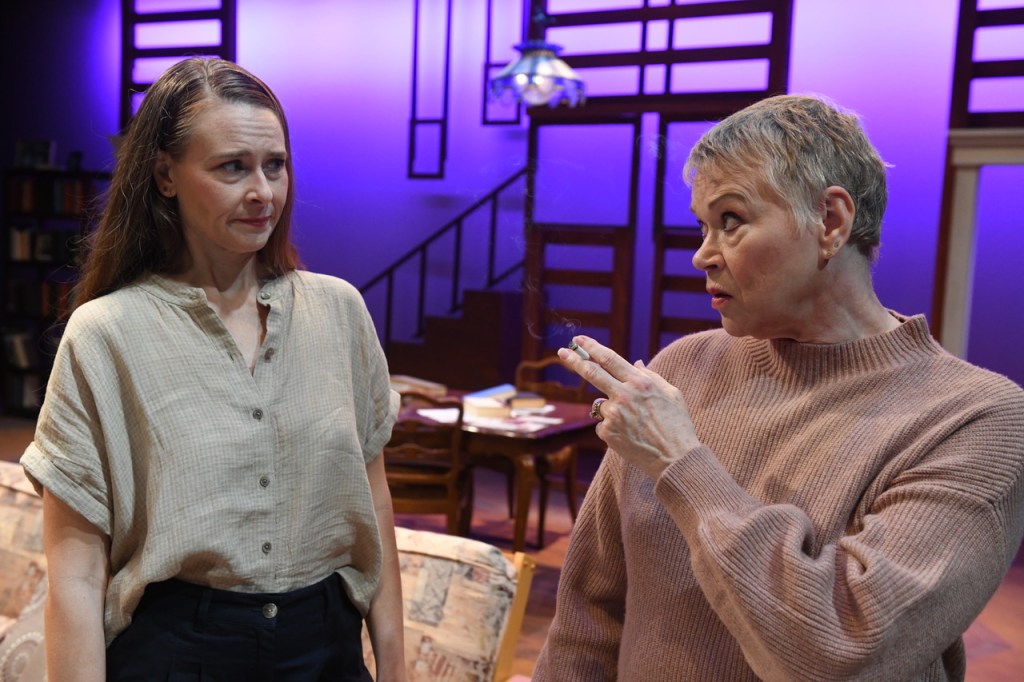
As Violet, Judith Miller brims with bombast, stalking about like a crazed lioness, sometimes loopy from the alphabet soup of uppers, downers, and sideways that make things copacetic and quell the pain of mouth cancer.  Her modal communication style is screaming, and her modal message is belittling, mostly venting hostility on the daughters who have disappointed her.  Barbara is a professor in Colorado and married to a professor, but she could have aspired to more.  Ivy, who stayed near home, is single and in her forties, but refuses to dress in a manner to attract men.  Karen, who moved to Florida appears to be the airhead in the family.  She’s brought her three-times-married fiancé with her and either doesn’t get or doesn’t care why he is a serial husband.

The household remains in a constant state of siege as one character after another acts divisively or reveals some secret, though there is one family member who appears to know even the most private of those embarrassments.  Of the daughters, it is Barb who carries the greatest baggage, and whom Violet blames for some of Beverly’s errant behavior because of her abandoning the family for the last several years.  Allison F. Rich portrays Barb (an appropriate sobriquet) with self-absorption and great ferocity, attacking with similar breadth and intensity as Vi.  She goes toe-to-toe with her mother and will ultimately challenge her rule in the pride.

Matthew Kropschot as Little Charles, Tanya Marie as Karen, Joshua Hollister as Steve.

This is a family that may be extreme in its drama, but the characters and situations will feel uncomfortably familiar to many.  An effective production of “August: Osage County” depends on crack timing, which Kelleher’s actors provide.  The director also oversees realistic overlapping dialogs and simultaneous conversations to great effect.  And the choreography of the chaotic no-household-crevice-unexamined pill search is a scream.  (Note: there is a vignette told about a family member conveying contraband in a bodily crevice!).  Kudos to all of the actors, but in addition to those already mentioned, special recognition goes to Marie Shell as Vi’s sister Mattie Fae. In all, the company brings it home, offering a most rewarding theatrical experience.

“August: Osage County,” written by Tracy Letts, is produced by San Jose Stage and plays in its theater at 490 South First Street, San Jose, CA through April 24 2022.

Circle Mirror Transformation

Brenda Cisneros as Lauren (facing away), Alfred Muller as Schultz, Emily Keyishian as Marty, Lauren Dunagan as Theresa, David Boyll as James. All photos by Jay Yamada.

Mastering a skill is often an arduous and indirect process.  Recall “The Karate Kid’ in which the sensei, Mr. Miyagi, makes his student, Daniel, wax cars and paint fences with very precise, repetitive motions and hold the crane pose for extended periods long before he ever practices a karate air chop.   In “Circle Mirror Transformation,” Marty teaches an adult acting class at a community center.  After sessions of numerous obliquely relevant exercises, Lauren, the only teen in the class, pipes up, “When are we going to do real acting?”  By Lauren’s definition, they’re not.  But happily for the audience, it gets to observe and enjoy the lessons, and the actors in the play do a wonderful job of making it entertaining. The playwright also develops a parallel track about the characters’ lives that enhances the narrative.

Annie Baker has established herself with a naturalistic stream of plays, including the trilogy taking place in the town of Shirley, Vermont, of which this play is a member.  These are narratives about ordinary people doing ordinary things, often written and acted with such uninflected manner as to elevate boredom and long silences as virtues.  But even when the action is subdued in “Circle Mirror Transformation,” backstories and offstage events divulged heighten the tension.  Fortunately, in this meta-acting play, varying emotion and gesticulation are what it is all about, so even the naturalistic approach results in theatricality.   

Alfred Muller as Schultz, Lauren Dunagan as Theresa.

The dramatic training that the participants receive serves a number of purposes including creativity, confidence, concentration, memory, spontaneity, timing, and most importantly, conquering inhibition.  One of the more directly relevant drills is the interpretation exercise in which two characters repeat the same exchange of lines like “I want it,” and “You can’t have it,” with varying affect.  It demonstrates well how different rendering of words and movement yield very different sense of meaning and emotional response for the viewer.  In another, they have to try to convey feeling and action in an interchange while one can only verbalize “goulash” repeatedly, and the other repeats “akmak.”

The classes take place over six weeks, during which we learn a bit about the characters from their pre-and-post class interaction.  One of the in-class exercises serves a dual purpose in the play when each character presents a bio of another.  The delivery acts as a window into the perceptions of how the speaker feels about the subject of the monologue, sometimes to the surprise of the latter.  Factually, we learn that Marty and her previously married husband James, also a class member, are having issues.  The diffident Schultz, who feels that as a recent divorcee, he is a failure, while the assertive Theresa, who is always stretching her limber body, also broke up with her boyfriend recently.  The otherwise reticent Lauren discloses discomforting family problems at home.

Emily Keyishian as Marty, David Boyll as James.

The characters also develop connections during the six weeks.  One relationship develops and feelings arise by one character for another, but they are not reciprocated.  The two shy members, Schultz and Lauren both open up and become full participants in the group.

Sometimes raw nerves are exposed.  When Lauren and James are portraying Theresa and her ex, Theresa intervenes because the scenario becomes so realistic and painful.  But the big denouement comes with the exercise in which each person is to write down a secret that has been previously shared with no one else.  Although the process to reveal the secrets is intended to be confidential, it would become clear that in a group of five, it can be hard to hide.

Alfred Muller as Schultz, David Boyll as James, Brenda Cisneros as Lauren, Emily Keyishian as Marty (facing away).

All five actors (David Boyll, Brenda Cisneros, Lauren Dunagan, Emily Keyishian, and Alfred Muller) suit their roles ideally and acquit themselves with flying colors.  Director Ciera Eis keeps the action moving and ensures the characters are involved, resisting the drag that can occur with some productions of Baker’s works.  Lighting Designer Weili Shi creates considerable visual drama with spots, floods, and frame illumination for the large mirrors in the set to compensate for the spare staging.  The play offers the viewer an interesting look into the learning of a craft and a brief but penetrating view into the lives of a group of people drawn to it.

“Circle Mirror Transformation” is written by Annie Baker, produced by Custom Made Theatre, and plays on the stage of Phoenix Theatre, 414 Mason Street, San Francisco, CA through April 16, 2022.