Men on Boats

Cast. All photos by Scott Lasky.

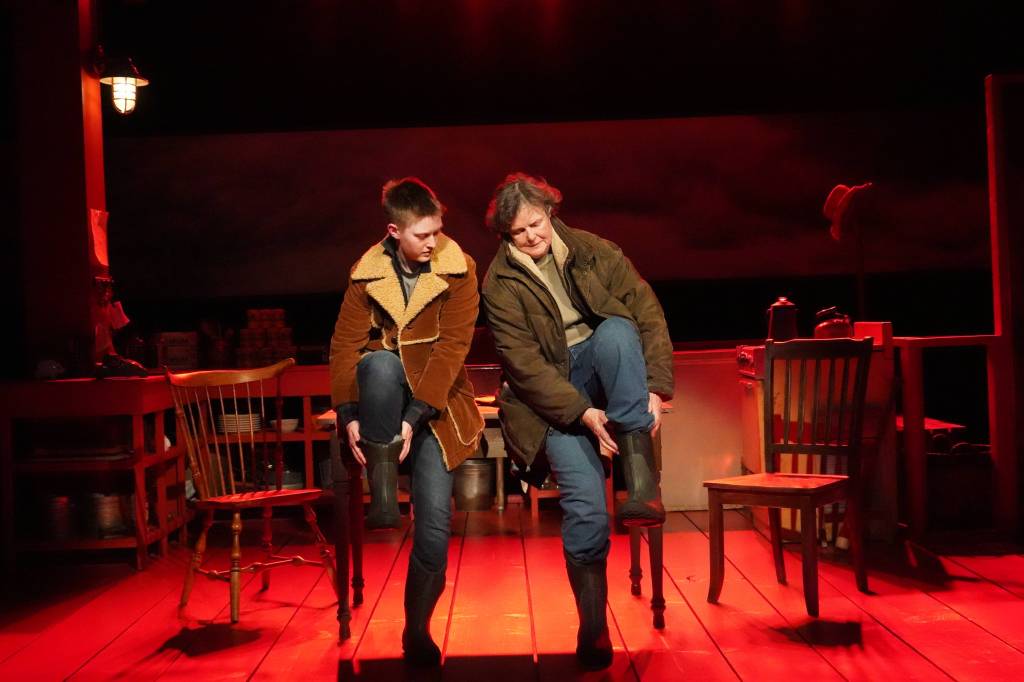
Somehow, the theatrical stage doesn’t seem quite the right venue for depicting a historic, path-finding river expedition of several hundred miles that includes countless rapids and waterfalls and that traverses the world’s largest canyon.  But by leaving much to the playgoer’s imagination, playwright Jaclyn Backhaus came up with a solution in her play “Men on Boats.”  She figured – what if we present the action without boats and without a river and with only rudimentary set and props?  And just for fun, how about as a final conceit that we eliminate the men?  So, there you have it – a cast of all females and non-binaries with bare-bones staging, and the curtain can be raised.

The year is 1869, and while a few Native American and small Mormon settlements exist in Southern Utah, the Colorado River, and its main tributary, the Green River, have not been successfully navigated and charted by the white man.  President Ulysses S. Grant has commissioned his friend Major John Wesley Powell to lead an otherwise volunteer expedition of nine geographers and geologists to do just that.  If your synapses are burning to link the Major with the manmade Lake Powell on the Colorado River, you have made the right connection.  That still doesn’t tell you whether he completed the trip or if the expedition succeeded.  You have to go to the play or read the history for that answer.

Mary Melnick as Major John Wesley Powell, Melissa Jones as William Dunn.

The first observation to make about the play, which is not a criticism, but an interesting bemusement, is the disorientation that may result from the playwright’s casting specification.  The actors are predominately female females (word repetition borrowed from the song “I Enjoy Being a Girl” in Rodgers and Hammerstein’s “Flower Drum Song”).  The observer may be whipsawed between a) perceiving the action as truly an expedition of courageous women, and b) trying to push through that surface to grasp the men underneath who they represent.  I even found myself making gender errors in my drafting this review.  With swagger and a lowered voice, Mary Melnick as the one-armed Major Powell (just the body configuration you want for the grasp and balance needed to run rapids!) comes the closest to neutralizing the casting anomaly.  But, of course, the whole idea is to create the tension of the untested.

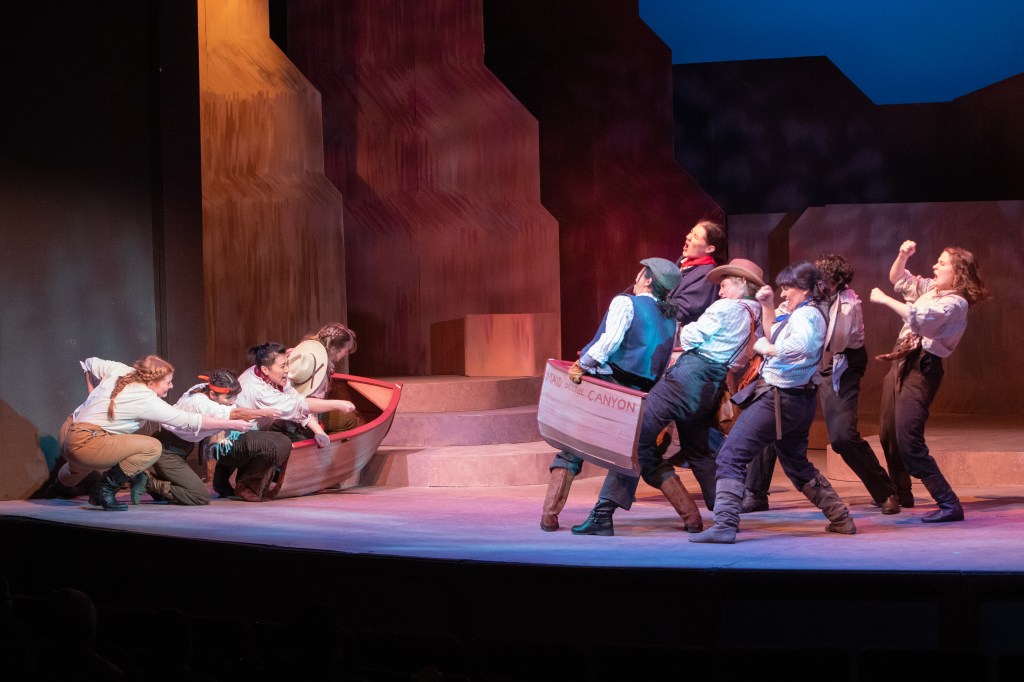
The play merges adventure and drama with comedy.  While vignettes often include at least one of those attributes, there are some that lack any of them, rendering those periods a bit slow.   Among the best amalgams are the explorers confronting the most perilous challenges on the river.   The four boats are represented by prows that are carried by the lead rower in each.  As the men maneuver the hazards, boats and their contents are violently heaved and corkscrewed to the blood-curdling screams and flailing of crew against the indominable crashing of water and intransigeance of rocks.  The viewer’s optimism that the boatsmen will conquer nature tempers the anxiety of the visual chaos with humor. That said, these recurring episodes did become a bit repetitious.
Cast.

Some surprisingly subtle moments also occur.  In what the movies call a reaction shot, the display of awe as the crew views the Grand Canyon after weeks of torment is quite touching.  Later, and not knowing how far or how long they had to get through the canyon, provisions run low and risks run high. A splinter group led by the divisive William Dunn, played very demonstrably by Melissa Jones, reveals that they plan to leave the expedition by climbing out of the canyon to try to find a settlement.  The humanity of the whole expedition party that shared danger and hardship but now divides in outlook is moving.  Finally, the quiet is punctuated several times throughout with the haunting and penetrating acapella singing of Maria Mikheyenko, who plays Old Shady, the older brother of Major Powell.

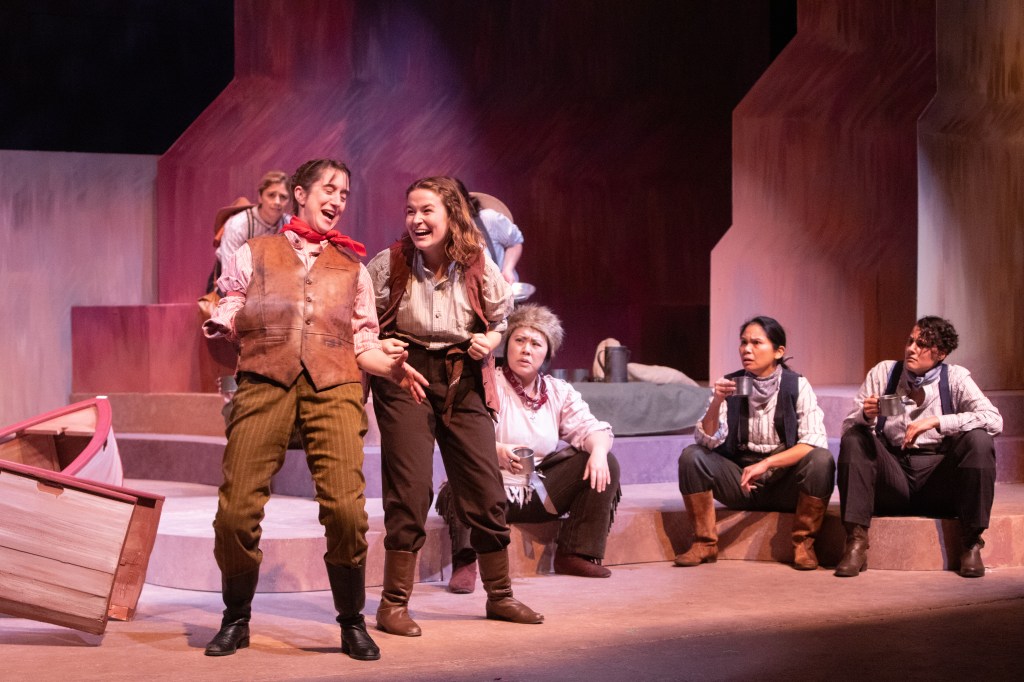
Among the humorous incidents, Hawkins, as portrayed by the lively Katie O’Bryon Champlin, confronts his first ever hissing, coiling rattlesnake.  Coffee pot in hand, he beats it to oblivion.  Stepping away, he returns to obliterate it further.  In a final return, he pulverizes it to make absolutely sure that the snake is dead beyond revival.  This reviewer can verify from personal experience that the process Hawkins follows is absolutely authentic, except that a hoe is a much preferred weapon to a coffee pot.

Cast.

While Palo Alto Players’ rendition of “Men on Boats” is not a perfect production of a perfect play, it does provide entertainment and stimulation.  Give credit to Director Lee Ann Payne for her interpretation and execution.  Apart from the immediacy of the camaraderie and challenges that the adventurers encounter, it provokes broader issues.  One wonders how the play would compare with a male cast.  Could it be as lighthearted?  As sensitive?  More importantly and in real life, one thinks about what it would have been like if women had the opportunity to mount such an expedition.

“Men on Boats” is written by Jaclyn Backhaus, produced by Palo Alto Players, and plays at Lucie Stern Community Center Theater, 1305 Middlefield Road, Palo Alto, CA through February 20, 2022.
The Kind Ones

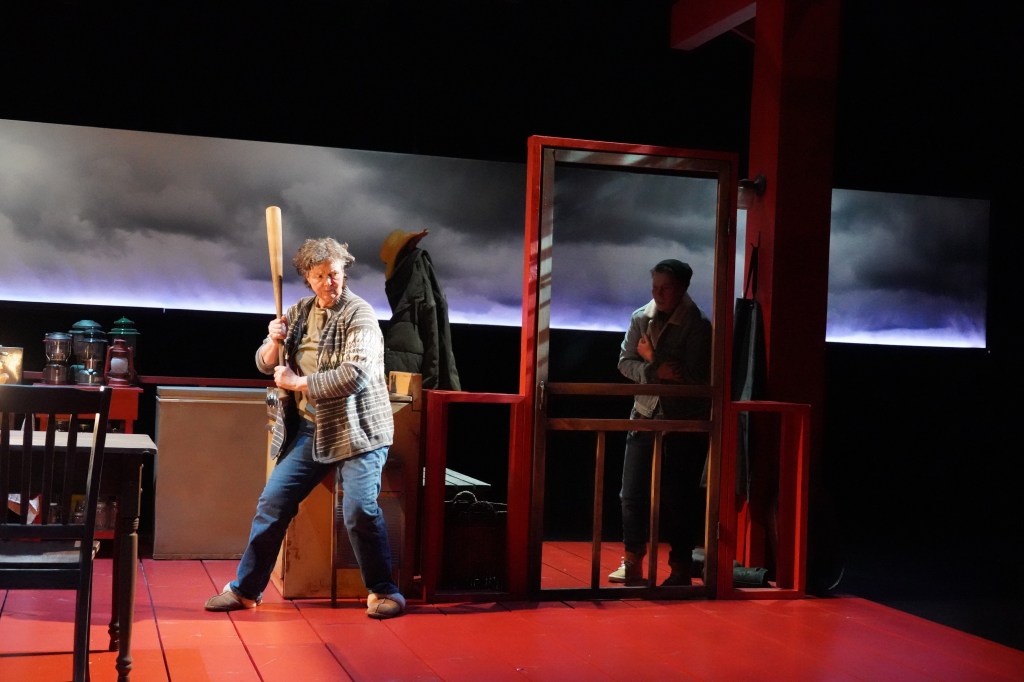
Anne Darragh, Kian Johnson (in shadows). All photos by Jay Yamada.

Solitude, especially in isolation, can engender eccentric and dangerous behaviors.  At one extreme, simple daily activities can become elaborate and self-indulgent rituals that consume time.  At the other, they can be perfunctory exercises that satisfy function rather than aesthetics.  The Biblically- inspired adage suggests that “Idle hands are the devil’s workshop,” and the same could be said of idle minds.  With time to spare, mischief finds Miranda Rose Hall’s central character in this compact, 70 minute, two-hander. 

Nellie is a 60ish widow in rural Montana who operates a small pig farm, and who slaughters her stock whenever she receives an order from her marketplace.  She came to this work late in life, as she was sidetracked by the unfortunate circumstance of murdering her abusive husband and serving 20 years in prison for it.  Having been a seemingly middle-class woman of reasonable intelligence and social stature, incarceration has left its imprint.

Anne Darragh.

The formidable Anne Darragh embraces the role of Nellie with total authority, understanding her contradictions.  In many ways, her role is a stereotypical male character, the courageous, self-sufficient hermit.  Physically, she slumps, disheveled, with sloppy clothes and unkempt hair that she often runs her hand over.  Her recurring repast is canned peaches, mushed banana, and Saltine crackers.  Yet her kitchen is as neat as a pin, with peach cans neatly stacked on the counter and dishes organized on the open shelves.  And perhaps in a nod to her pre-prison memories, she uses a rotary telephone!

An unexpected knock on the door reveals Fitz, the young adult child of Nellie’s lawyer, Frank, who had moved to Washington state after defending her.  Fitz has responded to a flyer that Nellie had sent Frank to show that she was in business, but apparently, in combination with vague conversations that she’d had with Frank, Nellie ends up in a bind and accepts engaging in illicit activity with Fitz.

Kian Johnson.

As an aside, note that Fitz is written as a transmasculine man and is portrayed effectively by Kian Johnson, a transmasculine man.  Although the character’s transgenderism is revealed in the script, the role has no inherently gender-specific qualities.  Perhaps the playwright admirably chose this characterization in recognition of the abuse (like Nellie) that transgenders suffer and/or to promote opportunity for the marginalized.  And if transgenders represent a small, yet underrepresented, population, transmasculines are a small percentage of that small percentage.

Fitz offers a huge contrast in style with Nellie.  Trim and spiffy, he is a barista with a college education, if majoring in digital poetry qualifies.  But in pursuing an uneasy partnership, trust between the two grows until the moral underpinnings of the narrative emerge.  The dramatic tension rises when the two diverge on what is good and what is evil.  Are evil actions redeemable if they produce good outcomes?  Further, when can we rely on the word of others to guide our own actions?  Are we accountable if we don’t help others when given the chance?

Kian Johnson, Anne Darragh.

The play is well done and the story has merit, though I appreciated it more on reflection than at the time.  It may not be to the liking of those who object to some of the coarseness or the morality of the characters, but that is a diminishing segment of the population.  Staging is effective.  Tanya Orellana’s single set conveys the kitchen and eating areas nicely, though the outdoor scenes, including slaughtering are left to the imagination.  Christopher Michael Sauceda’s sound design conveys everything from rich Americana music to the final mournful protests of pigs.  Lisa Peterson’s direction is resourceful and hits all the right notes.

“The Kind Ones” is a world premiere written by Miranda Rose Hall, produced by Magic Theatre, and plays on their stage at Fort Mason; Building D; 2 Marina Blvd.; San Francisco, CA through February 20, 2022.
Heroes of the Fourth Turning

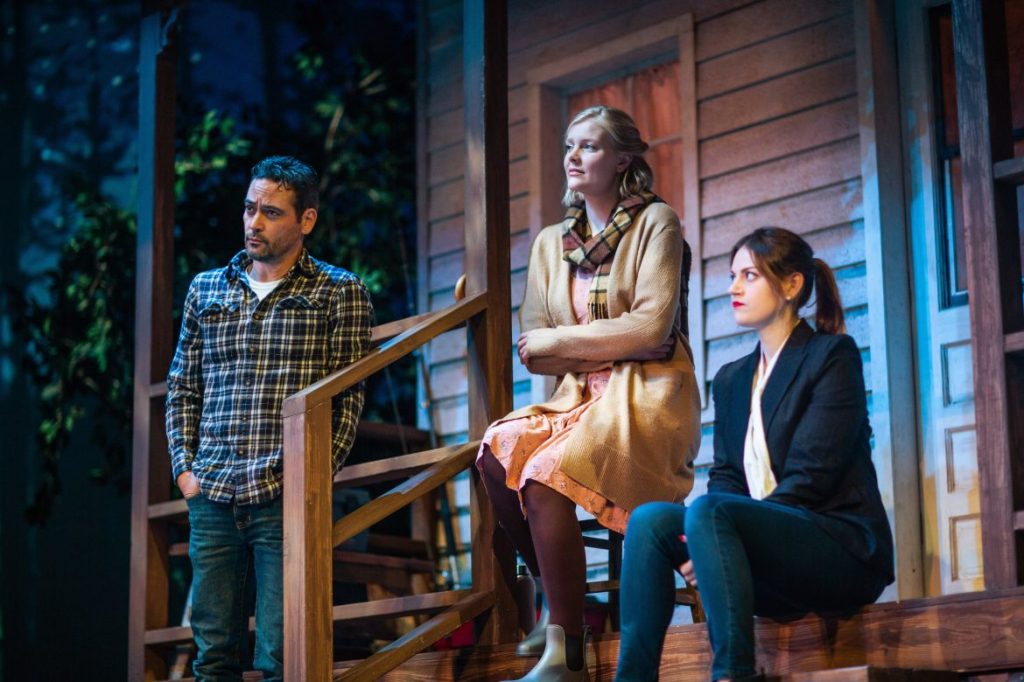
Josh Schell, Susi Damilano, Wera von Wolfen, Johnny Moreno. All photos by Jessica Palipoli.

Reunions provide great grist for drama.  Before and after snapshots of the participants offer scope for character development as they reminisce, revealing not only their shared glories but often how differently those events are remembered.  As layers of the onion unpeel, secrets are divulged.  We see how some characters move on, while others remain defined by the past.

In Will Arbery’s “Heroes of the Fourth Turning,” four friends converge seven years after graduation to celebrate the installation of a favorite professor as the new president of a fictitious small Catholic university in Wyoming.  The playwright knows whereof he speaks, as his father held the same post at the real institution after which the fictional one is modeled.

The script is built around verbal sparring, punctuated by bombastic polemics.  Rather than the generalistic, unsupported claims that dominate debate in real life, the arguments are largely supported by academic and religious sources.  The play itself is riveting, but not always enjoyable, while the production is world-class, with exemplary performances by each member of a fantastic cast and fine direction and scenic design by Bill English.

Josh Schell, Ash Malloy.

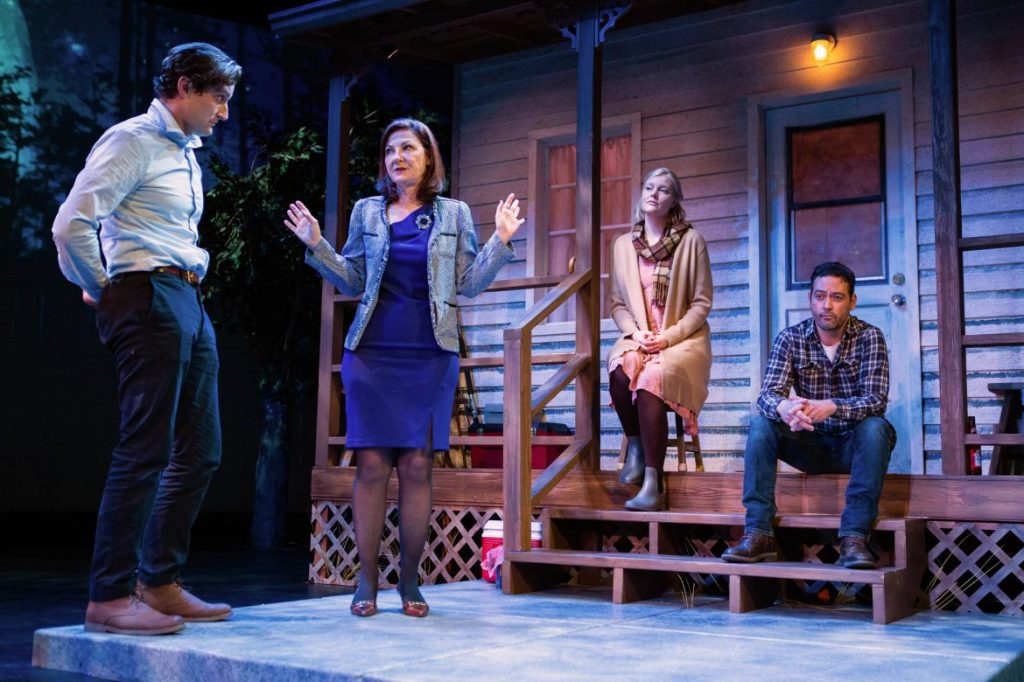
One discussion point about the play is that the playwright’s intent is to introduce the liberal-leaning theater crowd to conservatives that are full-featured and even likeable.  Judge for yourself.  The action occurs outside the country cabin of Justin (Johnny Moreno), a dark and moody gun-loving libertarian who seems like he could erupt at any time.  His affable college roommate, Kevin (Josh Schell), sells religious books in Oklahoma.  The actor admirably appears drunk for the full two hours and fifteen minutes during which his general weakness and specific neediness for a girlfriend arises again and again.

The angelic Emily (Wera von Wulfen) has suffered constant and sometimes incapacitating pain for several years from deer tick fever.   To liberals, she is the golden hope who befriends and respects others with different opinions.  Her foil, and the pivotal character, is Teresa (Ash Malloy), now living in Brooklyn.  An exemplar of Eric Hoffer’s “The True Believer,” her identity is absorbed by conservative, nay, reactionary Catholicism.  She sets the rules and brooks no compromise, for instance, insisting on calling abortion supporters murderers.  As fanatical and fractious an advocate as she is for her beliefs, one could see her being just as passionate for communism, ecology, or anything else she was exposed to at the right developmental point.  A late arrival to the party, the incoming president, Gina (Susi Damilano), relates cordially to her former students, but still uses the power of position to dominate when necessary and promote principle with compromise.

Susi Damilano.

Many liberals may find the early part of the play particularly depressing with its unrelenting reinforcement of an alienating philosophy.  Oddly, seeing a parallel scenario taking place in Hindu India or Moslem Egypt might be better received by the left-leaning as exotic, educational, and non-threatening.  But to those not closely exposed to the resolute and divisive thinking of what could be considered extremism within our midst, there might be a sense of dismay.

Over time, the discussion turns to even more disturbing views, but counterpoint is also rendered.  The desirability of empathy is questioned in the play.  Paradoxically, San Francisco Playhouse promotes itself as the Empathy Gym.  Racism is cloaked in deceptive garb, but antipathy for LGBT is not.  Whites, and particularly Catholics, are presented as martyrs (maybe they haven’t observed the composition of the Supreme Court, Congress, the Presidency, or corporate America).  Attributions to non-Catholics’ motivations are horrifying.  A torturously feeble defense of supporting the anti-Christ, Donald Trump, is given.  And there is more.  Perhaps one reason that the United States seems to be losing its way as a society is that a significant portion of the population views another portion as the enemy more so than threats like Russia and Covid.  We may realize that the thoughts of these characters do occur, but to see vivid depictions of well-educated young people harboring these thoughts is chilling.

Although the setting clearly draws from the playwright’s own experience, its symbolism cannot be ignored.  Wyoming is the least populated and one of the most isolated states in the country.  Its people are among those who consider themselves to be the real Americans, despite the fact that the state is grossly unrepresentative and has been a net recipient rather than contributor to the nation’s economic and intellectual health.  It serves as an ideal crucible for segregation and indoctrination that might be associated with a parochial school.

Johnny Moreno, Wera von Wulfen, Ash Malloy.

Finally, there is the matter of the title of the play.  It derives from the book “Generations” by William Strauss and Neil Howe.  The authors postulate in great, but highly questionable, detail that cycles of history with four phases repeat every 80-90 years.  Certainly, the notion of cycles has its own long history and is loosely demonstrable.  The question is whether the theory should be observed in order to understand current events or whether it should be accepted as deterministic and allowed to dictate our actions in order to fulfill its prophecy.

“Heroes of the Fourth Turning” is well produced; highly provocative; dense with scholarly detail; and even has a few unexpected turnings of its own.  But be prepared for something that may be outside your normal comfort zone.

“Heroes of the Fourth Turning” is written by Will Arbery, produced by San Francisco Playhouse, and plays on its stage at 450 Post Street, San Francisco, CA through March 5, 2022.
Roald Dahl’s Charlie and the Chocolate Factory

Cody Garcia as Willy Wonka and cast. All photos by Jeremy Daniel.

Most of us have confronted situations that are discomforting because we’re not sure that we’re in a place where we belong.  Maybe we’re improperly dressed, or we expect to have little in common with the crowd assembled.  Well, what about attending a musical based on a children’s novel without having kids in tow?  When it comes to “Roald Dahl’s Charlie and the Chocolate Factory,” never fear.  At its San Jose opening, very few youngsters could be seen in the orchestra.  So, any adult can relax and let the inner child enjoy an exhilarating musical that works on many levels and transcends the age divide.

Charlie Bucket is a child from poverty with hopes and dreams (one might say, a Bucket List!).  A lover of chocolate, he is budgeted only one bar of his favored Willy Wonka chocolate per year.  When Willy Wonka offers a contest in which five recipients of “golden tickets” hidden in chocolate bar wrappers will receive a free tour of the chocolate factory, Charlie is all in.  And (of course), he receives one of the prizes and gets to see the magic behind the scenes.

William Goldsman as Charlie Bucket.

Casting makes all the difference, especially in the lead roles.  A charismatic Cody Garcia leaves an indelible mark as Willy Wonka, both acting and singing.  He is a worthy challenger to more famous film portrayers, Gene Wilder and Johnny Depp.  Self-absorbed and self-interested, Wonka totally lacks empathy.  As Wonka, Garcia delightfully and imperiously crushes the aspirations of any and all.  When others suffer tragedies, he sees only the disruptions to his life.

But are there seeds for redemption?  What about his signature song “The Candy Man (Can)” in which he “makes the world taste good….and mixes it with love?”  Or the inspiration “Want to change the world, There’s nothing to it,” he offers in “Pure Imagination?”  Curmudgeon or motivator?  To counterbalance Wonka, a waifish boy to portray Charlie is de rigueur, and William Goldsman, one of the alternates in the role, provides the goods as a loving son and dedicated lover of chocolate.

This touring musical brings all of the glitzy production values of Broadway.  Staging, which combines extensive back-lit projection along with movable scenery, is bright, colorful and appealing, especially the brilliant landscape diorama made entirely from candy.  The play is highly episodic with different musical twists in the introductions of each winner of the free tour.  Lyrics are clever, funny, and revealing.  The German, polka-inspired “More of Him to Love” for the pot-bellied boy from Bavaria who wears a string of sausages around his neck is particularly distinctive.  That vignette, and others like the one about the unruly Iowa boy whose dipsomaniac mother controls him with physical restraints, are also reflective of Dahl’s dark edges.  Surprisingly mature themes and streaks of cruelty run through much of his children’s literature, but those attributes probably induce adults to like his work.

Cast.

Perhaps the most memorable feature of the play is the Oompa-Loompas, who help run the factory and who sing and dance at each contestant’s calamity.  As the story specifies that they are little people, various productions use different solutions.  This show’s answer is a technique that was made famous by the Fred Astaire-led “triplets” in the movie “The Bandwagon.”  Several orange-wigged, black-clad puppeteers hide their bodies behind small, white-dressed, full-body marionettes attached to their heads, with the actors’ faces exposed.  They sing and crack jokes as they manipulate the puppets by hand.  The effects, with puppets dancing and gesticulating wildly, are hilarious.

For a fun evening at the theater, this is the ticket.

“Roald Dahl’s Charlie and the Chocolate Factory,” with book by David Greig, music by Marc Shaiman, lyrics by Scott Wittman and Marc Shaiman, with added songs by Leslie Bricusse and Anthony Newley, and based on the novel of the same name by Roald Dahl, is produced by Broadway San Jose and plays at San Jose Center for the Performing Arts, 255 Almaden, San Jose, CA through January 23, 2022.

The Band’s Visit

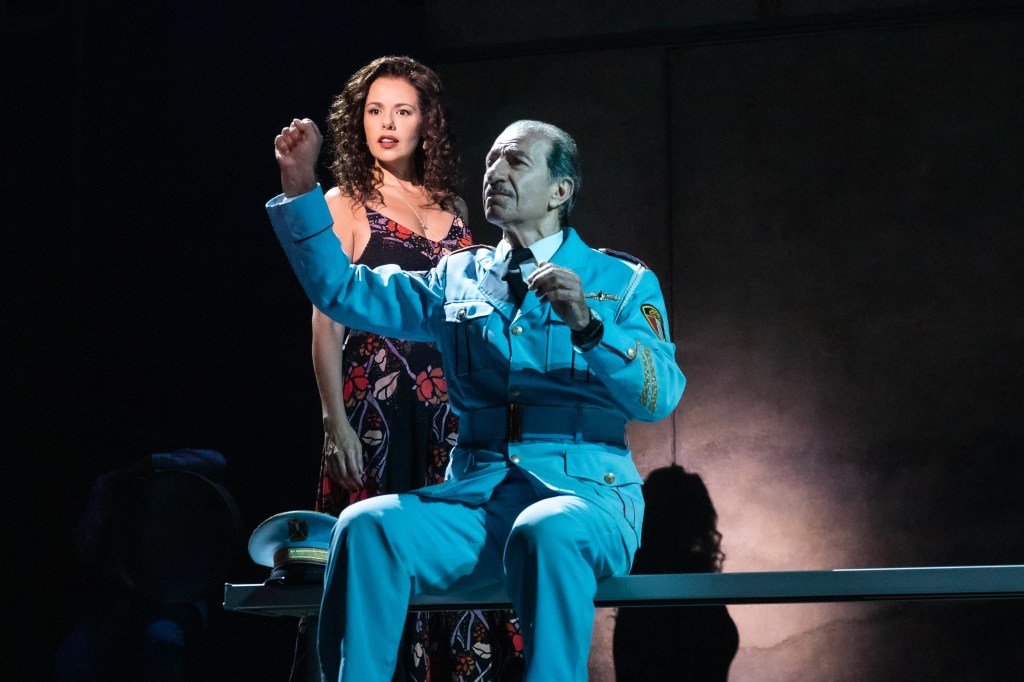
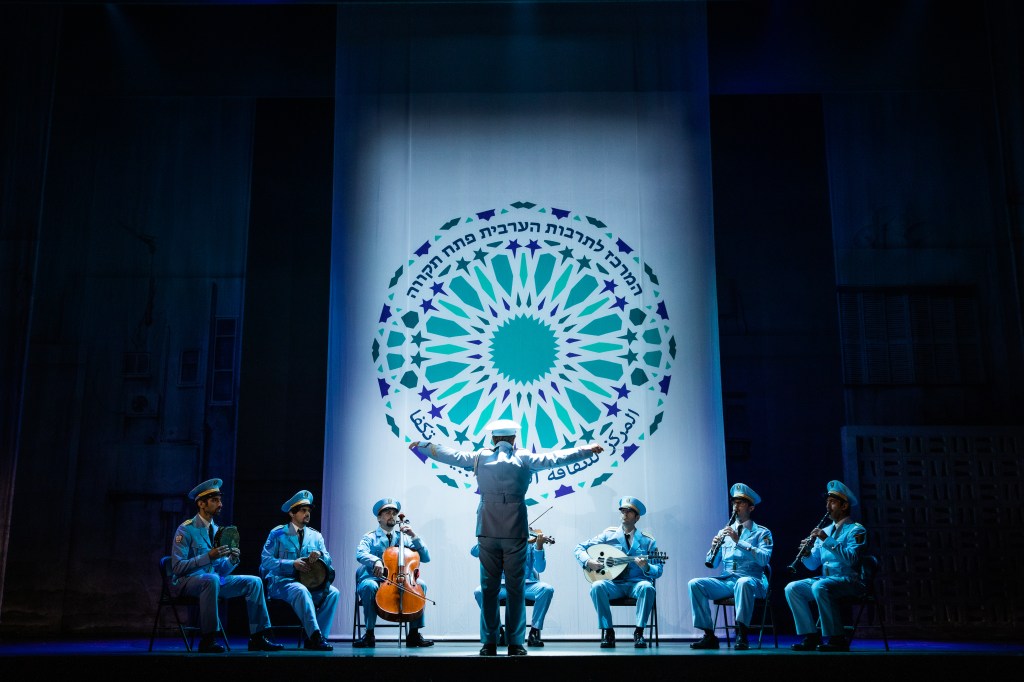
Janet Dacal, Sasson Gabay. All photos by Evan Zimmerman, MurphyMade.

How do you set expectations for the touring production of a Broadway musical?  Case in point – what about “The Band’s Visit”?  Did it get great reviews?  Check.  Did it have a long run on Broadway?  Check.  Was it well recognized by the industry, as in one of the most decorated musicals in Broadway history with 11 Tony nominations and 10 wins?  Check.  Is most of its artistry transferrable to other stages, like its recognition for Best Musical, Best Book, Best Score, Best Director, Best Scenic Design, Best Lighting Design, and Best Sound Design?  Check.  So, what is needed to ensure success on the road is a fine cast and professional execution.  Check.  To conclude, be prepared for a crowd-pleasing escape to a far away world full of issues that are close to home.

The unlikely setting is a desolate town in the Negev Desert of Israel in 1996, aptly characterized by one of the play’s songs, “Welcome to Nowhere.”  The incident that triggers the action is that the Alexandria Ceremonial Police Orchestra has been invited to perform at an Arab Culture Center in Israel.  Arriving at the Tel Aviv bus station, the band’s expected reception party fails to show.

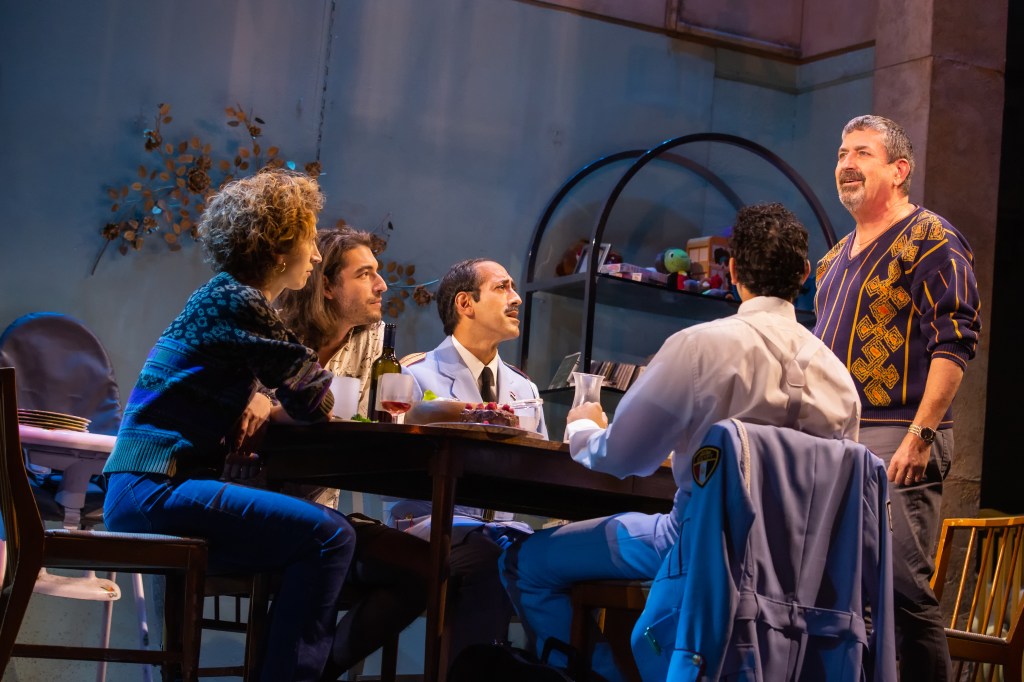
Company members

Tewfiq, the enterprising conductor of the band, decides that they will catch a bus to their final destination, but because of a minor communication problem, they end up in Bet Hatikva, not the intended Petah Tikva.  After realizing their misdirection, they learn that the next bus back to Tel Aviv is the following day.  Landing at the café of lively and lovely divorcée, Dina, she arranges overnight housing for the stranded musicians.  In the meantime, the evening fills with sweetness and sadness as various groups of hosts and visitors get to know one another.

As a classic cross-cultural collision, several clashing dimensions of difference could be exploited in the plot line – political (Israeli vs. Egyptian), religious (Jewish vs. Muslim), sociological (urban vs. rural), or even artistic (musicians vs. not), but the creators largely avoided the obvious and focused more on the shared challenges that people of all ilks face.  In that sense, the story is revealed on a small canvas of personal matters rather than a large canvas of great issues of the day.  But in wisely avoiding most clichés, one that might have resonated well with the audience is a real l’chaim moment, which it lacks. 

Along with incidents of no great importance, arguments occur, mostly among the Israelis who have deeper history with one another.  Yet, the overall tone is sympathetic and graced with gentle humor that flows largely from waggish and well-timed delivery rather than from jokes.  Hosts and visitors explore backgrounds and find that they experience the same human emotions of longing, love, failure, and loss.  As an element of shared history with the visitors, Dina even waxes nostalgically in the song “Omar Sharif” about growing up with a love for Egyptian movies she watched on television.

Alexandria Police Ceremonial Orchestra.

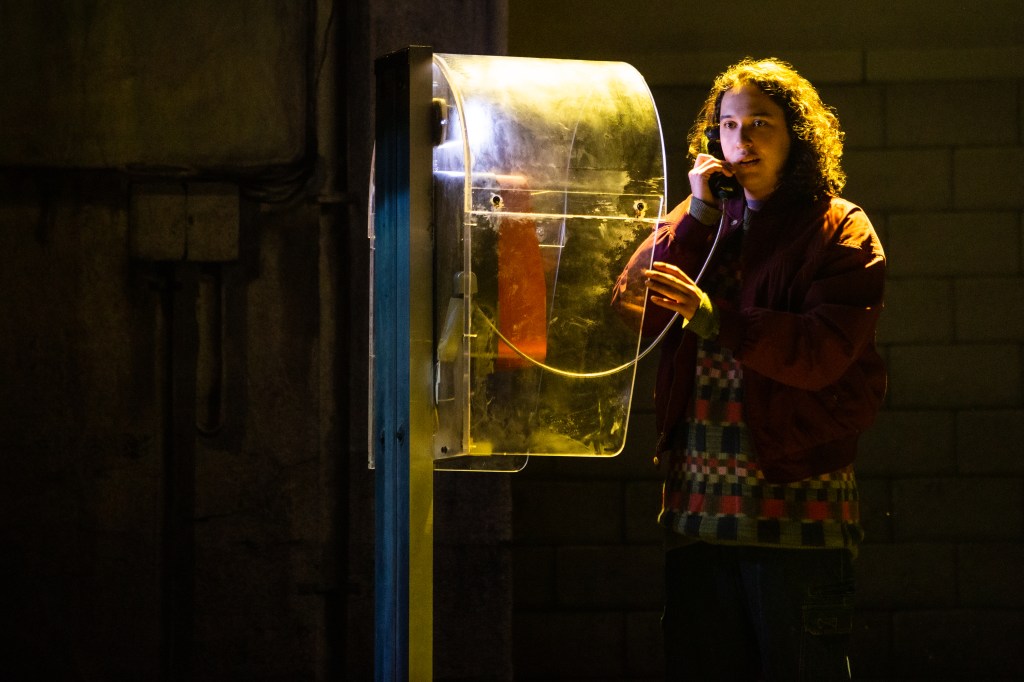
Apart from serious pain that characters have suffered, some idiosyncratic failures are explored in great fun.  A young Israeli man waits at a sidewalk telephone night and day hoping to hear from the girlfriend who left him a month before, blocking others from using the phone.  Separately, the hosts find that the Egyptian clarinetist is working on a symphony and encourage him to perform for them.  Playing what he has written so far, it turns out that in 20 years his output is less than a minute of the overture.

Janet Dacal portrays Dina with a fine mix of verve and ennui – disappointed that fate has not swept her from her bleak surroundings, yet ready to take advantage when opportunity presents itself.  Sasson Gabay reprises his well-suited role as the more reserved Tewfiq, but from the original movie, not from the New York staging.

The biggest star is the music.  Lyrics in the sung songs are witty and divulging, and the accompanying music is pleasant throughout, with eclectic influences from American pop to klezmer to bossanova.  Some of the stylings are a little rough, which at first may suggest poor casting, but on further consideration, less than perfect renditions work well.  After all, the characters represented are not singers, they are working class.

Joshua Grosso.

What is most distinctive, however, is how the Arabic-themed instrumental music played by the several band members is integrated into the action.  There is enough of it that it remains exotic and leaves you wanting more.  The musicianship is phenomenal especially the violinist in his solos, and the musicians playing the Arabian instruments, the oud, a gourd-back lute, and the darbouka, a smallish hourglass-shaped, finger-flicked drum.

The production transports the creative elements of the Broadway show, and they work well.  Staging is spare and reflects the humble nature of the town.  Unlike some other musicals, the staging does not upstage the show.  A correctible weakness is that on opening night, the sound delivery was uneven, and many lines were not sufficiently audible.  But overall, “The Band’s Visit” is a rewarding experience and a welcomed diversion from Covid.

“The Band’s Visit,” with music and lyrics by David Yazbek and book by Itamar Moses adapted from the screenplay of the same title by Eran Kolirin, appears at Golden Gate Theatre, 1 Taylor Street, San Francisco, CA through February 6, 2022.

The Woman in Black

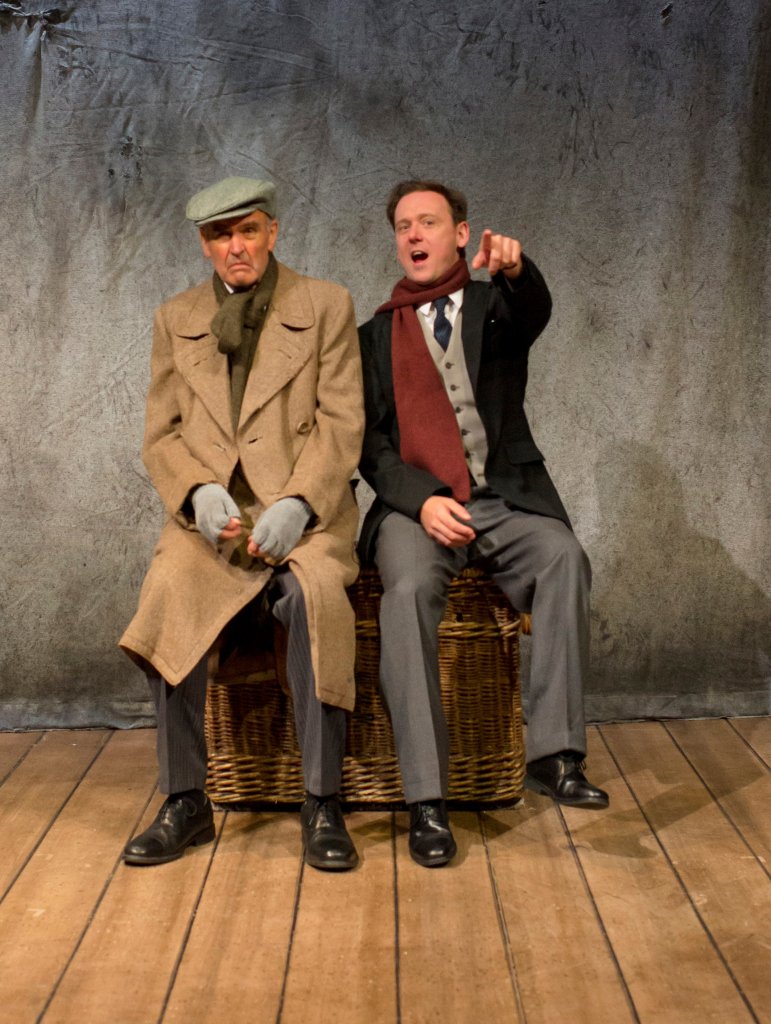
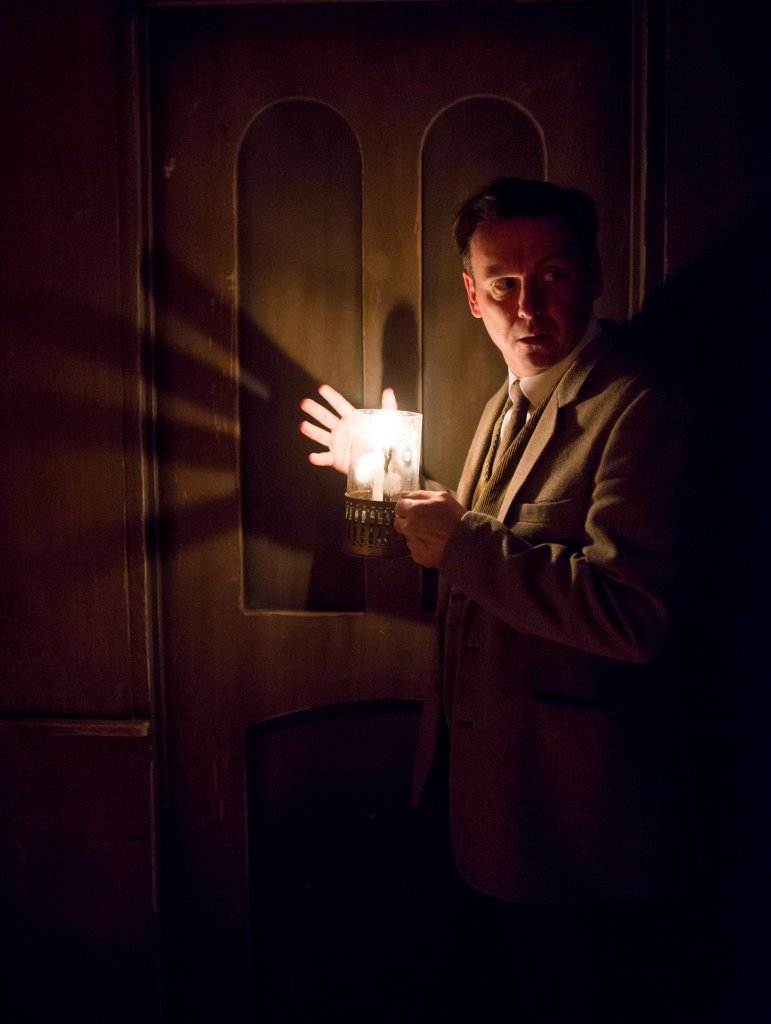
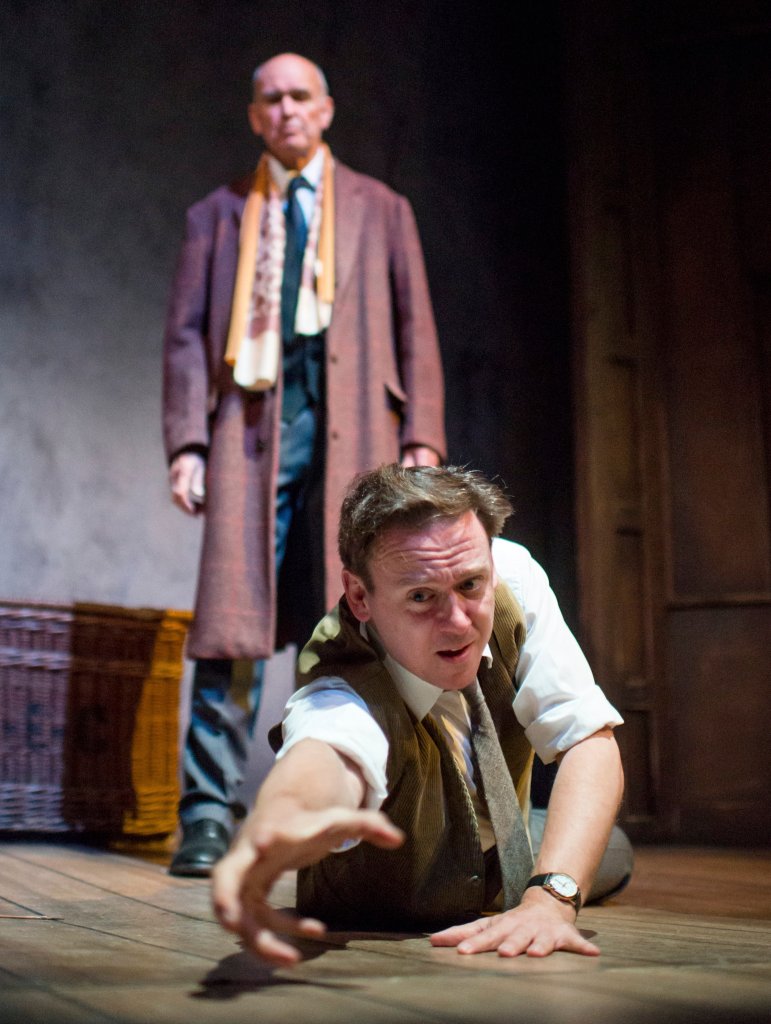
Robin Herford, Antony Eden. All photos by Kasey L. Ross.

Why are people so attracted to horror in entertainment, when in real life, it is one of the last things that they would want to confront?  Perhaps that is for psychologists to explain.  However, one proof of the pudding is the play “The Woman in Black.”  Although not shock-a-minute, grim-and-gory Grand Guignol horror, the occasional unexpected scares and tingles will keep the viewer on edge, ever anticipating more.  The work has drawn sufficient audience to run on London’s West End for over 30 years – second in longevity only to Agatha Christie’s “The Mousetrap.”  It’s had productions around the world and has been translated into 14 languages.  Not bad bona fides.

More than a simple frightfest, the play is a master class in storytelling, using only two speaking actors on stage.  The conceit is quite clever.  An older gentleman named Arthur Kipps has written a tome on bizarre episodes that he experienced as a junior solicitor.  Despite a driving compulsion to exorcise his long-internalized torment by sharing it with an assemblage of family and friends, he lacks the confidence to read his manuscript before others and enlists a not-named theatrical director to train him.

In what follows, the men reenact the incidents as rehearsal for the ultimate presentation, with the Director portraying the younger Kipps, while Kipps himself provides narrative and performs the characters that he had interacted with.  The mainspring of the story is that Kipps had been dispatched by his firm in London to deal with the estate of a recently deceased widow, Mrs. Drablow.  The reclusive woman had lived on the marshy east coast of England in a dank and gloomy castle-like manor on its own island, accessible by land only at low tide (what a surprising venue for a horror story!).  Kipps’ Gothic encounters with the local community and tales unveiled from reading the papers of the deceased would live with him always.

The Director advises Kipps that when he reads the story to his gathering, he will have to draw upon their imagination to visualize the sweep of the narrative.  Indeed, the play itself calls on the viewers’ imaginations. The single set by Michael Holt, who designed the West End production, cannot convey all of the locales in detail.  The play is full of soft humor, and much of it derives from the audience having to fill in the visual gaps.  A buggy ride is represented by the actors seated on a rattan chest and humorously bobbing in unison.  A dog is invisible, but the Director pets it, and the men’s heads and eyes follow its movement.

The unsettling disturbances come from sources other than the characters who the actors portray.  Sebastian Frost’s soundtrack resonates with sounds of nature and movement and with an occasional unexpected thunder or shriek to grab the audience’s attention.  Anshuman Bhatia’s lighting design is highly active, often with sharp contrast or total darkness to add another ominous element to the staging.  And then, of course, there is The Woman in Black.

So – great story, set, sound, and lighting.  Appears like the only thing left for a successful production is fine acting.  It seems almost ridiculous that the elder Arthur Kipps and all of the other characters except his younger self are portrayed by Robin Herford.  Herford is diffident as Kipps; demonstrative as the head of Kipps’ law firm; a laconic rube as the buggy driver.  And by the way, he not only commissioned this adaptation in 1989 but has directed every West End cast change as well as productions in seven other countries, including this one.  You can’t ask for more experience with this property, though at times he was a bit difficult to hear.

Antony Eden portrays the Director and Young Kipps with a stentorial voice, bounding energy, and great confidence.  He has a massive West End brag sheet, and in addition, is quite familiar with this part, having played it over 1,000 times.

But what about The Woman in Black character?  You’ll have to see the play to sort that one out.

“The Woman in Black” from the novel of the same name by Susan Hill is adapted to the stage by Stephen Mallatratt; produced by American Conservatory Theater; and plays at ACT’s Strand Theater, 1127 Market St., San Francisco, CA through January 16, 2022.

Georgiana & Kitty: Christmas at Pemberley

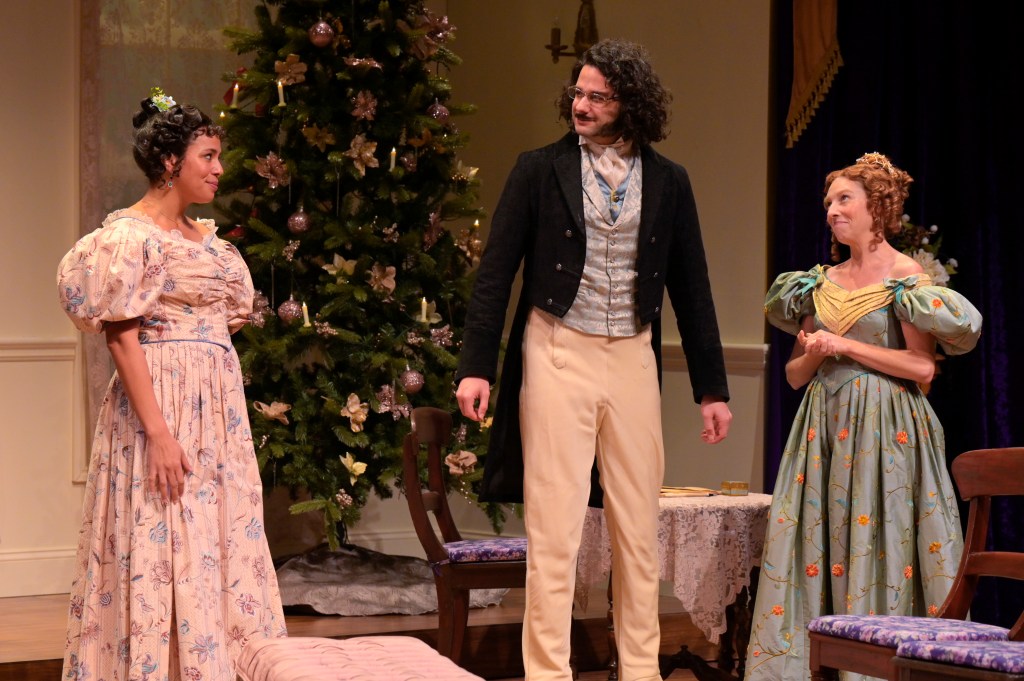
Lauren Spencer, Daniel Duque-Estrada (rear), Aidaa Peerzada, Emilie Whelan, Zahan F. Mehta, Adam Magill, Madeline Rouverol, Alicia M. P. Nelson. All photos by Kevin Berne.

Jane Austen’s 1831 romantic dramedy, “Pride and Prejudice” stands as one of the most beloved novels in British history – appreciated by critics and public alike.  The story focuses on the lives of the five Bennet sisters, whose family estate can only be passed to a male, thus leaving the young women without income upon their father’s passing, unless they can marry into money.  Crucially, second sister Elizabeth marries Fitzwilliam Darcy (for film buffs, Greer Garson and Lawrence Olivier in the 1940 movie), heir to the Pemberley estate.

The work has spawned many derivatives.  In 2017, Lauren M. Gunderson and Margot Melcon wrote a sequel “Miss Bennet: Christmas at Pemberley,” which quickly became one of the most produced plays in the U.S.  The playwrights continued mining the lode. “Georgiana & Kitty” completes a trilogy, focusing on two previously underdeveloped characters, Darcy’s only sister Georgiana and the second youngest and only unmarried of the Bennet brood, Kitty.  This final chapter adds to the splendor of the trappings with a lively, funny, and sensitive installment, fully worthy of its predecessors.

Lauren Spencer, Adam Magill, Emilie Whelan.

It would be easy to fob off Austen and her downstream contributors as producers of women’s literature, but that would be a mistake.  In “Georgiana and Kitty,” women dominate the stage and women’s issues abound.  But the whole of the social contract comes under examination, some of which is stuck in time, but much of which bears relevance today.  The impracticality of the ladies’ costumes alone suggests the rigidity of the gender system which severely limits the activities of the women.  These restrictions are compounded by notions of class and wealth distinctions; of propriety; family dynamics; the manner of meeting people; and arranged marriages, all of which inhibit women’s mobility and freedom.

One modicum of physical change noted in the play is this new idea of bringing the outdoors to the indoors being practiced in Germany – a nicely trimmed Christmas tree.  But more importantly, an internal change will occur as Darcy will realize his standards and rules don’t necessarily make for a better world.  He will learn that the selfishness of demanding his ward live the life that he wishes her to live will not bring her happiness – nor him, if he fails to persuade her.

Emilie Whelan, Madeline Rouverol, Alicia M. P. Nelson, Aidaa Peerzada.

From the opening scenes of the Bennet sisters in the sitting room, the social closeness of family is palpable, but so is the claustrophobia.  Although life may be soft, the routine, as evidenced by Mary’s constant needlepoint, condemns women to virtually unchanged behaviors and relationships for life.  In this stasis, the shy but musically-talented Georgiana and the ebullient and clever Kitty look to break rules.  But when Georgiana invites a young gentleman who attended one of her concerts to Pemberley for Christmas, the traditionalist Darcy shows his displeasure.  He exercises the common social practice of a male guardian dictating the courting alliances of young women.  But Georgiana will receive her own inheritance, and that twist of fortune which the Bennet sisters lack will grant her the ability to control her own destiny in love, music, and life.

As the center of the narrative, Lauren Spencer delights as Georgiana, who undergoes character development from hesitant and dominated to a woman of independent means and feminist conviction.  Yet the spark comes from the indomitable spirit, Kitty, portrayed by Emilie Whelan with great verve.   Largely ignored as a child, Kitty’s assertiveness and exuberance as a young woman are captured by Whelan with demonstrable charm.

Lauren Spencer, Zahan F. Mehta.

The playwrights and Director Meredith McDonough capture the 19th century life of rural England.  Nina Ball’s scenic design and Fumiko Bielefeldt’s costume design give the right visual effect we expect from these period pieces.  Dialect coach Lisa Anne Porter also deserves a nod for guiding an authentic vocal sound.  More significantly, the situations and interactions among the characters seem genuine.  One false note can’t be revealed, as it would be a spoiler, but there is an important “how could they not have known?” situation that defines the period between the first act and the second, which is 20 years later.  But, there are bigger disbeliefs in other works of fiction, and this whole play works so well that it can receive a pass on this one point.

“Georgiana & Kitty: Christmas at Pemberley,” a world premiere, is written by Lauren M. Gunderson and Margot Melcon, produced by Marin Theatre Company, and plays on their stage at 397 Miller Ave., Mill Valley, CA through December 19, 2021.

Così Fan Tutte

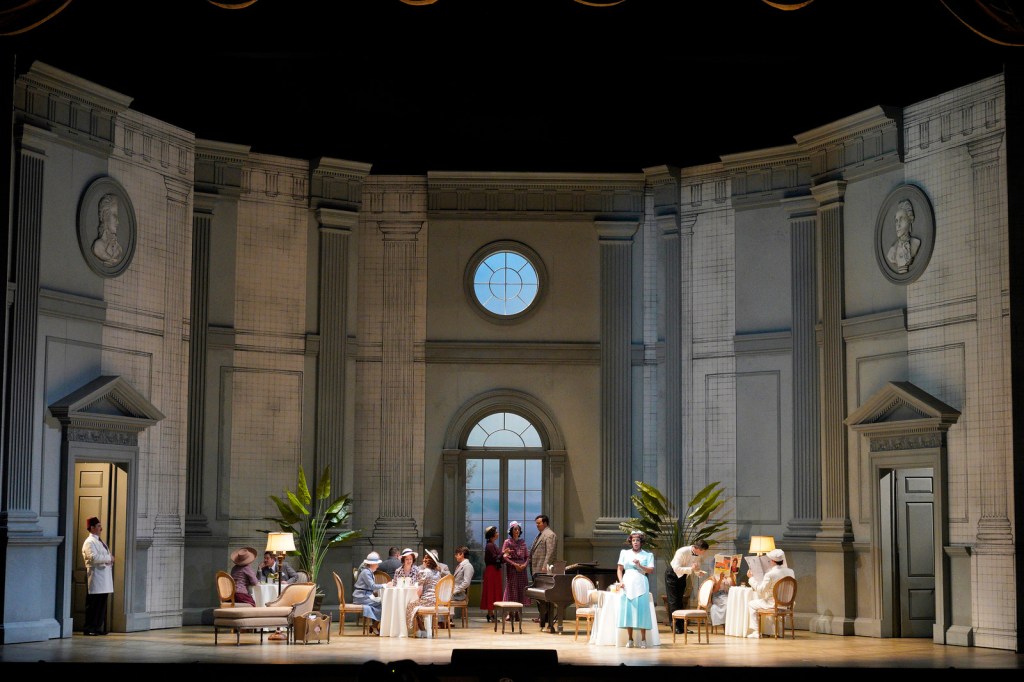
Framing set of the opera. All photos by Cory Weaver.

“Così Fan Tutte” was the last of three collaborations by perhaps the strongest composition team in opera history.  Composer Wolfgang Amadeus Mozart and librettist Lorenzo da Ponte had previously written “Le Nozze di Figaro” and “Don Giovanni.”  Acknowledging the significance of this unplanned trilogy, San Francisco Opera is presenting them all over a three-season period.   With a superb cast and wonderful staging, the company’s production of “Così” absolutely sparkles, making the best of the opera’s assets.

This opera was the only one that the duo produced based on original material written by da Ponte.  The good news is that as a result, the plot line is clear without the gaps and confusion that often accompanies operas compressed from other sources.  The bad news is that the authors take 3 ½ hours to tell a simple story.  The other good news is that Mozart lovers will find that a fine bargain.  The score is pure mature Mozart, yet surprisingly, it lacks signature arias that grace the other two collaborations.  And despite the current respect it receives today, it was virtually ignored for over a century.

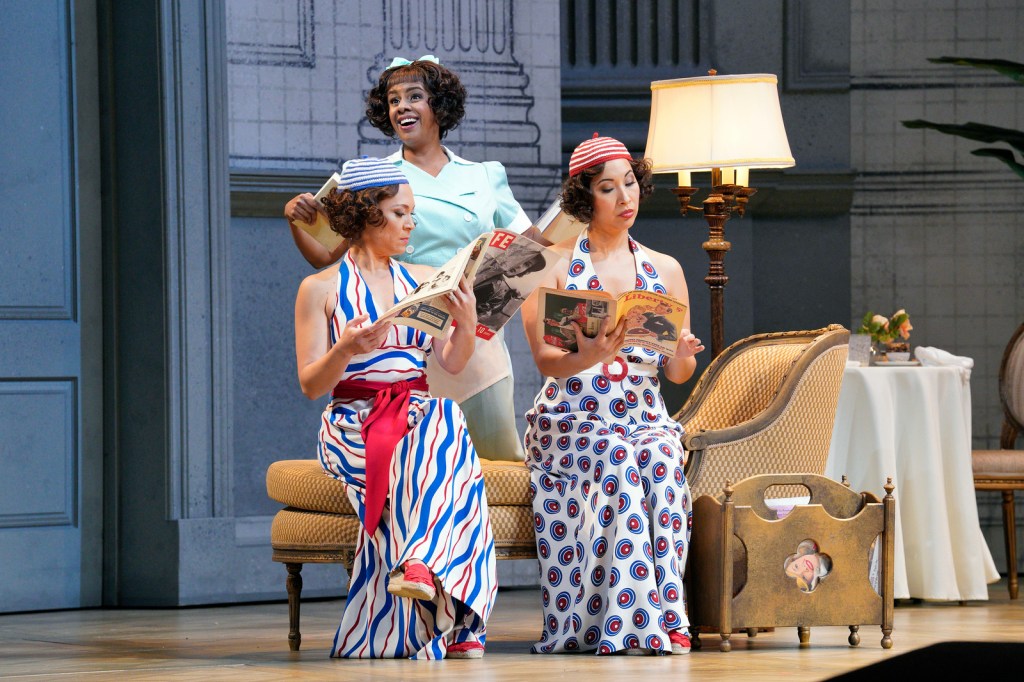
Irene Roberts as Dorabella, Nicole Heaston as Despina, Nicole Cabell as Fiordiligi.

Director Michael Cavanagh sets the action in the 1930s at a country club in the mid-Atlantic of the United States.  The time and venue changes work exceptionally well.  Erhard Rom’s framing set in Federalist style serves as backdrop for introduction to period props and decorations that work nicely – everything from a badminton court to a visual conceit of swimmers rising out of a pool.  And Constance Hoffman’s oft-changed costumery provides a panoply of color that engulfs the stage and a comic mock-country-club look.

The meaning of the title translates roughly to “all women do it.”  The “it” refers to infidelity.  Opera aficionados will realize the humorous irony of the libretto’s argument.  Da Ponte is acknowledged as one of the great womanizers in opera history – a bit of the pot calling the kettle black.

In this case, two somewhat naïve and headstrong military officers insist that their fiancées are eternally faithful, to which a provocateur, Don Alfonso, offers a wager that he can reveal them unfaithful in less than 24 hours.  What follows is a series of silly, unrealistic, but fun-filled episodes in which the officers disguise themselves as Albanians and try to court the sisters.  The men’s pratfalls to induce sympathy include fake poisoning followed by electromagnetic treatment that leaves them thrashing and writhing on the floor.

John Brancy as Guglielmo, Ben Bliss as Ferrando.

Ben Bliss as Ferrando possesses a classic tenor voice, while John Brancy as Guglielmo is a fine lyric baritone, and the contrast works nicely apart and together.  Sisters Fiordiligi, played by Nicole Cabell, and Dorabella, played by Irene Roberts, demonstrate singing and acting skills equal to the men.  But their depictions play to similarities.  With identical wigs, makeup, and costume style, they look like sisters.  What’s more, though Cabell has glorious power in her upper range and the higher tessitura in her soprano part, the two have very similar timbres in their mid ranges, which makes their close harmonies sound like they are related.

The third dyad of principals in “Così” are the instigators.  Don Alfonso is portrayed by the redoubtable Ferruccio Furlanetto, and he inhabits the role with great flair, seeming perfectly suited to his ‘30s wardrobe.  His vocals are largely recitatives, but, again, well suited.  The really juicy role, however, is that of Despina, his co-conspirator.   Nicole Heaston squeezes it for everything it’s worth.  Apart from being sassy and cynical as the girls’ maid who encourages deceiving the men, she plays a notary and the doctor who administers the anti-poison treatment, in disguise.  Oh, and like the other principals, she has a fine voice, a coloratura soprano.

John Brancy as Guglielmo, Irene Roberts as Dorabella, Ferruccio Furlanetto as Don Alfonso, Ben Bliss as Ferrando, Nicole Cabelle as Fiordiligi, Nicole Heaston as Despina (disguised as notary).

Given the length of the opera and its nature as a domestic comedy, the action may seem to move slowly.  In the first act, the unhurried story is mitigated by the initial high jinks and a number of bright ensembles.  The tone changes in the second act which is dominated by reflective stand-and-deliver arias and other fairly static set pieces that don’t move the narrative forward.  Two of the solos, however are the best candidates to appear in compilation albums, and they are both beautifully delivered.  Bliss gives a fine tenor rendering of ‘Un’aura amorosa,’ (A loving aura), while Cabell follows with the delicate apologia ‘Per pietà, ben mio’ (In the name of pity).  In the end, all is well in the world of romance.

“Così Fan Tutte,” composed by Wolfgang Amadeus Mozart with libretto by Lorenzo da Ponte, is produced by San Francisco Opera and plays at War Memorial Opera House, 301 Van Ness Ave., San Francisco, CA through December 3, 2021.

Father/Daughter

Sam Jackson, William Thomas Hodgson. All photos by Kevin Berne.

Nature or nurture?  This question has been raised for centuries.  Which is the greater determinant of intelligence and personality?

The storyline of “Father/Daughter” builds from the biological relationship of Baldwin, a high-school chemistry teacher, and his daughter, Miranda.    It is comprised of a sequence of many vignettes, but a scene between those two occurs only at the end.  The main action alternates between brief interludes of two couples.  In one set, Baldwin and Risa are courting, while the eight-year-old Miranda, a product of Baldwin’s failed marriage, is unseen.  The other set involves Miranda as a young adult, and her romance with Louis.

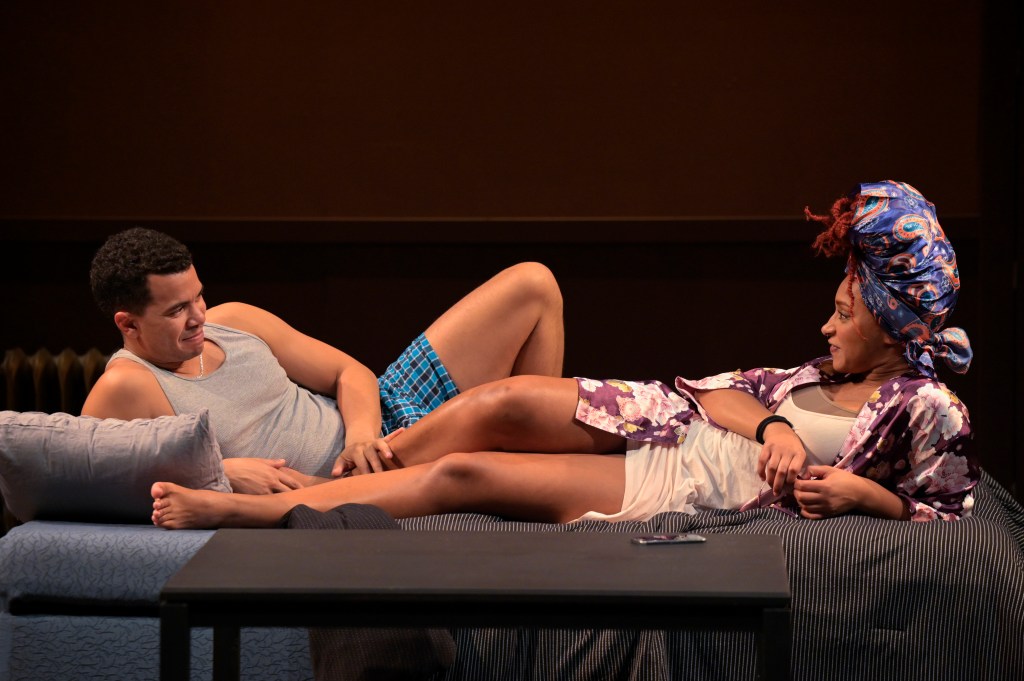
The Bay Area is blessed with many great performing artists, and Sam Jackson (for the sake of clarity – she!) and William Thomas Hodgson (he) are among the finest.  Jackson portrays both females, and Hodgson both males.  And both actors are scintillating. The same descriptors apply to each performer and their performances – attractive and charismatic; confident in their actions; possessing easy charm; able to extract humorous response almost effortlessly; and displaying a full range of emotions.  What’s more, the chemistry between them pops.  Watching them act is a real pleasure.

The anecdotes pretty much encompass the life cycles of two romantic relationships, occurring a generation apart. Some are funny, some are sad.  They are full of insight and are individually well constructed and entertaining.  Early on, we witness two different dating rituals, with the clumsy Baldwin and Louis berated respectively by the assertive Risa and Miranda.  Somewhat akin to trying to find the right lines in today’s evolving political correctness, the men never seem to say or do quite the right thing, and the women let them know it.  But despite the men’s ineptness and the women’s combativeness, each couple will have a roll in the hay and proceed to a serious relationship.  Later, each couple deals with hard issues like a serious problem that Baldwin faces with Miranda as daughter, and Miranda as woman getting pregnant.

In one funny scene involving the younger couple, Louis is on the brink of asking Baldwin for Miranda’s hand.  Louis tells Miranda that her dad talked with him about how on the outside, opposites attract, but on the inside, likes attract.  Louis took this figuratively and responded with “Yes.  We’re very different, but we both love your daughter.”  Horrified that her father was not ready to hear about that topic Miranda responds “Oh, no.  He wasn’t talking about love.  He was talking about chemical bonds!”

“Father/Daughter” covers a lot of ground leading to the question of whether, fundamentally, Miranda is her father’s daughter.  Although she hasn’t grown up in the same household with him, has she acquired similar disposition through genetics or osmosis?  Is she doomed to make his same mistakes?  But beyond trait-based linkages, does her limited relationship with her father inform her attitude toward her boyfriend, or does her feeling toward her boyfriend influence her feeling toward her father?  This line of inquiry deviates from the more common same-gender assessment, as in the injunction that if you want to know what a young woman will be like in later years, look at her mother.

Many new plays undergo revisions after their premiere, and while this one has a strong core that should attract future audiences, it might need revision to do so.  Authors and directors can sometimes be so close to their own work that they often don’t see that other observers don’t see.  In this case, they expect too much from their audience.  This reviewer read everything about the play in the program and on the Aurora website but still struggled to recognize some shifts between couples.  In talking with five other serious theater goers afterward, each of them was at least moderately confused about identities and relationships.  One who likes surprise and avoids advance publicity about plays was totally lost as were others who didn’t get what was going on.

The ages, ethnicities, social class, and such between the characters that each actor plays varies so little that there is not much they can do to differentiate their roles with affect alone.  Supertitles for each scene, however, would elucidate effectively, by designating, for instance, “Baldwin and Risa 1992.”  Otherwise, extensive use of character names in the script at the beginning of each scene would help.  Changing clothes came to be generally associated with change in characters in the play, but some dressing or changing occurs within roles to somewhat nullify that insight.  Truly distinctive wardrobe differentiation would help.

Some confusion might be attributable to having two actors playing four parts, and it is not clear whether that is specified by the playwright or the producer.  While it would be interesting to see a four-actor version in contrast to this one, the unbroken tour de force acting by a twosome like this would be splintered.  Also, an unspoken but the palpable link demonstrated by the two roles that Hodgson plays as father and lover would be severed.  By nature, do humans seek spouses that are reminiscent of their opposite gender parent?

Director M. Graham Smith keeps the action moving, but at one hour and forty-five minutes, the play exceeds some viewers’ tolerance for a two-hander, especially without intermission.

“Father/Daughter,” a world premiere, written by Kait Kerrigan, is produced by Aurora Theatre, and plays on their stage at 2081 Addison St., Berkeley, CA through December 12, 2021.

sAiNt jOaN (burn/burn/burn)

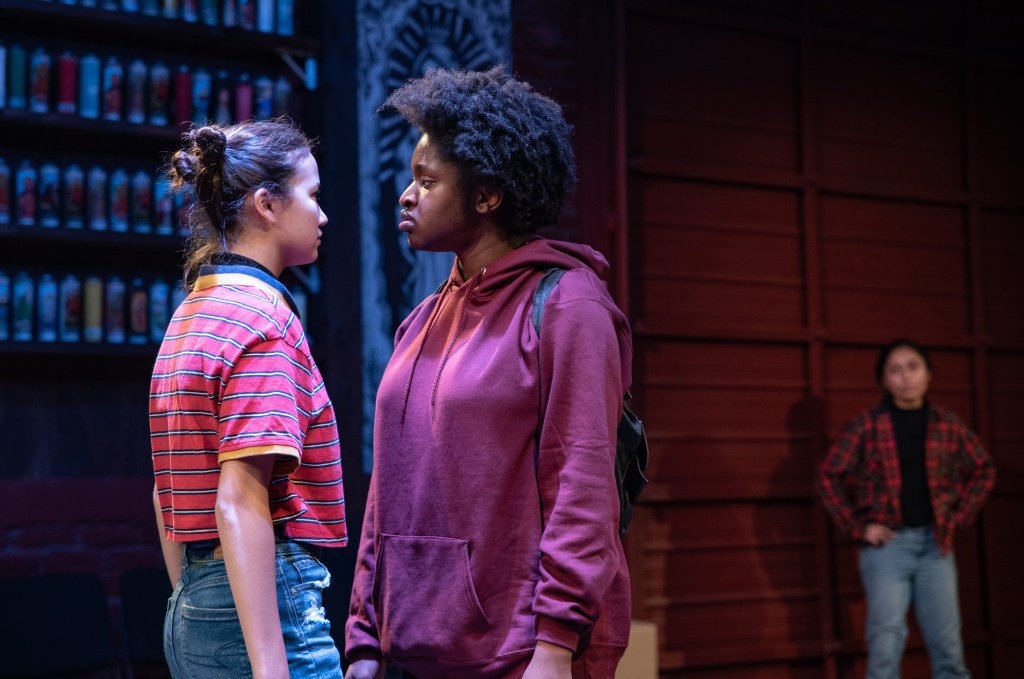
Daniela Cervantes as Sabra, Romeo Channer as Jean Dark, Success Ufondu as Bell, Charlotte Ying Levy as May, and Metsehafe Eyob as Angie. All photos by Carson French.

Jean d’Arc (Joan of Arc to English speakers) (1412-1431) holds a singular place of admiration in world history.  She is revered by French people for her military leadership, while still a teenager, in lifting the Siege of Orléans and turning the tide against England during the Hundred Years War.  Burned at the stake by enemies and declared a martyr by allies, she was canonized as a saint by the Roman Catholic Church for having been inspired by religious visions and for her fight against Protestant invaders.  She represents a role model for authority to feminists and to women in general for her ability to command men in battle and for her unwavering courage and determination against great odds.  But were her visions and her resulting brief period of triumph a result of psychological instability – massive delusion?

Playwright Lisa Ramirez draws on Jean d’Arc’s motive force as the basis for examining the will of young women to effect change in today’s frightening world.  Her vehicle is a riveting, uber-energetic, often chaotic and confrontational clash of five young people one fateful night.  “sAiNt jOaN” grabs the attention by the throat and throttles it for 60 exciting and exhausting minutes.

Charlotte Ying Levy as May and Success Ufondu as Bell.

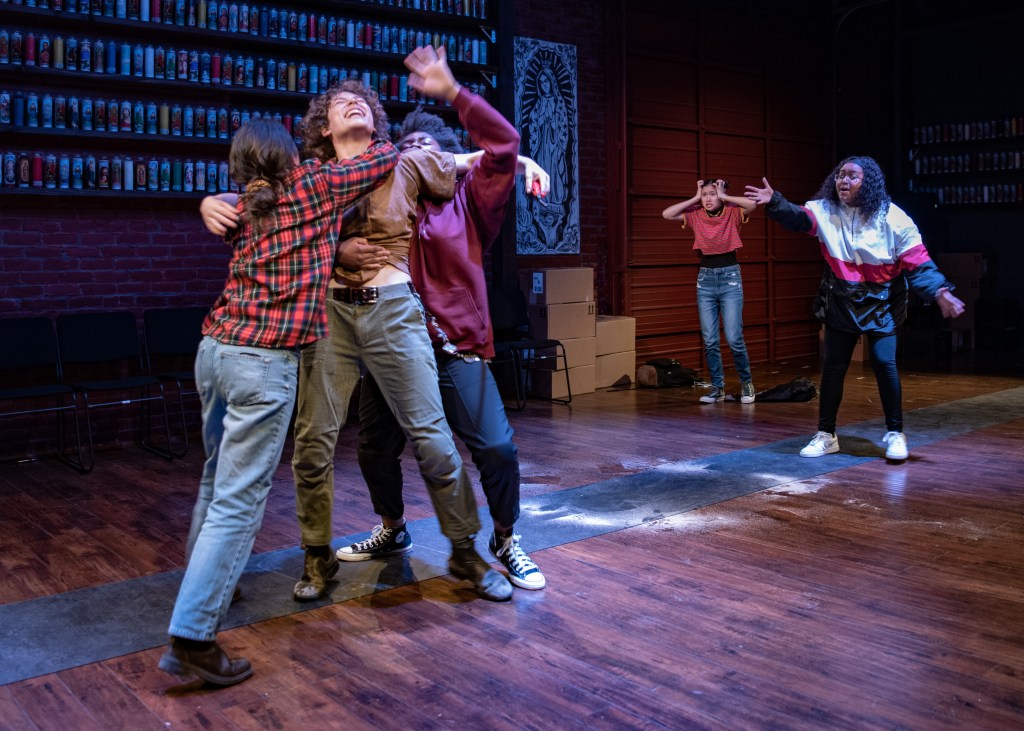
The setup occurs on the night of a Black Lives Matter protest in Oakland.  In the tumult of violence and police chase, many protesters escape if possible.  Sabra (played by Daniela Cervantes) is of Guatemalan heritage.  Her mother works in a devotional candle jar factory nearby, and Sabra has the code to enter the building, where she and her Chinese-Jewish girlfriend May (Charlotte Ling Levy) take refuge.  During the melee, two strangers, African-American sisters Bell (Success Ufondu) and Angie (Metsehafe Eyob) are allowed in.  Finally, a non-binary who identifies as Jean Dark (Romeo Channer) insinuates themself into the mix.  But did Jean even know where they were or why the protest?  Perhaps they missed taking their meds.  What ensues is a night of personal confrontations and empathy and learning.

A theatergoer might be understandably leary of a new work about teenagers and acted by ingénues, especially a play that attempts to catch the spark of a moment in time.  But Director Michael Socrates Moran lets out all the stops in facilitating the actors’ emotional rage, and they respond with raw and totally convincing portrayals.  Issues that are often carefully soft-pedalled in real life are blasted at megaphone volume.

Daniela Cervantes as Sabra and Romeo Channer as Jean Dark.

Each of the characters carries the burden of a minority status that suffers under the dominance of a largely unsympathetic majority.  Their having come from an event with a mutually shared objective, the expectation would be for a Kumbaya moment.  But even the core singularity of the protest is challenged.  Although the vacuous counterclaim that “White Lives Matter” is clearly an attempt to invalidate “Black Lives Matter,” what about the plight of Latinx?  Sabra raises the provocation that “Brown Lives Matter,” but can that doctrine exist in harmony with the goals of the Black community?  The tempestuous Bell is briefly silenced by the idea.

The complicated quest for united action by youth, who are clearly concerned with the future of their society, is evidenced by fractures within.  (In the real world, such internal divisions have weakened the organization of the “Me, Too” movement.)  Although May suffers discrimination from being both Chinese and Jewish, others in the group lack sympathy as they consider Chinese to be the model minority and Jews to be privileged.  Add that May is focused on environmental issues and that she has an important relative whom the protesters would consider an enemy.  Despite being presumed transgender, the white Jean fails to gain sympathy on an ad locum basis.  Jean is from tony Piedmont.  Through it all, Bell in her stridency sees the world through a race-based prism, although the more moderate and laid-back Angie tries to lower the temperature.  The group even argues over the value of various social media platforms, which Jean rejects the use of altogether.

Metsehafe Eyob as Angie, Romeo Channer as Jean Dark, and Success Ufondu as Bell.

Yet as morning breaks, there is cause for hope. Is it possible that youth can agree on a common agenda of non-competing issues to embrace? Maybe the mere exposure to people of different backgrounds and to their ideas has produced bonding.  Perhaps even Jean will be accepted and join the movement.  Perhaps like her inspiration, Jean will lead future battles.

“sAiNt jOaN (burn/burn/burn),” a world premiere is written by Lisa Ramirez, produced by Oakland Theater Project, and plays at FLAX art & design, 1501 Martin Luther King Jr Way, Oakland, CA through December 19, 2021.