I Do! I Do!

Many entertainments succeed by drawing on the audience’s inside knowledge of the subject matter.  The musical “I Do!  I Do!” covers familiar ground that is nearly universal in most places and times.  The vignettes from 60 years of marriage include that unforgettable first night; gender roles; pregnancy and the challenges in rearing children; how people change over time, and often in opposite directions; the special highs of being a couple; infidelity, disinterest, and reconciliation; and ultimately, shared dotage.  Whew!  Woodminster Summer Musicals has mounted a pleasing production of this bittersweet confection.

These days of Covid have prompted special cautions for the return of theater.  In this case, the company’s venue offers special comfort for the audience.  The spacious Woodminster Amphitheater in the Oakland Hills’ Joachin Miller Park provides more than ample room for social distancing in an outdoor setting.  Plus, attendees can picnic in the park or have food and drink al fresco from the limited concessions stand or brought from home.

The musical itself also fits the safety needs of the company almost as well as possible.  Played on a single set, it is a two-hander, thus limiting the number of performer contacts on stage.  Musical accompaniment is two pianos at opposite ends of the huge stage, with a conductor in the pit.  But amongst these minimalistic elements, Kevin Stanford’s numerous and oft changing props and Lisa Danz’s costume coordination give visual variety and relevance to scenes representing various time periods.

The backstory of the musical starts in World War II Netherlands.  Author of the source material, Jan de Hartog, wrote the play “The Fourposter” while hiding in his homeland from the Nazis.  The detailed mileposts of a marriage’s long journey are clearly not based on personal experience, because he was still a bachelor at the time of its writing.  But the story was picked up by composer Harvey Schmidt and lyricist Tom Jones, the team who in 1960 had written what would become the longest running stage musical ever, “The Fantasticks.”  In 1966, their “I Do! I Do!” would commence an award-winning, 18-month run on Broadway.

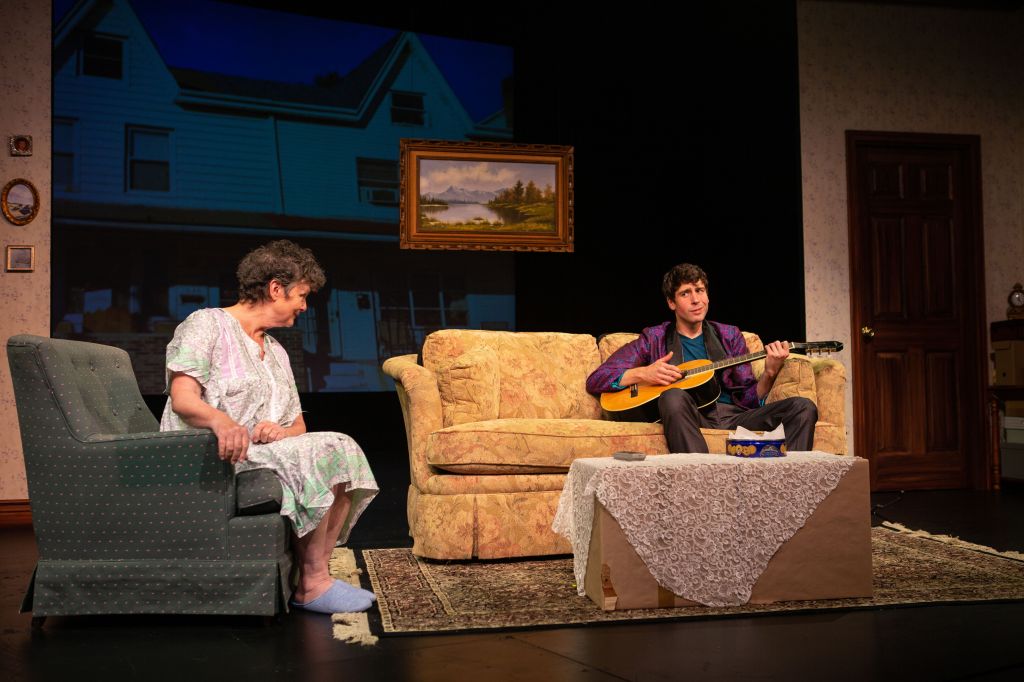
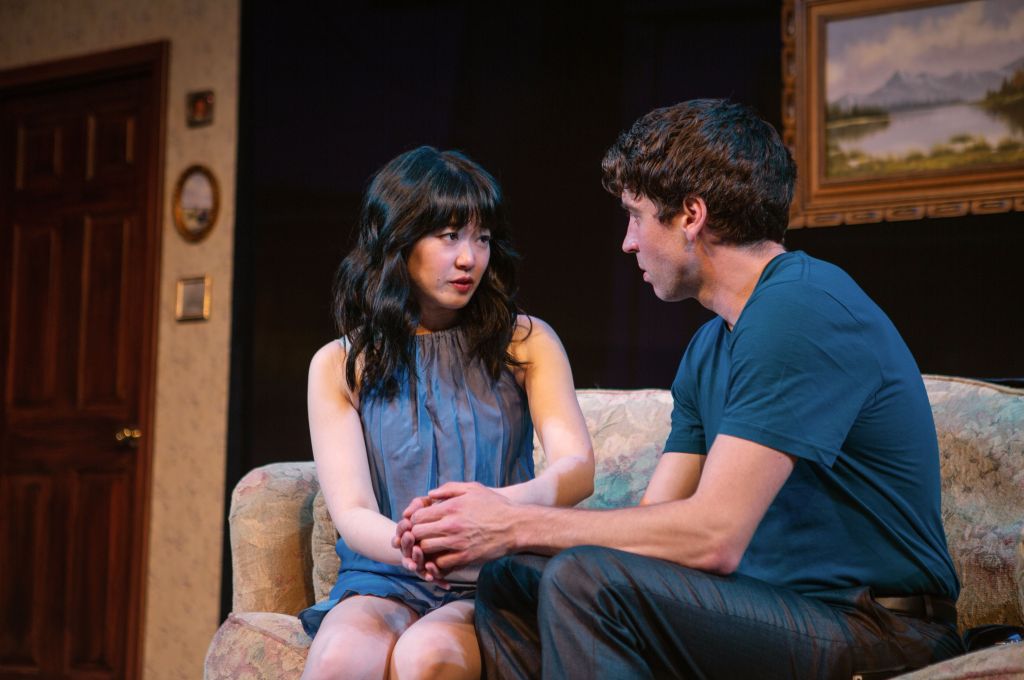
Veterans of Bay Area stages Gary Stanford, Jr. as Michael and Leslie Ivy as Agnes make up the cast for this production.  They are well matched as a pair and manage the dramatic and comedic aspects with skill.

The songs are largely upbeat and support the plotline.  Although the show isn’t studded with memorable tunes, the jaunty opening title song lilts and sets up the narrative.  Perhaps the actors weren’t warmed up or had first night jitters, but that number and those immediately following are not as strong as they should be.  Later, in pieces that call for powerful vocals, Ms. Ivy settles in and shows her stuff.  Mr. Stanford reveals a mid-range sweet spot, but his solos never quite hit the mark.  However, in harmonies, his voice mixes extremely well with Ivy’s, and they excel when singing together.  In addition, his dancing is definitely an asset.  Like a power forward with the moves of point guard, he is remarkably light on his feet – nimble, quick, and graceful.

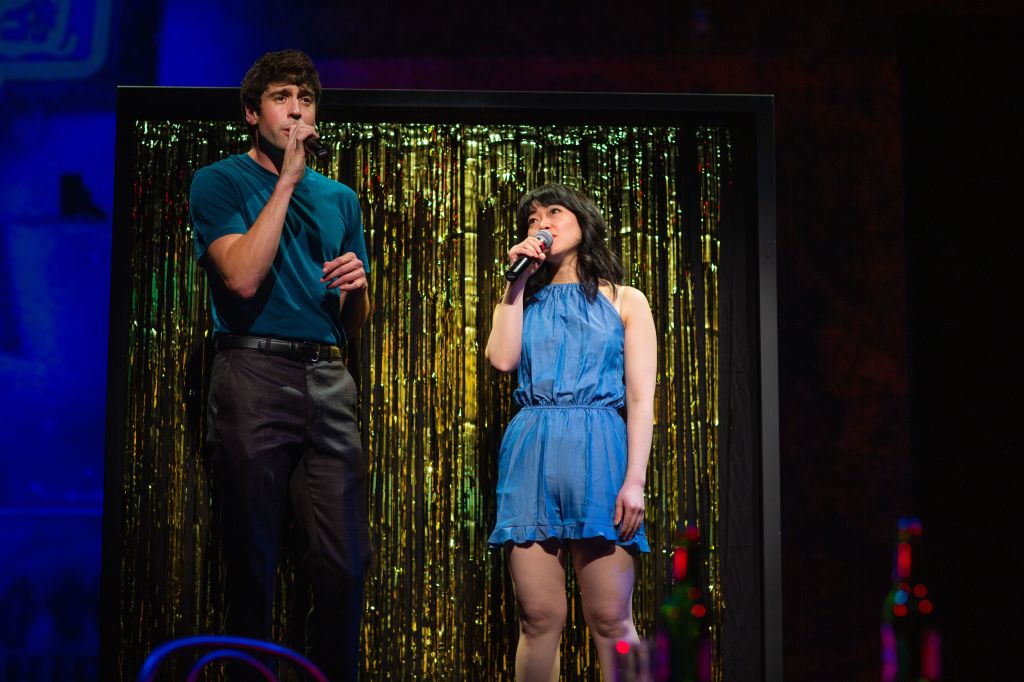
Leslie Ivy as Agnes, Gary Stanford, Jr. as Michael.

The show stopper is the beautiful, yet schmaltzy, “My Cup Runneth Over,” which became a Top 10 pop record single in 1967.  Sung as a duet in the show, the pair capture the essence of the song nicely.  But the most fun number is another duet, “Nobody’s Perfect.”  A lengthy piece that centers on each spouse enumerating the faults of the other, it is largely delivered in patter-talk.  It is hilarious and the couple ace this one.

Following on is another fractious, and this time, gasp-inducing song.  Michael has become a successful writer, whose novels are uninspiring to Agnes, a stay-at-home wife.  With an inflated sense of ego, he fancies himself a chick magnet, while not appreciating that his admirers at literary talks don’t see the side of him that only a wife suffers.  His self-indulgent anthem “A Well Known Fact” argues that a man only gets better with age, while a woman goes to pot, not winning him the gold medal in the diplomatic race.

Although the conflict songs are played for laughs, the clashes around them are serious.  The actors perform their best in these animated, hostile moments.  In all, the musical and the actors find a good balance between lightheartedness and dysfunction.  The years pass by quickly.

“I Do! I Do!,”  composed by Harvey Schmidt with lyrics by Tom Jones, is produced by Woodminster Summer Musicals and plays on its stage at 3540 Sanborn Drive, Oakland, CA through August 22, 2021.

Victor Cordell, Ph.D.
San Francisco Bay Area Theatre Critics Circle
American Theatre Critics Association
Eliogabalo

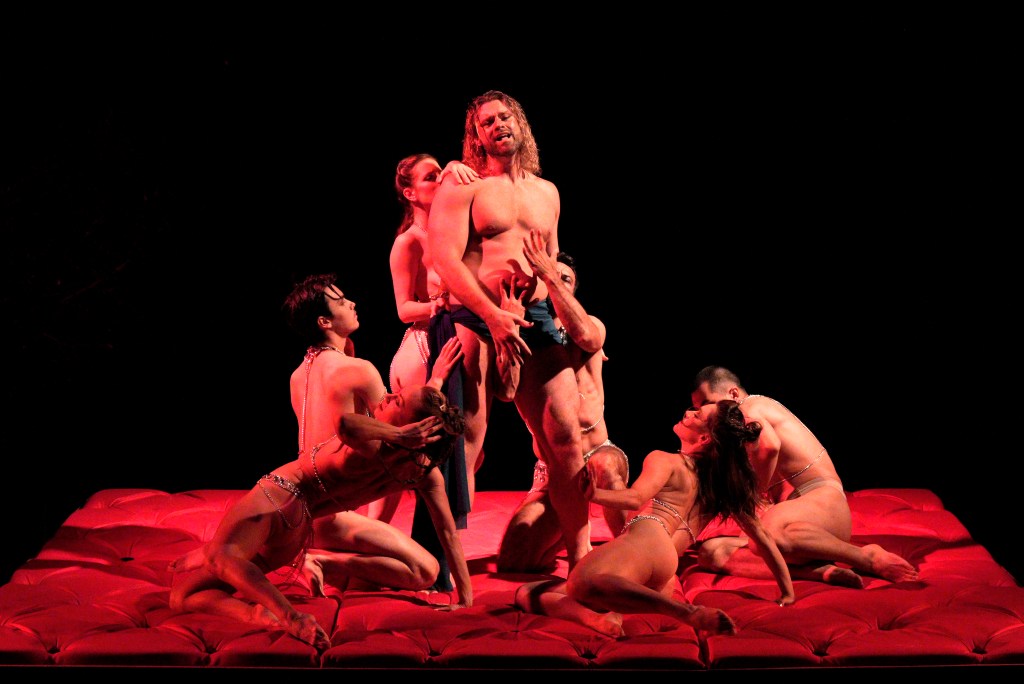
Randall Scotting as Eliogabalo.

Perhaps unique among performed operas, Francesco Cavalli’s 1667 “Eliogabalo”’s world premiere was delayed – by over three centuries – until 1999 to be precise.  Why, one might ask?  Interestingly, an aficionado today can evaluate an opera simply on its own merits, mindful of how appealing it is within its own idiom.  But at the time of its composition, an opera is judged largely within its context.

For instance, while “Madama Butterfly” is one of the most beloved operas in the repertoire, the contemporary detractors argued that Puccini had not advanced his oeuvre sufficiently beyond “La Boheme” and “Tosca.”  Most contemporary opera lovers will appreciate “Butterfly” independent of its place in history.

In Cavalli’s case, he was the most successful composer of his era in the field of small orchestra opera with 38 operas to his credit before his composition of “Eliogabalo.”  But his musical style for this work was deemed passé for the tastes of the Venetian audience of 1667 – an issue that bears little meaning in the 21st century.  The composer would be pleased to observe that this historical oddity has now benefitted by performances from nearly a dozen companies. West Edge Opera’s delightful rendition with well-sung beautiful music, bawdy humor, orgyistic eye-candy production numbers, and an edge of tragedy validates the work’s delayed recognition.

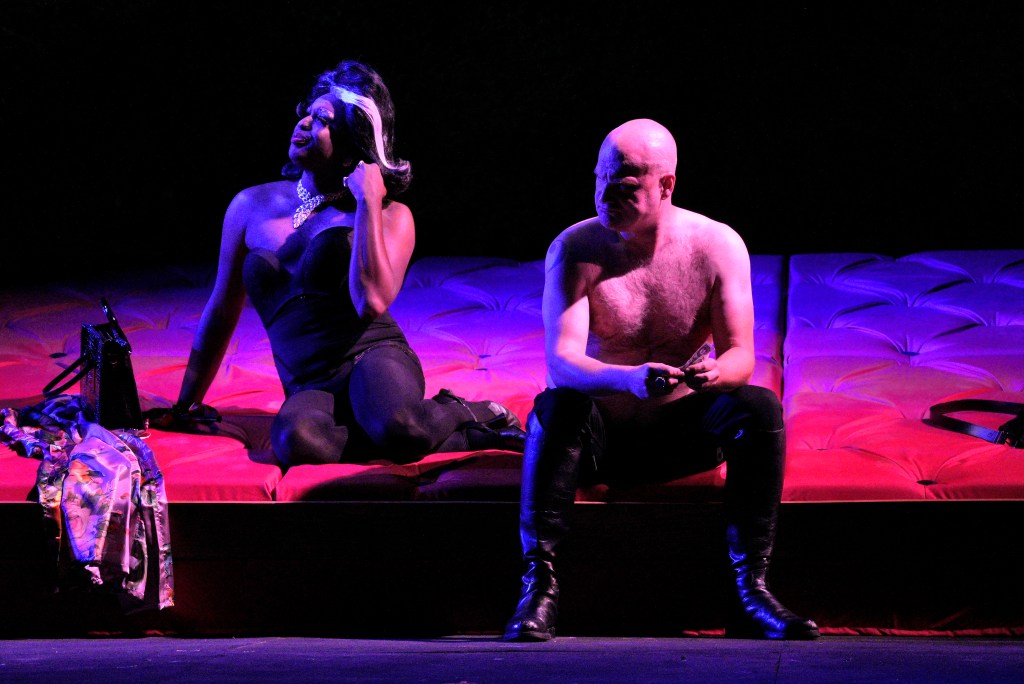
Jean-Paul Jones as Lenia, Nathan Stark as Nerbulone.

The libretto is loosely based on the life of a teenage Roman emperor who reigned from 218 to 222.  Though officially Antoninus, he became known in death as Elagabalus, named after the God he worshipped.  In his brief life, he defied and debauched all religious and sexual conventions.   What’s more, his incompetence was matched perhaps only by his tyranny.  The emperor lived by the notion that “the law does not pertain to me” and didn’t really care about his people, stating that “he who does not follow me blindly is guilty.”   Does this resonate with frightening currency? 

A charismatic Randall Scotting aptly portrays the self-indulgent, sexually ravenous title character.  The countertenor is himself a massive contradiction.  Scotting physically commands the stage having a Samson-like appearance with hunky muscularity.  Thus, his lilting, high voice seems anomalous.  Though his voice is profound, as is common with countertenor voicing, it doesn’t project the power of other voice types.

Eliogabalo’s main quarry is Gemmira, who is otherwise spoken for, but that doesn’t deter the predator.  The evasive maiden is played by Nikki Einfeld whose silky lyric soprano voice features well in arias and blends beautifully in several ensemble numbers.

Nikki Einfeld as Gemmira, Randall Scotting as Eliogabalo.

But the liveliness in the production comes largely from secondary characters.  Cavalli adopts the older, unfiltered maid/nurse meme in Eliogabalo’s enabler, Lenia, who is played in drag by Jean-Paul Jones.  As it happens, Jones is not only an opera singer but also a professional drag queen.  Remarkably, his squawk-box, false alto voice is well controlled, and he switches back and forth to a sonorous baritone with humor and ease.  Director Mark Streshinsky has given Jones liberty to go campy and off script, and the results are hilarious.

Lenia’s sometime partner-in-crime is the henchman-looking harem master Nerbulone.  He also ad libs, including dropping into the audience to solicit additions to the harem, and like Lenia, he occasionally lapses from Italian to English with great comic effect.  Nathan Stark plays the role with great verve, and his baritone range is rich and pleasant.  But while he hit his notes in the low bass end, his power is depleted there, perhaps because of the outdoor acoustics.

Cavalli’s medium of farcical dramedies set in ancient times was common when he was active.  The lasciviousness of “Eliogabalo” was maybe a bit extreme for its time, but the West Edge audience supported it completely.  The baroque score is surprisingly melodious and engaging with many charming arias and small ensembles.  Conductor Adam Pearl’s orchestra of seven includes period instruments and delivers a remarkably full and mellow sound. Kudos to the other principals Derek Chester, Aura Veruni, Mateus Koura, Shawnette Sulker, and Jonathan Smucker, whose voices and acting added to the overall enjoyment.

Nikki Einfeld as Gemmira, Matheus Coura as Giuliano, Aura Veruni as Eritea.

The look of Evan Streshinsky’s spare set is thematically appropriate, comprised of a huge, tilted bed and eight vertical panels.  All appear to be in a tufted red latex look, like straight out of a cheap honeymoon motel room.  But against that canvas is a recurring spectacle of writhing semi-naked and ninja-like dancers that provide the visual pop.

 West Edge Opera has once again shown its skill and daring in its 2021 Festival.  This third and final offering of the season is a welcomed addition that is delivered with great professionalism and flair.  Although the opera has been trimmed somewhat, at two hours and forty-five minutes, it could benefit from further cuts.

“Eliogabalo,” composed by Francesco Cavalli with libretto attributed to Aurelio Aureli is produced by West Edge Opera and plays at Bruns Amphitheater, 100 California Shakespeare Theater Way, Orinda, CA through August 8, 2021.

Victor Cordell, Ph.D.
San Francisco Bay Area Theatre Critics Circle
American Theatre Critics Association

Elizabeth Cree

Keith Phares as John Cree, Katy Pracht as Elizabeth Cree.

Murder!  Mayhem!  Ghoulish entertainment for the lower classes!  Terror in the night on the foggy, shabby back streets of Victorian London!  It sounds like the makings of a Gothic suspense novel.  But an opera?  With a canvas that is the amalgam of a 19th century English music hall milieu, a courtroom trial, and serial murders, it hardly seems likely.  Of significant works intended for the opera house, only Alban Berg’s “Lulu” comes close to being as lurid.

In “Elizabeth Cree,” the eminent Pulitzer Prize winning team, composer Kevin Puts and librettist Mark Campbell, have crafted a score and a darkly comic libretto with Gothic atmosphere that is absolutely riveting.  West Edge Opera’s stellar new production at its wonderful outdoor venue channels the creepiness of the events even at a broad daylight matinee.

Samuel Faustine as Dan Leno, Joe Meyers as Little Victor Farrell, Leslie Katter as Aveline Mortimer, Christopher Job as Uncle.

The opera is loosely based on fact.  Elizabeth Cree suffered a hard scrapple upbringing with a mother who badly abused Elizabeth’s genitals as punishment for the girl’s having been raped.   However, she rose from the bowels of society to catch on as a performer with a music hall troupe.  Later, she met and married John Cree, a literary critic and failed writer but with a comfortable income from his family.  John would be implicated in a series of Jack the Ripper like murders but would die from a dose of poison administered by Elizabeth, who would be tried for his murder.

Like the company producing it, the opera is edgy in every way.  The plot line is delivered briskly in a series of 29 vignettes that move back and forth in place and time.  At one point Elizabeth reveals her unhappy childhood and at another her sexual frigidity.  Vaudevillian-like music hall entertainers in silly costumes amuse us.  Real-life luminaries Karl Marx and George Gissing are encountered at the reading room of the British Museum, also frequented by John Cree, and are interrogated on the witness stand of the trial.  Most vividly, we see the scenes of the swarthy, rakishly handsome John Cree enacting and describing in gory detail the bloody, precise vivisection of the murder victims.

Samuel Faustine as Dan Leno, Katy Pracht as Elizabeth Cree.

The composer’s dizzying score engages throughout with the same rapid movement as the scenes.  The orchestra tinkles and tingles and screeches and pounds like a punch in the gut.  It soars as Cree contemplates impaling the next victim.  But at the same time, the music allows for a variety of lyrical vocalizations which are delivered with consummate skill.

Mezzo Katy Pracht soars as Elizabeth with a mellow voice and full vibrato, conveying a panoply of enigmatic emotions from her lost innocence to her deadly scheming.  But her murderous character is mundane when contrasted to her male counterparts.  Pracht’s real-life husband, Keith Phares, portrays the sinister John Cree with flair.  His silky, rounded baritone includes a lilting high end and warm vibrato.  Finally, Samuel Faustine is the brassy and gaudy comedian Dan Leno, the head of the music hall performers.  His versatile tenor voice includes a well-controlled countertenorish high end that is put to great use in low volume passages.

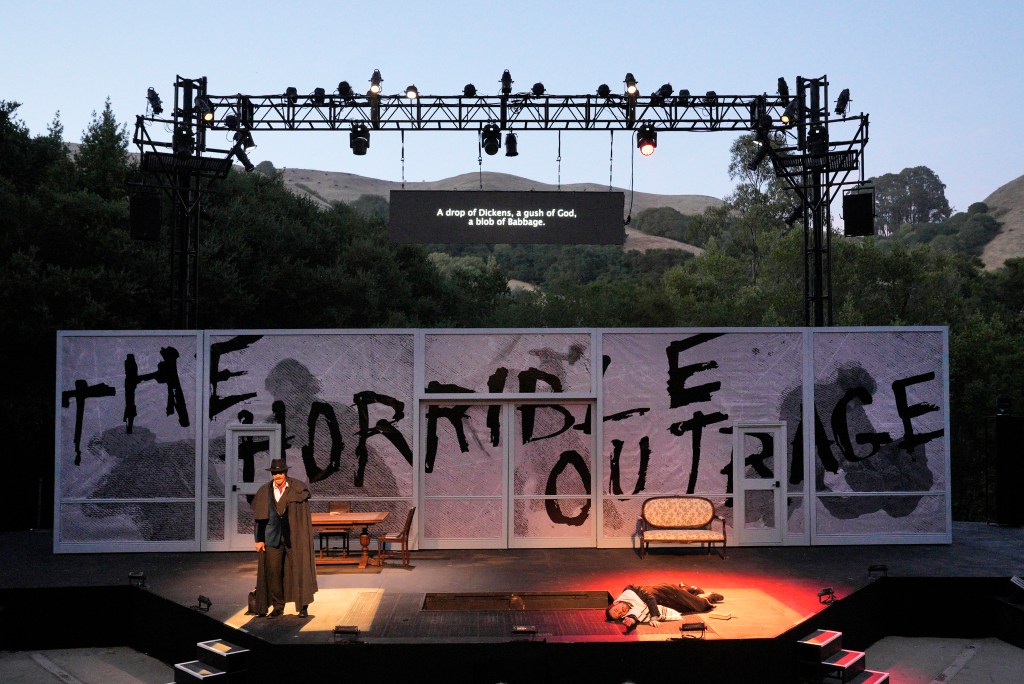
Keith Phares as John Cree.

This opera may not have the gravity of Verdi or Mozart works.  However, the score is multifaceted, fitting, and eminently listenable.  Not to mention, the libretto is clever in structure; gripping and engaging; and as propulsive as the music.  To top it off, there is an element of suspense with an intriguing denouement.  The West Edge production touch is a perfect fit to this delightful opera.

“Elizabeth Cree,” composed by Kevin Puts, with libretto by Mark Campbell, is produced by West Edge Opera and plays at Bruns Amphitheater, 100 California Shakespeare Theater Way, Orinda, CA through August 7, 2021.

Victor Cordell, Ph.D.

San Francisco Bay Area Theatre Critics Circle

American Theatre Critics Association
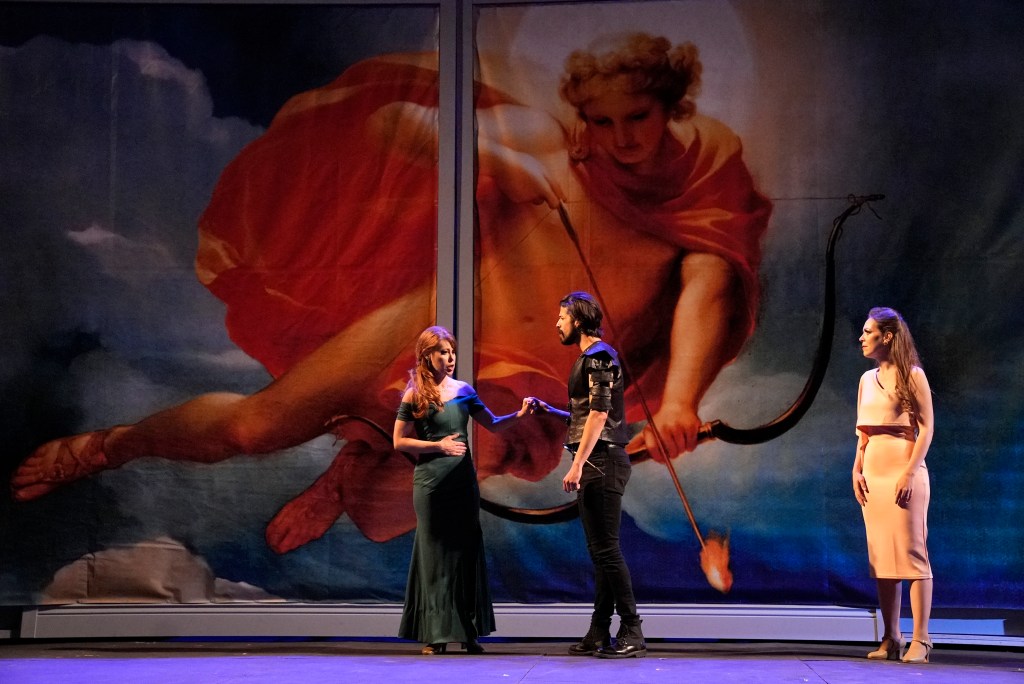
Katya Kabonova

Phil Skinner as Dikoj, Kristin Clayton as Kabanicka, Alex Boyer as Tichon, Carrie Hennessey as Katya, Sarah Coit as Varvara, Chad Somers as Kudrjas. All photos by Cory Weaver.

For several seasons, the innovative and peripatetic West Edge Opera has performed at various historic, industrial, and sometimes noisy venues, all with unsloped  seating.  This season, they have moved outdoors to the glorious Bruns Amphitheater in Orinda.  Its tiered seating provides comfortable sight lines that are greatly welcomed, not to mention a spectacular backdrop of golden hills with green riparians from its setting in the Siesta Valley.  Many thanks to California Shakespeare Theater, which holds a long-term lease on the venue.  Cal Shakes has facilitated other companies performing at this wonderful outdoor arena in its “Season of Shared Light,” providing a safer haven from the pandemic than indoor spaces.

In keeping with its tradition of producing operas that open new horizons for much of the audience, West Edge’s 2021 Festival commences with Leoš Janáček’s 1921 masterpiece, “Katya Kabanova.”  A stellar cast led by soprano Carrie Hennessey turn in outstanding performances to make this a compelling opera experience.

Carrie Hennessey as Katya, Christopher Oglesby as Boris.

Until recent times in the United States, Janáček was a known but rarely performed composer, limited largely because of the difficulty of casting opera in Czech.  However, “Katya Kabanova” is exemplary of his searing dramas about common people who sing with the vocabulary, style, and rhythms of natural language, creating an authenticity that has found audiences.  His eclectic, somewhat dissonant 20th century musical style which draws heavily on folk music, especially Moravian, has created demand.  Although the format of “Katya Kabanova” is through-sung, it does contain some notable arias.

The opera is based on a Russian play, Nikolayevich Ostrovsky’s “The Thunderstorm.”  However, its passion also draws from Janáček’s own unrequited love for a married woman, like Boris’s love for Katya in the opera.  Needless to say, social convention in small town Russia in the 19th century was more restrictive than current day.  It bears noting that moral turpitude (if one even wishes to classify “illicit” affairs as such) derives not from possessing thoughts about socially-unacceptable deeds, but rather by the failure to prevent thoughts from translating to action.  In some cases, temptation is all but unavoidable.

Katya is a tragic figure. She is a young, attractive woman, caught in an unhappy marriage to Tichon.  He is not inherently evil, but suffers under the thumb of his domineering and socially-rigid widowed mother, Kabanicka, who makes life hell for the free-thinking Katya.  In the critical event of the narrative, the mother forces Tichon to go on a long business trip.  Katya knows that she will be tempted to make love with Boris if Tichon leaves and begs the husband to either stay home or take her with him.  He argues that his mother gives him no choice and denies her.  His absence marks the descent into Katya’s devastation.

Kristin Clayton as Kabanicka, Alex Boyer as Tichon.

It is good fortune that General Manager Mark Streshinsky and Music Director Jonathan Khuner had a history with Carrie Hennessey through her playing the lead in the company’s 2014 “End of the Affair.”  From her resumé, it isn’t apparent that she would be up to a demanding role of the magnitude of Katya.  Yet she totally commands it.  Dramatically, she captures the many emotions of the desperate young woman.  Musically, she captures those moods through the full vocal range and in both lyric and dramatic voicings.  These contrasts are particularly well expressed when she is conflicted, as when she first meets Boris and admits both her love for him along with her guilt and wishing to die.

Other performers are superb as well, starting with Kristin Clayton’s appropriate harshly-delivered depiction of the demanding Kabanicka.  The two men in Katya’s life are represented by two clarion tenors, Alex Boyer as her husband Tichon and  Christopher Oglesby as the lover Boris.  Booming baritone Phil Skinner, delightful mezzo Sarah Coit, and bright tenor Chad Somers also provide appealing turns.

The opera is set “with a nod to 1950s California.”  A few furniture pieces are consistent with midcentury modern design, but décor features like sepia-colored prints and an antimacassar don’t fit that period.  In any case, the predominance of institutional green wall coloring is dreary.  A true representation of the 20th century, perhaps bright looking in contrast to the dark action of the opera might be interesting, but otherwise full-on traditional version would work well.

The orchestra endures somewhat daunting conditions, placed completely under the stage with only a small aperture onto the apron.  Amplification is required to produce satisfactory volume (though singers voices come through with great power and clarity without mics).  On opening night, the striking introductory sequence with a deep and long held chord followed by a brief melody and timpani motif was muffled and almost lost, perhaps because the sound controls hadn’t yet been optimized.  Overall, the orchestra seemed to fare better when the instruments’ soundings had greater separation, but they occasionally seemed a little out of sync and tune during tracts demanding greater unison.

Sarah Coit as Varvara, Chad Somers as Kudrjas.

In sum, with “Katya Kabavona”’s powerful score and intense drama, Janáček expressed his full maturity in the vocal genre.  It is a classic, and West Edge’s production is well worth seeing.

“Katya Kabanova,” composed by Leoš Janáček with libretto by Vincenc Červinka is produced by West Edge Opera and plays at Bruns Amphitheater, 100 California Shakespeare Theater Way, Orinda, CA through August 5, 2021.

Victor Cordell, Ph.D.
San Francisco Bay Area Theatre Critics Circle
American Theatre Critics Association
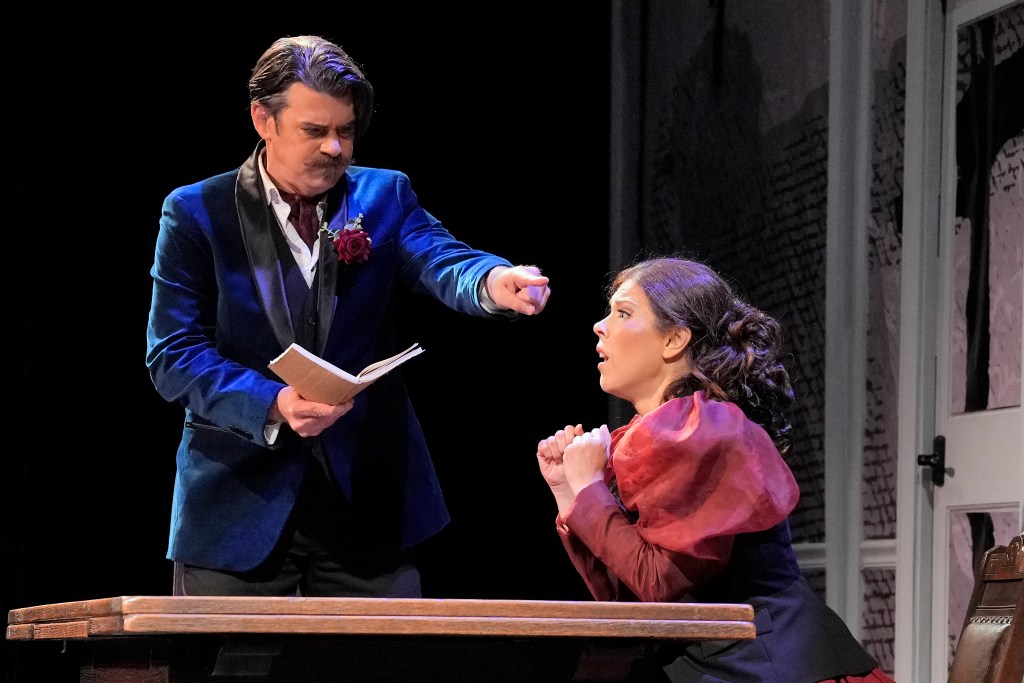
The Song of Summer

Jeremy Kahn, Monica Ho. All photos by Jessica Palopoli.

Nostalgia, that palpable yearning for past days of youthful enthusiasm and innocence, comprises the sights, sounds, and smells of those special times.  But a frequent trigger of those warm feelings comes from the soundtrack of the time.  Playwright Lauren Yee taps that vein and beyond with “The Song of Summer.”  With a nod to the music, the playwright takes a charming and humorous look at the relationships and trajectories of our lives.

Ever self-effacing Robbie has stumbled onto the brink of success.  While bartending in Tacoma, the bar’s manager, Joe, sees the potential of a song that Robbie introduced to him.  He organizes Robbie’s recording it, and it rises to become the emotional timestamp which young people would most associate with that summer.  The song’s popularity spawns a national tour for the nascent star, but when he receives boos at a North Carolina concert because some consider his lyrics “rapey,” he bails without notifying anyone.  His escape is into the bosom of his former piano teacher in Pottsville, PA, a coal town where he had grown up until a dozen years before at age 16.

Anne Darragh, Jeremy Kahn.

Who could portray Robbie’s nebbishy character more splendidly than Jeremy Kahn?  Eminently likeable, a talented musician, and nice looking, Robbie’s diffidence and lack of confidence leads him to repeatedly refer to himself as a 4 on a scale of 10.  As much as you like him, you want to make like Cher in the movie “Moonstruck,” and scream “Snap out of it!” and throttle him.

The piano teacher, Mrs. C, is delightfully performed by Anne Darragh.  Kind and supportive, she was more a mother to Robbie than his blood mother.  She is also a pack rat.  So when Joe, now Robbie’s artistic manager, catches up with him, Joe realizes that Mrs. C may possess information that could help benefit Robbie’s career.  Reggie D. White excels as the stereotypical artist’s manager – hyper, aggressive, and always keeping eyes on the prize, unlike the sometimes dreamy-eyed and ambivalent client.

Reggie D. White.

And then there is Tina, who had a complex relationship with Robbie growing up.  She is the daughter of Mrs. C played wonderfully by Monica Ho.  Very grounded as an adult, but in a flashback sequence to high school days, she is revealed as ambitious, yet fun-loving, and adventuresome.  She also has a foul mouth that could embarrass a sailor.

 “The Song of Summer” contains many stock situations, but they are written and performed with great flair, and the outcomes are not always as expected.  Importantly, the play’s subtext provides layers of depth that result in a thoughtful work.  Though the work doesn’t wallow in self-importance, this is not an episode of “Happy Days.”

Perhaps the most important underlying theme concerns the effects of random events in life.  People like to think that they exercise great agency over their lives, and often that is true.  The dominant life arc of some people may have few arbitrary disruptions, but for others, uncontrollable events create a trajectory as erratic as shots from a loose cannon.  Their lives are full of “what-ifs” – if a life-altering appointment weren’t missed; if a parent hadn’t died; if one hadn’t been required to serve in the military, all lead to radically different pathways of life.  In this case, what if Robbie hadn’t moved to Tacoma, an act over which he had no control?  What if Tina had seen the camcording intended for her?   But we are also reminded that momentous what-ifs occur from decisions over which we do exercise control.

Another key element is chosen versus inherited family.  Here, the caring Mrs. C acts as the nexus.  Although the central element of family is blood kinship, she demonstrates that water can be thicker than blood.  Tina did not come to her by birth but by adoption, though their bond is no different than blood relatives.  Robbie comes from a dysfunctional background, and Mrs. C was like a mother to him, who he felt comfortable returning to.  By design, the playwright specifies characters to have ethnicities – Asian (Tina, who is adopted) and Black (Joe, who had been a replacement singer in The Four Tops) to demonstrate familial linkages across color.

Monica Ho, Jeremy Kahn.

The play is also about going home again, and the way of life in small town America.  There is a clash between the traditional view of unchanging practices and values versus the realities of the modern day.

Although they are chalk and cheese, Kahn and Ho sparkle together as well as apart. “The Song of Summer” moves along at a brisk pace, and while Director Bill English’s clever staging allows for rapid set changes in the absence of intermission.   Given the play’s centerline, the show would benefit from having more punch in the musical numbers (especially the opening, but with the exception of the karaoke duet “Alone”).  That said, it is a well-acted and directed, fun and provocative play with a modicum of suspense that should appeal to a wide audience.

“The Song of Summer” written by Lauren Yee and produced by San Francisco Playhouse appears on their stage at 450 Post St., San Francisco, CA through August 14, 2021.

Victor Cordell, Ph.D.
San Francisco Bay Area Theatre Critics Circle
American Theatre Critics Association
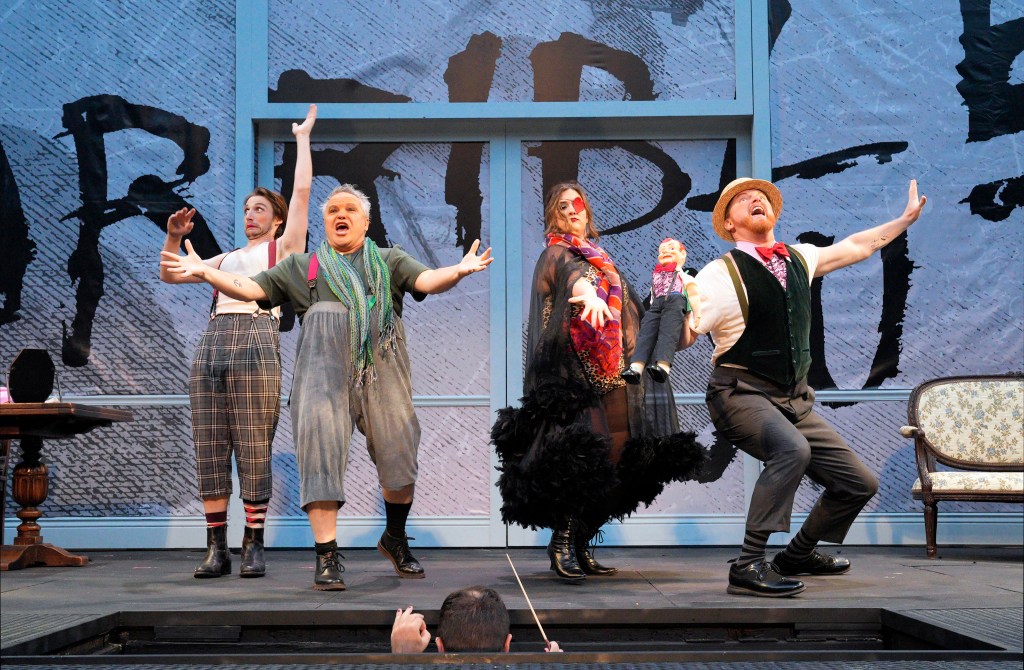
The Late Wedding

Tyler Jeffreys (above), Moshe Goodman (below). All photos by Squirrel Visuals.

Christopher Chen, born and raised in San Francisco, is one of the Bay Area’s favorite playwrights.  Innovative in structure and subject, funny and thoughtful, his plays break new ground.  But the title block on the program itself suggests that “The Late Wedding” goes a step beyond even his extraordinary.  Rather than stating that the play is “by” the playwright, it indicates that the play is “from the notes of Christopher Chen.”  This odd citation becomes the crux of the play’s structure and the basis for its criticism.  Those who favor the absurd; who value creativity; who appreciate skit comedy; and who follow the work of the playwright will be most drawn to this play.

With their fully-staged production of Chen’s work, kudos to Mountain View’s Pear Theatre for leading the way in the return to indoor theater after 15 months of pandemic-imposed darkness.  The adventuresome small company not only offers socially-distanced indoor performances to a play with a full cast, but also outdoor performances and online streaming, to accommodate all manner of theater lover. Hallelujah!

Carissa Ratanaphanyarat, Stephen Kanaski.

The company gives a spirited rendering of the play, directed by Sinohui Hinojosa.  The cast is led by the highly animated Annamarie MacLeod as the narrator, who tries from time-to-time to inject meaning into the proceedings.  Six other actors play multiple roles in the dozen-ish sketches that comprise the narrative.  Largely, the performers fit the characters well and imbue them with verve, though not all are equally convincing.

So, what is the playwright up to?  Chen acknowledges in the play itself the influence of Italo Calvino’s “Invisible Cities,” in which Emperor Kublai Khan discusses with merchants the cities that they trade in – thereby learning the nature of people in the various outposts.  In the case of “The Late Wedding,” relationships replace cities.  The unfolding of unusual foreign social practices yields farcical situations that produce more smiles than hardi-har belly laughs.

The first three segments provide a humorous anthropological look at what conventional people would consider strange marriage practices in these fictional places.  For example, in one venue, courtship is so revered and marriage considered such a letdown that true believers remain apart after marriage for as long as they can!  In another, marriage is so open that parents routinely don’t know who the fathers of their children are.

Annamarie MacLeod.

The formula then shifts to what Chen calls interludes, which are also segments largely focused on relationships.  In a thriller episode, a spy meets her handler and tries to prove legitimacy, despite having forgotten part of the passcode.  In a latter segment, a spaceship seeks the celestial bodies of the Calaman Islands, which played as a separate honeymoon destination for the earlier couple who planned to live blissfully apart.  While this closes one story loop, it doesn’t provide a prism through which to see the full procession of vignettes.

Many other playwrights have used absurdism as a central theme, such as one of Calvino’s inspirations, Luigi Pirandello, with his “Six Characters in Search of an Author.”  And giving broad latitude to directors on fleshing out and casting shows with many roles has been done by the likes of Caryl Churchill in “Love and Information.”  But as opposed to Chen’s play, those pieces convey the sense that they were completed as designed. That said, while much action in “The Late Wedding” is fanciful and disjointed, it is underscored by important themes such as social mores, time, perception, change, and morality.

“The Late Wedding” gives the sense that the playwright cobbled together several ideas that he couldn’t fully develop individually.  The fact that authorship attribution of the play is to “the notes of Christopher Chen,” and that a comment within the play observes that it includes leftovers conforms with the thinking that the sketches are an omnium gatherum. It even raises the question of whether he is responsible for the final text.  Also, extraneous “notes” appear throughout the play, including grocery lists and questions whether certain commentary in the manuscript was intended to be text or the playwright’s reminders to himself.  And the final support to the notion that the design is not premeditated is that there is explicit reference to writer’s block.

Gaz Jameel, John S. Boles, Tyler Jeffreys.

Of course, all of these diversions could be subterfuge – red herrings to make the audience think that the structure is chaotic rather than calculated to seem incoherent.  In any case, it is provocative and entertaining. But ultimately, does the work stand on its own as patchwork comedy? As metatheatrical exposition? As an expression of absurdism?  Is it art?  It’s up to you to decide.

“The Late Wedding” from the notes of Christopher Chen is produced by Pear Theatre and plays on its stage and outside of that venue at 1110 La Avenida, Mountain View, CA, and streaming online through July 18, 2021.

Victor Cordell, PhD

American Theatre Critics Association
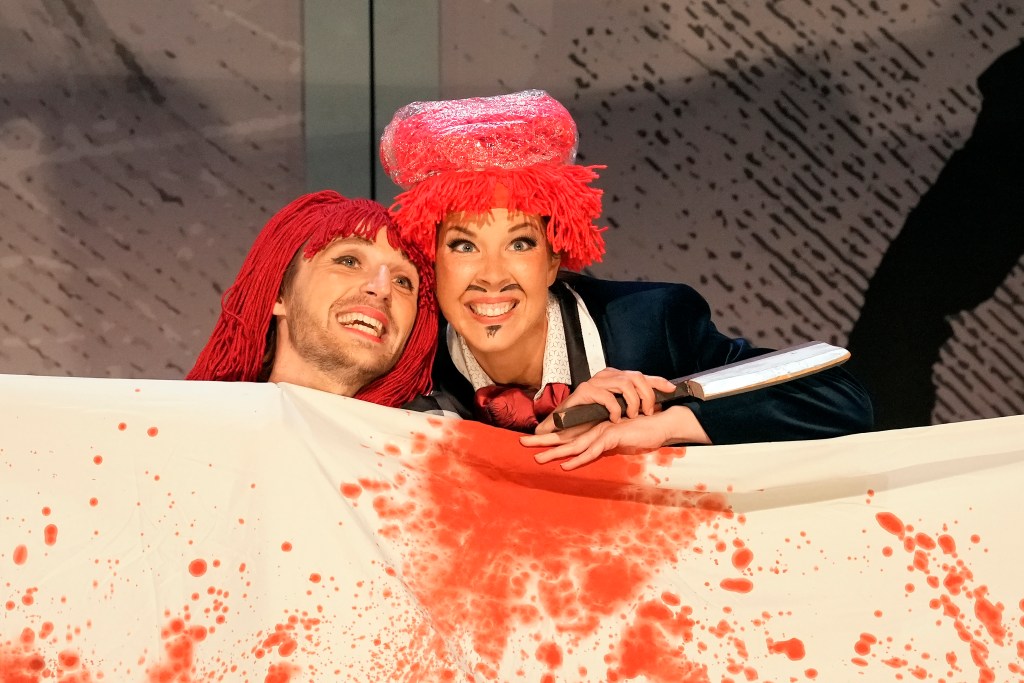
San Francisco Bay Area Theatre Critics Circle

Hold These Truths

Jomar Tagatac as Gordon Hirabayashi. Photo by Jessica Palopoli.

Gordon Hirabayashi grew up in Washington state as a nisei, a second-generation Japanese-American.  Although imbued with reverence for the United States Constitution, his “aha” moment comes upon his initial case before the United States Supreme Court, realizing then the painful contradiction between the Constitution as a most laudable political contract and those who were appointed to uphold it.

Playwright Jeanne Takata’s one-man, biographical drama “Hold These Truths” beautifully captures Hirabayashi’s courage and sacrifice in challenging President Franklin D. Roosevelt’s 1942 Executive Order 9066, which consigned Japanese-Americans, including those who were American citizens, to internment camps during World War II.  This act displaced human beings based strictly upon race, forcing them to virtually give away businesses, property, and personal possessions.

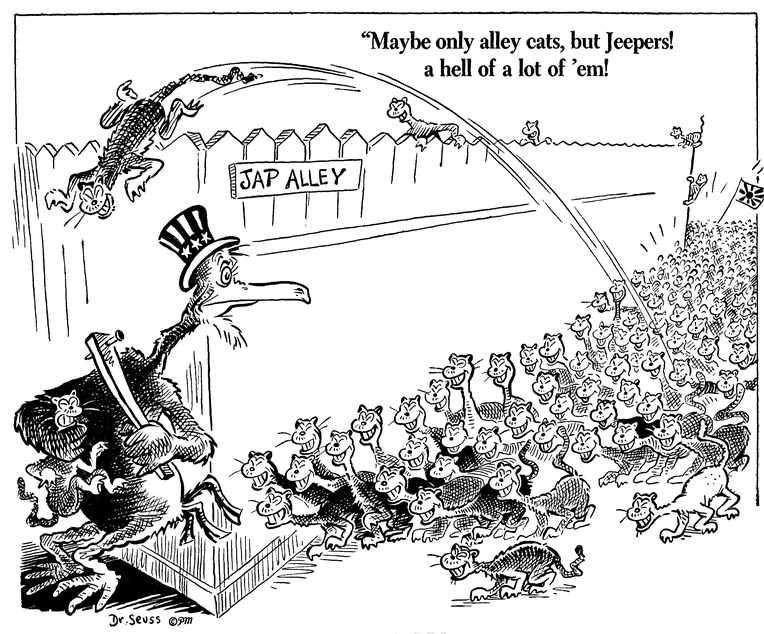
Political cartoon inciting fear of Japanese Americans.

Unlike any other nation, American polity is anchored in the bedrock of a set of glorious documents that provides a guiding light for democracy.  At conception, its Declaration of Independence embraced the radical notion that “We hold these truths to be self-evident, that all men are created equal.”  And at its birthing, the Preamble to the U.S. Constitution observes that the first objective of the American people is “to form a more perfect union,” conceding the new nation’s flaws at outset, but implying the quest of better welfare for its posterity.

American democracy has largely improved with age but not without suffering setbacks.  Egregious and systemic racism is at the core of many of our failures to live up to the grandiloquence of our ideals – slavery as an accepted practice at our inception; breaching of innumerable treaties and other agreements with Native American tribes;  Jim Crow laws in the South to deny African-Americans their rights following the emancipation amendments; the Chinese Exclusion Act of 1882 suspending Chinese immigration; the rejection of Jewish refugees during World War II and in the face of the Holocaust; and the blatantly discriminatory voter suppression laws passed or currently proposed by Republicans in over 25 states that are designed to impair blacks’ and other minorities’ ability to exercise their most cherished democratic rights.  All of these horrific practices fomented by our elected leaders serve to generalize the specifics of this play concerning the Japanese Relocation Order.

“Hold These Truths” is a love letter from the playwright to Hirabayashi’s memory.  Seemingly an average kind of guy who is a little diffident and socially clumsy, Takata largely applies a light touch to his childhood and time as a student at the University of Washington.   Although Hirabayashi adheres to the cautions of Japanese geography in Seattle, meaning he knows to avoid walking certain blocks because of anti-Japanese signs and in which shops and cafes he won’t receive service, he lives like a typical poor student.

Inflamed by the wartime actions against Japanese-Americans by the government, but lacking any expertise or strategy, he rises to the occasion and defies the order, certain that he is protected by the Constitution.   Some droll incidents occur after he is found guilty.  For reasons that won’t be shared, he asks for a longer sentence than he is originally given, but is told that the court doesn’t have the funds to transport him to an appropriate facility. So, he negotiates to wend his way to prison on his own recognizance!  1,500 miles away!  In Tucson, Arizona!

Another political cartoon inciting fear of Japanese-Americans. The cartoonist is Dr. Seuss.

The pace of “Hold These Truths” is a bit pedestrian, yet it excels in storytelling.  Surprisingly, a relatively small portion of it is dedicated to the reason that we care about Gordon Hirabayashi – the Supreme Court cases that challenged the unequal treatment of Japanese-Americans in World War II on the basis of race.  Yet, the character is very involving, and the storyline holds the audience’s attention.

A key element that makes the play work is the astounding tour-de-force performance of Jomar Tagatac, who conveys such genuineness and believability in the main role.  The actor has become recognized as one of the great performers in the Bay Area, but he has been seen in plays with ensembles in which he constitutes part of a whole.  Now he has proven beyond a doubt that he can single-handedly carry a one-hour-and-forty-five minute production with great conviction.

As Hirabayashi, Tagatac displays a wide range of emotions with engaging animation.  With Jeffrey Lo’s direction, his movement around the spare set and changes in affect keep the action lively.  In addition to playing the central character, he voices and mimes many others, from his mother and father to prisoners and judges.  His voicings are distinctive, yet never exaggerated.  Significantly, he uses posture and micromovement with remarkably subtle precision to bring even brief characterizations into focus.

Gordon Hirabayashi’s family was interned soon after the attack on Pearl Harbor.

This review is of a first preview, and in normal times, one would not publish a review of a preview.  Of course, these are not normal times.  Because of pandemic capacity constraints, SF Playhouse must spread the reviewers across several nights and has requested this exception.  This is the first indoor live performance that this theater lover has seen in 15 months.  There were a few hiccups along the way, but who cares?  I won’t even mention what they were.  It is a highly recommended theatrical experience.

“Hold These Truths” is written by Jeanne Sakata, produced by San Francisco Playhouse, and plays on their stage at 450 Post Street, San Francisco, CA through July 10, 2021.  It is also available streaming online throughout the run.

Victor Cordell, Ph.D.

American Theatre Critics Association
San Francisco Bay Area Theatre Critics Circle

Begin the Beguine: A Quartet of One-Acts

Dawn L. Troupe, Benoit Monin (from “Healing”) All photos by Carson French.

î

One can only imagine how many treasure troves of artistry lie hidden away around the world in dusty attics and musty cellars.  Nina Collins, daughter of playwright and poet Kathleen Collins, has collected and released a rich reserve of her late mother’s previously unpublished works from the 1970s and 1980s.  Included are four short plays that, while they are uneven, and despite their age, resonate today.

Like Kathleen Collins’s predecessor and inspiration, Zora Neale Hurston, who is referenced in “Begin the Beguine,” Collins’s work was largely unrecognized in her lifetime.  Two films she wrote and produced were seen only on the festival circuit, with no commercial distribution.  However, in the last several years, her “Losing Ground” from 1982 was released in various home electronics formats.  In 2020, the National Film Registry of the Library of Congress designated the movie for preservation as being “culturally, historically, or aesthetically significant.”

Participating in a joint world premiere with Performance Space New York, Oakland Theater Project presents the quartet live, viewed by the audience in these pandemic times from their vehicles and heard through FM radio feed.  Vehicles are parked only one-deep on three sides of the performance ground, so that the audience has unobstructed views as if from mid-orchestra around an outdoor thrust stage.

Leon Jones (from “Begin the Beguine”), Margherita Ventura (from “The Reading”).

Michael Socrates Moran and Dawn L. Troupe co-direct, and the latter plays the lead role in each play.  Ms Troupe’s passion for the project is evident in her commanding performances.  Her four characters are not defined as comprising one identity, yet, a complex, archetypical profile derives from the aggregate.  She must convey a wide range of emotions from reverent to hostile to sassy.  She is aloof, alluring, and uncertain in defining a composite personality.

It is not disclosed whether the plays were intended as a set, but together, they possess a symmetry in which the whole exceeds the sum of the parts.  Taken as one, they plumb the psyche of a black woman, or a group of black women, if the viewer rejects the notion of four phases of a single character.  The opening play is a soliloquy, while each of the remaining three have two significant players.  But in each, the two characters are variously distinguished by contrasts in race, gender, and/or age.  A professional or artistic black woman is central to each. 

“Reflection,” the most universal and existential of the plays, confronts us at the outset.  The black woman could be any ethnicity or gender as she confronts daily life and tries to find God.  As a dancer and a housewife with daily chores to complete, she tries to reconcile the different lives she leads, wondering which one is real.  The main concept in this play is of timeless interest, but consistent with the problem itself, the play offers no conclusion.  This thread runs through the one-acts and may be unsatisfying for those looking for closure from stories.

Most animated, conflictual, and interesting is “The Reading.”  Two women, one black and one white, await appointments with a psychic.  The sociable and uninhibited white woman probes and expounds and begins to reveal stereotypical racial thoughts, while the black woman parries and condescends.  Yet in the end, she, too, lets down her guard and shares her own inner thoughts.  When the women learn that the psychic will have time for only one reading, which woman will it be, and why?

Most opaque is the eponymous third play, “Begin the Beguine.”  A middle-aged actress engages with a younger man in a park.  At first, it seems that he is her son, but the relationship becomes increasingly ambiguous to the point that he becomes every man.  Her inclination to perform on and off stage is evident in her storytelling, but what does this say about her being?  Is she trapped on a treadmill, or is she released?

In the final episode, “The Healing,” the black woman receives laying-on-of-hands treatment from a white therapist.  Their fractious session evidences the divide between his offer of faith healing, a solution without reference to cause, versus her organic need to understand why it is that she hurts.  Along the way, racial tension is heightened as she willfully breaks a rule of propriety and he participates in a naive act that may be perceived as a precursor to what we now consider appropriation.

Kimberly Daniels (from “The Reading”), Dawn L. Troupe.

Kudos to OTP for devising ways to bring live theater to its audience.  The staging of these four one-acts is simple, accented by attractive decorative lighting.  The acting, mostly by company members, suits the material.  Nonetheless, the plays would benefit from production in a more traditional environment.  As a corollary to our time, observing a play from a car is a bit muffled, like breathing through a surgical mask. Yet it certainly serves it purpose.

Through the series of well-revealed incidents, we do gain understanding, as well as empathy, for this multidimensional woman.  Each play possesses its own internal motivation and noteworthy development, but typical of such compilations, it lacks connection to provide a true dramatic arc.  Minor adaptations to the texts could help facilitate connectiveness.  Nonetheless, these works represent a notable artifact from an underappreciated author, and an interesting viewing for those drawn to this type of material.

“Begin the Beguine: A Quartet of One-Acts,” a world premiere of plays written by Kathleen Collins is produced by Oakland Theater Project and plays live in drive-in format at FLAX art & design, 1501 Martin Luther King Way, Oakland, CA through July 3, 2021 and streams online June 19-July 3, 2021.

Victor Cordell, Ph.D.
American Theatre Critics Association
San Francisco Bay Area Theatre Critics Circle

The Adlers: Live at the Drive-In

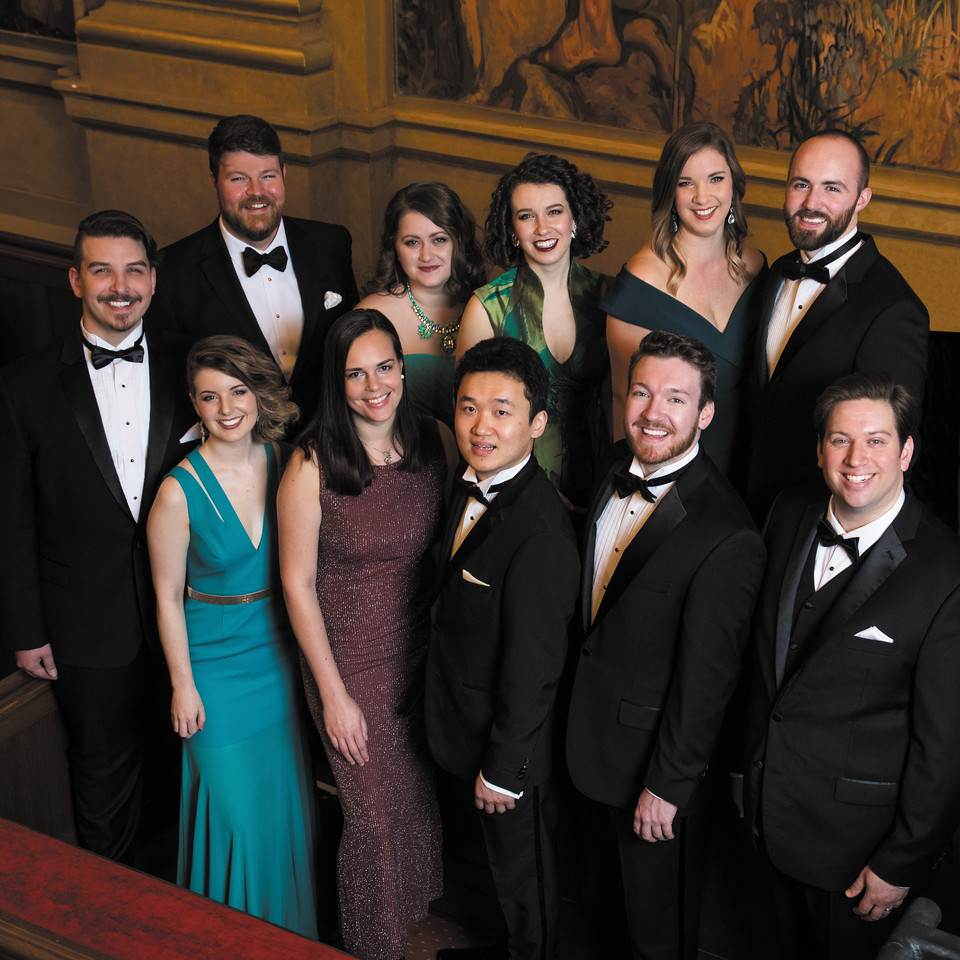
2021 San Francisco Opera’s Adler Fellows and concert piano accompanyists. Photo by Cheshire Isaacs.

The experiment continues.  San Francisco Opera broke new ground with their production of “Barber of Seville” – live performances of an opera at a “drive-in” with music delivered by FM radio to patrons seated in their vehicles.  Now the company’s resident artists, the Adler Fellows, are giving their annual concert series at the same venue, the beautiful and versatile, Frank Lloyd Wright designed Marin Center.  With the Fellows’ talent, they could delight an audience by performing anywhere.  In this case, they sing from the same purpose-built stage as “Barber”, which comprises a repurposed set originally designed for the company’s “Fidelio.” That production was cancelled due to the pandemic.  In addition to viewing the singers in the flesh, large projection screens provide close ups.

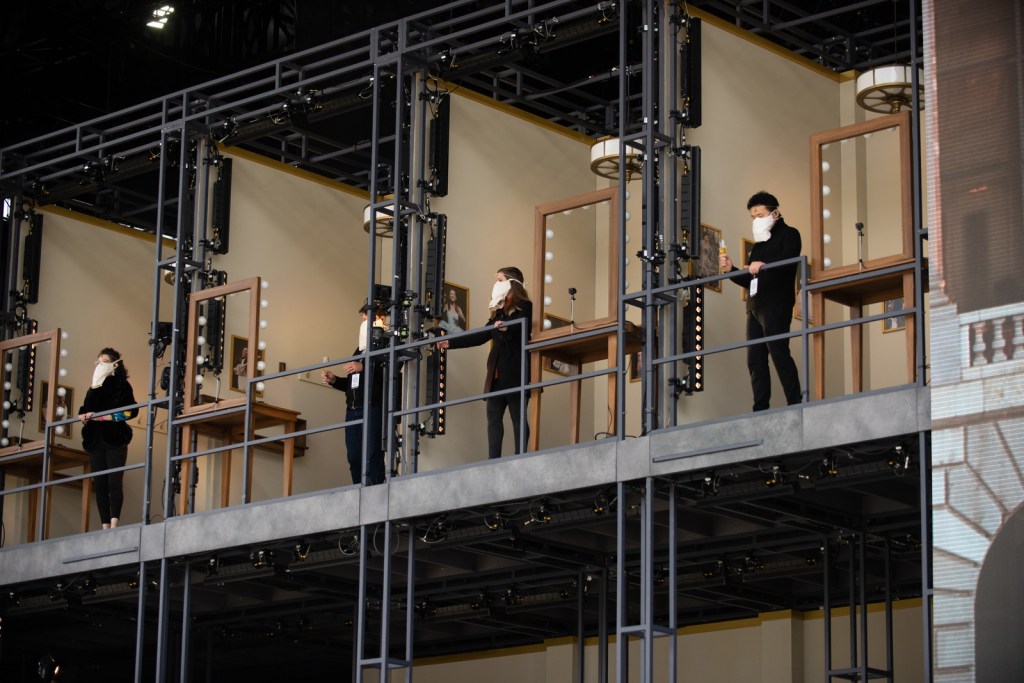
Singers wearing pandemic-induced rehearsal masks especially-designed for San Francisco Opera. Photo by Kristen Loken.

The hour-long program consists of sixteen musical numbers written by almost as many composers.  Appropriately, signature opera pieces dominate, with memorable music that suits this type of event, supplemented by a mix from other domains.

Highlights of the evening are very much determined by the subjective ears of the listener.  One that is almost universally appreciated is the gold standard of tenor-baritone duets, “Au fond du temple saint” from Bizet’s “Les Pêcheurs de Perles.”  Its heightening drama of two men loving the same woman, with the slow crescendo leading to sensational melodies and harmonies are passionately delivered by Christopher Oglesby and Timothy Murray.

Another vocal extravaganza is well known outside the opera world as well. In “Der Hölle Rache kocht in meinem Hertz,” better known as the “Queen of the Night aria” from Mozart’s “Die Zauberflöte,” the lady with dark intentions screeches her vengeance.  Elisa Sunshine makes the daring coloratura number pop with its thrilling high-pitched “ah-ah-ah-ah-ah-ah-aaah” sequences.  Like other artists, Sunshine had to deal with the weather, but she blew away the audience while the blustery wind blew her dress a bit sideways.

The other rat-a-tat number that gets the toes tapping rapid fire is from outside the opera realm, but penned by the great Gioachino Rossini.  “La Danza” is a southern Italian folk tarantella from the composer’s “Les soirées musicales.”   Zhengyi Bai brightly sings and charmingly conveys its conviviality.

Of course, sublime finds a significant place on the evening’s menu, with some of the most beautiful melodies from all of opera, each sung with great artistry.  Among those, Anne-Marie MacIntosh and Simone McIntosh (alert – there are no typos in those surnames) take on the haunting barcarolle “Belle nuit, ô nuit d’amour” from Offenbach’s “Les Contes d’Hoffmann” with luminous delight.  Also, Esther Tonea and Simone McIntosh’s ethereal voices shimmer in the subtle dual melodies of “Cosa mi narri…Sull’aria,” from Mozart’s “Le Nozze di Figaro.”

Christopher Colmenero is earnest and expressive in his rendition of the affirming “Freunde, das Leben ist Lebenswert,” from Lehár’s “Giuditta.”  Perhaps the warmest, richest voice is that of bass Stefan Egerstrom who sings “Some enchanted evening” from Rogers and Hammerstein’s “South Pacific.”  Each of the several remaining offerings from Verdi, Puccini, Bellini, Gounod, and others add to the program and display the Fellows’ substantial gifts.

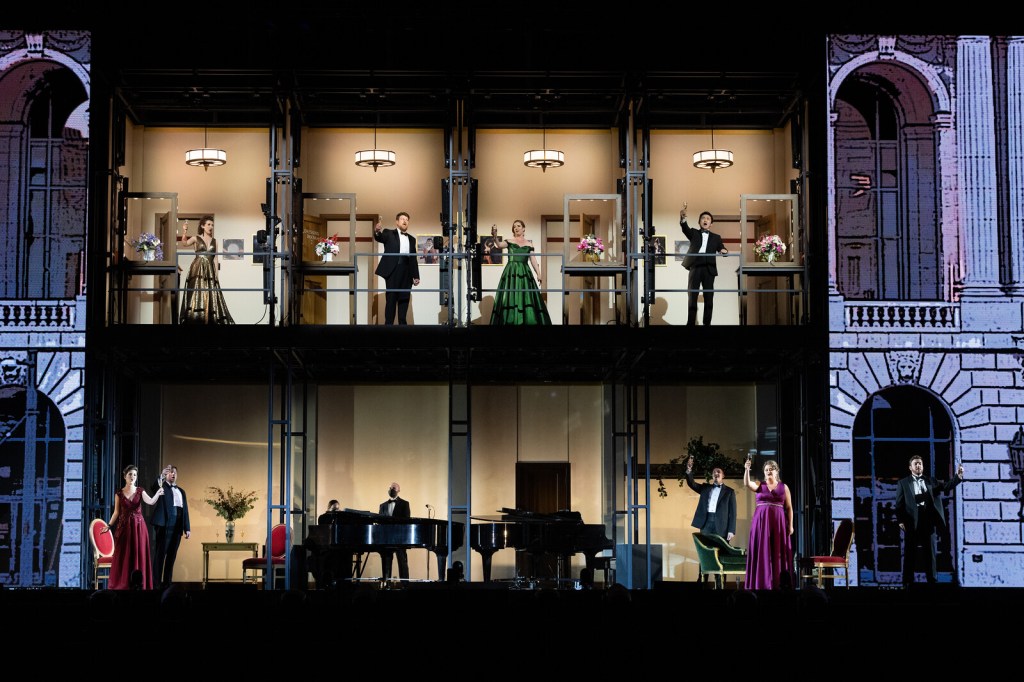
The cast lifts a toast. Photo by Kristen Loken.

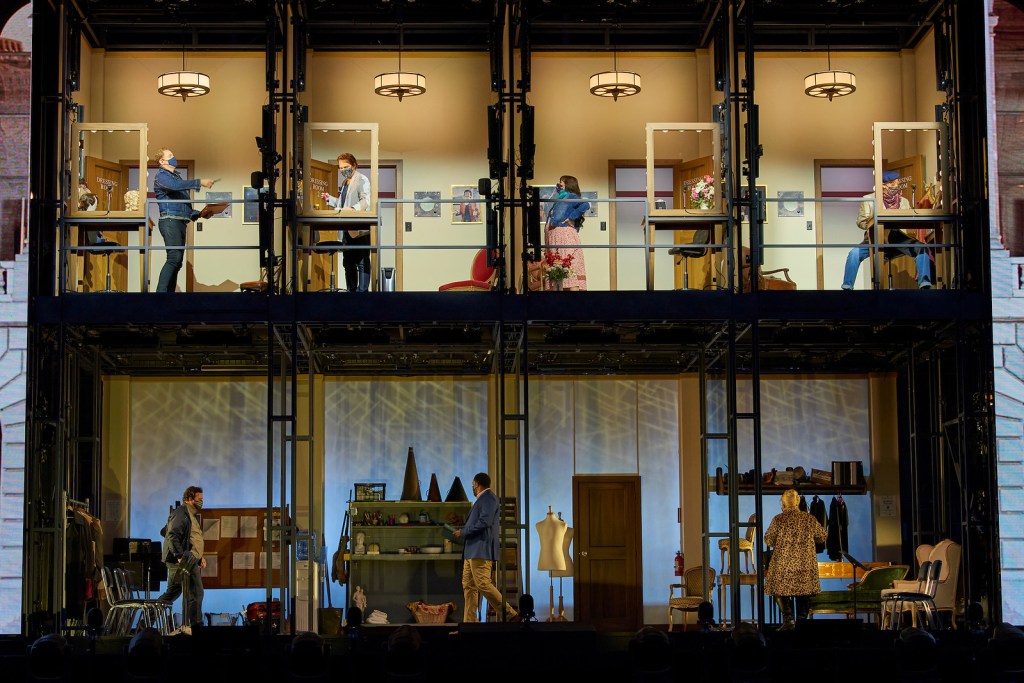
Because of social distancing restrictions, performers are separated into the cubicles of the set – two levels, each constituted of several defined spaces.  Thus, shoulder-to-shoulder ensembles and celebratory hugfests are not doable this year.  That limitation, plus the absence of audience applause (though glowsticks that are provided to the audience were waved after numbers and there was plenty of horn honking at the end of this evening’s performance) takes a little edge off the ambiance of the event.  Although recitals are usually given in formal dress, the overall effect of the concert would be enhanced by dressing in costumery appropriate to each number.  Also, though cost may be a prohibitive factor, a fuller sound more akin to an operatic performance would come from adding three or four strings to the piano accompaniment.  Nonetheless, the Adler Fellows are renowned throughout opera, and the high-quality performances expected of them are very much present.

“The Adlers: Live at the Drive-In” is produced by San Francisco Opera, directed by Jose Maria Condemi, and plays at Marin Center, San Rafael, California, with one remaining performance on May 13, 2021.

Victor Cordell, Ph.D.
American Theatre Critics Association
San Francisco Bay Area Theatre Critics Circle

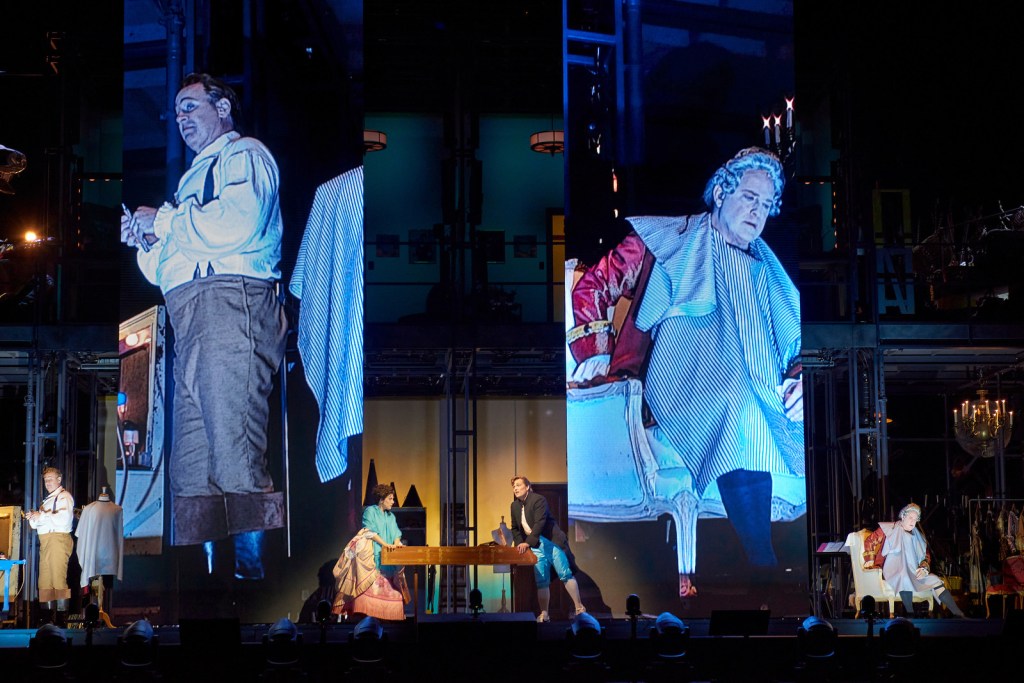
Barber of Seville

Lucas Meachem as Figaro (projected above left, live below left), Philip Skinner as Dr. Bartolo (projected above right, live below right), Daniela Mack as Rosina and Alek Shrader as Lindoro (live below center). Photo by Stefan Cohen.

Desperate times call for desperate measures.  With the stage of the grand War Memorial Opera House dark for over a year, the San Francisco Opera fashioned a creative fix – not a permanent solution, but one which offers a measure of the thrilling artistry that only live opera can provide.  In overcoming myriad technical, logistical, marketing, and public health issues, the company has produced a wonderfully charming “Barber of Seville” that will live in our memories. Gioachino Rossini’s 19th century imagination could probably conceive of people driving automobiles, but patrons attending one of his great comedic operas while ensconced in their vehicles would probably be beyond his wildest notions.  

Rossini’s “Barber” ranks as one of the most revered opera buffa in the repertoire.  Full of silly characters and silly situations, it tantalizes the funny bone.  At the same time, it is replete with wonderful music.  This adaptation operates under the pleasant conceit of a day of rehearsals, culminating with an evening performance.  Thus, the artists initially appear in contemporary casual costumery and progress toward 19th century dress as time progresses.  The “Barber” narrative is enhanced by announcements from an unseen stage director, including social distance warnings, as well as live and video back stage antics, which add to the fun.

This production contains an ideal cast with deep San Francisco Opera roots that would be the envy of any opera company.  Lucas Meachem plays the title role, and from the opening familiar-to-all “Largo al factotum,” he demonstrates that he possesses the vocal dexterity and magnetic appeal of a memorable Figaro.  Reprising their casting as the lovers several years ago, Daniela Mack and Alek Schrader perform as Rosina and Lindoro (who is really Count Almaviva).  Notably, the artists are married.  Mack also happens to be several months pregnant.  In a playful acknowledgement and despite Rosina’s being single, her first costume reveals the large bump, though later costumes showed that the pregnancy could easily have been hidden.  The pair are superb together and apart, with the highlight being Mack’s “Una voce poco fa,” which she embraces with a warm coloratura vibrato.

All of the principals, masked for rehearsal. Photo by Stefan Cohen.

A remarkable trio comprises the remaining principals.  Philip Skinner is powerful as Dr. Bartolo, Rosina’s guardian.  The company’s legendary Catherine Cook as the maid Berta and Kenneth Kellogg as Don Basilio are admirable as always, this time in roles with little song time, but the latter does deliver the bass aria “La Calumnia” with flair and conviction.  Apart from great solo numbers, “Barber” possesses ensembles, some with six or seven voices. These rapid fire, high wire vocal explosions are given with great precision and fine humor.  Supporting the singers is Maestro Roderick Cox’s orchestra.  Due to logistical and pandemic conditions, the orchestra is limited to 18 instrumentalists, and it performs out of sight.

Setting aside the beloved opera and sterling performances, the production suffered three possible deficiencies before even getting to the drive-in, in this reviewer’s mind.  The opera is perhaps overly familiar to a frequent opera goer; it is condensed to 90 minutes to meet Covid protocols; and instead of glorious acoustic music, it is piped electronically through FM radio.  Upon arrival at the venue (Marin Center, which is a stellar Frank Lloyd Wright designed multi-purposed civic campus for the county), another possible fault was finding that it was being sung in English.  Much to my surprise, in the overall, those concerns were more than adequately addressed.  Although trimming the opera’s length results in a jumpy and incomplete plot line, the good news for those who know the opera is that it hits all the high spots and eliminates the drag.  And while the acoustics of War Memorial are superior to any vehicle’s sound system, voices in particular come through with sufficient glory to make the listening well worthwhile.   Finally, opera almost always fulfills its intentions best in its original language.  However, the comic material of “Barber” in some ways benefits from being sung in words comprehensible to the listener’s ear, with supertitles in the same language.  So despite my misgivings, and perhaps because of the uniqueness of the experience, I enjoyed this version better than most all I’ve seen.   Concerns satisfied.

Many kudos go to General Director Matthew Shilvock and his team for accomplishing a project with a wide scope of demands that go well beyond those required when operating within one’s own home base.  Stage Director Matthew Ozawa orchestrated his creative directors to assemble a lively milieu for the production.  Masterfully adapting sets originally designed for the cancelled production of “Fidelio”, the stage is comprised of compartmentalized spaces on two levels, flanked by large video screens.  Projection screens often overlay the stage as well.  One positive aspect of this drive-in format is that there is more to look at.  While viewing the live performance gives a broad visual perspective, simultaneously, the screens provide more intimate close-ups.

Daniela Mack as Rosina. Photo by Drew Altizer.

Indoor live performance cannot return to the Bay Area too soon.  The intimacy of the stage; the immediacy of the performers; and the ambiance of the event are irreplaceable.  Yet, this format could have legs, especially for newcomers to the art.  Assessing this experiment on a slightly different set of criteria than used in traditional formats, it is a delightful romp and a magnificent piece of work, worthy of the world-class company that San Francisco Opera is.

“Barber of Seville,” composed by Gioachino Rossini, with Italian libretto by Cesare Sterbini, translated to English and adapted by Marcie Stapp, is produced by San Francisco Opera, and plays at Marin Center, San Rafael, California through May 15, 2021.

Victor Cordell, Ph.D.
American Theatre Critics Association
San Francisco Bay Area Theatre Critics Circle