Love and Secrets: A Domestic Trilogy

Vanessa Becerra, Efraín Solís in “Il Segreto di Susanna.” All photos by Ian Fullmer.

What a pleasure to see Bay Area opera companies offering alternatives to traditional live performance productions until we are able to return to the opera houses to experience their magnificence as intended.  Following its streaming production of “Three Decembers” by Jake Heggie, Opera San José now offers a curated trilogy of one-act operas.  Marital relationships, or more loosely, love constitutes the common bond among the trio.  With each requiring only two singing parts, they are highly conducive to the strictures of pandemic era productions.

The outcome is splendid.  All of the stellar performers excel in their singing and acting artistry, and director Tara Branham takes advantage of the assets that the electronic medium has to offer opera.  Yes – there are some pluses to opera production designed for film.  Mobile cameras allow different perspectives rather than the fixed point of view in a theater.  Close up shots add an appealing intimacy, and these artists thrive in the visual immediacy.  Blocking varies more, as singers needn’t have concern about projecting voice forward toward the audience.  And staging has been scaled to more realistic proportions than the stage filling requirements of a theatrical setting.

The three operas frame the 20th century, embracing widely different styles.  The anchor to the program, both in terms of its place in the repertoire and its length, is Wolf-Ferrari’s charming Italian opera buffa from 1909, “Il Segreto di Susanna.”  It opens the program, but as the only comedy, it might be better positioned as the closer, to leave the audience more upbeat at the end, just as “Gianni Schicchi” often closes Puccini’s “Il Trittico.”  Joining “Il Segreto” are the more brittle mid-century American “Four Dialogues” by Ned Rorem, and finally, from 1993, another American entry, the brief and melancholic “The Husbands” by Tom Cipullo.

The one-trick plot line of “Il Segreto di Susanna” is straightforward.  Bubbly young bride Susanna has been surreptitiously smoking, and when husband Gil returns home to smell the smoke, he fumes, assuming that she has a lover.  Even when Susanna thinks she has confessed to her transgression, Gil thinks she’s admitted to an illicit relationship rather than smoking.  Thus, they argue at cross purposes.  The light comedy is disrupted by Gil’s rage scene, which turns into an unlikely opera event, a hilarious pillow fight.

Musically, the opera holds to the 19th century Italian tradition of great lyricism and melody, with a pleasant score, highlighted by the harmonious duet “Dear memories” and Susanna’s aria “What a joy to follow the blue spiral.”  Vanessa Becerra is sweet as Susanna and uses her bright voice and delicate vibrato to good effect.  Efraín Solís pairs well as the righteous, jealous Gil, and a strings plus piano chamber orchestra provides a lush backing to a delightful rendition of this little gem.

Carlos Enrique Santelli , Marnie Breckenridge in “Four Dialogues.”

“Four Dialogues,” which composer Rorem based on the poetry of Frank O’Hara is cleverly comprised of four short vignettes representing the episodes in a relationship, from chance meeting through romance, marriage, and unfortunately, dissolution.  The tight formula with everchanging character affect and musical treatment encapsulates the life cycle of a couple. Although its musical idiom is generally modern opera form, the sultry duet “You’re burning like fire” is melodic and quite captivating as sung by Marnie Breckenridge and Carlos Enrique Santelli.  “And my heart is going gray” provides an appropriate sorrowful conclusion. 
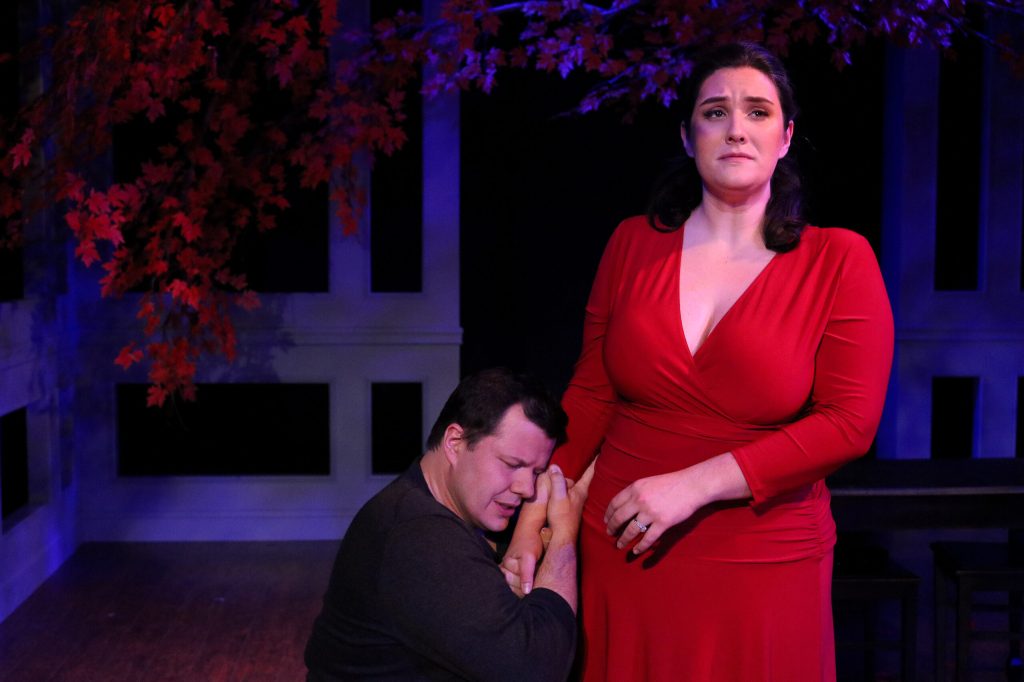
Eugene Brancoveanu, Ashley Dixon in “The Husbands.”

Tom Cipullo’s “The Husbands” is a sad and mysterious reminiscence set to an excerpt of William Carpenter’s poem “Rain.”  Ashley Dixon plays a widow on a bus tour in New England along with other widows.  Their lives are full of routine exchanges about their children and children’s children and deceased husbands and the doleful existence of ordering extra meals at restaurants for lost soulmates.  Eugene Brancoveanu plays a man who the widow communes with, seeming at first to be a local observer and then transitioning into the spirit of the husband. Together, the couple contemplates eternity in the poignant conversation.

Each opera in the program is well-staged – an ornate drawing room for “Il Segreto,” and hanging artistic panels as backdrop for “Four Dialogues” and “The Husbands,” but with distinguishing props. Placement and movement are thoughtful throughout.  One (Ingmar) Bergmanesque symbolic moment of note appears in the dissolution scene of “Four Dialogues” with a close up of the couple in profile, facing as if toward each other but actually in different planes and looking past each other. The lighting in “The Husbands” is particularly absorbing, playing on the autumn red tree leaves in the outdoor scene and isolating the characters from the world around them.

The domestic trilogy pleases and compels.  Much credit goes to Opera San José for translating these pieces to film with great skill.  One enhancement would be to provide some connective tissue with introductions to the operas and explaining their selection and development.

“Love and Secrets: A Domestic Trilogy,” comprised of “Il Segreto di Susanna” composed by Ermanno Wolf-Ferrari with libretto by Enrico Golisciani, “Four Dialogues” by Ned Rorem based on the poetry of Frank O’Hara, and “The Husbands” composed by Tom Cipullo with lyrics by William Carpenter is produced by Opera San José and streams online through May 15, 2021.

Victor Cordell, Ph.D.
American Theatre Critics Association
San Francisco Bay Area Theatre Critics Circle

The Waste Land

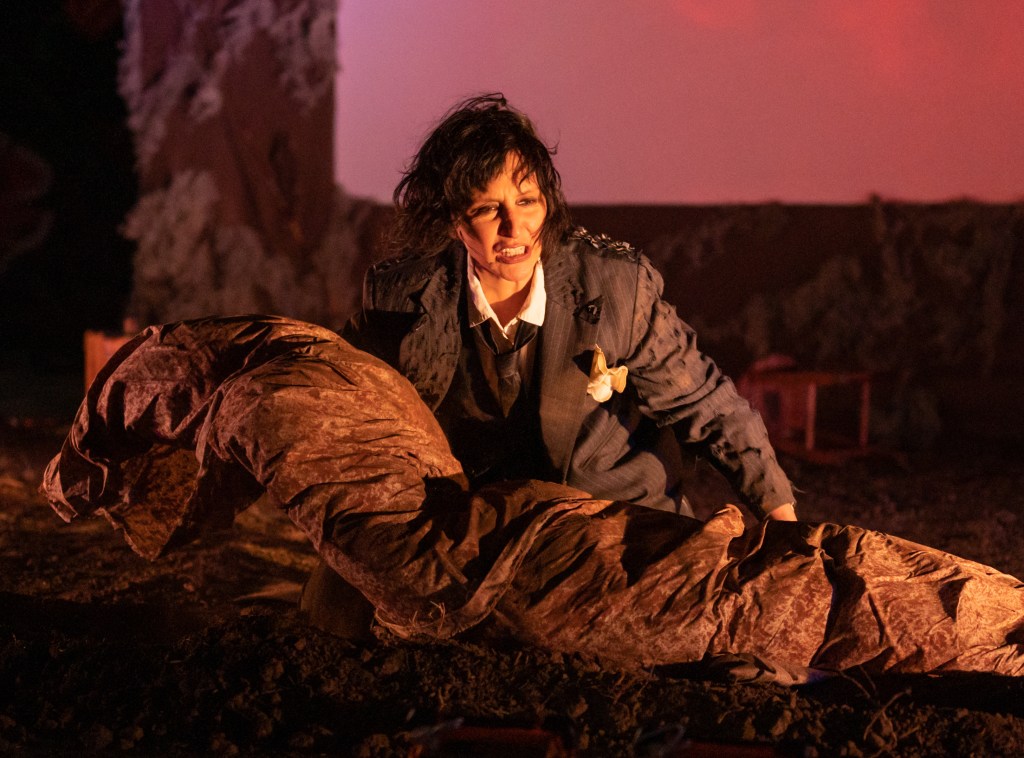
Solo performer Lisa Ramirez. All photos by Carson French.

“April is the cruelest month…..”  This famous line opens T. S. Eliot’s “The Waste Land,” generally regarded as one of the finest pieces of modern literature.  At its best, this 434-line epic poem oozes symbolism and begs never-ending analysis of its trenchant insights.  Yet, like its opening line, “The Waste Land” contains endless contradictions and ambiguities.  Indeed, Eliot provided lengthy annotations of the poem in its original publication, though some of those confuse rather than illuminate.  Detractors would submit that his episodic narrative with leaps in time, and changes in speakers and narrative style lacks cohesion.  But perhaps that reflected the way he saw the new world around him.  Further, Eliot’s frequent allusions to other literary works and use of untranslated foreign languages may seem to impress rather than inform.

John Wilkens has adapted “The Waste Land” to the stage as a vehicle for a solo performer.  Oakland Theater Project has produced the staging, starring the multi-talented Lisa Ramirez and directed by Michael Socrates Moran.  This production is the first live performance with a live audience sanctioned by Actors Equity in the state of California since the start of the pandemic.  But to accomplish the approval, the performance is outdoors, and the audience remain in their cars.  The good news with this arrangement is that the cars are parked one-deep, so that sight lines are great and the audience is close to the performer.  The audio comes through FM on the car radio.  The bad news, for the company, is that audience size is seriously limited.

Because the poem tells stories in different voices and perspectives, it is conducive to dramatic staging.  For those who wish to expand their intellectual horizons but can’t muster the motivation to read Eliot’s masterpiece, Ramirez’s recitation with impressive interpretive movement, and variation of voicing, affect, and intensity captures the viewer’s attention in a manner that few readers would self-engender.  And the performance offers an admirable dose of high-brow culture in well under an hour.  As a fine actor, Ramirez does emote effectively, although her voice is not long on the gravitas often associated with poetry reading. 

This production offers the added stimulation of projected images to enhance the lyrics and acting.  A video preface to the live performance of brief clips covers the history from when the poem was written to current day – a reminiscence of iconic snippets embracing everything from pop culture to war, while videos within the body of the play largely support the text.  In the absence of a printed program, I am unable to credit the creator.  Few props appear on the earthen parking-lot “stage.”  One used to pleasant effect is a strummed mandolin, which accompanies Ramirez as she delivers the words of the blind, Greek prophet, Tiresias, in a manner akin to an opera recitative. The overall impact of the production is provocative and engaging.

The poet doesn’t refer explicitly to a waste land, so what is the poem about?  The dominant received wisdom is that it concerns loss.  Published in 1922, American-born Eliot had lived for a decade in England, which had just suffered through World War I, and concurrently, the (inappropriately named!) Spanish Flu epidemic.  Sensing that the massive loss of life and destruction of property had permanently displaced pre-war society, Eliot foresaw a bleak future.  The poem is written in five distinct sections.  The first, “The Burial of the Dead” establishes the overriding motif, and the speaker, Marie, evidences loss of station and things when she leaves childhood behind.  The most direct reference to the uncertainty ahead appears in the final section, “What the Thunder Said,” with an expressed reference to the nursery rhyme “London Bridge is Falling Down” providing the analogy to failed civilization.

“The Waste Land” particularly resonates as a corollary to our time.   The impact of Covid-19 in the United States now approaches that of the Spanish Flu, though worldwide, the latter was 15 times more deadly than Covid-19 has been to date.  And while a devastating military war loomed in Eliot’s consciousness, this country now faces a cultural war that increasingly cleaves us into two disparate camps with little common ground between us, and in which, tragically, a large segment of the population representing one of those camps even refuses to accept empirical facts that disconfirm what they wish to believe. 

“The Waste Land” is written by T. S. Eliot, adapted by John Wilkens, and produced by Oakland Theater Project.  It plays in live performance drive-in theater format at the company’s home, Flax art + design, 1501 Martin Luther King, Jr. Parkway, Oakland, CA through May 16, 2021.

Victor Cordell, Ph.D.
American Theatre Critics Association
San Francisco Bay Area Theatre Critics Circle

God of Vengeance (Got fun Nekome)

Roni Alperin as Yankl, Jill Eickmann as Soreh. All images courtesy of Yiddish Theatre Ensemble.

Throughout history, the creative energy of playwrights has generated works of performing arts that have exposed the public to new worlds; challenged their old assumptions; and even incited them to action.  Few plays have been as successful or stormed the intellectual world like Sholem Asch’s 1906 Yiddish-language drama “God of Vengeance” (“Got fun Nekome”).  Even by today’s standards, the premise would be considered offensive, or at least controversial, by many.  But this play was also one of the most successful of its time, translated into many languages and performed throughout the theatrical world.  The Bay Area’s Yiddish Theatre Ensemble (YTE) has mounted a Zoom presentation of this important work that deserves attention.

Born and raised in a Hasidic Jewish family in Poland, the peripatetic Asch would become a naturalized American citizen, but symbolic of numerous Jewish theater companies, he traveled and wandered.  He may have been escaping the criticism that hounded him despite his becoming one of the lions of Yiddish literature.  Y.L. Peretz, a leader in that movement and mentor to Asch, simply said of “God of Vengeance,” “Burn it, Asch, burn it.”

YTE has used an English adaptation by the Irish-born Caraid O’Brien, an unlikely name for a Yiddish translator.  The setting shifts from a turn-of-the-century Polish shtetl to Depression-era New York City.  The central plot line concerns a pious, observant Jewish father, Yankl, who wishes to marry his daughter off to a Yeshiva student.  One hitch – the basement of his tenement row house is a brothel.  Yankl is a pimp!  Oh – and his daughter Rivkeleh is in love with one of the girls downstairs.  Hardly material for television’s “The Love Boat.”

Elena Faverio as Revkeleh, Zissel Piazza as Mankeh.

Despite the origins of the play, far from the American experience of the 21st century, many of the universal thematic situations from “God of Vengeance” resonate.  While daughter Rivkeleh comes from a caring family that wants only the best for her (or what they think is the best for her), she rebels.  Decades before the sexual revolution, she is drawn to another woman.  Yankl represents the contradictions that most humans possess.  His piety is inconsistent with his profession and his religiousness seems hypocritical.  A man of faith, he pleads for intervention from God to resolve his dilemma with Rivkeleh, but if there is a God, why should God care about him?  His wife, Soreh, is earnest and loving and will do anything necessary to ensure Rivkeleh’s safety when she goes missing.  If we weren’t told, it would be hard to believe that Soreh was a prostitute.  Her redemption from that way of life seems so complete.

The play operates well in terms of storytelling, but the action is sometimes slow until the third act.  Characters are varied and have dimensionality.  Despite working in the underbelly of society, we meet people who have the same dreams as we do.  And like many others in society who distinguish between their professions and their lives, the prostitutes do as well.

On an isolated basis, most performances are high quality, especially the leads.  Roni Alperin summons the dour, temperamental, conflicted Yankl.  Elena Faverio as Rivkeleh begins as a bright, bubbly maiden, but matures before our very eyes.  And Jill Eickmann captures the earnest devotion of a loving mother as Soreh, but reveals darker instincts when the situation calls for it.  Unlike most Zoom actors, she wisely shifts her visual focus away from the camera often to create a more realistic portrayal than many talking heads do.

Director Bruce Bierman marshals resources well and with good result under the circumstances.  The “look” works, with period costumes and rough, graphic scenery. But the backdrops are colorful and varied and even include different frames for the windows.  However, like any director of a Zoom production, Bierman faces constraints that are bound to limit viewer satisfaction.

Simon Winheld as an aspiring pimp Shlomo, Jill Eickmann as Soreh (yes, the same actor and character as in the lead photo!)

The windowed format of Zoom cannot produce the immediacy or interaction of characters to yield the dramatic tension of a live or realistically filmed performance. The inability to rehearse in one place is another obstacle.  Because visual flow is inherently jumpy in Zoom, so is the narrative, and the more characters there are, the clunkier it seems.  This play has the disadvantage of having around a dozen roles.  Perhaps the only advantage of Zoom productions is that it does allow the involvement of actors from far remote locations, as is this case with this one.

A final issue of interest in this production concerns dialogue-driven sound.  During a several minute scene between Rivkeleh and her lesbian lover Mankeh, they speak Yiddish, and happily, subtitles are used.  However, throughout the performance, Yiddish words and phrases are used that are not given translations through subtitles.  These usages are realistic, but non-Jewish audience members may find these words harder to hear and understand.  So how to treat with this issue largely depends on what audience the producer hopes to reach.

Despite whatever shortcomings caused by the pandemic, many aspects of this production are appealing given the circumstance.  While not for everyone, this is a significant play that retains an important place in theatrical history.  It is also a draw for those who are interested Jewish culture of the period.

“God of Vengeance” (“Got fun Nekome”) by Sholem Asch as translated by Caraid O’Brien is produced by Yiddish Theatre Ensemble and streams on Vimeo through March 23, 2021.

Victor Cordell, Ph.D.
American Theatre Critics Association
San Francisco Bay Area Theatre Critics Circle

Bird on a Tree Branch

Kerry Gudjohnsen (Vivian), Richard Aiello (Doug), Desiree Rogers (Hannah)

The year is 1965.  The place is small town Indiana.  During a thunderstorm and with a tornado threatening, middle-aged, white, married couple Doug and Vivian are driving home from church.  Seeing an already drenched, middle-aged, black woman at a bus stop, they give her a ride and offer that she join them in their basement until the violent storm passes.  Revelation often finds fertile ground in confined space, and many secrets are unearthed as the three weather the storm.  We learn the back stories that brought the characters to this juncture and witness the clashes of the moment in Jan Probst’s insightful drama, cleverly set in an earlier era, but one that is well-known today.

This tidy 75-minute play covers an uncommonly wide swath of issues – notably the effects of secrets and local myths, often riddled with falsehoods, that define perceptions about us and our community.  But in addition to that, the play deals with racism; sexism, including situations that foreshadowed the MeToo movement; survival; measuring against others rather than valuing what we have; sibling rivalry; gender roles; marital challenges; pacifism and war; time-anchored mores; religion versus belief in God; and redemption – among others.  Many of these could be the nexus for digging into this play, but the racial matters particularly tie into events of the current moment in time.  The following is as much essay that relates to the play as it is a review.

Doug, is a plain guy who does pretty well as an insurance salesman, but who, in his own words, sells products to people who don’t need them.  His self-loathing derives from a life-long parade of missed opportunities to do what his peers have done, and he even feels that as a marital catch he was consolation prize for Vivian, played with earnestness and resignation by Kerry Gudjohnsen.  Doug does consider himself a good person, yet I disliked him almost from the outset, which is a sign of the effective characterization that the playwright has penned and that Richard Aiello acts.

The black woman, Hannah, displays a reserved, confident dignity and that very special trait that many black people develop – to deal with insults from whites with great equanimity.  Doug asks her what she was doing in this neighborhood on a Sunday, noting that maids don’t work on Sundays, and blacks don’t live in this part of town.  He then assumes she is on welfare and asks what kind of work she does.  The microaggressions in this line of questioning comport with his reality and seem innocent enough and natural to him.  He follows up by asserting that blacks should be appreciative for the benefits that they have in this country, even if they are second-class citizens.  In time, Hanna will show that despite her status, she is more than Doug’s match by many measures.  Also relevant is that Doug’s view toward white women is condescending as well, reflecting the thinking of patriarchal society.

Even though people turn out differently, the time and place that one lives strongly influences their attitudes.  My dislike of Doug comes partly from my knowing this person who lacks understanding beyond his own frame of reference and my own repudiation of attitudes from my teenage years.  Growing up in an all-white suburb of Dallas, I thought many of the same thoughts, simply out of lack of exposure and ignorance.  Coincidentally, it was around 1965 that my view of the world started to expand, and I embraced inclusion.

“Bird on a Tree Branch” engages on many levels. We find festering resentments and unrealized potential, because people, even couples, remain uninformed and fail to communicate.   In the play, we witness some character evolution and wonder particularly with Doug, what kind of person he would become later in life. 

Thanks in part to the font of knowledge called Wikipedia and ubiquitous social media that archives every stupid message that every thoughtless person has shared on the Internet, we have entered an era of “gotchas.”   For example, the San Francisco School Board decided to eliminate 44 historical figures from school names, largely because of revealed racial bigotry.  While racist acts of a few of these figures were egregious, most of them were products of, if not progressive for, their times.  Many were more than redeemed by subsequent acts, to wit, Abraham Lincoln, who the Board wants to delist (Washington and Jefferson as well)!

Ironically, a current black member of the Board is under fire for postings she made five years ago which were critical of Asians.  So is this a good time to roll out that old adage about “let he who is without sin cast the first stone?” Some of her criticisms were borne out by facts, and she has since worked on issues that are helpful to Asians.  So, with her, Doug, and millions of others, do we evaluate them by current standards or in the context of their environment?  If they erred but changed, do we honor their redemption?

The play is produced in Zoom.  The three principal actors play their individual parts well.  Desiree Rogers as Hannah is particularly strong as she navigates the boundary of assertiveness without wanting to alienate her hosts under the circumstances.  In some ways, this is an ideal play for Zoom because of the small cast and contained setting.  Director Julie Dimas-Lockfeld opens up the space with a couple of outdoor video bits, including flashbacks to 1942.  Ambient sound occurs throughout along with occasional major storm sounds.

Nonetheless, the bulk of the production is in talking-head format, so that it comes across as a well-rehearsed reading.  Characters are mostly stationary and look into the camera rather than at one another, so that individual performances don’t add up to the desired theatrical experience.  Yet, this is a worthy play, and hopefully as actors, creatives, and techs get Covid inoculations, we will see more natural filming of this and other plays (see my review on [hieroglyph] for a contrast).  For the time being, if you accept it for what it is, this rendering is worthwhile.

“Bird on a Tree Branch,” a world premiere play by Jan Probst, is produced by Phoenix Arts Association Theatre and is available on streaming at YouTube through March 31, 2021.

Victor Cordell, Ph.D.
American Theatre Critics Association
San Francisco Bay Area Theatre Critics Circle
[hieroglyph]

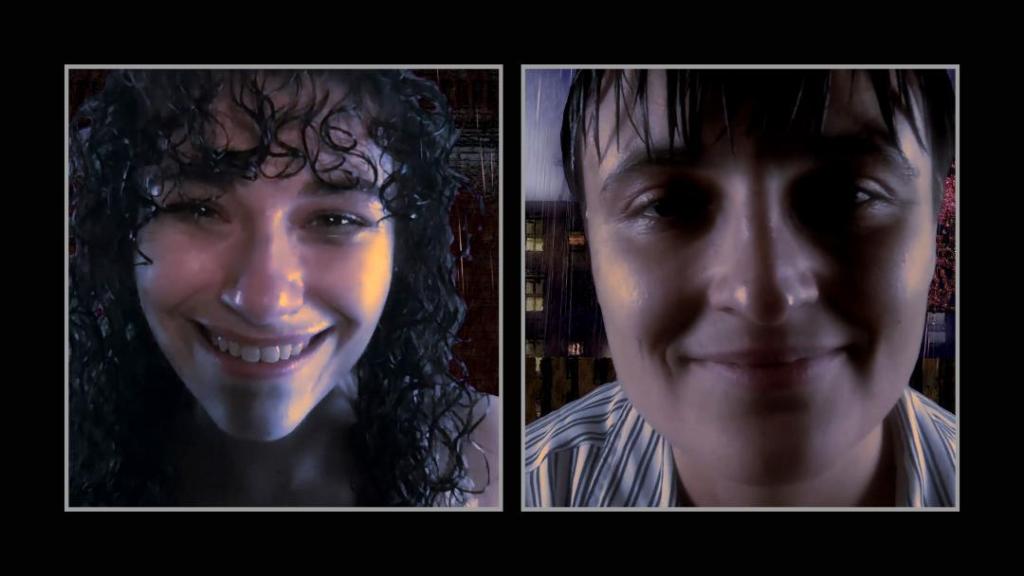
Khary L. Moye as Ernest, Jamella Cross as Davis. Photos by Jessica Palopoli.

For one year, we lovers of live performance have suffered without our favorite pastime.  On the one-year anniversary of the Covid-19 pandemic comes the closest thing the Bay Area has had to live theater.  Although it lacks the palpable dynamics of “the smell of the greasepaint and the roar of the crowd,” San Francisco Playhouse and Lorraine Hansberry Theatre have joined to produce a filmed staging.  While we all look forward to the vitality and urgency of live performance as well as the associated socialization, the current streamed performance of [hieroglyph] provides great satisfaction that has been missed for some time.

[hieroglyph]s plot line concerns the displacement of Davis, a 13-year-old Black girl, from the world that she understands.  In the aftermath of Hurricane Katrina, she and her father, Ernest, relocate from New Orleans to Chicago.  The natural disaster destroyed her memories; disconnected her from the things that she knew and loved; and triggered the spatial and marital separation of her parents, as her mother stayed behind to live in a FEMA trailer.  Davis now tries to reconstruct the happy moments of her life but is haunted by the more recent horrors.

Often, children find relocation more traumatic than adults.  Unsurprisingly, Davis is not adjusting well and collapses academically, except in one class – art.  Although she exhibits talent in her sketches of her previous life, disturbing characteristics are revealed that may reflect deep seated anxiety.  Her understanding teacher, Ms. T, takes a special interest in the girl’s talent and problems.

Playwright Erika Dickerson-Despenza’s poignant drama deals with trauma and loss that most of us, thankfully, will never have to handle. She speaks to the fears that women particularly suffer – and moreso, women of color; and moreso yet, teenage girls of color.  These core elements are enhanced by a rich exploration of boundaries – parent-child, teacher-student, parent-teacher, friend-to-friend, as well as those of professional and sexual propriety.  Causes of conflict are manifold. While many of those that are addressed result from conscious awareness of the participants, others derive from lack of understanding, suggesting that not all clashes result from intent, but often from naivete about the conditions of other people.

Khary L. Moye as Ernest, Jamella Cross as Davis, Safiya Fredericks as Ms. T.

The actors offer wonderful portrayals.  Only four roles are cast, as their interactions outside of this group cleverly transpire with characters who are unseen and unheard.  Jamella Cross gives a star turn as Davis, capturing the teen’s hopes and angst, and displaying a full range of emotions from cheerful to tormented.  Safiya Fredericks is equally challenged as the concerned teacher, striking the right balance of professionalism and compassion, but also employing righteous rage.  Khary L. Moye aptly plays Ernest, whose name is a homonym for his character.  An involved father, he is also brought to rage when some of his dearly held beliefs are brought to question.  Finally, Anna Marie Sharpe is sharp as Leah, the friend who tries to help Davis adjust to her new environment.

Dickenson-Despenza’s script and Margo Hall’s direction keep the action moving and interesting throughout, albeit with a little didactic bent.  Ms. T is the spokesperson for the playwright’s sympathies, but her inclinations deserve airing.  For instance, the play promotes the painting of Black artist Ernest Crichlow, who blossomed under the Works Progress Administration during the Great Depression.  Appropriately, the teacher’s analysis in class of his cynical anomaly “Lovers” advances the theme of sexual suffering of Black women.  Conversely, whereas discussion of Jim Crow is central to understanding racial abuses perpetrated on Blacks in this country, it only tangentially relates to the matters at hand.

Some minor flaws exist in the text that can’t be discussed without spoiling the plot.  One that can be referenced is that the denouement is telegraphed without sufficient nuance, especially to those familiar with a particular movie that follows a similar path or other works like it.  Most of the dialogue is quite clear, but when the two girls are together, their teen talk can be a little harder to follow.  But these issues are minor glitches in a highly recommended theatrical event.

It is a pleasure to see natural theatrical staging again and the San Francisco Playhouse’s revolving stage put back to work.  Bill English’s scenic design is skeletal but suits the play perfectly.  Another key element in creating an outstanding production is the camera work, which is perhaps the one improvement over live performance.  While the cinematography won’t win an Emmy, the use of multiple camera positions and variable focal lengths, including close up shots, adds vibrance that would be missed from Row G in a theatrical space.

[hieroglyph] by Erika Dickerson-Despenza is co-produced by San Francisco Playhouse and Lorraine Hansberry Theatre and is available by online streaming through April 13, 2021.

Victor Cordell, Ph.D.
American Theatre Critics Association
San Francisco Bay Area Theatre Critics Circle

The Art of Sacrifice

Lauren English as Nora, Susi Damilano as Willa.

Who would have thought that a recent television miniseries would spawn huge enthusiasm for a dweeby mental challenge like chess?  – especially when the protagonist is not only female, but a child for much of the chronicle.  While no others loomed so large in the public’s fascination, “The Queen’s Gambit” was certainly not the first performance work to feature chess as a central theme.  Among others was Anthony Clarvoe’s play “The Art of Sacrifice” which was first produced in 2006.

While the past twelve months of Covid-19 has shuttered theaters, creative minds continue at work.  Remote Theater is one of those newly-minted organizations designed especially to solve the challenges of the absence of live theater in the time of pandemic.  One of their projects has been to work with Clarvoe to adapt a new rendition of the “The Art of Sacrifice,” converting the two-hander from the relationship of a father and son to that of a mother and daughter.  Fortunately, the organizers benefited from a considerable resource – two-thirds of perhaps the Bay Area’s finest theatrical family – two women with highly accomplished and diverse resumés – Susi Damilano and her stepdaughter Lauren English.

On the most obvious level, the play is about the proverbial “stage mother” who has failed to make it to the top but lives vicariously through her child, prodding the offspring to be everything the mother had hoped for herself.  And the daughter responded by becoming U.S. National Champion at age 17.  But is that really best enough?

The action takes place in real time on a rare visit of the daughter, Nora, to her divorced and isolated mother, Willa.  But Nora’s mission of mercy out of concern that Willa was losing it turns into a raw emotional journey of revelations and accusations that opens more wounds than it closes, exposing the clashing perspectives that two people can hold in a shared relationship.

Tension runs from beginning to end of this perceptive one-act play.  At the analytical level, the game of chess serves as a great analogy to human relationships.  Indeed, Willa observes in a not-so-subtle declaration that modest chess players are condemned to a strategy of capturing as many pieces as possible, not realizing that sacrificing their own will often turn the direction of the game.

Both actors are well suited to their roles.  Damilano’s performance is show-stopping, totally belying the fact that this production is really a rehearsed reading.  She fumes and rages as the self-absorbed mother, always looking for blame-shifting explanations despite the fact that her obviously fractious personality has alienated many.

Like the play itself, English seemed slightly underpowered at the outset, but she compensates by giving a commanding performance as the conflicted daughter.  Though a chess master, she doesn’t share her mother’s death-grip zeal and has even thought of looking for a “money job.”  She reflects on a life that has focused only on winning and realizes the sacrifices she’s made to climb to the top – a classic study of the dilemma “what price glory?”

This production is captured with Zoom technology.  Director Desdemona Chiang has chosen to use conventional Zoom format with actors facing separate fixed cameras.  With this limitation, actors appear as talking heads delivering competing monologues.  This design yields the symbolic gesture of psychological distance and of characters not really communicating with each other.  They seem to be entreating the audience instead.  It may also act as a metaphor about the straitjacket rules that Willa employed when teaching chess to Nora or the constraints of chess competitions or of the game itself.  But this visual device works at all only because of the winning performances.

Although laptop or ipad cameras may be difficult to control artistically, they can be moved to zoom, pan, and create two-shots as well as one-shots, relieving the static nature of the stand-and-deliver approach.  Wider shots would give perspective of the setting and reduce the claustrophobia.  It would be great to see this production with more conventional cinematography (or better yet, on the stage!).

Nonetheless, Clarvoe’s relationship insights and situations make for a highly enjoyable and stimulating entertainment.  One sequence that does go off the rails concerns the aftermath of food and ashes stuffed away in trophies by Nora 20 years before, which is really unnecessary.

It is hard to consider this play without two comparisons.  In “The Queen’s Gambit,” the protagonist learns chess from a maintenance man in an orphanage and is adopted several years later when a teen.  The personalities of the new mother and daughter are already well formed, and the new mother knows nothing about chess, but a new somewhat symbiotic, yet somewhat parasitic relationship built around chess springs from their becoming family.

Even more apt is the comparison with the playwright’s original realization of “The Art of Sacrifice.”  Knowing of the predecessor, I found it hard to watch the revision without thinking about alternate situations that might appear in the two versions, or how the same situations would be handled differently in each because of the change in gender.  There should be enough material that reveals the variances in the two treatments to make for an interesting shared bill of two one-act plays.  More daring, but perhaps an interesting experiment, would be to integrate the two plays into one, alternating scenes between the male dyad and the female dyad, where the mother and father are in effect one person with the same name and the daughter and son are another.  But I digress from my reviewing duties.  This version is well worth watching.

“The Art of Sacrifice” by Anthony Clarvoe is produced by Remote Theater and was performed live online through Zoom on March 6-7, 2021.  Its archive will stream on demand March 18-25.

Victor Cordell, Ph.D.
American Theatre Critics Association
San Francisco Bay Area Theatre Critics Circle

Tosca: A Drive-In Experience

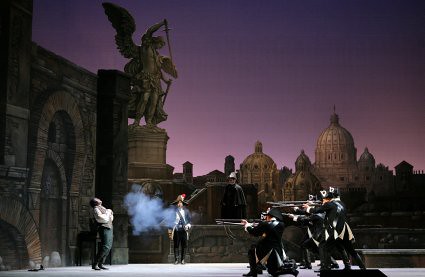
San Francisco Opera’s stage at the War Memorial Opera House has remained dark for nearly a year.  Happily, the company keeps touch with its patrons by initiating informative programs and delivering streaming performances of previous productions online.  It has now embarked on events to rouse its community out of their chairs and sofas.  Last weekend, SF Opera offered four screenings in the drive-in movie format at Fort Mason.  The filming was the company’s 2009 fine production of Puccini’s brilliant “Tosca.”  A review of the film of a 12-year-old stage production that has completed its drive-in run may seem fatuous.  However, it could be of interest to those who might consider viewing a future streaming of the production or buying an electronic copy.

Adrienne Pieczonka as Tosca, Lado Antoneli as Scarpia.

Although not without its detractors, who consider it melodramatic and musically harsh, audience and most music critics’ love of “Tosca” have not wavered since overcoming its hostile debut in 1900.  In contrast with the lyrical beauty of the other two of Puccini’s top three operas, “La Boheme” and “Madama Butterfly,” “Tosca’s” music and drama are bombastic and conflictual almost throughout.  But this opera is also exceptionally artful in many dimensions, and includes several masterful arias and love duets.

As specified by the score, the SF Opera’s Marco Armiliato-conducted orchestra roars and often punctuates with the deliciously ominous and powerful Scarpia leitmotif.  As one of the most demanding roles in the repertoire, the title character demands a soprano with the dramatic vocal power of a Wagnerian, who is able to caress poignant Pucciniesque melody.  Oh, and she must possess a full palette of acting colors with an array of emotions.  Two male leads must also be of top caliber.

Since aficionados value seeing multiple productions of the same opera, the notion of a plot spoiler doesn’t really exist in this realm.  So here’s a synopsis of the central plot.  In 1800, painter Cavaradossi is a partisan sympathizer opposed to Napoleon’s domination of Rome.   When caught harboring a political enemy of the state, he is tortured by the police.  The scheming chief of police, Scarpia, courts sexual favors from Tosca with the promise of freeing her lover, Cavaradossi.  All goes awry.  All three die – violently, of course.

Adrienne Pieczonka plays Tosca, and she possesses the vocal and dramatic chops required.  She retains pitch control while singing at full power for extended periods, especially during the high tension train wreck of Act 2, full of intrigue, interrogation, intimidation, betrayal, torture, and more.  But amidst this melee comes Tosca’s beautiful signature aria “Vissi d’Arte” (I lived for art).   It emerges after a significant pause which renders an almost dreamlike quality as Tosca seems to imagine herself removed to another place.  Pieczonka delivers the aria with confident assertiveness, but the style of a plaintive lament might better fit her ethereal escape.

Antagonist Scarpia is deftly performed and solidly sung by Lado Antoneli, though his “Te Deum” would have benefited from a stronger lower register.  The artist’s patrician gray wig and unthreatening visage belie his character’s nihilistic sadism.  Though falsely pious, polite, and proper when necessary, Scarpia’s singing “I savor violent conquest more than surrender” reveals his inner rage.  Antoneli mines these contradictions well as he punishes Cavaradossi and manipulates Tosca into a compromising position.

Spinto tenor Carlo Ventre is Cavaradossi.  Blessed with a warm vibrato, he sings in a manner associated with some Italian singers which is the opera corollary to country music twang.  Some listeners may not care for this style which is most evident in his beautiful Act 1 number “Recondita Armonia” (Concealed harmony).  But in his Act 3 lament, “E Lucevan Le Stelle” (And the stars were shining), the whine is less discernible, and he excels in this famed aria as he reflects on love and contemplates his imminent execution.

San Francisco Opera appeals to opera singers as a company, and it possesses one of the great singer development systems, thus performers in support roles are generally excellent.  This is true of “Tosca,” led by Dale Travis as the nervous sacristan.  Stage Director Jose Maria Condemi marshals top ranked creative designers.  The opera plays on a world class set designed by Thierry Bosquet.

Of course, this is a filming of a stage performance, not a movie, and some shortfalls should be expected.  A great fear in filming a staged opera is that it will seem static, like a video archival record.  In this case, multiple cameras are used, but they shoot from fixed positions, so that they can zoom and pan, but not dolly.  Editing cuts are sharp, so while there is reasonable variety in camerawork, the outcome is somewhat jerky and stilted.  In addition, lighting and sound production are designed for the live audience, not for filming, so some deficiencies exist.  That said, this is a fine production with a great cast performing one of the great operas in history.  It is a worthwhile watch.

“Tosca” composed by Giacomo Puccini with libretto by Luigi Illica and Giuseppe Giacosa was produced by San Francisco Opera in 2009 and played on screen outdoors at Fort Mason on February 12-14, 2021.

Victor Cordell, Ph.D.
American Theatre Critics Association
San Francisco Bay Area Theatre Critics Circle
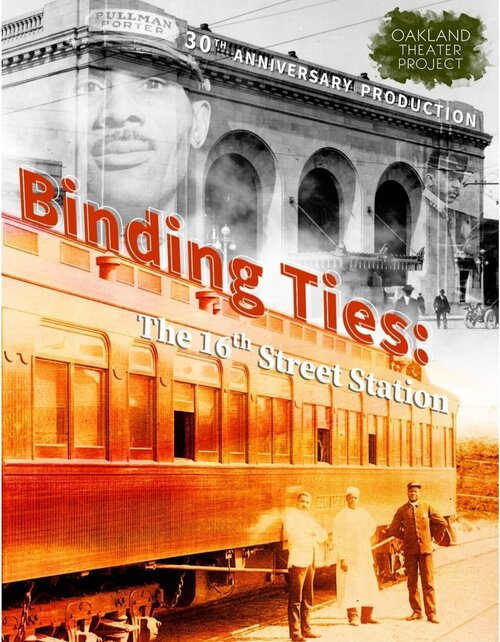
Binding Ties: 16th Street Station

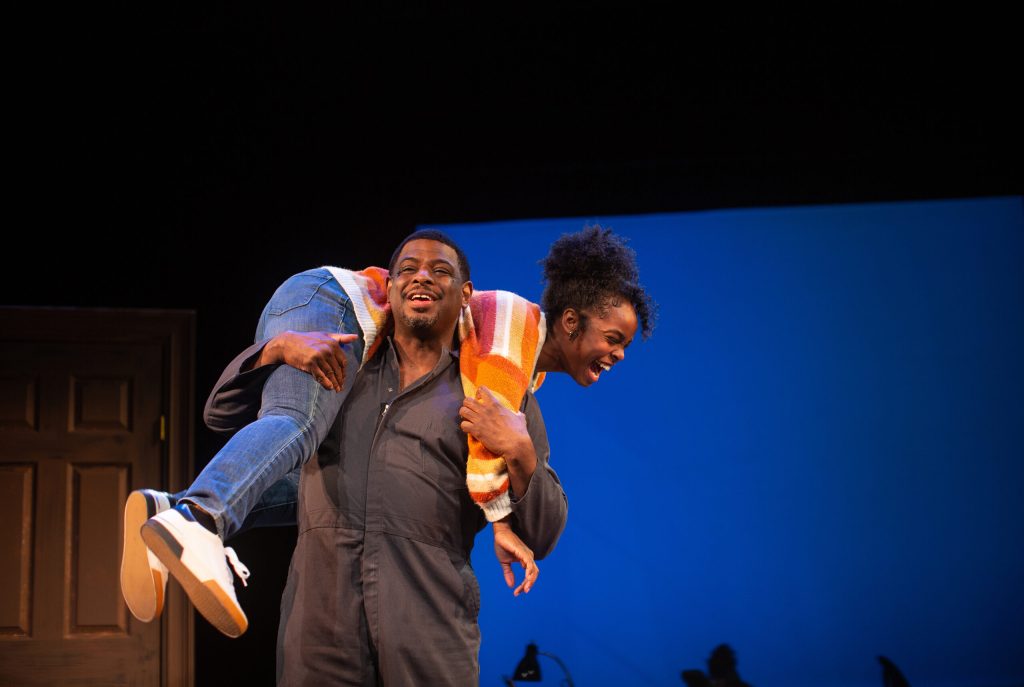
This image has an empty alt attribute; its file name is binding-ties-promo-graphic.jpg

It’s been virtually a year since the pandemic has darkened the stages of live performance.  All theatergoers lament the absence of our favorite intellectual stimulation and fear that many theatrical organizations may lack the wherewithal to rebound from the financial catastrophe.  Many companies now offer electronic alternatives – from filming of previous stage performances to original productions using Zoom technology.  Although electronic media don’t offer the same urgency and reward as live performance, these endeavors do provide a way for companies to reach their audience and for the audience to lend support to the companies.

Enter drive-in theater productions which, unlike viewing at home, do have the advantage of bringing theater lovers together at the venue to recreate some sense of community and allow some possibility of live elements.  And so it goes with Oakland Theater Project’s (OTP – formerly Ubuntu) entire 2021 season.  In keeping with OTP’s origins as a peripatetic, site-specific theater company, its season opener “Binding Ties: The 16th Street Station” takes place away from its current home base.  Even more poignant, the visuals are cast upon the outside walls of the titular station in Oakland.

This presentation of “Binding Ties:.…”  is the 30th anniversary of the documentary created by the esteemed Bay Area theatrical lighting designer, Dr. Stephanie Anne Johnson, with Michael Copeland Sydnor.  It focuses on the African-American, and to a small extent on Asian and Mexican immigrant minorities, experience working in service capacities on long-distance trains in the first half of the 20th century.  The stately Beaux-Arts styled 16th Street Station plays a major character in the stories that unfold.  The station itself was damaged by the 1989 Loma Prieta earthquake and was subsequently condemned, and the rail lines have been rerouted to other stations.  Nonetheless, attempts to revive and repurpose this beautiful grande dame continue to this day.

In addition to contextual narration, recorded interviews comprise the substance of “Binding Ties:…..”  The subjects are Oakland-based, Southern Pacific Railroad workers, primarily sleeping car porters, who recount vignettes of their lives and work.  This worthy look into history reveals maltreatment of minorities in this country, even those with relatively esteemed employment.  Despite their dignified hard work, their tales reveal many layers of indignity directed toward them.  Pay was poor.  Treatment by passengers and supervisors was often demeaning.  Unfounded claims that black employees were stealing from passengers and the company were common.  And even though female employees served as stewardesses, they were classified and referred to as maids.

The viewer also catches glimpses into the sometimes very luxurious aspects of train travel that also serve to emphasize the social and economic gulf between the passengers and those who served them.   Although the interesting storytelling yields a kaleidoscopic view of working on the trains, there is no dramatic arc or trend line leading to a denouement. 

One bright spot reported in the documentary was the founding of the Brotherhood of Sleeping Car Porters in 1925, which protected and advanced its members.  This noteworthy accomplishment in the labor and civil rights movements was the first ever union founded and led by African-Americans to be chartered by the American Federation of Labor.

As a result of inconsistent audio quality in the soundtrack (delivered by FM through car radios), some speakers sound loud and clear, but others are faint or scratchy, suggesting the need for audio engineering.  Sound designer Kevin Myrick has incorporated musical numbers, beginning with the appropriate “Hear That Train Whistle Blow,” that add life and dimensionality to the piece.

The visual component of the work is represented by a slide show of relevant black and white period photos projected on two screens.  The parking spot assigned this reviewer was extremely oblique to the screens, so that most text and smaller image details in the nearer screen could not be deciphered, and nothing could be discerned on the far screen.

In order to add a live element to the production, a “Conductor” played by William Oliver III introduces and closes the show.  But from my vantage point, I heard him clearly but caught only a glimpse of him.  The concept makes sense, but more content and spark for the role would be welcomed.

The concept and message of “Binding Ties: The 16th Street Station” appeal and deserve our patronage.  However, the dramatic elements could be strengthened as could the technical side of delivering performance with this technique.  Nonetheless, credit is due Oakland Theater Project for taking on important topics and providing some intellectual stimulation for its supporters.

“Binding Ties: The 16th Street Station” was created by Dr. Stephanie Anne Johnson with Michael Copeland Sydnor; produced by Oakland Theater Project; and plays in the parking lot of Oakland’s 16th Street Train Station through March 14, 2021.

Victor Cordell, Ph.D.
American Theatre Critics Association
San Francisco Bay Area Theatre Critics Circle

Darwin in Malibu

“As for a future life, every man must judge for himself between conflicting vague probabilities.” Charles Darwin, 1879, in a letter to J. Fordyce.

At the outset of “Darwin in Malibu”, we see Charles Darwin lounging in a Hawaiian shirt, cutoffs, and sandals. We suspect that this is not the Darwin of the dour countenance we have seen in pictures. Indeed, the conceit of the play begins with the premise that the famed biologist resides in a paradise-like purgatory a century after his passing from life as we know it. What follows is a humorous and interesting look into a vital intellectual realm.

The purpose of the play is to provide a playful vehicle for discussion of Darwin’s theory of natural selection, one of the most seminal, profound, and controversial postulates in scientific history. A useful backstory to the play is provided in a pre-play talk by director Bruce Coughran.

For those who may not know, Darwin misclassified the famed Galapagos finches that are central to the theory. He thought that he had identified finches, warblers, and gosbeaks, but he later learned from ornithologists back in England that all of the specimens were finches. The bumbling that led to his treatise on natural selection cannot be understated, no matter how indelible the theory would become. In fact, he was not a biologist but was training in earth science when he took the assignment on the Beagle, which brought him to the Galapagos. He had studied Charles Lyell’s “Principles of Geology” and having learned theories about changes in the earth’s surface from that source, he was able to map Lyell’s notions onto a biological framework.

It is also noteworthy that Darwin was cautious about developing and expounding the theory of natural selection, and he largely abandoned the critical public debates, leaving his position to be advanced by the ardent Thomas Huxley. A prominent critic of the theory was Bishop Samuel Wilberforce, who along with Huxley participated in the era’s most famous public debate of the theory, the 1860 Oxford Evolution Debate. Thus, the play is largely a series of informal two and three party arguments among Darwin, Huxley, and Wilberforce in a Malibu beach house.

The characters and their depictions are well delineated. George Killingsworth is Darwin, and he is played as an easy going man comfortable in his own skin. He is amused, amazed, and true to real life, he is uncertain of things religious and how exactly they fit with natural selection. He even reads horoscopes and trashy novels like his current diversion, “Malibu” by Pat Booth.

Darwin’s ally, Huxley, is played with unrelenting fervor by Robert Ernst. As a man committed to science, Huxley is highly empirical and brooks no compromise with beliefs that are not supported by fact. When he is asked which side of his family is descended from apes, he responds, “I’d rather be an ape than a bishop,” which is an adulturation of his real life reply. The other visitor, Wilberforce, is played with the smugness of a true believer by Stuart Elwyn Hall, and like, Huxley, he is didactic and dogmatic. Wilberforce and Darwin did not meet in real life, but somehow, after a century in “purgatory,” the former felt that the latter could be persuaded of the literal reading of the Bible and that he would abandon his theory.

The plot proceeds as a series of intellectual vignettes rather than a linear dramatic arc. Each of these giants is effective in making points, but Wilberforce slips when forced to respond to hypothetical examples. In one case, Darwin gets him to agree that he would be able to shoot partridges if he were in heaven. But then the bishop is forced to accept either that Darwin would be shooting partridges that are “good”, because they were in heaven, or he would be shooting partridges that are “bad” and shouldn’t be in heaven. Another more compelling example concerns Noah’s Arc. Without dwelling on details, Wilberforce is virtually forced to admit that because of space constraints in the arc, that evolution must have occurred since The Flood. Further interesting debate centers on Darwin’s arguing that Wilberforce’s heaven equates to Darwin’s hell, and that Wilberforce’s notion of perfection looks back in time, while Darwin’s looks forward.

In all, the play provides considerable food for thought in an entertaining package. The script does have some problematic elements, mostly around the fourth character, a young beach girl, Sarah, played by Leandra Ramm, who does bring a fine singing voice to the party. While Sarah facilitate in some ways, and she has a storyline of her own concerning love and loss, it’s a stretch to integrate it with the high order primary themes. It almost seems that the part was created to include a feminine accessory in the proceedings. The opening sequences with Darwin and Sarah are a bit pedestrian and lack energy. However, by the time the arguments begin, the activity level is pretty pumped up.

“Darwin in Malibu” by Crispin Whittell is produced by Intra’s Net Theater and is performed at the Berkeley City Club, 2315 Durant Ave, Berkeley, through January 15, 2017.

Victor Cordell
San Francisco Bay Area Theatre Critics Circle
American Theatre Critics Association

Gertrude Stein and a Companion

“There ain’t no answer. There ain’t gonna be any answer. There never has been an answer. That’s the answer.” Gertrude Stein

Gertrude Stein rests atop an odd pedestal in the gallery of fame. Certainly a wit of the highest order, her aphorisms are incisive and memorable. Her writing is sophisticated but confusing and is often given as much to cadence as content. Though a friend and contemporary of future Nobelists, her only significant contribution to the canon of literature was her slyly misnamed “The Autobiography of Alice B. Toklas” from 1933, an honor to her lover and manager of the last 40 years of her life.

Alice is the unnamed party in “Gertrude Stein and a Companion,” and the title draws from Ernest Hemingway’s refusal to refer to Alice by name. The two disliked one another, perhaps divided by each having a love for Gertrude. However, Alice had her; Ernest didn’t. The play is a brief meander on the relationship of Gertrude and Alice and their pantheon of friends. It is presented by Theatre Rhinoceros with love and confidence, and it charms from beginning to end.

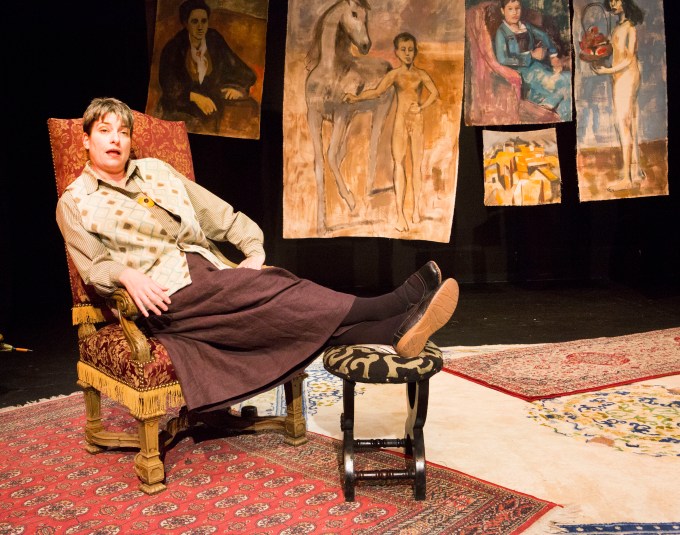
This piece was selected by Artistic Director John Fisher as a vehicle for Kathryn Wood who had long been drawn to the inter-war life of Paris. Fisher and Wood’s fingerprints touch all aspects of the production from co-directing to scenic design, with Wood also designing the costumes and playing the lead role. It is a role that she is made for, and she delivers with great brio.

The play is non-linear and episodic, with Gertrude deceased near the outset but still communicating with Alice. Together, they recount the glories as well as the heartbreaks of lives defined by Culture. Although Gertrude’s vocation was writing, she is perhaps better remembered for her contributions to modern art. As a seminal patron, especially of Matisse and Picasso, she did much to promote their paintings as well as others of the early twentieth century. Her salon was beehive for intellectuals including the aforementioned as well as Ezra Pound, Sherwood Anderson, F. Scott Fitzgerald, and many more.

The salon was covered with some of the finest paintings of the day, and in Alice’s coinage were “dollarless.” At one level, she could only imagine their evocativeness rather than their monetary value, but when it was necessary to finance publication of Gertrude’s books, she monetized what she needed off the walls. Those walls have been memorialized in photographs, and recently represented literally in Woody Allen’s movie “Midnight in Paris.” For this production, Kirsten Tradowsky has cleverly created the sense of the salon by mimicking a number of the hung works on unframed canvasses that are strung on wire and moved and removed as called for by the action of the play.

Elaine Jennings as Alice matches Wood for command of her role. Wood’s Gertrude is constantly beaming and self confident, but Jennings matches up to her every inch of the way. Wood relaxes open and uninhibited in armchair with her legs often splayed under a plain long skirt. Jennings is dressed in black and sits ramrod straight on a desk chair. What photographic images history provides us of Alice are even less flattering than those of Gertrude, but Jenning’s gives her a brilliance and a place in the sun that she must have had in order to thrive in the setting she did.

Gertrude declared herself a genius and noted that geniuses couldn’t possibly take care of themselves and need partners like Alice to do the necessaries for them. In another of Alice’s coinages, she said that she was dependented to Gertrude. Gertrude couldn’t decide whether the word was good or bad, but she said it was definitely delicious. It is somewhat amusing that having resided in Gertrude’s shadow, Alice’s name would be so much a part of pop culture. In addition to the “Autobiography” written about rather than by her, she did write the “Alice B. Toklas Cookbook” in 1956, which became a best seller. It is most remembered for her “hashish fudge,” more commonly known as hash brownies. As a result of that countercultural recipe, her name is even in the title of the 1968 Peter Sellers’ movie “I Love You, Alice B. Toklas.”

Some vignettes in playwright Win Wells’ script are prosaic, but all are engaging. One scene that raises questions of the women’s sanity is that they remained in France through the Nazi occupation. Furthermore, they were required to billet German military officers from time to time. Of being Jewish, lesbian, American, or purveyors of “decadent” art, it’s not clear which could have been the quickest trigger to concentration camps or summary execution. Through good fortune and probably connections, they would live to see liberty again.

Several other characters put in brief appearances, from Hemingway to a German major to a midwestern U.S. journalist. The audience must suspend a little extra disbelief, as each is played by a young female, Haley Bertelsen. With only minor costume changes to represent the various roles, and no attempt to disguise her person, she adeptly conveys their essences.

As the play is short, uses one simple set, and has only three actors, it might be considered a “small” play. But it is highly literate, revealing, and engaging, and it is well presented. For local audiences, there is the special attraction that it is about two Bay Area women, Gertrude having grown up in Oakland and Alice in San Francisco. Some people familiar with Gertrude’s quote when returning to Oakland that “There’s no there there” believe that she was disparaging the city. The quote is not in the play, but was mentioned by John Fisher in his pre-play talk. The “there” she was referring to was her home, which had been razed. So, take that, Berkeley, with your “Here” and “There” sculpture on your border with Oakland.

“Gertrude Stein and a Companion” by Win Wells is produced by Theatre Rhinoceros and plays at the Eureka Theater, 215 Jackson Street, San Francisco, through January 8. 2017.