Cruzar la Cara de la Luna

Kelly Guerra as Renata, Efraín Solis as Laurentino, Aléxa Anderson as Diana. All photos by Cory Weaver.

Few socio-political evolutions in the United States since World War II have been as profound as the growth in population from Latin American origins, from an estimated 4.5 million or 3% of the population in 1945 to over 63 million or 19% of a much larger current population.  First family arrivals have crossed the border both legally and undocumented in hopes of a safer and more comfortable way of life.

Few socio-political evolutions in the United States since World War II have been as profound as the growth in population from Latin American origins, from an estimated 4.5 million or 3% of the population in 1945 to over 63 million or 19% of a much larger current population.  First family arrivals have crossed the border both legally and undocumented in hopes of a safer and more comfortable way of life.

Alissa Aguilar as Lupita, Moisés Salazar as Chucho.

While the Latinx cultures, language, religion, and music of these peoples have left their marks in most performance arts, opera stands as an exception.  In 2010, composer José “Pepe” Martinez and librettist Leonard Foglia broke new ground with this piece, which translates as “to cross the face of the moon,” on a commission from Houston Grand Opera.  It has proven attractive with several productions launched by mid-sized opera companies.  West Edge Opera is offering a highly appealing and entertaining rendition of the work.

The story is about Laurentino, a man in New York who immigrated from Mexico half a century before.  On his deathbed, he reveals an undisclosed past to his family.  He had a first wife in Mexico who died in the crossing and a son who returned to his native land.  Upon hearing this surprise, his Mexican-American family sets out to locate the Mexican son and reunite him with the father before the latter dies.

Aléxa Anderson as Diana, Bernardo Bermudez as Mark.

As is fitting, “Cruzar” está mezclado de muchas maneras (is mixed in many ways).  As with musicals or operettas, conversation is spoken rather than sung, and songs stand apart with no connective musical recitatives.  Although the songs are in Spanish, dialogue shifts between English and Spanish throughout, with the associated shift in supertitles.  And to really keep the audience on its toes, the narrative is non-linear in time and place.  That said, the storyline is easy to follow because of the cues given in the thoughtful staging.

Sergio González as Raphael.

One might expect that to cover the ground that the action does, with many brief scenes in 90 minutes, the emotional impact of the story would be compromised.  It is not.  The human interest elements, the life challenges, the compassionate characters, and the sadness are largely understated, yet presented in ways that trigger immediate empathetic responses in the audience.  And in many ways, the tragedy of the crossings and divided families resonates even more today than when the opera debuted.

A poignant metaphor of the butterfly recurs in the music and conversation.   When the butterfly emerges from its chrysalis and moves on from its life as a caterpillar, it never returns to the same location, reenacting life’s transformation in a new land.  It is only the descendants that circle back to the homeland of earlier generations.

Instead of a traditional opera orchestra in a pit, the Mariachi Azteca band of guitars, violins, and trumpets plays from the periphery of the stage.  The melodic music in the mariachi style always engages.  Some songs are quite touching with messages particular to the immigrant experience – thoughts like “we never leave the south,” “we always want to return,” and the plea of Laurentino’s first wife Renata “I’m not marrying to receive money through the mail.”

Alissa Aguilar as Lupita, Kelly Guerra as Renata.

Efraín Solis, who has played the American son in several productions, deftly heads the well-suited ensemble cast as the dying Laurentino, who dreams of the life he left behind.  Other characters are well delineated from the distraught American son Mark (Bernardo Bermudez) to the surly Mexican son Rafael (Sergio González) and the spritely American granddaughter Diana (Aléxa Anderson).

Overriding and overlapping issues of interest about “Cruzar” deserve discussion.  First is whether it is an opera, for which there is no definitive definition, but in the first instance, the operatic music is sophisticated and draws from “classical” idioms.  This work is more like a zarzuela, a form from Spain that paralleled the development of opera in Europe, but shares the format of operettas in having spoken language interspersed with song.  It might even be more closely related to the American musical, being more akin to “In the Heights” than “Carmen.”

Efraín Solis as Laurentino, Bernardo Bermudez as Mark.

Another key element is that with rare exception (e.g., outdoor performances and John Adams’ operas) opera vocals are never amplified, but they are in this production.  One of the great virtuosities in performing arts is the astounding grandeur of an opera singer’s trained voice.  The cast of “Cruzar” all have opera credibility on their resumes – for instance, Moisés Salazar who plays Chucho follows Solis as a San Francisco Opera Adler Fellow.  However, it is impossible to evaluate their singing fairly compared with other opera performances when a lounge singer might sound as good using a microphone.  In addition, the songs from “Cruzar” don’t challenge the power, range, or flexibility of the artists’ instruments as is common in opera.  It is the high wire dynamics of the singing that produces the awe in audiences.

Apart from the matter of whether “Cruzar” is artistically suited to the opera house is the marketing issue.  It is good that this work is spreading, and hopefully that will continue.  But to the opera crowd, it may be largely a passing curiosity, not a trend.  It would be great if this piece could bring new audiences to live performance, whether that is in the opera house or the musical theater.  Perhaps the latter would be less intimidating to those without a history of attending either art form.

Efraín Solis as Laurentino, Moisés Salazar as Chucho.

That raises a final question.  Certainly, Latinx should be more drawn to the mariachi music and the cultural aspects of “Cruzar.”  But most Latin Americans in this country will have stories of crossing, separation, and tragedy from their own families or friends.  Although stories like this deserve a wide audience, the question remains whether the Latinx community wishes to relive the experiences in live performance.

“Cruzar la Cara de la Luna,” composed by José “Pepe” Martinez with libretto by José “Pepe” Martinez and Leonard Foglia and book by Leonard Foglia is produced by West Edge Opera and plays at Oakland Scottish Rite Center, 1547 Lakeside Drive, Oakland, CA through August 5, 2023.
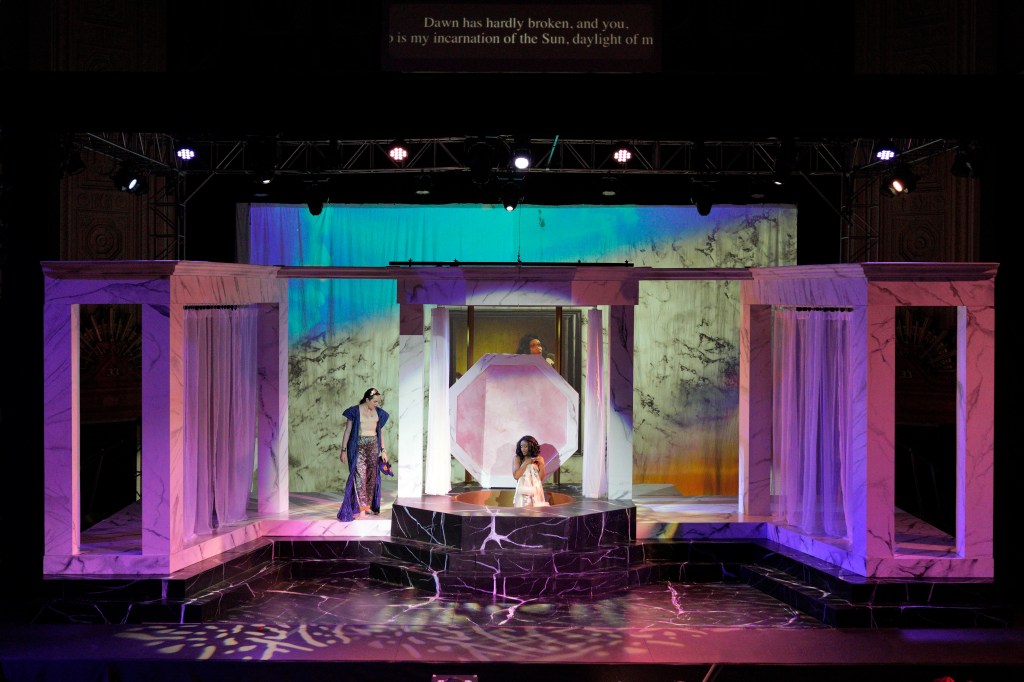
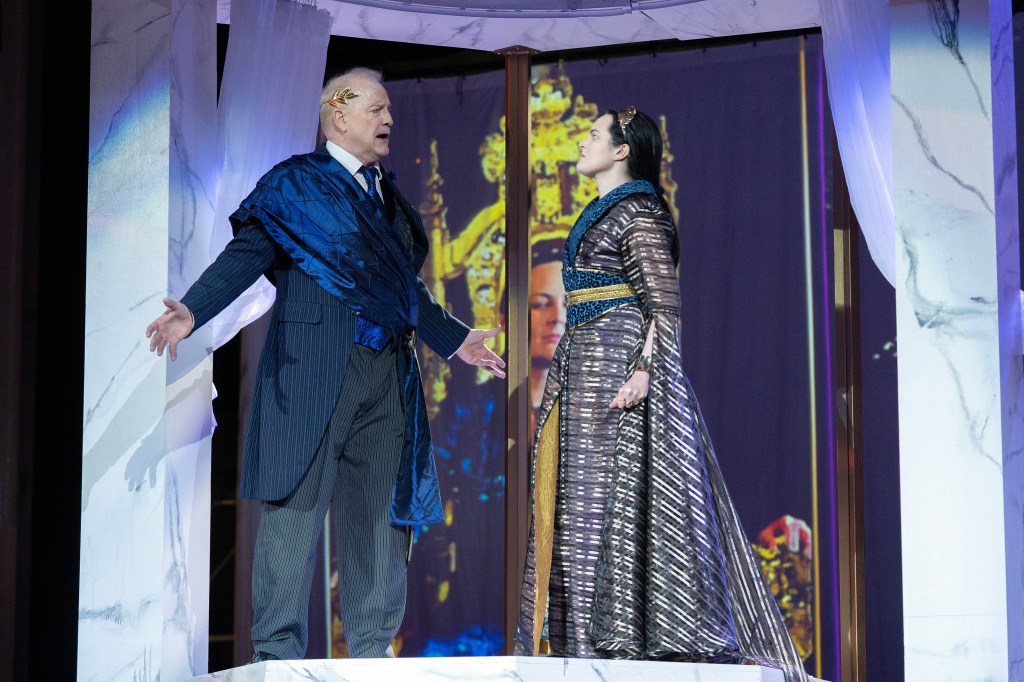
The Coronation of Poppea

Overall staging. All photos by Cory Weaver.

Overwhelmingly, operas based on history are tragic.  “The Coronation of Poppea” fits the category but barely meets the standard for adversity, exhibiting only attempted murder, forced suicide, intrigue, betrayal, and banishment.

The work acted as an important bridge between Renaissance and Baroque musical periods.  It is one of the earliest extant, and certainly most important seminal operas, produced in 1643 before the word opera was even in use.  At that time, music was composed to honor and enhance an existing text, thus Claudio Monteverdi’s music was designed to compliment and complement Giovanni Francesco Busenello’s scenario.

Sarah Coit as Nero, Shawnette Sulker as Poppea.

The libretto is historical only in the broadest sense.  While the plot points actually occurred from AD 58 to AD 65, not only are they condensed into one day, but their order is shifted!  Further, Busenello fancifully changes the character of characters, making some good who were actually bad and vice versa.  Who would have thought of the barbaric and narcissistic Nero as also having room for love and magnanimity?  So, for those who lambaste Hollywood for being fast and loose with the facts, let it be known that it had models to draw on.

West Edge’s bright and winsome production excels on two most important criteria.  The cast amazes – a wonderful match of exciting performers and voices to their respective roles.  Also, since copyright is not an issue, the company was able to trim the running time from four hours to a manageable two-and-a-half without loss of plotline or continuity.

Sara Couden as Octavia.

Despite the grave nature of many of the incidents, the overall effect of the production is relatively light.  This largely derives from ace casting and interpretation decisions, presumably by Artistic Director Adam Pearl.  The exacting and honey-tinged coloratura, Shawnette Sulker, heads the cast with a stellar sultry and conniving enactment and voicing of Poppea.  While her characterization as Nero’s mistress and wannabe empress is conventional, many others are a delightful confetti of gender bending.

Philip Skinner as Seneca, Sarah Coit as Nero.

First, as Nero is Sarah Coit, who handles the role’s tricky ornamented passages in the score with great facility.  Although written as a trousers role, it would normally be performed in a male mode.  However, several physical cues make it appear that a female is performing, and Nero’s wardrobe is largely aligned with that of a woman in terms of patterns and shapes.  The most profound gender switch involves Poppea’s nurse, Arnalta, who provides comic relief and is performed by Samuel Faustine.  The role calls for an alto, but Faustine sings largely in countertenor.  He also possesses a tenor timbre and is able to take deep dives into a lower register to add a special sass and bawdiness to the role.  The final gender twist is the part of Ottone, who is Poppea’s lover before she throws him over for Nero.  Although Ottone is designed as a trousers role for a mezzo’s voice, in a big surprise, a real male performs the role.  This is mellow sounding countertenor Michael Skarke, who acquits himself well.

In order to make Poppea his empress, Nero must rid himself of his wife Octavia.  Of course, when she gets drift of Nero’s intentions, Octavia comes up with an assassination scheme that would solve her problem.  She is performed by Sara Couden who possesses an uncommonly powerful instrument that absolutely fills a theater.  Each time she sang, the audience was rapt in awe.

Samuel Faustine as Arnalta.

The adult in the room is Seneca.  An advisor to Nero, the great philosopher and dramatist was on the receiving end of advice from Nero to take his own life after being implicated in a plot, perhaps wrongly, to kill the emperor.  The dignified and stentorial Philip Skinner fits the role exquisitely, the one exception being that it calls for a bass, while Skinner is a bass-baritone.  He does lose volume, but not other qualities at the bottom of the tessitura required.

The music of the opera engages throughout, though in typical Baroque fashion, harpsichords tinkle and theorboes clink with incessant regularity.   The score possesses a number of set pieces that are both melodious and meaningful.  Two duets are particularly telling and memorable.  The first reflects the moral and intellectual distance between Seneca and Nero with the former advising the emperor to be guided by reason and morality in his actions, while the petulant Nero willfully insists that he will have whatever he wants.  The other is the closing duet between Nero and Poppea.  Erotically charged, it symbolically exudes urgent sexuality in a repeated, fervent call-and-response sequence.

Rayna Mia Campbell as Drusilla, Michael Skarke as Ottone.

Nina Ball’s set embraces clean lines and function as would be expected for an ancient drama.  Yet, the overall staging is gemischt in time and place – although the anachronisms generally enhance rather than detract from the effect.  One device shows the events that occur in the action depicted as front-page newspaper articles, dramatically spinning into place on Ryan Yu’s rear-screen projections.  Unfortunately, columns and a top beam in the set block the visual and informational effectiveness.  Ralph W. Hoy’s costumes are eclectic.  Ottone’s and those of supernumeraries earlier in the piece are suggestive of mid-century Ecuador, with Panama hats, panchos, and earthtones.  Later, extras are wearing formal kilt attire, which may have simply been available from the venue, Oakland’s Scottish Rite Center.

An area for improvement in future productions relates to supertitles.  It would help if characters are identified in the titles at their first utterance.  Sometimes, it is simply unclear who a character is until their name is later mentioned, and the viewer may be left at sea for a time.  Another observation is that the ambient light reduces the contrast in the supertitles and makes them hard to read for many.  Projecting them in larger or thicker font would make them more readable.

Shawnette Sulker as Poppea.

Notwithstanding the minor issues, West Edge has produced an opera of historic significance in an intriguing and highly interesting manner.

“The Coronation of Poppea,” (“L’incoronazione di Poppea”) composed by Claudio Monteverdi with libretto by Giovanni Francesco Busenello, is produced by West Edge Opera and plays at Oakland Scottish Rite Center, 1547 Lakeside Drive, Oakland, CA through August 3, 2023.

The Rape of Lucretia

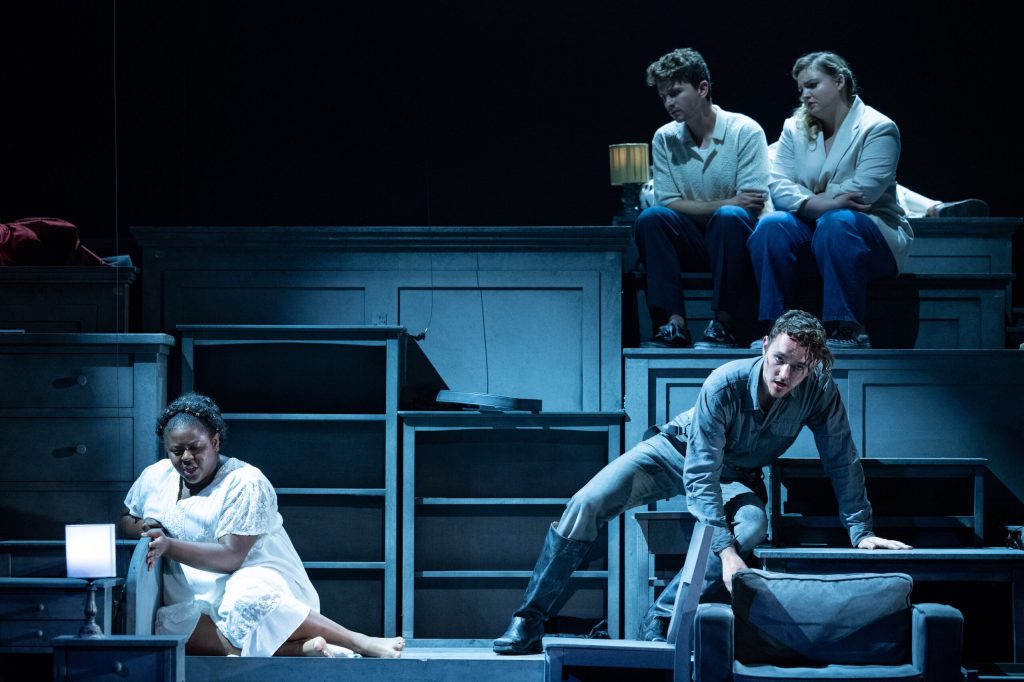
Natalie Lewis as Lucretia (front left), Samuel Kidd as Tarquinius (front right), Chance Jonas-O’Toole as Male Chorus (back left), Caroline Corrales as Female Chorus (back right). All photos by Kristen Loken.

In the midst of its 2023 Merola Summer Opera Festival, a program for gifted singers artistically associated with San Francisco Opera, it offers a fully-staged production of Benjamin Britten’s “The Rape of Lucretia.”  The opening performance was powerful and engrossing, led by a strong cast of eight singers from the illustrious training ground.

When a group produces only one opera in a season, the question arises how the selection was made.  In this era of “Me, Too,” much analysis is being conducted of the themes in operas.  Clearly, if operas such as “Madame Butterfly,” “Don Giovanni,” “Rigoletto,” “Abduction from the Seraglio,” and scores of others were written today, modern sensitivities would demand different  treatments of themes now deemed offensive.

James McCarthy as Collatinus, Cameron Rolling as Junius.

“The Rape of Lucretia” fits in that category but was chosen largely because of the themes, with the idea of exposing artists to such materials in a safe and supportive environment.  Given that objective, it is somewhat surprising that the rape scene, which could have been totally enacted behind a curtain, is rather physically depicted.  In addition to the rape, the text is full of misogyny.  Junius declares that “Virtue in a woman is lack of opportunity” and Tarquinius says that “The only girl worth having is wine.”  Note, however, that Lucretia’s husband, Collatinus, did not share this sentiment.  Fortunately, the program’s social objective was accomplished while presenting an otherwise interesting work.

Its mid-century, modern musicality does not break barriers, but it is highly listenable.  All eight roles provide significant stage and singing time for each performer, giving ample opportunity for each to show well – and they do.  None of the arias or ariosos are memorable, but two quartets and the septet finale are very involving.

Caroline Corrales as Female Chorus (left), Olivia Prendergast as Lucia (right), Simona Genga as Bianca (below).

The opera is based on history.  Prior to Rome’s becoming an empire, it was ruled by kings.  In the 6th century BCE, the tyrant Lucius Tarquinius Superbus was the last king, and his tumultuous reign was finally toppled by actions of his son Tarquinius.

In the opera, Roman officers, including Tarquinius, who are in a military camp wager whether their wives have remained constant.  Investigations prove that the wives of all of the men in the discussion have had indiscretions, with one exception.  Lucretia has remained faithful.  Tarquinius is determined to corrupt her morals.  Returning to Rome, his amorous advances toward Lucretia are repelled, and he forces himself on her.  Although not dealt with in the opera, this incident was the crowning blow to the king’s reign, and his overthrow led to the period of the Republic of Rome.

Samuel Kidd as Tarquinius, Natalie Lewis as Lucretia.

This early piece, orchestrated for 13 instrumentalists, is the first of Britten’s chamber operas.  Many who are familiar with the composer’s life will know that he often wrote lead parts for his life partner, operatic tenor Peter Pears, who was indeed in the cast of the opera’s premiere.  At first blush, one might think that Pears was shortchanged in being cast as Male Chorus.  However, this is the sole tenor role and the largest part in the work, narrating the storyline and the thoughts of the men.  Rather than a role as a talking-head, stoic sentinel, the Male Chorus is demonstrative, emotional, highly mobile, and interactive with his female counterpart.  Indeed, some would argue that a weakness of the libretto is that storytelling by the Choruses dominate the action.

In this Merola realization, impeccably-voiced Chance Jonas-O’Toole excels as Male Chorus with full vocal and acting ranges.  Caroline Corrales as Female Chorus is likewise a strong presence with an exciting voice.  In the other two large roles, full-throttle baritone Samuel Kidd is the devious Tarquinius and silken-warm-voiced mezzo Natalie Lewis is the righteous Lucretia.

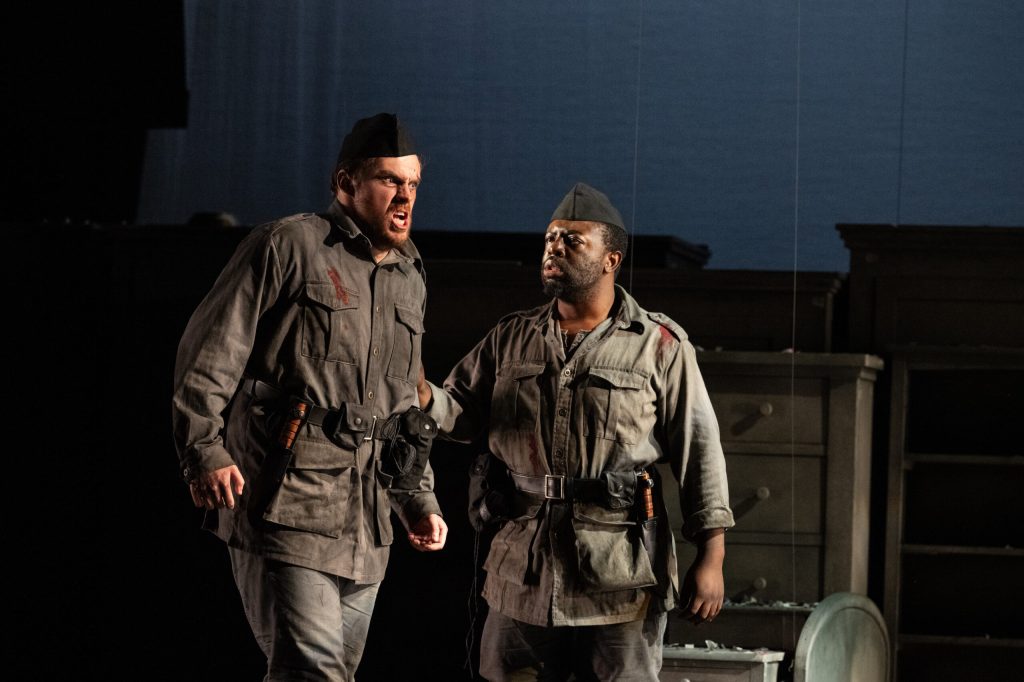
Samuel Kidd as Tarquinius, James McCarthy as Collatinus, Cameron Rolling as Junius.

Other performers are James McCarthy as Collatinus, Cameron Rolling as his colleague Junius, and as Lucretia’s attendants, Olivia Prendergast is Lucia and Simona Genga is Bianca.  As noted, the voices are accurate throughout, but at least three singers have difficulty at the low ends of their tessituras when competing with the small orchestra ably conducted by Judith Yan.

Director Jan Essinger’s staging is simple yet striking.  Sonja Füsti’s sets are monochromatic gray.  In the camp scenes, gray sheets draped over objects comprise the set.  In Lucinda’s home, the sheets are lifted to reveal a stage full of gray furniture pushed together as if in storage.  The somber notes are appropriately accentuated by David Robertson’s dim lighting and Christine Cook’s contemporary drab costuming.

Caroline Corrales as Female Chorus, Chance Jonas-O’Toole as Male Chorus.

Ronald Duncan’s libretto teems with literacy, blessed with intelligent conversation and an array of rich metaphors and references.  If you have to go to your dictionary to look up the word moiety (used to partially rhyme with anxiety), you get the picture.  Unlike many operas with convoluted storylines or leaps of logic, this one plays out clearly and concisely with one exception.

A conceit employed that rings false is the Christianization of the text.  The Choruses are presented as Christian observers in order to needlessly introduce notions of redemption, and in this interpretation, resurrection.  The effect of the dual timeline results in a sense of anachronism, especially when the Choruses are singing with historic figures from centuries earlier.

Natalie Lewis as Lucretia (above), Olivia Prendergast as Lucia (below).

Although “The Rape of Lucretia” is not among Britten’s oft performed works, its assets are abundant, and Merola offers a fine rendering of this underperformed opera.

“The Rape of Lucretia” is composed by Benjamin Britten with libretto by Ronald Duncan and is produced by Merola Opera Program and performed at Herbst Theatre in War Memorial Veterans Building, 401 Van Ness Ave., San Francisco, CA through July 15, 2023.

Les Misérables

Cast. All photos by Matthew Murphy and Evan Zimmerman for MurphyMade.

Though the stage musical descends from the European operetta, it became a unique art form associated with the American theater and particularly with Broadway.  Other English-language artistic teams have crafted musicals that have succeeded in the United States, but rarely has one that originated in a foreign language reached broad acceptance.

The two most popular musicals to fit that category were created by two Frenchmen whose names are little known and won’t roll off the American tongue.  They are composer Claude-Michel Schönberg and lyricist Alain Boublil.  In the 1980s, they brought to the stage in English two stellar musicals – “Miss Saigon,” and relevant to this review, “Les Misérables.”  Broadway San Francisco and Producer Cameron Mackintosh present the national touring production of “Les Mis” with stunning staging and uniformly strong singing voices.  The audience was transported to a radically different time and place and was wildly appreciative of the trip.

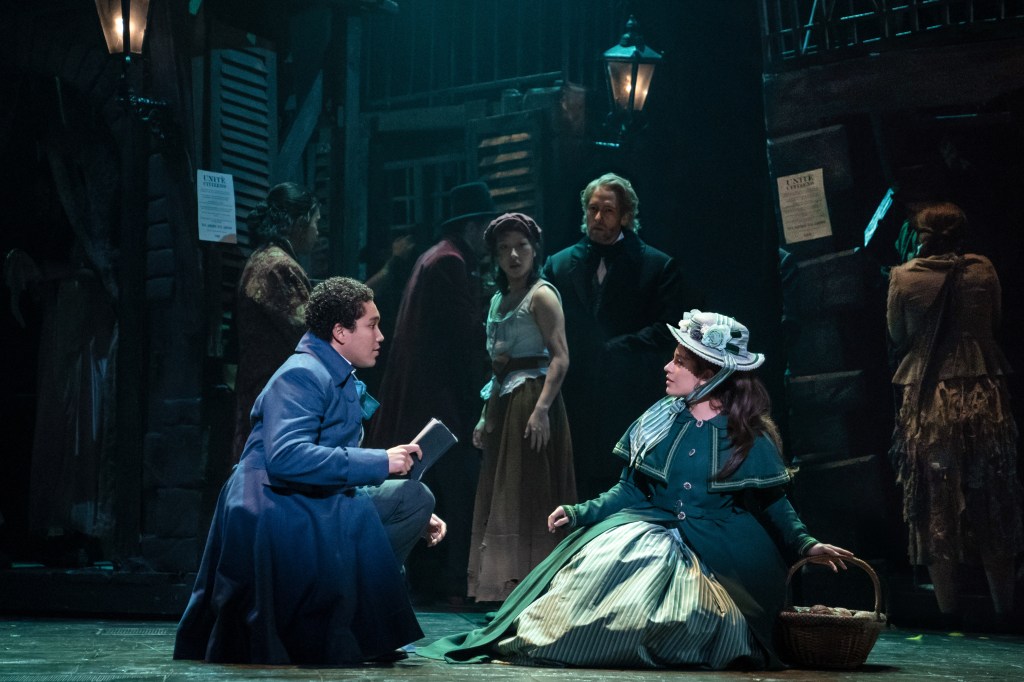
Preston Truman Boyd as Javert, Nick Cartell as Jean Valjean.

The source is one of literature’s greatest novels, Victor Hugo’s “Les Misérables,” which is set against the events of its time.  The central figure, Jean Valjean spends his adult life paying for having stolen a morsel of bread for his sister.  Even after a long prison sentence, he finds himself needing to hide and lie to avoid the relentless Inspector Javert, who obsesses over making Valjean pay endlessly for his petty crime.  Of course, the audience aligns with the thief rather than the lawman, as Hugo’s plea for reform of the justice system is clear.  Meanwhile, in 1823, Fantine, a young woman who becomes destitute, dies and asks Valjean to take care of her daughter Cosette.

Haley Dortch as Fantine.

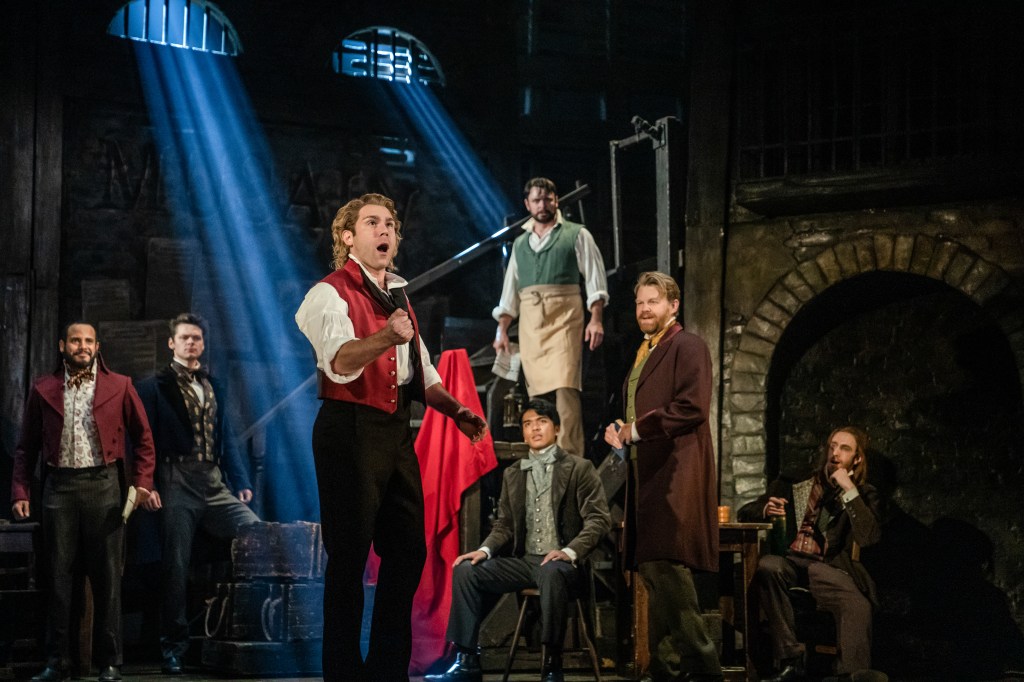
A second plot line concerns the Paris Uprising of 1832.  Act 2 plays out largely at a barricade set up by the republicans who are protesting the re-establishment of the monarchy.  The confrontations with the authorities will test the mettle of Valjean, Javert, and Cosette’s lover Marius.  The stage is ablaze with gunfire and conflict, and many will die before the battle is over.

(foreground) Gregory Lee Rodriguez as Marius, Addie Morales as Cosette, (rear) Christine Heesun Hwang as Éponine, Nick Cartell as Jean Valjean.

The music of “Les Mis” is appealing, but in large part, unmemorable.  What it does have is one powerful song that has grown into public consciousness well beyond the theater – “I Dreamed a Dream.”  While many signature songs from musicals put an exclamation point on the climax, this song comes very early and is delivered by Fantine, who is several rungs down the ladder of important characters.  The good news is that Haley Dortch delivers a beautiful rendition, and it is a truly beautiful song.  What’s more, key phrases from the melody and even the rhythm of the lyrics recur throughout the play, and the haunting and suggestive familiarity adds to the overall ambiance.

Nick Cartell as Jean Valjean.

One aspect of the music is the demands that it makes on Valjean, played with sensitivity and sung with panache by an exemplary Nick Cartell.  Valjean’s music is bimodal in range, and Cartell must often make musical leaps from the lower part of his range to the top while quickly switching from full voice to falsetto.  He accomplishes this with great skill.  As Javert, a very impressive Preston Truman Boyd faces a different challenge.  He is full of bile and bitterness, and he often sings with rage that is just a notch below uncontrollable.

Devin Archer as Enjolras.

Although “Les Mis” clocks in at over three-and-a-quarter hours, the pace is quick and the action commands the attention.  Through many clever, well-designed sets, the staging is among the darkest and most brooding in the genre, with low lighting and generous use of smoke.  The peasants’ costumery adds to the overall downtrodden effect.  Hugo’s artistry as a painter inspired the set design, but it appears that the novelist was in turn inspired by some of France’s most eminent early-and-mid 19th century painters.  We see the unstable action tilt from Delacroix; the dangling, supine corpse from David; the landscaping from Corot; and the grizzly peasantry from Daumier.  Set change, which is brisk, is facilitated by the broad use of backlit projections as distant scenery, reducing the props to be moved.

Preston Truman Boyd as Javert.

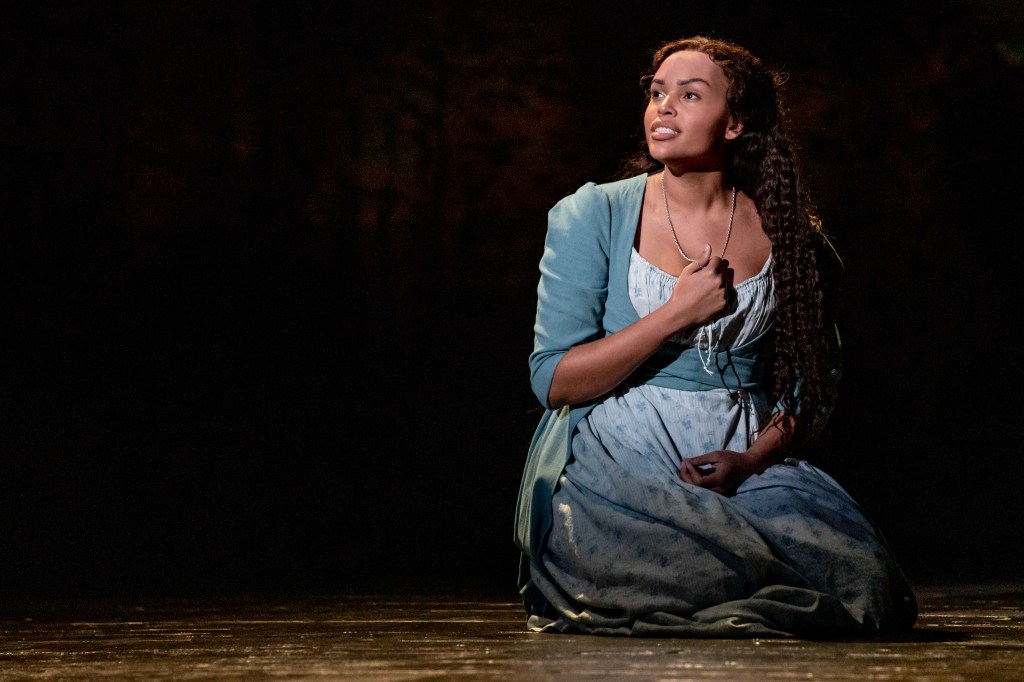
In their two highly successful musical collaborations, Schönberg and Boublil have drawn heavily on the Andrew Lloyd Webber playbook in three ways.  This musical is written in sung-through fashion.  Like opera, rather than traditional musicals, all of the text is sung.  A second commonality is that “Les Mis” contains a single beautiful anthem that is separable from the musical as a pop song and can be used as a promotion in advance of the play’s staging.  Finally, the show has a strong graphic logo that serves as an identifier that also aids in marketing.  In this case, it is the head shot of a straggly-haired Cosette as a waif in front of the French flag.

Christine Heesun Hwang as Éponine.

Altogether, the result is a musical that explores the human condition, starting with duty, love, forgiveness, and redemption. Its many assets have propelled it to becoming one of the longest running musicals both on Broadway and the West End.

“Les Misérables” with music by Claude-Michel Schönberg, French lyrics by Alain Boublil and Jean-Marc Natel, English lyrics by Herbert Kretzmer, and based on the novel of the same name by Victor Hugo is produced by Cameron Mackintosh, presented by the producer and Broadway San Francisco, and plays at the Orpheum Theatre, 1192 Market Street, San Francisco, CA through July 23, 2023.

A Chorus Line

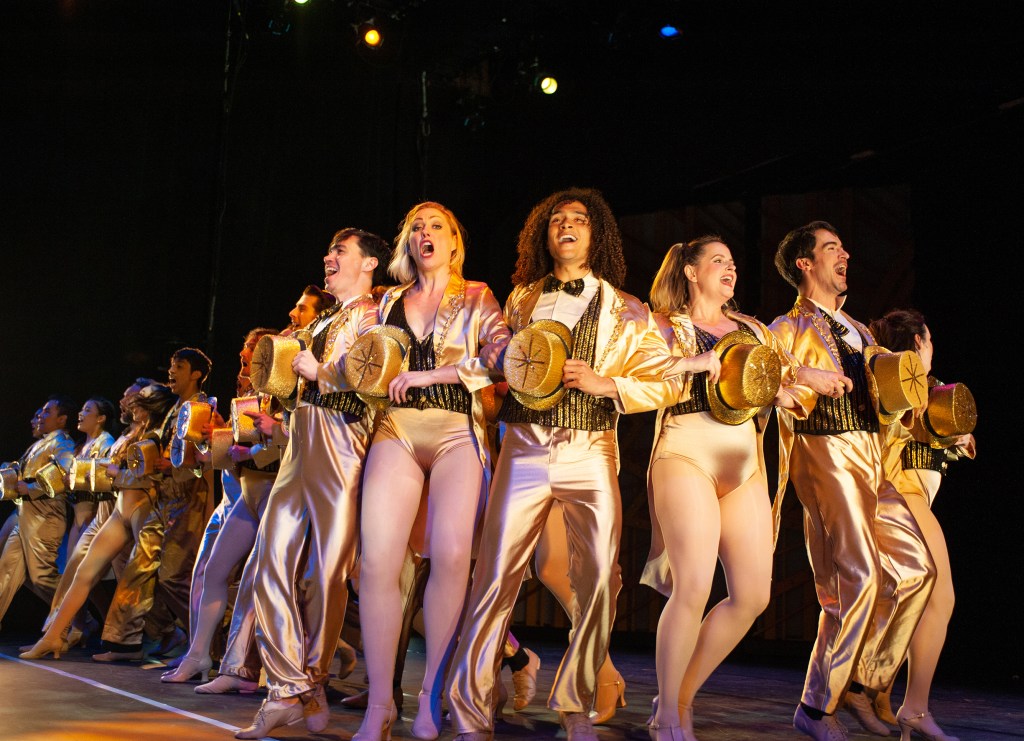
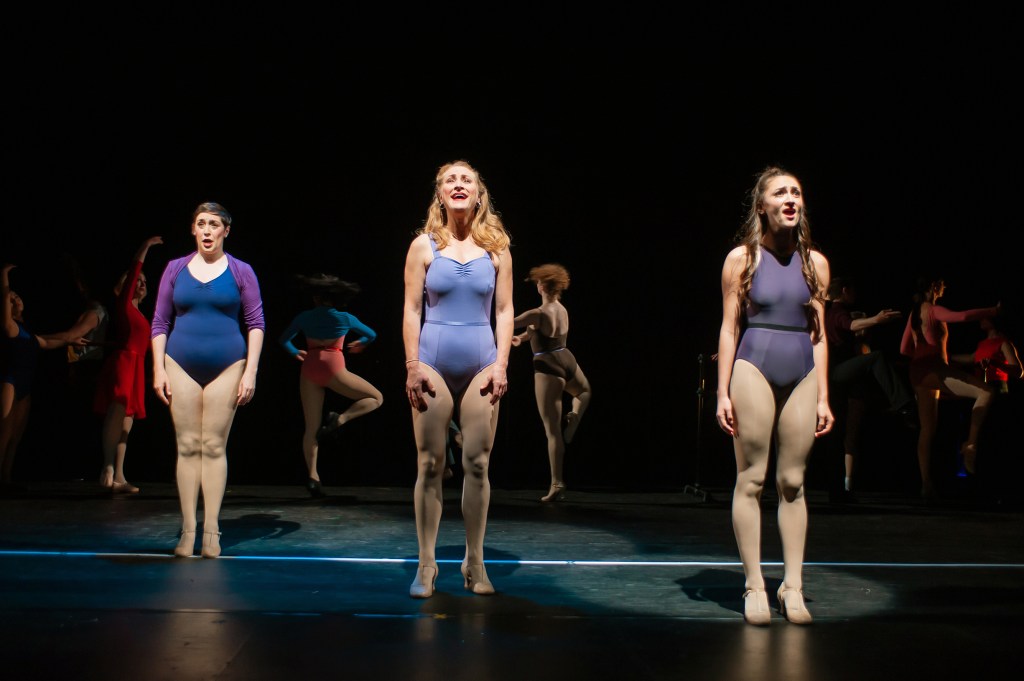
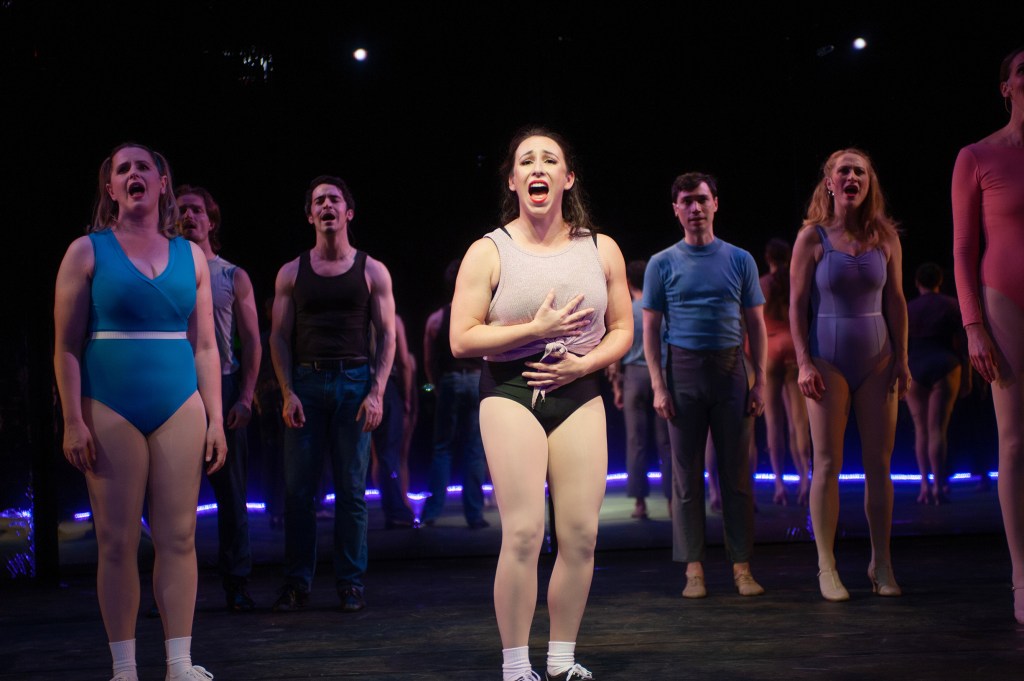
Cast. All photos by Jessica Palopoli.

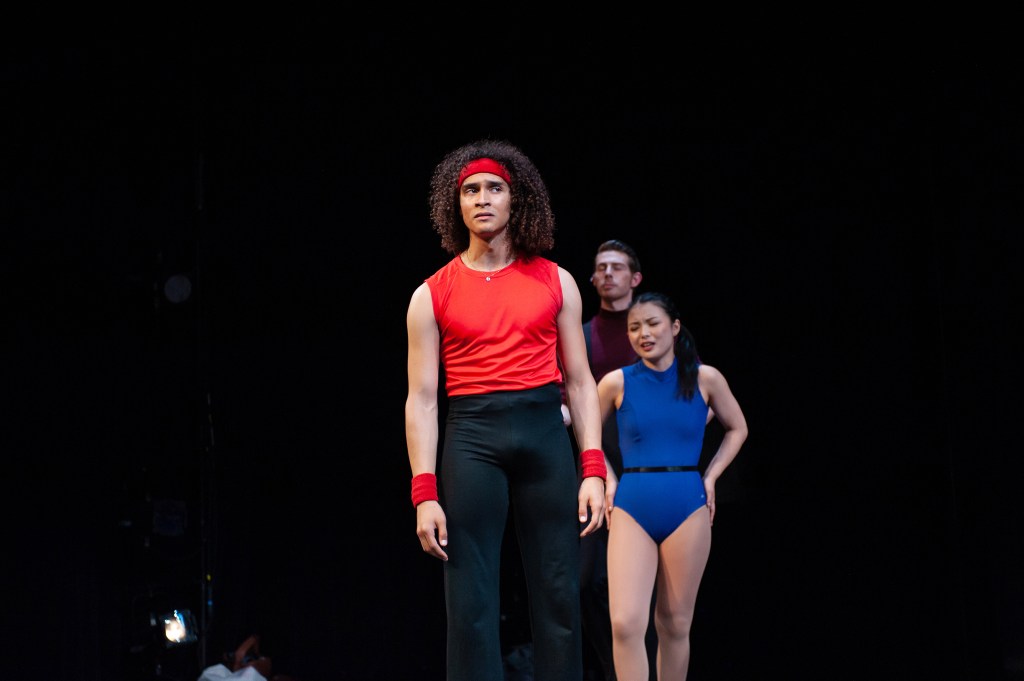
On Broadway and in Hollywood, the backstage genre endures and endears like few others.  They vary wildly in their treatment of the people and processes involved in putting a production on stage or screen, from “42nd Street” to “All About Eve” and from “Noises Off” to “Summer Stock.”  But in the history of American entertainment, no backstage montage has proven more heart wrenching and more diverse in its themes explored and its characters examined than “A Chorus Line.”  There are many good reasons why it is one of the most successful Broadway musicals of all time and why it is often revived the world over.  San Francisco Playhouse has captured the fairy dust magic of this very special entertainment.

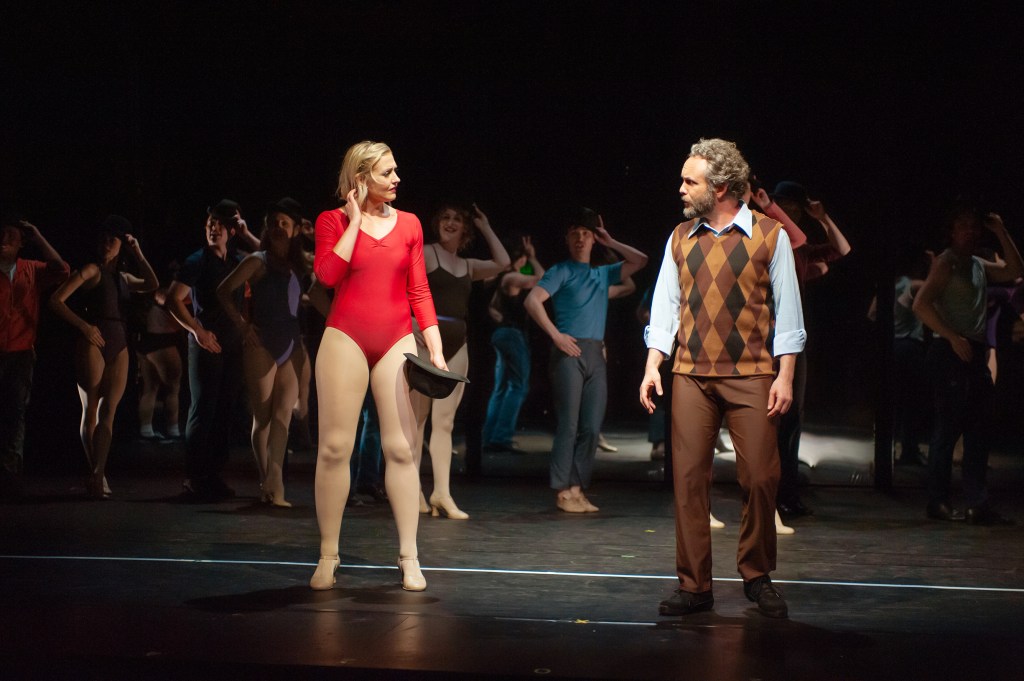
Nicole Helfer as Cassie, Keith Pinto as Zach.

Anxiety, uncertainty, and rejection fill the life of a would-be stage dancer.   “A Chorus Line” hits its mark from the opening beat.  The first memorable numbers typify the thoughts of the eager auditioners and propel the subtext.  Lyrics like “I hope I get it,” “I really blew it,” “I’ll never make it,” and “I really need this job” express the toll taken in precise terms.

Auditions are demeaning and choreographers are heartless in the grueling operation of winnowing down an abundance of candidates to a chorus line that will be contracted for a show.  But this musical’s creator as well as original director and choreographer, Michael Bennett, built on recorded interviews of dancers to devise the concept of having the final 16 competitors aligned on the stage to talk about themselves and what brought them to dancing.

Chachi Delgado as Richie, Dalton Bertolone as Greg, Ruri Kodama as Connie.

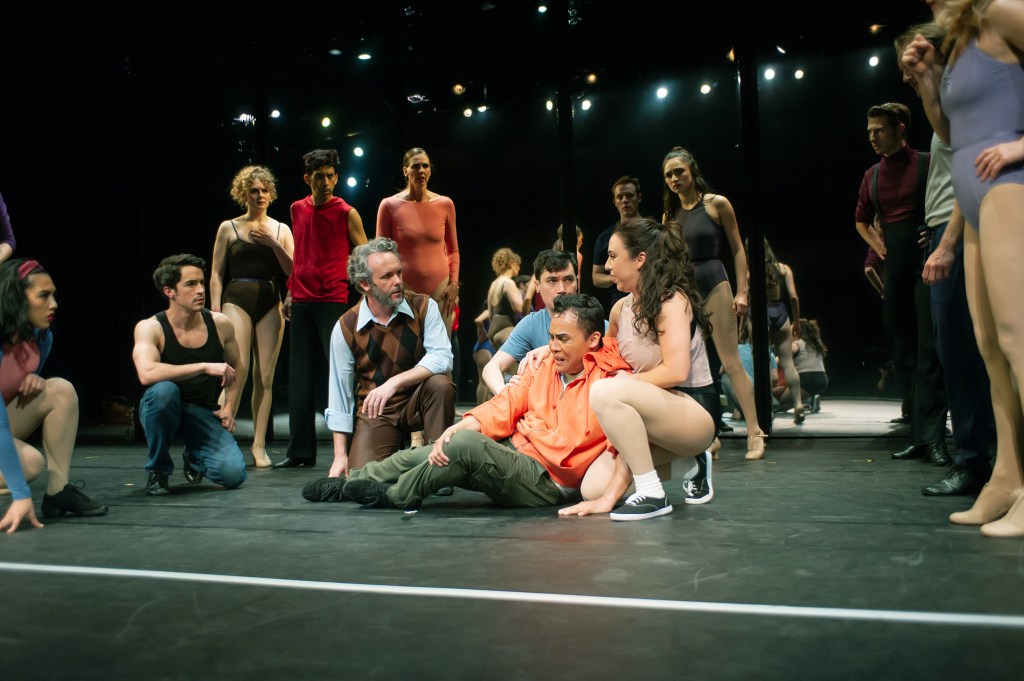
The result is one catharsis after another that engages the audience emotionally like few other dramas.  Each performer has different motivation, aspiration, and expectation.  Most have dark stories to tell – nonacceptance, loneliness, and abuse are common themes.

Humor is found in the background of many of the “gypsies.”  One character, Bobby, is modeled after Bennett, who, being from Buffalo, is no doubt responsible for Bobby’s line “committing suicide in Buffalo is redundant.”  Judy complains of being too tall, while Connie laments being too short.  Kristine is tone deaf.  Val suffered from not having noticeable tits.  And Paul, based on co-writer Nicholas Dante, had to hide from his parents the fact that he was playing stage parts in drag.  These and all the stories are told with great conviction and the appropriate emotion.

Danielle Cheiken as Maggie, Alison Ewing as Sheila, Julian A. Smith as Bebe.

The puppetmaster/inquisitor, also known as the choreographer, is Zach, deftly portrayed by Keith Pinto.  An unseen voice at the back of the audience while interviewing the dancers, he demonstrates both his dancing skills and acting chops when on stage.  Some of his big moments are his one-on-ones with Cassie, played by talented triple-threat cast alternate Adria Swan (the role is mostly played by choreographer Nicole Helfer).  Near invisible in the first act, she emerges to be the female lead.  She is a special case.  Not only has she been a featured dancer, but she has a history with Zach, and the dynamics of history will add to the friction in the narrative.

(foreground) Melissa Wolfklain as Val, Samantha Rose Cardenas as Diana, (rear) Zach Padlo as Don, Tony Conaty as Mike, Nicholas Yenson as Bobby, Alison Ewing as Sheila.

This production engages and entertains throughout.  Some artists sing better; others dance better; and all are expected to act a bit.  So a little unevenness in overall performances is understandable, but at no time does that detract from the appreciation.  Bill English’s direction is seamless, and Helfer’s choreography sparkles.  Interestingly, it is hard at times to tell whether the lack of synchronization is because the dancers aren’t up to snuff, or because Helfer has adopted Bennett’s seminal notion that the dancers shouldn’t be totally in sync because they are in auditions, not performances.  We’ll accept the latter.  Notwithstanding, the rousing, high-kick finale to the dancer’s anthem song “One” was excellent and exacting and not expected given the wild range of heights and girths of the performers.  The rising excitement from the audience through the number was palpable.

(seated center) Alex Rodriguez as Paul, (kneeling) Ann Warque as Lori, Tony Conaty as Mike, Keith Pinto as Zach, Nicholas Yenson as Bobby, Samantha Rose Cardenas as Diana, (standing) Gwen Tessman as Kristine, M. Javi Harnly as Al, Maggie Connard as Judy, Zeke Edmonds as Mark, Julian A. Smith as Bebe, Dalton Bertolone as Greg.

But if “One” provides a rousing and uplifting finish, it is the penultimate number that lingers.  The signature “What I did for love” is a hauntingly beautiful song that also encapsulates what it is to be an aspiring hoofer – drawn compulsively to the beauty of expression; knowing that the likelihood of success is low; and that even success in dance is ephemeral.  So “kiss today goodbye, and point me toward tomorrow…..the gift was ours to borrow…..won’t forget, can’t regret, what I did for love.”

“A Chorus Line,” conceived by Michael Bennett, book by James Kirkwood and Nicholas Dante, music by Marvin Hamlisch, and lyrics by Edward Kleban, is produced by San Francisco Playhouse and performed on its stage at 450 Post Street, San Francisco, CA through September 9, 2023.
The Dignity Circle

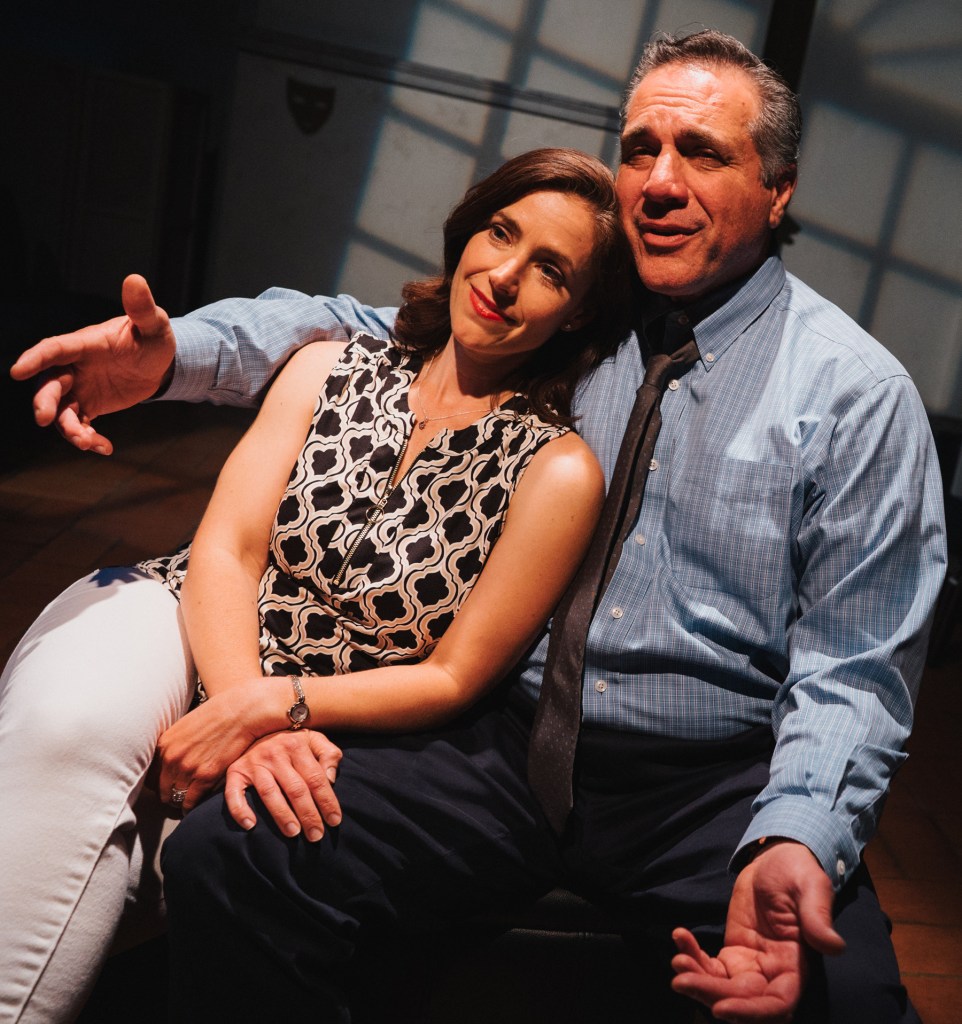
Sierra Marcks as Angela. All photos by Robbie Sweeny.

Itinerant evangelists.  Faith healers.  Rain makers.  Fortune tellers.  Ponzi promoters.  All variety of flim-flam artists convey confident conviction along with the abilities to persuade and evade as necessary.  So it is with Angela, the grand mistress of The Dignity Circle.  Opening with the alluring pitch “How would you like to receive $40,000 with no strings attached?” she lures her prey into her seductive scheme.  But one of the devices of the Circle is wearing masks, which suggests that there is indeed something hidden beneath the surface.

Lauren Smerkanich has crafted a tight drama well suited to its 90-minute length.  Especially in the wake of the “Me, Too” movement, women’s empowerment has gained momentum.  The playwright’s central character, Angela, has concocted what amounts to a women’s support group with weekly meetings that she promotes as a refuge for women which helps them reach their potential.  She argues that men have safe places women lack and that women’s successes often fail to be recognized by men.

Rebecca Pingree as Judith, Kimberly Ridgeway as Heather.

The grift is that the participants make Venmo payments from their cell phones that go into Angela’s pocket without the provision of any tangible service other than networking and pep talks.  And to encourage compliance, the payments take place at the meetings and in unison to the dinging bells of the payments being actuated.  Only if a member fulfills unlikely-to-attain recruitment quotas will some of the money devolve to that member.

Angela is performed by Sierra Marcks, who brings absolute assurance to the role with a commanding presence.  With her non-stop bravado she totally convinces the viewer that she could really be the huckster she portrays.  Marcks captivates with a strong and decisive voice, a disarming smile, and an ability to control the conversation.  Her character manufactures backstories about suppressed women, particularly about her mother, to conform to the world view that she preaches.

Heather Kellogg Baumann as Katie.

Angela’s departure point is that women fail to reach their potential because their abilities are subjugated by men who dominate them.  There is no little amount of (and often deserved) misandry in what she espouses.  It would be easy to criticize the playwright for her unflattering depictions of men, but each of the females are rendered as highly flawed as well.  We sympathize with the women’s plights yet wonder how they can be drawn in by what should appear to be a con.  That said, our country’s political stage and evangelical preaching are rife with deception that a frightening percentage of people are happy to swallow because it gives them hope for protected status or improved standing.

Somewhat ironically, Angela superficially appears to have a happy marriage.  She encourages her husband (played by Dov Hassan) to retire early from a job he dislikes, knowing the financial consequences.  But he lacks assertiveness and ambition, and the subtext is that she is a controlling individual.  She would exercise more power over him as the sole breadwinner.

Adam Roy as Scott.

Several cohorts of Circle members have previously been established and filled.  As they recruit others, members are elevated in crowning ceremonies to higher levels in the Circle’s noble hierarchy from lady-in-waiting and hopefully to queen.

At the time of forming a new group, Angela runs into an old acquaintance at the supermarket.  Unlike Angela’s typical quarry of professional women, Judith is a homemaker who happens to have an abusive husband (Adam Roy) who beats her yet tells her he loves and needs her.  Judith is also very well acted by Rebecca Pingree.  Judith will actually evolve, and Pingree effectively gradates the change.  Judith will gain confidence and become a confidant to and advocate for Angela, yet she will never have the charisma to compete with her – pretty much the perfect right-hand woman.

Rebecca Pingree as Judith.

Two other female characters appear.  Katie (Heather Kellogg Baumann) is bombastic – full of resentment and scorn.  Though a teacher, single mother Heather (Kimberly Ridgeway) suffers from the poverty of supporting a child with leukemia.  Notwithstanding the prospect of making some big bucks, she maintains cautious scepticism and is more analytical than emotional.

Five of six stage roles are one-note, but how much character development can occur in a short play anyway?  The parts are well drawn and differentiated, and despite the broad brushstrokes, they are interesting and well-performed archetypes.

Family plays a role in the narrative.  In scenes with split staging, the two married couples separately deal with their issues, which in a sense underscores Tolstoy’s dictum that all happy families are happy in the same way, but unhappy families differ in their unhappiness.

Sierra Marcks as Angela, Dov Hassan as Parker.

Other themes that are well developed concern the interrelated needs for belonging, love, and having at least one person to be able to relax with and trust.  The Circle itself is emblematic of belonging.  And despite Angela’s invincible public persona, she reveals her love needs to Judith in shared flattery and honesty.  Angela even exposes her contrary predilections for deceit and the simple need for touch, when she tells that as a child she would feign being asleep so that her mother was forced to carry her to bed.

Director Gary Graves’ guidance is sure and pace is quick.  Although the plot takes a not-altogether-unexpected turn, the intense play maintains audience interest and involvement while offering a cautionary tale of the price of gullibility.

“The Dignity Circle” is written by Lauren Smerkanich; produced in a world premiere by Central Works, and plays at Berkeley City Club, 2315 Durant Ave., Berkeley, CA through July 23, 2023.