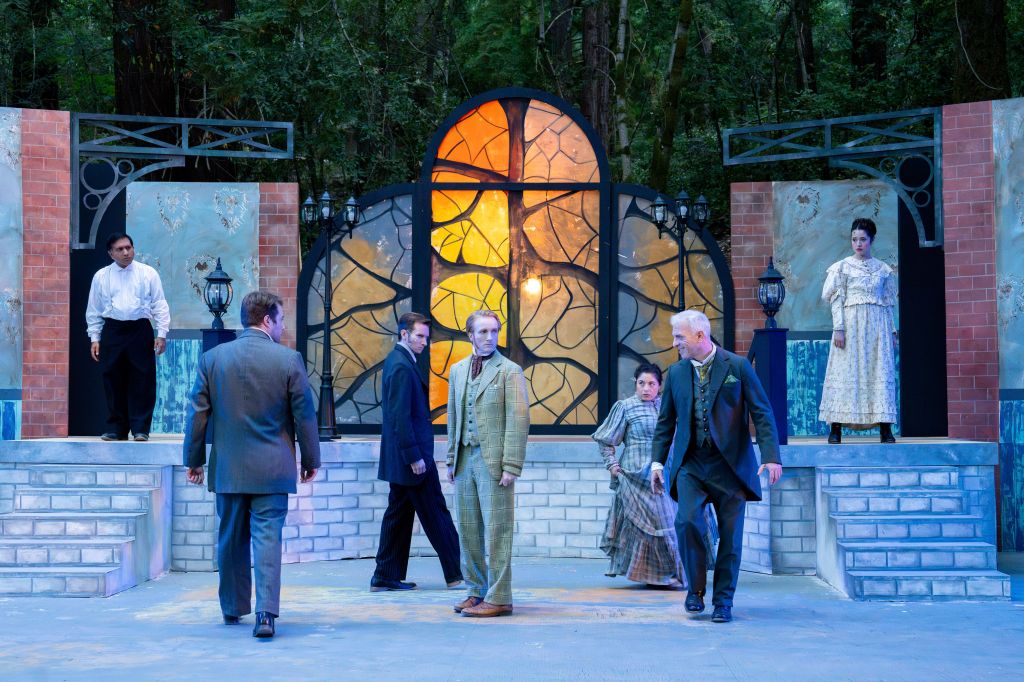
(lower level) Steve Allhoff as Hyde 3, Drew Benjamin Jones as Hyde 1, Myles Rowland as Dr. Jekyll, Valerie Valenzuela as Hyde 4, Tom Shamrell as Hyde 2. (upper level) Ronnie Misra as ensemble, Jaime Melendez as ensemble. Photos by Evelyn Huynh.
Robert Louis Stevenson’s Victorian novella “The Strange Case of Dr. Jekyll and Mr. Hyde” has proven successful grist for over 120 movie and endless stage adaptations. Its popularity owes in part to the most prevalent and popular genres it draws from – mystery, horror, and period piece. But his narrative explores greater depths – the contrary and often conflicting characteristics within each human being.
Unlike those who would see the world in black and white, Stevenson saw that each person has goodness as well as the potential for bad. But the author takes these tendencies a step further and offers an early literary example of schizophrenia, a split personality in which one identity may not know that another exists or be aware of what kind of life the other leads. In this case, Dr. Jekyll’s experiments have produced a potion and an antidote to entering the realm of an alternate persona, but with regrettable consequences.
Silicon Valley Shakespeare offers a brisk and pointed stage adaptation of the Jekyll/Hyde story by Jeffrey Hatcher which debuted in 2004. Although this drama is slow in developing and doesn’t always build momentum, it contains many moments of great tension and cascades to a powerful conclusion. The Alika Spencer directed SVS production is on-the-money for the most part, with effective acting in key roles. While the single multipurpose set occasions some clumsy movement of characters and uncertainty as to place, the thoughtful sound design embellishes the atmosphere.
“Dr. Jekyll and Mr. Hyde” is written by Jeffrey Hatcher based on a novella by Robert Louis Stevenson, is produced by Silicon Valley Shakespeare, and plays at Sanborn County Park, 16055 Sanborn Road, Saratoga, CA through August 30, 2024. Tickets and further information are available at https://www.svshakespeare.org or info@svshakespeare.org .
Myles Rowland as Dr. Jekyll, Annalisa Tkacheff as Elizabeth.
Chelsea Bearce as Katie, Lauren Dunagan as Loveday, Jan Zvaifler as Valeria. All photos by Robbie Sweeny.
Writers and producers have long valued sequels to popular works as a low-risk way to develop new product with the knowledge that its lead characters and structure have already succeeded with audiences. And nothing succeeds like success, so that a sequel that works often leads to a third in a series.
Patricia Milton serves as Resident Playwright at Central Works: The New Play Theater, and she has hit a happy trifecta with her mystery-comedy series. Beginning with “Victorian Ladies Detective Collective” in 2019, and then “Escape from the Asylum,” she now debuts “Accused!” to close out the trilogy. As suggested by the first title, the central theme concerns women who solve mysteries in London around the Naughty Nineties – the 1890s, that is.
Alan Coyne as Lord Albert.
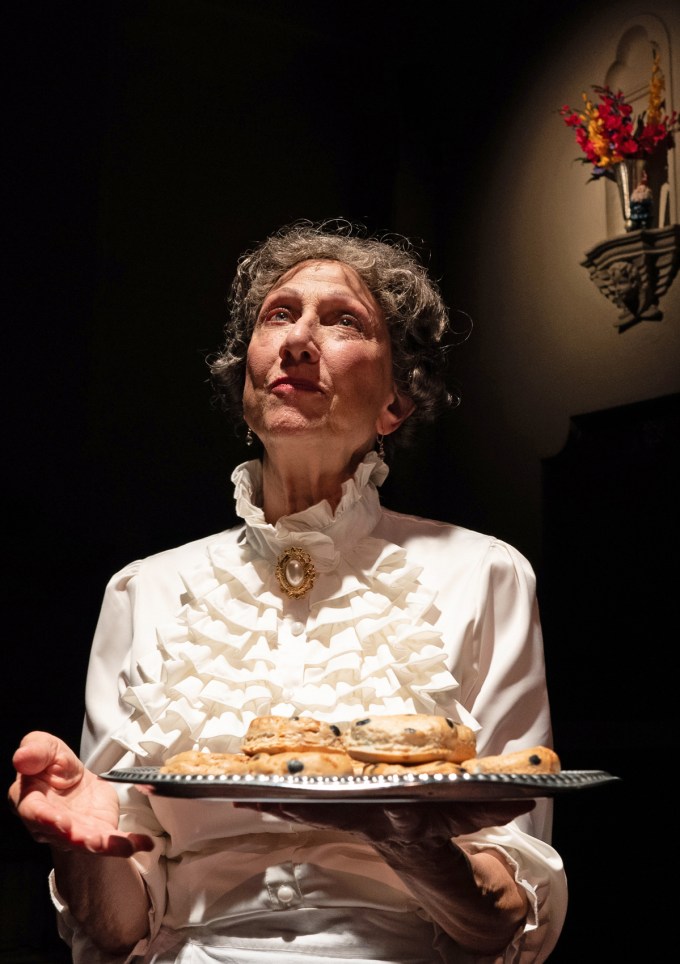
Three well-delineated detectiving ladies have been a constant in the series. Valeria (Jan Zvaifler reprising the role for a third time), a mature widow whose husband’s murder was unsolved, operates lodgings in London near the theater district, where Jack the Ripper type murders have taken place.
Valeria’s situation is complicated by the fact that Lord Albert (portrayed by another third-timer, Alan Coyne) threatens to have her husband’s murder investigation reopened and to implicate her, if she refuses to sponsor his membership into the Horticultural Society. Despite her fears of indictment, Valeria is true to her passion of gardening and refuses to give in to the inept cultivator, and Lord Albert may rue his intimidation. This situation evidences class distinctions (Lord Albert states “Impudence is my birthright”), gender disparities, and official corruption of the day in one fell swoop.
Lauren Dunagan as Loveday, Alan Coyne as Monsieur Blancmange.
Valeria’s determined and analytical unmarried sister, Loveday (Lauren Dunagan in her role debut), has returned to live with her. She leads in trying to solve the crimes in this installment, while her sister demurs, perhaps fearful of bringing public attention to herself. The final participant in sleuthing is Katie (Chelsea Bearce, a third timer), a young American who came to London as a wannabe actress, but has become a card-carrying private eye. Katie’s irreverence, cynicism, and groundedness stand against the formality of the sisters.
The storyline of “Accused!” centers on one of the socio-political movements of the day, anarchism. One of the complications is that Loveday and Katie admit to sympathizing with the anarchists’ goals of better conditions for the poor, making themselves suspects in the eyes of the law. Of course, the lady detectives are viewed as incompetent outsiders to suss out the crimes that are committed, but in a twist, the police inspector (Sindu Singh) who is involved in the case is also a woman. But unlike the sisters, she is of immigrant stock and lower class, not feeling a gender kinship with them.
Sindu Singh as Inspector Perkins.
In addition to the issues surfaced by Lord Albert’s unsavory menacing of Valeria, the playwright applies the results of her diligent research to integrate other complexities of the time period into the plot. It turns out that much of the dark side of that day applies to this day as well.
In this case, two women die violently, one being murdered and the other dying from an explosion. Both incidents are attributed to anarchists. But one of the revelations from the play is that the activities of Special Branch, comprised of government counter-terrorism agents, included perpetration of violent acts that were intended to implicate anarchists. So, along with the detectives, the audience is left guessing whether these are false flag events.
Mysteries require clues, and one of the dead women had left a box of three items with a note indicating that the clues derive from what is missing from each item in the box. The conceit is clever, but it’s unclear why the deceased would have used such a device. Audience members are unlikely to solve the puzzle unless they possess very specific knowledge.
Jan Zvaifler as Valeria.
“Accused!” is full of clever dialog, and Kimberly Ridgeway’s directing uses the stage space well and keeps up the pace. Overall, the acting is first rate. While the sisters are all well portrayed, the lesser characters who have more schtick steal the show as would be expected. In all three Victorian Ladies installments, Alan Coyne acts in wildly different multiple roles. This time he is not only the pompous and bullying Lord Albert but a laughable non-English-speaking Frenchman and a sexist lower-class fake deacon from the Church of Sacred Sinew! That’s the incomprehensible intersection of boxing and Jesus. Meanwhile, Sindu Singh plays the victim Alison Tinglepenny and effectively shifts affect and puts on a blue-collar Merseyside accent as Inspector Perkins.
While all of the individual elements impress, they don’t seem to have fully melded yet. Some tripping over lines and clumsy timing will be sorted out. The script is loaded with information and implications, but some points may need more clarity or emphasis to register properly.
Chelsea Bearce as Katie.
Nonetheless, “Accused!” is a fun romp with familiar faces. While the playwright has said that this is the end of the line for the three intrepid woman detectives, let’s hope that she returns them to the stage for more episodes of mind twisting and fun.
“Accused!” written by Patricia Milton is a world premiere produced by Central Works and plays on its stage at Berkeley City Club, 2315 Durant Ave., Berkeley, CA through August 18, 2024.
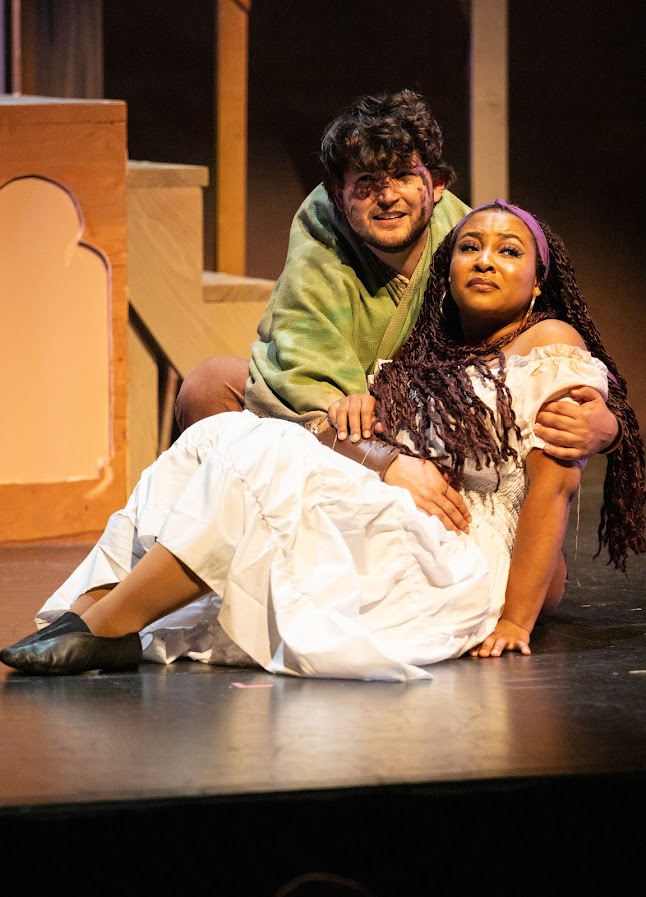
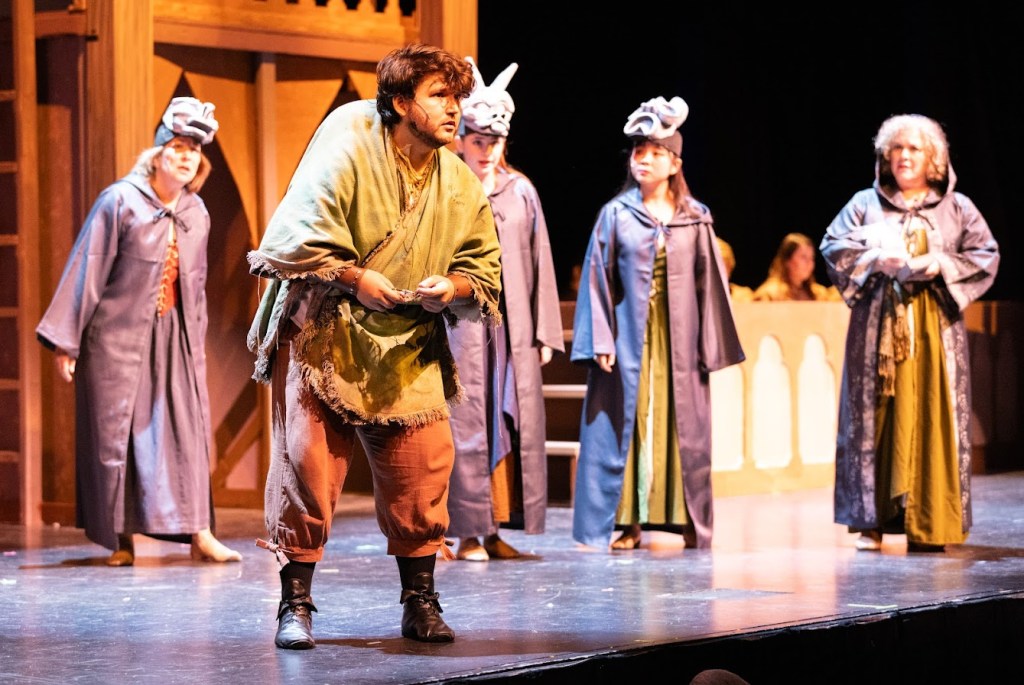
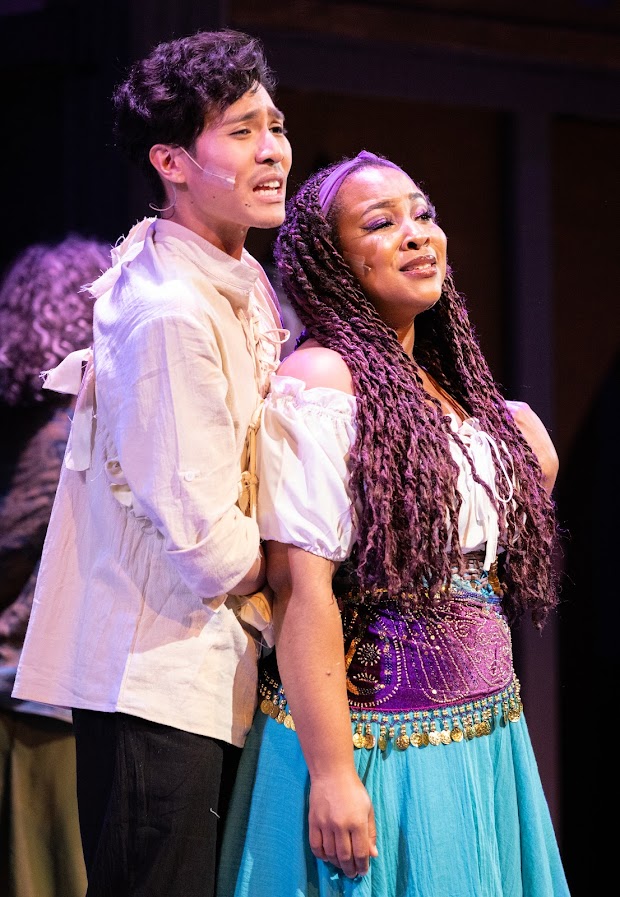
Danila Burshteyn as Quasimodo, Solona Husband as Esméralda. All photos by Darrell Lavin Photography.
Rarely has a Disney film production suffered the awkward, nay ignominious, transfer to the stage as did the musical “The Hunchback of Notre Dame.” The 1996 film captured good reviews and awards and succeeded at the box office. The transition to stage was blessed with an immaculate pedigree. The material draws from Victor Hugo’s revered novel; the music is composed by Alan Menken who won Academy Awards for two other Disney films among his many accolades; lyrics are by Stephen Swartz who lists “Wicked” and “Godspell” among his many successes; and James Lapine (“Into the Woods” and more) was brought in to write the book for the stage. Revisions and new songs were written to enhance the stage version. What could go wrong?
Retitled “Der Glöckner von Notre Dame” (note that hunchback was changed to bell ringer), one portend was that it was the first ever Disney musical to open outside the United States. Although its debut in Berlin in 1999 ran for three years, that was its only successful production, with its first American appearance not until 2013. In hopes of revitalizing the property, a new book was written by Peter Parnell, and this 2014 version has met with some success in multiple productions, though it has never played Broadway or the West End. Nonetheless, the narrative contains drama, action, pathos, and lessons about human relationships. Although none of its songs have entered the canon of the American Songbook, the music is absolutely compelling throughout.
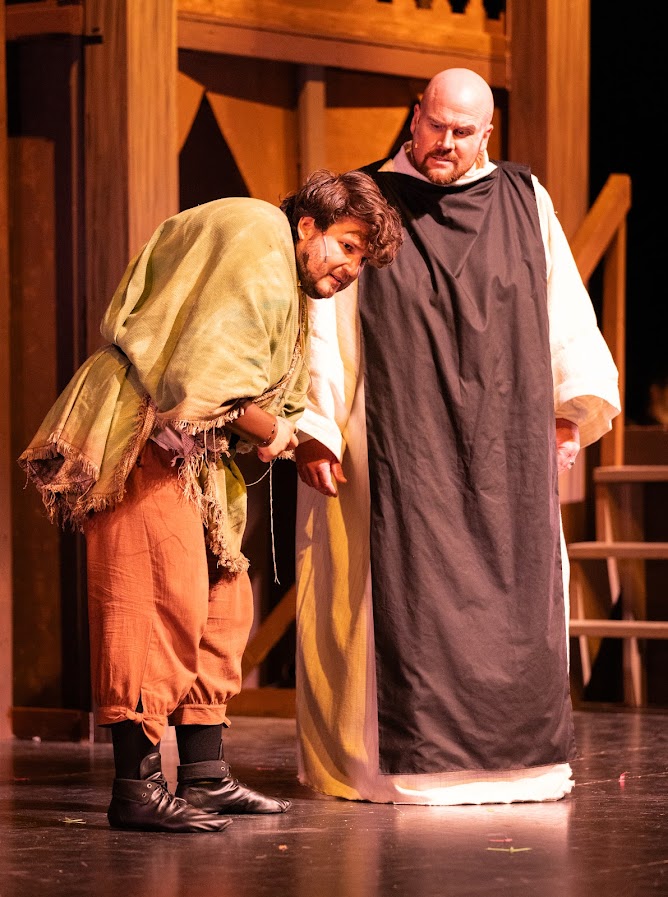
Danila Burshteyn as Quasimodo, Matthew Liebowitz as Frollo.
This daring choice by Castro Valley Arts Foundation and TMC Arts is highly worthy, and their offering has much to recommend it. Apart from the musical itself, the success of this production is driven by a highly talented trio of lead actors/singers.
Quasimodo is the ill-formed title character. He has been raised by a resentful and loathsome uncle, Claude Frollo, who is the powerful Deacon of the Cathedral. Quasimodo is confined to the bell tower, where he serves as the ringer, and his only human contact is with the cruel Frollo.
Charlotte Crespin as Clopin (front left), ensemble.
“The Feast of Fools,” the only day that gypsies are allowed to perform in Paris, provides a turning point. Quasimodo sneaks out to experience life and faces horror and scorn from all of the crowd except the Roma girl Esméralda who shows compassion for him. Enjoying only this smattering of humanity, Quasimodo understands how people can care for one another and will act accordingly. Confirming the notion of goodness, “The bells of Notre Dame” serves as both the musical and moral signature of the piece expressed in the poignant lyrics “What makes a monster and what makes a man?” Indeed, many lessons concerning character are conveyed.
Danila Burshteyn portrays Quasimodo. In addition to acting the part of the disfigured man, he has a beautiful voice and shows great range by hitting the high one in “Made of stone.” Theatrical performances always involve suspension of disbelief to greater or lesser extent. Between Burshteyn’s great voice and his pleasant and innocent appearance, despite makeup, it’s not so easy to imagine him ghoulish like Charles Laughton in the classic movie of the hunchback. But it’s hardly his fault, and it’s less of an issue because the Disney products are meant to appeal to children who probably don’t want an overly scary-looking protagonist.
Danila Burshteyn as Quasimodo, ensemble.
The antagonist is Frollo, and he is played with great skill by Matthew Liebowitz, who has specialized in odious characters. Though his vocal range is substantial, his ability to power the low end suits him to unsympathetic characterizations as does his height and beard (I’m sure however that he’s actually a very nice person). Frollo is officious, uncompromising, bigoted, and vengeful, so the invisible chains on Quasimodo and his conflict with the Roma community which he despises is inevitable, despite his carnal weakness for the desirable Esméralda.
Finally, Solona Husband plays Esméralda, and she does so with great charisma and panache. While she shares her gentle side with Quasimodo, she reveals her independence in dealing with the advances of Frollo. Her role is granted some of the most beautiful music either as solos or in ensembles, including the beautiful Gypsy prayer “God help the outcast,” “Someday,” and “Top of the world,” and she responds with beautiful tremolo in deeper vocalizations and ringing clarity in her upper range.
Ethan Le as Phoebus, Solona Husband as Esméralda.
The singing voices in the key supporting roles played by Charlotte Crespin as Clopin and Ethan Le as Phoebus are also sound. Interestingly, this is a fine work for community theater, because in addition to a number of principal roles, numerous single lines of song and dialog are delivered by individuals in the ensemble throughout. There are some good voices, but a number could use improvement. Hopefully, it’s mostly opening night jitters. Conversely, the Monk Choir, a standing group, sounded good particularly in religious music such as the opening “Olim.” The orchestra sounded a bit out of tune in Act 1, but not in Act 2. And while it was otherwise effective, it did sometimes overpower the singers.
Director Enrico Banson aptly coordinates a large number of moving pieces with an overall look that serves the time and place. One exception is that the action in the plot takes place on the ground and in the bell tower, and certain actions (not to be divulged here) seem silly when not occurring on an elevated platform (which there is in the set). Nonetheless, the musical offers considerable reward, and this realization has considerable merit, allowing that it is not an equity production.
Monk Choir.
“The Hunchback of Notre Dame” with music by Alan Menken, lyrics by Stephen Schwartz, and book by Peter Parnell is based on the novel by Victor Hugo, is produced by Castro Valley Arts Foundation and TMC Arts, and plays at Castro Valley Center for the Arts, 19501 Redwood Road, Castro Valley, CA through August 4, 2024.
Gwynnevere Cristobal as Janet, Bart Perry as Frank-N-Furter, Ethan Glasman as Brad, (rear) Alicia Adame as Columbia, Chloë Angst as Magenta. All photos by Evelyn Huynh.
In the arena of performing arts, no show exemplifies a world-wide cult classic like the uber-camp movie “The Rocky Horror Picture Show.” From audience members dressed in character to midnight showings, its unmistakable trappings set it apart. And as a fan favorite, loyalists not only sing-along, but shout out key dialog in unison throughout and engage in call-and-response.
Cast.
Many successful movie musicals are based on similarly successful stage shows, this being no exception. Now called “Richard O’Brien’s The Rocky Horror Show” (to distinguish it from all of the other “Rocky Horror Shows”!?), it reaches fewer audiences than the movie but replicates the devoted following. San Jose’s City Lights offers a revival after its well-received 2003 and 2013 productions, and the Amber Smith directed show hits all its marks with a highly entertaining and super skillful reprise.
“Richard O’Brien’s The Rocky Horror Show” with book, music, and lyrics by Richard O’Brien, is produced by City Lights Theater Company and plays on its stage at 529 S. Second St., San Jose, CA through August 25, 2024. Tickets and further information are available at Home – City Lights Theater Company (cltc.org), or 408-295-4200.
Annie Sullivan, George Elrod, Cat Savage, Max Thomas, Phylicia McLeod, Chas Lilly. Photo by Timothy M. Schmitt.
Sketch comedy’s history began in vaudeville and was later revived by early television shows like Milton Berle’s “Texaco Star Theater” and Sid Caesar’s “Show of Shows.” Today, it is most associated with the nearly 50-year history of NBC’s nationally broadcast “Saturday Night Live.”
If SNL owes a debt to a predecessor, it would be Chicago’s improvisation and sketch theater “The Second City” which not only preceded it by 16 years but has been a font for SNL players including original cast members Gilda Radner, John Belushi, and Dan Ackroyd as well as many later additions from Mike Myers to Tina Fey and Cecily Strong. Other Second City veterans include Alan Alda, Alan Arkin, Eugene Levy, Jordan Peele, Steve Carell, and Stephen Colbert.
One of the challenges and risks of live comedy that hasn’t been tested before an audience is that jokes or skits or improv fall flat. In contrast, “The Best of Second City” has the advantage of performing sketches that are among the best produced over the years, and that the tour has tested them before other audiences already. Thus, expectations are high that every piece will work. Of course, the litmus test is whether they’re funny, and happily, each one is – not roaring belly laugh funny, but each works well and promotes laughter.
At their Berkeley Rep residency, the six talented comedians under The Second City banner deliver, and all in pretty much equal measure. In addition to full sketches, which are shorter than on SNL, my only frame of reference, they provide numerous quick hitters, usually acted by twosomes on a darkened stage under spotlights. Plus, there is just enough improv to show that they are quick when put on the spot. The improv engages the audience by having attendees provide starters for the pieces. The program plays as a black box. Only several chairs adorn the stage, and the performers use extensive and effective mime to simulate props.
The sketches are so balanced and equal that it’s hard to select favorites, but one that worked especially well was the search for the missing Doritos, which is a combo sketch with improv. The piece centers on Annie Sullivan, who excels at making emcee or facilitator-type roles funny. She selects an audience participant who has unusually long involvement trying to help solve the mystery. Though the audience member on opening night was deadpan and appeared disinterested, he improvised often to keep the piece spontaneous and Sullivan on her toes.
Two of the cast seemed very much like early SNL members. Chas (pronounced Chase) Lilly is cut in the mold of Dan Ackroyd. Of his several great interpretations, perhaps the best is playing the archtypical high energy CEO making a product introduction at a Las Vegas trade show. After running the audience aisles, followed by furious fist pumping and leg kicking on stage, he repeatedly bends over on stage trying to recover from his overwrought display.
George Elrod has the look of Jay Mohr. In one skit, he plays that one guy in a backyard volleyball game who actually takes it seriously and makes it miserable for those who just want to have fun. With each point, he endures a new injury but insists on playing on as he becomes increasingly disabled. What is remarkable is Elrod’s contortion humor with his body parts. He twists his fingers into elongated gnarls and then his arms into positions that seem unreal. Gruesome, but funny.
It is interesting to note that many of the skits have pretty explicit sexual references, from simulated sexual activities to discussion of vaginal scent, so it is by no means prim and proper. Yet the language is prime time television except for one sketch without sexual innuendo in which Max Thomas plays the driving instructor from hell with two new students in his charge. During the lesson, he first drops off a bag on a drug deal and returns to the car wailing that his toes were cut off. Next stop is a convenience store which he robs and returns to the car having been shot. Meanwhile, the scared students act as his unintended “wheelmen.”
Successful sketches from the past have been updated, and a thoughtful aspect is that several have been adapted to include local references from the Castro to Berkeley culture. Phylicia McLeod, who in another sketch portrays a malaprop-spinning detective like a female Colombo, plays the “straight man” as a guide giving new students a tour of UC Berkeley with numerous references to landmarks on campus. Of course, there is always a know-it-all in the student group with a need to embellish the guide’s patter. In this case, it is Cat Savage, who often plays frenzied characters. This time, she constantly interrupts in crazed, wide-eyed fashion to welcome the others with secret horror stories about each place the guide points out.
This production marks a departure from Berkeley Rep’s traditional fare. But for those who enjoy short form comedy routines, this is an opportunity to see some of the best around from the country’s most storied improvisational comedy troupe.
“The Best of The Second City” is produced by Berkeley Repertory Company and plays on its stage at 2025 Addison Street, Berkeley, CA through July 28, 2024.
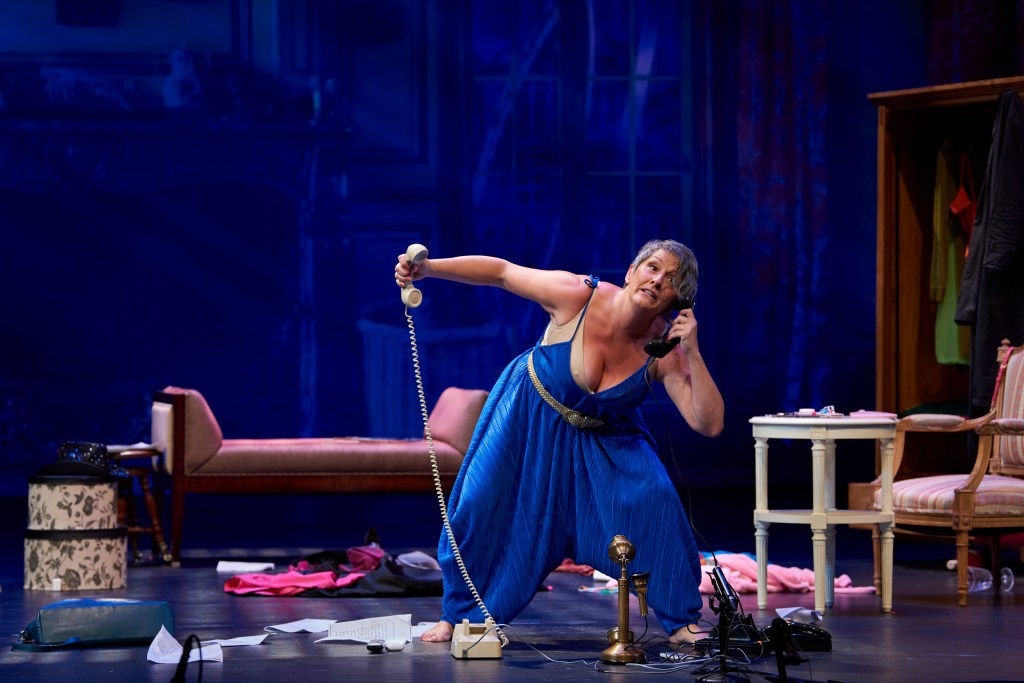
Carrie Hennessey as Elle. All photos by Stefan Cohen.
Certain themes recur in all forms of fiction, from short stories to opera, and one is the woman scorned. Separated by over a quarter of a millennium, two short operas, Henry Purcell’s “Dido and Aeneas” (1688) and Francis Poulenc’s “La Voix Humaine” (“The Human Voice,” 1958) share this subject. However, the two operas diverge structurally. “Dido and Aeneas” requires a full cast, chorus, and reduced orchestra to tell its story in three acts. “La Voix Humaine” uses a solo performer in one act. While the composer scored it for a full orchestra, Festival Opera’s piano accompaniment, which has precedent in other productions after the composer’s death, suits the intimacy of the narrative.
Both stories are female-dominant, but the characterizations differ considerably, though they both include suicide features. Dido is not simply a strong character but the Queen of Carthage, the action occurring in ancient times. Elle (she), the unnamed woman in “La Voix Humaine,” is a contemporary commoner who is flamboyant but ultimately needy (“You were the air that I breathed.”)
“La Voix Humaine,” a minor piece by a second-tier composer, opens the double bill. Few things are more satisfying than attending a performance with low expectations and having your socks blown off. The opera with a seriously limiting conceit holds the interest for its full 40 minutes. Soprano Carrie Hennessey is primarily a recital singer rather than a production artist, and the opera world is less for it. She portrays Elle in stunning bravura fashion, with exquisite singing and outstanding acting, from frivolity to despair. She absolutely sparkles for the duration without respite, and even her French diction is clear (meaning that she is probably not French!).
Carrie Hennessey as Elle.
The storyline is that Elle receives a phone call from her lover, but there are frequent interruptions and disconnects. We view and hear only Elle. Along the way, she reveals that she has lied to her lover and had tried to commit suicide the night before. She infers that he is now with another woman, and at the conclusion, puts the telephone cord around her neck to simulate self-destruction, but the ending is ambiguous.
To create a dynamic feel, Hennessey struts around flailing with her wardrobe and makeup and with cell and dial phones. Her facial expressions and gesticulations are dramatic and engaging. Most importantly, she navigates Poulenc’s vocal lines with precision. While much of the score is recitative or arioso-like with considerable acapella tracts, Hennessey makes the most of those and occasionally blasts a brief melodic line, displaying uncommon power and resonance. A performance like this makes seeing this little gem well worthwhile.
“Dido and Aeneas” was Purcell’s only true opera. Despite its brevity at a one-hour run time and that it was written for and first performed by a girl’s school (!), it is regarded as a major contribution to the baroque opera canon. Its music, albeit with considerable repetition, is a fine representation of its period. The action can be a bit stilted and static at times, but the choristers and projections create needed visual depth.
Lily Bogas as Attendant, Matthew Lovell as Aeneas, Kindra Scharich as Dido, Lila Khazoum as Belinda.
The widow Dido is Queen of Carthage and the visiting Aeneas the leader of Troy. A sorceress upends their proposed marriage by creating a ruse to divert Aeneas from Carthage, and Dido commits suicide, nullifying her previous image as a woman of strength while demonstrating the shallowness of many opera librettos. It should be noted that like virtually all operas and literature until more recent times, the story was written from the viewpoint of a man.
Kindra Scharich is a fine Dido, though she doesn’t hit her high until the ultimate, but most significant aria, the beautiful, heart-wrenching lament “When I am laid in earth.” Matthew Lovell cuts an imposing Aeneas, but his voice is a bit cloaked, robbing it of full power. The most captivating performer, both for her role depiction and her singing, is Sara Couden. The deep-voiced contralto plays the Sorceress to the hilt.
The surprise standouts in this production are the chorus and orchestra. The vocal balance, mellifluousness, and strength of the chorus is a surprise for a company of this size. It is outstanding. And Purcell gives them a lot of work throughout the piece, perhaps wanting to put a large number of the schoolgirls on the stage. Highlights include “Cupid only throws the dart,” and the conclusion, “With drooping wings.” The eight-piece orchestra conducted by General Director Zachary Gordin creates a rich and beautiful Baroque sound, aided by the use of period instruments, the harpsichord, theorbo, and Baroque guitar.
(foreground center) Reuben Zellman as Second Witch, Sara Couden as Sorceress, Courtney Miller as First Witch.
Céline Ricci stage directs both operas to fine effect. Although the costumery of “Dido and Aeneas” is updated, its Roman roots are well-suited for a bare-stage production, with backdrop projections. Movement of the ever-present chorus provides needed energy on the stage.
In addition to its dedicated projections, “La Voix Humaine” contains bedroom props that give the staging sizzle, and Hennessey’s movement and interaction with apparel and telephones create liveliness. My only objection is that the staging contains multiple dial phones as well as a cell phone, so confusion is created as to when the piece takes place. It is often unclear whether Elle is talking to her lover on the phone or to herself off of the phone as she never holds on to them except in passing.
Regrettably this well-selected twosome of operas plays for only two performances on one weekend, so reviews and word of mouth can’t contribute to enhancing audience support for this production. However, the word is out to be on the lookout for Festival Opera’s future offerings.
“La Voix Humaine” composed by Francis Poulenc with libretto by Jean Cocteau and “Dido and Aeneas” composed by Henry Purcell with libretto by Nahum Tate based on Virgil’s “Aeneid” is produced by Festival Opera and played at Lesher Center for the Arts, 1601 Civic Drive, Walnut Creek, CA through July 14, 2024.
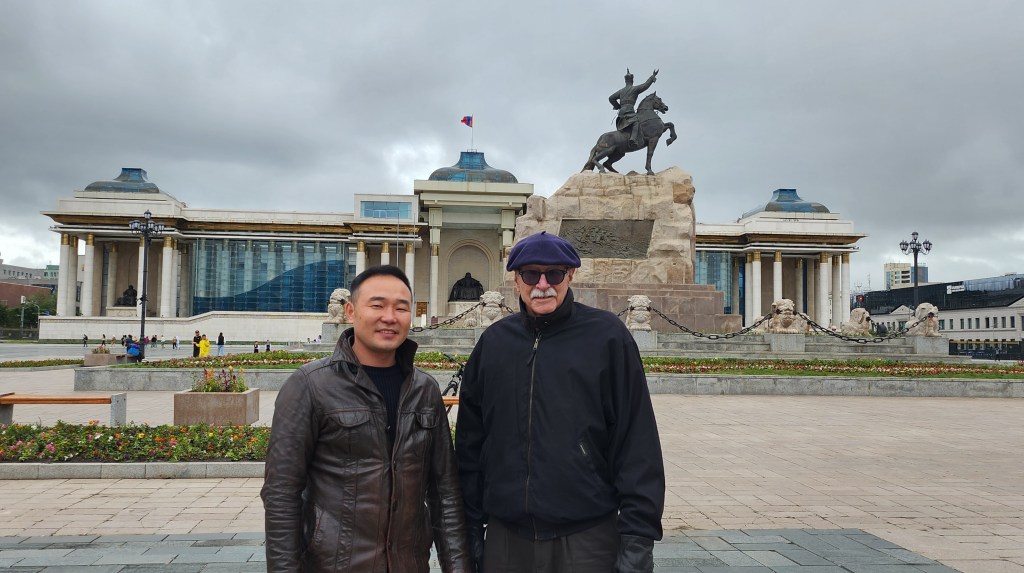
Tour guide Gulsanbat, author Victor Cordell on Sukhbaatar Square in front of Mongolian Parliament Building.
THIS TRAVELER’S NOTE IS DIVIDED INTO SECTIONS, MANY OF WHICH GIVE CONTEXT BUT MAY NOT BE OF INTEREST TO SPECIFIC READERS, SO FEEL FREE TO SELECT OR IGNORE. NOTE THAT I LACKED SPECIAL KNOWLEDGE OF MONGOLIA PRIOR TO THE TRIP, SO THIS 5,000 WORD CHRONICLE GREATLY REFLECTS LEARNING FROM NINE DAYS ON THE GROUND, ESPECIALLY FROM OUR WONDERFUL GUIDE GALSANBAT. MY WIFE, KARIN, AND I TOTALLY ENJOYED OUR TRIP AND RECOMMEND IT TO FELLOW TRAVELERS WHO SEEK A NEW AND DIFFERENT ADVENTURE.
GOING TO MONGOLIA
ARRIVAL – Summer Solstice 2024. My wife, Karin, and I departed from Seoul’s 94 degree steam bath on MIAT Mongolian Airline, with fully international service on my favorite aircraft, a Boeing 787 Dreamliner. As if boasting its position as the coldest capital in the world, arrival in Ulaanbaatar registers a bone-chilling 32 degrees and snow on June 21! Happily, the aberration was rectified by day 3, and seasonal weather, including a day of oppressive heat, carried the remaining 7 days.
WHY? – Many friends had questioned with trepidation – “Why are you going to Mongolia?” To begin with, we’re running out of new, interesting options. Importantly, it’s considered a destination for the adventurous, and that is true to an extent, but it has much to offer for its historic significance, distinctive way of life, and ecological interest. And with the right arrangements, luxury, not discomfort, awaits. Our sleepovers at the superbly-appointed Terelj Hotel and TS Khaan Resort have pocketbook-punishing rack rates if booked independently.
SEOUL MATES – Mongolia has a less developed tourism trade than many other Asian countries. The most visible tourist segment in Mongolia is young South Koreans. The countries share identity baggage. Koreans are often asked whether they speak Chinese or Japanese, although they take pride in their own distinctive written and spoken language. Mongolians are often asked if they are part of China or Russia, while they are fiercely independent. They both resent that much of their accomplishment is appropriated by their bigger neighbors. Many Mongolians have worked in Korea, with the result that the dominant restaurant cuisine in Mongolia is Korean. A final connection is that a common birthmark in the country of its name is the Mongolian blue spot, which usually disappears by age 5. Of other countries, Korea has the highest incidence of this condition.
OTHER VISITORS – In addition to Koreans, other visible intrepid travelers tend to be older ones who have a wealth of international experience, notably American and German. Tour operators like Gate 1 and Road Scholar offer group tours here with 15-20 guests.
GENERAL CHARACTERISTICS
PEOPLE COUNTS – Although Mongolia possesses a wealthy class, it is a poor country overall, though always self-sustaining. It has probably the most profound horse culture in the world. Half of its 3 million inhabitants live in the capital Ulaanbaatar. Over 60% of the rest are nomads, where the first yearning for possession is to own a horse, and there are many times more horses than people in the country. Perhaps another 3 million ethnic Mongols live in the Inner Mongolia Autonomous Region of China.
Traditional garb – Vic in Mongolian, Karin in Kazak, which are a minority in the west. Dried yoghurt and wheat “treats” on table.
LOOK – Appearances vary, with most having a characteristic Northeast Asian look with Central Asian influence – round face, high cheekbones, strong jaws, and narrow, almond-shaped eyes. Their lifestyle is hardy and athletic with interests like wrestling, archery, and horse racing. But despite their physical prowess, they are surprisingly soft spoken and polite.
Mongolian horseman in treeless central Mongolian countryside.
ACTIVITIES FOR LOCALS AND VISITORS – With such reverence for horses, it is no surprise that horse racing is a very popular pastime, and many competitions are for children. As a traditionally masculine-dominated and outdoor society, the three activities of horse racing, wrestling, and archery are celebrated in their most important festival, Naadam in July. Another festival of interest is the Eagle Festival in September, which is a tradition of the Kazak minority in western Mongolia. A unique, not to be repeated event occurred while we were in-country. The International Ultra Marathon took place in the Gobi, with over 100 contestants in a 225km race over five days. We had met participants at the airport and saw them on the course one day. What an unusual commitment they have!
COMMUNICATIONS – Internet was available at all of our stops, but in a couple of the accommodations it was only in the main lodge. Amazingly, cell phone service is ubiquitous, with drivers on the phone in the remote areas of the Gobi.
Directions for using western toilet.
DIET – Their diet draws from their nomadic roots, dominated by straight-forward preparations of red meat – beef, lamb, goat, and horse – and dumplings, with relatively little food from plants. Philosophically, they believe that it is wrong to eat young animals, so that their meat is from older, tougher specimens. Chicken, pork, and seafood are for foreigners. Ironically given the high incidence of lactose intolerance in Asia, nomads turn to dairy-heavy products in the summer following the birthing season for their herds. Some influence from cuisines of nearby countries has yielded greater balance in the diet.
Karin and Vic in a goat and sheep herd in Gobi.
RELIGION – Mongolia may be considered a godless society (yay!). About half are Buddhists in the Tibetan Vajrayana tradition. In this minor division, all documents are written in Tibetan, leading to alienation of some from the tradition due to the lack of understanding Tibetan. For those less familiar, Buddhism is a moral philosophy with Buddha being considered a teacher rather than a god, which is why it is a godless religion. Another 40% are without religion, meaning for most that they believe in some form of shamanism with local rituals and beliefs concerning the relationship of sentient beings to the spirit world.
LANGUAGE – Mongolian is unrelated to other East Asian languages, sharing its roots with but quite different from Turkish. Its written form was traditionally a Uighur based script read from top to bottom, but until the 20th century, 99% were illiterate. However, because of Russian influence, Mongolia adopted Cyrillic script in 1941 with an alphabet little different from Russia’s. Literacy has soared with education.
Vic and Karin on horseback in cattle herd in Terelj.
ANIMALS – Over 70 million domestic livestock are husbanded mostly by nomads. They live in collapsible, moveable gers (pronounced gair, also known by their Turkic name, yurt), which dot the countryside. They are herders who move up to 200 kilometers with the seasons to find nutrition for their stock. Probably 75% are sheep and goats, raised primarily for wool and cashmere respectively. The other key domestic animals are cattle (for dairy), horses (sporting and as liquid assets when short of cash!), yaks (dairy), and camels (transport and tourism). All are also used ultimately for their meat.
Northern Mongolia landscape.
LAND – This land of contrasts and contradictions is about twice the size of Texas and has three ecological zones of interest to tourists. The center is treeless with soft green hills, much like the coastal range of California, but without even the riparians that we have in the crease valleys between hills. Only 6% of the land is forested, and that is in the north. The south is the vast fearsome Gobi Desert with endless vistas of flat hardpan and sparse vegetation. Mongolia is a significant producer of coal and mines a number of metals as well.
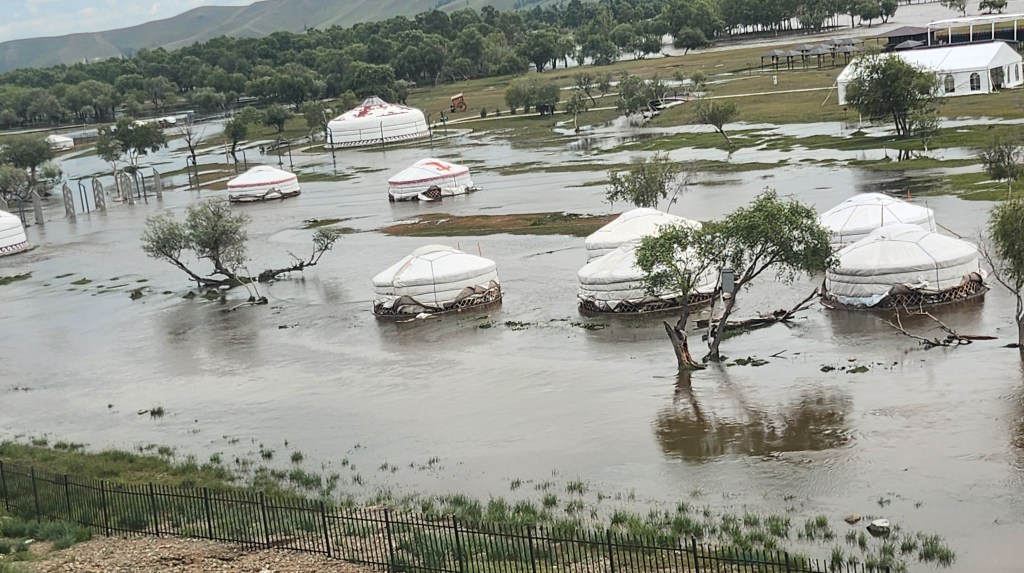
Gers flooded by heavy rains in the north. Ger entrances always face south, so you can tell that this picture was taken from the north.
LOCATION AND CLIMATE – While its latitude is similar to Vancouver or Paris and its altitude is a bit lower than Denver, the continental weather is brutal and plays a major role in life, with summer highs over 100° F and winter lows of -40° F. Herds find nutrition by moving around the area. Yet, when livestock die, it is usually from winter starvation rather than exposure. Horses are less susceptible to winter kill as they can use their hooves to dig through snow to find food, which cattle and others can’t.
POLITICAL HISTORY
GLORY YEARS – Remarkably, the Mongol Kingdom first under Genghis Khan (American spelling – local spelling will be used for sites), and later under his grandson Kublai Khan in the 13th century became the largest the world has ever known, stretching from the Pacific to the Mediterranean. It boggles the mind that they could manage such an empire, but with rapid transportation/communication and using the example of total destruction of communities that failed to kowtow, they ruled. Philosophically, Genghis felt that there was only one king under the stars, and that he was merely enforcing his divine right. Detractors felt that he was cruel and vile. Your thoughts?
LOSS OF DOMINION – The geographical growth of the United States has been monodirectional, growing from “sea to shining sea” with nary a setback or giveback. Conversely, East Asian history is exceedingly complex, with the rise and fall of Mongols, Manchus, Hans, and more. Borders of empires and countries have been fluid. Ethnicities overlapped and hegemony has occurred in various guises. Over time, Mongolia has been subjugated by China and Russia, and Inner Mongolia has been absorbed by the former, but it is still a people proud of its accomplishments and resentful when they are appropriated by their larger neighbors and others. In current culture, for instance, the Disney character Mulan is based on Mongolian history, not the derivative Chinese legend.
VASSAL STATE – The country’s modern history is a lesson in nuanced influence in international relations. Although Mongolia was never part of the USSR, the Soviet Union championed Mongolia’s becoming a UN member as an independent country in 1961. The former dictated the latter’s political policies for all but the first and last decades of the 20th century. The reason is that at great loss of life, Russia defended Mongolia from assaults by China, and it thus established dominion. Later, the imposition of communism, Stalinist purges, and the obliteration of Buddhism reflected the USSR’s determination to dictate the political life of its ally despite lacking any formal relationship. Russia can be also credited with bringing ballet, symphony, and opera to the country. With the collapse of the Soviet Union in 1989, Mongolia adopted democracy which it still retains.
A DELICATE DANCE – Present-day Mongolia is landlocked and borders only superpowers China and Russia, needing to appease both without overtipping in one direction. Mongolia relies on China for airspace and third country trade facilitation, while it relies on Russia for all of its energy needs. And with massive potential for wind and solar power, it can only dabble in those areas for fear of alienating Russia. The good news is that both superpowers want Mongolia to remain a buffer, giving it a bit of an ace up the sleeve.
IF ONLY! – Small distances have profound effect on international politics. Witness the influence on history of the 25 miles that separates Britain from the European continent, or the neck of North Korea along the Sea of Japan that keeps China from the open sea there and gives the smaller country a border with Russia as well as China. In the case of Mongolia, it is separated by a mere 15 miles from Kazakstan. Imagine the difference if the former had access to a third country.
ULAANBAATAR
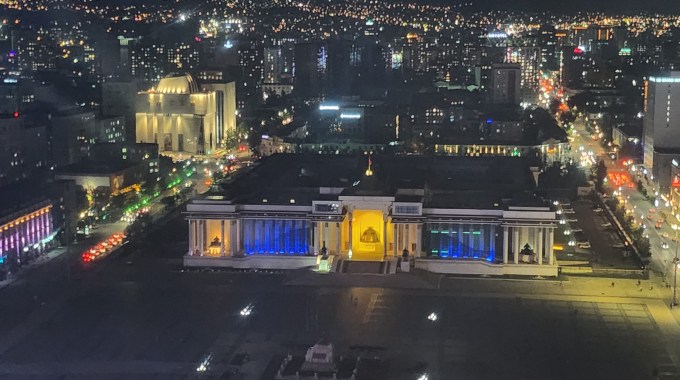
Ulanbaatar at night. Parliament center, National History Museum lower left edge, Chinggis Khaan Museum well-lit upper left.
THE CENTER – Another Russian influence is that the modern name of the capital means Red Hero, a very communist theme. Much like many large cities in middle-income countries, Ulaanbaatar has miles of non-descript mid-rise buildings. The heart of the city is Sukhbaatar Square which is surrounded by some pleasant looking classical public buildings, some in bright colors like red or blue. The only building on the square is the Parliament Building. Ingeniously, the brutalist communist era building received a glass facade and flanking columns to create a more pleasing look that the country can call its own.
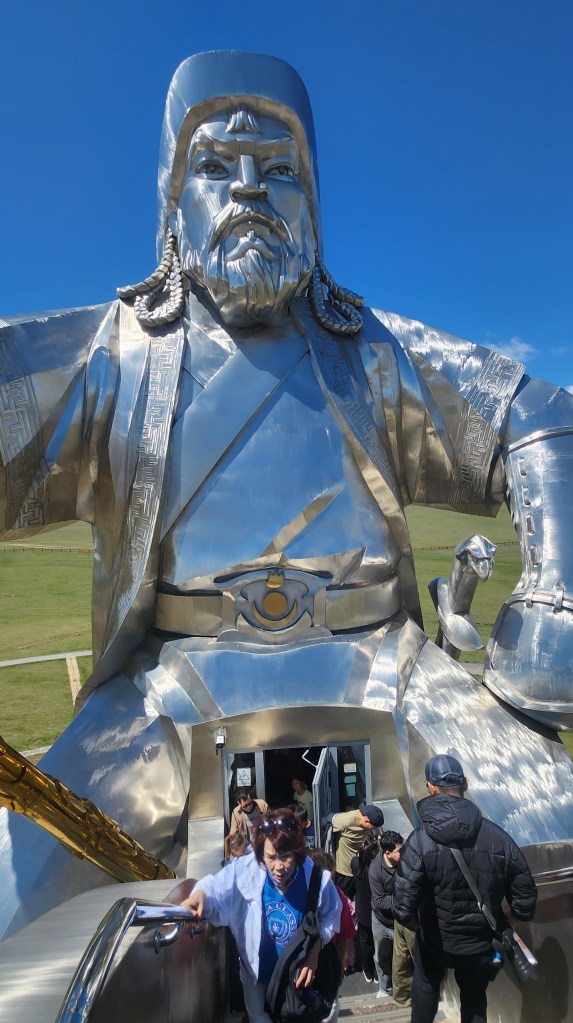
Karin and Vic at Chinggis Khaan statue. To gauge its size, you can see the top of a person above the neck of the horse.
KEY SITES – The main museums are all nearby and very walkable. The National History and Natural History museums both contain interesting and informative collections, but English language signage can be limited or missing, and the overall maintenance is not great. The Choijin Lama Temple is a cluster of pagodas that depict Buddhism’s representation in the country. A 13th century complex is an hour outside the city, but we didn’t visit it. Equidistanced from UB is the Chinggis Khaan (Mongolian spelling) statue complex, well worth the visit. The stainless steel statue is the largest equestrian statue in the world. It rises to 130 feet tall. You can stand atop the horse’s neck and view the khaan’s face up close and personal. By comparison, the presidents’ heads at Mount Rushmore are 60 feet high, and Crazy Horse’s at his memorial is 87 feet.
Chinggis Khaan statue seen from atop the neck of the horse.
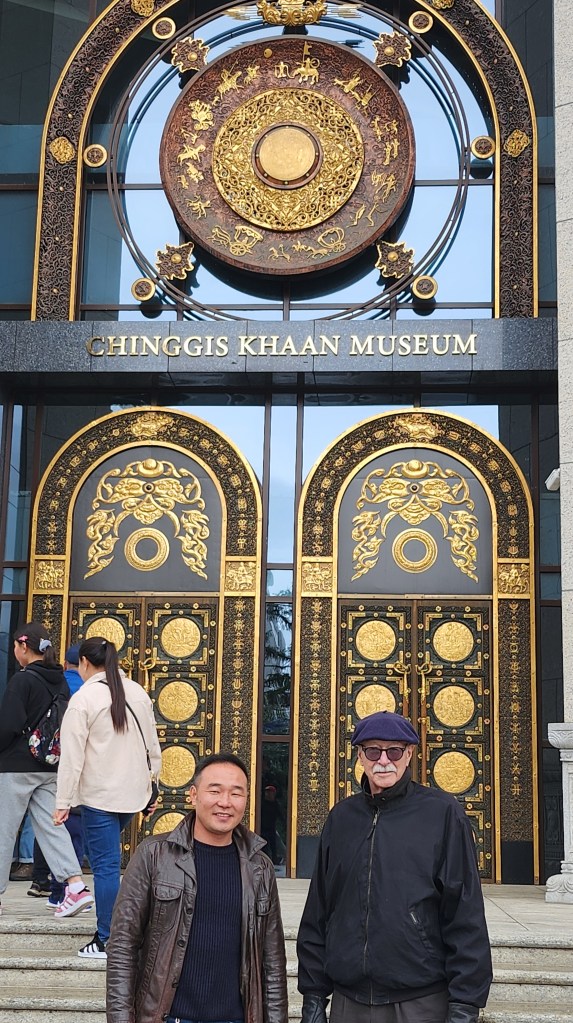
THE BEST – One museum is king, and that is the Chinggis Khaan Museum. Of course, that’s a play on words as khaan means king. Telling the story of the era surrounding his reign, this nine-story dedication to his life and times is full of attractively-presented subtly-lit collections, striking free-standing statuary, and well-designed dioramas. Perhaps we all grow up ethnocentricly, and are surprised to see some of heritage as being ersatz. I have always clung to unique notions about the American West of the Pony Express, branding irons, and chipped arrowheads. Their predecessors are on display here from six centuries earlier, with no claim that there weren’t antecedents. This museum is definitely world class.
Guide Gulsanbat, Vic in front of beautiful entrance to Chinggis Khaan Museum.
MEMORABILIA – At this point, we have to manufacture display space in our home anytime we purchase artifacts, but we’re still interested in looking and maybe buying selectively. There is a small area of antiques stores in UB, but it is much more limited than in many other destinations. And despite the low level of tourism, the prices quoted to foreigners tend to be pretty obscene. You’d have to be a serious buyer to get items that you hope are actually antiques, but older looking new artifacts are reasonable – religious items like temple hand bells and lightning bolts or horse and dress paraphernalia are good picks. Shiny new knick-knacks are available and mostly tacky.
Antique saddle.
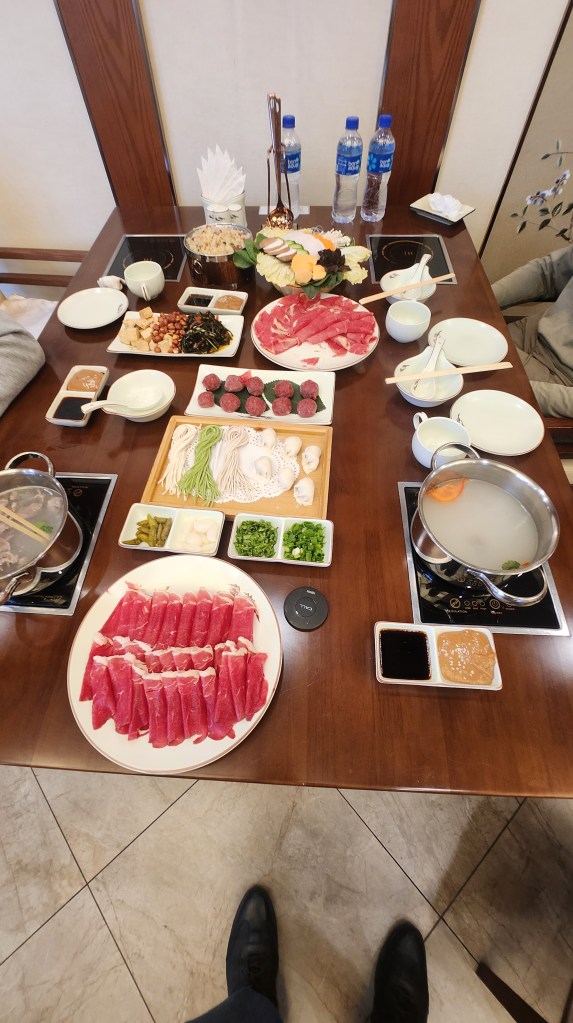
CUISINE – As noted before, the local cuisine is very limited. One specialty to enjoy however is hot pot, which uses finely sliced meat (we had beef and horse) that tames the toughness and many veggies. We went to The Bull, a distinguished eating establishment and enjoyed a top flight Mongolian hot pot. Because of the emphasis on meat, one specialty item that is widely available is bone marrow.
Mongolian Hot Pot at The Bull.
RESTAURANTS – Fortunately, restaurants are abundant and varied, but not necessarily authentic or top quality, though all of the following can be recommended within context. Near the square, Singaporean Food has decent Southeast Asian food; Hazara has better Indian food; and Silk Road is pretty good with its cosmopolitan menu. We had Korean, including table-cooked barbeque and Korean fried chicken, at a destination restaurant, Seoul Restaurant, which is well worth the trip. Our hotel, Blue Sky, has several restaurants. In a post-pandemic funk, the only ones open were the Korean, which closed early, and the 23rd Floor Lounge, which stays open until 2AM, but the food is brash and not satisfying to a persnickety foodie.
Vic at entrance to Hazara Restaurant, an antique Indian door.
FRANCHISES – Fast food and caffeine chains are pretty rare. KFC is most visible, with a little representation by its sister Pizza Hut and by Burger King. McDonalds and Starbucks are conspicuously absent, as are all others in the category
PROVISIONING – The grocery store scene is much different. We were impressed with the scope, quality, and reasonable prices of foods from many countries. Better supermarkets are associated with better department stores. They carry basic offerings like Del Monte canned fruits and select items like fine unsalted French butter. Three local food ingredients are of note – very good honeys, affordable pine nuts, and a nice fruit that is juiced – sea-buckthorn, which is like a currant but with apricotish color and taste. Because of its thorny host plant, it is harvested after freezing by shaking the bush to release the fruit. Chocolate is very popular – from locally-made to Godiva, with Russian brands being dominant. Individually wrapped bags of candy receive inordinate shelf space, suggesting a national sweet tooth.
FINEST OFFERING – The most distinguished product is fine cashmere, which is not cheap, but better priced than in the States. Designs are very attractive. Mongolia is second to China in cashmere production, but the latter has 400 times the human population. Apart from huge standalone specialty stores, what was eyepopping was to see about 20 branded cashmere boutiques on one floor in a department store.
PRIUS PARADISE – Some years back, I referred to the Bay Area as ground zero for Priuses. Boy, was I wrong. Prius probably has a 50% market share here, but with a couple of oddities. Along with other cars, almost all are purchased used from Japan as an economy saving measure. But the roads in Mongolia are laid out for left-hand drive cars, and cars in Japan are right-hand drive, so most drivers here are in the wrong position. Oddly, Prius is the car of choice for its fuel economy, yet UB seems to have a superabundance of gas stations on its outskirts. One thing that may dampen fuel economy is that the traffic is always awful except in the wee hours.
CULTURAL FOLKLORE SHOW – Having attended these in any number of Asian countries, we attended more by obligation and because it was included in our tour. Happily, it was the best I ever remember seeing. Acts were brief, brisk, and varied. Performances were great, and costumes were appealing. Many had equine themes of some sort, especially dance numbers which use much simulated horse movement and sound.
Most distinctive, however, were two forms of vocalization. First was a man throat singing, which is a unique practice in which the singer produces two-tones simultaneously. This astounding singer was able to sustain low tones while creating a melody in high tones. Another act involved two women vocalizing an eerie duet that is somewhat reminiscent of Chinese opera but very compelling.
In the final act, two young women demonstrated extreme contortionism combined with strength and athleticism. While one was contorted and balanced upside-down on the other, she used her feet to draw a bow and shoot an arrow into a target. Totally unhuman!
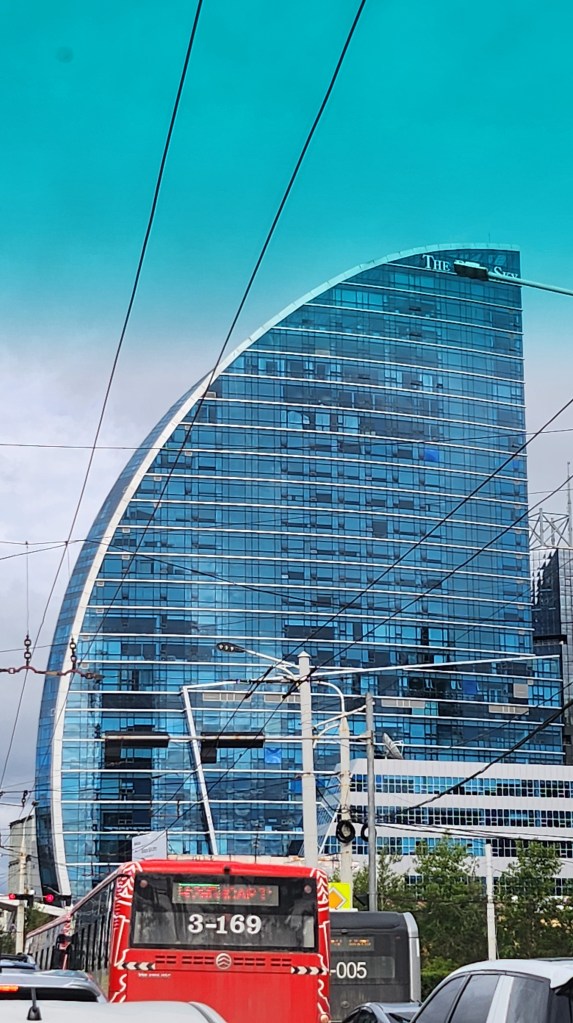
Blue Sky Hotel.
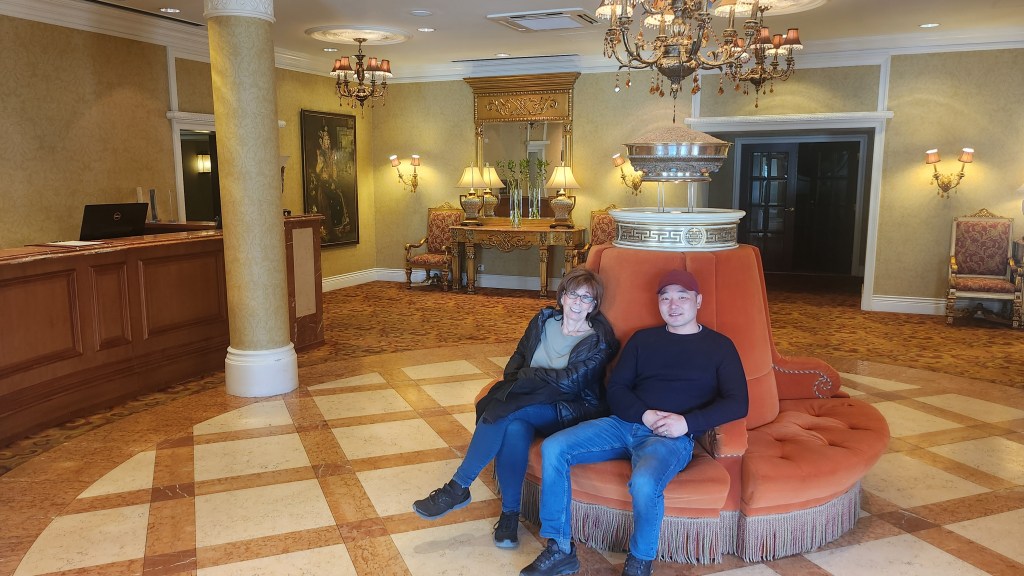
LODGING – We stayed at the Blue Sky which is noted for its cobalt blue glass skin and a shape like a sail. It postures as a 5-star hotel, but it is really a tourist level hotel with a few extras, like really nice bathrooms. But the furnishings are like in an old Soviet Intourist hotel. The breakfast buffet however is very good except for anemic coffee. Across Peace Avenue from Sukhbaatar Square, no hotel is better located for being able to walk to virtually all of the tourist attractions in the city. The sexiest lodging in town is definitely the Shangri-la at twice the price. Otherwise there are the Novotel, Kempinski, Holiday Inn, Best Western, Ramada, or a number of local hotels without international management companies.
OUR TOUR
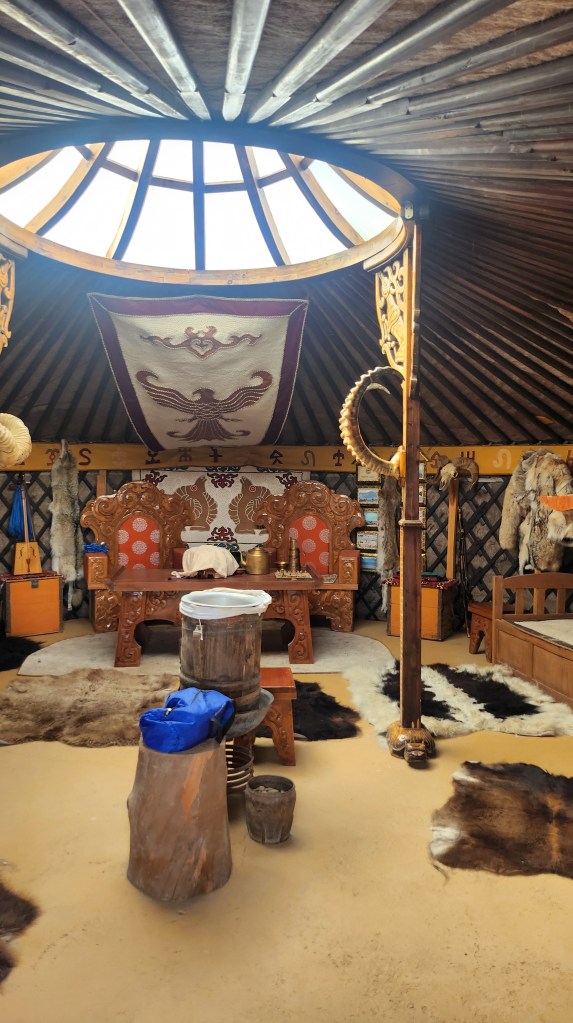
Inside a luxury ger.
We took a nine-day tour at the end of June, 2024, booking through Mongolian Luxury Tours, a local tour operator. We have heard about problems with using overseas tour agencies, but MLT seemed quite established and reputable. They lived up to every single commitment including airport transfers; an unbelievably superior guide, Galsa, who was with us the full time, including the portion we flew to; drivers for each region whose internal GPS was unerring; fees and costs for all of the entries and events bar known exceptions (animal rides and alcoholic beverages, both of which are cheap anyway); and restaurant selections in UB from among the best. My only complaint was that sometimes during the pre-trip arrangements, repeated nudging was required to get a response, but it is still highly recommended. Be aware that tours to Mongolia are not cheap, nor is the air fare, but it is a very special destination.
We were told that six clients had signed on, but the other four who had paid opted to defer until next year. There had been news in the US about with winter kill of several million livestock due to particularly severe weather, and perhaps there was fear of the consequences from that. We saw a total of two animal carcasses and a few piles of bones, but nothing that seemed out of the ordinary.
Since we were the only clients and purchased the package at an extremely attractive rate, we felt badly, as MLT must have taken a loss on us. But they still delivered the goods without complaint. At times, we felt that it might be nice to meet some new friends and share the experience, but overall, we were totally spoiled and appreciated the special service and having the guide in our vehicle full time, as a lot of time is spent on the road. We were always able to make changes to the itinerary without approval from others; go through museums at our own speed and focus on our own interests; and the attention we received from our guide was phenomenal.
Note that the standard is to tour in 4-wheel drives, and if there were six pax, we would have been with the guide 1/3 of the drive time. Outside of UB, the average drive time to sites of interest was probably 1 ½ hours each way, and for one, the Dunes, it was over 3 hours each way. Be aware that much time is spent on dirt/gravel roads, and they can be washboard or rutty. Most travelers will have no problem with this, but for those who are particularly vulnerable to motion sickness, it may not be a great choice.
VISITING A NOMADIC GER
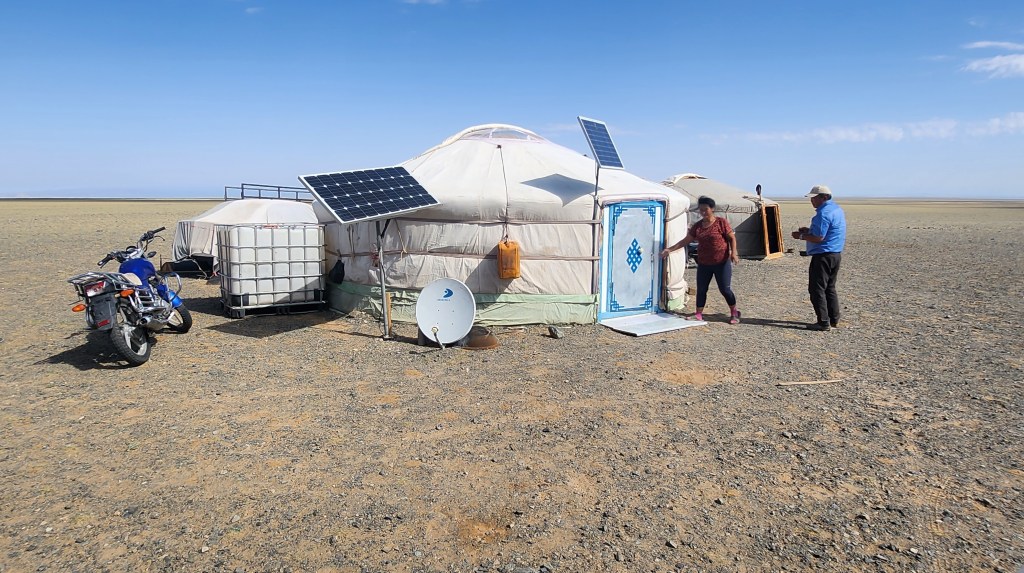
Nomad Ger in Gobi Desert. Note the solar panel, satellite dish, motorcycle, and the endless rock shard covered flatland.
Nomadic life can be severe, with temperatures in most of the country averaging 0° F high and -30° F low in January. In the Gobi, summer high temperatures are usually in the 80°s F but can exceed 100° F. Yet life goes on in circular gers of leather or cloth with felt insulation that nomads produce and a hole in the roof to vent smoke from cooking and heating from dung. Decor is limited and tatty. At the one we visited, several medals were on display, the only one that was explained was for having at least six children. Most nomads have some conveniences – a solar panel for electricity, a refrigerator, television, internet, and cell phone connection. For some, herding is not done by horse but by motorcycle.
Mistress of the ger.
Hospitality is de rigueur from the host, and acceptance is obligatory by the guest. If you can stomach the offerings with a smile, you’re a better person than I. Milk tea will always be offered, and it is uniformly insipid. Ours was from horse milk. But that was a pleasure compared to what came next – like a liquid yoghurt from camel’s milk that registered 11 on a sour scale that goes to 10. One sip and I was done. Top off the summer dairy diet with tooth-breaking dried, sweet yoghurt. The tasteless hard, wheat rolls were a welcomed relief.
Youngest daughter of the family. She loved coloring.
HUSTAI
Takhi or Przewalski Wild Horses, the only true wild horses known living, and they were rescued from extinction by being returned to Mongolia from zoos around the world.
Less than two hours from UB, this national park is noted for its resurrection of the Takhi horse (known as the Przewalski in the west), which had gone extinct in the wild, but fortunately some zoos in the West retained live specimens. They are considered the prototypical Mongolian horse and the only confirmed wild horse extant – American mustangs, for instance, are feral domesticated horses. The Takhi were resettled back to their homeland in the 1990s and have thrived in this hospitable environment.
They are best found watering and feeding around dusk, and we were fortunate to see several groups of 5 to 20 horses each. Unlike a mixed-trait herd, the Takhi are well defined. They are heavy headed, short, sturdy steeds, and their colors are constant among all specimens – graduated biscuit with burnt toast features. This being the season, there were numerous fawn-colored colts as well. In all, setting and horses were beautiful.
We also saw numerous marmots, which are a popular specialty meat, and occasional vultures. If you have time and go deeper into the park, aspen birch forests are home to many species including boars, foxes, and wolves as well as hugely varied flora with up to 30 species of mushrooms alone.
LODGING – Common to Mongolia, the primo resorts are far from the tourist destinations, but well worth it if you care to pay the freight. While you can stay right outside the park in spartan digs, we lapped up luxury 1 ¼ hours away at HS Khaan Resort. They offer Mongolian chic, with widely-spaced gers of an amazing 1,200 square feet, having picture windows overlooking a beautiful valley. Furnishings in the stepdown living area, dining, dressing room and wet bar are Mongolian modern, while the sleeping nook is traditional. Bathrooms are top flight as are toiletries. Dinner is six courses plus, and even breakfast is served in several generous tranches. The establishment’s drivers convey guests from lodging to reception and restaurant. All in all, a great experience.
TERELJ
Karin with golden eagle. Yes, it’s alive!
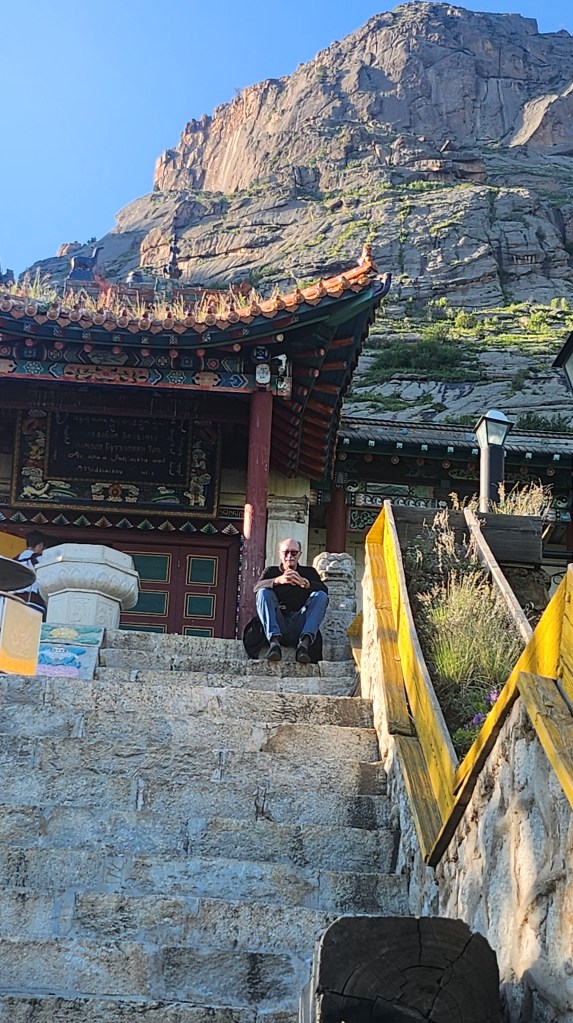
This national park lacks anything of historic significance. There is Turtle Rock, which you look at and pass on, and a Meditation Temple. It requires a bit of an uphill hike, and the voyage may be more interesting than the destination, which is a humble Buddhist temple. Wildflowers are profuse and beautiful. The park is also a place for horseback riding and holding eagles and vultures on a protected arm like a falconer. We enjoyed doing both, and despite the wealth staying at the adjacent hotel, the riding cost $6 per hour.
The author at Meditation Temple.
But Terelj is in the forest, and UB residents come here even in the dead of winter with -30 degree temperatures just to see the greenery and breathe the fresh air. Energy in UB is coal powered, and being in a valley, air pollution is trapped over the city, especially in the winter.
Karin and Gulsanbat at Terelj Hotel, surprisingly luxurious.
LODGING – We stayed at the Terelj Hotel, a recurring award winner, where the superwealthy stay. Different from any other place we stayed in Mongolia, this hotel is luxurious in the western sense. Unlike Mongolian chic, which can be very uneven in materials and design, this place is as harmonious as you would expect from a Ritz Carlton. The food is also top flight. One oddity is that, like some other places in Mongolia, the dining prices are on a much lower plane than the lodging prices.
GOBI DESERT
ECOLOGY – The most famous and unique landscape of Mongolia is the Gobi Desert, a vast semi-arid land. Though mountains and dunes exist, the overwhelmingly feature is vast miles of flat, treeless, bushless, hard-pan covered with rock shard. Herds forage for clump grass and other plants only several inches high. Occasional rain produces a carpet of greenery, and herders hope to take advantage as rain occurs. As noted elsewhere, climate can be extreme, especially the cold of winter, and appreciable winds are near constant.
DRIVING THE GOBI – With a network of miles of unpaved, unmarked driving trails, it is truly a miracle that drivers can find their way. The often washboard dirt tracks intersect, run parallel, and veer from one another. They can typically be driven at an average of 50 mph, with occasional slow-downs, but only a professional is capable of finding the way around.
Flaming Cliffs in the Gobi, an important dig site where dinosaurs were first found to lay eggs.
BAYAN ZAG (FLAMING CLIFFS) – Because of overcast, we couldn’t enjoy the redness of the rock at its most brilliant, but we did appreciate the area for its beauty and significance. For a decade starting 1922 American paleontologist Roy Chapman Andrews led digs in the area that found for the first time anywhere that dinosaurs lay eggs. They also identified several new species of dinosaurs; catalogued thousands of animals and plants; and mapped areas previously dark spots to cartographers. A terrific film from the expeditions testifies to many of their accomplishments.
YOL (VULTURE) VALLEY – This area is full of rugged, jagged mountains. We rode horses into the gorge, seeing gerbils, ground squirrels, and a single ibex high on a ridge. We rode beside glaciers that have the compressed blue ice, but it looks probable that the permanent ice will melt this year given climate change. A small but informative natural history museum has stuffed animals from the region.
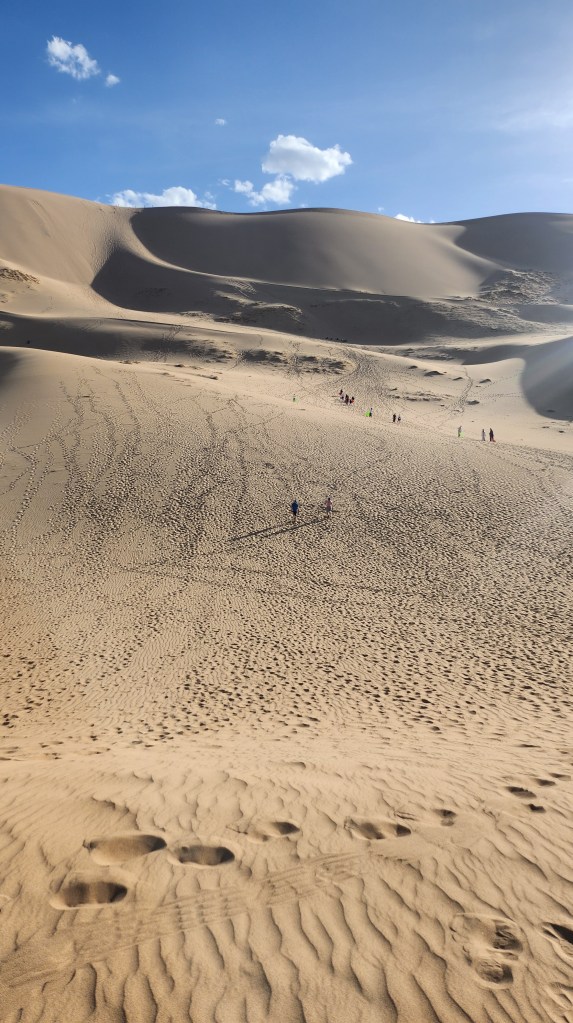
Sand Dunes. See size of people for perspective.
KHONGORYN ELS (KHONGOR SAND DUNES) – These golden dunes run 70 kilometers long but only hundreds of meters wide along the Altai Mountains, so they are significant examples of their kind with huge peaks and ridges. The shifting of the sand from the winds create the sound of “Singing Sands.” At our point of contact we rode camels to arrive at the dunes, but as we were led along by a guide rather than riding freely (which we have done on camels before), it didn’t offer much stimulation. At the dunes, sliding on plastic disks is popular, but most people go about half way up the dunes where the slope is not steep enough to allow sliding. For those who take the more arduous climb to the top, the reward is a steeper decline which does allow sliding higher on the dunes.
Camel ride at dunes.
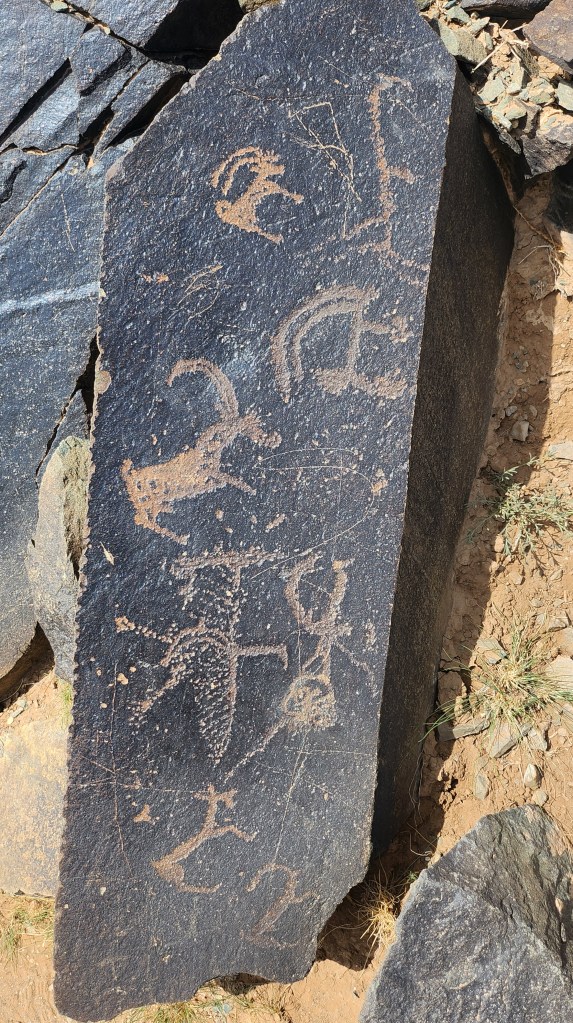
KHAVTSGAIT PETROGLYPHS – These rocks have an abundance of visual representations from the Bronze Age (4000 to 3000 BC) on the steep, slippery escarpments of a sacred mountain. Carved and painted motifs consist of scenes and effects from everyday life of a time long ago, with pictures of people, animals, implements, and more.
5,000 year old rock art.
LODGING – GOBI NOMAD LODGE – This is the primo lodging in the Gobi, and we were there for two nights. You stay in a luxury, climate-controlled ger with an ensuite safari-posh bathroom in flagstone and marble with Occitane toiletries. The food is good but not exceptional, but the overall experience is very nice.
LODGING – GOBI ERDENE LODGE – This was the only disappointment of the trip. Digs are spartan log cabins with minimally functional bathrooms. There is neither fan nor air conditioning, and we had 95 degree heat. The locations of the tiny windows made it difficult to get ventilation, and the one night there was pretty miserable. This was the lodge for the Dunes. My suggestion is that if it is hot and you have the option to gird your loins and drive 3 hours each way to the Dunes on the same day or to skip them altogether, consider it.
MISSED OPPORTUNITY – The Gobi was the only area that we needed a domestic flight to access. Some tours include Khuvskul Lake, which is also a flight away in the northwest corner of the country. It is supposed to be one of the deepest and five cleanest lakes in the world (sound familiar to what is said about Tahoe?).
CONCLUSION
Mongolia is a distant and exotic land that stimulates and excites. We’re very happy to have experienced it. While it can be expensive, opting for a small touring group is worth the money. It is possible to make arrangements on the fly once there, but it would be very complicated.
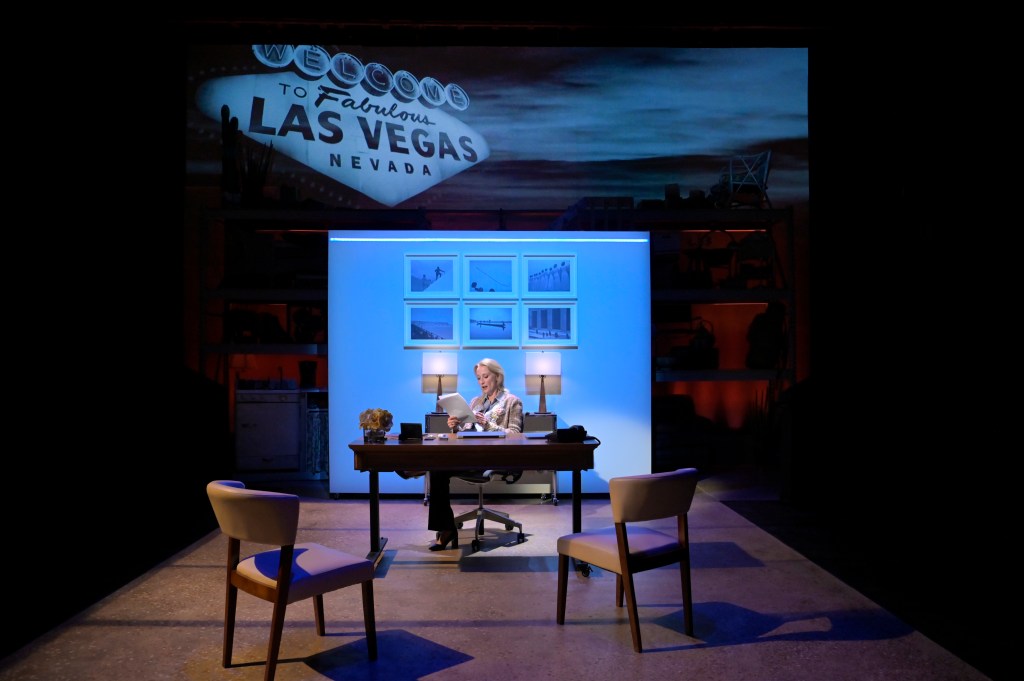
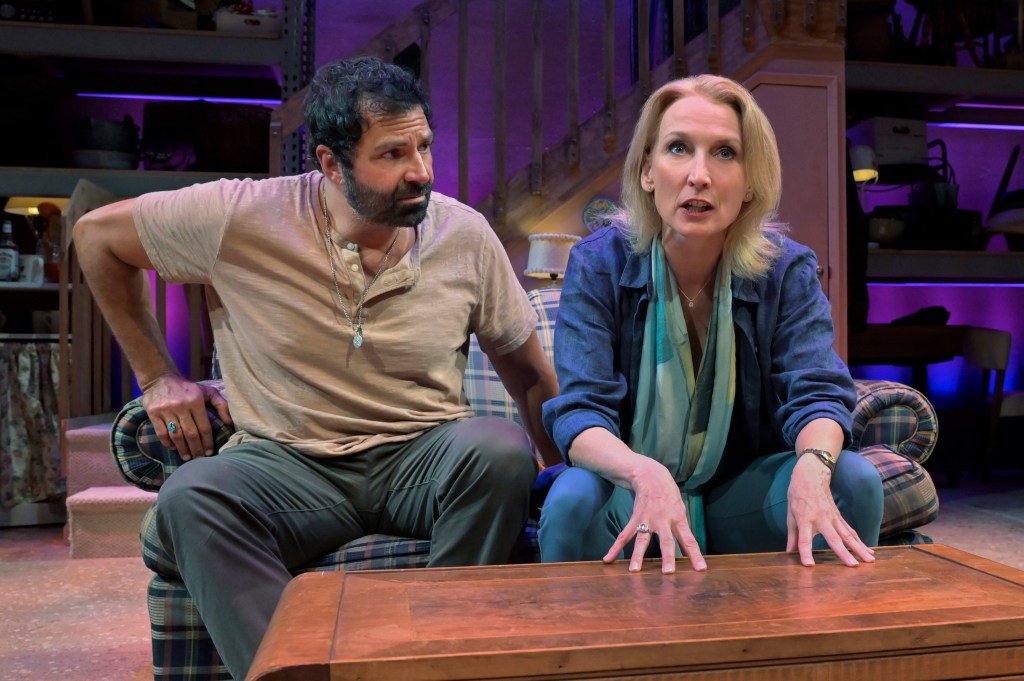
Carrie Paff as Emily, Elijah Alexander as John (above), Hernán Angulo as Jim. All photos by Kevin Berne.
It seems to me that when we were kids, our simple world of morality was comprised of truth and lies, with the special category of white lies. Especially in our current political environment, there seems to be an unlimited menu of colorations and characterizations, from truthiness to alternate reality, with an increasing hesitancy to call even the most egregious untruth a lie.
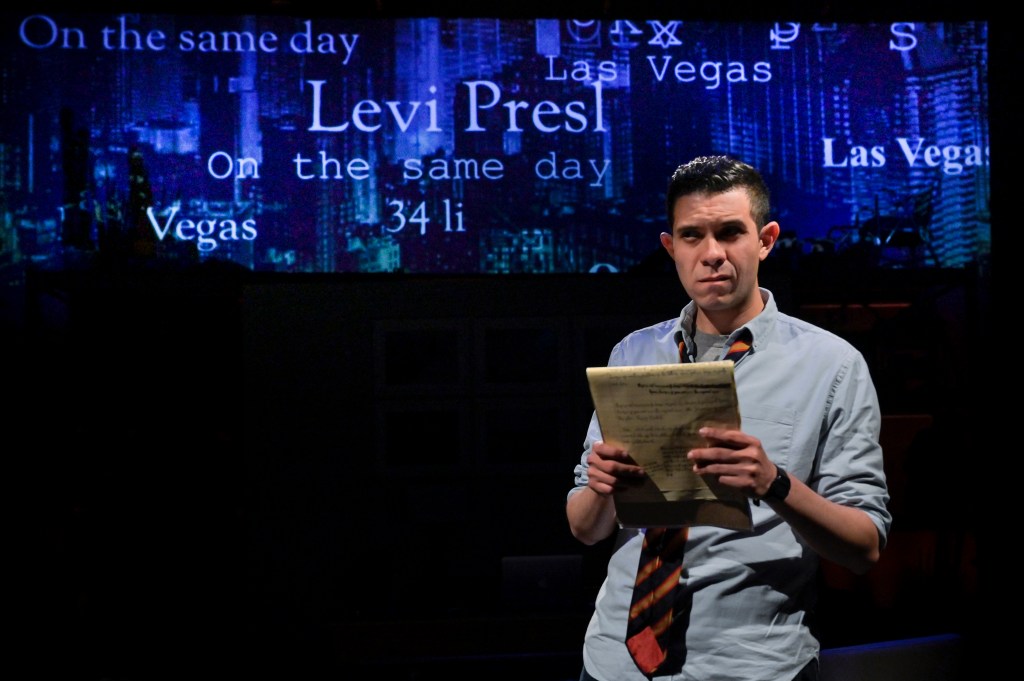
Into the real-world cauldron of etymology and principles comes John D’Agata, an essayist who writes a piece on the suicide of Levi Presley, a 16-year-old boy who leapt to his death with a 1,149 foot fall from the observation platform of the Stratosphere Hotel in Las Vegas in 2002. When the author took his manuscript “What Happens There” to The Believer, a distinguished journal of essays, reviews, and interviews, an intern fact checker, Jim Fingal, was assigned to the project.
Carrie Paff as Emily.
A seven-year tooth-and-nail battle over facts ensued between the two men before the essay was finally published. They documented their saga in the book “The Lifespan of a Fact” (itself a curious title), which is fact-check annotated. This was adapted into a play of the same name, but with generous doses of literary license (untruths), most importantly, compressing the timeline into several days. The result is a provocative discourse on the slipperiness of facts. Aurora Theatre’s taut and riveting production will provoke endless thought and discussion.
Carrie Paff as Emily, Hernán Angulo as Jim.
In this three-character production, stalwart Carrie Paff is Emily, the magazine editor who has sacrificed family to pursue career. Paff convinces as a professional whose goals are to produce quality articles of interest; to meet deadline; and to ensure that editorial procedures protect the magazine from being sued. Hernán Angulo is Jim, an overwrought intern in his first fact-checking assignment, who wants to prove that he can be accurate and thorough. But among the first overriding questions in the narrative is how he interprets his charge. What is he actually meant to do? Finally, Robert Parsons is John, condescending, self-serving, and sarcastic. Parsons is the understudy in this role, but he is a first-class actor with a significant resume of leading roles, and he fits the part exquisitely, extracting laughs from every acerbic comment.
Clearly, different grades of mendacity exist. We live in a world in which some amoral politicians no longer bend facts but break them to their advantage and to break their opposition, often through contrived falsehoods. And supporters totally suspend their moral convictions in cultish awe of their leader.
Hernán Angulo as Jim.
John is merely an embellisher. He knowingly distorts information but does so in what he considers the service of the greater good, to make a story more interesting and to promote its underlying value. If the rhythm of the number four satisfies more than the number one, he will replace the latter. If a numerical countdown of relevant incidents provides more drama, he will manipulate the facts to fit the device, but with no harm intended. As he duly notes, a well-crafted story told at the right time can change lives. He will even justify making up a scenario to support his “truth.” But though Emily can give innocuous fact-shifting a pass, she draws the line when she sees possible liability for the magazine. For Jim, a fact is a fact, and he will confront even the least consequential manipulation.
The narrative triggers thoughts about facts and truth. The viewer is confronted with a host of issues. What constitutes a fact? John gives the example of the coastline of Britain. The length depends on how it is measured, how deeply the measurement goes into estuaries. Do facts get in the way of truth? And what is close enough? If John writes that Levi fell to his death for nine seconds, but it was closer to eight, is his statement unfactual?
Hernán Angulo as Jim, Elijah Alexander as John.
Perhaps the most unsettling concern in today’s world is the permissibility of attribution to justify a statement. For instance, John’s source for a provably inaccurate but unimportant scenario in his manuscript was a homeless person. With the ubiquitous sweep of social media, it is now possible to find every opinion imaginable on the Internet, and the cynic may forward or paraphrase what they absolutely know is a lie. If confronted about the veracity, they defend themselves by saying that they saw online. This moral mudslide leads to the worst manner of misinformation and conspiracy theory.
The first 30 minutes of this 90-minute production are a bit uninvolving. Director Jessica Holt has Angulo playing Jim over-the-top, presumably to give energy to the early going. But as a bottom-of-the-totem-pole intern, his sass and disrespect for the editor simply doesn’t ring true in the real world. Happily, the remaining hour, which corresponds with the first appearance of John, is fully engaging. The acting is powerful; the pace is invigorating; and the issues are absorbing, so that many a discussion will be had by theatergoers on the way home from the performance.
Elijah Alexander as John, Carrie Paff as Emily.
“Lifespan of a Fact,” written by Jeremy Kareken & David Murrell and Gordon Farrell is based on the book by John D’Agata and Jim Fingal, produced by Aurora Theatre, and plays on its stage at 2081 Addison Street, Berkeley, CA through July 21, 2024.
Sophia Alawi as Eva Peron. All photos by Jessica Palopoli.
Despite human evolution and the requirement of a certain level of education, many people have shown themselves to lack the ability to exercise thoughtful judgment. Such is the playground of charismatics who manipulate their subjects into thoughtless minions. Eva Peron was such a personality, one whose devoted followers were captivated by her image.
Some revisionism influences the fine Bill English-directed San Francisco Playhouse production of “Evita” casting her in a more balanced light. Yet, the economic disaster of the Peron presidency; Eva’s complicity in the policies of the administration; and the long-range effects on the poor people of Argentina; and the country’s secular decline are a matter of record. On the other hand, so was her role in the passage of women’s suffrage and her diverting government funds to social programs of her liking.
Sophia Alawi as Eva.
Although the development of “Evita” had an odd history, the outcome was the first ever British-written musical to win the Tony Award for Best Musical, along with countless other honors and long runs in many venues. This is a quality musical with interesting characters, energy, emotion, and fine composition. In virtually all works for the stage involving music and lyrics, the composer of the music receives the lion’s share of the credit. In this case, that would be Andrew Lloyd Weber who initially rejected the project in order to work with playwright/lyricist Alan Ayckbourn on what would be the colossal failure “Jeeves.”
Lyricist Tim Rice was the driver of “Evita.” Curiously, he named his daughter Eva but he doesn’t appear to have liked the title character, a strange condition when one wants the audience to feel an emotional attachment to the material of the work. But whether by design or by happenstance, the audience does feel some sympathy for Eva Peron in the musical, if only because she overcame poverty; had the conviction to assert herself to become an indominable force in Argentina politics and social life; and died from cancer, no doubt with considerable pain, at the age of 33.
Alex Rodriguez as Che; Jurä Davis as Magaldi, Sophia Alawi as Eva.
Sophia Alawi evinces emotion as Eva with a convincing, smiling charisma and some finely nuanced moments. At one point she descends a flight of stairs conveying both the satisfaction from the crowd’s adulation, yet telegraphing pain that foretells her diagnosis of cancer. Her internal conflict and transformation are also evident in the play’s powerful signature song “Don’t Cry For Me Argentina.”
Although an accomplished singer whose voice mellows in ballades and in lower range, some commenters note that Alawi’s voice seems strained or insufficiently melodious in the upper reaches. This should be considered in context. Eva’s life was riddled with stress and urgency, and her singing part was written accordingly. It is an exceedingly demanding role that hopefully Alawi will be able to perform several times a week. The great Patti LuPone originated Evita on Broadway, and she noted that the score must have been written by a man who hates women, as she is screaming throughout the performance.
Alex Rodriguez as Che, Peter Gregus as Juan Peron.
That said, the score is full of melodic and memorable music. It mixes Latin dance music, rock, and pop to great effect.
The storyline is simple. Eva is depicted as an attractive, ambitious woman who sold her body, betrayed her first sponsor, and convinced the future president, Juan Peron, that “I’d Be Surprisingly Good For You.” There are jumps and gaps in the book, such as no indication that Eva and Juan actually got married.
But while Eva presents herself to the audience, a special conceit tells the other side of the story. A narrator and political activist, Che, stalks the scene throughout. The cynical Che argues the alternate reality that Eva represents only her own interest and that leadership is more than entertaining the peasants. He mocks her followers in the blistering “Oh, What A Circus,” a contrafactum of “Don’t Cry For Me Argentina” as they mourn her death in the opening scene.
Cast.
The multitalented Alex Rodriquez lurks in the shadows and displays fine vocal skills as Che, also with critical, yet beautiful songs like “High Flying Adored.” This characterization is modelled on Che Guevara, who, though Argentinian, would have been too young during the time of the action.
Broadway veteran Peter Gregus effectively portrays a rather stoic Juan Peron overshadowed by his dynamic wife. The role is definitely third fiddle and limited in scope, but Gregus provides desired gravitas.
The production itself is quite striking. Set in a spare black box style with Heather Kenyon’s limited staging, low but active lighting by Michael Oesch plays a key role, and Abra Berman’s costumery offers visual impact and diversity. On the music side, Dave Dobrusky’s orchestra provides fine support for the singers from the dissonant opening “Requiem” by the chorus to the touching “Lament” by Eva at the end. Fine choreography by Nicole Helfer includes several sharply drawn tango pieces that are representative of Argentina.
Peter Gregus as Juan Peron, Sophia Alawi as Eva Peron, Alex Rodriguez as Che.
“Evita” is a fine, crowd-pleasing choice for San Francisco Playhouse’s summer season. It should fare quite well.
“Evita” composed by Andrew Lloyd Weber, with book and lyrics by Tim Rice, is produced by San Francisco Playhouse and plays on its stage at 450 Post Street, San Francisco, CA through September 7, 2024.




























 cordellreportsdotcom