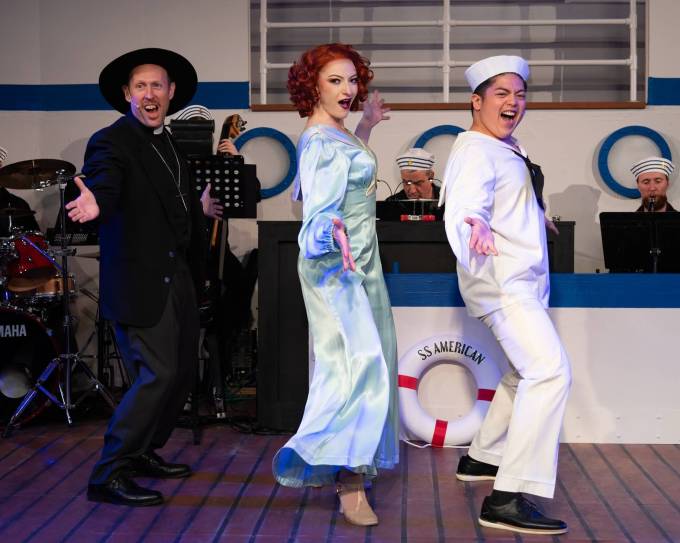
Dan Kolodny as Moonface Martin, Seana Nicol as Reno Sweeney, Nico Jaochico as Billy Crocker. All photos by Grizzly De Haro.
The Great American Musical has evolved through the years. In the early days, musicals were little more than a compilation of unrelated pop songs interspersed into a paper-thin story. Nowadays, they integrate thematic and often sophisticated songs into the plot; they may be sung-through like an opera; and un-frothy genres range from political to horror. But “back in the day” and particularly in 1934 in the midst of the Great Depression’s woes, audiences wanted fun-filled escapism and glamor. Into that breach came Cole Porter’s Anything Goes.
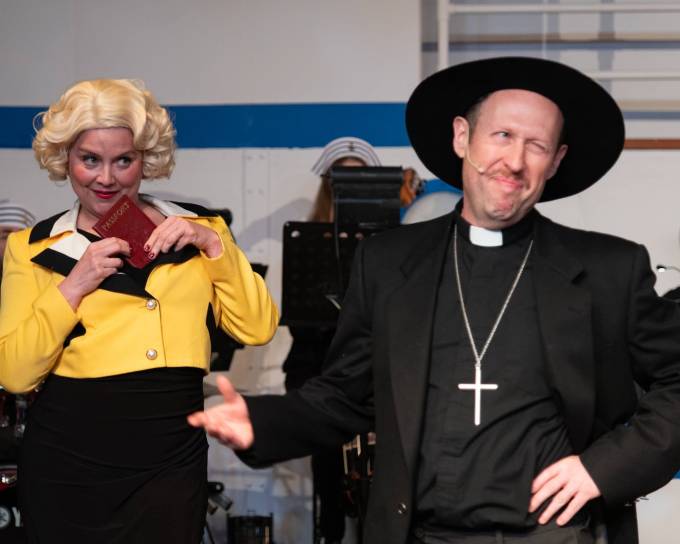
Erica Hartono as Bonnie, Dan Kolodny as Moonface.
Set in the luxury of an ocean liner crossing the Atlantic to London, its passenger list is replete with the wealthy, the nobility, and importantly to other passengers, the famous. But in this case, the famous are on the FBI’s Most Wanted List. And for all of its superficial frivolity, the book and lyrics do contain some broadsides concerning the erosion of American morality and respect for the law that occurred as a result of the just repealed Prohibition. Even the original lyrics of the title song are racy and full of sneaky social commentary.
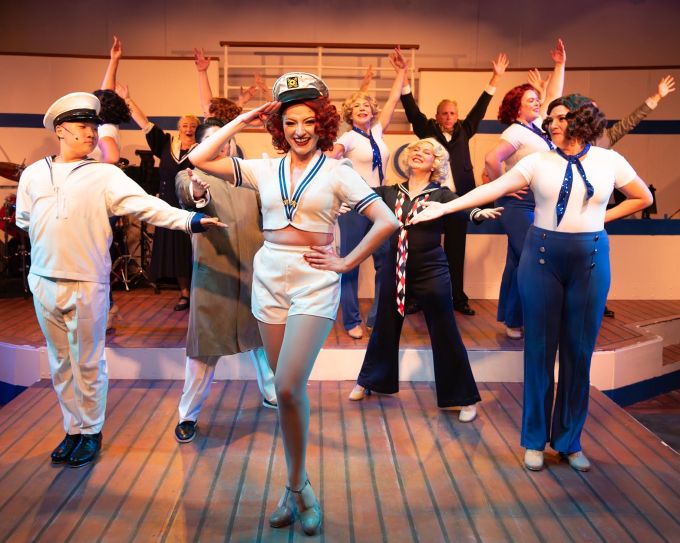
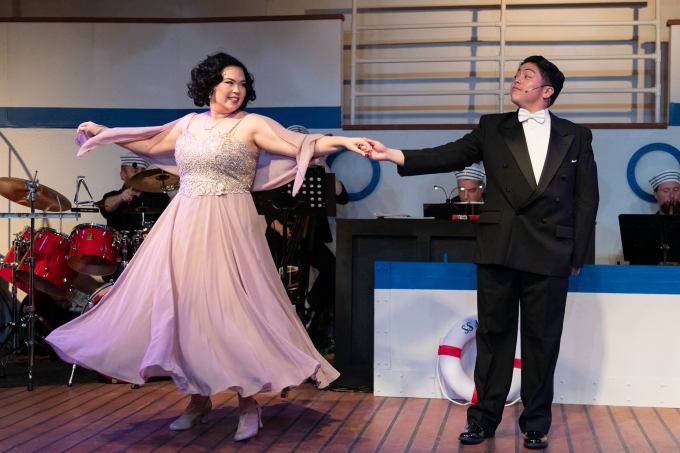
Thanks in part to revisions over the years which have tightened the storyline and borrowed several key songs from other Porter musicals, Anything Goes is often revived. Because of the large cast and frequent and diverse dancing, it is particularly popular with performing arts programs in schools. Altarena Playhouse has produced an appealing version that provides the kind of high-level entertainment that better community theaters are capable of.
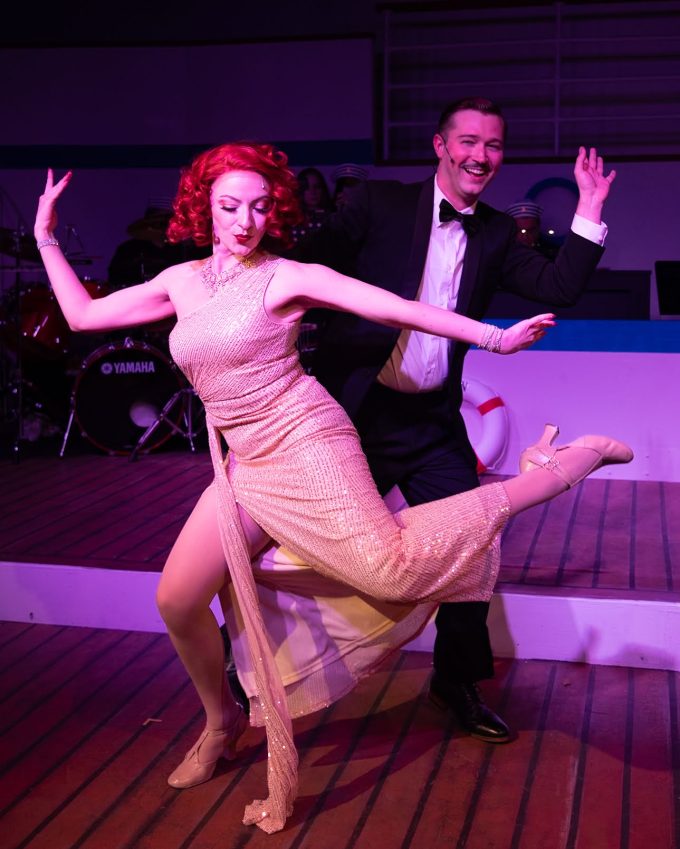
Seana Nicol as Reno, TJ Gassaway as Lord Evelyn.
Like many musicals, Anything Goes is ultimately about couples in love facing obstacles and overcoming them. Getting to the ultimate attachments is roundabout with a lot of implausible but engaging situations.
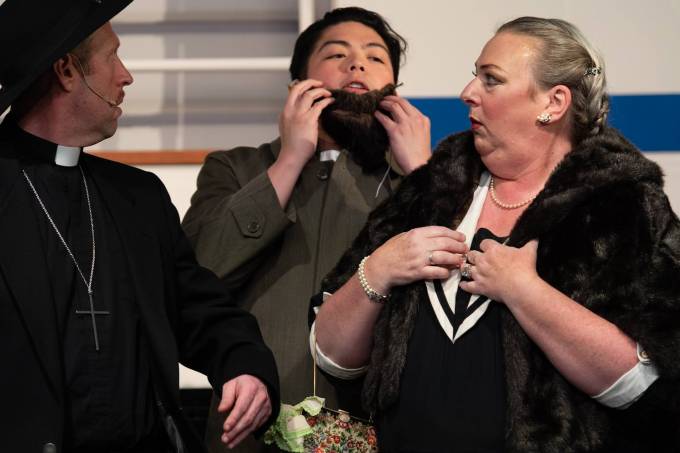
Billy Crocker, the central character, stows away on the S.S. American, on which his boss, a Wall Street magnate, is booked. Much of the plot is about Billy’s travails of not having a passport, a cabin, or clothes, other than what he’s wearing. Nico Jaochico is Billy, and the actor’s fit with the character is evident with Jaochico’s smiling enthusiasm, broad gesticulation, and comic delivery throughout. To avoid detection by his boss and the ship’s captain, Billy is constantly changing guises, including sailor, chef, and female, and the actor gets to display his versatility with voices and affect.
Dan Kolodny as Moonface, Nico Jaochico as Billy, Alexis Lane Jensen as Mrs. Harcourt.
Through these changes, the score is full of melodic tunes. The first act alone has an incredible five songs that are standards in the American Songbook – “You’re the Top,” “It’s De-Lovely,” “Friendship,” “I Get a Kick Out of You,” and of course, “Anything Goes.” All are delivered joyously, and the title song has the addition of great tap dancing accompaniment which leaves the whole audience smiling.
The female lead is nightclub singer Reno Sweeney, who knew Billy before the cruise and had a crush on him. Performed by a compelling Seana Nicol, she possesses a strong singing voice and acting chops, and like Jaochico, has charisma that suits the role. Individually and together, they give fine renditions to the Porter tunes, but one weakness is Act 2’s “All Through the Night,” in which the orchestra arrangement overpowers the singing in what should be a very understated backing. Nonetheless, the decision to have Music Director Armando Fox and the other six musicians on stage and in uniforms creates the feeling of a shipboard orchestra and otherwise works well.
Cast.
Another layer of the story could be labeled Damon-Runyon-goes-to-sea, as violent criminals who would have been sociopaths in real life are treated as harmless, goofy characters. The third lead in the show is the always reliable Dan Kolodny, who plays Moonface Martin, #13 on the FBI’s Most Wanted List, but who is disguised as a priest. He carries the passport of “Snake Eyes” Johnson, Public Enemy #1, who was to board the ship but was mistakenly left onshore. Moonface befriends Billy and allows him to use “Snake Eyes’” passport to have an identity. Being mistaken for a famous criminal initially benefits Billy, but he will eventually regret it.
Anything Goes is a funny romp, and Director Laura Morgan ensures crack delivery of the performances, and along with Set Designer Tom Curtin, they make great use of the small space to include a catwalk above the stage. Although the tap and other numbers with a dozen or so dancers is a bit congested, Choreographer Rachel King Campodonico makes the best of the limitations. While performances in supporting roles are uneven, most are adequate to make for an enjoyable production. Some voices are very good, led by Christina Swindlehurst Chan as Billy’s love interest, Hope.
Christina Swindlehurst Chan as Hope, Nico Jaochico as Billy.
Anything Goes with music and lyrics by Cole Porter and new book by Timothy Crouse & John Weidman, is produced by Altarena Playhouse and is performed on its stage at 1409 High Street, Alameda, CA through April 26, 2026.
We’ve had three cruises on Crystal’s 700 passenger sister ships, Symphony and Serenity, and highly recommend them.
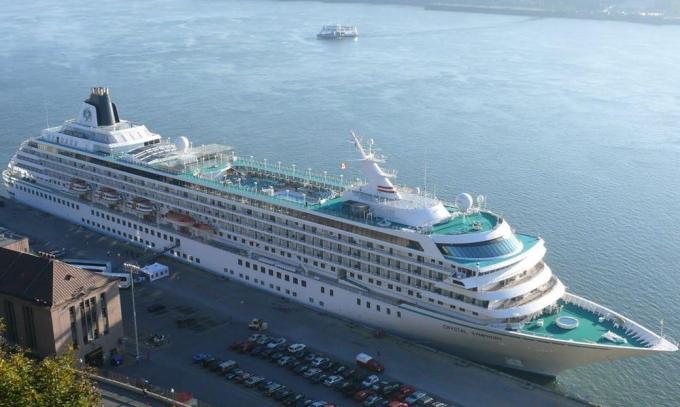
After our December sailing on Crystal Symphony, my wife Karin and I rejoined the ship for another A+ cruise in February, 2026 for 16 days in the equatorial region of the Indian Ocean from the Seychelles to Singapore. Disembarking, we stayed in Singapore on our own and continued on to Bangkok. What started as an anecdote about a cruise excursion to a game reserve in Sri Lanka intended for my annual December letter has morphed into another traveler’s commentary.
YALA NATIONAL PARK, SRI LANKA
Following are some notes about a “safari” day trip to Yala National Park in Sri Lanka, which we hadn’t heard of. We had low expectations but really enjoyed it. The hour-long trips to and from the park were highly interesting in their own right. A huge and attractive wetlands covers the south of Sri Lanka, and we saw a profusion of water birds of many types in lagoons and marshes along with lush rice paddies. What made the trip particularly unique is that there were at least several feral dogs per mile of roadway (which was in much better shape than the average in the U.S.), and they lolled about the pavement with impunity, often lying in the middle of the road. We passengers flinched throughout, but dogs and drivers managed misses, and we never saw evidence of a dog being hit.
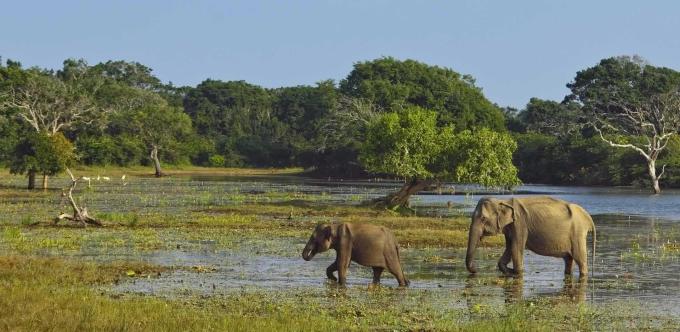
Elephants in the wetlands at Yala National Park.
The other notable incident in the open safari vehicle on the road was that as I was facing sideways, I heard a thunderous sound and felt what was like 10 or 12 small, sharp pelts on my face. Looking at the woman behind me that I was talking to, all of a sudden she had 30-40 bees on her blouse. We still don’t know if it was from the vehicle hitting an overhanging branch or what, but we figured there were 150-200 bees in the attack in all. Fortunately, we riders suffered only four bee stings, but it sure was an adventure fighting the bees off.
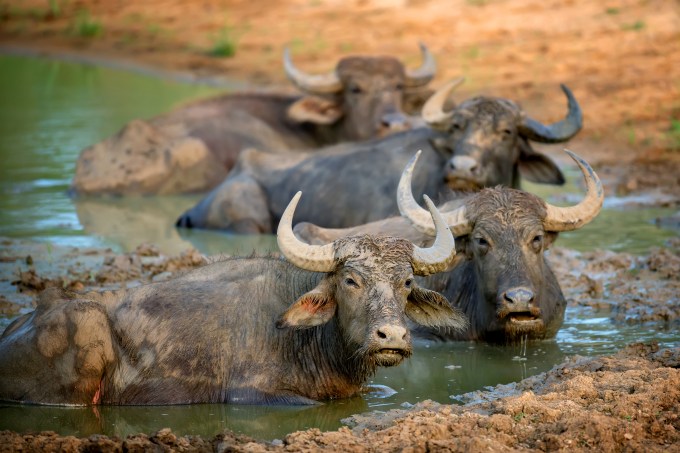
Buffalos enjoying the cool of a wallow. See the smiles!
We were shocked about how many tourists that we saw in scores of safari vehicles in this park that was unknown to us, but a lot of visitors to Sri Lanka seem to know about it. Other than herd animals and a few other common species, we saw only one or few of some of the more sought-after like leopard, jackal, and mongeese.
Our separate sightings of a leopard and a jackal were from great distances. However, we had a close look at a crocodile kill of a deer, in which the croc patiently clinched the deer’s leg, and over many minutes eased the larger deer underwater. Also, we could have slapped an elephant on the side while it ignored our vehicle and munched away on tree branches.
Axis, or spotted, deer.
At a nearby town, axis deer herds hang out near fruit stands to benefit from the wastage. Not only did I get to pet a wild deer, but we got photos of crows riding on deer’s backs, waiting for their turn at coconut meat from discarded shells. A summary of the animals seen (mostly for my external memory!) is at the end of this commentary.
SINGAPORE versus BANGKOK
The two economic and tourism lynchpins in Southeast Asia, both of which we visited on this trip, are Singapore and Bangkok, Thailand. So which is considered more desirable? They couldn’t be more different. We resided in Singapore 1972-74, and while we lived a life of luxury unlike any other time in our lives (living in a stunningly modern 5 bedroom, 5 bath house with tennis court, having membership in a country club with four 18 hole golf courses, plus subsidized this and that), we were bored and felt repressed. Censorship and numerous restrictions on social behavior were abundant. We’ve been back there several times over the decades and witnessed the changes, overwhelmingly positive, though it’s become one of the world’s most expensive cities. Outside of places overseas that we’ve lived, we’ve visited Bangkok more than any other city. So each place is familiar to us.
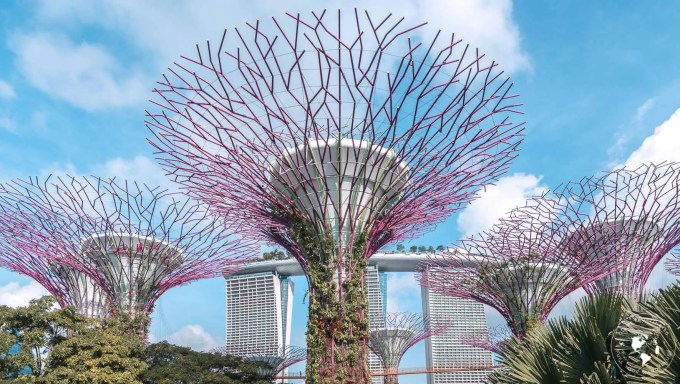
The Supertree Grove in the foreground is more impressive from a distance and particularly when lit up at night. The Marina Bay Sands Hotel at the rear is distinguished by the unique ship-like structure that spans the roofs of three towers.
Both are foodie cultures with delicious offerings. Coconut-based curries are central to Thai cooking, and there is heavy use of basil, ginger-family aromatics, and what may be the most fiery use of chilis anywhere. In Singapore, you’ll find great variety representing its ethnic communities – scrumptious Chinese, Malay, Peranakan (also called Nyonya, a hybrid of the first two derived from ethnic intermarriage), Indian, and other cuisines. Karin has said that if she could eat only the cuisine of one continent, it would be Asia, and the offerings from these two sources would suffice.
But when I saw an article selecting Bangkok as having the best street food in the world, I bristled. How could it not be Singapore? Upon reflection, I realized that street food acts a microcosm of the differences between the two cities. In Bangkok, vendors of Thai specialties appear randomly and chaotically on the sidewalks wherever crowds of people appear, and the food is eaten on the run. While Singapore has the greatest quality and variety of hawker food anywhere, like everything else, it is organized by regulation. Rather than appearing with seeming abandon on the sidewalks, these convenience foods are sold in hawker centers, pavilions with tens of food stalls and tables for eating, so that it doesn’t really qualify as “street food,” though the offerings are delicious. Try the famed Lau Pa Sat in Central for a wide variety of treats like dim sum, laksa, biryani, chili crab, and satay.
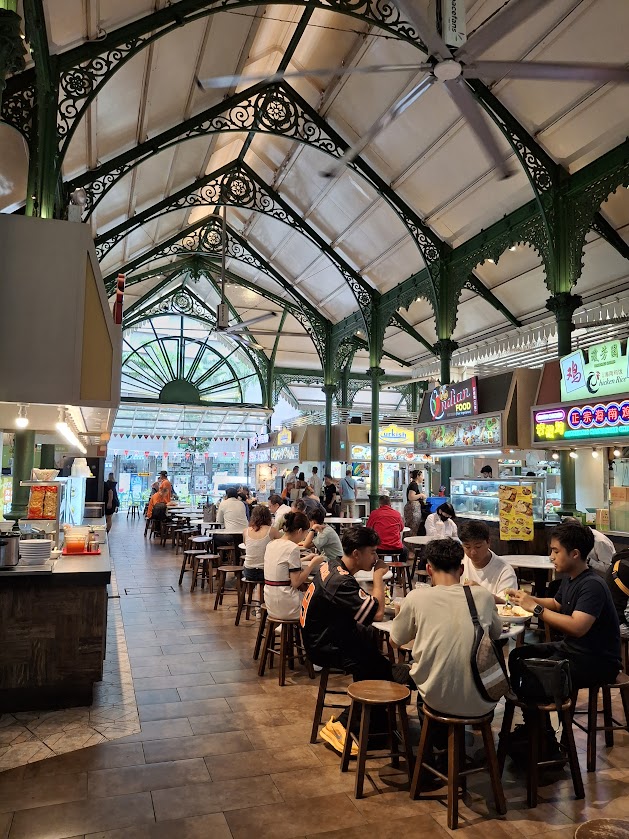
Interior shot of Lau Pa Sat, Singapore’s most famous hawker pavillion.
Like its food, Singapore is gemisched culturally, an admixture predominately of Chinese (mostly Hokkien and Teo Chew) but also Malay, Tamil (southern Indian), and others. However, for decades Singaporeans have been taught to suppress ethnicity for national identity. While Thailand does have some tribal people and significant Chinese influence that has been largely integrated, it is otherwise pretty ethnically homogeneous.
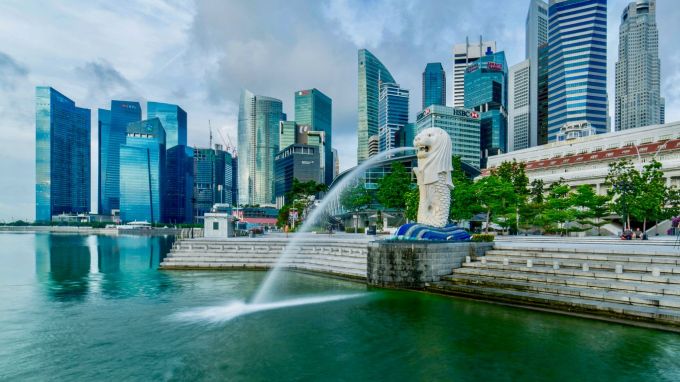
The statue is the historic Sinapura Merlion, a cross between a fish and a lion, the symbol of Singapore. Nothing in this skyline existed when we lived there.
As might be anticipated, Singapore is highly diverse religiously, but faith is less a part of its culture. Bangkok is profoundly Buddhist, with social and legal strictures to support it. One difference between the two cities is evident in their notable edifices. In Bangkok, wats, Buddhist temples, abound. They are filled with stunning Buddha images from the Emerald Buddha at Wat Phra Kaew to the 46 meter-long reclining Buddha at Wat Pho. In Singapore, secular works prevail, like the Supertrees by the Bay and the Marina Sands Casino and Hotel with its unique ship-like structure atop three towers.
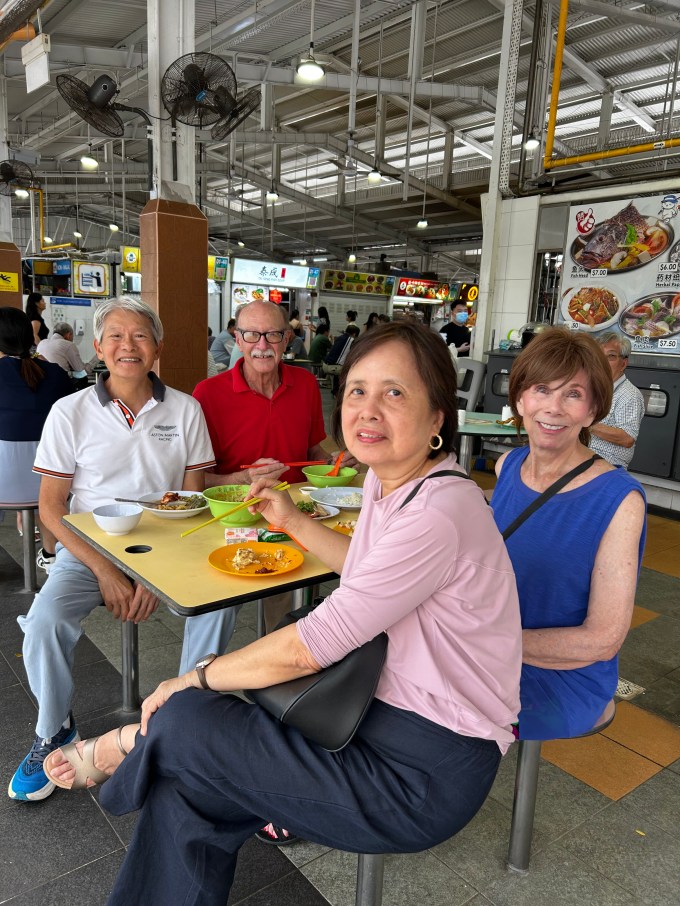
CH, Vic, Beng Hwa, and Karin. 80% of Singaporeans live in subsidized residences, housing estates, each of which has elaborate services, including a hawker pavilion like this one.
Singapore is also distinguished by investments in public attractions, like a cluster of five wildlife-related parks with the largest bird park in Asia; the botanical garden with the largest orchid collection in the world; and Sentosa Island, filled with entertainment sites from Universal Studios and Madame Tussaud’s to golf. Meanwhile, Bangkok offers floating and night markets; a vast array of handicrafts, artifacts, textiles, bespoke tailors, and day trips to UNESCO heritage sites. It is also a major center for well-priced dental and medical tourism from well-trained, English-speaking specialists.
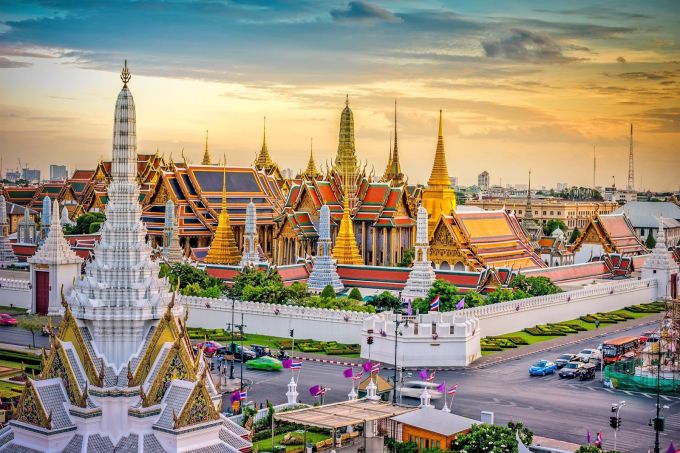
The Royal Palace in Bangkok has architecture in the same style as Buddhist wats, or temples.
Yet the most pronounced visual and social difference between the two cities is the overall organization and appearance. Long-time Prime Minister Lee Kuan Yew noted that Singapore must plan below the ground, on the surface, and in the sky. As a result, the city-state is the most ruthlessly planned existing metropolis (as opposed to de novo cities) anywhere. Using eminent domain, it converted miles of characterless low-rise buildings into mid-rises. But rather than creating concrete canyons, these buildings are surrounded by trees and other greenery, so that even the heavily built-up areas don’t seem oppressive. When we lived there, tree planting by civic-minded organizations was the order of the day, despite the existing lushness. The strategy paid off with incomparable greenery for an urban environment. The old buildings that remain like houses of religion, the repurposed godowns (warehouses) of the Singapore River, and classic public buildings are well chosen and retain the better character from the past. Another policy has been reclaiming land to expand island’s size in strategic locations.
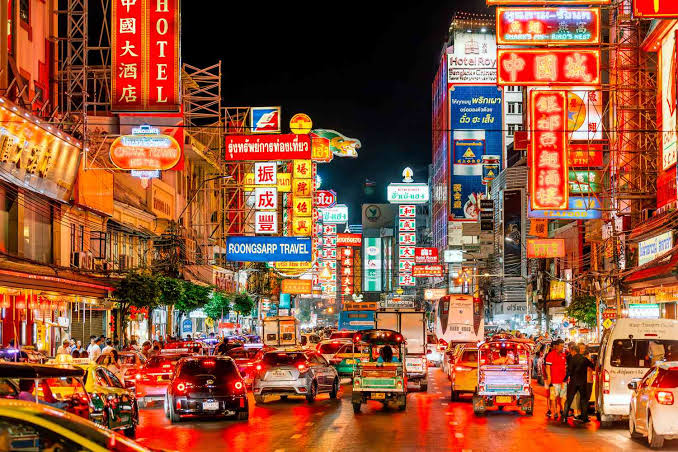
Bangkok’s Chinatown by night. Note the tuk-tuks, which are popular in much of Asia but originated in Bangkok based on Italian design.
On the other hand, Bangkok is organic and chaotic, with five-star hotels and premium shopping malls often plunked in cheesy areas of ramshackle retail. It does however have pleasant parks and klongs (canals), plus the Chao Phraya River, which gives the city character as it is woven into the fabric of the area. It is also a monarchy with a civil government that often suffers coups, military interventions, and incarceration of leaders, but these disruptions don’t often affect day-to-day life.
Finally, there are the people. As a rule, Singaporeans tend to be aspiring, accessible, and proper – well-behaved as would be expected in a society that is highly regimented, where chewing gum and vaping are illegal, and many behavioral strictures apply. Thais are among the most friendly and gentle people in the world, yet there is a pride in being the only Asian country never to have been colonized.
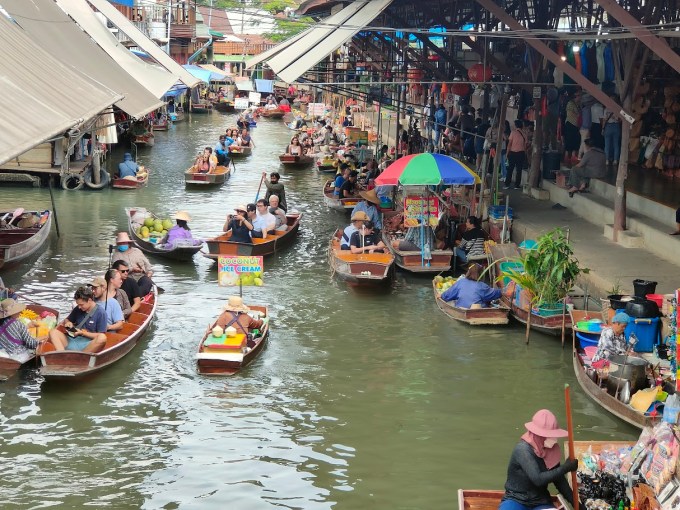
Floating markets on klongs (canals) are a great source of fresh foods, and the ones in touristy areas will also have souvenir items.
On our recent trip, we were fortunate to be hosted for part of our stay in both locations. We had met a Singaporean couple, CH and Beng Hwa, on our December cruise on Crystal, and they were incredibly generous hosts for a full day that included two meals (hawker and vegetarian Peranakan) and a visit to Bird Paradise that concluded with a cancelled outdoor production due to torrential rain and the loudest, most frequent thunder I can remember. In Bangkok, we were hosted by Nid, who we see about once a decade. A native Thai, she had been my colleague when we were both in our first professorial positions at George Mason University in Fairfax, Virginia.
So which will it be for you? The elegant Grace Kelly, or the earthy Sophia Loren? The one that works better depends a lot on your mission. If you’re looking for arts and souvenirs, body or tooth work, tailored additions to your wardrobe, religious monuments, organic chaos, and a more traditional Asian experience, it’s Bangkok. If you want exemplary order, neatness, and cleanliness with theme parks and fauna and flora reserves, high-end shopping, diverse but modulated cultures, all in a predominantly English-language environment, it’s Singapore.
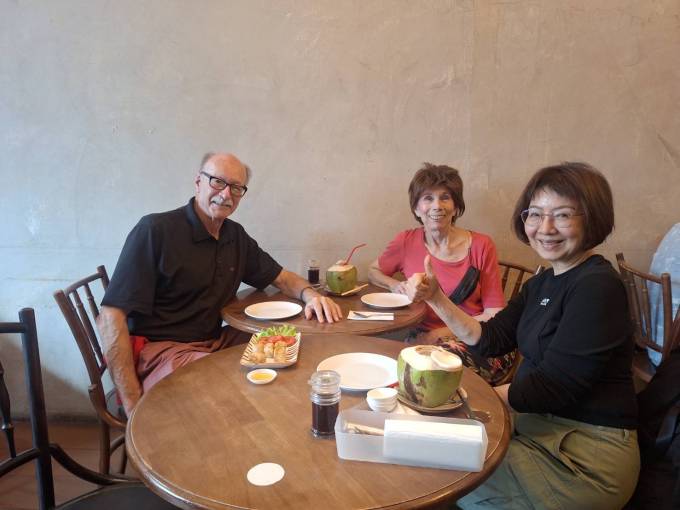
Vic, Karin, and Nid, having dim sum.
My recommendation is that as long as you’ve gone that far, do both. Note that Metro train transit is cheap, intuitive, and clean in both, and taxis and peasant food are also inexpensive. Presently, hotels cost considerably more in Singapore, being the budget difference maker.
FOLLOWING ARE BRIEF COMMENTS ON OTHER STOPS ON OUR FEBRUARY CRUISE:
I should note that at dinner in our hotel in Mahe, Seychelles before the cruise we met and befriended Major General (retired) Craig Whelden, who was a scheduled lecturer on the cruise, and his English friend from school days, Roger. Coincidentally, on 9/11, when Craig, then an active Major General, was organizing logistics after terrorists crashed a jet into the Pentagon, he called for materiel from the unit that I had been in during the Vietnam era – 1st Battalion, 3rd Infantry (The Old Guard). His several onboard lectures were on politico-military history, and since the Trump-Netanyahu organized attack on Iran occurred during our cruise, he was able to start developing a new lecture in real time.
On the second leg of the journey, long-time friend Cindy and new friend Betty joined the cruise in Colombo.
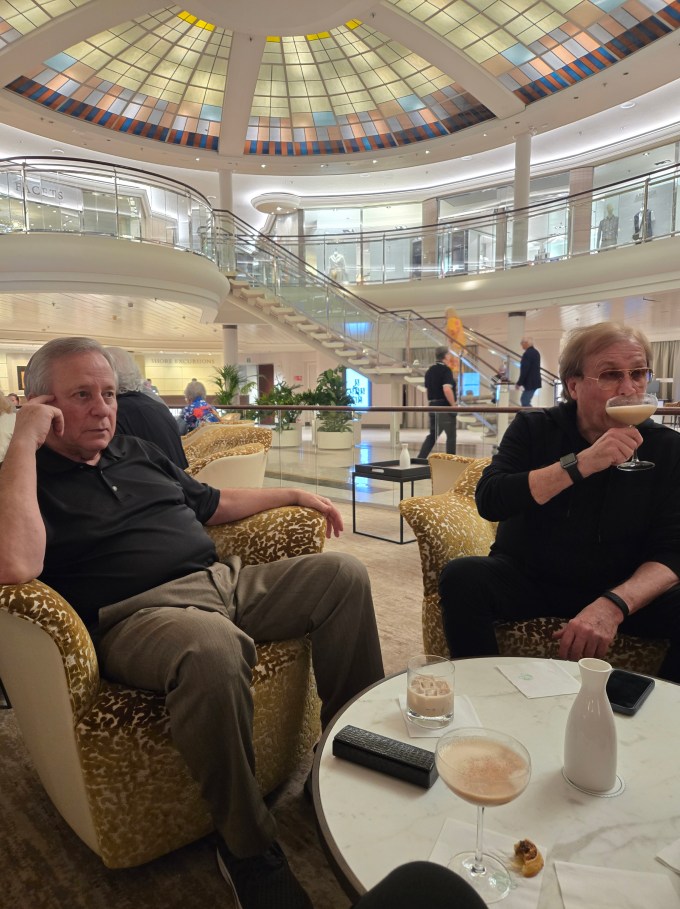
Craig and Roger relaxing in the ship’s atrium.
PORT BLAIR (NOW OFFICIALLY SRI VIJAYA PUNAM), ANDAMAN ISLANDS, INDIA
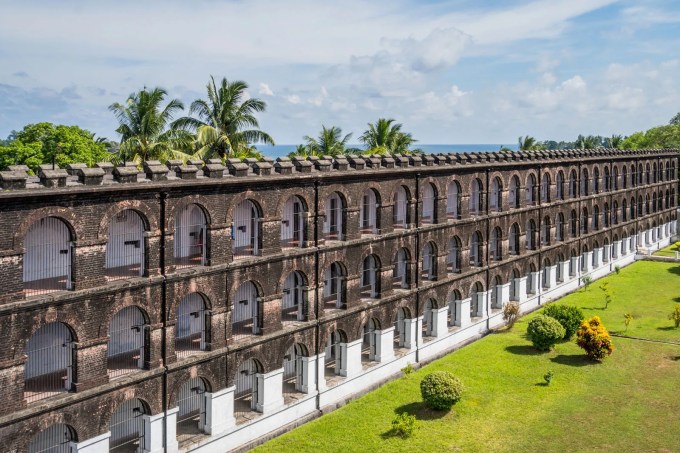
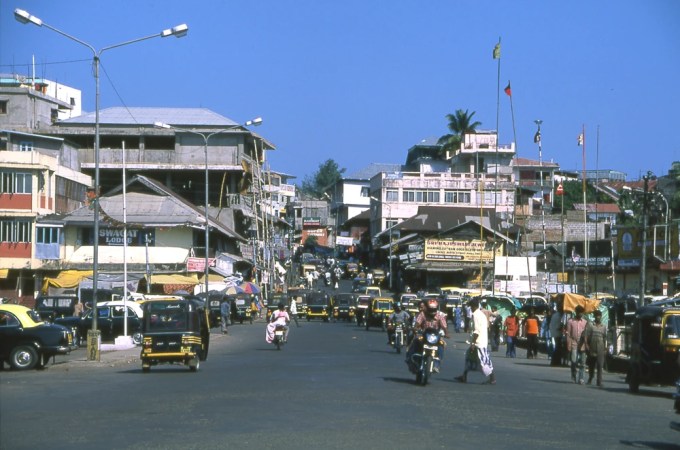
Isolated, nearly 800 sea miles from either Chennai (Madras) or Kolkata (Calcutta), Port Blair was established in 1858 as a British penal colony to incarcerate Indian freedom fighters, mostly from the 1857 Indian Rebellion. With an impressive hub and 7 spokes design, each of the arched-front 700 cells provided solitary confinement, though prisoners had contact with one another in brutal hard labor on the island. In use until the Japanese invasion in WW II, the prison is now a showcase. The hilly town is a bustling India-in-Miniature, right down to the venerated cows roaming free and interrupting traffic, though the pace is less hectic than India’s big cities. The tropical beaches are the main draw for vacationing Indians from the mainland.
One of seven spokes of cells of the Port Blair Penal Colony penitentiary.
As an aside, we have visited a number of notorious prisons besides Port Blair. Locally, we have Alcatraz, which ranks as San Francisco’s number one attraction, despite a wide array of others. Though we haven’t been inside, we pass by San Quentin’s gate frequently. It is on a prime San Francisco Bay promontory in Marin County and is worth a fortune. Others in our memory bank are Robben Island (Nelson Mandella’s home off Cape Town for 27 years); New Caledonia (the grim South Seas French penal colony, now a great beach holiday spot); and Botany Bay (the original British penal colony in Australia). When we lived in Sydney (1974-76), Karin worked as a psychologist in Long Bay Penitentiary, the contemporary maximum-security lockup at Botany Bay.
For India, Port Blair town is middle class.
MALACCA, MALAYSIA
A pleasant surprise for us, we had visited there when we lived in Singapore and even bought two double-decker chests (one known as a Malacca chest), which we still have. Like everywhere, it has grown and changed. Now a UNESCO city of 100,000, 200,000, or 500,000 (depending on your source!), we like the charm of this city steeped in the history of Dutch, Portuguese, and British colonization and the infusion of Chinese population. Oddly, of the ten ports in seven countries on the cruise, this was the only one that is not on an island.
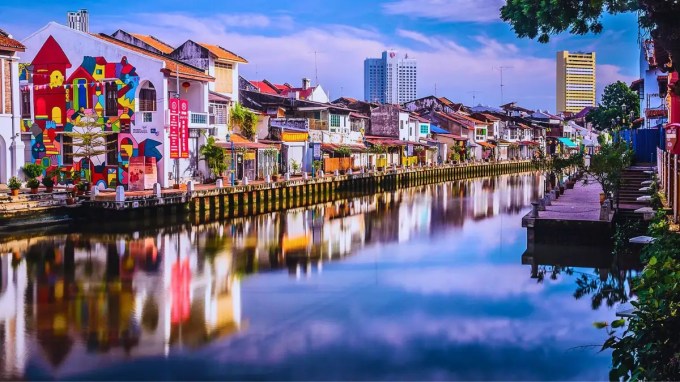
Malacca River.
Central to retail life is a waterway akin to an Asian version of San Antonio’s Riverwalk. We have taken boat cruises on both. Cafes and bars cover the Malacca River waterfront, and running perpendicular from the river is Jonker Walk, a garish and crowded commercial area in the city’s Chinatown. Also along the river is Kampung Merton, a living traditional village preserved in its original style, with over 100 homes and businesses. Its character would have been the mode when we were in Malacca before. Attractive red-brick historic buildings from the colonial era dot the central city.
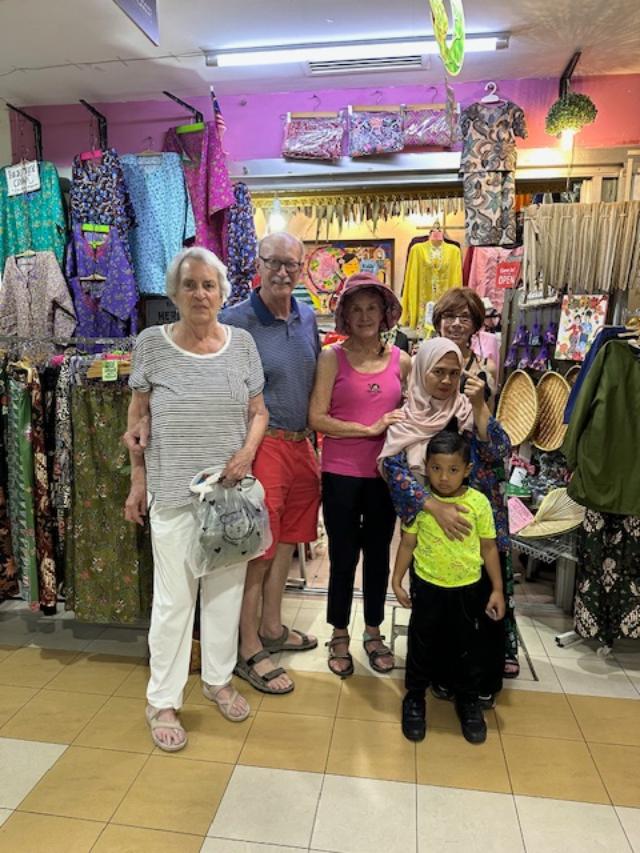
Betty, Vic, Cindy, and Karin. In front are the shopkeeper and her son. Most shops were closed for Ramadan.
SEYCHELLES and MALDIVES
These are two very different equatorial island chain getaways more for Europeans than Americans because of their locations. Nothing separates the two but 1,200 miles of Indian Ocean.
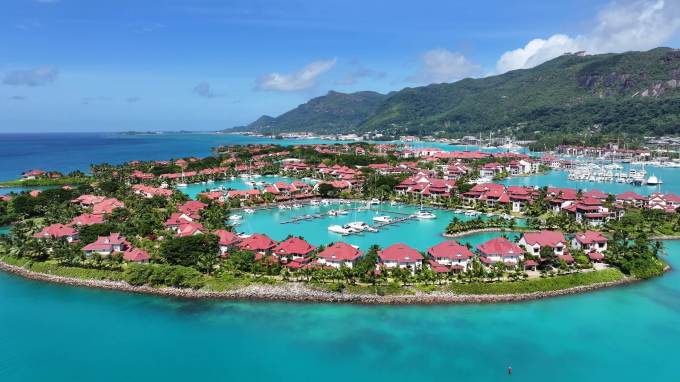
Mahe Island, Seychelles.
The Seychelles are Africa’s richest and smallest country and have attracted some expatriate population and high costs. The capital island, Mahe, draws from natural attractions including exclusive resorts on the shores and a man-made canal along steep hillsides with nice homes. The Maldives are in Asia, and its undistinguished capital island, Male, is pretty forgettable. Significantly, Sunni Islam is mandated for residents by law.
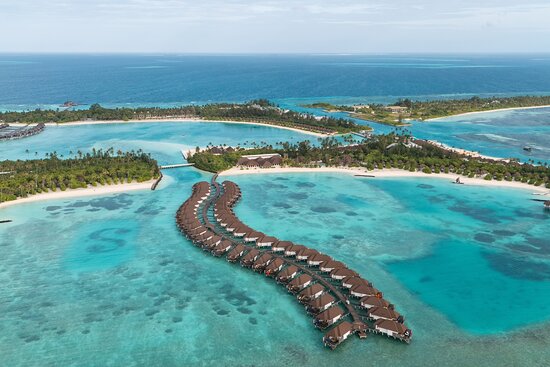
Both countries offer stunning coral reefs accessible from beaches and abundant tropical sea life, but the island chains are much different. The Seychelles are mountainous, verdant, and rich with biodiversity. The Maldives, with little exception, particularly the capital, are comprised of atolls, low slung sand rings with palm trees surrounding lagoons. Typically, a single exclusive resort is on an atoll, so that for vacationers, isolation with all-inclusive offerings is the mode. The rigid Islamic strictures, including prohibition of alcohol, are suspended on the resort atolls, genuflecting to the god of foreign currency.
A resort island with over-water bungalows on a Maldives atoll.
Of the two, the Seychelles offers a more diverse experience, but unless you have other business in that part of the world, there are closer, cheaper, and more interesting alternatives. On a personal note, I first visited Male, Maldives in 1980, when I was Chase Manhattan Bank’s Regional Manager for South Asia. I may still be the only visitor to the island who wore a western business suit.
PHUKET, THAILAND and PENANG, MALAYSIA
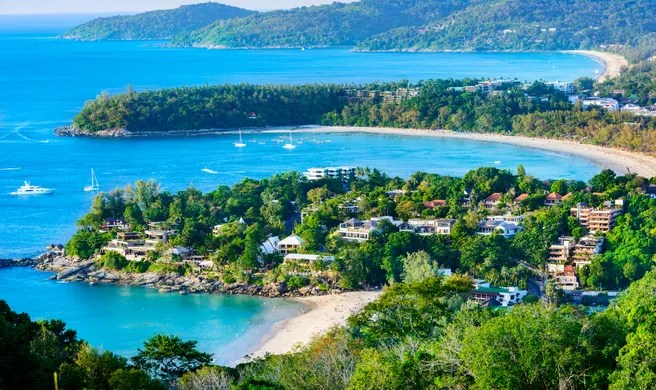
These are the two biggest seaside vacation spots in their respective countries. Both are islands and metropolises – Phuket with 1 million population, and Penang with 500,000. We are not really interested in the beaches, but Phuket has not only nice beaches but the distinctive tree-covered limestone karst towers that soar out of the bay made famous by the James Bond movie The Man with the Golden Gun. Penang is generally not recommended for swimming because of frequent jellyfish presence and often murky water, but water sports like ski boating and parasailing are popular.
Phuket with a few of its many beaches. Tourist accommodations near the beaches can be quite fancy, but the look of the city otherwise is not so appealing.
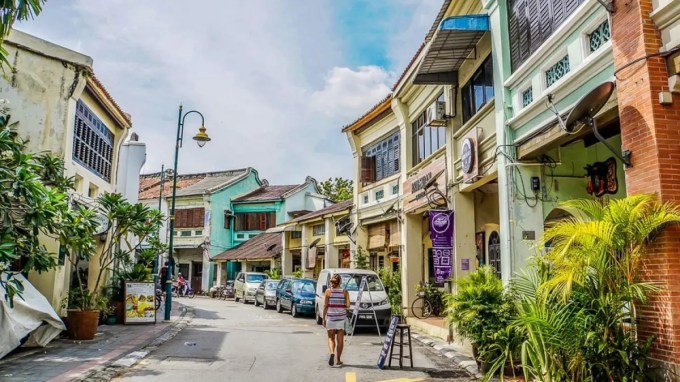
Like the Bangkok-Singapore comparison, both are great for food, and you can eat your way through a vacation. Phuket is more ragtag, spread out, and good for shopping for local goods, Buddhist temples, and muay Thai competitions. Penang is more organized with a distinctly attractive colonial district, Armenian Street for buying local tchotchkes, the clan jetties with overwater houses, and nature sights including a butterfly farm. My preference is Penang, but Karin’s is Phuket, so which makes sense depends on your vacation goals.
Armenian Street in Penang.
COLOMBO and TRINCOMALEE, SRI LANKA
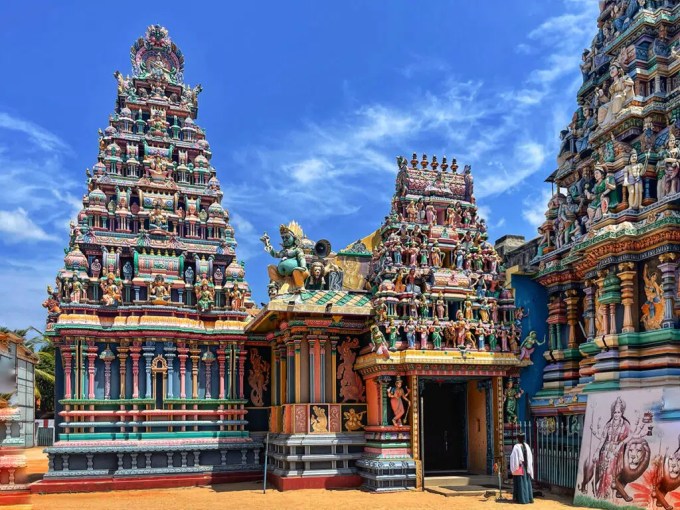
Sri Lanka is becoming a greater tourist destination, much like India but with less complexity and less edge. While not conveniently located at the crossroads, it is an appealing destination for the experienced traveler seeking more exotic locales. Colombo has the accoutrements of a capital and a metropolis. It is the home to Sri Lanka’s ascendent cuisine and to the majority, Buddha-worshiping Singhalese people. With South Indian roots, 20% of the population is Tamil, mostly Hindu, but with many Muslims. Historically, the Singhalese and Tamils have clashed violently, but now is one of the periodic times of respite. Trinco is the center of Tamil culture with many Hindu temples.
A Hindu temple in Trincomalee. They are typically very colorful, with an emphasis on pastels, and with hundreds of detailed figurines, mostly of different gods on the exterior. By contrast, the interior of Buddhist temples usually have tens to hundreds of monochrome statues of the same figure – Buddha.
The teardrop island, formerly known as Ceylon, and anciently as Serendib (from which serendipity derives), is rimmed with beaches and flush with greenery in the tea plantations of the hilly center. The main cities serve as launch points for the seaside, nature parks (like Yala, highlighted above), and antiquities in Polonnaruwa, Anuradhapura, and Sigiriya. Cooler (very much literally as well as figuratively) are two contrasting hill stations, Nuwara Eliya which best represents the British colonial presence of the past, and vibrant Kandy which is the center of Singhalese culture.
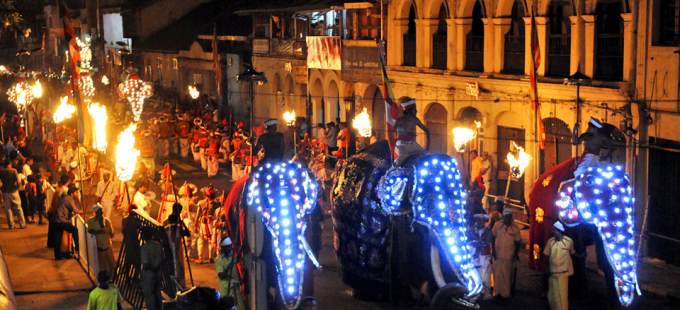
Kandy Perahera, Buddhist Festival of the Tooth, one of the city’s many cultural celebrations, with elephants leading the parade.
Sri Lanka has the highest density of elephants in Asia, some of which are used domestically and honored in Kandy pageants. In addition to the normal array of touristy trinkets and clothes, Sri Lanka is famous for its gems, particularly world-class sapphires and rubies.
IMPEDIMENTS TO VISITING THESE COUNTRIES
Remarkably, in a short period of time, many of these countries have gone from laissez faire to doctrinaire visa or travel authorization requirements for tourists. I hope that these demands drag on tourism enough that they are discontinued, because they are infantile, and the information gathered and security gained is almost without value. I believe that Malaysia is the only country we visited on this trip without any administrative paperwork.
India, the only one of these countries to characterize their demand as a visa, was so intimidating that one of our traveling companions wanted to opt out of the trip. When we returned to Thailand after having been there less than a week before, it took us two hours to get out of the airport because of the nonsense of having to reapply for travel authorization. My advice is to check these things out before you commit to travel and to make sure you have plenty of time to complete the requirements if they must be done in advance.
THE FOLLOWING SECTION GIVES THE HEADCOUNTS OF ANIMAL SPECIES SEEN IN AND NEAR YALA NATIONAL PARK
Numbers of species seen – many specimens of all herd animals were seen. Otherwise, in other categories, an x in parentheses (x) indicates that many specimens were seen; two numbers in parentheses indicates the number of sightings followed by how many total specimens were seen. No parentheses indicates one individual was seen.
feral dog (x), elephant (3-4), leopard, golden jackal, black naped hare, ruddy mongoose (4-4), palm squirrel (2-2), giant squirrel
REPTILES:
mugger crocodile (x), land monitor (x), cobra
BIRDS:
sea eagle (x), hawk eagle (x), peacock (x), Ceylon junglefowl (2-2), blue tailed bee eater (x), black necked stork (x), otherwise huge variety from all types of shorebirds to egrets, pelicans, and cormorants as well as unknowns.
INSECT SWARM
Bees (note that otherwise we had no instances of insect bites on the trip)
To begin with, let’s decipher the title. The first and last words directly relate to the content of the play as the narrative concerns a music summer school for high school girls in Berkeley, California. The middle word specifically refers to aleatory music which includes randomness in composition or scope for individual interpretation by the performer. More broadly, chance encompasses all manner of stochastic outcomes in the girls’ lives – from fortune or misfortune of birth and family to getting a lottery assignment to a school with a music program to the unpredictable outcomes of improvisational jazz. (The students fall into two camps of performance – improv and classical.) The symbols of the two vertical pipes with a colon in the title are “begin repeat” (with colon after) and “end repeat” (with colon before) indicators in a musical score. Serious music players confront many recurrences, the most common of which is rehearse, rehearse, and then rehearse.
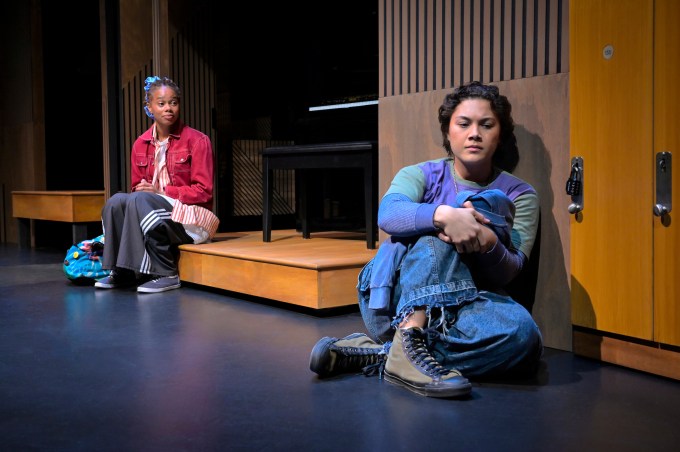
Hillary Fisher as Fax, Naomi Latta as Margot.
The Eisa Davis written play is a four hander about a group of girls new to each other who find bases for performing together. But apart from developing musicianship, it is about girls being girls with their yearning for affirmation and friendship, sometimes upended by resentment, envy, and misunderstanding.
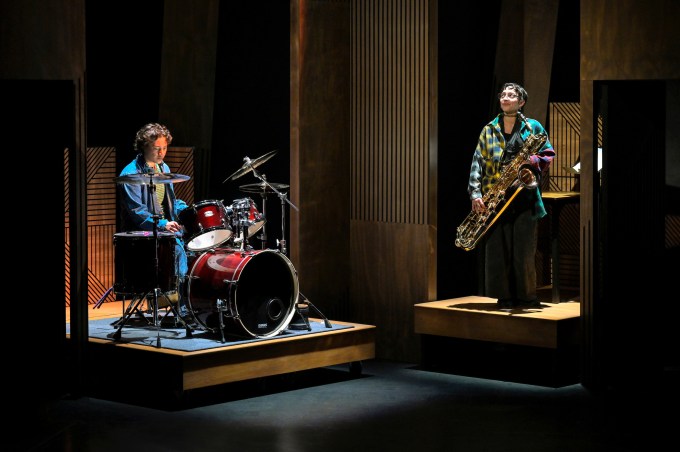
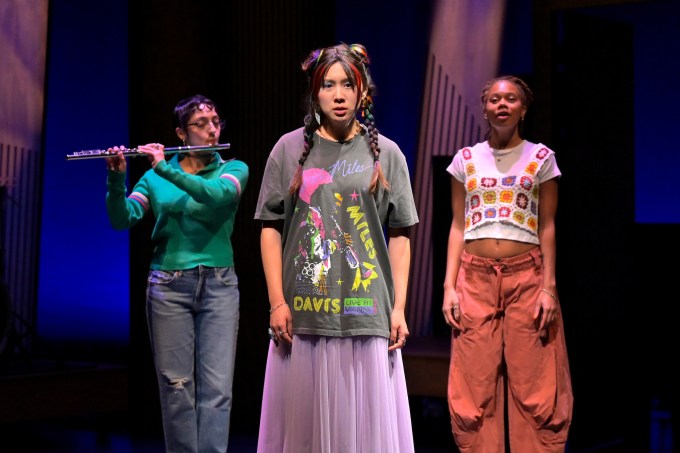
From the start of the play, the element of chance enters. When the fixed story begins, the lively and level-headed singer Fax (Hillary Fisher) is assigned a pianist, the stoner Rile, (Yeena Sung) as an accompanist, and in the middle of Fax’s singing an opera aria, Rile goes on improvisational tear, illustrative of the classical/improv clash. Also joining the fray are the mercurial and mysterious percussionist Margot (Naomi Latta), and what instrument is more inherently improv than drums? Finally, we have the breezy and independent wind player Clementine (Gianna DiGregorio Rivera) in a curiously underwritten part for such a small ensemble.
Naomi Latta as Margot, Gianna Di Gregorio Rivera as Clementine.
Laudably, ||:GIRLS:||….. reflects its intellectual power throughout with its aspiration to educate along with entertaining, and it particularly benefits and suits a younger audience with a serious interest in music. But as a stage drama it could use more cohesiveness. As somewhat a gimmicky prelude to the action, 12 audience members select 12 keys from a piano on stage, a random outcome, and music is composed and performed by the actor/musicians using only those notes. And while this device is instructive and even interesting, it deflects from dramatic impact of the story line. The play tries to be too many things that are out of balance or don’t mesh together. Also, there was one musical performance in the latter part of the show that was far too long to fit in with an absorbing dramatic pace.
Yeena Sung as Rile, Gianna DiGregorio Rivera as Clementine, Naomi Latta as Margot.
Engaging story elements and characterizations punctuate the action. Friendship alliances emerge, sexual preferences are exposed, and a diversity of family compositions and lifestyles affect the girls individually and collectively. An overall contributing theme is the idea of female empowerment, reacting to the notion that women are expected to defer to others, even to one another. These thematic aspects make for thoughtful theater, and musical expression using the framework of girls’ summer music school has an important place in the mix.
Another theme is the question that each participant who may wish for a career in music must answer: “What does music mean to me?” Like in the movie “Whiplash,” the moody Margot is wholly absorbed by rhythm. Will she be the one who succeeds in the business?
Gianna DiGregorio Rivera as Clementine, Yeena Sung as Rile, Hillary Fisher as Fax.
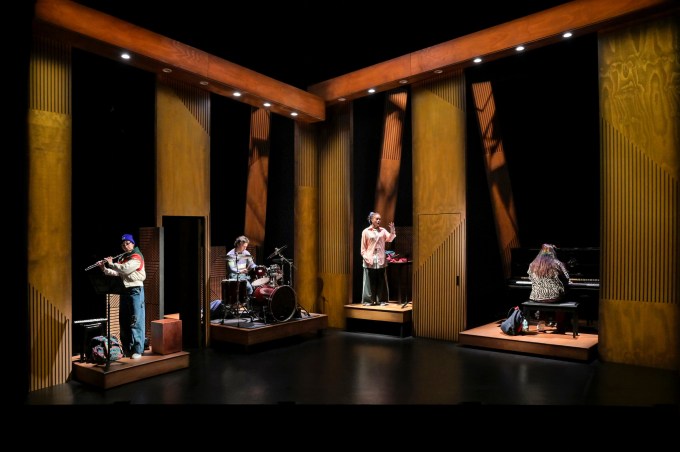
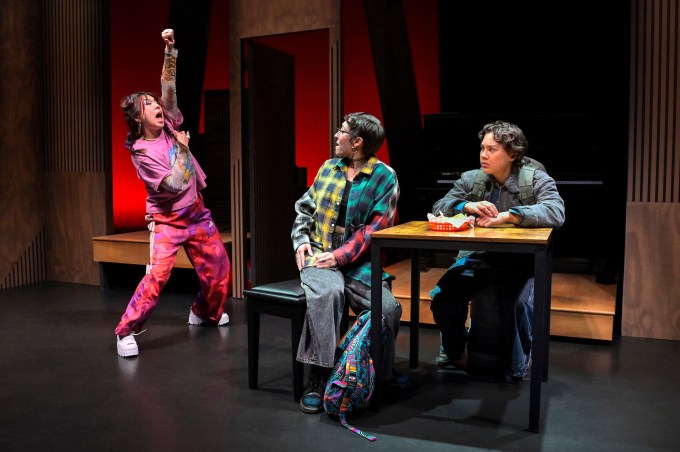
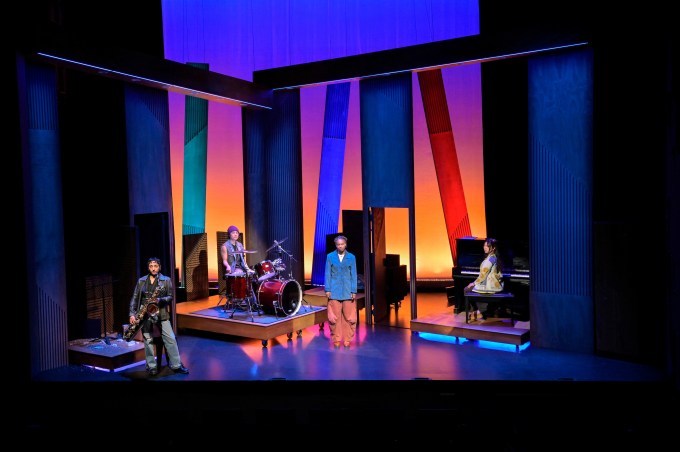
Director Pam MacKinnon, in her swan song as Artistic Director of the company, has enlisted and coordinated a fine team. Acting and musical performance meet standards, while some of the artistic design contributions are stunning. Nina Ball’s deceptively simple but powerful wedge-shaped set employs various types of columns, including non-vertical, in natural wood with faux-fluting. Their wonderful aesthetic design and spatial relationships beautifully interact with Russell H. Champa’s dramatic and at times colorful lighting to create uncommonly coordinated and outstanding visual imagery. As an illustration, compare the first and last photos in this review.
On the negative side, the sound design decision to eschew voice amplification doesn’t work except for audience in the first tier of the theater. A common discussion point by patrons in the upper deck after opening night was that they might have appreciated the performances if they could hear half of the dialog. Even though I heard the greater part of it, straining to understand means missing nuance and distracts from overall appreciation.
Cast.
Premiers usually undergo revisions that benefit the long-range prospects of the show. This play has so much going for it that hopefully some tweaks can give it legs.
||:GIRLS:||:CHANCE:||:MUSIC:||, a world premiere, is written by Eisa Davis, produced by American Conservatory Theater and Vineyard Theatre Company, and performed at ACT’s Strand Theater, 1127 Market Street, San Francisco, CA through April 19, 2026.
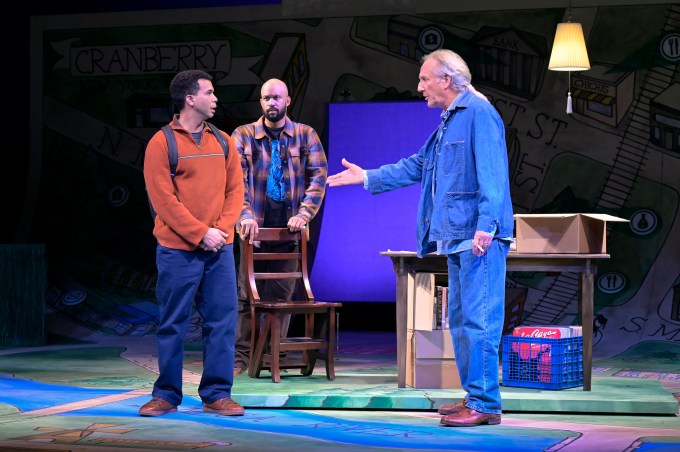
Kenny Scott as Bert, William Thomas Hodgson as Kenneth, Dan Hiatt as Clay. All photos by Kevin Berne.
Kenneth is nothing if not as consistent and predictable as a Swiss watch. Orphaned at age 10 and unmarried at age 38, he’s had only one job as an adult, working at an independent bookstore in Cranberry, New York, a fictional exurb of Rochester. He’s never amounted to much or had much of an impact on those around him.
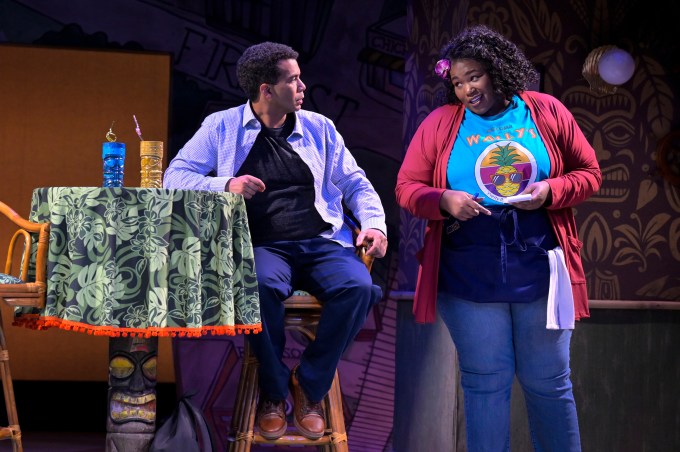
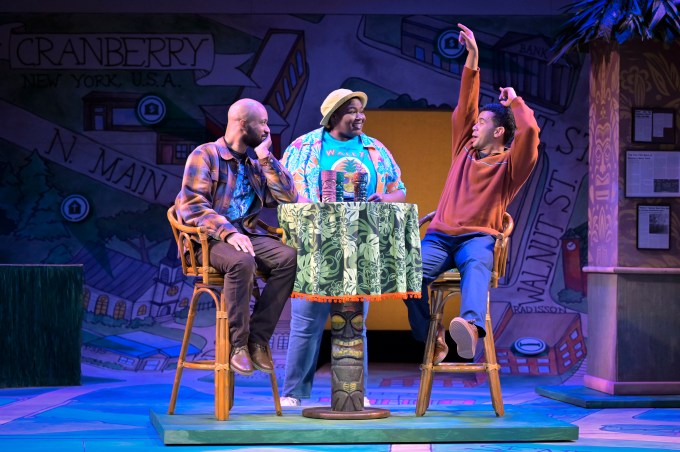
He also claims in 15 years never to have missed the daily happy hour, at Wally’s, a local tiki bar, except on some Sundays. His steadfast order is two mai tais, and that drink exemplifies the rut of his life, as he has never even tasted a martini. When each evening starts with a minimum of two mixed drinks, the imbiber probably qualifies as a drunkard.
What makes him particularly memorable to the bar staff is that he is always alone – in their observation, but not in his mind. Kenneth is almost always able to invoke Bert, his alter ego and only friend. But leading to questions of his mental stability, he sometimes speaks to Bert aloud. However, the incessance of Kenneth’s aimless march through time is disrupted when Sam, the bookstore owner, announces that he must close the store, forcing Kenneth into an unfamiliar decision mode.
William Thomas Hodgson as Kenneth, Rolanda A. Bell as bar maid.
Playwright Eboni Booth’s treatise on loneliness, Primary Trust, won the 2024 Pulitzer Prize for Literature and is already the most produced dramatic play in the country in 2025-26. Unsurprisingly, TheatreWorks Silicon Valley’s production, directed with verve and sensitivity by Jeffrey Lo, pushes all of the right buttons and makes for a thoroughly entertaining and thoughtful experience. The acting ensemble could not be more powerful, and the staging is highly distinctive.
The cast is led by the redoubtable William Thomas Hodgson who captures Kenneth’s grief with hesitant communication and an inability to connect with others. But the actor offers not just broadbrush strokes of the character, but nuanced and touching reflections as well. While Kenneth seems simple of mind, he does love books, so his long-held job suited him well. But despite interaction with customers, there is no translation to higher order socialization. So when interviewing for a new job, his ineptness is total, and only the desperate need to fill vacancies on the part of the employer plays in his favor.
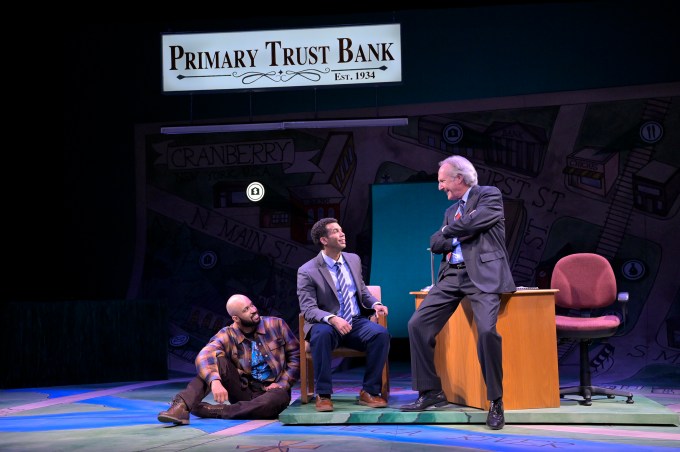
William Thomas Hodgson as Kenneth, Kenny Scott as Bert, Dan Hiatt as Sam.
The protagonist’s good fortune in gaining unearned support from the time of his placement in an orphanage to getting the new job is reminiscent of Blanche Dubois’s comment in Streetcar Named Desire that she always relied on the kindness of strangers. The title of both this play and the bank that Kenneth will work for are perhaps reinforcement of the notion that kindness, connection, and sense of community contribute to wellness and mutual benefit. Also embedded in the play’s message is that sometimes unpleasant disruptions to ones comfort provide fresh opportunity.
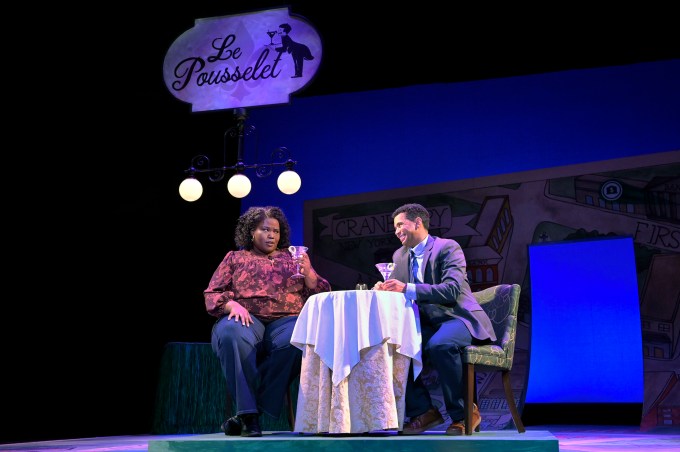
Perhaps the biggest variation in Kenneth’s life has been the frequent turnover of bar maids at Wally’s, who he interacts with in a perfunctory manner until one with more compassion and substance, Corrina, comes along. The depiction of the bar maids is hilarious. Rolanda D. Bell is truly spectacular in creating distinctions among the over 20 characters that she plays, including men in different contexts.
In many of the bar maid sequences, she passes across the stage, taking an order from Kenneth, does a quick costume change in the wings and passes through in the opposite direction as another. In one classic exchange, she plays two characters on stage simultaneously, switching her voice and affect along with the direction of her baseball cap to distinguish them.
Kenny Scott as Bert, Rolanda D. Bell as bar maid, William Thomas Hodgson as Kenneth.
Also acting multiple parts is Dan Hiatt, who performs two bosses and a waiter at a French restaurant. He is as much a scream in his roles as is Bell in her comic turns. He is forthright, cynical, overbearing, dismissive, and self-indulgent, tossing about grand gestures, yet in his roles as bosses, he does display generous humanity and takes an interest in the seemingly impassive Kenneth.
Throughout the action, Kenneth has conversations with himself, that is, with Bert, who gives guidance as best he can. Kenny Scott is Bert, and though he plays him with great energy, his part lacks the range that the other three actors get to display. However, lest you conclude that he is a lesser actor, note that Scott won the SF Bay Area Theatre Critics Circle Award for Best Performer in a Comedy last year, so he certainly has the chops and contributes admirably to this star alliance of actors.
Rolanda D. Bell as Corrina, William Thomas Hodgson as Kenneth.
A unique contribution to the context of Primary Trust is Christopher Fitzer’s striking scenic design. A cartoon map of the center of town appears as a huge scroll that begins on the backwall, reaches across the stage, and flows over its front lip. References to the two banks, two bars, and so on are even pointed out on the map. While the function elements of the bar and office staging are minimalistic, the framing creates a small-town feel that connects to the themes of the play.
Primary Trust, written by Eboni Booth, is produced by TheatreWorks Silicon Valley and plays at Lucie Stern Theatre, 1305 Middlefield Road, Palo Alto, CA through March 29, 2026.
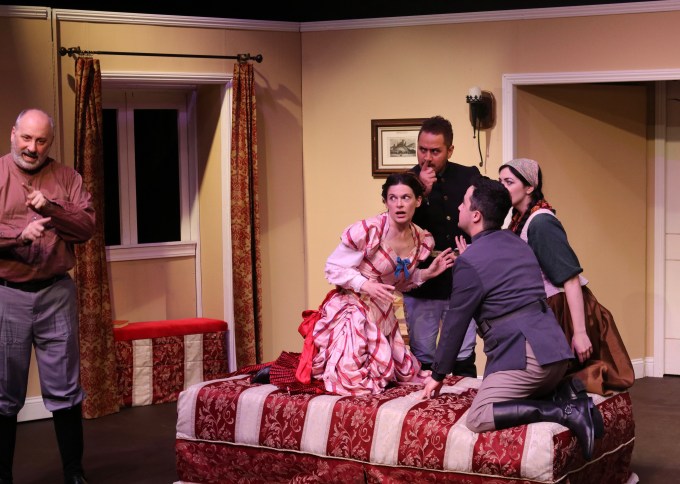
Mitchell VanLandingham as Captain Bluntschli, Samira Sheahan as Raina. All photos by Judy Potter.
Anti-war messages have appeared in all art forms since their inceptions. Sub-themes include the notion that because of their different nature, we would have no wars if women were national leaders. While there might be fewer wars, you need look no further than Golda Meir, Indira Gandhi, and Margaret Thatcher (or this play’s opening scene?) to disprove the universalism of that thought. Perhaps more reliable is the claim that wars are fought largely by the poor on behalf of the privileged.
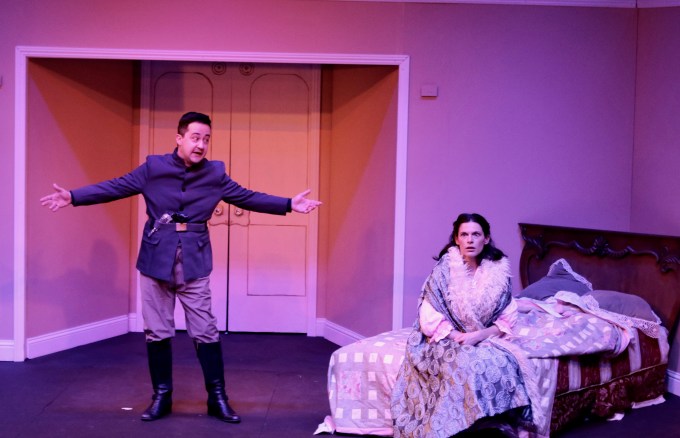
Nobel Prize winner George Bernard Shaw’s 1894 exploration of the futility of war opens with a mother and daughter giddy about the victories that their beloved have scored over the enemy as if they were rhapsodizing over the love scene of a matinee idol. The setup occurs during the final days of the Serbo-Bulgarian War. A Swiss mercenary, Captain Bluntschli, who has fought for the Serbs sneaks away from the fracas into the home of the Bulgarian Army leader, still away, and insinuates himself on the Bulgarian’s daughter, Raina.
The clash of beliefs comes when the professional military man disabuses Raina’s fantasy by claiming that nine of ten soldiers are fools. Her idealism about military comportment is further undermined when he tells her that he uses his ammo pouch to carry chocolates, not bullets. When he later ravages the remains of a box of her chocolates, he would become her “chocolate-cream soldier.” Variations of that term have since entered military parlance worldwide, and always as a pejorative.
Cast.
B8 Theater Company of Concord has taken on Shaw’s classic, and their production is another indicator of the depth of theatrical talent in the Bay Area. Director Becky Potter has chosen a farcical mode by having actors exaggerate their portrayals, virtually screaming their lines, and using overwrought gesticulation and expression. While some observers may not care for the mannerism, it works well with the material, and those who often complain that they can’t hear dialog from a stage should not have that issue in this intimate venue.
A minor criticism about the delivery of the dialog is that it is sometimes a little halting, which impairs the effect and slows the pacing. And while drama can usually indulge variations in meter, comedy demands split-second timing. Another concern about transporting these revivals to the stage is that references with emotive impact from other eras may be lost on today’s audience, and the very nature of what tickles the funny bone varies by time and place. That said, this worthy play deserves attention.
Kayla McConnell as Louka, John Mosa’ati as Major Sergius Saranoff.
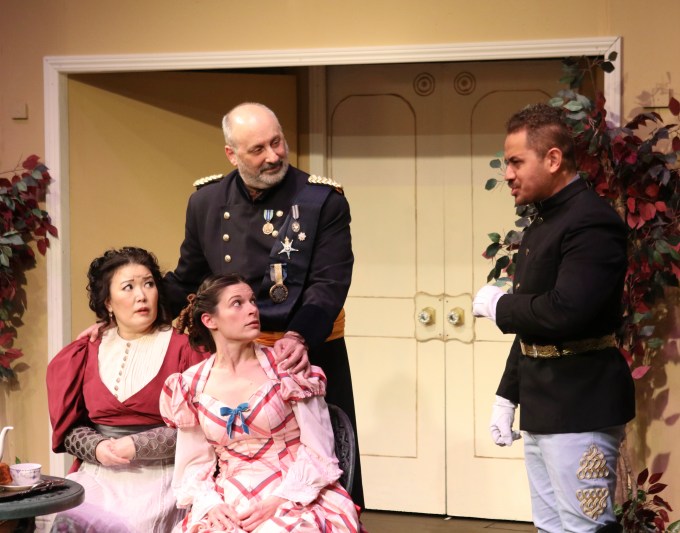
Otherwise, the acting is bright and commendable, particularly from the two male leads. As Bluntschli, Mitchell Van Landingham, at first seems soft for the role of a mercenary officer, but he displays defined facial expressions and verbal demeanor that make for a winsome characterization. His battlefield and romantic rival, Major Sergius Saranoff, played by John Mosa’ati, is engaged to Raina, an effective Samira Shahan, whose part however is one-note. Mosa’ati’s verbal and physical swagger perfectly fit the preening peacock.
Apart from denigrating the quest to conquer enemies in war, Shaw attacks other social behaviors as hypocritical and self-serving. The wealthy Saranoff has dalliances with the maid, Louka. Along with the Bluntschli-Raina relationship, social class implications are revealed. And the spirited major, reflecting the sensibilities of the day, challenges Bluntschli to a duel, but the more experienced and level-headed Swiss man has other ideas.
Helen Kim as Catherine Petkoff, Samira Sheahan as Raina Petkoff, Jason Berner as Major Paul Petkoff, John Mosa’ati as Major Sergius Saranoff.
Kudos to Diane McRice’s staging, which involves a single set-frame which is amended and accessorized as three different locations. One matter prompts comment only because of the Director’s Note in the program. Apparently, the word ottoman appears in the stage directions 27 times but never in the dialog. What appears to be a day bed centers the stage in Act 3. While it could be characterized as a mammoth ottoman, virtually anyone’s vision of that apparatus is as an overgrown, symmetrical foot rest, and this representation doesn’t work. The significance of the word is that Bulgaria was subjugated by the Ottoman Empire when the play was written and would not achieve independence until 1908.
Arms and the Man, written by George Bernard Shaw, is produced by B8 Theatre Company and plays at The Campbell Theatre, 636 Ward Street, Martinez, CA through March 22, 2026.


 cordellreportsdotcom