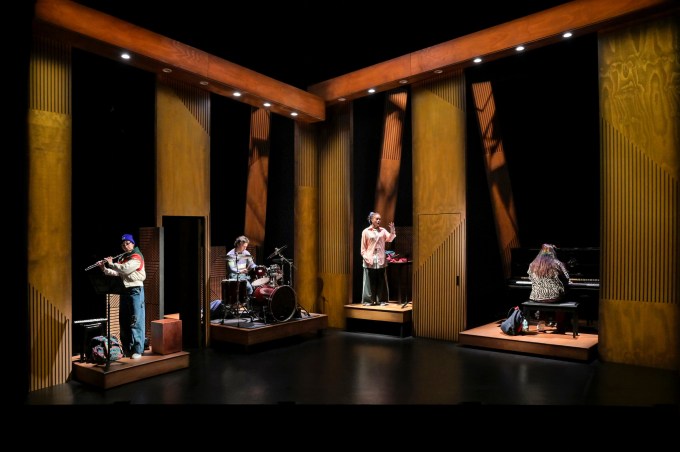
To begin with, let’s decipher the title. The first and last words directly relate to the content of the play as the narrative concerns a music summer school for high school girls in Berkeley, California. The middle word specifically refers to aleatory music which includes randomness in composition or scope for individual interpretation by the performer. More broadly, chance encompasses all manner of stochastic outcomes in the girls’ lives – from fortune or misfortune of birth and family to getting a lottery assignment to a school with a music program to the unpredictable outcomes of improvisational jazz. (The students fall into two camps of performance – improv and classical.) The symbols of the two vertical pipes with a colon in the title are “begin repeat” (with colon after) and “end repeat” (with colon before) indicators in a musical score. Serious music players confront many recurrences, the most common of which is rehearse, rehearse, and then rehearse.
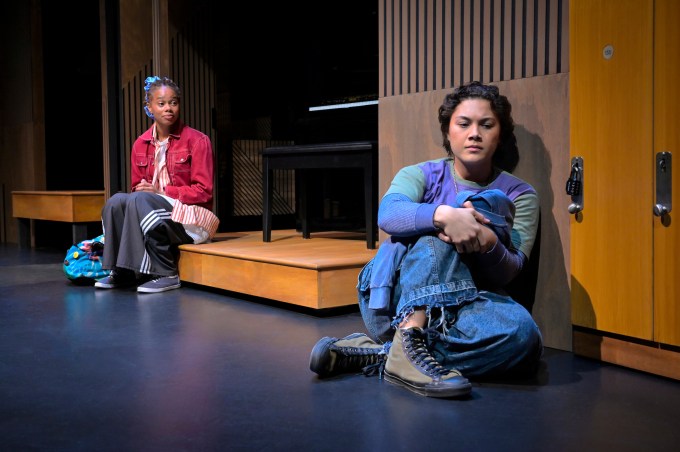
The Eisa Davis written play is a four hander about a group of girls new to each other who find bases for performing together. But apart from developing musicianship, it is about girls being girls with their yearning for affirmation and friendship, sometimes upended by resentment, envy, and misunderstanding.
From the start of the play, the element of chance enters. When the fixed story begins, the lively and level-headed singer Fax (Hillary Fisher) is assigned a pianist, the stoner Rile, (Yeena Sung) as an accompanist, and in the middle of Fax’s singing an opera aria, Rile goes on improvisational tear, illustrative of the classical/improv clash. Also joining the fray are the mercurial and mysterious percussionist Margot (Naomi Latta), and what instrument is more inherently improv than drums? Finally, we have the breezy and independent wind player Clementine (Gianna DiGregorio Rivera) in a curiously underwritten part for such a small ensemble.
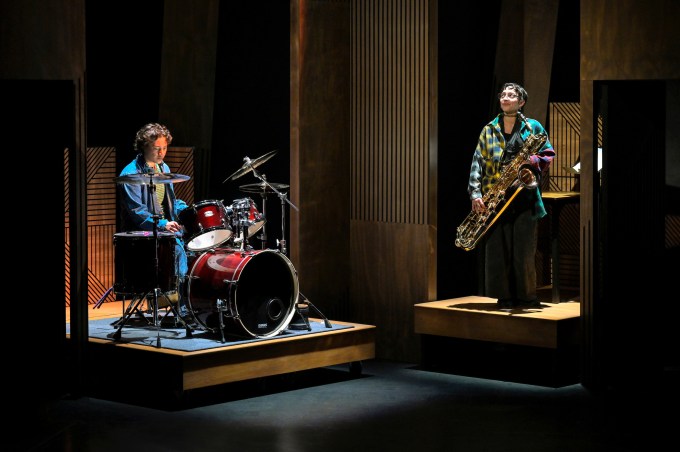
Laudably, ||:GIRLS:||….. reflects its intellectual power throughout with its aspiration to educate along with entertaining, and it particularly benefits and suits a younger audience with a serious interest in music. But as a stage drama it could use more cohesiveness. As somewhat a gimmicky prelude to the action, 12 audience members select 12 keys from a piano on stage, a random outcome, and music is composed and performed by the actor/musicians using only those notes. And while this device is instructive and even interesting, it deflects from dramatic impact of the story line. The play tries to be too many things that are out of balance or don’t mesh together. Also, there was one musical performance in the latter part of the show that was far too long to fit in with an absorbing dramatic pace.
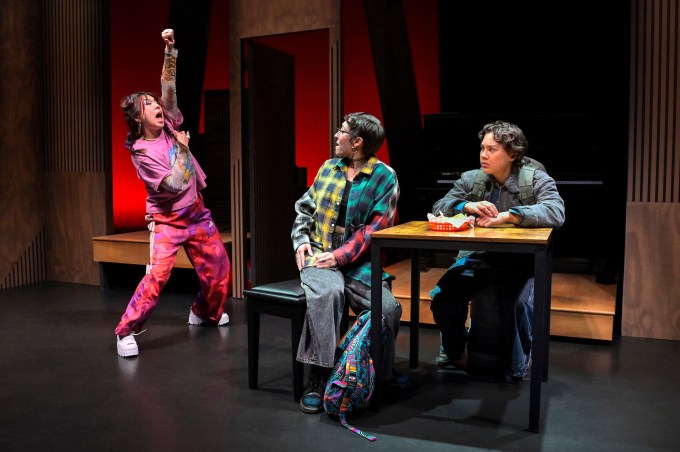
Engaging story elements and characterizations punctuate the action. Friendship alliances emerge, sexual preferences are exposed, and a diversity of family compositions and lifestyles affect the girls individually and collectively. An overall contributing theme is the idea of female empowerment, reacting to the notion that women are expected to defer to others, even to one another. These thematic aspects make for thoughtful theater, and musical expression using the framework of girls’ summer music school has an important place in the mix.
Another theme is the question that each participant who may wish for a career in music must answer: “What does music mean to me?” Like in the movie “Whiplash,” the moody Margot is wholly absorbed by rhythm. Will she be the one who succeeds in the business?
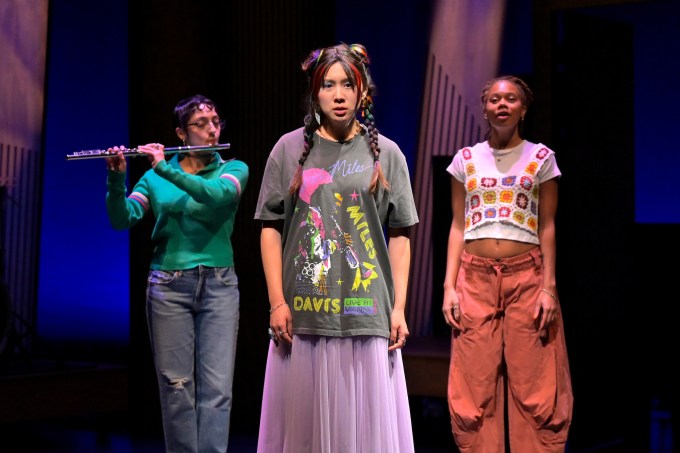
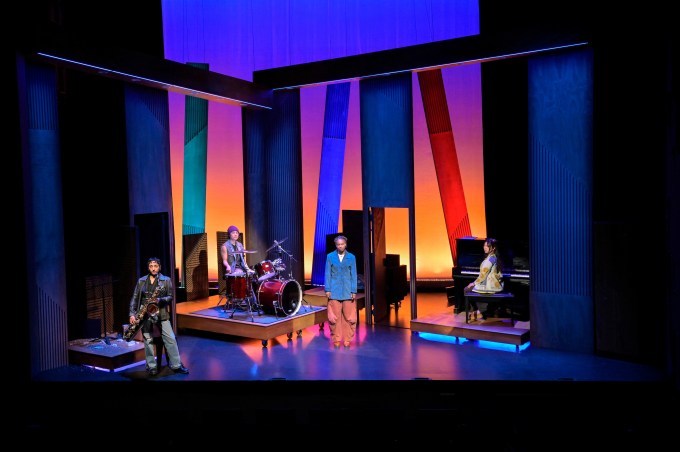
Director Pam MacKinnon, in her swan song as Artistic Director of the company, has enlisted and coordinated a fine team. Acting and musical performance meet standards, while some of the artistic design contributions are stunning. Nina Ball’s deceptively simple but powerful wedge-shaped set employs various types of columns, including non-vertical, in natural wood with faux-fluting. Their wonderful aesthetic design and spatial relationships beautifully interact with Russell H. Champa’s dramatic and at times colorful lighting to create uncommonly coordinated and outstanding visual imagery. As an illustration, compare the first and last photos in this review.
On the negative side, the sound design decision to eschew voice amplification doesn’t work except for audience in the first tier of the theater. A common discussion point by patrons in the upper deck after opening night was that they might have appreciated the performances if they could hear half of the dialog. Even though I heard the greater part of it, straining to understand means missing nuance and distracts from overall appreciation.
Premiers usually undergo revisions that benefit the long-range prospects of the show. This play has so much going for it that hopefully some tweaks can give it legs.
||:GIRLS:||:CHANCE:||:MUSIC:||, a world premiere, is written by Eisa Davis, produced by American Conservatory Theater and Vineyard Theatre Company, and performed at ACT’s Strand Theater, 1127 Market Street, San Francisco, CA through April 19, 2026.
 cordellreportsdotcom