Pipeline

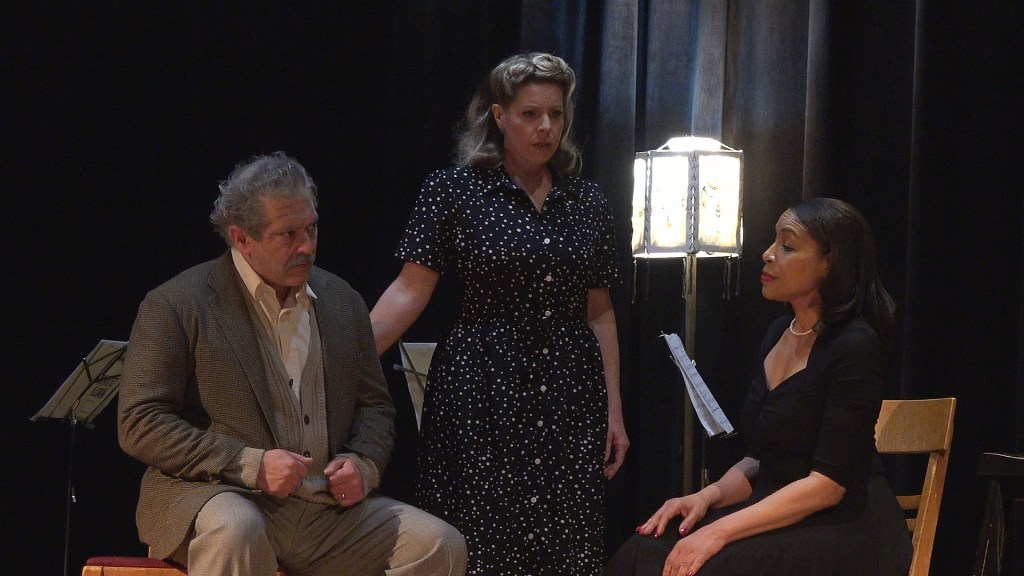
Leontyne Mbele-Mbong as Nya, Atlantis Clay as Omari. All photos by Joseph Giammarco.

Many events in the life of a mother can be distressing.  Among the most is when her child’s very public actions come into conflict with the mother’s values and jeopardize the child’s future…..

Dominique Morisseau has become one of the most distinguished playwrights of her generation.  A MacArthur Fellowship (“Genius Grant”) winner, she made her mark with her Detroit Project trilogy, which focuses on the Black community in her Michigan hometown.  She followed the last of those three plays with “Pipeline.”  Like its predecessors, this play exudes insight and power.  African-American Shakespeare’s L. Peter Callender-directed production totally enthralls as it extracts every bit of relevance and urgency from the taut and compelling script.

The title of the play derives from the tragic arc that many Black boys and young men follow.  Numerous studies have established that Black children in schools are subjected to more disciplinary measures than Whites and that their punishment is more extreme.  In the past, virtually all school conflicts were adjudicated by the school administration.  In recent decades, administrators have often turned to the police to intervene.  The consequence is that many Black males have been arrested and charged for behaviors in school before they have become men.  The taint of arrests and missed classes impacts their ability or desire to complete school and their employability, leading to the school-to-prison pipeline.

Atlantis Clay as Omari, Ije Success as Jasmine.

Black, divorced, single parent Nya teaches in a high school that her son Omari would attend if he were to go to public school.  Leontyne Mbele-Mbong is Nya, and she gives an exquisite, nuanced performance.  As one would expect from an aspirational teacher who also acts as a role model, her rage is as controlled and disciplined as her arguments.

Her son, Omari (Atlantis Clay), is bright and able to compete intellectually in a selective private boarding school, but he suffers social/psychological isolation and has had some deportment problems.  When we meet him, he is with his girlfriend Jasmine (Ije Success).  The scene seems out of place until we find through Jasmine that the damning incident of Omari’s pushing a teacher has been video recorded and has been posted on the Internet.

As a mother, Nya’s instinct is to protect her only child.  As a teacher, she feels strongly about civil rules that allow schools and all of society to function properly, even over Omari’s protestations that he was provoked by a biased teacher who made insinuating connections between Omari and the character Bigger from Richard Wright’s novel “Native Son.”

Michael Gene Sullivan as Xavier, Gary Moore as Dun, Atlantis Clay as Omari.

Nya’s ex, Xavier (Michael Gene Sullivan), is prosperous, and both parents are committed to giving their son all of the tools for success, including the private schooling.  Nya’s ambivalence, humility, and problem-solving approach in dealing with a possibly life-altering incident is countered by her ex, Xavier.  Morisseau delineates his character with unflattering precision.

Xavier’s power-based approach and certainty about the right courses of action is matched by the likelihood that his actions will have the opposite effect intended.  We see in his relationship with Omari the classic responsible, but absentee, father.  The checks and birthday presents are always on time, but he lacks a drop of human compassion, which may have led to the marital split as well.  And when it comes to blame, Xavier lays it on anyone but himself.

A subplot acts as a cross current.  In the classroom of a White teacher, Lauri (Kelly Rinehart), a violent fight takes place.  According to the security officer Dun (Gary Moore), protocol suggests that a teacher should always stay clear of the fray and only call security.  But when faced with a brutal struggle that could lead to serious injury or worse, should the teacher stand by or take action, and if so, what? The luxury of reflection does not exist.

In an intense 95 minutes, the playwright surfaces a number of universal relationship as well as racial issues.  Parents often feel accountable about how their children have been reared, and Nya feels guilt about whatever failings Omari manifests.  She also feels protective, knowing that as a young Black man his mere presence and innocent actions can be perceived by Whites as too this or too that.  And unlike Xavier, she is willing to make personal sacrifices for her son.

Leontyne Mbele-Mbong as Nya, Kelly Rinehart as Laurie.

From the opening video projections of violence in schools involving police, this production offers a chilling reminder of our country’s failure to create social harmony and a fair playing field for all of our people.  Unfortunately, the play provides no answers other than to suggest that there is much work to be done.

Fortunately, the production is graced with an ensemble of exceptional actors who bring veracity and passion to their roles.  Giulio C. Perrone’s set design is appropriately simple and leaves it to the words of the playwright and the delivery of the actors to instill the meaning.

Interestingly, the highly regarded film “The Hate U Give” was developed contemporaneously to “Pipeline.” For those interested in different perspectives on similar issues, it covers some of the same concerns and is recommended as a companion piece.  Both note how Whites can often misunderstand and miscommunicate with Blacks, sometimes insulting with or without intention.  Each deals with the lifelong risks of simply being Black and the code of silence in not betraying one of their kind to authorities, despite adverse consequences.  Finally, they deal with the cost that may be associated with taking responsibility, whether Black or White. 

“Pipeline” written by Dominique Morisseau, is produced by African-American Shakespeare Company, and plays at War Memorial Veterans Building, 401 Van Ness Ave., San Francisco, CA through March 31, 2024.

The Far Country

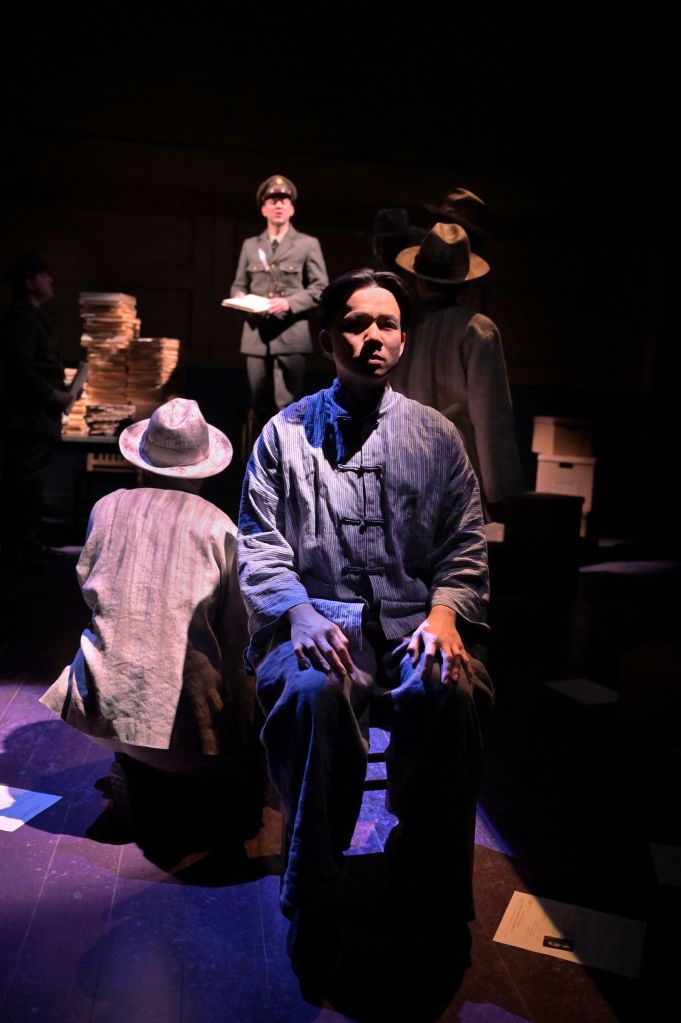
Feodor Chin as Gee, Aaron Wilton as Interrogator. All photos by Kevin Berne.

From 1886, the Statue of Liberty in New York Harbor has stood as a beacon for immigration to the United States with its welcoming inscription from poet Emma Lazarus, “Give me your tired, your poor, your huddled masses yearning to breathe free.”  Warmly admired by most Americans, its neighbor, the storied Ellis Island served as an efficient processing station for millions of European immigrants, unrestricted from entry until World War I.

Apart from the Asian-American community, many Bay Area residents, and some others along the West Coast, relatively few people are aware of Ellis Island’s counterpart, Angel Island in the San Francisco Bay.  From 1890, it served to reject applicants from Asia rather than welcome them, especially through enforcement of the Chinese Exclusion Act of 1882 and its successors.  Unambiguously racist, these laws prohibited immigration of any Chinese person except for those who could successfully claim that they were spouses or progeny of American citizens.  Ellis Island processed the incoming briskly, but detention at Angel Island lasted days, sometimes months, and up to two years.

Cast.

While playwright Lloyd Suh’s “The Far Country” is fiction, its gripping depiction of history, incidents, and characters might well be considered a stellar exemplar for events of its time, which spans from 1909 to 1930.  The play engages from opening curtain, thoroughly engrossing as it invades the sympathetic sensibilities of the audience.

In scene one, Fyodor Chin offers a magnetic tour de force performance that sets the stage for the whole play.  As Gee, a Chinese man resident in San Francisco, he wishes to travel to China, purportedly to bring his son to the United States.  He lacks proof of his right to be in the United States, and all of the immigration and naturalization records generated at Angel Island were destroyed by the 1906 San Francisco earthquake.  The restrictions of the Exclusion Act compounded by the loss of records spawned a massive cottage industry, with Chinese like Gee concocting elaborate origin stories in hopes of gaining permanence in “Gold Mountain,” as the U.S. was known in China.

Tess Lina as Low, Feodor Chin as Gee.

Interrogators at Angel Island used devious methods to try to expose elaborate hoaxes by seeking fine detail like how many steps at the front door of an applicant’s house in China, and what material, what color, and what texture they possess.  They often repeated questions at a later time and sought corroboration from others who should have had the same answers, even if it’s information most people would not know to begin with.

Gee’s interrogators appear heartless and clearly inclined to reject his application, as the extent of fraudulent misrepresentation they confront from men like him is profound.  As Gee, Chin deals with these challenges unflappably.  Ebullient, constantly smiling, and flailing his arms, the interrogators fail to pierce his practiced confidence.

The central thread of the narrative is Gee’s wanting to recruit a teen in China who can act as his fictitious son and who will pay to become indentured to Gee and his laundry business in San Francisco’s Chinatown.  That target is Moon Gyet, played by Tommy Bo, who must also memorize a script compatible with the stories of his presumptive father.

Tommy Bo as Moon Gyet, John Keabler as Interrogator.

Along the way, Moon Gyet will also confront a prospective wife of convenience, Yuen, who is played playfully, sassily, inquisitively, and assertively by Sharon Shao.  Led by Yuen’s constant badgering about what kind of relationship they would have (sex included?), the two find tremendous humor in their simple exchanges, producing one of the several effective and unexpected tone shifts in the drama.  In other scenes with changes in dramatic tension, Gee will reveal two personality transformations that not only enrich Chin’s characterization, but add to the kudos his acting deserves.

One of Moon Gyet’s revelations is that Chinese immigrants never see the Gold Mountain that they dream of but that he believes exists.  He speaks of the crowding, the loneliness, the bad food, and the implied caging of the Chinese in their ghetto because of the prejudices of white society.  So why do they come?  Part of the stereotyping of Chinese is that they are patient, sacrificing, and forward looking.  In this case, the adventuresome believe that theirs is the first step in a long march that will eventually benefit their descendants.

“The Far Country” unfortunately rings true in many ways.  And in fairness, it is not just the white Americans whose integrity is impugned but also the Chinese.  Ultimately, however, the optimism for a better world does come through.

Tommy Bo as Moon Gyet.

The story compels, and the striking artistic elements directed by Jennifer Chang enhance its telling in many ways.  Notwithstanding the play’s assets, the closure does contain an excess of earnestness.  There are other weaknesses like the excessive exposition about the conditions of detention.  Even that is presented in an artistic manner with dim lighting and constant movement of anonymous characters who describe the strictures.

An annoyance is that translators’ commentary overlaps the principal speakers to make dialogue harder to hear.  Supertitles could be employed, or translators could use indistinct low mumbling when the main characters are speaking so that the audience understands the process without disrupting the primary conversation.  Despite any minor criticisms, the play offers a powerful and memorable experience that is recommended for all theater audiences.

Tommy Bo as Moon Gyet, Sharon Shao as Yuen.

“The Far Country,” written by Lloyd Suh, is produced by Berkeley Repertory Theatre and plays on its stage at 2025 Addison Street, Berkeley, CA through April 14, 2024.

Rigoletto

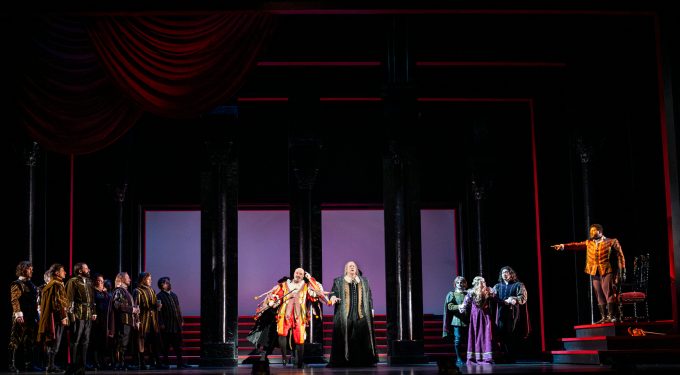
Duke of Mantua (Edward Graves), Rigoletto (Eugene Brancoveanu). All photos by David Allen.

The sixteenth of Giuseppe Verdi’s operas, “Rigoletto,” which debuted in 1851, marked an inflection point in the composer’s career.  The opera represented his first masterpiece of the highest order and the beginning of his rich middle period trove, to be followed immediately by “Il Trovatore” and “La Traviata.”  Although the libretto truncates important developments in the narrative, it touches on numerous themes from family relationships, romantic love, and gender norms to honesty and integrity.

Rigoletto (Eugene Brancoveanu, center) and Monterone (Philip Skinner, center), Duke of Mantua (Edward Graves, right).

“Rigoletto”’s brass-dominated foreboding prelude and this production’s mostly low lighting and darkened sets foretell the tragedy ahead.  The drama is intense and dispiriting, but the music is glorious like few other operas.  Four of its highly melodious and uplifting arias and quartets are fixtures in opera music compilations.  Remembering them may cause one to forget how many other luxuriant phrases and passages grace the score, not to mention the fireworks from the many highly emotional tracks.  Act 1 alone contains a complex double ensemble and two beautiful duets.

Rigoletto (Eugene Brancoveanu), Gilda (Melissa Sondhi).

Opera San Jose offers a highly entertaining, riveting, and traditional rendition, maintaining the complexion that made the opera controversial in its own day for its immorality and even more so in current times for its social incorrectness.  The jester Rigoletto hypocritically obsesses over his daughter Gilda’s honor, yet publicly lampoons courtiers as being cuckolded.  At the same time, women are treated as chattel.  Rigoletto’s employer, the Duke of Mantua, lies and debauches, yet Gilda, will make the ultimate sacrifice to protect the Duke, her abusive and libertine lover, who has shown no reciprocal commitment.

The taunted and isolated Rigoletto, who values only Gilda in this life, is portrayed by Eugene Broncoveanu, OSJ stalwart and veteran of the role.  His deceptively effortless and clarion baritone booms throughout this demanding part, which requires diverse acting skills as well as a versatile voice.  Those qualities culminate when Rigoletto confronts the courtiers upon learning that Gilda has been kidnapped.  Interestingly, the title role is large and presents vocal challenges, yet with the exception of a small participation in the glorious quartet section of “Bella figlia dell’amore” (“Beautiful daughter of love”), it lacks a real signature number.

Rigoletto (Eugene Brancoveanu), Gilda (Melissa Sondhi).

Rigoletto has cloistered Gilda so that she doesn’t know the ways of the world.  Her naivete leads to her deceiving her father and the impulsive willingness to give up her life for love.  Soprano Melissa Sondhi is Gilda, and early in Act 1 on opening night, her voice sounded thin and strained.  Fortunately, she was fully prepared by the end of the act for the moment that emblemizes the innocent girl.  The haltingly beautiful “Caro nome” (“Dearest name”) tells of her first love, really an infatuation, for the student Gualtier Malté, who is the Duke in disguise.  Sondhi’s voice was warm and evocative, and she milked the brief aria for all it is worth.  The silences between single notes were palpable, and her ornamentation was delightful.

Gilda (Melissa Sondhi, left), Sparafucile (Ashraf Sewailam, center), Duke of Mantua (Edward Graves, right).

Detached from the opera, and without knowing the context of its most famous arias, one might think that the Duke is heroic, rather than the cad he really is.  His “La donna è mobile” (“Woman is fickle”) is one of the most famous arias in the consciousness of the general public, but the Duke also sings the bouncy “Questa o quella” (“This woman or that”) and the solo portion of lavish “Bella figlia dell’amore.”  Tenor Edward Graves handles each with great dexterity and in fine voice.  His Italianate melodiousness (some might say twang) fits perfectly with this great work from the Italian canon.

Maddalena (Melisa Bonetti Luna), Rigoletto (Eugene Brancoveanu), Sparafucile (Ashraf Sewailam).

The supporting cast is strong.  Two basses stand out – Philip Skinner as the mournful and vengeful Monterone who issues a curse on Rigoletto, and Ashraf Sewailam as Sparafucile, the assassin who Rigoletto pays to murder the Duke.  Mezzo Melisa Bonetti Luna shines as Maddalena, Sparafucile’s sister, whose morality falls beneath her brother’s.  Conductor Jorge Parodi keeps the orchestra and action at a brisk pace making for a highly rewarding experience.

“Rigoletto” composed by Giuseppe Verdi with libretto by Francesco Maria Piave produced by Opera San Jose, plays at California Theatre, 345 South First Street, San Jose, CA through March 3, 2024.

Corpus Evita


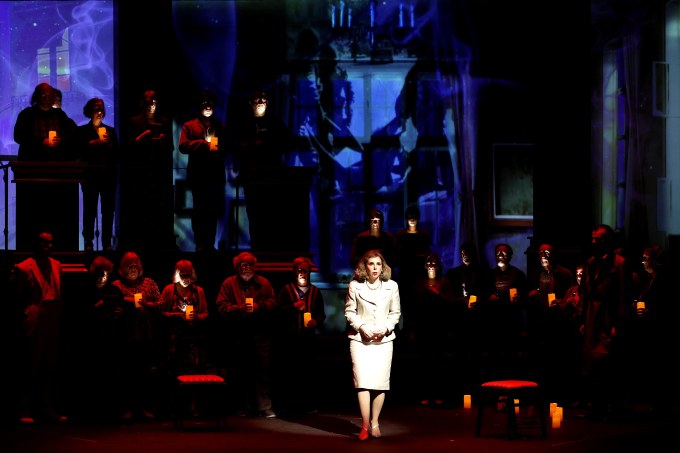
Eva Perón (Jessica Sandidge), Juan Perón (Casey Germain), Doctor (Anders Froehlich), Ministro (Patrick Bessenbacher). All photos by Otak Jump.

The name Perón is synonymous with modern politics in Argentina.  Juan Perón was a dominant post-WW2 populist president.  His second wife Evita became a mystical talisman for the country’s working class seeking a better way of life, but she died tragically in 1952 at age 33.  Perón was overthrown in 1955, but returning from exile, his third wife, Isabel, became his running mate in 1973 and succeeded him upon his death.   She sought to resurrect the magnetic aura of Evita as her own, only to be repudiated and overthrown by a military coup in 1976.

In fashioning “Corpus Evita,” composer Carlos Franzetti and librettist José Luis Moskovich explore the charisma of Juan and Evita, in contrast with Isabel’s doomed ascent and rejection, replete with the apparitions of her predecessors.  The seldom produced but remarkable musical drama was nominated for a Grammy in 2005.

Isabel Perón (Sara LeMesh), Ministro (Patrick Bessenbacher).

West Bay Opera offers a musically and visually powerful rendering of this piece which holds special resonance for its creators.  Both composer and librettist grew up in Argentina in the Perón era; were teenagers during Isabel’s regime; and ultimately crafted this operatic indictment of Perónism that many in their home country would find objectionable.  The librettist is West Bay’s General Manager, its artistic visionary, and the conductor of the orchestra.

The vivid look of the opera from Peter Crompton’s set and projection design appears from the start, with a classic public-appearances balcony surrounded by expressive and detailed projections that give depth to the stage.  At the opening, Evita bids farewell to her admirers from the balcony as she is dying from cancer.  In her soliloquy, soprano Jessica Sandidge cuts a striking and authentic figure as she powers through the high passages with grace and authority.

Doctor (Anders Froehlich), Corpus Evita (Laure de Marcellus).

The scene then shifts to 1974.  The central focus throughout the narrative is on the unprepared and hapless Isabel who considers herself well-intended but is unable to offer the hope and magnetism of Evita.   Feeling ineffectual and trapped, she meekly authorizes actions that result in the murders of thousands of innocent people.  Soprano Sara LeMesh adeptly captures Isabel’s inner conflict and sings her anguish with strident conviction without losing her eloquent vibrato.

A composite figure, Ministro, is the male lead, performed by tenor Patrick Bessenbacher.  He poses an ominous figure as the behind-the-scenes manipulator who hopes to resurrect “the flame of Evita” through Isabel.  He scorches his rage through his mid and upper range, but is asked to dig lower at times, and gets lost beneath the orchestra.

Isabel Perón (Sara LeMesh).

The musical idiom of the piece is neoromantic, without memorable melodies but continuously attractive.  Lush strings-forward sound dominates, with percussion often finishing, especially in heated sequences.  Notable choral contributions also include rhythmic, percussive effects, especially through repetition like “Evita. Evita. Evita” or “Isabel. Isabel. Isabel.”

Ensemble pieces also appeal.  Evita and Juan, sung by bass Casey Germain, engage in a self-indulgent duet at a grand ball, and the contrast of voices works particularly well.  Conversely, Isabel and Ministro vocally shout blame at each other with controlled fury in their electric exchange.  In a revelatory trio, Isabel, Juan, and Ministro share their different perspectives and shared regrets from Isabel’s failed regime.

Ministro (Patrick Bessenbacher).

“Corpus Evita” deals intelligently with important themes.  And though the conceit of magical realism allows for great leeway, because this opera deals with critical historical issues, accuracy is important.  Greater clarity would be welcomed in the plot line.  Simply including dates (which are in the program) in the supertitles would help orient the patron, as the timeline jumps by decades and is not chronological.  And though the device of Evita as an apparition is clever and understandable, a scene that includes Isabel with both Evita and Corpus Evita is not clear.

The events depicted in the opera are highly dramatic and engaging.  However, the drama is disrupted by emptiness during slow scene changes.  If the set change can’t be hastened, one solution is to move transitional action in front of the curtain while props are being moved.  Another is to add bridge orchestration for the changes.

Juan Perón (Casey Germain), Eva Perón (Jessica Sandidge).

Nonetheless, this opera offers a scintillating and worthy experience with beautiful music, an important storyline, and an opulent production.  Thematically, it excoriates Perónism as a symbol of populism, decrying the cult of personality and myths that invariably lead to tyranny.  Regrettably, many people fall captive to auras and neglect substance.  We face the same chilling challenge in this country today.

“Corpus Evita” with music by Carlos Franzetti and lyrics by José Luis Moskovich is produced by West Bay Opera and plays at Lucie Stern Theatre, 1305 Middlefield Road, Palo Alto, CA through February 25, 2024.

My Home on the Moon

Jenny Nguyen Nelson as Mai, Rinabeth Apostol as Vera, Sharon Omi as Lan. All photos by Jessica Palopoli.

Innovation has shaped the experience of humanity.  From hand tools to machines to computers, implements have reduced our burdens and determined how we go about our work and play.

Otherwise, from the dawn of humankind, dreams have reflected perceptions of a different world lived within – sometimes grand in our wakeful imagination, sometimes fearsome in our sleep.  But more recently, the innovations of virtual reality and artificial intelligence enhance perceptions and transport us to new and different realizations.  Playwright Minna Lee’s world premiere dramedy “My Home on the Moon” explores such an alternate reality, and San Francisco Playhouse delivers a richly rewarding production.

Sharon Omi as Lan.

Lan is a middle-aged Vietnamese-American woman who owns a café, Pho Lan, that offers only one item, the eponymous, famed noodle and meat soup from the country of her birth.  Young Mai, a dropout from a gourmet cooking academy, produces Lan’s recipe.

Though the soup is highly regarded, the café has fallen on hard times as the neighborhood gentrifies; other shops are closed to be replaced by construction for high rises; and the old customers move on.  Pho Lan faces closure when a seeming white knight comes along.  Lan learns that the shop has “won a grant” from the mysterious Novus Corporation.  Its representative, the marketing-savvy and charming but herky-jerky Vera organizes a new marketing campaign that Novus will sponsor.  It begins with a stylish update of the downmarket noodle shop that includes a lush Southeast Asian jungle.  But the promotions also include incongruous advertising with a vulgar couple engaging in sexualized acts, not something usually associated with a pho cafe.

Will Dao as Food Critic, Sharon Omi as Lan, Jenny Nguyen Nelson as Mai, Erin Mei-Ling Stuart as Camera Person.

The marketing plan works!  Pho Lan can’t keep up with demand, and even adds another popular menu item, bán xèo, a Vietnamese crepe.

So what’s wrong with this picture?  Without giving away too much, let’s say that we see the clash between fantasy and reality.  And since the fantasy experience is superior, it begs the question why we would ever want to come back to reality.  Although the script has logic holes, it could not be more timely.  It provokes thoughts about how we confront and assess the limitless potential and onslaught of falsehoods, security risks, displacement, and more that arise from artificial intelligence.

Erin Mei-Ling Stuart as Gigi (CEO of Novus), Will Dao as Beau (former employee of Lan).

Although the issues surfaced are serious, the overall tone is light.  The action occurs at the time of Tet with lion dances highlighted.  Separately, Lan and Vera perform humorous song and dance numbers demonstrating both Eastern and Western footwork.  Meanwhile, Vera’s personality is quirky altogether, while Will Dao’s food critic is outlandishly hyper and funny.

The cast is led by three captivating and contrasting female leads.  Sharon Omi is Lan, a smiling, sympathetic character who holds to tradition and hope.  This kind older woman treats Mai as a daughter.  As Mai, Jenny Nguyen Nelson is more grounded and concerned about the influx of unpaid bills that could cause the shop to close.  Vera becomes the catalyst for change, and an enthusiastic Rinabeth Apostol cooks up the marketing plan but has much to learn herself, much of which she will gain from a personal relationship with Mai.  Will Dao and Erin Mei-Ling Stuart give solid performances in multiple supporting roles.

Rinabeth Apostol as Vera, Jenny Nguyen Nelson as Mai.

Another big star is the production design led by Director Mei Ann Teo.  With the utilization of its revolving platform, SF Playhouse sets the Bay Area standard for multi-set staging, and Tanya Orellana’s clever use of the space complemented by Vincent Chau’s props results in a remarkable design.  Three essential lighting-related treatments complete the overall appearance.  Lighting Director Michael Oesch employs several lighting features including color changes to produce the look.  Jacqueline Scott, the specialty properties designer, implements the long snake-like light noodles.  Finally, Hao Bai’s inward swooping isobar projections create the appropriate symbolic sense of tumbling down the rabbit hole.

Sharon Omi as Lan.

“My Home on the Moon,” a world premiere written by Minna Lee, is produced by San Francisco Playhouse and plays on its stage at 450 Post Street, San Francisco, CA through February 24, 2024.
Cult of Love


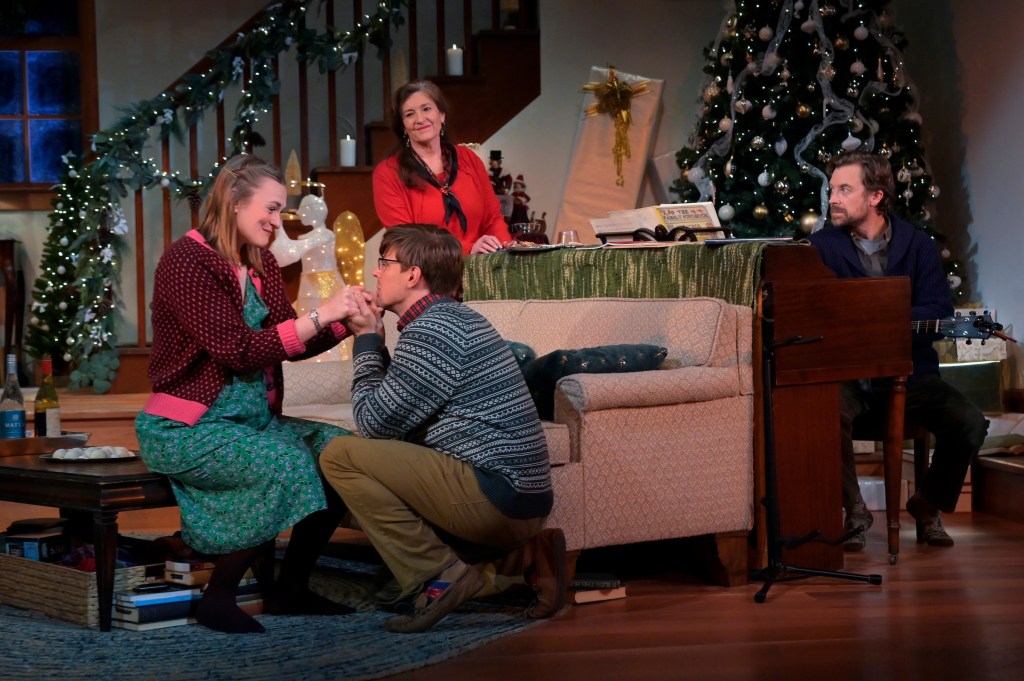
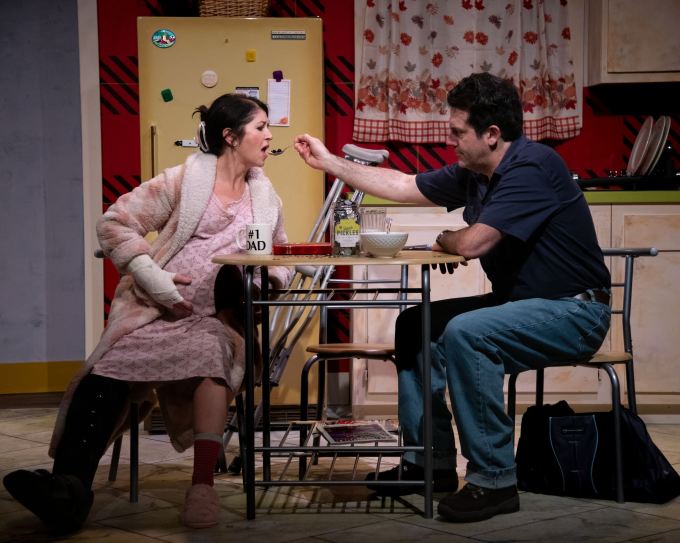
Cass Buggé (Pippa Ferguson – Evie’s wife), (above) Kerstin Anderson (Diana Dahl Bennett – daughter), Virginia Kull (Evie Dahl – daughter), Luisa Sermol (Ginny Dahl – mother), Lucas Near-Verbrugghe (Mark Dahl – son). All photos by Kevin Berne.

It all starts in Kumbaya spirit.  Adult children and their spouses gather with their parents at the Dahl family homestead, festively fashioned for Christmas.  Smiling and enthusiastic, they sing holiday and folk traditionals like “A’Soulin” and “Children, Go Where I Send Thee.”  Later, in memory of a trip to the Great Smokies, the four children sing a beautifully harmonic “Oh, Shenandoah.”  But like their erroneous connection with that song, which actually relates to an Indian chief, the familial harmony is an illusion, as it occurs almost solely when they join in song.

Dan Hiatt (Bill Dahl – father), Virginia Kull (Evie Dahl – daughter).

Playwright Lesley Headland has crafted a wildly entertaining and stunningly searing indictment in “Cult of Love,” the final chapter in a seven-play series.  Trip Cullman, a frequent collaborator with Headland, directs a stellar cast to a masterful and captivating production.  Each play addresses one of the Seven Deadly Sins, with this installment focusing on pride, which in some ways can be considered a master sin, as it can lead to committing most of the others. 

Bill and Ginny Dahl fervently identify themselves as “Christians” and raised their children accordingly. Christmas takes on special meaning for them, as the children ritually return home for the holiday; sing carols; eat lamb dinner prepared by the father; and take the obligatory photo of the four kids together smiling. 

Lucas Near-Verbrugghe (Mark Dahl – son), Molly Bernard (Rachel Dahl – Mark’s wife).

But ultimately, the traditions become disingenuous as children gain their own sense of agency, and gaping fissures appear in the relationships.  The uber-talented and academically accomplished Mark has settled for a government job, married a Jewish girl and seemingly repudiated Christianity.  Johnny is a recovering heroin addict and unmarried.  Evie is a lesbian and in a same-sex marriage.  Finally, Diana has become a doctrinaire fire-and-brimstone zealot who castigates and alienates those around her with her judgmentalism and rigidities.

Parents always hope to love their children, but the elder Dahls must confront children whose actions contradict the parents’ beliefs.  Not exactly what the parents hoped for.  But like Christian fundamentalists, Ginny’s belief-driven system extends beyond the moral and existential, so that beliefs trump facts in the realm of science. Although Bill has shown evidence of mental deterioration, she refuses to accept the obvious, which becomes a major source of friction in the family.

The partiality of the parents is felt by some of their children, to which Bill argues that he loves everyone, which may be interpreted as he feels no more for his children than for others.  He then qualifies his statement by noting that he hated his father, which suggests that generational antipathy is not limited to this immediate family.

(standing) Christopher Sears (Johnny Dahl – son).

Headland makes an interesting choice of surnames for the family in question, Dahl.  It is a homophone of doll, which is a human imitation, a counterfeit.  Are the Dahls a family in name alone?

Personality traits become more manifest and unidirectional as the action unfolds.  One exception is Mark, who has an episode that either represents retrogression or convenient and skilled acting.  Siblings inflame old wounds and new with remarkable candor.

Kerstin Anderson (Diana Dahl Bennett – daughter), Christopher Lowell (James Bennett – Diana’s husband), Luisa Sermol (Ginny Dahl – mother), Lucas Near-Verbrugghe (Mark Dahl – son).

So how does this all relate to pride?  The playwright’s thesis is that certainty of belief breeds pride.  We become self-referential and exclusionary when we feel that we have all of the right answers.  It may not be too difficult for the reader to intuit the primary source of the sin in this drama.  Of course, a further question is begged – is a person who actually does have the right answers prideful?

While the script offers powerful messages, they are also delivered with consummate skill.  Acting is superb by an ideal ensemble cast.  Talking overlap and even competing conversations are deftly executed.  Although the conflict in this play is pronounced, it offers considerable levity, with players earning laughs from pedestrian lines.  Major contributions are added by the creative designers, with a special nod to Scenic Designer Arnulfo Maldonado, whose massive and detailed set provides beauty, function, and authenticity.  This play is highly recommended.

Lucas Near-Verbrugghe (Mark Dahl – son), Dan Hiatt (Bill Dahl – father), Vero Maynez, (Loren Montgomery – addiction recovery mentee, friend of Johnny), Luisa Sermol (Ginny Dahl – mother).

“Cult of Love” is written by Leslye Headland, produced by Berkeley Repertory Company, and is performed on its stage at 2025 Addison Street, Berkeley, CA through March 3, 2024.

Kimberly Akimbo

Peter Marietta as Buddy, Jamison Vaughn as Kimberly. All photos by Grizzly De Haro.

Critics of the performing arts crave originality.  Having progeria, a disease in which the body ages at 4 ½ times the normal, as central to a comedy must check that box.  Playwright David Lindsay-Abaire crafted a thoroughly entertaining and touching play about a girl suffering the condition who turns 16, the average life span for its victims.  But the play is full of humanity and even an odd sense of optimism, promoting the notion of carpe diem, seize the day.  With a stellar cast and distinctive contributions from the creative directors, Altarena Playhouse offers a production that delivers most everything the play has to offer.

Kimberly lives with her dead-end, self-centered parents, Buddy and Pattie in northern New Jersey.  Kimberly deals with her physical tragedy as well as the expected social isolation of looking like the grandmother of her peers.  But at home, she is the most grounded and the adult in the room.  Buddy is a lush who always lies about why he is very late getting back from work and makes promises he will never keep.  The narcissistic Pattie exhibits hypochondria; is pregnant; and has both hands bandaged from carpal tunnel surgery, so she needs assistance to eat and more.  The family had moved houses recently without notifying Pattie’s sister Debra, a grifter who was in jail at the time.  But Debra tracked them down and moved in on the sly, armed with a scheme to get rich the illegal way.

Allison Gamlen as Pattie, Jamison Vaughn as Kimberly.

Jamison Vaughn is Kimberly, and she inhabits the role beautifully.  Often disparaging her parents for bad behavior, Vaughn’s sentences usually begin with a whiny “D-a-a-a-d” or “M-o-o-o-m” followed by a chiding or a plea.  And though her remaining life is short, she immerses herself in the day-to-day, and seems uncommonly well adjusted.  Although people close to her are sensitive to her condition and her mortality, well-intended but clumsy people say hurtful things.  One of the sublime elements of Vaughn’s acting is the subtle flinching when confronted with unmindful, distressing comments.

It’s rewarding to watch a great performance by an actor who is completely outside his real skin, and does it without the aid of prosthetics or transformative makeup.  Peter Marietta appears more fit to play debonaire or self-possessed roles, but aces the part of Buddy assisted only by sloppy clothes and slightly ruffled hair.  Of course, he adds the facial and bodily expressions as well as the speech, which is “The Sopranos” Jersey Accent 2.0 to create a totally convincing working class schlub.  His thoughtlessness is reflected in picking up Kimberly 2 ½ hours late in the freezing cold, and along with Pattie, forgetting Kimberly’s 16th birthday.

Caroline Schneider as Debra, Jamison Vaughn as Kimberly, Allison Gamlen as Pattie.

The same acting case can be made for the striking Allison Gamlen as she nails the heedless Pattie who is full of cringeworthy comments that are well delivered in Jersey patois.  In front of Kimberly, she insensitively notes about her unborn that “This one will be perfect.”  And about not being able to her use her bandaged hands, she shares with all that “I can’t wait to be able to wipe my own ass.”  She is however forward thinking enough to record comments as a memory bank for her next child, but needless to say, many of those comments may not reflect well.

Along with the parents’ insensitivity, profanity abounds, and one bright spot is that they agree to Kimberly’s challenge to put a nickel into a jar on the kitchen table each time they swear.  Surprisingly, given their personalities, they even humorously cough up the forfeit when nobody hears them and nobody is looking.

Jamison Vaughn as Kimberly, Rowen Cole Weeramantry as Jeff, Peter Marietta as Buddy.

Caroline Schneider impressively portrays the bombastic, ne’er-do-well Debra who creates mayhem any time she is in the scene.  Rounding out the cast is a charming Rowan Cole Weeramantry as Jeff, a recent and only school friend of Kimberly’s who obsessively creates anagrams, which accounts for the name Akimbo in the title.  He also shares the bond of living with bad parenting.

Director Dana Anderson leads an impressive team of creative directors.  Tom Curtin’s set is fitting for the production.  Danielle Ferguson provides many lighting changes from intensity and location to blackout.  Daniel “Techno” Debono offers numerous sound effects. 

Although the production brims with virtues, one major flaw in Kimberly’s depiction fails to avail the breadth of the character.  Vaughn’s age appearance on stage is ambiguous.  She could be in her thirties or forties.  She should look 72 years old, which is easily correctible with a realistic salt-and-pepper or gray wig.

Caroline Schneider as Debra, Jamison Vaughn as Kimberly, Peter Marietta as Buddy.

I usually hate comparing elements of a production being reviewed to another realization, but this time it is too hard to resist.  I saw 62-year-old actress Victoria Clark, who won a Best Actress Tony Award, portray Kimberly in the Broadway musical based on this play.  Two things make the central age conceit work for Clark with such power, and they could work in this production.  One is the massive contradiction between the look of a matronly woman versus her teenage behaviors and her teenage friend.  The other is the daughter looking like the mother to her parents rather than vice versa, which acts as a constant reminder of her condition and how close she is to the end of life.  These important dimensions are regrettably lost by not showing the character aged appropriately.

A minor issue concerns audibility, which is an inherent problem with a full-thrust stage, having audience on three sides.  Depending on where the action takes place on the stage and what direction the speaker is facing, dialogue is sometimes lost to one or the other wing section of the audience.  This was particularly true with Weeramantry early on when his voice did not project well from upstage right.

Allison Gamlen as Pattie, Peter Marietta as Buddy.

A final issue concerns pacing, which felt slow in the first game scene.  The second game scene, which involves “Dungeons and Dragons” was brisk, but of little interest to audience members who aren’t familiar with the game.  That, however, is a script issue, not a directing one or performing one.

But despite its theme and the abundance of flawed characters, “Kimberly Akimbo” is a winsome play and a delightful experience.

“Kimberly Akimbo,” written by David Lindsay-Abaire is produced by Altarena Playhouse and plays on its stage at 1409 High Street, Alameda, CA through February 25, 2024.

Miriam and Esther Go To The Diamond District

Janet Roitz as Esther, Ellen Brooks as Miriam. All photos by Marcus Hanschen.

Before the era of saving everything imaginable on electronic media, physical mementos were often preserved – handwritten letters, photographs, financial and legal documents, manuscripts, memorabilia from life’s experiences like books, Playbills, vinyl record albums, and other collectibles.  Upon a person’s death, one or more individuals, usually surviving family members, are often charged with foraging through the effects of the deceased to decide what to keep and what to trash.  The process can be daunting, with the fear of possibly disposing something that is of financial worth or sentimental value to someone else close to the deceased.  Some surprises may be positive, like an unexpected insurance policy or securities certificates.  But there may also be revelations that the survivors wish had not been unearthed.

Playwright and Director Andrea Gordon’s self-referential world premiere deals with just such an event.  Upon the death of their mother, two somewhat estranged sisters converge on the Upper West Side Manhattan apartment that had become their home when their father died and their mother moved them to New York City from Berkeley.

Janet Roitz as Esther, Merrill Grant as Mother.

The overall narrative arc of the play is relevant and interesting, as are most of the specific events, but the script needs a sharper pen and insights from more pre-production readers.  Modern playwrighting usually benefits from the number of processes that plays usually go through and from the numerous comments from participating artists along the way.  One risk that is usually avoided is the playwright directing their own play, which eliminates what is typically the most useful dialog in script evaluation and production development.  That caution is not exercised in this instance.

In Act 1 the sisters’ mother has died, and the women rifle through old artifacts, both reminiscing and reopening past wounds.  Miriam (played by Ellen Brooks) is six years older than Esther (played by Janet Roitz).  The gap is enough to argue that just based on age difference and birth order, that they grew up in different “families.”  Indeed, so separated are they that Esther states to Miriam that the latter doesn’t even know her.

Janet Roitz as Esther (rear), Ellen Brooks as Miriam (fore).

A specific incident reinforced their different family experiences.  Both bridled under their mother’s second husband, an urbane and well-connected patron of the arts, who also domineered the girls in an unpleasant manner.  Concerned about her own happiness, Miriam ran away from home as a teen, giving no thought to the consequences to Esther who was left to deal with the hostile environment on her own.  As relationship fissures crack open during the search through artifacts, they also come upon letters written by their father, which prompt yet another reappraisal of their childhood.

The mother had been an opera singer, and the playwright uses dream flashbacks to introduce her and to suggest the sisters’ remembrances of their childhoods.  The mother is played by Merrill Grant, who in the first act appears only twice, without speaking.  Once she sings the opera aria “O mio babbino caro” which a daughter sings to her dying father in Puccini’s “Gianni Schicchi.”  Later, she sings the “Embroidery aria” from Britten’s Peter Grimes, a song with dark themes that had oddly been used as a lullaby.  The transitions into the dream sequences are unclear, but the good news is that Grant has a beautiful and powerful voice that stunned the opening night audience into appreciation.

RP Welsh as Father, Merrill Grant as Mother.

In Act 2, the sisters continue to reveal more about themselves as well as their mother and both fathers.  A flashback conveys the backstory of the blood parents.  Included in the flashback is a nicely choreographed and danced pas de deux that seems a bit gratuitous, and its tone wavers uneasily between humorous and melodramatic.

This narrative is of considerable interest and one that many people will be able to relate to – at least in general, and for many, specifically.  Deception and forgiveness play important roles.  The personality differences between the women are well delineated, with Miriam being the steady, reliable one, and Esther being the easy-going Peter Pan.  Even the deceased are well defined, especially the stepfather, who, like the father has his backstory exposed through letters found by the sisters.  Creative elements and acting are sound.

Ellen Brooks as Miriam, Janet Roitz as Esther.

The weakness of the production derives both from the script and the manner of delivery.  The sisters get caught in the middle – neither sympathetic enough to evoke compassion or fractious enough to evoke discomfort.  There are situations that could produce more energy if the sisters were more combative with one another, and points of bonding that could produce more empathy.  Also, references to Valerie, a relative who had already picked over the belongings, don’t add anything to the drama.

Except from well established playwrights, premieres rarely emerge fully formed.  This play elicits considerable interest and enjoyment.  Hopefully it will benefit from strengthening the script and earn additional productions.  A new title could even be considered.  Although it is captivating, the story tells of the stepfather taking Miriam to the Diamond District when she is a teen, but there is no connection with Esther.

“Miriam and Esther Go To The Diamond District” written by Andrea Gordon, is produced by Rainbow Zebra Productions and plays at Magic Theatre, 2 Marina Blvd., Fort Mason Center, San Francisco, CA through January 28, 2024.

Legally Blonde – The Musical

Gwynnevere Cristobal as Elle. All photos by Austin Andrade.

From its opening number, with UCLA’s Delta Nu sorority sisters singing, shrieking, and shimmying to ‘Omigod You Guys,’ it’s clear that you’re in for an evening of youthful enthusiasm and energy.  Tri-Valley Theatre Company, in its inaugural production under this banner, shows that with “Legally Blonde – The Musical,” it knows how to make a musical and how to have fun.

Based largely on the real-life experiences of Amanda Brown, the movie “Legally Blonde” premiered in 2001 with a modest budget and revenue expectations that were blown away by its success.  Contrary to the normal sequencing, the Broadway musical followed the movie. Nominally a chick flick and then a sisters’ stage show with its veneer of pink wardrobe, style magazines, toy dogs, and shallow characters at the outset, it never loses its sense of humor, while making some strong social commentary along the way.

Gwynnevere Cristobal as Elle (center), sisters of Delta Nu sorority.

The central character is Elle, aptly sharing the same moniker as the famed fashion magazine.  Although her interests are decidedly plebeian, she will demonstrate that she can compete with the pompous privileged.  Along the way, she will show herself to be smart, persevering, analytical, loyal, and humane.  Not a bad personality package.  And despite some theater goers’ inclinations to have condescending thoughts about the slick, silly-seeming character, it’s well-nigh impossible not to be on her side.

Gwynnevere Cristobal plays Elle, conveying the character’s outsized personality with charisma and possessing a strong singing voice that perfectly suits the stage musical form.  Cristobal’s bubbly enthusiasm captures the essence of the character and carries the show.

Andrea Rae as Paulette, Gwynnevere Cristobal as Elle.

Near college graduation, Elle is crestfallen to find that her boyfriend Warner, who she expected to marry, is disposing her for not fitting the right socio-economic pattern for a permanent alliance.  He’s leaving her behind to go off to Harvard Law School.  But through diligence and unlimited chutzpah, the girl graduate who majored in fashion design wrangles acceptance to Harvard Law as well and surprises Warner by showing up to become his classmate.  Predictably, Elle must overcome obstacles to achieve her goals.  The relationship derails upon her arrival, but Elle will find her grounding and actualization in other ways.

The story is aided by the introduction of distinctive secondary characters, most importantly Elle’s mentor/friend in law school, Emmett. As he comes from a humble background and must work to overcome disadvantages, he inspires Elle to stick it out despite the hurdles and humiliations she faces.  Tommy Lassiter fills the bill with just the right levels of humility and assertiveness.  Also, beautician, Paulette, gives Elle a friend outside the legal community that she can relate to.  Andrea Rae possesses a beautiful and powerful singing voice but also imbues Paulette with the ethnicity and working-class zest to give her character great comic appeal. She urges Elle to be true to herself rather than give in to the conformities that others try to force upon her.

Gwynnevere Cristobal as Elle, Tommy Lassiter as Emmett, Alexander Kolm as Warner, Ray D’Ambrosio as Professor Callahan, Kinsey Erin as Vivienne, Emma Marie Wall as Enid – the Harvard Law contingent.

The music generally bounces and contributes to the plot and characterizations.  Professor Callahan’s “Blood in the Water” concerns the cutthroat nature of the law and absence of scruples in its practice.  Emmett’s “Chip on My Shoulder” is about marginalized students in law school who lack money and prominent family.  In “Bend and Snap” Elle shows a technique for use to detect perjury in a murder trial to distinguish whether a witness is gay or straight.  The action moves swiftly, though there is some superfluousness, especially the events surrounding the murder trial of Brooke, an exercise celebrity.

“Legally Blonde” has small scope in that situations are personalized and venues are interiors.  Yet this production is big and boisterous.  The choreographic demands on Cat Delos Santos Reyes are immense, and the vibrancy of the dance and the squealing from some of the cast create an energized environment.  Costume Designer Andrea Gorham-Browne deals not only with a large cast, but a huge number of costume changes.  With the exception of Elle’s wardrobe, most are pretty routine, but the volume, selection process, and logistics are monumental and very well managed.

Andrea Rae as Paulette, Tommy Lassiter as Emmett, Gwynnevere Cristobal as Elle.

The overarching creative contribution comes from Stage Designer Thomas Curtin.   Although the fixed set is simple, the endless changes of venue require numerous set dressing treatments which are handled deftly without delays in the action.  In addition to a vast array of moveable props on wheels, the designer makes great use of the stage’s fly to drop scenery in from above.  Final kudos go to Director Misty Megia, who manages and arranges all of the pieces of the demanding production.

Overall, the musical entertains.  Both its frivolous surface and its exploitation of social issues from professorial abuse to relationship dynamics resonate, and the production rewards with its stylishness and verve.  There are areas for improvement such as the voices in the sorority scenes, the orchestra at opening, and some of the dance execution, but these are minor.  Friends and family in the audience were quite apparent at the opening and filled the house.  Hopefully the production will continue to draw.

Shelly McDowell as Brooke (foreground).

“Legally Blonde – The Musical” with music and lyrics by Laurence O’Keefe and Nell Benjamin and with book by Heather Hach is based on the novel by Amanda Brown, produced by Tri-Valley Theatre Company, and plays at Bankhead Theater, 2400 First Street, Livermore, CA through January 28, 2024.

Einstein at Princeton

Nikolas Nackley as Albert Einstein, Angela Cadelago as Helene Dukas, Lori Willis as Marian Anderson.

Renowned scientists are often said to be aloof and austere.  By many accounts, perhaps the most famous and impactful modern scientist, Albert Einstein, had his flaws but was noted as being a mensch, with a great sense of humanity.  With their tenth collaboration, composer Allen Shearer and librettist Claudia Stevens have premiered a one-act chamber opera honoring the great physicist in a small but poignant way, demonstrating that profound matters can be distilled into small vessels. 

The overarching topic and the sub-themes seem teleologically selected by Stevens.  The opera is comprised of three scenes that appear to draw on the librettist’s reflections on her background as a daughter of refugees from Hitler’s Europe.  In a compact manner, it demonstrates the idealism of Einstein contrasted with the pragmatism of the women around him, while the story line covers political and social commentary; God and existence; the enormity of the creation of the atomic bomb; and more.

Angela Cadelago as Helene Dukas, Nikolas Nackley as Albert Einstein, Julia Hathaway as Margot Einstein.

Einstein played the violin for pleasure.  Music was very important to him, perhaps as an escape, including his Wednesday night get-togethers with other amateur musicians.  In this context, Shearer gets to sprinkle his own delightful and accessible music with borrowings from other composers, namely excerpts from Haydn and Beethoven string quartets, in which members of the chamber orchestra go on stage to perform with Einstein.

The title character is performed admirably by warm-voiced baritone Nikolas Nackley who captures a part of Einstein’s character, his concerns, and his groundedness.  The opera opens in 1941, with Einstein, his secretary Helene, and his stepdaughter Margot – the women beautifully sung and played by sopranos Angela Cadelago and Julie Hathaway respectively.  Each one Jewish, the three characters have just become U.S. citizens and relish the freedom from oppression and fear for life under the Nazi Holocaust.  But perhaps in a nod to the current threat to democracy posed by the possibility of a second Trump administration, a cautionary alert is also raised along with their appreciation for new lives.

Nikolas Nackley as Albert Einstein, Julia Hathaway as Margot Einstein.

Tying into the notion that this country has always been a less-than-perfect union, a flashback to 1937 occurs.  A stoic Marian Anderson has just performed in Princeton but was denied a room at the local inn because she is Black.  Einstein welcomes her to stay in his home, with all asking how such a great country could allow such prejudice to persist.  The emotional highlight of the evening is when Anderson is asked to sing.  Mezzo Lori Willis, who plays the great singer, gives a wonderful a cappella rendition of “He’s Got the Whole World in His Hands.”

A third solemn topic is the discussion of the nuclear bomb.  Einstein was instrumental in its theoretical conceptualization and influential in the decision to develop and deploy it.  But he suffered from remorse and raised existential questions about how a loving God could allow it to happen.

Orchestra players with Nikolas Nackley as Albert Einstein.

In composing the score, Shearer faced an extra challenge in orchestration.  He and Stevens proposed to Berkeley Chamber Performances inviting the touring group Strata, a trio of violin/viola, clarinet, and piano, to perform on the same bill before intermission, while they would be included in the opera’s chamber orchestra as well.  Trio Solano, a Bay Area group comprised of violin, viola, and cello, would fill out the opera’s orchestra.  Shearer worked adeptly within this self-imposed configuration to produce a sound suited to the libretto.  Jonathan Khuner deftly conducted the instrumental and voice ensembles, including the eccentric movement of musicians back and forth between pit and stage to perform as members of the amateur quartet.

The score would probably be categorized as postmodern, meaning that sweeping Romantic melodies are eschewed.  If not memorable, the score suits the nature of the interchange, which is conversation among friends and family, so vocal challenges of range and volume are limited.  Quotes from Haydn, Mozart, and Beethoven chamber music comprise a significant contribution to the score and its effect.  But the score also contains emotion and jocularity.  In one case, when Einstein says that he hopes the new cellist in their amateur group will play in tune, the cellist in the orchestra responds with a sad sounding downward glissando, which the audience responded to with laughter.

Lori Willis as Marian Anderson, Nikolas Nackley as Albert Einstein, Julia Hathaway as Margot Einstein.

As weighty as some of the topics in the libretto are, the overall feeling is far from downcast.  Indeed, at the end, and after some distractions, Einstein returns to physics.  Separately, the women conclude that life is limited and appear to accept that what will be will be.

“Einstein at Princeton,” a world premiere opera, composed by Allen Shearer with libretto by Claudia Stevens is produced by Berkeley Chamber Performances and performed at Berkeley City Club, 2315 Durant Avenue, Berkeley, CA, December 5, 2023.