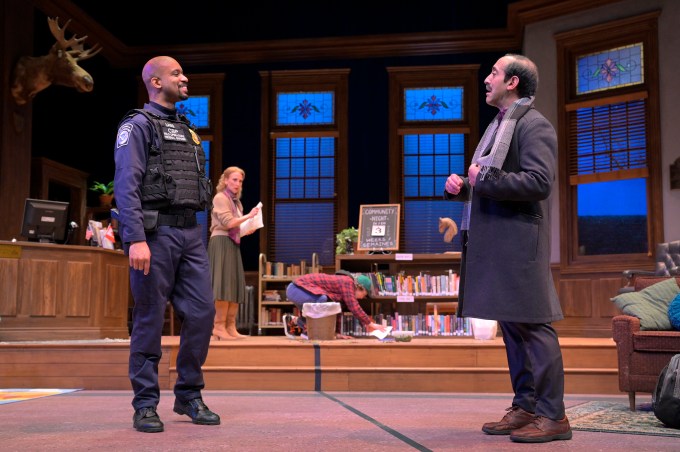
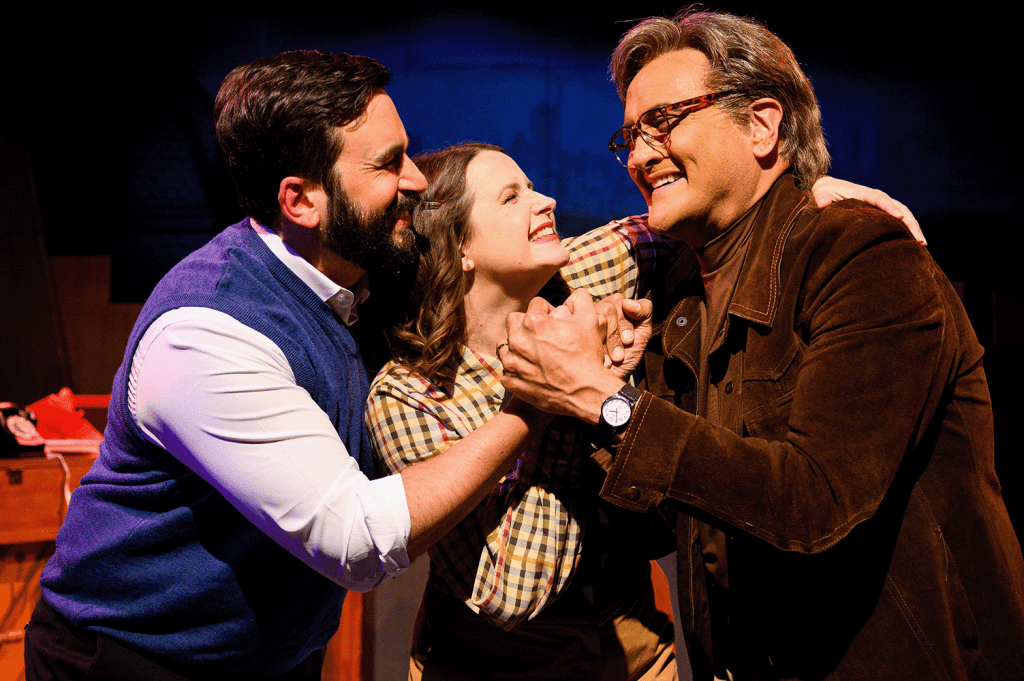
Kenny Scott as Bruce, James Rana as Peyman (both foreground), Carrie Paff as Manon, Daniel Allitt as Declan (both center rear). All photos by Kevin Berne.
Between the United States and Canada lies not only the longest international border in the world but also, by far, the longest unprotected one. The two countries share language, history, alliances, overlapping culture and food, and much more. Until the evolution of the European Union, movement of people was the most unobstructed between two countries anywhere. That has changed somewhat in the 21st century. Broadly, differences in immigration policy for the undocumented and the Covid pandemic began to inhibit people flow. One specific restriction enacted by the Trump administration in 2017 also stood out – the Muslim Travel Ban and its aftermath.
Playwright Kareem Fahmy taps into the American unease with Islam in his clever dramedy, “A Distinct Society,” but he introduces other dimensions to the storyline as well. The TheatreWorks world premiere production, directed by Giovanna Sardelli, possesses superb stagecrafting and wonderful acting.
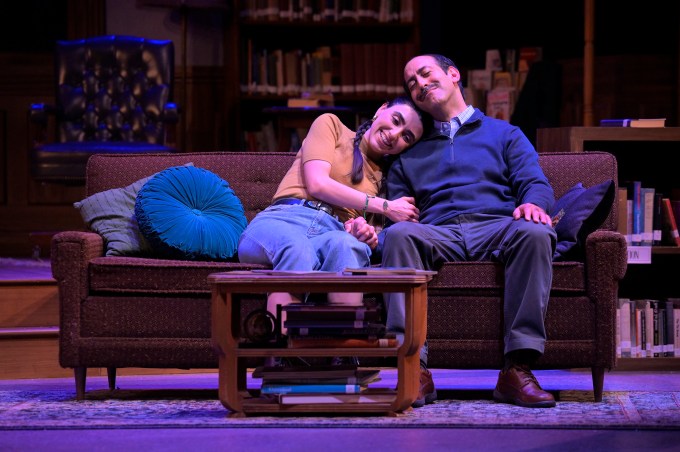
Carrie Paff as Manon, James Rana as Peyman.
Politically, northern New Hampshire is most noted for Dixville Notch, which is the first precinct to announce its vote for the U.S. Presidency every four years. But 20 miles north exists the Haskell Free Library and Opera House, straddling the border between the U.S. and Quebec Province in Canada as a result of a surveying error that occurred before the library was built. A line on the floor designates the border. The playwright has deftly used this real-life anomaly as the crucible for the play’s conflicts.
A kerfuffle arises as a result of a social media posting which suggests that the library is a good crossborder meeting place. The message is not lost on Muslims, particularly families with members on both sides of the divide. Peyman (played by James Rana) is an Iranian-Canadian physician whose daughter Shirin (played by Vaneh Assadodurian) lives in the U.S. Although they both live hours from the library, efforts to meet his daughter are central to the action. To begin with, they suffer poor timing, but then Homeland Security steps in with the restriction that meetings cannot exceed five minutes and that no gifts can be given – even food. And not only is Peyman a good chef, but Shirin has not been eating properly, and her father is sure that home-cooked Iranian cuisine is the solution. The challenges of meeting will go from bad to worse.
Vaneh Assadourian as Shirin, James Rana as Peyman.
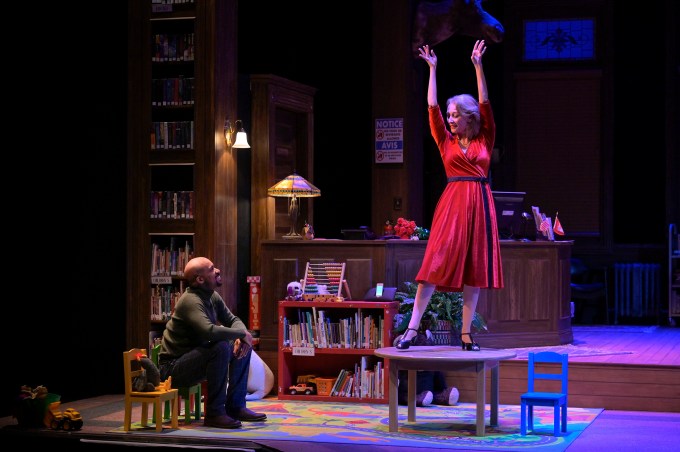
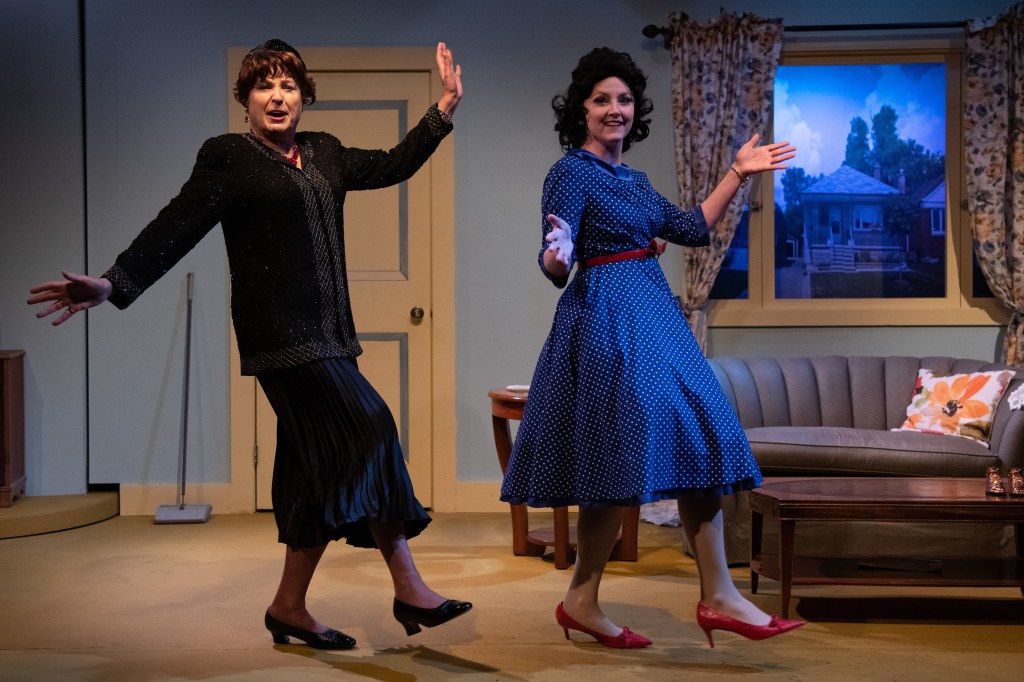
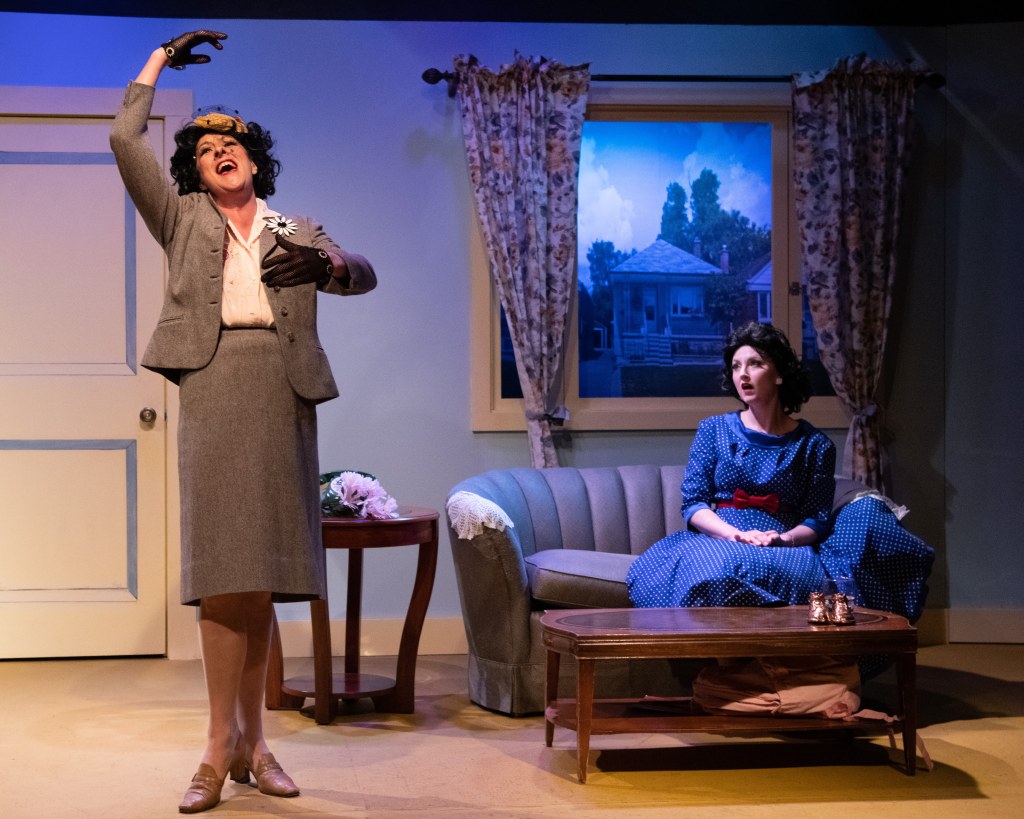
Two subplots complement the central action. The more direct concerns Manon, the library manager, who is Quebecois, and is played with consummate skill by Bay Area veteran Carrie Paff. She dances and sings tracts from the opera “Carmen” and speaks with a charming French accent. Manon sympathizes with those trying to meet up, but she has her own rules that she enforces, and she is obligated to follow DHS rules as well. They are reluctantly but emphatically enforced by Bruce (Kenny Scott), who also has a crush on Manon, though their backgrounds and interests differ vastly.
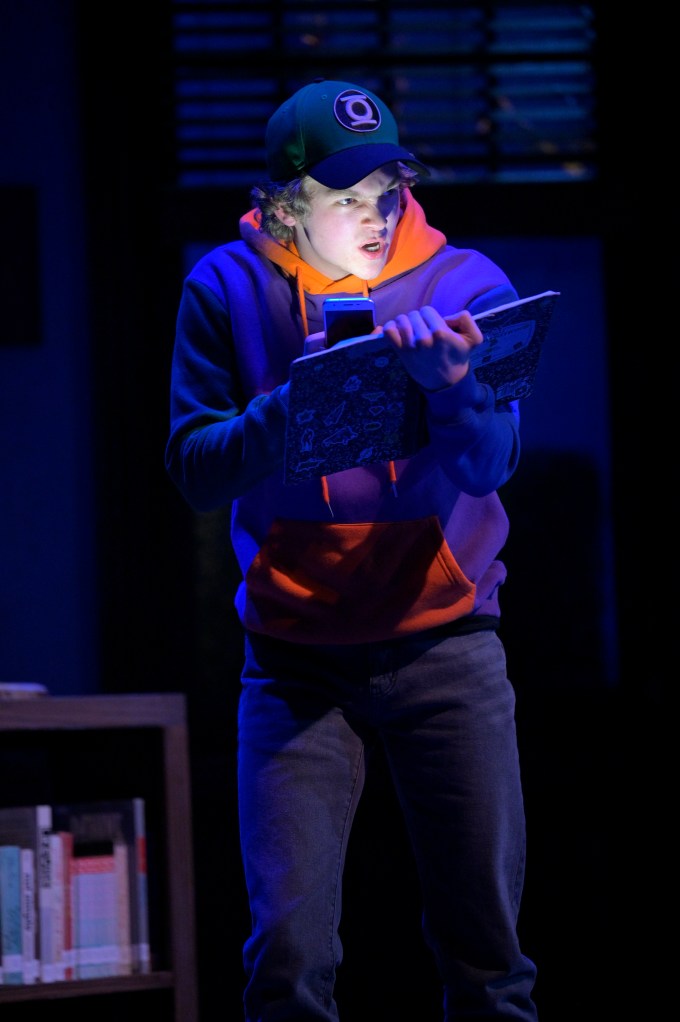
In another thread, Daniel Allitt, in a commanding first professional role, portrays Declan, an Irish-born, 15-year-old who comes to Haskell regularly from an hour away. His pretext is the library’s graphic novel collection, but we later learn of his desire to escape the ridicule he faces in Quebec. He often reads aloud from the novels, which focus on good and evil and distract at first, but ultimately the purpose comes through.
Daniel Allitt as Declan.
As disparate as these three substories seem, they make subtle but profound connections through their subtexts. Fahmy shows in multiple contexts how the rigidity of rules can subvert humanity. He also plumbs the importance of family and various dimensions of discrimination, trust, and ultimately, the power of love to stop people from destroying one another. Finally, issues are expressed and implied about society and country, including the not always clear categorization of patriot versus terrorist. His clay in molding these lessons and moral questions is comprised of five characters who we care about but who are flawed like real people.
Surprisingly, the play’s title does not refer to Islam. In the Quebec separatist movement, climaxing in the 1995 vote for independence, the thematic appeal of the separatists was that Quebec was “a distinct society.” And though the legal issues that pertain to the play are national level, U.S. to Canada, the sociocultural issues that derive from Quebec being French speaking, loom large.
Kenny Scott as Bruce, Carrie Paff as Manon.
“A Distinct Society” is highly involving. With its complexity, many issues are broached, resulting in a number of denouements. The actors are well cast and convincing in their roles. Jo Winiarski’s scenic design is stunning in its overall look and detail. Pamila Z. Gray’s lighting and Elton Bradman’s sound equally impress as they complement the set.
“A Distinct Society,” written by Kareem Fahmy, is produced by TheatreWorks Silicon Valley and plays at Mountain View Center for the Performing Arts, 500 Castro Street, Mountain View, CA through April 30, 2023.
Mehry Eslaminia as Elham, Christine Mirzayan as Goli, Sahar Bibiyan as Marjan, Amir Malaklou as Omid. All photos by Alessandra Mello.
English has gained the distinction of being the world’s most sought-after language. It is the official language in more countries with advanced economies than any other. It is the dominant lingua franca and sometimes official language of international business, international law, diplomacy, tourism, air traffic control, post-graduate educational materials, international conferences, global entertainment, and more. English-speaking countries are the most desired targets for immigration – legal and undocumented.
Born to immigrant parents, Iranian-American playwright Sanaz Toossi looks at a part of the global industry that has derived from the ubiquitous nature of English – teaching English to non-native speakers. Calling upon her own heritage to generate a narrative, her incisive dramedy “English” won both the Lucille Lortel and Obie awards for best new play in 2022. Berkeley Rep presents a nicely produced and acted version of the work, intelligently directed by Mina Morita, that is worth seeing. Yet, as well-crafted and revelatory as the script is, it lacks a wow factor.
Christine Mirzayan as Goli, Mehry Eslaminia as Elham.
Set in Karaj, Iran in 2008 at a private facility, four adult, advanced English learners comprise a class designed to prepare attendees for the TOEFL (Test of English as a Foreign Language) exam, which is used as a benchmark by over 11,000 institutions worldwide. The teacher is Marjan, who had spent nine years in the U.K., but she has returned to Iran.
The students vary in age, gender, and motivation for taking the course. Some have more specific reasons, like an older woman, Roya, who plans to join her son and his family in Canada and a younger woman, the sometimes fractious Elham, aspiring to medical school in Australia. The bubbly Goli simply wants to open new doors, while the goal of Omid, the only male and an accomplished English-speaker, is a mystery.
Classroom exchanges provide many humorous moments as students stumble along with fractured language. Activities provide fun as well – imitating Christiane Amanpour in a role playing interview; a recitation of “Mary Had a Little Lamb;” a show-and-tell of a pencil; and a recurring tossing of a ball in a categories game.
But the dark underside has two elements. One is that characters begin to clash. Personality and behavioral differences arise in addition to open questioning about why individuals are there and whether they will be able to accomplish their goals. Self-searching sets in. The other and more intriguing aspect is the unearthing of the many unsettling issues of learning and speaking in a new language. At the tip of the iceberg is inability to express oneself as precisely as in the mother tongue, and the effect that has on self-confidence and personality. As Roya notes, her son, with the Anglicized name Nate, seems a different person from one language to the other.
Sahar Bibiyan as Marjan, Amir Malaklou as Omid.
Toossi’s text is malleable, and for that reason demands adept actors. Although the playwright doesn’t intend it, it is easy to imagine the whole script being acted without a laugh. But this cast cleverly extracts humor from everyday conversation, especially in the early going before conflicts among the characters emerge.
Because of the nature of the topic and setting, the script requires that a fair bit of Farsi be spoken. One solution is that the actors could speak those lines in Farsi. The drawbacks are that actors need to speak Farsi or be able to learn enough to mimic it; that the audience would have to read supertitles; and that some humor might be lost when spoken in a foreign language. The somewhat confusing solution chosen is that when a character is supposedly speaking Farci, they speak in unaccented English, whereas, when speaking English, they have Iranian accents. This solves the drawbacks. Dialect Coach Ana Bayat has done a wonderful job, even coaching stronger and lesser accents among the characters. However, it is sometimes difficult for the audience to know which language is being spoken, especially early on, before the device is understood.
Sarah Nina Hayon as Roya.
Perhaps the greatest thematic weakness of the piece is that the stakes are small, which diminishes the consequences of dramatic situations that occur and possibly the viewer’s emotional involvement with some characters. Although the TOEFL exam represents a significant hurdle, not all students take the course or the exam with a specific purpose in mind. What’s more, it can be retaken. The applicant to Australian medical school had already taken it several times previously.
The single set staging is very effective, while the ensemble acting is solid. At the center is the almost always smiling Sahar Bibiyan who skillfully conveys her empathy as Marjan, yet she displays subtlety in her wariness and does have her limits. Mehry Eslaminia excels in the juiciest role as Elham. The most assertive and candid of the students, she jokes and whines and faces big obstacles in reaching English proficiency. In all, “English” engages for its full 100 minutes.
“English,” written by Sanaz Toossi, is produced by Berkeley Repertory Theatre and plays on their stage at 2025 Addison Street, Berkeley, CA through May 7, 2023.
Vic and Karin landing in Antarctica – zodiac on the right, midsection of the ship behind us.
NOTE: I’ve circulated this travelog among friends and gotten positive feedback, including multiple suggestions to publish it. Included in the distribution was the owner of Berkshire Fine Arts, who is a friend and who also publishes my reviews. He asked if he could publish it, which I agreed to. So, given the encouragement, here it is on Cordell Reports as well.
Introduction
Several friends have asked for reports about our Antarctic cruise, so here it is. Given the 2,500 word length, it may be of more interest to us for our own external memory than for other people, but I have broken it into categories for picking and choosing. It was a 9-day journey on Atlas Ocean Voyages, a new luxury brand, on the World Navigator. We had previously decided to give the Antarctic a miss because of the potential misery of four days on the Drake Passage. Then we learned of “Fly the Drake” (i.e., launching the cruise from South Georgia Island rather than Argentina or Chile) and became interested. But we came upon a deal that included the Drake that was too good to pass up.
The voyage started inauspiciously with a 12-hour departure delay because of high seas in the Drake. Our itinerary was unaffected, but the first day in the Drake was sheer misery – just what we feared. Motion sickness pills held our nausea at bay, but I was totally wiped out from a combination of conditions and slept any time I wasn’t eating or at a lecture. If that wasn’t bad enough, on the return, the cruise truncated the Antarctica portion, skipping two landings because of heavy winds and seas. Then we endured 92 mile an hour winds (i.e., hurricane force) on the Drake, which the ship’s captain had never witnessed in 10 years in the region. We also confronted 35-foot waves, some of which T-boned the ship, while head-on is preferred. After passing through the heart of the storm, I asked what height of waves might be cause for concern for structural damage or capsizing, and the navigation staff said that they were concerned. For this, we waited 40 years before visiting our seventh continent!
“The Skinny” – Visitation Facts First
There’s no denying that visiting the White Continent is a special experience. The pristine, austere, chilling environment has still been visited by very few people. With the foresighted international treaties and practices that protect its character, it is a privilege to enjoy this extreme environment. For those interested in Antarctica, note that currently, only ships with pax capacity of under 200 are allowed to land passengers. Larger vessels cruise by only with no up-close and personal. Depending on the specific destination, we sometimes had the choice of specified short hikes, milling around the landing site, or zodiac cruising. Kayaking and standup paddling were available where safe for a fee.
Far more than most, Antarctica is a tourism crap shoot. Though the Expedition Leader plans an itinerary, the Ship’s Captain is the final authority, with weather playing the determinant factor. We had four days scheduled for the Antarctic, and the first three were good to beautiful, with temperatures around freezing, some sunny patches, and modest winds. The fourth was the beginning of the epic struggle.
For those who are most interested in the wildlife, Antarctica offers a deep dive into a narrow range of animals. One of the biggest highlights was seeing our first penguin colony on the continent, though we had seen temperate-climate varieties in South Africa, New Zealand, and the Galapagos. As with all species, visitors are to remain 15 feet away from the animals, but it doesn’t seem that the penguins got the memo. They often intruded on our space recklessly! We saw beaucoups of penguins in rookeries (as it was the season) and beyond – mainly gentoo and chinstraps, but a couple of out-of-place kings as well. They are charming and fun to watch, with many chicks in their baby fuzz.
The observations were virtually all smiles, except that one of the staff did capture and share a video of two predator brown skuas snatching a penguin chick from under a parent with no resistance from penguins around (chickens!). Then the skuas ate the carcass right there in the rookery. When you think about how species adapt to their environments, perhaps a lot of species seem odd. But among other factors, penguins need flatish, rocky areas without snow to incubate eggs, which would seem to make an Antarctica residence a stretch. And unlike, say, Rocky Mountain Sheep who gracefully bound and navigate treacherous rocks, penguins look like fish out of water in their chosen terrain with their wobbly gait and flailing wings. But they sure are cute!
A key factor in the distinctive fauna of Antarctica versus the Arctic is that the latter attaches to lower latitudes by continuous land, so that you get a continuity of animal species. Antarctica is separated from other continents by the vast Southern Ocean, so that the species found there are water migratory or pelagic, which is why you don’t see wolves, antelopes, and such. We did see several other types of birds from the gull, albatross, and cormorant families, as well as the graceful Antarctic and Arctic Terns (yes, they migrate the length of the globe). We saw only two mammal types. There were onesies and twosies of three types of seals that were pretty lethargic. But the biggest excitement apart from penguins was numerous sightings and breechings of humpback whales, both from the ship and from zodiacs. Among the citizen science projects that pax could engage in was a humpback identification project. Each humpback has a unique tail fluke, and any photo captures can be shared with a research data base to learn more about family association and migration.
In addition to the wildlife, the white wilderness is striking. The only other natural colors to be seen are the gray of the rocks and aqua blue in glacier crevices which results from great depth of ice and pressure over time. Many glaciers come down to water. We had seen calving, when ice sheets sheer off glaciers into the water in Alaska but did not experience it here. We did however see icebergs with stunning blue striations as well as auto-sized, clear, egg-shaped ice rocks with honeycombed surfaces that come from pressure forcing air bubbles to the surface.
The most interesting panorama was Deception Island. It is a large active volcanic caldera with a live vent and enough of a gap in the circle of mountains to allow capable vessels to enter the caldera. It’s quite a sight to be in surrounded by a circle of white mountains lurching up from the sea. We were scheduled to have land and zodiac excursions there, but our disappointment was that conditions didn’t allow getting off the ship. Although the water surface was pretty flat, it was covered with mini-whitecaps from 50 mph winds.
Our connection with civilization was seeing a couple of people on the deck of a wreck-hunting vessel. We passed two research stations, one Argentinian and one Spanish, but we saw no people outside. We also saw a rusting shipwreck from over a century ago.
Shipboard Experience – For Those Considering the Voyage
Probably all carriers that offer landing privileges in Antarctica fit a similar profile. I can only speak specifically to Atlas’s World Navigator and say this. The experience is luxury quality. Staterooms are large and well appointed. Dining offerings are aspirational, and it’s remarkable how they can keep the quality up for nine days without reprovisioning. They offer the obligatory afternoon tea but have no specialty dining venues. Internet was spotty and slow, and while I could sometimes surf, I couldn’t use email at all for almost the full voyage because the Yahoo server is so slow loading. General shipboard service is high quality. You won’t get entertainment that is on offer from the Obesities of the Sea. Piano bar, torch singing, amateurish staff performances, and guest dancing can be expected, along with voyage-relevant movies. We were disappointed that they didn’t have competitive name-that-tune and trivia kinds of activities. Bridge, anyone? No. There are two “biggest d***” activities – the polar plunge, a few seconds spent in the Southern Ocean for anyone and for free, and camping, an expensive overnight with small capacity and a wait list. One of our usual meal companions, retired Iranian-American architect, Raheem, did both – at a healthy age 82.
At our age and condition, we passed on both extreme activities. For me, the condition was that I had severe cold/flu/covid symptoms from early in the cruise. Karin followed by a few days. We’ve both gone through periods of voluminous phlegm production, hacking coughs, total enervation, and in my case, limited appetite for food and drink (what timing!). Each of us tested negative for covid, but my guess is that we either tested too late or had a variant that wasn’t captured. It’s also noteworthy that while covid was mentioned in various staff presentations, it was only in historical context, never with concern for normative behavior. We wore masks when not eating or drinking to protect other people, but only a few other passengers did, and we know that others had some symptoms.
You quickly begin to appreciate why these cruises are so expensive – high staff to guest ratio; small guest capacity and thus little financial leveraging of resources; special facilities and special equipment. And then there is the expedition staff. We had 12, of which at least three had polar station or expedition experience. One was on the force that located the sunken Endurance, lost over a century ago (see below for more specifics). They were a highly skilled team that led excursions and gave briefings and lectures on all aspects of polar exploration. I was very impressed that Atlas had assembled such a team and offered such a flawless experience in their very first season in Antarctica.
In the seventh continent, we had two scheduled excursions per day. Each activity involved one hour off the ship and required probably an hour-and-a-half of combined preparation and winddown. So when you think about it, the financial expenditure relative to the essential experience is even higher than you might suspect. Pax get to keep the cozy parkas but not the provided boots. The only real cold we felt was on the face (Balaclavas or the like would help) and fingertips (battery-powered hand warmers come in handy).
In a sense, this is similar to a repositioning cruise in that there are no days off the boat investigating various cultures. Here, the only culture pertains to the stories of the brave people who have spent serious time on the continent.
Antarctic Exploration and Lore
It’s hard to be not totally awed by the unparalleled courage of the early Antarctic explorers. You can’t imagine any exploration having more risk, more sacrifice, more painful conditions with chronic frostbite and gangrene among the concerns. Two names associated with successful Antarctic exploration are Norwegian Roald Amundsen, who won the race by leading the first expedition to reach the South Pole in December, 1911, but who was criticized for seeking only personal glory and serving no societal purpose. The other in pursuit was Britisher Robert Scott, who did have research objectives. His expedition launched in the same season, but facing particularly adverse conditions, Scott reached the South Pole a month later. In one of the great “what-ifs” in history, Amundsen decided to return from the Pole with a tank of kerosene that his party would probably not need. The alternative was to leave it behind in the expectation that Scott’s party would find it and might need it given the worse conditions that Scott would have faced from the late start. Sadly, Scott’s men could have used Amundsen’s excess fuel to unfreeze food on their return. Scott and all of his men perished instead. You can only imagine the unfolding tragedy.
But ask anyone steeped in Antarctica, and one man is revered above all as a leader, despite the fact that he never accomplished his exploration objectives. That was Englishman Ernest Shackleton. No expedition leader put the safety of his men before his own glory like Shackleton. To lighten load when weight was essential, he dumped precious gold memorabilia and a bible given him by the Belgian royalty. When a man’s gloves were lost, Shackleton threatened to drop his own fur-lined gloves into the sea if the man didn’t take them.
His expedition in 1907 would have been the first to reach the South Pole, but calculating that a shortfall in provisions from continuing would result in the deaths of one or more men, he turned back only 90 miles from the goal. On another expedition, his vessel, Endurance, was strangled by trap ice in the Weddell Sea and eventually forced by the relentless ice down into a watery grave. The description of the inescapable, constant whining and grinding sounds of the ice imposing its will on the wood was chilling. Shackleton and a few men improvised an escape from Antarctica in a powerless, rudderless lifeboat, and in a heart-stopping adventure they were lucky enough to make landing at South Georgia Island. Had they missed this spec in the ocean, sure death would have followed. Not only did Shackleton return to rescue the rest of the force which wintered in Antarctica, but he also led another harrowing rescue mission that would add nothing to his resume or marketability for financing future expeditions but showed his dedication to his men. I believe that he never lost a man in spite of overwhelming challenges and hardships. I’m a little dubious about self-indulgent, high-risk adventurers, but I find Ernest Shackleton to be the most admirable expedition leader ever.
Travel Tie Ins
Many people simply did the cruise, which did include air charter from Buenos Aires to Ushuaia. We figured that if we went that far, we might see other stuff in the area, so we spent a few days each in Buenos Aires and Santiago, both of which we had been to before. For having many parallels, they are very different. I won’t go into that except to say that we like BA which architecturally has a vibrant mix of Parisian formality with an organic naturalism. Santiago is similar to Johannesburg, dominated by suburban communities that look like fairly prosperous South Florida – many high-rise residences surrounded by lush greenery, but with a downtown that is graffiti-ridden and dangerous. However, there are interesting excursions from Santiago. For the nature types in either country, Patagonia is the best bet. Both also have nice wine regions, but Santiago’s is much more convenient.
Verdict
Waffling is us. Of course, whether Antarctica makes sense for you depends on you. On the good versus great distinction, it was good for us, though I admit that the reflection involved with writing this piece raised my appreciation level. Reasons – For us, we were mostly wildlife driven, and after eight or so wildlife-dominated vacations with huge variety in animals in most, we would rank this among our less interesting. It is very expensive relative to alternatives. If you take a traditional cruise, you have four pretty dead days on the Drake except for any lectures. If you’re subject to motion sickness, it is a big gamble, but the yet more expensive option is to Fly the Drake.
Most people rave about Antarctica, but you have to wonder if there isn’t a little cognitive dissonance in operation for some people. However, for those with a special interest in the area or for the bucket-list driven, it is the brass ring. Go for it!
Amy Foote as Miranda, Bradley Kynard as Caliban, Shawnette Sulker as Ariel, Andrew Dwan as Prospero. All photos by Jeremy Knight.
Probably the greatest literary figure of all time, William Shakespeare, has served as a wellspring for opera narratives. Verdi alone created three operatic masterpieces based on Shakespeare plays. In recent times, Thomas Adès composed “The Tempest” with a libretto by Meredith Oakes, which holds closely to The Bard’s storyline, but adapted it to simplified yet poetic modern language.
Composer Allen Shearer and librettist Claudia Stevens have premiered their ninth opera collaboration, “Prospero’s Island,” another borrowing from the “The Tempest.” But they have moved it one measure further from the source material. In addition to lyrics in modern American-English vernacular interspersed with poetic accents, a plot update and revision gives the material more contemporary relevance while altering the moral profile of the main character. The result is a riveting chronicle of moral corruption followed by a quest for redemption that is accompanied by equally compelling music, calling on diverse idioms. Although the narrative arc is clearly dramatic, the creators frequently punctuate the proceedings with humorous interludes.
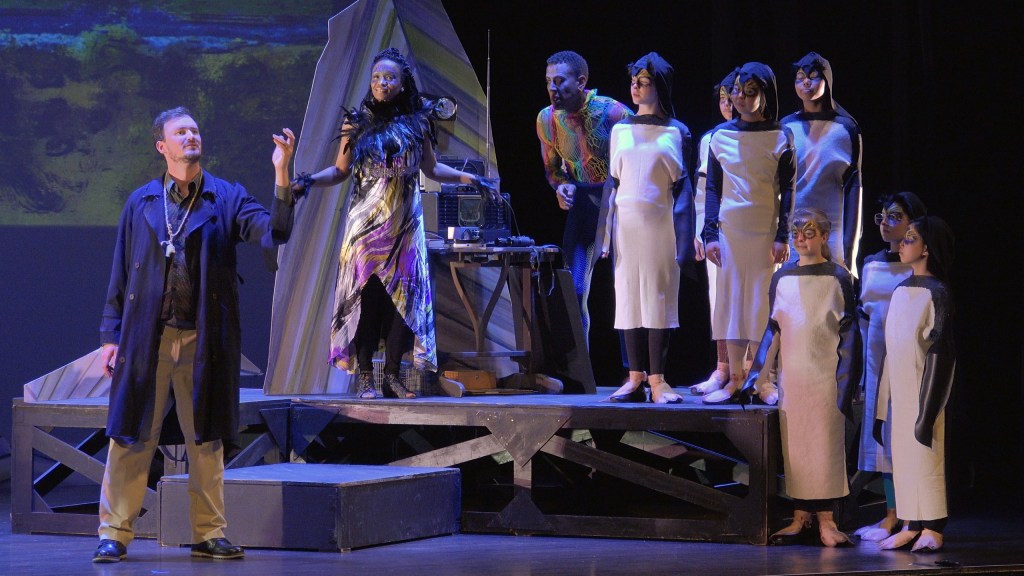
Andrew Dwan as Prospero, Shawnette Sulker as Ariel, Bradley Kynard as Caliban, members of the San Francisco Girls Chorus as penguins.
One way to unfold “Prospero’s Island” is to first contrast it with the original play, “The Tempest.” Perhaps the critical difference is the cause of Prospero’s turpitude. In the play, he is a duke who is wrongfully overthrown, and whatever villainy he displays derives only in consequence. In this opera, he was the (presumably German) Minister of Science, whose weak spine, like many of his passive countrymen during the rise of Nazism, led to his moral downfall. Overall, Shakespeare’s mostly good man has become mostly bad, but in either case, his complexity acts as the bedrock of conflict and contradictions.
In both versions, Prospero escapes to a distant island, but in this opera, the refuge is specific and presumably chosen by the opera creators with intent. It is the Falkland Islands, a British territory nearest to and claimed by Argentina. The presumed reason for the selection is that after World War II, many Nazis absconded to South America, including the nefarious medical experimenter Josef Mengele, perhaps a model for this iteration of Prospero. Another change in the narrative is that Shakespeare’s part-humans, Caliban and Ariel, who would become subservient to Prospero, were native to the island. In Shearer and Stevens’ version, they were created by Prospero.
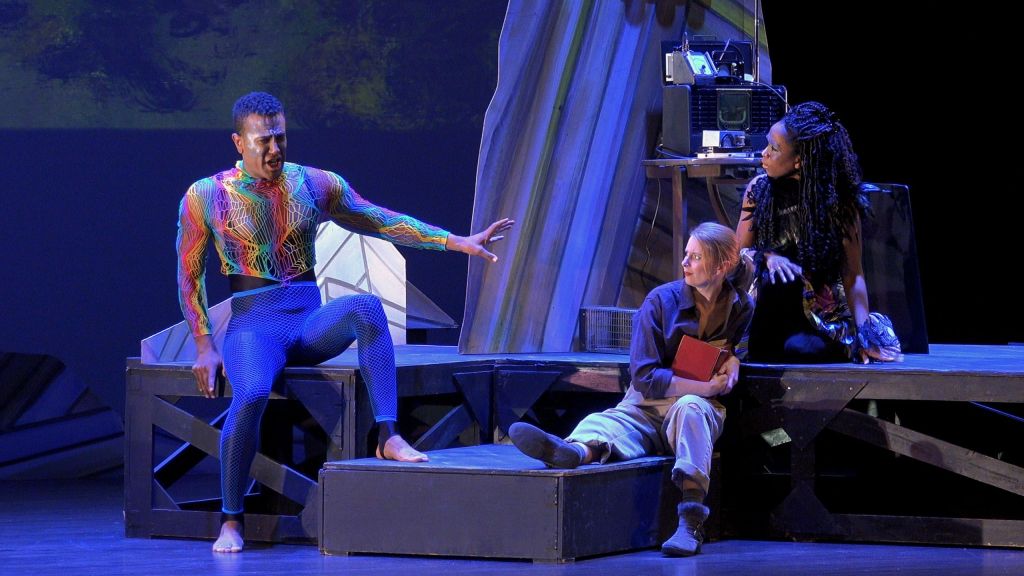
Bradley Kynard as Caliban, Amy Foote as Miranda, Shawnette Sulker as Ariel.
A final critical difference is that Duke Prospero would return home triumphant. The 20th century Prospero would return to be tried for his crimes.
This operatic update has been set to an eminently approachable and appealing score in Shearer’s very personal, eclectic modern operatic style. Nathaniel Berman conducted the chamber orchestra comprised of 12 instrumentalists. Their rich sound came in large measure from the orchestration which yields the range of timbres of a full orchestra. The composer’s attention to detail is evident in instrumental interplay, but most easily observed in the complexity of the percussion part.
Amy Foote as Miranda, Andrew Dwan as Prospero.
Shearer does not employ leitmotifs liberally, an exception being a slow, rising figure in the French horn and viola indicating Prospero and his power. He does, however, inflect his music to the character’s nature, with the most stylized being Ariel’s music, which is airy, with runs high in the soprano range. Another motif that is vocal rather than orchestral is the high-pitched trills that accompany entrances of the penguin chorus. Yes, you read that right. This reviewer was dubious when learning that penguins would play a role in the opera, but the Falklands is a penguin habitat, and their alteration story (as opposed to creation story) of being taught human attributes by Prospero works well. The birds were eight members of the Grammy-winning San Francisco Girls Chorus, and it was hard not to smile every time they hit the stage with their amusing waddles and clever outfits. Nevertheless, their choral contributions were competent and relevant.
Both score and script swirl with surprise. Interestingly, when script elements shock, darkness tends to prevail, as when daughter Miranda finds a Nazi armband among Prospero’s belongings. When the score jolts, the mood is often lightened, as when two members of the security force looking to arrest Prospero sing a verse of “Cigareets and Whiskey and Wild, Wild Women,” or when the scratchy radio plays “Sweet Georgia Brown,” as if the Harlem Globetrotters were at the door rather than a threat to Prospero’s freedom.
Sergio Gonzalez as Andy, Amy Foote as Miranda.
Casting of “Prospero’s Island” was strong, drawing on the Bay Area’s wealth of young talent. Mellow and crisp baritone Andrew Dwan dominates as the contrite but conflicted Prospero. His revealing moment comes near the outset in his well-spun aria when he admits turning a blind eye to the brutality of his work in his homeland. Clear, yet warm voiced soprano Amy Foote portrays daughter Miranda, and conveys her angst as one who has grown up in such isolation that she bemoans “I’m like a slate where little is written. How do I know I’m even pretty?” And as with current political affairs in this country, Miranda must deal with the trauma of her father’s facing a fate that she had never dreamed of.
One of the drawbacks of a 90-minute opera is that it has less time to develop secondary characters, which in this case are Ariel and Caliban. Shawnette Sulker portrays Ariel. Her bright, ringing soprano fits the bird-like quality of Ariel perfectly, and while much of her singing is in bits and starts, several brief poetic texts, including a take on Shakespeare’s “Full fathom five,” are written into her part, which she delivers with alacrity. The grumpy, resentful Caliban is the smooth-toned and rangy baritone Bradley Kynard who nails the role. Although given a grunt and groan personality, he excels in two significant solos of self-loathing over his ugliness and disgusting nature. Declaring himself the wormiest of worms in one, he demonstrates a taxonomy of worms in a funny patter-like treatment.
Julia Hathaway as Steffi, Bradley Kynard as Caliban, Angela Jarosz as Trish.
The production is directed by Philip Lowery, and as with the singers and orchestra, the quality of the staging is impressive. The set is simple, with Prospero’s primitive command and control center being the centerpiece. Otherwise, Jeremy Knight’s often changing backwall projection screen provides context, receiving productive use from the opening fall of the baton as the incoming plane, ablaze, seeks to land. In addition to Costume Designer Joy Graham Korst’s penguin costumes, particularly impressive is the colorful, fanciful attire of Ariel and Caliban.
This opera is highly literate, with deft treatment of the subject matter. Provocative situations arise from the relationships, while ethical and social issues including personal responsibility, loyalty, and abuse abound. “Prospero’s Island” is an enjoyable addition to the composer and librettist’s catalog and should receive further productions.
Cast.
“Prospero’s Island,” composed by Allen Shearer with libretto by Claudia Stevens, was produced by Ninth Planet and InTandem, and played at Herbst Theatre, in War Memorial Veterans Building, 401 Van Ness Ave., San Francisco, CA in its world premiere on March 25, 2023.
George Psarras as Charles, Georgia Ball as Elvira, Lisa Mallette as Madame Arcati, Maria Marquis as Ruth. All photos by Christian Pizzirani.
The flamboyant bon vivant Noël Coward excelled in many aspects of the performing arts, but he is best remembered today as a playwright who exposed the foibles of English society in several between-the-wars, comedy-of-manners plays. The last of these was “Blithe Spirit.” Many of us, having seen the movie and perhaps productions of the play as well, may wish to pass on seeing this war horse once again. That would be a mistake. City Lights has produced a sparkling rendition that hits the mark on every measure.
Probably the feature that distinguishes “Blithe Spirit” from most of Coward’s successful works is that it integrates fantasy into farce. Charles Condomine is a well-heeled author who wishes to learn more about the occult for a story that he’s writing. To do so, he hosts a small dinner party, with one of the guests being a medium, Madame Arcati. Although Charles dismisses notions of spirits and communicating with the dead, his deceased wife, Elvira, appears, but only to him. This induces the expected complications, especially in the friction created between Charles and his current, living wife, Ruth, in addition to the competition and bickering between the two wives with Charles as the go-between/translator.
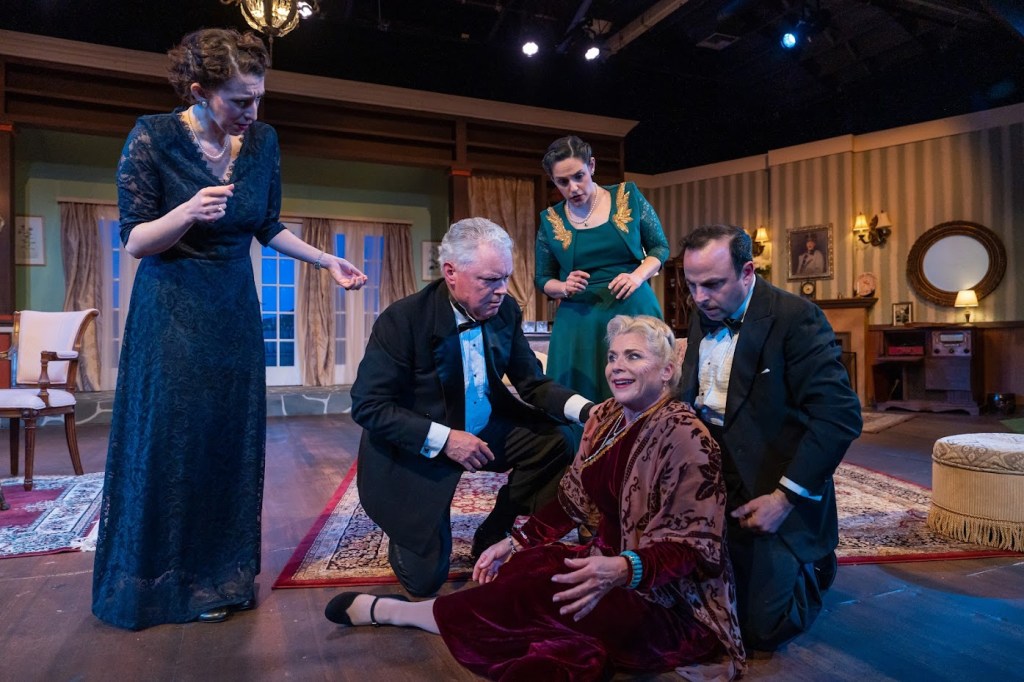
George Psarras as Charles, Lisa Mallette as Madame Arcati, Georgia Ball as Elvira.
The script and production are replete with clichés from English society of the period – the high-pitched, formal, lilting conversational modes, even between a couple in the privacy of their abode; sunset sherry poured from crystal decanters and martinis strained from chrome shakers; cocktail dresses and dinner jackets for meals at home; dotty maids and loopy fringe dwellers like Madame Arcati. George Psarras as Charles and Maria Marquis as Ruth are exquisite as the central couple, in all their class haughtiness and propriety. But before it’s all over, Charles will become frenetic, quickly pacing about, drinking more feverishly, and gesticulating wildly while dealing with warring wives. Ruth will become outraged about having to share her house and husband with an interloper that she can’t see or hear, especially when Charles has the audacity to warm to the situation. But Ruth has less to do, which is unfortunate, as Marquis is an excellent performer.
Maria Marquis as Ruth, Kyle Smith as Dr. Bradman, Roneet Aliza Rahamim as Mrs. Bradman, Lisa Mallette as Madame Arcati, George Psarras as Charles.
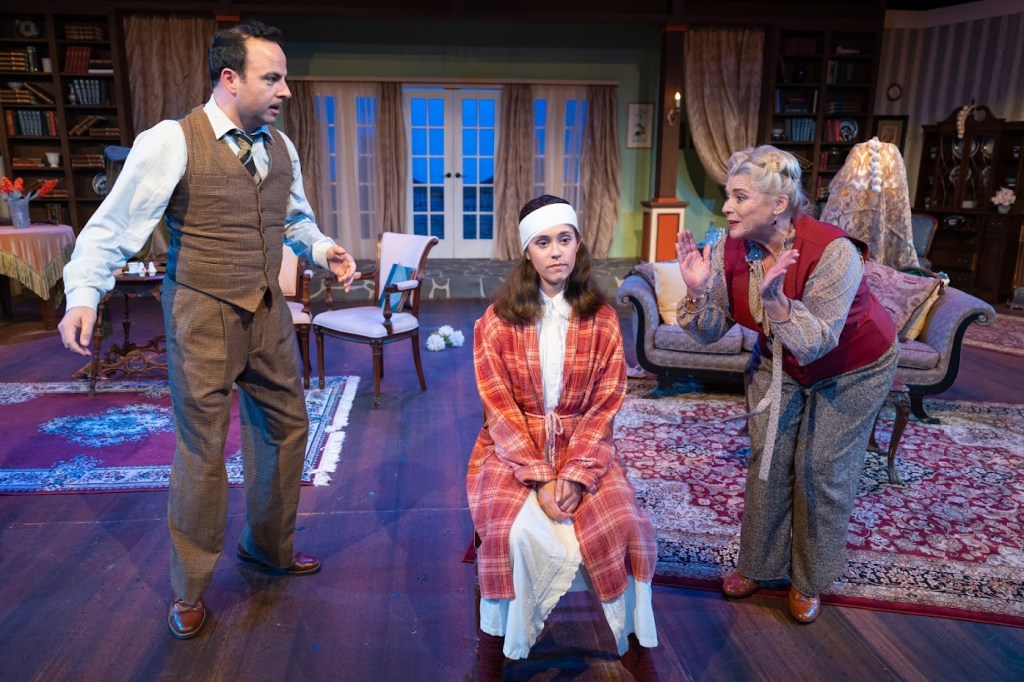
The company’s Artistic Director Lisa Mallette returns to the stage after several years absence and shows that she has lost nothing. As the balmy Madame Arcati, she flounces and flails, oblivious to convention and self-satisfied in her own wacky world. Mallette’s detailed facial gestures and body movement along with her affable silly certitude result in a well-sharpened and humorous portrayal.
The final critical character is of course the blithe spirit, Elvira, played by Georgia Ball. Although she may wish to leave this clumsy triangle, she does hold all the cards, and Ball plays them with smugness, yet teasing charm. She often prods Charles into making insulting responses that Ruth wrongly thinks are directed at her, which adds to the fun. Noteworthy is the fact nobody would suspect that the cool, controlled, mature interpretation of Elvira is given by a junior at San Jose State in her first professional performance.
George Psarras as Charles, Skylar Rose Adams as Edith, Lisa Mallette as Madame Arcati.
Mark Anderson Phillips directs, and he ensures that all of the pieces work. Individual performances are vivid and the interactions timely with the humor landing as intended. The whole of the wide stage is used to great effect. All of the creative elements are rock solid. Resident Scenic Designer Ron Gasparinetti’s expansive set is period looking, beautiful, highly detailed (Karen S. Leonard, Props Designer), and functionally superb. The lighting by Edward Hunter rises, falls, and focuses to meet the characteristics of the goings-on, while attending to details such as adding lights to an otherwise non-functioning old radio. And Resident Sound Designer George Psarras (yes, he’s also the lead performer) has covered all of the bases from the tinny sound of a period recording of the song “Always” to the thumping of table legs on the floor during the seances. Kudos also to Pat Tyler for costumes and Richard Newton as dialect coach, as contributions in both of those arenas convey authenticity.
“Blithe Spirit,” written by Noël Coward, is produced by City Lights Theater Company and plays on its stage at 529 South 2nd Street, San Jose, CA through April 23, 2023.
Will Giammona as Frank, Melissa WolfKlain as Mary, DC Scarpelli as Charley. All photos by Ben Kranz Studio.
Alert: Sondheim afficionados and other lovers of musicals. Complete your dance card. Take advantage of attending 42nd Street Moon’s new production of the rarely seen “Merrily We Roll Along.”
First, the easy part in discussing this stage oddity. “Merrily We Roll Along” tells the evolving relationship of friends from 1957 to 1976. The central figure is Frank, who begins as a poor, idealistic composer of musicals who cracks Broadway and then becomes successful composer for movies. He is also a serial lover with a succession of girlfriends and wives. Charley, Frank’s childhood best friend and lyricist during the Broadway days, becomes a family man and staunchly retains his artistic ideals, unwilling to bend to the demands of Hollywood. The two men part ways.
Now for the complications. When Stephen Sondheim’s “Merrily We Roll Along” hit Broadway in 1981, he was esteemed as the finest composer/lyricist in the stage musical idiom. But for various reasons, this work was an abject failure. However, it was subsequently reworked, winning various awards Off-Broadway and on the West End. Confidence in the revision has reached the point that it is scheduled to play Broadway this fall. That said, issues remain.
Will Giammona as Frank, Juliana Lustenader as Beth.
A distinctive, but not unique, feature of “Merrily We Roll Along” is that the story unfolds in reverse time. We first see Frank as the toast of the town, hosting a party for Hollywood glitterati, and work backward to a rooftop on 110th Street in Manhattan, where Frank, Charley, and their new friend Mary view Sputnik and dream of the future. The narrative arc is not remarkable, but serviceable as a libretto for a musical.
However, there are reasons that reverse-time storytelling is atypical. Because it doesn’t conform to human experience, it is harder for the viewer to remember details and make factual connections as the story proceeds backward. Perhaps more importantly, the conceit inhibits emotional involvement, as we don’t observe character evolution in its normal sequence. Although Sondheim selected the Kaufman and Hart play of the same name with the reverse storytelling in mind, many will find that device to be the weakness of the musical.
Happily, there are good reasons to see the current rendering. Those familiar with 42nd Street Moon will see how this offering fits the company’s modus operandi. Obviously, it is a musical, and one that calls for a large ensemble, but with limited orchestration and minimal staging, all of which suit the company. But for that, you get Sondheim – witty, and sometimes searing lyrics, creative rhythms, often delivered in patter style, and great music. The music, however, is a little off the composer’s beaten path – a bit more conventional Broadway and a bit less dissonance. There also seems to be an unusual amount of reprise, and not a lot of memorable melodies, though the leading phrase of the title song, which recurs a lot, is a prime candidate for an earworm.
Ensemble.
The performers are also typical of the company, with many veterans of earlier productions. Will Giammona heads the cast and is in fine voice. But DC Scarpelli as Charley, whose vocals vary, delivers the real show stopper, “Franklin Shepard, Inc.,” largely a funny talk-sing about how they work, how they play, and how they are already going their separate ways.
Indeed, perhaps the central theme of the show, which is explicitly revealed soon after, is that good friends don’t want good friends to change. It is very true to life as we all go through losing relationships because of growing in different directions, even as in the case of Frank and Charley, when the divergence has major financial consequences. A very public, real-life case in point is when Paul McCartney ultimately acknowledged that it wasn’t the presence of Yoko Ono that caused the Beatles to break up. Their fans wanted them to remain together and unchanged forever, but as McCartney said, they simply grew up and apart.
Much of the sauce in this production actually comes from the female secondary leads. Mary, portrayed by a spritely Melissa WolfKlain, is the third friend who the men meet in 1957. For years, she is the conciliator who works to keep Frank and Charley together, but in time, she becomes a liability rather than an asset in keeping the peace. A sharp portrait comes from Christine Capsuto-Shulman, who plays Gussie to the hilt. She will become Frank’s second wife. On the plus side, Capsuto-Shulman has a wonderful and powerful singing voice and charismatic pizzazz. On the minus side, her character is selfish, self-centered, and always one to create friction rather than harmony. Gussie is trouble, but because of her allure, some men can’t avoid entrapment.
Christine Capsuto-Shulman as Gussie.
The ensemble effectively acts to brighten the stage and sound, usually as party goers. Their voices are uneven, but some stand out, such as Juliana Lustenader, who also plays the role of Beth, Franks first wife.
In all, this work will not rank among Sondheim’s masterpieces, but that’s setting a very high bar. This production meets expectations for the company’s offerings and does provide plenty to those interested in the musical genre.
“Merrily We Roll Along” with music and lyrics by Stephen Sondheim, book by George Furth, and based on the play of the same name by George S. Kaufman and Moss Hart is produced by 42nd Street Moon and plays at Gateway Theatre, 215 Jackson Street, San Francisco, CA through April 9, 2023.
Ronnie Anderson as Sylvia St. Croix, Sarah Elizabeth Williams as Judy Denmark. All photos by Grizzly De Haro.
One of the more pleasing experiences of a critic is to reluctantly attend a production with low expectations but to find the performance totally gratifying. If the show is known to be a “send-up,” you can raise a red flag of apprehension, and even more if it’s a not-so-notable musical by not-so-famous collaborators. Send-ups can be tricky, since pastiche, and particularly farce, can wear thin. But “Ruthless! The Musical” pushes all the right buttons, offering a bright script and bouncy music with clever and provocative lyrics. Altarena Playhouse gives it a rousing rendition that is enjoyable from start to finish. The casting and acting are superb, and the creative elements sparkle.
“Ruthless! The Musical” is all about the super talented pre-teen Tina Denmark, portrayed by the super talented pre-teen McKenzie Lopezlira, who acts, sings, and taps up a storm. Her sarcasm bites, and her occasional off-color language lands with just the right mix of surprise and humor. Tina aspires to be a great performer. She receives all the support imaginable from sacrificing Judy, her stay-at-home mom, who exemplifies the ideal 1950’s homemaker. Attired in a crisp dress, a pristine white apron, and red high-heeled shoes, she’s prepared to serve tea or cocktails to any unannounced visitor. Sarah Elizabeth Williams is Judy, who displays a fine singing voice and crack comic timing as the demure mom in Act 1, and as her alter ego in Act 2.
Ronnie Anderson as Sylvia St. Croix, McKenzie Lopezlira as Tina Denmark, Anna Joham as Miss Thorn.
The show starts with a light touch as we get to know the characters. But then, Tina auditions to play the lead in “Pippi in Tahiti.” She loses to the untalented but rich Louise Lerman, played to the hilt by Caroline Schneider, and we find that Tina wasn’t spawned on the set of “Father Knows Best,” but of “The Bad Seed.” Black comedy sets in. Not only does Tina become manipulative and foul mouthed, but evil intentions arise when she realizes that if she were the understudy, she would stand in as Pippi Longstocking if the lead is unable to perform. Disaster looms.
Along the way, we meet Miss Thorn, the third-grade teacher, who selects Louise as the lead in the play because of her parents’ connections, and who suffers through the girl’s acting incompetence. A special recognition goes out to Laura Morgan, who in an emergency stepped in to play Miss Thorn. Morgan is not even the understudy, but the show’s choreographer! Although she had a script in hand to help with the lines, her performance could not have exuded more acting savvy, full of emotion and zest. The audience was demonstrative of its appreciation for her outstanding contribution during the bows.
McKenzie Lopezlira as Tina Denmark, Caroline Schneider as Louise Lerman.
There are also not one, but two, important characters who draw on the “Mame” and Mother Rose from “Gypsy” tradition. Ronnie Anderson plays Sylvia St. Croix, an unscrupulous theatrical agent, who pushes to get Tina into show business, with an over-the-top performance that fills the stage. Enter Lita Encore, theater critic and Judy Denmark’s adoptive mother, portrayed by an also saucy and domineering Lisa Appleyard, who offers a powerful delivery of the contrarian “I Hate Musicals.”
Significant events toward the end of Act 1 lead to situational and character transformations and revelations that should be enjoyed as surprises when attending the play. Some events become more extreme and darker, but they are so unrealistic and silly that they don’t dampen the fun. Suffice it to say that “Ruthless! The Musical” deserves its cult status and the awards that it has received over the years.
Lisa Appleyard as Lita Encore, Sarah Elizabeth Williams as Judy Denmark.
Director Dana Anderson uses all of the resources of the Altarena stage from the balconies and circular staircase to the vomitoria (i.e.: egresses). The crack performances and sharp interplay drive the action at just the right pace. Of the creative elements, Sarina Renteria’s lighting especially stands out.
The production is not flawless, but weaknesses don’t diminish the overall enjoyment. The band’s volume was too high in the prelude and continued to overpower the singers early in the performance. Williams has a beautifully trained voice, but her lyrics in her opening number, “Tina’s Mother” were sometimes drowned out by the musicians. The only sub-standard singing comes from Sylvia, which is particularly exposed in the trio “Angel Mom” because of the vocal range. Fortunately, the role of Sylvia is conducive to a talk-sing style, so not much is lost, and Anderson’s acting prowess has already been noted.
“Ruthless! The Musical” with book and lyrics by Joel Paley and music by Marvin Laird is produced by Altarena Playhouse and performed on their stage at 1409 High Street, Alameda, CA through April 30, 2023.
Alex Boyer as Cavaradossi, Ann Toomey as Tosca. All photos by Barbara Mallon.
Of all opera composers, perhaps none is so beloved for his soaring lyricism and accessibility as is Giacomo Puccini. His tragic heroines radiate fine-grained distinction. And where is the maestro more embraced than the Bay Area? From the time that Gaetano Merola brought professional opera to San Francisco, no composer has reigned with such a following. All four of Puccini’s top tier of masterworks, “La Bohème” (1896), “Tosca” (1900), “Madama Butterfly” (1904), and “Turandot” (1926) enjoy great popularity here.
The work that stands as the benchmark is the passionate “Tosca,” which audiences can’t get enough of. While sometimes criticized for its harshness, its compelling music which demands great vocal artistry, along with its wrenching libretto make it a perennial favorite. As appealing as “Tosca” is to audiences, its productions attract fine performers. The intense drama possesses three mighty roles to-die-for, and indeed, all three of the characters die!
Kirk Eichelberger as Angelotti.
Livermore Valley Opera provides a handsome, artistic, and well-cast traditional production of “Tosca,” which is no mean feat. In its essence, the opera is an intimate triangle of love, predation, betrayal, and murder. Although Puccini was no stranger to big ensemble numbers, he deliberately restrains that temptation to retain a strong sense of verismo and human closeness.
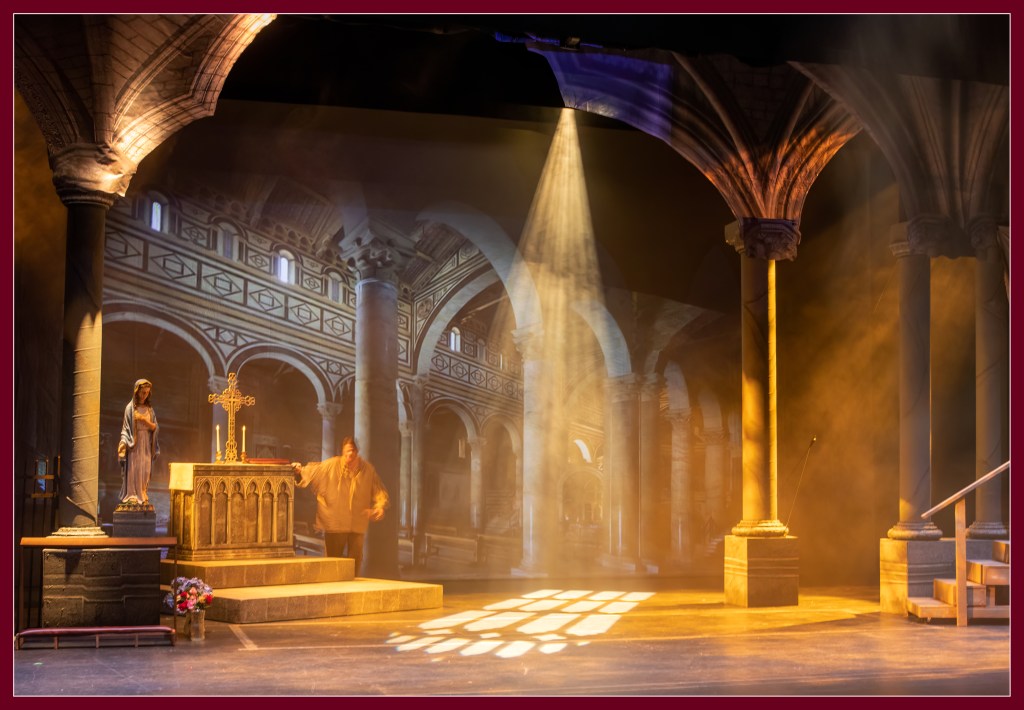
Yet the intimacy of “Tosca” plays against a grand canvass of three unrelated settings, which LVO executes deftly. Act 1 occurs in the nave of the Church of Sant’Andrea della Valle, where Cavaradossi is painting a larger-than-life portrait of the Magdalene for the church. Significant to the narrative, the painter is also a revolutionary fighting to overthrow Rome’s current government. In this act, the integration of the physical set with the backlit projections is especially well done. Act 2 takes place in the Chief of Police Scarpia’s vast quarters in Palazzo Farnese. Here, he manipulates his defenseless prey, Tosca, with sexual extortion, and Cavaradossi, with false arrest and beating. Act 3 takes place against the parapet of Castl Sant’Angelo, where Cavaradossi faces a firing squad.
Aleksey Bogdanov as Scarpia, chorus.
Casting for the three main parts in this opera is critical, starting with the title role, and Livermore Valley Opera has attracted Ann Toomey for her Bay Area debut. Toomey offers the vocal versatility that suits this demanding role completely. In mid range and middle volume, her lyrical voice caresses the composer’s beautiful melodic lines. But Tosca is an actress – one who suffers personal degradation and whose lover faces existential threat. As Toomey’s voice crescendos in emotional scenes, it emits a dramatic fervor rising to the intensity of the moment. Although she masters this duality throughout, it particularly comes together in Tosca’s wistful yet powerful signature aria, “Vissi d’arte” (“I lived for art”), when she realizes that life will not go on as before, and she begs Scarpia to release her from the pain.
Although Alex Boyer’s resumé includes stints around the country, he is well planted in the Bay Area, where he has become an audience favorite as a fine lyric tenor with a strong, clear, and compelling voice. Cavaradossi fits well within his catalog. He nails the hero’s bookend arias. His romanza, “Recondita armonia” (“Concealed harmony”), a love letter to Tosca when life is good, is sung with great panache. Sadly, he faces death and regret with the hauntingly delivered “E lucevan le stelle” (“The stars showed brightly”), though his being seated at the beginning of the latter reduces the impact at the start of the piece. Boyer also brings a little bit extra to his portrayal. Cavaradossi is often played with a rather dull earnestness, but the tenor adds a light and humorous touch with a charming twinkle in the eye.
Aleksey Bogdanov as Scarpia, Ann Toomey as Tosca.
It is unsurprising to learn that, despite his youth, Aleksey Bogdanov has performed Scarpia with several opera companies around the country. His characterization is as well-matched as it is profound. The high demand for his services in this part becomes evident from his first entry onto the stage. Unctuously pursuing Tosca, this cruel and imposing figure is a visual magnet who dominates the stage. More importantly, Bogdanov’s dark baritone booms, but with a percussive clarity unusual for such deep tones. While sopranos are often asked to sing above the din of many voices, it is uncommon to expect a male with a lower voice to do so. But Bogdanov rises to the occasion with his “Va, Tosca / Te Deum” in which he vocally slays the lesser voices surrounding him. The resounding number is particularly poignant in contrasting Scarpia’s purported religious devotion with his lust for Tosca as he repeats her name against the religiously themed music.
Of the supporting roles, Kirk Eichelberger deserves special recognition. In his brief presence as Angelotti, an escaped prisoner and political ally of Cavaradossi, he delivers a ringing vocal account with his nimble baritone voice. Conductor Alexander Katsman paces the orchestra well and produces a mellow sound. One of the understandable compromises that a smaller opera company must make is the size of the orchestra. Underpowering is an occasional issue, particularly with the striking opening of the opera and other recurrences of the searing Scarpia motif. Nonetheless, “Tosca” is another credit to LVO’s artistry.
Alex Boyer as Cavaradossi.
“Tosca,” composed by Giacomo Puccini, with libretto by Luigi Illica and Giuseppe Giacosa, is produced by Livermore Valley Opera and plays at Bankhead Theater, 2400 First Street, Livermore, CA through March 12, 2023.
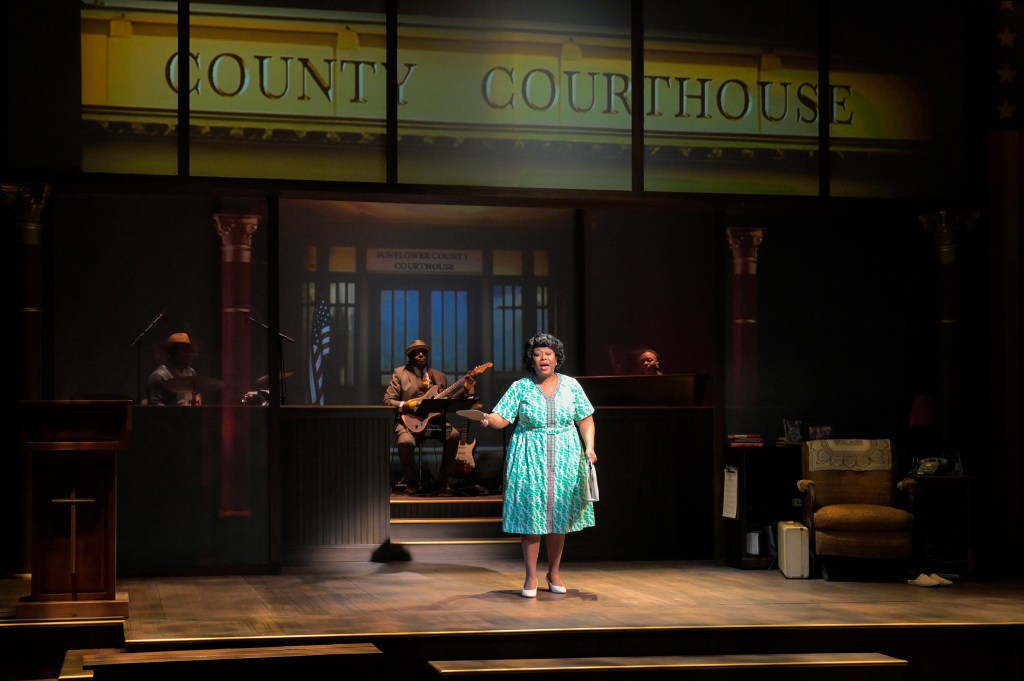
Greta Oglesby as Fannie Lou Hamer. Photos by Kevin Berne.
The side walls of the Lucie Stern Theatre are bedecked with simple posters reflective of 1962, when the push for the Civil Rights Act began. “We Demand the Right to Vote.” “No to Jim Crow.” “Pass the Civil Rights Bill.” And many more. Screen projections and audio on stage highlight the key players and incidents from the movement to secure voting rights for African Americans.
Several years ago, this play could be seen as history – a poignant reminder of the many tragedies and the ultimate triumph of good over evil – an admission of our reviled former days. Regrettably, this country suffers a redux of our hateful and sinful past, if without the preponderance of violence and extreme intimidation for wanting the vote. However, violence is still visited upon Blacks in other ways and for other reasons.
The political right wing in the United States threatens the very existence of democracy as political operatives boldly and cruelly crush the goodness out of progress and what made this nation great. The U.S. Supreme Court has undermined the Civil Rights Act of 1965, and conservative (read Republican) local political authorities, judges, state legislatures, and their colleagues in the U.S. Congress brazenly introduce laws and administrative procedures with the evil intent of depriving people who are not in their clan the right to vote by using lies, deceit, and Machiavellian ploys. As startling as the following question may be – how do these actions differ from fascism? And why aren’t its enemies not fielding a stronger defense against this perversion? So, ultimately, this is to say that “Fannie: The Music and Life of Fannie Lou Hamer” should not be viewed as a simple history lesson, but as a cautionary analogue to what is happening at this very time.
Greta Oglesby gloriously reprises the role of Fannie Lou Hamer that she performed at Oregon Shakes’ vast outdoor Elizabethan Theatre. She brings a speaking voice brimming with passion and conviction, as well as a strong and melodious singing voice. She stalks the stage with a slight hobble as a wounded warrior who is too busy planning the next demonstration to let her nagging injuries slow her down.
So, who was Fannie Lou Hamer? A minimally educated, but intelligent, articulate, and committed Mississippi woman – she is one of those whose contributions are not recognized in the same breath as activist leaders of the day. Yet, she organized the pivotal Mississippi’s Freedom Summer and co-founded the National Women’s Political Caucus. Perhaps her story has not rung forth simply because she is a woman, much like Dolores Huerta’s light as a leader of the United Farm Workers’ of America was totally overshadowed by co-founder Cesar Chavez until recently.
Playwright Cheryl L. West has crafted a 70-minute summary of Hamer’s work, shining light on this much overlooked lioness. Mixing vignettes of great gravity with occasional lighter touches, the playwright keeps the action moving along, and Director Tim Bond creates a kinetic and visual environment to prevent the one-woman show from going stale.
Fighting through poverty, even through the years of her activism, Oglesby depicts Hamer’s indomitable spirit in a series of stories mostly from the 1960’s. In one harrowing sequence in jail, she is beaten almost to death involuntarily at the hands of a Black male prisoner, so demanded by a White jailer. Hamer would suffer permanent kidney damage along with other lasting ailments. She vowed, however, that if she could survive that beating, she would be intimidated by nothing. She continued to register people to vote and fight literacy tests, poll taxes, and lying intimidation to accomplish equal voting rights. Along the way, she would objectively acknowledge the truths that she confronted. Not to generalize, but some white women advanced their own voting rights at the expense of rights of Black women to vote, so that the suffrage movement actually set back progress for Black women. At the same time, some white men and youths were instrumental in helping to move the needle toward universal suffrage.
The structure of the play is a key element in the entertainment. Throughout, Hamer sings snippets of songs of protest to enliven the stories, and she does so with great verve in a number of styles from ballad to rousing revival meeting gospel with sing-along, inducing audience involvement. Some lyrics are organic and cleverly carry the narrative of the story, while others are old standards like “This Little Light of Mine” and “We Shall Not Be Moved.” Missing is the civil rights anthem “We Shall Overcome,” which may have been omitted because it would seem too cliché. This device of integrating music into dialog, which she did use in her meetings, adds much liveliness to what could be a wholly depressing chronicle.
“Fannie: The Music and Life of Fannie Lou Hamer,” is a fitting tribute to a courageous and accomplished woman. While its messages are important, unfortunately, they largely reach the already converted. In these days, many people do not seek the truth but rather reinforcement of what they already believe. So those who don’t want to acknowledge the flaws in American history are unlikely to seek exposure to a presentation like this. As a footnote, Hamer’s prescient warning echoes that just because White resisters to the progress of Blacks are not wearing hoods doesn’t mean that they’re not trying to destroy the Black community. The battle is far from won.
“Fannie: The Music and Life of Fannie Lou Hamer,” is written by Cheryl L. West, produced by TheatreWorks Silicon Valley, and is performed at Lucie Stern Theatre, 1305 Middlefield Road, Palo Alto, CA through April 2, 2023.
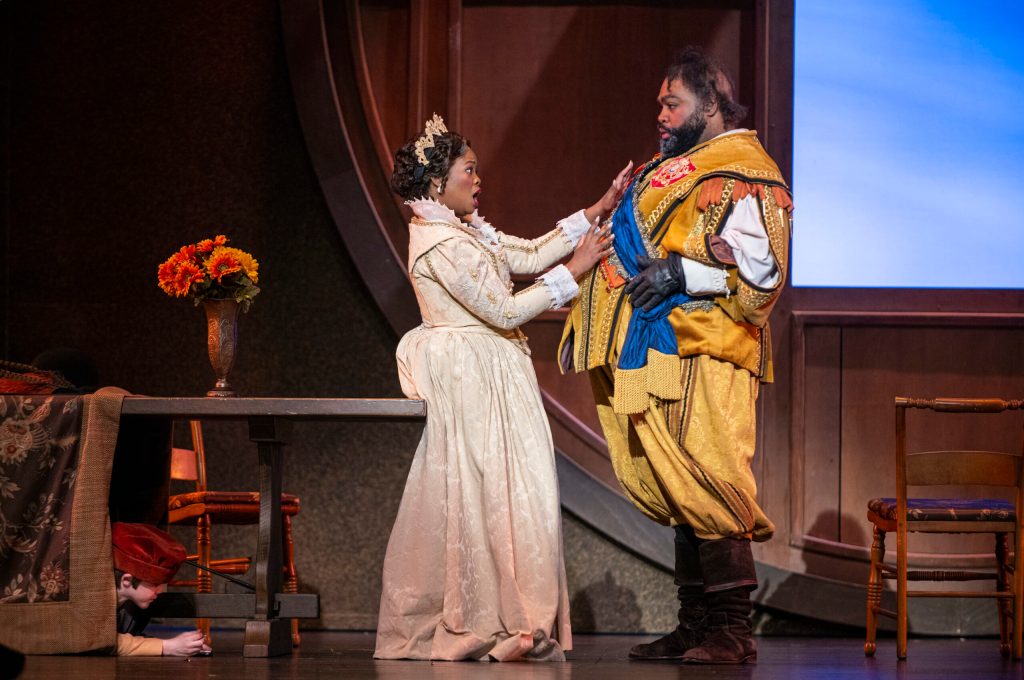
Chanáe Curtis as Alice Ford, Darren Lekeith Drone as Sir John Falstaff. All photos by David Allen.
Verdi admired Shakespeare. “Macbeth” was among the composer’s great early works. Four decades later, he would return to The Bard’s folio for his final two operas. Verdi’s penultimate opera, “Otello,” was perhaps his crowning achievement, with many cognoscenti arguing that the opera improves upon the play. After toiling seven more years, the composer premiered “Falstaff,” based on the character introduced in Henry IV Parts 1 and 2 and fleshed out in “The Merry Wives of Windsor.” For the librettos of both of these final operas, the composer turned to Arrigo Boito, who perhaps deserves as much credit as Verdi for the greatness of these works.
“Otello” abounds with darkness and tragic intrigue, while “Falstaff” offers spirited roguishness and light intrigue. This would be Verdi’s only attempt at comedy other than the failed early work “Un Giorno de Regno.” Unlike “Otello,” which is rich with notable arias, “Falstaff” seems to eschew memorable tunes in its through-sung, largely conversational format. Lacking set pieces that would appear on “Best Hits” albums, “Falstaff” instead treats the listener to endless anticipation and variety. In its highly inventive score, Verdi’s lifetime of musical mastery comes through. The mix of texture and rhythm are pronounced, especially in ensemble pieces.
(below) Marc Molomot as Bardolfo, Andrew Allan Hiers as Pistola, (above) Alexander Hernandez-Lopez as Page, Darren Lekeith Drone as Sir John Falstaff, Zhengyi Bai as Dr. Caius.
Frothy delights like “Falstaff” present particular challenges. Comic timing, enthusiastic affect, and vocal versatility must be heightened. Opera San José’s production excels in every dimension. Performers sing with joy and act with charm. All of the artistic elements strike the right note, resulting in a production that glitters.
As the focus of his comedy, Verdi set his sights on the larger-than-life character Sir John Falstaff. Licentious and self-indulgent, he is one of literature’s notable comic characters. He may be viewed as a chauvinist whose confidence to seduce women exceeds his desirability as a love interest, and he’s certainly willing to use whatever deception to entrap the opposite sex. But his self-delusion will become apparent as his scheming leads to humiliation. Indeed, Shakespeare and Verdi may be viewed as feminists in the context of this work as the women win the contests by outfoxing the conniving men.
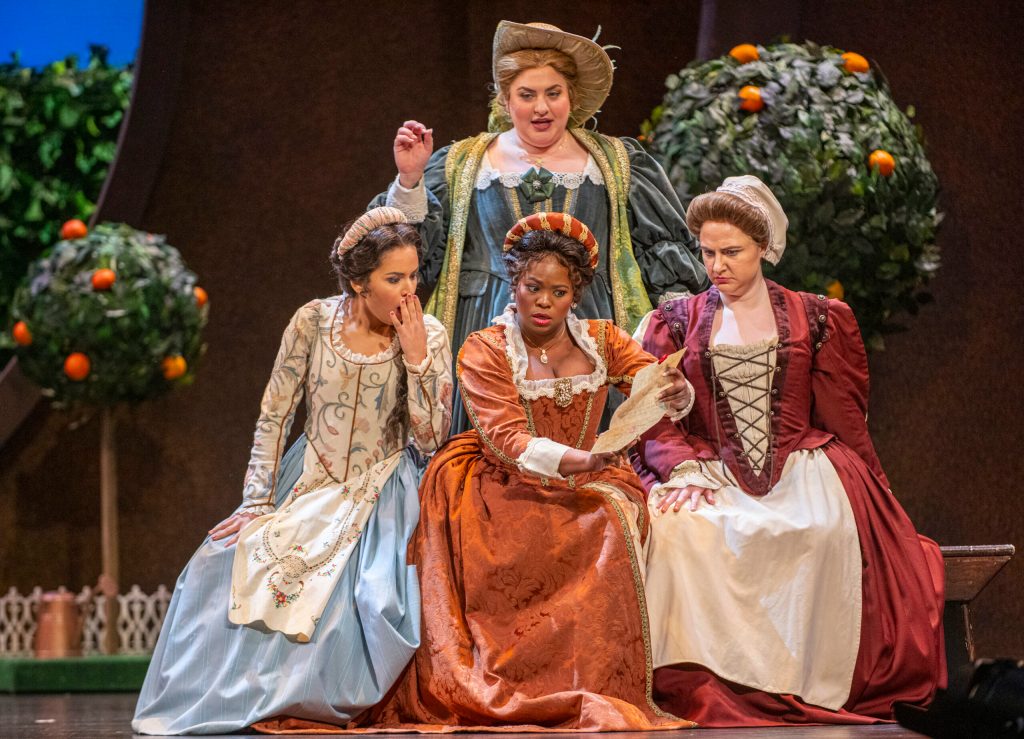
In the central plot line, Falstaff sends love letters to two married women, Alice Ford and Meg Page. Although he fancies himself an appealing lover, his motivation is financial – to blackmail the women after having assignations with them. Unknown to the perpetrator, his quarries are friends, and learning of the deception, they are able to turn the tables on Falstaff. In a secondary plot, Alice’s husband, John Ford, has arranged for their daughter Nannetta to marry the established and older Dr. Caius, but she loves the callow Fenton. The story develops a little slowly, having incidents that introduce characters without adding to the central narratives. But the story picks up steam and is always aided by the energy of the music as well as the fine performances and production values of this offering.
(seated) Natalia Santaliz as Nannetta, Chanáe Curtis as Alice Ford, Megan Esther Grey as Mistress Quickly, (standing) Shanley Horvitz as Meg Page.
The lively music is punctuated by animated ensemble pieces including the complex a capella patter quartet by the women in which they vow revenge against Falstaff. Another highlight is the double quartet plus one, in which the four men commit to foil the young lovers Fenton and Nannetta, while the women show support for them, and the lovers pledge their love above the cacophony of their elders. These clever ensembles are sung with remarkable zest and skill.
The score also includes aria-length soliloquys. Particularly touching is Ford’s wonderful reflection about his love for Alice. As previously noted, Verdi does not yield to recurring melodic phrases which mark the beloved arias of his middle period. While this may disappoint some, “Falstaff” is a masterpiece in its own right.
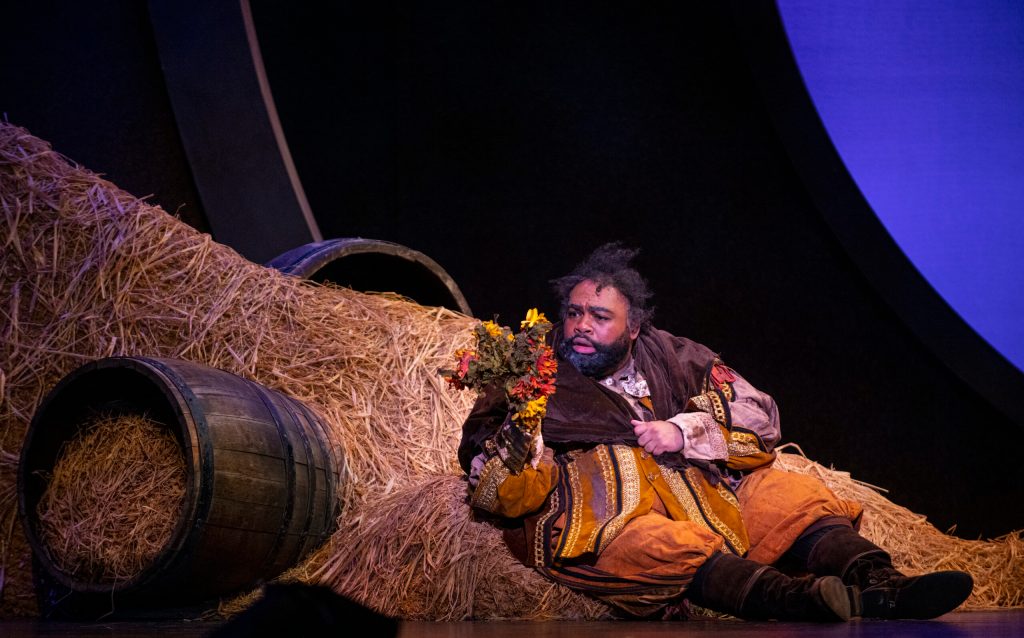
Opera San José’s casting is superb. Of course, the sine qua non for success with this opera is a compelling title character, and Darren Lekeith Drone transcends requirements in every way. His full baritone voice with warm vibrato suits the role well. Moreover, he nails the portrayal with a full range of visual and vocal expression. In his flouncy corpulence, Drone commands the stage, displaying pompousness and narcissism with everything from mugging to mock and genuine ire. His exuberance and smiling visage make him sympathetic enough to ultimately allow forgiveness in the end for his bad behavior.
Cast.
Falstaff’s nemesis, Alice Ford, provides a counterbalance. Played brilliantly by Chanáe Curtis, Mistress Ford possesses enterprise and quick wit to defeat him. Curtis exudes charm and a full range lyric soprano with considerable power in the mid and upper portions. Every other cast member contributes well to the happy outcome. It is a little unfair to mention one individual without mentioning them all, but Natalia Santaliz, with a sweet soprano voice, as the young lover Nannetta is a favorite.
Joseph Marcheso conducts the orchestra with complete authority. The sound is always rich and bright and the pace is brisk. Marcheso navigates the dynamics and staccato elements with particular skill. Director José Maria Condemi deserves special commendation for orchestrating the onstage chaos, with striking movement and positioning. The laundry scene, in which the women have Falstaff hide in a clothes basket only to get dumped into the river is particularly raucous. Steven C. Kemp’s scenic design also deserves a nod. He uses a single and appropriate basic set in a reddish wood color that is built around the visual theme of wine kegs and openings framed by the head hoops of barrels. Additionally, kudos to Howard Tsvi Kaplan for costumes, Christina Martin for wigs and makeup, and David Lee Cuthbert for lighting.
Darren Lekeith Drone as Sir John Falstaff.
“Falstaff” stands as a great achievement in the exquisite catalog of Giuseppe Verdi as well as that of librettist Arrigo Boito. It is a work that will satisfy the greatest opera afficionados yet is accessible to newcomers to the genre as a great comedy supported by exhilarating music. Opera San José has shown again what an asset it is to the Bay Area’s cultural community.
“Falstaff” is composed by Giuseppe Verdi with libretto by Arrigo Boito, produced by Opera San José, and plays at California Theatre, 345 First Street, San Jose, CA through February 19, 2023.


















 cordellreportsdotcom