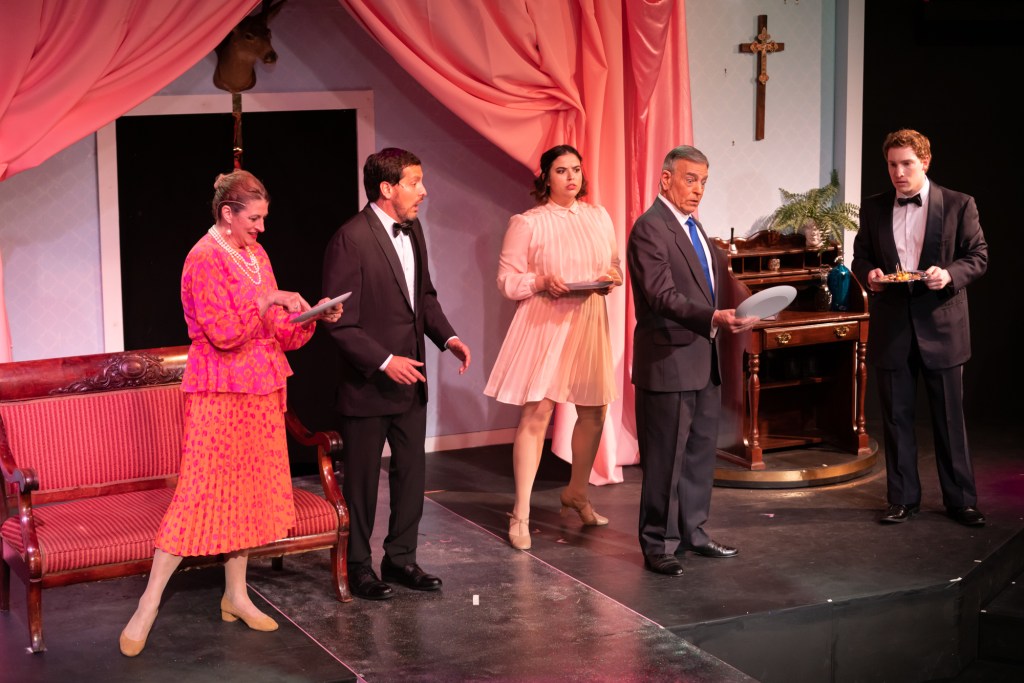
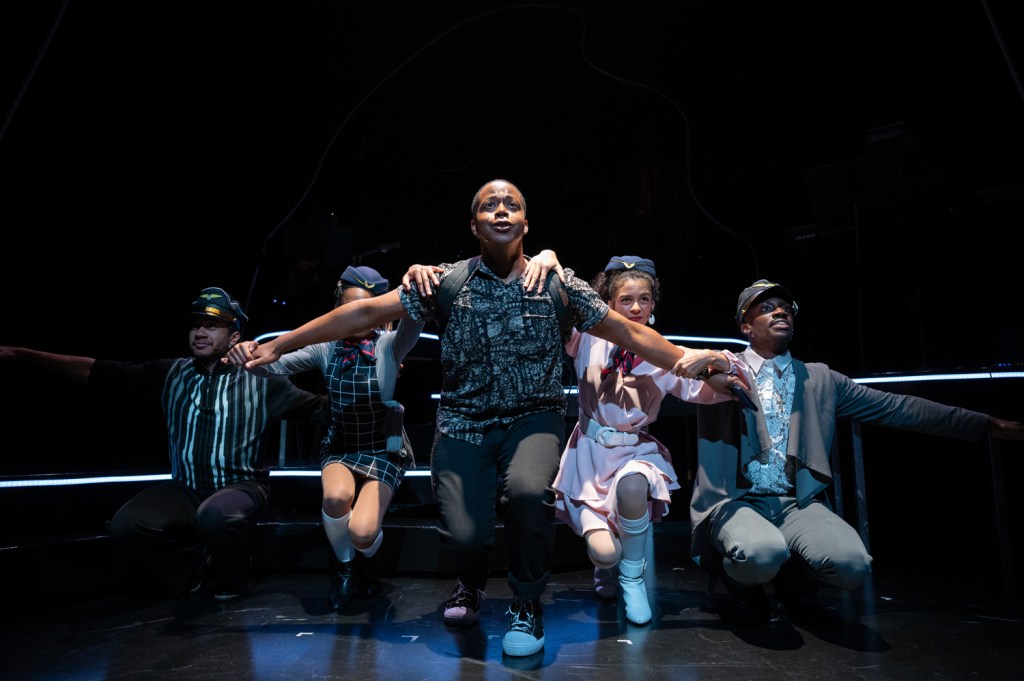
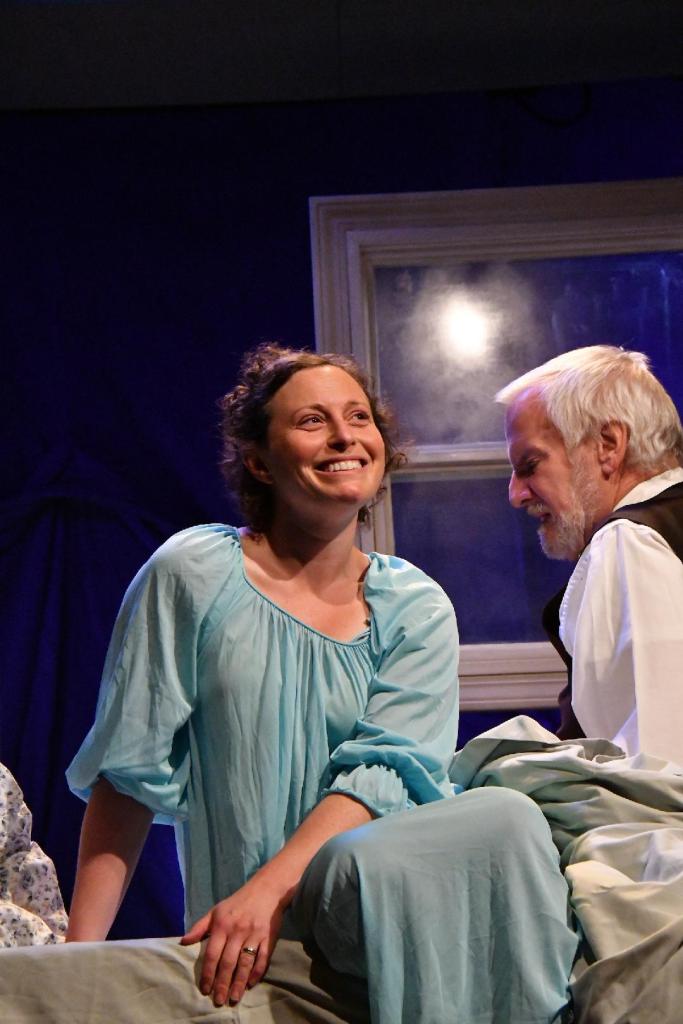
Fefu and Her Friends

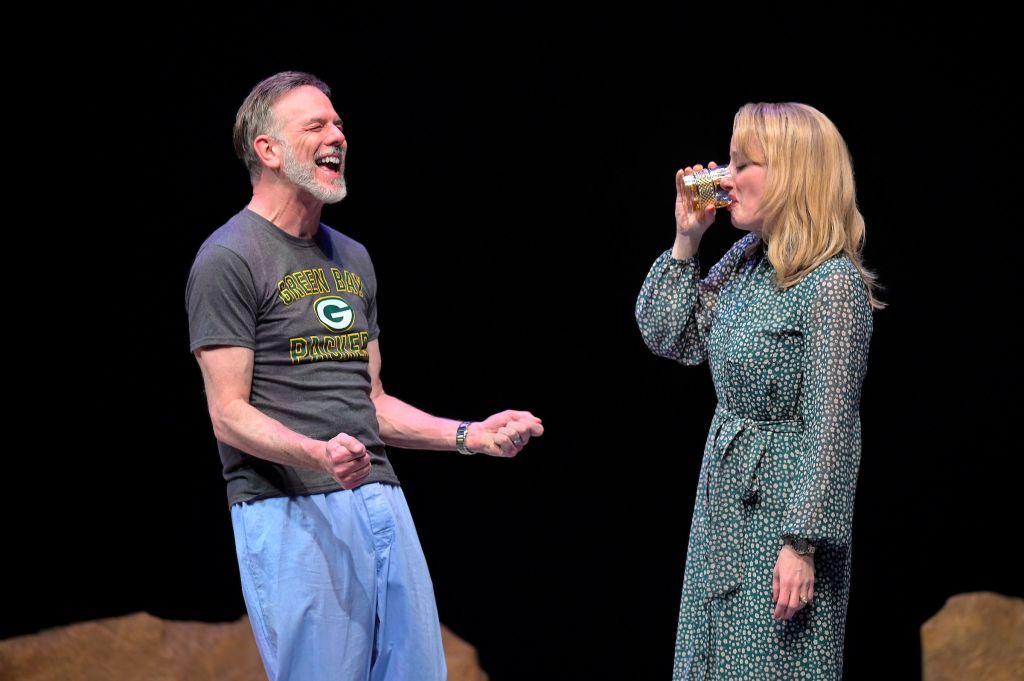
Sarita Ocón as Christina and Jennifer Ikeda as Cindy (both facing away), Lisa Anne Porter as Julia, Cindy Goldfield as Emma, Catherine Castellanos as Fefu, Marga Gomez as Cecilia. All photos by Kevin Berne.

In 1936, Clare Boothe Luce’s “The Women” became the first play with an all-female cast to reach the stage.  The women came from various walks of life; topics focused mostly on women’s relationships with men; the venues ranged from Manhattan to Reno and a trans-continental train that linked them; it took place over years; and the characters were stylized.

In 1977, María Irene Fornés’ innovative “Fefu and Her Friends” replicated the notion of an all-female cast but flips the script on all of those dimensions.  It concerns a reunion of a group of friends gathered to rehearse a presentation to be given to a charity; themes are varied, including women’s relationships with women, which was pretty daring at the time; the single setting is Fefu’s house; action takes place in one day; and the characters, if a little wacky, are grounded in realism.  ACT has assembled a cast of some of the Bay Area’s finest actors and provides a beautifully produced and directed, entertaining production of this quasi-absurdist play.

Catherine Castellanos as Fefu, Cindy Goldfield as Emma (both on balcony). Atrium as garden breakout venue.

But first, a note on a distinguishing structural conceit that limits the number of sites where it can be produced and creates unusual logistics challenges.  Although the happenings occur in one house, they span five locations.  For the opening and closing acts, the living room scenes are performed on the main stage.  In between, four breakout rooms are used for activities that go on simultaneously.  The audience is divided into four groups that rotate to the various locations to see the nine-minute scenes.  This play is highly regarded but seldom performed because of the design demands, so take advantage of seeing it while you can.

The use of simultaneity had been raised to high art by Alan Ayckbourn’s “Norman Conquests,” comprised of three full plays, each occurring in different parts of a house and grounds with the same six characters in each.  However, Fornés’ twist of the promenading to the four small locations adds the opportunity for audience reflection and sharing insights during the proceedings.   The viewer also observes those scenes with such intimacy as to feel like a member of the reunion.

Stacy Ross as Paula, Marga Gomez as Cecilia. Kitchen as breakout venue.

The play is set in New England in 1935.  Although Fefu, portrayed with flamboyance and dominance by the redoubtable Catherine Castellanos, facilitates the affair, wheelchair-bound Julia represents the axis of the plotline.  Sometime past, when a hunter had killed a deer in the woods, Julia, who was in attendance, fell as if shot herself.  And while no external wound was found, Julia suffered the loss of movement in her legs and a recurring madness developed.  Perhaps her condition represents the invisible emotional pain that many women suffer.

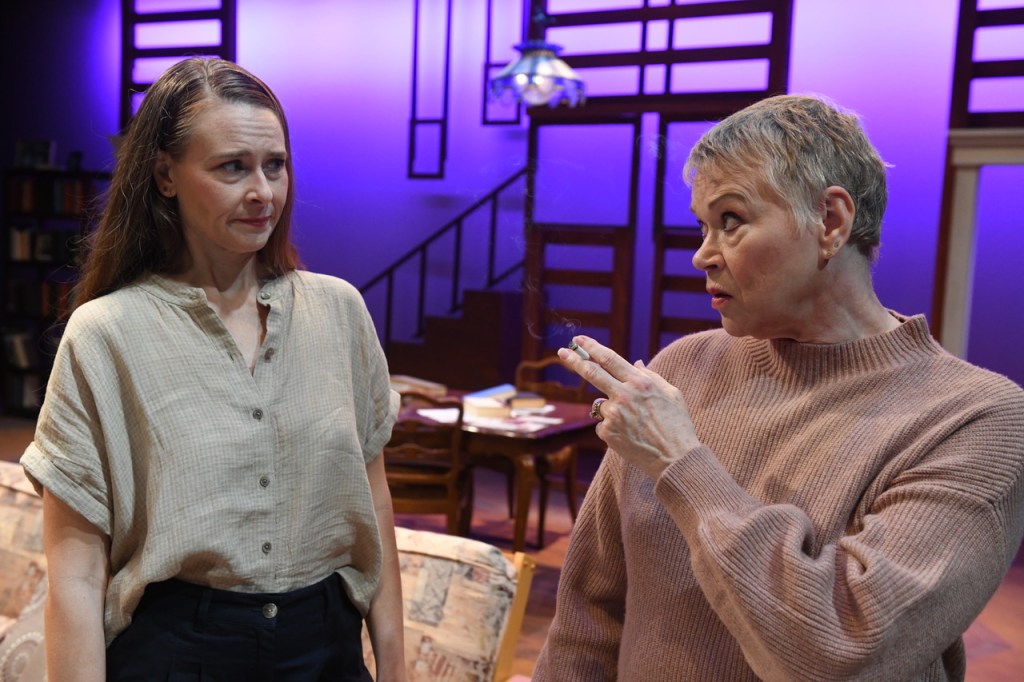
From start to finish, Julia’s story is quite short, but narratives zigzag as we learn about the women’s lives and relationships.  The playwright’s goal seems to be more about getting to know some real and diverse women and their relationships behind the curtains, rather than pressing a particular thematic agenda.  The content of scenes is all over the place.  One breakout session takes place in the study where Christina verbalizes her French language lessons and Cindy muses aloud at world records in a “Ripley’s Believe It Or Not” book.  They intermittently chat about things like the literal versus figurative meanings of being swept away.  That’s it!

Meanwhile, in the kitchen, Paula deconstructs the cycle of love into its sequence of events and determines that it lasts for seven years and three months.  As she’s solving this profound mystery, she is visited by Cecilia, a former lover who appears interested in rekindling the flame.

Sarita Ocón as Christina, Jennifer Ikeda as Cindy. Study as breakout venue.

The only breakout session with complete linearity to the central narratives has Julia lying in a semi-conscious state in a bedroom, hearing voices and mumbling about being clubbed.  Another odd thread is that she expresses misogynistic thoughts that are also espoused by Fefu in the living room.  These ideas are difficult to digest in the context of a play that advances women as whole people, but perhaps it’s another reflection of the playwright’s desire to be adventuresome and provocative rather than definitive.  As Fefu says, “Life is theater; theater is life.”

Subject matter is often dense and delivered with speed so that it may be hard to follow at a micro level, but whole skits can be missed without losing the overall sense of the play.  Each character has a chance to shine, but the most impactful is probably Cindy Goldfield as Emma.  She delivers an environmental treatise that includes dramatic sign language which is a hoot, as well as a line of questioning that starts “Do you think of genitals all the time?”

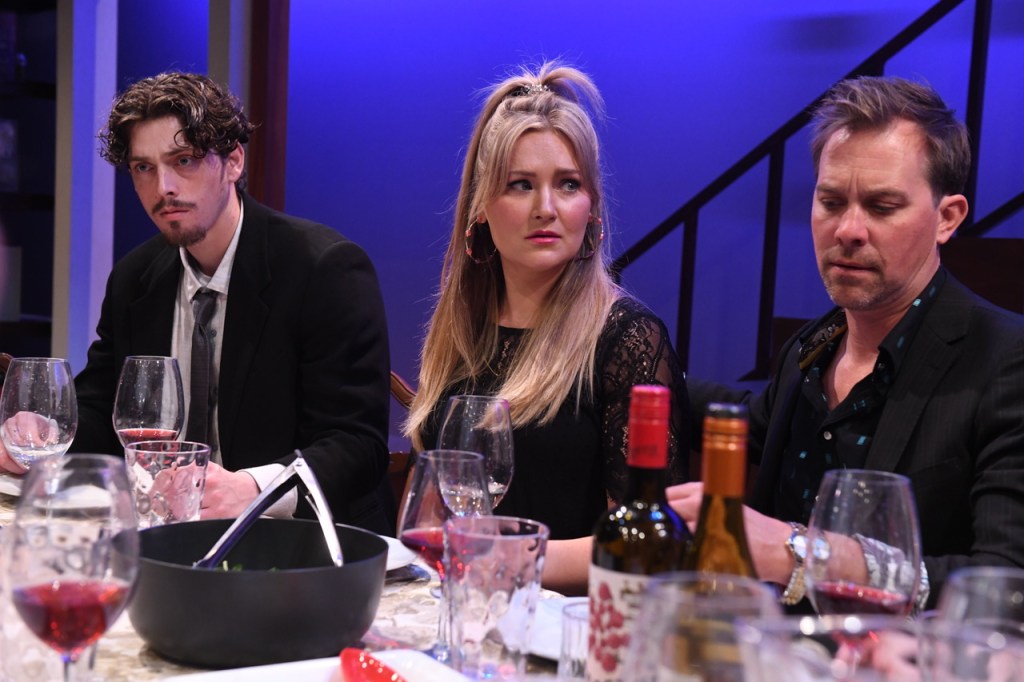
Leontyne Mbele-Mbong as Sue, Stacy Ross as Paula, Lisa Anne Porter as Julia.

Director Pam MacKinnon marshals her resources well.  Not only are there five stages to dress, but the logistics of moving the audience groups around as well as some of the actors who appear in more than one of the simultaneous vignettes is a special challenge.  Tanya Orellana has designed five spectacular and highly varied stages with separate audience seatings.  Jake Rodriguez with sound and Russell H. Champa with lighting have also created multiples of their artistic specialties.  The distinguished cast is Catherine Castellanos as Fefu, Cindy Goldfield as Emma, Marga Gomez as Cecilia, Jennifer Ikeda as Cindy, Leontyne Mbele-Mbong as Sue, Sarita Ocón as Christina, Lisa Anne Porter as Julia, and Stacy Ross as Paula.

“Fefu and Her Friends” is a unique theatrical experience that stimulates all of the senses.  ACT’s realization excels by every measure.  But to fully appreciate it, you must be pleased to leave the theater with more questions than answers.

“Fefu and Her Friends” is written by María Irene Fornés, produced by American Conservatory Theater, and plays on its Strand Theater stage at 1127 Market Street, San Francisco, CA through May 1, 2022.
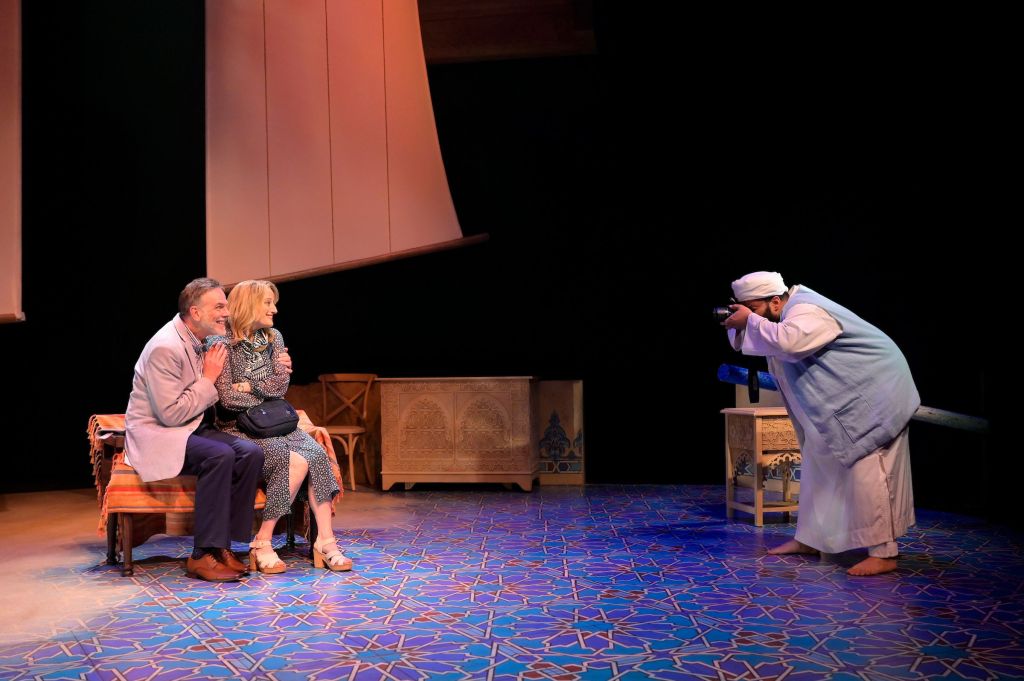

Hotter Than Egypt

Paul Morgan Stetler, Jen Taylor, Ahmad Kamal. All photos by Kevin Berne.

When Jean returns from the pool to the hotel room in a two-piece bathing suit and towel, husband Paul insists that she dress immediately, as their Egyptian tour guides, the recently engaged Maha (female) and Seif (male) are present.  Maha had previously been Paul’s tour guide, and she is breaking in Seif, as she hopes to shift to fashion design.  Maha insists that Jean is a tourist doing what tourists do, and that she is not offended.  Seif, supposedly speaking Arabic to Maha, is sarcastic.  Not wanting to offend local sensitivities, Paul persists, arguing to Jean that the Egyptians are not always going to say what they really mean.

This opening volley sets in motion the cross-cultural dimension of “Hotter Than Egypt,” which, by the way, is not a reference to the weather.  But the play-opening incident does raise some interesting questions.  Although cultural differences and norms clearly exist, does recognizing and acting upon them automatically affirm a form of stereotyping?  And though great differences between cultures often exist at the working-class level, generally, aren’t the richer and more educated in most places more cosmopolitan and not so bound by their society’s broader mores?  And should we cut more slack for private behavior than public action?

Naseem Etemad, Wasim No’Mani.

Yussef El Guindi’s new play deftly delves into a constellation of differences – not only cultural, but marital, economic, power, gender, and generational – some between cultures and some within.  The result is a lively dramedy that reveals the causes and consequences of the cracks in the American couple’s marriage.

Paul is a successful businessman from Wisconsin who has previously visited Egypt on business trips.  He and Jean have decided to celebrate their 24th wedding anniversary by combining business and pleasure on a trip Cairo.

Rather than a commemoration, the playwright shows how time together can expose classic, long simmering issues.  One is the asymmetry, particularly in the white-collar community, that results when the wife is a homemaker, which Jean is.  For decades, the husband engages regularly with other adults on issues of consequence beyond the family, while the wife’s horizons are limited mostly to dealing with children and interacting with other stay-at-home moms.  The husband thus may find the wife has become boring to him with less to say about the outside world.  The other is the contention that while men can become more attractive with age, that women invariably lose their appeal (this writer rejects that viewpoint), with the result that younger women become interested in older men and vice versa, often with disastrous outcomes.

Wasim No’Mani, Jen Taylor.

Structurally, the many social and personal divides are revealed in an unusual, but effective manner.  The bulk of the stage time is taken by scenes of two-person, mixed-gender conversations, with all four combinations of principal characters well represented.  Each twosome constitutes a very different relationship, and in these dyadal exchanges, we get in-depth looks into these people, who are depicted in very real ways.  The Paul and Jean conversations reinforce the notion that people simply change over time, and that any two people don’t necessarily change in compatible ways.  We also understand the kismet of random events.  Certain uncontrollable situations can have profound impacts on relationships.

Depictions by each of the actors resonate with authenticity. Paul (portrayed by Paul Morgan Stetler) is a great proponent of U.S. values; smarmy in his certitude; and deluded into believing that he is a great proponent of women’s rights, although he is quite condescending to his wife.  The diffident Jean (a particularly sensitive portrayal by Jen Taylor) feels her life has been wasted and dislikes her college-aged kids, but this adventure may be a game changer for her.  It’s not clear whether it is she or Paul who is more responsible for their sexual disengagement.  Maha (Naseem Etemad) is amiable, but goals oriented enough to keep her eye on the prize, tolerating what she must to get there.  The less self-censored Seif (Wasim No’mani) is “fed up with what we are in this country” but equally disparaging of ignorant foreigners.  In the end, however, he is perhaps the most complex of the characters, both in his restraint and in his foresight.

Paul Morgan Stetler, Jen Taylor.

Throughout, we see enough of Egypt to get the seeds of difference that separate it from American ways.  Nothing concerning this plot line is particularly original, but thematic elements are compiled in a cohesive and interesting fashion and effectively directed by John Langs.  The production is very worthy.  One glitch is that, at the beginning, it was not clear that Maha and Seif were speaking Arabic to each other when in the company of others, though later, Paul refers to being uncomfortable when they do.  More interesting options would be for the characters to speak Arabic while projecting English surtitles or for the Egyptians to code-switch into heavy accents to identify the foreign language speaking.

The story plays against Carey Wong’s strong and versatile set that had to be redesigned from the Seattle co-world-premiere, as it was performed there in-the-round, whereas Marin has a proscenium stage.  Special touches like antiquities features and the sails of a felucca boat on the Nile suspended from the fly add to the ambiance.  Johanna Melamed’s rich sound design evokes an Egyptian feel.

“Hotter Than Egypt,” a world premiere, is written by Yussef El Guindi, co-produced by Marin Theatre Company and A Contemporary Theatre of Seattle, WA, and plays at the MTC stage, 397 Miller Ave., Mill Valley, CA through April 24, 2022.

August: Osage County

Allison F. Rich as Barbara, Michael Ray Wisely as Bill, Judith Miller as Violet, Marie Shell as Mattie Fae. All photos by Dave Lepori.

In “Anna Karenina,” one of his finest novels, author Leo Tolstoy notes that “Happy families are all alike; every unhappy family is unhappy in its own way.”  In “August: Osage County,” the greater Weston family of greater Tulsa, Oklahoma and beyond covers most of the bases for unhappiness – suicide, addiction, adultery, separation, betrayal, incest, and more.  But at least they pursue their unhappiness with a certain quasi-intellectual flair and rapier-sharp wit (complemented by an abundance of f-bombs) as the family abounds with writers, teachers, and a librarian.

Playwright Tracy Letts’ Pulitzer Prize and multiple Tony Award winning play concerns the family reunion from hell.  The family doge, Beverly, was a prominent poet in his younger days, but settled into a long life as a disgruntled teacher and acknowledged but likeable alcoholic.  Several days after his unexplained disappearance, Violet, his wife and family doyenne, musters the troops.  Her sister and three daughters, each with their own family attachments in tow, arrive at the family homestead, and the mayhem begins.

Elena Wright as Ivy, Judith Miller as Violet.

Letts has mastered dramedy.  The events could not be more serious, yet the constant flow of laughable moments seems totally organic and averts the dark descent into another “Long Day’s Journey into Night.”  San Jose Stage stays true to the play’s intent and delivers an absolutely riveting production with captivating performances that make the time fly by, though run time could be the play’s most common criticism.  Along with fine contributions from the creative team, this is an excellent rendering of an excellent play.

From the outset, we understand that we’re dealing with a family that has issues.  Director Kenneth Kelleher has cleverly designed the opening scene in which Beverly is interviewing a Cheyenne woman, Johnna, to be a live-in cook/maid for the cancer-suffering Violet.  All the while, he scours the premises trying to fill his glass from hidden bottles of Jim Beam with dregs remaining in them.  Bev shares with the prospective employee that he and Violet have a contract – he has his booze and she has her pills.  Randall King as Bev milks the incident for all it’s worth, avoiding the static nature of a conventional sit-down exchange.

The dysfunction and division within the Weston family is palpable, but why shouldn’t it be?  As Ivy, the demure librarian sister observes, relatives are accidental – “a random collection of cells.”  Why is the family even together after Bev disappears?  Habit?  Custom?  Inheritance?  Violet notes that they didn’t gather when she was diagnosed with cancer, but they did when they thought Beverly might be dead.  The playwright explores these and other issues of being part of a family, like who takes responsibility for being around and for caring as well as social standards.

(foreground) Carley Herlihy as Jean, Allison F. Rich as Barbara. (rear) L. Duarte as Johnna, Michael Ray Wisely as Bill, Terrance Smith as Deon Gilbeau.

As Violet, Judith Miller brims with bombast, stalking about like a crazed lioness, sometimes loopy from the alphabet soup of uppers, downers, and sideways that make things copacetic and quell the pain of mouth cancer.  Her modal communication style is screaming, and her modal message is belittling, mostly venting hostility on the daughters who have disappointed her.  Barbara is a professor in Colorado and married to a professor, but she could have aspired to more.  Ivy, who stayed near home, is single and in her forties, but refuses to dress in a manner to attract men.  Karen, who moved to Florida appears to be the airhead in the family.  She’s brought her three-times-married fiancé with her and either doesn’t get or doesn’t care why he is a serial husband.

The household remains in a constant state of siege as one character after another acts divisively or reveals some secret, though there is one family member who appears to know even the most private of those embarrassments.  Of the daughters, it is Barb who carries the greatest baggage, and whom Violet blames for some of Beverly’s errant behavior because of her abandoning the family for the last several years.  Allison F. Rich portrays Barb (an appropriate sobriquet) with self-absorption and great ferocity, attacking with similar breadth and intensity as Vi.  She goes toe-to-toe with her mother and will ultimately challenge her rule in the pride.

Matthew Kropschot as Little Charles, Tanya Marie as Karen, Joshua Hollister as Steve.

This is a family that may be extreme in its drama, but the characters and situations will feel uncomfortably familiar to many.  An effective production of “August: Osage County” depends on crack timing, which Kelleher’s actors provide.  The director also oversees realistic overlapping dialogs and simultaneous conversations to great effect.  And the choreography of the chaotic no-household-crevice-unexamined pill search is a scream.  (Note: there is a vignette told about a family member conveying contraband in a bodily crevice!).  Kudos to all of the actors, but in addition to those already mentioned, special recognition goes to Marie Shell as Vi’s sister Mattie Fae. In all, the company brings it home, offering a most rewarding theatrical experience.

“August: Osage County,” written by Tracy Letts, is produced by San Jose Stage and plays in its theater at 490 South First Street, San Jose, CA through April 24 2022.

Circle Mirror Transformation

Brenda Cisneros as Lauren (facing away), Alfred Muller as Schultz, Emily Keyishian as Marty, Lauren Dunagan as Theresa, David Boyll as James. All photos by Jay Yamada.

Mastering a skill is often an arduous and indirect process.  Recall “The Karate Kid’ in which the sensei, Mr. Miyagi, makes his student, Daniel, wax cars and paint fences with very precise, repetitive motions and hold the crane pose for extended periods long before he ever practices a karate air chop.   In “Circle Mirror Transformation,” Marty teaches an adult acting class at a community center.  After sessions of numerous obliquely relevant exercises, Lauren, the only teen in the class, pipes up, “When are we going to do real acting?”  By Lauren’s definition, they’re not.  But happily for the audience, it gets to observe and enjoy the lessons, and the actors in the play do a wonderful job of making it entertaining. The playwright also develops a parallel track about the characters’ lives that enhances the narrative.

Annie Baker has established herself with a naturalistic stream of plays, including the trilogy taking place in the town of Shirley, Vermont, of which this play is a member.  These are narratives about ordinary people doing ordinary things, often written and acted with such uninflected manner as to elevate boredom and long silences as virtues.  But even when the action is subdued in “Circle Mirror Transformation,” backstories and offstage events divulged heighten the tension.  Fortunately, in this meta-acting play, varying emotion and gesticulation are what it is all about, so even the naturalistic approach results in theatricality.   

Alfred Muller as Schultz, Lauren Dunagan as Theresa.

The dramatic training that the participants receive serves a number of purposes including creativity, confidence, concentration, memory, spontaneity, timing, and most importantly, conquering inhibition.  One of the more directly relevant drills is the interpretation exercise in which two characters repeat the same exchange of lines like “I want it,” and “You can’t have it,” with varying affect.  It demonstrates well how different rendering of words and movement yield very different sense of meaning and emotional response for the viewer.  In another, they have to try to convey feeling and action in an interchange while one can only verbalize “goulash” repeatedly, and the other repeats “akmak.”

The classes take place over six weeks, during which we learn a bit about the characters from their pre-and-post class interaction.  One of the in-class exercises serves a dual purpose in the play when each character presents a bio of another.  The delivery acts as a window into the perceptions of how the speaker feels about the subject of the monologue, sometimes to the surprise of the latter.  Factually, we learn that Marty and her previously married husband James, also a class member, are having issues.  The diffident Schultz, who feels that as a recent divorcee, he is a failure, while the assertive Theresa, who is always stretching her limber body, also broke up with her boyfriend recently.  The otherwise reticent Lauren discloses discomforting family problems at home.

Emily Keyishian as Marty, David Boyll as James.

The characters also develop connections during the six weeks.  One relationship develops and feelings arise by one character for another, but they are not reciprocated.  The two shy members, Schultz and Lauren both open up and become full participants in the group.

Sometimes raw nerves are exposed.  When Lauren and James are portraying Theresa and her ex, Theresa intervenes because the scenario becomes so realistic and painful.  But the big denouement comes with the exercise in which each person is to write down a secret that has been previously shared with no one else.  Although the process to reveal the secrets is intended to be confidential, it would become clear that in a group of five, it can be hard to hide.

Alfred Muller as Schultz, David Boyll as James, Brenda Cisneros as Lauren, Emily Keyishian as Marty (facing away).

All five actors (David Boyll, Brenda Cisneros, Lauren Dunagan, Emily Keyishian, and Alfred Muller) suit their roles ideally and acquit themselves with flying colors.  Director Ciera Eis keeps the action moving and ensures the characters are involved, resisting the drag that can occur with some productions of Baker’s works.  Lighting Designer Weili Shi creates considerable visual drama with spots, floods, and frame illumination for the large mirrors in the set to compensate for the spare staging.  The play offers the viewer an interesting look into the learning of a craft and a brief but penetrating view into the lives of a group of people drawn to it.

“Circle Mirror Transformation” is written by Annie Baker, produced by Custom Made Theatre, and plays on the stage of Phoenix Theatre, 414 Mason Street, San Francisco, CA through April 16, 2022.

La Cage aux Folles

Joshua Beld as Albin. Photo by Grizzly De Haro.

Most of us have probably known people who are embarrassed about their parents.  The cause may be divorce, addiction, violence, or low socio-economic status.  Imagine France in the 1970’s.  A young adult who has flown the nest, Jean-Michel is bringing home the girl he wants to marry, along with her parents.  Her father is leader and political candidate of the Tradition, Family, and Morality Party, committed to cleaning up “immorality.”  Oh, and by the way, J-M’s father refers to himself as a regular homosexual.  The person who acted as his mother for his whole life is a male drag queen homosexual.   And he was brought up in his parents’ apartment above the drag queen nightclub his father owns and operates, La Cage aux Folles (the cage of drag queens.)  Anybody detect trouble on the horizon?

Even for the (rare?) audience member who is not familiar with this work or its Americanized version, “The Birdcage,” the message resonates from the opening number.  Les Cagelles, a chorus and dance line comprised of drag queens at the club, performs “We are what we are,” and the stage is set.  The action then revolves around the couple’s apartment and the club, where grounded Georges emcees and manages the business, and drama queen Albin manages the household and is the club’s lead performer, Zaza.

Matt Skinner as Jean-Miche, Max Thorne as Jacob, Erick Casanova as Georges. Photo by Zac Wollons.

Conflict arises as J-M determines that his father, Georges, can be made presentable for the visitors, but that his “mother,” Albin cannot.  So, J-M invites his birth mother, who had a one-night fling with Georges and who never lived with sire or son, to feign a current marriage with Georges while the fiancée’s delegation is in town.  J-M asks Albin to disappear for 24 hours.  Needless to say, Albin is heartbroken.  And, needless to say, the “best-laid schemes o’ mice an’ men gang aft agley.”

While each plot point is not predictable, the overall story arc is pretty much as expected.  But that’s not the point.  “La Cage” is a delight because of its joy and its empathetic treatment of marginalized people, not to mention the role it played in advancing understanding to many people who had little familiarity with or compassion for the community represented in the story.

Albin is thematically the central figure, and the success of “La Cage” relies heavily on an Albin who commands the stage in a faux-dramatic fashion.  Joshua Beld offers all of the necessary traits.  At once, fantastically funnily flamboyant and infused with mock arrogance, he also captures the sensitivity of compassion and the pathos of disappointment.  His high-pitched giggles belie a deep, trained baritone singing voice that serves well in numbers like “Song in the sand” and “I am what I am,” the latter done in a growling, raspy style.

The Cagelles – Emily Dwyer, Samuel Prince, Isabella Qureshi, Zachary Isen, Jesse Cortez. Photo by Zac Wallons.

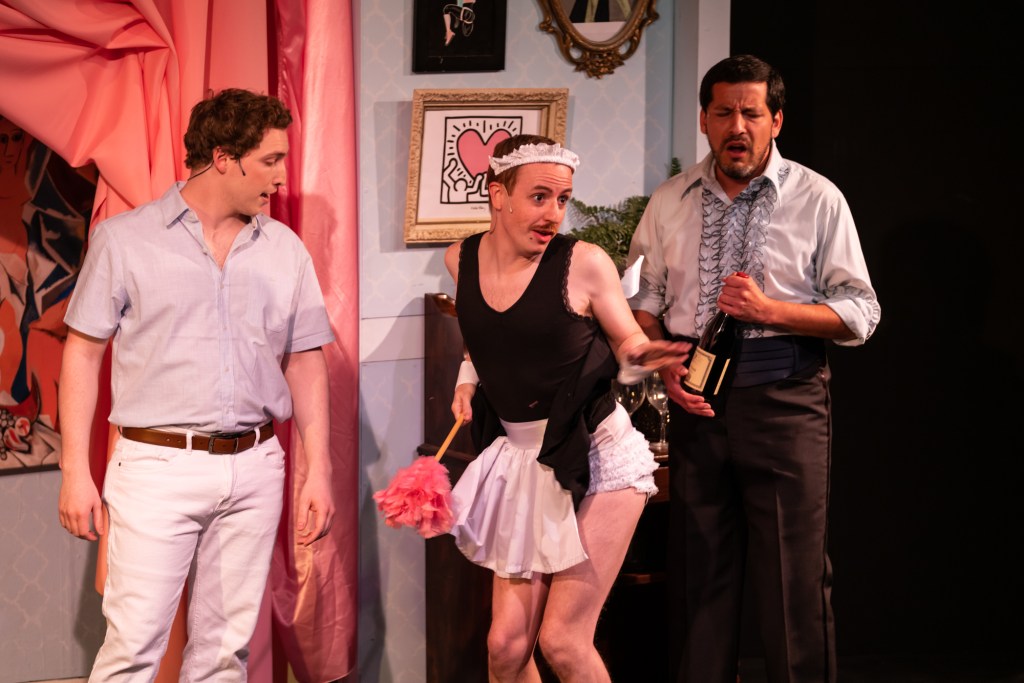
Let it be said that Altarena offers a fun show.  Director Noah Haydon distills a complex production amiably.  Casting and acting are not as consistently outstanding as would be expected of deep-pocket companies, but most are fine.  The other highlight performance is from Max Thorne as Albin’s exuberant and highly protective butler/maid – the moustache in the maid’s outfit.  One false note is that J-M doesn’t need to be played as unsympathetically as he is when confronted with some of his challenges.  Although “La Cage” would benefit from a large stage for elaborate dance numbers, this venue’s physical size compounded by the elevated runway in the set limits the possibilities.  Nevertheless, Leslie Waggoner’s choreography makes good use of the squeezed space.

Lisa Appleyard as Marie, Erick Casanova as Georges, Paige Collazo as Anne, Geoffrey Colton as Dindon, Matt Skinner as Jean-Michel. Photo by Zac Wollons.

The musical ran on Broadway for over four years, garnering six Tonys, including the most coveted – Best Musical, Best Score, and Best Book.   Accordingly, any production of “La Cage aux Folles” starts with great material.  Although there is not huge style and tempo variation in Jerry Herman’s score, it is full of tuneful music with lyrics that pluck the heartstrings.  Finally, Harvey Fierstein speaks with total authenticity in the adaption of the book which balances humor and issues well.

“La Cage aux Folles” with book by Harvey Fierstein and music and lyrics by Jerry Herman is based on the play of the same name by Jean Poiret, is produced by Altarena Playhouse, and appears on its stage at 1409 High Street, Alameda, CA through May 1, 2022.

Water by the Spoonful

Lisa Ramirez as Haikumom. All photos by Jessica Palopoli.

The notion of peer support groups that help link people with common issues has existed for centuries, really taking off in the self-aware, self-help 1970’s.  With the advent of computer technology, their role has expanded enormously, and Internet video conference technology has facilitated virtual face-to-face with the additional advantages of eliminating drive time and allowing remote participation.  But before Zoom, there were computer chat rooms.  While chat communication lacks visual or aural elements, it does offer the characteristic of anonymity, which includes greater ease of making misrepresentation.

In action that shifts back and forth between scenarios, playwright Quiara Alegría Hudes’ clever 2012 Pulitzer Prize winning “Water by the Spoonful” follows two seemingly independent threads through Act 1.  One is a chat group for recovering cocaine addicts.  The other concerns two young adult, Puerto Rican American cousins bereaving the passing of one’s mother.   The threads will intertwine in Act 2.

A small but lively and committed group who are in various stages of recovery participates in the addicts’ chat.  But first a note on the acting.  Similar to the treatment of plays about letter exchanges, like “Dear Liar” or “Dear Elizabeth,” the actual communications are on paper or computer monitors, but the actors speak the words, often directed toward the audience in a stand-and-deliver fashion.  I feel that I say this in a number of reviews, but the acting by this cast is spot on.

Sango Tajima as Orangutan, Dorian Locket as Chutes&Ladders.

In “Water by the Spoonful,” the mysterious facilitator who goes by Haikumom, is superbly played by Lisa Ramirez.  She wryly smiles, cajoling and controlling the interchanges with her charges, but she can also turn on the emotion.  Haikumom also acknowledges still craving and that “staying clean is like tap dancing on a minefield.”  “Chutes&Ladders” is the handle for an IRS Help Desk jockey who has been clean for several years and is played by a jocular Dorian Lockett.  The spritely Sango Tajima is “Orangutan.”  A more recent addict, she left the U.S. to teach English in Japan in order to escape temptations.  That core group is engaging and the characters sympathetic.  The good news is that if you expect a play about addicts to be largely grim and grisly, it’s not.  The bad news is that their being so cheery and well-adjusted may not feel realistic.

Enter “Fountainhead,” a successful young entrepreneur with a history of accomplishments played by an appropriately uptight Ben Euphrat.   His presence irks the veterans, because it’s not clear that he is even off cocaine; his credibility is brought into question; and he seems very self-involved.  We will later learn that he is not the only one lying, something that is easy to do in a chat room.

In the second thread, Lara Maria portrays Yazmin, who hoped for Julliard and a career playing music, but instead teaches music in primary school.  Xander DeAngeles is cousin Elliot, a former Marine relegated to working in a Subway shop, but who has done modeling gigs for Spanish-language television.  Yazmin’s mother, who had been a pillar of the community, endlessly giving, has passed.  The cousins prepare funeral arrangements, but they are financially challenged and need to turn to other sources.

Lara Maria as Yasmin, Xander DeAngeles as Elliot.

To describe the multiple intersections of the scenarios in Act 2 would give away too much of the drama.  The playwright is clearly concerned with addiction, referring to the first day without coke to be the “first day of your life.”  Also revealed is how dependency ruins relationships, impedes career development, and causes risk to other.

Hudes examines anonymous relationships, which have become even more prevalent in the era of social media.  Anonymity is a leveling agent that often gives shy people the courage to advance their convictions.  The less that is known about a person, the more that person’s thoughts are considered on their own merit rather than by attribution, reflective of the Delphi technique.  Haikumom credibly facilitates a group whose content has significant psychological and medical implications, but what are her credentials?  Orangutan reaches out emotionally to Chutes&Ladders knowing nothing of him but his chat in the group.  The nettlesome Fountainhead, whose selection of handle may say something about his self-evaluation, reaches an unexpected socio-emotional breakthrough not likely to have occurred in other circumstances.

Finally, the playwright expresses concern with family.  Why are Yazmin, Elliott, and their clan so tight?  How do individuals in the larger family deal with broken relationships?  Are there some actions in families that can’t be forgiven?  Despite guidance from religion, do they open their hearts to receive redemption?

Ben Euphrat (foreground) as Fountainhead, Lisa Ramirez (background) as Haikumom.

The title of the play will raise questions in the minds of some readers.  It is a treatment for severe diarrhea when a patient can’t keep anything down.  Administer one spoon of water every several minutes indefinitely to avert dehydration.  It is relevant to the play.  Additionally, the hour after hour, day after day of such a treatment acts as a metaphor for the struggle with addiction rehabilitation.

The play is talky with little consequence through much of the duration.  However, it is thoughtful, well produced, and the climaxes make it worthwhile.

“Water by the Spoonful” by Quiara Alegría Hudes is produced by San Francisco Playhouse and plays on their stage at 450 Post St., San Francisco, CA through April 23, 2022.

Otto Frank

Roger Guenveur Smith as Otto Frank. Photo by Jay Yamada.

Otto Frank was the father of Anne Frank.  He gave his daughter a blank autograph book on her 13th birthday in which Anne diligently recorded her thoughts and experiences from mundane activities to pathos to hope over the next two years.  Otto retrieved the diary after World War II and had it translated and published.  It would become the biggest selling non-fiction book in the world after the Bible.  In English, its title is “The Diary of a Young Girl.”

To those of my generation, Anne Frank was perhaps the most indelible victim of the Holocaust.  For those whose education may not include thorough exposure to the period, Anne and seven other members of her Jewish family hid in a secret space in Otto’s business offices in Amsterdam from July, 1942, supported by four of Otto’s loyal and courageous employees.  In August, 1944, Gestapo arrested and transported them to concentration camps.  Only Otto survived.

Acting in an engagement in Amsterdam as Rodney King, actor Roger Guenveur Smith visited Anne Frank House.  Moved by her story, he researched her brief life.  While she has been immortalized in print, on stage, and on screen, little is publicly known about Otto.  Guenveur Smith turned his investigation to the father, the result being this solo performance piece.

As Otto Frank, Guenveur Smith sits at a desk with a microphone on a stage darkened, save for a spotlight on the performer.  A haunting instrumental version of “Happy Birthday” plays at the opening.  Otto reminisces about Anne, partly in fact and partly in fancy, as he could only speculate on the final months of his lost family.  Similarly, Guenveur Smith could only conjecture Otto’s thoughts.

Guenveur Smith conveys the anguish of a man forever weighed down with unforgettable memories and emptiness, and the audience is hushed by the actor’s empathetic, commanding performance.  The material, however, is quixotic and can confuse and drag.  Rather than vignettes producing a dramatic arc of anger or fear or redemption, events are kaleidoscopic but without focus.  It’s not always clear whether Otto was present at events referenced (Kristallnacht, the Macy’s Thanksgiving Day Parade?) or why, for instance, the latter is significant.

Anne receives far less attention than one might expect, despite the fact that her writing made Otto known and prosperous.  If there is an overarching theme attributed to Otto’s thoughts, it is man’s inhumanity to man.  His thoughts turn to the devastation of Muslim Bosnia and the courage of Japanese-American soldiers fighting for the United States in World War II, despite their families being held in internment camps.  But the writer/performer’s own social frames of reference dominate – Hitler’s embarrassment at Jesse Owens winning four gold medals at the 1936 Olympics in Berlin, Billie Holliday’s despairing “Strange Fruit” that bore the pain of lynching.  The stream-of-consciousness compilation is of interesting events, but it’s unclear how the viewer assembles the many citations into a definable pattern.

Marshall McLuhan famously argued that “the medium is the message,” which has some parallel in this work.  Guenveur Smith comes from one minority, African-Americans, and his work honors another, Jews.  Often minorities have differing values and clash with one another for resources, jobs, and social pecking order.  Despite the fact that Jews have been highly overrepresented in fighting for civil rights, which overwhelmingly benefit Blacks, anti-Jewishness is not uncommon in the Black community.  Unsurprisingly, extremists such as Louis Farrakhan are unapologetic about their prejudices.  But even moderate leaders like Jesse Jackson reveal their own bigotry, which also undermines their own arguments against the discrimination they suffer.  Against this backdrop, the ad hominem Black messenger Roger Guenveur Smith’s dip into troubled waters is welcomed.

“Otto Frank” is written by Roger Guenveur Smith, with original score and sound by Marc Anthony Thompson, produced by Campo Santo as Home Resident Company at Magic Theatre, and plays at the Magic Stage, Bldg. D, Fort Mason, 2 Marina Blvd., San Francisco, CA through March 27, 2022.

Escape from the Asylum

Jan Zvaifler (center), Danielle O’Hare, Alan Coyne (facing away). All photos by Robbie Sweeney.

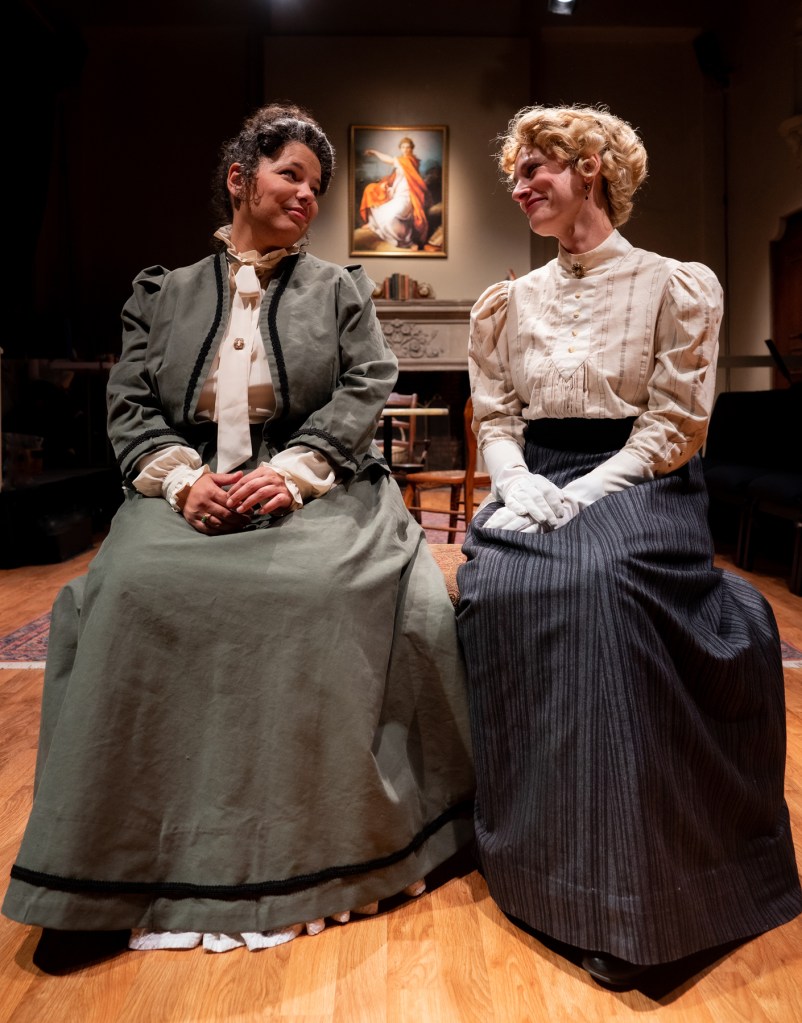
They’re b-a-a-a-ck.  Central Works’ Playwright-in-Residence Patricia Milton regaled us in 2019 with the unlikely exploits of three intrepid women in her “Victorian Ladies’ Detective Collective,” in which two middle-aged English sisters and a young American join forces to solve Jack the Ripper type murders in 1895 London.  With her most recent world premiere, “Escape from the Asylum,” Milton provides a sequel that is starting to suggest a series of crime-procedural, period-pieces of the sort that would run on PBS.  Like its predecessor, this comedic play charms with quirky characters, clever dialog, feminist issues, and a plot twist leading to a surprise ending.  The four actors, three of whom appeared in similar roles in “VLDC,” are delightful.

The playwright’s central concern is the marginalization of women, particularly through demeaning sexist characterizations of their mental and emotional capabilities.  This theme builds on “VLDC” as well as predecessors such as Sarah Ruhl’s “In the Other Room (or The Vibrator Play).”  Although we still have a way to go today, gender equality on these measures has greatly improved.  In the Victorian era, criteria for institutionalizing a wife were flimsy to the extreme.  If a woman was too assertive; pursued unconventional interests; or refused a husband’s demands, no matter how unreasonable, he could often have her committed.

Chelsea Bearce, Danielle O’Hare.

Banderford Clutterbuck suspects that a servant, Rosamund Smith, has been stealing art works from his home and approaches the women to solve the case.  While pursuing information, they find not only is the prospective client’s wife a renowned explorer, but that Clutterbuck has committed her to the Belfry Institution for Nervous Diseases.  The wife, Mahetabel Fernsby, is known to the older sister Valeria, who is certain that Fernsby is not crazy.  In the ensuing verbal clash with Clutterbuck, he withdraws along with his generous financial offer.  Because of their suspicions that he has falsely institutionalized his wife to gain access to her fortune, and despite their own fragile financial standing, the women decide to pursue the case on their own.

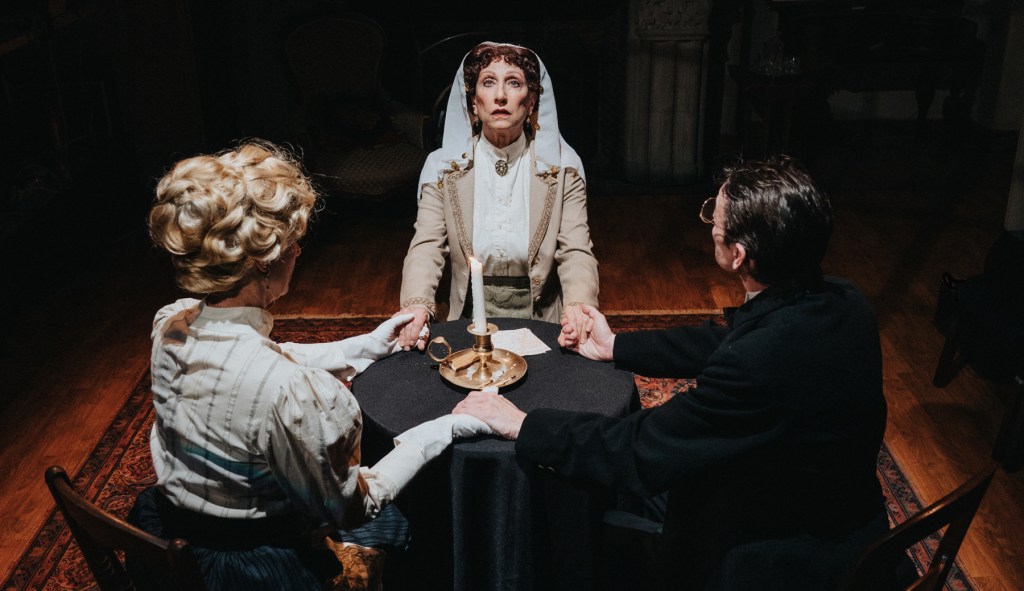
The charge to find how Ms. Smith could have stolen well-protected art works and to rescue Ms. Fernsby is led by younger sister Loveday, played by Danielle O’Hare with haughty assurance and determination.  An early feminist, she fancies herself as a leader and produces the dual plans, which include inducing Belfry’s proprietor, Dr. Florian von Grabstetter, an opportunistic charlatan, to reveal useful information.  Valeria, performed by Jan Zvaifler, conducts a fake séance (is there such a thing as a fake séance?) for Grabstetter to “communicate” with Belfry’s recently deceased matron, with whom he clearly had a more than professional relationship.  Zvaifler’s part is otherwise somewhat underwritten, but she captures the stage playing the first-time medium.  With swirling hands, glances of the eyes, and changes in voice and visage, she is terrific as a phony.

Alan Coyne.

As in “VLDC,” Alan Coyne portrays all of the male roles.  Aided by Tammy Berlin’s period costume designs, he differentiates them with skillful discrimination in affect, accent, and voice to make each unique.  His Grabstetter is a stereotypically supercilious Viennese who condescends toward women, extoling quack science theories like the wandering womb to explain female conditions and endorsing a magnetized wooden box contraption to treat them. Presumably a Freudian, he also imagines every elongated shape to represent a penis.

The remaining sleuth is Katie, specified as a young bi-racial American actress, who is a tenant of Valeria’s and always behind on the rent.  Chelsea Bearce brings a bundle of wisecracking fun to the role, often taking the starch out of the sisters and all of the male tormentors they face.  Unlike the other characters who fit in the period, Katie seems contemporary, but maybe that’s the only way to get the laughs to roll. In any event, it is ultimately the plucky youth who ties the pieces together to resolve the key question.

Danielle O’Hare, Chelsea Bearce.

Like a proper mystery writer, Milton leaves clues in plain sight that will help solve the puzzle.  But most of us will not grasp the significance of certain elements that would explain how the art works could be stolen from a secured display, or how an inmate could escape from a secure cell.  “Escape from the Asylum” offers a good blend of humor and whodunit to make for a fine entertainment.  Director Gary Graves makes the most of the intimate space and also deserves credit for the dramatic use of lighting, especially given the limited resources.  Finally, to acknowledge a sometimes creative position that seldom gets recognition, fight choreographer Dave Maier designed fencing with umbrellas that is amusing and well executed.

“Escape from the Asylum,” a world premiere written by Patricia Milton, is produced by Central Works and plays at Berkeley City Club, 2315 Durant Ave., Berkeley, CA through April 17, 2022.

Passing Strange

Myles Brown, Chanel Tilghman, Devin Cunninham, Champagne Hughes, Shakur Tolliver. All photos by Benjamin Krantz.

Ain’t life great?  What’s better than bemoaning a big commitment, only to be blown away by it?  It’s not clear why I had low expectations.  I really like Shotgun Players’ work.  I dig rock-and-roll.  I have great capacity for the Black experience and welcome European settings.  Maybe it was the notice that understudies would dominate the cast that evening.  But the show had me from “hello.”  “Passing Strange” is a distinctive and always involving play that deserves the Tony that it won for best book of a musical and its six other nominations.  Shotgun offers a high energy production with artistic values that fit the bill.

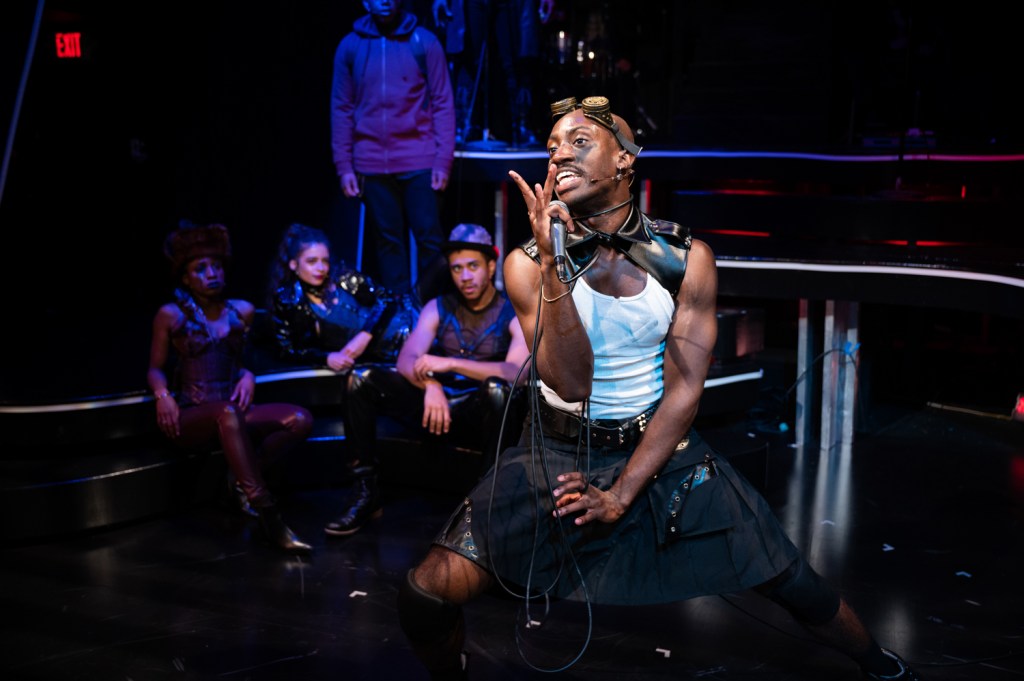
With “Passing Strange,” musician/playwright Stew created a multi-faceted coming-of-age story set to music and verse.  The music is a mashup of rock era styles that never hits a false note.  Both song lyrics and spoken sections set to music drive the narrative forward.  Romello Huins’ set is comprised of an unadorned apron for the show’s action, backed by a tiers occupied by the rock band.  The look created is that of a night club in a dark cave with Stephanie Anne Johnson’s neon lights defining the contours of the uneven walls of the cavity.  Her extensive use of area lighting helps create a perfect ambiance for the sometimes dark rock musical.

Albert Hodge.

Dominating the tiers is the charismatic Albert Hodge, “The Narrator.”  Although the actors who portray characters also have singing parts, The Narrator carries the bulk of the vocals.  Elevated above the acting stage, Hodge looms large.  He conveys the narrative in a storytelling style with broad gesticulation, sly humor, and a powerful baritone singing voice with rasp and soul.

The main character is called Youth, whose story begins as a teen in 1976.  Understudy Myles Brown portrays Youth with great confidence and skill.  If you didn’t know that he was an understudy, it would never occur to you.  Although a loving son, he goes through many of life’s natural transitions.  Objecting to phony churchiness as the Baptist Fashion Show, he adopts Buddhism.  But drawn in by attraction to a girl, he joins the church choir and sees the connection of call-and-response, common in Black church music, to rock-and-roll.

Many characters will cross Youth’s path, but none are as indelible as Franklin, the choir master.  Shakur Tolliver is an absolute scream as Franklin, the pot smoking son of the preacher, caught in a karma that he can’t escape.  His physical humor is totally reminiscent of a ‘70s sitcom comedian, whose name won’t be mentioned.  That might imply that Tolliver is an imitation of a known star, but frankly, I can’t imagine anyone being more compelling in this part.

Shakur Tolliver (foreground), Angel Adedokun, Chanel Tilghman, Myles Brown.

Making and writing music will motivate Youth, and he will travel through punk then psychedelic rock, while ingesting the latter’s namesake drugs.  Finding that after a psychedelic trip, he’s still in the same place, he will try a real trip.  His wanderlust will take him first to the paradise of the laid-back, Amsterdam, and then to Berlin, where even the anti-establishment is rooted in rules and tradition.  The same several supporting cast members who play Youth’s middle class Black friends in Los Angeles will be the open, free-loving Dutch and the abrupt leather and latex Germans.  Their transformations are all quite complete and compelling.

Along the way, Youth will be challenged and will grow.  He will face challenges of identity, family, friendship, and love.  He will suffer the realization that many decisions that affect adult life are made by stoned teenagers.  In the song “Bleeding Sunshine,” he will observe his need to break the chain of I, I, I, and find that he can’t be loved unless he reveals himself.  He will also learn new dimensions of being a Black man.

Literary titles often have great importance to authors, but sometimes their significance is lost on the audience.  “Passing Strange” derives from Stew’s inspiration to write a theatrical musical, which is Shakespeare.  Appropriately, the title come from a revelatory soliloquy in “Othello” spoken by the Black Moor himself.  But the word passing in Shakespeare’s time meant very or extremely, and the term referred to his adventures.  The double entendre of the word passing concerns a Black passing as white, or anyone passing for something that they are not, as Youth will attempt.  Finally, it can relate to passages, which Youth (and youth) endures.

Myles Brown, Devin Cunningham, Chanel Tilghman, Shakur Tolliver.

The musical is fully engaging, and Director William Hodgson has orchestrated a complex production task with precision.  Perhaps to comply with the current trend of tighter narrative design, the play could be pared down a bit, but most of the vignettes are interesting and well produced.

“Passing Strange” with book and lyrics by Stew, music by Stew and Heidi Rodewald, is produced by Shotgun Players and appears at Ashby Stage, 1901 Ashby Ave., Berkeley, CA through April 10, 2022.

Red Winged Blackbird

Aaron Wilton, Rinabeth Apostol, Adam Magill. All photos by Jay Yamada.

Every family is condemned to live with its own unique traits, its own unique secrets, its own unique pain.  Alyosha Zim writes of his family experience – a gemischt of dogma and spriritualism with inherited Judaism and adopted Buddhism; the challenges of love and relationships; and the overhang of a disease that if contracted is debilitating and ultimately fatal.  Although sadness pervades the play, it holds the attention throughout and fully satisfies on many levels thanks to great writing and formidable acting.

In part, “Red Winged Blackbird” is a classic play about two special generations of Americans – the parents being from the “greatest generation” who sacrifice all for their progeny, and the children being of the loving but self-indulgent “flower power” generation.  Sidney is a Jewish World War II refugee who lost virtually all of his family in the Holocaust.  Anchored in that tragedy, its gravity acts as a benchmark for evaluating everything in life.  Working hard in a deli, but valuing education and accomplishment, Sidney’s anguish and the hope that his children will have a better life are poignantly captured by Jullian Lopez-Morillas.  But like many of his era, his measuring sticks use orthodox values.  While Lopez-Morillas’s character is not sympathisch, we can’t help but respect how he has led his life.

Danielle Levin, Julian Lopez-Morillas.

Alyosha, born Sheldon but ultimately adopting a new identity from Dostoevsky’s spiritual Karamazov brother, has largely adopted the father’s values and achieved his desires, becoming a psychiatrist.  He’s retained an albeit diluted association with the Jewish faith and practice, like many American-born Jews.  He will also be the responsible one to stay near home to help his parents with their considerable needs.  But often it is the wayward child that a parent loves the most.  Harold, who takes on the name of Joshua, has disappointed by squandering the Harvard education that his father has afforded him; rejecting traditional religion; adopting a Buddhist lifestyle which the father scorns; and fleeing responsibility by migrating to an isolated aerie in Colorado.

The brothers are chalk and cheese, clashing on many issues.  They represent the changing landscape brought on by the ‘60s in which new values took root with some, but old ones remained with others.  In many ways, the play is about brotherly love, but it shows how circumstances can drive a wedge into a relationship.  A common bond is that each feels guilty about the ultimate death of a parent.  Aaron Wilton as the stiff, hard-working Alyosha, and Adam Magill as the laid back, but depressive counterculturist Joshua are fine fits for the roles.

Ogie Zulueta, Adam Magill.

But the 800-pound gorilla in the room is Huntington’s Disease, which degenerates the brain tissue, causing uncontrollable movement and mental and emotional deterioration.  Huntington’s is inherited.  The brothers’ mother suffers from the disease.  There is a 50/50 chance that either of them would contract it.   If one were to manifest it, the same odds would apply to his children.  It acts as a constant dark cloud over Alyosha and Joshua.

All of the acting in “Red Winged Blackbird” is noteworthy, including the two non-family members.  Rinabeth Apostol charms as Padma, Joshua’s soul mate and ardent supporter.  Ogie Zulueta fulfills as Rinpoche, Buddhist guru to the couple, and the comic relief who even rebukes Joshua for overdoing his spiritual commitment.

However, Danielle Levin as Eva, wife of Sidney and mother to the young men, is absolutely chilling.  Her contortions and thrashing as she struggles with the disease are heartbreakingly convincing – the endless jerky motion enervating.  Imagine suffering years from this condition.  As observed in the play, it gives so little time to living and so long to dying.

Aaron Wilton, Adam Magill, Rinabeth Apostol.

For scattered brief moments we see Eva before the disease set in.  Levin’s transformation is powerful as a totally different person wearing the same skin.  Oblivious to her fate, she broadly smiles with chirpy optimism, and patters on like a stereotypical Brooklyn immigrant mother of the era.  Great stuff.

Set initially in the late ‘60s, the play takes us forward to the mid ‘80s.  Much has transpired and critical points are reached.  The red winged blackbird symbolizes powerful forces within us that enable us to meet challenges and become stronger as a result.  The question is who in the family achieves that state.

As producer, Zim has assembled a formidable creative team.  Director Nancy Carlin marshals her resources well, notably Nina Ball’s clever set that incorporates two domestic settings and a Buddhist shine in a multitiered set.  Also, the music in Cliff Caruthers sound design adds a Jewish feel to the proceedings. Carlin also helped shape the script of a series of flashbacks into a tight and entertaining drama.

“Red Winged Blackbird,” written by Alyosha Zim, and produced by SparklePlenty Productions, plays at Live Oak Theater, 1301 Shattuck Avenue, Berkeley, CA through March 20, 2022.