Alabaster

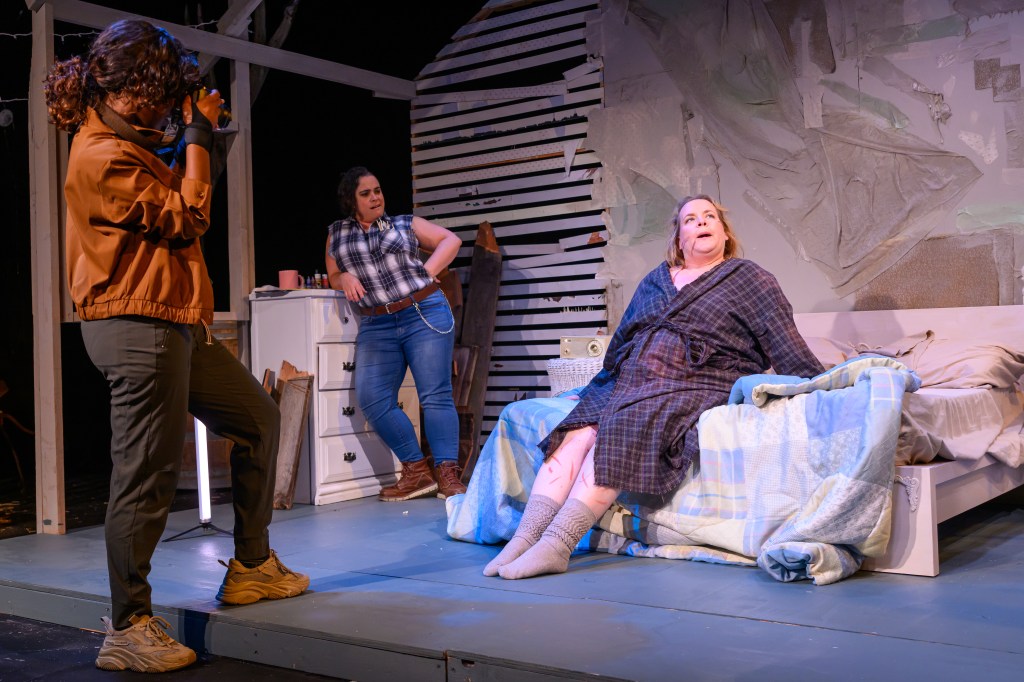
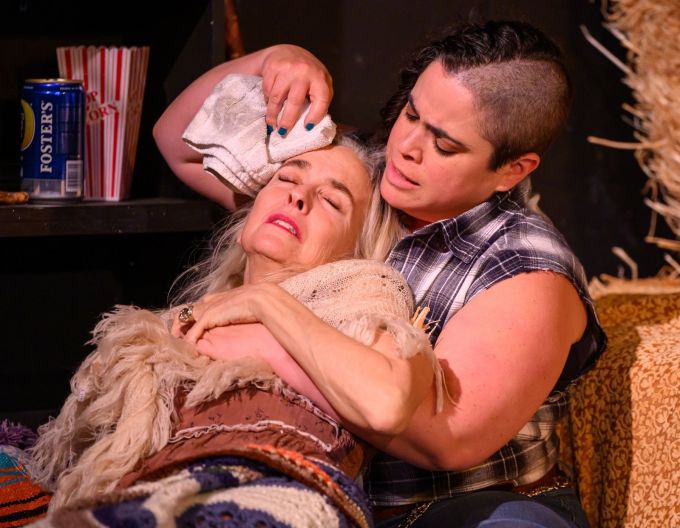
Raven Douglas as Alice, Melanie Marshall as Weezy, Sarah Nowicki as June. All photos by Craig Isaacs BlueGoo Photography.

Alabaster is usually thought of in one of two contexts – the beautiful mineral appropriate to artistic carvings or the creamy skin associated with the stone’s warm, translucent color.  Alabaster is also a real town in Alabama.  But what playwright Audrey Cefaly probably had in mind in situating her darkly-comic play in that locale is the portmanteau hidden in the name – Alabama disaster.  Town Hall Theatre has produced a compelling rendering of the quirky but touching and thoughtful narrative.

In this dramedy, the town had been hit with a devastating tornado.  A survivor who lost her family, June suffered extensive injuries requiring a long recovery.  She has since become reclusive on her unreconstructed farm.  But a cousin convinces her to extend an invitation to a New York based photojournalist, and June agrees.

Alice, the photog, has developed a special visual portfolio – damaged women, who have suffered from natural catastrophes, accidents from human error, or abuse.  Her goal is to present these women with dignity and beauty, and she has come to Alabaster in hopes that June would serve as a model.


Sarah Nowicki as June, Raven Douglas as Alice.

Alabaster pays tribute to women in multiple ways.  The cast of four are all women, and the two central characters are lesbians.  Each has lost family in tragic accidents and carries guilt for surviving and not having been able to save loved ones.  Each has adapted but carries additional baggage as well.  Each in her own way needs to give in and move on from what holds her back.

The twist in Alabaster that produces the comedy is that June communes with Weezy, who happens to be a goat that only June can speak with.  Two goats are all that remain of the farm’s livestock, the other being Bib, Weezy’s dying mother.  In a nod to decisions that humans face, Weezy has told June that when Bib passes, she will leave.

Sarah Nowicki is convincing for the greater part as the flippant and independent June.  In addition to farming, she paints, always on pieces of the barn destroyed by the storm because she values the history and the irregularity of wood as a medium.  Nowicki’s star turns come in two soliloquies.  The audience’s hush is palpable in the longer one when she describes how the tornado took away her parents and sister, one by one in different ways, and that she was unable to save them or even honor her father’s death wishes because of her own incapacity after the storm.  Her other dramatic highlight is the shorter but more searing moment as she relives the trauma in a nightmare.
Nathalie Archangel as Bib, Melanie Marshall as Weezy.

Raven Douglas as Alice has less to work with.  However, she is also effective and gets to show dramatic zest in one anger scene.  One area for improvement is that her dialogue is sometimes lost because of insufficient volume, especially when not facing the audience and in sensitive passages.  Like many stage actors, she conveys the touching scenes visually, but lowers her voice as if connecting only with her counterpart on stage.

The humor is driven by Weezy, portrayed by Melanie Marshall, and casting a comedienne in this role is essential to achieving the right balance in the play.  Marshall’s comic timing in her dialogue is exquisite, but perhaps more important is her uncanny mimicking a goat’s eating, facial expressions, and movement.

But the main dramatic thrust concerns the evolving relationship between the two women.  Interestingly, they learn about each other not just through normal conversation but by often invoking the game of Questions, usually with the choice of two answers, that each must answer and defend.  Before the questions between the women become more personal and penetrating, June asks perhaps the most ubiquitous and insignificant one asked in this game, at least by older generations – “Ginger or Mary Ann?” referring to the attractive young women in “Gilligan’s Island.”

Raven Douglas as Alice, Melanie Marshall as Weezy, Sarah Nowicki as June.

Director Kerry Gudjohnsen harnesses the creative resources of the production in an exemplary manner.  Scenery, lighting, and sound all contribute to the claustrophobic feel of June’s life of discontent.  Into her life comes someone with her own unresolved issues.  Is it possible that the two women can overcome their obstacles?

Alabaster, written by Audrey Cefaly and produced by Town Hall Theatre, plays on its stage at 3535 School Street, Lafayette, CA through September 6, 2025.

Wozzeck

Emma McNairy as Marie, Hadleigh Adams as Wozzeck. All photos by Cory Weaver.

Alban Berg was the greatest disciple of Arnold Schoenberg, who changed the face of serious music with his mathematical approach to composition.  Abandoning the mellifluous tonality of using a key-signature in which predominately notes that harmonize are included in the music, Schoenberg advanced the 12-tone method, making atonality a major force in classical music.  Among other notable works, Berg responded by creating Wozzeck in 1925, which staked its claim as the first ever atonal opera and became a highly influential work in the genre.

West Edge Opera offers Wozzeck, and in keeping with its whole summer festival program, the production is supported by outstanding singer/actors and compelling creative design led by Director Elkhanah Pulitzer.  While the storyline deals with social issues of great importance that resonate a century later, it is hard to think of a more depressing libretto in the repertory.  Aficionados who enjoy atonal music will find the musical score and the execution by Jonathan Khuner’s orchestra and the singers to be electrifying.  Those who prefer melodiousness may not be as enthralled.

Hadleigh Adams as Wozzeck, Spencer Hamlin as Captain.

Not only is the musical context of Wozzeck important, but so is the socio-political environment that the Viennese Berg wrote in.  Even worse than the indignities forced on Germany by the Allies after World War I, Austria’s empire was dismembered, and like Germany, it was a failed state economically, politically, and socially.

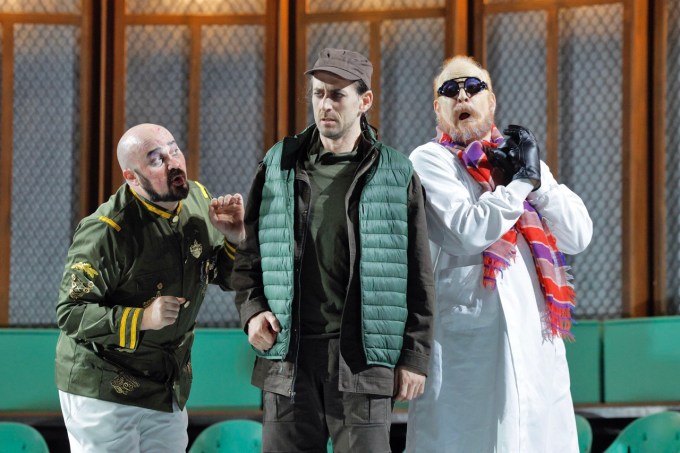
Into this miasma, Berg transfers from theater stage to opera stage Franz Wozzeck, a dour, downbeat, and abused Army soldier portrayed with chilling effect by Hadleigh Adams.  His non-conformity, which includes having an illegitimate son by a common-law wife, is vilified by his “Captain” (Spencer Hamlin) who receives extra services from Wozzeck for a pittance.  The soldier also receives a small stipend as a subject in the medical experiments of the “Doctor” (Philip Skinner) who should realize that Wozzeck’s dark hallucinations and aberrant behavior signal psychological derangement along the lines of schizophrenia.

Michael Belle as Drum Major, Emma McNairy as Marie.

But most likely, Berg believed that the system is designed to disadvantage the already impoverished, and that their needs will go unmet.  The Doctor complains that Wozzeck piddles in the street, but it is a small example that the poor don’t have the resources to be as virtuous as the rich.  Tragedy will befall the powerless Wozzeck and his lover, while those in the professional class blithely march onward.

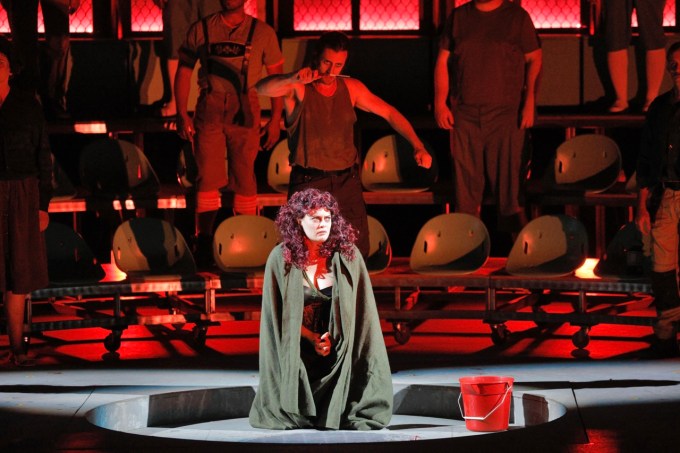
Emma McNairy sizzled a decade ago in the title role of West Edge’s Lulu by Alban Berg.  She completes her exquisite command of lead female parts in both of Berg’s operas with her portrayal of Marie, Wozzeck’s common-law wife and lover.  Earthy and volatile, her heavily tremoloed, dramatic coloratura voice pierces with raw emotion, and she dominates the action when she is present.

Spencer Hamlin as Captain, Hadleigh Adams as Wozzeck, Philip Skinner as Doctor.

More complexity is depicted in Marie’s character than any other.  As a fallen woman, she obsesses on Mary Magdalena and reveals either metaphoric thinking or ESP in a well-delivered soliloquy about a boy who lost his parents.  Ultimately, her lust will trigger disaster.  Marie will become entranced by the Drum Major (Michael Belle).  Wozzeck will learn of their tryst, and his violence will lead to downfall.

In a couple of ways, Berg’s composition seems a bit unusual, but for understandable reasons.  Although Hadleigh Adams is a highly accomplished baritone, in depicting the depressed title character, his singing part understandably lacks great expressiveness through most of the opera.  An exception is his brief but effective “mad scene” in Act III.  Conversely, Spencer Hamlin in the much smaller role as the Captain sings much higher in his range and sets the vocal standard among the male performers with great resonance and power.  In a sense, Marie is the central character and McNairy the star.  Her vocal part is more interesting than Wozzeck’s, though that is more understandable as she is a more voluble person, and while Wozzeck is mostly reactive, Marie is a moving force.

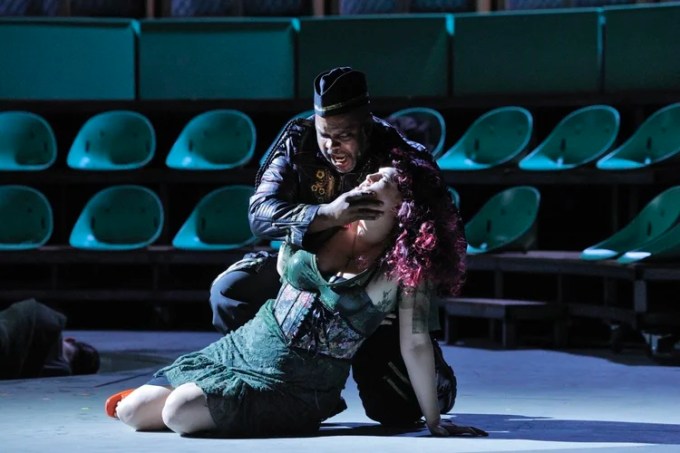
(below) Emma McNairy as Marie, (above) Hadleigh Adams as Wozzeck.

Tanya Orellana’s staging is unusual, with two concentric arcs of plain, light blue-green chairs dominating the set.  The concept is that the stage mirrors the seating of the opera house.  We are looking at ourselves, so the events on stage then represent the audience.  Although the theme of art imitating life appeals, this particular instance is somewhat disturbing, as the characters in the opera dwell in the netherworld of society.  This may be how Berg saw the world around him, and perhaps he would see our world today in the same way as the director seems to imply with this interpretation.

Wozzeck, with music and libretto by Alban Berg and based on the play Woyzeck by Georg Büchner, is produced by West Edge Opera and plays at Oakland Scottish Rite Center, 1547 Lakeside Drive, Oakland, CA through August 17, 2025.

David and Jonathan

Aaron Sheehan as Jonathan, Derek Chester as David. All photos by Cory Weaver.

David, of David and Goliath fame, is one of the best known and respected heroes of the Old Testament.  As such, he represents a good subject for artistic works of all types.

Early opera composers employed religious themes and texts in various musical idioms.  The prolific Baroque composer Marc-Antoine Charpentier was no exception and wrote sacred music of all kinds.  Of his several operatic works, David and Jonathan from 1688 survives owing to beautiful music and a story with drama and impact that will expand the knowledge about this familiar hero for most opera goers.

Goliath puppet.

In the Biblical account that acts as the basis of the libretto, Israel’s first king, Saul, is told by God that it is time for him to step aside and let David ascend to the throne.  Saul resists.  Ultimately, and similar to our own time, the leader accepts the false accusation from a lying sycophant that David plans to overthrow and kill him.  For this purported disloyalty, Saul will go to war with the Philistines who harbor David.  The complication is that David’s lover is the son of Saul, Jonathan, who must cope with divided loyalty.

After meeting the usual selection criteria for presenting an opera, West Edge Artistic Director Mark Streshinsky, who also stage directs, has deliberately chosen a libretto that can be plausibly adapted to represent a queer love story.  This one makes sense as the expressions of love are explicit, even if they convey different implications in the ancient context.  Although elements of the original work are shifted or omitted, no changes to the text are made.

Matthew Worth as Saul, Aaron Sheehan as Jonathan, Derek Chester as David.

Thus, the interpretation of the love story of David and Jonathan is drawn wholly between the lines, in the unverbalized action rather than the text.  The uncontroversial aspects of the production stand tall, with fine singing and clever, attractive, and effective staging.  Not unlike many operas that were made with very different audiences in mind, this one does sag a bit, especially toward the end.

At the outset a magnificent gigantic puppet of Goliath, requiring three men to guide it, dominates the action until the antagonist is slain.  Here, the most assertive statement about the adaptation’s orientation occurs, as Goliath’s gargantuan phallus hangs well below his skirt, and humorously, it is even used as a truncheon to deter enemies.

Laurel Semerdjian as Witch of Endor, dancers.

Soon, Saul, performed by baritone Matthew Worth, sings his mournful and resentful “What have I done to deserve the wrath of God?” which sets the narrative’s conflict in motion. After which, the all-male corps de ballet appear.  And, while the choreography and execution are excellent, the leather/beefcake outfits with bare butts and breasts are another statement in keeping with the queer adaptation.

A wise adjustment devised by Streshinsky and Music Director and Conductor Adam Pearl was to transpose Jonathan’s vocals from that of a treble (boy soprano) to a tenor.  Thus, the leads who share the intimate relationship, Derek Chester as David and Aaron Sheehan as Jonathan, both have warm tenor voices.  The title characters sing well individually and together, with the duet “Why must we end such a sweet peace?” being the most compelling.  Probably the most appealing music and touching moment is David’s final lament during the closing tragedy.

Wilford Kelly as Achis, (center rear) Benjamin Pattison as Joabel, Matthew Worth as Saul.

The crux of the action concerns Jonathan’s dilemma of duty versus love, when he must choose sides in the coming battle between his father and his lover.  Graciously, David accedes to the notion of filial piety and releases Jonathan to join his father.  David also does everything possible to demonstrate loyalty to Saul, but the latter’s obdurate resistance to knowing when to leave the fight behind represents another main thematic issue.

The small but luminous orchestra performs the lush music with great panache.  In addition to modern strings and woodwinds, but forgoing brass and percussion, the orchestra includes period instruments – a theorbo, a viola da gamba, and a harpsichord played by the conductor, all of which contribute to the unique Baroque sound.  Recognition is deserved for the design elements, in particular, Ember Streshinsky for the simple but appropriate scenic design with revolving modules; Marina Polakoff for costumes, especially the lavish black cladding of the witch; Michael Oesch for the effective use of colored and low lighting; Paul Hayes for the imposing monster Goliath puppet; and Benjamin Freedman for the handsome choreography.

Matthew Worth as Saul, Aaron Sheehan as Jonathan.

The question remains whether David and Jonathan were really carnal lovers.  While the Bible describes their relationship in the framework of love, it should be noted that the terms used and practices identified are wholly consistent with those of filial love or friendship described elsewhere in the Bible.  In addition, the Bible shuns homosexuality, and it is unlikely that one of its great heroes would be cast thusly.  As far as the opera’s version story, not only was Charpentier working for the Jesuits at the time the piece was created, but his librettist was a cleric.  Nonetheless, we can’t get inside Charpentier’s mind to know his thoughts as the project evolved

The remaining question concerns the acceptability of the West Edge realization.  It would seem that the market is trifurcated, with those who appreciate the nature of the adaptation, the neutrals, and the detractors.  Certainly, the gay theme will play better in the Bay Area than in Birmingham or Omaha, but the consequences and viability of this treatment will be better understood by the end of the run.

David and Jonathan, composed by Marc-Antoine Charpentier with libretto by Father François Bretonneau, is produced by West Edge Opera and plays at Oakland Scottish Rite Center, 1547 Lakeside Drive, Oakland, CA through August 16, 2025.

Dolores

Kelly Guerra as Dolores Huerta. All photos by Cory Weaver.

History is written of leaders – presidents, generals, popes.  Second-in-command, deputies, assistants, are largely forgotten.  The Delano, California grape pickers strike and boycott to challenge deplorable working conditions that became a major event in the modern American labor movement, began in 1965, started by Larry Itliong’s Agriculture Workers Organizing Committee.  That organization soon merged with the National Farm Workers Association (NFWA), led by César Chavez, and the latter would become the combined leader and the face of the movement.

Dolores Huerta was Chavez’s closest and most trusted associate, independently leading strikes and boycotts and negotiating the contract with the farmers that would end the strike in 1970.  Though well known to those with deep knowledge of labor movements, Dolores remains unknown to the general public, overshadowed by the recognition of Chavez.

Rolfe Dauz as Larry Itliong, Kelly Guerra as Dolores Huerta, Phillip Lopez as César Chavez.

In conjunction with composer Nicolás Lell Benavides and librettist Marella Marin Koch, West Edge Opera presents the world premiere of the opera Dolores. This counterbalances the lack of acknowledgement received by the title character – at least with the opera company’s audience, along with those of co-producers Opera Southwest and San Diego Opera.  The result is a powerful narrative supported by vibrant music that should have legs but can benefit from minor adjustments.  Staging adds to the effect with energetic strike and boycott scenes, supported by accompanying video projections.

Benavides’s music is blessedly tonal and fitting to the situation – often ominous, and sometimes consoling.  A full sound is developed by Conductor Mary Chun’s small orchestra, but the highlights tend to occur in various solo segments, a particularly appealing one being a haunting viola solo that accompanies Huerta’s sadness as she pines for her seven children that she seldom sees because of the demands of her job as a union executive.

(foreground) Kelly Guerra as Dolores Huerta, Rolfe Dauz as Larry Itliong, (above) Alex Boyer as Bobby Kennedy.

The central moral drive of the opera concerns clashes associated with trying to do good things, with sacrifice being the operative condition.  People of good intentions often clash because they differ somewhat in objectives or see different ways to accomplish the same thing.  But even more discordant are the internal conflicts.  Often fighting for one good goal results in sacrificing another, and successful people constantly must deal with these tradeoffs.  This story is specifically about those who sacrificed by striking and placing themselves and their families in jeopardy for several years.  It may be hard to believe or remember, but this strike went on for five years.

Much of the plot line deals with the relationships among the leaders in the movement.  Huerta is well represented by soprano Kelly Guerra who sings with conviction and shows her character’s passion.  Phillip Lopez as César Chavez and Rolfe Dauz as Larry Itliong give good depictions of their characters as well.  But vocal pinnacles came from featured players.  Sam Faustine as Tricky Dick (the program designation) produces a clarion tenor and an over-the-top depiction of future president Richard Nixon, while Alex Boyer serves well with his always strong voice as RFK.

Sam Faustine as Tricky Dick, Kelly Guerra as Dolores Huerta.

An interesting strategic decision was to place the opera in 1968, already three years into the strike and with three harvests rotted on the vine, in order to make the leadup to and assassination of Bobby Kennedy in Los Angeles the centerpiece.  As the opera’s narrative attests, RFK had allied with NFWA; personally visited Delano to break bread with Chavez to end his 25-day hunger strike; and had Huerta on the dais with him on the fateful day.

However, the focus on Bobby and the run time accorded deflects much attention away from Huerta.  Notwithstanding, a great deal of emotional impact results from reliving this tragedy.  But, overall, the plotline does drag a bit, and could be trimmed and recentered on the title character and more reference to the early stages of the movement.

Kelly Guerra as Dolores Huerta, Chelsea Hollow as Ethel Kennedy, Alex Boyer as Bobby Kennedy, Caleb Alexander as Paul Schrade.

We can all conclude that the war for higher moral objectives is never over, as we are in a period of serious backsliding presently.  Nonetheless, victories can be declared.  It was disappointing to find the lack of closure in the opera concerning the strike and boycott, and that Huerta’s contributions are underrepresented.  Despite all of the gains from the negotiated contracts that ended the unrest, we are left with a feeling of failure.

Finally, and I just made a similar comment in another review, programs and supertitles should not be stingy in identification.  For instance, character surnames are not mentioned in the cast listing, nor are characters always identified in the supertitles when they first appear.  Brevity is not always a virtue, and producers should not expect all operagoers to have in-depth knowledge in these fringe areas.  Don’t leave them in the dark.

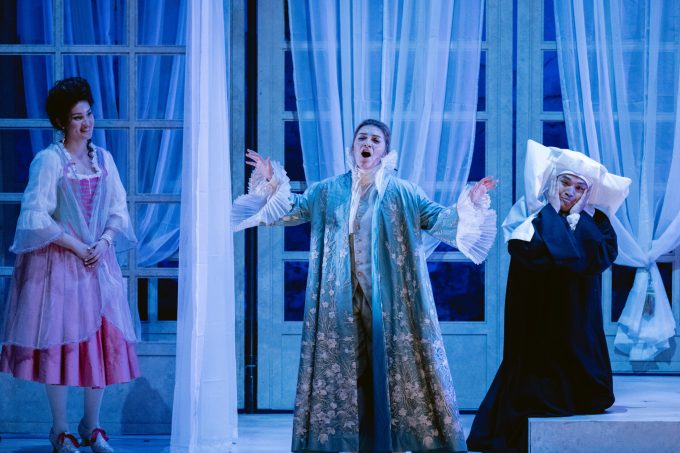
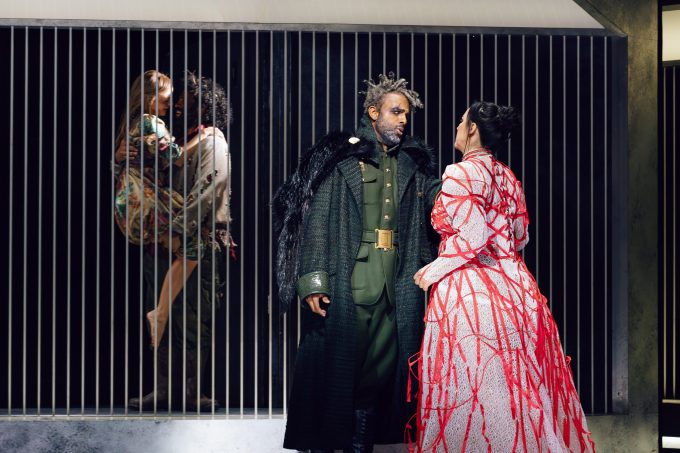
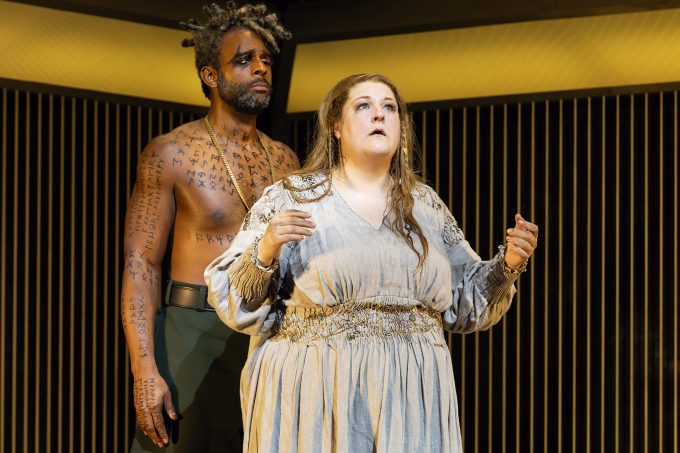
Sergio Gonzalez as Juan.

One delight that presumably only opening night attendees will enjoy is a stage visit from the spry and cogent 96-year-old Dolores Huerta after the performance.  She spoke to the timeliness of the opera given deplorable current immigrant, labor, and other conditions in this country and of a job not yet completed.  She stoked the crowd which responded with peals of her dictum, “Si, se puede!” (Yes, you can!).

One final point is that unfortunately, many people in the U.S. have unfavorable attitudes toward labor unions, fixated on relatively rare featherbedding and overly generous contracts.  Stories like this one and of the deaths of 146 workers at the Triangle Shirtwaist Factory fire in 1911 that also resulted in improved working conditions are important to demonstrate the dignity that unions have brought to the working class.

Dolores, composed by Nicolás Lell Benavides with libretto by Marella Marin Koch and produced by West Edge Opera has its world premiere at Oakland Scottish Rite Center, 1547 Lakeside Drive, Oakland, CA through August 16, 2025.
Le Comte Ory

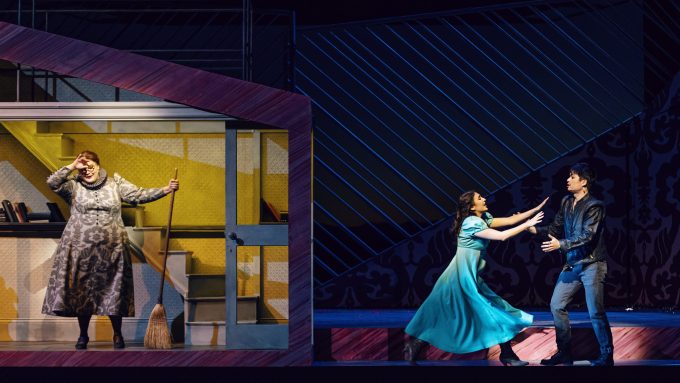
Eva Rae Martinez as Comtesse Adèle, Minghao Liu as Comte Ory. All photos by Kristen Loken.

Gioachino Rossini was perhaps the most successful and prolific opera composer of the early 19th century.  Retiring from the genre in 1829 at age 39, Le Comte Ory was his penultimate opera and his last comedy.  Saucy and sexually suggestive, it may not have passed the censors in his native Italy, but Paris, where he resided for several years, loved racy motifs.  Though rarely performed today, it was one of the most successful French language operas of its day.

The Merola Opera Program selected the medieval-themed Le Comte Ory for its summer opera production, which showcases the talents of several principal artists and gives the other Merolini opportunities for extensive choral work and solo snippets.  All performers meet the challenges of their roles, with clear, exquisite singing and effective comic acting, including extensive mime during the overtures of both acts. 

Minghao Liu as Comte Ory, Benjamin Dickerson as Raimbaud.

For those unfamiliar, Merola operates independently but in close partnership with San Francisco Opera in multiple ways, including as an artistic feeder.  It is probably the best regarded opera training program in the United States, offering a holistic career curriculum and remarkably providing graduates financial support for five years after program completion.

Rossini’s raucous work reflects a number of the composer’s practices.  Full of charm and peppy melodic music, it also becomes a bit repetitive with predictable set piece codas and Rossini crescendos to conclude overtures.  In retrospect, he is considered both a genius and a bit of a hack for recycling previously used music (the famous overture to The Barber of Seville was used in two earlier operas).  Though it wouldn’t be suspected by the unsuspecting, much of this opera’s music had appeared in a more serious dramma giocoso, Il Viagio a Reims.

(center) Eva Rae Martinez as Comtesse Adèle, (far right) Ariana Maubach as Ragonde.

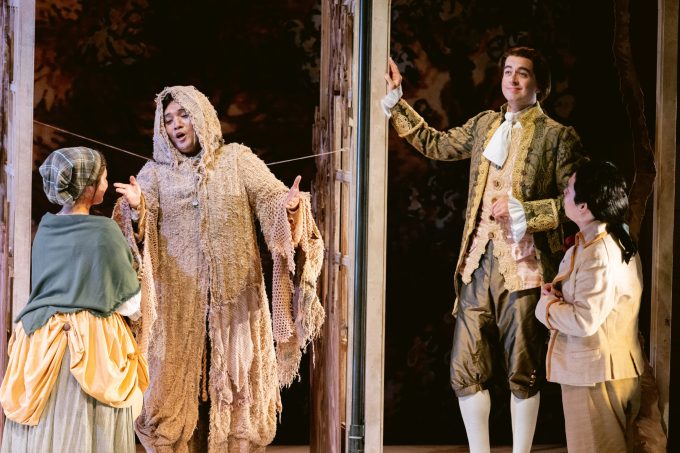
While the plot is thin and somewhat predictable, the payoff is in the character depictions and machinations as moral commentary underlies the farce.  The hedonistic title character seeks all forms of pleasure, and opportunities abound as most men from the town are away on Crusades.  Learning that the melancholic widow Comtesse Adèle seeks spiritual relief, the comte disguises as a hermit so as to seduce her.  But his biggest obstacle turns out to be his own page, Isolier, who also desires Adèle. 

Minghao Liu as Ory not only sings with a classic tenor voice, but exudes charisma as both a singer and actor.  He seems to relish being the antagonist and subsuming into the disguises of both the hermit in rags and the habit of a nun.  Soprano Eva Rae Martinez is Ory’s quarry, and she hits all of the marks, with a fine coloratura and range to sing the high notes, especially in her “agony” aria.

Benjamin Dickerson as Raimbaud, Minghao Liu as Comte Ory, Wanchun Liang as Gouverneur.

Another notable turn is made by bass-baritone Wanchun Liang who plays the tutor, Gouverneur.  Though Ory’s own page doesn’t recognize him as the hermit, the wizened tutor does.  Liang  also sings with distinction and manages a rapid patter that is difficult to do in a lower voice.

The final character central to the plot is Isolier, a trousers role performed by mezzo Meg Brilleslyper and sung with clarion purity.  On the performance side, she embodies a multi-level gender role as she is a female playing as a male who also disguises as a female to fool his boss.  She also participates in a delightful trio with the comte and the comtesse, perhaps the most notable set piece in the opera, “A la faveur de cette nuit obscure.”

Meg Brilleslyper as Isolier, Wanchun Liang as Gouverneur.

The remaining principals who perform admirably in all respects are mezzo Ariana Maubach as the comtesse’s companion Ragonde and baritone Benjamin Dickerson as Ory’s friend.  In addition, the choruses are excellent throughout.  The cast is particularly put through its paces at the end of Act 1 with two big ensemble/choruses divided by the news that the town’s men are coming home from war, which sets the stage for the humorous conflicts in Act 2.

Other artistic elements contribute to the overall effect. The staging is simple as would be expected given the limits of two performances.  Meanwhile, the orchestra is superb.  Pierre Vallet conducts with pointed precision in tight movement, and the musicians respond accordingly.  This is some of Rossini’s finest music, and the orchestra produces a rich sound complemented with an abundance of absolutely accurate pizzicato from the strings.

Eva Rae Martinez as Comtesse Adèle, Meg Brilleslyper as Isolier, Minghao Liu as Comte Ory.

I do have one bone to pick and that is with the program and supertitles.  The lack of identification of characters is pronounced, and there is no excuse for not embellishing the cast listing to include relationships or positions (e.g., Isolier – Ory’s page or Gouverneur – Ory’s tutor), and giving names in the early supertitles to note who the characters are.  I was partly at sea, leafing through my program through much of the first act, and even had one of the characters misidentified for over a half an hour.

Le Comte Ory, composed by Gioachino Rossini with libretto by Eugène Scribe and Charles-Gaspard Delestre-Poirson is produced by Merola Opera Program and performed at San Francisco Conservatory of Music, 50 Oak Street, San Francisco, CA through August 2, 2025.
Die Walküre

Ryan Speedo Green as Wotan. All photos by Curtis Brown.

No accomplishment in the world of opera exceeds Richard Wagner’s four opera Der Ring des Nibelungen or Ring Cycle compendium. With 15 hours of staging and 28 years in the making, it was a massive undertaking. Apart from extensive storytelling and the quantity of music involved, its intellectual integrity distinguishes it with its focus on a detailed dramatic arc; continuous music at the expense of popular set pieces, with no ensembles and choruses; and elaborate use of leitmotifs to identify characters and moods. Nonetheless, purity does not ensure that all will find the outcome entertaining.

While the four operas constitute a whole that is intended to be seen together over a short period of time, Die Walküre is the one that perhaps stands alone most successfully as a complete story with a satisfying beginning and end – even if complete closure is not reached. Among the many moral issues from incest to integrity, it deals with one great moral dilemma, betrayal, expressly and in considerable depth that gives it an extra dimension. Santa Fe Opera offers the opera for its very first time, and the result is magnificent.

Soloman Howard as Hunding, Vida Miknevičiūtė as Sieglinde, Jamez McCorkle as Siegmund.

At 4 ½ hours run time including two intermissions, Die Walküre’s storyline reduces to a few basic transactions. The opera opens with Siegmund, portrayed by tenor Jamez McCorkle, displaying a huge voice, especially in a sequence calling for his deceased father. He takes refuge in the home of what turns out to be an enemy, Hunding (Soloman Howard, with a rumbling bass voice), whom he must fight to the death. Siegmund falls in love with the host’s wife Sieglinde (soprano Vida Miknevičiūtė). They find they are siblings, but their tryst leads to pregnancy that will ultimately produce Siegfried, the hero of the next opera in the cycle.

Wotan (bass-baritone Ryan Speedo Green) is the king of the gods, and mortal Siegmund has descended from his illegitimate child. However, Wotan’s wife Fricka (imperious mezzo Sarah Saturnino), is an ally of Hunding’s family and resentful of Wotan’s promiscuity that ultimately led to Siegmund’s birth. She insists that Wotan use his power to ensure Siegmund’s death in the battle.

Sarah Saturnino as Fricka.

Meanwhile, Brünhilda (soprano Tamara Wilson), the leader of the Valkeries, who are the daughters of Wotan, sympathetically aids the illicit couple, as Sieglinde had been abducted and abused by Hunding. Although her assistance fails, Wotan disowns his favorite daughter and alter-ego for her betrayal and reduces her to a mortal to lie in a sleep state until discovered by a man and taken for his wife.

That process is perhaps the best developed moral internal conflict in the Ring Cycle, one that reflects dilemmas that leaders of all kinds face when a beloved or highly valued underling has betrayed trust. The punishment pains the leader as well as the follower. Wagner was nothing if not thorough in his narratives, and this is a good example of why Ring operas are so long, as he dwells on this issue for much longer than needed with the verbal clashes and bouts of empathy between Wotan and Brünhilde.

(foreground) Ryan Speedo Green as Wotan, Sarah Saturnino as Fricka, (rear) Vida Miknevičiūtė as Sieglinde, Jamez McCorkle as Siegmund.

Led by the commanding voices of Green and Wilson, cast selection is impeccable, and they deliver the goods. Wagnerian singers must possess powerful voices with heroic, some would say harsh, tone able to compete with the large orchestra that Wagner demands. To make sure that the singers get an adequate workout, roles with higher vocal ranges generally have high tessituras as well. And though Wagner eschews the notion of arias, each principal has at least one long, highly challenging soliloquy.

The biggest surprise of the evening was Miknevičiūtė as Sieglinde. Despite a distinguished European career, this was her American debut, and she wowed with the easy power and range of her mellifluous voice and her compelling stage presence.

Soloman Howard as Hunding, Ryan Speedo Green as Wotan, Jamez McCorkle as Siegmund.

The more melodic music in the Ring is often in the orchestra, and perhaps its most famous is the stirring “Ride of the Valkeries,” whose motif recurs through the final two acts. Associated with it is Brünhilde’s equally spirited “Hai Jo To Ho” which Wilson delivers with relish. Otherwise, it is notable to remember that while singers exert and then relax or disappear during the opera, the orchestra performs the whole time, and musicians’ lips and fingers can tire. Kudos to Conductor James Gaffigan and the orchestra for not only enduring, but excelling.

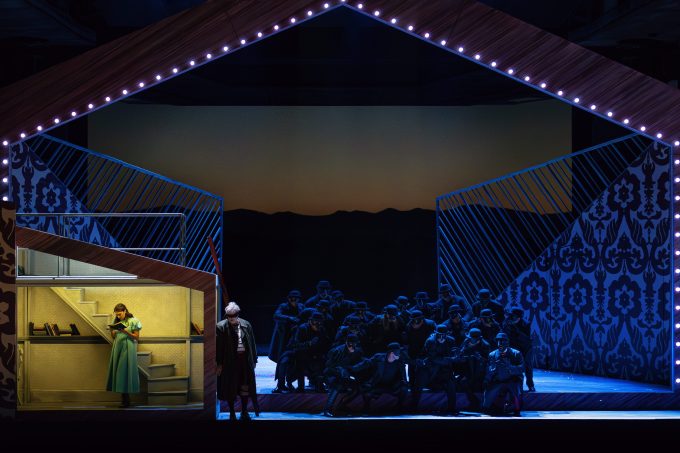
Director Melly Still and Scenic Designer Leslie Travers’s stunningly sharp abstract look in Acts 2 and 3 is simple in its appearance but complex in its design, which is easier to understand by seeing the included images than reading about it. Stands of closely-arranged vertical, white rubber ropes span the full breadth of the stage. Irregularly arranged red ropes decorate above the white rope frame. The white ropes convey separation and opaqueness, and their flexibility allows the functionality of egress for the characters. The red ropes presumably represent entanglement. Truncated trees and other scenic references to reality occur to enhance the meaning and the visual presence. Add to it Travers’s striking costumery for supernumeraries plus their depictions and movement as horses, dancers, and others, and the visual array is superb.

Tamara Wilson as Brünhilda.

The part of the visual design that detracts from the overall effect is Hunding’s modern dilapidated house with rusted appliances in Act 1. Likewise, the costumes and makeup of the principals are shabby and make the players look like homeless people, and that even extends to Wotan when he goes topless.

Hunding’s wealthy family are close associates of the most powerful goddess, Fricka, and the others are descendants of the leader of the gods. Not only does this look seem inappropriate for the station of the characters, but it is aesthetically unpleasing. There are many ways to be creative in design, but unlike the thoughtful scenery in Acts 2 and 3 as well as the interesting depictions of non-principal players, this portrayal of poverty or slovenliness serves no appealing purpose.

Ryan Speedo Green as Wotan, Tamara Wilson as Brünhilda.

In any event, the production marks an exemplary debut by Santa Fe Opera of this notable work.

Die Walküre with music and libretto by Richard Wagner is produced by Santa Fe Opera (www.santafeopera.org) and plays on its stage at 301 Opera Dr., Santa Fe, NM through August 21, 2025.
Rigoletto

Michael Chioldi as Rigoletto. All photos by Curtis Brown.

On the strength of several renowned operas, Giuseppe Verdi became Italy’s premiere opera composer by 1851. But it was only with the emergence of the masterpieces from his rich middle period that he became the most eminent composer in the genre. The works that marked this ascendance remain among the most revered today – La Traviata, Il Trovatore, and the first produced of the three, Rigoletto.

Common to all three is tragedy – the death of a loved one attributed to poor decisions by the ones closest to them. In the case of Rigoletto, the murder of the jester’s daughter results from revenge gone awry. Besides revenge and betrayal, the opera also explores themes of romantic love, filial love, social structure, integrity, and more.

Le Bu as Count Monterone.

Santa Fe Opera’s current realization is buoyed by Verdi’s timeless music with a raft of great arias and ensembles delivered by a cast of outstanding singers. The most distinguishing element is the staging which is professional and thematically consistent but will not be to everyone’s liking.

Like many operas from earlier eras, Francesco Maria Piave’s somewhat jumbled and gap-filled libretto is not without controversy. In its own day it was considered immoral, while today its dissonance derives from its social incorrectness. While the jester Rigoletto obsesses over his daughter Gilda’s honor, his publicly lampooning courtiers as being cuckolded is fair game. Notwithstanding their purported waywardness, women are treated as property.

Simona Genga as Giovanna, Elena Villalón as Gilda, Duke Kim as Duke of Mantua.

The debauched Duke of Mantua, Rigoletto’s employer, is performed by Duke Kim, who is tested from the starting gate with his lively aria “Questa o Quella” (“This One or That One”). He proves to possess a very Italianate lyric tenor voice with just the right amount of tremolo and lilt. For an assignation, the duke targets Gilda who has arrived only recently and is closeted by her father, and is assumed to be a lover, not a daughter.

Gilda, performed by exquisite soprano Elena Villalón, quickly falls in love with the duke, who has disguised himself as a poor student. At this point, Villalón elegantly sings one of the most hauntingly and haltingly beautiful numbers in the repertoire, “Cara Nome” (“Dearest Name”) to show Gilda’s love to this fictitious Gualtier Maldé. Although the duke is infatuated with her as well, he seeks dalliances with others, yet she is willing to sacrifice for her libertine lover.

Elena Villalón as Gilda, Michael Chioldi as Rigoletto.

Baritone Michael Chioldi is quintessentially adventuresome in performing innovative works, yet he has also sung this title role at the Met, and his rendering here is magnificent. His authoritative and penetrating foghorn voice carries the right mix of caustic humor and ennui, and his stage presence dominates. Somewhat surprising is that, unlike Gilda and the duke, he has no hummable signature aria. Nonetheless, he delivers every vocalization with aplomb, and his rage and lament aria after Gilda has been abducted is particularly poignant.

Although earlier acts are dramatic, the final act in a tawdry inn chills as Rigoletto first affirms the duke’s duplicity. Here Kim sings with great relish the universally known if clichéd “La Donna è Mobile” (“Woman is Fickle”), hypocritically, given the duke’s romantic inconstancy. But what follows is the stunningly beautiful and revelatory “Bella Figlia dell’ Amore” (“Beautiful Daughter of Love”) which starts as the duke’s love aria to the mistress of the inn but becomes a wonderfully conceived and performed double duet, as Rigoletto and Gilda secretly witness the tryst and concurrently sing of the betrayal. Finally, the tragedy plays out.

Michael Chioldi as Rigoletto, Elena Villalón as Gilda.

One of the challenges of producing war horses that aficionados have seen many times is the dilemma of whether to stick to the original intention of the composer and librettist or whether to breathe new life into the opera by changing era, location, or even the facts or tone of the action. Director Julien Chavez deserves credit for the creativity that has gone into this innovative version, but his vision does not completely work for me.

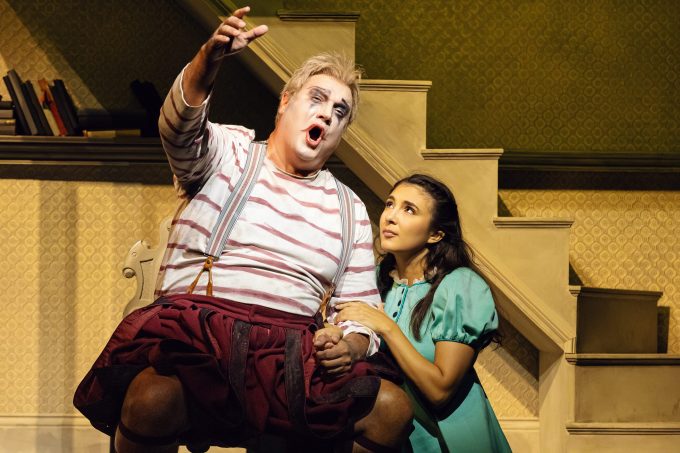
The abstract set gives the appearance of burgundy and cream gift wrap framed by makeup lights, and the first costumes of the chorus repeat the look of the walls, which seems forced. Also, the depictions of the interiors of Rigoletto’s apartment and the inn are like doll house dioramas, and particularly the former is undersized and cramped relative to the players. That said, some visuals are quite stunning.

Stephano Park as Sparafucile, Marcela Rahal as Maddalena.


What is more concerning is that while Rigoletto is a tragedy of the highest order that should maintain tension, silliness abounds. Sometimes with (apparently) red lipstick, a dangling earring, and black togs, the duke looks like a refugee from a leather bar and never convinces as one of the highest station. Rigoletto’s maid acts like a giddy Mrs. Doubtfire, and the courtier perpetrators of Gilda’s kidnapping skulk like Boris and Natasha from Rocky and Bullwinkle. Young, first time opera goers often snicker inappropriately anyway, and the inclusion of frivolousness only encourages them to see more humor that is not intended.

Happily, the power of the music conducted by Carlo Montanaro, fine singing, and the unique Santa Fe Opera experience make for a compelling and enjoyable entertainment.

(above) Elena Villalón as Gilda, Michael Chioldi as Rigoletto, (below) Marcela Rahal as Maddalena, Duke Kim as Duke of Mantua.

Rigoletto, composed by Giuseppe Verdi with libretto by Francesco Maria Piave, is produced by Santa Fe Opera (www.santafeopera.org) and plays on its stage at 301 Opera Dr., Santa Fe, NM through August 20, 2025.

The Turn of the Screw

Jacquelyn Stucker as the governess, Brenton Ryan as Prologue. All photos by Curtis Brown.

Drama in opera is relatively easy. The plot does the heavy lifting. Other idioms pose additional challenges. The rare class of ghost stories in opera also requires tingling music; good acting; and more precise action and reaction. In that genre, The Turn of the Screw has long been regarded by most aficionados to be the most successful example. Henry James’s novella proves a fine basis for a spooky chamber opera, and Benjamin Britten’s music fits beautifully. Santa Fe Opera’s handsome production brings out the best in the material.

In a turn-of-the-20th-century chronicle in rural England, a governess is hired by a London-based guardian to care for a boy Miles and a girl Flora, children of his late brother. The conditions are that she make all of the decisions concerning their upbringing and that she not contact the guardian. In time, two deceased former employees of the estate, Peter Quint and Miss Jessel, appear to the governess, but not to the housekeeper, Mrs. Grose. Further incidents leave the governess distressed and lead her to question whether the children are possessed by the ghosts and to wonder about her own sanity.

Jacquelyn Stucker as the governess, Jennifer Johnson Cano as Mrs. Grose.

The action takes place on Christopher Oram’s striking set with a back wall of huge, high arched windows and windowed doors. Rather than clear glass, the panes are like a murky isinglass that yields mostly shadows on the other side. A small pond of water on the corner of the stage’s apron into the wing offers optional egress – to a watery grave? Sharp lighting designed by Malcolm Rippeth provides threatening contrasts and shadows, accentuated further as one character, and later another, exits the stage though the water in darkness with only a key light illuminating the face.

The obscurity from the window glass is in keeping with James’s theory of revealing as little as necessary about the people and situations, believing that if readers/viewers know too much, they can be dismissive of the author’s notions, not to mention that sketchiness adds to the mystery. Backstories to embellish characters’ personas are non-existent. And if you’re wondering why the governess’s name hasn’t been mentioned, it’s because neither James nor the opera’s librettist Myfanwy Piper granted her one.

Everett Baumgarten as Miles, Annie Blitz as Flora.

To add to the ambiguity, Director Louisa Muller cleverly keeps the governess onstage throughout, sometimes in a sleep state. Does this suggest that the governess is the narrator of her subjectively perceived story, or that the whole account is perhaps a delusion – a dream?

Meanwhile, should the children be trusted? At times they are playful and seemingly innocent. But each engages in menacing acts. Perhaps because of his “station,” Miles considers himself more adult than he is and refers to the governess with a condescending “my dear.” He even sings a song “Malo” (meaning bad), and asks the governess provocatively, “Aren’t I bad?”

Children masked, Jacquelyn Stucker as the governess.

Britten’s composition makes fine use of a chamber orchestra to create the unstable, ominous sense of vulnerability. The score contains several leitmotifs, the most significant being the varying screw theme used in each of the 16 scenes, with its unsettling successions of rising major fourths and descending minor thirds. Conductor Gemma New executes with both brisk and languid precision, often highlighting solo instruments with great clarity as a bassoon warbles, bells tinkle, drums tick, and chimes toll as if a death knell.

A high vocal tessitura adds to the tension. The score is dominated by female voices, and the two male voices are a tenor and a treble (boy soprano). In addition to some notable but not memorable arias, several ensembles are the most compelling moments in the music, evidencing agitation among the characters.

(rear) Brenton Ryan as Peter Quint, (foreground) Jacquelyn Stucker as the governess, Everett Baumgarten as Miles.

The fine cast of four adult players is led by Jacquelyn Stucker as the governess. Her dramatic soprano voice with a steely edge especially fits the dissonant sections of the score, but one of the contradictions in the vocal requirements is that a young and at-risk female would have such a powerful voice. Stucker’s acting also excels as she descends into the spiral of horror.

High marks to the other mature artists as well – Jennifer Johnson Cano as Mrs. Grose, Wendy Bryn Harmer as the ghost of Miss Jessel, and Brenton Ryan as the ghost of Peter Quint. Child performers, veteran Everett Baumgarten as Miles and Annie Blitz as Flora suit their parts well.

Wendy Bryn Harmer as Miss Jessel, Jacquelyn Stucker as the governess.

Performed at Santa Fe Opera’s fabled sides-open-to-the-elements venue, this production also opens the backstage wall partly to nature. I envy anyone who gets to see this production on a night of thunder and lightning storms, which are common in Santa Fe summers. What a wonderful setting for a ghost story!

The Turn of the Screw composed by Benjamin Britten, with libretto by Myfanwy Piper and based on the novella of the same name by Henry James, is produced by Santa Fe Opera and plays on its stage at 301 Opera Dr., Santa Fe, NM through August 5, 2025.
The Rake’s Progress

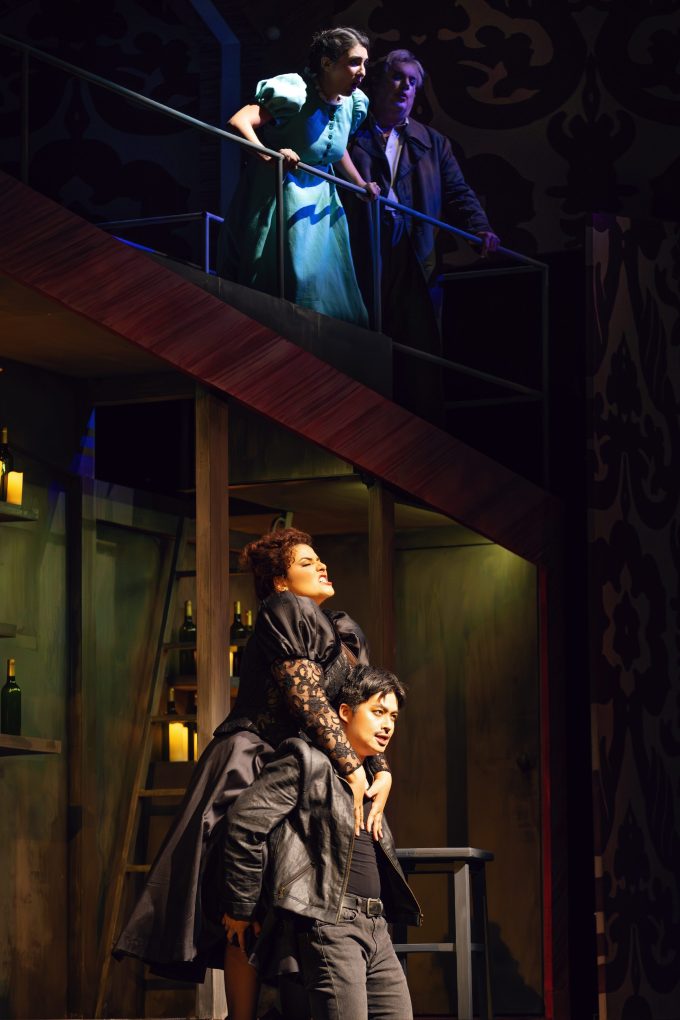
(far left) Aleksey Bogdanov as Nick Shadow, (foreground) Adrian Kramer as Tom Rakewell, Marc Webster as Mr. Trulove, Lydia Grindatto as Anne Trulove. All photos by Kayleen Bertrand / Glimmerglass Festival, except where otherwise noted.

Like many innovative artists, Igor Stravinsky, one of the most influential music composers of the 20th century, evolved through distinct stylistic periods. As his neo-classical period reached its end in 1951, he produced his only completed opera, The Rake’s Progress. Although it has proven to be one of the most enduring and popular in the English-language opera canon, it was not critically well-received at the outset. Atonal serialism, initiated by Arnold Schoenberg and later adopted by Stravinsky, had long dominated serious music. The Glimmerglass Festival offers a winsome version of this important opera, led by a stellar cast and a powerful look.

The composer was drawn to William Hogarth’s series of paintings, A Rake’s Progress, whose genesis is based on the Orfeo myth. To create the narrative, Stravinsky turned to eminent poet W. H. Auden, who later drafted another poet, Chester Kallman to the project. Not surprisingly, this team created one of the most literate librettos in this fantasy opera, full of poetic syntax, beauty, and allegory.

Cast.

Tom Rakewell is a country boy who shuns a regular job and instead hopes to fare well relying on his wits. Along comes Nick Shadow, who, unbeknownst to Tom, is the Devil. Shadow offers to be Tom’s servant and to introduce him to the high life in London, which turns out to center on a brothel. Only too late will Tom realize the mistake that he’s made.

The part of Tom represents one of the more challenging tenor roles in the repertory. Not only is his stage time enormous, but his four major arias can sap the strength. Fortunately, athletic Adrian Kramer has the stamina, as well as the vocal skill, to carry it off with seeming ease. He steps up in particular with his signature aria “Here I Stand,” which reflects his delusional confidence in his ability to make good choices with good outcomes.

Aleksey Bodonov as Nick Shadow, Adrian Kramer as Tom Rakewell.

As the faux ally who leads Tom to his descent, Aleksey Bogdanov performs Nick. His slick and swarthy appearance telegraphs his deceit, and while his deep, burly voice resonates ominously, he gains Tom’s confidence by saying things that he wants to hear.

In pursuing his fancy, Tom also abandons his betrothed from the country, Anne Trulove. Lydia Grindatto is the vision of innocence as the mournful yet hopeful Anne, who will continue to naively pursue Tom. Perhaps the best received singing in this opening performance was Grindatto’s long, beautiful Act 1 soliloquy, “No Word from Tom,” in which she excels, displaying her rich coloratura soprano voice.

Cast.

Visual elements on stage are a bit staid until the brothel scenes when they explode. The score makes considerable use of choruses, and the choristers in effect double as a corps de danse who contribute to the overall appearance. Dressed at this point in tawdry black and white, the carnal look and undulating movement is reminiscent of what you might see in Cabaret or Three Penny Opera.

In Tom’s plunge to the bottom, we meet the final main character, Baba the Turk. By some twisted logic, Nick induces Tom to marry Baba as an act of independence in Nick’s deceitful aria “Master, Observe the Host of Mankind.” Baba is performed by muscular-voiced mezzo, Deborah Nansteel, who gets to display her overall power, and particularly the strong top end of her range when Tom turns on her. Her “Scorned! Abused! Neglected!” is a raging tour de force. Oh, did I fail to mention that Baba is a bearded lady in a circus? Well, things do get worse, as all of Tom’s three great wishes go asunder, but I’ll leave it to the reader to suss out those details.

Deborah Nansteel as Baba the Turk. Photo by Brent Delanoy.

From this reviewer’s perspective, the least engaging element in the opera is the music itself. Coming from a great composer, it is technically refined with a classical backbone but dissonance to match the discomfort of the characters. Opportunities do exist for singers to stretch their vocal muscles. Choruses and ensembles, especially a duet between Tom and Nick as well as a couple of trios, appeal, though these gems are too short. Yet, nothing in the music is memorable or will appear in the Top 100 Hits from Opera.

Nonetheless, the colorful narrative fits the music well, and the production aptly fulfills the demands of the opera. It also makes a strong statement that is worth hearing – “Idle hands are the devil’s workshop.”

Cast.

The Rake’s Progress, composed by Igor Stravinsky with libretto by W. H. Auden and Chester Kallman, is produced by Glimmerglass Festival and plays at Alice Busch Opera Theater, 7300 State Highway 80, Cooperstown, NY through August 15, 2025.
The House on Mango Street

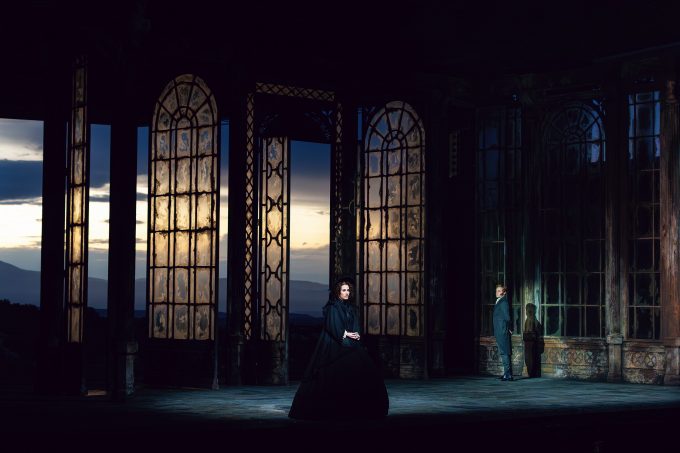
Taylor-Alexis DuPont as Sally, Micaela Bennett as Esperanza. All photos by Kayleen Bertrand / Glimmerglass Festival except as noted.

Since its publication 40 years ago, Sandra Cisneros’s The House on Mango Street has been one of the most powerful literary forces in the teen and young adult market. With over 6 million (reference: Wikipedia) or 8 million (according to the author) books sold, its popularity is buoyed by frequent listing in high school curricula and by notoriety from banning.

Having previously received permission to compose songs from the book’s text, Derek Bermel asked Cisneros to collaborate in creation of an opera based on the book. Glimmerglass Festival has commissioned and premiered the work with a stunningly rich depiction of life in a Mexican-American neighborhood in1980s Chicago. The opera entertains as its vibrant, eclectic music manifests the diverse musical culture that lives in Chicano communities.

Mikaela Bennett as Esperanza.

Cisneros speaks of identifying the 10 things that only you know about, and then revealing those you want to forget. She does this in The House on Mango Street with colorful images and eloquent language. These vignettes draw from the author’s own upbringing and experience teaching in an immigrant community. Like the music, the episode-driven format is both a strength and a weakness, highlighting diversity at the expense of drama.

Events reflect the world perceived by teenage girl, Esperanza, portrayed by promising soprano Mikaela Bennett. Like some neighborhood denizens, she dreams of getting away from Mango Street, while others love life there, perhaps because it is the only one they know.

Cast. Photo by Brent DeLanoy / Glimmerglass Festival.

Esperanza has her own story, mournful but not tragic, as she comes from a stable background. She suffers ridicule because of her long name and even its optimistic meaning – hope, in English. As articulated by a friend, she seeks the three things that matter to a girl transitioning to womanhood – education, financial self-sufficiency, and avoiding pregnancy. While she lacks experience in many areas, she also strives to help her friends avoid pitfalls. But Esperanza’s resolve will be tested when she herself is victimized.

Nearly 30 named principals enliven the narrative, resulting in street scenes full of energy and movement – the twins Lucy and Rachel who live for today; Cathy the Queen of Cats with her flashy style; Alicia the college girl with lectures on everything; Sire and Tito, the fast boys with cool grooves. No doubt, these characters animate the novel. But while they give great color to the opera and sparkle individually, many of the episodes involving them impede the dramatic arc.

Angelo Silva as Geraldo.

Esperanza’s own story provides drama, as do her intersections with two other characters. Sally is performed by a strong-voiced and effusive Taylor-Alexis DuPont, whose arias display a hefty top end to her voice. She is a good friend of Esperanza’s with an even more engrossing narrative. She tries to walk the line by having a good time with the boys, but not allowing them to go further than she wants. Sally also suffers abuse from her father, with whom she has a complex relationship often common in these situations.

The other dramatic personage is the most humble and least integrated into the social structure of the community. He is Geraldo, the street vendor, who, though poor, best recognizes the richness of what he has. Working conspicuously in the open, and sadly relevant to our times, his biggest fear, like that of many others, is deportation. He will suffer tragedy that links him to Sally. An adjustment that doesn’t stray far from these three characters’ storylines would probably result in less brightness but a more taut and compelling stage drama.

Mikaela Bennett as Esperanza, Taylor-Alexis DuPont as Sally, cast.

The music that supports the libretto brims with hummable melodies; tweaks the nostalgia with samplings of the likes of “Guantanamera” and “Habañera” from Bizet’s Carmen; and serves up all manner of musical styles. The twins, who are from South Texas, sing in Tejano style; Sally’s “Take and Take” is gospel-like; Sire’s “Ought Not To Be” is hip-hop; and more. Some may consider this pastiche, but in any case, it is spirited and works well. The most touching is the concluding number, Esperanza’s ballad, “A House of my Own,” which summarizes her hope for a better life. The beautiful soundtrack with its mix of idioms sounds almost like a sung-through musical, which some operagoers may find too far from the classical vein or from the received operatic wisdom of today to consider it appropriate to the opera house.

An additional element that makes The House on Mango Street work is its visual cacophony, and I mean that in the most positive sense. World-renowned John Conklin, who died less than a month ago at age 88, came out of retirement to set design four productions, including this one, for the 50th Anniversary Season of Glimmerglass. Conklin may be known to Bay Area fans for his design of San Francisco Opera’s Ring Cycle. This representation is astonishing with flushes of red, stick-skeleton houses, a huge El Muerto puppet and giant clown faces. The bold look brings the street to life. Add the costumery and movement of the players on stage, and the vitality of Director Chía Patiño’s vision makes for a special experience.

Cast. Photo by Brent DeLanoy / Glimmerglass Festival.

Of course, credit should go to the original source material for the opera. With all of its sadness, Sandra Cisneros paints a loving picture of coming of age and of a people whom she honors and whom deserve to be celebrated.

The House on Mango Street, a world premiere composed by Derek Bermel with libretto by Sandra Cisneros and Derek Bermel, is produced by Glimmerglass Festival and plays at Alice Busch Opera Theater, 7300 State Highway 80, Cooperstown, NY through August 16, 2025.