Guys and Dolls

Joel Roster as Nathan Detroit, Melissa WolfKlain as Adelaide. All photos by Jessica Palopoli.

The award winning 1950 Broadway musical “Guys and Dolls” succeeded in its debut run and in several revivals.  But for many, the 1955 film starring Marlon Brando and Frank Sinatra, represents their only knowledge of the piece.  As an aside, Sinatra played tin-eared Nathan Detroit.  The character was given only one song in the stage version, as the role was written for Sam Levene, and he lacked singing chops. Meanwhile, Brando had the Sky Masterson role with the great singing!?!?

While the film succeeded in many ways, some viewers today could see “Guys and Dolls” as antiquated and the casting and acting stilted to distraction – hardly likely to encourage viewers to go to a stage version.  That might be a mistake.  Driven by strong production values and four talented leads, San Francisco Playhouse’s rendition offers a nostalgic time and place capsule, albeit not without flaws.
Cast.

Author Damon Runyan cut a unique swath through the American persona, uncovering colorful characters and situations around Depression Era Broadway.  His world was one of people living on the edge – the demimonde of performers, gamblers, gangsters, tricksters, and women who turn tricks.  His stories form the basis for “Guys and Dolls,” one of over a dozen plays and movies to draw on his fiction.

One conversation that theater goers often have is whether they care about the characters or can relate to them.  Most would not relate to the motley crew in “Guys and Dolls,” but many would empathize with them.  They might feel for Nathan Detroit, but probably wouldn’t want him as a brother-in-law.  Played adeptly as grizzled and stressed by Joel Roster, he earns a hand-to-mouth existence as the proprietor of floating craps games.  Nathan does have a love life as well – a 14-year engagement to Adelaide, a nightclub singer.

Abigail Esfira Campbell as Sarah, David Toshiro Crane as Sky.

Melissa WolfKlain delights as Adelaide, the most challenging of the roles, having to maintain a mousy Brooklyn accent not only for her comedic contributions, but also for her considerable singing requirements to be on key and off kilter at the same time.  Perhaps the best example of that is when she nails the popular “Adelaide’s Lament” in which she attributes all of her maladies to not being able to get Nathan to the altar, e.g., ‘Just from wondering whether the wedding is on or off.  One could develop a cough.’  Meanwhile, she has been sending letters to her mother for years saying not only that she’s been married, but that they now have five children!

If Adelaide and Nathan’s endless engagement is the classic conflict between the party who wants to make a commitment and the other who won’t, the second couple is the classic case of opposites attracting.  The suave and cool Sky Masterson (played suavely and cooly by David Toshiro Crane), occasionally participates in Nathan’s games, and he will bet on anything.  As an indication of how silly the script can be, Nathan needs $1,000 to pay for a venue for his next craps game, and he bets Sky that he won’t be able to get a particular young woman to go to dinner with him in Havana.  (If you can remember a time when you could fly on a whim to Cuba from the U.S., you’re old.)

Cast.

So what’s the catch?  Nathan figures he has a sure bet, as his pick, the prim and proper Sergeant Sarah Brown, portrayed as physically and morally upright by Abigail Esfira Campbell, is a uniformed member of the Times Square Save-A-Soul Mission.  Her mission should be clear, and she’s clearly not accomplishing it.  You guessed right presuming that you predicted Sky would succeed in spiriting Sarah to Cuba, and Sky even gets her to loosen up a bit with the help of some of the island’s finest, highly disguised libations.  The couple’s new found feelings and beautiful voices are on display in the Act 1 finale, “I’ve Never Been in Love Before,” a wonderful duet with a life outside the musical.  Needless to say, plenty of action follows in Act 2.

Jill Slyter as Arvide, Abigail Esfira Campbell as Sarah.

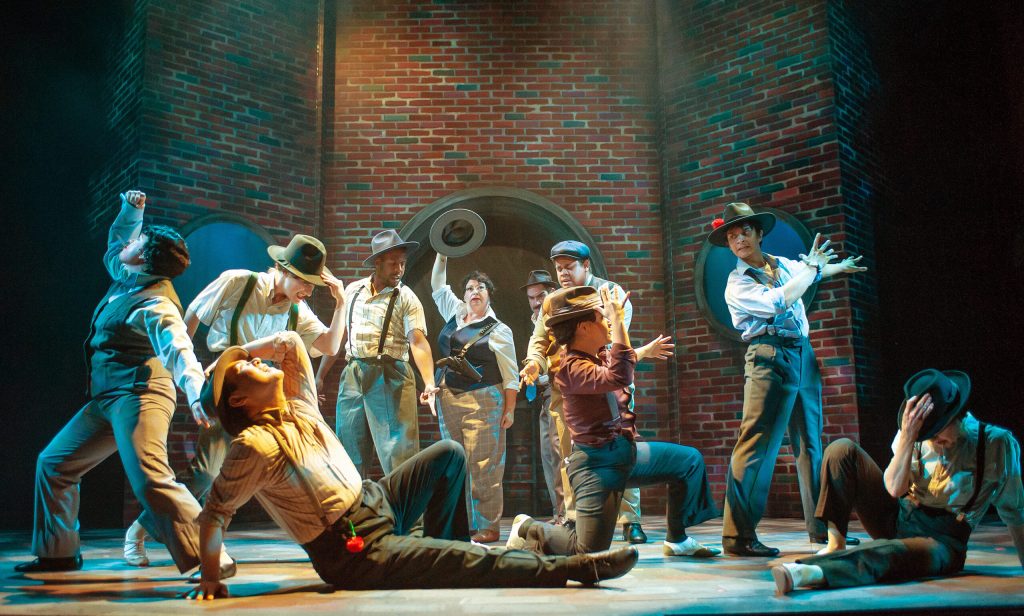
The Frank Loesser score of “Guys and Dolls” contains many pleasant numbers, though some of them are somewhat glued to the storyline such as “Luck Be a Lady” and “Tinhorns’ Fugue.”  If the latter title is unfamiliar, it’s the bouncy gamblers’ song with the lyrics ‘Can do.  Can do.  This guy says the horse can do.’  It is a brief but exceptional three-part counterpoint that is delivered exceptionally well and picks up the pace near the start after an overture that is uninspired in terms of its music, its playing, and its choreography.  Nicole Helfer’s choreography is otherwise strong throughout.  Execution varies but is best when danced by characters who in the script are supposed to be dancers, and at the other extreme, when non-dance movement is individualistic.

Melissa WolfKlain as Adelaide (center), dancers.

A final highlight is the staging, which as usual, takes advantage of the facility’s revolving stage, which is the investment that keeps on giving.  Designer Heather Kenyon’s angular street scape of three-story buildings in subtle but varied colors, reminiscent of an Edward Hopper painting, gives way to a nightclub, a parking garage, the mission office and more.  Along with other creative contributions, Director Bill English keeps the action moving and ties all the strings together.

“Guys and Dolls,” with music and lyrics by Frank Loesser and book by Abe Burrows & Jo Swerling based on short stories by Damon Runyon, is produced by San Francisco Playhouse and appears on its stage at 450 Post Street, San Francisco, CA through January 13, 2024.

The Elixir of Love

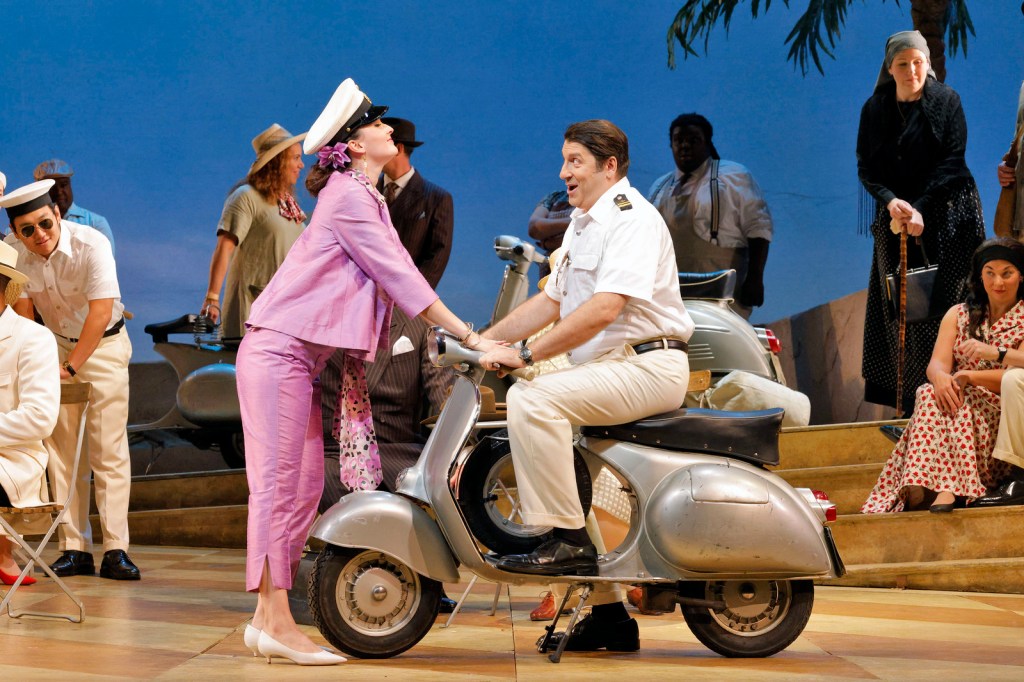
Slávka Zámečníková as Adina, Pene Pati as Nemorino. All photos by Cory Weaver.

Few opera composers reached the peak of their profession and showed equal facility in drama and comedy.  Gaetano Donizetti fulfilled those conditions like few others.  The delightful “L’elisir d’amore” debuted in 1832, around the middle of his career but before almost all of his most noted works, including his other two highly esteemed comedies “Don Pasquale” and “Daughter of the Regiment” as well as dramas “Lucia di Lammermore” and the three Tudor operas.

Cast.

This production updates the libretto’s action to the Italian Riviera in the 1950’s with a bright, colorful staging and costumes that give the production extra liveliness.  Director Daniel Slater’s sight gags add to the joy.  Nemorino waits tables in the café of the hotel owned by Adina who rebuffs his advances and instead indicates that she plans to marry Belcore, a captain in the navy.  Enter medicine man (read: snake oil salesman) Dr. Dulcamara, descending in a hot-air balloon, no less.  The good “doctor” convinces Nemorino that a love potion will make him irresistible to Adina.  This is a romantic comedy, so you can imagine the machinations leading to the eventual happy ending.

Slávka Zámečníková as Adina, David Bizic as Belcore.

After his successes on many European opera stages, what makes this production especially sparkle is the return to San Francisco Opera of Pene Pati in what could easily become a signature role for him.  Could there be a more quintessential Nemorino?  His gorgeous tenor voice, with a slight Italianate lilt, fits the vocal demands of the part.  More than that, he embodies Nemorino.  His pleasant, innocent face and easy smile align well, and Pati’s comic acting gives the character additional charm, right down to some spot-on miming of Elvis Presley.

While the libretto of “The Elixir of Love” exudes light-heartedness and froth from beginning to end like few other operas, the composition possesses abundant mastery of the genre.  Although some sameness and singsonginess recurs in much of the music, the haunting, almost bookended romanzas for tenor depart from the rest.  In the melancholy “Quanto è bella,” which is the first aria in the opera, a reflective Nemorino expresses his love for Adina but also his self doubt that he can make her love him.

Cast.

Appearing near the end is the opera’s most famous aria, “Una furtiva lagrima,” which flips the positions of the seeker and the sought.  While unquestionably beautiful, the pensiveness of the aria doesn’t really reflect what should be Nemorino’s joy, as the secret tear falls from Adina’s eye and says that she now loves him.  Pati really milked the aria on opening night with long pauses between phrases toward the end.  His rendition was powerful and deservingly produced as sustained an applause for an aria as you might witness at an American opera house.

Making her commanding American and role debut as Adina is Vienna-based Slávka Zámečníková.  With a voice both silken and agile, the soprano fits well musically into the bel canto role, navigating both the luxuriant and staccato elements of the score.  She captures both the warmth and aloofness of the character.  In her lovely “Della crudele Isotto,” which tells of the use of a love potion in the legend of Tristan and Isolda, Nemorino comes to believe that such a potion might help him win Adina over.  Zámečníková also delights in her duet with Pati, “Chiedi all’aura lusinghiera,” showing great range and vocal beauty.

Renato Girolami as Dulcamara, Pene Pati as Nemorino.

The clear and tight narrative of “The Elixir of Love” requires only five principals, all of whom perform admirably.  Both baritones fill the bill, having performed their respective parts previously.  David Bizic as Belcore and Renato Girolami as Dulcamara, are both self-indulgent, flamboyant, and elusive in their own way.  Belcore is likely to have a girl in every port and Dulcamara suckers in every town.  Finally, Adler Fellow Arianna Rodriguez portrays another employee of Adina, Gianetta, who spreads the word in the closing scenes that Nemorino’s uncle has died and that he is now rich.  Rodriguez shows great promise with a strong soprano voice and stage presence.

Of course, by today’s standards, one could criticize the libretto for its 19th century sensibility that Nemorino’s becoming rich makes him a greater catch.  The good news is that neither lover was aware of the newfound wealth when they declared their mutual love.

Arianna Rodriguez as Gianetta.

“The Elixir of Love” (L’elisir d’amore), composed by Gaetano Donizetti with libretto by Felice Romani after Eugène Scribe’s text based on Daniel Auber’s opera “Le Philtre,” is co-produced by San Francisco Opera and Lyric Opera of Chicago, and plays at War Memorial Opera House, 301 Van Ness Ave, San Francisco, CA through December 9, 2023.

Omar

Jamez McCorkle as Omar. All photos by Cory Weaver.

Historically, most new operas have fit into pre-existing musical formulas.  Although innovation always introduced changes, bel canto dominated at one point, continuous melody at another, and atonality at a third.  Recent trends, driven in part by opera companies seeking different voices and younger audiences, have opened the door to many new idioms with influence from the likes of Chinese and Spanish music.

Impressive additions have come from Black American composers, such as eminence gris Anthony Davis, and the likes of newer entrants like Terence Blanchard and Tamar-kali with no prior experience in opera.  Add to that list honored artists Rhiannon Giddens and Michael Abels who break new ground with their historical depiction of Omar bin Said, an enslaved scholar who left writings not only in English, but in his mother tongue of Arabic.  Co-commissioned by San Francisco Opera, the piece has won the 2023 Pulitzer Prize for music.

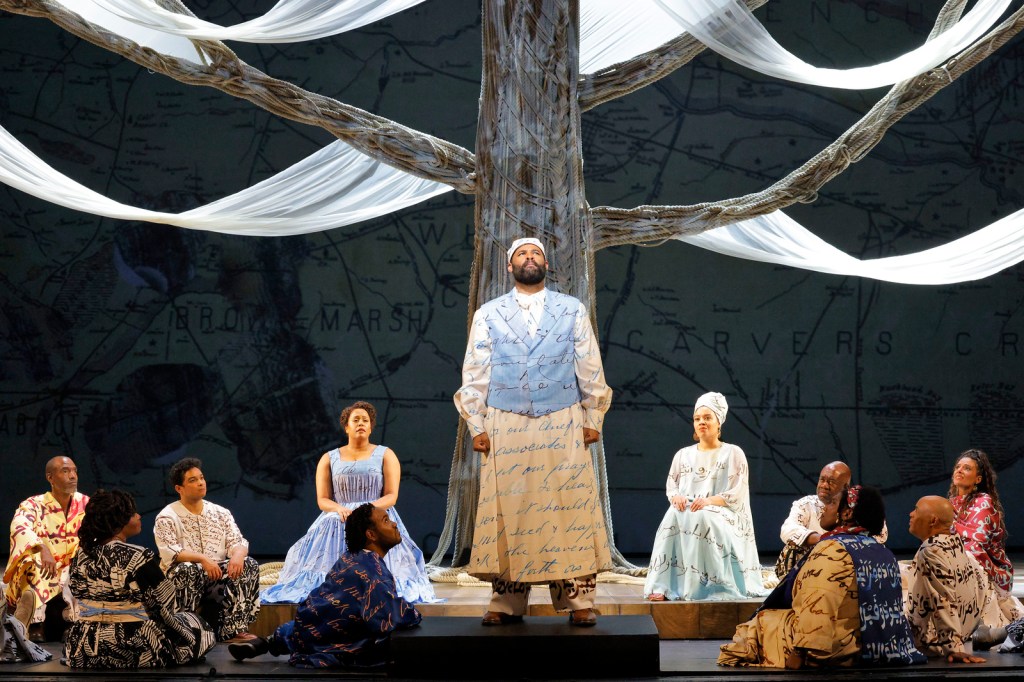
(center) Brittany Renee as Julie, Jamez McCorkle as Omar, Taylor Raven as Fatima.

As the driving force in the composition and as the librettist, Giddens has endowed this project with richness, and the music is appealing throughout.  Drawing on her Americana roots, she introduces a wide array of musical styles, depending on the location and situation.  The opera’s opening in what is today’s Senegal and on the passage to America draws on African and Arabic musical themes, using several types of African drums to replicate their folk rhythms.  In the United States, gospel, old time country, and folk become influences.

Cast.

The storyline follows Omar’s capture; his sale to a malicious slave owner; his escape and incarceration; and his eventual purchase by a more humane master.  This final overlord, Owen, encourages his writing and religious thinking, even while arguing that he prayed to a false God, believing the Muslim Allah to be different from the Christian God.  While the arc of the narrative is fitting, the opera’s libretto largely lacks liveliness or pathos.  And in reaching for epic status, focus on the title character sometimes suffers.  Perhaps Omar was a placid individual focused on religion, but his personality comes across as largely inert, and that doesn’t make for an involving character that induces compassion and sympathy.

Cast.

Incidents of horror such as the transportation across the Atlantic that resulted in many deaths because of desperate conditions and lack of food and water are treated perfunctorily.  The physical abuse by slave owners and their strawbosses receive little attention.  The degradation of the slave auction block, other than the incident of a son being separated from his parents, seems as tame as an antique auction.  And even though arias like “Waiting for the Time to See Jesus” and “I May Be Gone” express the fatalism of slaves, they fail to galvanize the emotions.

Powerful moments do arise, but most are brief.  The exception is the evocative multiple-segment closing sequence.  Starting with a strong chorus piece on stage, the cast fans into the audience.  And while this device has been used in other stage productions, the surround-sound effect of the delightful harmonies is exceptional.  On stage, Jamez McCorkle as Omar then sings in soliloquy fashion about faith, and finally transforms with a costume change from slave to modern free man in a profound visual statement.

Barry Banks as Taylor, Jamez McCorkle as Omar, Daniel Okulitch as Owen.

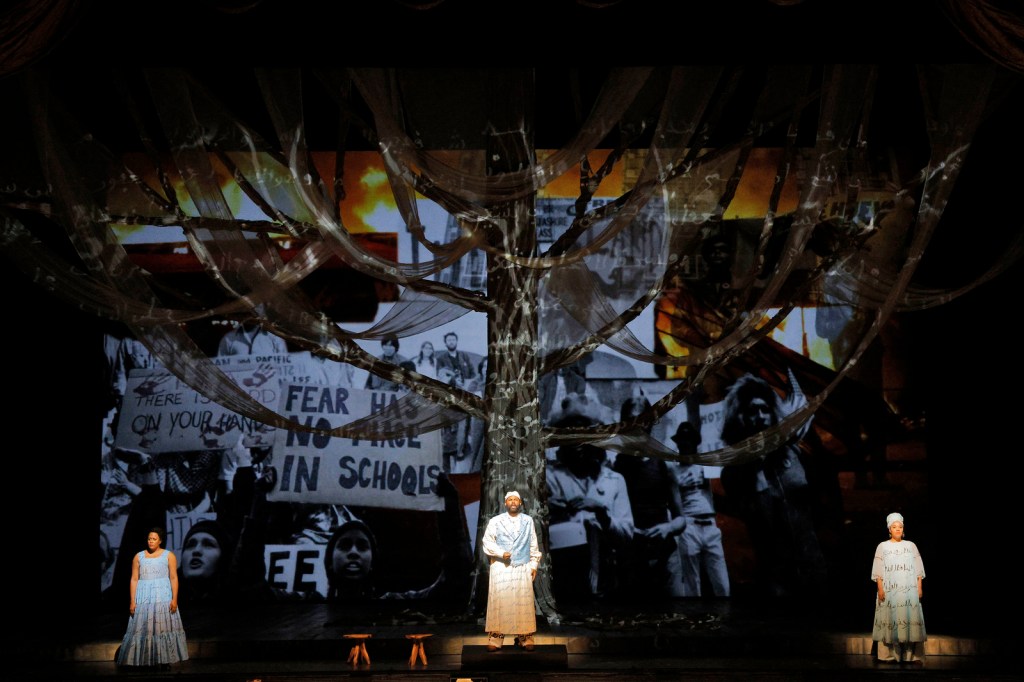
Striking staging complements the fine music.  Beautiful Arabic calligraphy often generously adorns the stage.  Even when the set is spare, it appeals, as when a single tree’s trunk and branches are represented by snarled rope and its leaves by long trains of gauzy muslin.

The opera house acts as the temple of the human voice, valuing the penetrating strength of the trained, unamplified vocalist.  On this occasion, the principals were underpowered in Act 1.  Voices were generally audible but lacked the volume and depth expected.  Sometimes opera singers routinely hold back a bit while their voices warm, but this lasted over an hour.  Act 2 differed.   The two female leads, Julie (Brittany Renee) and Fatima (Taylor Raven), proved to have fine voices.  McCorkle in particular seemed a different singer with a fluid sound, and it may be that his part is so demanding in Act 2 that he saves his voice in the first act.

Brittany Renee as Julie, Jamez McCorkle as Omar, Taylor Raven as Fatima.

“Omar” does deal with very serious historic issues, revealing elements such as the existence of Muslim slaves that many people will not be familiar with.  Although the narrative should produce more emotional involvement, the overall arc, the music, and the staging offer a significant and entertaining evening.

“Omar” with music and libretto by Rhiannon Giddens and music by Michael Abets, is co-produced by San Francisco Opera, Los Angeles Opera, and Lyric Opera of Chicago, and plays at War Memorial Opera House, 301 Van Ness Avenue, San Francisco, CA through November 21, 2023.

I Can Get It For You Wholesale

Right out of the box, let’s note that this musical is exceptionally well done with fine production values and a sensational cast with numerous honors from past Broadway performances.  As a bit of an intro, this revival of a 1962 musical opens in the Garment District of Lower Manhattan in 1937.  Young Harry Bogen who would become a user and abuser (played by an absolutely fitting and believable Santino Fontana) performs menial tasks, but he aspires.  Aided by considerable chutzpah and good luck, he opens a dress making company with two partners.  But success is not enough. His greed and gluttony lead him to crises and decline.

Our American Theatre Critics Association conference was fortunate to host a panel discussion of five creatives from this musical, and the tremendous insights the panelists offered form much of the basis for this commentary.  Some attributions below are inexact, because multiple participants chimed in on many issues.

Central to the revival was John Weidman, son of Jerome Weidman, who wrote the original book and the novel on which it was based.  John revised the book, emphasizing that there must be a reason for a revival, so that while the time and place of the story remain, sensibilities speak to 2023 rather than 1962.  For instance, in the earlier era, anti-heroes often went unpunished, whereas today’s audience would expect the perpetrator to pay a price.  And while Harry is a con man from the outset in 1962, John cleverly makes him a more appealing character to begin with, which brightens the show’s empathy and allows for a character arc.

David Chase adapted and arranged the music, which is full of appealing, exotic Jewish harmonies, but without any breakout songs.  He and others of the team scoured the Yale University archives of the original musical to try to gain further insights.  Among other contributions by Chase, he found two songs that did not make it into the 1962 final production.  Creating a patchwork, alternating duet from them between the devoted girlfriend, Ruthie (played as sweet and optimistic by Rebecca Naomi Jones), and the gold digging back door mistress, Martha (highly talented actor/singer/dancer Joy Woods).  This piece shows contrasting perspectives and becomes one of the musical highlights of the show.

The original story lacked inherent kinetic drive, and playing on a small thrust stage cluttered with sewing tables induces further physical limitations.  Choreographer Ellenore Scott was brought in, and she introduced swirling character movement among the tables and had them shoved aside in a couple of instances to allow hora and ballroom sequences that add tremendous vitality to the mix.

Director Trip Cullman drove the overall artistic vision and brought all the pieces together.  Among other aspects that he attended to was the depiction of the agency that the five women in the story possess – all in their own special way.

The final contributor to this process was Producing Artistic Director Jill Rafson, without whom there would be no production.  In her second year at Classic Stage Company, this was her first production decision – a bold one that appears will be a good one.

The narrative is replete with Jewish and Garment District tropes, but they are not overdone so that the more universal themes of family, faith, and integrity are allowed to come through.  Actually, the title is both a trope and a misnomer.  The common refrain about never paying retail never enters into the picture.

Rather, the theme of the story relates the sometimes devious behavior and corrupted values of many people whose success is measured by money, notoriety, and power.  Songs with indicative titles – “The Sound of Money” and “You’re a Pitcher or a Catcher” suggest this matter.  And a sad recurring theme is that you have to step on people to get to the top.

The creative decision to make Harry a suffering youth who initially is clever without dishonesty is perhaps the most important change in the revision.  He is able to capitalize the company because two righteous women believe in him as a decent and enterprising individual before his moral compass fails – Ruthie and Blanche (a decisive Sarah Steele), the wife of a future partner of Harry’s.  Another desirable quality that Harry has is his loyalty to his mama and his generosity in bringing her gifts and trying to make her happy.  Yet, mama (an austere and insightful Judy Kuhn) was the first to sense when Harry was going astray, and she was willing to share her concerns with the more gullible young women.

The final female of note runs interference for Harry, his secretary Miss Marmelstein.  Julia Lester is a total scene stealer in the role with over-the-top humor and a singing voice strong enough to power a locomotive.  And she is not the least bit intimidated that the cognescenti of musicals know that the role was created by and the launch for another performer who could fit the same description – Barbra Streisand.

Although “I Can Get It For You Wholesale” is a cautionary tale highlighted by Miss Marmelstein’s haunting “What Are They Doing To Us Now?,” it thoroughly engages and provokes without depressing.  The musical works on multiple levels.  Its only deficiency is the lack of tunes that have taken on a life beyond the musical, but there is so much more to appreciate.

“I Can Get It For You Wholesale” with book by Jerome Weidman, revised by John Weidman, with music and lyrics by Harold Rome is produced by Classic Stage Company and plays on its stage at 136 13th Street, New York, NY through December 17, 2023.

Here Lies Love

Arielle Jacobs as Imelda Marcos. All photos by Billy Bustamante, Matthew Murphy, and Evan Zimmerman.

Of the four plays that my wife/editor, Karin, and I saw on our pilgrimage to New York City for the American Theatre Critics Association conference, the revival of “Here Lies Love” was the only one that qualifies as a Broadway show by meeting the location and seating capacity of the classification.

Have you ever observed an undertaking that seems so out of whack that you ask yourself, “What were they thinking?” That has to be the case when you consider that rocker David Byrne conceived, researched, and developed (with the participation of another rocker, Fat Boy Slim) the notion that young audiences would absolutely love the strange admixture of an immersive theatrical musical that tells the biography of Imelda Marcos, who would become the First Lady of the Philippines. What is whackier is that despite much controversy, the device actually works for the greater part – and without a single mention of the thousands of pairs of shoes that Imelda owned. It is an exceptional crowd pleaser that happily brings a new audience into theater. The unanswered question, however, is whether those attendees will return to the theater for anything other than another crypto-rock-concert-dance-a-thon.

Cast.

So, to understand what makes this sung-through musical work, it helps to know the lay of the land. At the Broadway Theatre (yes, that’s the proper name of the venue), the orchestra-level seating is removed; the rake of the floor is flattened; and a movable, configurable stage is placed in the middle of the space. Ticket holders who opt for the orchestra floor know in advance that they will be on their feet for the whole performance. Add a hyperactive deejay, loud music, colorful flashing lights, and a compulsion to dance, and what do you have? Disco.

The driving force is definitely the pop/rock musical score which energizes the audience. The recurring call to dance, even among those in seats, engages the audience, but at the same time seems like the kind of manipulation that occurs in political rallies, which relates to an underlying theme of the show.

Jose Llana as Ferdinand Marcos.

Early on, Imelda is poor but becomes a beauty queen at age 16, known as the Rose of Tacloban, the small town she comes from. Bouncy music like the anthem song “Here Lies Love” is consistent with these younger, happier years, but the disco atmosphere is maintained even after Imelda marries war hero Ferdinand Marcos, who would become president and then dictator of the Philippines. From that point, lavish excess, deprivation of civil rights, and the tragedy of tyranny come into focus and are depicted in the narrative and graphic projections, yet, the dance goes on.

The controversy pertains to what many consider the whitewashing of Imelda’s horrific deeds by Byrne, who may be considered a white, parachute tourist. One glaring example of the lack of his understanding of local sensibilities is writing the lament that Aurora Aquino, Ninoy’s mother, sings upon his assassination – “He always wanted to be a drummer,” which seems inappropriate from an American point of view as well.

Cast.

In truth, Imelda’s dark side is largely revealed, but critics will still argue that the mere publicity constitutes glamorization and apologism for wretched behavior. Noteworthy, however, one of the most moving moments in this revival is a postscript. An acoustic number not only reinforces the damage caused by the Marcoses, but argues that democracies are only as strong as its people. This pointed commentary relates to the extremely troubling political environment in the United States, which itself risks becoming a banana republic.

Unfortunately, supporters of demagogues are usually drawn in by the leader’s charismatic ability to arouse crowds and oblivious to their flaws. One naive supporter notes “Imelda never did anything wrong.” This same formula operates to prop up Donald Trump.

Arielle Jacobs as Imelda Marcos, Jose Llana as Ferdinand Marcos.

In Asia, pinoys, or Filipinos, have long been known as skilled entertainers, especially as interpreters of Western pop and rock. So it is no surprise that the cast of “Here Lies Love” is fully Philippine-American, and the performances are absolutely spot on. Arielle Jacobs gives a bravura rendering of Imelda, while Jose Llana as Ferdinand Marcos and Conrad Ricamora as Ninoy Aquino also excel. But the other controversy about this show concerns its casting. On the one hand, the Philippine community in general and the performers in particular are exultant that so many of them have the opportunity to make their mark, but will that translate to future success?

With those caveats in mind, “Here Lies Love” showcases Philippine talent in an accurate narrative about recent history that energizes, entertains, and allows viewers to make their own judgments.

“Here Lies Love” composed by David Byrne and Fat Boy Slim is performed at Broadway Theatre through November 26, 2023.

Spies for the Pope

Eric Loscheider as Giulio Cesare Vanini. All photos by Jonathan Slaff.

On a trip to New York City for the American Theatre Critics Association conference, my wife/editor Karin and I caught four wildly different plays at four wildly different venues.

First was a trip Off-Off-Broadway to the Theater for the New City, which has been offering a home for experimental theater for over 50 years in an earthy, multi-stage facility in the East Village. Playwright Douglas Lackey and Director Alexander Harrington have forged several collaborations, with this most recent one being the highly literate and entertaining world premiere of “Spies for the Pope.”

Standing: Eric Loscheider as Vanini. Sitting: Daniel Yaiullo, Brian Ott as students.

History is full of characters and stories that have been largely lost to time, and this is one example that the author has unearthed and embellished. Giulio Casare Vanini was a Capuchin friar who was charged by Pope Paul V in 1618 to try to fend off an international conflict that threatened to occur among many European powers, most notably the Holy Roman Empire and France. Since this story pertains to history, it is no spoiler to disclose that Vanini failed, and the result was the highly destructive 30 Years War. And as articulated in the play, this abomination derived from pathetic little differences in religious beliefs and royal family-based tribalism.

Lackey tells the tale in 23 scenes as Vanini and his associate Brother Markus cross many borders and meet with numerous dignitaries critical to international diplomacy. The script is extremely well researched and delights with copious details of political machinations, but an equally important and extremely well articulated thread involves arguments over religious theory. Vanini is a deep and free thinker and even though he devoutly believes in God, the fact that he doesn’t accept specious arguments in the received wisdom of The Church becomes his undoing.

Courtney Stennett as Princess Elizabeth, Brian Ott as Frederick of the Palatinate, pretenders to the throne of Bohemia.

The action moves briskly, which keeps things lively, but at times can seem a little jumpy. More distracting are the tedious if minor set changes that occur with each shift in venue, as they disrupt the flow of the narrative. On the other hand, period music excerpts of various ilks from opera arias to madrigals are used throughout, using both live singing and piped music. They blend well and enrich in an organic manner rather than delay the action.

Eric Loscheider portrays Vanini in a confident and believable manner. If the real friar were half as convincing as the actor, one wonders how he would ever have lost an argument. Other performances are generally but not uniformly effective, and a little confusion derives from actors playing multiple parts. That said, this is an entertaining, intellectual piece priced at a pittance, that offers fine value.

Joseph J. Menino as Pope Paul V, Eric Loscheider as Vanini.

“Spies for the Pope,” is written by Douglas Lackey, produced by Theater for the New City, and plays on its stage at 155 First Avenue, New York, NY through November 26, 2023.

Watch Night

Brandon Michael Nase (Josh), Brian Golub (Rabbi), and Arri Lawton Simon (Saul). All photos by Matthew Murphy and Evan Zimmerman.

On a trip to New York City for the American Theatre Critics Association conference, my wife/editor Karin and I caught four wildly different plays at four wildly different venues.

Just having opened in September, the Perelman Performing Arts Center is an essential part of the rebirth of the World Trade Center in response to 9/11. Though it can seat no more than 1,000 patrons, its cost exceeded (sit down for this one) $600 million. It must be the most technologically advanced theater in the world, with the ability to configure into one, two, or three stages. The capabilities of manipulating the performance spaces on every possible dimension are mind boggling, and many decorative elements are simply arresting.

Oneika Phillips, Chelsea Nicole Green, Danyel Fulton (Shayla), and Kevin Csolak (The Wolf – white supremacist).

For its first performance commission, the Center turned to Bill T. Jones, one of the world’s greatest choreographers of modern dance and his collaborator Marc Bamuthi Joseph, who like Jones is anchored in dance, but also excels in related artistic realms. So the casual observer might be excused for expecting a dance-centric piece. And while the significance of dance in the artistic expression is undeniable, serious choreography doesn’t occur until 30 minutes into the production. Although it is easy to dismiss “Watch Night” as unfocused multidisciplinary expression, it really masks a serious, modern, sung-through opera full of pathos and diverse, powerful music composed by Tamar-kali.

Appropriate to the rich cityscape rising from the destruction of the World Trade Center, “Watch Night” fervently deals with group trauma resulting from tragic and diabolical events thrust upon two communities. The fictional storyline builds around two real-life incidents among the many that have scarred this nation physically and emotionally. The mass murders in a church with a black congregation in Charleston and in a synagogue in Pittsburgh ground the narrative. Remarkably, like the 30 Years War referenced in another play we attended, “Spies for the Pope”, these tragedies are driven by tribalism (racism) and religion. Sadly, societies seem to have learned little in these 400 years.

Dancers.

The play opens with considerable stridency that suggests that the whole experience that follows may be weighty and without release. However, as characters come into focus, the issues are no less grave, but the humanization allows personal connection and empathy to develop. A journalist, Josh (Brandon Michael Nase), is the key character, and his centrality to multiple situations causes some muddling in the narrative. He is not only witness to Pittsburgh slayings, but loses a brother in the killings.

Josh is conflicted in multiple ways. He is visibly black, though some other blacks confront him with the speculation that one parent is white, which is true. That parent is also Jewish, which places him in two camps that suffer discrimination. Yet, he is not portrayed as the suffering heroic but rather as driven by money rather than principles or tribal loyalty. Many people have defining moments in their lives that shape their life philosophies, and his is revealed when he is treated as black but not Jewish by a rabbi (Brian Golub). The female lead, Shayla (Danyel Fulton) also faces a moment of trial when she confronts the unrepentant white supremacist responsible for the deaths of blacks.

Kevin Csolak (The Wolf), dancers.

“Watch Night” drips with profound gravitas and will appeal to those seeking a gripping, provocative, and meaningful experience, appropriate to these disconcerting times. Those not willing to meet this challenge may not be satisfied. Production values impress, and performances are generally strong with powerful choreography of movement and dance. Especially notable is Ken Alston, Jr., who does not have a principal part, but whose clarion countertenor singing rings through the cacophony.

Interestingly, supertitles are used on occasion to emphasize important points, but plot details and the whole arc would be much better grasped if the production followed the opera house standard, even for English language librettos, and used supertitles throughout.

“Watch Night,” by Bill T. Jones, Marc Bamuthi Joseph, and Tamar-kali is produced by Perelman Performing Arts Center and appears on its stage at 251 Fulton Street, New York, NY through November 18, 2023.

Bulrusher

Jordan Tyson (Bulrusher), Shyla Lefner (Madame). All photos by T Charles Erikson.

According to this story, Boonville, California, 20 miles inland from the town of Mendocino, was never recognized for its diversity.  Prior to World War II, a lumber mill had attracted some black laborers, but it closed, and by the early ‘50s, a single black man named Lucas remained.

However, a somewhat mystical addition appeared 18 years earlier.  Found in a basket in the river reeds was a newborn Black girl.  She would be raised by a white man called Schoolch, which in the surprisingly extensive Boonville patois meant schoolteacher.  The girl was given the name Bulrusher, which was the generic for foundling or illegitimate child.  Not only was she racially unique among her schoolmates, but she possessed a special trait.  She could read water – seeing the future of a person who touched the water.  Of course, not all were happy to hear what was to come.

Cyndii Johnson (Vera), Jeorge Bennett Watson (Lucas), Jordan Tyson (Bulrusher).

If the whole milieu of “Bulrusher” seems off-kilter, the characters we meet seem even more eccentric than you might expect.   To begin with, the charming title character reveals rich and eloquent sentiments, but she has never had a friend.  Various explanations as to why she is a loner are advanced by those around her, and they don’t relate to race.  It’s because she doesn’t “harp the ling” (speak like other locals do), or because she doesn’t have known blood family, or because her special gift makes her weird.

Most of the action takes place in the public area of a brothel, which is certainly a surprise enterprise in a small California town.  Schoolch, who is also a loner, hangs out there drinking tea but doesn’t partake of the carnal offerings.  Lucas frequents the house but does enjoy the sex and also has emotional and physical history with Madame.  Both men have a crush on her.

Jeorge Bennett Watson (Lucas), Shyla Lefner (Madame), Jamie LaVerdiere (Schoolch), Rob Kellogg
(Boy).

It is not clear where this play is going, but it receives more shape upon the arrival of Lucas’s previously unmet niece, Vera, who has come from Alabama unannounced.  She is taken aback by local practices such as her being served in a café by a white woman.  Her presence acts as a catalyst to events and also underscores differences in racial relations between former slave states and those that had less experience with the tragedy of that institution.  It also points up an interesting sociological dynamic.  In situations where minorities are scarce and don’t seem likely to grow appreciably, minorities tend to be treated amicably and as a curiosity.  It is when their numbers surge and begin to represent a threat that the majority population tends to negatively react to their presence.

Vera’s experience and friendship become an education to Bulrusher who had been unfamiliar with things like Jet magazine and modern lynching.  She hadn’t even seen another black woman, and part of her allure is her growing through learning.  Another issue surfaces from outside of Bulrusher’s experience, and that is why blacks stay in places they hate where they continue to face oppression.  Vera’s explanation is that they are tired of running.  Thus, many will courageously stay in the South and stake their claim despite the risk and hardship.

Jordan Tyson (Bulrusher), Cyndii Johnson (Vera).

Playwright Eisa Davis has crafted a highly appealing play that covers a lot of ground.  It deals with race, sexuality, home, family, and the sense of belonging.  Connections between some of her characters sometimes clash, but that is reality.  The narrative is offered from the black perspective, but rather than a strident view of race relations, it comes across with greater hope of how things can be.  While clashes abound, they’re not about race.  Two complicated attempts at interracial romance are replete with differences.  But in one, Boy, who loves and chases after Bulrusher, seems oblivious to the fact that she is of a different race.

Overall, the characters are nuanced and somewhat empathetic.  Schoolch is perhaps the least engaging personality, but how can you not appreciate that he as a single man raised a foundling?

The exception is Madame, who is as rigid as a metal post. A disciplined workaholic who looks more like a school principal than a brothel owner, Madame has her own sense of morality and wants her world to consist of straight lines.  She knows that because of her line of work, she won’t receive any invitations to the Apple Festival, which suggests why she sublimates social involvement with business that she can control.  Although others have baggage as well, she has more, and she keeps her secrets hidden by maintaining social distance.  After previous false starts, Madame does have the opportunity to sell her property at a good price and move on. But the question is whether, like black people who choose to stay in Alabama, she feels that she is home.

Jeorge Bennett Watson (Lucas), Jamie LaVerdiere (Schoolch).

Relationships reflect various dynamics.  Boy and Lucas are both persistent in their romantic forays despite headwinds from their intendeds.  Bulrusher and Vera’s affinity becomes complicated.  The one affiliation that doesn’t resonate is between Bulrusher and Schoolch.  It just doesn’t seem like a family connection, with no explanation as to why they don’t act like father and daughter.  Bulrusher even calls him by his familiar name, which would have been unheard of in the early ‘50s.

In the end, some matters are clarified, while others are unresolved.  That’s life.

The creative side of Berkeley Rep’s co-production, directed by Nicole A. Watson excels.  Although relying on a single set does create some location confusion, it ably depicts the redwoods environment that it represents, enhanced by superior lighting, sound, and extensive projections.  Acting also is solid.  Jeorge Bennett Watson is smiling and charismatic as the black-poetry quoting Lucas, and Shyla Lefner is austere and businesslike as the incongruous Madame.  Jordan Tyson as Bulrusher has a demanding role with a ton of dialogue, and she does capture the character’s youth and inner conflicts.  While she enthralls most of the time, she is not fully convincing on occasion, especially in the dénouement.

Rob Kellogg (Boy), Jordan Tyson (Bulrusher).

“Bulrusher,” written by Eisa Davis, is co-produced by Berkeley Repertory Theatre and McCarter Theatre Company and plays on Berkeley Rep’s Peet’s Stage, 2025 Addison Street, Berkeley, CA through December 3, 2023.

The Emissary

Angela Yam as Mumei, Bradley Kynard as Yoshiro. All photos by Kristen Loken.

Record temperatures and climactic events of greater frequency and intensity.  Depleted fisheries, polluted waters, and rising sea levels.  Human errors in nuclear disasters.  This is but the beginning of the environmental degradation wrought by humankind’s poor stewardship of its home.

Opera Parallèle’s unique and forward-looking Hands-On-Opera contributes to the growth of new audiences and new sources for opera by commissioning operas that cast children and are written by composers who are fresh to the idiom, bringing new musical styles and approaches.  The company’s most recent project is the provocative and entertaining world premiere of the one-act opera “The Emissary,” which takes place in a dystopian future in Japan marred by a disaster broadly reminiscent of the Fukushima nuclear disaster.  Japan has returned to isolationism, and children are more frail and aged than their elders.

Bradley Kynard as Yoshiro.

Composer Kenji Oh was engaged to produce a piece that addresses environmental concerns, and his choice takes place in the country of his birth, a fiction written by Yoko Tawada.   Having no prior experience in opera, Oh’s musical palette in representing the story is eclectic.  He has written classical music for orchestral and choral performance, but he also draws on his own musical modes used in composing for films as well as Japanese folk music themes.

The chamber orchestra, conducted briskly by Nicole Paiement, comprises six instrumentalists.  They produce a mellifluous sound that is often in a punctuated fashion except for the occasional hissing of brushes and languid lushness of the violin.

Angela Yam as Mumei.

With only 50 minutes to work with, the storyline is brief.  The versatile and experienced Kelley Roarke has produced the libretto which induces the emotional response to the tragedy of human and environmental decline.  To fully understand the story, however, does require information from outside of the opera.  Roarke’s account calls for two prime time singers, the first of which is an old man Yoshiro, performed by Bradley Kynard.  After many years as a chorister with San Francisco Opera, the sonorous and expressive baritone is adeptly playing principal roles on smaller stages.  He excels as the sympathetic, loving caregiver.

Yoshiro’s mission is caring for his great-grandson Mumei, who, despite his affliction and sad prognosis, brings cheer and optimism to life, which keeps the narrative from being too depressing.  The role is written in the soprano range, which would be appropriate for a young boy.  But in an interesting conceit, not only is the role portrayed by an adult female, but there is no effort to make her look like a boy.

Ensemble.

Angela Yam is Mumei, and she mimics the deception admirably, with the posturing of a child.  Her vocal role calls for some ascent into her upper range, and she demonstrates dramatic power and command.  Interestingly, while Oh’s score provides operatic-like singing challenge for the Mumei role, the baritone doesn’t have as much opportunity to stretch his skills.

In addition to the two leads, several supporting characters are sung by youths.  A chorus with members from the Lick Wilmerding High School Chorus is often present, and some even have brief solos to add to their resumés.

While the title relates to a group that illegally sends young people abroad to share the story of Japan’s despair, it really centers on mortality and appreciating the small things in life.  For instance, since they are unable to trade with the outside world, the purchase of oranges is limited to one per customer, and shrimp are totally unavailable.

Bradley Kynard as Yoshiro.

In chilling commentary on the frightening and deceitful communication of today in the United States, euphemisms try to hide realities in the opera.  Notably, the word mutation is not to be used, but rather, environmental adaptation.  Disappearances are covered as “special circumstances.”  And fake news permeates everything.  In this telling, the islands of Japan have been further separated from mainland Asia as a result of earthquakes, but opportunists have no compunctions in depicting the event as caused by socio-political factors.

“The Emissary” is a meaningful, attractive, and easily digestible diversion that in its present form offers a great opportunity for school performances, especially because of the breadth of chorus involvement and the chance for many to shine individually with their 15 seconds of fame.  It also has an appealing core of music, drama, and message that could be the basis for a more significant chamber opera.

“The Emissary” is a world premiere composed by Kenji Oh with libretto by Kelley Roarke, based on a novel by Yoko Tawada, translated by Margaret Mitsutani, produced by Opera Parallèle, and plays at ODC Theater, 3153 17th Street, San Francisco, CA through October 28, 2023.

Miss Bennet: Christmas at Pemberley

Samantha Rich as Mary Bennet, Nico Jaochico as Arthur de Bourgh. All photos by Grizzly De Haro.

At times, you may suspect that a play you’ve previously seen wasn’t really as good as you’d remembered.  Other times, you may fear that that a play wouldn’t hold up well if seen again in a different production a few years later.  Sometimes, you’re wrong on both counts.

Altarena Playhouse has revived the first of the Lauren Gunderson & Margot Melcon’s unofficial trilogy of theatrical sequels to Jane Austen’s novel “Pride and Prejudice.”  The result is charming and wildly entertaining.

(foreground) Joshua Roberts as Fitzwilliam Darcy, Sarah Jiang as Elizabeth Darcy, (standing rear) Mikki Johnson as Anne de Bourgh, Samantha Rich as Mary Bennet, Nico Jaochico as Arthur de Bourgh, Zoe Novic as Lydia Wickham, (seated right rear) Thomas Hutchinson as Charles Bingley, Devon deGroot as Jane Bingley.

The main reason for qualms about revisiting “Miss Bennet: Christmas at Pemberley” is that the plotline seems so thin.  After all, it centers on whether a mousy middle sister from a modest middleclass English family will attract the attention of a young, recently-titled, no-count duke.  What does make that situation significant and one that recurred in Austen’s novels is the law of primogeniture, by which real property (i.e., land and buildings) must pass to a single male heir.  Necessarily. the eldest son is the first in line.

Since the Bennet sisters have no brother, their family house will pass onto the closest male relative when their father dies.  This situation leaves bachelorettes defenseless, so a successful marriage is imperative.  Mary, the middle of the five, has been outshined by her more gregarious and “successful” married sisters and has retreated to music and books for solace.  But at this family gathering, the three other sisters (Elizabeth, Jane, and Lydia – the youngest, Kitty, is not present) do note that Mary has become more assertive and adult.

Zoe Novic as Lydia Wickham, Sarah Jiang as Elizabeth Darcy, Devon deGroot as Jane Bingley.

Samantha Rich’s portrayal of Mary abounds with great authority while eliciting sympathy.   Socially clumsy and vulnerable, Rich is nonetheless haughty and willing to challenge with the chill of accuracy the slightest error of speech that others make in social conversation.  Often ignored or forgotten by her sisters, her relationship with Lydia is particularly fractious as they couldn’t be more opposite.

Zoe Novic plays Lydia with delightful buoyancy, but her depiction of Lydia’s shallowness, dishonesty, and meanness toward Mary is appropriately grating.   Married to the dastardly Wickham, Lydia hides her failures with effusive and offensive bravado.

Enter the newly-made duke, distant cousin Arthur de Bourgh, who has been invited to spend Christmas with the family.  Nico Jaochico captures Arthur’s spirit with great confidence.  His character lacks social grace, as he is laughably deer-in-the-headlights oblivious and klutzy as well.

Joshua Roberts as Fitzwilliam Darcy, Thomas Hutchinson as Charles Bingley, Nico Jaochico as Arthur de Bourgh.

Intellectually a perfect match for Mary, Arthur even corrects Jane’s husband Bingley who has referred to her upcoming delivery of a newborn as an extraordinary event.  Arthur, with concurrence from Mary, explains that statistically it is anything but extraordinary, but he obviously misses the subjective human side of the event.  He also finds it difficult to fend off the irrepressible Lydia, and other complications occur.

Jane Austen laid solid bedrock for building on her formidable work, and Gunderson & Melcon have magnificently added new layers to the Bennet family saga.  Issues of love, duty, conformity, and choice permeate the action.  The playwrights grasp the language, customs, and manners of early 19th century manor life in England and have imbued their script with humor that fits the social class of time yet resonates with modern audiences. They have also endowed their main characters with well-defined and interesting personalities.

Samantha Rich as Mary Bennet, Sarah Jiang as Elizabeth Darcy, Devon deGroot as Jane Bingley.

Apart from the many person-to-person issues that are plumbed, one funny thread that runs through the show concerns the appearance of a spruce tree that sister Elizabeth Darcy has installed inside Pemberley for the holidays.  In keeping with the social orthodoxy of the day, several family members separately question the unprecedented and socially questionable idea of removing a tree from nature to display it in a home!  Well, Merry Christmas to you, too!

Altarena has shown once again that its productions can compete with better endowed theater companies in the Bay Area, and Director Jaquie Duckworth has found all of the keys to success.  “Miss Bennet: Christmas at Pemberley” is by no means lavish, but the actors are well dressed (designs by Janice Stephenson and Katina Psihos Letheule), as is the stage (designed by Tom Curtin and Katina Psihos Letheule with props design by Susan Dunn).  Other artistic elements such as lighting (Kevin Myrick) and sound (Michael O’Brien) complement the production superbly.  The actors all answer the call with fine performances.  What is particularly comforting to the audience is that the actors’ accents, while clearly English, are also clearly consistent and understandable.

Samantha Rich as Mary Bennet, Nico Jaochico as Arthur de Bourgh.

Although Christmas appears in the title, the show doesn’t share traits with many holiday offerings, but for many theater goers, this may be a plus. In any event, the play and this production are both delightful and well worth seeing.

“Miss Bennet: Christmas at Pemberley,” written by Lauren Gunderson & Margot Melcon is produced by Altarena Playhouse and is performed on its stage at 1409 High Street, Alameda, CA through November 19, 2023.