An Inspector Calls

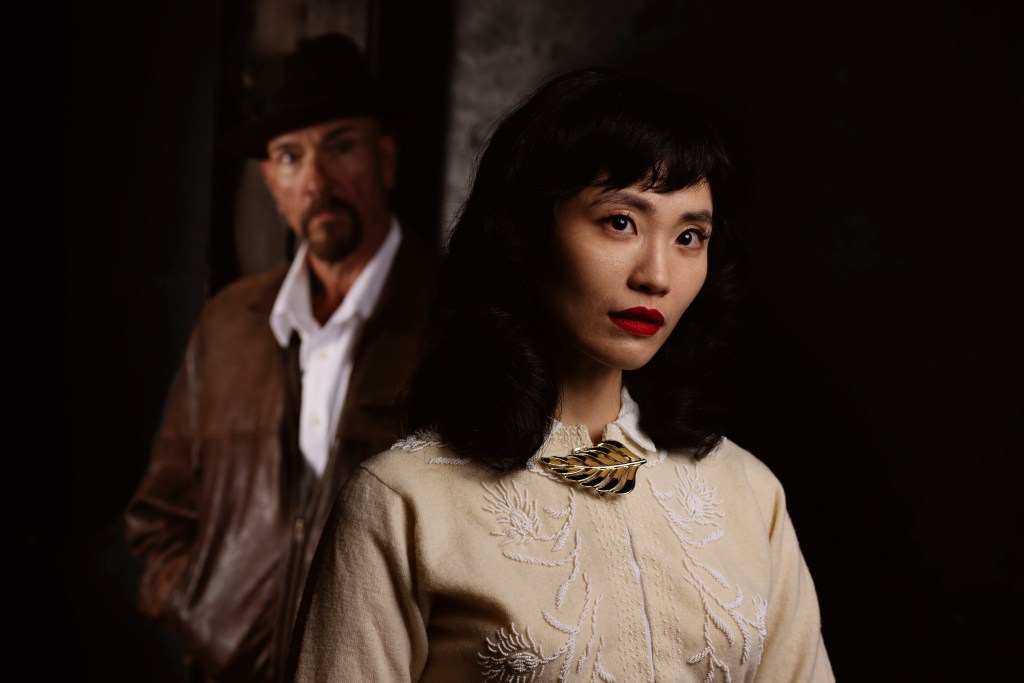
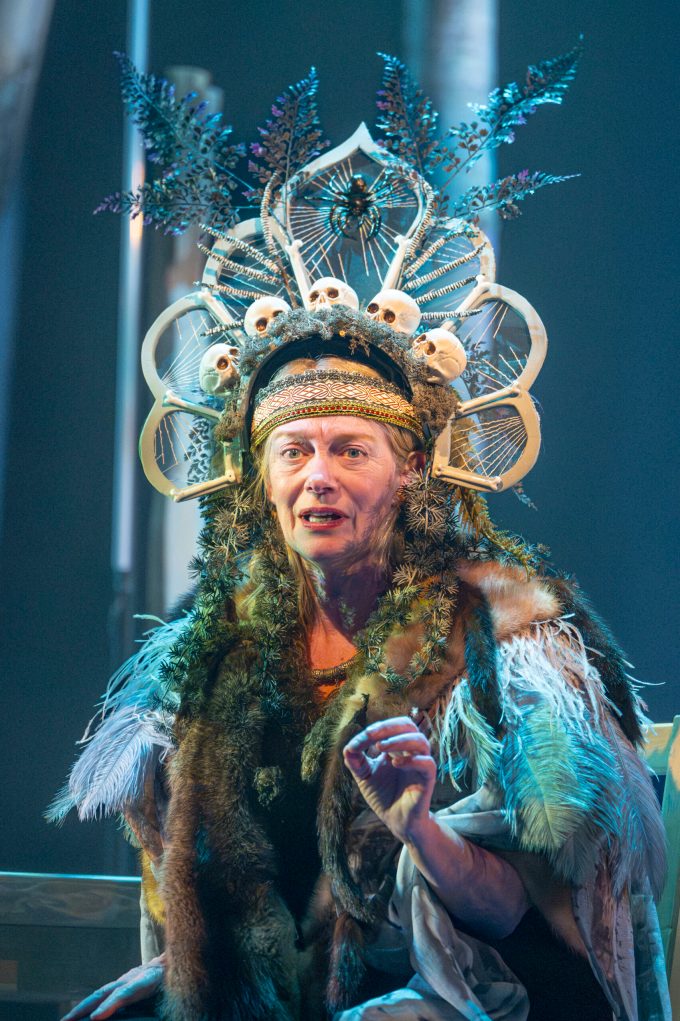
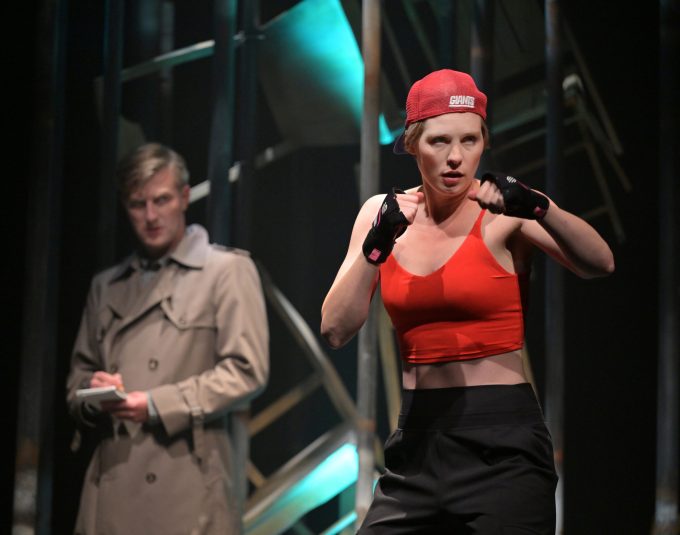
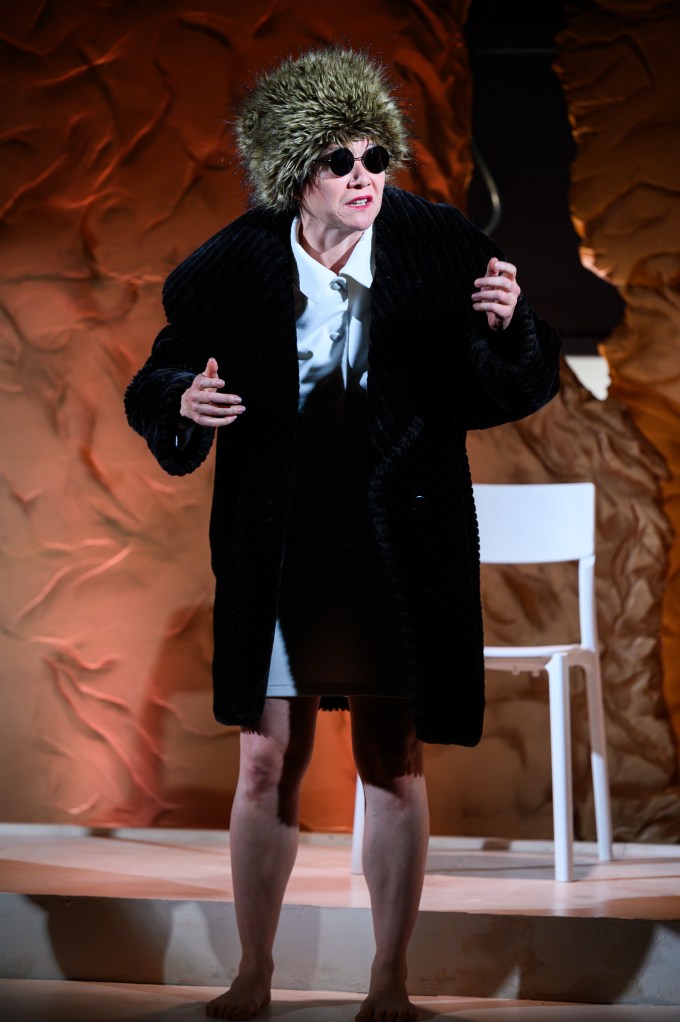
Doll Piccotto as Sybil, Myles Kenyon Rowland as Eric, Erik Gandolfi as Arthur, Sydney Harmon as Sheila. Photos by Christian Pizzirani.

[For the remainder of the year, my San Jose and Peninsula theater reviews will be posted on Talkin’ Broadway with only introductions to those reviews on this site]

Please continue to https://www.talkinbroadway.com/page/regional/sanjose/sj260.html for full review.

“Don’t build walls.  He’ll only tear them down,” one member of the Birling family declares to the others.  This reproach directly refers to the futility of hiding information that will come out anyway, but it also speaks to the divide that the privileged class has erected against the less affluent, including the inspector in question.  The year is 1912, and many in England already sense the impending threat of what would become World War I because of regional conflicts on the continent.

The engrossing An Inspector Calls follows in the English tradition of Agatha Christie’s Murder on the Orient Express and Then There Were None, in which all of those in the collected party are shown to have motive to wish the victim disappeared or dead.  Like those novels, this plot line becomes predictable, and the viewer can anticipate the pins falling and begin to guess the connection of each character to the victim.

But when it seems that the tale is told, audience members may look at their watches and see that there are still 20 minutes left in the estimated run time of two-and-a-half hours.  That remaining time conceals the twist that makes An Inspector Calls distinctive and ultimately satisfying.

****************

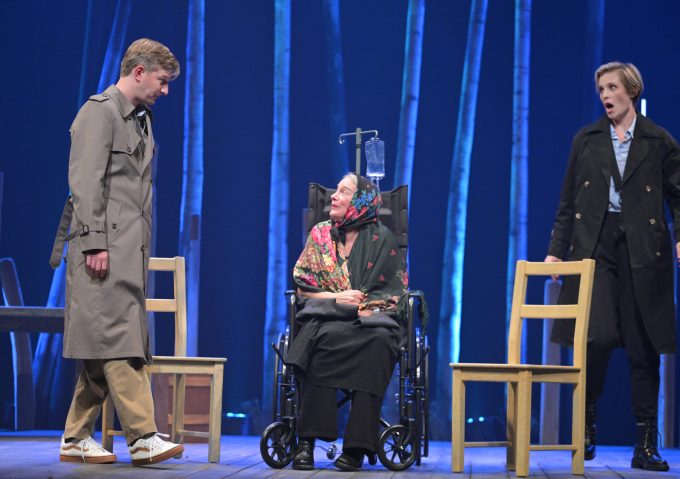
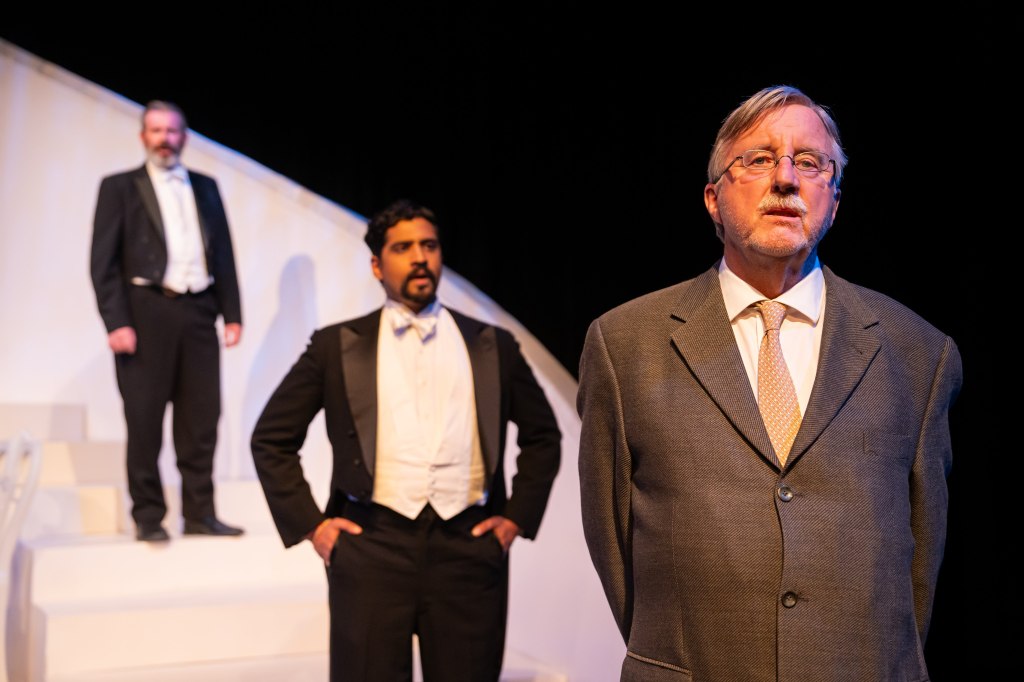
Erik Gandolfi as Arthur, Heren Patel as Gerald, Richard Newton as the Inspector.

An Inspector Calls, written by J. B. Priestley is produced by City Lights Theater Company and plays on its stage at 529 South 2nd Street, San Jose, CA through October 20, 2024.
Angels in America – Part 1 – Millenium Approaches

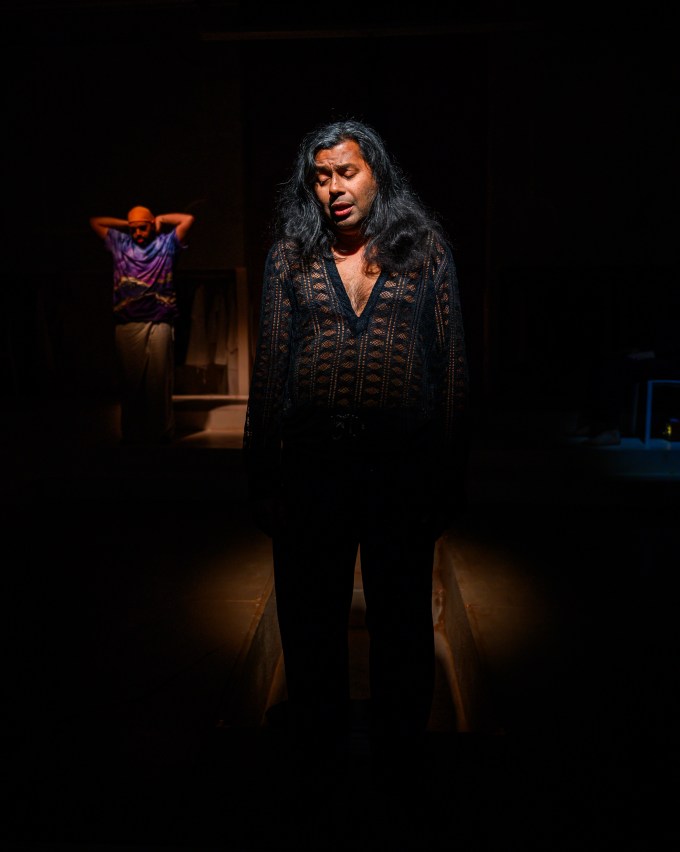
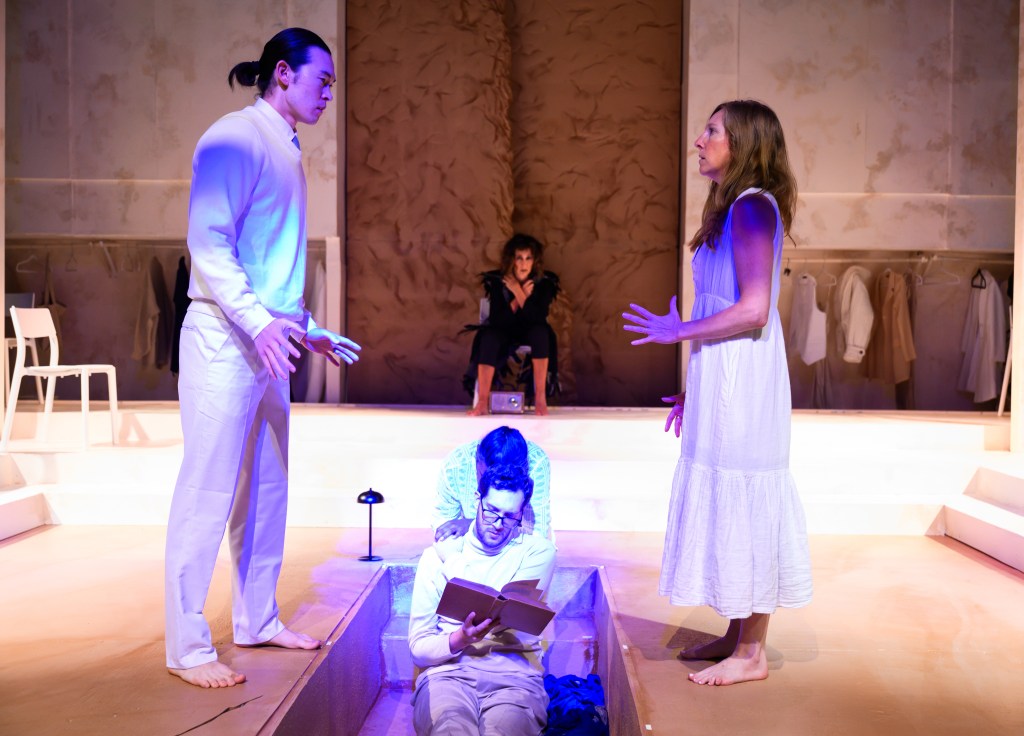
Lisa Ramirez (foreground), Victor Talmadge, James Mercer II, Dean Linnard, J Jha, Edric Young, Emilie Whelan, Erin Mei-Ling Stuart. All photos by Ben Krantz Studio.

Rarely does a play become a classic as soon as it reaches Broadway, but such was the case with Angels in America – Part 1 – Millenium Approaches in 1993.  Receiving the Pulitzer Prize for Drama, and the Tony, Drama Desk, and NY Critics Circle Best Play Awards, its afterlife would include decorated revivals and numerous adaptations.  It resonates now as it did then with its timely and thoughtful depiction of homosexuality (think of any minority as a corollary) and the AIDS epidemic (think of the Covid pandemic). Other grand social themes also receive treatment from race to religion.

Like many, having seen the HBO miniseries and the Berkeley Rep production, I felt inoculated from Angels in America but wanted to support Oakland Theater Project in this major undertaking anyway.  In retrospect, no pretext required.  With Michael Socrates Moran’s commanding, incisive, and brisk direction along with absolutely superlative acting across the board, this riveting production is breathtaking, and three hours whizzes by in an instant.

Victor Talmadge as Roy Cohn.

Angels… was born at the Eureka Theatre in San Francisco of unmatched pedigree.  Playwright Tony Kushner would become one of his generation’s greatest writers.  But most patrons will not realize that the plays were commissioned and shepherded by two of our greatest directors.  Oscar Eustis has become the long-time Artistic Director of New York’s Public Theater, while Tony Taccone long served as Artistic Director of Berkeley Rep.  And while the play takes place in New York City, San Francisco has served as Ground Zero for the topics at issue and remains its emotional heart.

Per the playwright’s stage directions in the script, the staging, by Set Designer Mark Thomas, is abstract with few props, allowing the audience to focus on the actors and to fill the scenery with their own imagination.  The most symbolic aspect of the set is the pit in the center which acts as a sunken bed but anticipates a coffin.  With the exception of the black-garbed angel, whitish outfits dominate the costumer against a whitish set.

Dean Linnard as Louis, J Jha as Prior.

Several taut but seemingly unrelated vignettes open the play, adding to the sense of disconnected abstraction.  Even though the individual aspects of the play are compelling, one may wonder where they will go.  Of course, the dots are eventually connected with intersections among characters, resulting in a rewarding whole.

Emotions are on edge throughout and often run high, though comic moments foreclose oppressiveness.  The most gripping and chilling performance comes from Victor Talmadge who is searing as Senator Joe McCarthy’s associate Roy Cohn, a man always on the attack and physically leaning in.  Perhaps his intense personification is more indelible because his is the only historical character in the play.  What’s more, Cohn was a mentor to Donald Trump, which makes his self-serving, megalomania even more frightening.  It is too relatable today.

(standing) Edric Young as Joe, Emilie Whelan as Harper, (rear) Lisa Ramirez as Angel, (below) Dean Linnard as Louis.

Talmadge’s Cohn knows one talking speed which is fast and one volume which is loud.  He is crass, domineering, and unrelenting.  And it is all about him – wielding his power, no matter whether legal, and satisfying his own needs at the expense of others. But in this end-of-life period, his one obsession is his reputation – that he not be outed as gay or as inflicted with AIDS.  His public insistence is that he has liver cancer, and so it is that appearance and reality fail to coincide in a world of macho and conservative hypocrisy.

The parallel concerns of love and loss in the fate of two couples actually anchor the storyline.  In one, Prior, the scion of an eminent patrician family, is dying from AIDS, and his partner Louis struggles to deal with the situation.  In a masterstroke of against-type casting, the director went with the best available actor, the salt-and-pepper, long-haired, Indian-ethnic, transgender J Jha in the role.  Jha wails in physical and mental agony with a plaintive rasp, often crying through his speech as he gains the empathy of the audience.  As implausible as this actor should seem in the role, you soon forget that and simply marvel at the fine acting.

J Jha as Prior, Emilie Whelan as Harper.

The other couple is a Mormon pair who have had difficulty procreating and with intimacy altogether.  Joe seems ambiguous and ambivalent, but his wife Harper’s pain is palpable with her agoraphobia and addiction to Valium.  Unlike Prior, she should be able to control the causes of her anguish.  Emilie Whelan shines as Harper, and she captures the vacant loneliness and hallucination with her flittering eyes and actions.

Kushner designed Angels… as an ensemble.  Each actor gets at least one “close-up” with sizzling highlights involving hair-trigger emotion, and each deserves recognition for outstanding work.  Dean Linnard plays the conflicted Louis whose urges and fears could result in betraying Prior.  Likewise, the androgynous Joe, played by Edric Young confronts similar urges and fears in dealing with his marital conundrum.  Lisa Ramirez is the Angel and others, while Erin Mei-Ling Stuart and James Mercer II play multiple roles, all to great effect.

This production truly excels.  Even theater fans who feel that they’ve “been there, done that” and sense that the urgency of those times has passed will plumb this work with renewed appreciation.

Lisa Ramirez as Angel.

To allow for larger audiences, Oakland Theater Project (formerly Ubuntu) has taken temporary residence at Marin Shakes’ new indoor home in San Rafael.  North Bay audiences should take advantage of the opportunity to experience this fine East Bay company.  The two parts are designed to work independently, but experiencing the whole sweep of the masterwork suggests seeing both if you can.

Angels in America – Part 1 – Millenium Approaches written by Tony Kushner is produced by Oakland Theater Project and plays at 514 4th Street, San Rafael, CA through October 26, 2024.

The Daughter of the Regiment

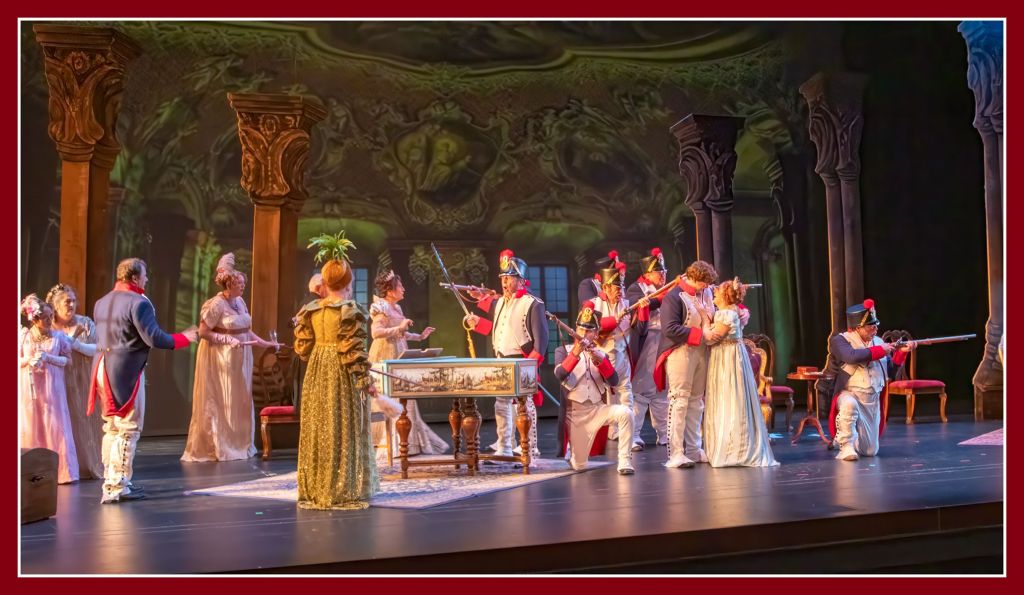
Véronique Filloux as Marie, Eugene Brancoveanu as Sulpice, Chris Mosz as Tonio. All photos by Barbara Mallon.

Like his contemporary Gioachino Rossini, the prolific Gaetano Donizetti proved an elite champion of the bel canto singing style; composed with equal skill in opera buffa and opera seria; and wrote for the French as well as his native Italian opera.  Nestled between his other comic masterpieces, L’elisir d’amore and Don Pasquale, The Daughter of the Regiment is a frothy gem from the repertory that Livermore Valley Opera aces with its lighthearted and skilled production.

The other two of Donizetti’s comedies are warhorses.  For instance, I saw four different productions of Don Pasquale in a little over 12 months, yet I’ve seen The Daughter of the Regiment only once, a production by a small company over 30 years ago.  Happily, LVO has a love affair with Donizetti’s comedies, offering Don Pasquale in 2017, L’elisir d’amore in 2022, and now Daughter…  I say happily because each production has sparkled.

Lisa Chavez as Marquise of Berkenfield (left), cast.

Like his other comedies, Daughter… is full of truly beautiful orchestral music with melodic arias and a number of ensembles, mostly duets graced with elegant counterpoint.  With a story centering on a young girl adopted by a French army regiment, now stationed in the Tyrol after a conflict, there is also ample horn-heavy, military-themed music accented by the rataplan (the librettist’s characterization) of the snare drum.

If Daughter… is not taken too seriously, it is probably because it lacks the underlying gravitas of serious comic operas like Don Giovanni or Falstaff even though it presents moments of conflict, compassion, and pathos.  But the irrepressible and sometimes complex music delights throughout, providing numerous highlights.

Véronique Filloux as Marie, Chris Mosz as Tonio.

All in the regiment are “fathers” to the orphan Marie.  The men’s chorus of eight had already performed as local peasants, but for the remainder will be soldiers of the regiment.  They acquit themselves exceptionally well with a harmonious and substantial sound that belies their small number.

Marie had promised to marry only a member of the regiment, but when falling during a mountain climb, her life is saved by a young Tyrolean, Tonio, and she is smitten.  Among the many comic interludes, this event is played out by small marionettes on a staged mountain. The Father of Fathers is Sergeant Sulpice.  The special relationship between Marie and Sulpice is soon revealed in their charming duet when he questions the girl’s intentions concerning Tonio with “Mais qui vient?” (“But who is this?”). 

Véronique Filloux portrays Marie, and the part fits her like a glove.  Although her voice seemed unready at the beginning, by the time of the first duet, she showed her upper range by hitting the high notes.  Then her agility in the playful opening rollercoaster of vocalization as well as her bright tone, clarity, and coloratura came through in her tribute to the regiment “Chacun le sait” (“Everybody knows it”) with its repeated rousing refrain “Il est là.  Il est là. Il est là.” (“There it is”).  Eugene Brancoveanu is Sulpice, and his always warm and smooth yet powerful baritone filled the house as usual.

Eugene Brancoveanu as Sulpice, Lisa Chavez as Marquise of Berkenfield, Véronique Filloux as Marie.

Another sensitive duet follows, “Depuis l’instant” (“Since that moment”), but this time between Marie and Tonio, whose love is flowering.  Chris Mosz is Tonio, and he brings a beautifully tremoloed youthful voice.  What Daughter… is perhaps most famous for is the Mount Everest for tenors, “Ah! Mes amis, quel jour de fête” (“My friends, what an exciting day”), one of Luciano Pavarotti’s signatures.  Mosz navigated its daunting eight high-Cs with great aplomb, and the audience showed its knowledge and appreciation with extended applause.

Of course, what is a comic opera without tension, discord, and sadness leading to a happy resolution, no matter how implausible the plot line?  Marie finds that she is a child of a marquise, lost during war.  She is swept away to lead a posh but vacuous life and enter into an arranged marriage to a duke, but not before singing her lovely cavatina “Il faut partir” (“I must leave”).  Ultimately love prevails, and Filloux and the chorus get to demonstrate their skills one last time in the patriotic “Salut à la France.”

Cast.

Daughter of the Regiment has had an up-and-down history of being in and out of the repertory, but it deserves the positive recognition it receives.  Although the story lacks depth and realism, it’s certainly not the only opera guilty of that.  Meanwhile the music, situations, and characterizations make for great entertainment.

Livermore Valley Opera gets whatever can be expected from this great comedy.  The cast is superb, and under the direction of Marc Jacobs, their comic acting extracts all of the humor available in the libretto.  In addition to those already mentioned, mezzo Lisa Chavez as the Marquise of Berkenfield deserves a nod as well.  Fine conducting by Alexander Katsman and performance by the orchestra, along with simple but effective staging all result in a fine production.

Eugene Brancoveanu as Sulpice, Véronique Filloux as Marie.

Daughter of the Regiment composed by Gaetano Donizetti with libretto by Jules-Henri Vernoy de Saint-Georges and Jean Françoise-Alfred Bayard is produced by Livermore Valley Opera and plays at Bankhead Theater, 2400 1st Street, Livermore, CA through October 6, 2024.
Private Lives

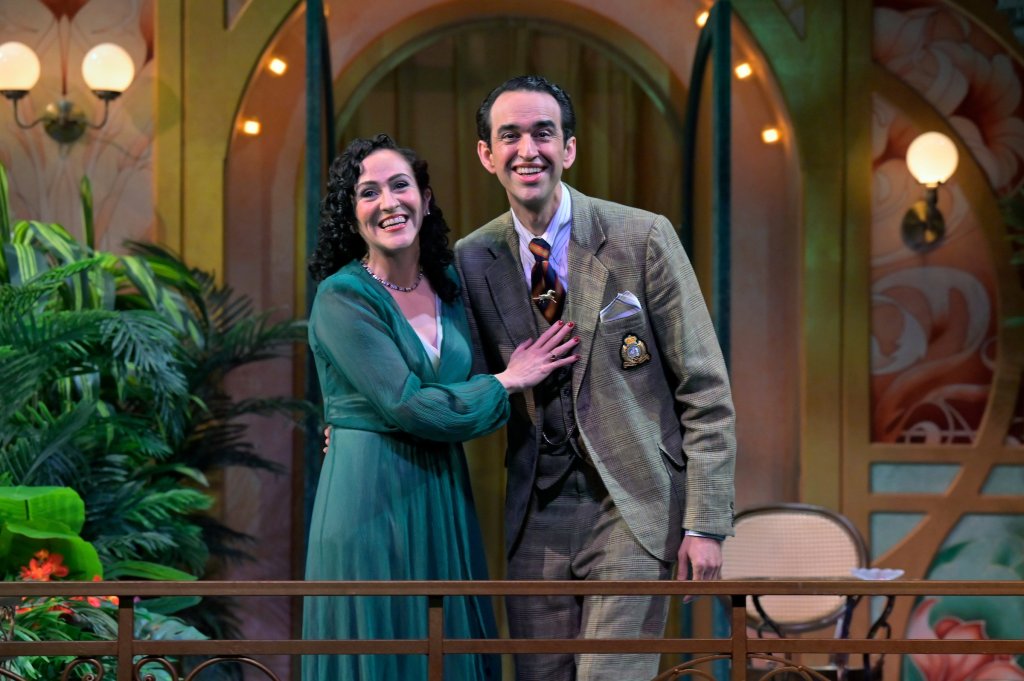
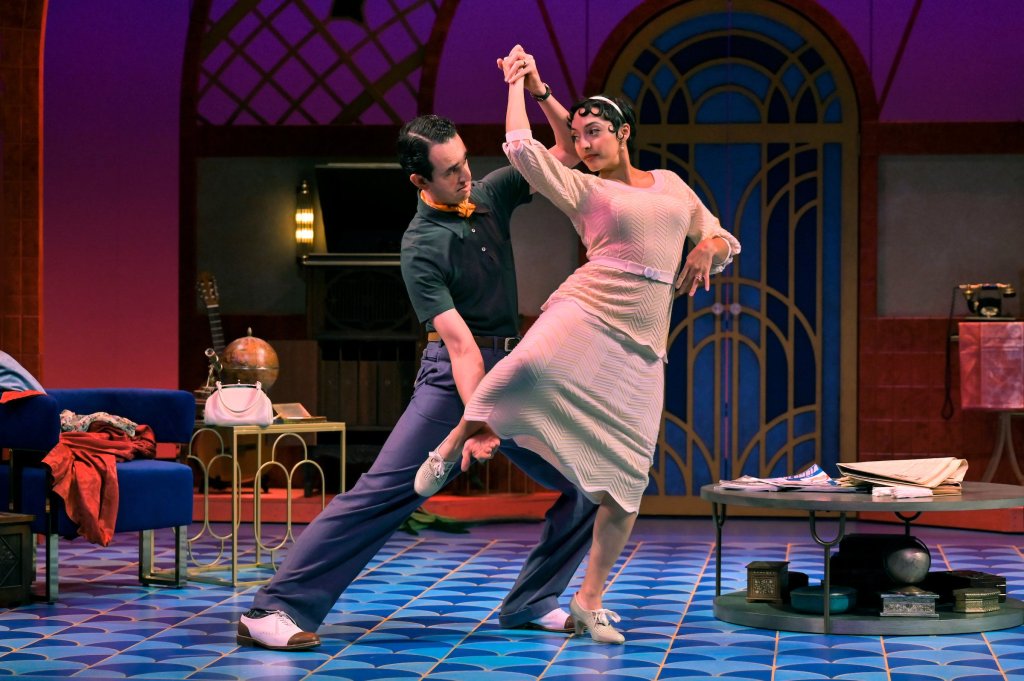
Hugo E. Carbajal as Elyot, Sarita Ocón as Amanda. All photos by Kevin Berne.

These days, honeymoons don’t carry great significance or cachet.  With all of the various forms of relationships that have replaced traditional courtship and marriage, the notion of consummation on the wedding night is not what it used to be.  Such was not the case in 1930, when Noël Coward’s Private Lives premiered – nearly 100 years ago!

Coward’s works are quintessentially British, and this comedy of manners, or bad manners, is no exception. When well directed and acted, the humor does hold up, even if the social conventions don’t.  American Conservatory Theater can always be expected to mount a professional production, and this one strikes all the right notes.  The actors in this four-hander are uniformly funny and make the most of the material.

Gianna DiGregorio Rivera as Sibyl, Hugo E. Carbajal as Elyot.

As British as it is, the action of the original takes place in Deauville and Paris, as honeymoons are special occasions that upper-class Brits would likely celebrate on the continent.  ACT has chosen a production in which the lovers are from Buenos Aires, with the action relocated to Mar del Plata, a seaside resort in Argentina, and then Montevideo, Uruguay.   Argentina was one of the wealthiest countries in the world then, and much of their life styles would have been similar to the British.

In this winsome production, considerable humor draws from pantomime rather than words, and two non-verbal emphases draw from the relocation to Latin America.  A recurring theme is the tango, which was born in Buenos Aires, and the music and dance do add considerable flair.  The other is the use of pretend bullfighting by one couple when they are bored by the other pair.

Sarita Ocón as Amanda, Brady Morales-Woolery as Victor.

Otherwise, there is nothing suggestive of the Latin venue.  What is significant but unmentioned by the company however is that the director, all of the actors, and many of the creatives are Latine.  Director KJ Sanchez has drawn on this pool of acting talent in various productions and locales, so that they are almost like a family or a traveling troupe.

The essence of Private Lives is that Elyot and Amanda had been married for three years and divorced for five.  They have both just remarried, and lo and behold, on their honeymoons they espy each other on their adjoining terraces at their honeymoon hotel.  What a coincidence!  Obviously, this happenstance is grist for their interaction and the question of whether they would reunite as a couple or not, and it is not long before they test out the idea.

Sarita Ocón as Amanda, Hugo E. Carbajal as Elyot, Gianna DiGregorio Rivera as Sibyl, Brady Morales-Woolery as Victor.

Elyot comes from money but revolts against many of the social conventions that his class embraces, though he does draw the line when it comes to male prerogatives.  Hugo E. Carbajal delights as Elyot, capturing his flippancy and silliness.  He mugs and shimmies and flops and beseeches to great effect.  He is also volatile and clearly still has a love-hate relationship with his former wife.

Amanda is Sarita Ocón, and she is the perfect match for Carbajal as is Amanda for Elyot.  Ocón shares the same gift for pantomime.  Her broad, whole-body, comic movement with flailing arms and legs reminiscent of Steve Martin always draws laughs.  Amanda is hot-blooded as well, and no shrinking violet when it comes to standing up to her man, as Ocón does with great verve.  She’ll have none of this male chauvinism that allows a man the liberty of peccadillos but scorns a woman for the same action.

Brady Morales-Woolery as Victor, Gianna DiGregorio Rivera as Sibyl.

The wronged, younger new spouses are the perky but quick to cry Gianna DiGregorio Rivera as Sibyl and the proper but quick to challenge offenses Brady Morales-Woolery as Victor.  Sibyl is a more traditional trophy wife, sexy and shallow, while Victor is the formal and intellectual type.  But as Elyot and Amanda test out their revived relationship, the other two become an odd-couple team of sorts as well.  Both actors are strong in their roles.

As a popular and well-respected play, Private Lives has been subjected to all manner of intellectual dissection.  Analysts have tried to frame it as fitting models concerning the likes of social mores, women’s rights, and theater of the absurd. None of that appears to have been the playwright’s intention.  In fact, a weakness in the minds of some more serious theater goers might be that the sub-text is weak, and the play lacks redeeming social value.  Whether or not – it does provide an evening of fun and laughter.

Hugo E. Carbajal as Elyot, Sarita Ocón as Amanda.

Private Lives, written by Noël Coward is produced by American Conservatory Theater and plays at Toni Rembe Theater, 415 Geary Street, San Francisco, CA through October 6, 2024.

The Handmaid’s Tale

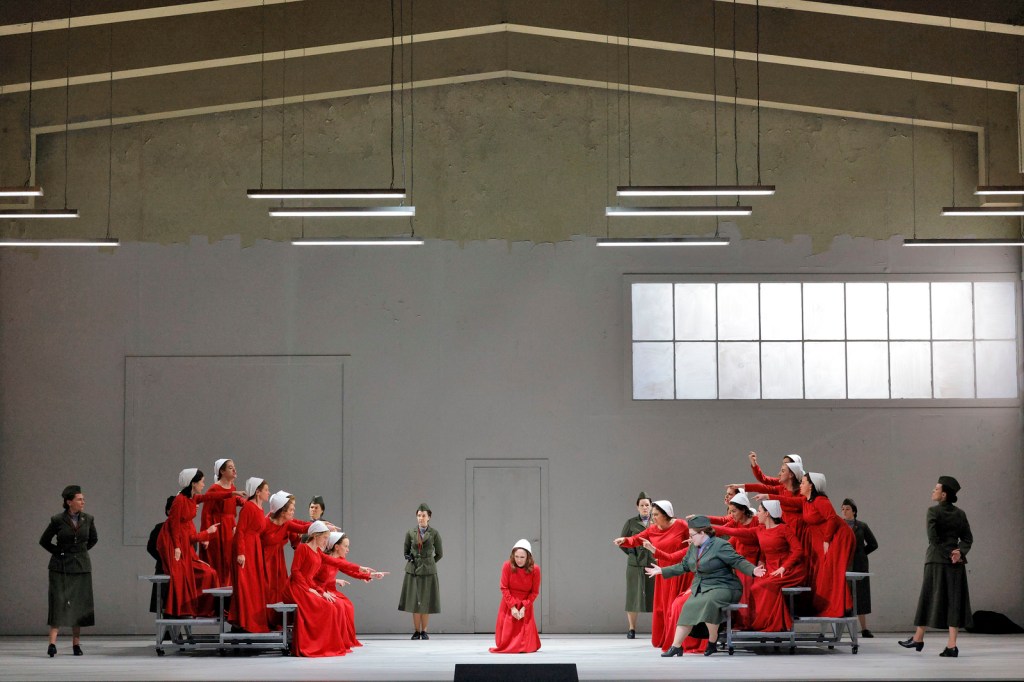
Cast. All photos by Cory Weaver.

Those of us with any literary bent who have spent most of our lives in the 20th century will be familiar with the theme of political dystopia.  Among the notable works and their distinguished authors to deal with the subject are It Couldn’t Happen Here (1935) by Sinclair Lewis; Animal Farm (1945) and 1984 (1949) by George Orwell; and The Handmaid’s Tale (1985) by Margaret Atwood.  These works provoke intellectual contemplation and elicit caution, but we Americans were convinced that “it couldn’t happen here.”

Events of recent years suggest otherwise – movements to have state governments dictate women’s reproductive behavior; to fund parochial schools with tax dollars; to force the Bible into public school curriculum; to ban books; to threaten political opponents with incarceration; to stifle voting rights from one part of the political spectrum; and to institutionalize lying in a Machiavellian manner all lead down the totalitarian path presciently predictive by these authors.

Irene Roberts as Offred, Christopher Oglesby as Luke, Simone McIntosh as Offred in the time before.

San Francisco Opera takes on this seldom produced but highly intense work which debuted in 2000 at a particularly poignant time in our nation’s history.  Its rendering exudes artistic excellence in the production of the complex music; conquering the challenging vocal tract; and depicting the austere regimentation of the dystopian world.  That said, not everyone will appreciate it.  The narrative crushes the spirit without significant relief, making the storyline a cultural experience valued for its provocation and learning rather than for pleasure.  The music ably reflects the story, and it does provide interest.

The oft adapted The Handmaid’s Tale chills with its societal strictures, philosophically based on the notion of “freedom from…” rather than our cherished “freedom to…”  Set in the near future, the nation of Gilead has replaced the United States, as Christian fundamentalists overpowered the elected government and replaced civil rights with pernicious patriarchy and rules derived from The Ten Commandments, a veritable corollary to the Taliban.

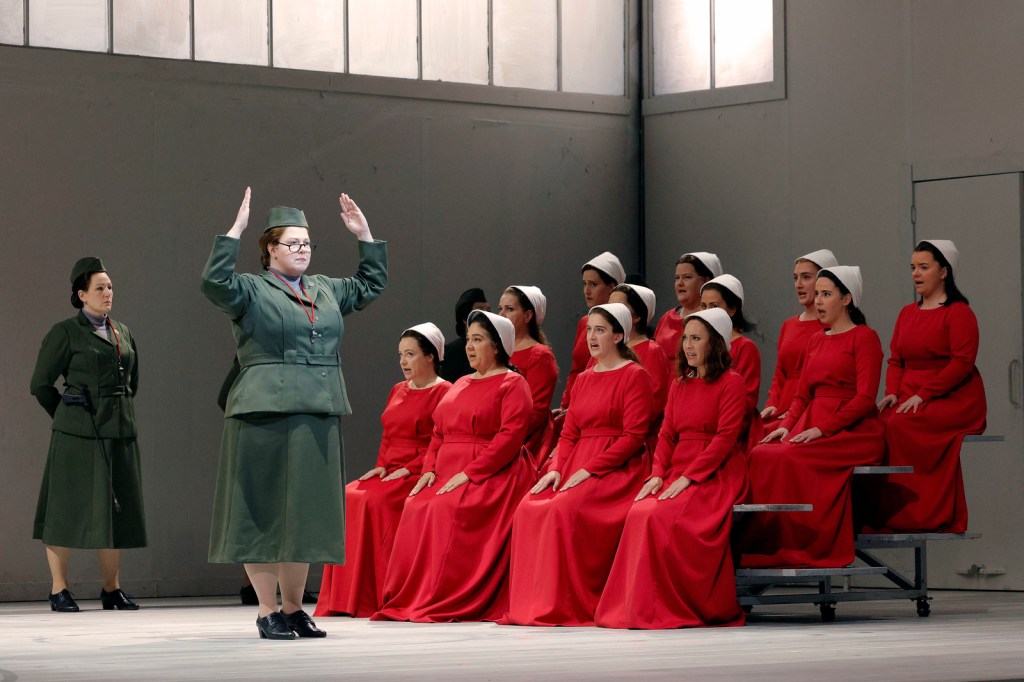
Sarah Cambidge as Aunt Lydia.

The rigidity of society is evidenced in the staging with its visual austerity and regularity.  The set largely appears in two dimensions with a dominance of straight lines and right angles, with an absence of capricious humanity.   Several classes of denizens wear specified garb to comply with regulations.  The titular handmaids, who function as mobile wombs to breed babies for infertile wives, are dressed in red with white caps or winged cornettes as headpieces.  In the misogynistic society, their members are named after their current master, the central character being Offred, i.e., the sexual slave “of Fred.”

Poul Ruders’s weighty music conforms with the abrasiveness of the society and helps maintain suspense.  Its modernist form is largely atonal and mostly harsh. Dissonance often derives from clashing musical lines that run simultaneously and disharmoniously.  The building of saturated sound to crescendos and the frequent thumping of bass drums from the five percussionists (!) in the orchestra produce tension, while other (literal) bells and whistles add to the effect.  Slight musical relief comes from periodic religious themes, including phrases from “Amazing Grace” and a lighter touch at the brothel that services men from the upper reaches.  Conductor Karen Kamensek does a fine job of orchestrating the extremely complex score which requires two heavy tomes to explicate.

John Relyea as The Commander, Lindsay Ammann as Serena Joy, Irene Roberts as Offred.

Mezzo-soprano Irene Roberts is Offred, who, like many handmaids, was trapped into duty and would like to escape, knowing that failure to produce children or violating rules can lead to being sent to the “colonies” or to execution.  A recurring visual is the appearance of women who have been hanged, as a constant reminder of consequences of misdeeds.

Roberts carries a big load but with commensurate skill.  The singing style is dramatic, and taxing to her voice and listener’s ear.  She does have a couple of arias, but the closest vocal to being mellifluous is a fantasy set piece in a close harmony duet that she sings with “herself” – that is, her representation from “the time before” her being captured.  In flashbacks, pre-and-post coup characterizations of the same individual often occur at the same time.

Irene Roberts (kneeling) as Offred in the time before.

The other noteworthy vocals belong to Sarah Cambidge as Aunt Lydia, aunts being militaristic authority figures.  She runs the Red Centre, which is the training ground for handmaids.  In the prologue, Cambidge is challenged to significant and shrill singing with a tessitura high in the soprano range, which she accomplishes with great skill.

Opera audiences are pretty inured to occasional death and destruction, but The Handmaid’s Tale contains an abundance of many forms of violence plus almost constant repression.  And what other opera acts as such a salient cautionary tale?

Cast.

The Handmaid’s Tale, composed by Poul Ruders with libretto by Paul Bentley and based on the novel of the same name by Margaret Atwood, is produced by San Francisco Opera and plays at War Memorial Opera House at 301 Van Ness Ave., San Francisco, CA through October 1, 2024.
The Magic Flute

Sergio González as Tamino. All photos by Kristen Loken.

‘Tis the season of the flute. Opera San José offers an innovative, artistically skillful, and highly entertaining production of the mystical opera The Magic Flute (Die Zauberflöte) that should please the full range of patrons from opera aficionados to novices, as it retains the magnificent essential elements while making it highly accessible and understandable.

The Magic Flute presents great opportunity for interpretation, and the Bay Area benefits from a surfeit of contrasting productions of the opera this year.  In addition to Opera San José’s splendid rendering, San Francisco Opera radically depicted it as if from the silent film era, using a large flat screen as its canvas and projecting the spoken words as if intertitles from an early film.  Soon to come is Berkeley Repertory’s Matchbox Magic Flute, which abbreviates and adapts the work into a form more akin to a stage musical.

Melissa Sondhi as Pamina, Ricardo José Rivera as Papageno.

As may be construed from these variations, few works in the opera canon are as interpretable as The Magic Flute, not only in how it can be produced, but in what one makes of all of the known and assumed symbols and characters.  Because composer and librettist were both Freemasons, many connections (and disconnects) can be inferred from initiation practices in the opera.  And because Mozart was Austrian, assumptions may be made that the Queen of the Night represents Maria Theresa and so forth.

In the central plot, Prince Tamino, falls in love with a picture of the Queen of the Night’s daughter, Pamina, who is held captive by High Priest Sarastro.  The Queen commits the daughter’s hand to Tamino if he can release Pamina from the Queen’s enemy.  The Queen’s bird-catcher Papageno, who also longs for a wife, is enlisted to accompany Tamino on the quest.  But Tamino, upon contact, finds Sarastro’s religion appealing and is given the opportunity for induction into the priesthood and to secure Pamina if he passes three trials.

Maria Brea, Mariya Kaganskaya, Melisa Bonetti Luna as Three Ladies. Sergio González as Tamino (lying).

Although there are clear periods of both solemnity and humor in the libretto, the overall dramatic tone can be manipulated to anything from somber and self-important to light-hearted and fairytale-like.  Opera San José has chosen the winsome latter appealing approach with an abundance of humanity and frivolity, and it succeeds by all measures.

The lightness achieved in this production begins with the comic flair of much of the acting, particularly of the genial Ricardo José Rivera as the flighty everyman Papageno whose greatest aspiration is simply to relax and enjoy a filling meal.  The Three Ladies who collectively act as saviors, facilitators, and provocateurs add a delightful touch with their prodding and probing humor.  The comedy extends as well to the overture and other interludes, where considerable pantomime and dance brighten the stage, much of it delivered by charming child performers.

Emily Misch as Queen of the Night, Melissa Sondhi as Pamina.

Flute is actually a singspiel with considerable spoken dialog, and here, the company has taken great liberties with mirthful “translations” into English.  In one instance, when Papageno’s mouth is padlocked so that he can’t tell lies, the text delivered is “Wouldn’t it be nice if all liars had locks on their mouths?”  On opening night, the current political intimation was not lost on the audience, and raucous laughter was punctuated by considerable spontaneous applause.

Ryan McGettigan’s stunning scenic design plays a significant role.  In Act 1, the set is comprised largely of pastel, two-dimensional cartoon-like sets that reflect the more carefree earlier period of the opera.  An extreme contrast occurs with the more ominous and challenging Act 2.  In large measure, the set is a modified black box with neon light framing that intensifies the drama of the latter portions of the narrative.

Ricardo José Rivera as Papageno, Sergio González as Tamino.

Of course, for all of this to work, the intriguing but sometimes opaque libretto must be supported by fine music, and who better to provide richly melodious and complex compositions than Mozart.  The work sustains interest well until post-climax, when the libretto drags.

Oddly, other than Papageno’s recurring riffs, the most memorable music is given to secondary principals.  Most notable is the Queen of the Night’s aria.  Emily Misch is developing a career on this role as she conquers the challenging coloratura ornamentation with great ease.  Another highlight “O Isis und Osiris,” Sarastro’s deep bass aria that Younggwang Park fully negotiates, but his volume does diminish on the low end.

Melissa Sondhi as Pamina, Three Spirits.

Conversely, lyric tenor Sergio González who suits the lead role of Tamino well, uses vocal clarity and dynamics effectively, though his controlled pianissimos are sometimes barely audible.  Melissa Sondhi turns in a fine performance as Pamina with her agility and lyric tone.  A real pleasure is the beautiful tight harmonies of the Three Ladies (Maria Brea, Melissa Bonetti Luna, and Mariya Kaganskaya) – and they are important to the plot.  But if the opera belongs to one performer, it is Rivera.  As good as his character definition is, his easy baritone warms every lyric it expresses.

A significant event in this performance is the return of 19-year-old Alma Deutscher at the baton, this time conducting a work that she did not compose.  She was first here at age 14 for the U.S. premiere of her opera Cinderella and has established quite a strategic partnership with the company.  The orchestra performed with admirable tone and precision under her decisive conducting. Kudos also to Director Brad Dalton who brings all of the glorious stage elements together in this sensational production.

Cast.

The Magic Flute, composed by Wolfgang Amadeus Mozart with libretto by Emanuel Schikaneder is produced by Opera San José and plays at the California Theatre, 345 South 1st Street, San Jose, CA through September 29, 2024.

Once on this Island

Angie Alvarez, Edie Flores, Kristy Aquino, Naomi Murray, Nique Eagen, John Ramirez, JM Appleby.  Photos by Sinjin Jones.
[For the remainder of the year, my San Jose and Peninsula reviews will be posted on Talkin’ Broadway with only introductions to those reviews on this site]

Please continue to https://talkinbroadway.com/page/regional/sanjose/sj259.html for full review.

Lynn Ahrens (book and lyrics) and Stephen Flaherty (music) set the award-winning Broadway musical Once on this Island on a fictitious former French colony in the Caribbean.  The island’s population splits, with the prosperous grands hommes lighter-skinned mulattos who were spawned from inter-mating with French settlers on one side and the “black as night” peasants on the other.  Hence, we have another dimension of bigotry within a population, the color of skin.

With a nod to The Little Mermaid, peasant girl Ti Moune (played by Shaneen Black) finds a dying young grand homme Daniel (Edie Flores) who has been in an accident.  Her father, Tonton Julian (JM Appleby) represents a viewpoint about life and death in which he suggests that she let the young man die.   In her effort to slowly nurse Daniel back to health, she enters a bargain with the Demon of Death, Papa Ge (John Ramirez), that she offers her life in return for saving his.  Daniel survives, and though he and Ti Moune fall in love, Daniel returns to his previous life, whereupon conflicts emerge.

This 90-minute drama offers many pleasures.  The story itself engages, with some touching moments.  Much of it is told in charming songs, with all of the ensemble taking the lead at one time or another.  The songs range from the hopeful and loving “Forever Yours” to the recognition of the two different worlds the communities live in (“We Dance”) to the cynical “Some Girls,” which notes the asymmetry in sexual relations, as males often take advantage of females for whom they have no serious intentions.  This is yet another of several moral issues which underpin the narrative.

*****

Once on this Island runs through October 13, 2024 at Pear Theatre, 1110 La Avenida, Mountain View, CA.  For tickets and information, please visit www.thepear.org

Shaneen Black.

Un Ballo in Maschera

Michael Fabiano as Gustavus, Lianna Haroutounian as Amelia. All photos by Cory Weaver.

Exquisite music remarkably performed by principals, chorus, and orchestra to tantalize the ears.  A colorful and tragic plot based on real history to provoke the mind.  Dazzling staging to please the eyes.  What’s not to like about San Francisco Opera’s production of Giuseppe Verdi’s Un Ballo in Maschera.

Like much 19th century Italian opera, Ballo suffered birthing pains because of censorship.  Popular with the masses but not with nobles, Gustavus III of Sweden, who is the focal character of Ballo, was assassinated in 1792.  But to placate the censors, Verdi re-set the story to Colonial America, a rare venue for opera in its era.  Today, many companies, including San Francisco Opera use the originally intended setting.

(standing in foreground) Mei Gui Zhang as Oscar, Michael Fabiano as Gustavus.

In the central thread, Gustavus and Amelia love one another, but she is married to his best friend and military chief Renato.  The furtive couple’s love is unconsummated, but when discovered in a rendezvous, Renato’s fury leads him ultimately to regicide.

While it lacks the number of memorable set pieces of Verdi’s fertile middle period trio, Rigoletto, Il Trovatore, and La Traviata, the 1859 score of Ballo teems with uncommon innovation and rare Verdi eclecticism.  The first bit of genius is its rare balance of drama with comedy.

Judit Kutasi as Ulrica.

Throughout, the page Oscar is a flighty, humorous figure, but his shenanigans don’t disrupt the overall tone.  Performed with spritely charm and precise soprano voice by Mei Gui Zhang, Oscar is a trousers role, a device that Verdi deplored.  One possible reason for this exception was to create vocal balance.  Another is that this was a code of the sort often employed to subvert censors.  In real life, Gustavus was a flamboyant bisexual, and placing the Oscar character close to him implies that by indirection.

Ballo brims with beautiful and complex ensembles from duets to quintets with and without chorus.  Yet, many aficionados would be surprised at the near absence of love duets in Verdi’s canon, a much later exception being Otello’s “Già nella notte densa” (“Now in the dark night”).  However, that and Ballo’s passionate “Teco io sto…Non sai tu” (“I am with you…Don’t you know”) when the couple meet in Act 2 make up for the otherwise absence.

Lianna Haroutounian as Amelia.

As Gustavus, world-acclaimed tenor Michael Fabiano brings his burnished, dark-hued, and penetrating tenor to the fore throughout and particularly in the duet.  Lianna Haroutounian is Amelia who here and elsewhere demonstrates why she also is famed, in her case for her spinto versatility and agility that contribute to both the great dramatic and lyric demands of her role.

Although Verdi had eased away from the rigid conventions of bel canto in his middle period, he does revert here to some cavatina-cabaletta set pieces like the just mentioned, as well as some coloratura.  Integrating an additional style, some of his lighter music from Act 1 and the ballet from Act 3 reflect his experience in mid-century French opera form, which he had applied in Les Vêpres Siciliennes. 

Renato turns from ally to antagonist upon finding that his wife and the king are in love.  Meanwhile, gathered conspirators who seek to assassinate Gustavus taunt Renato with their “laughing” chorus “Va’ se di notte qui colla sposa” (“If you are here at night with your bride”).  Mongolian baritone Amartuvshin Enkhbat makes his SF Opera debut as Renato and offers a deep resonant voice that fills the house, especially in his signature aria “Eri tu” (“It was you”) which bemoans Gustavus’s betrayal.

Jongwon Han as Tom, Adam Lau as Samuel, Amartuvshin Enkhbat as Renato.

The fifth key principal, Ulrica the fortuneteller, foresees the assassination by the next person who shakes the king’s hand, but whose prediction Gustavus rebuffs.  Judit Kutasi brings her strong presence and electrifying mezzo to the fore as Ulrica with shrieking highs and drops to depth charge lows that animate the memorable character.

Apart from the principals, both Eun Sun Kim’s orchestra and John Keene’s chorus are formidable.  Director Leo Muscato is responsible for the overall presentation, and some of the elements of Federica Parolini’s staging are particularly striking.  Although the setting seems prosaic early on, the purplish-lit, steam-infused field where the tryst and assassination conspiracy occur stands out.  The final scene reveals the revolving stage that had cleverly been in use throughout, but what sets that scene apart is Silvia Aymonino’s stunning costumery with the chorus in black-and-white ball garb and the dancers in varied bright dress.  In all, the combination of artistic elements supports the full breath of Verdi’s music and results in a totally compelling opera.

Chorus, dancers.

Un Ballo in Maschera, composed by Giuseppe Verdi, with libretto by Antonio Somma, is produced by San Francisco Opera and plays at War Memorial Opera House, 301 Van Ness Avenue, San Francisco, CA through September 27, 2024.

The Prom

Billy Raphael as Manager Sheldon Sapperstein, Mary Kalita as Angie Dickenson, Taylor Bartolucci as Dee Dee Allen, Jon-David Randle as Principal Hawkins, DC Scarpelli as Barry Glickman, Jaron Vesely as Trent Oliver. All photos by Ben Krantz Studio.

Before getting to the bulk of my review that actually requires time, thought, and other effort, let me start by saying that the Berkeley Playhouse production of The Prom is scintillating, heartfelt, and ultimately uplifting.  That in itself is a bit of a spoiler, but probably most people who will attend this wonderful musical have advance knowledge of the story and go because of thematic interest or its widespread reputation.

Arri Toshiko Glenn as Emma Nolan, Aleshani Altan as Alyssa Greene.

Some shows seem to connect with cast and creatives in such a way that their inspiration drives them to heights, and this appears to be such a case, as the show hits on all cylinders.  There are an incredible number of moving parts, and Co-Directors Christina Lazo and Megan McGrath assemble them with great skill.  And granted that the opening night audience was stocked with friends, family, and other partisans, but even allowing for the anticipated positive bias, the whole crowd went wild for The Prom.

Andrea Dennison-Laufer as PTA President Mrs. Green.

What disturbs about the plotline is that other than shifting the venue from the real Fulton, Mississippi to the fictional Edgewater, Indiana and some other choices made for dramatic effect, the essence is a true story.  In the musical version, a couple of Broadway performers suffer the closure of their show after opening night.  Their manager notes that the reason for the failure is that they are unlikeable, because they are such narcissists.  Although they argue that narcissism is ubiquitous among entertainers, they decide to try to do something highly visible that will portray them in a less self-indulgent light.

Culling through various options, the actors learn about a girl in Indiana whose high school cancels its prom because the espoused lesbian student plans to attend with another girl as her date.  Along with their manager (played by Billy Raphael) and two other acting colleagues (played by Mary Kalita and Jaron Vesely), the Broadway denizens descend upon the conservative Indiana town to save the day for Emma, the victim of the discrimination.  Their objective is nicely articulated in the song “It’s Not About Me” which also reveals that the well-intended interlopers are bumptious and clueless.

The magnetism of the two actors as Broadway performers drives the show.  As Dee Dee Allen, Taylor Bartolucci captures every bit of the character’s glamor and adulation-seeking self-absorption.  Every time she considers doing something generous, she pulls back as a hand from a flame.  Bartolucci has the goods with her self-centered, well-acted comedy.  Plus, she can sing a tune or two.

(with signs) Jaron Vesely as Trent Oliver, DC Scarpelli as Barry Glickman, Mary Kalita as Angie Dickenson.

The Barry Glickman character fits East Bay theater stalwart DC Scarpelli like a glove.  Perhaps it’s my imagination, but he seems to blossom with the liberation of flashy dressing and playing a flamboyant gay role.  Unlike Dee Dee, he conveys a warmth and connection and becomes a bit of a big-brother figure to Emma, who is well-portrayed and beautifully sung by Arri Toshiko Glenn.

Any narrative demands conflict and resolution, and the PTA provides the focal point of resistance to the beau geste.  What is truly sad is the extent of ignorance and hate that many people have for others who are not like them.  In this case, the meanness and subterfuge used to beat down innocents for simply being themselves is mortifying.

Jaron Vesely as Trent Oliver, Taylor Bartolucci as Dee Dee Allen, Mary Kalita as Angie Dickenson.

Despite the clashes, The Prom manages to be joyous.  The pop music is peppy throughout but can be quite moving as in the engrossing “Unruly Heart” with the focal message ‘I’m who I am, And I think that’s worth fighting for.’   The plentiful foot-stomping dance co-choreographed by the co-directors doing double-duty energizes the audience.  The two directors are quite a team.  Finally, all of the creative elements, including set design (Sarah Phykitt), lighting (Amy Abad), sound (Joshua Price), and costumery (Andrea Gorham) integrate successfully.  Music Director Daniel Alley and the orchestra deserve a nod as well.

The narrative also has depth, as it deals with life’s issues.  It touches on themes about growing up and about being different.  It especially addresses conformity and bullying.  Agency is also a concern.  At what point should parents stop forcing values on children and let them stand morally on their own?  Ultimately, it condemns bigotry and reminds putative followers of Christ who dominate the community in question of his embrace of The Golden Rule.

Cast.

The Prom with book by Chad Beguelin & Bob Martin, music by Matthew Sklar, and lyrics by Chad Beguelin is produced by Berkeley Playhouse and plays at the Julia Morgan Theater, 2640 College Ave., Berkeley, CA through October 13, 2024.

Young Frankenstein

(standing) Pat Barr as Igor, Michael Bauer as Dr. Frederick Frankenstein, Emma Sutherland as Inga, Kim Williams as Frau Blucher, (lying down) Todd Krish as The Monster. All photos by Miller Oberlin.

Few artists have the breadth of talent and deserve the success of Mel Brooks.  His sophisticatedly raucous, multidimensional comedy embraces visual and verbal humor steeped in cultural and social issues.  His palette dabbles in a wide coloration of material to include hilarities such as Blazing Saddles (westerns), The Producers (Broadway), Spaceballs (space adventure), High Anxiety (psychiatry), and of course, Young Frankenstein (horror).  And though he is known for his zaniness as a script writer and director, many comedy admirers don’t realize that Brooks composes music and writes lyrics for most of the original songs in his works.

Sonoma Arts Live takes on one of these masterpieces, the stage musical of Young Frankenstein and delivers the goods in a boisterous, fast-paced entertainment.  Director Larry Williams’s performers seem to enjoy themselves, and that happy contagion spreads to the audience.

Although Brooks’s plays and movies are dominated by genre parody, this one conspicuously draws on specific previous material, albeit adding its own literary license.  The central character, Dr. Frederick Frankenstein, is an American academic scientist invited to the family’s castle in Transylvania, where his infamous grandfather had created “The Monster.”  The setup is that Frederick sees the opportunity to correct his grandfather’s flawed work by recreating a monster but giving him human intelligence.  All does not go as planned.

Bruce Viera as The Inspector.

With a thin but adequate plotline, interest and narrative thrust must be generated by the personalities of the players.  Happily, Brooks has invested them with quirky attributes and memorable lines, so that the play entertains throughout when well done.  Apart from routine jokes and schtick, the script brims with bawdy double entendres, so that when we hear the passionate moan “Oh, sweet mystery of life,” from offstage, we know whereof the lady speaks.  Or when Frankenstein says “What knockers!” it’s clear that he’s not referring to the two rings on the door that are rapped to announce one’s arrival.

Offering charm and a wry, durable smile, often prompted by irony, frustration, or error, Michael Bauer takes on the role of Frederick.  He also brings a fine singing voice.  Although it is used to good effect throughout, it is most fun when he engages in long patters concerning gray matter in “There is Nothing Like the Brain.”  He deals with numerous predictable but well-executed pratfalls.

One gag is the classic from the haunted house genre in which he and his sometimes yodeling and always distracting assistant Inga (Emma Sutherland) get caught in a swiveling bookcase in the castle that fronts a hidden chamber.  Another is when he is to go into a room with The Monster and gives the instructions “Do not open this door no matter how much you hear me scream.”  Unsurprisingly, he does scream and desperately does want the door opened.

Joanna Lynn Bert as Elizabeth.

Young Frankenstein is full of other wackos, all of whom are performed with great zest.  First up is Frederick’s American fiancée, Elizabeth, who teems with self-indulgence, and Joanna Lynn Bert totally gets her character.  She flounces about with a pasted-on smile of condescending confidence.  Her aloofness is captured by her perfect nail fetish and her song and dance “Please Don’t Touch Me,” which also displays Bert’s great singing voice and range.

Two castle characters add to the hilarity.  Pat Barr portrays Igor, the black-draped, hooded servant with a dragging leg and a hunched back in which the hump inexplicably appears on one side and later on the other.  Then there is the tight lipped, scowling Frau Blucher, played with dominatrix-like relish by Kim Williams.  So strong is the Frau’s disturbing aura that horses outside whinny at the mere mention of her name. The great comic actor Bruce Viera also contributes as the militaristic inspector with the hilarious uncontrollable mechanical arm.

Finally, there is Todd Krish as The Monster.  Even when limited to grunts and groans, his depiction generates interest, and when blessed with language, he is quite droll and captivating, especially when repeatedly fracturing the lyric “Puttin’ on the Ritz” in his singing duet.

Emma Sutherland as Inga, Pat Barr as Igor, Michael Bauer as Dr. Frankenstein, Kim Williams as Frau Blucher.

Creative elements add to this fine community theater production.  The small stage constrains scenarios that want to allow for wandering, but the director utilizes elements beyond the stage that work during and between scenes.  Carl Jordan’s scenery is simple but appropriate. Among other notable effects, Frank Sarubbi’s lighting and Albert Casselhoff’s sound fill out the staging nicely.

Young Frankenstein based on Mary Shelly’s novels, with book by Thomas Meehan & Mel Brooks, music and lyrics by Mel Brooks, and produced by Sonoma Arts Live plays at Sonoma Community Center, 276 East Napa Street, Sonoma, CA through September 22, 2024.