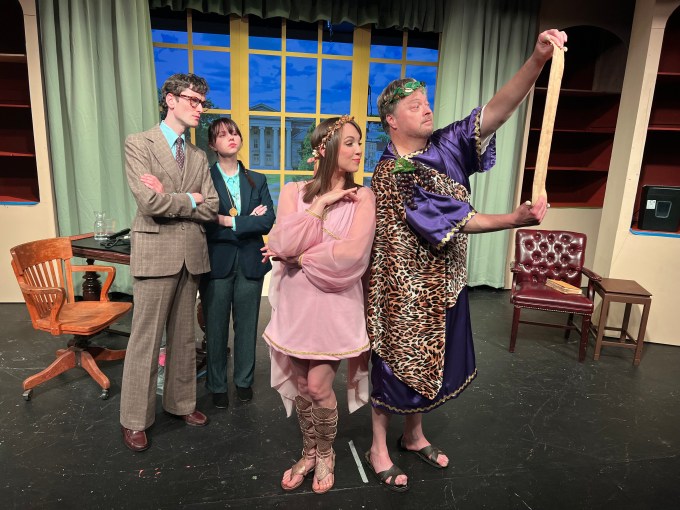
A Greek Classics instructor at a university, the disturbed Daphne desperately calls for help from the Greek Gods. Lo and behold, who should appear? – Dionysus, the God of wine, and Thalia, the Goddess of Comedy. Needless to say, Daphne is shocked that her invocation produces results. Perhaps it draws on the power of the talisman an appreciative souvenir vendor gave her in Naxos.
So what can these goofy among the Gods do for her? What she really needs is an investigator. But at least the good news is that Ovid’s Metamorphoses suggests that the Gods can transform into other personas, so maybe they can help after all. Not to mention, these divinities who Zeus allows to intervene in these human affairs are charged to ensure a happy ending.
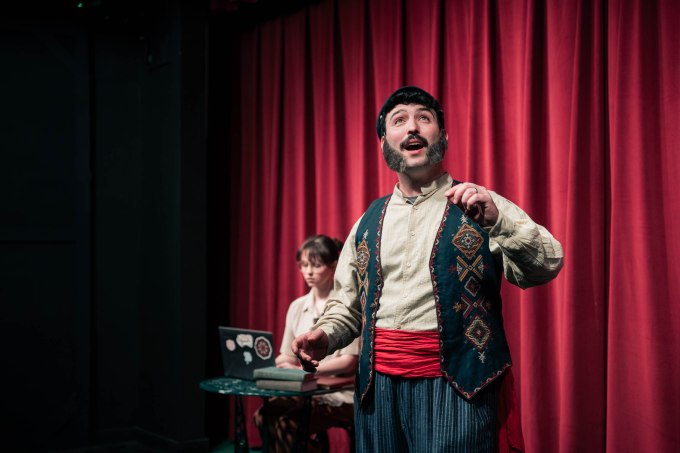
So, what’s the problem? Daphne’s department chair Ralph has found a hitherto unknown manuscript of the ancient master Euripides’ lost play Andromeda. Ralph will become famed in his field. Entrusting the work to Daphne while he runs errands, Ralph later finds that the invaluable manuscript has disappeared, and the fault lies with Daphne who was not supposed to let it leave her little hands.
Such is the set up to The Gods of Comedy, from the unquestioned master of modern American farce, Ken Ludwig, who created Lend Me a Tenor, Moon Over Buffalo, and Crazy for You, among many others. While not as lauded as his most distinguished work, this one is full of idiosyncratic characters in quirky situations. And it happily romps through tropes of academe, romance, and Greek theater.
Director Ronnie Anderson has attracted a fine cast that appear to enjoy the silliness and pratfalls and do a fine job in extracting the humor from the material. The Masquers Playhouse staging, notably sets and sound but also costumes and lighting, exceeds expectations, particularly given that it is a small-house community theater.
From the outset, Anna Wesner’s Daphne is a timid and bookish soul, but she animates with hysteria, determination, and amor as the plot thickens. Her relationship with Ralph, a sometimes stuttering and daft Paul Bisesi, is conflicted by their respective professional standing and by their attraction. It becomes more conflicted when Daphne, made invisible by the Gods, hears Ralph refer to her as his assistant. The shoe is on the other foot when she thinks she is still invisible and admits in front of Ralph that she lost the irreplaceable book.
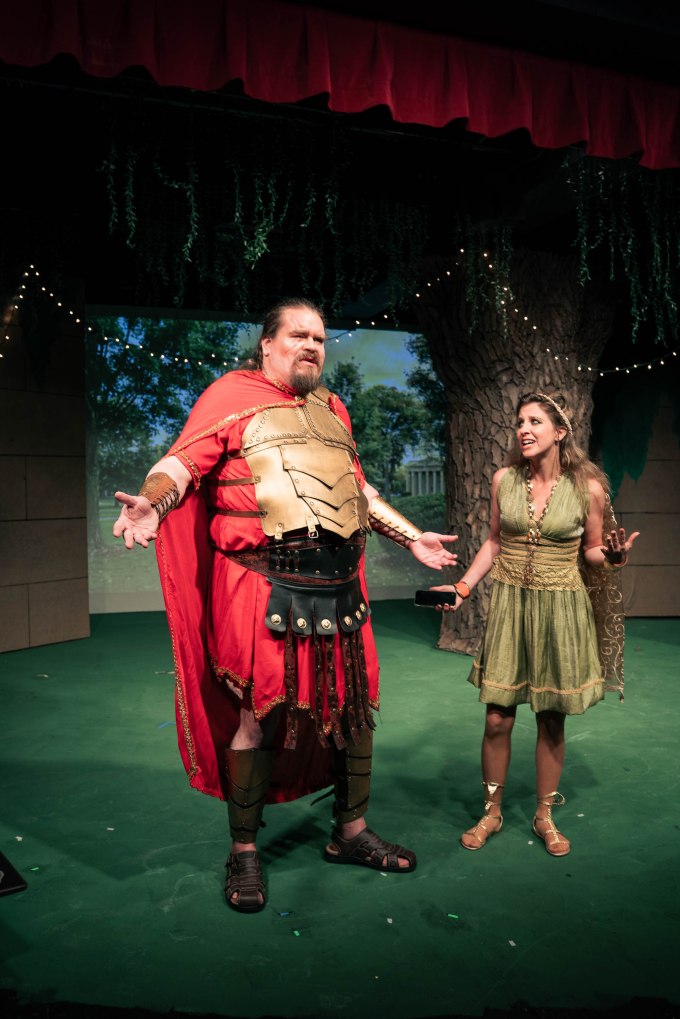
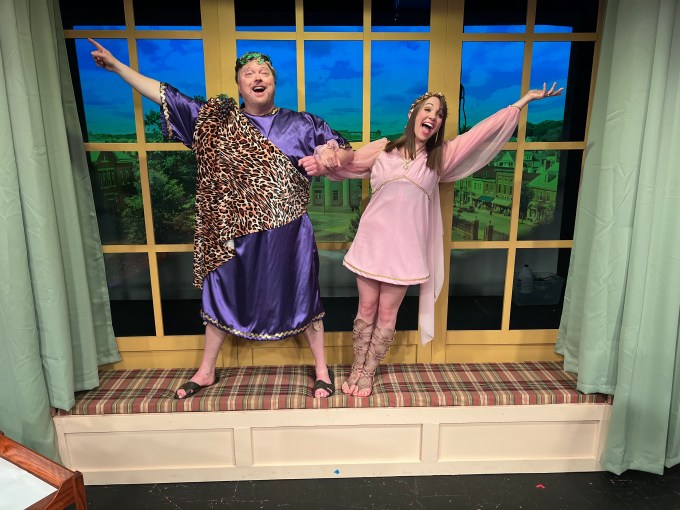
The comic center of the play, however, are the deities. Jeffrey Biddle is Dionysus, who is happy-go-lucky and into current human culture, but he also has an obsession with working sex and cringeworthy jokes into every discussion. Ironically, though, when given opportunities with Daphne, he turns chaste. Somehow, he is aware of many idioms in English, like “pulling your leg,” which make no sense literally, that he frequently has to explain to Thalia. Yet, as much as he loves cheeseburgers, he is taken to calling them cheeseburglers! Biddle’s quick laugh and gregarious personality make him easy to watch.
But he is totally matched by Melody Payne Alonzo who imbues Thalia with charm, panache, enthusiasm, and humor fitting her comic designation as a muse, that make her an appealing character. She bounces around chaotically, doing everything from playing a cheerleader with pom-poms to doing the splits. She is not the sharpest tool in the shed, waxing on about a nectar called Dr. Pepper and enthusing over heavenly French fries. Thalia tends to complicate matters rather than resolve them. But Alonzo makes her irresistible.
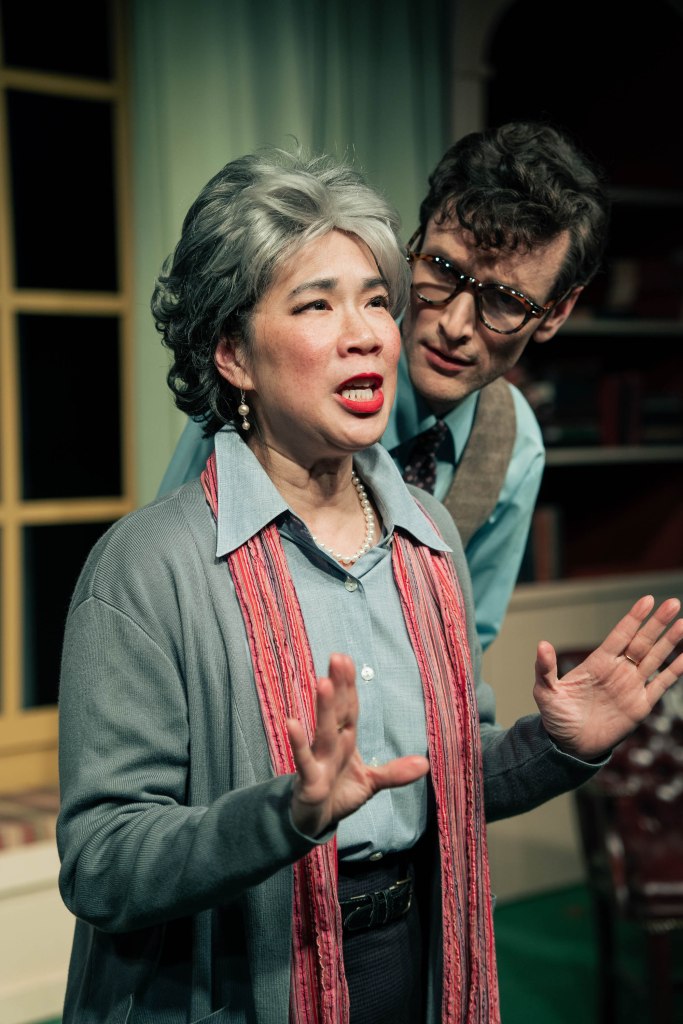
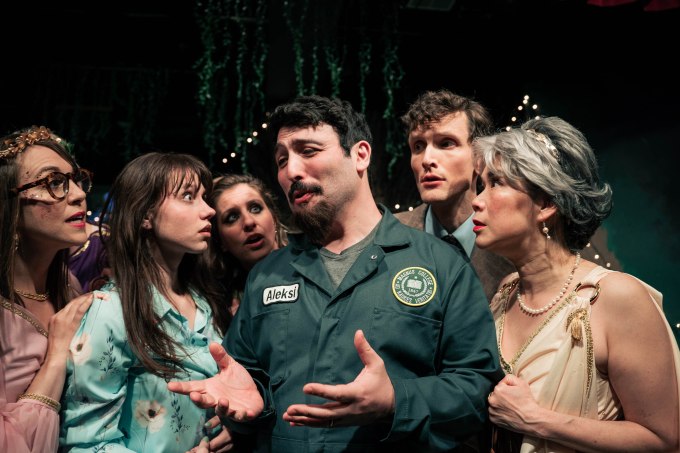
Some of the characters are really one-dimensional, but metamorphosis allows the actors to break out. One example is Lisa Wang who plays Dean Thicket simplistically with humorous pomposity and a put-on British affect. However, when Thalia is transformed to portray the Dean, it is Wang with a completely different characterization that demonstrates the breadth of her acting skills.
The Gods of Comedy holds the attention, and even those who aren’t crazy about farce will find it full of humor and gentle jabs at institutions and practices that we love.
The Gods of Comedy is written by Ken Ludwig, produced by Masquers Playhouse, and plays on its stage at 105 Park Place, Point Richmond, CA through May 17, 2026.

