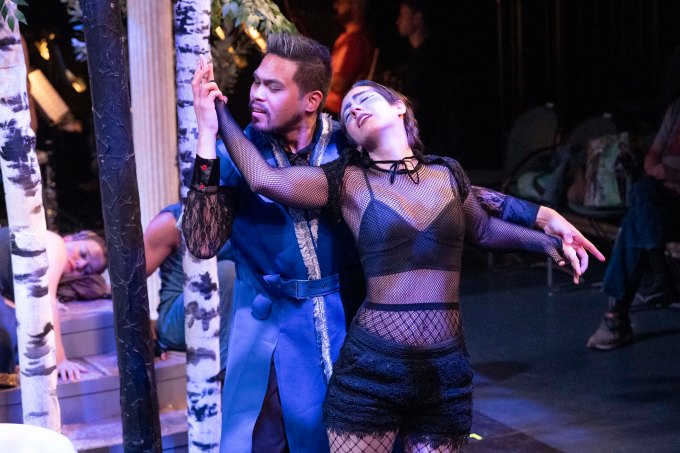
As the world’s most noted playwright, it should be no surprise that William Shakespeare’s works have provided the basis for some of opera’s most enduring classics. Giuseppe Verdi was a particular admirer and sourced Otello, Falstaff, and Macbeth from the Bard’s work. Gounod’s Romeo and Juliet and Thomas’s Hamlet are other examples. But though Benjamin Britten and Peter Pears condensed the beloved A Midsummer Night’s Dream (AMND), unlike other adaptations from Shakespeare, they preserved his language in an eloquent if archaic libretto.
Pocket Opera offers a spectacular rendering of Britten’s music in a world premiere chamber orchestra adaptation of the instrumental music by its orchestrator Liam Daly, authorized by the Britten-Pears Estate. The score feels absolutely perfect in the chamber form as well executed under the leadership of Music Director and Conductor David Drummond.
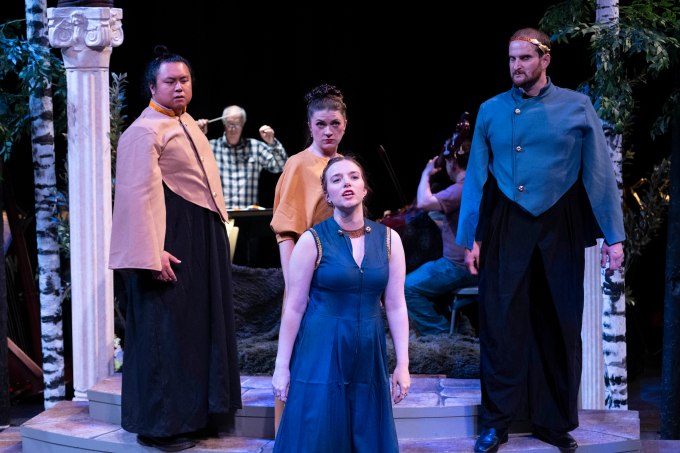
As Shakespeare’s foremost comedy, AMND possesses all of the trappings of the genre – non-human fairies, supernatural intervention, sleeping potions, crossed lovers, mistaken identities, a play-within-a-play, the human Bottom in a pun-worthy act turned into an ass (the animal, that is), and general frivolity throughout. All of this plays to the most lilting, delightful music in Britten’s canon.
For the greater part, the orchestral music seems almost detached from the sung, but each appeals, and somehow they work together. Leitmotifs abound, and the score is bouncy, often with lush, quavering strings supported by a raft of pizzicato elements from plucks to clinks coming from virtually all of the instruments. There are discrete if unmemorable arias in the score, while the most distinctive true ensemble is the interesting high wire screaming quartet by the young Athenian lovers in Act 2.
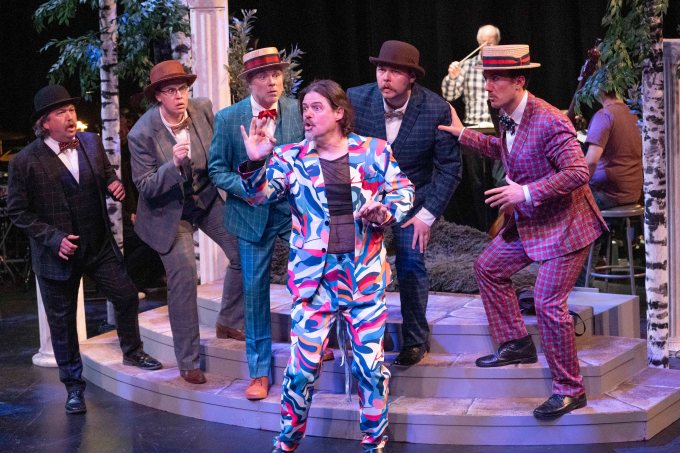
The score is generally in the post-Romantic, modernist idiom, with the exception of the rustic actors’ performance of the play-within-a-play. In this case, the orchestra very much complements the singing, and the idiom is a melodic throwback to the likes of Puccini and Verdi. To top it off, bits include humorous parodies of Romeo and Juliet’s death scene as well as Lucia’s mad scene.
Bringing off this somewhat overstuffed narrative that may be hard for the uninitiated to follow, is an absolutely marvelous, well-selected cast. With twentyish named principal roles, filling the parts would seem a monumental challenge, but each voice is remarkably skilled and suited to the role. In a sense, it’s unfair to highlight some and not others, but we all have our favorites.
As the mischief-making protagonist Oberon, the King of the Fairies, Kyle Tingson displays a rare, honey-like, easy-sounding countertenor voice that sets the standard and tone for the other artists. Another standout is tenor Kevin Gino as Lysander who not only displays a wide vocal range but best exemplifies the other compelling aspect of all of the performances, and that is fine acting. Gino visually and emotionally expresses with the fine detail expected from a straight actor.
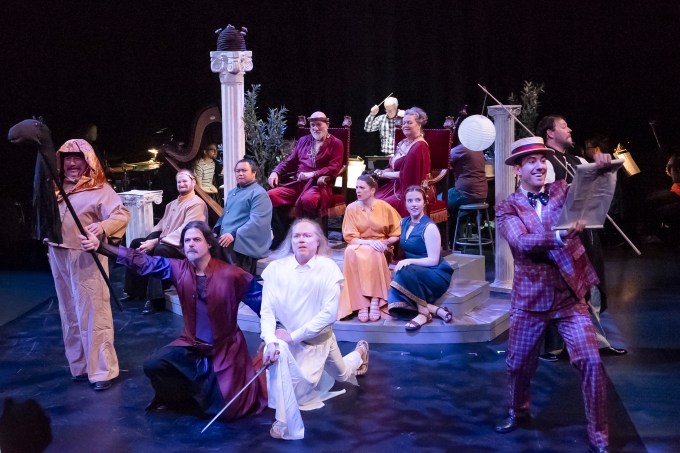
The other male voice of note is a local favorite with a strong North American resumé, and that is bass Kirk Eichelberger as Bottom. His powerful, mellifluous voice is a house filler under normal circumstances, but in the intimate surroundings of this production, there’s no challenge. This intimacy, performed on a front-row-level thrust stage and only several rows of seats on each side offers an immediacy that makes for a very involving personal experience.
While male voices dominate AMND, female voices in the production are equally strong, but only one major principal female part stands out, the role of Tytania, Queen of the Fairies. With the originally-cast Tytania falling sick early in the week, cover Ash Hurtado filled the role without missing a beat. Hurtado’s heavily tremoloed coloratura soprano soars to the heights with arpeggios and leaps, both in terms of range and volume, standing out above a chorus of others.
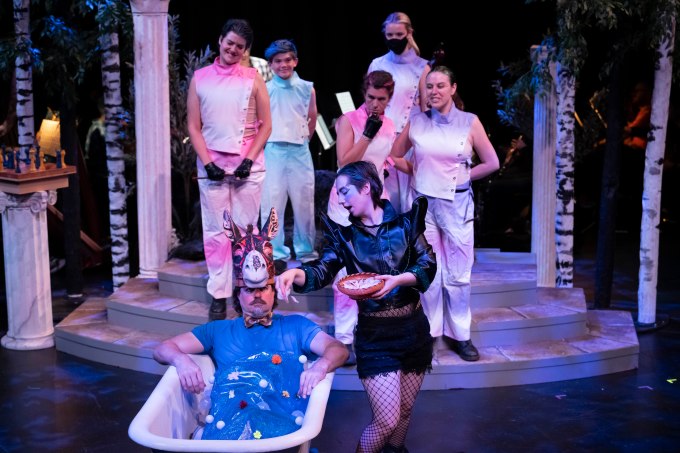
A Midsummer Night’s Dream is full of humorous possibilities that rely on interpretation and fulfillment. Here we must shed light on multi-talented factotum (borrowing from Figaro) Nicolas Garcia, the general director of the company. He stage directs this production, extracting wonderfully expressive and nuanced performances from the cast and guiding the complex movement. He also designed the lively costumes from the pastel jump-suit-like outfits of the soprano-driven fairy chorus to the gaudy plaid suits of the rustic actors.
Because of Pocket Opera’s unique operational mode, offering one performance of a production in three different venues, staging must be easily portable. Though Daniel Yelen’s set and props are fairly rudimentary, they work beautifully in this compact arena and with the other elements of the production.
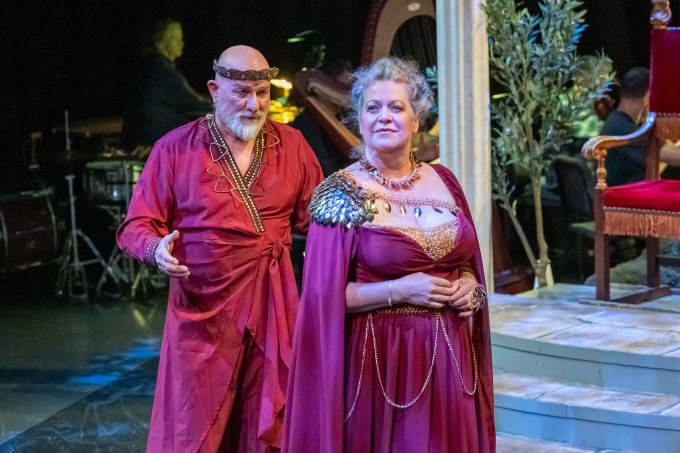
Similar to other Pocket Opera productions that I’ve reviewed, I have not been favorably disposed going in. However, they’ve proven once again how professionally they produce and how entertaining their productions are.
A Midsummer Night’s Dream, a world-premiere orchestration by Liam Daly, is composed by Benjamin Britten with libretto by the composer and Peter Pears, based on the play of the same name by William Shakespeare, and was performed at Mountain View Center for the Performing Arts with remaining performances on April 19 at Hillside Club, 2286 Cedar Street, Berkeley, CA, and on April 26 at Legion of Honor, 100 34th Avenue, San Francisco, CA.

